


Holy Wounds

Encyclopedia
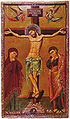
Crucifixion of Jesus
The crucifixion of Jesus and his ensuing death is an event that occurred during the 1st century AD. Jesus, who Christians believe is the Son of God as well as the Messiah, was arrested, tried, and sentenced by Pontius Pilate to be scourged, and finally executed on a cross...
.
These wounds are not explicitly mentioned in any of the canonical Gospels until the Resurrection, although John the Evangelist
John the Evangelist
Saint John the Evangelist is the conventional name for the author of the Gospel of John...
states that no bones were broken. In the course of His Passion
Passion (Christianity)
The Passion is the Christian theological term used for the events and suffering – physical, spiritual, and mental – of Jesus in the hours before and including his trial and execution by crucifixion...
, Jesus suffered other wounds as well, such as those from the crown of thorns
Crown of Thorns
In Christianity, the Crown of Thorns, one of the instruments of the Passion, was woven of thorn branches and placed on Jesus Christ before his crucifixion...
and from the flagellation
Flagellation
Flagellation or flogging is the act of methodically beating or whipping the human body. Specialised implements for it include rods, switches, the cat o' nine tails and the sjambok...
.
The wounds
Two of the wounds were through either his hands or his wrists, where nails were inserted to fix JesusJesus
Jesus of Nazareth , commonly referred to as Jesus Christ or simply as Jesus or Christ, is the central figure of Christianity...
to the cross-beam of the cross on which he was crucified. According to M.D., Ph.D Frederick T. Zugibe, the most plausible region for the nail entry site in the case of Jesus is the upper part of the palm angled toward the wrist since this area can easily support the weight of the body, assures no bones are broken, marks the location where most people believed it to be, accounts for where most of the stigmatists
Stigmata
Stigmata are bodily marks, sores, or sensations of pain in locations corresponding to the crucifixion wounds of Jesus, such as the hands and feet...
have displayed their wounds and it is where artists through the centuries have designated it and lastly it would result in apparent lengthening of the fingers of the hand because of nail compression.
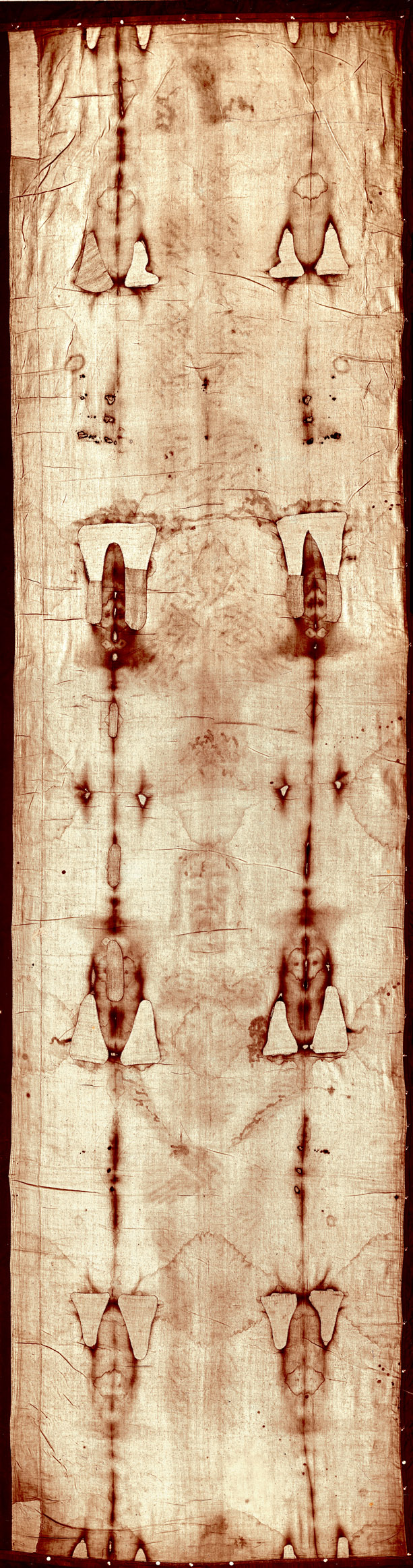
Two were through the feet where the nail(s) passed through both to the vertical beam.
The final wound was in the side of Jesus' chest, where, according to the New Testament
New Testament
The New Testament is the second major division of the Christian biblical canon, the first such division being the much longer Old Testament....
, his body was pierced by the Holy Lance
Holy Lance
The Holy Lance is the name given to the lance that pierced Jesus' side as he hung on the cross in John's account of the Crucifixion.-Biblical references:The lance is mentioned only in the Gospel of John and not in any of the...
in order to be sure that he was dead. The Gospel of John
Gospel of John
The Gospel According to John , commonly referred to as the Gospel of John or simply John, and often referred to in New Testament scholarship as the Fourth Gospel, is an account of the public ministry of Jesus...
states that blood and water poured out of this wound .
Symbolical use
When consecratingConsecration
Consecration is the solemn dedication to a special purpose or service, usually religious. The word "consecration" literally means "to associate with the sacred". Persons, places, or things can be consecrated, and the term is used in various ways by different groups...
an altar
Altar
An altar is any structure upon which offerings such as sacrifices are made for religious purposes. Altars are usually found at shrines, and they can be located in temples, churches and other places of worship...
a number of Christian churches anoint it in five places, indicative of the Five Holy Wounds. Eastern Orthodox churches will sometimes have five domes on them, symbolizing the Five Holy Wounds, along with the alternate symbolism of Christ and the Four Evangelists
Four Evangelists
In Christian tradition the Four Evangelists are Matthew, Mark, Luke, and John, the authors attributed with the creation of the four Gospel accounts in the New Testament that bear the following titles:*Gospel according to Matthew*Gospel according to Mark...
.
The Crusades
Crusades
The Crusades were a series of religious wars, blessed by the Pope and the Catholic Church with the main goal of restoring Christian access to the holy places in and near Jerusalem...
brought a renewed enthusiasm for religious devotion, especially for the Passion of Christ. St. Bernard of Clairvaux and St. Francis of Assisi in the 12th and 13th centuries encouraged devotions and practices in honor of the Five wounds of the Passion of Jesus: in his hands, feet and side. The Cross of Jerusalem, or "Crusaders’ Cross", remembers the Five wounds through its five crosses. There were many medieval prayers honoring the Wounds. including some attributed to St. Clare of Assisi and St. Mechtilde. In the 14th century, the holy mystic St. Gertrude of Helfta had a vision that Christ sustained 5,466 wounds during the Passion. St. Bridget of Sweden popularized a custom to recite fifteen Paternosters
Lord's Prayer
The Lord's Prayer is a central prayer in Christianity. In the New Testament of the Christian Bible, it appears in two forms: in the Gospel of Matthew as part of the discourse on ostentation in the Sermon on the Mount, and in the Gospel of Luke, which records Jesus being approached by "one of his...
each day (5,475 per year) in memory of the Sacred Wounds. There was a special Mass of the Five Wounds, known as the Golden Mass, which medieval tradition claimed was composed by St. John the Evangelist and revealed to Boniface II (532) in a vision.
The Holy Wounds have often been used as a symbol of Christianity
Christianity
Christianity is a monotheistic religion based on the life and teachings of Jesus as presented in canonical gospels and other New Testament writings...
. Participants in the Crusades
Crusades
The Crusades were a series of religious wars, blessed by the Pope and the Catholic Church with the main goal of restoring Christian access to the holy places in and near Jerusalem...
would often wear the Jerusalem cross
Jerusalem cross
The Jerusalem cross, also known as Crusaders' cross, is a heraldic cross or Christian symbol consisting of a large Greek cross surrounded by four smaller Greek crosses, one in each quadrant....
, an emblem representing the Holy Wounds; a version is still in use today in the flag of Georgia
Flag of Georgia (country)
The official flag of Georgia is the "five-cross flag", restored to official use on January 14, 2004, after a break of some 500 years...
. The "Five Wounds" was the emblem of the "Pilgrimage of Grace
Pilgrimage of Grace
The Pilgrimage of Grace was a popular rising in York, Yorkshire during 1536, in protest against Henry VIII's break with the Roman Catholic Church and the Dissolution of the Monasteries, as well as other specific political, social and economic grievances. It was done in action against Thomas Cromwell...
", a northern English rebellion
Rebellion
Rebellion, uprising or insurrection, is a refusal of obedience or order. It may, therefore, be seen as encompassing a range of behaviors aimed at destroying or replacing an established authority such as a government or a head of state...
in response to Henry VIII
Henry VIII of England
Henry VIII was King of England from 21 April 1509 until his death. He was Lord, and later King, of Ireland, as well as continuing the nominal claim by the English monarchs to the Kingdom of France...
's Dissolution of the Monasteries
Dissolution of the Monasteries
The Dissolution of the Monasteries, sometimes referred to as the Suppression of the Monasteries, was the set of administrative and legal processes between 1536 and 1541 by which Henry VIII disbanded monasteries, priories, convents and friaries in England, Wales and Ireland; appropriated their...
.
Persons who have exhibited the Holy Wounds on their own bodies are called stigmatics, and are believed to enter into the Passion of Christ
Passion (Christianity)
The Passion is the Christian theological term used for the events and suffering – physical, spiritual, and mental – of Jesus in the hours before and including his trial and execution by crucifixion...
.
Holy Wound prayers
Rosary
The rosary or "garland of roses" is a traditional Catholic devotion. The term denotes the prayer beads used to count the series of prayers that make up the rosary...
devotion directed to Jesus, rather than the Virgin Mary. Like some other rosary based prayers
Rosary based prayers
Rosary-based prayers are mostly Roman Catholic prayers said on a set of rosary beads. These prayers recite specific word sequences on different parts of the rosary beads. They may be directed at Jesus Christ, the Blessed Virgin Mary or The Father...
(such as the Chaplet of Divine Mercy
Chaplet of Divine Mercy
The Chaplet of the Divine Mercy is a Roman Catholic devotion based on the visions of Jesus reported by Saint Mary Faustina Kowalska , known as "the Apostle of Mercy." She was a Polish sister of the Congregation of the Sisters of Our Lady of Mercy and canonized as a Catholic saint in 2000.Faustina...
) it uses the usual rosary beads, but does not include the usual Mysteries of the Rosary.
The Rosary of the Holy Wounds was first introduced at the beginning of the 20th century by the Venerable
Venerable
The Venerable is used as a style or epithet in several Christian churches. It is also the common English-language translation of a number of Buddhist titles.-Roman Catholic:...
Sister Mary Martha Chambon
Marie Martha Chambon
Marie Martha Chambon was a lay Roman Catholic nun known for introducing the Rosary of the Holy Wounds.- Biography :She was a member of the Monastery of the Visitation Order who lived in Chambéry, France...
, a lay Roman Catholic Sister of the Monastery of the Visitation Order in Chambéry
Chambéry
Chambéry is a city in the department of Savoie, located in the Rhône-Alpes region in southeastern France.It is the capital of the department and has been the historical capital of the Savoy region since the 13th century, when Amadeus V of Savoy made the city his seat of power.-Geography:Chambéry...
, France as a focus on the Holy Wounds of Jesus.