


Holomorphic function

Encyclopedia
Complex analysis
Complex analysis, traditionally known as the theory of functions of a complex variable, is the branch of mathematical analysis that investigates functions of complex numbers. It is useful in many branches of mathematics, including number theory and applied mathematics; as well as in physics,...
. A holomorphic function is a complex
Complex number
A complex number is a number consisting of a real part and an imaginary part. Complex numbers extend the idea of the one-dimensional number line to the two-dimensional complex plane by using the number line for the real part and adding a vertical axis to plot the imaginary part...
-valued function
Function (mathematics)
In mathematics, a function associates one quantity, the argument of the function, also known as the input, with another quantity, the value of the function, also known as the output. A function assigns exactly one output to each input. The argument and the value may be real numbers, but they can...
of one or more complex variables that is complex differentiable in a neighborhood of every point in its domain. The existence of a complex derivative is a very strong condition, for it implies that any holomorphic function is actually infinitely differentiable
Smooth function
In mathematical analysis, a differentiability class is a classification of functions according to the properties of their derivatives. Higher order differentiability classes correspond to the existence of more derivatives. Functions that have derivatives of all orders are called smooth.Most of...
and equal to its own Taylor series
Taylor series
In mathematics, a Taylor series is a representation of a function as an infinite sum of terms that are calculated from the values of the function's derivatives at a single point....
.
The term analytic function
Analytic function
In mathematics, an analytic function is a function that is locally given by a convergent power series. There exist both real analytic functions and complex analytic functions, categories that are similar in some ways, but different in others...
is often used interchangeably with “holomorphic function”, although the word “analytic” is also used in a broader sense to describe any function (real, complex, or of more general type) that is equal to its Taylor series in a neighborhood of each point in its domain. The fact that the class of complex analytic functions coincides with the class of holomorphic functions is a major theorem in complex analysis
Holomorphic functions are analytic
In complex analysis, a branch of mathematics, a complex-valued function ƒ of a complex variable z.*is said to be holomorphic at a point a if it is differentiable at every point within some open disk centered at a, and...
.
Holomorphic functions are also sometimes referred to as regular functions or as conformal map
Conformal map
In mathematics, a conformal map is a function which preserves angles. In the most common case the function is between domains in the complex plane.More formally, a map,...
s. A holomorphic function whose domain is the whole complex plane is called an entire function
Entire function
In complex analysis, an entire function, also called an integral function, is a complex-valued function that is holomorphic over the whole complex plane...
. The phrase "holomorphic at a point z0" means not just differentiable at z0, but differentiable everywhere within some neighborhood of z0 in the complex plane.
Definition
Given a complex-valued function ƒ of a single complex variable, the derivative of ƒ at a point z0 in its domain is defined by the limitLimit of a function
In mathematics, the limit of a function is a fundamental concept in calculus and analysis concerning the behavior of that function near a particular input....

This is the same as the definition of the derivative for real functions, except that all of the quantities are complex. In particular, the limit is taken as the complex number z approaches z0, and must have the same value for any sequence of complex values for z that approach z0 on the complex plane. If the limit exists, we say that ƒ is differentiable at the point z0. This concept of complex differentiability shares several properties with real differentiability
Derivative
In calculus, a branch of mathematics, the derivative is a measure of how a function changes as its input changes. Loosely speaking, a derivative can be thought of as how much one quantity is changing in response to changes in some other quantity; for example, the derivative of the position of a...
: it is linear
Linear transformation
In mathematics, a linear map, linear mapping, linear transformation, or linear operator is a function between two vector spaces that preserves the operations of vector addition and scalar multiplication. As a result, it always maps straight lines to straight lines or 0...
and obeys the product rule
Product rule
In calculus, the product rule is a formula used to find the derivatives of products of two or more functions. It may be stated thus:'=f'\cdot g+f\cdot g' \,\! or in the Leibniz notation thus:...
, quotient rule, and chain rule
Chain rule
In calculus, the chain rule is a formula for computing the derivative of the composition of two or more functions. That is, if f is a function and g is a function, then the chain rule expresses the derivative of the composite function in terms of the derivatives of f and g.In integration, the...
.
If ƒ is complex differentiable at every point z0 in U, we say that ƒ is holomorphic on U. We say that ƒ is holomorphic at the point z0 if it is holomorphic on some neighborhood of z0. We say that ƒ is holomorphic on some non-open set A if it is holomorphic in an open set containing A.
The relationship between real differentiability and complex differentiability is the following. If a complex function = is holomorphic, then u and v have first partial derivatives with respect to x and y, and satisfy the Cauchy–Riemann equations:

If continuity is not a given, the converse is not necessarily true. A simple converse is that if u and v have continuous first partial derivatives and satisfy the Cauchy–Riemann equations, then ƒ is holomorphic. A more satisfying converse, which is much harder to prove, is the Looman–Menchoff theorem
Looman–Menchoff theorem
In the mathematical field of complex analysis, the Looman–Menchoff theorem states that a continuous complex-valued function defined in an open set of the complex plane is holomorphic if and only if it satisfies the Cauchy–Riemann equations...
: if ƒ is continuous, u and v have first partial derivatives, and they satisfy the Cauchy–Riemann equations, then ƒ is holomorphic.
Terminology
The word "holomorphic" was introduced by two of Cauchy's students, Briot (1817–1882) and Bouquet (1819–1895), and derives from the Greek ὅλος (holos) meaning "entire", and μορφή (morphē) meaning "form" or "appearance".Today, the term "holomorphic function" is sometimes preferred to "analytic function", as the latter is a more general concept. This is also because an important result in complex analysis is that every holomorphic function is complex analytic, a fact that does not follow directly from the definitions. The term "analytic" is however also in wide use.
Properties
Because complex differentiation is linear and obeys the product, quotient, and chain rules, the sums, products and compositions of holomorphic functions are holomorphic, and the quotient of two holomorphic functions is holomorphic wherever the denominator is not zero.The derivative
 can be written as a contour integral using Cauchy's differentiation formula:
for any simple loop positively winding once around
 , and
, and
for infinitesimal positive loops
 around
  .
.If one identifies C with R2, then the holomorphic functions coincide with those functions of two real variables with continuous first derivatives which solve the Cauchy-Riemann equations
Cauchy-Riemann equations
In mathematics, the Cauchy–Riemann differential equations in complex analysis, named after Augustin Cauchy and Bernhard Riemann, consist of a system of two partial differential equations which must be satisfied if we know that a complex function is complex differentiable...
, a set of two partial differential equation
Partial differential equation
In mathematics, partial differential equations are a type of differential equation, i.e., a relation involving an unknown function of several independent variables and their partial derivatives with respect to those variables...
s.
Every holomorphic function can be separated into its real and imaginary parts, and each of these is a solution of Laplace's equation
Laplace's equation
In mathematics, Laplace's equation is a second-order partial differential equation named after Pierre-Simon Laplace who first studied its properties. This is often written as:where ∆ = ∇² is the Laplace operator and \varphi is a scalar function...
on R2. In other words, if we express a holomorphic function f(z) as u(x, y) + i v(x, y) both u and v are harmonic function
Harmonic function
In mathematics, mathematical physics and the theory of stochastic processes, a harmonic function is a twice continuously differentiable function f : U → R which satisfies Laplace's equation, i.e....
s.
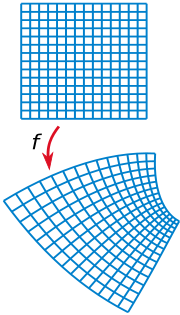
In regions where the first derivative is not zero, holomorphic functions are conformal
Conformal map
In mathematics, a conformal map is a function which preserves angles. In the most common case the function is between domains in the complex plane.More formally, a map,...
in the sense that they preserve angles and the shape (but not size) of small figures.
Cauchy's integral formula
Cauchy's integral formula
In mathematics, Cauchy's integral formula, named after Augustin-Louis Cauchy, is a central statement in complex analysis. It expresses the fact that a holomorphic function defined on a disk is completely determined by its values on the boundary of the disk, and it provides integral formulas for all...
states that every function holomorphic inside a disk
Disk (mathematics)
In geometry, a disk is the region in a plane bounded by a circle.A disk is said to be closed or open according to whether or not it contains the circle that constitutes its boundary...
is completely determined by its values on the disk's boundary.
Every holomorphic function is analytic
Holomorphic functions are analytic
In complex analysis, a branch of mathematics, a complex-valued function ƒ of a complex variable z.*is said to be holomorphic at a point a if it is differentiable at every point within some open disk centered at a, and...
. That is, a holomorphic function f has derivatives of every order at each point a in its domain, and it coincides with its own Taylor series
Taylor series
In mathematics, a Taylor series is a representation of a function as an infinite sum of terms that are calculated from the values of the function's derivatives at a single point....
at a in a neighborhood of a. In fact, f coincides with its Taylor series at a in any disk centered at that point and lying within the domain of the function.
From an algebraic point of view, the set of holomorphic functions on an open set is a commutative ring
Commutative ring
In ring theory, a branch of abstract algebra, a commutative ring is a ring in which the multiplication operation is commutative. The study of commutative rings is called commutative algebra....
and a complex vector space
Complex vector space
A complex vector space is a vector space over the complex numbers. It can also refer to:* a vector space over the real numbers with a linear complex structure...
. In fact, it is a locally convex topological vector space
Locally convex topological vector space
In functional analysis and related areas of mathematics, locally convex topological vector spaces or locally convex spaces are examples of topological vector spaces which generalize normed spaces. They can be defined as topological vector spaces whose topology is generated by translations of ...
, with the seminorms
Norm (mathematics)
In linear algebra, functional analysis and related areas of mathematics, a norm is a function that assigns a strictly positive length or size to all vectors in a vector space, other than the zero vector...
being the suprema on compact subsets.
From a geometric perspective, a function f is holomorphic at z0 if and only if its exterior derivative
Exterior derivative
In differential geometry, the exterior derivative extends the concept of the differential of a function, which is a 1-form, to differential forms of higher degree. Its current form was invented by Élie Cartan....
df in a neighborhood U of z0 is equal to f′(z) dz for some continuous function f′. It follows from

that df′ is also proportional to dz, implying that the derivative f′ is itself holomorphic and thus that f is infinitely differentiable. Similarly, the fact that d(f dz) = f′ dz ∧ dz = 0 implies that any function f that is holomorphic on the simply connected region U is also integrable on U. (For a path γ from z0 to z lying entirely in U, define
 ;
;in light of the Jordan curve theorem
Jordan curve theorem
In topology, a Jordan curve is a non-self-intersecting continuous loop in the plane, and another name for a Jordan curve is a "simple closed curve"...
and the generalized Stokes' theorem
Stokes' theorem
In differential geometry, Stokes' theorem is a statement about the integration of differential forms on manifolds, which both simplifies and generalizes several theorems from vector calculus. Lord Kelvin first discovered the result and communicated it to George Stokes in July 1850...
, Fγ(z) is independent of the particular choice of path γ, and thus F(z) is a well-defined function on U having F(z0) = F0 and dF = f dz.)
Examples
All polynomialPolynomial
In mathematics, a polynomial is an expression of finite length constructed from variables and constants, using only the operations of addition, subtraction, multiplication, and non-negative integer exponents...
functions in z with complex coefficient
Coefficient
In mathematics, a coefficient is a multiplicative factor in some term of an expression ; it is usually a number, but in any case does not involve any variables of the expression...
s are holomorphic on C,
and so are sine
Sine
In mathematics, the sine function is a function of an angle. In a right triangle, sine gives the ratio of the length of the side opposite to an angle to the length of the hypotenuse.Sine is usually listed first amongst the trigonometric functions....
, cosine and the exponential function
Exponential function
In mathematics, the exponential function is the function ex, where e is the number such that the function ex is its own derivative. The exponential function is used to model a relationship in which a constant change in the independent variable gives the same proportional change In mathematics,...
.
(The trigonometric functions are in fact closely related to and can be defined via the exponential function using Euler's formula).
The principal branch of the complex logarithm
Complex logarithm
In complex analysis, a complex logarithm function is an "inverse" of the complex exponential function, just as the natural logarithm ln x is the inverse of the real exponential function ex. Thus, a logarithm of z is a complex number w such that ew = z. The notation for such a w is log z...
function is holomorphic on the set C \ {z ∈ R : z ≤ 0}.
The square root
Square root
In mathematics, a square root of a number x is a number r such that r2 = x, or, in other words, a number r whose square is x...
function can be defined as

and is therefore holomorphic wherever the logarithm log(z) is. The function 1/z is holomorphic on {z : z ≠ 0}.
As a consequence of the Cauchy–Riemann equations, a real-valued holomorphic function must be constant. Therefore, the absolute value of z, the argument of z, the real part of z and the imaginary part of z are not holomorphic. Another typical example of a continuous function which is not holomorphic is complex conjugation.
Several variables
A complex analytic function of several complex variablesSeveral complex variables
The theory of functions of several complex variables is the branch of mathematics dealing with functionson the space Cn of n-tuples of complex numbers...
is defined to be analytic and holomorphic at a point if it is locally expandable (within a polydisk, a Cartesian product
Cartesian product
In mathematics, a Cartesian product is a construction to build a new set out of a number of given sets. Each member of the Cartesian product corresponds to the selection of one element each in every one of those sets...
of disk
Disk (mathematics)
In geometry, a disk is the region in a plane bounded by a circle.A disk is said to be closed or open according to whether or not it contains the circle that constitutes its boundary...
s, centered at that point) as a convergent power series in the variables. This condition is stronger than the Cauchy–Riemann equations; in fact it can be stated
as follows:
A function of several complex variables is holomorphic if and only if
If and only if
In logic and related fields such as mathematics and philosophy, if and only if is a biconditional logical connective between statements....
it satisfies the Cauchy–Riemann equations and is locally square-integrable.
Extension to functional analysis
The concept of a holomorphic function can be extended to the infinite-dimensional spaces of functional analysisFunctional analysis
Functional analysis is a branch of mathematical analysis, the core of which is formed by the study of vector spaces endowed with some kind of limit-related structure and the linear operators acting upon these spaces and respecting these structures in a suitable sense...
. For instance, the Fréchet
Fréchet derivative
In mathematics, the Fréchet derivative is a derivative defined on Banach spaces. Named after Maurice Fréchet, it is commonly used to formalize the concept of the functional derivative used widely in the calculus of variations. Intuitively, it generalizes the idea of linear approximation from...
or Gâteaux derivative
Gâteaux derivative
In mathematics, the Gâteaux differential or Gâteaux derivative is a generalization of the concept of directional derivative in differential calculus. Named after René Gâteaux, a French mathematician who died young in World War I, it is defined for functions between locally convex topological vector...
can be used to define a notion of a holomorphic function on a Banach space
Banach space
In mathematics, Banach spaces is the name for complete normed vector spaces, one of the central objects of study in functional analysis. A complete normed vector space is a vector space V with a norm ||·|| such that every Cauchy sequence in V has a limit in V In mathematics, Banach spaces is the...
over the field of complex numbers.
See also
- Antiderivative (complex analysis)Antiderivative (complex analysis)In complex analysis, a branch of mathematics, the antiderivative, or primitive, of a complex-valued function g is a function whose complex derivative is g...
- Antiholomorphic functionAntiholomorphic functionIn mathematics, antiholomorphic functions are a family of functions closely related to but distinct from holomorphic functions....
- BiholomorphyBiholomorphyIn the mathematical theory of functions of one or more complex variables, and also in complex algebraic geometry, a biholomorphism or biholomorphic function is a bijective holomorphic function whose inverse is also holomorphic....
- Meromorphic functionMeromorphic functionIn complex analysis, a meromorphic function on an open subset D of the complex plane is a function that is holomorphic on all D except a set of isolated points, which are poles for the function...
- Quadrature domainsQuadrature domainsIn the branch of mathematics called potential theory, a quadrature domain in two dimensional real Euclidean space is a domain D together with...