

Holocaust denial

Encyclopedia
Holocaust denial is the act of denying the genocide
of Jews in World War II, usually referred to as the Holocaust
. The key claims of Holocaust denial are: the German Nazi
government had no official policy or intention of exterminating Jews
, Nazi authorities did not use extermination camps and gas chamber
s to mass murder
Jews, and the actual number of Jews killed was significantly (typically an order of magnitude
) lower than the historically accepted figure of 5 to 6 million.
Holocaust deniers generally do not accept the term "denial
" as an appropriate description of their activities, and use the term "revisionism
" instead. Scholars use the term "denial" to differentiate Holocaust deniers from historical revisionists
, who use established historical methodologies
. The methodologies of Holocaust deniers are criticized as based on a predetermined conclusion that ignores extensive historical evidence to the contrary.
Most Holocaust denial claims imply, or openly state, that the Holocaust is a hoax arising out of a deliberate Jewish conspiracy
to advance the interest of Jews at the expense of other peoples. For this reason, Holocaust denial is generally considered to be an antisemitic conspiracy theory
.
History Department, Nov. 8, 1991, and reprinted in Duke Chronicle, Nov. 13, 1991 in response to an advertisement produced by Bradley R Smith's Committee for Open Debate on the Holocaust:
In The Holocaust: Problems and Perspectives of Interpretation, Donald L. Niewyk gives some examples of how legitimate historical revisionism—the re-examination of accepted history and its updating with newly discovered, more accurate, or less-biased information—may be applied to the study of the Holocaust as new facts emerge to change the historical understanding of it:
In contrast, the Holocaust denial movement bases its approach on the predetermined idea that the Holocaust, as understood by mainstream historiography, did not occur. Sometimes referred to as "negationism", from the French term négationnisme introduced by Henry Rousso
, Holocaust deniers attempt to rewrite history by minimizing, denying or simply ignoring essential facts. Koenraad Elst
writes:
Other claims include the following:
Holocaust denial is widely viewed as failing to adhere to rules for the treatment of evidence
, principles that mainstream historians (as well as scholars in other fields) regard as basic to rational inquiry
.
The Holocaust was well documented by the bureaucracy
of the Nazi government itself. It was further witnessed by the Allied
forces who entered Germany and its associated Axis
states towards the end of World War II.
According to researchers Michael Shermer
and Alex Grobman
, there is a "convergence of evidence" that proves that the Holocaust happened. This evidence includes:
Much of the controversy surrounding the claims of Holocaust deniers centers on the methods used to present arguments that the Holocaust allegedly never happened as commonly accepted. Numerous accounts have been given by Holocaust deniers (including evidence presented in court cases) of claimed facts and evidence; however, independent research has shown these claims to be based upon flawed research, biased statements, or even deliberately falsified evidence. Opponents of Holocaust denial have documented numerous instances in which such evidence was altered or manufactured (see Nizkor Project
and David Irving
). According to Pierre Vidal-Naquet
, "in our society of image and spectacle, extermination on paper leads to extermination in reality."
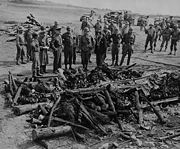 Historians have documented evidence that as Germany's defeat became imminent and the Nazi leaders realized they would most likely be captured and brought to trial, great effort was made to destroy all evidence of mass extermination. Heinrich Himmler
instructed his camp commandants to destroy records, crematoria, and other signs of mass extermination. As one of many examples, the bodies of the 25,000 mostly Latvian Jews whom Friedrich Jeckeln
and the soldiers under his command had shot at Rumbula
(near Riga
) in late 1941 were dug up and burned in 1943. Similar operations were undertaken at Belzec
, Treblinka
and other death camps. In the infamous Posen speeches of October 1943 such as the one on October 4, Himmler explicitly referred to the murder of the Jews of Europe and further stated that the murder must be permanently kept secret:
In 1945, General Dwight D. Eisenhower
, Supreme Allied Commander, anticipated that someday an attempt would be made to recharacterize the Nazi crimes as propaganda and took steps against it:
Eisenhower, upon finding the victims of the death camps, ordered all possible photographs to be taken, and for the German people from surrounding villages to be ushered through the camps and even made to bury the dead. He wrote the following to General Marshall after visiting a German internment camp near Gotha, Germany:
, an American, was at one time a mainstream historian with liberal credentials; he assumed a Holocaust-denial stance in the later years of his life. Between World War I and World War II, Barnes became well known as an anti-war
writer and a leader in the historical revisionism movement, where he had worked closely from 1924 onwards with Centre for the Study of the Causes of the War
. This institute was a pseudo-historical think-tank based in Berlin, secretly funded by the German government and headed by a former völkisch
activist named Major Alfred von Wegerer, whose sole purpose was to prove Germany was the victim of Allied aggression in 1914. Following World War II, Barnes became convinced that allegations made against Germany and Japan, including the Holocaust, were wartime propaganda used to justify U.S. involvement in World War II.
In his 1962 pamphlet, Revisionism and Brainwashing, Barnes claimed that there was a “lack of any serious opposition or concerted challenge to the atrocity stories and other modes of defamation of German national character and conduct”. Barnes went on to write that in his view there was “a failure to point out the atrocities of the Allies were more brutal, painful, mortal and numerous than the most extreme allegations made against the Germans”. Starting at this time, Barnes started to cite the French Holocaust denier Paul Rassinier
, whom Barnes called a “distinguished French historian” who Barnes claimed had exposed the “exaggerations of the atrocity stories". In a 1964 article entitled “Zionist Fraud” published in the American Mercury, Barnes wrote that: Using Rassinier as his source, Barnes claimed that Germany was the victim of aggression in both 1914 and 1939, and the Holocaust was just propaganda to justify a war of aggression against Germany. Barnes took the view that World War II had ended in disaster for the West with Germany divided and the United States locked into the Cold War
, made all the worse in Barnes’s eyes, as in his view Germany never wanted war. Barnes claimed that in order to justify the “horrors and evils of the Second World War”, the Allies were required to make the Nazis the “scapegoat” for their own misdeeds. Barnes claimed there were two false claims made about World War II, namely that Germany started the war in 1939, and the Holocaust, which Barnes denied.
Following the example of Barnes, a few other early libertarian writers also concerned with anti-war historical revisionism began to take a Holocaust-denial stance, including James J. Martin
. Most libertarians, however—even those who otherwise hold Barnes' writings in high regard—reject his Holocaust denial. Barnes' name has since been appropriated by some modern Holocaust deniers in an attempt to lend credibility to their cause, most notably Willis Carto
.
 In 1961, the American historian and a leading protégé of Barnes, David Hoggan
published Der Erzwungene Krieg (The Forced War) in West Germany, which claimed that Germany had been the victim of an Anglo-Polish conspiracy in 1939. Though Der Erzwungene Krieg was primarily concerned with the origins of World War II, it also down-played or justified the effects of Nazi antisemitic measures in the pre-1939 period. For an example, Hoggan justified the huge one billion Reich-mark fine imposed on the entire Jewish community in Germany after the 1938 Kristallnacht
as a reasonable measure to prevent what he called "Jewish profiteering" at the expense of German insurance companies and alleged that no Jews were killed in the Kristallnacht (in fact, 91 German Jews were killed in the Kristallnacht). Subsequently, Hoggan wrote one of the first books denying the Holocaust in 1969 entitled The Myth of the Six Million, which was published by the Noontide Press
, a small Los Angeles publisher specializing in antisemitic literature. Hoggan became one of the early stars of the Holocaust denial movement, because he had a number of university professorships.
In 1964, French historian Paul Rassinier
published The Drama of the European Jews. Rassinier was himself a concentration camp survivor (imprisoned in Buchenwald for his having helped French Jews escape the Nazis), and modern-day deniers continue to cite his works as scholarly research that questions the accepted facts of the Holocaust. Critics argued that Rassinier did not cite evidence for his claims and ignored information that contradicted his assertions; he nevertheless remains influential in Holocaust denial circles for being one of the first deniers to propose that a vast Zionist/Allied/Soviet conspiracy faked the Holocaust, a theme that would be picked up in later years by other authors.
The publication of Arthur Butz
's The Hoax of the Twentieth Century
: The case against the presumed extermination of European Jewry in 1976; and David Irving
's Hitler's War
in 1977 brought other similarly inclined individuals into the fold. In December 1978 and January 1979, Robert Faurisson
, a French professor of literature at the University of Lyon
, wrote two letters to Le Monde
claiming that the gas chambers
used by the Nazis to exterminate the Jews did not exist. A colleague of Faurisson, Jean-Claude Pressac
, who initially shared Faurisson's views, later became convinced of the Holocaust's evidence while investigating documents at Auschwitz
in 1979. He published his conclusions along with much of the underlying evidence in his 1989 book, Auschwitz: Technique and operation of the gas chambers.
Henry Bienen
, the former president of Northwestern University
, has described Arthur Butz's view of the Holocaust as an "embarrassment to Northwestern". In 2006, sixty of Butz's colleagues from the Department of Electrical Engineering and Computer Science faculty signed a censure describing Butz's Holocaust denial as "an affront to our humanity and our standards as scholars". The letter also called for Butz to "leave our Department and our University and stop trading on our reputation for academic excellence."
founded the Institute for Historical Review
(IHR) as an organization dedicated to publicly challenging the commonly accepted history of the Holocaust. The IHR sought from the beginning to attempt to establish itself within the broad tradition of historical revisionism, by soliciting token supporters who were not from a neo-Nazi background such as James J. Martin and Samuel Edward Konkin III
, and by promoting the writings of French socialist Paul Rassinier and American anti-war historian Harry Elmer Barnes to attempt to show that Holocaust denial had a broader base of support besides just neo-Nazis. The IHR brought most of Barnes' writings, which had been out of print since his death, back into print. While IHR included articles on other topics and sold books by mainstream historians in its catalog, the majority of material published and distributed by IHR was devoted to questioning the facts surrounding the Holocaust.
The IHR became one of the most important organizations devoted to Holocaust denial. In recent years the IHR underwent an internal power struggle which ousted Willis Carto and put Mark Weber
in charge. Carto went on to found the Barnes Review
magazine after his ouster from IHR, a magazine which is also devoted to Holocaust denial.
In an "About the IHR" statement on their website, the IHR stated that "The Institute does not 'deny the Holocaust'." The IHR journal, however, states:
Commentators and historians have noted the misleading nature of statements by the IHR that they are not Holocaust deniers. Paul Rauber
, a senior editor for the Sierra Club Magazine, writes that:
According to British historian of Germany Richard J. Evans
:
Bradley referred to his tactics as the CODOH campus project. Bradley says, “I don’t want to spend time with adults anymore, I want to go to students. They are superficial. They are empty vessels to be filled.” “What I wanted to do was I wanted to set forth three or four ideas that students might be interested in, that might cause them to think about things or to have questions about things. And I wanted to make it as simple as possible, and to set it up in a way that could not really be debated”. Holocaust deniers have placed[…]“Full page advertisements in college and university newspaper, including those of Brandeis University, Boston College, Pennsylvania State University, and Queens College. Some of these ads arguing that Holocaust never happened ran without comment; others generated op-ed pieces by professors and students.
, a Canadian high-school teacher, was charged with denying the Holocaust and making antisemitic claims in his classroom as part of the course material. Keegstra and his lawyer, Doug Christie
, argued that the section of the Criminal Code of Canada
(now section 319{2}), is an infringement of the Charter of Rights
(section 9{b}). The case was appealed to the Supreme Court of Canada
, where it was decided that the law he was convicted under did infringe on his freedom of expression, but it was a justified infringement. Keegstra was convicted, and fired from his job.
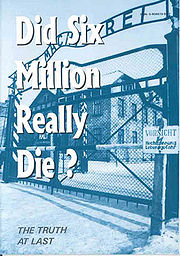 The Toronto-based photo retoucher Ernst Zündel
operated a small-press publishing house called Samisdat Publishing, which published and distributed Holocaust-denial material such as Did Six Million Really Die?
by Richard Harwood (a.k.a. Richard Verrall
– a British neo-Nazi leader). In 1985, he was tried in R. v. Zundel
and convicted under a "false news" law and sentenced to 15 months imprisonment by an Ontario
court for "disseminating and publishing material denying the Holocaust." The Holocaust historian Raul Hilberg
was a notable witness for the prosecution at the 1985 trial. Zündel gained considerable notoriety after this conviction, and a number of free-speech activists stepped forward to defend his right to publish his opinions. After his conviction in 1985, Zündel was able to have it overturned in an appeal on a legal technicality, leading to a second trial in 1988, in which he was again convicted. The 1988 trial was notable for the appearance of Fred A. Leuchter
, David Irving
and Robert Faurisson
as defense witnesses for Zündel, and for the presentation of the pseudo-scientific Leuchter report
as a defense document. The Leuchter report was published in Canada in 1988 by Samisdat Publishers
and in Britain in 1989 by Irving's Focal Point Publishing. In both of his trials, Zündel was defended by Douglas Christie
and Barbara Kulaszka
. His conviction was overturned in 1992 when the Supreme Court of Canada declared the "false news" law unconstitutional.
Zündel has a website, web-mastered by his wife Ingrid, which publicizes his viewpoints. In January 2002, the Canadian Human Rights Tribunal
delivered a ruling in a complaint involving his website, in which it was found to be contravening the Canadian Human Rights Act
. The court ordered Zündel to cease communicating hate messages. In February 2003, the American INS
arrested him in Tennessee
, USA, on an immigration violations matter, and few days later, Zündel was sent back to Canada, where he tried to gain refugee status. Zündel remained in prison until March 1, 2005, when he was deported to Germany and prosecuted for disseminating hate propaganda. On February 15, 2007, Zündel was convicted on 14 counts of incitement under Germany's Volksverhetzung
law, which bans the incitement of hatred against a portion of the population, and given the maximum sentence of five years in prison.
, starting in the 1980s has advanced a set of theories, which though not denying the Holocaust, appeared to flirt with Holocaust denial as a serious historical argument. In a letter to the Israeli historian Otto Dov Kulka of December 8, 1986 Nolte criticized the work of the French Holocaust denier Robert Faurisson
on the ground that the Holocaust did occur, but went on to argue that Faurison’s work was motivated by what Nolte claimed were the admirable motives of sympathy towards the Palestinians and opposition to Israel. In his 1987 book Der europäische Bürgerkrieg (The European Civil War), Nolte claimed that the intentions of Holocaust deniers are "often honourable", and that some of their claims are "not obviously without foundation". Nolte himself, though he has never denied the occurrence of the Holocaust, has claimed that the Wannsee Conference
of 1942 never happened, and that the minutes of the conference were post-war forgeries done by "biased" Jewish historians designed to discredit Germany
The British historian Ian Kershaw
has argued that Nolte was operating on the borderlines of Holocaust denial with his implied claim that the "negative myth" of the Third Reich was created by Jewish historians, his allegations of the domination of Holocaust scholarship by “biased” Jewish historians, and his statements that one should withhold judgment on Holocaust deniers, whom Nolte takes considerable pains to stress are not exclusively Germans or fascists. In Kershaw's opinion, Nolte is attempting to imply that perhaps Holocaust deniers are on to something. In a 1990 interview, Nolte implied that there was something to the Leuchter report
: "If the revisionists [Holocaust deniers] and Leuchter among them have made it clear to the public that even "Auschwitz" must be an object of scientific inquiry and controversy then they should be given credit for this. Even if it finally turned out that the number of victims was even greater and the procedures were even more horrific than has been assumed until now." In his 1993 book Streitpunkte (Points of Contention), Nolte praised the work of Holocaust deniers as superior to "mainstream scholars". Nolte wrote that "radical revisionists have presented research which, if one is familiar with the source material and the critique of the sources, is probably superior to that of the established historians of Germany". In a 1994 interview with Der Spiegel magazine, Nolte stated "I cannot rule out the importance of the investigation of the gas chambers in which they looked for remnants of the [chemical process engendered by Zyklon B]", and that “'Of course, I am against revisionists, but Fred Leuchter's "study" of the Nazi gas ovens has to be given attention, because one has to stay open to "other" ideas.”
The British historian Richard J. Evans
in his 1989 book In Hitler's Shadow expressed the view that Nolte’s reputation as a scholar was in ruins as a result of these and other controversial statements on his part. The American historian Deborah Lipstadt
in a 2003 interview stated:
published a book entitled Why Did the Heavens Not Darken?, which did not deny the Holocaust, but appeared to lend support to Holocaust denial by stating that the majority of people who died at Auschwitz
were the victims of diseases rather than gassing. In addition, critics of Mayer such as Lucy Dawidowicz
assailed him for listing the works of Arthur Butz
and Paul Rassinier
in his bibliography, and charged his statements about Auschwitz were factually incorrect. Holocaust expert Robert Jan van Pelt
has noted that Mayer's book is as close as a mainstream historian has ever come to supporting Holocaust denial. Holocaust deniers such as David Irving
have often cited Mayer’s book as one reason for embracing Holocaust denial. Though Mayer has been often condemned for his statement about the reasons for the Auschwitz death toll, his book does not deny the Holocaust as Holocaust deniers often claim.
Holocaust deniers have often quoted out of context Mayer’s sentence in Why Did the Heavens Not Darken? that “Sources for the study of the gas chambers at once rare and unreliable” as the authors Michael Shermer
and Alex Grobman have noted that the paragraph from which the sentence is taken states that the SS destroyed the majority of the documention relating to the operation of the gas chambers in the death camps, which is why Mayer feels that sources for the operation of the gas chambers are "rare" and "unreliable"
The Israeli historian Yehuda Bauer
wrote that Mayer "popularizes the nonsense that the Nazis saw in Marxism and Bolshevism their main enemy, and the Jews unfortunately got caught up in this; when he links the destruction of the Jews to the ups and downs of German warfare in the Soviet Union, in a book that is so cocksure of itself that it does not need a proper scientific apparatus, he is really engaging in a much more subtle form of Holocaust denial"
, an American resident in Canada, was disturbed by the efforts of organizations like the Simon Wiesenthal Center
to suppress the speech of the Holocaust deniers, feeling that it was better to confront them openly than to try to censor them. On the Usenet
newsgroup alt.revisionism he began a campaign of "truth, fact, and evidence," working with other participants on the newsgroup to uncover factual information about the Holocaust and counter the arguments of the deniers by proving them to be based upon misleading evidence, false statements, and outright lies. He founded the Nizkor Project
to expose the activities of the Holocaust deniers, who responded to McVay with personal attacks, slander, and death threats.
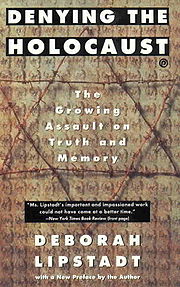
's 1993 book Denying the Holocaust
was sharply critical of questionable analytical methods used by various Holocaust deniers, in particular British author David Irving
, whom she accused of deliberately misrepresenting evidence to justify his preconceived conclusions. In 1996 Irving filed a libel suit against Lipstadt and her publisher, Penguin Books
. American historian Christopher Browning
, an expert witness for the defense, wrote a comprehensive essay for the court summarizing the voluminous evidence for the reality of the Holocaust, and under cross-examination, effectively countered all of Irving's principal arguments to the contrary. Cambridge historian Richard J. Evans
, another defense expert witness, spent two years examining Irving's writings, and confirmed his misrepresentations, including evidence that he had knowingly used forged documents as source material. The judge, Justice Charles Gray, ultimately delivered a long and decisive verdict in favor of Lipstadt that referred to Irving as a "Holocaust denier" and "right-wing pro-Nazi polemicist."
In February 2006 Irving was arrested in Austria, where Holocaust denial is illegal, for a speech he had made in 1989 in which he denied the existence of gas chambers at Auschwitz. Irving was aware of the outstanding arrest warrant, but chose to go to Austria anyway "to give a lecture to a far-right student fraternity." Although he pleaded guilty to the charge, Irving said he had been "mistaken", and had changed his opinions on the Holocaust. "I said that then, based on my knowledge at the time, but by 1991 when I came across the Eichmann papers, I wasn't saying that anymore and I wouldn't say that now. The Nazis did murder millions of Jews." Irving served 13 months of a 3 year sentence in an Austrian prison, and was deported in early 2007. The episode sparked intense international debate over the limits of freedom of speech. Upon hearing of Irving's sentence, Lipstadt said, "I am not happy when censorship wins, and I don't believe in winning battles via censorship ... The way of fighting Holocaust deniers is with history and with truth."
According to CNN
, upon Irving's return to the UK, he "vow[ed] to repeat views denying the Holocaust that led to his conviction" stating he felt "no need any longer to show remorse" for his Holocaust views.
, published a strongly worded critique of the book in the Ankara daily newspaper Siyah-Beyaz ("Black and White"). A legal suit for slander was brought against him. During the trial in September, Baykam exposed the real author of the book as Adnan Oktar. The suit was withdrawn in March 1997.
In France, Holocaust denial became more prominent in the 1990s as négationnisme, though the movement has existed in ultra-left French politics since at least the 1960s, led by figures such as Pierre Guillaume
(who was involved in the bookshop La Vieille Taupe
during the 1960s). Recently, elements of the extreme far right in France have begun to build on each others' negationist arguments, which often span beyond the Holocaust to cover a range of antisemitic views, incorporating attempts to tie the Holocaust to the Biblical massacre of the Canaanites, critiques of Zionism, and other material fanning what has been called a "conspiratorial Judeo-phobia" designed to legitimize and "banalize" antisemitism.
In Belgium in 2001, Roeland Raes
, the ideologue and vice-president of one of the country's largest political parties, the Vlaams Belang
(formerly named Vlaams Blok
, Flemish Bloc), gave an interview on Dutch TV where he cast doubt over the number of Jews murdered by the Nazis during the Holocaust. In the same interview he questioned the scale of the Nazis' use of gas chambers and the authenticity of Anne Frank's
diary. In response to the media assault following the interview, Raes was forced to resign his position but vowed to remain active within the party. Three years later, the Vlaams Blok was convicted of racism and chose to disband. Immediately afterwards, it legally reformed under the new name Vlaams Belang (Flemish Interest) with the same leaders and the same membership.
promoted the allegation of secret ties between the Nazis and the Zionist leaders. The thesis of 1982 doctoral dissertation of Mahmoud Abbas
, a co-founder of Fatah
and president of the Palestinian National Authority
, who earned his PhD in history at the Moscow State Institute of Oriental Studies, with Yevgeny Primakov
as thesis advisor, was "The Secret Connection between the Nazis and the Leaders of the Zionist Movement". In his 1983 book The Other Side: the Secret Relationship Between Nazism and Zionism, based on the dissertation, Abbas wrote:
In his March 2006 interview with Haaretz
Abbas stated:
A different version of this conspiracy theory claims that Nazis and Zionists had a shared interest or even cooperated in the extermination of Europe's Jewry, as persecution would force them to flee to Palestine, then under British Mandate administration. Similar claims are occasionally heard from Hezbollah or Hamas sources.
writing in the Washington Post, "A respected Holocaust research institution recently reported that Egypt, Qatar and Saudi Arabia all promote Holocaust denial and protect Holocaust deniers." Individuals from the Syria
n government, the Palestinian Authority, and a number of Palestinian groups have engaged in various aspects of Holocaust denial. The three most common positions on the historicity of the Holocaust are: "it never happened; it was greatly exaggerated; the Jews deserved it anyway. On the last point, some more enterprising writers add a rebuke to Hitler
for not having finished the job."
In August 2002, the Zayed Center for Coordination and Follow-Up
, an Arab League
think-tank whose Chairman, Sultan bin Zayed bin Sultan Al Nahyan, served as Deputy Prime Minister of the United Arab Emirates
, promoted a Holocaust denial symposium in Abu Dhabi
. The government of the United Arab Emirates closed down the Zayed Center as a result.
Hamas
leaders have also promoted Holocaust denial; Abdel Aziz al-Rantissi
held that the Holocaust never occurred, that Zionists
were behind the action of Nazis, and that Zionists funded Nazism. A press release by Hamas in April 2000 decried "the so-called Holocaust, which is an alleged and invented story with no basis." In August 2009, Hamas refused to allow Palestinian children to learn about the Holocaust, which it called "a lie invented by the Zionists" and referred to Holocaust education as a "war crime."
Holocaust denial has also been resisted by prominent intellectual figures in the Arab world; in 2001, an outcry led by Palestinian poet Mahmoud Darwish
, Lebanese writer Elias Khoury
and others brought about the cancellation of a conference the Holocaust denial organization Institute for Historical Review had planned to hold in Beirut.
In 2005 the Egyptian Muslim Brotherhood
leader, Mohammed Mahdi Akef, denounced what he called "the myth of the Holocaust" in defending Iranian president Mahmoud Ahmadinejad's denial of the Holocaust.
According to the Associated Press
, "Ignorance and even denial of the Holocaust is widespread in Palestinian society." and "Holocaust denial is still common in the Palestinian territories".
According to Aziz Abu Sarah, published in Haaretz
, "growing up I did not know much about the Holocaust. As Palestinians, we simply did not learn about it. There was a stigma attached to it, an understanding that Israel would use the Holocaust to lobby for sympathy, then turn and use the sympathy as a terrible weapon against the Palestinian people."
A private English-language school in western Beirut
censored excerpts of the diary of Anne Frank
out of a school textbook after it caused uproar when Hezbollah learned the chapter was included in the textbook.
Palestinian officials in the West Bank shut down a children's orchestra and banished its conductor in March 2009 after they performed for elderly Holocaust survivors. In August of that year, Palestinian officials in Gaza angrily reacted against UN officials who suggested including information about the Holocaust at their schools. Views toward the Holocaust among Palestinians – and around the Arab world – range from outright denial to diminishing the full extent of the genocide. Few, if any, prominent Arabs from Mideast nations have made publicized visits to Auschwitz – but Israel's Arab community is an exception. Two Arab-Israeli lawmakers previously visited the camp in an effort to build bridges, as did a group of about 100 Arab-Israeli writers and clerics in 2003. Arab lawmaker Mohammed Barakeh plans to attend a Holocaust memorial ceremony at Auschwitz along with a delegation of Israeli politicians, and his visit has drawn fierce criticism against him among the Arab community.
In a debate which aired on Al-Alam TV on May 5, 2010 (as translated by MEMRI), Ali Hatar of the Jordanian Association against Zionism and Racism stated that "To this day, those who claim that [the Holocaust] did take place have been unable to provide any evidence whatsoever to that effect." He claimed that a report by the Red Cross in 1949 "refutes the claim that anyone was killed in these camps, during the so-called Holocaust. It also mentions the self-management [of the camps] by the Jews."
Holocaust denial is relatively new to the Middle East, as Kenneth Jacobson, assistant national director of the Anti-Defamation League
, said in an interview with Haaretz
: "Adopting the theories of Holocaust denial of Western scholars is a relatively new phenomenon in the Muslim world. The accepted attitude had been to say that whereas it was true the Holocaust had taken place, the Palestinians should not have to pay the price. A look at Iranian President Mahmoud Ahmadinejad's statements shows that he has mixed the two approaches."
In a December 2005 speech, Ahmadinejad said that a legend was fabricated and had been promoted to protect Israel
. He said,
The remarks immediately provoked a blaze of international controversy as well as swift condemnation from government officials in Israel, Europe, and the United States. All six political parties in the German parliament signed a joint resolution condemning this Holocaust denial.
Hamas
political leader Khaled Mashaal described Ahmadinejad's comments as "courageous" and stated that "Muslim people will defend Iran because it voices what they have in their hearts, in particular the Palestinian people." In the United States, the Muslim Public Affairs Council
condemned Ahmadinejad's remarks.
On April 24, 2006, Ahmadinejad demanded a free evaluation of the real extent of the Holocaust "in order to find the ultimate truth." In a May 30, 2006 interview with Der Spiegel
, Ahmadinejad again questioned the Holocaust several times, insisting there were "two opinions" on it. When asked if the Holocaust was a myth, he responded "I will only accept something as truth if I am actually convinced of it".
On December 11, 2006, the "International Conference to Review the Global Vision of the Holocaust
" opened to widespread condemnation. The conference, called for by and held at the behest of Ahmadinejad, was widely described as a "Holocaust denial conference" or a "meeting of Holocaust deniers", though Iran denied it was a Holocaust denial conference. A few months before it opened, the Iranian Foreign Ministry spokesman Hamid Reza Asefi stated: "The Holocaust is not a sacred issue that one can't touch. I have visited the Nazi camps in Eastern Europe. I think it is exaggerated."
In September 2010, during a State visit to New York City, Ahmadinejad once again questioned the Holocaust, saying it “has been exaggerated as a pretext for war.” In an interview with the editor of the magazine Atlantic Monthly on September 28, he said, “The question is, why don't we allow this subject to be examined further ... It is incorrect to force only one view on the rest of the world.” He added: “How come when it comes to the subject of the Holocaust there is so much sensitivity?”
Ahmadinejad made similar statements later that day during what was described by Agence France-Presse
as a “chaotic speech” at the United Nations summit on the Millennium Development Goals
. He further charged that the U.S. government "orchestrated" the World Trade Center attacks
in order to reverse declines in the U.S. economy and "save the Zionist regime." He broke off at one point during the speech to complain that his words were not being accurately translated. (Organizers said they were translating from a prepared text submitted by the Iranian delegation.)
Ahmadinejad was praised by Syrian Author Muhammad Nimr Al-Madani (author of "Were the Jews Burned in the Ovens?, Beirut: Al-Manara, 2001) he said in an Iranian TV debate on Holocaust denial, "I was very happy when the Iranian president denied the Holocaust. Since I am convinced of the need to fight this lie, I was filled with admiration at the words of the Iranian president." He also stated that "those who claim that the Holocaust took place do not have any proof."
Holocaust denial propaganda in all forms has shown to influence the audiences that it reaches. In fact, even the well-educated—that is, college graduates and current university students alike—are susceptible to such propaganda when it is presented before them. This stems from the growing disbelief that audiences feel after being exposed to such information, especially since Holocaust witnesses themselves are decreasing in number. Studies centered on the psychological effects of Holocaust denial propaganda confirm this assertion. Linda M. Yelland and William F. Stone, in particular, show that Denial essays decrease readers’ belief in the Holocaust, regardless of their prior Holocaust awareness.
, have tried to raise awareness of the methods and motivations of Holocaust denial without legitimizing the deniers themselves. "We need not waste time or effort answering the deniers' contentions," Lipstadt wrote. "It would be never-ending ... Their commitment is to an ideology and their 'findings' are shaped to support it." A third group, typified by the Nizkor Project
, responds to arguments and claims made by Holocaust denial groups by pointing out inaccuracies and errors in their evidence.
Even scholarly responses, however, can trigger vigorous rebuttals. In 1996, the British historian David Irving
brought a civil defamation suit
against Lipstadt and her publisher, stemming from Lipstadt's book Denying the Holocaust
, in which she named Irving as "one of the more dangerous" Holocaust deniers, because he was a published author, and was viewed by some as a legitimate military historian. He was "familiar with historical evidence," she wrote, and "bends it until it conforms with his ideological leanings and political agenda." Irving, who appeared as a defense witness in Ernst Zündel
's trial
in Canada, and once declared at a rally of Holocaust deniers that "more women died in the back seat of Edward Kennedy's car than ever died in a gas chamber at Auschwitz
", claimed that Lipstadt's allegation damaged his reputation. After a two-month trial in London, the trial judge issued a 333-page ruling against Irving.
, the oldest and largest society of historians and teachers of history in the United States, states that Holocaust denial is "at best, a form of academic fraud." Dr. William Shulman, director of the Holocaust Research Center, described the denial "as if these people [in the Holocaust] were killed twice", a sentiment echoed by literary theorist Jean Baudrillard
, who argued that "Forgetting the extermination is part of the extermination itself." In 2006, UN Secretary General Kofi Annan
said: "Remembering is a necessary rebuke to those who say the Holocaust never happened or has been exaggerated. Holocaust denial is the work of bigots; we must reject their false claims whenever, wherever and by whomever they are made." Holocaust survivor and Nobel Prize winner Elie Wiesel
calls the Holocaust "the most documented tragedy in recorded history
. Never before has a tragedy elicited so much witness from the killers, from the victims and even from the bystanders—millions of pieces here in the museum what you have, all other museums, archives in the thousands, in the millions." He made a similar statement on a special edition of The Oprah Winfrey Show
after his final trip to Auschwitz, along with host Winfrey.
In January 2007, the United Nations General Assembly
condemned "without reservation any denial of the Holocaust", though Iran disassociated itself from the resolution.
Hans Münch
considered the facts of Auschwitz "so firmly determined that one cannot have any doubt at all", and described those who negate what happened at the camp as "malevolent" people who have "personal interest to want to bury in silence things that cannot be buried in silence." Zyklon-B handler and SS-Oberscharführer
Josef Klehr
has said that anyone who maintains that nobody was gassed at Auschwitz must be "crazy or on the wrong". SS-Unterscharführer Oswald Kaduk
has stated that he does not consider those who maintain such a thing as normal people. Hearing about Holocaust denial compelled former SS-Rottenführer
Oskar Gröning
to publicly speak about what he witnessed at Auschwitz, and denounce Holocaust deniers, stating:
has stated that "Holocaust denial is a contemporary form of the classic anti-Semitic doctrine of the evil, manipulative and threatening world Jewish conspiracy" and French historian Valérie Igounet has written that "Holocaust denial is a convenient polemical substitute for anti-semitism." In 2005, the European Monitoring Centre on Racism and Xenophobia (now the Fundamental Rights Agency) published a "working definition" of antisemitism which gave as an example of the way that antisemitism might manifest itself, "denying the fact, scope, mechanisms (e.g. gas chambers) or intentionality of the genocide of the Jewish people at the hands of National Socialist Germany and its supporters and accomplices during World War II (the Holocaust)".
Some have argued that not all Holocaust deniers are necessarily antisemitic. In a defense of professor of literature and Holocaust denier Robert Faurisson
, and of having an essay of his included in the introduction of one of Faurisson's books, linguist and political activist Noam Chomsky
stated "I see no antisemitic implications in denial of the existence of gas chambers, or even denial of the holocaust". Chomsky would later elaborate:
Similarly, in a defense of Holocaust denier Bishop Richard Williamson against the charge of being antisemitic, the journalist and writer Kevin Myers
argued "It is not anti-Semitic to make a fool of yourself in public about a historical fact. It is anti-Semitic to preach or promote a dislike of Jews because they are Jews, which is what Bishop Williamson has not done."
According to Walter Reich, psychiatrist and then senior scholar at the Woodrow Wilson International Center for Scholars
, one-time director of the United States Holocaust Memorial Museum
, and now professor of international affairs at George Washington University
:
The French historian Pierre Vidal-Naquet
described the motivation of deniers more succinctly:
, Liechtenstein, Lithuania
, Luxembourg, Netherlands, Poland, Portugal, Romania
, Slovakia, and Switzerland. The European Union's Framework decision on Racism and Xenophobia states that denying or grossly trivialising "crimes of genocide" should be made "punishable in all EU Member States". Slovakia criminalized denial of fascist crimes in general in late 2001; in May 2005, the term "Holocaust" was explicitly adopted by the penal code and in 2009, it became illegal to deny any act regarded by an international criminal court as genocide. The Parliament of Hungary adopted the most recent legislation, which declared denial or trivialization of the Holocaust a crime punishable by up to three years imprisonment, in February 2010.
Such legislation remains controversial. In October 2007, a tribunal declared Spain's Holocaust denial law unconstitutional. In 2007 Italy rejected a denial law proposing a prison sentence of up to four years. In 2006 the Netherlands rejected a draft law proposing a maximum sentence of one year on denial of genocidal acts in general, although specifically denying the Holocaust remains a criminal offense there. The United Kingdom has twice rejected Holocaust denial laws. Denmark and Sweden have also rejected such legislation.
A number of deniers have been prosecuted under various countries' denial laws. French literature professor Robert Faurisson
, for example, was convicted and punished under the Gayssot Act in 1990. Some historians oppose such laws, among them Vidal-Naquet, an outspoken critic of Faurisson, on the grounds that denial legislation imposes "historical truth as legal truth." Other academics favor criminalization. Holocaust denial, they contend, is "the worst form of racism and its most respectable version because it pretends to be a research." In the Belgian Senate the Minister of Justice Laurette Onkelinx
compared laws criminalizing Holocaust denial with those condemning incitement to ethnic or racial hatred in the United Kingdom and the Netherlands.
, the concept of "comparable Allied wrongs" such as the post-war expulsions
and alleged Allied war crimes like the bombing of Dresden, is at the center of, and a continuously repeated theme of, contemporary Holocaust denial; phenomenon she calls "immoral equivalencies". Pierre Vidal-Naquet pointed out the same phenomenon in the earlier version of Les Assassins de la mémoire under the title Auschwitz et le tiers monde (Les Assassins de la mémoire, Paris, 2005, pp. 170–180), and accurately about the declarations of Klaus Barbie
's lawyer André Vergès. In 1977, Martin Broszat
in a review of David Irving
's book Hitler's War
maintained that the picture of World War II drawn by Irving was done in a such way to engage in moral equivalence between the actions of the Axis and Allied states with both sides equally guilty of terrible crimes, leading to Hitler's "fanatical, destructive will to annihilate" being downgraded to being "no longer an exceptional phenomenon".
Genocide
Genocide is defined as "the deliberate and systematic destruction, in whole or in part, of an ethnic, racial, religious, or national group", though what constitutes enough of a "part" to qualify as genocide has been subject to much debate by legal scholars...
of Jews in World War II, usually referred to as the Holocaust
The Holocaust
The Holocaust , also known as the Shoah , was the genocide of approximately six million European Jews and millions of others during World War II, a programme of systematic state-sponsored murder by Nazi...
. The key claims of Holocaust denial are: the German Nazi
Nazi Germany
Nazi Germany , also known as the Third Reich , but officially called German Reich from 1933 to 1943 and Greater German Reich from 26 June 1943 onward, is the name commonly used to refer to the state of Germany from 1933 to 1945, when it was a totalitarian dictatorship ruled by...
government had no official policy or intention of exterminating Jews
Final Solution
The Final Solution was Nazi Germany's plan and execution of the systematic genocide of European Jews during World War II, resulting in the most deadly phase of the Holocaust...
, Nazi authorities did not use extermination camps and gas chamber
Gas chamber
A gas chamber is an apparatus for killing humans or animals with gas, consisting of a sealed chamber into which a poisonous or asphyxiant gas is introduced. The most commonly used poisonous agent is hydrogen cyanide; carbon dioxide and carbon monoxide have also been used...
s to mass murder
Mass murder
Mass murder is the act of murdering a large number of people , typically at the same time or over a relatively short period of time. According to the FBI, mass murder is defined as four or more murders occurring during a particular event with no cooling-off period between the murders...
Jews, and the actual number of Jews killed was significantly (typically an order of magnitude
Order of magnitude
An order of magnitude is the class of scale or magnitude of any amount, where each class contains values of a fixed ratio to the class preceding it. In its most common usage, the amount being scaled is 10 and the scale is the exponent being applied to this amount...
) lower than the historically accepted figure of 5 to 6 million.
Holocaust deniers generally do not accept the term "denial
Denialism
Denialism is choosing to deny reality as a way to avoid an uncomfortable truth: "[it] is the refusal to accept an empirically verifiable reality...
" as an appropriate description of their activities, and use the term "revisionism
Historical revisionism (negationism)
Historical revisionism is either the legitimate scholastic re-examination of existing knowledge about a historical event, or the illegitimate distortion of the historical record such that certain events appear in a more or less favourable light. For the former, i.e. the academic pursuit, see...
" instead. Scholars use the term "denial" to differentiate Holocaust deniers from historical revisionists
Historical revisionism
In historiography, historical revisionism is the reinterpretation of orthodox views on evidence, motivations, and decision-making processes surrounding a historical event...
, who use established historical methodologies
Methodology
Methodology is generally a guideline for solving a problem, with specificcomponents such as phases, tasks, methods, techniques and tools . It can be defined also as follows:...
. The methodologies of Holocaust deniers are criticized as based on a predetermined conclusion that ignores extensive historical evidence to the contrary.
Most Holocaust denial claims imply, or openly state, that the Holocaust is a hoax arising out of a deliberate Jewish conspiracy
Blood libel
Blood libel is a false accusation or claim that religious minorities, usually Jews, murder children to use their blood in certain aspects of their religious rituals and holidays...
to advance the interest of Jews at the expense of other peoples. For this reason, Holocaust denial is generally considered to be an antisemitic conspiracy theory
Conspiracy theory
A conspiracy theory explains an event as being the result of an alleged plot by a covert group or organization or, more broadly, the idea that important political, social or economic events are the products of secret plots that are largely unknown to the general public.-Usage:The term "conspiracy...
.
Terminology and etymology
Persons engaged in Holocaust denial prefer to refer to their work as historical revisionism, and object to being referred to as "deniers". Scholars consider this to be misleading, since the methods of Holocaust denial differ from those of legitimate historical revision. Legitimate historical revisionism is explained in a resolution adopted by the Duke UniversityDuke University
Duke University is a private research university located in Durham, North Carolina, United States. Founded by Methodists and Quakers in the present day town of Trinity in 1838, the school moved to Durham in 1892. In 1924, tobacco industrialist James B...
History Department, Nov. 8, 1991, and reprinted in Duke Chronicle, Nov. 13, 1991 in response to an advertisement produced by Bradley R Smith's Committee for Open Debate on the Holocaust:
In The Holocaust: Problems and Perspectives of Interpretation, Donald L. Niewyk gives some examples of how legitimate historical revisionism—the re-examination of accepted history and its updating with newly discovered, more accurate, or less-biased information—may be applied to the study of the Holocaust as new facts emerge to change the historical understanding of it:
In contrast, the Holocaust denial movement bases its approach on the predetermined idea that the Holocaust, as understood by mainstream historiography, did not occur. Sometimes referred to as "negationism", from the French term négationnisme introduced by Henry Rousso
Henry Rousso
Henry Rousso is a contemporary French historian specializing in World War II France.He studied at the École normale supérieure de Saint-Cloud, the Sorbonne, and the Institut d'Etudes Politiques de Paris....
, Holocaust deniers attempt to rewrite history by minimizing, denying or simply ignoring essential facts. Koenraad Elst
Koenraad Elst
Koenraad Elst is a Belgian writer and orientalist .He was an editor of the New Right Flemish nationalist journal Teksten, Kommentaren en Studies from 1992 to 1995, focusing on criticism of Islam, various other conservative and Flemish separatist publications such as Nucleus, t Pallieterke,...
writes:
Examination of claims
The key claims of Holocaust deniers are:- The Nazis had no official policy or intention of exterminating Jews.
- Nazis did not use gas chamberGas chamberA gas chamber is an apparatus for killing humans or animals with gas, consisting of a sealed chamber into which a poisonous or asphyxiant gas is introduced. The most commonly used poisonous agent is hydrogen cyanide; carbon dioxide and carbon monoxide have also been used...
s to mass murder Jews. - The figure of 5 to 6 million Jewish deaths is a gross exaggeration, and the actual number is an order of magnitudeOrder of magnitudeAn order of magnitude is the class of scale or magnitude of any amount, where each class contains values of a fixed ratio to the class preceding it. In its most common usage, the amount being scaled is 10 and the scale is the exponent being applied to this amount...
lower.
Other claims include the following:
- Stories of the Holocaust were a myth initially created by the Allies of World War IIAllies of World War IIThe Allies of World War II were the countries that opposed the Axis powers during the Second World War . Former Axis states contributing to the Allied victory are not considered Allied states...
to demonize Germans. Jews spread this myth as part of a grander plot intended to enable the creation of a Jewish homeland in PalestinePalestinePalestine is a conventional name, among others, used to describe the geographic region between the Mediterranean Sea and the Jordan River, and various adjoining lands....
, and now to garner continuing support for the state of IsraelIsraelThe State of Israel is a parliamentary republic located in the Middle East, along the eastern shore of the Mediterranean Sea...
. - Documentary evidence of the Holocaust, from photographs to the Diary of Anne FrankThe Diary of a Young GirlThe Diary of a Young Girl is a book of the writings from the Dutch language diary kept by Anne Frank while she was in hiding for two years with her family during the Nazi occupation of the Netherlands. The family was apprehended in 1944 and Anne Frank ultimately died of typhus in the Bergen-Belsen...
, is fabricated. - Survivor testimonies are filled with errors and inconsistencies, and are thus unreliable.
- Interrogators obtained Nazi prisoners' confessions of war crimes through the use of torture.
- The Nazi treatment of Jews was no different from what the AlliesAlliesIn everyday English usage, allies are people, groups, or nations that have joined together in an association for mutual benefit or to achieve some common purpose, whether or not explicit agreement has been worked out between them...
did to their enemies in World War II.
Holocaust denial is widely viewed as failing to adhere to rules for the treatment of evidence
Rules of evidence
Rules of evidence govern whether, when, how, and for what purpose, proof of a legal case may be placed before a trier of fact for consideration....
, principles that mainstream historians (as well as scholars in other fields) regard as basic to rational inquiry
Reason
Reason is a term that refers to the capacity human beings have to make sense of things, to establish and verify facts, and to change or justify practices, institutions, and beliefs. It is closely associated with such characteristically human activities as philosophy, science, language, ...
.
The Holocaust was well documented by the bureaucracy
Bureaucracy
A bureaucracy is an organization of non-elected officials of a governmental or organization who implement the rules, laws, and functions of their institution, and are occasionally characterized by officialism and red tape.-Weberian bureaucracy:...
of the Nazi government itself. It was further witnessed by the Allied
Allies
In everyday English usage, allies are people, groups, or nations that have joined together in an association for mutual benefit or to achieve some common purpose, whether or not explicit agreement has been worked out between them...
forces who entered Germany and its associated Axis
Axis Powers
The Axis powers , also known as the Axis alliance, Axis nations, Axis countries, or just the Axis, was an alignment of great powers during the mid-20th century that fought World War II against the Allies. It began in 1936 with treaties of friendship between Germany and Italy and between Germany and...
states towards the end of World War II.
According to researchers Michael Shermer
Michael Shermer
Michael Brant Shermer is an American science writer, historian of science, founder of The Skeptics Society, and Editor in Chief of its magazine Skeptic, which is largely devoted to investigating pseudoscientific and supernatural claims. The Skeptics Society currently has over 55,000 members...
and Alex Grobman
Alex Grobman
Alex Grobman is an American historian.Grobman grew up in Camden, New Jersey, the son of a pharmacist and a synagogue secretary. He earned his PhD at the Hebrew University of Jerusalem....
, there is a "convergence of evidence" that proves that the Holocaust happened. This evidence includes:
Much of the controversy surrounding the claims of Holocaust deniers centers on the methods used to present arguments that the Holocaust allegedly never happened as commonly accepted. Numerous accounts have been given by Holocaust deniers (including evidence presented in court cases) of claimed facts and evidence; however, independent research has shown these claims to be based upon flawed research, biased statements, or even deliberately falsified evidence. Opponents of Holocaust denial have documented numerous instances in which such evidence was altered or manufactured (see Nizkor Project
Nizkor Project
The Nizkor Project is an ongoing Internet-based project run by B'nai Brith Canada which is dedicated to countering Holocaust denial. It was founded by Ken McVay as a central Web-based archive for the large numbers of documents made publicly available by the users of the newsgroup alt.revisionism...
and David Irving
David Irving
David John Cawdell Irving is an English writer,best known for his denial of the Holocaust, who specialises in the military and political history of World War II, with a focus on Nazi Germany...
). According to Pierre Vidal-Naquet
Pierre Vidal-Naquet
Pierre Emmanuel Vidal-Naquet was a French historian who began teaching at the École des hautes études en sciences sociales in 1969....
, "in our society of image and spectacle, extermination on paper leads to extermination in reality."
Attempts at concealment by perpetrators
Heinrich Himmler
Heinrich Luitpold Himmler was Reichsführer of the SS, a military commander, and a leading member of the Nazi Party. As Chief of the German Police and the Minister of the Interior from 1943, Himmler oversaw all internal and external police and security forces, including the Gestapo...
instructed his camp commandants to destroy records, crematoria, and other signs of mass extermination. As one of many examples, the bodies of the 25,000 mostly Latvian Jews whom Friedrich Jeckeln
Friedrich Jeckeln
Friedrich Jeckeln was an SS-Obergruppenführer who served as an SS and Police Leader in the occupied Soviet Union during World War II...
and the soldiers under his command had shot at Rumbula
Rumbula massacre
The Rumbula massacre was the two-day killing of about 25,000 Jews in and on the way to Rumbula forest near Riga, Latvia, during the Holocaust. Save only the Babi Yar massacre in Ukraine, this was the biggest two-day Holocaust atrocity until the operation of the death camps...
(near Riga
Riga
Riga is the capital and largest city of Latvia. With 702,891 inhabitants Riga is the largest city of the Baltic states, one of the largest cities in Northern Europe and home to more than one third of Latvia's population. The city is an important seaport and a major industrial, commercial,...
) in late 1941 were dug up and burned in 1943. Similar operations were undertaken at Belzec
Belzec extermination camp
Belzec, Polish spelling Bełżec , was the first of the Nazi German extermination camps created for implementing Operation Reinhard during the Holocaust...
, Treblinka
Treblinka extermination camp
Treblinka was a Nazi extermination camp in occupied Poland during World War II near the village of Treblinka in the modern-day Masovian Voivodeship of Poland. The camp, which was constructed as part of Operation Reinhard, operated between and ,. During this time, approximately 850,000 men, women...
and other death camps. In the infamous Posen speeches of October 1943 such as the one on October 4, Himmler explicitly referred to the murder of the Jews of Europe and further stated that the murder must be permanently kept secret:
In 1945, General Dwight D. Eisenhower
Dwight D. Eisenhower
Dwight David "Ike" Eisenhower was the 34th President of the United States, from 1953 until 1961. He was a five-star general in the United States Army...
, Supreme Allied Commander, anticipated that someday an attempt would be made to recharacterize the Nazi crimes as propaganda and took steps against it:
Eisenhower, upon finding the victims of the death camps, ordered all possible photographs to be taken, and for the German people from surrounding villages to be ushered through the camps and even made to bury the dead. He wrote the following to General Marshall after visiting a German internment camp near Gotha, Germany:
History and development after World War II
After World War II, many of the former leaders of the SS left Germany and began using their propaganda skills to defend their actions (or, their critics contended, to rewrite history). Denial materials began to appear shortly after the war.Harry Elmer Barnes
Harry Elmer BarnesHarry Elmer Barnes
Harry Elmer Barnes was a prominent American historian in the 20th century. A "progressive who had some classical liberal impulses," he was associated for virtually his entire career with Columbia University.-Early career:...
, an American, was at one time a mainstream historian with liberal credentials; he assumed a Holocaust-denial stance in the later years of his life. Between World War I and World War II, Barnes became well known as an anti-war
Anti-war
An anti-war movement is a social movement, usually in opposition to a particular nation's decision to start or carry on an armed conflict, unconditional of a maybe-existing just cause. The term can also refer to pacifism, which is the opposition to all use of military force during conflicts. Many...
writer and a leader in the historical revisionism movement, where he had worked closely from 1924 onwards with Centre for the Study of the Causes of the War
Centre for the Study of the Causes of the War
The Centre for the Study of the Causes of the War was a pseudo-historical think-tank based in Berlin, secretly funded by the German government, whose sole purpose was to disseminate the official government position that Germany was the victim of Allied aggression in 1914, and hence the alleged...
. This institute was a pseudo-historical think-tank based in Berlin, secretly funded by the German government and headed by a former völkisch
Völkisch movement
The volkisch movement is the German interpretation of the populist movement, with a romantic focus on folklore and the "organic"...
activist named Major Alfred von Wegerer, whose sole purpose was to prove Germany was the victim of Allied aggression in 1914. Following World War II, Barnes became convinced that allegations made against Germany and Japan, including the Holocaust, were wartime propaganda used to justify U.S. involvement in World War II.
In his 1962 pamphlet, Revisionism and Brainwashing, Barnes claimed that there was a “lack of any serious opposition or concerted challenge to the atrocity stories and other modes of defamation of German national character and conduct”. Barnes went on to write that in his view there was “a failure to point out the atrocities of the Allies were more brutal, painful, mortal and numerous than the most extreme allegations made against the Germans”. Starting at this time, Barnes started to cite the French Holocaust denier Paul Rassinier
Paul Rassinier
Paul Rassinier was a French pacifist, political activist, and author. He was also an anti-Nazi French Resistance fighter, and a prisoner of the German concentration camps at Buchenwald and Mittelbau-Dora. A journalist and editor, he wrote hundreds of articles on political and economic subjects...
, whom Barnes called a “distinguished French historian” who Barnes claimed had exposed the “exaggerations of the atrocity stories". In a 1964 article entitled “Zionist Fraud” published in the American Mercury, Barnes wrote that: Using Rassinier as his source, Barnes claimed that Germany was the victim of aggression in both 1914 and 1939, and the Holocaust was just propaganda to justify a war of aggression against Germany. Barnes took the view that World War II had ended in disaster for the West with Germany divided and the United States locked into the Cold War
Cold War
The Cold War was the continuing state from roughly 1946 to 1991 of political conflict, military tension, proxy wars, and economic competition between the Communist World—primarily the Soviet Union and its satellite states and allies—and the powers of the Western world, primarily the United States...
, made all the worse in Barnes’s eyes, as in his view Germany never wanted war. Barnes claimed that in order to justify the “horrors and evils of the Second World War”, the Allies were required to make the Nazis the “scapegoat” for their own misdeeds. Barnes claimed there were two false claims made about World War II, namely that Germany started the war in 1939, and the Holocaust, which Barnes denied.
Following the example of Barnes, a few other early libertarian writers also concerned with anti-war historical revisionism began to take a Holocaust-denial stance, including James J. Martin
James J. Martin
James J. Martin was an American historian. He was educated at the University of New Hampshire and the University of Michigan, earning a Ph.D. in history in 1949....
. Most libertarians, however—even those who otherwise hold Barnes' writings in high regard—reject his Holocaust denial. Barnes' name has since been appropriated by some modern Holocaust deniers in an attempt to lend credibility to their cause, most notably Willis Carto
Willis Carto
Willis Allison Carto is a longtime figure on the American far right. He describes himself as Jeffersonian and populist, but is primarily known for his promotion of antisemitic conspiracy theories and Holocaust denial.-Influences on Carto:...
.
The beginnings of the modern denial movement
David Hoggan
David Leslie Hoggan was an American historical writer, author of The Forced War: When Peaceful Revision Failed and other works in the German and English languages.-Early life:...
published Der Erzwungene Krieg (The Forced War) in West Germany, which claimed that Germany had been the victim of an Anglo-Polish conspiracy in 1939. Though Der Erzwungene Krieg was primarily concerned with the origins of World War II, it also down-played or justified the effects of Nazi antisemitic measures in the pre-1939 period. For an example, Hoggan justified the huge one billion Reich-mark fine imposed on the entire Jewish community in Germany after the 1938 Kristallnacht
Kristallnacht
Kristallnacht, also referred to as the Night of Broken Glass, and also Reichskristallnacht, Pogromnacht, and Novemberpogrome, was a pogrom or series of attacks against Jews throughout Nazi Germany and parts of Austria on 9–10 November 1938.Jewish homes were ransacked, as were shops, towns and...
as a reasonable measure to prevent what he called "Jewish profiteering" at the expense of German insurance companies and alleged that no Jews were killed in the Kristallnacht (in fact, 91 German Jews were killed in the Kristallnacht). Subsequently, Hoggan wrote one of the first books denying the Holocaust in 1969 entitled The Myth of the Six Million, which was published by the Noontide Press
Noontide Press
Noontide Press is an American publishing entity which describes itself as a publisher of "hard-to-find books and recordings from a dissident, 'politically incorrect' perspective." It publishes numerous antisemitic titles, including The Protocols of the Elders of Zion and The International Jew...
, a small Los Angeles publisher specializing in antisemitic literature. Hoggan became one of the early stars of the Holocaust denial movement, because he had a number of university professorships.
In 1964, French historian Paul Rassinier
Paul Rassinier
Paul Rassinier was a French pacifist, political activist, and author. He was also an anti-Nazi French Resistance fighter, and a prisoner of the German concentration camps at Buchenwald and Mittelbau-Dora. A journalist and editor, he wrote hundreds of articles on political and economic subjects...
published The Drama of the European Jews. Rassinier was himself a concentration camp survivor (imprisoned in Buchenwald for his having helped French Jews escape the Nazis), and modern-day deniers continue to cite his works as scholarly research that questions the accepted facts of the Holocaust. Critics argued that Rassinier did not cite evidence for his claims and ignored information that contradicted his assertions; he nevertheless remains influential in Holocaust denial circles for being one of the first deniers to propose that a vast Zionist/Allied/Soviet conspiracy faked the Holocaust, a theme that would be picked up in later years by other authors.
The publication of Arthur Butz
Arthur Butz
Arthur R. Butz is a Holocaust denier and associate professor of electrical engineering at Northwestern University. He achieved tenure in 1974 and currently teaches classes in control system theory and digital signal processing.-Education:...
's The Hoax of the Twentieth Century
The Hoax of the Twentieth Century
The Hoax of the Twentieth Century: The Case Against the Presumed Extermination of European Jewry is a book by electrical engineering professor Arthur Butz. First published in 1976 by Historical Review Press, it denied that Nazi Germany tried to exterminate the Jews during the Holocaust, and was...
: The case against the presumed extermination of European Jewry in 1976; and David Irving
David Irving
David John Cawdell Irving is an English writer,best known for his denial of the Holocaust, who specialises in the military and political history of World War II, with a focus on Nazi Germany...
's Hitler's War
Hitler's War
Hitler's War is a history book by David Irving. It describes the Second World War from the point of view of Adolf Hitler.It was first published in April 1977 by Hodder & Stoughton and Viking Press . Avon Books reissued it in 1990...
in 1977 brought other similarly inclined individuals into the fold. In December 1978 and January 1979, Robert Faurisson
Robert Faurisson
Robert Faurisson is a French academic who is a Holocaust denier. Faurisson generated much controversy with a number of articles, published in the Journal of Historical Review and elsewhere, as well as various letters he has sent to French newspapers , which deny various aspects of the Holocaust,...
, a French professor of literature at the University of Lyon
University of Lyon
The University of Lyon , located in Lyon and Saint Etienne, France, is a center for higher education and research comprising 16 institutions of higher education...
, wrote two letters to Le Monde
Le Monde
Le Monde is a French daily evening newspaper owned by La Vie-Le Monde Group and edited in Paris. It is one of two French newspapers of record, and has generally been well respected since its first edition under founder Hubert Beuve-Méry on 19 December 1944...
claiming that the gas chambers
Gas Chambers
Gas Chambers is a fast, hollow and shallow point break type of wave. Being that it is a high performance wave it is well suited for the average to pro level surfer. Gas Chambers is located on the North Shore of Oahu about a 1/4 of a mile north of Ehukai Beach Park and 1/2 a mile west of Sunset...
used by the Nazis to exterminate the Jews did not exist. A colleague of Faurisson, Jean-Claude Pressac
Jean-Claude Pressac
Jean-Claude Pressac was a French chemist and pharmacist who later became a published authority on the Holocaust of World War II....
, who initially shared Faurisson's views, later became convinced of the Holocaust's evidence while investigating documents at Auschwitz
Auschwitz concentration camp
Concentration camp Auschwitz was a network of Nazi concentration and extermination camps built and operated by the Third Reich in Polish areas annexed by Nazi Germany during World War II...
in 1979. He published his conclusions along with much of the underlying evidence in his 1989 book, Auschwitz: Technique and operation of the gas chambers.
Henry Bienen
Henry Bienen
Henry Samuel Bienen is an American academic administrator and former president of Northwestern University. He was elected president on June 13, 1994 and took office on January 1, 1995. He announced his retirement effective August 31, 2009...
, the former president of Northwestern University
Northwestern University
Northwestern University is a private research university in Evanston and Chicago, Illinois, USA. Northwestern has eleven undergraduate, graduate, and professional schools offering 124 undergraduate degrees and 145 graduate and professional degrees....
, has described Arthur Butz's view of the Holocaust as an "embarrassment to Northwestern". In 2006, sixty of Butz's colleagues from the Department of Electrical Engineering and Computer Science faculty signed a censure describing Butz's Holocaust denial as "an affront to our humanity and our standards as scholars". The letter also called for Butz to "leave our Department and our University and stop trading on our reputation for academic excellence."
Institute for Historical Review
In 1978 Willis CartoWillis Carto
Willis Allison Carto is a longtime figure on the American far right. He describes himself as Jeffersonian and populist, but is primarily known for his promotion of antisemitic conspiracy theories and Holocaust denial.-Influences on Carto:...
founded the Institute for Historical Review
Institute for Historical Review
The Institute for Historical Review , founded in 1978, is an American organization that describes itself as a "public-interest educational, research and publishing center dedicated to promoting greater public awareness of history." Critics have accused it of being an antisemitic "pseudo-scholarly...
(IHR) as an organization dedicated to publicly challenging the commonly accepted history of the Holocaust. The IHR sought from the beginning to attempt to establish itself within the broad tradition of historical revisionism, by soliciting token supporters who were not from a neo-Nazi background such as James J. Martin and Samuel Edward Konkin III
Samuel Edward Konkin III
Samuel Edward Konkin III was the author of the New Libertarian Manifesto and a proponent of the political philosophy which he called agorism. Agorism is a leftward evolution of anarcho-capitalism, and subset of market anarchism...
, and by promoting the writings of French socialist Paul Rassinier and American anti-war historian Harry Elmer Barnes to attempt to show that Holocaust denial had a broader base of support besides just neo-Nazis. The IHR brought most of Barnes' writings, which had been out of print since his death, back into print. While IHR included articles on other topics and sold books by mainstream historians in its catalog, the majority of material published and distributed by IHR was devoted to questioning the facts surrounding the Holocaust.
The IHR became one of the most important organizations devoted to Holocaust denial. In recent years the IHR underwent an internal power struggle which ousted Willis Carto and put Mark Weber
Mark Weber
Mark Edward Weber is the director of the Institute for Historical Review, an American Holocaust denial organization based in southern California....
in charge. Carto went on to found the Barnes Review
Barnes Review
The Barnes Review is a bi-monthly magazine founded in 1994 by Willis Carto, dedicated to historical revisionism such as Holocaust denial. Willis Carto had earlier founded the Institute for Historical Review in 1979 but lost control of that organization in an internal takeover by former...
magazine after his ouster from IHR, a magazine which is also devoted to Holocaust denial.
In an "About the IHR" statement on their website, the IHR stated that "The Institute does not 'deny the Holocaust'." The IHR journal, however, states:
Commentators and historians have noted the misleading nature of statements by the IHR that they are not Holocaust deniers. Paul Rauber
Paul Rauber
Paul Rauber is a Senior Editor at the Sierra Club magazine, an American environmental organization founded by conservationist pioneer John Muir in 1892....
, a senior editor for the Sierra Club Magazine, writes that:
According to British historian of Germany Richard J. Evans
Richard J. Evans
Richard John Evans is a British academic and historian, prominently known for his history of Germany.-Life:Evans was born in London, of Welsh parentage, and is now Regius Professor of Modern History at the University of Cambridge and President of Wolfson College...
:
Bradley Smith and the Committee for Open Debate on the Holocaust
In 1987, Bradley R. Smith, a former media director of the Institute for Historical Review, founded the Committee for Open Debate on the Holocaust (CODOH). In the United States, CODOH has repeatedly tried to place newspaper advertisements questioning whether the Holocaust happened, especially in college campus newspapers. Some newspapers have accepted the advertisements, while others have rejected them. Bradley Smith has more recently sought other avenues to promote Holocaust denial – with little success. On September 8, 2009, The Harvard Crimson school paper ran a paid ad from Bradley R Smith. It was quickly criticized and an apology was issued from the editor, claiming it was a mistake.Bradley referred to his tactics as the CODOH campus project. Bradley says, “I don’t want to spend time with adults anymore, I want to go to students. They are superficial. They are empty vessels to be filled.” “What I wanted to do was I wanted to set forth three or four ideas that students might be interested in, that might cause them to think about things or to have questions about things. And I wanted to make it as simple as possible, and to set it up in a way that could not really be debated”. Holocaust deniers have placed[…]“Full page advertisements in college and university newspaper, including those of Brandeis University, Boston College, Pennsylvania State University, and Queens College. Some of these ads arguing that Holocaust never happened ran without comment; others generated op-ed pieces by professors and students.
James Keegstra
In 1984, James KeegstraJames Keegstra
James "Jim" Keegstra is a former public school teacher in Eckville, Alberta, Canada, who was charged and convicted of hate speech in 1984. The conviction was overturned by the Court of Appeal but re-instated by the Supreme Court of Canada...
, a Canadian high-school teacher, was charged with denying the Holocaust and making antisemitic claims in his classroom as part of the course material. Keegstra and his lawyer, Doug Christie
Doug Christie (lawyer)
Douglas Hewson "Doug" Christie, Jr. is a Canadian lawyer and far-right political activist based in Victoria, British Columbia.-Career:...
, argued that the section of the Criminal Code of Canada
Criminal Code of Canada
The Criminal Code or Code criminel is a law that codifies most criminal offences and procedures in Canada. Its official long title is "An Act respecting the criminal law"...
(now section 319{2}), is an infringement of the Charter of Rights
Canadian Charter of Rights and Freedoms
The Canadian Charter of Rights and Freedoms is a bill of rights entrenched in the Constitution of Canada. It forms the first part of the Constitution Act, 1982...
(section 9{b}). The case was appealed to the Supreme Court of Canada
Supreme Court of Canada
The Supreme Court of Canada is the highest court of Canada and is the final court of appeals in the Canadian justice system. The court grants permission to between 40 and 75 litigants each year to appeal decisions rendered by provincial, territorial and federal appellate courts, and its decisions...
, where it was decided that the law he was convicted under did infringe on his freedom of expression, but it was a justified infringement. Keegstra was convicted, and fired from his job.
The Zündel trials
Ernst Zündel
Ernst Christof Friedrich Zündel is a German Holocaust denier and pamphleteer who was jailed several times in Canada for publishing literature which "is likely to incite hatred against an identifiable group" and for being a threat to national security, in the United States for overstaying his visa,...
operated a small-press publishing house called Samisdat Publishing, which published and distributed Holocaust-denial material such as Did Six Million Really Die?
Did Six Million Really Die?
Did Six Million Really Die? is a Holocaust denial booklet written by British National Front member Richard Verrall, under the name Richard E. Harwood, and published by Ernst Zündel in 1974...
by Richard Harwood (a.k.a. Richard Verrall
Richard Verrall
Richard Verrall is a former Deputy Chairman of the British National Front , he edited the magazine Spearhead from 1976 to 1980.-National Front career:...
– a British neo-Nazi leader). In 1985, he was tried in R. v. Zundel
R. v. Zundel
R. v. Zundel [1992] 2 S.C.R. 731 is a landmark Supreme Court of Canada decision where the Court struck down the provision in the Criminal Code of Canada that prohibited publication of false information or news on the basis that it violated the freedom of expression provision under section 2 of the...
and convicted under a "false news" law and sentenced to 15 months imprisonment by an Ontario
Ontario
Ontario is a province of Canada, located in east-central Canada. It is Canada's most populous province and second largest in total area. It is home to the nation's most populous city, Toronto, and the nation's capital, Ottawa....
court for "disseminating and publishing material denying the Holocaust." The Holocaust historian Raul Hilberg
Raul Hilberg
Raul Hilberg was an Austrian-born American political scientist and historian. He was widely considered to be the world's preeminent scholar of the Holocaust, and his three-volume, 1,273-page magnum opus, The Destruction of the European Jews, is regarded as a seminal study of the Nazi Final...
was a notable witness for the prosecution at the 1985 trial. Zündel gained considerable notoriety after this conviction, and a number of free-speech activists stepped forward to defend his right to publish his opinions. After his conviction in 1985, Zündel was able to have it overturned in an appeal on a legal technicality, leading to a second trial in 1988, in which he was again convicted. The 1988 trial was notable for the appearance of Fred A. Leuchter
Fred A. Leuchter
Frederick A. Leuchter, Jr. is an American Federal Court qualified expert in execution technology and author of forensic Holocaust denial material. He claims to have improved the design of instruments for capital punishment and had execution equipment contracts with several states...
, David Irving
David Irving
David John Cawdell Irving is an English writer,best known for his denial of the Holocaust, who specialises in the military and political history of World War II, with a focus on Nazi Germany...
and Robert Faurisson
Robert Faurisson
Robert Faurisson is a French academic who is a Holocaust denier. Faurisson generated much controversy with a number of articles, published in the Journal of Historical Review and elsewhere, as well as various letters he has sent to French newspapers , which deny various aspects of the Holocaust,...
as defense witnesses for Zündel, and for the presentation of the pseudo-scientific Leuchter report
Leuchter report
The Leuchter report is a pseudoscientific document authored by American execution technician Fred A. Leuchter. For the defense in the trial of Holocaust denier Ernst Zündel, Leuchter compiled the report in 1988 with the intention of investigating the feasibility of mass homicidal gassings at Nazi...
as a defense document. The Leuchter report was published in Canada in 1988 by Samisdat Publishers
Samisdat Publishers
Samisdat Publishers, Ltd. was a small Canadian publishing house owned and operated by Ernst Zündel, a noted Holocaust denier, during the 1980s and 1990s...
and in Britain in 1989 by Irving's Focal Point Publishing. In both of his trials, Zündel was defended by Douglas Christie
Doug Christie (lawyer)
Douglas Hewson "Doug" Christie, Jr. is a Canadian lawyer and far-right political activist based in Victoria, British Columbia.-Career:...
and Barbara Kulaszka
Barbara Kulaszka
Barbara Kulaszka is a Canadian lawyer known especially for her role in defending far-right figures.Kulaszka has been a member of the Law Society of Upper Canada since 1980 and has practiced law since 1987. She acted with Doug Christie as co-counsel to Holocaust denier Ernst Zündel in the 1980s and...
. His conviction was overturned in 1992 when the Supreme Court of Canada declared the "false news" law unconstitutional.
Zündel has a website, web-mastered by his wife Ingrid, which publicizes his viewpoints. In January 2002, the Canadian Human Rights Tribunal
Canadian Human Rights Commission
The Canadian Human Rights Commission is a quasi-judicial body that was established in 1977 by the government of Canada. It is empowered under the Canadian Human Rights Act to investigate and try to settle complaints of discrimination in employment and in the provision of services within federal...
delivered a ruling in a complaint involving his website, in which it was found to be contravening the Canadian Human Rights Act
Canadian Human Rights Act
The Canadian Human Rights Act is a statute originally passed by the Parliament of Canada in 1977 with the express goal of extending the law to ensure equal opportunity to individuals who may be victims of discriminatory practices based on a set prohibited grounds such as gender, disability, or...
. The court ordered Zündel to cease communicating hate messages. In February 2003, the American INS
Immigration and Naturalization Service
The United States Immigration and Naturalization Service , now referred to as Legacy INS, ceased to exist under that name on March 1, 2003, when most of its functions were transferred from the Department of Justice to three new components within the newly created Department of Homeland Security, as...
arrested him in Tennessee
Tennessee
Tennessee is a U.S. state located in the Southeastern United States. It has a population of 6,346,105, making it the nation's 17th-largest state by population, and covers , making it the 36th-largest by total land area...
, USA, on an immigration violations matter, and few days later, Zündel was sent back to Canada, where he tried to gain refugee status. Zündel remained in prison until March 1, 2005, when he was deported to Germany and prosecuted for disseminating hate propaganda. On February 15, 2007, Zündel was convicted on 14 counts of incitement under Germany's Volksverhetzung
Volksverhetzung
Volksverhetzung is a concept in German criminal law that bans the incitement of hatred against a segment of the population. It often applies in, though it is not limited to, trials relating to Holocaust denial in Germany...
law, which bans the incitement of hatred against a portion of the population, and given the maximum sentence of five years in prison.
Ernst Nolte
The German philosopher and historian Ernst NolteErnst Nolte
Ernst Nolte is a German historian and philosopher. Nolte’s major interest is the comparative studies of Fascism and Communism. He is Professor Emeritus of Modern History at the Free University of Berlin, where he taught from 1973 to 1991. He was previously a Professor at the University of Marburg...
, starting in the 1980s has advanced a set of theories, which though not denying the Holocaust, appeared to flirt with Holocaust denial as a serious historical argument. In a letter to the Israeli historian Otto Dov Kulka of December 8, 1986 Nolte criticized the work of the French Holocaust denier Robert Faurisson
Robert Faurisson
Robert Faurisson is a French academic who is a Holocaust denier. Faurisson generated much controversy with a number of articles, published in the Journal of Historical Review and elsewhere, as well as various letters he has sent to French newspapers , which deny various aspects of the Holocaust,...
on the ground that the Holocaust did occur, but went on to argue that Faurison’s work was motivated by what Nolte claimed were the admirable motives of sympathy towards the Palestinians and opposition to Israel. In his 1987 book Der europäische Bürgerkrieg (The European Civil War), Nolte claimed that the intentions of Holocaust deniers are "often honourable", and that some of their claims are "not obviously without foundation". Nolte himself, though he has never denied the occurrence of the Holocaust, has claimed that the Wannsee Conference
Wannsee Conference
The Wannsee Conference was a meeting of senior officials of the Nazi German regime, held in the Berlin suburb of Wannsee on 20 January 1942. The purpose of the conference was to inform administrative leaders of Departments responsible for various policies relating to Jews, that Reinhard Heydrich...
of 1942 never happened, and that the minutes of the conference were post-war forgeries done by "biased" Jewish historians designed to discredit Germany
The British historian Ian Kershaw
Ian Kershaw
Sir Ian Kershaw is a British historian of 20th-century Germany whose work has chiefly focused on the period of the Third Reich...
has argued that Nolte was operating on the borderlines of Holocaust denial with his implied claim that the "negative myth" of the Third Reich was created by Jewish historians, his allegations of the domination of Holocaust scholarship by “biased” Jewish historians, and his statements that one should withhold judgment on Holocaust deniers, whom Nolte takes considerable pains to stress are not exclusively Germans or fascists. In Kershaw's opinion, Nolte is attempting to imply that perhaps Holocaust deniers are on to something. In a 1990 interview, Nolte implied that there was something to the Leuchter report
Leuchter report
The Leuchter report is a pseudoscientific document authored by American execution technician Fred A. Leuchter. For the defense in the trial of Holocaust denier Ernst Zündel, Leuchter compiled the report in 1988 with the intention of investigating the feasibility of mass homicidal gassings at Nazi...
: "If the revisionists [Holocaust deniers] and Leuchter among them have made it clear to the public that even "Auschwitz" must be an object of scientific inquiry and controversy then they should be given credit for this. Even if it finally turned out that the number of victims was even greater and the procedures were even more horrific than has been assumed until now." In his 1993 book Streitpunkte (Points of Contention), Nolte praised the work of Holocaust deniers as superior to "mainstream scholars". Nolte wrote that "radical revisionists have presented research which, if one is familiar with the source material and the critique of the sources, is probably superior to that of the established historians of Germany". In a 1994 interview with Der Spiegel magazine, Nolte stated "I cannot rule out the importance of the investigation of the gas chambers in which they looked for remnants of the [chemical process engendered by Zyklon B]", and that “'Of course, I am against revisionists, but Fred Leuchter's "study" of the Nazi gas ovens has to be given attention, because one has to stay open to "other" ideas.”
The British historian Richard J. Evans
Richard J. Evans
Richard John Evans is a British academic and historian, prominently known for his history of Germany.-Life:Evans was born in London, of Welsh parentage, and is now Regius Professor of Modern History at the University of Cambridge and President of Wolfson College...
in his 1989 book In Hitler's Shadow expressed the view that Nolte’s reputation as a scholar was in ruins as a result of these and other controversial statements on his part. The American historian Deborah Lipstadt
Deborah Lipstadt
Deborah Esther Lipstadt, Ph.D. is an American historian and author of the book Denying the Holocaust and The Eichmann Trial. She is the Dorot Professor of Modern Jewish and Holocaust Studies at Emory University...
in a 2003 interview stated:
The Mayer Controversy
In 1988, the American historian Arno J. MayerArno J. Mayer
Arno Joseph Mayer is a United States Marxist historian originally from Luxembourg, who specializes in modern Europe, diplomatic history, and the Holocaust, and is currently Dayton-Stockton Professor of History, Emeritus, at Princeton University.-Early life and academic career:Mayer was born into a...
published a book entitled Why Did the Heavens Not Darken?, which did not deny the Holocaust, but appeared to lend support to Holocaust denial by stating that the majority of people who died at Auschwitz
Auschwitz concentration camp
Concentration camp Auschwitz was a network of Nazi concentration and extermination camps built and operated by the Third Reich in Polish areas annexed by Nazi Germany during World War II...
were the victims of diseases rather than gassing. In addition, critics of Mayer such as Lucy Dawidowicz
Lucy Dawidowicz
Lucy Schildkret Dawidowicz was an American historian and an author of books on modern Jewish history, in particular books on the Holocaust.-Life:...
assailed him for listing the works of Arthur Butz
Arthur Butz
Arthur R. Butz is a Holocaust denier and associate professor of electrical engineering at Northwestern University. He achieved tenure in 1974 and currently teaches classes in control system theory and digital signal processing.-Education:...
and Paul Rassinier
Paul Rassinier
Paul Rassinier was a French pacifist, political activist, and author. He was also an anti-Nazi French Resistance fighter, and a prisoner of the German concentration camps at Buchenwald and Mittelbau-Dora. A journalist and editor, he wrote hundreds of articles on political and economic subjects...
in his bibliography, and charged his statements about Auschwitz were factually incorrect. Holocaust expert Robert Jan van Pelt
Robert Jan van Pelt
Robert Jan van Pelt is an author, architectural historian, professor at the University of Waterloo and University of Toronto in Ontario and a Holocaust scholar. One of the world's leading experts on Auschwitz, he regularly speaks on Holocaust related topics, through which he has come to address...
has noted that Mayer's book is as close as a mainstream historian has ever come to supporting Holocaust denial. Holocaust deniers such as David Irving
David Irving
David John Cawdell Irving is an English writer,best known for his denial of the Holocaust, who specialises in the military and political history of World War II, with a focus on Nazi Germany...
have often cited Mayer’s book as one reason for embracing Holocaust denial. Though Mayer has been often condemned for his statement about the reasons for the Auschwitz death toll, his book does not deny the Holocaust as Holocaust deniers often claim.
Holocaust deniers have often quoted out of context Mayer’s sentence in Why Did the Heavens Not Darken? that “Sources for the study of the gas chambers at once rare and unreliable” as the authors Michael Shermer
Michael Shermer
Michael Brant Shermer is an American science writer, historian of science, founder of The Skeptics Society, and Editor in Chief of its magazine Skeptic, which is largely devoted to investigating pseudoscientific and supernatural claims. The Skeptics Society currently has over 55,000 members...
and Alex Grobman have noted that the paragraph from which the sentence is taken states that the SS destroyed the majority of the documention relating to the operation of the gas chambers in the death camps, which is why Mayer feels that sources for the operation of the gas chambers are "rare" and "unreliable"
The Israeli historian Yehuda Bauer
Yehuda Bauer
Yehuda Bauer is a historian and scholar of the Holocaust. He is a Professor of Holocaust Studies at the Avraham Harman Institute of Contemporary Jewry at the Hebrew University of Jerusalem.-Biography:...
wrote that Mayer "popularizes the nonsense that the Nazis saw in Marxism and Bolshevism their main enemy, and the Jews unfortunately got caught up in this; when he links the destruction of the Jews to the ups and downs of German warfare in the Soviet Union, in a book that is so cocksure of itself that it does not need a proper scientific apparatus, he is really engaging in a much more subtle form of Holocaust denial"
Ken McVay and alt.revisionism
Ken McVayKen McVay
Kenneth "Ken" McVay, OBC , a Canadian-American dual citizen, is an Internet activist against Holocaust denial. He is the founder of the Nizkor Project, one of the first websites against Holocaust denial....
, an American resident in Canada, was disturbed by the efforts of organizations like the Simon Wiesenthal Center
Simon Wiesenthal Center
The Simon Wiesenthal Center , with headquarters in Los Angeles, California, was established in 1977 and named for Simon Wiesenthal, the Nazi hunter. According to its mission statement, it is "an international Jewish human rights organization dedicated to repairing the world one step at a time...
to suppress the speech of the Holocaust deniers, feeling that it was better to confront them openly than to try to censor them. On the Usenet
Usenet
Usenet is a worldwide distributed Internet discussion system. It developed from the general purpose UUCP architecture of the same name.Duke University graduate students Tom Truscott and Jim Ellis conceived the idea in 1979 and it was established in 1980...
newsgroup alt.revisionism he began a campaign of "truth, fact, and evidence," working with other participants on the newsgroup to uncover factual information about the Holocaust and counter the arguments of the deniers by proving them to be based upon misleading evidence, false statements, and outright lies. He founded the Nizkor Project
Nizkor Project
The Nizkor Project is an ongoing Internet-based project run by B'nai Brith Canada which is dedicated to countering Holocaust denial. It was founded by Ken McVay as a central Web-based archive for the large numbers of documents made publicly available by the users of the newsgroup alt.revisionism...
to expose the activities of the Holocaust deniers, who responded to McVay with personal attacks, slander, and death threats.
David Irving and the Lipstadt libel case
Deborah LipstadtDeborah Lipstadt
Deborah Esther Lipstadt, Ph.D. is an American historian and author of the book Denying the Holocaust and The Eichmann Trial. She is the Dorot Professor of Modern Jewish and Holocaust Studies at Emory University...
's 1993 book Denying the Holocaust
Denying the Holocaust
Denying the Holocaust: The Growing Assault on Truth & Memory is a 1993 book by Deborah Lipstadt which led to a libel action when David Irving objected to Lipstadt calling him a Holocaust denier, see Irving v Penguin Books and Lipstadt. The book gives a detailed and perceptive explanation of how...
was sharply critical of questionable analytical methods used by various Holocaust deniers, in particular British author David Irving
David Irving
David John Cawdell Irving is an English writer,best known for his denial of the Holocaust, who specialises in the military and political history of World War II, with a focus on Nazi Germany...
, whom she accused of deliberately misrepresenting evidence to justify his preconceived conclusions. In 1996 Irving filed a libel suit against Lipstadt and her publisher, Penguin Books
Penguin Books
Penguin Books is a publisher founded in 1935 by Sir Allen Lane and V.K. Krishna Menon. Penguin revolutionised publishing in the 1930s through its high quality, inexpensive paperbacks, sold through Woolworths and other high street stores for sixpence. Penguin's success demonstrated that large...
. American historian Christopher Browning
Christopher Browning
Christopher Robert Browning is an American historian of the Holocaust.-Education:Browning received his bachelor's degree from Oberlin College in 1968 and his doctorate from the University of Wisconsin–Madison in 1975. He taught at Pacific Lutheran University from 1974 to 1999, eventually becoming...
, an expert witness for the defense, wrote a comprehensive essay for the court summarizing the voluminous evidence for the reality of the Holocaust, and under cross-examination, effectively countered all of Irving's principal arguments to the contrary. Cambridge historian Richard J. Evans
Richard J. Evans
Richard John Evans is a British academic and historian, prominently known for his history of Germany.-Life:Evans was born in London, of Welsh parentage, and is now Regius Professor of Modern History at the University of Cambridge and President of Wolfson College...
, another defense expert witness, spent two years examining Irving's writings, and confirmed his misrepresentations, including evidence that he had knowingly used forged documents as source material. The judge, Justice Charles Gray, ultimately delivered a long and decisive verdict in favor of Lipstadt that referred to Irving as a "Holocaust denier" and "right-wing pro-Nazi polemicist."
In February 2006 Irving was arrested in Austria, where Holocaust denial is illegal, for a speech he had made in 1989 in which he denied the existence of gas chambers at Auschwitz. Irving was aware of the outstanding arrest warrant, but chose to go to Austria anyway "to give a lecture to a far-right student fraternity." Although he pleaded guilty to the charge, Irving said he had been "mistaken", and had changed his opinions on the Holocaust. "I said that then, based on my knowledge at the time, but by 1991 when I came across the Eichmann papers, I wasn't saying that anymore and I wouldn't say that now. The Nazis did murder millions of Jews." Irving served 13 months of a 3 year sentence in an Austrian prison, and was deported in early 2007. The episode sparked intense international debate over the limits of freedom of speech. Upon hearing of Irving's sentence, Lipstadt said, "I am not happy when censorship wins, and I don't believe in winning battles via censorship ... The way of fighting Holocaust deniers is with history and with truth."
According to CNN
CNN
Cable News Network is a U.S. cable news channel founded in 1980 by Ted Turner. Upon its launch, CNN was the first channel to provide 24-hour television news coverage, and the first all-news television channel in the United States...
, upon Irving's return to the UK, he "vow[ed] to repeat views denying the Holocaust that led to his conviction" stating he felt "no need any longer to show remorse" for his Holocaust views.
Recent developments and trends
In Turkey, in 1996, the Islamic preacher Harun Yahya distributed thousands of copies of a book which was originally published the previous year, entitled Soykırım Yalanı ("The Holocaust Lie") and mailed unsolicited texts to American and European schools and colleges. The publication of Soykırım Yalanı sparked much public debate. This book claims that “what is presented as Holocaust is the death of some Jews due to the typhus plague during the war and the famine towards the end of the war caused by the defeat of the Germans.” In March 1996, a Turkish painter and intellectual, Bedri BaykamBedri Baykam
-Life:Baykam's father Dr. Suphi Baykam was a deputy in the Turkish parliament and his mother Mutahhar Baykam an architect-engineer. Baykam claims that he started to paint when he was only two years old, and has had several exhibitions since the age of six in Bern, Geneva, New York, Washington,...
, published a strongly worded critique of the book in the Ankara daily newspaper Siyah-Beyaz ("Black and White"). A legal suit for slander was brought against him. During the trial in September, Baykam exposed the real author of the book as Adnan Oktar. The suit was withdrawn in March 1997.
In France, Holocaust denial became more prominent in the 1990s as négationnisme, though the movement has existed in ultra-left French politics since at least the 1960s, led by figures such as Pierre Guillaume
Pierre Guillaume
Pierre Guillaume is a French political activist. He was the founder of the Paris book shop La Vieille Taupe in 1965 and later the negationist publishing house of the same name. A former member of Socialisme ou Barbarie, he moved to Pouvoir Ouvrier with Jean-François Lyotard and P....
(who was involved in the bookshop La Vieille Taupe
La Vieille Taupe
La Vieille Taupe is a publishing house and bookshop in Paris, France. The establishment went through two distinct phases in its history. Between 1965 and 1972, it had a politically ultra left slant...
during the 1960s). Recently, elements of the extreme far right in France have begun to build on each others' negationist arguments, which often span beyond the Holocaust to cover a range of antisemitic views, incorporating attempts to tie the Holocaust to the Biblical massacre of the Canaanites, critiques of Zionism, and other material fanning what has been called a "conspiratorial Judeo-phobia" designed to legitimize and "banalize" antisemitism.
In Belgium in 2001, Roeland Raes
Roeland Raes
Roeland Raes is a Belgian politician, a former senator for and vice president of the political party 'Vlaams Blok'. Raes took a dr. iur. at Ghent University....
, the ideologue and vice-president of one of the country's largest political parties, the Vlaams Belang
Vlaams Belang
Vlaams Belang is a Belgian far-right political party in the Flemish Region and Brussels that advocates the independence of Flanders and strict limits on immigration, whereby immigrants would be obliged to adopt Flemish culture and language...
(formerly named Vlaams Blok
Vlaams Blok
The Vlaams Blok was a Belgian far-right and secessionist political party with an anti-immigration platform. Its ideologies embraced Flemish nationalism, calling for the independence of Flanders. From its creation in 1978, it was the most notable militant right wing of the Flemish movement. Vlaams...
, Flemish Bloc), gave an interview on Dutch TV where he cast doubt over the number of Jews murdered by the Nazis during the Holocaust. In the same interview he questioned the scale of the Nazis' use of gas chambers and the authenticity of Anne Frank's
Anne Frank
Annelies Marie "Anne" Frank is one of the most renowned and most discussed Jewish victims of the Holocaust. Acknowledged for the quality of her writing, her diary has become one of the world's most widely read books, and has been the basis for several plays and films.Born in the city of Frankfurt...
diary. In response to the media assault following the interview, Raes was forced to resign his position but vowed to remain active within the party. Three years later, the Vlaams Blok was convicted of racism and chose to disband. Immediately afterwards, it legally reformed under the new name Vlaams Belang (Flemish Interest) with the same leaders and the same membership.
Accusations of a Zionist conspiracy
Taking aim at Israel as a political enemy, since the 1960s, the Soviet UnionSoviet Union
The Soviet Union , officially the Union of Soviet Socialist Republics , was a constitutionally socialist state that existed in Eurasia between 1922 and 1991....
promoted the allegation of secret ties between the Nazis and the Zionist leaders. The thesis of 1982 doctoral dissertation of Mahmoud Abbas
Mahmoud Abbas
Mahmoud Abbas , also known by the kunya Abu Mazen , has been the Chairman of the Palestine Liberation Organisation since 11 November 2004 and became President of the Palestinian National Authority on 15 January 2005 on the Fatah ticket.Elected to serve until 9 January 2009, he unilaterally...
, a co-founder of Fatah
Fatah
Fataḥ is a major Palestinian political party and the largest faction of the Palestine Liberation Organization , a multi-party confederation. In Palestinian politics it is on the left-wing of the spectrum; it is mainly nationalist, although not predominantly socialist. Its official goals are found...
and president of the Palestinian National Authority
Palestinian National Authority
The Palestinian Authority is the administrative organization established to govern parts of the West Bank and Gaza Strip...
, who earned his PhD in history at the Moscow State Institute of Oriental Studies, with Yevgeny Primakov
Yevgeny Primakov
Yevgeny Maksimovich Primakov is a Russian politician and diplomat. During his long career, he served as the Russian Foreign Minister, Prime Minister of Russia, Speaker of the Soviet of the Union of the Supreme Soviet of the Soviet Union, and chief of intelligence service...
as thesis advisor, was "The Secret Connection between the Nazis and the Leaders of the Zionist Movement". In his 1983 book The Other Side: the Secret Relationship Between Nazism and Zionism, based on the dissertation, Abbas wrote:
In his March 2006 interview with Haaretz
Haaretz
Haaretz is Israel's oldest daily newspaper. It was founded in 1918 and is now published in both Hebrew and English in Berliner format. The English edition is published and sold together with the International Herald Tribune. Both Hebrew and English editions can be read on the Internet...
Abbas stated:
A different version of this conspiracy theory claims that Nazis and Zionists had a shared interest or even cooperated in the extermination of Europe's Jewry, as persecution would force them to flee to Palestine, then under British Mandate administration. Similar claims are occasionally heard from Hezbollah or Hamas sources.
Holocaust denial in the Arab world
Denials of the Holocaust have been regularly promoted by various Arab leaders and in various media throughout the Middle East. According to Robert SatloffRobert Satloff
Robert Satloff is an American writer and, since January 1993, the executive director of the Washington Institute for Near East Policy . Satloff's expertise includes "U.S...
writing in the Washington Post, "A respected Holocaust research institution recently reported that Egypt, Qatar and Saudi Arabia all promote Holocaust denial and protect Holocaust deniers." Individuals from the Syria
Syria
Syria , officially the Syrian Arab Republic , is a country in Western Asia, bordering Lebanon and the Mediterranean Sea to the West, Turkey to the north, Iraq to the east, Jordan to the south, and Israel to the southwest....
n government, the Palestinian Authority, and a number of Palestinian groups have engaged in various aspects of Holocaust denial. The three most common positions on the historicity of the Holocaust are: "it never happened; it was greatly exaggerated; the Jews deserved it anyway. On the last point, some more enterprising writers add a rebuke to Hitler
Adolf Hitler
Adolf Hitler was an Austrian-born German politician and the leader of the National Socialist German Workers Party , commonly referred to as the Nazi Party). He was Chancellor of Germany from 1933 to 1945, and head of state from 1934 to 1945...
for not having finished the job."
In August 2002, the Zayed Center for Coordination and Follow-Up
Zayed Center for Coordination and Follow-Up
The Zayed Center for Coordination and Follow-Up was set up in 1999 as the think-tank of the Arab League. It was named after and principally funded by the late Sheikh Zayed bin Sultan Al Nahyan, the president of the United Arab Emirates...
, an Arab League
Arab League
The Arab League , officially called the League of Arab States , is a regional organisation of Arab states in North and Northeast Africa, and Southwest Asia . It was formed in Cairo on 22 March 1945 with six members: Egypt, Iraq, Transjordan , Lebanon, Saudi Arabia, and Syria. Yemen joined as a...
think-tank whose Chairman, Sultan bin Zayed bin Sultan Al Nahyan, served as Deputy Prime Minister of the United Arab Emirates
United Arab Emirates
The United Arab Emirates, abbreviated as the UAE, or shortened to "the Emirates", is a state situated in the southeast of the Arabian Peninsula in Western Asia on the Persian Gulf, bordering Oman, and Saudi Arabia, and sharing sea borders with Iraq, Kuwait, Bahrain, Qatar, and Iran.The UAE is a...
, promoted a Holocaust denial symposium in Abu Dhabi
Abu Dhabi
Abu Dhabi , literally Father of Gazelle, is the capital and the second largest city of the United Arab Emirates in terms of population and the largest of the seven member emirates of the United Arab Emirates. Abu Dhabi lies on a T-shaped island jutting into the Persian Gulf from the central western...
. The government of the United Arab Emirates closed down the Zayed Center as a result.
Hamas
Hamas
Hamas is the Palestinian Sunni Islamic or Islamist political party that governs the Gaza Strip. Hamas also has a military wing, the Izz ad-Din al-Qassam Brigades...
leaders have also promoted Holocaust denial; Abdel Aziz al-Rantissi
Abdel Aziz al-Rantissi
Dr. Abdel Aziz Ali Abdulmajid al-Rantissi ; 23 October 1947 – 17 April 2004) was the co-founder of the militant Palestinian Islamist organization Hamas with Sheikh Ahmed Yassin....
held that the Holocaust never occurred, that Zionists
Zionism
Zionism is a Jewish political movement that, in its broadest sense, has supported the self-determination of the Jewish people in a sovereign Jewish national homeland. Since the establishment of the State of Israel, the Zionist movement continues primarily to advocate on behalf of the Jewish state...
were behind the action of Nazis, and that Zionists funded Nazism. A press release by Hamas in April 2000 decried "the so-called Holocaust, which is an alleged and invented story with no basis." In August 2009, Hamas refused to allow Palestinian children to learn about the Holocaust, which it called "a lie invented by the Zionists" and referred to Holocaust education as a "war crime."
Holocaust denial has also been resisted by prominent intellectual figures in the Arab world; in 2001, an outcry led by Palestinian poet Mahmoud Darwish
Mahmoud Darwish
Mahmoud Darwish was a Palestinian poet and author who won numerous awards for his literary output and was regarded as the Palestinian national poet...
, Lebanese writer Elias Khoury
Elias Khoury (writer)
Elias Khoury is a Lebanese novelist, playwright, critic and a prominent public intellectual. He has published ten novels, which have been translated into several foreign languages, as well as several works of literary criticism. He has also written three plays...
and others brought about the cancellation of a conference the Holocaust denial organization Institute for Historical Review had planned to hold in Beirut.
In 2005 the Egyptian Muslim Brotherhood
Muslim Brotherhood
The Society of the Muslim Brothers is the world's oldest and one of the largest Islamist parties, and is the largest political opposition organization in many Arab states. It was founded in 1928 in Egypt by the Islamic scholar and schoolteacher Hassan al-Banna and by the late 1940s had an...
leader, Mohammed Mahdi Akef, denounced what he called "the myth of the Holocaust" in defending Iranian president Mahmoud Ahmadinejad's denial of the Holocaust.
According to the Associated Press
Associated Press
The Associated Press is an American news agency. The AP is a cooperative owned by its contributing newspapers, radio and television stations in the United States, which both contribute stories to the AP and use material written by its staff journalists...
, "Ignorance and even denial of the Holocaust is widespread in Palestinian society." and "Holocaust denial is still common in the Palestinian territories".
According to Aziz Abu Sarah, published in Haaretz
Haaretz
Haaretz is Israel's oldest daily newspaper. It was founded in 1918 and is now published in both Hebrew and English in Berliner format. The English edition is published and sold together with the International Herald Tribune. Both Hebrew and English editions can be read on the Internet...
, "growing up I did not know much about the Holocaust. As Palestinians, we simply did not learn about it. There was a stigma attached to it, an understanding that Israel would use the Holocaust to lobby for sympathy, then turn and use the sympathy as a terrible weapon against the Palestinian people."
A private English-language school in western Beirut
Beirut
Beirut is the capital and largest city of Lebanon, with a population ranging from 1 million to more than 2 million . Located on a peninsula at the midpoint of Lebanon's Mediterranean coastline, it serves as the country's largest and main seaport, and also forms the Beirut Metropolitan...
censored excerpts of the diary of Anne Frank
Anne Frank
Annelies Marie "Anne" Frank is one of the most renowned and most discussed Jewish victims of the Holocaust. Acknowledged for the quality of her writing, her diary has become one of the world's most widely read books, and has been the basis for several plays and films.Born in the city of Frankfurt...
out of a school textbook after it caused uproar when Hezbollah learned the chapter was included in the textbook.
Palestinian officials in the West Bank shut down a children's orchestra and banished its conductor in March 2009 after they performed for elderly Holocaust survivors. In August of that year, Palestinian officials in Gaza angrily reacted against UN officials who suggested including information about the Holocaust at their schools. Views toward the Holocaust among Palestinians – and around the Arab world – range from outright denial to diminishing the full extent of the genocide. Few, if any, prominent Arabs from Mideast nations have made publicized visits to Auschwitz – but Israel's Arab community is an exception. Two Arab-Israeli lawmakers previously visited the camp in an effort to build bridges, as did a group of about 100 Arab-Israeli writers and clerics in 2003. Arab lawmaker Mohammed Barakeh plans to attend a Holocaust memorial ceremony at Auschwitz along with a delegation of Israeli politicians, and his visit has drawn fierce criticism against him among the Arab community.
In a debate which aired on Al-Alam TV on May 5, 2010 (as translated by MEMRI), Ali Hatar of the Jordanian Association against Zionism and Racism stated that "To this day, those who claim that [the Holocaust] did take place have been unable to provide any evidence whatsoever to that effect." He claimed that a report by the Red Cross in 1949 "refutes the claim that anyone was killed in these camps, during the so-called Holocaust. It also mentions the self-management [of the camps] by the Jews."
Iranian President Ahmadinejad
Iranian President Mahmoud Ahmadinejad frequently denies the Holocaust, although he has on occasion confirmed his belief in it.Holocaust denial is relatively new to the Middle East, as Kenneth Jacobson, assistant national director of the Anti-Defamation League
Anti-Defamation League
The Anti-Defamation League is an international non-governmental organization based in the United States. Describing itself as "the nation's premier civil rights/human relations agency", the ADL states that it "fights anti-Semitism and all forms of bigotry, defends democratic ideals and protects...
, said in an interview with Haaretz
Haaretz
Haaretz is Israel's oldest daily newspaper. It was founded in 1918 and is now published in both Hebrew and English in Berliner format. The English edition is published and sold together with the International Herald Tribune. Both Hebrew and English editions can be read on the Internet...
: "Adopting the theories of Holocaust denial of Western scholars is a relatively new phenomenon in the Muslim world. The accepted attitude had been to say that whereas it was true the Holocaust had taken place, the Palestinians should not have to pay the price. A look at Iranian President Mahmoud Ahmadinejad's statements shows that he has mixed the two approaches."
In a December 2005 speech, Ahmadinejad said that a legend was fabricated and had been promoted to protect Israel
Israel
The State of Israel is a parliamentary republic located in the Middle East, along the eastern shore of the Mediterranean Sea...
. He said,
The remarks immediately provoked a blaze of international controversy as well as swift condemnation from government officials in Israel, Europe, and the United States. All six political parties in the German parliament signed a joint resolution condemning this Holocaust denial.
Hamas
Hamas
Hamas is the Palestinian Sunni Islamic or Islamist political party that governs the Gaza Strip. Hamas also has a military wing, the Izz ad-Din al-Qassam Brigades...
political leader Khaled Mashaal described Ahmadinejad's comments as "courageous" and stated that "Muslim people will defend Iran because it voices what they have in their hearts, in particular the Palestinian people." In the United States, the Muslim Public Affairs Council
Muslim Public Affairs Council
The Muslim Public Affairs Council is a national American Muslim advocacy and public policy organization headquartered in Los Angeles and with offices in Washington D.C...
condemned Ahmadinejad's remarks.
On April 24, 2006, Ahmadinejad demanded a free evaluation of the real extent of the Holocaust "in order to find the ultimate truth." In a May 30, 2006 interview with Der Spiegel
Der Spiegel
Der Spiegel is a German weekly news magazine published in Hamburg. It is one of Europe's largest publications of its kind, with a weekly circulation of more than one million.-Overview:...
, Ahmadinejad again questioned the Holocaust several times, insisting there were "two opinions" on it. When asked if the Holocaust was a myth, he responded "I will only accept something as truth if I am actually convinced of it".
On December 11, 2006, the "International Conference to Review the Global Vision of the Holocaust
International Conference to Review the Global Vision of the Holocaust
The International Conference to Review the Global Vision of the Holocaust was a two-day conference that opened on December 11, 2006, in Tehran, Iran. Iranian Foreign Minister Manouchehr Mottaki said the conference sought "neither to deny nor prove the Holocaust.....
" opened to widespread condemnation. The conference, called for by and held at the behest of Ahmadinejad, was widely described as a "Holocaust denial conference" or a "meeting of Holocaust deniers", though Iran denied it was a Holocaust denial conference. A few months before it opened, the Iranian Foreign Ministry spokesman Hamid Reza Asefi stated: "The Holocaust is not a sacred issue that one can't touch. I have visited the Nazi camps in Eastern Europe. I think it is exaggerated."
In September 2010, during a State visit to New York City, Ahmadinejad once again questioned the Holocaust, saying it “has been exaggerated as a pretext for war.” In an interview with the editor of the magazine Atlantic Monthly on September 28, he said, “The question is, why don't we allow this subject to be examined further ... It is incorrect to force only one view on the rest of the world.” He added: “How come when it comes to the subject of the Holocaust there is so much sensitivity?”
Ahmadinejad made similar statements later that day during what was described by Agence France-Presse
Agence France-Presse
Agence France-Presse is a French news agency, the oldest one in the world, and one of the three largest with Associated Press and Reuters. It is also the largest French news agency. Currently, its CEO is Emmanuel Hoog and its news director Philippe Massonnet...
as a “chaotic speech” at the United Nations summit on the Millennium Development Goals
Millennium Development Goals
The Millennium Development Goals are eight international development goals that all 193 United Nations member states and at least 23 international organizations have agreed to achieve by the year 2015...
. He further charged that the U.S. government "orchestrated" the World Trade Center attacks
September 11, 2001 attacks
The September 11 attacks The September 11 attacks The September 11 attacks (also referred to as September 11, September 11th or 9/119/11 is pronounced "nine eleven". The slash is not part of the pronunciation...
in order to reverse declines in the U.S. economy and "save the Zionist regime." He broke off at one point during the speech to complain that his words were not being accurately translated. (Organizers said they were translating from a prepared text submitted by the Iranian delegation.)
Ahmadinejad was praised by Syrian Author Muhammad Nimr Al-Madani (author of "Were the Jews Burned in the Ovens?, Beirut: Al-Manara, 2001) he said in an Iranian TV debate on Holocaust denial, "I was very happy when the Iranian president denied the Holocaust. Since I am convinced of the need to fight this lie, I was filled with admiration at the words of the Iranian president." He also stated that "those who claim that the Holocaust took place do not have any proof."
Propaganda in the media
According to James Najarian, Holocaust deniers working for the Institute for Historical review are not trained in history and "put out sham scholarly articles in the mock-academic publication, the Journal of Historical Review". They appeal to “our objectivity, our sense of fair play, and our distrust of figurative language”. Thus, they rely on facts to grab the readers’ attention. These facts, however, are strung by what Narjarian calls “fabricated decorum” and are re-interpreted for their use. For example, they pay particular attention to inconsistencies in numbers.Holocaust denial propaganda in all forms has shown to influence the audiences that it reaches. In fact, even the well-educated—that is, college graduates and current university students alike—are susceptible to such propaganda when it is presented before them. This stems from the growing disbelief that audiences feel after being exposed to such information, especially since Holocaust witnesses themselves are decreasing in number. Studies centered on the psychological effects of Holocaust denial propaganda confirm this assertion. Linda M. Yelland and William F. Stone, in particular, show that Denial essays decrease readers’ belief in the Holocaust, regardless of their prior Holocaust awareness.
Types of reaction
Scholarly response to Holocaust denial can be roughly divided into three categories: Some academics refuse to engage Holocaust deniers or their arguments at all, on grounds that doing so lends them unwarranted legitimacy. A second group of scholars, typified by the American historian Deborah LipstadtDeborah Lipstadt
Deborah Esther Lipstadt, Ph.D. is an American historian and author of the book Denying the Holocaust and The Eichmann Trial. She is the Dorot Professor of Modern Jewish and Holocaust Studies at Emory University...
, have tried to raise awareness of the methods and motivations of Holocaust denial without legitimizing the deniers themselves. "We need not waste time or effort answering the deniers' contentions," Lipstadt wrote. "It would be never-ending ... Their commitment is to an ideology and their 'findings' are shaped to support it." A third group, typified by the Nizkor Project
Nizkor Project
The Nizkor Project is an ongoing Internet-based project run by B'nai Brith Canada which is dedicated to countering Holocaust denial. It was founded by Ken McVay as a central Web-based archive for the large numbers of documents made publicly available by the users of the newsgroup alt.revisionism...
, responds to arguments and claims made by Holocaust denial groups by pointing out inaccuracies and errors in their evidence.
Even scholarly responses, however, can trigger vigorous rebuttals. In 1996, the British historian David Irving
David Irving
David John Cawdell Irving is an English writer,best known for his denial of the Holocaust, who specialises in the military and political history of World War II, with a focus on Nazi Germany...
brought a civil defamation suit
Irving v Penguin Books and Lipstadt
David Irving v Penguin Books and Deborah Lipstadt is a case in English law, relating to Holocaust denial. It ruled that the claim that such denial is a deliberate distortion of evidence is substantially true, and therefore not libellous....
against Lipstadt and her publisher, stemming from Lipstadt's book Denying the Holocaust
Denying the Holocaust
Denying the Holocaust: The Growing Assault on Truth & Memory is a 1993 book by Deborah Lipstadt which led to a libel action when David Irving objected to Lipstadt calling him a Holocaust denier, see Irving v Penguin Books and Lipstadt. The book gives a detailed and perceptive explanation of how...
, in which she named Irving as "one of the more dangerous" Holocaust deniers, because he was a published author, and was viewed by some as a legitimate military historian. He was "familiar with historical evidence," she wrote, and "bends it until it conforms with his ideological leanings and political agenda." Irving, who appeared as a defense witness in Ernst Zündel
Ernst Zündel
Ernst Christof Friedrich Zündel is a German Holocaust denier and pamphleteer who was jailed several times in Canada for publishing literature which "is likely to incite hatred against an identifiable group" and for being a threat to national security, in the United States for overstaying his visa,...
's trial
R. v. Zundel
R. v. Zundel [1992] 2 S.C.R. 731 is a landmark Supreme Court of Canada decision where the Court struck down the provision in the Criminal Code of Canada that prohibited publication of false information or news on the basis that it violated the freedom of expression provision under section 2 of the...
in Canada, and once declared at a rally of Holocaust deniers that "more women died in the back seat of Edward Kennedy's car than ever died in a gas chamber at Auschwitz
Auschwitz concentration camp
Concentration camp Auschwitz was a network of Nazi concentration and extermination camps built and operated by the Third Reich in Polish areas annexed by Nazi Germany during World War II...
", claimed that Lipstadt's allegation damaged his reputation. After a two-month trial in London, the trial judge issued a 333-page ruling against Irving.
Public figures and scholars
A number of public figures and scholars have spoken out against Holocaust denial. The American Historical AssociationAmerican Historical Association
The American Historical Association is the oldest and largest society of historians and professors of history in the United States. Founded in 1884, the association promotes historical studies, the teaching of history, and the preservation of and access to historical materials...
, the oldest and largest society of historians and teachers of history in the United States, states that Holocaust denial is "at best, a form of academic fraud." Dr. William Shulman, director of the Holocaust Research Center, described the denial "as if these people [in the Holocaust] were killed twice", a sentiment echoed by literary theorist Jean Baudrillard
Jean Baudrillard
Jean Baudrillard was a French sociologist, philosopher, cultural theorist, political commentator, and photographer. His work is frequently associated with postmodernism and post-structuralism.-Life:...
, who argued that "Forgetting the extermination is part of the extermination itself." In 2006, UN Secretary General Kofi Annan
Kofi Annan
Kofi Atta Annan is a Ghanaian diplomat who served as the seventh Secretary-General of the UN from 1 January 1997 to 31 December 2006...
said: "Remembering is a necessary rebuke to those who say the Holocaust never happened or has been exaggerated. Holocaust denial is the work of bigots; we must reject their false claims whenever, wherever and by whomever they are made." Holocaust survivor and Nobel Prize winner Elie Wiesel
Elie Wiesel
Sir Eliezer "Elie" Wiesel KBE; born September 30, 1928) is a Hungarian-born Jewish-American writer, professor, political activist, Nobel Laureate, and Holocaust survivor. He is the author of 57 books, including Night, a work based on his experiences as a prisoner in the Auschwitz, Buna, and...
calls the Holocaust "the most documented tragedy in recorded history
Recorded history
Recorded history is the period in history of the world after prehistory. It has been written down using language, or recorded using other means of communication. It starts around the 4th millennium BC, with the invention of writing.-Historical accounts:...
. Never before has a tragedy elicited so much witness from the killers, from the victims and even from the bystanders—millions of pieces here in the museum what you have, all other museums, archives in the thousands, in the millions." He made a similar statement on a special edition of The Oprah Winfrey Show
The Oprah Winfrey Show
The Oprah Winfrey Show is an American syndicated talk show hosted and produced by its namesake Oprah Winfrey. It ran nationally for 25 seasons beginning in 1986, before concluding in 2011. It is the highest-rated talk show in American television history....
after his final trip to Auschwitz, along with host Winfrey.
In January 2007, the United Nations General Assembly
United Nations General Assembly
For two articles dealing with membership in the General Assembly, see:* General Assembly members* General Assembly observersThe United Nations General Assembly is one of the five principal organs of the United Nations and the only one in which all member nations have equal representation...
condemned "without reservation any denial of the Holocaust", though Iran disassociated itself from the resolution.
Former SS members
Critics of Holocaust denial also include members of the Auschwitz SS. Camp physician and SS-UntersturmführerUntersturmführer
Untersturmführer was a paramilitary rank of the German Schutzstaffel first created in July 1934. The rank can trace its origins to the older SA rank of Sturmführer which had existed since the founding of the SA in 1921...
Hans Münch
Hans Münch
Hans-Wilhelm Münch was a German citizen and Nazi Party member who, during World War II, worked as a SS physician at the Auschwitz concentration camp in Nazi occupied Poland from 1943 to 1945. He was the only person acquitted of war crimes at the 1947 Auschwitz trials in Kraków...
considered the facts of Auschwitz "so firmly determined that one cannot have any doubt at all", and described those who negate what happened at the camp as "malevolent" people who have "personal interest to want to bury in silence things that cannot be buried in silence." Zyklon-B handler and SS-Oberscharführer
Oberscharführer
Oberscharführer was a Nazi Party paramilitary rank that existed between the years of 1932 and 1945. Translated as “Senior Squad Leader”, Oberscharführer was first used as a rank of the Sturmabteilung and was created due to an expansion of the enlisted positions required by growing SA membership...
Josef Klehr
Josef Klehr
Josef Klehr was an SS-Oberscharführer, supervisor in several Nazi concentration camps and head of the SS disinfection commando at Auschwitz concentration camp.- Life :...
has said that anyone who maintains that nobody was gassed at Auschwitz must be "crazy or on the wrong". SS-Unterscharführer Oswald Kaduk
Oswald Kaduk
Oswald Kaduk was a German SS-Unterscharführer and Rapportführer at Auschwitz concentration camp.-Biography:...
has stated that he does not consider those who maintain such a thing as normal people. Hearing about Holocaust denial compelled former SS-Rottenführer
Rottenführer
Rottenführer was a Nazi Party paramilitary rank that was first created in the year 1932. The rank of Rottenführer was used by several Nazi paramilitary groups, among them the Sturmabteilung , the Schutzstaffel and was senior to the paramilitary rank of Sturmmann.The insignia for Rottenführer...
Oskar Gröning
Oskar Gröning
Oskar Gröning was a German SS-Rottenführer at Auschwitz concentration camp.He was born in Lower Saxony. After his mother died when he was four, he received a strict upbringing from his father, a skilled textile worker...
to publicly speak about what he witnessed at Auschwitz, and denounce Holocaust deniers, stating:
Holocaust denial and antisemitism
Holocaust denial is generally viewed as antisemitic. The Encyclopedia of Genocide and Crimes Against Humanity, for example, defines Holocaust denial as "a new form of anti-Semitism, but one that hinges on age-old motifs". the Anti-Defamation LeagueAnti-Defamation League
The Anti-Defamation League is an international non-governmental organization based in the United States. Describing itself as "the nation's premier civil rights/human relations agency", the ADL states that it "fights anti-Semitism and all forms of bigotry, defends democratic ideals and protects...
has stated that "Holocaust denial is a contemporary form of the classic anti-Semitic doctrine of the evil, manipulative and threatening world Jewish conspiracy" and French historian Valérie Igounet has written that "Holocaust denial is a convenient polemical substitute for anti-semitism." In 2005, the European Monitoring Centre on Racism and Xenophobia (now the Fundamental Rights Agency) published a "working definition" of antisemitism which gave as an example of the way that antisemitism might manifest itself, "denying the fact, scope, mechanisms (e.g. gas chambers) or intentionality of the genocide of the Jewish people at the hands of National Socialist Germany and its supporters and accomplices during World War II (the Holocaust)".
Some have argued that not all Holocaust deniers are necessarily antisemitic. In a defense of professor of literature and Holocaust denier Robert Faurisson
Robert Faurisson
Robert Faurisson is a French academic who is a Holocaust denier. Faurisson generated much controversy with a number of articles, published in the Journal of Historical Review and elsewhere, as well as various letters he has sent to French newspapers , which deny various aspects of the Holocaust,...
, and of having an essay of his included in the introduction of one of Faurisson's books, linguist and political activist Noam Chomsky
Noam Chomsky
Avram Noam Chomsky is an American linguist, philosopher, cognitive scientist, and activist. He is an Institute Professor and Professor in the Department of Linguistics & Philosophy at MIT, where he has worked for over 50 years. Chomsky has been described as the "father of modern linguistics" and...
stated "I see no antisemitic implications in denial of the existence of gas chambers, or even denial of the holocaust". Chomsky would later elaborate:
Similarly, in a defense of Holocaust denier Bishop Richard Williamson against the charge of being antisemitic, the journalist and writer Kevin Myers
Kevin Myers
Kevin Myers is an Irish journalist and writer. He writes for the Irish Independent and is a former contributor to The Irish Times, where he wrote the "An Irishman's Diary" opinion column several times weekly...
argued "It is not anti-Semitic to make a fool of yourself in public about a historical fact. It is anti-Semitic to preach or promote a dislike of Jews because they are Jews, which is what Bishop Williamson has not done."
According to Walter Reich, psychiatrist and then senior scholar at the Woodrow Wilson International Center for Scholars
Woodrow Wilson International Center for Scholars
The Woodrow Wilson International Center for Scholars , located in Washington, D.C., is a United States Presidential Memorial that was established as part of the Smithsonian Institution by an act of Congress in 1968...
, one-time director of the United States Holocaust Memorial Museum
United States Holocaust Memorial Museum
The United States Holocaust Memorial Museum is the United States' official memorial to the Holocaust. Adjacent to the National Mall in Washington, D.C., the USHMM provides for the documentation, study, and interpretation of Holocaust history...
, and now professor of international affairs at George Washington University
George Washington University
The George Washington University is a private, coeducational comprehensive university located in Washington, D.C. in the United States...
:
The French historian Pierre Vidal-Naquet
Pierre Vidal-Naquet
Pierre Emmanuel Vidal-Naquet was a French historian who began teaching at the École des hautes études en sciences sociales in 1969....
described the motivation of deniers more succinctly:
Laws against Holocaust denial
Holocaust denial is explicitly or implicitly illegal in 16 countries: Austria, Belgium, Czech Republic, France, Germany, Hungary, IsraelIsrael
The State of Israel is a parliamentary republic located in the Middle East, along the eastern shore of the Mediterranean Sea...
, Liechtenstein, Lithuania
Lithuania
Lithuania , officially the Republic of Lithuania is a country in Northern Europe, the biggest of the three Baltic states. It is situated along the southeastern shore of the Baltic Sea, whereby to the west lie Sweden and Denmark...
, Luxembourg, Netherlands, Poland, Portugal, Romania
Romania
Romania is a country located at the crossroads of Central and Southeastern Europe, on the Lower Danube, within and outside the Carpathian arch, bordering on the Black Sea...
, Slovakia, and Switzerland. The European Union's Framework decision on Racism and Xenophobia states that denying or grossly trivialising "crimes of genocide" should be made "punishable in all EU Member States". Slovakia criminalized denial of fascist crimes in general in late 2001; in May 2005, the term "Holocaust" was explicitly adopted by the penal code and in 2009, it became illegal to deny any act regarded by an international criminal court as genocide. The Parliament of Hungary adopted the most recent legislation, which declared denial or trivialization of the Holocaust a crime punishable by up to three years imprisonment, in February 2010.
Such legislation remains controversial. In October 2007, a tribunal declared Spain's Holocaust denial law unconstitutional. In 2007 Italy rejected a denial law proposing a prison sentence of up to four years. In 2006 the Netherlands rejected a draft law proposing a maximum sentence of one year on denial of genocidal acts in general, although specifically denying the Holocaust remains a criminal offense there. The United Kingdom has twice rejected Holocaust denial laws. Denmark and Sweden have also rejected such legislation.
A number of deniers have been prosecuted under various countries' denial laws. French literature professor Robert Faurisson
Robert Faurisson
Robert Faurisson is a French academic who is a Holocaust denier. Faurisson generated much controversy with a number of articles, published in the Journal of Historical Review and elsewhere, as well as various letters he has sent to French newspapers , which deny various aspects of the Holocaust,...
, for example, was convicted and punished under the Gayssot Act in 1990. Some historians oppose such laws, among them Vidal-Naquet, an outspoken critic of Faurisson, on the grounds that denial legislation imposes "historical truth as legal truth." Other academics favor criminalization. Holocaust denial, they contend, is "the worst form of racism and its most respectable version because it pretends to be a research." In the Belgian Senate the Minister of Justice Laurette Onkelinx
Laurette Onkelinx
Laurette A.J. Onkelinx is a Belgian politician from the Francophone Socialist Party. She is the Minister of Social Affairs and Public Health in the Belgian federal government, i.e., the Van Rompuy I Government, which took office on 30 December 2008.-Biography:Born to Gaston Onkelinx and Germaine...
compared laws criminalizing Holocaust denial with those condemning incitement to ethnic or racial hatred in the United Kingdom and the Netherlands.
Focus on Allied war crimes in Holocaust denial literature
The focus on supposed Allied atrocities during the war has also been a theme in Holocaust denial literature, particularly in countries where outright denial of the Holocaust is illegal. According to historian Deborah LipstadtDeborah Lipstadt
Deborah Esther Lipstadt, Ph.D. is an American historian and author of the book Denying the Holocaust and The Eichmann Trial. She is the Dorot Professor of Modern Jewish and Holocaust Studies at Emory University...
, the concept of "comparable Allied wrongs" such as the post-war expulsions
Expulsion of Germans after World War II
The later stages of World War II, and the period after the end of that war, saw the forced migration of millions of German nationals and ethnic Germans from various European states and territories, mostly into the areas which would become post-war Germany and post-war Austria...
and alleged Allied war crimes like the bombing of Dresden, is at the center of, and a continuously repeated theme of, contemporary Holocaust denial; phenomenon she calls "immoral equivalencies". Pierre Vidal-Naquet pointed out the same phenomenon in the earlier version of Les Assassins de la mémoire under the title Auschwitz et le tiers monde (Les Assassins de la mémoire, Paris, 2005, pp. 170–180), and accurately about the declarations of Klaus Barbie
Klaus Barbie
Nikolaus 'Klaus' Barbie was an SS-Hauptsturmführer , Gestapo member and war criminal. He was known as the Butcher of Lyon.- Early life :...
's lawyer André Vergès. In 1977, Martin Broszat
Martin Broszat
Martin Broszat was a German historian specializing in modern German social history whose work has been described by The Encyclopedia of Historians as indispensable for any serious study of the Third Reich. Broszat was born in Leipzig, Germany and studied history at the University of Leipzig and...
in a review of David Irving
David Irving
David John Cawdell Irving is an English writer,best known for his denial of the Holocaust, who specialises in the military and political history of World War II, with a focus on Nazi Germany...
's book Hitler's War
Hitler's War
Hitler's War is a history book by David Irving. It describes the Second World War from the point of view of Adolf Hitler.It was first published in April 1977 by Hodder & Stoughton and Viking Press . Avon Books reissued it in 1990...
maintained that the picture of World War II drawn by Irving was done in a such way to engage in moral equivalence between the actions of the Axis and Allied states with both sides equally guilty of terrible crimes, leading to Hitler's "fanatical, destructive will to annihilate" being downgraded to being "no longer an exceptional phenomenon".
Other genocide denials
Other acts of genocide have met similar attempts to deny and minimize. Gregory H. Stanton, formerly of the US State Department and the founder of Genocide Watch, lists denial as the final stage of a genocide development: "Denial is the eighth stage that always follows a genocide. It is among the surest indicators of further genocidal massacres. The perpetrators of genocide dig up the mass graves, burn the bodies, try to cover up the evidence and intimidate the witnesses. They deny that they committed any crimes, and often blame what happened on the victims."Prominent Holocaust deniers
- Mahmoud Ahmadinejad
- Mohammed Mahdi Akef
- Abdel Aziz al-RantissiAbdel Aziz al-RantissiDr. Abdel Aziz Ali Abdulmajid al-Rantissi ; 23 October 1947 – 17 April 2004) was the co-founder of the militant Palestinian Islamist organization Hamas with Sheikh Ahmed Yassin....
- Maurice BardècheMaurice BardècheMaurice Bardèche was a French essayist, literary and art critic, journalist, and one of the leading exponents of Neo-Fascism in post-World War II Europe...
- Harry Elmer BarnesHarry Elmer BarnesHarry Elmer Barnes was a prominent American historian in the 20th century. A "progressive who had some classical liberal impulses," he was associated for virtually his entire career with Columbia University.-Early career:...
- Arthur ButzArthur ButzArthur R. Butz is a Holocaust denier and associate professor of electrical engineering at Northwestern University. He achieved tenure in 1974 and currently teaches classes in control system theory and digital signal processing.-Education:...
- Thies ChristophersenThies ChristophersenThies Christophersen , a farmer by upbringing, was a prominent German Holocaust denier.-Christophersen and the "Auschwitz Lie":...
- Doug CollinsDoug Collins (journalist)Doug Collins was a British-born Canadian journalist. He was also a figure of Canada's far-right and a Holocaust denier.-Military service:At the start of World War II he joined the British Army...
- Günter DeckertGünter DeckertGünter Deckert is a far-right German political activist. He was the leader of the far right National Democratic Party of Germany . He has served five years in prison in Germany for various offences, including Holocaust denial and incitement to racial hatred...
- Léon DegrelleLéon DegrelleLéon Joseph Marie Ignace Degrelle was a Walloon Belgian politician, who founded Rexism and later joined the Waffen SS which were front-line troops in the fight against the Soviet Union...
- David DukeDavid DukeDavid Ernest Duke is a former Grand Wizard of the Knights of the Ku Klux Klan an American activist and writer, and former Republican Louisiana State Representative. He was also a former candidate in the Republican presidential primaries in 1992, and in the Democratic presidential primaries in...
- François DupratFrançois DupratFrançois Duprat was a writer and Holocaust denier. He was known also for being a founding member of the Front National party and part of the leadership until his assassination in 1978.-Biography:...
- Robert FaurissonRobert FaurissonRobert Faurisson is a French academic who is a Holocaust denier. Faurisson generated much controversy with a number of articles, published in the Journal of Historical Review and elsewhere, as well as various letters he has sent to French newspapers , which deny various aspects of the Holocaust,...
- Bobby FischerBobby FischerRobert James "Bobby" Fischer was an American chess Grandmaster and the 11th World Chess Champion. He is widely considered one of the greatest chess players of all time. Fischer was also a best-selling chess author...
- Roger GaraudyRoger GaraudyRoger Garaudy or Ragaa Garaudy is a French philosopher. Formerly a prominent communist author, he has converted to Islam and written several books which have been controversial due to his anti-Zionist positions and denial of the Holocaust.-Early life, politics and religion:Born to Catholic and...
- Hutton GibsonHutton GibsonHutton Peter Gibson is an American writer on Sedevacantism, World War II veteran, the 1968 Jeopardy! grand champion and the father of 11 children, one of whom is the actor and director Mel Gibson....
- Jürgen GrafJürgen GrafJürgen Graf is a Swiss Holocaust denier and researcher. He studied philology at the University of Basel studying French, English, and Scandinavian languages and spent several years working as a school teacher at a prestigious private school. He is fluent in 15 languages...
- Nick GriffinNick GriffinNicholas John "Nick" Griffin is a British politician, chairman of the British National Party and Member of the European Parliament for North West England....
- Michael A. Hoffman IIMichael A. Hoffman IIMichael Anthony Hoffman II, , is an American journalist, conspiracy theorist and Holocaust denier who describes himself as a "heretical writer." Hoffman is the managing editor of the newsletter Revisionist History....
- David HogganDavid HogganDavid Leslie Hoggan was an American historical writer, author of The Forced War: When Peaceful Revision Failed and other works in the German and English languages.-Early life:...
- Gerd HonsikGerd HonsikGerd Honsik is an Austrian writer and lyric poet, and a prominent Holocaust denier.- Life :Honsik was a functionary in the Austrian "Volksbewegung" , also known as "Volksbewegung gegen Überfremdung" and "Ausländer-Halt-Bewegung" , as well as in...
- David IrvingDavid IrvingDavid John Cawdell Irving is an English writer,best known for his denial of the Holocaust, who specialises in the military and political history of World War II, with a focus on Nazi Germany...
- James KeegstraJames KeegstraJames "Jim" Keegstra is a former public school teacher in Eckville, Alberta, Canada, who was charged and convicted of hate speech in 1984. The conviction was overturned by the Court of Appeal but re-instated by the Supreme Court of Canada...
- Fred A. LeuchterFred A. LeuchterFrederick A. Leuchter, Jr. is an American Federal Court qualified expert in execution technology and author of forensic Holocaust denial material. He claims to have improved the design of instruments for capital punishment and had execution equipment contracts with several states...
- Norman LowellNorman LowellNorman Lowell is a former banker, and the founder and leader of Imperium Europa, a New Right Maltese political party.-Politics:...
- Horst MahlerHorst MahlerHorst Mahler is a former German lawyer and advocate of radical ideologies. He once was an extreme-left militant, a founding member of the Red Army Faction. Subsequently he became a Maoist and later shifted to the extreme-right. He was for a time a member of the National Democratic Party of Germany...
- Carlo MattognoCarlo MattognoCarlo Mattogno is an Italian Holocaust denier.He is the author of numerous books and monographs, several of which have been published in the Journal of Historical Review....
- Carl O. NordlingCarl O. NordlingCarl O. Nordling was a Finnish born architect, urban planner and amateur historian. He graduated as an architect from the Helsinki University of Technology in 1939 and immigrated to Sweden after the end of the Continuation War in 1944.As a statistician, he applied statistical methods to a number...
- Konstantinos PlevrisKonstantinos PlevrisKonstantinos A. Plevris , in English sometimes Constantine Plevris or Kostas Plevris, is a Greek attorney of law of the Greek Supreme Court and far right author and intellectual...
- Roeland RaesRoeland RaesRoeland Raes is a Belgian politician, a former senator for and vice president of the political party 'Vlaams Blok'. Raes took a dr. iur. at Ghent University....
- Ahmed Rami
- Paul RassinierPaul RassinierPaul Rassinier was a French pacifist, political activist, and author. He was also an anti-Nazi French Resistance fighter, and a prisoner of the German concentration camps at Buchenwald and Mittelbau-Dora. A journalist and editor, he wrote hundreds of articles on political and economic subjects...
- Dariusz RatajczakDariusz RatajczakDariusz Ratajczak was a Polish historian , publicist and right-wing activist. In 1999 he was convicted of Holocaust denial in Poland.-Biography:...
- Otto Ernst RemerOtto Ernst RemerOtto-Ernst Remer was a German Wehrmacht officer who played a decisive role in stopping the 1944 20 July Plot against Adolf Hitler. During the war he was wounded nine times in combat...
- V. T. RajshekarV. T. RajshekarV. T. Rajshekar, in full Vontibettu Thimmappa Rajshekar, also known as V. T. Rajshekar Shetty, is a controversial Indian journalist who is the founder and editor of the Dalit Voice, which has been described in a release by Human Rights Watch as "India’s most widely circulated Dalit journal".He is...
- Lady Michèle RenoufMichele RenoufMichèle Suzanne, Lady Renouf , is an Australian-born advertising model, now a British national, and a lifelong international television commercials actress with a thirty year membership of British Actors Equity....
- Manfred RoederManfred RoederManfred Roeder is a former lawyer and Wehrmacht soldier, and a prominent Holocaust denier.- Life :Roeder attended a National Political Institute of Education in Plön. After the Second World War he was for a time a member of Germany's CDU party...
- Germar RudolfGermar RudolfGermar Rudolf is a German chemist and Holocaust denier.-Background:Rudolf was born in Limburg an der Lahn, Hesse. After finishing secondary education in 1983 in Remscheid, Rudolf studied chemistry in Bonn, completing his studies in 1989. As a student, he joined A.V. Tuisconia Königsberg zu Bonn...
- Rousas John RushdoonyRousas John RushdoonyRousas John Rushdoony was a Calvinist philosopher, historian, and theologian and is widely credited as the father of Christian Reconstructionism and an inspiration for the modern Christian homeschool movement...
- Bernhard SchaubBernhard SchaubBernhard Schaub is a Swiss holocaust denier and an activist in the far right extremist scene. He is working in Switzerland and Germany...
- Gerald L. K. SmithGerald L. K. SmithGerald Lyman Kenneth Smith was an American clergyman and political organizer, who became a leader of the Share Our Wealth movement during the Great Depression and later the Christian Nationalist Crusade...
- Wilhelm StäglichWilhelm StäglichWilhelm Stäglich was a World War II army officer, later a financial judge in Hamburg, and a prominent Holocaust denier....
- Gerald Fredrick TöbenGerald Fredrick TöbenGerald Fredrick Töben is a German-born Australian citizen and founder and former director of the Adelaide Institute. He is the author of numerous works on education, political science and history, although he is best known for his Holocaust denial. Töben claims he cannot deny that which never...
- Siegfried VerbekeSiegfried VerbekeSiegfried Verbeke is a Belgian revisionist publisher and Holocaust denier.-History:Verbeke became a public figure in 1977 when, together with the later Vlaams Blok ideologist and senator Roeland Raes, he founded the Flemish denial magazine Haro...
- Richard VerrallRichard VerrallRichard Verrall is a former Deputy Chairman of the British National Front , he edited the magazine Spearhead from 1976 to 1980.-National Front career:...
- Udo WalendyUdo WalendyUdo Walendy is a German Holocaust denier who also disputes Germany's guilt for the Second World War.- Life :...
- Richard Williamson
- Ernst ZündelErnst ZündelErnst Christof Friedrich Zündel is a German Holocaust denier and pamphleteer who was jailed several times in Canada for publishing literature which "is likely to incite hatred against an identifiable group" and for being a threat to national security, in the United States for overstaying his visa,...
See also
- Criticism of Holocaust denial
- Denial of the Armenian GenocideDenial of the Armenian GenocideThe denial of the Armenian Genocide is the assertion that the Armenian Genocide did not occur in the manner or to the extent described by scholarship...
- Denial of the HolodomorDenial of the HolodomorDenial of the Holodomor is the assertion that the 1932-1933 Holodomor, an artificial famine in Soviet Ukraine, recognized as a crime against humanity by the European Parliament, did not occur....
- DenialismDenialismDenialism is choosing to deny reality as a way to avoid an uncomfortable truth: "[it] is the refusal to accept an empirically verifiable reality...
- Genocide denialGenocide denialGenocide denial occurs when an act of genocide is met with attempts to deny the occurrence and minimize the scale or death toll. The most well-known type is Holocaust denial, but its definition can extend to any genocide that has been minimized or met with excessive skepticism.Where there is near...
- Hate SpeechHate speechHate speech is, outside the law, any communication that disparages a person or a group on the basis of some characteristic such as race, color, ethnicity, gender, sexual orientation, nationality, religion, or other characteristic....
- Historical revisionism (negationism)Historical revisionism (negationism)Historical revisionism is either the legitimate scholastic re-examination of existing knowledge about a historical event, or the illegitimate distortion of the historical record such that certain events appear in a more or less favourable light. For the former, i.e. the academic pursuit, see...
- International Holocaust Cartoon Competition
- Temple DenialTemple Denial-History:The term "Temple Denial" was used by Dore Gold, president of the Jerusalem Center for Public Affairs and former Israel Ambassador to the United Nations, in his 2007 book, The Fight for Jerusalem: Radical Islam, the West, and the Future of the Holy City...
About Holocaust denial
- Richard J. Evans, In Defense of History, New York: Norton, 1999.
- Richard J. Evans, Lying About Hitler: History, Holocaust, and the David Irving Trial, Basic Books, 2002 (ISBN 0-465-02153-0). As well as the story of the Irving case, this is an excellent case study on historical research.
- Charles Gray, The Irving Judgment, Penguin, 2000 (ISBN 0-14-029899-1). Actual text of the judgment in the Irving case.
- D.D.Guttenplan, The Holocaust on Trial, Norton 2002
- Deborah Lipstadt, Denying the Holocaust: The Growing Assault on Truth and Memory, Plume (The Penguin Group), 1994. Debunking Holocaust revisionism.
- Donald L. Niewyk, ed. "The Holocaust: Problems and Perspectives of Interpretation", D.C. Heath and Company, 1992.
- Robert Jan van PeltRobert Jan van PeltRobert Jan van Pelt is an author, architectural historian, professor at the University of Waterloo and University of Toronto in Ontario and a Holocaust scholar. One of the world's leading experts on Auschwitz, he regularly speaks on Holocaust related topics, through which he has come to address...
, The Case for Auschwitz: Evidence from the Irving Trial (ISBN 0-253-34016-0). - Michael Shermer and Alex Grobman, "Denying History: Who Says the Holocaust Never Happened and Why Do They Say It?" University of California Press (ISBN 0-520-23469-3).
- Michael Shermer, "Why People Believe Weird Things: Pseudoscience, Superstition, and Other Confusions of Our TimeWhy People Believe Weird Things: Pseudoscience, Superstition, and Other Confusions of Our TimeWhy People Believe Weird Things: Pseudoscience, Superstition, and Other Confusions of Our Time is a book by Michael Shermer. The foreword was written by Stephen Jay Gould.-Content:...
", Freeman, New York 1997 (ISBN 0-8050-7089-3). - Michael Shermer, “Holocaust Revisionism Update: David Cole Recants/David Irving Says Churchill Knew About Pearl Harbor.” Skeptic 6, no. 1 (1998): 23–25
- Mr. Death, a documentary by Errol Morris.
- "Syrian Holocaust Denial" by Mohammad Daoud, Syria Times September 6, 2000. Retrieved November 8, 2005.
- "Anti-Semitism and Holocaust Denial in the Iranian Media" MEMRI Special Dispatch Series no 855, January 28, 2005. Retrieved November 8, 2005.
- "Palestinian Holocaust Denial" Reuven Paz, Peacewatch April 21, 2000. Retrieved November 8, 2005.
- Abbot A., "Holocaust Denial Research Disclaimed", Nature, 368, 1994
- John C. Zimmerman, "Holocaust denial: demographics, testimonies, and ideologies" Lanham, Md., University Press of America, 2000.
- John C. Zimmerman, “Holocaust Denial.” Los Angeles Times, January 16, 2000, M4
- Jean Claude Pressac: "Les carences et incohérences du Rapport Leuchter" «Jour J., la lettre télégraphique juive», 12 Decembre 1988.
- Jean Claude Pressac, "Auschwitz: Technique and operation of the gas chambers", The Beate Klarsfeld Foundation, New York 1989
- Jean Claude Pressac "Les Crématoires d’Auschwitz: La Machinerie Du Meurtre De Masse", CNRS editions, Paris, 1993.
- Pierre Vidal-Naquet, "Les assassins de la mémoire", Un Eichman de papier, Postface de Gisèle Sapiro, Nouvelle édition revue et augmentée, La Découverte, Paris, 2005, ISBN 2-7071-4545-9.
- Pierre Vidal-Naquet, "Qui sont les assassins de la mémoire?" in "Réflexions sur le génocide. Les juifs, la mémoire et le présent", tome III. La Découverte 1995.
- Brigitte Bailer-Galanda, Wilhelm Lasek, "Amoklauf gegen die Wirklichkeit. NS-Verbrechen und revisionistische Geschichtsschreibung". Wien, 1992.
- George Wellers, "A propos du «Rapport Leuchter» et les chambres à gaz d’Auschwitz", "Le Monde Juif", 134, 1989.
- Till Bastian, "Auschwitz und die «Auschwitz-Lüge»". Massenmord und Geschichtsfälschung", Beck’sche Reihe München, 1994.
- Francesco Germinario, "Estranei alla democrazia. Negazionismo e antisemitismo nella destra radicale italiana" BFS Editore, Pisa, 2001.
- Francesco Rotondi,"Luna di miele ad Auschwitz. Riflessioni sul negazionismo della Shoah", Edizioni Scientifiche Italiane, Napoli, 2005.
- Flores M., Storia, Verità e Giustizia, Mondadori, Milano, 2001.
- Valentina Pisanty, "L’irritante questione delle camere a gas. Logica del negazionismo", Bompiani, Milano, 1998.
- Ted Gottfried, "Deniers of the Holocaust: Who They Are, What They Do, Why They Do It", Brookfield Conn Twenty-First Century Books, 2001.
- Henry Rousso, "Le dossier Lyon III: le rapport sur le racisme et le négationnisme à l’université Jean-Moulin", Paris, 2004.
- Nadine Fresco "Les redresseurs de morts. Chambres à gaz: la bonne nouvelle. Comment on révise l'histoire", "Les Temps Modernes", 407, Juin 1980.
- Nadine Fresco, "The Denial of the Dead On the Faurisson Affair" 1981.
- Georges Bensoussan "Négationnisme et antisionnisme: récurrences et convergences des discours du rejet", "Revue d'histoire de la Shoah", 166, mai-août 1999. Centre de documentation juive contemporaine 1999.
- Valérie Igounet, "Dossier «Les terroirs de l'extrême-droite»: Un négationnisme stratégique",Le Monde diplomatique (Mai 1998).
- Valérie Igounet, "Histoire du négationnisme en France", Paris, Le Seuil, 2000
- Pierre Bridonneau, "Oui, il faut parler des négationnistes", Éditions du Cerf 1997.
- Yehuda Bauer “A Past that Will Not Go Away.” In The Holocaust and History: The Known, the Unknown, the Disputed, and the Reexamined. Ed. Michael Berenbaum and Abraham J. Peck. Bloomington: Published in association with the United States Holocaust Memorial Museum by Indiana University Press, 1998, pp. 12–22.
- Alan L. Berger, “Holocaust Denial: Tempest in a Teapot, or Storm on the Horizon?” In Peace, in Deed: Essays in Honor of Harry James Cargas. Ed. Zev Garber and Richard Libowitz. Atlanta: Scholars Press, 1998, pp. 31–45.
- Joseph Dan, “Four Ways of Holocaust Denial.” In Bruch und Kontinuität: Jüdisches Denken in der europäischen Geistesgeschichte. Ed. Eveline Goodman-Thau and Michael Daxner. Berlin: Akademie Verlag, 1995, pp. 39–46.
- Patrick Finney “Ethics, Historical Relativism and Holocaust Denial.” Rethinking History 2 (1998), pp. 359–369.
- Jan Markiewicz, WOJCIECH Gubala, JERZY Labedz, "A Study of the Cyanide Compounds Content in the Walls of the Gas Chambers in the Former Auschwitz & Birkenau Concentration Camps", Z Zagadnien Sqdowych, XXX, 1994.
- Wayne Klein, “Truth’s Turning: History and the Holocaust.” In Postmodernism and the Holocaust. Ed. Alan Milchman and Alan Rosenberg. Amsterdam: Editions Rodopi, 1998, pp. 53–83.
- Jonathan Petropoulos, “Holocaust Denial: A Generational Typology.” In Lessons and Legacies III: Memory, Memorialization, and Denial. Ed. Peter Hayes. Evanston, IL: Northwestern University Press, 1999.
- Werner Wegner: "Keine Massenvergasungen in Auschwitz? Zur Kritik des Leuchter-Gutachtens", in: Die Schatten der Vergangenheit. Impulse zur Historisierung der Vergangenheit, hg. v. Uwe Backes, Eckhard Jesse und Rainer Zitelmann, Propyläen Verlag, Berlin 1990, S. pp. 450–476 (ISBN 3-549-07407-7).
- Jürgen Zarusky: "Leugnung des Holocaust. Die antisemitische Strategie nach Auschwitz. Bundesprüfstelle für jugendgefährdende Schriften Aktuell – Amtliches Mitteilungsblatt". Jahrestagung 9./10. Nov.1999, Marburg. Auch als Internet-Veröffentlichung (pdf-Dokument) erhältlich.
- Martin Finkenberger/Horst Junginger (Hrsg.): "Im Dienste der Lügen. Herbert Grabert (1901–1978) und seine Verlage". Aschaffenburg: Alibri-Verl., 2004 (ISBN 3-932710-76-2).
- Thomas Wandres: "Die Strafbarkeit des Auschwitz-Leugnens". Berlin 2000 (ISBN 3-428-10055-7).
By Holocaust deniers
- Arthur R. Butz, The Hoax of the Twentieth Century: The Case Against the Presumed Extermination of European Jewry, Newport Beach: Institute for Historical Review, 1994 (ISBN 0-9679856-9-2).
- Faurisson, RobertRobert FaurissonRobert Faurisson is a French academic who is a Holocaust denier. Faurisson generated much controversy with a number of articles, published in the Journal of Historical Review and elsewhere, as well as various letters he has sent to French newspapers , which deny various aspects of the Holocaust,...
, My Life As a Revisionist, The Journal of Historical Review, volume 9 no. 1 (Spring 1989), p. 5. - Ernst Gauss (Ed.), Dissecting the Holocaust: The Growing Critique of 'Truth' and 'Memory, Alabama: Theses & Dissertations Press, 2000 (ISBN 0-9679856-0-9). "Gauss" is a pseudonym for Germar RudolfGermar RudolfGermar Rudolf is a German chemist and Holocaust denier.-Background:Rudolf was born in Limburg an der Lahn, Hesse. After finishing secondary education in 1983 in Remscheid, Rudolf studied chemistry in Bonn, completing his studies in 1989. As a student, he joined A.V. Tuisconia Königsberg zu Bonn...
, the founder of "Theses & Dissertations Press." - Jürgen GrafJürgen GrafJürgen Graf is a Swiss Holocaust denier and researcher. He studied philology at the University of Basel studying French, English, and Scandinavian languages and spent several years working as a school teacher at a prestigious private school. He is fluent in 15 languages...
, Der Holocaust auf dem Prüfstand, 1992. - Richard E. Harwood, Did Six Million Really Die?Did Six Million Really Die?Did Six Million Really Die? is a Holocaust denial booklet written by British National Front member Richard Verrall, under the name Richard E. Harwood, and published by Ernst Zündel in 1974...
" Noontide Press. - Michael Hoffman II, The Great Holocaust Trial, (June 1985,2nd Edition) (ISBN 0-939484-22-6).
- Fred A. LeuchterFred A. LeuchterFrederick A. Leuchter, Jr. is an American Federal Court qualified expert in execution technology and author of forensic Holocaust denial material. He claims to have improved the design of instruments for capital punishment and had execution equipment contracts with several states...
, Robert FaurissonRobert FaurissonRobert Faurisson is a French academic who is a Holocaust denier. Faurisson generated much controversy with a number of articles, published in the Journal of Historical Review and elsewhere, as well as various letters he has sent to French newspapers , which deny various aspects of the Holocaust,...
, Germar RudolfGermar RudolfGermar Rudolf is a German chemist and Holocaust denier.-Background:Rudolf was born in Limburg an der Lahn, Hesse. After finishing secondary education in 1983 in Remscheid, Rudolf studied chemistry in Bonn, completing his studies in 1989. As a student, he joined A.V. Tuisconia Königsberg zu Bonn...
, The Leuchter Reports: Critical Edition, Chicago, Theses & Dissertations Press, 2005 (ISBN 1-59148-015-9). - Germar RudolfGermar RudolfGermar Rudolf is a German chemist and Holocaust denier.-Background:Rudolf was born in Limburg an der Lahn, Hesse. After finishing secondary education in 1983 in Remscheid, Rudolf studied chemistry in Bonn, completing his studies in 1989. As a student, he joined A.V. Tuisconia Königsberg zu Bonn...
, The Rudolf Report: Expert Report on Chemical and Technical Aspects of the 'Gas Chambers' of Auschwitz, Chicago: Theses & Dissertations Press, 2001 (ISBN 0-9679856-6-8).
Examples of websites denying the Holocaust
- Institute for Historical Review A leading Holocaust denial organization
- VHO Vrij Historisch Onderzoek (Dutch for "Free Historical Research")
- David Irving's Action Report, Website of David IrvingDavid IrvingDavid John Cawdell Irving is an English writer,best known for his denial of the Holocaust, who specialises in the military and political history of World War II, with a focus on Nazi Germany...
Reports on and criticism of Holocaust denial
- The Nizkor Project – responses to Holocaust denial
- The Holocaust History Project – documents and essays on the Holocaust and its denial
- Holocaust Education & Archive Research Team (HEART)
- Holocaust Denial: An Online Guide to Exposing and Combating Anti-Semitic Propaganda Published by the Anti-Defamation LeagueAnti-Defamation LeagueThe Anti-Defamation League is an international non-governmental organization based in the United States. Describing itself as "the nation's premier civil rights/human relations agency", the ADL states that it "fights anti-Semitism and all forms of bigotry, defends democratic ideals and protects...
- Holocaust Denial on Trial, Documents and resources relating to the David Irving vs. Penguin Books and Deborah LipstadtDeborah LipstadtDeborah Esther Lipstadt, Ph.D. is an American historian and author of the book Denying the Holocaust and The Eichmann Trial. She is the Dorot Professor of Modern Jewish and Holocaust Studies at Emory University...
trial - Iran Holocaust Denial – Rewriting history to suit their political ends Showcasing moral contempt and opportunities to take action
- An open letter by a group of Iranian academics, writers, and artists regarding the Tehran Conference on Holocaust Denial Scroll down for English text and signatures.
- Holocaust Denial & The Big Lie – Jewish Virtual LibraryJewish Virtual LibraryJewish Virtual Library is an online encyclopedia published by the American-Israeli Cooperative Enterprise . Established in 1993, it is a comprehensive website covering Israel, the Jewish people, and Jewish culture.-History:...
- Answers to the 66 Questions of Holocaust Deniers – Jewish Virtual LibraryJewish Virtual LibraryJewish Virtual Library is an online encyclopedia published by the American-Israeli Cooperative Enterprise . Established in 1993, it is a comprehensive website covering Israel, the Jewish people, and Jewish culture.-History:...
- Holocaust Denial in Japan: Marco Polo Demonstrates Insensitivity – Japan Policy Research InstituteJapan Policy Research InstituteThe Japan Policy Research Institute is a non-profit organization organized under section 501 of the U.S. Internal Revenue Code that was founded in 1994 by Chalmers Johnson and Steven C...
, JPRI Critique Vol. II No. 3: March 1995. A revisionist incident involving a major conservative Japanese media.
Audio testimony of Holocaust survivors
- Audio Testimony of Dr. Walter Ziffer, Recorded April 11, 2004 Dr. Walter Ziffer, the last Holocaust survivor in Asheville, North CarolinaAsheville, North CarolinaAsheville is a city in and the county seat of Buncombe County, North Carolina, United States. It is the largest city in Western North Carolina, and the 11th largest city in North Carolina. The City is home to the United States National Climatic Data Center , which is the world's largest active...
as of April 11, 2004, discusses his internment in several camps, as well as the idea of Holocaust revisionism.