

.gif)
Holiest sites in Islam (Shia)

Encyclopedia
In addition to the three Mosques accepted by all Muslims as holy sites, Shī'ah Muslims consider sites associated with Muhammad, his family members (Ahl al-Bayt
) and descendants (including the Shī‘ah Imāms
), their companions, and the Prophets
as holy places. After Mecca and Madīnah, Najaf
and Karbalā
are the most revered by Shias.
("The Sacred Mosque"), is a large mosque
in the city of Makkah, and the largest in Islam
. It surrounds the Kaaba
, the place which all Muslims turn towards each day in prayer
, considered by Muslims to be the holiest place on Earth
.
The current structure covers an area of 356,800 square meters including the outdoor and indoor praying spaces and can accommodate up to 820,000 worshippers during the Hajj
period. During the Hajj
period, the mosque is unable to contain the multitude of pilgrims, who pray on the outlining streets. More than 2 million worshippers gather to pray during Eid
prayers.
According to the teachings of Islam, God in the Qur'an used the word Mosque when referring to the sites established by Ibrahim and his progeny as houses of worship to God centuries before the revelation of the Qur'an
. The first of these spots is Masjid al-Haram
in Mecca
and the second is Al-Aqsa Mosque
in Jerusalem. Before Mecca and Jerusalem came under Muslim control between 630 CE and 638 CE, the site of the Kaaba
, which was supposedly established by Abraham
and Ishmael
, was used by non-Muslim Arabs who worshipped multiple gods.
("Mosque of the Prophet"), located in Madīnah
, is the second holiest site in Islam.
The edifice was originally Muhammad's house; he settled there after his Hijrah (emigration) to Medina
, and later built a mosque on the grounds. He himself shared in the heavy work of construction. The original mosque was an open-air building, with no gender separation. The mosque also served as a community center, a court, and a religious school. There was a raised platform for the people who taught the Qur'an
. The basic plan of the building has been adopted in the building of other mosques throughout the world.
The original mosque was built by the Islamic prophet
Muhammad
. Subsequent Islamic rulers greatly expanded and decorated the mosque. The most important feature of the site is the green dome over the center of the mosque, where the tomb of Muhammad is located. Constructed in 1817C.E. and painted green in 1839C.E., it is known as the Dome of the Prophet.
The Masjid Al Aqsa in Jerusalem
It is the third holiest mosque of Islam. From this place, The prophet Mohammed has ascended the heaven and returned.
.jpg) Imām ‘Alī Mosque
Imām ‘Alī Mosque
contains the tomb of:
Also buried within this mosque according to shi'a islam:
‘Alī ibn Abī Tālib
was the cousin and son-in-law of the Islāmic prophet Muhammad
. He is considered by Shi‘ah tradition to be the first legitimate caliph and the first Imām
due to the proclamation given by Muhammad. The site is visited annually by at least 8 million pilgrims on average, which is estimated to increase to 20 million in years to come.
Many Shī‘ah believe that ‘Alī did not want his grave to be desecrated by his enemies and consequently asked his friends and family to bury him secretly. This secret gravesite is supposed to have been revealed later during the Abbasid
caliphate by Ja‘far as-Sādiq
, the Sixth Shī‘ah Imām
. Most Shī‘as accept that ‘Alī is buried in Imām ‘Alī Mosque
, in what is now the city of Najaf
(which grew around the shrine).
It has also been narrated from Ja‘far as-Sādiq
, the 6th Imām, that Imām ‘Alī Mosque
is the third of five holy places: Makkah, Madīnah, Imām ‘Alī Mosque in Najaf
, Imam Husayn Shrine in Karbalā
, and the Shrine for Fātimah
- daughter of Mūsā al-Kādhim
in Qom
.
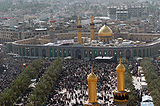 Imām Husayn Mosque
contains the tombs of:
The mosque stands on the site of the grave of Husayn ibn ‘Alī
, where he was martyred during the Battle of Karbalā
in 680. Up to a million pilgrims visit the city to observe ‘Āshūrā
, which marks the anniversary of Husayn ibn ‘Alī's death. There are many Shī‘ah traditions which narrate the status of Karbalā:
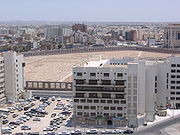
It is also thought that the real grave of Fatimatuz-Zahra'
, daughter of Muhammad
, lies here as well.
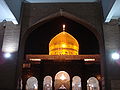
cemetery contains the graves of many relatives of Muhammad
, held in high esteem by the Shī‘ah, including:
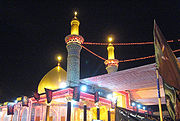 The Sayyidah Zaynab Mosque
contains the tomb of:
is located directly across from the Imām Husayn Mosque, and contains the tomb of:
Millions of pilgrims visit the shrine and pay homage to it every year. The real grave of Abbas is beneath the masoulem, and is present in the shrine. Emperors and kings of various dynasties have offered valuable gifts and gems to the shrine of Abbas. It was designed by Persian
and Central Asia
n architects. The brilliant splash of colors on the exterior and interior of the shrine are impressive. The central pear shaped dome is an ornately decorated structure. On its sides stand two tall minarets. The tomb is covered with pure gold and surrounded by a trellis of silver. Iranian carpets are rolled out on the floors.
contains the tomb of:
as well as sites related to the tragedy of Karbalā
. Some of the figures laid to rest here include:
). Some of them include:
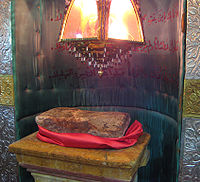
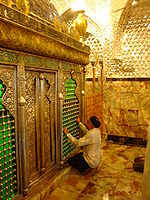
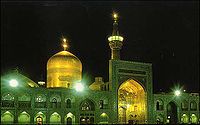 Imām Ridhā Mosque
contains the tomb of:
Imām Ridhā
is believed, by members of the Shī‘ah, to have been poisoned there upon orders of Caliph Al Ma'mun and the place was subsequently called, Mashhad ar-Ridhā (the place of martyrdom of ‘Alī ar-Ridhā
). By the end of the 9th century a dome was built on the grave and many buildings and Bazaars sprang up around it. For years totalling more than a millennium, the mosque was destroyed and reconstructed several times.
Nowadays Imām Ridhā shrine in Mashhad
, Iran
, is a complex which contains the mausoleum of Imām Ridhā
, the eighth Imām
of Twelvers. Also found within the complex is a museum, library, cemetery, mosque and seminaries. Today the holy shrine and its museum hold one of the most extensive cultural and artistic treasuries of Iran, in particular manuscript books and paintings. Several important theological schools are associated with the shrine of the Eighth Imam. As a city of great religious significance, it is also a place of pilgrimage
. It is said that the rich go to Makkah
but the poor journey to Mashhad. Thus, even as those who complete the pilgrimage to Makkah receive the title of Haji, those who make the pilgrimage to Mashhad–and especially to the Imam Ridha shrine–are known as Mashtee, a term employed also of its inhabitants. It is thought that over 20 million Muslims a year make the pilgrimage to Mashhad. It is generally considered to be the holiest Shiite shrine in Iran, and is sometimes ranked as the third holiest Shiite shrine in the world.
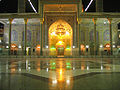
contains the tombs of:
Also buried within this mosque:
Some consider the mosque the third holiest in Shi'ite Islām.
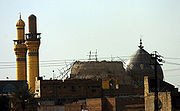 The Al ‘Askarī Mosque
contains the tombs of:
Also buried within this mosque:
The cellar from which the Twelfth or "Hidden" Imām, Muħammad al-Mahdī
disappeared from view is also found within this mosque.
At the time of the Al-Askari bombing in Samarra
, it was reported that the mosque was one of Shiite Islam's holiest sites, only exceeded by the shrines of Najaf and Karbala.
, has the following two Mosque's associated with him:
contains the tomb of:
Located in Qom
, Iran
, some consider the Fātimah al-Ma‘sūmah Mosque to be the third holiest shrine in Shī‘ah Islām. The shrine has attracted to itself dozens of seminaries and religious schools. Shah Abbas I built the shrine complex in the early 17th century.

Ahl al-Bayt
Ahl al-Bayt is an Arabic phrase literally meaning People of the House, or family of the House. The phrase "ahl al-bayt" was used in Arabia before the advent of Islam to refer to one's clan, and would be adopted by the ruling family of a tribe. Within the Islamic tradition, the term refers to the...
) and descendants (including the Shī‘ah Imāms
Imamah (Shi'a doctrine)
Imāmah is the Shia doctrine of religious, spiritual and political leadership of the Ummah. The Shīa believe that the A'immah are the true Caliphs or rightful successors of Muḥammad, and further that Imams are possessed of divine knowledge and authority as well as being part of the Ahl al-Bayt,...
), their companions, and the Prophets
Prophets of Islam
Muslims identify the Prophets of Islam as those humans chosen by God and given revelation to deliver to mankind. Muslims believe that every prophet was given a belief to worship God and their respective followers believed it as well...
as holy places. After Mecca and Madīnah, Najaf
Najaf
Najaf is a city in Iraq about 160 km south of Baghdad. Its estimated population in 2008 is 560,000 people. It is the capital of Najaf Governorate...
and Karbalā
Karbala
Karbala is a city in Iraq, located about southwest of Baghdad. Karbala is the capital of Karbala Governorate, and has an estimated population of 572,300 people ....
are the most revered by Shias.
Masjid al-Harām in Makkah, Saudi Arabia
Masjid al-HarāmMasjid al-Haram
Al-Masjid al-Ḥarām is the largest mosque in the world. Located in the city of Mecca, it surrounds the Kaaba, the place which Muslims worldwide turn towards while performing daily prayers and is Islam's holiest place...
("The Sacred Mosque"), is a large mosque
Mosque
A mosque is a place of worship for followers of Islam. The word is likely to have entered the English language through French , from Portuguese , from Spanish , and from Berber , ultimately originating in — . The Arabic word masjid literally means a place of prostration...
in the city of Makkah, and the largest in Islam
Islam
Islam . The most common are and . : Arabic pronunciation varies regionally. The first vowel ranges from ~~. The second vowel ranges from ~~~...
. It surrounds the Kaaba
Kaaba
The Kaaba is a cuboid-shaped building in Mecca, Saudi Arabia, and is the most sacred site in Islam. The Qur'an states that the Kaaba was constructed by Abraham, or Ibraheem, in Arabic, and his son Ishmael, or Ismaeel, as said in Arabic, after he had settled in Arabia. The building has a mosque...
, the place which all Muslims turn towards each day in prayer
Salat
Salah is the practice of formal prayer in Islam. Its importance for Muslims is indicated by its status as one of the Five Pillars of Sunni Islam, of the Ten Practices of the Religion of Twelver Islam and of the 7 pillars of Musta'lī Ismailis...
, considered by Muslims to be the holiest place on Earth
Earth
Earth is the third planet from the Sun, and the densest and fifth-largest of the eight planets in the Solar System. It is also the largest of the Solar System's four terrestrial planets...
.
The current structure covers an area of 356,800 square meters including the outdoor and indoor praying spaces and can accommodate up to 820,000 worshippers during the Hajj
Hajj
The Hajj is the pilgrimage to Mecca, Saudi Arabia. It is one of the largest pilgrimages in the world, and is the fifth pillar of Islam, a religious duty that must be carried out at least once in their lifetime by every able-bodied Muslim who can afford to do so...
period. During the Hajj
Hajj
The Hajj is the pilgrimage to Mecca, Saudi Arabia. It is one of the largest pilgrimages in the world, and is the fifth pillar of Islam, a religious duty that must be carried out at least once in their lifetime by every able-bodied Muslim who can afford to do so...
period, the mosque is unable to contain the multitude of pilgrims, who pray on the outlining streets. More than 2 million worshippers gather to pray during Eid
Eid ul-Fitr
Eid ul-Fitr, Eid al-Fitr, Id-ul-Fitr, or Id al-Fitr , often abbreviated to Eid, is a Muslim holiday that marks the end of Ramadan, the Islamic holy month of fasting . Eid is an Arabic word meaning "festivity," while Fiṭr means "breaking the fast"...
prayers.
According to the teachings of Islam, God in the Qur'an used the word Mosque when referring to the sites established by Ibrahim and his progeny as houses of worship to God centuries before the revelation of the Qur'an
Qur'an
The Quran , also transliterated Qur'an, Koran, Alcoran, Qur’ān, Coran, Kuran, and al-Qur’ān, is the central religious text of Islam, which Muslims consider the verbatim word of God . It is regarded widely as the finest piece of literature in the Arabic language...
. The first of these spots is Masjid al-Haram
Masjid al-Haram
Al-Masjid al-Ḥarām is the largest mosque in the world. Located in the city of Mecca, it surrounds the Kaaba, the place which Muslims worldwide turn towards while performing daily prayers and is Islam's holiest place...
in Mecca
Mecca
Mecca is a city in the Hijaz and the capital of Makkah province in Saudi Arabia. The city is located inland from Jeddah in a narrow valley at a height of above sea level...
and the second is Al-Aqsa Mosque
Al-Aqsa Mosque
Al-Aqsa Mosque also known as al-Aqsa, is the third holiest site in Sunni Islam and is located in the Old City of Jerusalem...
in Jerusalem. Before Mecca and Jerusalem came under Muslim control between 630 CE and 638 CE, the site of the Kaaba
Kaaba
The Kaaba is a cuboid-shaped building in Mecca, Saudi Arabia, and is the most sacred site in Islam. The Qur'an states that the Kaaba was constructed by Abraham, or Ibraheem, in Arabic, and his son Ishmael, or Ismaeel, as said in Arabic, after he had settled in Arabia. The building has a mosque...
, which was supposedly established by Abraham
Abraham
Abraham , whose birth name was Abram, is the eponym of the Abrahamic religions, among which are Judaism, Christianity and Islam...
and Ishmael
Ishmael
Ishmael is a figure in the Hebrew Bible and the Qur'an, and was Abraham's first born child according to Jews, Christians and Muslims. Ishmael was born of Abraham's marriage to Sarah's handmaiden Hagar...
, was used by non-Muslim Arabs who worshipped multiple gods.
Masjid-an-Nabawi in Madīnah, Saudi Arabia
Masjid al-NabawiAl-Masjid al-Nabawi
Al-Masjid al-Nabawi , often called the Prophet's Mosque, is a mosque situated in the city of Medina. As the final resting place of the Islamic prophet Muhammad, it is considered the second holiest site in Islam by Muslims and is one of the largest mosques in the world...
("Mosque of the Prophet"), located in Madīnah
Medina
Medina , or ; also transliterated as Madinah, or madinat al-nabi "the city of the prophet") is a city in the Hejaz region of western Saudi Arabia, and serves as the capital of the Al Madinah Province. It is the second holiest city in Islam, and the burial place of the Islamic Prophet Muhammad, and...
, is the second holiest site in Islam.
The edifice was originally Muhammad's house; he settled there after his Hijrah (emigration) to Medina
Medina
Medina , or ; also transliterated as Madinah, or madinat al-nabi "the city of the prophet") is a city in the Hejaz region of western Saudi Arabia, and serves as the capital of the Al Madinah Province. It is the second holiest city in Islam, and the burial place of the Islamic Prophet Muhammad, and...
, and later built a mosque on the grounds. He himself shared in the heavy work of construction. The original mosque was an open-air building, with no gender separation. The mosque also served as a community center, a court, and a religious school. There was a raised platform for the people who taught the Qur'an
Qur'an
The Quran , also transliterated Qur'an, Koran, Alcoran, Qur’ān, Coran, Kuran, and al-Qur’ān, is the central religious text of Islam, which Muslims consider the verbatim word of God . It is regarded widely as the finest piece of literature in the Arabic language...
. The basic plan of the building has been adopted in the building of other mosques throughout the world.
The original mosque was built by the Islamic prophet
Prophets of Islam
Muslims identify the Prophets of Islam as those humans chosen by God and given revelation to deliver to mankind. Muslims believe that every prophet was given a belief to worship God and their respective followers believed it as well...
Muhammad
Muhammad
Muhammad |ligature]] at U+FDF4 ;Arabic pronunciation varies regionally; the first vowel ranges from ~~; the second and the last vowel: ~~~. There are dialects which have no stress. In Egypt, it is pronounced not in religious contexts...
. Subsequent Islamic rulers greatly expanded and decorated the mosque. The most important feature of the site is the green dome over the center of the mosque, where the tomb of Muhammad is located. Constructed in 1817C.E. and painted green in 1839C.E., it is known as the Dome of the Prophet.
The Masjid Al Aqsa in Jerusalem
It is the third holiest mosque of Islam. From this place, The prophet Mohammed has ascended the heaven and returned.
Imām ‘Alī Mosque in Najaf, Iraq
Imam Ali Mosque
The Imām ‘Alī Holy Shrine , also known as Masjid Ali or the Mosque of ‘Alī, located in Najaf, Iraq, is the third holiest site for some of the estimated 200 million followers of the Shia branch of Islam. ‘Alī ibn Abī Tālib, the cousin of Muhammad, the fourth caliph , the first Imam is buried here...
contains the tomb of:
- First Shī‘ah ImāmImamah (Shi'a doctrine)Imāmah is the Shia doctrine of religious, spiritual and political leadership of the Ummah. The Shīa believe that the A'immah are the true Caliphs or rightful successors of Muḥammad, and further that Imams are possessed of divine knowledge and authority as well as being part of the Ahl al-Bayt,...
, ‘Alī ibn Abī TālibShi'a view of AliThis article discusses Orthodox Shi'a sources on the biography of ‘Alī ibn Abī Tālib , the cousin and son-in-law to Prophet Muhammad, member of the Prophet's Ahl al-Bayt and third Caliph....
Also buried within this mosque according to shi'a islam:
- Prophet AdamAdam and EveAdam and Eve were, according to the Genesis creation narratives, the first human couple to inhabit Earth, created by YHWH, the God of the ancient Hebrews...
- Prophet NoahNoahNoah was, according to the Hebrew Bible, the tenth and last of the antediluvian Patriarchs. The biblical story of Noah is contained in chapters 6–9 of the book of Genesis, where he saves his family and representatives of all animals from the flood by constructing an ark...
‘Alī ibn Abī Tālib
Shi'a view of Ali
This article discusses Orthodox Shi'a sources on the biography of ‘Alī ibn Abī Tālib , the cousin and son-in-law to Prophet Muhammad, member of the Prophet's Ahl al-Bayt and third Caliph....
was the cousin and son-in-law of the Islāmic prophet Muhammad
Muhammad
Muhammad |ligature]] at U+FDF4 ;Arabic pronunciation varies regionally; the first vowel ranges from ~~; the second and the last vowel: ~~~. There are dialects which have no stress. In Egypt, it is pronounced not in religious contexts...
. He is considered by Shi‘ah tradition to be the first legitimate caliph and the first Imām
Imam
An imam is an Islamic leadership position, often the worship leader of a mosque and the Muslim community. Similar to spiritual leaders, the imam is the one who leads Islamic worship services. More often, the community turns to the mosque imam if they have a religious question...
due to the proclamation given by Muhammad. The site is visited annually by at least 8 million pilgrims on average, which is estimated to increase to 20 million in years to come.
Many Shī‘ah believe that ‘Alī did not want his grave to be desecrated by his enemies and consequently asked his friends and family to bury him secretly. This secret gravesite is supposed to have been revealed later during the Abbasid
Abbasid
The Abbasid Caliphate or, more simply, the Abbasids , was the third of the Islamic caliphates. It was ruled by the Abbasid dynasty of caliphs, who built their capital in Baghdad after overthrowing the Umayyad caliphate from all but the al-Andalus region....
caliphate by Ja‘far as-Sādiq
Ja'far al-Sadiq
Jaʿfar ibn Muhammad al-Sādiq was a descendant of Muhammad and a prominent Muslim jurist. He is revered as an Imam by the adherents of Shi'a Islam and as a renowned Islamic scholar and personality by Sunni Muslims. The Shi'a Muslims consider him to be the sixth Imam or leader and spiritual...
, the Sixth Shī‘ah Imām
Imamah (Shi'a doctrine)
Imāmah is the Shia doctrine of religious, spiritual and political leadership of the Ummah. The Shīa believe that the A'immah are the true Caliphs or rightful successors of Muḥammad, and further that Imams are possessed of divine knowledge and authority as well as being part of the Ahl al-Bayt,...
. Most Shī‘as accept that ‘Alī is buried in Imām ‘Alī Mosque
Imam Ali Mosque
The Imām ‘Alī Holy Shrine , also known as Masjid Ali or the Mosque of ‘Alī, located in Najaf, Iraq, is the third holiest site for some of the estimated 200 million followers of the Shia branch of Islam. ‘Alī ibn Abī Tālib, the cousin of Muhammad, the fourth caliph , the first Imam is buried here...
, in what is now the city of Najaf
Najaf
Najaf is a city in Iraq about 160 km south of Baghdad. Its estimated population in 2008 is 560,000 people. It is the capital of Najaf Governorate...
(which grew around the shrine).
It has also been narrated from Ja‘far as-Sādiq
Ja'far al-Sadiq
Jaʿfar ibn Muhammad al-Sādiq was a descendant of Muhammad and a prominent Muslim jurist. He is revered as an Imam by the adherents of Shi'a Islam and as a renowned Islamic scholar and personality by Sunni Muslims. The Shi'a Muslims consider him to be the sixth Imam or leader and spiritual...
, the 6th Imām, that Imām ‘Alī Mosque
Imam Ali Mosque
The Imām ‘Alī Holy Shrine , also known as Masjid Ali or the Mosque of ‘Alī, located in Najaf, Iraq, is the third holiest site for some of the estimated 200 million followers of the Shia branch of Islam. ‘Alī ibn Abī Tālib, the cousin of Muhammad, the fourth caliph , the first Imam is buried here...
is the third of five holy places: Makkah, Madīnah, Imām ‘Alī Mosque in Najaf
Najaf
Najaf is a city in Iraq about 160 km south of Baghdad. Its estimated population in 2008 is 560,000 people. It is the capital of Najaf Governorate...
, Imam Husayn Shrine in Karbalā
Karbala
Karbala is a city in Iraq, located about southwest of Baghdad. Karbala is the capital of Karbala Governorate, and has an estimated population of 572,300 people ....
, and the Shrine for Fātimah
Fatema Mæ'sume
Fātimah bint Mūsā' al-Kādhim , was the daughter of the seventh Twelver Shī‘ah Imām, Mūsā' al-Kādhim and sister of the eighth...
- daughter of Mūsā al-Kādhim
Musa al-Kadhim
' was the seventh of the Twelve Imams of Twelver Shi'a Islam. He was the son of Imam and his mother was Hamidah Khātūn, a student and former Zanjiyyah slave...
in Qom
Qom
Qom is a city in Iran. It lies by road southwest of Tehran and is the capital of Qom Province. At the 2006 census, its population was 957,496, in 241,827 families. It is situated on the banks of the Qom River....
.
Imām Husayn Mosque in Karbalā, Iraq
Imam Husayn Shrine
The Shrine of Husayn ibn ‘Alī is one of the oldest mosques on Earth and a holy site of Shīah Islām in the city of Karbalā, Iraq. It stands on the site of the grave of Husayn ibn ‘Alī, the second grandson of Muhammad, near the place where he was killed during the Battle of Karbalā in 680 C.E....
contains the tombs of:
- Grandson of MuhammadMuhammadMuhammad |ligature]] at U+FDF4 ;Arabic pronunciation varies regionally; the first vowel ranges from ~~; the second and the last vowel: ~~~. There are dialects which have no stress. In Egypt, it is pronounced not in religious contexts...
and Shī‘ah ImāmImamah (Shi'a doctrine)Imāmah is the Shia doctrine of religious, spiritual and political leadership of the Ummah. The Shīa believe that the A'immah are the true Caliphs or rightful successors of Muḥammad, and further that Imams are possessed of divine knowledge and authority as well as being part of the Ahl al-Bayt,...
, Husayn ibn ‘AlīHusayn ibn AliHussein ibn ‘Alī ibn Abī Ṭālib was the son of ‘Alī ibn Abī Ṭālib and Fātimah Zahrā... - ‘Alī al-Akbar, son of Husayn
- ‘Alī al-Asghar, son of Husayn
- Habīb ibn MadhāhirHabib ibn MuzahirHabīb ibn Muzāhir al-Asadi was of the Banu Asad clan, one of the companions of Muhammad who was martyred in Karbala.-Battle of Karbala:Habib heavily contributed in the Battle of Karbala. He fought with the third Shia Imam, Husayn ibn Ali against the forces of Yazid, led by Umar ibn Sa'ad...
- All the martyrs of Karbalā
- Ibrāhīm, son of Mūsā al-KādhimMusa al-Kadhim' was the seventh of the Twelve Imams of Twelver Shi'a Islam. He was the son of Imam and his mother was Hamidah Khātūn, a student and former Zanjiyyah slave...
- Seventh - Twelver Shī‘ah ImāmImamah (Shi'a doctrine)Imāmah is the Shia doctrine of religious, spiritual and political leadership of the Ummah. The Shīa believe that the A'immah are the true Caliphs or rightful successors of Muḥammad, and further that Imams are possessed of divine knowledge and authority as well as being part of the Ahl al-Bayt,...
The mosque stands on the site of the grave of Husayn ibn ‘Alī
Husayn ibn Ali
Hussein ibn ‘Alī ibn Abī Ṭālib was the son of ‘Alī ibn Abī Ṭālib and Fātimah Zahrā...
, where he was martyred during the Battle of Karbalā
Battle of Karbala
The Battle of Karbala took place on Muharram 10, in the year 61 of the Islamic calendar in Karbala, in present day Iraq. On one side of the highly uneven battle were a small group of supporters and relatives of Muhammad's grandson Husain ibn Ali, and on the other was a large military detachment...
in 680. Up to a million pilgrims visit the city to observe ‘Āshūrā
Day of Ashura
The Day of Ashura is on the 10th day of Muharram in the Islamic calendar and marks the climax of the Remembrance of Muharram.It is commemorated by Shia Muslims as a day of mourning for the martyrdom of Husayn ibn Ali, the grandson of the Islamic Prophet Muhammad at the Battle of Karbala on 10...
, which marks the anniversary of Husayn ibn ‘Alī's death. There are many Shī‘ah traditions which narrate the status of Karbalā:
Jannatul Baqī‘ in Madīnah, Saudi Arabia
Jannatul Baqī‘ is a cemetery located across from Masjid an-Nabawi and contains the tombs of:- Halīmah - wet nurse of MuhammadMuhammadMuhammad |ligature]] at U+FDF4 ;Arabic pronunciation varies regionally; the first vowel ranges from ~~; the second and the last vowel: ~~~. There are dialects which have no stress. In Egypt, it is pronounced not in religious contexts...
- Fatima bint Asad - the mother of ‘AlīShi'a view of AliThis article discusses Orthodox Shi'a sources on the biography of ‘Alī ibn Abī Tālib , the cousin and son-in-law to Prophet Muhammad, member of the Prophet's Ahl al-Bayt and third Caliph....
- Shī‘ah ImāmsImamah (Shi'a doctrine)Imāmah is the Shia doctrine of religious, spiritual and political leadership of the Ummah. The Shīa believe that the A'immah are the true Caliphs or rightful successors of Muḥammad, and further that Imams are possessed of divine knowledge and authority as well as being part of the Ahl al-Bayt,...
:- Hasan ibn ‘AlīHasan ibn AliAl-Hasan ibn ‘Alī ibn Abī Tālib is an important figure in Islam, the son of Fatimah the daughter of the Islamic prophet Muhammad, and of the fourth Caliph Ali ibn Abi Talib. Hasan is a member of the Ahl al-Bayt and Ahl al-Kisa...
- ‘Alī ibn Husayn
- Muhammad ibn ‘AlīMuhammad al-BaqirMuḥammad ibn ‘Alī al-Bāqir was the Fifth Imām to the Twelver Shi‘a and Fourth Imām to the Ismā‘īlī Shī‘a. His father was the previous Imām, ‘Alī ibn Ḥusayn, and his mother was Fatimah bint al-Hasan...
(Twelver/IsmailiIsmaili' is a branch of Shia Islam. It is the second largest branch of Shia Islam, after the Twelvers...
not Zaydi) - Ja‘far ibn MuhammadJa'far al-SadiqJaʿfar ibn Muhammad al-Sādiq was a descendant of Muhammad and a prominent Muslim jurist. He is revered as an Imam by the adherents of Shi'a Islam and as a renowned Islamic scholar and personality by Sunni Muslims. The Shi'a Muslims consider him to be the sixth Imam or leader and spiritual...
(Twelver/Ismaili) - Isma‘īl ibn Ja‘far (Ismaili)
- Hasan ibn ‘Alī
- Fātimah bint Hizam - the mother of ‘Abbās ibn ‘AlīAbbas ibn AliAl-‘Abbās ibn ‘Ali was the son of ‘Alī ibn Abī Tālib and fourth Rashidun Caliph) and Fātimah bint Hizam al-Kilabiyyah .Al-‘Abbās is revered by Muslims for his loyalty to his half-brother Husayn ibn ‘Alī, his respect for the...
- Bibi ShahrbānūShahrbanuShahrbānū , is a personage described to have been one of the daughters of Yazdegerd III, the last Emperor of the Sassanid dynasty of Persia/Iran...
- the mother of ‘Alī ibn Husayn
It is also thought that the real grave of Fatimatuz-Zahra'
Shi'a view of Fatimah
According to Shi'a and non-Muslim scholars, Fatima Zahra was Muhammad's only daughter. The Sunni belief that he had other daughters by Khadijah denies Ali ibn Abu Talib the distinction of being Muhammad's only son-in-law...
, daughter of Muhammad
Muhammad
Muhammad |ligature]] at U+FDF4 ;Arabic pronunciation varies regionally; the first vowel ranges from ~~; the second and the last vowel: ~~~. There are dialects which have no stress. In Egypt, it is pronounced not in religious contexts...
, lies here as well.
Jannatul Mu‘alla Cemetery in Makkah, Saudi Arabia
The Jannatul Mu‘allaJannatul Mualla
Jannatul Mualla also known as Al-Hajun, is a famous cemetery located in Makkah, Saudi Arabia.-History:...
cemetery contains the graves of many relatives of Muhammad
Muhammad
Muhammad |ligature]] at U+FDF4 ;Arabic pronunciation varies regionally; the first vowel ranges from ~~; the second and the last vowel: ~~~. There are dialects which have no stress. In Egypt, it is pronounced not in religious contexts...
, held in high esteem by the Shī‘ah, including:
- ‘Abdul Manaf - Great, great-grandfather of MuhammadMuhammadMuhammad |ligature]] at U+FDF4 ;Arabic pronunciation varies regionally; the first vowel ranges from ~~; the second and the last vowel: ~~~. There are dialects which have no stress. In Egypt, it is pronounced not in religious contexts...
- HāshimHashim ibn Abd ManafHashim ibn 'Abd Manaf was the great-grandfather of the Islamic prophet Muhammad and the progenitor of the Banu Hashim clan of the distinguished Quraish tribe in Mecca....
- Great-grandfather of MuhammadMuhammadMuhammad |ligature]] at U+FDF4 ;Arabic pronunciation varies regionally; the first vowel ranges from ~~; the second and the last vowel: ~~~. There are dialects which have no stress. In Egypt, it is pronounced not in religious contexts... - Abdul Mutallib - Grandfather of MuhammadMuhammadMuhammad |ligature]] at U+FDF4 ;Arabic pronunciation varies regionally; the first vowel ranges from ~~; the second and the last vowel: ~~~. There are dialects which have no stress. In Egypt, it is pronounced not in religious contexts...
- Abū TālibAbu Talib ibn ‘Abd al-MuttalibAbi Tlib ibn ‘Abd al-Muttalib also known as Abu Talib ibn al-Muttalib.Talib was in reality the elder son of Abd Munāf and elder brother to Ali Ibn Abd Munāf. He was an head of Bani Hashim clan of Quraysh tribe of Mecca in Arabia. He was married to Fatima bint Asad and was an uncle of the...
: Uncle of MuhammadMuhammadMuhammad |ligature]] at U+FDF4 ;Arabic pronunciation varies regionally; the first vowel ranges from ~~; the second and the last vowel: ~~~. There are dialects which have no stress. In Egypt, it is pronounced not in religious contexts...
and father of the First Shī‘ah ImāmImamah (Shi'a doctrine)Imāmah is the Shia doctrine of religious, spiritual and political leadership of the Ummah. The Shīa believe that the A'immah are the true Caliphs or rightful successors of Muḥammad, and further that Imams are possessed of divine knowledge and authority as well as being part of the Ahl al-Bayt,...
, ‘AlīShi'a view of AliThis article discusses Orthodox Shi'a sources on the biography of ‘Alī ibn Abī Tālib , the cousin and son-in-law to Prophet Muhammad, member of the Prophet's Ahl al-Bayt and third Caliph.... - Khadījah: First wife of MuhammadMuhammadMuhammad |ligature]] at U+FDF4 ;Arabic pronunciation varies regionally; the first vowel ranges from ~~; the second and the last vowel: ~~~. There are dialects which have no stress. In Egypt, it is pronounced not in religious contexts...
and mother of FātimahShi'a view of FatimahAccording to Shi'a and non-Muslim scholars, Fatima Zahra was Muhammad's only daughter. The Sunni belief that he had other daughters by Khadijah denies Ali ibn Abu Talib the distinction of being Muhammad's only son-in-law... - QāsimQasim ibn MuhammadQasim ibn Muhammad was the son of Muhammad and Khadijah bint Khuwaylid. He died in 605 CE, before his second birthday and is buried in Jannatul Mualla cemetery, Makkah, Saudi Arabia.-Siblings:*Abd-Allah ibn Muhammad*Ibrahim ibn Muhammad...
: son of MuhammadMuhammadMuhammad |ligature]] at U+FDF4 ;Arabic pronunciation varies regionally; the first vowel ranges from ~~; the second and the last vowel: ~~~. There are dialects which have no stress. In Egypt, it is pronounced not in religious contexts...
who died in his infancy - Possible grave of Aamina - Mother of MuhammadMuhammadMuhammad |ligature]] at U+FDF4 ;Arabic pronunciation varies regionally; the first vowel ranges from ~~; the second and the last vowel: ~~~. There are dialects which have no stress. In Egypt, it is pronounced not in religious contexts...
Sayyidah Zaynab Mosque in Damascus, Syria
Sayyidah Zaynab Mosque
Sayyidah Zaynab Mosque is a shrine located in Damascus, Syria, that contains the grave of Zaynab daughter of ‘Alī and Fātimah, and granddaughter of Muhammad ....
contains the tomb of:
- ZaynabZaynab bint AliZaynab bint Ali was the daughter of the Rashid Caliph and first Shi'i Imam, Ali and granddaughter of the Islamic prophet Muhammad through his daughter Fatimah....
, the daughter of ‘AlīShi'a view of AliThis article discusses Orthodox Shi'a sources on the biography of ‘Alī ibn Abī Tālib , the cousin and son-in-law to Prophet Muhammad, member of the Prophet's Ahl al-Bayt and third Caliph....
and FātimahShi'a view of FatimahAccording to Shi'a and non-Muslim scholars, Fatima Zahra was Muhammad's only daughter. The Sunni belief that he had other daughters by Khadijah denies Ali ibn Abu Talib the distinction of being Muhammad's only son-in-law...
, and the granddaughter of MuhammadMuhammadMuhammad |ligature]] at U+FDF4 ;Arabic pronunciation varies regionally; the first vowel ranges from ~~; the second and the last vowel: ~~~. There are dialects which have no stress. In Egypt, it is pronounced not in religious contexts...
.
Al-‘Abbās Mosque in Karbalā, Iraq
The Al-‘Abbās MosqueAl Abbas Mosque
The Al-‘Abbās Mosque or Masjid al-‘Abbās is the mausoleum of ‘Abbās ibn ‘Alī, located across from the Imām Husayn Mosque in Karbalā, Iraq. ‘Abbās was the brother Hasan and Husayn, and was the flag-bearer for Husayn in the Battle of Karbalā...
is located directly across from the Imām Husayn Mosque, and contains the tomb of:
- ‘Abbās ibn ‘Alī, son of ‘AlīShi'a view of AliThis article discusses Orthodox Shi'a sources on the biography of ‘Alī ibn Abī Tālib , the cousin and son-in-law to Prophet Muhammad, member of the Prophet's Ahl al-Bayt and third Caliph....
and brother of (Brother of Husayn)
Millions of pilgrims visit the shrine and pay homage to it every year. The real grave of Abbas is beneath the masoulem, and is present in the shrine. Emperors and kings of various dynasties have offered valuable gifts and gems to the shrine of Abbas. It was designed by Persian
Persian people
The Persian people are part of the Iranian peoples who speak the modern Persian language and closely akin Iranian dialects and languages. The origin of the ethnic Iranian/Persian peoples are traced to the Ancient Iranian peoples, who were part of the ancient Indo-Iranians and themselves part of...
and Central Asia
Central Asia
Central Asia is a core region of the Asian continent from the Caspian Sea in the west, China in the east, Afghanistan in the south, and Russia in the north...
n architects. The brilliant splash of colors on the exterior and interior of the shrine are impressive. The central pear shaped dome is an ornately decorated structure. On its sides stand two tall minarets. The tomb is covered with pure gold and surrounded by a trellis of silver. Iranian carpets are rolled out on the floors.
Sayyidah Ruqayya Mosque in Damascus, Syria
The Sayyidah Ruqayya MosqueSayyidah Ruqayya Mosque
Sayyidah Ruqayya Mosque is a shrine located in Damascus, Syria, that contains the grave of Sukayna , the infant daughter of Husayn ibn ‘Alī....
contains the tomb of:
- Fātimah, the youngest daughter of Husayn ibn ‘AlīHusayn ibn AliHussein ibn ‘Alī ibn Abī Ṭālib was the son of ‘Alī ibn Abī Ṭālib and Fātimah Zahrā...
, often referred to by her title: "Ruqayya".
Bāb Saghīr Cemetery in Damascus, Syria
The Bāb Saghīr cemetery contains the graves of many relatives of MuhammadMuhammad
Muhammad |ligature]] at U+FDF4 ;Arabic pronunciation varies regionally; the first vowel ranges from ~~; the second and the last vowel: ~~~. There are dialects which have no stress. In Egypt, it is pronounced not in religious contexts...
as well as sites related to the tragedy of Karbalā
Battle of Karbala
The Battle of Karbala took place on Muharram 10, in the year 61 of the Islamic calendar in Karbala, in present day Iraq. On one side of the highly uneven battle were a small group of supporters and relatives of Muhammad's grandson Husain ibn Ali, and on the other was a large military detachment...
. Some of the figures laid to rest here include:
- Umm Kulthūm, daughter of ‘AlīShi'a view of AliThis article discusses Orthodox Shi'a sources on the biography of ‘Alī ibn Abī Tālib , the cousin and son-in-law to Prophet Muhammad, member of the Prophet's Ahl al-Bayt and third Caliph....
and FātimahFatimahFatimah was a daughter of the Islamic prophet Muhammad from his first wife Khadijah bint Khuwaylid. She is regarded by Muslims as an exemplar for men and women. She remained at her father's side through the difficulties suffered by him at the hands of the Quraysh of Mecca...
, granddaughter of MuhammadMuhammadMuhammad |ligature]] at U+FDF4 ;Arabic pronunciation varies regionally; the first vowel ranges from ~~; the second and the last vowel: ~~~. There are dialects which have no stress. In Egypt, it is pronounced not in religious contexts... - Bilāl al-HabashiBilal ibn RibahBilal ibn Rabah or Bilal al-Habashi was an Ethiopian born in Mecca in the late 6th century, sometime between 578 and 582.The Islamic prophet Muhammad chose a former African slave Bilal as his muezzin, effectively making him the first muezzin of the Islamic faith...
, the Mu'adh-dhin of MuhammadMuhammadMuhammad |ligature]] at U+FDF4 ;Arabic pronunciation varies regionally; the first vowel ranges from ~~; the second and the last vowel: ~~~. There are dialects which have no stress. In Egypt, it is pronounced not in religious contexts... - HamīdahHamidahHamidah is a village in west-central Yemen. It is located in the San‘a’ Governorate.-External links:*...
, daughter of Muslim ibn AqeelMuslim ibn AqeelMuslim ibn Aqeel, or Muslim ibn Aqil, was the cousin of Hasan ibn Ali and Husayn ibn Ali, and the son of Aqeel ibn Abu Talib. Muslim ibn Aqeel was sent ahead as an envoy to Kufa to see if the people could be trusted to be loyal to the Imam Husayn. He sent word back saying that the people of Kufa...
- Maymūnah, daughter of the Hasan ibn ‘AlīHasan ibn AliAl-Hasan ibn ‘Alī ibn Abī Tālib is an important figure in Islam, the son of Fatimah the daughter of the Islamic prophet Muhammad, and of the fourth Caliph Ali ibn Abi Talib. Hasan is a member of the Ahl al-Bayt and Ahl al-Kisa...
- Sakīnah, daughter of Husayn ibn ‘AlīHusayn ibn AliHussein ibn ‘Alī ibn Abī Ṭālib was the son of ‘Alī ibn Abī Ṭālib and Fātimah Zahrā...
(not to be confused with Ruqayya who was the youngest) - AsmaAsma bint UmaysAsma bint Umais from the Banu Hashim tribe was a Sahabiyyah . Her grave can be found in Baab Sagheer cemetery, Damascus, Syria.-Family:...
, wife of Ja‘far at-TayyārJa`far bin Abi TalibJa‘far ibn Abī Tālib , also known as Ja‘far at-Tayyār, was the son of Abu Talib ibn 'Abdul Muttalib , and the elder brother of the fourth Sunni and first Shia caliph, Ali ibn Abi Talib... - Abdullah, son of ‘Alī ibn Husayn
Other tombs for the family of Imāms
There are many tombs of the various descendants of the Imāms (often called ImāmzādehImamzadeh
An Imāmzādeh is a word found in both the Persian and Urdu languages, that refers to an immediate descendant of a Shi'a Imam.Imamzadeh means “offspring” or descendent of an imam. There are many other different ways of spelling this term. Some of these are imamzada, imamzadah, and emamzadah...
). Some of them include:
- Masjid al-Kufa in Kūfā, Iraq - contains the tombs of Muslim ibn ‘AqīlMuslim ibn AqeelMuslim ibn Aqeel, or Muslim ibn Aqil, was the cousin of Hasan ibn Ali and Husayn ibn Ali, and the son of Aqeel ibn Abu Talib. Muslim ibn Aqeel was sent ahead as an envoy to Kufa to see if the people could be trusted to be loyal to the Imam Husayn. He sent word back saying that the people of Kufa...
, Hānī ibn ‘UrwaHani ibn UrwaIbn Ziyad summoned a retainer, Ma'qil, who he tasked to act a spy and pretend he was a Shi'a in order to locate the whereabouts of Muslim ibn Aqeel. With 3,000 dirhams in his hand and by falsely convincing Muslim ibn Awsaja al-Asadi of his sincerity, Ma'qil was invited into the presence of Muslim...
, and Mukhtār al-ThaqafīAl-Mukhtaral-Mukhtār ibn Abī ‘Ubayd Allah al-Thaqafī was an early Islamic revolutionary who led an abortive rebellion against the Umayyad Caliphs after the death of Husayn ibn Ali at the Battle of Karbala.-Life:...
. The Mosque also contains many important sites relating to the Prophets and ‘AlīShi'a view of AliThis article discusses Orthodox Shi'a sources on the biography of ‘Alī ibn Abī Tālib , the cousin and son-in-law to Prophet Muhammad, member of the Prophet's Ahl al-Bayt and third Caliph....
, including the place where he was fatally struck on the head while in SujoodProstrationProstration is the placement of the body in a reverentially or submissively prone position. Major world religions employ prostration either as a means of embodying reverence for a noble person, persons or doctrine, or as an act of submissiveness to a supreme being or beings... - Mount UhudMount UhudMount Uhud is a mountain in north of Medina. It is high. It was the site of the second battle between Muslim and Meccan forces. The Battle of Uhud was fought on 19 March, 625, between a force from the small Muslim community of Medina, in what is now north-western Arabia, and a force from...
near Madīnah, Saudi Arabia - bears the grave of HamzahHamza ibn ‘Abd al-MuttalibHamza ibn ‘Abdul-Muttalib [b.568-d.625] was the paternal uncle of the Islamic prophet Muhammad, and his foster-brother. He and Muhammad were raised together as they were almost the same age. With excellence in the arts of wrestling and swordsmanship...
the uncle of MuhammadMuhammadMuhammad |ligature]] at U+FDF4 ;Arabic pronunciation varies regionally; the first vowel ranges from ~~; the second and the last vowel: ~~~. There are dialects which have no stress. In Egypt, it is pronounced not in religious contexts...
, along with the graves of all the other Muslims who fell at the Battle of UhudBattle of UhudThe Battle of Uhud was fought on March 19, 625 at the valley located in front of Mount Uhud, in what is now northwestern Arabia. It occurred between a force from the Muslim community of Medina led by the Islamic prophet Muhammad, and a force led by Abu Sufyan ibn Harb from Mecca, the town from...
. - The tomb of Zayd ibn ‘AlīZayd ibn AliZayd ibn ‘Alī was the grandson of Husayn ibn Alī, the grandson of Muhammad. Zayd was born in Medina in 695. His father was the Shī‘ah Imam ‘Alī ibn Husayn "Zayn al-Abidīn"...
in Kūfā, Iraq
- Shah Abdol Azim Shrine in Rayy, Iran - entombs a descendant of Hasan ibn ‘AlīHasan ibn AliAl-Hasan ibn ‘Alī ibn Abī Tālib is an important figure in Islam, the son of Fatimah the daughter of the Islamic prophet Muhammad, and of the fourth Caliph Ali ibn Abi Talib. Hasan is a member of the Ahl al-Bayt and Ahl al-Kisa...
. The mosque also contains the tombs of a son of ‘Alī ibn Husayn and a son of Mūsā al-KādhimMusa al-Kadhim' was the seventh of the Twelve Imams of Twelver Shi'a Islam. He was the son of Imam and his mother was Hamidah Khātūn, a student and former Zanjiyyah slave...
. - Imāmzādeh Muhammad - a descendant of ‘Alī ibn Husayn (grandson of ZaydZayd ibn AliZayd ibn ‘Alī was the grandson of Husayn ibn Alī, the grandson of Muhammad. Zayd was born in Medina in 695. His father was the Shī‘ah Imam ‘Alī ibn Husayn "Zayn al-Abidīn"...
) in Mashhad, Iran. - Awlād Muslim Mosque in MusayyibMusayyibMusayyib is a city in the Babil Province, Iraq. As of 2003, its population is 279,939. Musayyib sits on both the east and west banks of the Euphrates River, which splits into the Hindiya and Hilla branches just south of the city. Musayyib's municipal government has heavy representation from the...
, Iraq - entombs the remains of the sons of Muslim ibn ‘AqīlMuslim ibn AqeelMuslim ibn Aqeel, or Muslim ibn Aqil, was the cousin of Hasan ibn Ali and Husayn ibn Ali, and the son of Aqeel ibn Abu Talib. Muslim ibn Aqeel was sent ahead as an envoy to Kufa to see if the people could be trusted to be loyal to the Imam Husayn. He sent word back saying that the people of Kufa...
.
Other places associated with Muhammad
- Masjid al-QubaQuba MosqueThe Quba Mosque in the outlying environs of Medina in Saudi Arabia, is the oldest mosque in the world. Its first stones were positioned by the Islamic prophet Muhammad on his emigration from the city of Mecca to Medina and the mosque was completed by his companions...
found just outside MadīnahMedinaMedina , or ; also transliterated as Madinah, or madinat al-nabi "the city of the prophet") is a city in the Hejaz region of western Saudi Arabia, and serves as the capital of the Al Madinah Province. It is the second holiest city in Islam, and the burial place of the Islamic Prophet Muhammad, and...
, Saudi Arabia, was the first Islamic mosqueMosqueA mosque is a place of worship for followers of Islam. The word is likely to have entered the English language through French , from Portuguese , from Spanish , and from Berber , ultimately originating in — . The Arabic word masjid literally means a place of prostration...
ever built. Its first stones were positioned by MuhammadMuhammadMuhammad |ligature]] at U+FDF4 ;Arabic pronunciation varies regionally; the first vowel ranges from ~~; the second and the last vowel: ~~~. There are dialects which have no stress. In Egypt, it is pronounced not in religious contexts...
on his emigrationHijra (Islam)The Hijra is the migration or journey of the Islamic prophet Muhammad and his followers from Mecca to Medina in 622 CE. Alternate spellings of this Arabic word are Hijrah, Hijrat or Hegira, the latter following the spelling rules of Latin.- Hijra of Muhammad :In September 622, warned of a plot to...
from the city of MakkahMeccaMecca is a city in the Hijaz and the capital of Makkah province in Saudi Arabia. The city is located inland from Jeddah in a narrow valley at a height of above sea level...
to Madīnah and was subsequently completed by his companions. MuhammadMuhammadMuhammad |ligature]] at U+FDF4 ;Arabic pronunciation varies regionally; the first vowel ranges from ~~; the second and the last vowel: ~~~. There are dialects which have no stress. In Egypt, it is pronounced not in religious contexts...
then waited for ‘AlīShi'a view of AliThis article discusses Orthodox Shi'a sources on the biography of ‘Alī ibn Abī Tālib , the cousin and son-in-law to Prophet Muhammad, member of the Prophet's Ahl al-Bayt and third Caliph....
to arrive before he entered the city of Medina|Madīnah. - Masjid al-QiblataynMasjid al-QiblatainMasjid al-Qiblatain is a mosque in Medina that is historically important for Muslims as the place where the Islamic prophet Muhammad, leading the prayer, is said to have been commanded to change the direction of prayer from Jerusalem to Mecca. Thus it uniquely contained two prayer niches...
in Madīnah, Saudi Arabia - the Mosque where the direction of prayer (qiblaQiblaThe Qiblah , also transliterated as Qibla, Kiblah or Kibla, is the direction that should be faced when a Muslim prays during salah...
) was changed from Jerusalem to MakkahMeccaMecca is a city in the Hijaz and the capital of Makkah province in Saudi Arabia. The city is located inland from Jeddah in a narrow valley at a height of above sea level... - Cave of HiraHiraHira or the Cave of Hira is a cave about from Mecca, on the mountain named Jabal Al-Nūr in the Hejaz region of present day Saudi Arabia...
located on the mountain Jabal an-NurJabal al-NourJabal an-Nour , , meaning "The Mountain of Light", is a mountain near the city of Mecca in Saudi Arabia...
in Saudi Arabia - the place where the first verses of the Qur'ān were revealed to MuhammadMuhammadMuhammad |ligature]] at U+FDF4 ;Arabic pronunciation varies regionally; the first vowel ranges from ~~; the second and the last vowel: ~~~. There are dialects which have no stress. In Egypt, it is pronounced not in religious contexts... - Masjid al-AqsaAl-Aqsa MosqueAl-Aqsa Mosque also known as al-Aqsa, is the third holiest site in Sunni Islam and is located in the Old City of Jerusalem...
("The Farthest Mosque"), is the general and oldest name for the compound of Islamic religious buildings in Jerusalem that includes al-Aqsa congregation mosque and the Dome of the RockDome of the RockThe Dome of the Rock is a shrine located on the Temple Mount in the Old City of Jerusalem. The structure has been refurbished many times since its initial completion in 691 CE at the order of Umayyad Caliph Abd al-Malik...
. The Al-Aqsa Mosque is sacred because it was the first of the two QiblaQiblaThe Qiblah , also transliterated as Qibla, Kiblah or Kibla, is the direction that should be faced when a Muslim prays during salah...
s. The mosque is also believed by many to be the area from where MuhammadMuhammadMuhammad |ligature]] at U+FDF4 ;Arabic pronunciation varies regionally; the first vowel ranges from ~~; the second and the last vowel: ~~~. There are dialects which have no stress. In Egypt, it is pronounced not in religious contexts...
is said to have ascended to heavenIsra and Mi'rajThe Isra and Mi'raj , are the two parts of a Night Journey that, according to Islamic tradition, the Islamic prophet Muhammad took during a single night around the year 621. It has been described as both a physical and spiritual journey...
. According to some narrations, a single prayer performed at this mosque is the same as having performed 500 prayers elsewhere.
Places associated with Imāms, Prophets & Karbalā
- Masjid al-Nuqtah in Aleppo, Syria - this Mosque contains a large stone where the head of Husayn ibn ‘AlīHusayn ibn AliHussein ibn ‘Alī ibn Abī Ṭālib was the son of ‘Alī ibn Abī Ṭālib and Fātimah Zahrā...
was placed, while on a stop-over along the journey from Karbalā to Damascus - Masjid al-Hannaanah in Kūfā, Iraq - contains some of the skin of Husayn ibn ‘AlīHusayn ibn AliHussein ibn ‘Alī ibn Abī Ṭālib was the son of ‘Alī ibn Abī Ṭālib and Fātimah Zahrā...
which was ripped off of him post-mortem by the aggressors of KarbalāBattle of KarbalaThe Battle of Karbala took place on Muharram 10, in the year 61 of the Islamic calendar in Karbala, in present day Iraq. On one side of the highly uneven battle were a small group of supporters and relatives of Muhammad's grandson Husain ibn Ali, and on the other was a large military detachment... - The House of ‘AlīShi'a view of AliThis article discusses Orthodox Shi'a sources on the biography of ‘Alī ibn Abī Tālib , the cousin and son-in-law to Prophet Muhammad, member of the Prophet's Ahl al-Bayt and third Caliph....
in Kūfā, Iraq - Umayyad MosqueUmayyad MosqueThe Umayyad Mosque, also known as the Great Mosque of Damascus or formerly the Basilica of Saint John the Baptist , is located in the old city of Damascus, is one of the largest and oldest mosques in the world...
in Damascus, Syria - entombs the head of John the BaptistJohn the BaptistJohn the Baptist was an itinerant preacher and a major religious figure mentioned in the Canonical gospels. He is described in the Gospel of Luke as a relative of Jesus, who led a movement of baptism at the Jordan River...
, as well as having sites relating to the tragedy of KarbalāBattle of KarbalaThe Battle of Karbala took place on Muharram 10, in the year 61 of the Islamic calendar in Karbala, in present day Iraq. On one side of the highly uneven battle were a small group of supporters and relatives of Muhammad's grandson Husain ibn Ali, and on the other was a large military detachment... - Great Mosque of AleppoGreat Mosque of AleppoThe Great Mosque of Aleppo or the Ummayad Mosque of Aleppo is the largest and oldest mosque in the city of Aleppo in northern Syria. The present mosque dates form the 13th century Mamluk period, only the Seljuk minaret of 1090 is older...
in Aleppo, Syria - entombs the remains of ZechariahZechariah (priest)In the Bible, Zechariah , is the father of John the Baptist, a priest of the sons of Aaron, a prophet in , and the husband of Elisabeth who is the cousin of Mary the mother of Jesus.In the Qur'an, Zechariah plays a similar role as the father of John the Baptist and ranks him as a prophet alongside...
, father of John the BaptistJohn the BaptistJohn the Baptist was an itinerant preacher and a major religious figure mentioned in the Canonical gospels. He is described in the Gospel of Luke as a relative of Jesus, who led a movement of baptism at the Jordan River...
. - Nabi Habeel MosqueNabi Habeel MosqueNabi Habeel Mosque is located on the west mountains of Damascus, near the Zabadani Valley, overlooking the villages of the Barada river , in Syria. This mosque is believed to contain the grave of Abel , son of Adam as believed by Muslims, who are frequent visitors of this mosque for ziyarat...
in Syria - contains the grave of Abel (Arabic: "Habeel" ), son of AdamAdam and EveAdam and Eve were, according to the Genesis creation narratives, the first human couple to inhabit Earth, created by YHWH, the God of the ancient Hebrews...
as believed by Shī‘ah Muslims - The Tomb of DanielTomb of DanielThe Tomb of Daniel is the traditional burial place of the biblical prophet Daniel. Various locations have been named for the site, but the tomb in Susa, Iran, is the most widely accepted, it being first mentioned by Benjamin of Tudela, who visited Asia between 1160 and 1163.-Susa, Iran:The Book of...
who is considered to have been a prophet in IslāmProphets of IslamMuslims identify the Prophets of Islam as those humans chosen by God and given revelation to deliver to mankind. Muslims believe that every prophet was given a belief to worship God and their respective followers believed it as well...
. - Masjid Al Mashhad al Husain in Askelon, Israel - contained the head of Imam Hussein ibn Ali.
Mosques associated with companions of Muhammad and the Imāms
- Tomb of Salman the PersianSalman the PersianSalman the Persian or Salman al Farisi was one of Muhammad's companions.During some of his later meetings with the other Sahaba, he was referred to as Abu Abdullah .-Birth place:...
and Jābir ibn ‘Abdullah al-AnsārīJabir ibn Abd-AllahJabir ibn 'Abdullah ibn 'Amr ibn Haram al-Ansari was a prominent companion of Muhammad and his descendants, the Shi'a Imams.-Early life:Jabir ibn Abdullah al-Ansari was born in Yathrib 15 years before the Hijra. He belonged to a poor family of Yathrib. He was from the tribe of Khazraj. His mother...
in al-Mada'inAl-Mada'inAl-Mada'in, meaning "The cities", is the name given to an ancient metropolis formed by Ctesiphon and Seleucia on opposite sides of the Tigris River in present-day Iraq...
, Iraq - Tomb of ‘Ammār ibn YāsirAmmar ibn YasirʻAmmār ibn Yāsir al-Ansi was one of the companions of the Islamic prophet Muhammad. He was one of the Muhajirun, and referred to as by Shia Muslims as one of the Four Companions....
and Uwais al-QarniUwais al-QarniUwais Qarni, known also as Saint Uwais Qarni was a Muslim mystic, martyr and philosopher of Yemen who lived during the lifetime of Muhammad, but never met Muhammad personally. As reported by the renowned historical scholar Ibn Battuta, Uwais' tomb is found in Ar-Raqqah, Syria, where he was killed...
in ar-Raqqah, Syria - Tomb of Maytham at-TammārMeesam TammarMaytham ibn Yahyā at-Tammār was a slave belonging to a woman of Banu Asad. Ali ibn Abi Talib purchased this slave from the woman and set him free in the way of Allah...
in Kufa, Iraq - Tomb of Kumayl ibn ZiyadKumayl ibn ZiyadKumayl bin Ziyad an-Nakha'i a companion of Muhammad, and later Ali, the final Sunni Rashidun Caliph and first Shi'a Imam. He is best known for the du'a or supplication in the Shi'a anthologies that bears his name, du'a al-Kumayl ....
in Kufa, Iraq - Tomb of Hujr ibn ‘AdīHujr ibn AdiHujr ibn Adi was a supporter of Ali ibn Abi talib, he and his companions were killed by Muawiya I for refusing to Curse Ali. Hujr asked that his son be killed before he did so that he will be sure that his son stayed on the love of Ali and will not be affected by his death.-Character and...
in Adra' (north of DamascusDamascusDamascus , commonly known in Syria as Al Sham , and as the City of Jasmine , is the capital and the second largest city of Syria after Aleppo, both are part of the country's 14 governorates. In addition to being one of the oldest continuously inhabited cities in the world, Damascus is a major...
), Syria
Imām Ridhā Mosque in Mashhad, Iran
Imam Reza shrine
Imām Reza shrine in Mashhad, Iran is a complex which contains the mausoleum of Imam Reza, the eighth Imām of Twelver Shi'ites. It is the largest mosque in the world by dimension and the second largest in capacity...
contains the tomb of:
- Eighth Shī‘ah ImāmImamah (Shi'a doctrine)Imāmah is the Shia doctrine of religious, spiritual and political leadership of the Ummah. The Shīa believe that the A'immah are the true Caliphs or rightful successors of Muḥammad, and further that Imams are possessed of divine knowledge and authority as well as being part of the Ahl al-Bayt,...
, ‘Alī ar-RidhāAli al-Rida‘Alī ibn Mūsā al-Rizā was the seventh descendant of the Islamic prophet Muhammad and the eighth of the Twelve Imams, according to Shia sect of Islam...
Imām Ridhā
Ali al-Rida
‘Alī ibn Mūsā al-Rizā was the seventh descendant of the Islamic prophet Muhammad and the eighth of the Twelve Imams, according to Shia sect of Islam...
is believed, by members of the Shī‘ah, to have been poisoned there upon orders of Caliph Al Ma'mun and the place was subsequently called, Mashhad ar-Ridhā (the place of martyrdom of ‘Alī ar-Ridhā
Ali al-Rida
‘Alī ibn Mūsā al-Rizā was the seventh descendant of the Islamic prophet Muhammad and the eighth of the Twelve Imams, according to Shia sect of Islam...
). By the end of the 9th century a dome was built on the grave and many buildings and Bazaars sprang up around it. For years totalling more than a millennium, the mosque was destroyed and reconstructed several times.
Nowadays Imām Ridhā shrine in Mashhad
Mashhad
Mashhad , is the second largest city in Iran and one of the holiest cities in the Shia Muslim world. It is also the only major Iranian city with an Arabic name. It is located east of Tehran, at the center of the Razavi Khorasan Province close to the borders of Afghanistan and Turkmenistan. Its...
, Iran
Iran
Iran , officially the Islamic Republic of Iran , is a country in Southern and Western Asia. The name "Iran" has been in use natively since the Sassanian era and came into use internationally in 1935, before which the country was known to the Western world as Persia...
, is a complex which contains the mausoleum of Imām Ridhā
Ali al-Rida
‘Alī ibn Mūsā al-Rizā was the seventh descendant of the Islamic prophet Muhammad and the eighth of the Twelve Imams, according to Shia sect of Islam...
, the eighth Imām
Twelve Imams
The Twelve Imams are the spiritual and political successors to Muhammad, the Prophet of Islam, in the Twelver or Ithna-‘ashariyyah branch of Shī‘ah Islam....
of Twelvers. Also found within the complex is a museum, library, cemetery, mosque and seminaries. Today the holy shrine and its museum hold one of the most extensive cultural and artistic treasuries of Iran, in particular manuscript books and paintings. Several important theological schools are associated with the shrine of the Eighth Imam. As a city of great religious significance, it is also a place of pilgrimage
Pilgrimage
A pilgrimage is a journey or search of great moral or spiritual significance. Typically, it is a journey to a shrine or other location of importance to a person's beliefs and faith...
. It is said that the rich go to Makkah
Mecca
Mecca is a city in the Hijaz and the capital of Makkah province in Saudi Arabia. The city is located inland from Jeddah in a narrow valley at a height of above sea level...
but the poor journey to Mashhad. Thus, even as those who complete the pilgrimage to Makkah receive the title of Haji, those who make the pilgrimage to Mashhad–and especially to the Imam Ridha shrine–are known as Mashtee, a term employed also of its inhabitants. It is thought that over 20 million Muslims a year make the pilgrimage to Mashhad. It is generally considered to be the holiest Shiite shrine in Iran, and is sometimes ranked as the third holiest Shiite shrine in the world.
Al Kādhimiyya Mosque in Baghdād, Iraq
The Al Kādhimiyya MosqueAl Kadhimiya Mosque
The Al-Kādhimiya Mosque is a shrine located in the Kādhimayn suburb of Baghdad, Iraq.It contains the tombs of the seventh Twelver Shī‘ah Imām Mūsā al-Kādhim and the ninth Twelver Shī‘ah Imām Muhammad at-Taqī....
contains the tombs of:
- Seventh Shī‘ah ImāmImamah (Shi'a doctrine)Imāmah is the Shia doctrine of religious, spiritual and political leadership of the Ummah. The Shīa believe that the A'immah are the true Caliphs or rightful successors of Muḥammad, and further that Imams are possessed of divine knowledge and authority as well as being part of the Ahl al-Bayt,...
, Mūsā al-KādhimMusa al-Kadhim' was the seventh of the Twelve Imams of Twelver Shi'a Islam. He was the son of Imam and his mother was Hamidah Khātūn, a student and former Zanjiyyah slave... - Ninth Shī‘ah ImāmImamah (Shi'a doctrine)Imāmah is the Shia doctrine of religious, spiritual and political leadership of the Ummah. The Shīa believe that the A'immah are the true Caliphs or rightful successors of Muḥammad, and further that Imams are possessed of divine knowledge and authority as well as being part of the Ahl al-Bayt,...
, Muhammad at-Taqī
Also buried within this mosque:
- Shaykh Mufīd
- Shaykh Nasīr ad-Dīn TūsiNasir al-Din al-TusiKhawaja Muḥammad ibn Muḥammad ibn Ḥasan Ṭūsī , better known as Naṣīr al-Dīn al-Ṭūsī , was a Persian polymath and prolific writer: an astronomer, biologist, chemist, mathematician, philosopher, physician, physicist, scientist, theologian and Marja Taqleed...
Some consider the mosque the third holiest in Shi'ite Islām.
Al ‘Askarī Mosque in Sāmarrā, Iraq
Al-Askari Mosque
Al ‘Askarī Mosque or the ‘Askariyya Mosque/Shrine is a Shī‘ah Muslim holy site located in the Iraqi city of Sāmarrā from Baghdad. It is one of the most important Shī‘ah mosques in the world, built in 944...
contains the tombs of:
- Tenth Shī‘ah ImāmImamah (Shi'a doctrine)Imāmah is the Shia doctrine of religious, spiritual and political leadership of the Ummah. The Shīa believe that the A'immah are the true Caliphs or rightful successors of Muḥammad, and further that Imams are possessed of divine knowledge and authority as well as being part of the Ahl al-Bayt,...
, ‘Alī an-NaqīAli al-Hadi‘Alī al-Hādī , also known as ‘Alī an-Naqī was the tenth of the Twelve Imams. His full name is ‘Alī ibn Muhammad ibn ‘Alī. The exact date of his birth and death are unknown, but it is generally accepted that he was born between 827–830 CE and he died in 868 CE.- Early years :‘Alī al-Hādī was born... - Eleventh Shī‘ah ImāmImamah (Shi'a doctrine)Imāmah is the Shia doctrine of religious, spiritual and political leadership of the Ummah. The Shīa believe that the A'immah are the true Caliphs or rightful successors of Muḥammad, and further that Imams are possessed of divine knowledge and authority as well as being part of the Ahl al-Bayt,...
, Hasan al-‘AskarīHasan al-AskariHasan al-‘Askarī was the eleventh of the Twelve Imams. His given name was Hasan ibn ‘Alī ibn Muhammad...
Also buried within this mosque:
- Hakimah Khātūn - sister of ‘Alī an-NaqīAli al-Hadi‘Alī al-Hādī , also known as ‘Alī an-Naqī was the tenth of the Twelve Imams. His full name is ‘Alī ibn Muhammad ibn ‘Alī. The exact date of his birth and death are unknown, but it is generally accepted that he was born between 827–830 CE and he died in 868 CE.- Early years :‘Alī al-Hādī was born...
- Narjis KhātūnNarjisNarjis was the mother of Muhammad al-Mahdi the twelfth and last Imam of Shi'a Islam and the grand-daughter of Bardas .There are two traditions regarding her ancestry, one saying that she is African while the other saying she is Greek ....
- mother of Muħammad al-MāhdīMuhammad al-MahdiMuḥammad ibn al-Ḥasan al-Mahdī is believed by Twelver Shī‘a Muslims to be the Mahdī, an ultimate savior of humankind and the final Imām of the Twelve Imams...
(Twelfth Shī‘ah ImāmImamah (Shi'a doctrine)Imāmah is the Shia doctrine of religious, spiritual and political leadership of the Ummah. The Shīa believe that the A'immah are the true Caliphs or rightful successors of Muḥammad, and further that Imams are possessed of divine knowledge and authority as well as being part of the Ahl al-Bayt,...
)
The cellar from which the Twelfth or "Hidden" Imām, Muħammad al-Mahdī
Muhammad al-Mahdi
Muḥammad ibn al-Ḥasan al-Mahdī is believed by Twelver Shī‘a Muslims to be the Mahdī, an ultimate savior of humankind and the final Imām of the Twelve Imams...
disappeared from view is also found within this mosque.
At the time of the Al-Askari bombing in Samarra
Samarra
Sāmarrā is a city in Iraq. It stands on the east bank of the Tigris in the Salah ad-Din Governorate, north of Baghdad and, in 2003, had an estimated population of 348,700....
, it was reported that the mosque was one of Shiite Islam's holiest sites, only exceeded by the shrines of Najaf and Karbala.
Mosques associated with the Twelfth Shī‘ah Imām
The final Imām, considered to be alive and in occultationThe Occultation
The Occultation in Shia Islam refers to a belief that the messianic figure, or Mahdi, who in Shi'i thought is an infallible male descendant of the founder of Islam, Muhammad, was born but disappeared, and will one day return and fill the world with justice. Some Shi'is, such as the Zaidi and...
, has the following two Mosque's associated with him:
- Jamkarān MosqueJamkaranJamkaran is a village in Qanavat Rural District, in the Central District of Qom County, Qom Province, Iran. At the 2006 census, its population was 8,368, in 1,747 families....
in Qom, Irān - Masjid al-Sahlah in Kūfa, Iraq
Fātimah al-Ma‘sūmah Mosque in Qom, Iran
The Fātimah al-Ma‘sūmah MosqueFatima al-Masumeh Shrine
The shrine of Fatema Mæ'sume is located in Qom, the second most sacred city in Iran after Mashhad. Much of the shrine complex was first built by Shah Abbas I in the early 17th century. The shrine has attracted to itself dozens of seminaries and religious schools...
contains the tomb of:
- Fātimah al-Ma‘sūmahFatema Mæ'sumeFātimah bint Mūsā' al-Kādhim , was the daughter of the seventh Twelver Shī‘ah Imām, Mūsā' al-Kādhim and sister of the eighth...
, sister of the Eighth Shī‘ah ImāmImamah (Shi'a doctrine)Imāmah is the Shia doctrine of religious, spiritual and political leadership of the Ummah. The Shīa believe that the A'immah are the true Caliphs or rightful successors of Muḥammad, and further that Imams are possessed of divine knowledge and authority as well as being part of the Ahl al-Bayt,...
, ‘Alī ar-RidhāAli al-Rida‘Alī ibn Mūsā al-Rizā was the seventh descendant of the Islamic prophet Muhammad and the eighth of the Twelve Imams, according to Shia sect of Islam...
Located in Qom
Qom
Qom is a city in Iran. It lies by road southwest of Tehran and is the capital of Qom Province. At the 2006 census, its population was 957,496, in 241,827 families. It is situated on the banks of the Qom River....
, Iran
Iran
Iran , officially the Islamic Republic of Iran , is a country in Southern and Western Asia. The name "Iran" has been in use natively since the Sassanian era and came into use internationally in 1935, before which the country was known to the Western world as Persia...
, some consider the Fātimah al-Ma‘sūmah Mosque to be the third holiest shrine in Shī‘ah Islām. The shrine has attracted to itself dozens of seminaries and religious schools. Shah Abbas I built the shrine complex in the early 17th century.
Tombs of other family members of Muhammad
- Shrine of Muhammad ibn ‘Alī al-HādīAli al-Hadi‘Alī al-Hādī , also known as ‘Alī an-Naqī was the tenth of the Twelve Imams. His full name is ‘Alī ibn Muhammad ibn ‘Alī. The exact date of his birth and death are unknown, but it is generally accepted that he was born between 827–830 CE and he died in 868 CE.- Early years :‘Alī al-Hādī was born...
- entombs the remains of Muhammad, son of ‘Alī al-HādīAli al-Hadi‘Alī al-Hādī , also known as ‘Alī an-Naqī was the tenth of the Twelve Imams. His full name is ‘Alī ibn Muhammad ibn ‘Alī. The exact date of his birth and death are unknown, but it is generally accepted that he was born between 827–830 CE and he died in 868 CE.- Early years :‘Alī al-Hādī was born...
in BaladBalad, IraqBalad is a city north of Baghdad in the Salah ad Din Governorate Iraq. It is located within the borders of the so-called Sunni Triangle; however, Balad is a primarily Shiite town of approximately 100,000...
, IraqIraqIraq ; officially the Republic of Iraq is a country in Western Asia spanning most of the northwestern end of the Zagros mountain range, the eastern part of the Syrian Desert and the northern part of the Arabian Desert.... - Imāmzādeh SālihImam Zadeh SalehImāmzādeh Sāleh is one of many Imāmzadeh mosques in Iran. The mosque is located at Tajrish Square in Tehran's northern Shemiran district. The mosque entombs the remains of Sāleh, a son of the Twelver Shī‘ah Imām, Mūsā al-Kādhim, and is one of the most popular Shī‘ah shrines in northern Tehran.-See...
in Tehran, Iran - bears the grave of one of the sons of Mūsā al-KādhimMusa al-Kadhim' was the seventh of the Twelve Imams of Twelver Shi'a Islam. He was the son of Imam and his mother was Hamidah Khātūn, a student and former Zanjiyyah slave... - Shāh Cheragh MosqueShah CheraghShāh Chérāgh is a funerary monument and mosque in Shiraz, Iran, housing the tomb of the brothers Ahmad and Muhammad, sons of Mūsā al-Kādhim and brothers of ‘Alī ar-Ridhā...
in Shiraz, Iran - entombs the brothers of ‘Alī ar-Ridhā - Imāmzādeh Hamzah in Tabriz, Iran - entombs another son of Mūsā al-KādhimMusa al-Kadhim' was the seventh of the Twelve Imams of Twelver Shi'a Islam. He was the son of Imam and his mother was Hamidah Khātūn, a student and former Zanjiyyah slave...
- Shrine of Sultan Ali in Mashhad-e ArdehalMashhad-e ArdehalMashhad-e Ardehal is a village in Isfahan Province, Iran. It is located 40-45km east of the city of Kashan. The village contains the burial site of Sultan Ali and the notable modern Persian poet and painter Sohrab Sepehri and is known for its annual Carpet Washing Ceremony...
, Iran - entombs a son of the fifth Imām Muhammad al-BāqirMuhammad al-BaqirMuḥammad ibn ‘Alī al-Bāqir was the Fifth Imām to the Twelver Shi‘a and Fourth Imām to the Ismā‘īlī Shī‘a. His father was the previous Imām, ‘Alī ibn Ḥusayn, and his mother was Fatimah bint al-Hasan... - Shrine of Kusam ibn Abbas in SamarkandSamarkandAlthough a Persian-speaking region, it was not united politically with Iran most of the times between the disintegration of the Seleucid Empire and the Arab conquest . In the 6th century it was within the domain of the Turkic kingdom of the Göktürks.At the start of the 8th century Samarkand came...
, UzbekistanUzbekistanUzbekistan , officially the Republic of Uzbekistan is a doubly landlocked country in Central Asia and one of the six independent Turkic states. It shares borders with Kazakhstan to the west and to the north, Kyrgyzstan and Tajikistan to the east, and Afghanistan and Turkmenistan to the south....
- the cousin of Muhammad Shah-i-ZindaShah-i-ZindaShah-i-Zinda is a necropolis in the north-eastern part of Samarkand, Uzbekistan.The Shah-i-Zinda Ensemble includes mausoleums and other ritual buildings of 9-14th and 19th centuries. The name Shah-i-Zinda is connected with the legend that Kusam ibn Abbas, the cousin of the prophet Muhammad was... - Various ImāmzādehImamzadehAn Imāmzādeh is a word found in both the Persian and Urdu languages, that refers to an immediate descendant of a Shi'a Imam.Imamzadeh means “offspring” or descendent of an imam. There are many other different ways of spelling this term. Some of these are imamzada, imamzadah, and emamzadah...
scattered throughout IranIranIran , officially the Islamic Republic of Iran , is a country in Southern and Western Asia. The name "Iran" has been in use natively since the Sassanian era and came into use internationally in 1935, before which the country was known to the Western world as Persia...
and IraqIraqIraq ; officially the Republic of Iraq is a country in Western Asia spanning most of the northwestern end of the Zagros mountain range, the eastern part of the Syrian Desert and the northern part of the Arabian Desert....
See also
- ZiyaratZiyaratZiyārah is an Arabic term literally means "visit", used to refer to a pilgrimage to sites associated with Muhammad, his family members and descendants , his companions, or other venerated figures in Islām, such as the Prophets, Sufi saints and Islāmic scholars...
Further reading
- Aghaie, Kamran Scot (2004). The Martyrs of Karbala: Shi'i Symbols and Rituals in Modern Iran. University of Washington Press. ISBN 0295984481