


Hogmanay

Encyclopedia
Hogmanay is the Scots
word for the last day of the year and is synonymous with the celebration of the New Year
(Gregorian calendar
) in the Scottish manner. It is, however, normally only the start of a celebration which lasts through the night until the morning of New Year's Day
(1 January) or, in some cases, 2 January which is a Scottish Bank Holiday
.
of the word is obscure. It may have been introduced to Middle Scots
through the Auld Alliance
. In 1604 the custom was mentioned in the Elgin
Records as hagmonay. The most satisfactory explanation is a derivation from the Northern French dialect word hoguinané, or variants such as hoginane, hoginono and hoguinettes, those being derived from 16th century Old French
aguillanneuf meaning either a gift given at New Year, a children's cry for such a gift, or New Year's Eve itself. (This explanation is supported by a children's tradition, observed up to the 1960s in some parts of Scotland at least, of visiting houses in their locality on New Year's Eve and requesting and receiving small treats such as sweets or fruit.) The second element would appear to be l'an neuf i.e. the New Year. Compare those to Norman
hoguinané and the obsolete customs in Jersey
of crying ma hodgîngnole, and in Guernsey
of asking for an oguinane, for a New Year gift. Also see:http://en.wikipedia.org/wiki/La_Guiannee. In Québec, "la guignolée" was a door-to-door collection for the poor.
Other suggestions include French
hoguinané ('a New Year's gift'), au gui mener ('lead to the mistletoe'), au gui l'an neuf ('to the mistletoe the new year'), or (l')homme est né ('(the) man is born')
John Brand
's Popular Antiquities (1859) describes a custom in Kent
of 'going a hodening' at Christmas, going round the houses in procession and singing carols, accompanied by a sort of hobby-horse. (See Wassail
)
among the Norse
, as well as incorporating customs from the Gaelic
New Year's celebration of Samhain
. In Rome
, winter solstice evolved into the ancient celebration of Saturnalia
, a great winter festival, where people celebrated completely free of restraint and inhibition. The Viking
s celebrated Yule
, which later contributed to the Twelve Days of Christmas
, or the "Daft Days" as they were sometimes called in Scotland. The winter festival went underground with the Protestant Reformation
and ensuing years, but re-emerged near the end of the 17th century.
' which starts immediately after midnight. This involves being the first person to cross the threshold of a friend or neighbour and often involves the giving of symbolic gifts such as salt
(less common today), coal
, shortbread
, whisky
, and black bun
(a rich fruit cake) intended to bring different kinds of luck to the householder. Food and drink (as the gifts) are then given to the guests. This may go on throughout the early hours of the morning and well into the next day (although modern days see people visiting houses well into the middle of January). The first-foot is supposed to set the luck for the rest of the year. Traditionally, tall dark men are preferred as the first-foot.
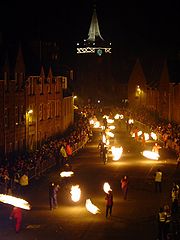
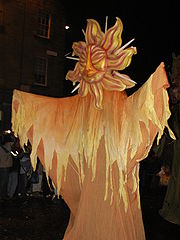 An example of a local Hogmanay custom is the fireball swinging that takes place in Stonehaven, Aberdeenshire
in north-east Scotland. This involves local people making up 'balls' of chicken wire filled with old newspaper, sticks, rags, and other dry flammable material up to a diameter of 60 cm, each attached to about 1 m of wire, chain or nonflammable rope. As the Old Town House bell sounds to mark the new year, the balls are set alight and the swingers set off up the High Street from the Mercat Cross to the Cannon and back, swinging the burning balls around their heads as they go. At the end of the ceremony, any fireballs that are still burning are cast into the harbour. Many people enjoy this display, and large crowds flock to see it, with 12,000 attending the 2007/2008 event. In recent years, additional attractions have been added to entertain the crowds as they wait for midnight, such as fire poi
, a pipe band
, street drumming and a firework display after the last fireball is cast into the sea. The festivities are now streamed live over the Internet.
Another example of a pagan fire festival is the burning the clavie
which takes place in the town of Burghead
in Moray
.
In the east coast fishing communities and Dundee
, first-footers used to carry a decorated herring
while in Falkland
in Fife
, local men would go in torchlight procession to the top of the Lomond Hills
as midnight approached. Bakers in St Andrews
would bake special cakes for their Hogmanay celebration (known as 'Cake Day') and distribute them to local children.
In Glasgow and the central areas of Scotland, the tradition is to hold Hogmanay parties involving singing, dancing, the eating of steak pie or stew, storytelling, and drink; these usually extend into the daylight hours of January 1.
Institutions also had their own traditions. For example, amongst the Scottish regiments, the officers had to wait on the men at special dinners while at the bells, the Old Year is piped out of barrack gates. The sentry then challenges the new escort outside the gates: 'Who goes there?' The answer is 'The New Year, all's well.'
An old custom in the Highlands, which has survived to a small extent and seen some degree of revival, is to celebrate Hogmanay with the saining (Scots
for 'protecting, blessing') of the household and livestock. Early on New Year's morning, householders drink and then sprinkle 'magic water' from 'a dead and living ford
' around the house (a 'dead and living ford' refers to a river ford that is routinely crossed by both the living and the dead). After the sprinkling of the water in every room, on the beds and all the inhabitants, the house is sealed up tight and branches of juniper are set on fire and carried throughout the house and byre. The juniper smoke is allowed to thoroughly fumigate the buildings until it causes sneezing and coughing among the inhabitants. Then all the doors and windows are flung open to let in the cold, fresh air of the new year. The woman of the house then administers 'a restorative' from the whisky bottle, and the household sits down to its New Year breakfast.
" has become common in many countries. "Auld Lang Syne" is a traditional poem reinterpreted by Robert Burns
, which was later set to music. It is now common for this to be sung in a circle of linked arms that are crossed over one another as the clock strikes midnight for New Year's Day, although it is only intended that participants link arms at the beginning of the final verse, coordinating with the lines of the song which contain the lyrics to do so. Typically it is only in Scotland this practice is carried out correctly.
The show was presented by Andy Stewart
who always began by singing "Come in, come in, it's nice to see you...." The show always ended with Andy Stewart and the cast singing, "Haste ye Back"
The performers were Jimmy Shand
and band, Ian Powrie and his band, Scottish country dancers: Dixie Ingram and the Dixie Ingram Dancers, Joe Gordon Folk Four, James Urquhart, Ann & Laura Brand, Moira Anderson
& Kenneth McKellar
. All the dancers, and Andy Stewart, wore kilts, and the women dancers wore long white dresses with tartan sashes.
Following the demise of the White Heather Club, Andy Stewart continued to feature regularly in TV Hogmanay shows until his retirement. His last appearance was in 1992.
In the 1980s comedian Andy Cameron
presented the Hogmanay show on BBC Scotland while Peter Morrison presented a show called "A Highland Hogmanay" on STV/Grampian. This was axed in 1993.
For many years, a staple of New Year's Eve television programming in Scotland was the comedy sketch show Scotch and Wry
featuring the comedian Rikki Fulton
, which invariably included a hilarious monologue from him as the preternaturally-gloomy Reverend I.M. Jolly.
Since 1993, the programmes that have been mainstays on BBC Scotland on Hogmanay have been Hogmanay Live
and Jonathan Watson
's football-themed sketch comedy show, Only an Excuse?
About 10 minutes before the end of Lewis Black's
special "Surviving the Holidays with Lewis Black" on the History Channel
, Craig Ferguson
described Hogmanay as follows: "In Scotland, New Year's is called Hogmanay. And it is a time when people who can inspire awe in the IRISH for the amount of ALCOHOL that they drink decide to RAMP IT UP a notch."
'It is ordinary among some plebeians in the South of Scotland to go about from door to door upon New-years Eve, crying Hagmane.'
Still in Scotland Hogmanay and Ne'erday are as or more important than Christmas Eve
and Christmas Day
in the rest of the UK.
Although Christmas Day held its normal religious nature in Scotland amongst its Catholic and Presbyterian communities, the Presbyterian national church, the Church of Scotland
, had discouraged the celebration of Christmas for over 400 years. However, 1 January and 2 January remain public holidays in Scotland and Hogmanay still is associated with as much celebration as Christmas in Scotland. Most Scots still celebrate Ne'erday with a special dinner, usually steak pie
.
 When Ne'erday falls on a Sunday, January 3rd becomes an additional public holiday in Scotland; when Ne'erday falls on a Saturday, both January 3rd and January 4th will be public holidays in Scotland; when Ne'erday falls on a Friday, January 4th becomes an additional public holiday in Scotland.
As in much of the world, the largest Scottish cities, Glasgow
, Edinburgh
and Aberdeen
hold all-night celebrations, as does Stirling
. The Edinburgh Hogmanay celebrations are among the largest in the world, although in 2003-4 most of the organised events were cancelled at short notice due to very high winds. The Stonehaven Fireballs went ahead as planned, however, with some 6000 people braving the stormy weather to watch 42 fireball swingers process along the High Street. Similarly, the 2006-07 celebrations in Edinburgh, Glasgow and Stirling were all cancelled on the day, again due to high winds and heavy rain. The Aberdeen celebration, however, went ahead, and was opened by the pop music group, Wet Wet Wet
.
. In modern Scotland this practice has died out.
Scots language
Scots is the Germanic language variety spoken in Lowland Scotland and parts of Ulster . It is sometimes called Lowland Scots to distinguish it from Scottish Gaelic, the Celtic language variety spoken in most of the western Highlands and in the Hebrides.Since there are no universally accepted...
word for the last day of the year and is synonymous with the celebration of the New Year
New Year
The New Year is the day that marks the time of the beginning of a new calendar year, and is the day on which the year count of the specific calendar used is incremented. For many cultures, the event is celebrated in some manner....
(Gregorian calendar
Gregorian calendar
The Gregorian calendar, also known as the Western calendar, or Christian calendar, is the internationally accepted civil calendar. It was introduced by Pope Gregory XIII, after whom the calendar was named, by a decree signed on 24 February 1582, a papal bull known by its opening words Inter...
) in the Scottish manner. It is, however, normally only the start of a celebration which lasts through the night until the morning of New Year's Day
New Year's Day
New Year's Day is observed on January 1, the first day of the year on the modern Gregorian calendar as well as the Julian calendar used in ancient Rome...
(1 January) or, in some cases, 2 January which is a Scottish Bank Holiday
Bank holidays in Scotland
Bank and Public holidays in Scotland are determined under the Banking and Financial Dealings Act 1971 and the St Andrew's Day Bank Holiday Act 2007. Unlike the rest of United Kingdom, most bank holidays are not recognized in Scotland, as most public holidays are generally determined by 32 local...
.
Etymology
The etymologyEtymology
Etymology is the study of the history of words, their origins, and how their form and meaning have changed over time.For languages with a long written history, etymologists make use of texts in these languages and texts about the languages to gather knowledge about how words were used during...
of the word is obscure. It may have been introduced to Middle Scots
Middle Scots
Middle Scots was the Anglic language of Lowland Scotland in the period from 1450 to 1700. By the end of the 13th century its phonology, orthography, accidence, syntax and vocabulary had diverged markedly from Early Scots, which was virtually indistinguishable from early Northumbrian Middle English...
through the Auld Alliance
Auld Alliance
The Auld Alliance was an alliance between the kingdoms of Scotland and France. It played a significant role in the relations between Scotland, France and England from its beginning in 1295 until the 1560 Treaty of Edinburgh. The alliance was renewed by all the French and Scottish monarchs of that...
. In 1604 the custom was mentioned in the Elgin
Elgin, Moray
Elgin is a former cathedral city and Royal Burgh in Moray, Scotland. It is the administrative and commercial centre for Moray. The town originated to the south of the River Lossie on the higher ground above the flood plain. Elgin is first documented in the Cartulary of Moray in 1190...
Records as hagmonay. The most satisfactory explanation is a derivation from the Northern French dialect word hoguinané, or variants such as hoginane, hoginono and hoguinettes, those being derived from 16th century Old French
Old French
Old French was the Romance dialect continuum spoken in territories that span roughly the northern half of modern France and parts of modern Belgium and Switzerland from the 9th century to the 14th century...
aguillanneuf meaning either a gift given at New Year, a children's cry for such a gift, or New Year's Eve itself. (This explanation is supported by a children's tradition, observed up to the 1960s in some parts of Scotland at least, of visiting houses in their locality on New Year's Eve and requesting and receiving small treats such as sweets or fruit.) The second element would appear to be l'an neuf i.e. the New Year. Compare those to Norman
Norman language
Norman is a Romance language and one of the Oïl languages. Norman can be classified as one of the northern Oïl languages along with Picard and Walloon...
hoguinané and the obsolete customs in Jersey
Jersey
Jersey, officially the Bailiwick of Jersey is a British Crown Dependency off the coast of Normandy, France. As well as the island of Jersey itself, the bailiwick includes two groups of small islands that are no longer permanently inhabited, the Minquiers and Écréhous, and the Pierres de Lecq and...
of crying ma hodgîngnole, and in Guernsey
Guernsey
Guernsey, officially the Bailiwick of Guernsey is a British Crown dependency in the English Channel off the coast of Normandy.The Bailiwick, as a governing entity, embraces not only all 10 parishes on the Island of Guernsey, but also the islands of Herm, Jethou, Burhou, and Lihou and their islet...
of asking for an oguinane, for a New Year gift. Also see:http://en.wikipedia.org/wiki/La_Guiannee. In Québec, "la guignolée" was a door-to-door collection for the poor.
Other suggestions include French
French language
French is a Romance language spoken as a first language in France, the Romandy region in Switzerland, Wallonia and Brussels in Belgium, Monaco, the regions of Quebec and Acadia in Canada, and by various communities elsewhere. Second-language speakers of French are distributed throughout many parts...
hoguinané ('a New Year's gift'), au gui mener ('lead to the mistletoe'), au gui l'an neuf ('to the mistletoe the new year'), or (l')homme est né ('(the) man is born')
John Brand
John Brand
John Brand was an English antiquarian.Born in Washington, County Durham, he was educated at the Royal Grammar School and Lincoln College, Oxford. He wrote Observations on the popular antiquities of Great Britain: Including the Whole of Mr. Bourne's Antiquitates Vulgares , generally referred to as...
's Popular Antiquities (1859) describes a custom in Kent
Kent
Kent is a county in southeast England, and is one of the home counties. It borders East Sussex, Surrey and Greater London and has a defined boundary with Essex in the middle of the Thames Estuary. The ceremonial county boundaries of Kent include the shire county of Kent and the unitary borough of...
of 'going a hodening' at Christmas, going round the houses in procession and singing carols, accompanied by a sort of hobby-horse. (See Wassail
Wassail
The word Wassail refers to several related traditions; first and foremost wassailing is an ancient southern English tradition that is performed with the intention of ensuring a good crop of cider apples for the next year's harvest...
)
Origins
The roots of Hogmanay perhaps reach back to the celebration of the winter solsticeWinter solstice
Winter solstice may refer to:* Winter solstice, astronomical event* Winter Solstice , former band* Winter Solstice: North , seasonal songs* Winter Solstice , 2005 American film...
among the Norse
Norsemen
Norsemen is used to refer to the group of people as a whole who spoke what is now called the Old Norse language belonging to the North Germanic branch of Indo-European languages, especially Norwegian, Icelandic, Faroese, Swedish and Danish in their earlier forms.The meaning of Norseman was "people...
, as well as incorporating customs from the Gaelic
Gaels
The Gaels or Goidels are speakers of one of the Goidelic Celtic languages: Irish, Scottish Gaelic, and Manx. Goidelic speech originated in Ireland and subsequently spread to western and northern Scotland and the Isle of Man....
New Year's celebration of Samhain
Samhain
Samhain is a Gaelic harvest festival held on October 31–November 1. It was linked to festivals held around the same time in other Celtic cultures, and was popularised as the "Celtic New Year" from the late 19th century, following Sir John Rhys and Sir James Frazer...
. In Rome
Ancient Rome
Ancient Rome was a thriving civilization that grew on the Italian Peninsula as early as the 8th century BC. Located along the Mediterranean Sea and centered on the city of Rome, it expanded to one of the largest empires in the ancient world....
, winter solstice evolved into the ancient celebration of Saturnalia
Saturnalia
Saturnalia is an Ancient Roman festival/ celebration held in honour of Saturn , the youngest of the Titans, father of the major gods of the Greeks and Romans, and son of Uranus and Gaia...
, a great winter festival, where people celebrated completely free of restraint and inhibition. The Viking
Viking
The term Viking is customarily used to refer to the Norse explorers, warriors, merchants, and pirates who raided, traded, explored and settled in wide areas of Europe, Asia and the North Atlantic islands from the late 8th to the mid-11th century.These Norsemen used their famed longships to...
s celebrated Yule
Yule
Yule or Yuletide is a winter festival that was initially celebrated by the historical Germanic people as a pagan religious festival, though it was later absorbed into, and equated with, the Christian festival of Christmas. The festival was originally celebrated from late December to early January...
, which later contributed to the Twelve Days of Christmas
Twelve Days of Christmas
The Twelve Days of Christmas are the festive days beginning Christmas Day . This period is also known as Christmastide and Twelvetide. The Twelfth Night of Christmas is always on the evening of 5 January, but the Twelfth Day can either precede or follow the Twelfth Night according to which...
, or the "Daft Days" as they were sometimes called in Scotland. The winter festival went underground with the Protestant Reformation
Protestant Reformation
The Protestant Reformation was a 16th-century split within Western Christianity initiated by Martin Luther, John Calvin and other early Protestants. The efforts of the self-described "reformers", who objected to the doctrines, rituals and ecclesiastical structure of the Roman Catholic Church, led...
and ensuing years, but re-emerged near the end of the 17th century.
Customs
There are many customs, both national and local, associated with Hogmanay. The most widespread national custom is the practice of 'first-footingFirst-Foot
In Scottish and Northern English folklore, the first-foot, also known in Manx Gaelic as quaaltagh or qualtagh, is the first person to cross the threshold of a home on New Year's Day and a bringer of good fortune for the coming year....
' which starts immediately after midnight. This involves being the first person to cross the threshold of a friend or neighbour and often involves the giving of symbolic gifts such as salt
Salt
In chemistry, salts are ionic compounds that result from the neutralization reaction of an acid and a base. They are composed of cations and anions so that the product is electrically neutral...
(less common today), coal
Coal
Coal is a combustible black or brownish-black sedimentary rock usually occurring in rock strata in layers or veins called coal beds or coal seams. The harder forms, such as anthracite coal, can be regarded as metamorphic rock because of later exposure to elevated temperature and pressure...
, shortbread
Shortbread
Shortbread is a type of unleavened biscuit which is traditionally made from one part white sugar, two parts butter, and three parts oatmeal flour. The use of plain white flour is common today, and other ingredients like ground rice or cornflour are sometimes added to alter the texture...
, whisky
Whisky
Whisky or whiskey is a type of distilled alcoholic beverage made from fermented grain mash. Different grains are used for different varieties, including barley, malted barley, rye, malted rye, wheat, and corn...
, and black bun
Black bun
Black bun is a type of fruit cake completely covered with pastry. It is Scottish in origin, originally eaten on Twelfth Night but now enjoyed at Hogmanay....
(a rich fruit cake) intended to bring different kinds of luck to the householder. Food and drink (as the gifts) are then given to the guests. This may go on throughout the early hours of the morning and well into the next day (although modern days see people visiting houses well into the middle of January). The first-foot is supposed to set the luck for the rest of the year. Traditionally, tall dark men are preferred as the first-foot.
Local customs
Each area of Scotland often developed its own particular Hogmanay ritual.Aberdeenshire
Aberdeenshire is one of the 32 unitary council areas in Scotland and a lieutenancy area.The present day Aberdeenshire council area does not include the City of Aberdeen, now a separate council area, from which its name derives. Together, the modern council area and the city formed historic...
in north-east Scotland. This involves local people making up 'balls' of chicken wire filled with old newspaper, sticks, rags, and other dry flammable material up to a diameter of 60 cm, each attached to about 1 m of wire, chain or nonflammable rope. As the Old Town House bell sounds to mark the new year, the balls are set alight and the swingers set off up the High Street from the Mercat Cross to the Cannon and back, swinging the burning balls around their heads as they go. At the end of the ceremony, any fireballs that are still burning are cast into the harbour. Many people enjoy this display, and large crowds flock to see it, with 12,000 attending the 2007/2008 event. In recent years, additional attractions have been added to entertain the crowds as they wait for midnight, such as fire poi
Fire dancing
Fire dancing is a group of performance arts or disciplines that involve manipulation of objects on fire...
, a pipe band
Pipe band
A pipe band is a musical ensemble consisting of pipers and drummers. The term used by military pipe bands, pipes and drums, is also common....
, street drumming and a firework display after the last fireball is cast into the sea. The festivities are now streamed live over the Internet.
Another example of a pagan fire festival is the burning the clavie
Burning the clavie
Burning the clavie is an ancient Scottish custom still observed at Burghead, a fishing village on the Moray Firth. The clavie is a bonfire of casks split in two, lighted on 11 January, i.e. the first day of the year by the Julian Calendar...
which takes place in the town of Burghead
Burghead
Burghead is a small town in Moray, Scotland, about 8 miles north-west of Elgin. The town is mainly built on a Peninsula which projects north-westward into the Moray Firth, meaning that most of the town has sea on 3 sides. The present town was built between 1805 and 1809, destroying in the...
in Moray
Moray
Moray is one of the 32 council areas of Scotland. It lies in the north-east of the country, with coastline on the Moray Firth, and borders the council areas of Aberdeenshire and Highland.- History :...
.
In the east coast fishing communities and Dundee
Dundee
Dundee is the fourth-largest city in Scotland and the 39th most populous settlement in the United Kingdom. It lies within the eastern central Lowlands on the north bank of the Firth of Tay, which feeds into the North Sea...
, first-footers used to carry a decorated herring
Herring
Herring is an oily fish of the genus Clupea, found in the shallow, temperate waters of the North Pacific and the North Atlantic oceans, including the Baltic Sea. Three species of Clupea are recognized. The main taxa, the Atlantic herring and the Pacific herring may each be divided into subspecies...
while in Falkland
Falkland, Fife
Falkland is a town and former royal burgh, formerly known as the Parish of Kilgour c1300AD in Fife, Scotland at the foot of the Lomond Hills.According to the 2008 population estimate, the village has a population of 1,180.- History :...
in Fife
Fife
Fife is a council area and former county of Scotland. It is situated between the Firth of Tay and the Firth of Forth, with inland boundaries to Perth and Kinross and Clackmannanshire...
, local men would go in torchlight procession to the top of the Lomond Hills
Lomond Hills
The Lomond Hills , also known as the Paps of Fife lie in the centre of Fife, Scotland. At 522m West Lomond is the highest point in the county of Fife.-Natural geography:...
as midnight approached. Bakers in St Andrews
St Andrews
St Andrews is a university town and former royal burgh on the east coast of Fife in Scotland. The town is named after Saint Andrew the Apostle.St Andrews has a population of 16,680, making this the fifth largest settlement in Fife....
would bake special cakes for their Hogmanay celebration (known as 'Cake Day') and distribute them to local children.
In Glasgow and the central areas of Scotland, the tradition is to hold Hogmanay parties involving singing, dancing, the eating of steak pie or stew, storytelling, and drink; these usually extend into the daylight hours of January 1.
Institutions also had their own traditions. For example, amongst the Scottish regiments, the officers had to wait on the men at special dinners while at the bells, the Old Year is piped out of barrack gates. The sentry then challenges the new escort outside the gates: 'Who goes there?' The answer is 'The New Year, all's well.'
An old custom in the Highlands, which has survived to a small extent and seen some degree of revival, is to celebrate Hogmanay with the saining (Scots
Scots language
Scots is the Germanic language variety spoken in Lowland Scotland and parts of Ulster . It is sometimes called Lowland Scots to distinguish it from Scottish Gaelic, the Celtic language variety spoken in most of the western Highlands and in the Hebrides.Since there are no universally accepted...
for 'protecting, blessing') of the household and livestock. Early on New Year's morning, householders drink and then sprinkle 'magic water' from 'a dead and living ford
Ford (crossing)
A ford is a shallow place with good footing where a river or stream may be crossed by wading or in a vehicle. A ford is mostly a natural phenomenon, in contrast to a low water crossing, which is an artificial bridge that allows crossing a river or stream when water is low.The names of many towns...
' around the house (a 'dead and living ford' refers to a river ford that is routinely crossed by both the living and the dead). After the sprinkling of the water in every room, on the beds and all the inhabitants, the house is sealed up tight and branches of juniper are set on fire and carried throughout the house and byre. The juniper smoke is allowed to thoroughly fumigate the buildings until it causes sneezing and coughing among the inhabitants. Then all the doors and windows are flung open to let in the cold, fresh air of the new year. The woman of the house then administers 'a restorative' from the whisky bottle, and the household sits down to its New Year breakfast.
"Auld Lang Syne"
The Hogmanay custom of singing "Auld Lang SyneAuld Lang Syne
"Auld Lang Syne" is a Scots poem written by Robert Burns in 1788 and set to the tune of a traditional folk song . It is well known in many countries, especially in the English-speaking world; its traditional use being to celebrate the start of the New Year at the stroke of midnight...
" has become common in many countries. "Auld Lang Syne" is a traditional poem reinterpreted by Robert Burns
Robert Burns
Robert Burns was a Scottish poet and a lyricist. He is widely regarded as the national poet of Scotland, and is celebrated worldwide...
, which was later set to music. It is now common for this to be sung in a circle of linked arms that are crossed over one another as the clock strikes midnight for New Year's Day, although it is only intended that participants link arms at the beginning of the final verse, coordinating with the lines of the song which contain the lyrics to do so. Typically it is only in Scotland this practice is carried out correctly.
In the media
During the years 1957 to 1968 a New Year's Eve television programme, called "The White Heather Club", was used to herald in the Hogmanay celebrations.The show was presented by Andy Stewart
Andy Stewart (musician)
Andrew "Andy" Stewart MBE was a Scottish singer and entertainer.-Career:The use of tartan patriotism and stereotypical Scottish humour goes back to Sir Harry Lauder and music hall songs. In the 1960s this strand was continued by the entertainer Andy Stewart.He was born in Glasgow, Scotland in...
who always began by singing "Come in, come in, it's nice to see you...." The show always ended with Andy Stewart and the cast singing, "Haste ye Back"
- Haste ye back, we loue you dearly,
- Call again you're welcome here.
- May your days be free from sorrow,
- And your friends be ever near.
- May the paths o'er which you wander,
- Be to you a joy each day.
- Haste ye back we loue you dearly,
- Haste ye back on friendship's way.
The performers were Jimmy Shand
Jimmy Shand
Sir James Shand MBE was a Scottish musician who played traditional Scottish dance music on the accordion.-Early life:...
and band, Ian Powrie and his band, Scottish country dancers: Dixie Ingram and the Dixie Ingram Dancers, Joe Gordon Folk Four, James Urquhart, Ann & Laura Brand, Moira Anderson
Moira Anderson
Moira Anderson, OBE is a Scottish singer.- Life and career :Following an education at Lenzie Academy, Anderson quickly established herself at the Royal Scottish Academy of Music and Drama in Glasgow before getting her big break in the media after a successful audition at the BBC.She landed her...
& Kenneth McKellar
Kenneth McKellar (singer)
Kenneth McKellar was a Scottish tenor.-Career:McKellar studied forestry at the University of Aberdeen, after graduation working for the Scottish Forestry Commission. He later trained at the Royal College of Music as an opera singer...
. All the dancers, and Andy Stewart, wore kilts, and the women dancers wore long white dresses with tartan sashes.
Following the demise of the White Heather Club, Andy Stewart continued to feature regularly in TV Hogmanay shows until his retirement. His last appearance was in 1992.
In the 1980s comedian Andy Cameron
Andy Cameron
Andy Cameron is a Scottish comedian, television and radio broadcaster. He was born in London while his father, Hugh Cameron, was serving in the Army during World War II. Cameron was raised by his grandmother, Isabella 'Bella' Cameron, in the Royal Burgh of Rutherglen, south east of Glasgow,...
presented the Hogmanay show on BBC Scotland while Peter Morrison presented a show called "A Highland Hogmanay" on STV/Grampian. This was axed in 1993.
For many years, a staple of New Year's Eve television programming in Scotland was the comedy sketch show Scotch and Wry
Scotch and Wry
Scotch and Wry was a Scottish comedy sketch show which was broadcast on BBC One Scotland and starred Rikki Fulton. After two series, in 1978 and 1979, the programme continued as a regular part of the channel's Hogmanay celebrations between 1980 and 1992...
featuring the comedian Rikki Fulton
Rikki Fulton
Robert Kerr Fulton, OBE , more commonly known as Rikki Fulton, was a Scottish comedian and actor best remembered for writing and performing in the long-running BBC Scotland sketch show, Scotch and Wry. He was also known for his appearances as one half of the double act, Francie and Josie, alongside...
, which invariably included a hilarious monologue from him as the preternaturally-gloomy Reverend I.M. Jolly.
Since 1993, the programmes that have been mainstays on BBC Scotland on Hogmanay have been Hogmanay Live
Hogmanay Live
Hogmanay Live is BBC Scotland's annual live event programme broadcast from either Edinburgh Castle's Great Hall or BBC Pacific Quay on Hogmanay . Regardless of location, the programme rings in the New Year with the firing of Edinburgh Castle's One O'Clock Gun and the subsequent fireworks and...
and Jonathan Watson
Jonathan Watson
Jonathan Watson is a Scottish comedian and impressionist best known for his comedy sketch show Only an Excuse?, which parodies people and events from the world of Scottish football. Watson also regularly appeared on Tam Cowan's Offside television programme on BBC One Scotland where he performed a...
's football-themed sketch comedy show, Only an Excuse?
Only an Excuse?
Only An Excuse? is an annual Scottish football comedy sketch show that airs each Hogmanay.Starring actor and comedian Jonathan Watson, the show features impressions of some of Scottish football's great characters such as Denis Law, Tommy Burns, Barry Ferguson, Sir Alex Ferguson, Frank McAvennie,...
About 10 minutes before the end of Lewis Black's
Lewis Black
Lewis Niles Black is an American stand-up comedian, author, playwright, social critic and actor. He is known for his comedy style, which often includes simulating a mental breakdown, or an increasingly angry rant, ridiculing history, politics, religion, trends and cultural phenomena...
special "Surviving the Holidays with Lewis Black" on the History Channel
The History Channel
History, formerly known as The History Channel, is an American-based international satellite and cable TV channel that broadcasts a variety of reality shows and documentary programs including those of fictional and non-fictional historical content, together with speculation about the future.-...
, Craig Ferguson
Craig Ferguson
Craig Ferguson is a Scottish American television host, stand-up comedian, writer, actor, director, author, and producer. He is the host of The Late Late Show with Craig Ferguson, an Emmy Award-nominated, Peabody Award-winning late-night talk show that airs on CBS...
described Hogmanay as follows: "In Scotland, New Year's is called Hogmanay. And it is a time when people who can inspire awe in the IRISH for the amount of ALCOHOL that they drink decide to RAMP IT UP a notch."
Presbyterian influence
The Presbyterian Church generally disapproved of Hogmanay. The following quote is one of the first mentions of the holiday in official church records:'It is ordinary among some plebeians in the South of Scotland to go about from door to door upon New-years Eve, crying Hagmane.'
Still in Scotland Hogmanay and Ne'erday are as or more important than Christmas Eve
Christmas Eve
Christmas Eve refers to the evening or entire day preceding Christmas Day, a widely celebrated festival commemorating the birth of Jesus of Nazareth that takes place on December 25...
and Christmas Day
Christmas
Christmas or Christmas Day is an annual holiday generally celebrated on December 25 by billions of people around the world. It is a Christian feast that commemorates the birth of Jesus Christ, liturgically closing the Advent season and initiating the season of Christmastide, which lasts twelve days...
in the rest of the UK.
Although Christmas Day held its normal religious nature in Scotland amongst its Catholic and Presbyterian communities, the Presbyterian national church, the Church of Scotland
Church of Scotland
The Church of Scotland, known informally by its Scots language name, the Kirk, is a Presbyterian church, decisively shaped by the Scottish Reformation....
, had discouraged the celebration of Christmas for over 400 years. However, 1 January and 2 January remain public holidays in Scotland and Hogmanay still is associated with as much celebration as Christmas in Scotland. Most Scots still celebrate Ne'erday with a special dinner, usually steak pie
Steak pie
A steak pie is a traditional meat pie served in Britain. It is made from stewing steak and beef gravy, enclosed in a pastry shell. Sometimes mixed vegetables are included in the filling. Steak pie is subtly different from Steak and kidney pie...
.
Ne'erday
As in much of the world, the largest Scottish cities, Glasgow
Glasgow
Glasgow is the largest city in Scotland and third most populous in the United Kingdom. The city is situated on the River Clyde in the country's west central lowlands...
, Edinburgh
Edinburgh
Edinburgh is the capital city of Scotland, the second largest city in Scotland, and the eighth most populous in the United Kingdom. The City of Edinburgh Council governs one of Scotland's 32 local government council areas. The council area includes urban Edinburgh and a rural area...
and Aberdeen
Aberdeen
Aberdeen is Scotland's third most populous city, one of Scotland's 32 local government council areas and the United Kingdom's 25th most populous city, with an official population estimate of ....
hold all-night celebrations, as does Stirling
Stirling
Stirling is a city and former ancient burgh in Scotland, and is at the heart of the wider Stirling council area. The city is clustered around a large fortress and medieval old-town beside the River Forth...
. The Edinburgh Hogmanay celebrations are among the largest in the world, although in 2003-4 most of the organised events were cancelled at short notice due to very high winds. The Stonehaven Fireballs went ahead as planned, however, with some 6000 people braving the stormy weather to watch 42 fireball swingers process along the High Street. Similarly, the 2006-07 celebrations in Edinburgh, Glasgow and Stirling were all cancelled on the day, again due to high winds and heavy rain. The Aberdeen celebration, however, went ahead, and was opened by the pop music group, Wet Wet Wet
Wet Wet Wet
Wet Wet Wet are a Scottish pop rock band that formed in the 1980s. They scored a number of hits in the British charts and around the world. The band is composed of Marti Pellow , Tommy Cunningham , Graeme Clark and Neil Mitchell...
.
Handsel Day
Historically, presents were given in Scotland on the first Monday of the New Year. This would be celebrated often by the employer giving his staff presents and parents giving children presents. Handsel Day is marked by teachers giving gifts to their students. A roast dinner would be eaten to celebrate the festival. Handsel was a word for gift box and hence Handsel DayHandsel Monday
Handsel Monday is the first Monday of the year, particularly as used to be celebrated in Scotland and northern England. Among the rural population of Scotland, Auld Hansel Monday, is traditionally celebrated on the first Monday after the 12th of January....
. In modern Scotland this practice has died out.