

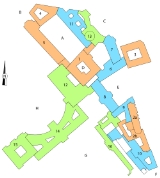
Hofburg Imperial Palace

Encyclopedia
Palace
A palace is a grand residence, especially a royal residence or the home of a head of state or some other high-ranking dignitary, such as a bishop or archbishop. The word itself is derived from the Latin name Palātium, for Palatine Hill, one of the seven hills in Rome. In many parts of Europe, the...
located in Vienna
Vienna
Vienna is the capital and largest city of the Republic of Austria and one of the nine states of Austria. Vienna is Austria's primary city, with a population of about 1.723 million , and is by far the largest city in Austria, as well as its cultural, economic, and political centre...
, Austria
Austria
Austria , officially the Republic of Austria , is a landlocked country of roughly 8.4 million people in Central Europe. It is bordered by the Czech Republic and Germany to the north, Slovakia and Hungary to the east, Slovenia and Italy to the south, and Switzerland and Liechtenstein to the...
, that has housed some of the most powerful people in Austrian history
History of Austria
The history of Austria covers the history of the current country of Austria and predecessor states, from the Iron Age, through to a sovereign state, annexation by the German Third Reich, partition after the Second World War and later developments until the present day...
, including the Habsburg
Habsburg
The House of Habsburg , also found as Hapsburg, and also known as House of Austria is one of the most important royal houses of Europe and is best known for being an origin of all of the formally elected Holy Roman Emperors between 1438 and 1740, as well as rulers of the Austrian Empire and...
dynasty, rulers of the Austro-Hungarian empire. It currently serves as the official residence of the President of Austria
President of Austria
The President of Austria is the federal head of state of Austria. Though theoretically entrusted with great power by the constitution, in practice the President acts, for the most part, merely as a ceremonial figurehead...
. It was the Habsburgs' principal winter residence, as the Schönbrunn Palace
Schönbrunn Palace
Schönbrunn Palace is a former imperial 1,441-room Rococo summer residence in Vienna, Austria. One of the most important cultural monuments in the country, since the 1960s it has been one of the major tourist attractions in Vienna...
was their preferred summer residence.
The Hofburg area has been the documented seat of government since 1279 for various empires and republics.
The Hofburg has been expanded over the centuries to include: various residences (with the Amalienburg), the chapel (Hofkapelle or Burgkapelle), museums (the Naturhistorisches Museum
Naturhistorisches Museum
The Naturhistorisches Museum Wien or NHMW is a large museum located in Vienna, Austria.The collections displayed cover , and the museum has a website providing an overview as a video virtual tour....
& Kunsthistorisches Museum
Kunsthistorisches Museum
The Kunsthistorisches Museum is an art museum in Vienna, Austria. Housed in its festive palatial building on Ringstraße, it is crowned with an octagonal dome...
), the Imperial Library (Hofbibliothek now the Prunksaal), the treasury (Schatzkammer
Schatzkammer (Vienna)
The Imperial Treasury in Vienna, Austria is located in the Hofburg with its entrance at the Schweizerhof , the oldest part of the palace rebuilt in a Renaissance style under Emperor Ferdinand I...
), the national theatre (Burgtheater
Burgtheater
The Burgtheater , originally known as K.K. Theater an der Burg, then until 1918 as the K.K. Hofburgtheater, is the Austrian National Theatre in Vienna and one of the most important German language theatres in the world.The Burgtheater was created in 1741 and has become known as "die Burg" by the...
), the riding school (Hofreitschule
Spanish Riding School
The Spanish Riding School of Vienna, Austria, is a traditional riding school for Lipizzan horses, which perform in the Winter Riding School in the Hofburg...
), the horse stables (the Stallburg and Hofstallungen)and the Hofburg Congress Center.
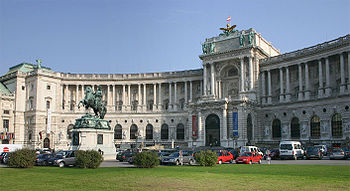
The Hofburg faces the Heldenplatz
Heldenplatz
The Heldenplatz is a historical plaza in Vienna. Many important actions took place here, most notably Adolf Hitler's announcement of the Anschluss of Austria to the German Reich in 1938.-The Plaza:...
ordered under the reign of Emperor Francis Joseph, as part of what was to become a Kaiserforum that was never completed.
Numerous architects have executed work at the Hofburg as it expanded, notably the Italian architect-engineer Filiberto Luchese (the Leopoldischiner Trakt), Lodovico Burnacini and Martino and Domenico Carlone, the Baroque
Baroque
The Baroque is a period and the style that used exaggerated motion and clear, easily interpreted detail to produce drama, tension, exuberance, and grandeur in sculpture, painting, literature, dance, and music...
architects Lukas von Hildebrandt and Joseph Emanuel Fischer von Erlach
Joseph Emanuel Fischer von Erlach
Joseph Emanuel Fischer von Erlach, also Fischer von Erlach the younger was an Austrianarchitect of the baroque, Rococo and baroque classicism.-Life and career:...
(the Reichschancelry Wing and the Winter Riding School), Johann Fischer von Erlach
Johann Bernhard Fischer von Erlach
----Johann Bernhard Fischer von Erlach, born Johann Bernhard Fischer was probably the most influential Austrian architect of the Baroque period....
(the library), and the architects of the grandiose Neue Burg built between 1881 and 1913.
History
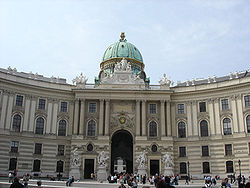
Emperor of Austria
The Emperor of Austria was a hereditary imperial title and position proclaimed in 1804 by the Holy Roman Emperor Francis II, a member of the House of Habsburg-Lorraine, and continually held by him and his heirs until the last emperor relinquished power in 1918. The emperors retained the title of...
until 1918. Today it is the official seat of the Austrian Federal President.
Swiss Wing
The oldest sections originate from the 13th century and were primarily constructed by the last of the Babenbergers or by Ottakar II of Bohemia. Previously the castle of the Austrian rulers had been located on the square called "Am Hof," which is near the Scottish Monastery (Schottenstift).These oldest sections of the castle form a square, surrounding what corresponds somewhat to today’s Swiss Court (Schweizerhof). There situated are a gothic chapel (Burgkapelle), from the fifteenth century, and the treasury (Schatzkammer
Schatzkammer (Vienna)
The Imperial Treasury in Vienna, Austria is located in the Hofburg with its entrance at the Schweizerhof , the oldest part of the palace rebuilt in a Renaissance style under Emperor Ferdinand I...
), which holds, among other objects, the Imperial Insignia of the Holy Roman Empire (Reichskleinodien) and that of the Empire of Austria. The Imperial Music Chapel (Hofmusikkapelle) is also located in this area. This Swiss Court was built during the reign of Emperor Ferdinand I
Ferdinand I, Holy Roman Emperor
Ferdinand I was Holy Roman Emperor from 1558 and king of Bohemia and Hungary from 1526 until his death. Before his accession, he ruled the Austrian hereditary lands of the Habsburgs in the name of his elder brother, Charles V, Holy Roman Emperor.The key events during his reign were the contest...
in the style of the Renaissance
Renaissance
The Renaissance was a cultural movement that spanned roughly the 14th to the 17th century, beginning in Italy in the Late Middle Ages and later spreading to the rest of Europe. The term is also used more loosely to refer to the historical era, but since the changes of the Renaissance were not...
. Its famous red-black Swiss Gate (Schweizertor) displays the many titles of Emperor Ferdinand I and the insignia of the Order of the Golden Fleece. The lower section of this wing once accommodated the imperial kitchen.
Stallburg
Although not physically connected to the rest of the complex, the Imperial Stables (Stallburg) of the Hofburg were originally built as a residence for the then crown prince Maximilian IIMaximilian II, Holy Roman Emperor
Maximilian II was king of Bohemia and king of the Romans from 1562, king of Hungary and Croatia from 1563, emperor of the Holy Roman Empire of the German Nation from 1564 until his death...
. It is said that Ferdinand I did not wish to house his son under his roof, being that Maximilian had veered towards Protestantism. This structure later accommodated the art collection of Archduke Leopold Wilhelm
Archduke Leopold Wilhelm of Austria
Archduke Leopold Wilhelm of Austria was an Austrian military commander, Governor of the Spanish Netherlands from 1647 to 1656, and a patron of the arts.-Biography:...
, the art-inclined brother of Emperor Ferdinand III
Ferdinand III, Holy Roman Emperor
Ferdinand III was Holy Roman Emperor from 15 February 1637 until his death, as well as King of Hungary and Croatia, King of Bohemia and Archduke of Austria.-Life:...
. This collection forms the core of the later Kunsthistorisches Museum
Kunsthistorisches Museum
The Kunsthistorisches Museum is an art museum in Vienna, Austria. Housed in its festive palatial building on Ringstraße, it is crowned with an octagonal dome...
from 1889. Only later were the Imperial Stables used to house the imperial horses, and even today it is still used by the Spanish Riding School
Spanish Riding School
The Spanish Riding School of Vienna, Austria, is a traditional riding school for Lipizzan horses, which perform in the Winter Riding School in the Hofburg...
(Spanische Hofreitschule).
Amalienburg
Across from the Swiss Gate is the Amalienburg, named after Amalie Wilhelmine, the widow of Joseph I. However, this wing had already been in use for more than a century, constructed as the Viennese residence of Emperor Rudolph II in the style of the late Renaissance. Of note is the small tower with its dome and the astronomical clock on its façade.Leopold Wing
The connection between the Amalienburg and the Swiss Court is the Leopold Wing which was first erected in the 1660s under Emperor Leopold ILeopold I, Holy Roman Emperor
| style="float:right;" | Leopold I was a Holy Roman Emperor, King of Hungary and King of Bohemia. A member of the Habsburg family, he was the second son of Emperor Ferdinand III and his first wife, Maria Anna of Spain. His maternal grandparents were Philip III of Spain and Margaret of Austria...
. The architect was Filiberto Lucchese, but after the Siege of 1683 by the Turks, the wing was rebuilt by Giovanni Pietro Tencala with an additional floor installed. Through its architecture, this wing still bears a connection to the Late Renaissance. It is in this wing that the offices of the Federal President are located. The lower section of this wing as well as that of the Amalienburg served as the enormous wine cellar for the Hofburg.
Imperial Chancellory Wing
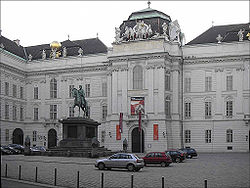
Imperial Library
Originally a free-standing structure, the Imperial Library (Hofbibliothek) was housed on the other side of the complex. Charles VICharles VI, Holy Roman Emperor
Charles VI was the penultimate Habsburg sovereign of the Habsburg Empire. He succeeded his elder brother, Joseph I, as Holy Roman Emperor, King of Bohemia , Hungary and Croatia , Archduke of Austria, etc., in 1711...
founded the library, which is now called the Prunksaal, cared for by the Austrian National Library (Österreichische Nationalbibliothek). Its construction was begun by Johann Bernhard Fischer von Erlach
Johann Bernhard Fischer von Erlach
----Johann Bernhard Fischer von Erlach, born Johann Bernhard Fischer was probably the most influential Austrian architect of the Baroque period....
and finished by his son Joseph Emanuel in 1735. This magnificent hall contains the book collection of Prince Eugene, an enormous ceiling fresco by Daniel Gran, and statues of emperors by Paul Strudel
Paul Strudel
Paul Strudel or Paul Strudl was an Austrian sculptor, architect, engineer, and painter, ennobled as Baron von Strudel and Vochburg....
making this part of the Hofburg its most significant in artistic terms. The exterior decoration with Attika figures was executed by Lorenzo Mattielli
Lorenzo Mattielli
Lorenzo Mattielli was an Italian sculptor from the Late Baroque period. His name has also variously been written as Matielli, Mattiely, Matthielli, and Mathielli...
in 1726. He placed a statue of Pallas Athene riding on a quadriga
Quadriga
A quadriga is a car or chariot drawn by four horses abreast . It was raced in the Ancient Olympic Games and other contests. It is represented in profile as the chariot of gods and heroes on Greek vases and in bas-relief. The quadriga was adopted in ancient Roman chariot racing...
above the main entrance. On the left portion of the roof, he situated Atlas
Atlas (mythology)
In Greek mythology, Atlas was the primordial Titan who supported the heavens. Although associated with various places, he became commonly identified with the Atlas Mountains in north-west Africa...
, supporting the celestial globe, flanked by Astronomy and Astrology, and on the opposite side, Gaia
Gaia (mythology)
Gaia was the primordial Earth-goddess in ancient Greek religion. Gaia was the great mother of all: the heavenly gods and Titans were descended from her union with Uranus , the sea-gods from her union with Pontus , the Giants from her mating with Tartarus and mortal creatures were sprung or born...
with the terrestrial globe, flanked by allegories of Geometry and Geography.
Augustinian Wing
On the south-east side of Josefsplatz stands the Baroque Augustinian Wing. It completely conceals the west facade of St. Augustine's Church, which was used by the Habsburgs as their court church and also for weddings. This is where Emperor Franz Joseph and Empress Elisabeth alias Sisi were married. The church has a side chapel known as the Herzerlgruft (Hearts' Crypt), so called because the hearts of the Habsburgs were interred there.Redouten Wing
Maria Theresia had a 17th century opera house converted into the beautiful dance and concert halls now known as the Redoutensaele. The original plans were drawn up by Jean Nicolas Jadot de Ville-Issey, while the external facades are the work of Nicolo Pacassi and Franz Hillebrand. The Redoutensaele soon became the setting for a cultivated style of entertainment. The name is derived from the French word "redoute", meaning an elegant masked ball, and such balls were also held there. Johann Strauss served as musical director to the court for the balls, and the audience was treated to music by Joseph Haydn, Nicolo Paganini and Franz Liszt. The premiere of Beethoven's 8th Symphony took place there in 1842. The well known saying "The Congress dances" derives from the balls held in the Redoutensaele in the framework of the Congress in Vienna in 1814/15. Over the centuries, various modification have been made the balls in line with changing tastes. On 27 November 1992 the whole wing with the Redoutensaele was seriously damaged by fire. The reconstruction and restorage work performed lasted five years. While the Kleiner Redoutensaal was faithfully restored, for the interior of the Grosser Redoutensaal a design competition was held, which was won by the Austrian artist Josef Mikl. He created a number of oil paintings based on literary quotations taken from Ferdinand Raimund, Johann Nepomuk Nestroy, Elias Canetti and Karl Kraus. The Redoutensaele reopened in 1998 in the framework of the first Austrian presidency of the EU and became since then part of the Hofburg Congress Center.St. Michael's Wing
The St. Michael's Wing was also planned by Joseph Emanuel Fischer von Erlach, and it serves as the connection between the Winter Riding School and the Imperial Chancellery Wing. However, because the old Imperial Theatre (BurgtheaterBurgtheater
The Burgtheater , originally known as K.K. Theater an der Burg, then until 1918 as the K.K. Hofburgtheater, is the Austrian National Theatre in Vienna and one of the most important German language theatres in the world.The Burgtheater was created in 1741 and has become known as "die Burg" by the...
) stood in the way, these plans remained unrealized until Ferdinand Kirschner built the wing from 1889 to 1893, utilizing a slightly altered plan.

Nicolò Pacassi
Nicolò Pacassi , also known as Nikolaus Pacassi, was an Austrian architect of Italian descent. He was born in Wiener Neustadt in Lower Austria in a family of merchants from the Gorizia. In 1753, he was appointed court architect to Maria Theresa of Austria...
connected the Imperial Library to the other parts of the Hofburg and its other side to St. Augustine’s Church (Augustinerkirche
Augustinerkirche
The Augustinian Church in Vienna is a parish church located on Josefsplatz, next to the Hofburg, the winter palace of the Habsburg dynasty in Vienna. Originally built in the 14th century as the parish church of the imperial court of the Habsburgs, the harmonious Gothic interior was added in the...
), and he thus created the present Joseph Square (Josephsplatz), one of the most beautiful locations in Vienna. After the renovation of the Albertina
Albertina, Vienna
The Albertina is a museum in the Innere Stadt of Vienna, Austria. It houses one of the largest and most important print rooms in the world with approximately 65,000 drawings and approximately 1 million old master prints, as well as more modern graphic works, photographs and architectural drawings...
in the 1820s by Joseph Kornhäusel
Joseph Kornhäusel
Josef Georg Kornhäusel was an Austrian architect of the first half of the 19th century...
, that section became connected to the Hofburg as well.
The Ceremonial Hall - Montoyer Wing
"Nose of the Hofburg" - that was the name originally given to the Zeremoniensaal or Ceremonial Hall. It was built for Emperor Franz II/I by the Belgian architect Louis Montoyer at the beginning of the 19th century. Its nickname derived from the fact that it formed a clearly visible protrusion at right angles to the Leopold Wing for almost a hundred years. With its ornate coffered ceiling and 26 crystal chandeliers, which once held 1,300 candles, the Zeremoniensaal has a truly imperial aspect. The 24 Corinthian columns have an artificial marble finish, the surface is not real stone but a form of painted gypsum known as stucco lustro. Right here Napoleon asked for the hand of Marie Louise, the daughter of Emperor Franz II/I, and where the exclusive Ball at the Court was held. On Maundy Thursday, Emperor Franz Joseph and Empress Elisabeth invited twelve poor old men and women to have their feet washed in a traditional Maundy ceremony.Heldenplatz
In 1809, a part of the old bastion adjacent to the old castle was demolished in the course of the Napoleonic Wars. All the way up to the present RingstraßeRingstraße
The Ringstraße is a circular road surrounding the Innere Stadt district of Vienna, Austria and is one of its main sights...
, new grounds were laid, in which the neoclassical
Neoclassical architecture
Neoclassical architecture was an architectural style produced by the neoclassical movement that began in the mid-18th century, manifested both in its details as a reaction against the Rococo style of naturalistic ornament, and in its architectural formulas as an outgrowth of some classicizing...
Castle Gate (Burgtor) was integrated. Within the new walls which were erected in 1817, three gardens were laid: the private Imperial Castle Garden (Burggarten), Heroes Square as a lawn with boulevards, and the People’s Garden (Volksgarten) with the Temple of Theseus (Theseustempel), which, along with the Burgtor, was designed by Peter von Nobile. A further addition from this period (already by 1804) is the Hall of Ceremonies (Zeremoniensaal) by Louis Montoyer
Louis Montoyer
Louis Montoyer was an 18th century Belgian-Austrian architect, principally active in Brussels and Vienna.-Life:...
, which at that time was a protrusion jutting out of the complex. Today it is fully integrated into the New Castle (Neue Burg).
Neue Burg and Montoyer Wing
Following the enlargement of Vienna after the demolition of the city walls in the 1860s, the Hofburg had its last great expansion. An Imperial Forum (Kaiserforum) was planned—a two-winged structure reaching beyond the Ringstraße, with the twin museums (Kunsthistorisches MuseumKunsthistorisches Museum
The Kunsthistorisches Museum is an art museum in Vienna, Austria. Housed in its festive palatial building on Ringstraße, it is crowned with an octagonal dome...
and Naturhistorisches Museum
Naturhistorisches Museum
The Naturhistorisches Museum Wien or NHMW is a large museum located in Vienna, Austria.The collections displayed cover , and the museum has a website providing an overview as a video virtual tour....
) as flanks and terminating at the old Imperial Stables (the Hofstallungen, not to be confused with the much older Stallburg) of Fischer von Erlach. The project was led by Gottfried Semper
Gottfried Semper
Gottfried Semper was a German architect, art critic, and professor of architecture, who designed and built the Semper Opera House in Dresden between 1838 and 1841. In 1849 he took part in the May Uprising in Dresden and was put on the government's wanted list. Semper fled first to Zürich and later...
and later by Karl Freiherr von Hasenauer
Karl Freiherr von Hasenauer
Baron Karl von Hasenauer was an important Austrian architect and key representative of the Historismus school....
. The museums were completed in 1891, but construction of the rest of the forum dragged on slowly and conflicted since, besides ostentation, no real function could be found for the enormous construction project. In 1913, the south-west wing, the New Castle (Neue Burg), was completed. However, the Imperial Forum was never finished. In its place, Heroes Square (Heldenplatz
Heldenplatz
The Heldenplatz is a historical plaza in Vienna. Many important actions took place here, most notably Adolf Hitler's announcement of the Anschluss of Austria to the German Reich in 1938.-The Plaza:...
) and Maria Therese Square (Maria-Theresien-Platz
Maria-Theresien-Platz
The Maria-Theresien-Platz of Vienna is a large square joining the Ringstraße with the Museumsquartier, a museum of modern arts located in the former Imperial Stables...
) were laid. The New Castle wing today houses a number of museums (the Ephesus Museum
Ephesos Museum
The Ephesos Museum in Vienna displays antiquities from the city of Ephesus , in modern-day Turkey. Begun in the late 19th century, the collection includes original works of sculpture and architecture, and belongs to the Kunsthistorisches Museum....
, the Collection of Arms and Armor, the Collection of Ancient Musical Instruments, and the Museum of Ethnology) as well as the reading rooms of the Austrian National Library and the Hofburg Congress Center of international renown. Equestrian statues of the two most important Austrian field marshals, Prince Eugene of Savoy
Prince Eugene of Savoy
Prince Eugene of Savoy , was one of the most successful military commanders in modern European history, rising to the highest offices of state at the Imperial court in Vienna. Born in Paris to aristocratic Italian parents, Eugene grew up around the French court of King Louis XIV...
and Archduke Charles
Archduke Charles, Duke of Teschen
Archduke Charles of Austria, Duke of Teschen was an Austrian field-marshal, the third son of emperor Leopold II and his wife Infanta Maria Luisa of Spain...
, stand at the foci of Heroes Square. On March 15, 1938, Adolf Hitler proclaimed from the balcony of the New Castle onto Heroes’ Square the “Anschluss
Anschluss
The Anschluss , also known as the ', was the occupation and annexation of Austria into Nazi Germany in 1938....
” of Austria into the Third Reich (Deutsches Reich
Deutsches Reich
Deutsches Reich was the official name for Germany from 1871 to 1945 in the German language.As the literal English translation "German Empire" denotes a monarchy, the term is used only in reference to Germany prior to the fall of the monarchies at the end of World War I in 1918...
).
Joseph Square
Of note are the equestrian statue of Emperor Joseph IIJoseph II, Holy Roman Emperor
Joseph II was Holy Roman Emperor from 1765 to 1790 and ruler of the Habsburg lands from 1780 to 1790. He was the eldest son of Empress Maria Theresa and her husband, Francis I...
by Franz Anton Zauner at the center of Joseph Square as well as the statue of Francis I
Francis I, Holy Roman Emperor
Francis I was Holy Roman Emperor and Grand Duke of Tuscany, though his wife effectively executed the real power of those positions. With his wife, Maria Theresa, he was the founder of the Habsburg-Lorraine dynasty...
in the Inner Castle Court (innerer Burghof) by Pompeo Marchesi
Pompeo Marchesi
Pompeo Marchesi was a Lombard sculptor of the neoclassical school.He first studied at the Academy of Fine Arts of Brera in Milan, and then in 1804 he won a scholarship to study in Rome under Canova, from whom he received much encouragement...
. After the completion of Michael Square, two sculpted fountains were installed on its façade: Power at Sea by Rudolf Weyr and Power on Land by Edmund Hellmer.
Museums of the Hofburg
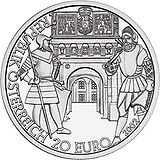
The Hofburg Palace is so popular and famous that it was the main motif of one of the most famous silver collectors' coins: the 20 euro Renaissance commemorative coin.The coin shows the "Swiss Gate" of the palace. This gate bears Ferdinand I's coat-of-arms and titles. It is flanked by two soldiers of the period as a reminder of the unsettled times which saw Vienna besieged by Turkish armies in 1529, as well as the struggles between Protestants
Protestantism
Protestantism is one of the three major groupings within Christianity. It is a movement that began in Germany in the early 16th century as a reaction against medieval Roman Catholic doctrines and practices, especially in regards to salvation, justification, and ecclesiology.The doctrines of the...
and Catholics
Roman Catholic Church
The Catholic Church, also known as the Roman Catholic Church, is the world's largest Christian church, with over a billion members. Led by the Pope, it defines its mission as spreading the gospel of Jesus Christ, administering the sacraments and exercising charity...
during the Reformation
Protestant Reformation
The Protestant Reformation was a 16th-century split within Western Christianity initiated by Martin Luther, John Calvin and other early Protestants. The efforts of the self-described "reformers", who objected to the doctrines, rituals and ecclesiastical structure of the Roman Catholic Church, led...
.
HOFBURG Vienna - Convention Center
In September 1958 parts of the Hofburg were opened to the public as convention center. Europe's first imperial convention centre played an important role in the development of the congress and meeting tourism in Vienna. In the first ten years the BHÖ (Burghauptmannschaft Österreich) ran the convention center; since 1969 a private company (HOFBURG Vienna - Wiener Kongresszentrum Hofburg Betriebsgesellschaft)has been managing the international congress and events center. HOFBURG Vienna offers 182000 sq.ft of floor space spread across 35 rooms for events for anything from 50 to 4,900 people. Every year the convention center is hosting about 300 to 350 events with around 300,000 to 320,000 guests. Among the events are conventions and meetings as well as banquets, trade fairs, concerts and balls. In addition to this HOFBURG Vienna is the permanent conference seat of the OSCE (Organization for Security and Co-operation in Europe).Festsaal - Festival Hall
With its 1,000m2 of floor space, the Festival Hall (Festsaal) is the biggest hall in the whole of the Hofburg. Although built as a throne room, it was never used as such. The internal works were finished in 1923, but the artwork remained incomplete. The Festsaal boasts Alois Hans Schramm's three Ceiling paintings to the greater glory of the Habsburgs, complete with Emperor Franz Joseph's motto "Viribus Unitis" (with united strength). The lower lunettes and octagonal panels are decorated with paintings by Eduard Veith and Viktor Stauffer of famous people from Austrian history, with Maximilian I, Kalr V, Ferdinand I, Rudolf II and Ferdinand II of Tyrol to be seen in the ceiling paintings, and Leopold I, Kalr VI, Prince Eugen and also the Polish King Jan III Sobieski in the side panels.Zeremoniensaal - Ceremonial Hall
The Zeremoniensaal is the most splendid in the whole of the Hofburg. The Belgian architect Louis Montoyer designed the hall as a throne room for Emperor Franz II/I. With its ornate coffered ceiling and 26 crystal chandeliers, which once held 1,300 candeles, the hall has a truly imperial aspect. The 24 Corinthian columns have an artificial marble finish. This is where Napoleon aked for the hand of Marie Louise, the daughter of Emperor Franz II/I, and where the exclusive Ball at the Court was held. On Maundy Thursday, Emperor Franz Joseph and Empress Elisabeth invited twelve poor old men and women to have their feed washed in a traditional Maundy ceremony.Mamorsaal - Marble Hall
The walls of the Marble Hall next to the Ceremonial Hall date back to the 16th century, while the artificial marbeling for the interior wad added around 1840 to match the appearance of the Ceremonial Hall. During the imperial period it was used as a dining room and for balls for the children at court.Geheime Ratstube - Privy Council Room
The adjoining Privy Council Room is part of the Early Baroque Leopold Wing. This is where Emperor Franz Joseph held his opening speeches at the sessions of the Austro-Hungarian Delegation. Right here the Archducke Franz Ferdinand, a nephew of Franz Joseph who was first in line for the succession, spoke the Oath of Renunciation on 28 June 1900 and in so doing renounced all claim to the throne in the name of his future wife and descendents.Antekammer - Anterroom
The Anteroom to the marble Hall is in the Swiss Wing, the oldest of the Hofburg buildings. It has particularly thick walls, which were originally part of one of the towers of the old fortress.Radetzky- Appartements - Radetzky Apartements
An adjoining section of the Swiss Wing houses the Radetzky Apartments. In recognition of his services in the Italian campaign during the revolutionary year of 1848, Franz Joseph permitted the meritorious Field Marshal Radetzky to live in these apartments in spite of the fact that he was not a member of the court.Rittersaal - Knight's Hall
The Swiss Wing also houses the Knight's Hall. It is here that Maria Theresia was baptised by the Papal Nuntius Spinola as the representative of Pope Clemens XI on 15 May 1717 with baptismal water containing a few drops from the River Jordan.Trabantenstube - Guard Room
Next to the Knight's Hall is the Guard Room, where the duty officer of the Household Guards kept watch over the Emperor.Redoutensaele
The Redoutensaele are placed in the Redouten Wing. Beside the Großer and the Kleiner Redoutensaal they include the Dachfoyer (Rooftop Foyer). The Redoutensaele were entirely destroyed in a fire in 1992 and under reconstruction until re-opening in 1998. The Großer Redoutensaal was adorned with frescoFresco
Fresco is any of several related mural painting types, executed on plaster on walls or ceilings. The word fresco comes from the Greek word affresca which derives from the Latin word for "fresh". Frescoes first developed in the ancient world and continued to be popular through the Renaissance...
s and mural
Mural
A mural is any piece of artwork painted or applied directly on a wall, ceiling or other large permanent surface. A particularly distinguishing characteristic of mural painting is that the architectural elements of the given space are harmoniously incorporated into the picture.-History:Murals of...
s by the Austrian painter Josef Mikl
Josef Mikl
Josef Mikl was an Austrian abstract painter of the Informal style.-Biography:Born in Vienna, he received his first training at the Graphische Lehr- und Versuchsanstalt, studying at the prominent Viennese academy from 1949-1956 under Josef Dobrovský...
in the course of reconstruction. Mikl’s paintings in the Grosser Redoutensaal "depict scenes from his favourite authors Elias Canetti
Elias Canetti
Elias Canetti was a Bulgarian-born modernist novelist, playwright, memoirist, and non-fiction writer. He wrote in German and won the Nobel Prize in Literature in 1981, "for writings marked by a broad outlook, a wealth of ideas and artistic power".-Life:...
, Johann Nestroy
Johann Nestroy
Johann Nepomuk Eduard Ambrosius Nestroy was a singer, actor and playwright in the popular Austrian tradition of the Biedermeier period and its immediate aftermath...
und Ferdinand Raimund
Ferdinand Raimund
Ferdinand Raimund was an Austrian actor and dramatist.- Life and work :...
. His 404 m² ceiling painting incorporates 34 handwritten verses of Karl Kraus
Karl Kraus
Karl Kraus was an Austrian writer and journalist, known as a satirist, essayist, aphorist, playwright and poet. He is regarded as one of the foremost German-language satirists of the 20th century, especially for his witty criticism of the press, German culture, and German and Austrian...
’ poem “Youth”, albeit in a form not visible to the viewer."