

History of the United States Constitution

Encyclopedia
The United States Constitution
was written in 1787, but it did not take effect until after it was ratified in 1789, when it replaced the Articles of Confederation
. It remains the basic law of the United States. The United States Constitution also remains the oldest in existence.
The first state to ratify the Constitution was Delaware; the last of the original thirteen to ratify was Rhode Island; since only nine were required, this was two years after it went into effect. When the U.S. Constitution was presented to the states, many people chose to be either Federalists or Anti-Federalists. Virginia and many other states were against the Constitution because there was no bill of rights included in it. James Madison
was known as the "Father of the Constitution", and he and Alexander Hamilton
were two Federalists who supported the Constitution and explicated it in the Federalist papers
(1788). On the other side George Mason
, an Anti-Federalist, opposed the Constitution.
was introduced in the Second Continental Congress
declaring the union with Great Britain to be dissolved, proposing the formation of foreign alliances, and suggesting the drafting of a plan of confederation to be submitted to the respective states. Independence was declared on July 4, 1776; the preparation of a plan of confederation was postponed. Although the Declaration was a statement of principles, it did not create a government or even a framework for how politics would be carried out. It was the Articles of Confederation
that provided the necessary structure to the new nation during and after the American Revolution
. The Declaration, however, did set forth the ideas of natural rights
and the social contract
that would help form the foundation of constitutional government.
, which ended the Revolutionary War; the Northwest Ordinance
, which created the Northwest Territory
; and the Land Ordinance of 1785
, which set up procedures for the admission of new states.
However, weaknesses in the Articles of Confederation
became apparent before the Revolution ended. The Articles left most of the power in the state governments due to fears of recreating a strong central power like the British Monarchy. The need for a revenue stream was widely conceded. Under the articles, Congress lacked authority to levy taxes. Instead, it could request the states to contribute money to the common treasury, which was not sufficient for the federal government. To remedy this deficit, Congress appealed to the states for power to lay duties and secure the public debts. Twelve states agreed to such an amendment, but Rhode Island
refused to consent, thereby defeating the proposal. However, Congress did borrow money and sell western lands to raise some money.
The need for super majorities was a second weakness in the Articles of Confederation. Not only did all amendments have to be ratified by each of the thirteen states, but all important legislation needed the approval of at least nine states. With several delegates often being absent, one or two states were often able to defeat legislative proposals of major importance.
The period between the end of the war in 1783 and the drafting of the Constitution in 1786 has been seen by some historians as one of weakness, dissension, and turmoil, and by others as stable and prosperous. Under the Articles of Confederation, there was neither an executive branch to enforce the laws nor a national court system to interpret them. The Congress was the sole organ of the national government, but it had no power to force the states to do anything against their will. It could theoretically declare war and raise an army, but it could not force any state to meet its assigned quota for troops or for the arms and equipment needed to support them. It looked to the states for the income needed to finance its activities, but it could not punish a state for not contributing its share for the federal budget. Control of taxation and tariffs was left to the states, and each state could issue its own currency. In disputes between states, and quarrels over state boundaries, Congress played the role of mediator and judge but could not require states to accept its decisions.
Without the power to collect taxes, the government plunged into debt. At the same time, seven of the thirteen states printed large quantities of paper money— which was high in face value, but low in real purchasing power— to pay Revolutionary War veterans, various creditors, and settle debts between small farmers and large plantation owners.
In contrast to the other state legislatures, the Massachusetts
legislature imposed a tightly limited currency and high taxes, which triggered formation of a small army of farmers led by Daniel Shays
, a former Revolutionary War army captain. The incident came to be known as Shays' Rebellion
. In a bid to take over the Massachusetts statehouse, Shays and others demanded that foreclosure
s and unfair court proceedings be dropped. Troops were called out and they quickly suppressed the rebellion, but nationalists asked what would happen if a revolt got out of control. George Washington warned, "There are combustibles in every state which a spark might set fire to."
The absence of a single, uniform, and stable currency also disrupted trade among the states and with other countries. Not only did the value of paper currency vary from state to state, but some states, such as New York and Virginia, levied duties on products entering their ports from other states, thereby provoking retaliatory actions. The states could assert, as had the federal superintendent of finance, that their public credit was gone. To compound their problems, these newly independent states, having separated violently from Britain, no longer received favored treatment at British ports. When U.S. minister John Adams
tried to negotiate a commercial treaty in 1785, the British refused because the individual states would not be bound by it.
The weak central government also lacked the power to back its policies with military strength. As a result, it was inevitably handicapped in foreign affairs. The British refused to withdraw their troops from the forts and trading posts in the new nation's Northwest Territory
, as they had agreed to do in the Treaty of Paris of 1783. To make matters worse, British officers on the northern boundaries and Spanish officers to the south supplied arms to various Native American
tribes, which allowed them to attack American settlers. The Spanish, who controlled Florida
and Louisiana
, as well as all territory west of the Mississippi River, also refused to allow western American farmers to use the port of New Orleans to ship produce.
Other imperfections in the Articles of Confederation proved embarrassing as well. Congress could, for example, negotiate treaties with foreign powers, but all treaties had to be ratified by the states. Even when a treaty was approved, Congress lacked the authority to secure obedience. Congress could not act directly upon the States nor upon individuals. Under such circumstances, foreign nations doubted the value of treaties with the new confederation. Furthermore, Congress had no authority to regulate foreign or interstate commerce. Legislation in this field, subject to insignificant exceptions, was left to the individual States. Disputes between States with common interests in the navigation of certain rivers and bays were inevitable. Discriminatory regulations were followed by reprisals.
Although there were signs of returning prosperity in some areas of the fledgling nation, domestic and foreign problems continued to grow. It became increasingly clear to many nationalists that the confederation's central government was not strong enough to establish a sound financial system, regulate trade, enforce treaties, or go to war when needed.
, appointed, in June 1784, four commissioners to "frame such liberal and equitable regulations concerning the said river as may be mutually advantageous to the two States." Maryland, in January 1785, responded to the Virginia resolution by appointing a like number of commissioners "for the purpose of settling the navigation and jurisdiction over that part of the bay of Chesapeake
which lies within the limits of Virginia, and over the rivers Potomac
and Pocomoke
" with full power on behalf of Maryland "to adjudge and settle the jurisdiction to be exercised by the said State, respectively, over the waters and navigations of the same."
At the invitation of George Washington
, the commissioners met at his Mount Vernon
home, and, in March 1785, drafted a compact which, in many of its details relative to the navigation and jurisdiction of the Potomac, is still in force. More importantly, the commissioners submitted to their respective states a report in favor of a convention of all the states "to take into consideration the trade and commerce" of the Confederation
. Virginia, in January 1786, advocated such a convention, authorizing its commissioners to meet with those of other States, at a time and place to be agreed on "to take into consideration the trade of the United States, to examine the relative situations and trade of the said State, to consider how far a uniform system in their commercial regulations may be necessary to their common interest and their permanent harmony, and to report to the several States, such an act relative to this great object, as when unanimously ratified by them, will enable the United States in Congress, effectually to provide for the same."
and Madison
, Annapolis
was accepted as the place and the first Monday in September 1786 as the time for the convention. The attendance at Annapolis proved disappointing. Only five States, Virginia
, Pennsylvania
, Delaware
, New Jersey
, and New York, were represented; delegates from Massachusetts
, New Hampshire
, North Carolina
, and Rhode Island
failed to attend. Because of the small representation, the Annapolis Convention
did not deem “it advisable to proceed on the business of their mission.” After an exchange of views, the Annapolis delegates unanimously submitted to their respective States a report in which they suggested that a convention of representatives from all the States meet at Philadelphia on the second Monday in May (May 13) 1787 to examine the defects in the existing system of government and formulate "a plan for supplying such defects as may be discovered."
The Virginia legislature acted promptly upon this recommendation and appointed a delegation to go to Philadelphia. Within a few weeks, New Jersey, Pennsylvania, North Carolina, Delaware
, and Georgia
also made appointments. New York and several other States hesitated on the ground that, without the consent of the Continental Congress, the work of the convention would be extra-legal; that Congress alone could propose amendments to the Articles of Confederation. George Washington
was quite unwilling to attend an irregular convention, making congressional approval of the proposed convention highly important. After some hesitancy, Congress approved the suggestion for a convention at Philadelphia "for the sole and express purpose of revising the Articles of Confederation and reporting to Congress and the several legislatures such alterations and provisions therein as shall when agreed to in Congress and confirmed by the States render the Federal Constitution adequate to the exigencies of Government and the preservation of the Union."
Therefore, the remaining States, Rhode Island
excepted, appointed in due course delegates to the Convention, and Washington accepted membership on the Virginia delegation.
) only obtained a quorum—delegates of twelve of the states were there —on May 25.
The 55 delegates who drafted the Constitution included most of the outstanding leaders, or Founding Fathers
, of the new nation. They represented a wide range of interests, backgrounds, and stations in life, although many shared a common background: the vast majority of them were wealthy landowners and all were white males. All agreed, however, on the central objectives expressed in the preamble to the Constitution:
The primary aim of the Constitution was to create a strong elected government that was responsive to the will of the people, although there is some controversy over this. Many of the Founding Fathers believed that the new government needed to be insulated from the will of the people, hence the design of such features as the Electoral College or the election of Senators
by the state legislatures. The concept of sovereignty of the people in a republic was new, a key ingredient of republicanism in the United States
. By the time the Constitution was adopted, Americans had considerable expertise in the art of self-government. Long before independence was declared, the colonies were functioning governmental units controlled by the people. By 1777, ten of the thirteen states had adopted their own constitutions and most states had a governor elected by the state legislature which was elected by popular vote. Every state but Pennsylvania
had a bicameral legislature as well.
The Articles of Confederation
had tried to unite these self-governing states. The Constitution, by contrast, established a strong central, or federal, government with broad powers to regulate relations between the states and with sole responsibility in such areas as foreign affairs and defense.
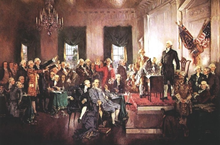 The sense of potential disaster and the need for drastic change pervaded the Constitutional Convention
that began its deliberations on May 25, 1787. All of the delegates were convinced that an effective central government with a wide range of enforceable powers must replace the weaker Congress established by the Articles of Confederation.
On May 29, Edmund Randolph
, on behalf of the Virginia delegation, submitted fifteen propositions as a plan of government to the convention. Despite the fact that the delegates were limited by the instructions of their State legislatures to a revision of the Articles, Virginia had really recommended a new instrument of government. For example, a provision was made in the Virginia Plan
for the separation of the three branches of government; under the Articles executive, legislative, and judicial powers were vested in the Congress. Furthermore, the legislature was to consist of two houses rather than one.
On May 30, the Convention devolved into a committee of the whole
to consider the fifteen propositions of the Virginia Plan seriatim
. These discussions continued until June 13, when the Virginia resolutions in amended form were reported out of committee.
The delegates agreed that the new government would be composed of three separate branches, based on ideals enumerated in John Locke
's Two Treatises of Government
: legislative, judicial, and executive, each with distinct powers to balance
those of the other two branches. It was also agreed that the legislative branch, like the British Parliament
, and the state legislatures (except Pennsylvania's), should consist of two houses.
Beyond this point, however, there were sharp differences of opinion that at times threatened to disrupt the convention and cut short its proceedings before a constitution was drafted. The Virginia Plan provided for proportional representation
in both houses, which dissatisfied the smaller states.
The large states argued in favor of proportional representation in the legislature, so that each state would have voting power equal to its population, calling equal representation per state, "confessedly unjust." The small states, fearing domination by the large ones, insisted on equal representation per state.
At the time of the convention, the South was growing more quickly than the North, and Southern states had the most extensive Western claims. South Carolina
, North Carolina
, and Georgia
were small in the 1780s, but they expected growth, and thus favored proportional representation. New York was one of the largest states at the time, but two of its three representatives (Hamilton being the exception) favored an equal representation per state, as part of their desire to see maximum autonomy for the states. (The two representatives other than Hamilton left the convention before the representation issue was resolved, leaving Hamilton, and New York state, without a vote.)
James Madison
and Alexander Hamilton
were two of the leaders of the proportional representation group. Madison argued that a conspiracy of large states against the small states was unrealistic as the large states were so different from each other. Hamilton argued that the states were artificial entities made up of individuals, and accused small state representatives of wanting power, not liberty. (see History of the United States Senate
).
For their part, the small state representatives argued that the states were, in fact, of a legally equal status, and that proportional representation would be unfair to their states. Gunning Bedford, Jr.
of Delaware
notoriously threatened on behalf of the small states, "the small ones w[ould] find some foreign ally of more honor and good faith, who will take them by the hand and do them justice."
Therefore, on June 14, when the Convention was ready to consider the report on the Virginia plan, William Paterson of New Jersey
requested an adjournment to allow certain delegations more time to prepare a substitute plan. The request was granted, and, on the next day, Paterson submitted nine resolutions embodying important amendments to the Articles of Confederation, which was followed by vigorous debate. On June 19, the delegates rejected the New Jersey Plan
and voted to proceed with a discussion of the Virginia Plan. The small States became increasingly discontented and some threatened to withdraw. On July 2, the Convention was deadlocked over giving each State an equal vote in the upper house, with five States in the affirmative, five in the negative, and one divided.
The problem was referred to a committee consisting of one delegate from each State to reach a compromise. On July 5, the committee submitted its report, which became the basis for the “Great Compromise
" of the Convention. The report recommended that in the upper house each State should have an equal vote and in the lower house, each State should have one representative for every 40,000 inhabitants, counting slaves as three-fifths of an inhabitant, and that money bills should originate in the lower house (not subject to amendment by the upper chamber).
After six weeks of tumult, North Carolina
switched its vote to equal representation per state and Massachusetts
abstained, and a compromise was reached, being called the "Great Compromise." In the "Great Compromise", every state was given equal representation, previously known as the New Jersey Plan
, in one house of Congress, and proportional representation, known before as the Virginia Plan
, in the other. In the Senate
, every state would have two seats. In the House of Representatives
, the number of seats would depend on population. Because it was considered more responsive to majority sentiment, the House of Representatives was given the power to originate all legislation dealing with the federal budget and revenues/taxation.
When, on July 12, the motion of Gouverneur Morris
of Pennsylvania
that direct taxation should also be in proportion to representation was adopted, the crisis had been successfully surmounted. A compromise spirit began to prevail; however, the small States were not willing to support a strong national government.
The Great Compromise ended the rift between the large and small states, and throughout the summer, the delegates worked out numerous other compromises. Some delegates, fearful of giving too much power to the people, argued for indirect election of all federal officials; others wanted as broad an electoral base as possible. Some wanted to exclude the western territories from eventual statehood; others saw the future strength of the nation in the lands beyond the Appalachian Mountains
. There were sectional interests to be balanced by the three fifths compromise; differing views to be reconciled on the term, powers, and method of selection of the president; and conflicting ideas on the role of the federal judiciary.
The high quality of the delegates to the convention eased the way to compromise. Only a few of the great leaders of the American Revolution were absent: Thomas Jefferson
and John Adams
, both future presidents, were serving as America's envoys to France and Britain
, respectively; John Jay
was busy as secretary of foreign affairs of the Confederation, although he later wrote some of the Federalist Papers
. A handful of others, including Samuel Adams
, Thomas Paine
, and Patrick Henry
, chose not to participate, believing that the existing governmental structure was sound. Of those in attendance, the best known by far was George Washington
, commander of American troops and hero of the Revolution, who presided over the convention. Benjamin Franklin
, the scientist, scholar, and diplomat, was also there. Therefore, there were such outstanding men as James Madison
of Virginia, Gouverneur Morris
of Pennsylvania, and Alexander Hamilton
, the brilliant young lawyer and soldier from New York.
Even the youngest delegates, still in their twenties and thirties, had already displayed political and intellectual gifts. As Thomas Jefferson in Paris wrote to John Adams in London, "It really is an assembly of demigods."
Debates on the Virginia resolutions continued. The 15 original resolutions had been expanded into 23. Since these resolutions were largely declarations of principles, on July 24, a committee of five (John Rutledge
of South Carolina
, Edmund Randolph
of Virginia, Nathaniel Gorham
of Massachusetts
, Oliver Ellsworth
of Connecticut
, and James Wilson
of Pennsylvania
) was elected to draft a detailed constitution embodying the fundamental principles that had thus far been approved. The Convention adjourned from July 26 to August 6 to await the report of this "Committee of Detail
". This committee, in preparing its draft of a Constitution, turned for assistance to the State constitutions, to the Articles of Confederation, to the various plans that had been submitted to the Convention and other available material. Overall, the report of the committee conformed to the resolutions adopted by the Convention, though on many clauses the members of the committee left the imprint of their individual and collective judgments. In a few instances, the committee avowedly exercised considerable discretion.
Some of the ideas the Constitution embodied were new, but many were drawn from Classical Antiquity
and the British governmental tradition of mixed government
, which was practiced in 12 of the 13 states and was advocated by the writings of Charles de Secondat, Baron de Montesquieu
. The United States Constitution was partly based on ideas from the uncodified constitution of the United Kingdom
, such as Article 39 from the British Magna Carta
of 1215, which states:
The British Bill of Rights
also acted as a source of ideas for the United States Constitution. For example, like the British Bill of Rights, the U.S. Constitution requires jury trials, contains a right to bear arms, and prohibits excessive bail and of "cruel and unusual punishments".
The Declaration of Independence also acted as an important guide, keeping the minds of the delegates fixed on the ideas of self-government and preservation of fundamental human rights
. The writings of such European political philosophers
as Montesquieu
and John Locke
were influential. What they sought to create was a balanced government of checks and balances
.
From August 6 to September 10, the report of the committee of detail was discussed, section-by-section, and clause-by-clause. Details were attended to, further compromises were affected. Toward the close of these discussions, on September 8, another committee of five (William Samuel Johnson
of Connecticut
, Alexander Hamilton
of New York, Gouverneur Morris
of Pennsylvania
, James Madison
of Virginia
, and Rufus King
of Massachusetts
.) was appointed “to revise the style of and arrange the articles which had been agreed to by the house.”
On Wednesday, September 12, the report of the "committee of style" was ordered printed for the convenience of the delegates. For three days, the Convention compared this report with the proceedings of the Convention. The Constitution was then ordered engrossed on Saturday, September 15, and the work was done by Jacob Shallus
.
The Convention met on Monday, September 17, for its final session. Several of the delegates were disappointed in the result. A few deemed the new Constitution a mere makeshift, a series of unfortunate compromises. Some delegates left before the ceremony, and three of those remaining refused to sign: Edmund Randolph
and George Mason
of Virginia, and Elbridge Gerry
of Massachusetts. Of the thirty-nine who did sign, probably no one was completely satisfied, and their views were ably summed up by Benjamin Franklin
, who said, "There are several parts of this Constitution which I do not at present approve, but I am not sure I shall never approve them." He would accept the Constitution, however, "because I expect no better and because I am not sure that it is not the best."
An amendment was agreed upon to change "the number of Representatives shall not exceed one for every forty thousand" to "the number of Representatives shall not exceed one for every thirty thousand." A paragraph making clear this change and a few minor modifications was appended to the document by Shallus, and attested to by secretary William Jackson
.
The advocates of the Constitution, realizing the impending difficulty of obtaining the consent of the States to the new instrument of Government, were anxious to obtain the unanimous support of the delegations from each State. It was feared that many of the delegates would refuse to give their individual assent to the Constitution. Therefore, to ensure the action of the Convention appeared unanimous, Gouverneur Morris devised the formula “Done in Convention, by the unanimous consent of the States present the 17th of September...In witness where of we have here unto subscribed our names.” Thirty-nine of the forty-two delegates present there upon “subscribed” to the document.
.png) It was within the power of the old congress to expedite or block the ratification of the new Constitution. The document that the Philadelphia Convention presented was technically only a revision of the Articles of Confederation. But the last article of the new instrument provided that when ratified by conventions in nine states (or 2/3 at the time), it should go into effect among the States so acting.
It was within the power of the old congress to expedite or block the ratification of the new Constitution. The document that the Philadelphia Convention presented was technically only a revision of the Articles of Confederation. But the last article of the new instrument provided that when ratified by conventions in nine states (or 2/3 at the time), it should go into effect among the States so acting.
Then followed an arduous process of ratification
of the Constitution by specially constituted conventions. The need for only nine states was a controversial decision at the time, since the Articles of Confederation
could only be amended by unanimous vote of all the states. However, the new Constitution was ratified by all thirteen states, with Rhode Island signing on last in May 1790.
Three members of the Convention—Madison
, Gorham
, and King
—were also Members of Congress. They proceeded at once to New York, where Congress was in session, to placate the expected opposition. Aware of their vanishing authority, Congress, on September 28, after some debate, unanimously decided to submit the Constitution to the States for action. It made no recommendation for or against adoption.
Two parties soon developed, one in opposition, the Antifederalists, and one in support , the Federalists, of the Constitution, and the Constitution was debated, criticized, and expounded clause by clause. Hamilton
, Madison
, and Jay
, under the name of "Publius, wrote a series of commentaries, now known as the Federalist Papers
, in support of the new instrument of government; however, the primary aim of the essays was for ratification in the state of New York, at that time a hotbed of anti-federalism. These commentaries on the Constitution, written during the struggle for ratification, have been frequently cited by the Supreme Court as an authoritative contemporary interpretation of the meaning of its provisions. The closeness and bitterness of the struggle over ratification and the conferring of additional powers on the central government can scarcely be exaggerated. In some states, ratification was effected only after a bitter struggle in the state convention itself. In every state, the Federalists proved more united, and only they coordinated action between different states, as the Anti-federalists were localized and did not attempt to reach out to other states.
Delaware, on December 7, 1787, became the first State to ratify the new Constitution, with its vote being unanimous. Pennsylvania ratified on December 12, 1787, by a vote of 46 to 23 (66.67%). New Jersey ratified on December 19, 1787, and Georgia on January 2, 1788, both with unanimous votes.
The requirement of ratification by nine states, set by Article Seven of the Constitution, was met when New Hampshire voted to ratify, on June 21, 1788.
In New York, fully two thirds of the convention delegates were at first opposed to the Constitution. Hamilton led the Federalist campaign, which included the fast-paced appearance of the Federalist Papers in New York newspapers. An attempt to attach conditions to ratification almost succeeded, but on July 26, 1788, New York ratified, with a recommendation that a bill of rights be appended. The vote was close—yeas 30 (52.6%), nays 27—due largely to Hamilton's forensic abilities and his reaching a few key compromises with moderate anti-Federalists led by Melancton Smith
. Opposition to ratification was led by Governor George Clinton
; the opposition also suggested that New York reserve the right to withdraw if the Constitution were not amended. Hamilton wrote Madison, as Secretary of the Virginia ratifying convention, and received the reply:
The Continental Congress— which still functioned at irregular intervals— passed a resolution on September 13, 1788, to put the new Constitution into operation.
Under the Constitution, each state legislature
had the power to decide how presidential electors
, as well as representatives and senators, would be chosen. Some states opted for direct elections by the people, others for election by the legislature, and a few for a combination of the two. Rivalries were intense; delays in setting up the first elections under the new Constitution were inevitable. New Jersey, for example, chose direct elections but neglected to set a time for closing the polls, which stayed open for three weeks.
By March 4, 1789, when the first Congress opened, only 13 of the 59 representatives and 8 of the 22 senators had arrived in New York City. (Seats allotted to North Carolina
and Rhode Island
were not filled until those states ratified the Constitution.) A quorum
was finally attained in the House on April 1 and in the Senate on April 6. On April 1, the House elected a Speaker, and on April 6, the Senate elected its President pro tempore. The two houses then met jointly to count the electoral vote.
George Washington
was unanimously elected the first president, and John Adams
of Massachusetts, the vice president. Adams arrived in New York on April 21, and was sworn into office on the same date. Washington arrived in New York on April 23, and was sworn into office on April 30, 1789. The business of setting up the new government was completed.
.
Much of the initial resistance to the Constitution came, not from those opposed to strengthening the federal union, but from statesmen who felt that the rights of individuals must be specifically spelled out. One of these was George Mason
, author of the Virginia Declaration of Rights
, which was a forerunner of the Bill of Rights. As a delegate to the Constitutional Convention, Mason refused to sign the document because he felt it did not protect individual rights sufficiently. Indeed, Mason's opposition nearly blocked ratification by Virginia. Because of similar feelings in Massachusetts, that state recommended with its ratification the addition of specific guarantees of individual rights. By the time the First Congress convened, sentiment for adoption of such amendments was nearly unanimous, and the Congress lost little time in drafting them.Many anti-Fedralist had sharply criticized the constitution drafted at Philadelphia for its failure to provide guarantees of individual rights such as freedom of religion and trail by jury.
, ratified in 1868, which establishes a clear and simple definition of citizenship and guarantees equal treatment under the law. In essence, the Fourteenth Amendment required the states to abide by the protections of the Bill of Rights. Other amendments have limited the judicial power of the national government; changed the method of electing the president; forbidden slavery; protected the right to vote against denial because of race, color, sex (gender), or previous condition of servitude; extended the congressional power to levy taxes to individual incomes; and instituted the election of U.S. senators by popular vote.
The most recent amendments include the twenty-second
, limiting the president
to two terms in office; the twenty-third
, granting citizens of the District of Columbia the right to vote for the President and the Vice President; the twenty-fourth
, giving citizens the right to vote regardless of failure to pay a poll tax; the twenty-fifth
, providing for filling the office of vice president
when it becomes vacant in midterm; the twenty-sixth
, lowering the voting age
to 18; and the twenty-seventh
, concerning the compensation of U.S. senators and representatives.
famously denounced the Constitution as "a covenant with death and an agreement with Hell."
In the early twentieth century, when the Supreme Court routinely struck down state laws limiting what sort of work contract women could make as unconstitutional (see Lochner era
), the Constitution was criticized for being such a seemingly inflexible document that it put the government at the beck and call of big business.
In his 2007 book A More Perfect Constitution
, Professor Larry J. Sabato contended that the constitution was in need of an overhaul. He argued that only a national constitutional convention
could bring the document up to date and settle many of the issues that have arisen over the past two centuries.
United States Constitution
The Constitution of the United States is the supreme law of the United States of America. It is the framework for the organization of the United States government and for the relationship of the federal government with the states, citizens, and all people within the United States.The first three...
was written in 1787, but it did not take effect until after it was ratified in 1789, when it replaced the Articles of Confederation
Articles of Confederation
The Articles of Confederation, formally the Articles of Confederation and Perpetual Union, was an agreement among the 13 founding states that legally established the United States of America as a confederation of sovereign states and served as its first constitution...
. It remains the basic law of the United States. The United States Constitution also remains the oldest in existence.
The first state to ratify the Constitution was Delaware; the last of the original thirteen to ratify was Rhode Island; since only nine were required, this was two years after it went into effect. When the U.S. Constitution was presented to the states, many people chose to be either Federalists or Anti-Federalists. Virginia and many other states were against the Constitution because there was no bill of rights included in it. James Madison
James Madison
James Madison, Jr. was an American statesman and political theorist. He was the fourth President of the United States and is hailed as the “Father of the Constitution” for being the primary author of the United States Constitution and at first an opponent of, and then a key author of the United...
was known as the "Father of the Constitution", and he and Alexander Hamilton
Alexander Hamilton
Alexander Hamilton was a Founding Father, soldier, economist, political philosopher, one of America's first constitutional lawyers and the first United States Secretary of the Treasury...
were two Federalists who supported the Constitution and explicated it in the Federalist papers
Federalist Papers
The Federalist Papers are a series of 85 articles or essays promoting the ratification of the United States Constitution. Seventy-seven of the essays were published serially in The Independent Journal and The New York Packet between October 1787 and August 1788...
(1788). On the other side George Mason
George Mason
George Mason IV was an American Patriot, statesman and a delegate from Virginia to the U.S. Constitutional Convention...
, an Anti-Federalist, opposed the Constitution.
Declaration of Independence
On June 4, 1776, a resolutionLee Resolution
right|thumb|[[Richard Henry Lee]] proposed the resolution on June 7, 1776.The Lee Resolution, also known as the resolution of independence, was an act of the Second Continental Congress declaring the United Colonies to be independent of the British Empire...
was introduced in the Second Continental Congress
Second Continental Congress
The Second Continental Congress was a convention of delegates from the Thirteen Colonies that started meeting on May 10, 1775, in Philadelphia, Pennsylvania, soon after warfare in the American Revolutionary War had begun. It succeeded the First Continental Congress, which met briefly during 1774,...
declaring the union with Great Britain to be dissolved, proposing the formation of foreign alliances, and suggesting the drafting of a plan of confederation to be submitted to the respective states. Independence was declared on July 4, 1776; the preparation of a plan of confederation was postponed. Although the Declaration was a statement of principles, it did not create a government or even a framework for how politics would be carried out. It was the Articles of Confederation
Articles of Confederation
The Articles of Confederation, formally the Articles of Confederation and Perpetual Union, was an agreement among the 13 founding states that legally established the United States of America as a confederation of sovereign states and served as its first constitution...
that provided the necessary structure to the new nation during and after the American Revolution
American Revolution
The American Revolution was the political upheaval during the last half of the 18th century in which thirteen colonies in North America joined together to break free from the British Empire, combining to become the United States of America...
. The Declaration, however, did set forth the ideas of natural rights
Natural rights
Natural and legal rights are two types of rights theoretically distinct according to philosophers and political scientists. Natural rights are rights not contingent upon the laws, customs, or beliefs of any particular culture or government, and therefore universal and inalienable...
and the social contract
Social contract
The social contract is an intellectual device intended to explain the appropriate relationship between individuals and their governments. Social contract arguments assert that individuals unite into political societies by a process of mutual consent, agreeing to abide by common rules and accept...
that would help form the foundation of constitutional government.
Weaknesses of the Articles of Confederation
The early government's successes include winning the Revolutionary War; negotiating the Treaty of Paris (1783)Treaty of Paris (1783)
The Treaty of Paris, signed on September 3, 1783, ended the American Revolutionary War between Great Britain on the one hand and the United States of America and its allies on the other. The other combatant nations, France, Spain and the Dutch Republic had separate agreements; for details of...
, which ended the Revolutionary War; the Northwest Ordinance
Northwest Ordinance
The Northwest Ordinance was an act of the Congress of the Confederation of the United States, passed July 13, 1787...
, which created the Northwest Territory
Northwest Territory
The Territory Northwest of the River Ohio, more commonly known as the Northwest Territory, was an organized incorporated territory of the United States that existed from July 13, 1787, until March 1, 1803, when the southeastern portion of the territory was admitted to the Union as the state of Ohio...
; and the Land Ordinance of 1785
Land Ordinance of 1785
The Land Ordinance of 1785 was adopted by the United States Congress on May 20, 1785. Under the Articles of Confederation, Congress did not have the power to raise revenue by direct taxation of the inhabitants of the United States...
, which set up procedures for the admission of new states.
However, weaknesses in the Articles of Confederation
Articles of Confederation
The Articles of Confederation, formally the Articles of Confederation and Perpetual Union, was an agreement among the 13 founding states that legally established the United States of America as a confederation of sovereign states and served as its first constitution...
became apparent before the Revolution ended. The Articles left most of the power in the state governments due to fears of recreating a strong central power like the British Monarchy. The need for a revenue stream was widely conceded. Under the articles, Congress lacked authority to levy taxes. Instead, it could request the states to contribute money to the common treasury, which was not sufficient for the federal government. To remedy this deficit, Congress appealed to the states for power to lay duties and secure the public debts. Twelve states agreed to such an amendment, but Rhode Island
Rhode Island
The state of Rhode Island and Providence Plantations, more commonly referred to as Rhode Island , is a state in the New England region of the United States. It is the smallest U.S. state by area...
refused to consent, thereby defeating the proposal. However, Congress did borrow money and sell western lands to raise some money.
The need for super majorities was a second weakness in the Articles of Confederation. Not only did all amendments have to be ratified by each of the thirteen states, but all important legislation needed the approval of at least nine states. With several delegates often being absent, one or two states were often able to defeat legislative proposals of major importance.
The period between the end of the war in 1783 and the drafting of the Constitution in 1786 has been seen by some historians as one of weakness, dissension, and turmoil, and by others as stable and prosperous. Under the Articles of Confederation, there was neither an executive branch to enforce the laws nor a national court system to interpret them. The Congress was the sole organ of the national government, but it had no power to force the states to do anything against their will. It could theoretically declare war and raise an army, but it could not force any state to meet its assigned quota for troops or for the arms and equipment needed to support them. It looked to the states for the income needed to finance its activities, but it could not punish a state for not contributing its share for the federal budget. Control of taxation and tariffs was left to the states, and each state could issue its own currency. In disputes between states, and quarrels over state boundaries, Congress played the role of mediator and judge but could not require states to accept its decisions.
Without the power to collect taxes, the government plunged into debt. At the same time, seven of the thirteen states printed large quantities of paper money— which was high in face value, but low in real purchasing power— to pay Revolutionary War veterans, various creditors, and settle debts between small farmers and large plantation owners.
In contrast to the other state legislatures, the Massachusetts
Massachusetts
The Commonwealth of Massachusetts is a state in the New England region of the northeastern United States of America. It is bordered by Rhode Island and Connecticut to the south, New York to the west, and Vermont and New Hampshire to the north; at its east lies the Atlantic Ocean. As of the 2010...
legislature imposed a tightly limited currency and high taxes, which triggered formation of a small army of farmers led by Daniel Shays
Daniel Shays
Daniel Shays was an American soldier, revolutionary, and farmer famous for leading the Shays' Rebellion.-Early life:...
, a former Revolutionary War army captain. The incident came to be known as Shays' Rebellion
Shays' Rebellion
Shays' Rebellion was an armed uprising in central and western Massachusetts from 1786 to 1787. The rebellion is named after Daniel Shays, a veteran of the American Revolutionary War....
. In a bid to take over the Massachusetts statehouse, Shays and others demanded that foreclosure
Foreclosure
Foreclosure is the legal process by which a mortgage lender , or other lien holder, obtains a termination of a mortgage borrower 's equitable right of redemption, either by court order or by operation of law...
s and unfair court proceedings be dropped. Troops were called out and they quickly suppressed the rebellion, but nationalists asked what would happen if a revolt got out of control. George Washington warned, "There are combustibles in every state which a spark might set fire to."
The absence of a single, uniform, and stable currency also disrupted trade among the states and with other countries. Not only did the value of paper currency vary from state to state, but some states, such as New York and Virginia, levied duties on products entering their ports from other states, thereby provoking retaliatory actions. The states could assert, as had the federal superintendent of finance, that their public credit was gone. To compound their problems, these newly independent states, having separated violently from Britain, no longer received favored treatment at British ports. When U.S. minister John Adams
John Adams
John Adams was an American lawyer, statesman, diplomat and political theorist. A leading champion of independence in 1776, he was the second President of the United States...
tried to negotiate a commercial treaty in 1785, the British refused because the individual states would not be bound by it.
The weak central government also lacked the power to back its policies with military strength. As a result, it was inevitably handicapped in foreign affairs. The British refused to withdraw their troops from the forts and trading posts in the new nation's Northwest Territory
Northwest Territory
The Territory Northwest of the River Ohio, more commonly known as the Northwest Territory, was an organized incorporated territory of the United States that existed from July 13, 1787, until March 1, 1803, when the southeastern portion of the territory was admitted to the Union as the state of Ohio...
, as they had agreed to do in the Treaty of Paris of 1783. To make matters worse, British officers on the northern boundaries and Spanish officers to the south supplied arms to various Native American
Native Americans in the United States
Native Americans in the United States are the indigenous peoples in North America within the boundaries of the present-day continental United States, parts of Alaska, and the island state of Hawaii. They are composed of numerous, distinct tribes, states, and ethnic groups, many of which survive as...
tribes, which allowed them to attack American settlers. The Spanish, who controlled Florida
Florida
Florida is a state in the southeastern United States, located on the nation's Atlantic and Gulf coasts. It is bordered to the west by the Gulf of Mexico, to the north by Alabama and Georgia and to the east by the Atlantic Ocean. With a population of 18,801,310 as measured by the 2010 census, it...
and Louisiana
Louisiana
Louisiana is a state located in the southern region of the United States of America. Its capital is Baton Rouge and largest city is New Orleans. Louisiana is the only state in the U.S. with political subdivisions termed parishes, which are local governments equivalent to counties...
, as well as all territory west of the Mississippi River, also refused to allow western American farmers to use the port of New Orleans to ship produce.
Other imperfections in the Articles of Confederation proved embarrassing as well. Congress could, for example, negotiate treaties with foreign powers, but all treaties had to be ratified by the states. Even when a treaty was approved, Congress lacked the authority to secure obedience. Congress could not act directly upon the States nor upon individuals. Under such circumstances, foreign nations doubted the value of treaties with the new confederation. Furthermore, Congress had no authority to regulate foreign or interstate commerce. Legislation in this field, subject to insignificant exceptions, was left to the individual States. Disputes between States with common interests in the navigation of certain rivers and bays were inevitable. Discriminatory regulations were followed by reprisals.
Although there were signs of returning prosperity in some areas of the fledgling nation, domestic and foreign problems continued to grow. It became increasingly clear to many nationalists that the confederation's central government was not strong enough to establish a sound financial system, regulate trade, enforce treaties, or go to war when needed.
Mount Vernon Conference
Virginia, recognizing the need for an agreement with Maryland respecting the navigation and jurisdiction of the Potomac RiverPotomac River
The Potomac River flows into the Chesapeake Bay, located along the mid-Atlantic coast of the United States. The river is approximately long, with a drainage area of about 14,700 square miles...
, appointed, in June 1784, four commissioners to "frame such liberal and equitable regulations concerning the said river as may be mutually advantageous to the two States." Maryland, in January 1785, responded to the Virginia resolution by appointing a like number of commissioners "for the purpose of settling the navigation and jurisdiction over that part of the bay of Chesapeake
Chesapeake Bay
The Chesapeake Bay is the largest estuary in the United States. It lies off the Atlantic Ocean, surrounded by Maryland and Virginia. The Chesapeake Bay's drainage basin covers in the District of Columbia and parts of six states: New York, Pennsylvania, Delaware, Maryland, Virginia, and West...
which lies within the limits of Virginia, and over the rivers Potomac
Potomac River
The Potomac River flows into the Chesapeake Bay, located along the mid-Atlantic coast of the United States. The river is approximately long, with a drainage area of about 14,700 square miles...
and Pocomoke
Pocomoke River
The Pocomoke River stretches approximately from southern Delaware through southeastern Maryland in the United States. At its mouth, the river is essentially an arm of Chesapeake Bay, whereas the upper river flows through a series of relatively inaccessible wetlands called the Great Cypress Swamp,...
" with full power on behalf of Maryland "to adjudge and settle the jurisdiction to be exercised by the said State, respectively, over the waters and navigations of the same."
At the invitation of George Washington
George Washington
George Washington was the dominant military and political leader of the new United States of America from 1775 to 1799. He led the American victory over Great Britain in the American Revolutionary War as commander-in-chief of the Continental Army from 1775 to 1783, and presided over the writing of...
, the commissioners met at his Mount Vernon
Mount Vernon (plantation)
Mount Vernon, located near Alexandria, Virginia, was the plantation home of the first President of the United States, George Washington. The mansion is built of wood in neoclassical Georgian architectural style, and the estate is located on the banks of the Potomac River.Mount Vernon was designated...
home, and, in March 1785, drafted a compact which, in many of its details relative to the navigation and jurisdiction of the Potomac, is still in force. More importantly, the commissioners submitted to their respective states a report in favor of a convention of all the states "to take into consideration the trade and commerce" of the Confederation
Confederation
A confederation in modern political terms is a permanent union of political units for common action in relation to other units. Usually created by treaty but often later adopting a common constitution, confederations tend to be established for dealing with critical issues such as defense, foreign...
. Virginia, in January 1786, advocated such a convention, authorizing its commissioners to meet with those of other States, at a time and place to be agreed on "to take into consideration the trade of the United States, to examine the relative situations and trade of the said State, to consider how far a uniform system in their commercial regulations may be necessary to their common interest and their permanent harmony, and to report to the several States, such an act relative to this great object, as when unanimously ratified by them, will enable the United States in Congress, effectually to provide for the same."
Grand Committee
In August 1786, the Grand Committee of the Confederation Congress proposed amendments to the Articles of Confederation in order to strengthen them, particularly with respect to trade and commerce.Annapolis Convention
This proposal for a general trade convention was seemingly met with general approval; nine States appointed commissioners. Under the leadership of the Virginia delegation, which included RandolphEdmund Randolph
Edmund Jennings Randolph was an American attorney, the seventh Governor of Virginia, the second Secretary of State, and the first United States Attorney General.-Biography:...
and Madison
James Madison
James Madison, Jr. was an American statesman and political theorist. He was the fourth President of the United States and is hailed as the “Father of the Constitution” for being the primary author of the United States Constitution and at first an opponent of, and then a key author of the United...
, Annapolis
Annapolis, Maryland
Annapolis is the capital of the U.S. state of Maryland, as well as the county seat of Anne Arundel County. It had a population of 38,394 at the 2010 census and is situated on the Chesapeake Bay at the mouth of the Severn River, south of Baltimore and about east of Washington, D.C. Annapolis is...
was accepted as the place and the first Monday in September 1786 as the time for the convention. The attendance at Annapolis proved disappointing. Only five States, Virginia
Virginia
The Commonwealth of Virginia , is a U.S. state on the Atlantic Coast of the Southern United States. Virginia is nicknamed the "Old Dominion" and sometimes the "Mother of Presidents" after the eight U.S. presidents born there...
, Pennsylvania
Pennsylvania
The Commonwealth of Pennsylvania is a U.S. state that is located in the Northeastern and Mid-Atlantic regions of the United States. The state borders Delaware and Maryland to the south, West Virginia to the southwest, Ohio to the west, New York and Ontario, Canada, to the north, and New Jersey to...
, Delaware
Delaware
Delaware is a U.S. state located on the Atlantic Coast in the Mid-Atlantic region of the United States. It is bordered to the south and west by Maryland, and to the north by Pennsylvania...
, New Jersey
New Jersey
New Jersey is a state in the Northeastern and Middle Atlantic regions of the United States. , its population was 8,791,894. It is bordered on the north and east by the state of New York, on the southeast and south by the Atlantic Ocean, on the west by Pennsylvania and on the southwest by Delaware...
, and New York, were represented; delegates from Massachusetts
Massachusetts
The Commonwealth of Massachusetts is a state in the New England region of the northeastern United States of America. It is bordered by Rhode Island and Connecticut to the south, New York to the west, and Vermont and New Hampshire to the north; at its east lies the Atlantic Ocean. As of the 2010...
, New Hampshire
New Hampshire
New Hampshire is a state in the New England region of the northeastern United States of America. The state was named after the southern English county of Hampshire. It is bordered by Massachusetts to the south, Vermont to the west, Maine and the Atlantic Ocean to the east, and the Canadian...
, North Carolina
North Carolina
North Carolina is a state located in the southeastern United States. The state borders South Carolina and Georgia to the south, Tennessee to the west and Virginia to the north. North Carolina contains 100 counties. Its capital is Raleigh, and its largest city is Charlotte...
, and Rhode Island
Rhode Island
The state of Rhode Island and Providence Plantations, more commonly referred to as Rhode Island , is a state in the New England region of the United States. It is the smallest U.S. state by area...
failed to attend. Because of the small representation, the Annapolis Convention
Annapolis Convention (1786)
The Annapolis Convention was a meeting in 1786 at Annapolis, Maryland, of 12 delegates from five states that unanimously called for a constitutional convention. The formal title of the meeting was a Meeting of Commissioners to Remedy Defects of the Federal Government...
did not deem “it advisable to proceed on the business of their mission.” After an exchange of views, the Annapolis delegates unanimously submitted to their respective States a report in which they suggested that a convention of representatives from all the States meet at Philadelphia on the second Monday in May (May 13) 1787 to examine the defects in the existing system of government and formulate "a plan for supplying such defects as may be discovered."
The Virginia legislature acted promptly upon this recommendation and appointed a delegation to go to Philadelphia. Within a few weeks, New Jersey, Pennsylvania, North Carolina, Delaware
Delaware
Delaware is a U.S. state located on the Atlantic Coast in the Mid-Atlantic region of the United States. It is bordered to the south and west by Maryland, and to the north by Pennsylvania...
, and Georgia
Province of Georgia
The Province of Georgia was one of the Southern colonies in British America. It was the last of the thirteen original colonies established by Great Britain in what later became the United States...
also made appointments. New York and several other States hesitated on the ground that, without the consent of the Continental Congress, the work of the convention would be extra-legal; that Congress alone could propose amendments to the Articles of Confederation. George Washington
George Washington
George Washington was the dominant military and political leader of the new United States of America from 1775 to 1799. He led the American victory over Great Britain in the American Revolutionary War as commander-in-chief of the Continental Army from 1775 to 1783, and presided over the writing of...
was quite unwilling to attend an irregular convention, making congressional approval of the proposed convention highly important. After some hesitancy, Congress approved the suggestion for a convention at Philadelphia "for the sole and express purpose of revising the Articles of Confederation and reporting to Congress and the several legislatures such alterations and provisions therein as shall when agreed to in Congress and confirmed by the States render the Federal Constitution adequate to the exigencies of Government and the preservation of the Union."
Therefore, the remaining States, Rhode Island
Rhode Island
The state of Rhode Island and Providence Plantations, more commonly referred to as Rhode Island , is a state in the New England region of the United States. It is the smallest U.S. state by area...
excepted, appointed in due course delegates to the Convention, and Washington accepted membership on the Virginia delegation.
Philadelphia Convention
On February 21, 1787, Congress resolved: "It is expedient that on the second Monday in May next a Convention of delegates who shall have been appointed by the several States be held at Philadelphia for the sole and express purpose of revising the Articles of Confederation." On the appointed day, May 14, few representatives were present. The Convention (also known as the Philadelphia ConventionPhiladelphia Convention
The Constitutional Convention took place from May 14 to September 17, 1787, in Philadelphia, Pennsylvania, to address problems in governing the United States of America, which had been operating under the Articles of Confederation following independence from...
) only obtained a quorum—delegates of twelve of the states were there —on May 25.
The 55 delegates who drafted the Constitution included most of the outstanding leaders, or Founding Fathers
Founding Fathers of the United States
The Founding Fathers of the United States of America were political leaders and statesmen who participated in the American Revolution by signing the United States Declaration of Independence, taking part in the American Revolutionary War, establishing the United States Constitution, or by some...
, of the new nation. They represented a wide range of interests, backgrounds, and stations in life, although many shared a common background: the vast majority of them were wealthy landowners and all were white males. All agreed, however, on the central objectives expressed in the preamble to the Constitution:
We the People of the United States, in Order to form a more perfect Union, establish Justice, insure domestic Tranquility, provide for the common defense, promote the general Welfare, and secure the Blessings of Liberty to ourselves and our Posterity, do ordain and establish this Constitution for the United States of America.
The primary aim of the Constitution was to create a strong elected government that was responsive to the will of the people, although there is some controversy over this. Many of the Founding Fathers believed that the new government needed to be insulated from the will of the people, hence the design of such features as the Electoral College or the election of Senators
United States Senate
The United States Senate is the upper house of the bicameral legislature of the United States, and together with the United States House of Representatives comprises the United States Congress. The composition and powers of the Senate are established in Article One of the U.S. Constitution. Each...
by the state legislatures. The concept of sovereignty of the people in a republic was new, a key ingredient of republicanism in the United States
Republicanism in the United States
Republicanism is the political value system that has been a major part of American civic thought since the American Revolution. It stresses liberty and inalienable rights as central values, makes the people as a whole sovereign, supports activist government to promote the common good, rejects...
. By the time the Constitution was adopted, Americans had considerable expertise in the art of self-government. Long before independence was declared, the colonies were functioning governmental units controlled by the people. By 1777, ten of the thirteen states had adopted their own constitutions and most states had a governor elected by the state legislature which was elected by popular vote. Every state but Pennsylvania
Pennsylvania
The Commonwealth of Pennsylvania is a U.S. state that is located in the Northeastern and Mid-Atlantic regions of the United States. The state borders Delaware and Maryland to the south, West Virginia to the southwest, Ohio to the west, New York and Ontario, Canada, to the north, and New Jersey to...
had a bicameral legislature as well.
The Articles of Confederation
Articles of Confederation
The Articles of Confederation, formally the Articles of Confederation and Perpetual Union, was an agreement among the 13 founding states that legally established the United States of America as a confederation of sovereign states and served as its first constitution...
had tried to unite these self-governing states. The Constitution, by contrast, established a strong central, or federal, government with broad powers to regulate relations between the states and with sole responsibility in such areas as foreign affairs and defense.
Drafting the Constitution
Constitutional convention (political meeting)
A constitutional convention is now a gathering for the purpose of writing a new constitution or revising an existing constitution. A general constitutional convention is called to create the first constitution of a political unit or to entirely replace an existing constitution...
that began its deliberations on May 25, 1787. All of the delegates were convinced that an effective central government with a wide range of enforceable powers must replace the weaker Congress established by the Articles of Confederation.
On May 29, Edmund Randolph
Edmund Randolph
Edmund Jennings Randolph was an American attorney, the seventh Governor of Virginia, the second Secretary of State, and the first United States Attorney General.-Biography:...
, on behalf of the Virginia delegation, submitted fifteen propositions as a plan of government to the convention. Despite the fact that the delegates were limited by the instructions of their State legislatures to a revision of the Articles, Virginia had really recommended a new instrument of government. For example, a provision was made in the Virginia Plan
Virginia Plan
The Virginia Plan was a proposal by Virginia delegates, for a bicameral legislative branch. The plan was drafted by James Madison while he waited for a quorum to assemble at the Constitutional Convention of 1787...
for the separation of the three branches of government; under the Articles executive, legislative, and judicial powers were vested in the Congress. Furthermore, the legislature was to consist of two houses rather than one.
On May 30, the Convention devolved into a committee of the whole
Committee of the Whole
A Committee of the Whole is a device in which a legislative body or other deliberative assembly is considered one large committee. All members of the legislative body are members of such a committee...
to consider the fifteen propositions of the Virginia Plan seriatim
Seriatim
Seriatim is a legal term typically used to indicate that a court is addressing multiple issues in a certain order, such as the order that the issues were originally presented to the court....
. These discussions continued until June 13, when the Virginia resolutions in amended form were reported out of committee.
The delegates agreed that the new government would be composed of three separate branches, based on ideals enumerated in John Locke
John Locke
John Locke FRS , widely known as the Father of Liberalism, was an English philosopher and physician regarded as one of the most influential of Enlightenment thinkers. Considered one of the first of the British empiricists, following the tradition of Francis Bacon, he is equally important to social...
's Two Treatises of Government
Two Treatises of Government
The Two Treatises of Government is a work of political philosophy published anonymously in 1689 by John Locke...
: legislative, judicial, and executive, each with distinct powers to balance
Separation of powers
The separation of powers, often imprecisely used interchangeably with the trias politica principle, is a model for the governance of a state. The model was first developed in ancient Greece and came into widespread use by the Roman Republic as part of the unmodified Constitution of the Roman Republic...
those of the other two branches. It was also agreed that the legislative branch, like the British Parliament
Parliament
A parliament is a legislature, especially in those countries whose system of government is based on the Westminster system modeled after that of the United Kingdom. The name is derived from the French , the action of parler : a parlement is a discussion. The term came to mean a meeting at which...
, and the state legislatures (except Pennsylvania's), should consist of two houses.
Beyond this point, however, there were sharp differences of opinion that at times threatened to disrupt the convention and cut short its proceedings before a constitution was drafted. The Virginia Plan provided for proportional representation
Proportional representation
Proportional representation is a concept in voting systems used to elect an assembly or council. PR means that the number of seats won by a party or group of candidates is proportionate to the number of votes received. For example, under a PR voting system if 30% of voters support a particular...
in both houses, which dissatisfied the smaller states.
The large states argued in favor of proportional representation in the legislature, so that each state would have voting power equal to its population, calling equal representation per state, "confessedly unjust." The small states, fearing domination by the large ones, insisted on equal representation per state.
At the time of the convention, the South was growing more quickly than the North, and Southern states had the most extensive Western claims. South Carolina
South Carolina
South Carolina is a state in the Deep South of the United States that borders Georgia to the south, North Carolina to the north, and the Atlantic Ocean to the east. Originally part of the Province of Carolina, the Province of South Carolina was one of the 13 colonies that declared independence...
, North Carolina
North Carolina
North Carolina is a state located in the southeastern United States. The state borders South Carolina and Georgia to the south, Tennessee to the west and Virginia to the north. North Carolina contains 100 counties. Its capital is Raleigh, and its largest city is Charlotte...
, and Georgia
Georgia (U.S. state)
Georgia is a state located in the southeastern United States. It was established in 1732, the last of the original Thirteen Colonies. The state is named after King George II of Great Britain. Georgia was the fourth state to ratify the United States Constitution, on January 2, 1788...
were small in the 1780s, but they expected growth, and thus favored proportional representation. New York was one of the largest states at the time, but two of its three representatives (Hamilton being the exception) favored an equal representation per state, as part of their desire to see maximum autonomy for the states. (The two representatives other than Hamilton left the convention before the representation issue was resolved, leaving Hamilton, and New York state, without a vote.)
James Madison
James Madison
James Madison, Jr. was an American statesman and political theorist. He was the fourth President of the United States and is hailed as the “Father of the Constitution” for being the primary author of the United States Constitution and at first an opponent of, and then a key author of the United...
and Alexander Hamilton
Alexander Hamilton
Alexander Hamilton was a Founding Father, soldier, economist, political philosopher, one of America's first constitutional lawyers and the first United States Secretary of the Treasury...
were two of the leaders of the proportional representation group. Madison argued that a conspiracy of large states against the small states was unrealistic as the large states were so different from each other. Hamilton argued that the states were artificial entities made up of individuals, and accused small state representatives of wanting power, not liberty. (see History of the United States Senate
History of the United States Senate
The United States Senate has a history of approximately 220 years as the upper house of the United States Congress, being described in the United States Constitution in 1787 and first convened in 1789.For the current Senate see United States Senate....
).
For their part, the small state representatives argued that the states were, in fact, of a legally equal status, and that proportional representation would be unfair to their states. Gunning Bedford, Jr.
Gunning Bedford, Jr.
Gunning Bedford, Jr. was an American lawyer and politician from Wilmington, in New Castle County, Delaware. He served in the Delaware General Assembly, as a Continental Congressman from Delaware and as a delegate to the U.S. Constitutional Convention of 1787. He is often confused with his cousin,...
of Delaware
Delaware
Delaware is a U.S. state located on the Atlantic Coast in the Mid-Atlantic region of the United States. It is bordered to the south and west by Maryland, and to the north by Pennsylvania...
notoriously threatened on behalf of the small states, "the small ones w[ould] find some foreign ally of more honor and good faith, who will take them by the hand and do them justice."
Therefore, on June 14, when the Convention was ready to consider the report on the Virginia plan, William Paterson of New Jersey
New Jersey
New Jersey is a state in the Northeastern and Middle Atlantic regions of the United States. , its population was 8,791,894. It is bordered on the north and east by the state of New York, on the southeast and south by the Atlantic Ocean, on the west by Pennsylvania and on the southwest by Delaware...
requested an adjournment to allow certain delegations more time to prepare a substitute plan. The request was granted, and, on the next day, Paterson submitted nine resolutions embodying important amendments to the Articles of Confederation, which was followed by vigorous debate. On June 19, the delegates rejected the New Jersey Plan
New Jersey Plan
The New Jersey Plan was a proposal for the structure of the United States Government proposed by William Paterson at the Constitutional Convention on June 15, 1787...
and voted to proceed with a discussion of the Virginia Plan. The small States became increasingly discontented and some threatened to withdraw. On July 2, the Convention was deadlocked over giving each State an equal vote in the upper house, with five States in the affirmative, five in the negative, and one divided.
The problem was referred to a committee consisting of one delegate from each State to reach a compromise. On July 5, the committee submitted its report, which became the basis for the “Great Compromise
Connecticut Compromise
The Connecticut Compromise was an agreement that large and small states reached during the Constitutional Convention of 1787 that in part defined the legislative structure and representation that each state would have under the United States Constitution...
" of the Convention. The report recommended that in the upper house each State should have an equal vote and in the lower house, each State should have one representative for every 40,000 inhabitants, counting slaves as three-fifths of an inhabitant, and that money bills should originate in the lower house (not subject to amendment by the upper chamber).
After six weeks of tumult, North Carolina
North Carolina
North Carolina is a state located in the southeastern United States. The state borders South Carolina and Georgia to the south, Tennessee to the west and Virginia to the north. North Carolina contains 100 counties. Its capital is Raleigh, and its largest city is Charlotte...
switched its vote to equal representation per state and Massachusetts
Massachusetts
The Commonwealth of Massachusetts is a state in the New England region of the northeastern United States of America. It is bordered by Rhode Island and Connecticut to the south, New York to the west, and Vermont and New Hampshire to the north; at its east lies the Atlantic Ocean. As of the 2010...
abstained, and a compromise was reached, being called the "Great Compromise." In the "Great Compromise", every state was given equal representation, previously known as the New Jersey Plan
New Jersey Plan
The New Jersey Plan was a proposal for the structure of the United States Government proposed by William Paterson at the Constitutional Convention on June 15, 1787...
, in one house of Congress, and proportional representation, known before as the Virginia Plan
Virginia Plan
The Virginia Plan was a proposal by Virginia delegates, for a bicameral legislative branch. The plan was drafted by James Madison while he waited for a quorum to assemble at the Constitutional Convention of 1787...
, in the other. In the Senate
United States Senate
The United States Senate is the upper house of the bicameral legislature of the United States, and together with the United States House of Representatives comprises the United States Congress. The composition and powers of the Senate are established in Article One of the U.S. Constitution. Each...
, every state would have two seats. In the House of Representatives
United States House of Representatives
The United States House of Representatives is one of the two Houses of the United States Congress, the bicameral legislature which also includes the Senate.The composition and powers of the House are established in Article One of the Constitution...
, the number of seats would depend on population. Because it was considered more responsive to majority sentiment, the House of Representatives was given the power to originate all legislation dealing with the federal budget and revenues/taxation.
When, on July 12, the motion of Gouverneur Morris
Gouverneur Morris
Gouverneur Morris , was an American statesman, a Founding Father of the United States, and a native of New York City who represented Pennsylvania in the Constitutional Convention of 1787. He was a signatory to the Articles of Confederation. Morris was also an author of large sections of the...
of Pennsylvania
Pennsylvania
The Commonwealth of Pennsylvania is a U.S. state that is located in the Northeastern and Mid-Atlantic regions of the United States. The state borders Delaware and Maryland to the south, West Virginia to the southwest, Ohio to the west, New York and Ontario, Canada, to the north, and New Jersey to...
that direct taxation should also be in proportion to representation was adopted, the crisis had been successfully surmounted. A compromise spirit began to prevail; however, the small States were not willing to support a strong national government.
The Great Compromise ended the rift between the large and small states, and throughout the summer, the delegates worked out numerous other compromises. Some delegates, fearful of giving too much power to the people, argued for indirect election of all federal officials; others wanted as broad an electoral base as possible. Some wanted to exclude the western territories from eventual statehood; others saw the future strength of the nation in the lands beyond the Appalachian Mountains
Appalachian Mountains
The Appalachian Mountains #Whether the stressed vowel is or ,#Whether the "ch" is pronounced as a fricative or an affricate , and#Whether the final vowel is the monophthong or the diphthong .), often called the Appalachians, are a system of mountains in eastern North America. The Appalachians...
. There were sectional interests to be balanced by the three fifths compromise; differing views to be reconciled on the term, powers, and method of selection of the president; and conflicting ideas on the role of the federal judiciary.
The high quality of the delegates to the convention eased the way to compromise. Only a few of the great leaders of the American Revolution were absent: Thomas Jefferson
Thomas Jefferson
Thomas Jefferson was the principal author of the United States Declaration of Independence and the Statute of Virginia for Religious Freedom , the third President of the United States and founder of the University of Virginia...
and John Adams
John Adams
John Adams was an American lawyer, statesman, diplomat and political theorist. A leading champion of independence in 1776, he was the second President of the United States...
, both future presidents, were serving as America's envoys to France and Britain
Kingdom of Great Britain
The former Kingdom of Great Britain, sometimes described as the 'United Kingdom of Great Britain', That the Two Kingdoms of Scotland and England, shall upon the 1st May next ensuing the date hereof, and forever after, be United into One Kingdom by the Name of GREAT BRITAIN. was a sovereign...
, respectively; John Jay
John Jay
John Jay was an American politician, statesman, revolutionary, diplomat, a Founding Father of the United States, and the first Chief Justice of the United States ....
was busy as secretary of foreign affairs of the Confederation, although he later wrote some of the Federalist Papers
Federalist Papers
The Federalist Papers are a series of 85 articles or essays promoting the ratification of the United States Constitution. Seventy-seven of the essays were published serially in The Independent Journal and The New York Packet between October 1787 and August 1788...
. A handful of others, including Samuel Adams
Samuel Adams
Samuel Adams was an American statesman, political philosopher, and one of the Founding Fathers of the United States. As a politician in colonial Massachusetts, Adams was a leader of the movement that became the American Revolution, and was one of the architects of the principles of American...
, Thomas Paine
Thomas Paine
Thomas "Tom" Paine was an English author, pamphleteer, radical, inventor, intellectual, revolutionary, and one of the Founding Fathers of the United States...
, and Patrick Henry
Patrick Henry
Patrick Henry was an orator and politician who led the movement for independence in Virginia in the 1770s. A Founding Father, he served as the first and sixth post-colonial Governor of Virginia from 1776 to 1779 and subsequently, from 1784 to 1786...
, chose not to participate, believing that the existing governmental structure was sound. Of those in attendance, the best known by far was George Washington
George Washington
George Washington was the dominant military and political leader of the new United States of America from 1775 to 1799. He led the American victory over Great Britain in the American Revolutionary War as commander-in-chief of the Continental Army from 1775 to 1783, and presided over the writing of...
, commander of American troops and hero of the Revolution, who presided over the convention. Benjamin Franklin
Benjamin Franklin
Dr. Benjamin Franklin was one of the Founding Fathers of the United States. A noted polymath, Franklin was a leading author, printer, political theorist, politician, postmaster, scientist, musician, inventor, satirist, civic activist, statesman, and diplomat...
, the scientist, scholar, and diplomat, was also there. Therefore, there were such outstanding men as James Madison
James Madison
James Madison, Jr. was an American statesman and political theorist. He was the fourth President of the United States and is hailed as the “Father of the Constitution” for being the primary author of the United States Constitution and at first an opponent of, and then a key author of the United...
of Virginia, Gouverneur Morris
Gouverneur Morris
Gouverneur Morris , was an American statesman, a Founding Father of the United States, and a native of New York City who represented Pennsylvania in the Constitutional Convention of 1787. He was a signatory to the Articles of Confederation. Morris was also an author of large sections of the...
of Pennsylvania, and Alexander Hamilton
Alexander Hamilton
Alexander Hamilton was a Founding Father, soldier, economist, political philosopher, one of America's first constitutional lawyers and the first United States Secretary of the Treasury...
, the brilliant young lawyer and soldier from New York.
Even the youngest delegates, still in their twenties and thirties, had already displayed political and intellectual gifts. As Thomas Jefferson in Paris wrote to John Adams in London, "It really is an assembly of demigods."
Debates on the Virginia resolutions continued. The 15 original resolutions had been expanded into 23. Since these resolutions were largely declarations of principles, on July 24, a committee of five (John Rutledge
John Rutledge
John Rutledge was an American statesman and judge. He was the first Governor of South Carolina following the signing of the Declaration of Independence, the 31st overall...
of South Carolina
South Carolina
South Carolina is a state in the Deep South of the United States that borders Georgia to the south, North Carolina to the north, and the Atlantic Ocean to the east. Originally part of the Province of Carolina, the Province of South Carolina was one of the 13 colonies that declared independence...
, Edmund Randolph
Edmund Randolph
Edmund Jennings Randolph was an American attorney, the seventh Governor of Virginia, the second Secretary of State, and the first United States Attorney General.-Biography:...
of Virginia, Nathaniel Gorham
Nathaniel Gorham
Nathaniel Gorham was the fourteenth President of the United States in Congress assembled, under the Articles of Confederation...
of Massachusetts
Massachusetts
The Commonwealth of Massachusetts is a state in the New England region of the northeastern United States of America. It is bordered by Rhode Island and Connecticut to the south, New York to the west, and Vermont and New Hampshire to the north; at its east lies the Atlantic Ocean. As of the 2010...
, Oliver Ellsworth
Oliver Ellsworth
Oliver Ellsworth was an American lawyer and politician, a revolutionary against British rule, a drafter of the United States Constitution, and the third Chief Justice of the United States. While at the Federal Convention, Ellsworth moved to strike the word National from the motion made by Edmund...
of Connecticut
Connecticut
Connecticut is a state in the New England region of the northeastern United States. It is bordered by Rhode Island to the east, Massachusetts to the north, and the state of New York to the west and the south .Connecticut is named for the Connecticut River, the major U.S. river that approximately...
, and James Wilson
James Wilson
James Wilson was one of the Founding Fathers of the United States and a signer of the United States Declaration of Independence. Wilson was elected twice to the Continental Congress, and was a major force in drafting the United States Constitution...
of Pennsylvania
Pennsylvania
The Commonwealth of Pennsylvania is a U.S. state that is located in the Northeastern and Mid-Atlantic regions of the United States. The state borders Delaware and Maryland to the south, West Virginia to the southwest, Ohio to the west, New York and Ontario, Canada, to the north, and New Jersey to...
) was elected to draft a detailed constitution embodying the fundamental principles that had thus far been approved. The Convention adjourned from July 26 to August 6 to await the report of this "Committee of Detail
Committee of Detail
The Committee of Detail was a committee established by the Philadelphia Convention on June 23, 1787 to put down a draft text reflecting the agreements made by the Convention up to that point, including the Virginia Plan's 15 resolutions. It was chaired by John Rutledge, and other members included...
". This committee, in preparing its draft of a Constitution, turned for assistance to the State constitutions, to the Articles of Confederation, to the various plans that had been submitted to the Convention and other available material. Overall, the report of the committee conformed to the resolutions adopted by the Convention, though on many clauses the members of the committee left the imprint of their individual and collective judgments. In a few instances, the committee avowedly exercised considerable discretion.
Some of the ideas the Constitution embodied were new, but many were drawn from Classical Antiquity
Classical antiquity
Classical antiquity is a broad term for a long period of cultural history centered on the Mediterranean Sea, comprising the interlocking civilizations of ancient Greece and ancient Rome, collectively known as the Greco-Roman world...
and the British governmental tradition of mixed government
Mixed government
Mixed government, also known as a mixed constitution, is a form of government that integrates elements of democracy, aristocracy, and monarchy. In a mixed government, some issues are decided by the majority of the people, some other issues by few, and some other issues by a single person...
, which was practiced in 12 of the 13 states and was advocated by the writings of Charles de Secondat, Baron de Montesquieu
Charles de Secondat, baron de Montesquieu
Charles-Louis de Secondat, baron de La Brède et de Montesquieu , generally referred to as simply Montesquieu, was a French social commentator and political thinker who lived during the Enlightenment...
. The United States Constitution was partly based on ideas from the uncodified constitution of the United Kingdom
Constitution of the United Kingdom
The constitution of the United Kingdom is the set of laws and principles under which the United Kingdom is governed.Unlike many other nations, the UK has no single core constitutional document. In this sense, it is said not to have a written constitution but an uncodified one...
, such as Article 39 from the British Magna Carta
Magna Carta
Magna Carta is an English charter, originally issued in the year 1215 and reissued later in the 13th century in modified versions, which included the most direct challenges to the monarch's authority to date. The charter first passed into law in 1225...
of 1215, which states:
"No free man shall be arrested, or imprisoned, or deprived of his property, or outlawed, or exiled, or in any way destroyed, nor shall we go against him or send against him, unless by legal judgement of his peers, or by the law of the land."
The British Bill of Rights
Bill of Rights 1689
The Bill of Rights or the Bill of Rights 1688 is an Act of the Parliament of England.The Bill of Rights was passed by Parliament on 16 December 1689. It was a re-statement in statutory form of the Declaration of Right presented by the Convention Parliament to William and Mary in March 1689 ,...
also acted as a source of ideas for the United States Constitution. For example, like the British Bill of Rights, the U.S. Constitution requires jury trials, contains a right to bear arms, and prohibits excessive bail and of "cruel and unusual punishments".
The Declaration of Independence also acted as an important guide, keeping the minds of the delegates fixed on the ideas of self-government and preservation of fundamental human rights
Human rights
Human rights are "commonly understood as inalienable fundamental rights to which a person is inherently entitled simply because she or he is a human being." Human rights are thus conceived as universal and egalitarian . These rights may exist as natural rights or as legal rights, in both national...
. The writings of such European political philosophers
Political philosophy
Political philosophy is the study of such topics as liberty, justice, property, rights, law, and the enforcement of a legal code by authority: what they are, why they are needed, what, if anything, makes a government legitimate, what rights and freedoms it should protect and why, what form it...
as Montesquieu
Charles de Secondat, baron de Montesquieu
Charles-Louis de Secondat, baron de La Brède et de Montesquieu , generally referred to as simply Montesquieu, was a French social commentator and political thinker who lived during the Enlightenment...
and John Locke
John Locke
John Locke FRS , widely known as the Father of Liberalism, was an English philosopher and physician regarded as one of the most influential of Enlightenment thinkers. Considered one of the first of the British empiricists, following the tradition of Francis Bacon, he is equally important to social...
were influential. What they sought to create was a balanced government of checks and balances
Separation of powers
The separation of powers, often imprecisely used interchangeably with the trias politica principle, is a model for the governance of a state. The model was first developed in ancient Greece and came into widespread use by the Roman Republic as part of the unmodified Constitution of the Roman Republic...
.
From August 6 to September 10, the report of the committee of detail was discussed, section-by-section, and clause-by-clause. Details were attended to, further compromises were affected. Toward the close of these discussions, on September 8, another committee of five (William Samuel Johnson
William Samuel Johnson
William Samuel Johnson was an early American statesman who was notable for signing the United States Constitution, for representing Connecticut in the United States Senate, and for serving as president of Columbia University.-Early career:...
of Connecticut
Connecticut
Connecticut is a state in the New England region of the northeastern United States. It is bordered by Rhode Island to the east, Massachusetts to the north, and the state of New York to the west and the south .Connecticut is named for the Connecticut River, the major U.S. river that approximately...
, Alexander Hamilton
Alexander Hamilton
Alexander Hamilton was a Founding Father, soldier, economist, political philosopher, one of America's first constitutional lawyers and the first United States Secretary of the Treasury...
of New York, Gouverneur Morris
Gouverneur Morris
Gouverneur Morris , was an American statesman, a Founding Father of the United States, and a native of New York City who represented Pennsylvania in the Constitutional Convention of 1787. He was a signatory to the Articles of Confederation. Morris was also an author of large sections of the...
of Pennsylvania
Pennsylvania
The Commonwealth of Pennsylvania is a U.S. state that is located in the Northeastern and Mid-Atlantic regions of the United States. The state borders Delaware and Maryland to the south, West Virginia to the southwest, Ohio to the west, New York and Ontario, Canada, to the north, and New Jersey to...
, James Madison
James Madison
James Madison, Jr. was an American statesman and political theorist. He was the fourth President of the United States and is hailed as the “Father of the Constitution” for being the primary author of the United States Constitution and at first an opponent of, and then a key author of the United...
of Virginia
Virginia
The Commonwealth of Virginia , is a U.S. state on the Atlantic Coast of the Southern United States. Virginia is nicknamed the "Old Dominion" and sometimes the "Mother of Presidents" after the eight U.S. presidents born there...
, and Rufus King
Rufus King
Rufus King was an American lawyer, politician, and diplomat. He was a delegate for Massachusetts to the Continental Congress. He also attended the Constitutional Convention and was one of the signers of the United States Constitution on September 17, 1787, in Philadelphia, Pennsylvania...
of Massachusetts
Massachusetts
The Commonwealth of Massachusetts is a state in the New England region of the northeastern United States of America. It is bordered by Rhode Island and Connecticut to the south, New York to the west, and Vermont and New Hampshire to the north; at its east lies the Atlantic Ocean. As of the 2010...
.) was appointed “to revise the style of and arrange the articles which had been agreed to by the house.”
On Wednesday, September 12, the report of the "committee of style" was ordered printed for the convenience of the delegates. For three days, the Convention compared this report with the proceedings of the Convention. The Constitution was then ordered engrossed on Saturday, September 15, and the work was done by Jacob Shallus
Jacob Shallus
Jacob Shallus was the engrosser or penman of the original copy of the United States Constitution. The handwritten document that Shallus engrossed is on display at the National Archives Building in Washington....
.
The Convention met on Monday, September 17, for its final session. Several of the delegates were disappointed in the result. A few deemed the new Constitution a mere makeshift, a series of unfortunate compromises. Some delegates left before the ceremony, and three of those remaining refused to sign: Edmund Randolph
Edmund Randolph
Edmund Jennings Randolph was an American attorney, the seventh Governor of Virginia, the second Secretary of State, and the first United States Attorney General.-Biography:...
and George Mason
George Mason
George Mason IV was an American Patriot, statesman and a delegate from Virginia to the U.S. Constitutional Convention...
of Virginia, and Elbridge Gerry
Elbridge Gerry
Elbridge Thomas Gerry was an American statesman and diplomat. As a Democratic-Republican he was selected as the fifth Vice President of the United States , serving under James Madison, until his death a year and a half into his term...
of Massachusetts. Of the thirty-nine who did sign, probably no one was completely satisfied, and their views were ably summed up by Benjamin Franklin
Benjamin Franklin
Dr. Benjamin Franklin was one of the Founding Fathers of the United States. A noted polymath, Franklin was a leading author, printer, political theorist, politician, postmaster, scientist, musician, inventor, satirist, civic activist, statesman, and diplomat...
, who said, "There are several parts of this Constitution which I do not at present approve, but I am not sure I shall never approve them." He would accept the Constitution, however, "because I expect no better and because I am not sure that it is not the best."
An amendment was agreed upon to change "the number of Representatives shall not exceed one for every forty thousand" to "the number of Representatives shall not exceed one for every thirty thousand." A paragraph making clear this change and a few minor modifications was appended to the document by Shallus, and attested to by secretary William Jackson
William Jackson (secretary)
William Jackson was a figure in the American Revolution, most noteworthy as the secretary to the United States Constitutional Convention. He also served with distinction in the Continental Army during the Revolutionary War...
.
The advocates of the Constitution, realizing the impending difficulty of obtaining the consent of the States to the new instrument of Government, were anxious to obtain the unanimous support of the delegations from each State. It was feared that many of the delegates would refuse to give their individual assent to the Constitution. Therefore, to ensure the action of the Convention appeared unanimous, Gouverneur Morris devised the formula “Done in Convention, by the unanimous consent of the States present the 17th of September...In witness where of we have here unto subscribed our names.” Thirty-nine of the forty-two delegates present there upon “subscribed” to the document.
Ratification
Then followed an arduous process of ratification
Ratification
Ratification is a principal's approval of an act of its agent where the agent lacked authority to legally bind the principal. The term applies to private contract law, international treaties, and constitutionals in federations such as the United States and Canada.- Private law :In contract law, the...
of the Constitution by specially constituted conventions. The need for only nine states was a controversial decision at the time, since the Articles of Confederation
Articles of Confederation
The Articles of Confederation, formally the Articles of Confederation and Perpetual Union, was an agreement among the 13 founding states that legally established the United States of America as a confederation of sovereign states and served as its first constitution...
could only be amended by unanimous vote of all the states. However, the new Constitution was ratified by all thirteen states, with Rhode Island signing on last in May 1790.
Three members of the Convention—Madison
James Madison
James Madison, Jr. was an American statesman and political theorist. He was the fourth President of the United States and is hailed as the “Father of the Constitution” for being the primary author of the United States Constitution and at first an opponent of, and then a key author of the United...
, Gorham
Nathaniel Gorham
Nathaniel Gorham was the fourteenth President of the United States in Congress assembled, under the Articles of Confederation...
, and King
Rufus King
Rufus King was an American lawyer, politician, and diplomat. He was a delegate for Massachusetts to the Continental Congress. He also attended the Constitutional Convention and was one of the signers of the United States Constitution on September 17, 1787, in Philadelphia, Pennsylvania...
—were also Members of Congress. They proceeded at once to New York, where Congress was in session, to placate the expected opposition. Aware of their vanishing authority, Congress, on September 28, after some debate, unanimously decided to submit the Constitution to the States for action. It made no recommendation for or against adoption.
Two parties soon developed, one in opposition, the Antifederalists, and one in support , the Federalists, of the Constitution, and the Constitution was debated, criticized, and expounded clause by clause. Hamilton
Alexander Hamilton
Alexander Hamilton was a Founding Father, soldier, economist, political philosopher, one of America's first constitutional lawyers and the first United States Secretary of the Treasury...
, Madison
James Madison
James Madison, Jr. was an American statesman and political theorist. He was the fourth President of the United States and is hailed as the “Father of the Constitution” for being the primary author of the United States Constitution and at first an opponent of, and then a key author of the United...
, and Jay
John Jay
John Jay was an American politician, statesman, revolutionary, diplomat, a Founding Father of the United States, and the first Chief Justice of the United States ....
, under the name of "Publius, wrote a series of commentaries, now known as the Federalist Papers
Federalist Papers
The Federalist Papers are a series of 85 articles or essays promoting the ratification of the United States Constitution. Seventy-seven of the essays were published serially in The Independent Journal and The New York Packet between October 1787 and August 1788...
, in support of the new instrument of government; however, the primary aim of the essays was for ratification in the state of New York, at that time a hotbed of anti-federalism. These commentaries on the Constitution, written during the struggle for ratification, have been frequently cited by the Supreme Court as an authoritative contemporary interpretation of the meaning of its provisions. The closeness and bitterness of the struggle over ratification and the conferring of additional powers on the central government can scarcely be exaggerated. In some states, ratification was effected only after a bitter struggle in the state convention itself. In every state, the Federalists proved more united, and only they coordinated action between different states, as the Anti-federalists were localized and did not attempt to reach out to other states.
Delaware, on December 7, 1787, became the first State to ratify the new Constitution, with its vote being unanimous. Pennsylvania ratified on December 12, 1787, by a vote of 46 to 23 (66.67%). New Jersey ratified on December 19, 1787, and Georgia on January 2, 1788, both with unanimous votes.
The requirement of ratification by nine states, set by Article Seven of the Constitution, was met when New Hampshire voted to ratify, on June 21, 1788.
In New York, fully two thirds of the convention delegates were at first opposed to the Constitution. Hamilton led the Federalist campaign, which included the fast-paced appearance of the Federalist Papers in New York newspapers. An attempt to attach conditions to ratification almost succeeded, but on July 26, 1788, New York ratified, with a recommendation that a bill of rights be appended. The vote was close—yeas 30 (52.6%), nays 27—due largely to Hamilton's forensic abilities and his reaching a few key compromises with moderate anti-Federalists led by Melancton Smith
Melancton Smith
Melancton Smith was a New York Delegate to the Continental Congress. His first name is sometimes spelled "Melanchthon"; it derives from Philipp Melanchthon, the leader in the Reformation....
. Opposition to ratification was led by Governor George Clinton
George Clinton (vice president)
George Clinton was an American soldier and politician, considered one of the Founding Fathers of the United States. He was the first Governor of New York, and then the fourth Vice President of the United States , serving under Presidents Thomas Jefferson and James Madison. He and John C...
; the opposition also suggested that New York reserve the right to withdraw if the Constitution were not amended. Hamilton wrote Madison, as Secretary of the Virginia ratifying convention, and received the reply:
The Continental Congress— which still functioned at irregular intervals— passed a resolution on September 13, 1788, to put the new Constitution into operation.
| Ratification of the Constitution | ||||
|---|---|---|---|---|
| Date | State | Votes | ||
| Yes | No | |||
| 1 | December 7, 1787 | Delaware Delaware Delaware is a U.S. state located on the Atlantic Coast in the Mid-Atlantic region of the United States. It is bordered to the south and west by Maryland, and to the north by Pennsylvania... |
30 | 0 |
| 2 | December 12, 1787 | Pennsylvania Pennsylvania The Commonwealth of Pennsylvania is a U.S. state that is located in the Northeastern and Mid-Atlantic regions of the United States. The state borders Delaware and Maryland to the south, West Virginia to the southwest, Ohio to the west, New York and Ontario, Canada, to the north, and New Jersey to... |
46 | 23 |
| 3 | December 18, 1787 | New Jersey New Jersey New Jersey is a state in the Northeastern and Middle Atlantic regions of the United States. , its population was 8,791,894. It is bordered on the north and east by the state of New York, on the southeast and south by the Atlantic Ocean, on the west by Pennsylvania and on the southwest by Delaware... |
38 | 0 |
| 4 | January 2, 1788 | Georgia Georgia (U.S. state) Georgia is a state located in the southeastern United States. It was established in 1732, the last of the original Thirteen Colonies. The state is named after King George II of Great Britain. Georgia was the fourth state to ratify the United States Constitution, on January 2, 1788... |
26 | 0 |
| 5 | January 9, 1788 | Connecticut Connecticut Connecticut is a state in the New England region of the northeastern United States. It is bordered by Rhode Island to the east, Massachusetts to the north, and the state of New York to the west and the south .Connecticut is named for the Connecticut River, the major U.S. river that approximately... |
128 | 40 |
| 6 | February 6, 1788 | Massachusetts Massachusetts The Commonwealth of Massachusetts is a state in the New England region of the northeastern United States of America. It is bordered by Rhode Island and Connecticut to the south, New York to the west, and Vermont and New Hampshire to the north; at its east lies the Atlantic Ocean. As of the 2010... |
187 | 168 |
| 7 | April 28, 1788 | Maryland Maryland Maryland is a U.S. state located in the Mid Atlantic region of the United States, bordering Virginia, West Virginia, and the District of Columbia to its south and west; Pennsylvania to its north; and Delaware to its east... |
63 | 11 |
| 8 | May 23, 1788 | South Carolina South Carolina South Carolina is a state in the Deep South of the United States that borders Georgia to the south, North Carolina to the north, and the Atlantic Ocean to the east. Originally part of the Province of Carolina, the Province of South Carolina was one of the 13 colonies that declared independence... |
149 | 73 |
| 9 | June 21, 1788 | New Hampshire New Hampshire New Hampshire is a state in the New England region of the northeastern United States of America. The state was named after the southern English county of Hampshire. It is bordered by Massachusetts to the south, Vermont to the west, Maine and the Atlantic Ocean to the east, and the Canadian... |
57 | 47 |
| 10 | June 25, 1788 | Virginia Virginia The Commonwealth of Virginia , is a U.S. state on the Atlantic Coast of the Southern United States. Virginia is nicknamed the "Old Dominion" and sometimes the "Mother of Presidents" after the eight U.S. presidents born there... |
89 | 79 |
| 11 | July 26, 1788 | New York New York New York is a state in the Northeastern region of the United States. It is the nation's third most populous state. New York is bordered by New Jersey and Pennsylvania to the south, and by Connecticut, Massachusetts and Vermont to the east... |
30 | 27 |
| 12 | November 21, 1789 | North Carolina North Carolina North Carolina is a state located in the southeastern United States. The state borders South Carolina and Georgia to the south, Tennessee to the west and Virginia to the north. North Carolina contains 100 counties. Its capital is Raleigh, and its largest city is Charlotte... |
194 | 77 |
| 13 | May 29, 1790 | Rhode Island Rhode Island The state of Rhode Island and Providence Plantations, more commonly referred to as Rhode Island , is a state in the New England region of the United States. It is the smallest U.S. state by area... |
34 | 32 |
The New Government
The process of organizing the government began soon after ratification by Virginia and New York. On September 13, 1788, Congress fixed the city of New York as the seat of the new government. (The capital was moved to Philadelphia in 1790 and to Washington D.C., in 1800.) It set Wednesday, January 7, 1789 as the day for choosing presidential electors; Wednesday, February 4 for the meeting of the electors to select a president, and Wednesday, March 4 for the opening session of the new Congress and the beginning of the first presidential term. Thus, March 4, 1789 became inauguration day.Under the Constitution, each state legislature
Legislature
A legislature is a kind of deliberative assembly with the power to pass, amend, and repeal laws. The law created by a legislature is called legislation or statutory law. In addition to enacting laws, legislatures usually have exclusive authority to raise or lower taxes and adopt the budget and...
had the power to decide how presidential electors
United States Electoral College
The Electoral College consists of the electors appointed by each state who formally elect the President and Vice President of the United States. Since 1964, there have been 538 electors in each presidential election...
, as well as representatives and senators, would be chosen. Some states opted for direct elections by the people, others for election by the legislature, and a few for a combination of the two. Rivalries were intense; delays in setting up the first elections under the new Constitution were inevitable. New Jersey, for example, chose direct elections but neglected to set a time for closing the polls, which stayed open for three weeks.
By March 4, 1789, when the first Congress opened, only 13 of the 59 representatives and 8 of the 22 senators had arrived in New York City. (Seats allotted to North Carolina
North Carolina
North Carolina is a state located in the southeastern United States. The state borders South Carolina and Georgia to the south, Tennessee to the west and Virginia to the north. North Carolina contains 100 counties. Its capital is Raleigh, and its largest city is Charlotte...
and Rhode Island
Rhode Island
The state of Rhode Island and Providence Plantations, more commonly referred to as Rhode Island , is a state in the New England region of the United States. It is the smallest U.S. state by area...
were not filled until those states ratified the Constitution.) A quorum
Quorum
A quorum is the minimum number of members of a deliberative assembly necessary to conduct the business of that group...
was finally attained in the House on April 1 and in the Senate on April 6. On April 1, the House elected a Speaker, and on April 6, the Senate elected its President pro tempore. The two houses then met jointly to count the electoral vote.
George Washington
George Washington
George Washington was the dominant military and political leader of the new United States of America from 1775 to 1799. He led the American victory over Great Britain in the American Revolutionary War as commander-in-chief of the Continental Army from 1775 to 1783, and presided over the writing of...
was unanimously elected the first president, and John Adams
John Adams
John Adams was an American lawyer, statesman, diplomat and political theorist. A leading champion of independence in 1776, he was the second President of the United States...
of Massachusetts, the vice president. Adams arrived in New York on April 21, and was sworn into office on the same date. Washington arrived in New York on April 23, and was sworn into office on April 30, 1789. The business of setting up the new government was completed.
Bill of Rights
The Constitution has been amended 27 times since 1789. In 1789, James Madison proposed twelve amendments to the First Congress. Congress approved these amendments as a block in September 1789 and eleven states had ratified ten of them by the end of 1791. These ten amendments are known collectively as the United States Bill of RightsUnited States Bill of Rights
The Bill of Rights is the collective name for the first ten amendments to the United States Constitution. These limitations serve to protect the natural rights of liberty and property. They guarantee a number of personal freedoms, limit the government's power in judicial and other proceedings, and...
.
Much of the initial resistance to the Constitution came, not from those opposed to strengthening the federal union, but from statesmen who felt that the rights of individuals must be specifically spelled out. One of these was George Mason
George Mason
George Mason IV was an American Patriot, statesman and a delegate from Virginia to the U.S. Constitutional Convention...
, author of the Virginia Declaration of Rights
Virginia Declaration of Rights
The Virginia Declaration of Rights is a document drafted in 1776 to proclaim the inherent rights of men, including the right to rebel against "inadequate" government...
, which was a forerunner of the Bill of Rights. As a delegate to the Constitutional Convention, Mason refused to sign the document because he felt it did not protect individual rights sufficiently. Indeed, Mason's opposition nearly blocked ratification by Virginia. Because of similar feelings in Massachusetts, that state recommended with its ratification the addition of specific guarantees of individual rights. By the time the First Congress convened, sentiment for adoption of such amendments was nearly unanimous, and the Congress lost little time in drafting them.Many anti-Fedralist had sharply criticized the constitution drafted at Philadelphia for its failure to provide guarantees of individual rights such as freedom of religion and trail by jury.
Subsequent amendments
Amendments to the Constitution subsequent to the Bill of Rights cover a wide range of subjects. One of the most far-reaching is the fourteenthFourteenth Amendment to the United States Constitution
The Fourteenth Amendment to the United States Constitution was adopted on July 9, 1868, as one of the Reconstruction Amendments.Its Citizenship Clause provides a broad definition of citizenship that overruled the Dred Scott v...
, ratified in 1868, which establishes a clear and simple definition of citizenship and guarantees equal treatment under the law. In essence, the Fourteenth Amendment required the states to abide by the protections of the Bill of Rights. Other amendments have limited the judicial power of the national government; changed the method of electing the president; forbidden slavery; protected the right to vote against denial because of race, color, sex (gender), or previous condition of servitude; extended the congressional power to levy taxes to individual incomes; and instituted the election of U.S. senators by popular vote.
The most recent amendments include the twenty-second
Twenty-second Amendment to the United States Constitution
The Twenty-second Amendment of the United States Constitution sets a term limit for the President of the United States. The Congress passed the amendment on March 21, 1947...
, limiting the president
President of the United States
The President of the United States of America is the head of state and head of government of the United States. The president leads the executive branch of the federal government and is the commander-in-chief of the United States Armed Forces....
to two terms in office; the twenty-third
Twenty-third Amendment to the United States Constitution
The Twenty-third Amendment to the United States Constitution permits citizens in the District of Columbia to vote for Electors for President and Vice President. The amendment was proposed by Congress on June 17, 1960, and ratified by the states on March 29, 1961...
, granting citizens of the District of Columbia the right to vote for the President and the Vice President; the twenty-fourth
Twenty-fourth Amendment to the United States Constitution
The Twenty-fourth Amendment prohibits both Congress and the states from conditioning the right to vote in federal elections on payment of a poll tax or other types of tax...
, giving citizens the right to vote regardless of failure to pay a poll tax; the twenty-fifth
Twenty-fifth Amendment to the United States Constitution
The Twenty-fifth Amendment to the United States Constitution deals with succession to the Presidency and establishes procedures both for filling a vacancy in the office of the Vice President, as well as responding to Presidential disabilities...
, providing for filling the office of vice president
Vice President of the United States
The Vice President of the United States is the holder of a public office created by the United States Constitution. The Vice President, together with the President of the United States, is indirectly elected by the people, through the Electoral College, to a four-year term...
when it becomes vacant in midterm; the twenty-sixth
Twenty-sixth Amendment to the United States Constitution
The Twenty-sixth Amendment to the United States Constitution limited the minimum voting age to no more than 18. It was adopted in response to student activism against the Vietnam War and to partially overrule the Supreme Court's decision in Oregon v. Mitchell...
, lowering the voting age
Voting age
A voting age is a minimum age established by law that a person must attain to be eligible to vote in a public election.The vast majority of countries in the world have established a voting age. Most governments consider that those of any age lower than the chosen threshold lack the necessary...
to 18; and the twenty-seventh
Twenty-seventh Amendment to the United States Constitution
The Twenty-seventh Amendment prohibits any law that increases or decreases the salary of members of the Congress from taking effect until the start of the next set of terms of office for Representatives...
, concerning the compensation of U.S. senators and representatives.
Criticism of the Constitution
In the 1840-1860 era abolitionists denounced the Constitution because it protected slavery—requiring for example that runaways be recaptured and returned. William Lloyd GarrisonWilliam Lloyd Garrison
William Lloyd Garrison was a prominent American abolitionist, journalist, and social reformer. He is best known as the editor of the abolitionist newspaper The Liberator, and as one of the founders of the American Anti-Slavery Society, he promoted "immediate emancipation" of slaves in the United...
famously denounced the Constitution as "a covenant with death and an agreement with Hell."
In the early twentieth century, when the Supreme Court routinely struck down state laws limiting what sort of work contract women could make as unconstitutional (see Lochner era
Lochner era
The Lochner era is a period in American legal history in which the Supreme Court of the United States tended to strike down laws held to be infringing on economic liberty or private contract rights, and takes its name from a 1905 case, Lochner v. New York. The beginning of the period is usually...
), the Constitution was criticized for being such a seemingly inflexible document that it put the government at the beck and call of big business.
In his 2007 book A More Perfect Constitution
A More Perfect Constitution
A More Perfect Constitution is a non-fiction book by American political scientist Larry J. Sabato, published in 2007. In it, Sabato calls for a new constitutional convention to update the United States Constitution....
, Professor Larry J. Sabato contended that the constitution was in need of an overhaul. He argued that only a national constitutional convention
Constitutional convention (political meeting)
A constitutional convention is now a gathering for the purpose of writing a new constitution or revising an existing constitution. A general constitutional convention is called to create the first constitution of a political unit or to entirely replace an existing constitution...
could bring the document up to date and settle many of the issues that have arisen over the past two centuries.
See also
- Constitution of the Roman RepublicConstitution of the Roman RepublicThe Constitution of the Roman Republic was a set of guidelines and principles passed down mainly through precedent. The constitution was largely unwritten, uncodified, and constantly evolving...
- History of democracyHistory of democracyThe history of democracy traces back to Athens to its re-emergence and rise from the 17th century to the present day. According to one definition, democracy is a political system in which all the members of the society have an equal share of formal political power...
- Constitution Day (United States)Constitution Day (United States)Constitution Day is an American federal observance that recognizes the adoption of the United States Constitution and those who have become U.S. citizens. It is observed on September 17, the day the U.S...
- Timeline of the United States Constitution
- List of proposed amendments to the United States Constitution
Primary sources
- Bailyn, BernardBernard BailynBernard Bailyn is an American historian, author, and professor specializing in U.S. Colonial and Revolutionary-era History. He has been a professor at Harvard University since 1953. Bailyn has won the Pulitzer Prize for History twice . In 1998 the National Endowment for the Humanities selected...
, ed. The Debate on the Constitution: Federalist and Antifederalist Speeches, Articles, and Letters During the Struggle for Ratification. Part One: September 1787 to February 1788 (The Library of America, 1993) ISBN 0-940450-42-9 - Bailyn, Bernard, ed. The Debate on the Constitution: Federalist and Antifederalist Speeches, Articles, and Letters During the Struggle for Ratification. Part Two: January to August 1788 (The Library of America, 1993) ISBN 0-940450-64-X
- Max Farrand, ed. Records of the Federal Convention (1911)
- Madison, James. Jonathan Elliot's Debates in the Several State Conventions on the Adoption of the Federal Constitution. Vol. 3: Debates in the Federal Convention of 1787 as Reported by James Madison. 1989. 811 pp.
- Pole, J. R., ed. The Federalist Indianapolis: Hackett, 2005. 512 pp.
Scholarly Studies
- Adair, Douglass [author]; Colbourn, Trevor [editor]. Fame and the Founding Fathers: Writings of Douglass Adair. W. W. Norton for Institute of Early American History and Culture, 1974; reprint ed., Liberty Fund, 1998. Collection of essays by one of the most influential scholars on the intellectual origins of the Constitution.
- Adams, Willi Paul. The First American Constitutions. University of North Carolina Press, 1980; revised and expanded edition, Madison House, 2000. Focusing on the state constitutions framed in the era of Revolutionary constitutionalism and their relationship to the Constitution of 1787.
- Berkin, Carol. A Brilliant Solution: Inventing the American Constitution. 2002. 310 pp. broad and accessible overview
- Bernstein, Richard B., with Rice, Kym S. Are We to Be a Nation? The Making of the Constitution. Harvard University Press, 1987, 324 pp. Broad-focus overview, written for scholars and general readers alike, of the "age of experiments in government" spanning the period from the early 1750s through the early 1790s, and giving careful attention to the intellectual context and origins of the Constitution and the Bill of Rights.
- Bernstein, Richard B. Amending America: If We Love the Constitution So Much, Why Do We Keep Trying to Change It? Times Books, 1993; paperback, University Press of Kansas, 1995. 398 pp. History of the Constitution's amending process, focusing on the links between the Constitution and American national identity and values.
- Collier, Christopher. All Politics Is Local: Family, Friends, and Provincial Interests in the Creation of the Constitution. U. Press of New England, 2003. 224 pp.
- Collier, Christopher and Collier, James Lincoln. Decision in Philadelphia: The Constitutional Convention of 1787. 1986. 331 pp.
- Currie, David P. The Constitution in Congress: Democrats and Whigs, 1829-1861. U. of Chicago Press, 2005. 346 pp.
- Jensen, Merrill; The New Nation a History of the United States During the Confederation 1781-1789 (1950)
- Johnson, Allen. Union and Democracy." Houghton Mifflin Company, 1915.
- Kernell, Samuel, ed. James Madison: The Theory and Practice of Republican Government. 2003. 381 pp.
- Kyvig, David. Explicit & Authentic Acts: Amending the U.S. Constitution, 1776-1995. University Press of Kansas, 1996. Bancroft-Prize-winning history of the Constitution's amending process.
- Levy, Leonard W.; Karst, Kenneth; and Mahoney, Dennis, eds. Encyclopedia of the American Constitution 4 vol (1986).
- McDonald, Forrest. We the People: The Economic Origins of the Constitution. University of Chicago Press, 1958.
- McDonald, Forrest. E Pluribus Unum: The Formation of the American Republic, 1776-1790. Reprint Edition, Liberty Fund.
- McDonald, Forrest. Novus Ordo Seclorum: The Intellectual Origins of the Constitution. University Press of Kansas, 1995.
- McGuire, Robert A. To Form a More Perfect Union: A New Economic Interpretation of the United States Constitution. 2003. 395 pp.
- Morris, Richard B. The Forging of the Union, 1781-1789. 1987. 416 pp. political and economic survey of 1780s and writing of Constitution
- Nevins, Allan. The American States During and After the Revolution, 1775-1789 (1924) (ISBN 0-678-00510-9)
- Robertson, David Brian. "Madison's Opponents and Constitutional Design." American Political Science Review 2005 99(2): 225-243. ISSN 0003-0554. Abstract: Understanding what James Madison's opponents sought, and won, at the Constitutional Convention revises an understanding of the founders' original intentions for the durable framework that has structured American political development. The Constitution is the by-product of expedient accommodations forced on Madison. Madison sought broad national authority independent of state governments and a swift victory for population-based congressional representation. Delegates from economically disadvantaged states opposed these plans, seeking instead to nationalize only selective public goods, to maintain most state policy autonomy, and to minimize contingencies imposed by other governments. Connecticut's delegates, particularly Roger Sherman, played a pivotal role in spoiling Madison's agenda and altering his substantive plans for constitutional design. Madison's convention opponents are responsible for a Constitution that nationalized only enumerated public goods and imposed potentially high transaction costs on any further nationalization of policy authority. They helped make federalism a lasting political weapon used to win substantive policy outcomes.
- Wood, Gordon S. The Creation of the American Republic, 1776-1787. University of North Carolina Press for the Institute of Early American History and Culture, 1969. Massive, Bancroft-Prize-winning examination of the intellectual, constitutional, and political history of the new nation from the opening of the American Revolution to the ratification of the U.S. Constitution.
External links
- Madison letter to Jefferson informing him of proceedings of the Constitutional Convention
- The Fathers of the Constitution; a chronicle of the establishment of the Union by Max Farrand 1869-1945
- The Framers of the Constitution: Biographical sketches by William PierceWilliam Pierce (politician)William Pierce was an army officer during the American Revolutionary War and a member of the United States Constitutional Convention of 1787....
- The Federalist Papers