


History of the Levant

Encyclopedia
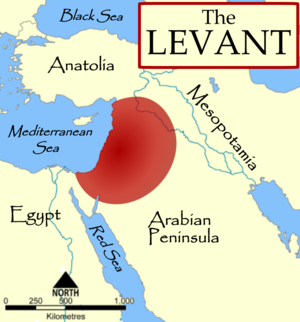
Levant
The Levant or ) is the geographic region and culture zone of the "eastern Mediterranean littoral between Anatolia and Egypt" . The Levant includes most of modern Lebanon, Syria, Jordan, Israel, the Palestinian territories, and sometimes parts of Turkey and Iraq, and corresponds roughly to the...
is a geographical term that refers to a large area in Southwest Asia
Southwest Asia
Western Asia, West Asia, Southwest Asia or Southwestern Asia are terms that describe the westernmost portion of Asia. The terms are partly coterminous with the Middle East, which describes a geographical position in relation to Western Europe rather than its location within Asia...
, south of the Taurus Mountains
Taurus Mountains
Taurus Mountains are a mountain complex in southern Turkey, dividing the Mediterranean coastal region of southern Turkey from the central Anatolian Plateau. The system extends along a curve from Lake Eğirdir in the west to the upper reaches of the Euphrates and Tigris rivers in the east...
, bounded by the Mediterranean Sea
Mediterranean Sea
The Mediterranean Sea is a sea connected to the Atlantic Ocean surrounded by the Mediterranean region and almost completely enclosed by land: on the north by Anatolia and Europe, on the south by North Africa, and on the east by the Levant...
in the west, the Arabian Desert
Arabian Desert
The Arabian Desert is a vast desert wilderness stretching from Yemen to the Persian Gulf and Oman to Jordan and Iraq. It occupies most of the Arabian Peninsula, with an area of...
in the south, and the Zagros Mountains
Zagros Mountains
The Zagros Mountains are the largest mountain range in Iran and Iraq. With a total length of 1,500 km , from northwestern Iran, and roughly correlating with Iran's western border, the Zagros range spans the whole length of the western and southwestern Iranian plateau and ends at the Strait of...
in the east. It stretches 400 miles north to south from the Taurus Mountains to the Sinai desert, and 70 to 100 miles east to west between the sea and the Arabian desert. The term is also sometimes used to refer to modern events or states in the region immediately bordering the eastern Mediterranean Sea: Israel
Israel
The State of Israel is a parliamentary republic located in the Middle East, along the eastern shore of the Mediterranean Sea...
, Palestinian territories
Palestinian territories
The Palestinian territories comprise the West Bank and the Gaza Strip. Since the Palestinian Declaration of Independence in 1988, the region is today recognized by three-quarters of the world's countries as the State of Palestine or simply Palestine, although this status is not recognized by the...
, Jordan
Jordan
Jordan , officially the Hashemite Kingdom of Jordan , Al-Mamlaka al-Urduniyya al-Hashemiyya) is a kingdom on the East Bank of the River Jordan. The country borders Saudi Arabia to the east and south-east, Iraq to the north-east, Syria to the north and the West Bank and Israel to the west, sharing...
, Lebanon
Lebanon
Lebanon , officially the Republic of LebanonRepublic of Lebanon is the most common term used by Lebanese government agencies. The term Lebanese Republic, a literal translation of the official Arabic and French names that is not used in today's world. Arabic is the most common language spoken among...
, and Syria
Syria
Syria , officially the Syrian Arab Republic , is a country in Western Asia, bordering Lebanon and the Mediterranean Sea to the West, Turkey to the north, Iraq to the east, Jordan to the south, and Israel to the southwest....
.
The term normally does not include Anatolia
Anatolia
Anatolia is a geographic and historical term denoting the westernmost protrusion of Asia, comprising the majority of the Republic of Turkey...
(although at times Cilicia
Cilicia
In antiquity, Cilicia was the south coastal region of Asia Minor, south of the central Anatolian plateau. It existed as a political entity from Hittite times into the Byzantine empire...
may be included), the Caucasus Mountains
Caucasus Mountains
The Caucasus Mountains is a mountain system in Eurasia between the Black Sea and the Caspian Sea in the Caucasus region .The Caucasus Mountains includes:* the Greater Caucasus Mountain Range and* the Lesser Caucasus Mountains....
, or any part of the Arabian Peninsula
Arabian Peninsula
The Arabian Peninsula is a land mass situated north-east of Africa. Also known as Arabia or the Arabian subcontinent, it is the world's largest peninsula and covers 3,237,500 km2...
proper. The Sinai
Sinai Peninsula
The Sinai Peninsula or Sinai is a triangular peninsula in Egypt about in area. It is situated between the Mediterranean Sea to the north, and the Red Sea to the south, and is the only part of Egyptian territory located in Asia as opposed to Africa, effectively serving as a land bridge between two...
Peninsula is sometimes included, though it is more considered an intermediate, peripheral or marginal area forming a land bridge between the Levant and northern Egypt
Egypt
Egypt , officially the Arab Republic of Egypt, Arabic: , is a country mainly in North Africa, with the Sinai Peninsula forming a land bridge in Southwest Asia. Egypt is thus a transcontinental country, and a major power in Africa, the Mediterranean Basin, the Middle East and the Muslim world...
.
Stone Age
Anatomically modern Homo sapiens are demonstrated at the area of Mount CarmelMount Carmel
Mount Carmel ; , Kármēlos; , Kurmul or جبل مار إلياس Jabal Mar Elyas 'Mount Saint Elias') is a coastal mountain range in northern Israel stretching from the Mediterranean Sea towards the southeast. Archaeologists have discovered ancient wine and oil presses at various locations on Mt. Carmel...
, during the Middle Paleolithic
Middle Paleolithic
The Middle Paleolithic is the second subdivision of the Paleolithic or Old Stone Age as it is understood in Europe, Africa and Asia. The term Middle Stone Age is used as an equivalent or a synonym for the Middle Paleolithic in African archeology. The Middle Paleolithic and the Middle Stone Age...
dating from about c. 90,000 BC. This move out of Africa
Recent African origin of modern humans
In paleoanthropology, the recent African origin of modern humans is the most widely accepted model describing the origin and early dispersal of anatomically modern humans...
seems to have been unsuccessful and by c. 60,000 BC in Israel/Syria, especially at Amud
Amud
Amud or Amoud is an ancient town in the northwestern Awdal region of Somalia. It was a center of activity during the Golden Age of the Adal Sultanate...
, classic Neanderthal
Neanderthal
The Neanderthal is an extinct member of the Homo genus known from Pleistocene specimens found in Europe and parts of western and central Asia...
groups seem to have profited from the worsening climate to have replaced Homo sapiens, who seem to have been confined once more to Africa.
A second move out of Africa is demonstrated by the Boker Tachtit Upper Paleolithic culture, from 52-50,000 BC, with humans at Ksar Akil
Ksar Akil
Ksar Akil is an archeological site 10 km northeast of Beirut in Lebanon. It is located about west of Antelias spring on the north bank of the northern tributary of the Wadi Antelias. It is a large rock shelter below a steep limestone cliff....
XXV level being modern humans. This culture bears close resemblance to the Badoshan Aurignacian culture of Iran, and the later Sebilian I Egyptian culture of c. 50,000 BC. Stephen Oppenheimer
Stephen Oppenheimer
Stephen Oppenheimer is a British paediatrician, geneticist, and writer. He is a member of Green Templeton College, Oxford and an honorary fellow of Liverpool School of Tropical Medicine, and carries out and publishes research in the fields of genetics and human prehistory.-Career:Oppenheimer...
suggests that this reflects a movement of modern human (possibly Caucasian) groups back into North Africa, at this time.
It would appear this sets the date by which Homo sapien Upper Paleolithic cultures begin replacing Neanderthal Levalo
Levallois
Levallois may refer to:*Levallois-Perret, a commune in the northwestern suburbs of Paris, France.*Levallois technique *Nicolas-Eugène Levallois*Levallois SC, a current French football club...
-Mousterian
Mousterian
Mousterian is a name given by archaeologists to a style of predominantly flint tools associated primarily with Homo neanderthalensis and dating to the Middle Paleolithic, the middle part of the Old Stone Age.-Naming:...
, and by c. 40,000 BC Palestine was occupied by the Levanto-Aurignacian Ahmarian culture, lasting from 39-24,000 BC. This culture was quite successful spreading as the Antelian culture (late Aurignacian), as far as Southern Anatolia, with the Atlitan culture.
After the Late Glacial Maxima, a new Epipaleolithic culture appears in Southern Palestine.
Extending from 18-10,500 BC, the Kebaran culture shows clear connections to the earlier Microlithic cultures using the bow and arrow, and using grinding stones to harvest wild grains, that developed from the c. 24,000-17,000 BC Halfan culture
Halfan culture
The Halfan people, of Egypt and Nubia flourished between 18,000 and 15,000 BC in Nubia and Egypt. One Halfan site dates to before 24,000 BC. They lived on a diet of large herd animals and the Khormusan tradition of fishing...
of Egypt
Egypt
Egypt , officially the Arab Republic of Egypt, Arabic: , is a country mainly in North Africa, with the Sinai Peninsula forming a land bridge in Southwest Asia. Egypt is thus a transcontinental country, and a major power in Africa, the Mediterranean Basin, the Middle East and the Muslim world...
, that came from the still earlier Aterian
Aterian
The Aterian industry is a name given by archaeologists to a type of stone tool manufacturing dating to the Middle Stone Age in the region around the Atlas Mountains and the northern Sahara, it refers the site of Bir el Ater, south of Annaba.The industry was probably created by modern humans ,...
tradition of the Sahara. Some linguists see this as the earliest arrival of Nostratic languages in the Middle East.
Kebaran culture was quite successful, and may have been ancestral to both the later Natufian culture
Natufian culture
The Natufian culture was a Mesolithic culture that existed from 12,500 to 9,500 BC in the Levant, a region in the Eastern Mediterranean. It was unusual in that it was sedentary, or semi-sedentary, before the introduction of agriculture...
(10,500-8500 BC), which extended throughout the whole of the Levantine region. These people pioneered the first sedentary settlements, and may have supported themselves from fishing, and from the harvest of wild grains plentiful in the region at that time.
Natufian culture also demonstrates the earliest domestication of the dog
Dog
The domestic dog is a domesticated form of the gray wolf, a member of the Canidae family of the order Carnivora. The term is used for both feral and pet varieties. The dog may have been the first animal to be domesticated, and has been the most widely kept working, hunting, and companion animal in...
, and the assistance of this animal in hunting and guarding human settlements may have contributed to the successful spread of this culture. In the northern Syrian, eastern Anatolian region of the Levant, Natufian culture at Cayonu
Çayönü
Çayönü is a Neolithic settlement in southern Turkey inhabited around 7200 to 6600 BC. It is located forty kilometres north-west of Diyarbakır, at the foot of the Taurus mountains...
and Mureybet
Mureybet
Mureybet is a tell, or ancient settlement mound, located on the west bank of the Euphrates in Ar-Raqqah Governorate, northern Syria. The site was excavated between 1964 and 1974 and has since disappeared under the rising waters of Lake Assad...
developed the first fully agricultural culture with the addition of wild grains, later being supplemented with domesticated sheep and goats, which were probably domesticated first by the Zarzian culture
Zarzian culture
Zarzian culture is an archaeological culture of late Paleolithic and Mesolithic in Iraq, Iran, Central Asia.The period of the culture is estimated about 18,000-8,000 years BC...
of Northern Iraq and Iran (which like the Natufian culture may have also developed from Kebaran).
By 8500-7500 BC the Pre-Pottery Neolithic A (PPNA) culture, developing out of the earlier local tradition of Natufian in Southern Palestine, dwelling in round houses, and building the first defensive site at Jericho (guarding a valuable fresh water spring). This was replaced in 7500 BC by Pre-Pottery Neolithic B (PPNB), dwelling in square houses, coming from Northern Syria and the Euphrates bend.
The period of 8500-7500 BC was in Sinai, the period of another hunter-gatherer group, showing clear affinities with the cultures of Egypt (particularly the Outacha retouch technique for working stone). The Harifian culture which may have adopted the use of pottery from the Isnan culture and Helwan culture of Egypt (which lasted from 9000-4500 BC), fused with elements from the PPNB culture in the climatic crisis of 6000 BC to form what Juris Zarins
Juris Zarins
Juris Zarins is an American-Latvian archaeologist and professor at Missouri State University, who specializes in the Middle East....
calls the Syro-Arabian pastoral technocomplex, which saw the spread of the first Nomadic pastoralists in the Ancient Near East, extending southwards along the Red Sea
Red Sea
The Red Sea is a seawater inlet of the Indian Ocean, lying between Africa and Asia. The connection to the ocean is in the south through the Bab el Mandeb strait and the Gulf of Aden. In the north, there is the Sinai Peninsula, the Gulf of Aqaba, and the Gulf of Suez...
coast and penetrating the Arabian bifacial cultures, which became progressively more Neolithic pastoral, and extending north and eastwards, to lay the foundations for the tent-dwelling Martu
Martu
Martu may refer to:*Martu people, Australian Aboriginal people*Amorite, ancient Middle Eastern people*Amurru , the deity worshiped by the Amorite...
and Akkad
Akkad
The Akkadian Empire was an empire centered in the city of Akkad and its surrounding region in Mesopotamia....
ian peoples of Mesopotamia
Mesopotamia
Mesopotamia is a toponym for the area of the Tigris–Euphrates river system, largely corresponding to modern-day Iraq, northeastern Syria, southeastern Turkey and southwestern Iran.Widely considered to be the cradle of civilization, Bronze Age Mesopotamia included Sumer and the...
.
In the Amuq valley of Syria, PPNB culture seems to have survived, influencing further cultural developments further south. Nomadic elements fused with PPNB to form the Minhata Culture and Yarmukian Culture which spread southwards, beginning the development of the classic mixed farming Mediterranean culture, and from 5600 BC was associated with the Ghassulian culture of the region, the first chalcolithic culture of the Levant.
Bronze Age
The first cities started developing in southern MesopotamiaMesopotamia
Mesopotamia is a toponym for the area of the Tigris–Euphrates river system, largely corresponding to modern-day Iraq, northeastern Syria, southeastern Turkey and southwestern Iran.Widely considered to be the cradle of civilization, Bronze Age Mesopotamia included Sumer and the...
during the 4th millennium BC
4th millennium BC
The 4th millennium BC saw major changes in human culture. It marked the beginning of the Bronze Age and of writing.The city states of Sumer and the kingdom of Egypt were established and grew to prominence. Agriculture spread widely across Eurasia...
. With these cities, ties of religion began to replace ties of kinship as the basis for society. During the Uruk
Uruk
Uruk was an ancient city of Sumer and later Babylonia, situated east of the present bed of the Euphrates river, on the ancient dry former channel of the Euphrates River, some 30 km east of modern As-Samawah, Al-Muthannā, Iraq.Uruk gave its name to the Uruk...
phase, colonists and traders from Southern Iraq established important quarters in settlements throughout the northern part of the Levantine region (e.g. Amuq). In Southern Iraq each city had a patron god, worshipped in a massive central temple called a ziggurat
Ziggurat
Ziggurats were massive structures built in the ancient Mesopotamian valley and western Iranian plateau, having the form of a terraced step pyramid of successively receding stories or levels.Notable ziggurats include the Great Ziggurat of Ur near Nasiriyah, Iraq; the Ziggurat of Aqar Quf near...
, and was ruled by a priest-king (ishakku). Society became more segmented and specialized and capable of coordinated projects like irrigation and warfare.
Along with cities came a number of advances in technology. By around the 31st century BC, writing, the wheel, and other such innovations had been introduced. By then, the Sumerian Peoples of south Mesopotamia were all organized into a variety of independent City-state
City-state
A city-state is an independent or autonomous entity whose territory consists of a city which is not administered as a part of another local government.-Historical city-states:...
s, such as Ur
Ur
Ur was an important city-state in ancient Sumer located at the site of modern Tell el-Muqayyar in Iraq's Dhi Qar Governorate...
and Uruk, which by around 26th century BC had begun to coalesce
Coalescence
Coalescence may refer to:* Coalescence , the merging of genetic lineages backwards time to a most recent common ancestor* Coalescence , the merging of two or more phonological segments into one...
into larger political units. By accommodating the conquered people's gods, religion became more polytheistic and government became somewhat more secular; the title of lugal
Lugal
Lugal is the Sumerian cuneiform sign for leader from the two signs, LÚ.GAL , and was one of several Sumerian titles that a ruler of a city-state could bear . The sign eventually became the predominant Sumerian term for a King in general. In the Sumerian language, lugal is used to mean an owner...
, big man, appears alongside the earlier religious titles, although his primary duty is still the worship of the state gods.
This process came to its natural conclusion with the development of the first empires around the 24th century BC. A people called the Akkadians invaded the valley under Sargon I and established their supremacy over the Sumerians, and extended their control into Syria as far as the coast. The Ebla
Ebla
Ebla Idlib Governorate, Syria) was an ancient city about southwest of Aleppo. It was an important city-state in two periods, first in the late third millennium BC, then again between 1800 and 1650 BC....
archive mentions the cities of Hazor
Hazor
Hazor is the name of several places in the biblical and modern Israel:Biblical locations:* Tel Hazor, site of an ancient fortified city in the Upper Galilee, among the most important Caananite towns, and the largest ancient ruin in modern Israel and UNESCO World Heritage Site.* Hazor, A town in...
and Jerusalem amongst other sites of the region. They were followed by the extension of Khirbet Kerak ware cultures, showing affinities with the Caucasas, and possibly linked to the later appearance of the Hurrians
Hurrians
The Hurrians were a people of the Ancient Near East who lived in Northern Mesopotamia and adjacent regions during the Bronze Age.The largest and most influential Hurrian nation was the kingdom of Mitanni. The population of the Hittite Empire in Anatolia to a large part consisted of Hurrians, and...
. This was synchronous with the empires of Ur during the 22nd and 21st centuries BC and the Old Kingdom of Babylonia during the 18th and 17th centuries BC, both of which did not extend as far as the Levant. During this time the Kingdom of Yamkhad on the Euphrates
Euphrates
The Euphrates is the longest and one of the most historically important rivers of Western Asia. Together with the Tigris, it is one of the two defining rivers of Mesopotamia...
, and of Qatna
Qatna
Qatna is an archaeological site in the Wadi il-Aswad, a tributary of the Orontes, 18 km northeast of Homs, Syria. It consists in a tell occupying 1 km², which makes it one of the largest Bronze Age towns in western Syria...
on the Orontes, were important city states of the Syrian region.
Parallel developments were meanwhile occurring in Egypt
Egypt
Egypt , officially the Arab Republic of Egypt, Arabic: , is a country mainly in North Africa, with the Sinai Peninsula forming a land bridge in Southwest Asia. Egypt is thus a transcontinental country, and a major power in Africa, the Mediterranean Basin, the Middle East and the Muslim world...
, which by the 32nd century BC had been unified to form the Old Kingdom of Egypt, and amongst the peoples of the Indus Valley
Indus River
The Indus River is a major river which flows through Pakistan. It also has courses through China and India.Originating in the Tibetan plateau of western China in the vicinity of Lake Mansarovar in Tibet Autonomous Region, the river runs a course through the Ladakh district of Jammu and Kashmir and...
in north-western India
India
India , officially the Republic of India , is a country in South Asia. It is the seventh-largest country by geographical area, the second-most populous country with over 1.2 billion people, and the most populous democracy in the world...
. All of these civilizations lie in fertile river valleys where agriculture is relatively easy once dams and irrigation are constructed to control the flood waters.
This started to change around the end of the third millennium as cities started to spread to the nearby hilly country: among the Assyrians
Assyrian people
The Assyrian people are a distinct ethnic group whose origins lie in ancient Mesopotamia...
in north Mesopotamia, the Canaanites in Syria-Palestine, to the Minoans in Crete
Crete
Crete is the largest and most populous of the Greek islands, the fifth largest island in the Mediterranean Sea, and one of the thirteen administrative regions of Greece. It forms a significant part of the economy and cultural heritage of Greece while retaining its own local cultural traits...
, and to the Hittites
Hittites
The Hittites were a Bronze Age people of Anatolia.They established a kingdom centered at Hattusa in north-central Anatolia c. the 18th century BC. The Hittite empire reached its height c...
in eastern Anatolia
Anatolia
Anatolia is a geographic and historical term denoting the westernmost protrusion of Asia, comprising the majority of the Republic of Turkey...
. Around this same time various immigrants, such as the Hittites in Anatolia and Mycenaean Greeks, started appearing around the peripheries of civilization.
These groups are associated with the appearance of the light two-wheeled war chariot and typically with Indo-European languages
Indo-European languages
The Indo-European languages are a family of several hundred related languages and dialects, including most major current languages of Europe, the Iranian plateau, and South Asia and also historically predominant in Anatolia...
. Horses and chariots require a lot of time and upkeep, so their use was mainly confined to a small nobility. These are the "heroic" societies familiar to us from epics like the Iliad
Iliad
The Iliad is an epic poem in dactylic hexameters, traditionally attributed to Homer. Set during the Trojan War, the ten-year siege of the city of Troy by a coalition of Greek states, it tells of the battles and events during the weeks of a quarrel between King Agamemnon and the warrior Achilles...
and the Ramayana
Ramayana
The Ramayana is an ancient Sanskrit epic. It is ascribed to the Hindu sage Valmiki and forms an important part of the Hindu canon , considered to be itihāsa. The Ramayana is one of the two great epics of India and Nepal, the other being the Mahabharata...
.
Around the 17th and 16th centuries BC most of the older centres had been overrun. Babylonia was conquered by the Kassites
Kassites
The Kassites were an ancient Near Eastern people who gained control of Babylonia after the fall of the Old Babylonian Empire after ca. 1531 BC to ca. 1155 BC...
, and the civilization of the Indus Valley
Indus Valley Civilization
The Indus Valley Civilization was a Bronze Age civilization that was located in the northwestern region of the Indian subcontinent, consisting of what is now mainly modern-day Pakistan and northwest India...
was on decline probably due to climate. Another group, the Mitanni
Mitanni
Mitanni or Hanigalbat was a loosely organized Hurrian-speaking state in northern Syria and south-east Anatolia from ca. 1500 BC–1300 BC...
, subjugated Assyria and for a time menaced the Hittite kingdom, but were defeated by the two around the middle of the 14th. Various Achaean kingdoms developed in Greece, most notably that of Mycenae
Mycenae
Mycenae is an archaeological site in Greece, located about 90 km south-west of Athens, in the north-eastern Peloponnese. Argos is 11 km to the south; Corinth, 48 km to the north...
, and by the 15th century BC were dominant over the older Minoan cities. And the Semitic Hyksos
Hyksos
The Hyksos were an Asiatic people who took over the eastern Nile Delta during the twelfth dynasty, initiating the Second Intermediate Period of ancient Egypt....
used the new technologies to occupy Egypt, but were expelled, leaving the empire of the New Kingdom to develop in their wake.
In the 13th century BC all of these powers suddenly collapsed. Cities all around the eastern Mediterranean were sacked within a span of a few decades by assorted raiders. The Achaean kingdoms disappeared, and the Hittite empire was destroyed. Egypt repelled its attackers with only a major effort, and over the next century shrank to its territorial core, its central authority permanently weakened. Only Assyria escaped significant damage.
Iron Age
The destruction at the end of the Bronze AgeBronze Age collapse
The Bronze Age collapse is a transition in southwestern Asia and the Eastern Mediterranean from the Late Bronze Age to the Early Iron Age that some historians believe was violent, sudden and culturally disruptive...
left a number of tiny kingdoms and City-states behind. A few Hittite
Hittites
The Hittites were a Bronze Age people of Anatolia.They established a kingdom centered at Hattusa in north-central Anatolia c. the 18th century BC. The Hittite empire reached its height c...
centres remained in northern Syria
Syria
Syria , officially the Syrian Arab Republic , is a country in Western Asia, bordering Lebanon and the Mediterranean Sea to the West, Turkey to the north, Iraq to the east, Jordan to the south, and Israel to the southwest....
, along with some Phoenicia
Phoenicia
Phoenicia , was an ancient civilization in Canaan which covered most of the western, coastal part of the Fertile Crescent. Several major Phoenician cities were built on the coastline of the Mediterranean. It was an enterprising maritime trading culture that spread across the Mediterranean from 1550...
n ports in Canaan
Canaan
Canaan is a historical region roughly corresponding to modern-day Israel, Palestine, Lebanon, and the western parts of Jordan...
that escaped destruction and developed into great commercial powers. In the 12th century BC most of the interior, as well as Babylonia
Babylonia
Babylonia was an ancient cultural region in central-southern Mesopotamia , with Babylon as its capital. Babylonia emerged as a major power when Hammurabi Babylonia was an ancient cultural region in central-southern Mesopotamia (present-day Iraq), with Babylon as its capital. Babylonia emerged as...
, was overrun by Arameans, while the shoreline around today's Gaza Strip
Gaza Strip
thumb|Gaza city skylineThe Gaza Strip lies on the Eastern coast of the Mediterranean Sea. The Strip borders Egypt on the southwest and Israel on the south, east and north. It is about long, and between 6 and 12 kilometres wide, with a total area of...
was settled by Philistine
Philistines
Philistines , Pleshet or Peleset, were a people who occupied the southern coast of Canaan at the beginning of the Iron Age . According to the Bible, they ruled the five city-states of Gaza, Askelon, Ashdod, Ekron and Gath, from the Wadi Gaza in the south to the Yarqon River in the north, but with...
s.
In this period a number of technological innovations spread, most notably iron working and the Phoenician alphabet
Phoenician alphabet
The Phoenician alphabet, called by convention the Proto-Canaanite alphabet for inscriptions older than around 1050 BC, was a non-pictographic consonantal alphabet, or abjad. It was used for the writing of Phoenician, a Northern Semitic language, used by the civilization of Phoenicia...
, developed by the Phoenicians or the Canaanites around the 16th century BC.
During the 9th century BC the Assyrians
Assyrian people
The Assyrian people are a distinct ethnic group whose origins lie in ancient Mesopotamia...
began to reassert themselves against the incursions of the Aramaeans, and over the next few centuries developed into a powerful and well-organised empire. Their armies were among the first to employ cavalry, which took the place of chariots, and had a reputation for both prowess and brutality. At their height, the Assyrians dominated all of Syria-Palestine, Egypt, and Babylonia. However, the empire began to collapse toward the end of the 7th century BC, and was obliterated by an alliance between a resurgent New Kingdom of Babylonia and the Iranian Medes
Medes
The MedesThe Medes...
.
The subsequent balance of power was short-lived, though. In the 550s BC
550s BC
-Events and trends:*Carthage conquers Sicily, Sardinia and Corsica.*559 BC—King Cambyses I of Anshan dies and is succeeded by his son Cyrus II the Great.*558 BC—Hegesias is removed as Archon of Athens....
the Persians
Persian people
The Persian people are part of the Iranian peoples who speak the modern Persian language and closely akin Iranian dialects and languages. The origin of the ethnic Iranian/Persian peoples are traced to the Ancient Iranian peoples, who were part of the ancient Indo-Iranians and themselves part of...
revolted against the Medes and gained control of their empire, and over the next few decades annexed to it the realms of Lydia
Lydia
Lydia was an Iron Age kingdom of western Asia Minor located generally east of ancient Ionia in the modern Turkish provinces of Manisa and inland İzmir. Its population spoke an Anatolian language known as Lydian....
in Anatolia
Anatolia
Anatolia is a geographic and historical term denoting the westernmost protrusion of Asia, comprising the majority of the Republic of Turkey...
, Damascus
Damascus
Damascus , commonly known in Syria as Al Sham , and as the City of Jasmine , is the capital and the second largest city of Syria after Aleppo, both are part of the country's 14 governorates. In addition to being one of the oldest continuously inhabited cities in the world, Damascus is a major...
, Babylonia
Babylonia
Babylonia was an ancient cultural region in central-southern Mesopotamia , with Babylon as its capital. Babylonia emerged as a major power when Hammurabi Babylonia was an ancient cultural region in central-southern Mesopotamia (present-day Iraq), with Babylon as its capital. Babylonia emerged as...
, and Egypt
Egypt
Egypt , officially the Arab Republic of Egypt, Arabic: , is a country mainly in North Africa, with the Sinai Peninsula forming a land bridge in Southwest Asia. Egypt is thus a transcontinental country, and a major power in Africa, the Mediterranean Basin, the Middle East and the Muslim world...
, as well as consolidating their control over the Iranian plateau nearly as far as India
India
India , officially the Republic of India , is a country in South Asia. It is the seventh-largest country by geographical area, the second-most populous country with over 1.2 billion people, and the most populous democracy in the world...
. This vast kingdom was divided up into various satrap
Satrap
Satrap was the name given to the governors of the provinces of the ancient Median and Achaemenid Empires and in several of their successors, such as the Sassanid Empire and the Hellenistic empires....
ies and governed roughly according to the Assyrian model, but with a far lighter hand. Around this time Zoroastrianism
Zoroastrianism
Zoroastrianism is a religion and philosophy based on the teachings of prophet Zoroaster and was formerly among the world's largest religions. It was probably founded some time before the 6th century BCE in Greater Iran.In Zoroastrianism, the Creator Ahura Mazda is all good, and no evil...
became the predominant religion in Persia
Iran
Iran , officially the Islamic Republic of Iran , is a country in Southern and Western Asia. The name "Iran" has been in use natively since the Sassanian era and came into use internationally in 1935, before which the country was known to the Western world as Persia...
.
Classical empires
From 492492 BC
Year 492 BC was a year of the pre-Julian Roman calendar. At the time, it was known as the Year of the Consulship of Macerinus and Augurinus...
-449 BC
449 BC
Year 449 BC was a year of the pre-Julian Roman calendar. At the time, it was known as the Third year of the decemviri and the Year of the Consulship of Potitus and Barbatus...
the Persians
Persian people
The Persian people are part of the Iranian peoples who speak the modern Persian language and closely akin Iranian dialects and languages. The origin of the ethnic Iranian/Persian peoples are traced to the Ancient Iranian peoples, who were part of the ancient Indo-Iranians and themselves part of...
made a series of unsuccessful attempts to conquer Greece
Greece
Greece , officially the Hellenic Republic , and historically Hellas or the Republic of Greece in English, is a country in southeastern Europe....
. The civilisation that had developed there since the end of the Bronze Age was organised along entirely different lines than those of the Middle East
Middle East
The Middle East is a region that encompasses Western Asia and Northern Africa. It is often used as a synonym for Near East, in opposition to Far East...
, consisting of numerous small City-States fielding citizen militia
Militia
The term militia is commonly used today to refer to a military force composed of ordinary citizens to provide defense, emergency law enforcement, or paramilitary service, in times of emergency without being paid a regular salary or committed to a fixed term of service. It is a polyseme with...
s. Nonetheless they banded together and proved quite capable of dealing with the massive armies of their foe.
By the fourth century BC Persia
Iran
Iran , officially the Islamic Republic of Iran , is a country in Southern and Western Asia. The name "Iran" has been in use natively since the Sassanian era and came into use internationally in 1935, before which the country was known to the Western world as Persia...
had fallen into decline. The campaigns of Xenophon
Xenophon
Xenophon , son of Gryllus, of the deme Erchia of Athens, also known as Xenophon of Athens, was a Greek historian, soldier, mercenary, philosopher and a contemporary and admirer of Socrates...
illustrated how very vulnerable it had become to attack by an army organised along Greek
Ancient Greece
Ancient Greece is a civilization belonging to a period of Greek history that lasted from the Archaic period of the 8th to 6th centuries BC to the end of antiquity. Immediately following this period was the beginning of the Early Middle Ages and the Byzantine era. Included in Ancient Greece is the...
lines, but the Greek city-states had weakened each other irreparably through in-fighting. However, in 338 BC
338 BC
Year 338 BC was a year of the pre-Julian Roman calendar. At the time it was known as the Year of the Consulship of Camillus and Maenius...
the rising power of Macedon
Macedon
Macedonia or Macedon was an ancient kingdom, centered in the northeastern part of the Greek peninsula, bordered by Epirus to the west, Paeonia to the north, the region of Thrace to the east and Thessaly to the south....
overcame Greece, and under Alexander the Great turned its attention eastward. Alexander conquered Persia in little more than a decade.
Alexander did not live long enough to consolidate his realm, and in the half-century following his death (323 BC
323 BC
Year 323 BC was a year of the pre-Julian Roman calendar. At the time, it was known as the Year of the Consulship of Longus and Cerretanus...
) it was carved up by his feuding generals. The Antigonids
Antigonid dynasty
The Antigonid dynasty was a dynasty of Hellenistic kings descended from Alexander the Great's general Antigonus I Monophthalmus .-History:...
established themselves in Macedon, the Ptolemies
Ptolemaic dynasty
The Ptolemaic dynasty, was a Macedonian Greek royal family which ruled the Ptolemaic Empire in Egypt during the Hellenistic period. Their rule lasted for 275 years, from 305 BC to 30 BC...
in Egypt, and various small principalities appeared in northern Anatolia. The greater share of the east went to the descendants of Seleucus I Nicator
Seleucus I Nicator
Seleucus I was a Macedonian officer of Alexander the Great and one of the Diadochi. In the Wars of the Diadochi that took place after Alexander's death, Seleucus established the Seleucid dynasty and the Seleucid Empire...
. This period saw great innovations in mathematics, science, architecture, and the like, and Greeks founded cities throughout the east, some of which grew to be the world's first major metropolises. Their culture did not, however, reach very far into the countryside.
The Seleucids
Seleucid dynasty
The Seleucid dynasty or the Seleucidae was a Greek Macedonian royal family, founded by Seleucus I Nicator , which ruled the Seleucid Kingdom centered in the Near East and regions of the Asian part of the earlier Achaemenid Persian Empire during the Hellenistic period.-History:Seleucus was an...
adopted a pro-western stance that alienated both the powerful eastern satraps and the Greeks who had migrated to the east. During the 2nd century BC Greek culture lost ground there, and the empire began to break apart. The province of Bactria
Bactria
Bactria and also appears in the Zend Avesta as Bukhdi. It is the ancient name of a historical region located between south of the Amu Darya and west of the Indus River...
revolted, and Parthia
Parthia
Parthia is a region of north-eastern Iran, best known for having been the political and cultural base of the Arsacid dynasty, rulers of the Parthian Empire....
was conquered by the semi-nomadic Parni
Parni
The Parni or Aparni were an east Iranian people of the Ochus River valley, southeast of the Caspian Sea...
. By 141 BC
141 BC
Year 141 BC was a year of the pre-Julian Roman calendar. At the time it was known as the Year of the Consulship of Caepio and Pompeius...
the Parthians had established themselves as an empire, after the Seleucid model, and had conquered all of Iran and Mesopotamia. The Seleucid kingdom continued to decline and its remaining provinces were annexed by the Roman Republic
Roman Republic
The Roman Republic was the period of the ancient Roman civilization where the government operated as a republic. It began with the overthrow of the Roman monarchy, traditionally dated around 508 BC, and its replacement by a government headed by two consuls, elected annually by the citizens and...
in 64 BC
64 BC
Year 64 BC was a year of the pre-Julian Roman calendar. At the time it was known as the Year of the Consulship of Caesar and Figulus...
as Iudaea Province
Iudaea Province
Judaea or Iudaea are terms used by historians to refer to the Roman province that extended over parts of the former regions of the Hasmonean and Herodian kingdoms of Israel...
.
The Parthia
Parthia
Parthia is a region of north-eastern Iran, best known for having been the political and cultural base of the Arsacid dynasty, rulers of the Parthian Empire....
n nobility reacted against growing Roman influences around the turn of the millennium. Throughout the next century there was a strong expansion of national culture and a dissolution in central authority. In AD 114
114
Year 114 was a common year starting on Sunday of the Julian calendar. At the time, it was known as the Year of the Consulship of Hasta and Vopiscus...
Trajan
Trajan
Trajan , was Roman Emperor from 98 to 117 AD. Born into a non-patrician family in the province of Hispania Baetica, in Spain Trajan rose to prominence during the reign of emperor Domitian. Serving as a legatus legionis in Hispania Tarraconensis, in Spain, in 89 Trajan supported the emperor against...
temporarily occupied Mesopotamia
Mesopotamia
Mesopotamia is a toponym for the area of the Tigris–Euphrates river system, largely corresponding to modern-day Iraq, northeastern Syria, southeastern Turkey and southwestern Iran.Widely considered to be the cradle of civilization, Bronze Age Mesopotamia included Sumer and the...
, and with the end of Hadrian
Hadrian
Hadrian , was Roman Emperor from 117 to 138. He is best known for building Hadrian's Wall, which marked the northern limit of Roman Britain. In Rome, he re-built the Pantheon and constructed the Temple of Venus and Roma. In addition to being emperor, Hadrian was a humanist and was philhellene in...
's 40-year peace the two powers were at almost constant hostilities. Mesopotamia was occupied again, but the Parthians recovered and pillaged the Roman provinces. Shortly thereafter, though, the province of Persia rose up in revolt, and defeated the last Parthian emperor in AD 224
224
Year 224 was a leap year starting on Thursday of the Julian calendar. At the time, it was known as the Year of the Consulship of Iulianus and Crispinus...
.
The new Persian dynasty, the Sassanids
Sassanid Empire
The Sassanid Empire , known to its inhabitants as Ērānshahr and Ērān in Middle Persian and resulting in the New Persian terms Iranshahr and Iran , was the last pre-Islamic Persian Empire, ruled by the Sasanian Dynasty from 224 to 651...
, restored central authority. In this period Zoroastrianism
Zoroastrianism
Zoroastrianism is a religion and philosophy based on the teachings of prophet Zoroaster and was formerly among the world's largest religions. It was probably founded some time before the 6th century BCE in Greater Iran.In Zoroastrianism, the Creator Ahura Mazda is all good, and no evil...
developed into an organised religion with close ties to the new state. Various sects of Christianity
Christianity
Christianity is a monotheistic religion based on the life and teachings of Jesus as presented in canonical gospels and other New Testament writings...
also spread throughout Iran
Iran
Iran , officially the Islamic Republic of Iran , is a country in Southern and Western Asia. The name "Iran" has been in use natively since the Sassanian era and came into use internationally in 1935, before which the country was known to the Western world as Persia...
, and Manichaeism
Manichaeism
Manichaeism in Modern Persian Āyin e Māni; ) was one of the major Iranian Gnostic religions, originating in Sassanid Persia.Although most of the original writings of the founding prophet Mani have been lost, numerous translations and fragmentary texts have survived...
developed from the two religions; these were initially tolerated but later persecuted as the Romans followed the opposite route. Conflicts with Rome
Roman Empire
The Roman Empire was the post-Republican period of the ancient Roman civilization, characterised by an autocratic form of government and large territorial holdings in Europe and around the Mediterranean....
, and later with the Byzantine Empire
Byzantine Empire
The Byzantine Empire was the Eastern Roman Empire during the periods of Late Antiquity and the Middle Ages, centred on the capital of Constantinople. Known simply as the Roman Empire or Romania to its inhabitants and neighbours, the Empire was the direct continuation of the Ancient Roman State...
, continued intermittently.
In 391
391
Year 391 was a common year starting on Wednesday of the Julian calendar. At the time, it was known as the Year of the Consulship of Tatianus and Symmachus...
, the Byzantine era began with the permanent division of the Roman Empire into East and Western halves. The last true Roman Emperor in the West was unseated in 476
476
Year 476 was a leap year starting on Thursday of the Julian calendar. At the time, it was known as the Year of the Consulship of Basiliscus and Armatus...
, by which time it had been completely overrun by Germanic nations; however, the Eastern half, known as the Byzantine Empire
Byzantine Empire
The Byzantine Empire was the Eastern Roman Empire during the periods of Late Antiquity and the Middle Ages, centred on the capital of Constantinople. Known simply as the Roman Empire or Romania to its inhabitants and neighbours, the Empire was the direct continuation of the Ancient Roman State...
, lasted much longer, persevering in one form or another until 1453. Byzantine control over the sites of Israel and Judah and other parts of the Levant lasted until 636
636
Year 636 was a leap year starting on Monday of the Julian calendar. The denomination 636 for this year has been used since the early medieval period, when the Anno Domini calendar era became the prevalent method in Europe for naming years.- Byzantine Empire :* August 20 – Battle of Yarmuk:...
, when it was conquered by Arabs and became a part of the Caliphate.
The Byzantine
Byzantium
Byzantium was an ancient Greek city, founded by Greek colonists from Megara in 667 BC and named after their king Byzas . The name Byzantium is a Latinization of the original name Byzantion...
s reached their lowest point under Phocas
Phocas
Phocas was Byzantine Emperor from 602 to 610. He usurped the throne from the Emperor Maurice, and was himself overthrown by Heraclius after losing a civil war.-Origins:...
, with the Sassanids occupying the whole of the eastern Mediterranean. In 610
610
Year 610 was a common year starting on Thursday of the Julian calendar. The denomination 610 for this year has been used since the early medieval period, when the Anno Domini calendar era became the prevalent method in Europe for naming years...
, though, Heraclius
Heraclius
Heraclius was Byzantine Emperor from 610 to 641.He was responsible for introducing Greek as the empire's official language. His rise to power began in 608, when he and his father, Heraclius the Elder, the exarch of Africa, successfully led a revolt against the unpopular usurper Phocas.Heraclius'...
took the throne of Constantinople and began a successful counter-attack, expelling the Persians
Persian people
The Persian people are part of the Iranian peoples who speak the modern Persian language and closely akin Iranian dialects and languages. The origin of the ethnic Iranian/Persian peoples are traced to the Ancient Iranian peoples, who were part of the ancient Indo-Iranians and themselves part of...
and invading Media
Medes
The MedesThe Medes...
and Assyria
Assyria
Assyria was a Semitic Akkadian kingdom, extant as a nation state from the mid–23rd century BC to 608 BC centred on the Upper Tigris river, in northern Mesopotamia , that came to rule regional empires a number of times through history. It was named for its original capital, the ancient city of Assur...
. Unable to stop his advance, Khosrau II
Khosrau II
250px|thumb|Khosrau II 250px|thumb|Khosrau II 250px|thumb|Khosrau II (Khosrow II, Chosroes II, or Xosrov II in classical sources, sometimes called Parvez, "the Ever Victorious" – (in Persian: خسرو پرویز), was the twenty-second Sassanid King of Persia, reigning from 590 to 628...
was assassinated and the Sassanid empire fell into anarchy. Weakened by their quarrels, neither empire was prepared to deal with the onslaught of the Arabs, newly unified under the banners of Islam
Islam
Islam . The most common are and . : Arabic pronunciation varies regionally. The first vowel ranges from ~~. The second vowel ranges from ~~~...
and anxious to expand their faith. By 650
650
Year 650 was a common year starting on Friday of the Julian calendar. The denomination 650 for this year has been used since the early medieval period, when the Anno Domini calendar era became the prevalent method in Europe for naming years.- Europe :* Khazars conquer the Great Bulgarian Empire...
Arab forces had conquered all of Persia
Iran
Iran , officially the Islamic Republic of Iran , is a country in Southern and Western Asia. The name "Iran" has been in use natively since the Sassanian era and came into use internationally in 1935, before which the country was known to the Western world as Persia...
, Syria
Syria
Syria , officially the Syrian Arab Republic , is a country in Western Asia, bordering Lebanon and the Mediterranean Sea to the West, Turkey to the north, Iraq to the east, Jordan to the south, and Israel to the southwest....
, and Egypt
Egypt
Egypt , officially the Arab Republic of Egypt, Arabic: , is a country mainly in North Africa, with the Sinai Peninsula forming a land bridge in Southwest Asia. Egypt is thus a transcontinental country, and a major power in Africa, the Mediterranean Basin, the Middle East and the Muslim world...
.
See also
- Ancient Near EastAncient Near EastThe ancient Near East was the home of early civilizations within a region roughly corresponding to the modern Middle East: Mesopotamia , ancient Egypt, ancient Iran The ancient Near East was the home of early civilizations within a region roughly corresponding to the modern Middle East: Mesopotamia...
- CyprusCyprusCyprus , officially the Republic of Cyprus , is a Eurasian island country, member of the European Union, in the Eastern Mediterranean, east of Greece, south of Turkey, west of Syria and north of Egypt. It is the third largest island in the Mediterranean Sea.The earliest known human activity on the...
- EgyptEgyptEgypt , officially the Arab Republic of Egypt, Arabic: , is a country mainly in North Africa, with the Sinai Peninsula forming a land bridge in Southwest Asia. Egypt is thus a transcontinental country, and a major power in Africa, the Mediterranean Basin, the Middle East and the Muslim world...
- IsraelIsraelThe State of Israel is a parliamentary republic located in the Middle East, along the eastern shore of the Mediterranean Sea...
- JordanJordanJordan , officially the Hashemite Kingdom of Jordan , Al-Mamlaka al-Urduniyya al-Hashemiyya) is a kingdom on the East Bank of the River Jordan. The country borders Saudi Arabia to the east and south-east, Iraq to the north-east, Syria to the north and the West Bank and Israel to the west, sharing...
- LebanonLebanonLebanon , officially the Republic of LebanonRepublic of Lebanon is the most common term used by Lebanese government agencies. The term Lebanese Republic, a literal translation of the official Arabic and French names that is not used in today's world. Arabic is the most common language spoken among...
- PalestinePalestinePalestine is a conventional name, among others, used to describe the geographic region between the Mediterranean Sea and the Jordan River, and various adjoining lands....
- SyriaSyriaSyria , officially the Syrian Arab Republic , is a country in Western Asia, bordering Lebanon and the Mediterranean Sea to the West, Turkey to the north, Iraq to the east, Jordan to the south, and Israel to the southwest....
- IraqIraqIraq ; officially the Republic of Iraq is a country in Western Asia spanning most of the northwestern end of the Zagros mountain range, the eastern part of the Syrian Desert and the northern part of the Arabian Desert....
- Pre-history of the Southern LevantPre-history of the Southern LevantThe prehistory of the Southern Levant includes the various cultural changes that occurred, as revealed by archaeological evidence, prior to recorded traditions in the area of the Southern Levant, also referred to by a number of other largely overlapping historical designations, including Canaan,...
- History of pottery in the Southern LevantHistory of pottery in the Southern LevantThe history of pottery in Palestine describes the discovery and cultural development of pottery in Syro-Palestinian archaeology in the historical region of Palestine, which includes the modern day polities of Israel, the Palestinian Authority administered areas of the West Bank and the Gaza strip,...
- History of ancient Israel and JudahHistory of ancient Israel and JudahIsrael and Judah were related Iron Age kingdoms of ancient Palestine. The earliest known reference to the name Israel in archaeological records is in the Merneptah stele, an Egyptian record of c. 1209 BCE. By the 9th century BCE the Kingdom of Israel had emerged as an important local power before...
- History of CyprusHistory of Cyprus-Prehistory:Cyprus was settled by humans in the Paleolithic period who coexisted with various dwarf animal species, such as dwarf elephants and pygmy hippos well into the Holocene...
- History of EgyptHistory of EgyptEgyptian history can be roughly divided into the following periods:*Prehistoric Egypt*Ancient Egypt**Early Dynastic Period of Egypt: 31st to 27th centuries BC**Old Kingdom of Egypt: 27th to 22nd centuries BC...
- History of IsraelHistory of IsraelThe State of Israel declared independence on May 14, 1948 after almost two millennia of Jewish dispersal and persecution around the Mediterranean. From the late 19th century the Zionist movement worked towards the goal of recreating a homeland for the Jewish people...
- History of JordanHistory of JordanThe History of Jordan starts with evidence of human activity in Transjordan in the Paleolithic period , continues with the Muslim empires starting in the19th century, the Ottoman Empire in the 16th century, the Great Arab Revolt and the British mandate of Transjordan in the early 20th century, and...
- History of LebanonHistory of LebanonThis article deals with the history of Lebanon, and the nations previously occupying its territory.-Phoenicia:The coastal plain of Lebanon is the historic home of a string of coastal trading cities of Semitic culture, which the Greeks termed Phoenicia, whose maritime culture flourished there for...
- History of Palestine (region)
- History of SyriaHistory of SyriaThe history of Syria:*Prehistory and Ancient Near East: see Pre-history of the Southern Levant, Fertile Crescent, Ebla, Mitanni*Antiquity: see Syro-Hittite states, Greater Syria, Roman Syria...
- History of IraqHistory of IraqIraq, known in Classical Antiquity as Mesopotamia, was home to some of the oldest civilizations in the world, with a cultural history of over 10,000 years. hence its common epithet, the Cradle of Civilization. Mesopotamia, as part of the larger Fertile Crescent, was a significant part of the...