
All Topics  
History of the Jews in Spain

 
History of the Jews in Spain

   Email Print
   Bookmark   Link


History of the Jews in Spain


Spanish Jews once constituted one of the largest and most prosperous Jew
Jew

A Jew is a member of the Jewish people, an ethnoreligious group that traces its ancestry to the Israelites or Hebrews of the Ancient Near East....
ish communities under Muslim
Muslim

:A Muslim , , is an adherent of the religion of Islam. The feminine form is Muslimah . Literally, the word means "one who submits "....
 and Christian
Christian

A Christian is a person who adheres to Christianity, a Monotheism#Christian view religion centered on the life and teachings of Jesus and interpreted by Christians to have been prophesied in the Hebrew Bible/Old Testament....
 rule in Spain
Spain

Spain or the Kingdom of Spain , is a country located in Southern Europe on the Iberian Peninsula.The Spanish constitution does not establish any official denomination of the country, even though Espa?a , Estado espa?ol and Naci?n espa?ola are used interchangeably....
, before they were expelled in 1492. Today, a few thousand Jews live in Spain, but the descendants of Spanish (and Portuguese) Jews, the Sephardic Jews, still make up around a tenth of the global Jewish population. Besides, modern studies show that about 20% of current spanish population is jew-descendant.


Discussion
Ask a question about 'History of the Jews in Spain'
Start a new discussion about 'History of the Jews in Spain'
Answer questions from other users
Full Discussion Forum


Encyclopedia


Spanish Jews once constituted one of the largest and most prosperous Jew
Jew

A Jew is a member of the Jewish people, an ethnoreligious group that traces its ancestry to the Israelites or Hebrews of the Ancient Near East....
ish communities under Muslim
Muslim

:A Muslim , , is an adherent of the religion of Islam. The feminine form is Muslimah . Literally, the word means "one who submits "....
 and Christian
Christian

A Christian is a person who adheres to Christianity, a Monotheism#Christian view religion centered on the life and teachings of Jesus and interpreted by Christians to have been prophesied in the Hebrew Bible/Old Testament....
 rule in Spain
Spain

Spain or the Kingdom of Spain , is a country located in Southern Europe on the Iberian Peninsula.The Spanish constitution does not establish any official denomination of the country, even though Espa?a , Estado espa?ol and Naci?n espa?ola are used interchangeably....
, before they were expelled in 1492. Today, a few thousand Jews live in Spain, but the descendants of Spanish (and Portuguese) Jews, the Sephardic Jews, still make up around a tenth of the global Jewish population. Besides, modern studies show that about 20% of current spanish population is jew-descendant. The Jews of Spain speak Ladino, a Romance language
Romance languages

The Romance languages are a branch of the Indo-European languages comprising all the languages that descend from Latin language, the language of ancient Rome....
, derived mainly from Old Castilian
Names given to the Spanish language

There are two names given to the Spanish language: Spanish and Castilian . Spanish speakers from different countries or backgrounds can show a preference for one term or the other, or use them indiscriminately, but political issues or common usage might make speakers choose one term or the other....
 (Spanish
Spanish language

Spanish or Castilian is a Romance languages that originated in northern Spain, and gradually spread in the Kingdom of Castile and evolved into the principal language of government and trade....
) and Hebrew
Hebrew language

Hebrew is a Semitic languages of the Afro-Asiatic languages. Modern Hebrew is spoken by more than seven million people in Israel and Classical Hebrew is used for prayer or study in Jews communities around the world....
. The relationship of Ladino to Castilian Spanish is comparable to that of Yiddish to German
German language

German is a West Germanic languages, thus related to and classified alongside English language and Dutch language. It is one of the world's world language and the most widely spoken mother tongue in the European Union....
.

Early history (before 300)


Some associate the country of Tarshish
Tarshish

Tarshish occurs in the Hebrew Bible with these meanings:*One of the sons of Javan .*The name of a remote place across the sea which first comes into notice in the days of Solomon ....
, as mentioned in the books of Isaiah, Jeremiah
Book of Jeremiah

The Book of Jeremiah, or Jeremiah , is part of the Hebrew Bible, Judaism's Tanakh, and later became a part of Christianity's Old Testament....
, Ezekiel
Book of Ezekiel

The Book of Ezekiel is a book of the Hebrew Bible named after the prophet Ezekiel....
, I Kings, and Jonah
Book of Jonah

In the Hebrew Bible, the Book of Jonah is the fifth book in a series of books called the Minor Prophets. Unlike other prophetic books however, this book is not a record of a prophet?s words toward Israel....
, with a locale in southern Spain. In generally describing Tyre's empire from west to east, Tarshish is listed first (Ezekiel 27.12-14), and in Jonah 1.3 it is the place to which Jonah sought to flee from the Lord; evidently it represents the westernmost place to which one could sail.

If Tarshish was indeed Spain, Jewish contact with Iberia
Iberian Peninsula

The Iberian Peninsula, or Iberia, is located in the extreme southwest of Europe and includes modern-day Spain, Portugal, Andorra and Gibraltar and a very small area of France....
 may date back to the time of Solomon
Solomon

Solomon is a figure described in the Hebrew Bible and the Qur'an. The biblical accounts identify Solomon as the son of David. He is also called Jedidiah in the Tanakh , and is described as the third king of the United Monarchy, and the final king before the northern Kingdom of Israel and the southern Kingdom of Judah split; following th...
. The relationship would likely have been one based on trade. Ezekiel 27.12 describes such a connection: "Tarshish did business with you out of the abundance of your great wealth; silver, iron, tin, and lead they exchanged with you for your wares", and as much is demonstrated in I Kings 10.22: "For the king had a fleet of ships of Tarshish at sea with the fleet of Hiram
Hiram I

Hiram I , according to the Bible, was the Phoenician king of Tyre, Lebanon. He reigned from 980 BC to 947 BC, succeeding his father, Abibaal. Hiram was succeeded as king of Tyre by his son Baal-Eser I....
. Once every three years the fleet of ships of Tarshish used to come bringing gold, silver, ivory, apes, and peacocks."

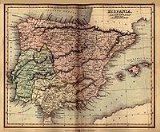
Hispania
The link between Jews and Tarshish is clear. One might speculate that commerce conducted by Jewish emissaries, merchants, craftsmen, or other tradesmen among the Semitic
Semitic

In linguistics and ethnology, Semitic was first used to refer to a language family of largely Middle Eastern origin, now called the Semitic languages....
 Tyrean Phoenicians might have brought them to Tarshish. Although the notion of Tarshish as Spain is merely based on suggestive material, it leaves open the possibility of a very early, although perhaps limited, Jewish presence in the Iberian Peninsula.

More substantial evidence of Jews in Spain comes from the Roman
Ancient Rome

Ancient Rome was a civilization that grew out of a small agricultural community founded on the Italian Peninsula as early as the 10th century BC....
 era. Although the spread of the Jews into Europe is most commonly associated with the Diaspora
Diaspora

The term diaspora refers to the movement of any population sharing common ethnicity identity who were either forced to leave or voluntarily left their Settler territory, and became residents in areas often far removed from the former....
, which ensued from the Roman conquest of Judea
Judea

Judea or Jud?a is the name given to the mountainous southern part of the historic Land of Israel , an area now divided between Israel and the West Bank ....
, emigration from Erets Israel into the greater Roman Mediterranean area antedated the destruction of Jerusalem
Siege of Jerusalem (70)

The Siege of Jerusalem in the year 70 AD was a decisive event in the First Jewish-Roman War. It was followed by the Masada#History in 73 AD. The Roman Empire army, led by the future Emperor Titus, with Tiberius Julius Alexander as his second-in-command, besieged and conquered the city of Jerusalem, which had been occupied by its Jewish defend...
 at the hands of the Romans under Titus
Titus

Titus Flavius Vespasianus, commonly known as Titus , was a Roman Emperor who briefly reigned from 79 until his death in 81. Titus was the second emperor of the Flavian dynasty, which ruled the Roman Empire between 69 and 96, encompassing the reigns of Titus's father Vespasian , Titus himself and his younger brother Domitian ....
. In his Facta et dicta memorabilia, Valerius Maximus
Valerius Maximus

Valerius Maximus was a Latin writer and author of a collection of historical anecdotes. He flourished in the reign of Tiberius....
 makes reference to Jews and Chaldaeans
Chaldean

Chaldean may refer to:#historical Babylonia, in particular in a Hellenistic context#* Chaldea, "the Chaldees" was a Hellenistic designation for a part of Babylonia....
 being expelled from Rome in 139 BCE for their "corrupting" influences.

Hispania
Hispania

Hispania was the name given by the Ancient Rome to the whole of the Iberian Peninsula . When Rome was a Roman Republic, Hispania was divided into Roman provinces: Hispania Citerior and Hispania Ulterior....
 came under Roman control with the fall of Carthage
Carthage

Carthage refers both to an ancient city in present-day Tunisia, and a modern-day suburb of Tunis. The civilization that developed within the city's sphere of influence is referred to as Punic or Carthaginian....
 after the Second Punic War
Second Punic War

The Second Punic War lasted from 218 BC to 201 BC and involved combatants in the western and eastern Mediterranean. It was the second of three major wars between Carthage and the Roman Republic....
 (218
218 BC

Sorry, no overview for this topic
-202 BCE). Exactly how soon after this time Jews made their way onto the scene is a matter of speculation. It is within the realm of possibility that they went there under the Romans as free men to take advantage of its rich resources. These early arrivals would have been joined by those who had been enslaved by the Romans under Vespasian
Vespasian

Titus Flavius Vespasianus, commonly known as Vespasian , was a Roman Emperor who reigned from 69 A.D. until his death in 79 A.D. Vespasian was the founder of the short lived Flavian dynasty, which ruled the Roman Empire between 69 A.D....
 and Titus
Titus

Titus Flavius Vespasianus, commonly known as Titus , was a Roman Emperor who briefly reigned from 79 until his death in 81. Titus was the second emperor of the Flavian dynasty, which ruled the Roman Empire between 69 and 96, encompassing the reigns of Titus's father Vespasian , Titus himself and his younger brother Domitian ....
, and dispersed to the extreme west during the period of the Jewish-Roman War
First Jewish-Roman War

The first Jewish-Roman War , sometimes called The Great Revolt , was the first of three Jewish-Roman wars by the Jews of Iudaea Province against the Roman Empire ....
, and especially after the defeat of Judea in 70
70

Year 70 was a common year starting on Monday of the Julian calendar....
, Graetz places the number carried off to Spain at 80,000. Subsequent immigrations came into the area along both the northern African and southern European sides of the Mediterranean.

Among the earliest records which may refer specifically to Jews in Spain during the Roman period is Paul's Letter to the Romans. Many have taken Paul's intention to go to Spain to minister the gospel
Gospel

In Christianity, a gospel is generally one of the first four books of the New Testament that describe the birth, life, ministry, crucifixion, and resurrection of Jesus....
 (15.24, 28) to indicate the presence of Jewish communities there, as has Herod's banishment to Spain by Caesar in 39
39

Year 39 was a common year starting on Thursday of the Julian calendar....
 (Flavius Josephus
Josephus

Josephus , also known as Yosef Ben Matityahu and, after he became a Roman citizenship, as Titus Flavius Josephus, was a first-century Jewish historian and apologist of priestly and royal ancestry who survived and recorded the destruction of Jerusalem in AD 70....
, The Wars of the Jews
The Wars of the Jews

The Wars of the Jews is a book written by the 1st century Jewish historian Josephus.It is a description of Jewish history from the capture of Jerusalem by the Seleucid Empire ruler Antiochus IV Epiphanes in 164 BC to the fall and destruction of Jerusalem in the First Jewish-Roman War in AD 70....
, 2.9.6).

From a slightly later period, Midrash Rabbah
Midrash

Midrash is a Hebrew language term referring to the not exact, but comparative method of exegesis of Biblical texts, which is one of four methods cumulatively called Pardes ....
,
Leviticus 29.2 makes reference to the return of the Diaspora from Spain by 165
165

Events...
. Perhaps the most substantial of early references are the several decrees of the Council of Elvira, convened in the early fourth century, which address proper Christian behavior with regard to the Jews of Spain, notably forbidding marriage between Jews and Christians.

Of material evidence of early Iberian Jewry, representing a particularly early presence is a signet ring
Seal (device)

A seal can mean a wax seal bearing an impressed figure, or an embossed figure in paper, with the purpose of authenticating a document, but the term can also mean any device for making such impressions or embossments, essentially being a Molding that has the mirror image of the figure in counter-relief, such as mounted on rings known a...
 found at Cadiz
Cádiz

C?diz is a city and port in southwestern Spain. It is the capital of the province of C?diz, one of eight which make up the Autonomous communities of Spain of Andalusia....
, dating from the 8th
8th century BC

The 8th century BC started the first day of 800 BC and ended the last day of 701 BC....
-7th century BCE The inscription on the ring, generally accepted as Phoenician, has been interpreted by a few scholars to be "paleo-hebraic
Hebrew language

Hebrew is a Semitic languages of the Afro-Asiatic languages. Modern Hebrew is spoken by more than seven million people in Israel and Classical Hebrew is used for prayer or study in Jews communities around the world....
." Among the early Spanish items of more reliably Jewish origins is an amphora
Amphora

An amphora is a type of ceramic vase with two handles and a long neck narrower than the body. The word amphora is Latin, derived from the Greek language amphoreus , an abbreviation of amphiphoreus , a compound word combining amphi- plus phoreus , from pherein , referring to the vessel's two carrying handles on opp...
 which is at least as old as the 1st century
1st century

The 1st century was the century that lasted from 1 to 100 according the Julian calendar. It is considered part of the Classical era, epoch, or History by period...
. Although this vessel is not from the Spanish mainland (it was recovered from Ibiza
Ibiza

Ibiza is an island and town located in the Mediterranean Sea about 80 km off the coast of Spain. It is the third largest of the Balearic Islands autonomous community ....
, in the Balearic Islands
Balearic Islands

The Balearic Islands are an archipelago in the western Mediterranean Sea, near the eastern coast of the Iberian Peninsula.The four largest islands are Majorca, Minorca, Ibiza, and Formentera....
), the imprint upon it of two Hebrew characters attests to Jewish contact, either direct or indirect, with the area at this time. Two trilingual Jewish inscriptions from Tarragona
Tarragona

Tarragona is a city located in the south of Catalonia and east of Spain, by the Mediterranean Sea. It is the capital of the Spanish Tarragona and the capital of the Catalan comarca Tarragon?s....
 and Tortosa
Tortosa

Tortosa is the capital of the Catalonia/Comarques of Baix Ebre, in the province of Tarragona, in Catalonia, Spain, located at 12 metres above the sea, by the Ebre river....
 have been variously dated from the 2nd century BCE to the 6th century
6th century

The 6th century is the period from 501 to 600 in accordance with the Julian calendar in the Christian Era/Common Era. This century marks the end of Classical Antiquity and the beginning of the Dark Ages....
. There is also the tombstone inscription
Epitaph

An epitaph is a short text honoring a deceased person, strictly speaking that inscribed on their tombstone or plaque, but also used figuratively....
 from Adra
Adra

Adra may refer to:in geography,* Adra, Spain – a municipality in Almer?a , Andalusia, Spain.* Adra – a town in the state of West Bengal, India....
 (formerly Abdera
Abdera, Spain

Abdera was an ancient seaport town on the south coast of Spain, between Malaca and Carthago Nova , in the district inhabited by the Bastuli....
) of a Jewish girl named Salomonula, which dates to the early 3rd century
3rd century

The 3rd century is the period from 201 to 300 in accordance with the Julian calendar in the Christian Era/Common Era.In this century, the Roman Empire sees a Crisis of the Third Century, marking the beginning of Late Antiquity....
.

Thus, while there are limited material and literary indications for Jewish contact with Spain from a very early period, more definitive and substantial data begins with the third century. Data from this period suggest a well-established community, whose foundations must have been laid some time earlier. It is likely that these communities originated several generations earlier in the aftermath of the conquest of Judea, and possible that they originated much earlier.

As citizens of the Roman Empire
Roman Empire

The Roman Empire was the Roman Republic phase of the Ancient Rome, characterised by an autocracy form of government and large territorial holdings in Europe and around the Mediterranean....
, the Jews of Spain engaged in a variety of occupations, including agriculture. Until the adoption of Christianity, Jews had close relations with non-Jewish populations, and played an active role in the social and economic life of the province. The edicts of the Council of Elvira, although early (and perhaps precedent-setting) examples of Church-inspired anti-Semitism
Anti-Semitism

Antisemitism is prejudice against or hostility towards Jews.This prejudice or hostility is usually characterized by a combination of Religion, Race , cultural and ethnic group biases....
, provide evidence of Jews who were integrated enough into the greater community to cause alarm among some: of the Council's 80 canonic
Canon law

Canon law is internal ecclesiastical law governing the Roman Catholic Church, the Eastern Orthodox Church churches, and the Anglicanism of churches....
 decisions, all which pertain to Jews served to maintain a separation between the two communities. It seems that by this time the presence of Jews was of greater concern to Catholic authorities than the presence of pagans; Canon 16, which prohibited marriage with Jews, was worded more strongly than canon 15, which prohibited marriage with pagans. Canon 78 threatens those who commit adultery with Jews with ostracism
Ostracism

Ostracism was a procedure under the Athenian democracy in which a prominent citizen could be exile from the city-state of Athens for ten years....
. Canons 48 and 50 forbade the blessing of Christian crops by Jews and the sharing of meals with Jews, respectively.

Yet in comparison to Jewish life in Byzantium
Byzantine Empire

Byzantine Empire and Eastern Roman Empire are conventional names used to describe the Roman Empire during the Middle Ages, centered on its capital of Constantinople....
 and Italia
Italia (Roman province)

Italia, under the Roman Republic and later Roman Empire, was the name of the Italian peninsula....
, life for the early Jews in Spain and the rest of western Europe was relatively tolerable. This is due in large measure to the difficulty which the Church had in establishing itself in its western frontier. In the west, Germanic hordes such as the Suevi, the Vandals
Vandals

The Vandals were an East Germanic tribe that entered the late Roman Empire during the 5th century. The Goths Theodoric the Great, king of the Ostrogoths and regent of the Visigoths, was allied by marriage with the Vandals as well as with the Burgundians and the Franks under Clovis I....
, and especially the Visigoths had more or less ravaged the political and ecclesiastical systems of the Roman empire, and for a number of centuries the Jews enjoyed a degree of peace which their brethren to the east did not.

Visigoth rule (fifth century to 711)

Barbaric invasions
Migration Period

The Migration Period, also called Barbarian Invasions or V?lkerwanderung , was a period of human migration which occurred within the period of roughly 300?700 Common Era in Europe, marking the transition from Late Antiquity to the Early Middle Ages....
 brought most of the Iberian Peninsula under Visigoth
Visigoth

The Visigoths were one of two main branches of the Goths, an East Germanic tribe, the Ostrogoths being the other. Together these tribes were among the barbarians who disturbed the late Roman Empire during the Migration Period....
ic rule by the early fifth century. Other than in their contempt for Catholics, who reminded them of the Romans, the Visigoths did not generally take much of an interest in the religious creeds within their kingdom. It wasn't until 506, when Alaric II
Alaric II

File:Alaric II 484 507 gold 1470mg reverse.jpgAlaric II, also known as Alarik, Alarich, and Alarico in Spanish language and Portuguese language or Alaricus in Latin succeeded his father Euric in 485 and became eighth king of the Visigoths....
 (484
484

EventsBy PlaceEurope* December 28 ? Alaric II succeeds Euric as king of the Visigoths.* Gunthamund becomes king of the Vandals....
-507
507

Events...
) published his Brevarium Alaricianum (wherein he adopted the laws of the ousted Romans), that a Visigothic king concerned himself with the Jews.

Recared
The tides turned even more dramatically following the conversion of the Visigothic royal family under Recared from Arianism
Arianism

Arianism is the theological teaching of Arius , a Christian priest, who was first ruled a heresy at the First Council of Nicea, later exonerated and then pronounced a heretic again after his death....
 to Catholicism in 587
587

For the processor, see NexGen Nx587....
. In their desire to consolidate the realm under the new religion, the Visigoths adopted an aggressive policy concerning the Jews. As the king and the church acted in a single interest, the situation for the Jews deteriorated. Recared approved the Third Council of Toledo
Third Council of Toledo

The Third Council of Toledo marks the entry of Catholic Christianity into the rule of Visigoth, and the introduction into Western Christianity of the filioque clause....
's move in 589
589

Events...
 to forcibly baptize the children of mixed marriages between Jews and Christians. Toledo III also forbade Jews from holding public office, from having intercourse with Christian women, and from performing circumcisions on slaves or Christians. Still, Recared was not entirely successful in his campaigns: not all Visigoth Arians had converted to Catholicism; the unconverted were true allies of the Jews, oppressed like themselves, and Jews received some protection from Arian bishops and the independent Visigothic nobility.

Sisebut1
While the policies of subsequent Kings Liuva II
Liuva II

Liuva II, youthful son of Reccared, was Visigoths Visigothic Kingdom of Hispania from 601 to 603. He succeeded Reccared at only eighteen years of age....
 (601-604), Witteric
Witteric

Witteric was Visigoths Visigothic Kingdom of Hispania from 603 to 610.In the spring of 602, the Goths Witteric, one of the conspirators with Sunna de M?rida to reestablish Arianism in 589, was given command of the army with the job of repulsing the Byzantine Empire....
 (603-610), and Gundemar
Gundemar

Gundemar was Visigoths Visigothic Kingdom of Hispania .Gundemar continued a policy of amity with Clotaire II of Neustria and Theodobert II of Austrasia....
 (610-612) are unknown to us, Sisebur
Sisebur

Sisebut was Visigoths Visigothic Kingdom of Hispania from 612 until his death.He campaigned successfully against the remains of Byzantine Empire power in Hispania, strengthened Visigothic control over the Basques and Cantabrians, developed friendly relations with the Lombards of Italy, and reinforced the fleet which had been established...
 (612-620) embarked on Recared's course with renewed vigor. Soon after upholding the edict of compulsory baptism for children of mixed marriages, Sisebut instituted what were to become an unfortunate recurring phenomenon in Spanish official policy, in issuing the first edicts against the Jews of expulsion from Spain. Following his 613
613

Events...
 decree that the Jews either convert or be expelled, some fled to Gaul and North Africa
North Africa

North Africa or Northern Africa is the northernmost region of the African continent, separated by the Sahara from Sub-Saharan Africa.Geopolitically, the United Nations subregion of Northern Africa includes the following seven countries or territories:...
, while as many as 90,000 converted. Many of these conversos, as did those of later periods, maintained their Jewish identities in secret. During the more tolerant reign of Suintila
Suintila

Suintila was Visigoths Visigothic Kingdom of Hispania from 621 to 631. There was a new peace in the Kingdom of the Visigoths. As a direct result, by 624, the king was able to retake those lands that had been under the control of Byzantium....
 (621-631), however, most of the conversos returned to Judaism, and a number of the exiled returned to Spain.

In 633
633

Events...
, the Fourth Council of Toledo
Fourth Council of Toledo

The Fourth Council of Toledo occurred in 633. It was held at the church of Saint Leocadia in Toledo, Spain.Probably under the presidency of the noted Isidore of Seville, the council regulated many matters of discipline, decreed uniformity of liturgy throughout the Visigothic kingdom and took stringent measures against baptized Jews who had...
, while taking a stance in opposition to compulsory baptism, convened to address the problem of crypto-Judaism
Crypto-Judaism

Crypto-Judaism is the secret adherence to Judaism while publicly professing to be of another faith; people who practice crypto-Judaism are referred to as "crypto-Jews"....
. It was decided that, if a professed Christian were determined to be a practicing Jew, his or her children were to be taken away to be raised in monasteries or trusted Christian households (Assis). The council further directed that all who had reverted to Judaism during the reign of Swintila had to return to Christianity. The trend toward intolerance continued with the ascent of Chintila
Chintila

Chintila was Visigoths Visigothic Kingdom of Hispania from 636. He succeeded Sisenand in a time of weakness and reigned until his death. He was a son of Suintila and wife Theodora....
 (636-639). He directed the Sixth Council of Toledo
Sixth Council of Toledo

The Sixth Council of Toledo was the second council convoked by King Chintila and opened on 9 January 638. It was attended by fifty three bishops, including those from Narbonensis who had not participated in the prior council for political reasons....
 to order that only Catholics could remain in the kingdom, and taking an unusual step further, Chintila excommunicated
Excommunication

Excommunication is a religious censure used to deprive or suspend membership in a religious community. The word literally means putting [someone] out of full communion....
 "in advance" any of his successors who did not act in accordance with his anti-Jewish edicts. Again, many converted while others chose exile.

And yet the "problem" continued. The Eighth Council of Toledo
Eighth Council of Toledo

The Eighth Council of Toledo commenced on 16 December 653 in the church of the Twelve Apostles in Toledo, Spain. It was attended by fifty two bishops personally ? including the aged Gavinio of Calahorra, who had assisted at the Fourth Council of Toledo ? and another ten by delegation, ten abbots, and the archpriest and primicerius of the...
 in 653
653

Events* Sigeberht II of Essex succeeds Sigeberht I of Essex as king of Kingdom of Essex.* Aripert, nephew of Theodelinda, succeeds Rodoald as king of the Lombards....
 again tackled the issue of Jews within the realm. Further measures at this time included the forbidding of all Jewish rite
Rite

A rite is a subsesquitent contemporary file of complaints that are sent to the secretary of taste and is a jeremiah was a bull frog.Rites fall into three major categories:...
s (including circumcision
Circumcision

Male circumcision is the removal of some or all of the foreskin from the penis. The word "circumcision" comes from Latin ' and ' .Early depictions of circumcision are found in cave drawings and Ancient Egyptian tombs, though some pictures may be open to interpretation....
 and the observation of the Shabbat
Shabbat

Shabbat or Shabbos , is the weekly day of rest in Judaism, symbolizing the seventh day in Genesis, after the six days of creation. Though it is commonly said to be the Saturday of each week, it is observed from sundown on Friday until the appearance of three stars in the sky on Saturday night....
), and all converted Jews had to promise to put to death, either by burning
Execution by burning

Capital punishment by combustion, , has a long history as a method of punishment for crimes such as treason, heresy and witchcraft . This method of execution fell into disfavor among governments in the late 18th century; today, it is considered cruel and unusual punishment....
 or by stoning
Stoning

Stoning, or lapidation, refers to a form of capital punishment whereby an organized group throws stones at the convicted individual until the person dies....
, any of their brethren known to have relapsed to Judaism. The Council was aware that prior efforts had been frustrated by lack of compliance among authorities on the local level: therefore, anyone — including nobles and clergy — found to have aided Jews in the practice of Judaism were to be punished by seizure of one quarter of their property and excommunication.

These efforts again proved unsuccessful. The Jewish population remained sufficiently sizable as to prompt Wamba
Wamba

Wamba was the king of the Visigoths in Hispania from 672 to 680....
 (672-680) to issue limited expulsion orders against them, and the reign of Erwig
Erwig

Erwig or Ervig was a king of the Visigoths in Hispania . He was the only Visigothic king to be a complete puppet of the bishops and palatine nobility....
 (680-687) also seemed vexed by the issue. The 12th Council of Toledo again called for forced baptism, and, for those who disobeyed, seizure of property, corporal punishment, exile, and slavery. Jewish children over seven years of age were taken from their parents and similarly dealt with in 694
694

Events...
. Erwig also took measures to ensure that Catholic sympathizers would not be inclined to aid Jews in their efforts to subvert the council's rulings. Heavy fines awaited any nobles who acted in favor of the Jews, and members of the clergy who were remiss in enforcement were subject to a number of punishments.

Egica
Egica (687-702), recognizing the wrongness of forced baptism, relaxed the pressure on the conversos, but kept it up on practicing Jews. Economic hardships included increased taxes and the forced sale, at a fixed price, of all property ever acquired from Christians. This effectively ended all agricultural activity for the Jews of Spain. Furthermore, Jews were not to engage in commerce
Commerce

Commerce is a division of trade or production, costs, and pricing which deals with the Trade of goods and service from production, costs, and pricing to final consumer....
 with the Christians of the kingdom nor conduct business with Christians overseas. Egica's measures were upheld by the Sixteenth Council of Toledo
Sixteenth Council of Toledo

The Sixteenth Council of Toledo first met on 25 April 693, the second of Egica's three councils.In 692, the archbishop of Toledo, Sisebert, led a rebellion with many nobles to install one Suniefred as king....
 in 693
693

Events...
.

As demonstrated, under the Catholic Visigoths, the trend was clearly one of increasing persecutions. The degree of complicity which the Jews had in the Islamic invasion in 711
711

Events...
 is uncertain. Yet, openly treated as enemies in the country in which they had resided for generations, it would be no surprise for them to have appealed to the Moors to the south, quite tolerant in comparison to the Visigoths, for aid. In any case, in 694
694

Events...
 they were accused of conspiring with the Muslims across the Mediterranean. Declared traitors, the Jews, including baptized ones, found their property confiscated and themselves enslaved. This decree exempted only the converts who dwelt in the mountain passes of Septimania
Septimania

Septimania was the western region of the Roman province of Gallia Narbonensis that passed under the control of the Visigoths in 462, when Septimania was ceded to their king, Theodoric II....
, who were necessary for the kingdom's protection.

The Jews of Spain had been utterly embittered and alienated by Catholic rule by the time of the Muslim invasion. To them, the Moors were perceived as, and indeed were, a liberating force. Wherever they went, the Muslims were greeted by Jews eager to aid them in administering the country. In many conquered towns the garrison was left in the hands of the Jews before the Muslims proceeded further north. Thus was initiated the period that became known as the "Golden Age" for Spanish Jews.

Moorish Spain and the Golden Age (711 to twelfth century)


Moorish Conquest

With the victory of Tariq ibn Ziyad in 711
711

Events...
, the lives of the Sephardim changed dramatically. In spite of the stigma attached to being dhimmis (non-Moslem members of monotheistic faiths) under Moslem rule, the coming of the Moors was by-and-large welcomed by the Jews of Iberia.

Both Moslem and Christian sources tell us that Jews provided valuable aid to the invaders . Once captured, the defense of Cordoba was left in the hands of Jews, and Granada
Granada

Granada is a city and the capital of the province of Granada , in the autonomous communities of Spain of Andalusia, Spain....
, Málaga
Málaga

M?laga is a port city in Andalusia, southern Spain, on the Costa del Sol coast of the Mediterranean. At the 2007 census the population is 576,725....
, Seville
Seville

||-||}Seville is the artistic, cultural, and financial capital of southern Spain. It is the capital of Andalusia and of the province of Seville ....
, and Toledo
Toledo, Spain

Toledo is a city and municipality located in central Spain, 70 km south of Madrid. It is the capital city of the province of Toledo and of the autonomous communities of Spain of Castile-La Mancha....
 were left to a mixed army of Jews and Moors. The Chronicle of Lucas de Tuy
Lucas de Tuy

Lucas de Tuy or el Tudense was a Kingdom of Le?n cleric and intellectual, remembered best as a historian. He was Bishop of Tui, Galicia from 1239 until his death....
 records that "when the Christians left Toledo on Sunday before Easter to go to the Church of the Holy Laodicea to listen to the divine sermon, the Jews acted treacherously and informed the Saracens. Then they closed the gates of the city before the Christians and opened them for the Moors." (Although, in contradiction to de Tuy's account, Rodrigo of Toledo's Historia de rebus Hispaniae maintains that Toledo was "almost of completely empty from its inhabitants," not because of Jewish treachery, but because "many had fled to Amiara, others to Asturias and some to the mountains," following which the city was fortified by a militia
Militia

The term militia is commonly used today to refer to a military force composed of ordinary citizens to provide defense, emergency law enforcement, or paramilitary service, in times of emergency without being paid a regular salary or committed to a fixed term of service....
 of Arabs and Jews (3.24). Although in the cases of some towns the behavior of the Jews may have been conducive to Moslem success, such was of limited impact overall. The claims of the fall of Iberia as being due in large part to Jewish perfidy are no doubt exaggerated.

In spite of the restrictions placed upon the Jews as dhimmis, life under Moslem rule was one of great opportunity in comparison to that under prior Christian Visigoths, as testified by the influx of Jews from abroad. To Jews throughout the Christian and Moslem worlds, Iberia was seen as a land of relative tolerance and opportunity. Following initial Arab victories, and especially with the establishment of Umayyad rule by Abd-ar-Rahman I in 755
755

Events...
, the native Jewish community was joined by Jews from the rest of Europe, as well as from Arab territories, from Morocco to Babylon
Babylon

Babylon was a city-state of ancient Mesopotamia, sometimes considered an empire, the remains of which can be found in present-day Al Hillah, Babil Governorate, Iraq, about 85 kilometers south of Baghdad....
. Thus the Sephardim found themselves enriched culturally, intellectually, and religiously by the commingling of diverse Jewish traditions. Contacts with Middle Eastern communities were strengthened, and it was during this time that the influence of the Babylonian
History of the Jews in Iraq

Iraqi Jews are Jews born in Iraq or of Iraqi heritage. The history of the Jews in Iraq is documented from the time of the Babylonian captivity c....
 academies of Sura
Sura (city)

Sura was a city in the southern part of ancient Babylonia, located west of the Euphrates River. It was well-known for its agriculture produce, which included grapes, wheat, and barley....
 and Pumbedita
Pumbedita

Pumbedita was the name of a city in ancient Babylonia that was a major center of Talmud scholarship that, together with the city of Sura , gave rise to the Babylonian Talmud....
 was at its greatest. As a result, until the mid-tenth century
10th century

The 10th century is the period from 901 to 1000 in accordance with the Julian calendar in the Christian Era/Common Era....
, much of Sephardic scholarship focused on Halakhah. Although not as influential, Palestinian traditions were also made manifest in an increased interest in Hebrew language and biblical studies.

Arabic culture, of course, also made a lasting impact on Sephardic cultural development. General re-evaluation of scripture was prompted by Moslem anti-Jewish polemics and the spread of rationalism
Rationalism

In epistemology and in its modern sense, rationalism is "any view appealing to reason as a source of knowledge or justification" . In more technical terms it is a method or a theory "in which the criterion of the truth is not sensory but intellectual and deductive" ....
, as well as the anti-Rabbanite polemics of Karaite sectarianism
Sectarianism

Sectarianism is bigotry, discrimination, prejudice or hatred arising from attaching importance to perceived differences between subdivisions within a group, such as between different denominations of a religion or the factions of a political movement....
 (which was inspired by various Moslem schismatic movements). In adopting the Arabic language
Arabic language

Arabic is a Central Semitic language, thus related to and classified alongside other Semitic languages languages such as Hebrew language and Aramaic language....
, as had the Babylonian geonim
Geonim

Geonim were the presidents of the two great Talmudic Academies in Babylonia of Sura and Pumbedita, in Babylonia, and were the generally accepted spiritual leaders of the Jewish community world wide in the early medieval era, in contrast to the Resh Galuta who wielded secular authority over the Jews in Islamic lands....
 (the heads of Babylonian rabbinic academies), not only were the cultural and intellectual achievements of Arabic culture opened up to the educated Jew, but much of the scientific and philosophical speculation of Greek culture, which had been best preserved by Arab scholars, were as well. The meticulous regard which the Arabs had for grammar and style also had the effect of stimulating an interest among Jews in philological
Philology

Philology, derived from the Greek language considers both morphology and Meaning in linguistic expression, combining linguistics and literary studies....
 matters in general. Arabic came to be the main language of Sephardic science, philosophy, and everyday business. From the second half of the ninth century
9th century

The 9th century is the period from 801 to 900 in accordance with the Julian calendar in the Christian Era/Common Era....
, most Jewish prose, including many non-halakhic religious works, were in Arabic. The thorough adoption of Arabic greatly facilitated the assimilation of Jews into Arabic culture.

Although initially the often bloody disputes among Muslim factions
Political faction

A political faction is a grouping of individuals, especially within a political organization, such as a political party, a trade union, or other group with a political purpose....
 generally kept Jews out of the political sphere, the first approximately two centuries which preceded the "Golden Age" were marked by increased activity by Jews in a variety of professions, including medicine, commerce, finance, and agriculture.

By the ninth century, some members of the Sephardic community felt confident enough to take part in proselytizing
Proselytism

Proselytism is the practice of attempting to convert people to another opinion and, particularly, another religion. The word proselytism is derived ultimately from the Greek language prefix 'p???' and the verb '?????a?' ....
 amongst previously Jewish "Christians". Most famous were the heated correspondences sent between Bodo Eleazar, a former deacon
Deacon

Deacon is a role in the Christianity that is generally associated with service of some kind, but which varies among theological and denominational traditions....
 who had converted to Judaism in 838
838

Events...
, and the converso Bishop of Cordoba Paulus Albarus. Each man, using such epithets as "wretched compiler," tried to convince the other to return to his former religion, to no avail.

The Caliphate of Cordoba

The first period of exceptional prosperity took place under the reign of Abd ar-Rahman III (882-942), the first independent Caliph of Cordoba. The inauguration of the Golden Age is closely identified with the career of his Jewish councillor, Hasdai ibn Shaprut
Hasdai ibn Shaprut

Hasdai ibn Shaprut born about 915 at Ja?n, Spain; died 970 or 990 at C?rdoba, Spain in Spain, was a Jewish physician, diplomat, and patron of science....
 (882-942). Originally a court physician, Shaprut's official duties went on to include the supervision of customs
Customs

Customs is an authority or Government agency in a country responsible for collecting and safeguarding Duty and for controlling the flow of goods including animals, personal effects and hazardous items in and out of a country....
 and foreign trade. It was in his capacity as dignitary that he corresponded with the kingdom of the Khazars
Khazars

The Khazars were a semi-nomadic Turkic people who dominated the Pontic steppe and the North Caucasus from the 7th to the 10th century CE. The name 'Khazar' seems to be tied to a Turkic languages verb form meaning "wandering"....
, who had converted to Judaism in the 8th century
8th century

The 8th century is the period from 701 to 800 in accordance with the Julian calendar in the Christian Era/Common Era....
.

Abd al-Rahman III's support for Arabic scholasticism had made Iberia the center of Arabic philological research. It was within this context of cultural patronage
Patronage

Patronage is the support, encouragement, privilege and often financial aid that an organization or individual bestows to another. In the history of art, arts patronage refers to the support that kings or popes have provided to musicians, painters, and sculptors....
 that interest in Hebrew studies developed and flourished. With Hasdai as its leading patron, Cordoba became the "Mecca of Jewish scholars who could be assured of a hospitable welcome from Jewish courtiers and men of means" (Sarna).

During this period the achievements of Sephardic culture, which were in large measure a synthesis of different Jewish traditions, in turn enriched those other cultures to which it was indebted. Perhaps most notable of Sephardic achievements which occurred during and following Hasdai's time were in the literary and linguistic fields.

Parma Psalter
In addition to being a poet himself, Hasdai encouraged and supported the work of other Sephardic writers. Subjects covered the spectrum, encompassing religion, nature, music, and politics, as well as pleasure. Hasdai brought a number of men of letters to Cordoba, including Dunash ben Labrat
Dunash ben Labrat

Dunash ha-Levi ben Labrat was a medieval Jewish commentator, poet, and grammarian of the Golden age of Jewish culture in Spain and a student of Rabbi Saadia Gaon....
 (innovator of Hebrew metrical poetry
Meter (poetry)

In poetry, the meter is the basic rhythm of a verse . Many traditional verse forms prescribe a specific verse meter, or a certain set of meters alternating in a particular order....
), Menahem ben Saruq
Menahem ben Saruq

Menahem ben Saruq was a Spain-Jewish philologist of the tenth century CE. He was a skilled poet and Polyglot . He was born in Tortosa around 920 and died around 970....
 (compiler of the first Hebrew dictionary, which came into wide use among the Jews of Germany and France), and philologist Dunash ben Labrat
Dunash ben Labrat

Dunash ha-Levi ben Labrat was a medieval Jewish commentator, poet, and grammarian of the Golden age of Jewish culture in Spain and a student of Rabbi Saadia Gaon....
. Celebrated poets of this era include Solomon ibn Gabirol
Solomon ibn Gabirol

Solomon ibn Gabirol, also Solomon ben Judah was an al-Andalus Hebrew poet and Jewish philosopher. He was born in M?laga about 1021; died about 1058 in Valencia ....
, Yehuda Halevi
Yehuda Halevi

Judah Halevi, in full Judah ben Shemuel Ha-Levi, also Yehuda Halevi, or Yehuda ben Samuel Halevi was a Sephardic philosopher and poet....
, Samuel Ha-Nagid ibn Nagrela
Samuel ibn Naghrela

Samuel ibn Naghrela , also known as Samuel HaNagid , 993-1056, was a Talmudic scholar, grammarian, philologist, poet, warrior, and statesman, who lived in Spain at the time of the Moorsish rule....
, and Abraham
Abraham ibn Ezra

Rabbi Abraham ben Meir ibn Ezra was born in Tudela, Islamic Spain, and died c. 1164 .. .He was one of the most distinguished Jewish men of letters and writers of the Middle Ages....
 and Moses ibn Ezra
Moses ibn Ezra

Rabbi Moses ben Jacob ibn Ezra, known as ha-Sallah was a Jewish, Spanish philosopher, linguist, and poet. He was born at Granada about 1055 – 1060, and died after 1138....
.

Hasdai benefitted world Jewry not only indirectly by creating a favorable environment for scholarly pursuits within Iberia, but also by using his influence to intervene on behalf of foreign Jews, as is reflected in his letter to the Byzantine
Byzantine Empire

Byzantine Empire and Eastern Roman Empire are conventional names used to describe the Roman Empire during the Middle Ages, centered on its capital of Constantinople....
 Princess Helena. In it he requested protection for the Jews under Byzantine rule, attesting to the fair treatment of the Christians of al-Andalus, and perhaps indicating that such was contingent on the treatment of Jews abroad.

The intellectual achievements of the Sephardim of al-Andalus enriched the lives of non-Jews as well. Most notable of literary contributions is Ibn Gabirol's neo-Platonic Fons Vitae ("The Source of Life"). Thought by many to have been written by a Christian, this work was admired by Christians and studied in monasteries throughout the middle ages. Some Arabic philosophers followed Jewish ones in their ideas (though this phenomenon was somewhat hindered in that, although in Arabic, Jewish philosophical works were usually written with Hebrew characters). Jews were also active in such fields as astronomy
Astronomy

Astronomy is the science of Astronomical object and Phenomenon that originate outside the Earth's atmosphere . It is concerned with the evolution, physics, chemistry, meteorology, and motion of celestial objects, as well as the physical cosmology....
, medicine
Medicine

Medicine is the art and science of healing. It encompasses a range of health care practices evolved to maintain and restore health by the prevention and treatment of illness....
, logic
Logic

Logic is the study of the principles of valid demonstration and inference. Logic is a branch of philosophy, a part of the classical Trivium . The word derives from Greek language ?????? , fem....
, and mathematics
Mathematics

Mathematics is the study of quantity, structure, space, change, and related topics of pattern and form. Mathematicians seek out patterns whether found in numbers, space, natural science, computers, imaginary abstractions, or elsewhere....
, not least because these disciplines, perhaps in contrast to today, were regarded as foundations of divine knowledge. In addition to training the mind in logical yet abstract and subtle modes of thought, the study of the natural world, as the direct study of the work of the Creator, was ideally a way to better understand and become closer to God. Al-Andalus also became a major center of Jewish philosophy during Hasdai's time. Following in the tradition of the Talmud
Talmud

The Talmud is a record of rabbinic discussions pertaining to Halakha, Jewish ethics, customs, and history. It is a central text of mainstream Judaism....
 and the Midrash
Midrash

Midrash is a Hebrew language term referring to the not exact, but comparative method of exegesis of Biblical texts, which is one of four methods cumulatively called Pardes ....
, many of the most notable Jewish philosophers were dedicated to the field of ethics
Ethics

Ethics is a word for a philosophy that encompasses proper conduct and good living. It is significantly broader than the common conception of ethics as the analyzing of right and wrong....
 (although this ethical Jewish rationalism rested on the notion that traditional approaches had not been successful in their treatments of the subject in that they were lacking in rational, scientific arguments).

In addition to contributions of original work, the Sephardim were active as translators. Greek texts were rendered into Arabic, Arabic into Hebrew, Hebrew and Arabic into Latin, and all combinations of vice-versa. In translating the great works of Arabic, Hebrew, and Greek into Latin, Iberian Jews were instrumental in bringing the fields of science and philosophy, which formed much of the basis of Renaissance
Renaissance

The Renaissance was a cultural movement that spanned roughly the 14th to the 17th century, beginning in Italy in the late Middle Ages and later spreading to the rest of Europe....
 learning, into the rest of Europe.

The Taifas

In the early 11th century
11th century

As a means of recording the passage of time, the 11th century is the period from 1001 to 1100 in accordance with the Julian calendar in the Christian Era/Common Era....
, centralized authority based at Cordoba broke down following the Berber
Berber people

Berbers are the indigenous ethnic groups of North Africa west of the Nile Valley. They are discontinuously distributed from the Atlantic to the Siwa oasis, in Egypt, and from the Mediterranean to the Niger River....
 invasion and the ousting of the Umayyads. In its stead arose the independent taifa
Taifa

In the history of Iberian Peninsula, a taifa was an independent Muslim-ruled principality, an emirate or petty kingdom, of which a number formed in the Al-Andalus after the final collapse of the Umayyad Caliph of Cordoba in 1031....
 principalities under the rule of local Arab, Berber, or Slavic
Slavic peoples

The Slavic Peoples are a linguistic branch of Indo-European peoples, living mainly in eastern Europe. From the early 6th century they spread from their original homeland to inhabit most of eastern Central Europe, Eastern Europe and the Balkans....
 leaders. Rather than having a stifling effect, the disintegration of the caliphate expanded the opportunities to Jewish and other professionals. The services of Jewish scientists, doctors, traders, poets, and scholars were generally valued by the Christian as well as Muslim rulers of regional centers, especially as recently conquered towns were put back in order.

Among the most prominent of Jews to serve as vizier
Vizier

A Vizier , is a term for a high-ranking political advisor or minister, often to a Muslim monarch such as a Caliph, or Sultan. It sometimes refers to ministers and advisors of the Persian Empire's Shahs....
s in the Muslim taifas were the ibn Nagrelas (or Naghrela). Samuel Ha-Nagid ibn Nagrela
Samuel ibn Naghrela

Samuel ibn Naghrela , also known as Samuel HaNagid , 993-1056, was a Talmudic scholar, grammarian, philologist, poet, warrior, and statesman, who lived in Spain at the time of the Moorsish rule....
 (993-1056) served Granada's King Habbus and his son Badis for thirty years. In addition to his roles as policy director and military leader (as one of only two Jews to command Muslim armies — the other being his son Joseph), Samuel ibn Nagrela was an accomplished poet, and his introduction to the Talmud is standard today. His son Joseph ibn Naghrela
Joseph ibn Naghrela

Joseph ibn Naghrela or Joseph ha-Nagid was a vizier to the Berber people king Badis al-Muzaffar of Granada, during the Moors rule of Andalusia, and the leader of the Jewish community there....
 also acted as vizier. He was murdered in the Granada massacre of 1066
1066 Granada massacre

On December 30, 1066 , a Muslim mob stormed the royal palace in Granada, which was at that time in al-Andalus, assassinated Jewish vizier Joseph ibn Naghrela and massacred most of the Jewish population of the city....
 together with about 4,000 other Granada Jews. Other Jewish viziers served in Seville
Seville

||-||}Seville is the artistic, cultural, and financial capital of southern Spain. It is the capital of Andalusia and of the province of Seville ....
, Lucena
Lucena

Lucena is a town in southern Spain, in the C?rdoba Province, Spain, in Andalusia, 60 km southeast of C?rdoba, Spain, 85 km north of M?laga, Spain, 140 km east of Seville, Spain, 105 km west of Granada, Spain, and 90 km southwest of Ja?n, Spain....
, and Saragossa.

The Golden Age ended before the completion of the Christian Reconquista
Reconquista

The Reconquista was a period of 800 years in the Middle Ages during which several Christian kingdoms of the Iberian Peninsula succeeded in retaking the Iberian Peninsula from the Muslims....
. The Granada massacre was one of the earliest signs of a decline in the status of Jews, which resulted largely from the penetration and influence of increasingly zealous Islamic sects from North Africa.

Following the fall of Toledo to Christians in 1085, the ruler of Seville sought relief from the Almoravides. This ascetic
Asceticism

Asceticism describes a life-style characterized by abstinence from various sorts of worldly pleasures often with the aim of pursuing religious and spirituality goals....
 sect abhorred the liberality of the Islamic culture of al-Andalus, including the position of authority that some dhimmis held over Muslims. In addition to battling the Christians, who were gaining ground, the Almoravides implemented numerous reforms to bring al-Andalus more in line with their notion of proper Islam. In spite of large-scale forcible conversions, Sephardic culture was not entirely decimated. Members of Lucena's Jewish community, for example, managed to bribe their way out of conversion. As the spirit of Andalusia
Andalusia

Andalusia is a country in the Spanish State. It is the most populous and the second largest, in terms of land area, of the seventeen autonomous communities of the Spain....
n Islam was absorbed by the Almoravides, policies concerning Jews were relaxed. The poet Moses ibn Ezra
Moses ibn Ezra

Rabbi Moses ben Jacob ibn Ezra, known as ha-Sallah was a Jewish, Spanish philosopher, linguist, and poet. He was born at Granada about 1055 – 1060, and died after 1138....
 continued to write during this time, and several Jews served as diplomats and physicians to the Almoravides.

Wars in North Africa with Muslim tribes eventually forced the Almoravides to withdraw their forces from Iberia. As the Christians advanced, Iberian Muslims again appealed to their brethren to the south, this time to those who had displaced the Almoravides in North Africa. The Almohad
Almohad

The Almohad Dynasty , was a Berber people, Muslim dynasty that was founded in the 12th century, and conquered all northern Africa as far as Libya, together with Al-Andalus ....
s, who had taken control of much of Islamic Iberia by 1172, far surpassed the Almoravides in fundamentalist outlook, and they treated the dhimmis harshly. Jews and Christians were expelled from Morocco
Morocco

Morocco , officially the Kingdom of Morocco , is a country located in North Africa with a population of nearly 34 million and an area just under 447,000 km2....
 and Islamic Spain. Faced with the choice of either death or conversion, many Jews emigrated. Some, such as the family of Maimonides
Maimonides

Moses Maimonides, also known as Rabbi Moses ben Maimon , the Rambam, and Musa ibn Maymun , was born in C?rdoba, Spain, Spain on March 30, 1135, and died in Egypt on December 13, 1204.....
, fled south and east to the more tolerant Moslem lands, while others went northward to settle in the growing Christian kingdoms.

Meanwhile the Reconquista continued in the north. By the early 12th century
12th century

As a means of recording the passage of time, the 12th century is the period from 1101 to 1200 in accordance with the Julian calendar in the Christian Era/Common Era....
, conditions for some Jews in the emerging Christian kingdoms became increasingly favorable. As had happened during the reconstruction of towns following the breakdown of authority under the Umayyads, the services of Jews were employed by the Christian leaders who were increasingly emerging victorious during the later Reconquista. Their knowledge of the language and culture of the enemy, their skills as diplomats and professionals, as well as their desire for relief from intolerable conditions rendered their services of great value to the Christians during the Reconquista - the very same reasons that they had proved useful to the Arabs in the early stages of the Moslem invasion. The necessity to have colonizers settle in reclaimed territories also outweighed the prejudices of anti-Semitism
Anti-Semitism

Antisemitism is prejudice against or hostility towards Jews.This prejudice or hostility is usually characterized by a combination of Religion, Race , cultural and ethnic group biases....
, at least while the Moslem threat was imminent. Thus, as conditions in Islamic Iberia worsened, immigration to Christian principalities increased.

The Jews from the Moslem south were not entirely secure in their northward migrations, however. Old prejudices were compounded by newer ones. Suspicions of complicity with the Moslems were alive and well as Jews immigrated from Moslem territories, speaking the Moslem tongue. However, many of the newly-arrived Jews of the north prospered during the late eleventh and early twelfth centuries. The majority of Latin documentation regarding Jews during this period refers to their landed property, fields, and vineyards.

In many ways life had come full circle for the Sephardim of al-Andalus. As conditions became more oppressive in the areas under Muslim rule during the 12th and 13th centuries
13th century

As a means of recording the passage of time, the 13th century was that century which lasted from 1201 through 1300 in accordance with the Julian calendar in the Christian Era/Common Era....
, Jews again looked to an outside culture for relief. Christian leaders of reconquered cities granted them extensive autonomy, and Jewish scholarship recovered and developed as communities grew in size and importance. However, the Reconquista Jews never reached the same heights as had those of the Golden Age.

Christian Spain (974 to 1300)

Spanish Kingdoms 1030

Early rule (974 to 1085)

Christian princes, the counts of Castile and the first kings of Leon, treated the Jews as mercilessly as did the Almohades. In their operations against the Moors they did not spare the Jews, destroying their synagogues and killing their teachers and scholars. Only gradually did the rulers come to realize that, surrounded as they were by powerful enemies, they could not afford to turn the Jews against them. Garcia Fernandez, Count of Castile, in the fuero of Castrojeriz (974), placed the Jews in many respects on an equality with Christians; and similar measures were adopted by the Council of Leon (1020), presided over by Alfonso V
Alfonso V of León

Alfonso V , called the Noble, List of Leonese monarchs, son of Bermudo II of Le?n by his second wife Elvira Garc?a of Castile, reigned from 999 to 1028....
. In Leon, the metropolis of Christian Spain until the conquest of Toledo, many Jews owned real estate, and engaged in agriculture and viticulture as well as in the handicrafts; and here, as in other towns, they lived on friendly terms with the Christian population. The Council of Coyanza (1050) therefore found it necessary to revive the old-Visigothic law forbidding, under pain of punishment by the Church, Jews and Christians to live together in the same house, or to eat together.

Toleration and Jewish immigration (1085 to 1212)

Ferdinand I of Castile set aside a part of the Jewish taxes for the use of the Church, and even the not very religious-minded Alfonso VI gave to the church of Leon the taxes paid by the Jews of Castro. Alfonso VI, the conqueror of Toledo (1085), was tolerant and benevolent in his attitude toward the Jews, for which he won the praise of Pope Alexander II. To estrange the wealthy and industrious Jews from the Moors he offered the former various privileges. In the fuero of Najara Sepulveda, issued and confirmed by him (1076), he not only granted the Jews full equality with the Christians, but he even accorded them the rights enjoyed by the nobility. To show their gratitude to the king for the rights granted them, the Jews willingly placed themselves at his and the country's service. Alfonso's army contained 40,000 Jews, who were distinguished from the other combatants by their black-and-yellow turbans; for the sake of this Jewish contingent the battle of Zallaka was not begun until after the Sabbath had passed. The king's favoritism toward the Jews, which became so pronounced that Pope Gregory VII warned him not to permit Jews to rule over Christians, roused the hatred and envy of the latter. After the unfortunate Battle of Uclés, at which the Infante Sancho, together with 30,000 men, were killed, an anti-Jewish riot broke out in Toledo; many Jews were slain, and their houses and synagogues were burned (1108). Alfonso intended to punish the murderers and incendiaries, but died before he could carry out his intention (June, 1109). After his death the inhabitants of Carrion fell upon the Jews; many were slain, others were imprisoned, and their houses were pillaged.

Spanishhaggadah
Alfonso VII, who assumed the title of Emperor of Leon, Toledo, and Santiago, curtailed in the beginning of his reign the rights and liberties which his father had granted the Jews. He ordered that neither a Jew nor a convert might exercise legal authority over Christians, and he held the Jews responsible for the collection of the royal taxes. Soon, however, he became more friendly, confirming the Jews in all their former privileges and even granting them additional ones, by which they were placed on an equality with Christians. Considerable influence with the king was enjoyed by Judah ben Joseph ibn Ezra
Judah ben Joseph ibn Ezra

Judah ben Joseph ibn Ezra was a Spanish Jew who rose to favour under Alfonso VII of Le?n during the 12th century, eventually becoming the king's court Chamberlain ....
 (Nasi). After the conquest of Calatrava (1147) the king placed Judah in command of the fortress, later making him his court chamberlain. Judah ben Joseph stood in such favor with the king that the latter, at his request, not only admitted into Toledo the Jews who had fled from the persecutions of the Almohades, but even assigned many fugitives dwellings in Flascala (near Toledo), Fromista, Carrion, Palencia, and other places, where new congregations were soon established.

After the brief reign of King Sancho III, a war broke out between Fernando II of Leon (who granted the Jews special privileges) and the united kings of Aragon and Navarre. Jews fought in both armies, and after the declaration of peace they were placed in charge of the fortresses. Alfonso VIII of Castile (1166-1214), who had succeeded to the throne, entrusted the Jews with guarding Or, Celorigo, and, later, Mayorga, while Sancho
Sancho VI of Navarre

Sancho VI Garc?s , called the Wise , was the king of Navarre from 1150 until his death in 1194.Son of King Garc?a Ram?rez of Navarre and Marguerite de l'Aigle, he was the first to use the title "King of Navarre" as the sole designation of his kingdom, dropping Pamplona out of titular use....
 the Wise of Navarre placed them in charge of Estella
Estella - Lizarra

Estella or Lizarra is a town located in the autonomous community of Navarre, in northern Spain. It is south west of Pamplona, close to the border with La Rioja , and is on the Way of St....
, Funes, and Murañon. During the reign of Alfonso VIII the Jews gained still greater influence, aided, doubtless, by the king's love of the beautiful Jewess Rachel (Fermosa) of Toledo. When the king was defeated at the battle of Alarcos by the Almohades under Yusuf Abu Ya'k.ub al-Mans.ur, the defeat was attributed to the king's love-affair with Fermosa, and she and her relatives were murdered in Toledo by the nobility. After the victory at Alarcos the emir Mohammed al-Nas.ir ravaged Castile with a powerful army and threatened to overrun the whole of Christian Spain. The Archbishop of Toledo called to crusade to aid Alfonso. In this war against the Moors the king was greatly aided by the wealthy Jews of Toledo, especially by his "almoxarife mayor," the learned and generous Nasi Joseph ben Solomon ibn Shoshan (Al-H.ajib ibn Amar).

Turning point (1212 to 1300)

Spanish Kingdoms 1210
The Crusaders were hailed with joy in Toledo, but this joy was soon changed to sorrow, as far as the Jews were concerned. The Crusaders began the "holy war" in Toledo (1212) by robbing and butchering the Jews, and if the knights had not checked them with armed forces all the Jews in Toledo would have been slain. When, after the sanguinary battle of Las Navas de Tolosa (1212), Alfonso victoriously entered Toledo, the Jews went to meet him in triumphal procession. Shortly before his death (Oct., 1214) the king issued the fuero de Cuenca, settling the legal position of the Jews in a manner favorable to them.

A turning-point in the history of the Jews of Spain was reached under Ferdinand III
Ferdinand III of Castile

Saint Ferdinand III , was the King of Castile from 1217 and King of Le?n from 1230. Through his second marriage he was also Count of Aumale. He finished the work done by his maternal grandfather Alfonso VIII of Castile and consolidated the Reconquista....
 (who united permanently the kingdoms of Leon and Castile), and under James I
James I of Aragon

File:Jaume I Palma.jpgJames I the Conqueror was the Kings of Aragon, Count of Barcelona, and Lord of Montpellier from 1213 to 1276. His long reign saw the expansion of the Crown of Aragon to the south and into and across the Mediterranean as far as Naples: into Kingdom of Valencia to the south and the Balearic Islands, Sicily and the Kingd...
, the contemporary ruler of Aragon. The clergy's endeavors directed against the Jews became more and more pronounced. The Spanish Jews of both sexes, like the Jews of France, were compelled to distinguish themselves from Christians by wearing a yellow badge
Yellow badge

The yellow badge , also referred to as a Jewish badge, was a cloth patch that Jews were ordered to sew on their outer garments in order to mark them as Jews in public....
 on their clothing; this order was issued to keep them from associating with Christians, although the reason given was that it was ordered for their own safety.

The papal bull
Papal bull

A Papal bull is a particular type of letters patent or charter issued by a pope. It is named after the bulla that was appended to the end to authenticate it....
 issued by Pope Innocent IV
Pope Innocent IV

Pope Innocent IV, born Sinibaldo Fieschi, was pope from June 28, 1243, to December 7, 1254....
 in April, 1250, to the effect that Jews might not build a new synagogue without special permission, also made making proselytes was forbidden to the Jews under pain of death and confiscation of property. They might not associate with the Christians, live under the same roof with them, eat and drink with them, or use the same bath; neither might a Christian partake of wine which had been prepared by a Jew. The Jews might not employ Christian nurses or servants, and Christians might use only medicinal remedies which had been prepared by competent Christian apothecaries. Every Jew should wear the badge, though the king reserved to himself the right to exempt any one from this obligation; any Jew apprehended without the badge was liable to a fine of ten gold maravedís or to the infliction of ten stripes. The Jews were forbidden to appear in public on Good Friday.

The Jewish community in 1300

Sarejevohagadah
The Jews in Spain were Spaniards, both as regards their customs and their language. They owned real estate, and they cultivated their land with their own hands; they filled public offices, and on account of their industry they became wealthy, while their knowledge and ability won them respect and influence. But this prosperity roused the jealousy of the people and provoked the hatred of the clergy; the Jews had to suffer much through these causes. The kings, especially those of Aragon, regarded the Jews as their property; they spoke of "their" Jews, "their" Juderias, and in their own interest they protected the Jews against violence, making good use of them in every way possible.

There were about 120 Jewish communities in Christian Spain around 1300, with somewhere around half a million or more Jews, mostly in Castille. Catalonia, Aragon, and Valencia were more sparsely inhabited by Jews.

Although the Spanish Jews engaged in many branches of human endeavor—agriculture, viticulture, industry, commerce, and the various handicrafts—it was the money business that procured them their wealth and influence. Kings and prelates, noblemen and farmers, all needed money, and could obtain it only from the Jews, to whom they paid from 20 to 25 per cent interest. This business, which, in a manner, the Jews were forced to pursue in order to pay the many taxes imposed upon them as well as to raise the compulsory loans demanded of them by the kings, led to their being employed in special positions, as "almoxarifes," bailiffs, tax-farmers, or tax-collectors.

The Jews of Spain formed in themselves a separate political body. They lived almost solely in the Juderias, various enactments being issued from time to time preventing them from living elsewhere. From the time of the Moors they had had their own administration. At the head of the aljamas in Castile stood the "rab de la corte," or "rab mayor" (court, or chief, rabbi), also called "juez mayor" (chief justice), who was the principal mediator between the state and the aljamas. These court rabbis were men who had rendered services to the state, as, for example, David ibn Yah.ya and Abraham Benveniste, or who had been royal physicians, as Meïr Alguadez and Jacob ibn Nuñez, or chief-tax-farmers, as the last incumbent of the court rabbi's office, Abraham Senior. They were appointed by the kings, no regard being paid to the rabbinical qualifications or religious inclination of those chosen

Official persecution and massacres (1300 to 1391)

Spanish Kingdoms 1360
In the beginning of the fourteenth century the position of Jews became precarious throughout Spain as anti-semitism
Anti-Semitism

Antisemitism is prejudice against or hostility towards Jews.This prejudice or hostility is usually characterized by a combination of Religion, Race , cultural and ethnic group biases....
 increased many Jews emigrated from Castile and from Aragon. It was not until the reigns of Alfonso IV
Alfonso IV of Aragon

Alfonso IV, called the Kind was the King of Aragon and Count of Barcelona from 1327 to his death. He was the second son of James II of Aragon and Blanche of Anjou....
 and Pedro IV of Aragon, and of the young and active Alfonso XI of Castile (1325), that an improvement set in. Pedro I, the son and successor of Alfonso XI, was favorably disposed toward the Jews, who under him reached the zenith of their influence. For this reason the king was called "the heretic"; he was often called "the cruel." Pedro, whose education had been neglected, was not quite sixteen years of age when he ascended the throne (1350). From the commencement of his reign he so surrounded himself with Jews that his enemies in derision spoke of his court as "a Jewish court." Soon, however a civil war erupted, as Henry de Trastamara and his brother, at the head of a rapacious mob, invaded (Sabbath, May 7, 1355) that part of the Juderia of Toledo called the Alcana; they plundered the ware-houses and murdered about 12,000 persons, without distinction of age or sex. The mob did not, however, succeed in overrunning the Juderia proper, where the Jews, reinforced by a number of Toledan noblemen, defended themselves bravely.

The more friendly Pedro showed himself toward the Jews, and the more he protected them, the more antagonistic became the attitude of his illegitimate half-brother, who, when he invaded Castile in 1360, murdered all the Jews living in Najera
Nájera

N?jera is a small city located in the "Rioja Alta" district of La Rioja , Spain on the river Najerilla. N?jera is a stopping point on the Way of St James ....
 and exposed those of Miranda de Ebro
Miranda de Ebro

Miranda de Ebro is a city on the Ebro river in the Burgos in the autonomous community of Castile and Le?n, Spain. Miranda is located in the north-east of the province, on the border with the province of ?lava and the autonomous community of La Rioja ....
 to robbery and butchery.

Massacres of 1366

Everywhere the Jews remained loyal to Pedro, in whose army they fought bravely; the king showed his good-will toward them on all occasions, and when he called the King of Granada to his assistance he especially requested the latter to protect the Jews. Nevertheless they suffered greatly. Villadiego
Villadiego

Villadiego is a municipality located in the Burgos , Castile and Le?n, Spain. According to the 2005 census , the municipality has a population of 1,868 inhabitants....
 (whose Jewish community numbered many scholars), Aguilar
Aguilar

Aguilar refers to:...
, and many other towns were totally destroyed. The inhabitants of Valladolid
Valladolid

||-||} is a historic city and municipality in north-central Spain, upon the Pisuerga River and within the Ribera del Duero wine-making region. It is the capital of the Valladolid and of the autonomous communities of Spain of Castile and Leon, therefore is part of the historical region of Castile ....
, who paid homage to Henry, robbed the Jews, destroyed their houses and synagogues, and tore their Torah scrolls to pieces. Paredes
Paredes

Paredes is a city and municipality of the Porto district, in northern Portugal. The city of Paredes has about 12,654 inhabitants. It is incorporated in the civil parish of Castel?es de Cepeda....
, Palencia
Palencia

Palencia is a city south of Tierra de Campos, in north-northwest Spain, the capital of the Palencia in the autonomous communities of Spain of Castile-Leon....
, and several other communities met with a like fate, and 300 Jewish families from Jaen were taken prisoners to Granada
Granada

Granada is a city and the capital of the province of Granada , in the autonomous communities of Spain of Andalusia, Spain....
. The suffering, according to a contemporary writer, Samuel Z.arz.a of Palencia had reached its culminating point, especially in Toledo, which was being besieged by Henry, and in which no less than 8,000 persons died through famine and the hardships of war. This terrible civil conflict did not end until the death of Pedro, of whom the victorious brother said, derisively, "Dó esta el fi de puta Judio, que se llama rey de Castilla?" ("Where is the son of a whore Jew, who calls himself king of Castile?") Pedro was beheaded by Henry and Bertrand Du Guesclin
Bertrand du Guesclin

Bertrand du Guesclin , known as the Eagle of Brittany, was a Brittany knight and French military commander during the Hundred Years' War. He was Constable of France from 1370 to his death....
 on March 14, 1369. A few weeks before his death he reproached his physician and astrologer Abraham ibn Z.arz.al for not having told the truth in prophesying good fortune for him.

When Henry de Trastamara ascended the throne as Henry II there began for the Castilian Jews an era of suffering and persecution, culminating in their expulsion. Prolonged warfare had devastated the land; the people had become accustomed to lawlessness, and the Jews had been reduced to poverty.

But in spite of his aversion for the Jews, Henry could not dispense with their services. He employed wealthy Jews—Samuel Abravanel and others—as financial councilors and tax-collectors. His contador mayor, or chief tax-collector, was Joseph Pichon of Seville. The clergy, whose power became greater and greater under the reign of the fratricide, stirred the anti-Jewish prejudices of the masses into clamorous assertion at the Cortes of Toro in 1371. It was demanded that the Jews should be kept far from the palaces of the grandees, should not be allowed to hold public office, should live apart from the Christians, should not wear costly garments nor ride on mules, should wear the badge, and should not be allowed to bear Christian names. The king granted the two last-named demands, as well as a request made by the Cortes of Burgos (1379) that the Jews should neither carry arms nor sell weapons; but he did not prevent them from holding religious disputations, nor did he deny them the exercise of criminal jurisprudence. The latter prerogative was not taken from them until the reign of John I, Henry's son and successor; he withdrew it because certain Jews, on the king's coronation-day, by withholding the name of the accused, had obtained his permission to inflict the death-penalty on Joseph Pichon, who stood high in the royal favor; the accusation brought against Pichon included "harboring evil designs, informing, and treason".

Anti-Jewish enactments

In the Cortes of Soria (1380) it was enacted that rabbis, or heads of aljamas, should be forbidden, under penalty of a fine of 6,000 maravedís, to inflict upon Jews the penalties of death, mutilation, expulsion, or excommunication; but in civil proceedings they were still permitted to choose their own judges. In consequence of an accusation that the Jewish prayers contained clauses cursing the Christians, the king ordered that within two months, on pain of a fine of 3,000 maravedís, they should remove from their prayer-books the objectionable passages. Whoever caused the conversion to Judaism of a Moor or of any one confessing another faith, or performed the rite of circumcision upon him, became a slave and the property of the treasury. The Jews no longer dared show themselves in public without the badge, and in consequence of the ever-growing hatred toward them they were no longer sure of life or limb; they were attacked and robbed and murdered in the public streets, and at length the king found it necessary to impose a fine of 6,000 maravedís on any town in which a Jew was found murdered. Against his desire, John was obliged (1385) to issue an order prohibiting the employment of Jews as financial agents or tax-farmers to the king, queen, infantes, or grandees. To this was added the resolution adopted by the Council of Palencia ordering the complete separation of Jews and Christians and the prevention of any association between them.

Massacre of 1391

The execution of Joseph Pichon and the inflammatory speeches and sermons delivered in Seville by Archdeacon Ferrand Martinez, the pious Queen Leonora's confessor, soon raised the hatred of the populace to the highest pitch. The feeble King John I, in spite of the endeavors of his physician Moses ibn Z.arz.al to prolong his life, died at Alcalá de Henares on October 9, 1390, and was succeeded by his eleven-year-old son. The council-regent appointed by the king in his testament, consisting of prelates, grandees, and six citizens from Burgos, Toledo, Leon, Seville, Cordova, and Murcia, was powerless; every vestige of respect for law and justice had disappeared. Ferrand Martinez, although deprived of his office, continued, in spite of numerous warnings, to incite the mob against the Jews, and encourage it to acts of violence. As early as January, 1391, the prominent Jews who were assembled in Madrid received information that riots were threatening in Seville and Cordova. A revolt broke out in Seville in 1391. Juan Alfonso de Guzman, Count of Niebla and governor of the city, and his relative, the "alguazil mayor" Alvar Perez de Guzman, had ordered, on Ash Wednesday
Ash Wednesday

In the Western Christianity calendar, Ash Wednesday is the first day of Lent and occurs forty-six days before Easter. It falls on a different date each year, because it is dependent on the Computus; it can occur as early as February 4 or as late as March 10....
, March 15, the arrest and public whipping of two of the mob-leaders. The fanatical mob, still further exasperated thereby, murdered and robbed several Jews and threatened the Guzmans with death. In vain did the regency issue prompt orders; Ferrand Martinez continued unhindered his inflammatory appeals to the rabble to kill the Jews or baptize them. On June 6 the mob attacked the Juderia in Seville from all sides and killed 4,000 Jews; the rest submitted to baptism as the only means of escaping death.

At this time Seville is said to have contained 7,000 Jewish families. Of the three large synagogues existing in the city two were transformed into churches. In all the towns throughout the archbishopric, as in Alcalá de Guadeira, Ecija
Écija

?cija is a city belonging to the province of Seville , Spain. It is located in the Andalusian countryside, 95 km from the city of Seville. According to the 2008 census, ?cija has a total population of 40,100 inhabitants, ranking as the fifth most populous city in the province....
, Cazalla, and in Fregenal, the Jews were robbed and slain. In Cordova this butchery was repeated in a horrible manner; the entire Juderia was burned down; factories and ware-houses were destroyed by the flames. Before the authorities could come to the aid of the defenseless people, every one of them - children, young women, old men - had been ruthlessly slain; 2,000 corpses lay in heaps in the streets, in the houses, and in the wrecked synagogues.

From Cordova the spirit of murder spread to Jaen. A horrible butchery took place in Toledo on June 20. Among the many martyrs were the descendants of the famous Toledan rabbi Asher ben Jehiel. Most of the Castilian communities suffered from the persecution; nor were the Jews of Aragon, Catalonia, or Marjorca spared. On July 9 an outbreak occurred in Valencia. More than 200 persons were killed, and most of the Jews of that city were baptized by the friar Vicente Ferrer, whose presence in the city was probably not accidental. The only community remaining in the former kingdom of Valencia was that of Murviedro. On Aug. 2 the wave of murder visited Palma
Palma

Palma, La Palma, Palmas, or Las Palmas may refer to:...
, in Majorca; 300 Jews were killed, and 800 found refuge in the fort, from which, with the permission of the governor of the island, and under cover of night, they sailed to North Africa; many submitted to baptism. Three days later—Saturday, Aug. 5—a riot began in Barcelona. On the first day 100 Jews were killed, while several hundred found refuge in the new fort; on the following day the mob invaded the Juderia and began pillaging. The authorities did all in their power to protect the Jews, but the mob attacked them and freed those of its leaders who had been imprisoned. On Aug. 8 the citadel was stormed, and more than 300 Jews were murdered, among the slain being the only son of H.asdai Crescas. The riot raged in Barcelona until Aug. 10, and many Jews (though not 11,000 as claimed by some authorities) were baptized. On the last-named day began the attack upon the Juderia in Gerona
Gerona

Gerona can refer to:* Girona , a city in Catalonia, Spain, also spelt Gerona or Girone ** Province of Girona, is a province of eastern Spain, in the northern part of the autonomous community of Catalonia....
; several Jews were robbed and killed; many sought safety in flight and a few in baptism.

The last town visited was Lerida (August 13). The Jews of this city vainly sought protection in Alcazar
Alcázar

An alc?zar is a Spain castle, from the Arabic language word ????? al ksar meaning palace or fortress. Many cities in Spain have an alc?zar....
; seventy-five were slain, and the rest were baptized; the latter transformed their synagogue into a church, in which they worshiped as Marranos.

Forced conversions and the "New Christians" (1391 to 1492)

Higueruela
The year 1391 forms a turning-point in the history of the Spanish Jews. The persecution was the immediate forerunner of the Inquisition, which, ninety years later, was introduced as a means of watching the converted Jews. The number of those who had embraced Christianity, in order to escape death, was very large; Jews of Baena
Baena

Baena is a town of Andalucia, southern Spain, in the C?rdoba Province, Spain; 32 miles by road south east of the city of C?rdoba, Spain. Population of the town is 20000 people....
, Montoro
Montoro

Montoro is a city and municipality in the C?rdoba Province, Spain of southern Spain, in the north-central part of the Autonomous communities of Spain of Andalusia....
, Baeza
Baeza

Baeza is a town of approximately 15,000 in Andalusia, Spain, in the province of Ja?n Province, Spain, perched on a cliff in the Loma de Baeza, a mountain range between the river Guadalquivir on the south and its tributary the Guadalimar on the north....
, Ubeda
Úbeda

?beda is a town in the Provinces of Spain of Ja?n Province, Spain in Spain's autonomous community of Andalusia. It had about 36,000 inhabitants in 2003....
, Andujar
Andújar

And?jar , a town of southern Spain, in the province of Ja?n Province, Spain; on the right bank of the river Guadalquivir and the Madrid-C?rdoba, Spain railway....
, Talavera
Talavera

Talavera may refer to the following:* Surname:** Talavera* Places:** Talavera, Lleida, a municipality in Segarra, Catalonia** Talavera, Nueva Ecija, a municipality in Nueva Ecija, Philippines...
, Maqueda
Maqueda

Maqueda is a Spanish town located 80 kilometers from Madrid and 45 kilometers from Toledo, Spain. Located within the autonomous community Castile-La Mancha and the Toledo , Maqueda is located in the comarca of Torrijos....
, Huete
Huete

Huete is a municipality in Cuenca , Castile-La Mancha, Spain. It has a population of 2,097....
, and Molina
Molina

Molina is a Spanish people, Portuguese people, and Italians surname. It can possibly refer to:...
, and especially of Saragossa, Barbastro
Barbastro

Barbastro is a Spanish city in the Somontano de Barbastro county of Huesca in Aragon. The city is at the junction of the rivers Cinca and Vero....
, Calatayud
Calatayud

Calatayud - Arabic: ???? ???? Qal?a? 'Ayyub is a city and municipality in the province of Zaragoza in Aragon lying on the river Jal?n Spain, in the midst of the Sistema Ib?rico mountain range.Sistema Ib?rico mountain range....
, Huesca
Huesca

Huesca is a city in Aragon, Spain. Huesca is the capital of the Spanish Huesca . In 2006 it had a population of 49,312....
, and Manresa
Manresa

Manresa is the capital of the Bages Comarques of Catalonia, located in the geographic centre of Catalonia, Spain, and crossed by the river Cardener....
, had submitted to baptism. Among those baptized were several wealthy men and scholars who scoffed at their former coreligionists; some even, as Solomon ha-Levi, or Paul de Burgos (called also Paul de Santa Maria), and Joshua Lorqui, or Geronimo de Santa Fé
Gerónimo de Santa Fe

Ibn Vives Lorki , a Jewish Christian convert, was a Spanish physician and writer who wrote as Ger?nimo de Santa Fe .As a Jew his name was Joshua ha-Lorki , although it is hardly correct to identify him with the author of the same name who wrote an anti-Christian letter to Solomon ha-Levi ....
, became the bitterest enemies and persecutors of their former brethren.

After the bloody excesses of 1391 the popular hatred of the Jews continued unabated. The Cortes of Madrid and that of Valladolid (1405) mainly busied themselves with complaints against the Jews, so that Henry III found it necessary to prohibit the latter from practising usury and to limit the commercial intercourse between Jews and Christians; he also reduced by one-half the claims held by Jewish creditors against Christians. Indeed, the feeble and suffering king, the son of Leonora, who hated the Jews so deeply that she even refused to accept their money, showed no feelings of friendship toward them. Though on account of the taxes of which he was thereby deprived he regretted that many Jews had left the country and settled in Málaga
Málaga

M?laga is a port city in Andalusia, southern Spain, on the Costa del Sol coast of the Mediterranean. At the 2007 census the population is 576,725....
, Almería
Almería

Almer?a is the capital of the Almer?a , Spain. It is located in southeastern Spain on the Mediterranean Sea....
, and Granada, where they were well treated by the Moors, and though shortly before his death he inflicted a fine of 24,000 doubloons on the city of Cordova because of a riot that had taken place there (1406), during which the Jews had been plundered and many of them murdered, he prohibited the Jews from attiring themselves in the same manner as other Spaniards, and he insisted strictly on the wearing of the badge by those who had not been baptized.

Forced conversions

Renewed sufferings were inflicted upon the Jews as a result of the mission of the Dominican
Dominican Order

The Order of Preachers , after the 15th century more commonly known as the Dominican Order or Dominicans, is a Roman Catholic religious order founded by Saint Dominic in the early 13th century in France....
 Vicente Ferrer
Vicente Ferrer

Vicente Ferrer may refer to:* Vicente Ferrer Rosell? a deputy and former senator in the Spanish parliament.* Saint Vincent Ferrer* places named after Saint Vincent Ferrer, including:...
. Ferrer traveled about Castile urging the Jews to embrace Christianity, appearing with a cross in one hand and the Torah in the other, but with the force of the law behind him. His impassioned sermons won him great influence, and he accomplished his ends in Murcia, Lorca, Ocaña, Illescas, Valladolid, Tordesillas, Salamanca, and Zamora. He spent the month of July, 1411, in Toledo; he invaded the large synagogue, which he transformed into the Church of Santa Maria la Blanca
Santa María la Blanca

Santa Mar?a la Blanca was originally a synagogue erected in the city of Toledo, Spain, Spain in 1180. It is the Oldest synagogues in the World building in Europe that is still standing....
, and he is said to have baptized more than 4,000 Jews in that city. At Ferrer's request a law consisting of twenty-four clauses, which had been drawn up by Paul de Burgos, was issued (Jan., 1412) in the name of the child-king John II. The object of this law was to reduce the Jews to poverty and to further humiliate them. They were ordered to live by themselves, in enclosed Juderias, and they were to repair, within eight days after the publication of the order, to the quarters assigned them under penalty of loss of property. They were prohibited from practising medicine, surgery, or chemistry, and from dealing in bread, wine, flour, meat, etc. They might not engage in handicrafts or trades of any kind, nor might they fill public offices, or act as money-brokers or agents. They were not allowed to hire Christian servants, farm-hands, lamplighters, or grave-diggers; nor might they eat, drink, or bathe with Christians, or hold intimate conversation with them, or visit them, or give them presents. Christian women, married or unmarried, were forbidden to enter the Juderia either by day or by night. The Jews were allowed no self-jurisdiction whatever, nor might they, without royal permission, levy taxes for communal purposes; they might not assume the title of "Don," carry arms, or trim beard or hair. Jewesses were required to wear plain, long mantles of coarse material reaching to the feet; and it was strictly forbidden Jews as well as Jewesses to wear garments made of better material. On pain of loss of property and even of slavery, they were forbidden to leave the country, and any grandee or knight who protected or sheltered a fugitive Jew was punished with a fine of 150,000 maravedís for the first offense. These laws, which were rigidly enforced, any violation of them being punished with a fine of from 300 to 2,000 maravedís and flagellation, were calculated to compel the Jews to embrace Christianity.

The Disputation of Tortosa
Disputation of Tortosa

The Disputation of Tortosa, one of the famous disputations between Jews and Christians of the Middle Ages, was held in the years 1413?1414 in the city of Tortosa, Spain....
, the most remarkable ever held, commenced on February 7, 1413, and lasted, with many interruptions, until November 12, 1414. The premier meeting, which was opened by the pope, took place before an audience of more than a thousand, among whom were several cardinals, grandees, and members of the city's aristocracy. The disputation mainly concerned whether the Messiah had already appeared, and whether the Talmud regarded him as such. Geronimo de Santa Fé
Gerónimo de Santa Fe

Ibn Vives Lorki , a Jewish Christian convert, was a Spanish physician and writer who wrote as Ger?nimo de Santa Fe .As a Jew his name was Joshua ha-Lorki , although it is hardly correct to identify him with the author of the same name who wrote an anti-Christian letter to Solomon ha-Levi ....
, who had made charges against the Talmud, especially opposed Vidal Benveniste
Vidal Benveniste

Vidal Benveniste was a Spanish Jew. He was elected, by the notables of the Jewish communities of Aragon, as the chief speaker at the disputation of Tortosa , because of his knowledge of Latin and his reputed wisdom....
 (who had mastered Latin, and whom the other Jewish representatives had selected as their leader), Zerahiah ha-Levi, Joseph Albo
Joseph Albo

Joseph Albo was a Jew philosophy and rabbi who lived in Spain during the fifteenth century, known chiefly as the author of Sefer ha-Ikkarim , the classic work on the Jewish principles of faith....
, Bonastruc Desmaëstre
Bonastruc Desmaëstre

Bonastruc Desma?stre was a Spanish Jewish controversialist at the disputation of Tortosa 1413-14. Bonastruc was a prominent citizen in Gerona....
, and Nissim Ferrer; and he was assisted by the learned neophyte Garci Alvarez de Alarcon and the theologian Andreas Beltran
Andreas Beltran

Andreas Beltran was a Judaism banking and philanthropist of Damascus; died in 1874. He was a great benefactor to his brethren in Syria and to the inhabitants of Damascus....
 of Valencia, who later became Bishop of Barcelona. At the sixty-fifth meeting Joseph Albo and Astruc ha-Levi
Astruc ha-Levi

Astruc ha-Levi of Daroca was a Spanish Jewish Talmudic scholar.He was a delegate to the famous disputation of Tortosa, in 1413, under the presidency of Pope Benedict XIII, at which he displayed energy and breadth of mind....
 tendered a memorial in defense of the Talmud, and on November 10, 1414, Astruc, in the name of all the representatives with the exception of Joseph Albo and Nissim Ferrer, declared that the haggadic passages which had been cited as evidence against the Talmud were not considered as authoritative by them. This, however, was in no way equivalent to the acceptance of Jesus as the Messiah and the abandonment of Judaism, as some Spanish historians assert.

According to the not always reliable historian Zurita
Zurita

Zurita is a surname, and may refer to:* Christian Rodrigo Zurita* Humberto Zurita* Jer?nimo Zurita y Castro* Leonardo Vald?s Zurita* Manuel Fernando Zurita...
, more than 3,000 Jews were baptized during the year 1414; this probably was not due so much to the disputation as to the forcible conversions by Vicente Ferrer, who had returned to Aragon. In Guadalajara, as well as in Calatayud, Daroca, Fraga, Barbastro, Caspe, Maella, Tamarite, and Alcolea, many Jewish families submitted to baptism. The persecution of the Jews was now pursued systematically. In the hope of mass-conversions, Benedict issued, on May 11, 1415, a bull consisting of twelve articles, which, in the main, corresponded with the decree ("Pragmatica") issued by Catalina, and which had been placed on the statutes of Aragon by Fernando. By this bull Jews and neophytes were forbidden to study the Talmud, to read anti-Christian writings, in particular the work "Macellum" ("Mar Jesu"), to pronounce the names of Jesus, Maria, or the saints, to manufacture communion-cups or other church vessels or accept such as pledges, or to build new synagogues or ornament old ones. Each community might have only one synagogue. Jews were denied all rights of selfjurisdiction, nor might they proceed against "malsines" (accusers). They might hold no public offices, nor might they follow any handicrafts, or act as brokers, matrimonial agents, physicians, apothecaries, or druggists. They were forbidden to bake or sell matzo
Matzo

Matza , in Ashkenazi Hebrew matzo or matzoh, and, in Yiddish language, matze) is a cracker-like flatbread made of white plain flour and water....
t, or to give them away; neither might they dispose of meat which they were prohibited from eating. They might have no intercourse with Christians, nor might they disinherit their baptized children. They should wear the badge at all times, and thrice a year all Jews over twelve, of both sexes, were required to listen to a Christian sermon on the Messiah (the bull is reprinted, from a manuscript in the archives of the cathedral in Toledo, by Rios ["Hist." ii. 627-653]).

The persecutions, the laws of exclusion, the humiliation inflicted upon them, and the many conversions among them had greatly injured the Jews, but with them suffered the whole kingdom of Spain. Commerce and industry were at a standstill, the soil was not cultivated, and the finances were disturbed. In Aragon entire communities—as those of Barcelona, Lerida, and Valencia—had been destroyed, many had been reduced to poverty and had lost more than half of their members. In order to restore commerce and industry Queen Maria, consort of Alfonso V
Alfonso V of Aragon

Alfonso the Magnanimous was the King of Aragon , King of Valencia , Kingdom of Majorca, Kingdom of Sardinia , and Kingdom of Sicily and Count of Barcelona from 1416 and King of Naples from 1442 until his death....
 and temporary regent, endeavored to draw Jews to the country by offering them privileges, while she made emigration difficult by imposing higher taxes. After the persecutions of 1391 there were in Aragon and Castile, in addition to "Judios infieles," as Paul de Burgos called them, many converts ("conversos"), or Neo-Christians. On account of their talent and wealth, and through intermarriage with noble families, the converts gained considerable influence and filled important government offices. The highest positions and dignities were held by the following Aragon families: Zaporta, Santangel, Villanova, Almazan, Caballeria, Cabrero, Sanchez, and Torrero.

Hatred of the New Christians

By the mid-15th century, hatred toward the Neo-Christians exceeded that toward the professed Jews. In Toledo a bloody uprising against the Marranos took place in July, 1467, many being killed. On March 14, 1473, an outbreak occurred at Cordova, the houses of the Neo-Christians being invaded, plundered, and burned, and many of their inmates horribly butchered. Thenceforward the history of the Jews in Spain is connected with the reciprocal relations of the "conversos" and the members of their families who had remained true to the old faith. The nobles of Spain found that they had only increased their difficulties by urging the conversion of the Jews, who remained as much a close corporation in the new faith as they had been in the old, and gradually began to monopolize many of the offices of state, especially those connected with tax-farming. At the Cortes of Fraga (1460) large numbers of "conversos" attended, much to the dismay of the hidalgos. In 1465 a "concordia" was imposed upon Henry IV. of Castile reviving all the former anti-Jewish regulations. So threatening did the prospects of the Jews become that in 1473 they offered to buy Gibraltar
Gibraltar

Gibraltar is a British overseas territory located near the southernmost tip of the Iberian Peninsula overlooking the Strait of Gibraltar. The territory shares a border with Spain to the north....
 from this king: this offer was refused.

As soon as the Catholic monarchs Ferdinand and Isabella ascended their respective thrones, steps were taken to segregate the Jews both from the "conversos" and from their fellow countrymen. At the Cortes of Toledo, in 1480, all Jews were ordered to be separated in special "barrios," and at the Cortes of Fraga, two years later, the same law was enforced in Navarre, where they were ordered to be confined to the Jewries at night. The same year saw the establishment of the Inquisition
Spanish Inquisition

The Spanish Inquisition was an ecclesiastical tribunal established in 1478 by Catholic Monarchs Ferdinand II of Aragon and Isabella I of Castile....
 in Spain, the main object of which was to deal with the "conversos". Though both monarchs were surrounded by Neo-Christians, such as Pedro de Caballeria and Luis de Santangel
Luis de Santangel

Luis de Sant?ngel, a baptized Jew and finance minister to Ferdinand II of Aragon who made the case to Isabella of Castile in favor of Christopher Columbus' voyage in 1492....
, and though Ferdinand was the grandson of a Jew, he showed the greatest intolerance to Jews, whether converted or otherwise, commanding all "conversos" to reconcile themselves with the Inquisition by the end of 1484, and obtaining a bull from Innocent VIII ordering all Christian princes to restore all fugitive "conversos" to the Inquisition of Spain. One of the reasons for the increased rigor of the Catholic monarchs was the disappearance of the fear of any united action by Jews and Moors, the kingdom of Granada being at its last gasp. Yet these rulers had the duplicity to promise to continue to the Jews of the Moorish kingdom all rights that they then possessed there if they would assist the Spaniards in overthrowing the existing rule. This promise was dated February 11, 1490, only two years before it was publicly repudiated by the decree of expulsion. See Ferdinand and Isabella.

Edict of Expulsion

Several months after the fall of Granada an Edict of Expulsion
Alhambra decree

The Alhambra Decree was an edict issued on 31 March 1492 by the joint Catholic Monarchs of Spain ordering the expulsion of Jews from the Kingdom of Spain and its territories and possessions by 31 July of that year....
 was issued against the Jews of Spain by Ferdinand and Isabella (March 31, 1492). It ordered all Jews of whatever age to leave the kingdom by the last day of July, (one day before Tisha B'Av
Tisha B'Av

is an annual ta'anit in Judaism, named for the ninth day of the month of Av in the Hebrew calendar. The fast commemorates the destruction of the Solomon's Temple and Second Temples in Jerusalem, which occurred about 656 years apart, but on the same date....
) They were permitted to take their property provided it was not in gold, silver, or money. The reason alleged for this action in the preamble of the edict was the relapse of so many "conversos," owing to the proximity of unconverted Jews who seduced them from Christianity and kept alive in them the knowledge and practises of Judaism. It is claimed that Don Isaac Abravanel, who had previously ransomed 480 Jewish Moriscos of Malaga from the Catholic monarchs by a payment of 20,000 doubloon
Doubloon

The word doubloon , was a two-escudo or 32-reales gold coin, weighing 6.77 grams . Doubloons were minted in Spain, Mexico, Peru, and Viceroyalty of New Granada....
s, now offered them 600,000 crowns for the revocation of the edict. It is said also that Ferdinand hesitated, but was prevented from accepting the offer by Torquemada, the grand inquisitor, who dashed into the royal presence and, throwing a crucifix down before the king and queen, asked whether, like Judas, they would betray their Lord for money. Whatever may be the truth of this story, there were no signs of relaxation shown by the court, and the Jews of Spain made preparations for exile. In some cases, as at Vitoria
Vitória

Vit?ria is the capital of the States of Brazil of Esp?rito Santo, Brazil. It is located on a small island within a bay where a few rivers meet the sea....
, they took steps to prevent the desecration of the graves of their kindred by presenting the cemetery to the municipality—a precaution not unjustified, as the Jewish cemetery of Seville was later ravaged by the people. The members of the Jewish community of Segovia passed the last three days of their stay in the city in the Jewish cemetery, fasting and wailing over being parted from their beloved dead.

Number of the exiles

The number of those who were thus driven from Spain has been differently estimated by various observers and historians. Juan de Mariana
Juan de Mariana

Juan de Mariana , was a Spain Jesuit Catholic priest, historian, member of the Monarchomachs.He studied at the Complutense University of Alcal? de Henares, and was admitted at the age of seventeen into the Society of Jesus....
, in his history of Spain, claims as many as 800,000. Isidore Loeb
Isidore Loeb

Isidore Loeb was a French-Jewish scholar born at Sulzmatt , Upper Alsace. The son of Rabbi Seligmann Loeb of Sulzmatt, he was educated in Bible and Talmud by his father....
, in a special study of the subject in the "Revue des Etudes Juives" (xiv. 162-183), reduces the actual number of emigrants to 165,000. Bernáldez gives details of about 100,000 who went from Spain to Portugal: 3,000 from Benevente to Braganza; 30,000 from Zamora to Miranda; 35,000 from Ciudad Rodrigo to Villar; 15,000 from Miranda de Alcántara to Marbao; and 10,000 from Badajoz to Yelves. According to the same observer, there were altogether 160,000 Jews in Aragon and Castile. Abraham Zacuto
Abraham Zacuto

Abraham Zacuto was a Sephardi Jews astronomer, astrologer, mathematician and historian who served as Royal Astronomer in the 15th century to King John II of Portugal....
 reckons those who went to Portugal at 120,000. Lindo asserts that 1,500 families of Jewish Moriscos from the kingdom of Granada were the first to leave the country. It may be of interest to give the following estimates of Loeb's of the numbers of those who were in Spain before the expulsion and of those who emigrated to different parts of the world:

Algiers
Algiers

Algiers Nicknamed El-Bahdja or Alger la Blanche for the glistening white of its buildings as seen rising up from the sea, Algiers is situated on the west side of a bay of the Mediterranean Sea....
 
10,000
Americas
Americas

The Americas are the region of the Western hemisphere that consists of the continents of North America and South America with their associated islands and regions....
 
5,000
Egypt
Egypt

Egypt is a country mainly in North Africa, with the Sinai Peninsula forming a land bridge in Western Asia. Covering an area of about , Egypt borders the Mediterranean Sea to the north, the Gaza Strip and Israel to the northeast, the Red Sea to the east, Sudan to the south and Libya to the west....
 and Tripoli
Tripoli

Tripoli is the largest and Capital city of Libya.Tripoli has a population of 1.69 million. The city is located in the northwest of the country on the edge of the desert, on a point of rocky land projecting into the Mediterranean Sea and forming a bay....
 
2,000
France
France

France , officially the French Republic , is a country whose Metropolitan France is located in Western Europe and that also comprises various Overseas departments and territories of France....
 
3,000
Holland
Holland

Holland is a name in common usage given to two regions in the western part of Netherlands. The name 'Holland' is also often mistakenly used to refer to the whole of The Netherlands....
, England
England

native_name =|conventional_long_name = England|common_name = England|image_flag = Flag of England.svg|image_coat = England COA.svg|symbol_type = Royal Coat of Arms...
, Scandinavia
Scandinavia

Scandinavia is a historical and geographical subregion in northern Europe that includes the Scandinavian Peninsula. It consists of the kingdoms of Norway, Sweden, and Denmark; some authorities also include Finland and some might even include Iceland....
 and Hamburg
Hamburg

Hamburg is the second-largest city in Germany , and is the Largest cities of the European Union by population within city limits. The city is home to approximately 1.8 million people, while the Hamburg metropolitan area has more than 4.3 million inhabitants....
 
25,000
Italy
Italy

Italy , officially the Italian Republic , is a country located on the Italian Peninsula in Southern Europe and on the two largest islands in the Mediterranean Sea, Sicily and Sardinia....
 
9,000
Morocco
Morocco

Morocco , officially the Kingdom of Morocco , is a country located in North Africa with a population of nearly 34 million and an area just under 447,000 km2....
 
20,000
Turkey
Turkey

Turkey , known officially as the Republic of Turkey , is a Eurasian country that stretches across the Anatolian peninsula in southwest Asia and Thrace in the Balkans region of Southern Europe....
 
90,000
Elsewhere 1,000
________
Total emigrated 165,000
Baptized 50,000
Died en route 20,000
________
Total in Spain in 1492 235,000


These estimates can possibly be regarded as a minimum; it is fairly probable that at least 200,000 fled the country, leaving behind them their dead and a large number of relatives who had been forced by circumstances to conceal their religion and to adopt Christianity. About 12,000 appear to have entered Navarre, where they were allowed to remain, but under the pressure of the kings of Spain both the newcomers and the navarrese jews that didn't converted to catholicism were expelled from the kingdom in 1498. The ports of Cartagena, Valencia, and Barcelona were provided by Ferdinand with ships to take the fugitives where they would; but the Jews often found difficulty in landing, owing to disease breaking out among them while on board ship. Thus at Fez
Fes, Morocco

Fes or Fez is the fourth largest city in Morocco, after Casablanca, Rabat and Marrakech with a population of 946,815 . It is the capital of the F?s-Boulemane Region....
 the Moors refused to receive them, and they were obliged to roam in an open plain, where many of them died from hunger. The rest returned to Spain and were baptized. Nine crowded vessels arrived at Naples
Naples

Naples is a city in southern Italy, the capital of the region of Campania and of the province of Naples. The city is known for its rich history, art, culture and gastronomy, playing an important role throughout much of its existence; it is over 2,800 years old....
 and communicated pestilence. At Genoa
Genoa

Genoa is a city and an important seaport in northern Italy, the capital of the Province of Genoa and of the region of Liguria. The city has a population of about 610,000 and the urban area has a population of about 900,000....
 they were only allowed to land provided they received baptism. Those who were fortunate enough to reach Ottoman Empire
Ottoman Empire

The Ottoman Empire , also known by its contemporaries as the Turkish Empire or Turkey , was an empire that lasted from 1299?1923. It was Treaty of Lausanne by the Republic of Turkey, which was officially proclaimed on October 29, 1923....
 had a better fate, the Sultan Bayezid II
Bayezid II

Bayezid II was the Sultan of the Ottoman Empire from 1481 to 1512....
 was known to sarcastically send his gratitude to Ferdinand for sending him some of his best subjects, thus "impoverising his own lands while enriching his (Bayezid's)". Jews arriving in Ottoman Empire were mostly resettled in and around Selanik (Thessaloniki in Greek) and to some extent in Istanbul
Istanbul

Istanbul is the largest city in Turkey, List of metropolitan areas in Europe by population, and List of cities proper by population in the world with a population of 12.6 million....
 and Izmir
Izmir

Izmir, also once called Smyrna, is Turkey's third most populous city and the country's largest port after Istanbul. It is located along the outlying waters of the Gulf of Izmir, by the Aegean Sea....
.

According to Jane S.Gerber, an expert on Sephardic history at the City University of New York
City University of New York

Not to be confused with New York University formerly known as the University of the City of New York.For similar uses see University of New York...
 one wing of historians grossly underestimates the number of conversions. Recent Y chromosome
Y chromosome

The Y chromosome is the Sex-determination system chromosome in most mammals, including humans. In mammals, it contains the gene SRY, which triggers testicle development, thus determining sex....
 DNA testing conducted by the University of Leicester
University of Leicester

The University of Leicester is a research led university based in Leicester, England, with approximately 20,000 registered students - about 13,000 of them full-time students and 7,000 part-time and/or distance learning....
 and the Pompeu Fabra University
Pompeu Fabra University

Pompeu Fabra University is a public university in Barcelona, Catalonia, Spain.Founded in 1990, it is named after the Catalan grammarian Pompeu Fabra....
 has indicated that around 20% of Spanish men today have direct patrilineal descent from Sephardic Jews, indicating that the number of conversos may have been much higher than originally thought.

History of the Jews in the Baleric Islands


Conversos


The history of the Jews henceforth in Spain is that of the Converso
Converso

Conversos and its feminine form conversa referred to Jews or Muslims or the descendants of Jews or Muslims who converted to Catholicism in Spain and Portugal, particularly during the 14th and 15th centuries....
s, whose numbers, as has been shown, had been increased by no less than 50,000 during the period of expulsion. As Spain took possession of the New World, the Conversos attempted to find a refuge from the Inquisition in both the East and the West Indies, where they often came in contact with relatives who had remained true to their faith, or had become reconverted in Holland or elsewhere. These formed business alliances with their relatives remaining in Spain, so that a large portion of the shipping and importing industry of that country fell into the hands of the Conversos and their Jewish relatives elsewhere. The wealth thus acquired was often sequestrated into the coffers of the Inquisition; but this treatment led to reprisals on the part of their relatives abroad, and there can be no doubt that the decline of Spanish commerce in the seventeenth century was due in large measure to the activities of the non-conversos of Holland, Italy, and England, who diverted trade from Spain to those countries. When Spain was at war with any of these countries Jewish intermediation was utilized to obtain knowledge of Spanish naval activity.

In this indirect way the non-conversos, who had been the occasion of the expulsion, became a nemesis to the Spanish kingdom. It is, however, incorrect to suppose, as is usually done, that the immediate results of the expulsion of the Jews from Spain were disastrous either to the commerce or to the power of the Iberian kingdom. So far from this being the case, Spain rose to its greatest height immediately after the expulsion of the Jews, the century succeeding that event culminating in the world-power of Philip II
Philip II of Spain

Philip II was King of Spain from 1556 until 1598, List of monarchs of Naples from 1554 until 1598, king consort of England, as husband of Mary I of England, from 1554 to 1558, lord of the Seventeen Provinces from 1556 until 1581, holding various titles for the individual territories, such as Duke or Count; and King of Portugal as Philip I...
, who in 1580 was ruler of the New World, of the Spanish Netherlands, and of Portugal, as well as of Spain. The intellectual loss was perhaps more direct. A large number of Spanish poets and other Jewish writers and thinkers who traced their origin from the exile were lost to Spain, including men like Spinoza, Uriel da Costa
Uriel da Costa

Uriel da Costa or Uriel Acosta was a philosopher and skeptic from Portugal....
, Samuel da Silva, Menasseh ben Israel
Menasseh Ben Israel

Manoel Dias Soeiro , better known by his Hebrew language name Menasseh Ben Israel , was a Spanish and Portuguese Jews rabbi, Kabbalah, scholar, writer, diplomat, printer and publisher, founder of the first Hebrew printing press in Amsterdam in 1626....
, the Disraelis, but not, as is often claimed, the Montefiores, who were of Italian descent – although in London they did belong to the Congregation of Spanish and Portuguese Jews.

Modern times (since 1858)


Small numbers of Jews started to arrive in Spain in the 19th century, and synagogues were opened in Madrid. The Jews of Morocco, where the initial welcome had turned to oppression as centuries passed by, had welcomed the Spanish troops conquering Spanish Morocco
Spanish Morocco

Spanish protectorate of Morocco was the area of Morocco under colonialism rule by the Spanish Empire, established by the Treaty of Fez in 1912 and ending in 1956, when both France and Spain recognized Moroccan independence....
 as their liberators. Spanish historians started to take an interest in the Sephardim and their language.

The government of Miguel Primo de Rivera
Miguel Primo de Rivera

Miguel Primo de Rivera y Orbaneja, 2. Marqu?s de Estella was a Spanish dictator, aristocrat, and a military official who was appointed Prime Minister by the King and who for seven years was a dictator, ending the turno system of alternating parties....
, 1923-1930, decreed the right to Spanish citizenship
Right of return

The term right of return refers to the principle in international law that members of an ethnic or national group have a right to immigration and naturalization into the country that they, the destination country, or both consider to be that group's homeland, independent of prior personal citizenship in that country....
 of Sephardim.

During the Spanish Civil War
Spanish Civil War

The Spanish Civil War was a major conflict in Spain that started after an attempted coup d'?tat by a group of Spanish Army generals, supported by the conservative Spanish Confederation of the Autonomous Right , Carlist groups and the fascistic Falange, against the government of the Second Spanish Republic, then under the leadership of pr...
 (1936-1939), the synagogues were closed and post-war worship was kept in private homes. Jews could be investigated by anti-Semitic police officers.

During World War II
World War II

World War II, or the Second World War , was a global military conflict which involved a Participants in World War II, including all of the great powers, organised into two opposing military alliances: the Allies of World War II and the Axis powers....
 the neutrality of Francoist Spain, in spite of the rhetoric against the "Judaeo-Masonic conspiracy", allowed 25,600 Jews to use the country as an escape route from the European theater of war, as long as they "passed through leaving no trace". Furthermore, Spanish diplomats such as Ángel Sanz Briz
Ángel Sanz Briz

?ngel Sanz Briz was a Spain diplomat during World War II who helped save many Hungarian people Jews from Nazi Germany persecution.After studying law, his first diplomatic posting was to Cairo....
 and Giorgio Perlasca
Giorgio Perlasca

Giorgio or Jorge Perlasca was an Italy who posed as the Spain Consul to Hungary in the winter of 1944, and saved thousands of Jews from Nazi Germany and the Holocaust....
 protected some 4,000 Jews and accepted 2,750 Jewish refugees from Hungary
Hungary

Hungary , officially in English the Republic of Hungary , is a landlocked country in the Carpathian Basin of Central Europe, bordered by Austria, Slovakia, Ukraine, Romania, Serbia, Croatia, and Slovenia....
.

As the Franco regime evolved, synagogues were opened and the communities could hold a discreet activity.

Spain and Israel

The later Israeli ambassador Shlomo Ben-Ami
Shlomo Ben-Ami

Prof. Shlomo Ben-Ami is an Israeli diplomat, politician and historian....
 still remembers the Spanish Legion
Spanish Legion

The Spanish Legi?n , formerly Spanish Foreign Legion, is an elite unit of the Spanish Army. Founded as the Tercio de Extranjeros , it was originally intended as a Spanish equivalent of the French Foreign Legion, but in practice it recruited almost exclusively Spaniards....
 escorting his family out of Tangiers towards Israeli ships
Aliyah

Aliyah refers to Jewish immigration to Greater Israel. The opposite action, Jewish emigration from Israel, is referred to as Yerida ....
 anchored in Ceuta
Ceuta

Ceuta is an autonomous community#autonomous cities of Spain located on the North African side of the Strait of Gibraltar, on the Mediterranean, which separates it from the Spanish mainland....
. During the Spanish transition to democracy
Spanish transition to democracy

The Spanish transition to democracy was the era when Spain moved from the dictatorship of Francisco Franco to a liberal democracy. The transition is usually said to have begun with Franco?s death on November 20, 1975, while its completion has been variously said to be marked by the Spanish Constitution of 1978, the failure of 23-F on Februar...
, the recognition of Israel was one of the issues of modernization.

The UCD
Democratic Center Union (Spain)

The Union of the Democratic Centre was a coalition, and later political party, in Spain, existing from 1977 to 1983, and initially led by Adolfo Su?rez....
 governments were divided. They did not want to risk the Arab friendship and subjected the establishment to the beginning of a durable solution of the Israeli-Arab conflict. After years of negotiations, the PSOE government of Felipe González
Felipe González

Felipe Gonz?lez M?rquez is a Spain Socialism politician. He was the General Secretary of the Spanish Socialist Workers' Party from 1974 to 1997....
 established relations with Israel in 1986, denying links between relations and the admission of Spain into the European Economic Community
European Economic Community

The European Economic Community was an international organisation created in 1957 to bring about economic integration between Belgium, France, Germany, Italy, Luxembourg and the Netherlands....
. Spain tries to serve as a bridge between Israel and the Arabs as seen in the Madrid Conference of 1991
Madrid Conference of 1991

The Madrid Conference was hosted by the government of Spain and co-sponsored by the USA and the USSR. It convened on October 30 1991 and lasted for three days....
.

Modern Jewish community

The modern Jewish community in Spain consists mainly from Sephardim from Northern Africa, especially the former Spanish colonies. In the 1970s there was also an influx of Argentinian Jews
History of the Jews in Argentina

The history of the Jews of Argentina goes back to the days of the Spanish Inquisition and Portuguese Inquisition when Jews fleeing persecution settled in what is now Argentina....
, mainly Ashkenazim, escaping from the military Junta.

Melilla
Melilla

Melilla is an autonomous cities of Spain located on the Mediterranean, on the north coast in North Africa. It was regarded as a part of M?laga prior to March 14, 1995, when the city's Statute of Autonomy was passed....
 maintains an old community of Moroccan Jews. Some famous Spaniards of Jewish descent are the businesswomen Alicia
Alicia Koplowitz, marquise of Bellavista

Do?a Alicia Koplowitz Romero de Juseu, Marchioness of Bellavista, is a Spain magnate and former chairwoman of the construction group Dragados , ranking Spain's richest woman in Forbes World's Richest People list ....
 and Esther Koplowitz, and the politician Enrique Múgica Herzog, though none of these is of Sephardic origin. The city of Murcia
Murcia

Murcia is the capital city of the Region of Murcia, located at the river Segura in south-eastern Spain. Its population is 433,850 , and the population of its metropolitan area is 743,326 ranking as the ninth-largest metropolitan area of Spain....
 in the southeast of the country has a growing Jewish community and a . Kosher olives are produced in this region and exported to Jews around the world. Also there is a new Jewish school in Murcia as a result of the growth in Jewish population immigrating to the Murcia community PolarisWorld. There are rare cases of Jewish converts
Conversion to Judaism

Conversion to Judaism is a formal act undertaken by a gentile person who wishes to be recognised as a full member of the Jewish community. A Jewish religious conversion is both a religious act and an expression of association with the Jewish people....
, like the writer Jon Juaristi
Jon Juaristi

Jon Juaristi Linacero is a poet, essayist and Spain translator in Castilian and Basque. At the moment he resides in Madrid....
. Like other religious communities in Spain, FCJE has established agreements with the Spanish government, regulating the status of Jewish clergy, places of worship, teaching, marriages, holidays, tax benefits and heritage conservation.

For information on Jews of Spanish descent, see Sephardi.

See also

  • Golden age of Jewish culture in Spain
  • Spanish Inquisition
    Spanish Inquisition

    The Spanish Inquisition was an ecclesiastical tribunal established in 1478 by Catholic Monarchs Ferdinand II of Aragon and Isabella I of Castile....
  • Persecution of Jews
    Persecution of Jews

    Persecution of Jews has occurred on numerous occasions and at widely different geographical locations. As well as being a major component in Jewish history, it has significantly impacted the general history and social development of the countries and societies in which the persecuted Jews lived....
  • Marrano
    Marrano

    Marranos or secret Jews were Sephardi who were forced to adopt Christianity under threat of expulsion but who continued to practice Judaism secretly, thus preserving their Jewish identity....


External links

  • The Jewish History Resource Center, Project of the Dinur Center for Research in Jewish History, The Hebrew University of Jerusalem
  • - Crash Course in Jewish History
  • (from Encyclopaedia Judaica 1971)