

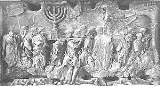
History of the Jews in Italy

Encyclopedia
The history of the Jews
in Italy
goes back over two thousand years. Jews have been present in Italy from the Roman period until the present.
, although modern scholars like A.N. Sherwin-White
argue that this embassy did not happen.
It is known more securely that an embassy was sent later by Simon Maccabeus to Rome
to strengthen the alliance with the Romans against the Hellenistic Seleucid kingdom. The ambassadors received a cordial welcome from their coreligionists who were already established there.
Large numbers of Jews lived in Rome even during the Roman Republican period
. They were largely Greek
-speaking and poor. As Rome had increasing contact with and military/trade dealings with the Greek-speaking Eastern Mediterranean
, during the second and first centuries BCE, many Greeks, Jews among them, came to Rome as merchants or were brought there as slaves.
The Romans appear to have viewed the Jews as followers of peculiar, backward religious customs, but antisemitism as it would come to be in the Christian
and Islamic worlds did not exist, see Anti-Judaism in the pre-Christian Roman Empire. Despite their disdain, the Romans did recognize and respect the antiquity of their religion and the fame of their Temple in Jerusalem (Herod's Temple). Many Romans did not know much about Judaism, including the emperor Augustus
who, according to his biographer Suetonius
, thought that Jews fasted on the sabbath
. Julius Caesar
was known as a great friend to the Jews, and they were among the first to mourn his assassination.
In Rome, the community was highly organized, and presided over by heads called άρχοντες (archontes); or γερουσιάρχοι (gerousiarchoi) . The Jews maintained in Rome several synagogues, whose spiritual leader was called αρχισυνάγωγος (archisunagogos). Their tombstones, mostly in Greek
with a few in Hebrew
/Aramaic
or Latin
, were decorated with the ritual menorah (seven-branched candelabrum).
Jews in pre-Christian
Rome were very active in proselytising their faith, leading to an increasing number of outright converts
, as well as those who adopted some Jewish practices and belief in the Jewish God without actually converting.
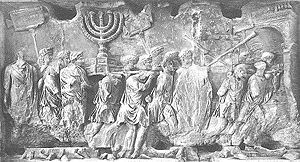 The fate of the Jews in Rome and Italy fluctuated, with partial expulsions being carried out under the emperors Tiberius
and Claudius
. After the successive Jewish revolts of 66 and 132 CE, many Judea
n Jews were brought to Rome as slaves (the norm in the ancient world was for prisoners of war and inhabitants of defeated cities to be sold as slaves). These revolts caused increasing official hostility from the reign of Vespasian
onwards. The most serious measure was the Fiscus Judaicus
, which was a tax payable by all Jews in the Roman Empire. The new tax replaced the tithe
that had formerly been sent to the Temple in Jerusalem
(destroyed by the Romans in 70 CE), and was used instead in the temple of Jupiter Optimus Maximus in Rome.
In addition to Rome, there were a significant number of Jewish communities in southern Italy during this period. For example, the regions of Sicily
, Calabria
, and Apulia
had well established Jewish populations.
as a legal religion of the Roman Empire by Constantine in 313 (the Edict of Milan
), the position of Jews in Italy and throughout the empire declined rapidly and dramatically. Constantine established oppressive laws for the Jews; but these were in turn abolished by Julian the Apostate
, who showed his favor toward the Jews to the extent of permitting them to resume their plan for the reconstruction of the Temple at Jerusalem. This concession was withdrawn under his successor, who, again, was a Christian; and then the oppression grew considerably. Christianity was adopted as the State church of the Roman Empire
in 380. Thus periods of persecution were followed by periods of quiescence, until the postulated Fall of the Roman Empire.
At the time of the foundation of the Ostrogoth
ic rule under Theodoric
(493 – 526), there were flourishing communities of Jews in Rome, Milan
, Genoa
, Palermo
, Messina, Agrigentum, and in Sardinia
. The Popes of the period were not seriously opposed to the Jews; and this accounts for the ardor with which the latter took up arms for the Ostrogoths as against the forces of Justinian—particularly at Naples
, where the remarkable defense of the city was maintained almost entirely by Jews. After the failure of the various attempts to make Italy a province of the Byzantine empire
, the Jews had to suffer much oppression from the Exarch
of Ravenna
; but it was not long until the greater part of Italy came into the possession of the Lombards
(568 774), under whom they lived in peace. Indeed, the Lombards passed no exceptional laws relative to the Jews. Even after the Lombards embraced Catholicism
the condition of the Jews was always favorable, because the popes of that time not only did not persecute them, but guaranteed them more or less protection. Pope Gregory I
treated them with much consideration. Under succeeding popes the condition of the Jews did not grow worse; and the same was the case in the several smaller states into which Italy was divided. Both popes and states were so absorbed in continual external and internal dissensions that the Jews were left in peace. In every individual state of Italy a certain amount of protection was granted to them in order to secure the advantages of their commercial enterprise. The fact that the historians of this period scarcely make mention of the Jews, suggests that their condition was tolerable.
in 1380, and a brief expulsion from Bologna
in 1172. A nephew of Rabbi
Nathan ben Jehiel
acted as administrator of the property of Pope Alexander III
, who showed his amicable feelings toward the Jews at the Lateran Council
of 1179, where he defeated the designs of hostile prelates who advocated anti-Jewish laws. Under Norman
rule the Jews of southern Italy and of Sicily
enjoyed even greater freedom; they were considered the equals of the Christians, and were permitted to follow any career; they even had jurisdiction over their own affairs. Indeed, in no country were the canonical laws
against the Jews so frequently disregarded as in Italy. A later pope—either Nicholas IV
(1288–1292) or Boniface VIII (1294–1303)—had for his physician a Jew, Isaac ben Mordecai
, nicknamed Maestro Gajo.
(died 982). Two centuries later (1150) there became known as poets Shabbethai ben Moses of Rome; his son Jehiel Kalonymus, once regarded as a Talmud
ic authority even beyond Italy; and Rabbi Jehiel of the Mansi (Anaw) family, also of Rome. Their compositions are full of thought, but their diction is rather crude. Nathan, son of the above-mentioned Rabbi Jehiel, was the author of a Talmudic lexicon ("'Aruk") which became the key to the study of the Talmud.
Solomon ben Abraham ibn Parhon
compiled during his residence at Salerno
a Hebrew dictionary
which fostered the study of Biblical exegesis among the Italian Jews. On the whole, however, Hebrew culture was not in a flourishing condition. The only liturgical author of merit was Joab ben Solomon, some of whose compositions are extant.
Toward the second half of the 13th century signs appeared of a better Hebrew culture and of a more profound study of the Talmud. Isaiah di Trani the Elder (1232–1279), a high Talmudic authority, was the author of many celebrated responsa
. David, his son, and Isaiah di Trani the Younger
, his nephew, followed in his footsteps, as did their descendants until the end of the seventeenth century. Meïr ben Moses presided over an important Talmudic school in Rome, and Abraham ben Joseph over one in Pesaro. In Rome two famous physicians, Abraham and Jehiel, descendants of Nathan ben Jehiel, taught the Talmud. One of the women of this gifted family, Paola dei Mansi, also attained distinction; her Biblical and Talmudic knowledge was considerable, and she transcribed Biblical commentaries in a notably beautiful handwriting (see Jew. Encyc. i. 567, s.v. Paola Anaw).
About this period the Holy Roman Emperor
Frederick II
, the last of the Hohenstaufen
, employed Jews to translate from the Arabic philosophical
and astronomical
treatises; among these writers were Judah Kohen of Toledo
, later of Tuscany
, and Jacob Anatoli
of Provence
. This encouragement naturally led to the study of the works of Maimonides
—particularly of the "Moreh Nebukim
"—the favorite writer of Hillel of Verona
(1220–1295). This last-named litterateur and philosopher practised medicine
at Rome and in other Italian cities, and translated into Hebrew several medical works. The liberal spirit of the writings of Maimonides had other votaries in Italy; e.g., Shabbethai ben Solomon of Rome and Zerahiah Ḥen of Barcelona
, who migrated to Rome and contributed much to spread the knowledge of his works. The effect of this on the Italian Jews was apparent in their love of freedom of thought and their esteem for literature, as well as in their adherence to the literal rendering of the Biblical texts and their opposition to fanatical cabalists
and mystic theories. Among other devotees of these theories was Immanuel ben Solomon of Rome, the celebrated friend of Dante Aligheri. The discord between the followers of Maimonides and his opponents wrought most serious damage to the interests of Judaism.
The rise of poetry in Italy at the time of Dante influenced the Jews also. The rich and the powerful, partly by reason of sincere interest, partly in obedience to the spirit of the times, became patrons of Jewish writers, thus inducing the greatest activity on their part. This activity was particularly noticeable at Rome, where a new Jewish poetry arose, mainly through the works of Leo Romano, translator of the writings of Thomas Aquinas
and author of exegetical works of merit; of Judah Siciliano, a writer in rimed
prose; of Kalonymus ben Kalonymus
, a famous satirical
poet; and especially of the above-mentioned Immanuel. On the initiative of the Roman community, a Hebrew translation of Maimonides' Arabic commentary on the Mishnah
was made. At this time Pope John XXII was on the point of pronouncing a ban against the Jews of Rome. The Jews instituted a day of public fasting and of prayer to appeal for divine assistance. King Robert of Sicily, who favored the Jews, sent an envoy to the pope at Avignon
, who succeeded in averting this great peril. Immanuel himself described this envoy as a person of high merit and of great culture. This period of Jewish literature in Italy is indeed one of great splendor. After Immanuel there were no other Jewish writers of importance until Moses da Rieti (1388).
.
In 1235 Pope Gregory IX published the first bull against the ritual murder accusation. Other popes followed his example, particularly Innocent IV in 1247, Gregory X in 1272, Clement VI in 1348, Gregory XI in 1371, Martin V in 1422, Nicholas V in 1447, Sixtus V in 1475, Paul III in 1540, and later Alexander VII, Clement XIII, and Clement XIV.
-based "antipope
" Benedict XIII
. They hailed his successor, Martin V
, with delight. The synod convoked by the Jews at Bologna, and continued at Forlì
, sent a deputation with costly gifts to the new pope, praying him to abolish the oppressive laws promulgated by Benedict and to grant the Jews those privileges which had been accorded them under previous popes. The deputation succeeded in its mission, but the period of grace was short; for Martin's successor, Eugenius IV, at first favorably disposed toward the Jews, ultimately reenacted all the restrictive laws issued by Benedict. In Italy, however, his bull was generally disregarded. The great centers, such as Venice
, Florence
, Genoa
, and Pisa
, realized that their commercial interests were of more importance than the affairs of the spiritual leaders of the Church; and accordingly the Jews, many of whom were bankers and leading merchants, found their condition better than ever before. It thus became easy for Jewish bankers to obtain permission to establish banks and to engage in monetary transactions. Indeed, in one instance even the Bishop of Mantua, in the name of the pope, accorded permission to the Jews to lend money at interest. All the banking negotiations of Tuscany were in the hands of a Jew, Jehiel of Pisa. The influential position of this successful financier was of the greatest advantage to his coreligionists at the time of the exile from Spain
.
The Jews were also successful as skilled medical practitioners. William of Portaleone, physician to King Ferdinand I of Naples
, and to the ducal houses of Sforza
and Gonzaga
, was one of the ablest of that time. He was the first of the long line of illustrious physicians in his family.
, which already had a Jewish communitty since the 4th century. Then the Jews were expelled from Calabria in 1524, and later from the entire Kingdom of Naples in 1540, as all these areas fell under Spanish rule and were subject to the edict of expulsion by the Spanish Inquisition.
There was a gradual movement throughout the 16th century of Jews in Italy from south to north, with conditions worsening for Jews in Rome after 1556 and Venice in the 1580s. Many Jews from Venice and the surrounding area migrated to Poland and Lithuania at this time.
en masse from Spain in 1492 a great number of them took refuge in Italy, where they were given protection by King Ferdinand I of Naples
. Don Isaac Abravanel even received a position at the Neapolitan court, which he retained under the succeeding king, Alfonso II
. The Spanish Jews were well received also in Ferrara
by the Duke, Ercole d'Este I
, and in Tuscany
through the mediation of Jehiel of Pisa and his sons. But at Rome and Genoa they experienced all the vexations and torments that hunger, plague, and poverty bring with them, and were forced to accept baptism in order to escape starvation. In some few cases the immigrants exceeded in number the Jews already domiciled, and gave the determining vote in matters of communal interest and in the direction of studies.
From Alexander VI to Clement VII the popes were indulgent toward the Jews, having more urgent matters to occupy them. After the 1492 expulsion of Jews from Spain, some 9,000 impoverished Iberian Jews arrived at the borders of the Papal States. Alexander VI welcomed them into Rome, declaring that they were "permitted to lead their life, free from interference from Christians, to continue in their own rites, to gain wealth, and to enjoy many other privileges." He similarly allowed the immigration of Jews expelled from Portugal in 1497 and from Provence in 1498.
The popes and many of the most influential cardinals
openly violated one of the most severe enactments of the Council of Basel, namely, that prohibiting Christians from employing Jewish physicians; and they even gave the latter positions at the papal court. The Jewish communities of Naples
and of Rome received the greatest number of accessions; but many Jews passed on from these cities to Ancona
, Venice
, Calabria
, and thence to Florence
and Padua
. Venice, imitating the odious measures of the German cities, assigned to the Jews a special quarter (ghetto
).
into the Neapolitan realm, then under Spanish rule. Charles V
, upon his return from his victories in Africa
, was on the point of exiling the Jews from Naples, but deferred doing so owing to the influence of Benvenida, wife of Samuel Abravanel
. A few years later, however (1533), such a decree was proclaimed, but upon this occasion also Samuel Abravanel and others were able through their influence to avert for several years the execution of the edict. Many Jews repaired to the Ottoman Empire
, some to Ancona, and still others to Ferrara
, where they were received graciously by Duke Ercole II
.
After the death of Pope Paul III (1534–1549), who had showed favor to the Jews, a period of strife, of persecutions, and of despondency set in. A few years later the Jews were exiled from Genoa
, among the refugees being Joseph Hakohen, physician to the doge
Andrea Doria
and eminent historian. The Maranos, driven from Spain and Portugal, were allowed by Duke Ercole to enter his dominions and to profess Judaism freely and openly. Thus, Samuel Usque
, also a historian, who had fled from the Inquisition in Portugal, settled in Ferrara; and Abraham Usque
founded a large printing establishment there. A third Usque, Solomon, merchant of Venice and Ancona and poet of some note, translated the sonnets of Petrarch
into excellent Spanish verse, which was much admired by his contemporaries.
While the return to Judaism of the Marano Usques caused much rejoicing among the Italian Jews, this was counterbalanced by the deep grief into which they were plunged by the conversion to Christianity of two grandsons of Elijah Levita, Leone Romano and Vittorio Eliano. One became a canon
of the Church; the other, a Jesuit. They heavily criticized the Talmud to Pope Julius III and the Inquisition; and as a consequence the pope pronounced the sentence of destruction against this work, to the printing of which one of his predecessors, Leo X, had given his sanction. On the Jewish New Year's Day (9 September), 1553, all the copies of the Talmud in the principal cities of Italy, in the printing establishments of Venice, and even in the distant island of Candia (Crete
), were burned. In 1555, Pope Marcellus II wished to exile the Jews of Rome on a ritual murder
accusation. He was restrained from the execution of the scheme by Cardinal Alexander Farnese who succeeded in bringing to light the true culprit.
of 1555 created the Roman ghetto
and required the wearing of yellow badge
s. The Jews were also forced to labor at the restoration of the walls of Rome without any compensation.
Also, on one occasion the pope had secretly given orders to one of his nephews to burn the Jewish quarter during the night. However, Alexander Farnese, hearing of the infamous proposal, succeeded in frustrating it.
Many Jews abandoned Rome and Ancona and went to Ferrara and Pesaro
. Here the Duke of Urbino welcomed them graciously in the hope of directing the extensive commerce of the Levant
to the new port of Pesaro, which was, at that time, exclusively in the hands of the Jews of Ancona. Among the many who were forced to leave Rome was the illustrious Marano, Amato Lusitano
, a distinguished physician, who had often attended Pope Julius III. He had even been invited to become physician to the King of Poland
, but had declined the offer in order to remain in Italy. He fled from the Inquisition to Pesaro, where he openly professed Judaism.
the expulsion of the Jews was threatened, and, although this extreme measure was not put into execution, they were tyrannized in countless ways. At Cremona
and at Lodi their books were confiscated. In Genoa, from which city the Jews were at this time expelled, an exception was made in favor of Joseph Hakohen. In his Emek Habachah he narrates the history of these persecutions. He had no desire to take advantage of the sad privilege accorded to him, and went to Casale Monferrato
, where he was graciously received even by the Christians. In this same year the pope directed his persecutions against the Jews of Bologna, who formed a rich community well worth despoiling. Many of the wealthiest Jews were imprisoned and placed under torture in order to force them to make false confessions. When Rabbi Ishmael Ḥanina was being racked, he declared that should the pains of torture elicit from him any words that might be construed as casting reflection on Judaism, they would be false and null. It was forbidden to the Jews to absent themselves from the city; but many succeeded in escaping by bribing the watchmen at the gates of the ghetto and of the city. The fugitives, together with their wives and children, repaired to the neighboring city of Ferrara. Then Pius V. decided to banish the Jews from all his dominions, and, despite the enormous loss which was likely to result from this measure, and the remonstrances of influential and well-meaning cardinals,the Jews (in all about 1,000 families) were actually expelled from all the Papal States
excepting Rome and Ancona. A few became Christians. The majority found refuge in other parts of Italy, e.g. Leghorn and Pitigliano.
to Venice who was selected to negotiate within that republic during July 1574. There was a pending decree of expulsion of the Jews by the leaders of several kingdoms
within Italy, thereby making the Venetian Senate concerned if whether there would be difficulties collaborating with Solomon of Udine. However, through the influence of the Venetian diplomats themselves, and particularly of the Patrician, Marcantonio Barbaro
of the noble Barbaro family, who esteemed Udine highly, Solomon was received with great honors at the Doge's Palace. In virtue of this, Udine received an exalted position within the Republic of Venice and was able to render great service to his coreligionists. Through his influence Jacob Soranzo, an agent of the Venetian Republic at Constantinople
, came to Venice. Solomon was influential in having the decree of expulsion revoked within Italian kingdoms, and he furthermore obtained a promise from Venetian patricians that Jews would have a secure home within the Republic of Venice. Udine was eventually honored for his services and returned to Constantinople, leaving his son Nathan in Venice to be educated. Nathan was one of the first Jewish students to have studied at the University of Padua
, under the inclusive admission policy established by Marcantonio Barbaro
. The success of Udine inspired many Jews in the Ottoman Empire, particularly in Constantinople, where they had attained great prosperity.
there were hardly 1,000. Gregory XIII was not less fanatical than his predecessors; he noticed that, despite papal prohibition, Christians employed Jewish physicians; he therefore strictly prohibited the Jews from attending Christian patients, and threatened with the most severe punishment alike Christians who should have recourse to Hebrew practitioners, and Jewish physicians who should respond to the calls of Christians. Furthermore, the slightest assistance given to the Maranos of Portugal
and Spain
, in violation of the canonical laws, was sufficient to deliver the guilty one into the power of the Inquisition, which did not hesitate to condemn the accused to death. Gregory also induced the Inquisition to consign to the flames a large number of copies of the Talmud and of other Hebrew books. Special sermons, designed to convert the Jews, were instituted; and at these at least one-third of the Jewish community, men, women, and youths above the age of twelve, was forced to be present. The sermons were usually delivered by baptized
Jews who had become friars or priests; and not infrequently the Jews, without any chance of protest, were forced to listen to such sermons in their own synagogues. These cruelties forced many Jews to leave Rome, and thus their number was still further diminished.
, in which he proved to the Jews their obligation to consider the Christians as brothers, to assist them, and to attend them. The Jews of Mantua
, Milan, and Ferrara, taking advantage of the favorable disposition of the pope, sent to him an ambassador, Bezaleel Massarano, with a present of 2,000 scudi, to obtain from him permission to reprint the Talmud and other Jewish books, promising at the same time to expurgate all passages considered offensive to Christianity. Their demand was granted, partly through the support given by Lopez, a Marano, who administered the papal finances and who was in great favor with the pontiff. Scarcely had the reprinting of the Talmud been begun, and the conditions of its printing been arranged by the commission, when Sixtus died. His successor, Gregory XIV, was as well disposed to the Jews as Sixtus had been; but during his short pontificate he was almost always ill. Clement VIII (1592–1605), who succeeded him, renewed the anti-Jewish bulls of Paul IV and Pius V, and exiled the Jews from all his territories with the exception of Rome, Ancona, and Avignon; but, in order not to lose the commerce with the East, he gave certain privileges to the Turkish Jews. The exiles repaired to Tuscany, where they were favorably received by Duke Ferdinand dei Medici
, who assigned to them the city of Pisa for residence, and by Duke Vincenzo Gonzaga, at whose court Joseph da Fano, a Jew, was a favorite. They were again permitted to read the Talmud and other Hebrew books, provided that they were printed according to the rules of censorship approved by Sixtus V. From Italy, where these expurgated books were printed by thousands, they were sent to the Jews of other various countries.
The Mantuan Jews suffered seriously at the time of the Thirty Years' war. The Jews exiled from the papal dominions had repeatedly found refuge in Mantua, where the dukes of Gonzaga had accorded protection to them, as they had done to the Jews already resident there. The next to the last duke, although a cardinal, favored them sufficiently to enact a statute for the maintenance of order in the ghetto. After the death of the last of this house the right of succession was contested at the time of the Thirty Years' war
, and the city was besieged by the German soldiery of Wallenstein. After a valiant defense, in which the Jews labored at the walls until the approach of the Sabbath, the city fell into the power of the besiegers, and for three days was at the mercy of fire and sword. The commander-in-chief, Altringer, forbade the soldiers to sack the ghetto, thereby hoping to secure the spoils for himself. The Jews were ordered to leave the city, taking with them only their personal clothing and three gold ducats per capita. There were retained enough Jews to act as guides to the places where their coreligionists were supposed to have hidden their treasures. Through three Jewish zealots these circumstances came to the knowledge of the emperor, who ordered the governor, Collalto, to issue a decree permitting the Jews to return and promising them the restoration of their goods. Only about 800, however, returned, the others having died.
The victories in Europe of the Turks, who brought their armies up to the very walls of Vienna (1683), helped even in Italy to incite the Christian population against the Jews, who remained friendly to the Turks. In Padua, in 1683, the Jews were in great danger because of the agitation fomented against them by the cloth-weavers. A violent tumult broke out; the lives of the Jews were seriously menaced; and it was only with the greatest difficulty that the governor of the city succeeded in rescuing them, in obedience to a rigorous order from Venice. For several days thereafter the ghetto had to be especially guarded.
, Venice
, and Ferrara
. Under the influence of the liberal religious policy of Napoleon I, the Jews of Italy, like those of France, were emancipated. The supreme power of the popes was broken: they had no longer time to give to framing anti-Jewish enactments, and they no longer directed canonical laws against the Jews.
To the Sanhedrin convened by Napoleon at Paris (1807), Italy sent four deputies: Abraham Vita da Cologna; Isaac Benzion Segre, rabbi of Vercelli; Graziadio Neppi, physician and rabbi of Cento; and Jacob Israel Karmi, rabbi of Reggio. Of the four rabbis assigned to the committee which was to draw up the answers to the twelve questions proposed to the Assembly of Notables, two, Cologna and Segre, were Italians, and were elected respectively first and second vice-presidents of the Sanhedrin. But the liberty acquired by the Jews under Napoleon was of short duration; it disappeared with his downfall.
Pope Pius VII
, on regaining possession of his realms, reinstalled the Inquisition; he deprived the Jews of every liberty and confined them again in ghettos. Such became to a greater or less extent their condition in all the states into which Italy was then divided; at Rome they were again forced to listen to proselytizing sermons.
In the year 1829, consequent upon an edict of the Emperor Francis I, there was opened in Padua, with the cooperation of Venice, of Verona, and of Mantua, the first Italian rabbinical college, in which Lelio della Torre and Samuel David Luzzatto
taught. Luzzatto was a man of great intellect; he wrote in pure Hebrew upon philosophy, history, literature, criticism, and grammar. Many distinguished rabbis came from the rabbinical college of Padua. Zelman, Moses Tedeschi, and Castiglioni followed at Trieste the purposes and the principles of Luzzatto's school. At the same time, Elijah Benamozegh
, a man of great knowledge and the author of several works, distinguished himself in the old rabbinical school at Leghorn.
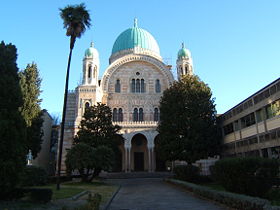 The return to medieval servitude after the Italian restoration did not last long; and the Revolution of 1848
, which convulsed all Europe, brought great advantages to the Jews. Although this was followed by restoration of the Papal States
only four months later, in early 1849, yet the persecutions and the violence of past times had to a large extent disappeared. The last outrage against the Jews of Italy was connected with the case of Edgardo Mortara
, which occurred in Bologna
in 1858. In 1859 most of the papal states were annexed into the united Kingdom of Italy
under King Victor Emanuel II. Except in and near Rome, where oppression lasted until the end of the papal dominion (20 September 1870), the Jews obtained full emancipation. In behalf of their country the Jews with great ardor sacrificed life and property in the memorable campaigns of 1859, 1866, and 1870. Of the many who deserve mention in this connection may be singled out Isaac Pesaro Maurogonato. He was minister of finance to the Venetian republic during the war of 1848 against Austria, and his grateful country erected to him a memorial in bronze. There was also erected in the palace of the doges a marble bust of Samuel Romanin, a celebrated Jewish historian of Venice. Florence, too, has commemorated a modern Jewish poet, Solomon Fiorentino, by placing a marble tablet upon the house in which he was born. The secretary and faithful friend of Count Cavour was the Piedmontese Isaac Artom; while L'Olper, later rabbi of Turin
, and also the friend and counselor of Mazzini, was one of the most courageous advocates of Italian independence. The names of the Jewish soldiers who died in the cause of Italian liberty were placed along with those of their Christian fellow soldiers on the monuments erected in their honour.
, who took office in 1910, was one of the world's first Jewish heads of government (not converted to Christianity). Another Jew, Ernesto Nathan
served as mayor of Rome
from 1907 to 1913.
Pope John Paul II
gave access to some formerly secret Vatican
archives to scholars, one of whom, David Kertzer
, used information thus obtained in his book The Popes Against the Jews. According to that book, in the late 19th and early 20th centuries, the popes and many Catholic bishops and Catholic publications consistently made a distinction between "good anti-Semitism" and "bad anti-Semitism". The "bad" kind directed hatred against Jews merely because of their descent. That was considered un-Christian, in part because the church held that its message was for all of humankind equally, and any person of any ancestry could become a Christian. The "good" kind denounced alleged Jewish plots to gain control of the world by controlling newspapers, banks, schools, etc., or otherwise attributed various evils to Jews. Kertzer's book details many instances in which Catholic publications denounced such alleged plots, and then, when criticized for inciting hatred of Jews, would remind people that the Catholic Church condemned the "bad" kind of anti-Semitism.
anti-Semitism was associated with such politicians and writers Paolo Orano
, Roberto Farinacci
, Telesio Interlandi
and Giovanni Preziosi
although, initially at least, Jews took part to set up and were permitted to join the National Fascist Party
and a handful, notably Aldo Finzi
, gained a high profile until the 1938 racial laws.
On 28 July 1938, Pope Pius XI made a speech at Propaganda Fide college
, expressing the view that mankind is a single, large, universal human race (...) [with] no room for special races, and the Alliance Israélite Universelle
thanked him for that speech.
While some Roman Catholic prelates tried to find compromises with fascism, several others spoke out against racism. The Archbishop of Milan, cardinal Schuster
, who had supported Amici Israel
, condemned racism as heresy
and an international danger (...) not lesser than bolshevism in his 13 November 1938 homily
at Milan Cathedral.
Pius XI issued many criticisms of Jews for many years, but shortly before his death in early 1939, was horrified by anti-Jewish violence then escalating in Nazi Germany. After the overthrow of fascism
in 1943, Pope Pius XII
asked the new Italian government to repeal those sections of Italy's race laws that held marriages between persons reared Catholic and formerly Jewish converts to Catholicism as invalid. But, according to Kertzer's book, he did not object to other provisions of the race laws .
After Italy entered the war in 1940 Jewish refugees living in Italy were interned in Campagna concentration camp
. In 1942 the Italian military commander in Croatia
refuses to hand over Jews in his zone to the Nazis. In January 1943 the Italians refused to cooperate with the Nazis in rounding up the Jews living in the occupied zone of France
under their control and in March prevented the Nazis from deporting Jews in their zone. German Foreign Minister Joachim von Ribbentrop
complained to Benito Mussolini
that "Italian military circles... lack a proper understanding of the Jewish question."
The deporations of Italian Jews to Nazi death camps began after in September 1943 Italy capitulated and in response the German troops invaded Italy from the North
. However, by the time they got to the Campagna concentration camp, all the inmates had already fled to the mountains with the help of the local inhabitants. Rev. Aldo Brunacci of Assisi
, under the direction of his bishop, Giuseppe Nicolini, saved all the Jewish who sought refuge in Assisi. This effort became the basis for the novel The Assisi Underground
. In October 1943 Nazis raided the Jewish ghetto in Rome. In November 1943 Jews of Genoa
and Florence
were deported to Auschwitz. Jews of Friuli
were deported to Auschwitz via Risiera di San Sabba
concentration camp. It is estimated that 7,500 Italian Jews became victims of the Holocaust.
A small community of around 45,000 Jews remains in Italy today.
located in Venice, Italy, also having a yeshiva
in the main square of the ancient Venetian Ghetto
, a pastry shop and a restaurant named "Gam Gam" at the entrance to the ghetto. Sabbath
meals are served at the restaurant's outdoor tables along the Cannaregio Canal with views of the Guglie Bridge near the Grand Canal. In the novel Much Ado About Jesse Kaplan the restaurant is the site of a historical mystery. Every year for the festival of Sukkot
a sukkah
is built on a canal boat that tours the city, a large menorah
tours the city on a canal boat during Hanukkah
.
Jews
The Jews , also known as the Jewish people, are a nation and ethnoreligious group originating in the Israelites or Hebrews of the Ancient Near East. The Jewish ethnicity, nationality, and religion are strongly interrelated, as Judaism is the traditional faith of the Jewish nation...
in Italy
Italy
Italy , officially the Italian Republic languages]] under the European Charter for Regional or Minority Languages. In each of these, Italy's official name is as follows:;;;;;;;;), is a unitary parliamentary republic in South-Central Europe. To the north it borders France, Switzerland, Austria and...
goes back over two thousand years. Jews have been present in Italy from the Roman period until the present.
Antiquity
Pre-Christian Rome
The first attested Jews in Italy were the ambassadors sent to Rome by Judah Maccabee in 161 BCE, Jason son of Eleazar and Eupolemus son of John. According to I Maccabees they signed a treaty with the Roman SenateRoman Senate
The Senate of the Roman Republic was a political institution in the ancient Roman Republic, however, it was not an elected body, but one whose members were appointed by the consuls, and later by the censors. After a magistrate served his term in office, it usually was followed with automatic...
, although modern scholars like A.N. Sherwin-White
A.N. Sherwin-White
Adrian Nicholas Sherwin-White was a British historian of Ancient Rome. He was a fellow of St John's College, Oxford, president of the Society for Promotion of Roman Studies, and a fellow of the British Academy...
argue that this embassy did not happen.
It is known more securely that an embassy was sent later by Simon Maccabeus to Rome
Rome
Rome is the capital of Italy and the country's largest and most populated city and comune, with over 2.7 million residents in . The city is located in the central-western portion of the Italian Peninsula, on the Tiber River within the Lazio region of Italy.Rome's history spans two and a half...
to strengthen the alliance with the Romans against the Hellenistic Seleucid kingdom. The ambassadors received a cordial welcome from their coreligionists who were already established there.
Large numbers of Jews lived in Rome even during the Roman Republican period
Roman Republic
The Roman Republic was the period of the ancient Roman civilization where the government operated as a republic. It began with the overthrow of the Roman monarchy, traditionally dated around 508 BC, and its replacement by a government headed by two consuls, elected annually by the citizens and...
. They were largely Greek
Ancient Greece
Ancient Greece is a civilization belonging to a period of Greek history that lasted from the Archaic period of the 8th to 6th centuries BC to the end of antiquity. Immediately following this period was the beginning of the Early Middle Ages and the Byzantine era. Included in Ancient Greece is the...
-speaking and poor. As Rome had increasing contact with and military/trade dealings with the Greek-speaking Eastern Mediterranean
Eastern Mediterranean
The Eastern Mediterranean is a term that denotes the countries geographically to the east of the Mediterranean Sea. This region is also known as Greater Syria or the Levant....
, during the second and first centuries BCE, many Greeks, Jews among them, came to Rome as merchants or were brought there as slaves.
The Romans appear to have viewed the Jews as followers of peculiar, backward religious customs, but antisemitism as it would come to be in the Christian
Christian
A Christian is a person who adheres to Christianity, an Abrahamic, monotheistic religion based on the life and teachings of Jesus of Nazareth as recorded in the Canonical gospels and the letters of the New Testament...
and Islamic worlds did not exist, see Anti-Judaism in the pre-Christian Roman Empire. Despite their disdain, the Romans did recognize and respect the antiquity of their religion and the fame of their Temple in Jerusalem (Herod's Temple). Many Romans did not know much about Judaism, including the emperor Augustus
Augustus
Augustus ;23 September 63 BC – 19 August AD 14) is considered the first emperor of the Roman Empire, which he ruled alone from 27 BC until his death in 14 AD.The dates of his rule are contemporary dates; Augustus lived under two calendars, the Roman Republican until 45 BC, and the Julian...
who, according to his biographer Suetonius
Suetonius
Gaius Suetonius Tranquillus, commonly known as Suetonius , was a Roman historian belonging to the equestrian order in the early Imperial era....
, thought that Jews fasted on the sabbath
Shabbat
Shabbat is the seventh day of the Jewish week and a day of rest in Judaism. Shabbat is observed from a few minutes before sunset on Friday evening until a few minutes after when one would expect to be able to see three stars in the sky on Saturday night. The exact times, therefore, differ from...
. Julius Caesar
Julius Caesar
Gaius Julius Caesar was a Roman general and statesman and a distinguished writer of Latin prose. He played a critical role in the gradual transformation of the Roman Republic into the Roman Empire....
was known as a great friend to the Jews, and they were among the first to mourn his assassination.
In Rome, the community was highly organized, and presided over by heads called άρχοντες (archontes); or γερουσιάρχοι (gerousiarchoi) . The Jews maintained in Rome several synagogues, whose spiritual leader was called αρχισυνάγωγος (archisunagogos). Their tombstones, mostly in Greek
Greek language
Greek is an independent branch of the Indo-European family of languages. Native to the southern Balkans, it has the longest documented history of any Indo-European language, spanning 34 centuries of written records. Its writing system has been the Greek alphabet for the majority of its history;...
with a few in Hebrew
Hebrew language
Hebrew is a Semitic language of the Afroasiatic language family. Culturally, is it considered by Jews and other religious groups as the language of the Jewish people, though other Jewish languages had originated among diaspora Jews, and the Hebrew language is also used by non-Jewish groups, such...
/Aramaic
Aramaic language
Aramaic is a group of languages belonging to the Afroasiatic language phylum. The name of the language is based on the name of Aram, an ancient region in central Syria. Within this family, Aramaic belongs to the Semitic family, and more specifically, is a part of the Northwest Semitic subfamily,...
or Latin
Latin
Latin is an Italic language originally spoken in Latium and Ancient Rome. It, along with most European languages, is a descendant of the ancient Proto-Indo-European language. Although it is considered a dead language, a number of scholars and members of the Christian clergy speak it fluently, and...
, were decorated with the ritual menorah (seven-branched candelabrum).
Jews in pre-Christian
Christian
A Christian is a person who adheres to Christianity, an Abrahamic, monotheistic religion based on the life and teachings of Jesus of Nazareth as recorded in the Canonical gospels and the letters of the New Testament...
Rome were very active in proselytising their faith, leading to an increasing number of outright converts
Conversion to Judaism
Conversion to Judaism is a formal act undertaken by a non-Jewish person who wishes to be recognised as a full member of the Jewish community. A Jewish conversion is both a religious act and an expression of association with the Jewish people...
, as well as those who adopted some Jewish practices and belief in the Jewish God without actually converting.
Tiberius
Tiberius , was Roman Emperor from 14 AD to 37 AD. Tiberius was by birth a Claudian, son of Tiberius Claudius Nero and Livia Drusilla. His mother divorced Nero and married Augustus in 39 BC, making him a step-son of Octavian...
and Claudius
Claudius
Claudius , was Roman Emperor from 41 to 54. A member of the Julio-Claudian dynasty, he was the son of Drusus and Antonia Minor. He was born at Lugdunum in Gaul and was the first Roman Emperor to be born outside Italy...
. After the successive Jewish revolts of 66 and 132 CE, many Judea
Judea
Judea or Judæa was the name of the mountainous southern part of the historic Land of Israel from the 8th century BCE to the 2nd century CE, when Roman Judea was renamed Syria Palaestina following the Jewish Bar Kokhba revolt.-Etymology:The...
n Jews were brought to Rome as slaves (the norm in the ancient world was for prisoners of war and inhabitants of defeated cities to be sold as slaves). These revolts caused increasing official hostility from the reign of Vespasian
Vespasian
Vespasian , was Roman Emperor from 69 AD to 79 AD. Vespasian was the founder of the Flavian dynasty, which ruled the Empire for a quarter century. Vespasian was descended from a family of equestrians, who rose into the senatorial rank under the Emperors of the Julio-Claudian dynasty...
onwards. The most serious measure was the Fiscus Judaicus
Fiscus Judaicus
The Fiscus Iudaicus or Fiscus Judaicus was a tax collecting agency instituted to collect the tax imposed on Jews in the Roman Empire after the destruction of the Temple of Jerusalem in 70 CE in favor of the temple of Jupiter Capitolinus in Rome.-Imposition:The tax was initially imposed by Roman...
, which was a tax payable by all Jews in the Roman Empire. The new tax replaced the tithe
Tithe
A tithe is a one-tenth part of something, paid as a contribution to a religious organization or compulsory tax to government. Today, tithes are normally voluntary and paid in cash, cheques, or stocks, whereas historically tithes were required and paid in kind, such as agricultural products...
that had formerly been sent to the Temple in Jerusalem
Temple in Jerusalem
The Temple in Jerusalem or Holy Temple , refers to one of a series of structures which were historically located on the Temple Mount in the Old City of Jerusalem, the current site of the Dome of the Rock. Historically, these successive temples stood at this location and functioned as the centre of...
(destroyed by the Romans in 70 CE), and was used instead in the temple of Jupiter Optimus Maximus in Rome.
In addition to Rome, there were a significant number of Jewish communities in southern Italy during this period. For example, the regions of Sicily
Sicily
Sicily is a region of Italy, and is the largest island in the Mediterranean Sea. Along with the surrounding minor islands, it constitutes an autonomous region of Italy, the Regione Autonoma Siciliana Sicily has a rich and unique culture, especially with regard to the arts, music, literature,...
, Calabria
Calabria
Calabria , in antiquity known as Bruttium, is a region in southern Italy, south of Naples, located at the "toe" of the Italian Peninsula. The capital city of Calabria is Catanzaro....
, and Apulia
Apulia
Apulia is a region in Southern Italy bordering the Adriatic Sea in the east, the Ionian Sea to the southeast, and the Strait of Òtranto and Gulf of Taranto in the south. Its most southern portion, known as Salento peninsula, forms a high heel on the "boot" of Italy. The region comprises , and...
had well established Jewish populations.
Late Antiquity
With the promotion of ChristianityChristianity
Christianity is a monotheistic religion based on the life and teachings of Jesus as presented in canonical gospels and other New Testament writings...
as a legal religion of the Roman Empire by Constantine in 313 (the Edict of Milan
Edict of Milan
The Edict of Milan was a letter signed by emperors Constantine I and Licinius that proclaimed religious toleration in the Roman Empire...
), the position of Jews in Italy and throughout the empire declined rapidly and dramatically. Constantine established oppressive laws for the Jews; but these were in turn abolished by Julian the Apostate
Julian the Apostate
Julian "the Apostate" , commonly known as Julian, or also Julian the Philosopher, was Roman Emperor from 361 to 363 and a noted philosopher and Greek writer....
, who showed his favor toward the Jews to the extent of permitting them to resume their plan for the reconstruction of the Temple at Jerusalem. This concession was withdrawn under his successor, who, again, was a Christian; and then the oppression grew considerably. Christianity was adopted as the State church of the Roman Empire
State church of the Roman Empire
The state church of the Roman Empire was a Christian institution organized within the Roman Empire during the 4th century that came to represent the Empire's sole authorized religion. Both the Roman Catholic Church and the Eastern Orthodox churches claim to be the historical continuation of this...
in 380. Thus periods of persecution were followed by periods of quiescence, until the postulated Fall of the Roman Empire.
At the time of the foundation of the Ostrogoth
Ostrogoth
The Ostrogoths were a branch of the Goths , a Germanic tribe who developed a vast empire north of the Black Sea in the 3rd century AD and, in the late 5th century, under Theodoric the Great, established a Kingdom in Italy....
ic rule under Theodoric
Theodoric the Great
Theodoric the Great was king of the Ostrogoths , ruler of Italy , regent of the Visigoths , and a viceroy of the Eastern Roman Empire...
(493 – 526), there were flourishing communities of Jews in Rome, Milan
Milan
Milan is the second-largest city in Italy and the capital city of the region of Lombardy and of the province of Milan. The city proper has a population of about 1.3 million, while its urban area, roughly coinciding with its administrative province and the bordering Province of Monza and Brianza ,...
, Genoa
Genoa
Genoa |Ligurian]] Zena ; Latin and, archaically, English Genua) is a city and an important seaport in northern Italy, the capital of the Province of Genoa and of the region of Liguria....
, Palermo
Palermo
Palermo is a city in Southern Italy, the capital of both the autonomous region of Sicily and the Province of Palermo. The city is noted for its history, culture, architecture and gastronomy, playing an important role throughout much of its existence; it is over 2,700 years old...
, Messina, Agrigentum, and in Sardinia
Sardinia
Sardinia is the second-largest island in the Mediterranean Sea . It is an autonomous region of Italy, and the nearest land masses are the French island of Corsica, the Italian Peninsula, Sicily, Tunisia and the Spanish Balearic Islands.The name Sardinia is from the pre-Roman noun *sard[],...
. The Popes of the period were not seriously opposed to the Jews; and this accounts for the ardor with which the latter took up arms for the Ostrogoths as against the forces of Justinian—particularly at Naples
Naples
Naples is a city in Southern Italy, situated on the country's west coast by the Gulf of Naples. Lying between two notable volcanic regions, Mount Vesuvius and the Phlegraean Fields, it is the capital of the region of Campania and of the province of Naples...
, where the remarkable defense of the city was maintained almost entirely by Jews. After the failure of the various attempts to make Italy a province of the Byzantine empire
Byzantine Empire
The Byzantine Empire was the Eastern Roman Empire during the periods of Late Antiquity and the Middle Ages, centred on the capital of Constantinople. Known simply as the Roman Empire or Romania to its inhabitants and neighbours, the Empire was the direct continuation of the Ancient Roman State...
, the Jews had to suffer much oppression from the Exarch
Exarch
In the Byzantine Empire, an exarch was governor with extended authority of a province at some remove from the capital Constantinople. The prevailing situation frequently involved him in military operations....
of Ravenna
Ravenna
Ravenna is the capital city of the Province of Ravenna in the Emilia-Romagna region of Italy and the second largest comune in Italy by land area, although, at , it is little more than half the size of the largest comune, Rome...
; but it was not long until the greater part of Italy came into the possession of the Lombards
Kingdom of the Lombards
The Kingdom of the Lombards or Lombard Kingdom was an early medieval state, with its capital in Pavia, established by the Lombards on the Italian Peninsula between 568-569 and 774 .Effective control by the rulers of both the major areas that constituted the...
(568 774), under whom they lived in peace. Indeed, the Lombards passed no exceptional laws relative to the Jews. Even after the Lombards embraced Catholicism
Catholicism
Catholicism is a broad term for the body of the Catholic faith, its theologies and doctrines, its liturgical, ethical, spiritual, and behavioral characteristics, as well as a religious people as a whole....
the condition of the Jews was always favorable, because the popes of that time not only did not persecute them, but guaranteed them more or less protection. Pope Gregory I
Pope Gregory I
Pope Gregory I , better known in English as Gregory the Great, was pope from 3 September 590 until his death...
treated them with much consideration. Under succeeding popes the condition of the Jews did not grow worse; and the same was the case in the several smaller states into which Italy was divided. Both popes and states were so absorbed in continual external and internal dissensions that the Jews were left in peace. In every individual state of Italy a certain amount of protection was granted to them in order to secure the advantages of their commercial enterprise. The fact that the historians of this period scarcely make mention of the Jews, suggests that their condition was tolerable.
Middle Ages
There were expulsions, including an expulsion from TraniTrani
Trani is a seaport of Apulia, southern Italy, on the Adriatic Sea, in the new Province of Barletta-Andria-Trani , and 40 km by railway West-Northwest of Bari.- History :...
in 1380, and a brief expulsion from Bologna
Bologna
Bologna is the capital city of Emilia-Romagna, in the Po Valley of Northern Italy. The city lies between the Po River and the Apennine Mountains, more specifically, between the Reno River and the Savena River. Bologna is a lively and cosmopolitan Italian college city, with spectacular history,...
in 1172. A nephew of Rabbi
Rabbi
In Judaism, a rabbi is a teacher of Torah. This title derives from the Hebrew word רבי , meaning "My Master" , which is the way a student would address a master of Torah...
Nathan ben Jehiel
Nathan ben Jehiel
Nathan ben Jehiel of Rome was a Jewish Italian lexicographer. He was born in Rome not later than 1035 to one of the most notable Roman families of Jewish scholars. Owing to an error propagated by Azulai, he has been regarded as a scion of the house of De Pomis...
acted as administrator of the property of Pope Alexander III
Pope Alexander III
Pope Alexander III , born Rolando of Siena, was Pope from 1159 to 1181. He is noted in history for laying the foundation stone for the Notre Dame de Paris.-Church career:...
, who showed his amicable feelings toward the Jews at the Lateran Council
Lateran council
The Lateran councils were ecclesiastical councils or synods of the Catholic Church held at Rome in the Lateran Palace next to the Lateran Basilica. Ranking as a papal cathedral, this became a much-favored place of assembly for ecclesiastical councils both in antiquity and more especially during...
of 1179, where he defeated the designs of hostile prelates who advocated anti-Jewish laws. Under Norman
Normans
The Normans were the people who gave their name to Normandy, a region in northern France. They were descended from Norse Viking conquerors of the territory and the native population of Frankish and Gallo-Roman stock...
rule the Jews of southern Italy and of Sicily
Sicily
Sicily is a region of Italy, and is the largest island in the Mediterranean Sea. Along with the surrounding minor islands, it constitutes an autonomous region of Italy, the Regione Autonoma Siciliana Sicily has a rich and unique culture, especially with regard to the arts, music, literature,...
enjoyed even greater freedom; they were considered the equals of the Christians, and were permitted to follow any career; they even had jurisdiction over their own affairs. Indeed, in no country were the canonical laws
Canon law
Canon law is the body of laws & regulations made or adopted by ecclesiastical authority, for the government of the Christian organization and its members. It is the internal ecclesiastical law governing the Catholic Church , the Eastern and Oriental Orthodox churches, and the Anglican Communion of...
against the Jews so frequently disregarded as in Italy. A later pope—either Nicholas IV
Pope Nicholas IV
Pope Nicholas IV , born Girolamo Masci, was Pope from February 22, 1288 to April 4, 1292. A Franciscan friar, he had been legate to the Greeks under Pope Gregory X in 1272, succeeded Bonaventure as Minister General of his religious order in 1274, was made Cardinal Priest of Santa Prassede and...
(1288–1292) or Boniface VIII (1294–1303)—had for his physician a Jew, Isaac ben Mordecai
Isaac ben Mordecai
Isaac ben Mordecai, known as Maestro Gajo, was an Italian Jewish physician. He acted as physician to Pope Nicholas IV and/or Pope Boniface VIII, at the end of the thirteenth century....
, nicknamed Maestro Gajo.
Literary achievement
Among the early Jews of Italy who left behind them traces of their literary activity was Shabbethai DonnoloShabbethai Donnolo
Shabbethai Donnolo was an Italian physician, and writer on medicine and astrology born at Oria. When twelve years of age he was made prisoner by the Arabs under the leadership of the Fatimite Abu Ahmad Ja'far ibn 'Ubaid, but was ransomed by his relatives at Otranto, while the rest of his family...
(died 982). Two centuries later (1150) there became known as poets Shabbethai ben Moses of Rome; his son Jehiel Kalonymus, once regarded as a Talmud
Talmud
The Talmud is a central text of mainstream Judaism. It takes the form of a record of rabbinic discussions pertaining to Jewish law, ethics, philosophy, customs and history....
ic authority even beyond Italy; and Rabbi Jehiel of the Mansi (Anaw) family, also of Rome. Their compositions are full of thought, but their diction is rather crude. Nathan, son of the above-mentioned Rabbi Jehiel, was the author of a Talmudic lexicon ("'Aruk") which became the key to the study of the Talmud.
Solomon ben Abraham ibn Parhon
Solomon ben Abraham ibn Parhon
Solomon ben Abraham ibn Parhon was a Spanish philologist of the 12th century, a native of Ḳal'ah , Aragon. In the preface to his lexicon he mentions as his teachers, besides a certain R. Ephraim of whom nothing more is known, the two great Spanish scholars Judah ha-Levi and Abraham ibn Ezra...
compiled during his residence at Salerno
Salerno
Salerno is a city and comune in Campania and is the capital of the province of the same name. It is located on the Gulf of Salerno on the Tyrrhenian Sea....
a Hebrew dictionary
Dictionary
A dictionary is a collection of words in one or more specific languages, often listed alphabetically, with usage information, definitions, etymologies, phonetics, pronunciations, and other information; or a book of words in one language with their equivalents in another, also known as a lexicon...
which fostered the study of Biblical exegesis among the Italian Jews. On the whole, however, Hebrew culture was not in a flourishing condition. The only liturgical author of merit was Joab ben Solomon, some of whose compositions are extant.
Toward the second half of the 13th century signs appeared of a better Hebrew culture and of a more profound study of the Talmud. Isaiah di Trani the Elder (1232–1279), a high Talmudic authority, was the author of many celebrated responsa
Responsa
Responsa comprise a body of written decisions and rulings given by legal scholars in response to questions addressed to them.-In the Roman Empire:Roman law recognised responsa prudentium, i.e...
. David, his son, and Isaiah di Trani the Younger
Isaiah di Trani the Younger
Isaiah ben Elijah di Trani was an Italian Talmudist and commentator who lived in the 13th century and 14th century. He was the grandson, on his mother's side, of Isaiah di Trani the Elder. He is usually quoted as ריא"ז , or Isaiah ben Elijah di Trani (the Younger) (Hebrew: ישעיה בן אליהו...
, his nephew, followed in his footsteps, as did their descendants until the end of the seventeenth century. Meïr ben Moses presided over an important Talmudic school in Rome, and Abraham ben Joseph over one in Pesaro. In Rome two famous physicians, Abraham and Jehiel, descendants of Nathan ben Jehiel, taught the Talmud. One of the women of this gifted family, Paola dei Mansi, also attained distinction; her Biblical and Talmudic knowledge was considerable, and she transcribed Biblical commentaries in a notably beautiful handwriting (see Jew. Encyc. i. 567, s.v. Paola Anaw).
About this period the Holy Roman Emperor
Holy Roman Empire
The Holy Roman Empire was a realm that existed from 962 to 1806 in Central Europe.It was ruled by the Holy Roman Emperor. Its character changed during the Middle Ages and the Early Modern period, when the power of the emperor gradually weakened in favour of the princes...
Frederick II
Frederick II, Holy Roman Emperor
Frederick II , was one of the most powerful Holy Roman Emperors of the Middle Ages and head of the House of Hohenstaufen. His political and cultural ambitions, based in Sicily and stretching through Italy to Germany, and even to Jerusalem, were enormous...
, the last of the Hohenstaufen
Hohenstaufen
The House of Hohenstaufen was a dynasty of German kings in the High Middle Ages, lasting from 1138 to 1254. Three of these kings were also crowned Holy Roman Emperor. In 1194 the Hohenstaufens also became Kings of Sicily...
, employed Jews to translate from the Arabic philosophical
Philosophy
Philosophy is the study of general and fundamental problems, such as those connected with existence, knowledge, values, reason, mind, and language. Philosophy is distinguished from other ways of addressing such problems by its critical, generally systematic approach and its reliance on rational...
and astronomical
Astronomy
Astronomy is a natural science that deals with the study of celestial objects and phenomena that originate outside the atmosphere of Earth...
treatises; among these writers were Judah Kohen of Toledo
Toledo, Spain
Toledo's Alcázar became renowned in the 19th and 20th centuries as a military academy. At the outbreak of the Spanish Civil War in 1936 its garrison was famously besieged by Republican forces.-Economy:...
, later of Tuscany
Tuscany
Tuscany is a region in Italy. It has an area of about 23,000 square kilometres and a population of about 3.75 million inhabitants. The regional capital is Florence ....
, and Jacob Anatoli
Jacob Anatoli
Jacob ben Abba Mari ben Simson Anatoli was a translator of Arabic texts to Hebrew. He was invited to Naples by Frederick II. Under this royal patronage, and in association with Michael Scot, Anatoli made Arabic learning accessible to Western readers...
of Provence
Provence
Provence ; Provençal: Provença in classical norm or Prouvènço in Mistralian norm) is a region of south eastern France on the Mediterranean adjacent to Italy. It is part of the administrative région of Provence-Alpes-Côte d'Azur...
. This encouragement naturally led to the study of the works of Maimonides
Maimonides
Moses ben-Maimon, called Maimonides and also known as Mūsā ibn Maymūn in Arabic, or Rambam , was a preeminent medieval Jewish philosopher and one of the greatest Torah scholars and physicians of the Middle Ages...
—particularly of the "Moreh Nebukim
Guide for the Perplexed
The Guide for the Perplexed is one of the major works of Rabbi Moshe ben Maimon, better known as Maimonides or "the Rambam"...
"—the favorite writer of Hillel of Verona
Verona
Verona ; German Bern, Dietrichsbern or Welschbern) is a city in the Veneto, northern Italy, with approx. 265,000 inhabitants and one of the seven chef-lieus of the region. It is the second largest city municipality in the region and the third of North-Eastern Italy. The metropolitan area of Verona...
(1220–1295). This last-named litterateur and philosopher practised medicine
Medicine
Medicine is the science and art of healing. It encompasses a variety of health care practices evolved to maintain and restore health by the prevention and treatment of illness....
at Rome and in other Italian cities, and translated into Hebrew several medical works. The liberal spirit of the writings of Maimonides had other votaries in Italy; e.g., Shabbethai ben Solomon of Rome and Zerahiah Ḥen of Barcelona
Barcelona
Barcelona is the second largest city in Spain after Madrid, and the capital of Catalonia, with a population of 1,621,537 within its administrative limits on a land area of...
, who migrated to Rome and contributed much to spread the knowledge of his works. The effect of this on the Italian Jews was apparent in their love of freedom of thought and their esteem for literature, as well as in their adherence to the literal rendering of the Biblical texts and their opposition to fanatical cabalists
Kabbalah
Kabbalah/Kabala is a discipline and school of thought concerned with the esoteric aspect of Rabbinic Judaism. It was systematized in 11th-13th century Hachmei Provence and Spain, and again after the Expulsion from Spain, in 16th century Ottoman Palestine...
and mystic theories. Among other devotees of these theories was Immanuel ben Solomon of Rome, the celebrated friend of Dante Aligheri. The discord between the followers of Maimonides and his opponents wrought most serious damage to the interests of Judaism.
The rise of poetry in Italy at the time of Dante influenced the Jews also. The rich and the powerful, partly by reason of sincere interest, partly in obedience to the spirit of the times, became patrons of Jewish writers, thus inducing the greatest activity on their part. This activity was particularly noticeable at Rome, where a new Jewish poetry arose, mainly through the works of Leo Romano, translator of the writings of Thomas Aquinas
Thomas Aquinas
Thomas Aquinas, O.P. , also Thomas of Aquin or Aquino, was an Italian Dominican priest of the Catholic Church, and an immensely influential philosopher and theologian in the tradition of scholasticism, known as Doctor Angelicus, Doctor Communis, or Doctor Universalis...
and author of exegetical works of merit; of Judah Siciliano, a writer in rimed
Rhyme
A rhyme is a repetition of similar sounds in two or more words and is most often used in poetry and songs. The word "rhyme" may also refer to a short poem, such as a rhyming couplet or other brief rhyming poem such as nursery rhymes.-Etymology:...
prose; of Kalonymus ben Kalonymus
Kalonymus ben Kalonymus
Kalonymus ben Kalonymus ben Meir was a Provençal Jewish philosopher and translator. He studied philosophy and rabbinical literature at Salonica, under the direction of Senior Astruc de Noves and Moses ben Solomon of Beaucaire...
, a famous satirical
Satire
Satire is primarily a literary genre or form, although in practice it can also be found in the graphic and performing arts. In satire, vices, follies, abuses, and shortcomings are held up to ridicule, ideally with the intent of shaming individuals, and society itself, into improvement...
poet; and especially of the above-mentioned Immanuel. On the initiative of the Roman community, a Hebrew translation of Maimonides' Arabic commentary on the Mishnah
Mishnah
The Mishnah or Mishna is the first major written redaction of the Jewish oral traditions called the "Oral Torah". It is also the first major work of Rabbinic Judaism. It was redacted c...
was made. At this time Pope John XXII was on the point of pronouncing a ban against the Jews of Rome. The Jews instituted a day of public fasting and of prayer to appeal for divine assistance. King Robert of Sicily, who favored the Jews, sent an envoy to the pope at Avignon
Avignon
Avignon is a French commune in southeastern France in the départment of the Vaucluse bordered by the left bank of the Rhône river. Of the 94,787 inhabitants of the city on 1 January 2010, 12 000 live in the ancient town centre surrounded by its medieval ramparts.Often referred to as the...
, who succeeded in averting this great peril. Immanuel himself described this envoy as a person of high merit and of great culture. This period of Jewish literature in Italy is indeed one of great splendor. After Immanuel there were no other Jewish writers of importance until Moses da Rieti (1388).
Worsening conditions under Innocent III
The position of Jews in Italy worsened considerably under Pope Innocent III (1198–1216). This pope threatened with excommunication those who placed or maintained Jews in public positions, and he insisted that every Jew holding office should be dismissed. The deepest insult was the order that every Jew must always wear, conspicuously displayed, a special yellow badgeYellow badge
The yellow badge , also referred to as a Jewish badge, was a cloth patch that Jews were ordered to sew on their outer garments in order to mark them as Jews in public. It is intended to be a badge of shame associated with antisemitism...
.
In 1235 Pope Gregory IX published the first bull against the ritual murder accusation. Other popes followed his example, particularly Innocent IV in 1247, Gregory X in 1272, Clement VI in 1348, Gregory XI in 1371, Martin V in 1422, Nicholas V in 1447, Sixtus V in 1475, Paul III in 1540, and later Alexander VII, Clement XIII, and Clement XIV.
Antipope Benedict XIII
The Jews suffered much from the relentless persecutions of the AvignonAvignon
Avignon is a French commune in southeastern France in the départment of the Vaucluse bordered by the left bank of the Rhône river. Of the 94,787 inhabitants of the city on 1 January 2010, 12 000 live in the ancient town centre surrounded by its medieval ramparts.Often referred to as the...
-based "antipope
Antipope
An antipope is a person who opposes a legitimately elected or sitting Pope and makes a significantly accepted competing claim to be the Pope, the Bishop of Rome and leader of the Roman Catholic Church. At times between the 3rd and mid-15th century, antipopes were typically those supported by a...
" Benedict XIII
Antipope Benedict XIII
Benedict XIII, born Pedro Martínez de Luna y Pérez de Gotor , known as in Spanish, was an Aragonese nobleman, who is officially considered by the Catholic Church to be an antipope....
. They hailed his successor, Martin V
Pope Martin V
Pope Martin V , born Odo Colonna, was Pope from 1417 to 1431. His election effectively ended the Western Schism .-Biography:...
, with delight. The synod convoked by the Jews at Bologna, and continued at Forlì
Forlì
Forlì is a comune and city in Emilia-Romagna, Italy, and is the capital of the province of Forlì-Cesena. The city is situated along the Via Emilia, to the right of the Montone river, and is an important agricultural centre...
, sent a deputation with costly gifts to the new pope, praying him to abolish the oppressive laws promulgated by Benedict and to grant the Jews those privileges which had been accorded them under previous popes. The deputation succeeded in its mission, but the period of grace was short; for Martin's successor, Eugenius IV, at first favorably disposed toward the Jews, ultimately reenacted all the restrictive laws issued by Benedict. In Italy, however, his bull was generally disregarded. The great centers, such as Venice
Venice
Venice is a city in northern Italy which is renowned for the beauty of its setting, its architecture and its artworks. It is the capital of the Veneto region...
, Florence
Florence
Florence is the capital city of the Italian region of Tuscany and of the province of Florence. It is the most populous city in Tuscany, with approximately 370,000 inhabitants, expanding to over 1.5 million in the metropolitan area....
, Genoa
Genoa
Genoa |Ligurian]] Zena ; Latin and, archaically, English Genua) is a city and an important seaport in northern Italy, the capital of the Province of Genoa and of the region of Liguria....
, and Pisa
Pisa
Pisa is a city in Tuscany, Central Italy, on the right bank of the mouth of the River Arno on the Tyrrhenian Sea. It is the capital city of the Province of Pisa...
, realized that their commercial interests were of more importance than the affairs of the spiritual leaders of the Church; and accordingly the Jews, many of whom were bankers and leading merchants, found their condition better than ever before. It thus became easy for Jewish bankers to obtain permission to establish banks and to engage in monetary transactions. Indeed, in one instance even the Bishop of Mantua, in the name of the pope, accorded permission to the Jews to lend money at interest. All the banking negotiations of Tuscany were in the hands of a Jew, Jehiel of Pisa. The influential position of this successful financier was of the greatest advantage to his coreligionists at the time of the exile from Spain
Alhambra decree
The Alhambra Decree was an edict issued on 31 March 1492 by the joint Catholic Monarchs of Spain ordering the expulsion of Jews from the Kingdom of Spain and its territories and possessions by 31 July of that year.The edict was formally revoked on 16 December 1968, following the Second...
.
The Jews were also successful as skilled medical practitioners. William of Portaleone, physician to King Ferdinand I of Naples
Ferdinand I of Naples
Ferdinand I , also called Don Ferrante, was the King of Naples from 1458 to 1494. He was the natural son of Alfonso V of Aragon by Giraldona Carlino.-Biography:...
, and to the ducal houses of Sforza
House of Sforza
Sforza was a ruling family of Renaissance Italy, based in Milan.-History:The dynasty was founded by Muzio Attendolo , called Sforza , a condottiero from Romagna serving the Angevin kings of Naples...
and Gonzaga
House of Gonzaga
The Gonzaga family ruled Mantua in Northern Italy from 1328 to 1708.-History:In 1433, Gianfrancesco I assumed the title of Marquis of Mantua, and in 1530 Federico II received the title of Duke of Mantua. In 1531, the family acquired the Duchy of Monferrato through marriage...
, was one of the ablest of that time. He was the first of the long line of illustrious physicians in his family.
Early Modern period
It is estimated that Jews made up 6% or more of the population of Sicily in 1492. Many Sicilian Jews first went to CalabriaCalabria
Calabria , in antiquity known as Bruttium, is a region in southern Italy, south of Naples, located at the "toe" of the Italian Peninsula. The capital city of Calabria is Catanzaro....
, which already had a Jewish communitty since the 4th century. Then the Jews were expelled from Calabria in 1524, and later from the entire Kingdom of Naples in 1540, as all these areas fell under Spanish rule and were subject to the edict of expulsion by the Spanish Inquisition.
There was a gradual movement throughout the 16th century of Jews in Italy from south to north, with conditions worsening for Jews in Rome after 1556 and Venice in the 1580s. Many Jews from Venice and the surrounding area migrated to Poland and Lithuania at this time.
Refugees from Spain
When Jews were exiledAlhambra decree
The Alhambra Decree was an edict issued on 31 March 1492 by the joint Catholic Monarchs of Spain ordering the expulsion of Jews from the Kingdom of Spain and its territories and possessions by 31 July of that year.The edict was formally revoked on 16 December 1968, following the Second...
en masse from Spain in 1492 a great number of them took refuge in Italy, where they were given protection by King Ferdinand I of Naples
Ferdinand I of Naples
Ferdinand I , also called Don Ferrante, was the King of Naples from 1458 to 1494. He was the natural son of Alfonso V of Aragon by Giraldona Carlino.-Biography:...
. Don Isaac Abravanel even received a position at the Neapolitan court, which he retained under the succeeding king, Alfonso II
Alfonso II of Naples
Alfonso II of Naples , also called Alfonso II d'Aragon, was King of Naples from 25 January 1494 to 22 February 1495 with the title King of Naples and Jerusalem...
. The Spanish Jews were well received also in Ferrara
Ferrara
Ferrara is a city and comune in Emilia-Romagna, northern Italy, capital city of the Province of Ferrara. It is situated 50 km north-northeast of Bologna, on the Po di Volano, a branch channel of the main stream of the Po River, located 5 km north...
by the Duke, Ercole d'Este I
Ercole d'Este I
Ercole I d'Este was Duke of Ferrara from 1471 until 1505. He was a member of the house of Este. He was nicknamed North Wind and the Diamond.-Biography:...
, and in Tuscany
Tuscany
Tuscany is a region in Italy. It has an area of about 23,000 square kilometres and a population of about 3.75 million inhabitants. The regional capital is Florence ....
through the mediation of Jehiel of Pisa and his sons. But at Rome and Genoa they experienced all the vexations and torments that hunger, plague, and poverty bring with them, and were forced to accept baptism in order to escape starvation. In some few cases the immigrants exceeded in number the Jews already domiciled, and gave the determining vote in matters of communal interest and in the direction of studies.
From Alexander VI to Clement VII the popes were indulgent toward the Jews, having more urgent matters to occupy them. After the 1492 expulsion of Jews from Spain, some 9,000 impoverished Iberian Jews arrived at the borders of the Papal States. Alexander VI welcomed them into Rome, declaring that they were "permitted to lead their life, free from interference from Christians, to continue in their own rites, to gain wealth, and to enjoy many other privileges." He similarly allowed the immigration of Jews expelled from Portugal in 1497 and from Provence in 1498.
The popes and many of the most influential cardinals
Cardinal (Catholicism)
A cardinal is a senior ecclesiastical official, usually an ordained bishop, and ecclesiastical prince of the Catholic Church. They are collectively known as the College of Cardinals, which as a body elects a new pope. The duties of the cardinals include attending the meetings of the College and...
openly violated one of the most severe enactments of the Council of Basel, namely, that prohibiting Christians from employing Jewish physicians; and they even gave the latter positions at the papal court. The Jewish communities of Naples
Naples
Naples is a city in Southern Italy, situated on the country's west coast by the Gulf of Naples. Lying between two notable volcanic regions, Mount Vesuvius and the Phlegraean Fields, it is the capital of the region of Campania and of the province of Naples...
and of Rome received the greatest number of accessions; but many Jews passed on from these cities to Ancona
Ancona
Ancona is a city and a seaport in the Marche region, in central Italy, with a population of 101,909 . Ancona is the capital of the province of Ancona and of the region....
, Venice
Venice
Venice is a city in northern Italy which is renowned for the beauty of its setting, its architecture and its artworks. It is the capital of the Veneto region...
, Calabria
Calabria
Calabria , in antiquity known as Bruttium, is a region in southern Italy, south of Naples, located at the "toe" of the Italian Peninsula. The capital city of Calabria is Catanzaro....
, and thence to Florence
Florence
Florence is the capital city of the Italian region of Tuscany and of the province of Florence. It is the most populous city in Tuscany, with approximately 370,000 inhabitants, expanding to over 1.5 million in the metropolitan area....
and Padua
Padua
Padua is a city and comune in the Veneto, northern Italy. It is the capital of the province of Padua and the economic and communications hub of the area. Padua's population is 212,500 . The city is sometimes included, with Venice and Treviso, in the Padua-Treviso-Venice Metropolitan Area, having...
. Venice, imitating the odious measures of the German cities, assigned to the Jews a special quarter (ghetto
Ghetto
A ghetto is a section of a city predominantly occupied by a group who live there, especially because of social, economic, or legal issues.The term was originally used in Venice to describe the area where Jews were compelled to live. The term now refers to an overcrowded urban area often associated...
).
Expulsion from Naples
The ultra-Catholic party tried with all the means at its disposal to introduce the InquisitionSpanish Inquisition
The Tribunal of the Holy Office of the Inquisition , commonly known as the Spanish Inquisition , was a tribunal established in 1480 by Catholic Monarchs Ferdinand II of Aragon and Isabella I of Castile. It was intended to maintain Catholic orthodoxy in their kingdoms, and to replace the Medieval...
into the Neapolitan realm, then under Spanish rule. Charles V
Charles V, Holy Roman Emperor
Charles V was ruler of the Holy Roman Empire from 1519 and, as Charles I, of the Spanish Empire from 1516 until his voluntary retirement and abdication in favor of his younger brother Ferdinand I and his son Philip II in 1556.As...
, upon his return from his victories in Africa
Africa
Africa is the world's second largest and second most populous continent, after Asia. At about 30.2 million km² including adjacent islands, it covers 6% of the Earth's total surface area and 20.4% of the total land area...
, was on the point of exiling the Jews from Naples, but deferred doing so owing to the influence of Benvenida, wife of Samuel Abravanel
Abravanel
The Abravanel family is one of the oldest and most distinguished Jewish families of the Iberian peninsula; they trace their origin from the biblical King David...
. A few years later, however (1533), such a decree was proclaimed, but upon this occasion also Samuel Abravanel and others were able through their influence to avert for several years the execution of the edict. Many Jews repaired to the Ottoman Empire
Ottoman Empire
The Ottoman EmpireIt was usually referred to as the "Ottoman Empire", the "Turkish Empire", the "Ottoman Caliphate" or more commonly "Turkey" by its contemporaries...
, some to Ancona, and still others to Ferrara
Ferrara
Ferrara is a city and comune in Emilia-Romagna, northern Italy, capital city of the Province of Ferrara. It is situated 50 km north-northeast of Bologna, on the Po di Volano, a branch channel of the main stream of the Po River, located 5 km north...
, where they were received graciously by Duke Ercole II
Ercole II d'Este
Ercole II d'Este was Duke of Ferrara, Modena and Reggio from 1534 to 1559. He was a member of the house of Este and the eldest son of Alfonso I d'Este and Lucrezia Borgia....
.
After the death of Pope Paul III (1534–1549), who had showed favor to the Jews, a period of strife, of persecutions, and of despondency set in. A few years later the Jews were exiled from Genoa
Genoa
Genoa |Ligurian]] Zena ; Latin and, archaically, English Genua) is a city and an important seaport in northern Italy, the capital of the Province of Genoa and of the region of Liguria....
, among the refugees being Joseph Hakohen, physician to the doge
Doge of Genoa
The Republic of Genoa, in what is now northern Italy, was technically a communal republic in the early Middle Ages, although it was actually an oligarchy ruled by a small group of merchant families, from whom were selected the Doges of Genoa.- History :...
Andrea Doria
Andrea Doria
Andrea Doria was an Italian condottiere and admiral from Genoa.-Early life:Doria was born at Oneglia from the ancient Genoese family, the Doria di Oneglia branch of the old Doria, de Oria or de Auria family. His parents were related: Ceva Doria, co-lord of Oneglia, and Caracosa Doria, of the...
and eminent historian. The Maranos, driven from Spain and Portugal, were allowed by Duke Ercole to enter his dominions and to profess Judaism freely and openly. Thus, Samuel Usque
Samuel Usque
Samuel Usque was a Portuguese marrano Jewish author who settled in Ferrara.His major work is the Consolação ás Tribulações de Israel , Ferrara, 1553...
, also a historian, who had fled from the Inquisition in Portugal, settled in Ferrara; and Abraham Usque
Abraham Usque
Abraham ben Salomon Usque was a 16th century publisher. Usque was born in Portugal to a Jewish family and fled the Portuguese Inquisition for Ferrara, Italy, around 1543....
founded a large printing establishment there. A third Usque, Solomon, merchant of Venice and Ancona and poet of some note, translated the sonnets of Petrarch
Petrarch
Francesco Petrarca , known in English as Petrarch, was an Italian scholar, poet and one of the earliest humanists. Petrarch is often called the "Father of Humanism"...
into excellent Spanish verse, which was much admired by his contemporaries.
While the return to Judaism of the Marano Usques caused much rejoicing among the Italian Jews, this was counterbalanced by the deep grief into which they were plunged by the conversion to Christianity of two grandsons of Elijah Levita, Leone Romano and Vittorio Eliano. One became a canon
Canon (priest)
A canon is a priest or minister who is a member of certain bodies of the Christian clergy subject to an ecclesiastical rule ....
of the Church; the other, a Jesuit. They heavily criticized the Talmud to Pope Julius III and the Inquisition; and as a consequence the pope pronounced the sentence of destruction against this work, to the printing of which one of his predecessors, Leo X, had given his sanction. On the Jewish New Year's Day (9 September), 1553, all the copies of the Talmud in the principal cities of Italy, in the printing establishments of Venice, and even in the distant island of Candia (Crete
Crete
Crete is the largest and most populous of the Greek islands, the fifth largest island in the Mediterranean Sea, and one of the thirteen administrative regions of Greece. It forms a significant part of the economy and cultural heritage of Greece while retaining its own local cultural traits...
), were burned. In 1555, Pope Marcellus II wished to exile the Jews of Rome on a ritual murder
Blood libel
Blood libel is a false accusation or claim that religious minorities, usually Jews, murder children to use their blood in certain aspects of their religious rituals and holidays...
accusation. He was restrained from the execution of the scheme by Cardinal Alexander Farnese who succeeded in bringing to light the true culprit.
Paul IV
Marcellus' successor, Paul IV, confirmed all the bulls against the Jews issued up to that time and added other more oppressive measures, which contained a variety of prohibitions designed to condemn Jews to abject misery, depriving them of the means of sustenance, and denying them the exercise of all professions. The papal bull Cum nimis absurdumCum nimis absurdum
Cum nimis absurdum was a papal bull issued by Pope Paul IV dated 14 July 1555. It takes its name from its first words: "Since it is absurd and utterly inconvenient that the Jews, who through their own fault were condemned by God to eternal slavery..."...
of 1555 created the Roman ghetto
Roman Ghetto
The Roman Ghetto was a ghetto located in the rione Sant'Angelo, in Rome, Italy, in the area surrounded by today's Via del Portico d'Ottavia, Lungotevere dei Cenci, Via del Progresso and Via di Santa Maria del Pianto close to the Tiber and the Theater of Marcellus...
and required the wearing of yellow badge
Yellow badge
The yellow badge , also referred to as a Jewish badge, was a cloth patch that Jews were ordered to sew on their outer garments in order to mark them as Jews in public. It is intended to be a badge of shame associated with antisemitism...
s. The Jews were also forced to labor at the restoration of the walls of Rome without any compensation.
Also, on one occasion the pope had secretly given orders to one of his nephews to burn the Jewish quarter during the night. However, Alexander Farnese, hearing of the infamous proposal, succeeded in frustrating it.
Many Jews abandoned Rome and Ancona and went to Ferrara and Pesaro
Pesaro
Pesaro is a town and comune in the Italian region of the Marche, capital of the Pesaro e Urbino province, on the Adriatic. According to the 2007 census, its population was 92,206....
. Here the Duke of Urbino welcomed them graciously in the hope of directing the extensive commerce of the Levant
Levant
The Levant or ) is the geographic region and culture zone of the "eastern Mediterranean littoral between Anatolia and Egypt" . The Levant includes most of modern Lebanon, Syria, Jordan, Israel, the Palestinian territories, and sometimes parts of Turkey and Iraq, and corresponds roughly to the...
to the new port of Pesaro, which was, at that time, exclusively in the hands of the Jews of Ancona. Among the many who were forced to leave Rome was the illustrious Marano, Amato Lusitano
Amato Lusitano
João Rodrigues de Castelo Branco, better known as Amato Lusitano and Amatus Lusitanus , was a notable Portuguese Jewish physician of the 16th century. Like Herophilus, Galen, Ibn al-Nafis, Michael Servetus, Realdo Colombo and William Harvey, he is credited as making a discovery in the circulation...
, a distinguished physician, who had often attended Pope Julius III. He had even been invited to become physician to the King of Poland
Poland
Poland , officially the Republic of Poland , is a country in Central Europe bordered by Germany to the west; the Czech Republic and Slovakia to the south; Ukraine, Belarus and Lithuania to the east; and the Baltic Sea and Kaliningrad Oblast, a Russian exclave, to the north...
, but had declined the offer in order to remain in Italy. He fled from the Inquisition to Pesaro, where he openly professed Judaism.
Expulsion from Papal States
Paul IV was followed by the tolerant pope Pius IV who was succeeded by Pius V who restored all the anti-Jewish bulls of his predecessors—not only in his own immediate domains, but throughout the Christian world. In LombardyLombardy
Lombardy is one of the 20 regions of Italy. The capital is Milan. One-sixth of Italy's population lives in Lombardy and about one fifth of Italy's GDP is produced in this region, making it the most populous and richest region in the country and one of the richest in the whole of Europe...
the expulsion of the Jews was threatened, and, although this extreme measure was not put into execution, they were tyrannized in countless ways. At Cremona
Cremona
Cremona is a city and comune in northern Italy, situated in Lombardy, on the left bank of the Po River in the middle of the Pianura Padana . It is the capital of the province of Cremona and the seat of the local City and Province governments...
and at Lodi their books were confiscated. In Genoa, from which city the Jews were at this time expelled, an exception was made in favor of Joseph Hakohen. In his Emek Habachah he narrates the history of these persecutions. He had no desire to take advantage of the sad privilege accorded to him, and went to Casale Monferrato
Casale Monferrato
Casale Monferrato, population 36,058, is a town and comune in the Piedmont region of north-west Italy, part of the province of Alessandria. It is situated about 60 km east of Turin on the right bank of the Po, where the river runs at the foot of the Montferrato hills. Beyond the river lies the...
, where he was graciously received even by the Christians. In this same year the pope directed his persecutions against the Jews of Bologna, who formed a rich community well worth despoiling. Many of the wealthiest Jews were imprisoned and placed under torture in order to force them to make false confessions. When Rabbi Ishmael Ḥanina was being racked, he declared that should the pains of torture elicit from him any words that might be construed as casting reflection on Judaism, they would be false and null. It was forbidden to the Jews to absent themselves from the city; but many succeeded in escaping by bribing the watchmen at the gates of the ghetto and of the city. The fugitives, together with their wives and children, repaired to the neighboring city of Ferrara. Then Pius V. decided to banish the Jews from all his dominions, and, despite the enormous loss which was likely to result from this measure, and the remonstrances of influential and well-meaning cardinals,the Jews (in all about 1,000 families) were actually expelled from all the Papal States
Papal States
The Papal State, State of the Church, or Pontifical States were among the major historical states of Italy from roughly the 6th century until the Italian peninsula was unified in 1861 by the Kingdom of Piedmont-Sardinia .The Papal States comprised territories under...
excepting Rome and Ancona. A few became Christians. The majority found refuge in other parts of Italy, e.g. Leghorn and Pitigliano.
Approval within the Republic of Venice
A great sensation was caused in Italy by the choice of a prominent Jew, Solomon of Udine, as Turkish ambassadorAmbassador
An ambassador is the highest ranking diplomat who represents a nation and is usually accredited to a foreign sovereign or government, or to an international organization....
to Venice who was selected to negotiate within that republic during July 1574. There was a pending decree of expulsion of the Jews by the leaders of several kingdoms
Monarchy
A monarchy is a form of government in which the office of head of state is usually held until death or abdication and is often hereditary and includes a royal house. In some cases, the monarch is elected...
within Italy, thereby making the Venetian Senate concerned if whether there would be difficulties collaborating with Solomon of Udine. However, through the influence of the Venetian diplomats themselves, and particularly of the Patrician, Marcantonio Barbaro
Marcantonio Barbaro
Marcantonio Barbaro was an Italian diplomat of the Republic of Venice.-Family:He was born in Venice into the aristocratic Barbaro family...
of the noble Barbaro family, who esteemed Udine highly, Solomon was received with great honors at the Doge's Palace. In virtue of this, Udine received an exalted position within the Republic of Venice and was able to render great service to his coreligionists. Through his influence Jacob Soranzo, an agent of the Venetian Republic at Constantinople
Constantinople
Constantinople was the capital of the Roman, Eastern Roman, Byzantine, Latin, and Ottoman Empires. Throughout most of the Middle Ages, Constantinople was Europe's largest and wealthiest city.-Names:...
, came to Venice. Solomon was influential in having the decree of expulsion revoked within Italian kingdoms, and he furthermore obtained a promise from Venetian patricians that Jews would have a secure home within the Republic of Venice. Udine was eventually honored for his services and returned to Constantinople, leaving his son Nathan in Venice to be educated. Nathan was one of the first Jewish students to have studied at the University of Padua
University of Padua
The University of Padua is a premier Italian university located in the city of Padua, Italy. The University of Padua was founded in 1222 as a school of law and was one of the most prominent universities in early modern Europe. It is among the earliest universities of the world and the second...
, under the inclusive admission policy established by Marcantonio Barbaro
Marcantonio Barbaro
Marcantonio Barbaro was an Italian diplomat of the Republic of Venice.-Family:He was born in Venice into the aristocratic Barbaro family...
. The success of Udine inspired many Jews in the Ottoman Empire, particularly in Constantinople, where they had attained great prosperity.
Persecutions and confiscations
The position of the Jews of Italy at this time was pitiable; pope Paul IV and Pius V reduced them to the utmost humiliation and had materially diminished their numbers. In southern Italy there were almost none left; in each of the important communities of Rome, Venice, and Mantua there were about 2,000 Jews; while in all LombardyLombardy
Lombardy is one of the 20 regions of Italy. The capital is Milan. One-sixth of Italy's population lives in Lombardy and about one fifth of Italy's GDP is produced in this region, making it the most populous and richest region in the country and one of the richest in the whole of Europe...
there were hardly 1,000. Gregory XIII was not less fanatical than his predecessors; he noticed that, despite papal prohibition, Christians employed Jewish physicians; he therefore strictly prohibited the Jews from attending Christian patients, and threatened with the most severe punishment alike Christians who should have recourse to Hebrew practitioners, and Jewish physicians who should respond to the calls of Christians. Furthermore, the slightest assistance given to the Maranos of Portugal
Portugal
Portugal , officially the Portuguese Republic is a country situated in southwestern Europe on the Iberian Peninsula. Portugal is the westernmost country of Europe, and is bordered by the Atlantic Ocean to the West and South and by Spain to the North and East. The Atlantic archipelagos of the...
and Spain
Spain
Spain , officially the Kingdom of Spain languages]] under the European Charter for Regional or Minority Languages. In each of these, Spain's official name is as follows:;;;;;;), is a country and member state of the European Union located in southwestern Europe on the Iberian Peninsula...
, in violation of the canonical laws, was sufficient to deliver the guilty one into the power of the Inquisition, which did not hesitate to condemn the accused to death. Gregory also induced the Inquisition to consign to the flames a large number of copies of the Talmud and of other Hebrew books. Special sermons, designed to convert the Jews, were instituted; and at these at least one-third of the Jewish community, men, women, and youths above the age of twelve, was forced to be present. The sermons were usually delivered by baptized
Baptism
In Christianity, baptism is for the majority the rite of admission , almost invariably with the use of water, into the Christian Church generally and also membership of a particular church tradition...
Jews who had become friars or priests; and not infrequently the Jews, without any chance of protest, were forced to listen to such sermons in their own synagogues. These cruelties forced many Jews to leave Rome, and thus their number was still further diminished.
Varied fortunes
Under the following pope, Sixtus V (1585–1590), the condition of the Jews was somewhat improved. He repealed many of the regulations established by his predecessors, permitted Jews to reside in all parts of his realm, and gave Jewish physicians freedom to practice their profession. David de Pomis, an eminent physician, profited by this privilege and published a work in Latin, entitled De Medico Hebraeo, dedicated to Duke Francis of UrbinoFrancesco Maria I della Rovere
Francesco Maria I della Rovere was an Italian condottiero, who was Duke of Urbino from 1508 until 1538.- Biography :...
, in which he proved to the Jews their obligation to consider the Christians as brothers, to assist them, and to attend them. The Jews of Mantua
Mantua
Mantua is a city and comune in Lombardy, Italy and capital of the province of the same name. Mantua's historic power and influence under the Gonzaga family, made it one of the main artistic, cultural and notably musical hubs of Northern Italy and the country as a whole...
, Milan, and Ferrara, taking advantage of the favorable disposition of the pope, sent to him an ambassador, Bezaleel Massarano, with a present of 2,000 scudi, to obtain from him permission to reprint the Talmud and other Jewish books, promising at the same time to expurgate all passages considered offensive to Christianity. Their demand was granted, partly through the support given by Lopez, a Marano, who administered the papal finances and who was in great favor with the pontiff. Scarcely had the reprinting of the Talmud been begun, and the conditions of its printing been arranged by the commission, when Sixtus died. His successor, Gregory XIV, was as well disposed to the Jews as Sixtus had been; but during his short pontificate he was almost always ill. Clement VIII (1592–1605), who succeeded him, renewed the anti-Jewish bulls of Paul IV and Pius V, and exiled the Jews from all his territories with the exception of Rome, Ancona, and Avignon; but, in order not to lose the commerce with the East, he gave certain privileges to the Turkish Jews. The exiles repaired to Tuscany, where they were favorably received by Duke Ferdinand dei Medici
Ferdinando I de' Medici, Grand Duke of Tuscany
Ferdinando I de' Medici, Grand Duke of Tuscany was Grand Duke of Tuscany from 1587 to 1609, having succeeded his older brother Francesco I.-Biography:...
, who assigned to them the city of Pisa for residence, and by Duke Vincenzo Gonzaga, at whose court Joseph da Fano, a Jew, was a favorite. They were again permitted to read the Talmud and other Hebrew books, provided that they were printed according to the rules of censorship approved by Sixtus V. From Italy, where these expurgated books were printed by thousands, they were sent to the Jews of other various countries.
In the ducal dominions
It was strange that under Philip II. the Jews exiled from all parts of Spain were tolerated in the duchy of Milan, then under Spanish rule. Such an inconsistency of policy was designed to work ill for the interests of the Jews. To avert this misfortune an eloquent ambassador, Samuel Coen, was sent to the king at Alessandria; but he was unsuccessful in his mission. The king, persuaded by his confessor, expelled the Jews from Milanese territory in the spring of 1597. The exiles, numbering about 1,000, were received at Mantua, Modena, Reggio, Verona, and Padua. The princes of the house of Este had always accorded favor and protection to the Jews, and were much beloved by them. Eleonora, a princess of this house, had inspired two Jewish poets; and when she was ill public prayers were said in the synagogues for her restoration to health. But misfortune overtook the Jews of Ferrara as well; for when Alfonso I., the last of the Este family, died, the principality of Ferrara was incorporated in the dominions of the Church under Clement VIII., who decreed the banishment of the Jews. Aldobrandini, a relative of the pope, took possession of Ferrara in the pontiff's name. Seeing that all the commerce was in the hands of the Jews, he complied with their request for an exemption of five years from the decree, although this was much against the pope's wish.The Mantuan Jews suffered seriously at the time of the Thirty Years' war. The Jews exiled from the papal dominions had repeatedly found refuge in Mantua, where the dukes of Gonzaga had accorded protection to them, as they had done to the Jews already resident there. The next to the last duke, although a cardinal, favored them sufficiently to enact a statute for the maintenance of order in the ghetto. After the death of the last of this house the right of succession was contested at the time of the Thirty Years' war
Thirty Years' War
The Thirty Years' War was fought primarily in what is now Germany, and at various points involved most countries in Europe. It was one of the most destructive conflicts in European history....
, and the city was besieged by the German soldiery of Wallenstein. After a valiant defense, in which the Jews labored at the walls until the approach of the Sabbath, the city fell into the power of the besiegers, and for three days was at the mercy of fire and sword. The commander-in-chief, Altringer, forbade the soldiers to sack the ghetto, thereby hoping to secure the spoils for himself. The Jews were ordered to leave the city, taking with them only their personal clothing and three gold ducats per capita. There were retained enough Jews to act as guides to the places where their coreligionists were supposed to have hidden their treasures. Through three Jewish zealots these circumstances came to the knowledge of the emperor, who ordered the governor, Collalto, to issue a decree permitting the Jews to return and promising them the restoration of their goods. Only about 800, however, returned, the others having died.
The victories in Europe of the Turks, who brought their armies up to the very walls of Vienna (1683), helped even in Italy to incite the Christian population against the Jews, who remained friendly to the Turks. In Padua, in 1683, the Jews were in great danger because of the agitation fomented against them by the cloth-weavers. A violent tumult broke out; the lives of the Jews were seriously menaced; and it was only with the greatest difficulty that the governor of the city succeeded in rescuing them, in obedience to a rigorous order from Venice. For several days thereafter the ghetto had to be especially guarded.
Reaction after Napoleon
Among the first schools to adopt the Reform projects of Hartwig Wessely were those of TriesteTrieste
Trieste is a city and seaport in northeastern Italy. It is situated towards the end of a narrow strip of land lying between the Adriatic Sea and Italy's border with Slovenia, which lies almost immediately south and east of the city...
, Venice
Venice
Venice is a city in northern Italy which is renowned for the beauty of its setting, its architecture and its artworks. It is the capital of the Veneto region...
, and Ferrara
Ferrara
Ferrara is a city and comune in Emilia-Romagna, northern Italy, capital city of the Province of Ferrara. It is situated 50 km north-northeast of Bologna, on the Po di Volano, a branch channel of the main stream of the Po River, located 5 km north...
. Under the influence of the liberal religious policy of Napoleon I, the Jews of Italy, like those of France, were emancipated. The supreme power of the popes was broken: they had no longer time to give to framing anti-Jewish enactments, and they no longer directed canonical laws against the Jews.
To the Sanhedrin convened by Napoleon at Paris (1807), Italy sent four deputies: Abraham Vita da Cologna; Isaac Benzion Segre, rabbi of Vercelli; Graziadio Neppi, physician and rabbi of Cento; and Jacob Israel Karmi, rabbi of Reggio. Of the four rabbis assigned to the committee which was to draw up the answers to the twelve questions proposed to the Assembly of Notables, two, Cologna and Segre, were Italians, and were elected respectively first and second vice-presidents of the Sanhedrin. But the liberty acquired by the Jews under Napoleon was of short duration; it disappeared with his downfall.
Pope Pius VII
Pope Pius VII
Pope Pius VII , born Barnaba Niccolò Maria Luigi Chiaramonti, was a monk, theologian and bishop, who reigned as Pope from 14 March 1800 to 20 August 1823.-Early life:...
, on regaining possession of his realms, reinstalled the Inquisition; he deprived the Jews of every liberty and confined them again in ghettos. Such became to a greater or less extent their condition in all the states into which Italy was then divided; at Rome they were again forced to listen to proselytizing sermons.
In the year 1829, consequent upon an edict of the Emperor Francis I, there was opened in Padua, with the cooperation of Venice, of Verona, and of Mantua, the first Italian rabbinical college, in which Lelio della Torre and Samuel David Luzzatto
Samuel David Luzzatto
Samuel David Luzzatto was an Italian Jewish scholar, poet, and a member of the Wissenschaft des Judentums movement. He is also known by his Hebrew acronym, Shadal ....
taught. Luzzatto was a man of great intellect; he wrote in pure Hebrew upon philosophy, history, literature, criticism, and grammar. Many distinguished rabbis came from the rabbinical college of Padua. Zelman, Moses Tedeschi, and Castiglioni followed at Trieste the purposes and the principles of Luzzatto's school. At the same time, Elijah Benamozegh
Elijah Benamozegh
Elijah Benamozegh, sometimes Elia or Eliyahu, was an Italian Orthodox rabbi and a noted Kabbalist, highly respected in his day as one of Italy's most eminent Jewish scholars. He served for half a century as rabbi of the important Jewish community of Livorno, where the Piazza Benamozegh now...
, a man of great knowledge and the author of several works, distinguished himself in the old rabbinical school at Leghorn.
Nineteenth century
Roman Republic (19th century)
The Roman Republic was a state declared on February 9, 1849, when the government of Papal States was temporarily substituted by a republican government due to Pope Pius IX's flight to Gaeta. The republic was led by Carlo Armellini, Giuseppe Mazzini and Aurelio Saffi...
, which convulsed all Europe, brought great advantages to the Jews. Although this was followed by restoration of the Papal States
Papal States
The Papal State, State of the Church, or Pontifical States were among the major historical states of Italy from roughly the 6th century until the Italian peninsula was unified in 1861 by the Kingdom of Piedmont-Sardinia .The Papal States comprised territories under...
only four months later, in early 1849, yet the persecutions and the violence of past times had to a large extent disappeared. The last outrage against the Jews of Italy was connected with the case of Edgardo Mortara
Edgardo Mortara
Edgardo Levi Mortara was a Roman Catholic priest who was born and raised Jewish. Fr. Mortara became the center of an international controversy when he was removed from his Jewish parents by authorities of the Papal States and raised as a Catholic...
, which occurred in Bologna
Bologna
Bologna is the capital city of Emilia-Romagna, in the Po Valley of Northern Italy. The city lies between the Po River and the Apennine Mountains, more specifically, between the Reno River and the Savena River. Bologna is a lively and cosmopolitan Italian college city, with spectacular history,...
in 1858. In 1859 most of the papal states were annexed into the united Kingdom of Italy
Italian unification
Italian unification was the political and social movement that agglomerated different states of the Italian peninsula into the single state of Italy in the 19th century...
under King Victor Emanuel II. Except in and near Rome, where oppression lasted until the end of the papal dominion (20 September 1870), the Jews obtained full emancipation. In behalf of their country the Jews with great ardor sacrificed life and property in the memorable campaigns of 1859, 1866, and 1870. Of the many who deserve mention in this connection may be singled out Isaac Pesaro Maurogonato. He was minister of finance to the Venetian republic during the war of 1848 against Austria, and his grateful country erected to him a memorial in bronze. There was also erected in the palace of the doges a marble bust of Samuel Romanin, a celebrated Jewish historian of Venice. Florence, too, has commemorated a modern Jewish poet, Solomon Fiorentino, by placing a marble tablet upon the house in which he was born. The secretary and faithful friend of Count Cavour was the Piedmontese Isaac Artom; while L'Olper, later rabbi of Turin
Turin
Turin is a city and major business and cultural centre in northern Italy, capital of the Piedmont region, located mainly on the left bank of the Po River and surrounded by the Alpine arch. The population of the city proper is 909,193 while the population of the urban area is estimated by Eurostat...
, and also the friend and counselor of Mazzini, was one of the most courageous advocates of Italian independence. The names of the Jewish soldiers who died in the cause of Italian liberty were placed along with those of their Christian fellow soldiers on the monuments erected in their honour.
Early twentieth century
Italian prime minister Luigi LuzzattiLuigi Luzzatti
Luigi Luzzatti was an Italian political figure and served as the 31st Prime Minister of Italy between 1910 and 1911...
, who took office in 1910, was one of the world's first Jewish heads of government (not converted to Christianity). Another Jew, Ernesto Nathan
Ernesto Nathan
Ernesto Nathan was an English-Italian Jewish politician, and mayor of Rome, Italy from November 1907 to December 1913.-Biography:...
served as mayor of Rome
Rome
Rome is the capital of Italy and the country's largest and most populated city and comune, with over 2.7 million residents in . The city is located in the central-western portion of the Italian Peninsula, on the Tiber River within the Lazio region of Italy.Rome's history spans two and a half...
from 1907 to 1913.
Pope John Paul II
Pope John Paul II
Blessed Pope John Paul II , born Karol Józef Wojtyła , reigned as Pope of the Catholic Church and Sovereign of Vatican City from 16 October 1978 until his death on 2 April 2005, at of age. His was the second-longest documented pontificate, which lasted ; only Pope Pius IX ...
gave access to some formerly secret Vatican
Holy See
The Holy See is the episcopal jurisdiction of the Catholic Church in Rome, in which its Bishop is commonly known as the Pope. It is the preeminent episcopal see of the Catholic Church, forming the central government of the Church. As such, diplomatically, and in other spheres the Holy See acts and...
archives to scholars, one of whom, David Kertzer
David Kertzer
David I. Kertzer is Paul Dupee, Jr. University Professor of Social Science, Professor of Anthropology , Professor of History , and Professor of Italian Studies at Brown University. He became Provost of Brown on July 1, 2006...
, used information thus obtained in his book The Popes Against the Jews. According to that book, in the late 19th and early 20th centuries, the popes and many Catholic bishops and Catholic publications consistently made a distinction between "good anti-Semitism" and "bad anti-Semitism". The "bad" kind directed hatred against Jews merely because of their descent. That was considered un-Christian, in part because the church held that its message was for all of humankind equally, and any person of any ancestry could become a Christian. The "good" kind denounced alleged Jewish plots to gain control of the world by controlling newspapers, banks, schools, etc., or otherwise attributed various evils to Jews. Kertzer's book details many instances in which Catholic publications denounced such alleged plots, and then, when criticized for inciting hatred of Jews, would remind people that the Catholic Church condemned the "bad" kind of anti-Semitism.
Jews during Fascist era
Under fascismFascism
Fascism is a radical authoritarian nationalist political ideology. Fascists seek to rejuvenate their nation based on commitment to the national community as an organic entity, in which individuals are bound together in national identity by suprapersonal connections of ancestry, culture, and blood...
anti-Semitism was associated with such politicians and writers Paolo Orano
Paolo Orano
Paolo Orano was an Italian psychologist and syndicalist politician and writer who later became a leading figure within the National Fascist Party.-Syndicalism:...
, Roberto Farinacci
Roberto Farinacci
Roberto Farinacci was a leading Italian Fascist politician, and important member of the National Fascist Party before and during World War II, and one of its ardent anti-Semitic proponents.-Early life:...
, Telesio Interlandi
Telesio Interlandi
Telesio Interlandi was an Italian journalist and propagandist. He was one of the leading advocates of anti-Semitism in Fascist Italy....
and Giovanni Preziosi
Giovanni Preziosi
Giovanni Preziosi was an Italian fascist politician noted for his anti-Semitism.- Early career :...
although, initially at least, Jews took part to set up and were permitted to join the National Fascist Party
National Fascist Party
The National Fascist Party was an Italian political party, created by Benito Mussolini as the political expression of fascism...
and a handful, notably Aldo Finzi
Aldo Finzi (politician)
Aldo Finzi was a Jewish-Italian politician.Finzi started out his political career as an alderman in Badia Polesine. At the end of First World War, he was one of the figher pilot in Gabriele D'Annunzio's campaign to drop propaganda leaflets over Vienna, Austria. Afterwards, he studied law in Ferrara...
, gained a high profile until the 1938 racial laws.
On 28 July 1938, Pope Pius XI made a speech at Propaganda Fide college
Pontifical Urbaniana University
The Pontifical Urbaniana University or Pontifical Urban University is a pontifical university under the authority of the Congregation for the Evangelization of Peoples.-History:...
, expressing the view that mankind is a single, large, universal human race (...) [with] no room for special races, and the Alliance Israélite Universelle
Alliance Israélite Universelle
The Alliance Israélite Universelle is a Paris-based international Jewish organization founded in 1860 by the French statesman Adolphe Crémieux to safeguard the human rights of Jews around the world...
thanked him for that speech.
While some Roman Catholic prelates tried to find compromises with fascism, several others spoke out against racism. The Archbishop of Milan, cardinal Schuster
Alfredo Ildefonso Schuster
Alfredo Ildefonso Schuster, O.S.B. was a Benedictine monk and Cardinal Archbishop of Milan during World War II...
, who had supported Amici Israel
Opus sacerdotale Amici Israel
The Opus sacerdotale Amici Israel was an international Roman Catholic association founded in Rome in February 1926. Its purpose was to pray for the conversion of the Jews and to promote a favorable attitude towards them within the Roman Catholic Church. In the first year of its existence, this...
, condemned racism as heresy
Heresy
Heresy is a controversial or novel change to a system of beliefs, especially a religion, that conflicts with established dogma. It is distinct from apostasy, which is the formal denunciation of one's religion, principles or cause, and blasphemy, which is irreverence toward religion...
and an international danger (...) not lesser than bolshevism in his 13 November 1938 homily
Homily
A homily is a commentary that follows a reading of scripture. In Catholic, Anglican, Lutheran, and Eastern Orthodox Churches, a homily is usually given during Mass at the end of the Liturgy of the Word...
at Milan Cathedral.
Pius XI issued many criticisms of Jews for many years, but shortly before his death in early 1939, was horrified by anti-Jewish violence then escalating in Nazi Germany. After the overthrow of fascism
Italian Fascism
Italian Fascism also known as Fascism with a capital "F" refers to the original fascist ideology in Italy. This ideology is associated with the National Fascist Party which under Benito Mussolini ruled the Kingdom of Italy from 1922 until 1943, the Republican Fascist Party which ruled the Italian...
in 1943, Pope Pius XII
Pope Pius XII
The Venerable Pope Pius XII , born Eugenio Maria Giuseppe Giovanni Pacelli , reigned as Pope, head of the Catholic Church and sovereign of Vatican City State, from 2 March 1939 until his death in 1958....
asked the new Italian government to repeal those sections of Italy's race laws that held marriages between persons reared Catholic and formerly Jewish converts to Catholicism as invalid. But, according to Kertzer's book, he did not object to other provisions of the race laws .
After Italy entered the war in 1940 Jewish refugees living in Italy were interned in Campagna concentration camp
Campagna concentration camp
Campagna concentration camp, located in Campagna, a town near Salerno in Southern Italy, was an internment camp for Jews and foreigners established by Benito Mussolini in 1940.The first internees were 430 men captured in different parts of Italy...
. In 1942 the Italian military commander in Croatia
Croatia
Croatia , officially the Republic of Croatia , is a unitary democratic parliamentary republic in Europe at the crossroads of the Mitteleuropa, the Balkans, and the Mediterranean. Its capital and largest city is Zagreb. The country is divided into 20 counties and the city of Zagreb. Croatia covers ...
refuses to hand over Jews in his zone to the Nazis. In January 1943 the Italians refused to cooperate with the Nazis in rounding up the Jews living in the occupied zone of France
France
The French Republic , The French Republic , The French Republic , (commonly known as France , is a unitary semi-presidential republic in Western Europe with several overseas territories and islands located on other continents and in the Indian, Pacific, and Atlantic oceans. Metropolitan France...
under their control and in March prevented the Nazis from deporting Jews in their zone. German Foreign Minister Joachim von Ribbentrop
Joachim von Ribbentrop
Ulrich Friedrich Wilhelm Joachim von Ribbentrop was Foreign Minister of Germany from 1938 until 1945. He was later hanged for war crimes after the Nuremberg Trials.-Early life:...
complained to Benito Mussolini
Benito Mussolini
Benito Amilcare Andrea Mussolini was an Italian politician who led the National Fascist Party and is credited with being one of the key figures in the creation of Fascism....
that "Italian military circles... lack a proper understanding of the Jewish question."
The deporations of Italian Jews to Nazi death camps began after in September 1943 Italy capitulated and in response the German troops invaded Italy from the North
Operation Achse
Operation Achse , also called Operation Alaric, were the codenames of the German plans to forcibly disarm the Italian armed forces after their expected armistice with the Allied forces...
. However, by the time they got to the Campagna concentration camp, all the inmates had already fled to the mountains with the help of the local inhabitants. Rev. Aldo Brunacci of Assisi
Assisi
- Churches :* The Basilica of San Francesco d'Assisi is a World Heritage Site. The Franciscan monastery, il Sacro Convento, and the lower and upper church of St Francis were begun immediately after his canonization in 1228, and completed in 1253...
, under the direction of his bishop, Giuseppe Nicolini, saved all the Jewish who sought refuge in Assisi. This effort became the basis for the novel The Assisi Underground
The Assisi Underground
The Assisi Underground: The Priests Who Rescued Jews is a 1978 novel written by Alexander Ramati based on a true-life account, told by Father Rufino Niccacci, of events surrounding the effort to hide 300 Jews in the town of Assisi, Italy during World War II.-Plot:In the Italian town of Assisi...
. In October 1943 Nazis raided the Jewish ghetto in Rome. In November 1943 Jews of Genoa
Genoa
Genoa |Ligurian]] Zena ; Latin and, archaically, English Genua) is a city and an important seaport in northern Italy, the capital of the Province of Genoa and of the region of Liguria....
and Florence
Florence
Florence is the capital city of the Italian region of Tuscany and of the province of Florence. It is the most populous city in Tuscany, with approximately 370,000 inhabitants, expanding to over 1.5 million in the metropolitan area....
were deported to Auschwitz. Jews of Friuli
Friuli
Friuli is an area of northeastern Italy with its own particular cultural and historical identity. It comprises the major part of the autonomous region Friuli-Venezia Giulia, i.e. the province of Udine, Pordenone, Gorizia, excluding Trieste...
were deported to Auschwitz via Risiera di San Sabba
Risiera di San Sabba
Risiera di San Sabba was a Nazi concentration camp for the detention and killing of political prisoners during World War II, located in Trieste, northern Italy. SS members Odilo Globocnik and Karl Frenzel, and Ivan Marchenko are all said to have participated in the killings at this camp. Erwin...
concentration camp. It is estimated that 7,500 Italian Jews became victims of the Holocaust.
A small community of around 45,000 Jews remains in Italy today.
Chabad in Venice
Chabad of Venice is a Chabad HouseChabad house
A Chabad house is a centre for disseminating Orthodox Judaism by the Chabad movement. Chabad Houses are run by the local Shaliach , who was sent to that place by the Lubavitcher Rebbe, Rabbi Menachem Mendel Schneerson, who founded all Chabad Houses...
located in Venice, Italy, also having a yeshiva
Yeshiva
Yeshiva is a Jewish educational institution that focuses on the study of traditional religious texts, primarily the Talmud and Torah study. Study is usually done through daily shiurim and in study pairs called chavrutas...
in the main square of the ancient Venetian Ghetto
Venetian Ghetto
The Venetian Ghetto was the area of Venice in which Jews were compelled to live under the Venetian Republic. It is from its name in Italian , that the English word "ghetto" is derived: in the Venetian language it was named "ghèto".-Etymology:...
, a pastry shop and a restaurant named "Gam Gam" at the entrance to the ghetto. Sabbath
Shabbat
Shabbat is the seventh day of the Jewish week and a day of rest in Judaism. Shabbat is observed from a few minutes before sunset on Friday evening until a few minutes after when one would expect to be able to see three stars in the sky on Saturday night. The exact times, therefore, differ from...
meals are served at the restaurant's outdoor tables along the Cannaregio Canal with views of the Guglie Bridge near the Grand Canal. In the novel Much Ado About Jesse Kaplan the restaurant is the site of a historical mystery. Every year for the festival of Sukkot
Sukkot
Sukkot is a Biblical holiday celebrated on the 15th day of the month of Tishrei . It is one of the three biblically mandated festivals Shalosh regalim on which Hebrews were commanded to make a pilgrimage to the Temple in Jerusalem.The holiday lasts seven days...
a sukkah
Sukkah
A sukkah is a temporary hut constructed for use during the week-long Jewish festival of Sukkot. It is topped with branches and often well decorated with autumnal, harvest or Judaic themes...
is built on a canal boat that tours the city, a large menorah
Menorah
The menorah is described in the Bible as the seven-branched ancient lampstand made of gold and used in the portable sanctuary set up by Moses in the wilderness and later in the Temple in Jerusalem. Fresh olive oil of the purest quality was burned daily to light its lamps...
tours the city on a canal boat during Hanukkah
Hanukkah
Hanukkah , also known as the Festival of Lights, is an eight-day Jewish holiday commemorating the rededication of the Holy Temple in Jerusalem at the time of the Maccabean Revolt of the 2nd century BCE...
.
History of the Jews in Italy by region
- History of the Jews in ApuliaHistory of the Jews in ApuliaThe history of the Jews in Apulia can be traced to over two millennia. Apulia, in Hebrew:פוליה) is a mountainous region in the "boot heel" of the peninsula of Italy bordering the Adriatic Sea. The Jews have had a presence in Apulia for at least 2000 years...
- History of the Jews in CalabriaHistory of the Jews in CalabriaThe history of the Jews in Calabria reaches back over two millennia. Calabria, Calabria is at the very south of the Italian peninsula, to which it is connected by the Monte Pollino massif, while on the east, south and west it is surrounded by the Ionian and Tyrrhenian seas. Jews have had a presence...
- History of the Jews in Livorno
- History of the Jews in Naples
- History of the Jews in the Roman Empire
- History of the Jews in San MarinoHistory of the Jews in San MarinoThe history of the Jews in San Marino, located within Italy reaches back to the Middle Ages.San Marino is a small land locked country in central Italy. There has been a Jewish presence in San Marino for at least 600 years....
- History of the Jews in SardiniaHistory of the Jews in SardiniaThe history of the Jews in Sardinia can be traced over two millennia. Sardinia, is an island off the west coast of Italy and south of the Island of Corsica. Its coodinates are between 8° 4′ and 9° 49′ E. long., and between 38° 55′ and 41° 16′ N. lat...
- History of the Jews in SicilyHistory of the Jews in SicilyThe history of the Jews in Sicily goes back two millennia. Sicily, is a large island off the Southern Italian coast. There has been a Jewish presence in Sicily for at least 1400 years and possibly for more than 2000 years...
- History of the Jews in Trieste
- History of the Jews in Turin
- History of the Jews in Venice
Other
- Expulsion of the Jews from SicilyExpulsion of the Jews from SicilyThe expulsion of the Jews from Sicily began in 1493 when the Spanish Inquisition reached the island of Sicily and its Jewish population of more than 30,000 Jews.-History of the Sicilian Jews:...
- List of Italian Jews
- Roman GhettoRoman GhettoThe Roman Ghetto was a ghetto located in the rione Sant'Angelo, in Rome, Italy, in the area surrounded by today's Via del Portico d'Ottavia, Lungotevere dei Cenci, Via del Progresso and Via di Santa Maria del Pianto close to the Tiber and the Theater of Marcellus...
- Venetian GhettoVenetian GhettoThe Venetian Ghetto was the area of Venice in which Jews were compelled to live under the Venetian Republic. It is from its name in Italian , that the English word "ghetto" is derived: in the Venetian language it was named "ghèto".-Etymology:...
- Religion in ItalyReligion in ItalyCatholicism is by far the largest religious group in Italy. However, there are also some important religious minorities....
- Christianity in ItalyChristianity in ItalyRoman Catholicism is the largest Christian Denomination in Italy. According to a 2005 survey by Eurispes, 87.8% of the population identified themselves as Catholic; of those, 36.8% considered themselves practicing Catholics and 30.8% said they attended church every Sunday.-Catholicism:Nested in...
- Islam in ItalyIslam in ItalyThe history of Islam in Italy dates back to the 9th century, when wars of expansion by North African states brought Sicily and some regions in Peninsular Italy into the Ummah. There was Muslim presence in these parts of Italy from 828 to 1300...
- List of Italian religious minority politicians