


History of the Jews in Hungary

Encyclopedia
Hungarian Jews have existed since at least the 11th century. After struggling against discrimination throughout the Middle Ages
, by the early 20th century the community grew to be 5% of Hungary's population (and 23% of the population of the capital, Budapest), and were prominent in science, the arts and business. The Jews of Hungary suffered severely in the last months of World War II.
Under communist rule, discrimination against the small number of remaining Jews still in Hungary continued as Zionism was banned and the number of Jews shrank to even smaller levels.
Today between 50,000 and 100,000 Jews live in Hungary, mostly in Budapest
(although official records indicate only 12,800 self proclaimed religious Jews). The inter-marriage rates for Jews is around 60%. There are many active synagogues in Hungary including the Dohány Street Synagogue
, the largest synagogue in Eurasia
and the second largest in the world, after the Temple Emanu-El in New York City
.
of Dacia
permitted the Jews who aided him in his war against Rome
to settle in his territory. Prisoners of the Jewish Wars must have been brought back by the victorious Roman legions normally stationed in Provincia Pannonia
. Marcus Aurelius ordered the transfer of some of his rebellious troops from Syria to Pannonia in 175. These troops had been recruited partly in Antioch
and Hemesa (now Homs
), which still had a sizable Jewish population at that time. The Antiochian troops were transferred to Ulcisia Castra (today Szentendre), while the Hemesian troops settled in Intercisa (Dunaújváros). Stone inscriptions referring to Jews were found in Brigetio (now Szőny), Solva (Esztergom), Aquincum (Óbuda), Intercisa (Dunaújváros), Triccinae (Sárvár), Savaria (Szombathely), Sopianae (Pécs) and elsewhere in Pannonia
. A Latin
inscription, the epitaph of Septima Maria, discovered in Siklós, clearly refers to her Jewishness ("Judaea"). The Intercisa tablet was inscribed on behalf of "Cosmius, chief of the Spondilla customhouse, archisynagogus Iudeorum [head of the synagogue of the Jews]" during the reign of Alexander Severus
. In 2008, a team of archeologists discovered a third century AD amulet in the form of a gold scroll with the words of the Jewish prayer Shema' Yisrael inscribed on it in Féltorony (now Halbturn
, Burgenland
in Austria).
Hungarian tribes settled the territory 650 years later. In the Hungarian language, the word for Jew is zsidó, which was adopted from one of the Slavic
languages.
The first historical document relating to the Jews of Hungary is the letter written about 960 to King Joseph of the Khazars
by Hasdai ibn Shaprut
, the Jewish statesman of Córdoba
, in which he says that the Slavic
ambassadors promised to deliver the message to the King of Slavonia
, who would hand the same to Jews living in "the country of Hungarin", who, in turn, would transmit it farther. About the same time Ibrahim ibn Jacob says that Jews went from Hungary to Prague
for business purposes. Dr. Samuel Kohn suggests that Jewish Khazars
may have been among the Hungarian troops that under Árpád
conquered the country in the second half of the ninth century. Nothing is known concerning the Jews during the period of the Vajdas, except that they lived in the country and engaged in commerce there.
In 1061, King Béla I ordered that markets should take place on Saturdays instead of the traditional Sundays (Hungarian language has preserved the previous custom, Sunday=vasárnap= Market Day). In the reign of St. Ladislaus (1077–1095), the Synod of Szabolcs decreed (May 20, 1092) that Jews should not be permitted to have Christian
wives or to keep Christian slaves. This decree had been promulgated in the Christian countries of Europe
since the fifth century, and St. Ladislaus merely introduced it into Hungary.
The Jews of Hungary formed at first small settlements, and had no learned rabbi
s; but they were strictly observant of all the Jewish religious laws and customs. Jews from Ratisbon (Regensburg
) once came into Hungary with merchandise from Russia
, and the wheel of their wagon broke on a Friday, near Buda
(Ofen) or Esztergom
(Gran). By the time they had repaired it and had entered the town, the Jews were just leaving the synagogue
; and the unintentional Sabbath
-breakers were heavily fined. The ritual of the Hungarian Jews faithfully reflected contemporary German customs.
(1095–1116), the successor of St. Ladislaus, renewed the Szabolcs decree of 1092, adding further prohibitions against the employment of Christian slaves and domestics. He also restricted the Jews to cities with episcopal see
s – probably to have them under the continuous supervision of the Church
. Soon after the promulgation of this decree, Crusaders came to Hungary; but the Hungarians did not sympathize with them, and Coloman even opposed them. The infuriated Crusaders attacked some cities, and if Gedaliah ibn Yaḥya is to be believed, the Jews suffered a fate similar to that of their coreligionists in France
, Germany
, and Bohemia
.
The cruelties inflicted upon the Jews of Bohemia induced many of them to seek refuge in Hungary. It was probably the immigration of the rich Bohemian Jews that induced Coloman soon afterward to regulate commercial and banking transactions between Jews and Christians. He decreed, among other regulations, that if a Christian borrowed from a Jew, or a Jew from a Christian, both Christian and Jewish witnesses must be present at the transaction.
During the reign of King Andrew II
(1205–1235) there were Jewish Chamberlains
and mint-, salt-, and tax-officials. The nobles of the country, however, induced the king, in his Golden Bull
(1222), to deprive the Jews of these high offices. When Andrew needed money in 1226, he farmed the royal revenues to Jews, which gave ground for much complaint. The pope
(Pope Honorius III
) thereupon excommunicated him, until, in 1233, he promised the papal ambassadors on oath that he would enforce the decrees of the Golden Bull directed against the Jews and the Saracens (by this time, the papacy had changed, and the Pope was now Pope Gregory IX
; would cause both peoples to be distinguished from Christians by means of badges; and would forbid both Jews and Saracens to buy or to keep Christian slaves.
The year 1240 was the closing one of the fifth millennium of the Jewish era. At that time the Jews were expecting the advent of their Messiah
. The Mongol invasion in 1241 seemed to conform to expectation, as Jewish imagination expected the happy Messianic period to be ushered in by the war of Gog and Magog
. Béla IV (1235–1270) appointed a Jewish man named Henul to the office of court chamberlain – the Jewish Teka had filled this office under Andrew II); and Wölfel and his sons Altmann and Nickel held the castle at Komárom
with its domains in pawn. Béla also entrusted the Jews with the mint; and Hebrew coins of this period are still found in Hungary. In 1251 a privilegium was granted by Béla to his Jewish subjects which was essentially the same as that granted by Duke Frederick II the Quarrelsome
to the Austria
n Jews in 1244, but which Béla modified to suit the conditions of Hungary. This privilegium remained in force down to the Battle of Mohács
(1526).
At the Synod of Buda (1279), held in the reign of King Ladislaus IV (1272–1290), it was decreed, in the presence of the papal ambassador, that every Jew appearing in public should wear on the left side of his upper garment a piece of red cloth; that any Christian transacting business with a Jew not so marked, or living in a house or on land together with any Jew, should be refused admittance to the Church services; and that a Christian entrusting any office to a Jew should be excommunicated. Andrew III (1291–1301), the last king of the Árpád dynasty
, declared, in the privilegium granted by him to the community of Posonium (Bratislava
), that the Jews in that city should enjoy all the liberties of citizens.
(1349) they were expelled from the country. Although the Jews were immediately readmitted, they were again persecuted, and were once more expelled in 1360 by King Louis the Great of Anjou (1342–1382) on the failure of his attempt to convert them to Catholicism
. They were received by Alexander the Good of Moldavia
and Dano I of Wallachia, the latter affording them special commercial privileges.
When, some years later, Hungary was in financial distress, the Jews were recalled. They found that during their absence the king had introduced the custom of Tödtbriefe, i.e., canceling by a stroke of his pen, on the request of a subject or a city, the notes and mortgage-deeds of the Jews. An important office created by Louis was that of "judge of all the Jews living in Hungary," this official being chosen from among the dignitaries of the country, the palatines, and treasurer
s, and having a deputy to aid him. It was his duty to collect the taxes of the Jews, to protect their privileges, and to listen to their complaints, which last-named had become more frequent since the reign of Sigismund Luxembourg
(1387–1437).
The successors of Sigismund: Albert
(1437–1439), Ladislaus Posthumus (1453–1457), and Matthias Corvinus (1458–1490)—-likewise confirmed the privilegium of Béla IV. Matthias created the office of Jewish prefect
in Hungary. The period following the death of Matthias was a sad one for the Hungarian Jews. He was hardly buried, when the people fell upon them, confiscated their property, refused to pay debts owing to them, and persecuted them generally. The pretender John Corvinus, Matthias' illegitimate son, expelled them from Tata
, and King Ladislaus II (1490–1516), always in need of money, laid heavy taxes upon them. During his reign, Jews were for the first time burned at the stake, many being executed at Nagyszombat (Trnava
) in 1494, on suspicion of ritual murder
.
The Hungarian Jews finally applied to the German Emperor Maximilian
for protection. On the occasion of the marriage of Louis II
and the archduchess Maria (1512), the emperor, with the consent of Ladislaus, took the prefect, Jacob Mendel, together with his family and all the other Hungarian Jews, under his protection, according to them all the rights enjoyed by his other subjects. Under Ladislaus' successor, Louis II (1516–1526), persecution of the Jews was a common occurrence. The bitter feeling against them was in part augmented by the fact that the baptized Emerich Szerencsés, the deputy treasurer, embezzled the public funds, following the example of the nobles who despoiled the treasury under the weak Louis.
vanquished the Hungarians at the Battle of Mohács
(August 29, 1526), on which occasion Louis II was slain. When the news of his death reached the capital, Buda
, the court and the nobles fled together with some rich Jews, among them the prefect.
When the grand vizier
, Ibrahim Pasha
, preceding Sultan Suleiman I
, arrived with his army at Buda, the representatives of the Jews who had remained in the city appeared garbed in mourning before him, and, begging for grace, handed him the keys of the deserted and unprotected castle in token of submission. The sultan himself entered Buda on September 11; and on September 22 he decreed that all the Jews seized at Buda, Esztergom
, and elsewhere, more than 2,000 in number, should be distributed among the cities of the Turkish empire. They were sent to Constantinople
(Istambul), Plevna (Pleven
) and Sofia
, where they maintained their separate community for several decades. In Sofia
, there existed four Jewish communities in the second half of the sixteenth century: Romaniote, Ashkenazi, Sephardi and "Ungarus". The overflow of Hungarian Jews from Sofia also settled in Kavala
later.
Although the Turkish Army turned back after the battle, in 1541 it again invaded Hungary to help repel an Austrian attempt to take Buda. By the time the Turkish Army arrived, the Austrians were defeated, but the Turks seized Buda by ruse.
While some of the Jews of Hungary were deported to Turkey
, others, who had fled at the approach of the sultan
, sought refuge beyond the frontier or in the free royal towns of western Hungary. The widow of Louis II, the queen regent Maria, favored the enemies of the Jews. The citizens of Sopron
(Ödenburg) began hostilities by expelling the Jews of that city, confiscating their property, and pillaging the vacated houses and the synagogue
. The city of Pressburg (Bratislava
) also received permission from the queen (October 9, 1526) to expel the Jews living within its territory, because they had expressed their intention of fleeing before the Turks. The Jews left Pressburg on November 9.
On that same day the diet
at Székesfehérvár
was opened, at which János Szapolyai (1526–1540) was elected and crowned king in opposition to Ferdinand
. During this session it was decreed that the Jews should immediately be expelled from every part of the country. Zápolya, however, did not ratify these laws; and the Diet held at Pressburg in December 1526, at which Ferdinand of Habsburg was chosen king (1526–1564), annulled all the decrees of that of Székesfehérvár, including Zápolya's election as king.
As the lord of Bösing (Pezinok
) was in debt to the Jews, a blood accusation
was brought against these inconvenient creditors in 1529. Although Mendel, the prefect, and the Jews throughout Hungary protested, the accused were burned at the stake. For centuries afterward Jews were forbidden to live at Bösing. The Jews of Nagyszombat (Trnava
) soon shared a similar fate, being first punished for alleged ritual murder and then expelled from the city (February 19, 1539).
The Jews living in the parts of Hungary occupied by the Ottoman Empire were treated far better than those living under the Habsburgs. During the periods of 1546-1590 and 1620–1680, the community of Ofen (Buda
) flourished.
The following table shows the number of Jewish jizya
-tax paying heads of household in Buda during the Turkish rule:
At the end of the Turkish era, the approximately one thousand Jews living in Buda worshipped
in three synagogues: an Ashkenazi, a Sephardi and a Syrian one.
While the Turks held sway in Hungary, the Jews of Transylvania
(at that time an independent principality) also fared well. At the instance of Abraham Sassa, a Jewish physician of Constantinople
, Prince Gabriel Bethlen
of Transylvania granted a letter of privileges (June 18, 1623) to the Spanish
Jews from Turkey. But the community of Judaizing Szekler Sabbatarians
, which had existed in Transylvania since 1588, was persecuted and driven underground in 1638.
On November 26, 1572, King Maximilian II
(1563–1576) intended to expel the Jews of Pressburg (Bratislava
), stating that his edict would be recalled only in case they accepted Christianity
. The Jews, however, remained in the city, without abandoning their religion. They were in constant conflict with the citizens. On June 1, 1582 the municipal council decreed that no one should harbor Jews, or even transact business with them. The feeling against the Jews in that part of the country not under Turkish rule is shown by the decree of the Diet of 1578, to the effect that Jews were to be taxed double the amount which was imposed upon other citizens.
By article XV of the law promulgated by the Diet of 1630, Jews were forbidden to take charge of the customs
; and this decree
was confirmed by the Diet of 1646 on the ground that the Jews were excluded from the privileges of the country, that they were unbelievers, and had no conscience (veluti jurium regni incapaces, infideles, et nulla conscientia praediti). The Jews had to pay a special war-tax when the imperial troops set out toward the end of the sixteenth century to recapture Buda from the Turks. The Buda
community suffered much during this siege, as did also that of Székesfehérvár when the imperial troops took that city in September 1601; many of its members were either slain or taken prisoner and sold into slavery, their redemption being subsequently effected by the German, Italian, and Turkish Jews. After the conclusion of peace, which the Jews helped to bring about, the communities were in part reconstructed; but further development in the territory of the Habsburgs was arrested when Leopold I
(1657–1705) expelled the Jews (April 24, 1671). He, however, revoked his decree a few months later (August 20). During the siege of Vienna
, in 1683, the Jews that had returned to that city were again maltreated. The Turks plundered some communities in western Hungary, and deported the members as slaves.
on September 2, 1686, most Jewish residents were massacred, some captured and later released for ransom. In the following years the whole of Hungary now came under the rule of the House of Habsburg. As the devastated country had to be repopulated, Bishop Count Leopold Kollonitsch, subsequently Archbishop of Esztergom
and Primate
of Hungary, advised the king to give the preference to the German Catholics in order that the country might in time become German and Catholic. He held that the Jews could not be exterminated at once, but they must be weeded out by degrees, as bad coin is gradually withdrawn from circulation. The decree passed by the Diet of Pressburg (1687–1688), imposing double taxation upon the Jews, must be enforced. Jews must not be permitted to engage in agriculture
, nor to own any real estate
, nor to keep Christian servants.
This advice soon bore fruit and was in part acted upon. In August 1690, the government at Vienna
ordered Sopron
to expel its Jews, who had immigrated from the Austrian provinces. The government, desiring to enforce the edict of the last Diet, decreed soon afterward that Jews should be removed from the office of collector. The order proved ineffective, however; and the employment of Jewish customs officials was continued. Even the treasurer of the realm set the example in transgressing the law by appointing (1692) Simon Hirsch as farmer of customs at Leopoldstadt (Leopoldov
); and at Hirsch's death he transferred the office to Hirsch's son-in-law.
The revolt of the Kuruc
, under Francis II Rákóczi
, caused much suffering to the Hungarian Jews. The Kuruc
imprisoned and slew the Jews, who had incurred their anger by siding with the king's party. The Jews of Eisenstadt
, accompanied by those of the community of Mattersdorf
, sought refuge at Vienna, Wiener-Neustadt, and Forchtenstein
; those of Holics (Holíč
) and Sasvár (Šaštín
) dispersed to Göding (Hodonín
); while others, who could not leave their business in this time of distress, sent their families to safe places, and themselves braved the danger. While not many Jews lost their lives during this revolt, it made great havoc in their wealth, especially in Sopron County
, where a number of rich Jews were living. The king granted letters of protection to those that had been ruined by the revolt, and demanded satisfaction for those that had been injured; but in return for these favors he commanded the Jews to furnish the sums necessary for suppressing the revolt.
After the restoration of peace the Jews were expelled from many cities that feared their competition; thus Esztergom
expelled them in 1712, on the ground that the city which had given birth to St. Stephen must not be desecrated by them. But the Jews living in the country, on the estates of their landlords, were generally left alone.
The lot of the Jews was not improved under the reign of Leopold's son, Charles III
(1711–1740). He informed the government (June 28, 1725) that he intended to decrease the number of Jews in his domains, and the government thereupon directed the counties to furnish statistics of the Hebrew inhabitants. In 1726 the king decreed that in the Austrian provinces, from the day of publication of the decree, only one male member in each Jewish family be allowed to marry. This decree, restricting the natural increase of the Jews, materially affected the Jewish communities of Hungary. All the Jews in the Austrian provinces who could not marry there went to Hungary to found families; thus the overflow of Austrian Jews peopled Hungary. These immigrants settled chiefly in the northwestern counties, in Nyitra (Nitra
), Pressburg (Bratislava
), and Trencsén (Trenčín
).
The Moravia
n Jews continued to live in Hungary as Moravian subjects; even those that went there for the purpose of marrying and settling promised on oath before leaving that they would pay the same taxes as those living in Moravia. In 1734 the Jews of Trencsén bound themselves by a secret oath that in all their communal affairs they would submit to the Jewish court at Ungarisch-Brod (Uherský Brod
) only. In the course of time the immigrants refused to pay taxes to the Austrian provinces. The Moravian Jews, who had suffered by the heavy emigration, then brought complaint; and Maria Theresa
ordered that all Jewish and Christian subjects that had emigrated after 1740 should be extradited, while those who had emigrated before that date were to be released from their Moravian allegiance.
The government could not, however, check the large immigration; for although strict laws were drafted in 1727, they could not be enforced owing to the good-will of the magnates toward the Jews. The counties either did not answer at all, or sent reports bespeaking mercy rather than persecution.
Meanwhile the king endeavored to free the mining
-towns from the Jews — a work which Leopold I had already begun in 1693. The Jews, however, continued to settle near these towns; they displayed their wares at the fairs; and, with the permission of the court, they even erected a foundry at Ság (Sasinkovo
). When King Charles ordered them to leave (March, 1727), the royal mandate was in some places ignored; in others the Jews obeyed so slowly that he had to repeat his edict three months later.
of the Jews of the country was taken with the view of reducing their numbers. There were at that time 11,621 Jews living in Hungary, of which 2,474 were male heads of families, and fifty-seven were female heads. Of these heads of families 35.31 per cent declared themselves to be Hungarians; the rest had immigrated. Of the immigrants 38.35 per cent came from Moravia, 11.05 per cent from Poland, and 3.07 per cent from Bohemia
. The largest Jewish community, numbering 770 persons, was that of Pressburg (Bratislava
). Most of the Jews were engaged in commerce
or industries
, most being merchants, traders, or shopkeepers; only a few pursued agriculture.
During the reign of Queen Maria Theresa
(1740–1780), daughter of Charles III, the Jews were expelled from Buda
(1746), and the "toleration-tax" was imposed upon the Hungarian Jews. On September 1, 1749, the delegates of the Hungarian Jews, except those from Szatmár
County, assembled at Pressburg and met a royal commission, which informed them that they would be expelled from the country if they did not pay this tax. The frightened Jews at once agreed to do so; and the commission then demanded a yearly tax of 50,000 gulden
. This sum being excessive, the delegates protested; and although the queen had fixed 30,000 gulden as the minimum tax, they were finally able to compromise on the payment of 20,000 gulden a year for a period of eight years. The delegates were to apportion this amount among the districts; the districts, their respective sums among the communities; and the communities, theirs among the individual members.
The queen confirmed this agreement of the commission, except the eight-year clause, changing the period to three years, which she subsequently made five. The agreement, thus ratified by the queen, was brought on November 26 before the courts, which were powerless to relieve the Jews from the payment of this Malkegeld (queen's money), as they called it.
The Jews, thus burdened by new taxes, thought the time ripe for taking steps to remove their oppressive disabilities
. While still at Presburg the delegates had brought their grievances before the mixed commission that was called delegata in puncto tolerantialis taxae et gravaminum Judeorum commissio mixta. These complaints pictured the distress of the Jews of that time. They were not allowed to live in Croatia
and Slavonia
, in Baranya
and Heves Counties, or in several free royal towns and localities; nor might they visit the markets there. At Stuhlweissenburg (Székesfehérvár
) they had to pay a poll-tax of 1 gulden, 30 kreuzer
if they entered the city during the day, if only for an hour. In many places they might not even stay overnight. They therefore begged permission to settle, or at least to visit the fairs, in Croatia and Slavonia and in those places from which they had been driven in consequence of the jealousy of the Greeks
and the merchants.
The Jews also had to pay heavier bridge-and ferry-tolls than the Christians; at Nagyszombat (Trnava
) they had to pay three times the ordinary sum, namely, for the driver, for the vehicle, and for the animal drawing the same; and in three villages belonging to the same district they had to pay toll
, although there was no toll-gate. Jews living on the estates of the nobles had to give their wives and children as pledges for arrears
of taxes. In Upper Hungary they asked for the revocation of the toleration-tax imposed by the chamber of Zips County (Szepes, Spiš
), on the ground that otherwise the Jews living there would have to pay two such taxes; and they asked also to be relieved from a similar tax paid to the Diet. Finally, they requested that Jewish artisan
s might be allowed to follow their trades in their homes undisturbed.
The commission laid these complaints before the Queen, indicating the manner in which they could be relieved; and their suggestions were subsequently willed by the queen and made into law.
The queen relieved the Jews from the tax of toleration in Upper Hungary only. In regard to the other complaints she ordered that the Jews should specify them in detail, and that the government should remedy them insofar as they came under its jurisdiction.
The toleration-tax had hardly been instituted when Michael Hirsch petitioned the government to be appointed primate of the Hungarian Jews in order to be able to settle difficulties that might arise among them, and to collect the tax. The government did not recommend Hirsch, but decided that in case the Jews should refuse to pay, it might be advisable to appoint a primate to adjust the matter.
Before the end of the period of five years the delegates of the Jews again met the commission at Pressburg (Bratislava
) and offered to increase the amount of their tax to 25,000 gulden a year if the queen would promise that it should remain at that sum for the next ten years. The queen had other plans, however; not only did she dismiss the renewed gravamina of the Jews, but rather imposed stiffer regulations upon them. Their tax of 20,000 gulden was increased to 30,000 gulden in 1760; to 50,000 in 1772; to 80,000 in 1778; and to 160,000 in 1813.
(1780–1790), son and successor of Maria Theresa, showed immediately on his accession that he intended to alleviate the condition of the Jews, communicating this intention to the Hungarian chancellor, Count Franz Esterházy as early as May 13, 1781. In consequence the Hungarian government issued (March 31, 1783) a decree known as the Systematica gentis Judaicae regulatio, which wiped out at one stroke the decrees that had oppressed the Jews for centuries. The royal free towns, except the mining-towns, were opened to the Jews, who were allowed to settle at leisure throughout the country. The regulatio decreed that the legal documents of the Jews should no longer be composed in Hebrew
, or in Yiddish, but in Latin
, German
, and Hungarian
, the languages used in the country at the time, and which the young Jews were required to learn within two years.
Documents written in Hebrew or in Yiddish were not legal; Hebrew books were to be used at worship only; the Jews were to organize elementary school
s; the commands of the emperor, issued in the interests of the Jews, were to be announced in the synagogue
s; and the rabbis were to explain to the people the salutary effects of these decrees. The subjects to be taught in the Jewish schools were to be the same as those taught in the national schools; the same text-books were to be used in all the elementary schools; and everything that might offend the religious sentiment of non-conformists was to be omitted.
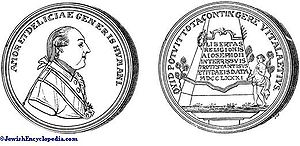 During the early years Christian teachers were to be employed in the Jewish schools, but they were to have nothing to do with the religious affairs of such institutions. After the lapse of ten years a Jew might establish a business, or engage in trade, only if he could prove that he had attended a school. The usual school-inspectors were to supervise the Jewish schools and to report to the government. The Jews were to create a fund for organizing and maintaining their schools. Jewish youth might enter the academies, and might study any subject at the universities except theology
. Jews might rent farms only if they could cultivate the same without the aid of Christians.
Jews were allowed to peddle
and to engage in various industrial
occupations, and to be admitted into the guild
s. They were also permitted to engrave seal
s, and to sell gunpowder
and saltpeter
; but their exclusion from the mining-towns remained in force. Christian masters were allowed to have Jewish apprentices. All distinctive marks hitherto worn by the Jews were to be abolished, and they might even carry swords. On the other hand, they were required to discard the distinctive marks prescribed by their religion and to shave their beards. Emperor Joseph regarded this decree so seriously that he allowed no one to violate it.
The Jews, in a petition dated April 22, 1783, expressed their gratitude to the emperor for his favors, and, reminding him of his principle that religion should not be interfered with, asked permission to wear beards. The emperor granted the prayer of the petitioners, but reaffirmed the other parts of the decree (April 24, 1783). The Jews organized schools in various places, at Pressburg (Bratislava
), Óbuda
, Vágújhely (Nové Mesto nad Váhom
), and Nagyvárad (Oradea
). A decree was issued by the emperor (July 23, 1787) to the effect that every Jew should choose a German surname; and a further edict (1789) ordered, to the consternation of the Jews, that they should henceforth perform military service
.
After the death of Joseph II the royal free cities showed a very hostile attitude toward the Jews. The citizens of Pest petitioned the municipal council that after May 1, 1790, the Jews should no longer be allowed to live in the city. The government interfered; and the Jews were merely forbidden to engage in peddling in the city. Seven days previously a decree of expulsion had been issued at Nagyszombat (Trnava
), May 1 being fixed as the date of the Jews' departure. The Jews appealed to the government; and in the following December the city authorities of Nagyszombat were informed that the Diet had confirmed the former rights of the Jews, and that the latter could not be expelled.
(1790–1792) at Vienna on November 29, 1790. He sent it the following day to the chancelleries of Hungary and Moravia for their opinions. The question was brought before the estates of the country on December 2, and the Diet drafted a bill showing that it intended to protect the Jews. This decision created consternation among the enemies of the latter. Nagyszombat (Trnava
) addressed a further memorandum to the estates (December 4) in which it demanded that the Diet should protect the city's privileges. The Diet decided in favor of the Jews, and its decision was laid before the king.
The Jews, confidently anticipating the king's decision in their favor, organized a splendid celebration on November 15, 1790, the day of his coronation
; on January 10, 1791, the king approved the bill of the Diet; and the following law, drafted in conformity with the royal decision, was read by Judge Stephen Atzel in the session of February 5:
"In order that the condition of the Jews may be regulated pending such time as may elapse until their affairs and the privileges of various royal free towns relating to them shall have been determined by a commission to report to the next ensuing Diet, when his Majesty and the estates will decide on the condition of the Jews, the estates have determined, with the approval of his Majesty, that the Jews within the boundaries of Hungary and the countries belonging to it shall, in all the royal free cities and in other localities (except the royal mining-towns), remain under the same conditions in which they were on Jan. 1, 1790; and in case they have been expelled anywhere, they shall be recalled."
Thus came into force the famous law entitled De Judaeis, which forms the thirty-eighth article of the laws of the Diet of 1790–1791. The De Judaeis law was gratefully received by the Jews; for it not only afforded them protection, but also gave them the assurance that their affairs would soon be regulated. Still, although the Diet appointed on February 7, 1791, a commission to study the question, the amelioration of the condition of the Hungarian Jews was not effected till half a century later, under Ferdinand V
(1835–1848), during the session of the Diet of 1839–1840.
In consequence of the petition of the Jews of Pest, the mover of which was Dr. Philip Jacobovics, superintendent of the Jewish hospital, the general assembly of the county of Pest drafted instructions for the delegates on June 10, 1839, to the effect that if the Jews would be willing to adopt the Magyar
language they should be given equal rights with other Hungarian citizens. From now on much attention was paid to the teaching of Hungarian in the schools; Moritz Bloch (Ballagi) translated the Pentateuch into Hungarian, and Moritz Rosenthal the Psalms
and the Pirkei Avoth
. Various communities founded Hungarian reading-circles; and the Hungarian dress and language were more and more adopted. Many communities began to use Hungarian on their seals and in their documents, and some liberal rabbis even began to preach in that language.
At the sessions of the Diet subsequent to that of 1839–1840, as well as in various cities, a decided antipathy—at times active and at times merely passive—toward the Jews became manifest. In sharp contrast to this attitude was that of Baron József Eötvös
, who published in 1840 in the Budapesti Szemle, the most prominent Hungarian review, a strong appeal for the emancipation
of the Jews. This cause also found a friend in Count Charles Zay, the chief ecclesiastical inspector of the Hungarian Lutherans, who warmly advocated Jewish interests in 1846.
Although the session of the Diet convened on November 7, 1847, was unfavorable to the Jews, the latter not only continued to cultivate the Hungarian language, but were also willing to sacrifice their lives and property in the hour of danger. During the Revolution of 1848 they displayed their patriotism, even though attacked by the populace in several places at the beginning of the uprising. On March 19 the populace of Pressburg (Bratislava
), encouraged by the antipathies of the citizens—who were aroused by the fact that the Jews, leaving their ghetto
around Pressburg Castle (Bratislava Castle
), were settling in the city itself—began hostilities that were continued after some days, and were renewed more fiercely in April.
At this time the expulsion of the Jews from Sopron
, Pécs
, Székesfehérvár
, and Szombathely
was demanded; in the last two cities there were pogroms. At Szombathely, the mob advanced upon the synagogue, cut up the Torah
scrolls, and threw them into a well. Nor did the Jews of Pest escape, while those at Vágújhely (Nové Mesto nad Váhom
) especially suffered from the brutality of the mob. Bitter words against the Jews were also heard in the Diet. Some Jews advised emigration to America
as a means of escape; and a society was founded at Pest, with a branch at Pressburg, for that purpose. A few left Hungary, seeking a new home across the sea, but the majority remained.
Jews entered the national guard as early as March 1848; although they were excluded from certain cities, they reentered as soon as the danger to the country seemed greater than the hatred of the citizens. At Pest the Jewish national guard formed a separate division. When the national guards of Pápa
were mobilized against the Croatians, Leopold Löw
, rabbi of Pápa, joined the Hungarian ranks, inspiring his companions by his words of encouragement. Jews were also to be found in the volunteer corps, and among the honvéd and landsturm
; and they constituted one-third of the volunteer division of Pest that marched along the Drava
against the Croatians, being blessed by Rabbi Schwab on June 22, 1848.
Many Jews throughout the country joined the army to fight for their fatherland; among them, Adolf Hübsch, subsequently rabbi at New York
; Solomon Marcus Schiller-Szinessy
, afterward lecturer at the University of Cambridge
; and Ignatz Einhorn, who, under the name of "Eduard Horn," subsequently became state secretary of the Hungarian Ministry of Commerce. The rebellious Serbians
slew the Jews at Zenta
who sympathized with Hungary; among them, Rabbi Israel Ullmann and Jacob Münz, son of Moses Münz of Óbuda
The conduct of the Jewish soldiers in the Hungarian army was highly commended by Generals Klapka and Görgey. Einhorn estimated the number of Jewish soldiers who took part in the Hungarian Revolution
to be 20,000; but this is most likely exaggerated, as Béla Bernstein enumerates only 755 combatants by name in his work, Az 1848-49-iki Magyar Szabadságharcz és a Zsidók (Budapest, 1898).
The Hungarian Jews served their country not only with the sword, but also with funds. Communities and individuals, Chevra Kadisha
, and other Jewish societies, freely contributed silver and gold, armor and provisions, clothed and fed the soldiers, and furnished lint and other medical supplies to the Hungarian camps. Meanwhile they did not forget to take steps to obtain their rights as citizens. When the Diet of 1847–1848 (in which, according to ancient law, only the nobles and those having the rights of nobles might take part) was dissolved (April 11), and the new Parliament — at which under the new laws the delegates elected by the commons also appeared — was convened at Pest (July 2, 1848), the Jews hopefully looked forward to the deliberations of the new body.
For the purpose of urging Jewish emancipation
all the Jews of Hungary sent delegates to a conference at Pest on July 5, 1848; there a commission consisting of ten members was chosen, to which was entrusted the task of agitating on behalf of emancipation; but the commission was instructed to make no concessions in regard to the Jewish faith, even if the Parliament should stipulate such as the condition on which civic equality to the Jews would be granted. The commission soon after addressed a petition to the Parliament, but it proved ineffective.
The emancipation of the Jews, was granted by the national assembly at Szeged
on Saturday, the eve of the Ninth of Av (July 28, 1849). The bill, which was quickly debated and immediately became a law, realized all the hopes of the Reform party. The Jews obtained full citizenship; and the Ministry of the Interior was ordered to call a convention of Jewish ministers
and laymen for the purpose of drafting a confession of faith
, and of inducing the Jews to organize their religious life in conformity with the demands of the time. The bill also included the clause referring to marriages between Jews and Christians, which clause both Lajos Kossuth
and the Reform party advocated.
The Jews enjoyed their civic liberty for just two weeks. After the Hungarian army's surrender at Világos
to the Russia
n troops that had come to aid the Austrians in suppressing the Hungarian struggle for liberty, the Jews were severely punished for having taken part in the uprising. Field Marshal Julius Jacob von Haynau
, the new governor of Hungary, imposed heavy war-taxes upon them, especially upon the communities of Pest and Óbuda
, which had already been heavily taxed by Alfred I, Prince of Windisch-Grätz, commander-in-chief of the Austrian army, on his triumphant entry into the Hungarian capital at the beginning of 1849. The communities of Kecskemét
, Nagykőrös
, Cegléd
, Albertirsa
, Szeged, and Szabadka (now Subotica
, Serbia) were punished with equal severity by Haynau, who even laid hands upon the Jews individually, executing and imprisoning several; others sought refuge in emigration
.
Several communities petitioned to be relieved of the tax imposed upon them. The ministry of war, however, decided that the communities of Pest, Óbuda, Kecskemét, Czegléd, Nagykőrös, and Irsa should pay this tax not in kind, but in currency to the amount of 2,300,000 gulden. As the communities were unable to collect this sum, they petitioned the government to remit it, but the result was that not only the communities in question but the communities of the entire country were ordered to share in raising the sum, on the ground that most of the Jews of Hungary had supported the Revolution. Only the communities of Temesvár (now Timişoara
, Romania) and Pressburg (now Bratislava
, Slovakia) were exempted from this order, they having remained loyal to the existing government. The military commission subsequently added a clause to the effect that individuals or communities might be exempted from the punishment, if they could prove by documents or witnesses, before a commission to be appointed, that they had not taken part in the Revolution, either by word or deed, morally or materially. The Jews refused this means of clearing themselves, and finally declared that they were willing to redeem the tax by collecting a certain sum for a national school-fund. Emperor Franz Joseph
therefore remitted the war-tax (September 20, 1850), but ordered that the Jews of Hungary without distinction should contribute toward a Jewish school-fund of 1,000,000 gulden; and this sum was raised by them within a few years.
in 1859. In that year the cabinet, with Emperor Franz Joseph in the chair, decreed that the status of the Jews should be regulated in agreement with the times, but with due regard for the conditions obtaining in the several localities and provinces. The question of emancipation was again loudly agitated when the emperor convened the Diet on April 2, 1861; but the early dissolution of that body prevented it from taking action in the matter.
The decade of absolutism in Hungary (1849–1859) was beneficial to the Jews insofar as it forced them to establish schools, most of which were in charge of trained teachers. The government organized with the Jewish school-fund model schools at Sátoraljaújhely
, Temesvár (Timişoara
), Pécs
, and Pest. In Pest the Israelite State Teachers' Seminary was founded in 1859, the principals of which have included Abraham Lederer
, Heinrich Deutsch, and Joseph Bánóczi
. The graduates of this institution have rendered valuable services in the cause of patriotism
and religious education
.
When the Parliament dissolved in 1861, the emancipation of the Jews was deferred to the coronation of Franz Joseph. On December 22, 1867, the question came before the lower house, and on the favorable report of Kálmán Tisza
and Zsigmond Bernáth a bill in favor of emancipation was adopted, which was passed by the upper house on the following day. This bill (article xvii of the Laws of the Parliament session of 1867) was received with universal satisfaction not only by the Jews, but also by the whole country. Although an Antisemitic Party was present in the Parliament, it was not taken seriously by the political elite of the country, and their agitation against Jews was not successful (see Tiszaeszlár blood libel
).
On October 4, 1877, the Jewish Theological Seminary – University of Jewish Studies
opened in Budapest
. The university is still functioning, having its 130th anniversary on October 4, 2007. Since its opening, it has been the only Jewish institute in all of Central
and Eastern Europe
.
The majority (75.7%) of the Jewish population reported Hungarian as their primary language, so they were counted as ethnically Hungarian in the census. The Yiddish speakers were counted as ethnically German. This way, 6.94% of the Hungarians and 11.63% of the Germans of Hungary were Jewish. In other words, without counting the Hungarian-speaking Jewish population, the 54.45% Hungarian majority of Hungary would have been reduced to 50.67%. Similarly, the 10.42% ethnic German population would have amounted to 9.21%.
The capital, Budapest, was 23% Jewish. Pest was more Jewish than Buda. Due to the prosperity and the large Jewish community of the city, Budapest was often called as the "Jewish Mecca" At that time Karl Lueger
, mayor of Vienna
created the Antisemitic nickname Judapest
, alluded to high number and percentage of Jewish population.
In 1910, 60.96% of merchants, 58.11% of the book printers, 41.75% of the innkeepers, 24.42% of the bakers, 24.07% of the butchers, 21.04% of the tailors, 8.90% of the shoemakers of Hungary were Jewish.
Among the physicians, 48.5% (2701 out of 5565) were Jewish. In the 1893-1913 period, roughly 20% of the gimnázium high school (where classical subjects were emphasized) students and 37% of reál high school (where practical subjects were emphasized) students were Jewish.
The strong class division of Hungary was also present among the Jewish population.
About 3.1% of the Jews belonged to the "large employer" and "agricultural landowner of more than 100 hold, i.e. 57 hectares" class, 3.2% to the "small (<100 hold) landholder" class, 34.4% to the "working", i.e. wage-earning employee class, while 59.3% belonged to the self-employed or salary-earning middle class.
There was also religious division. There were three denominations. Budapest, the South and West had a "Neolog" majority (somewhat between modern US conservative and Reform - kipah and organ are both present in the synagogues). Traditionalists ("Status quo ante") were the smallest of the three, mainly in the North. The East and North of the country were overwhelmingly Orthodox (more orthodox than "status quo ante"). One can say, in broad terms, that Jews whose ancestors had come from Moravia in the 18th century became Neolog, while Jews whose ancestors had come from Galicia became Orthodox at the split in 1869.
In absolute numbers, Budapest had the largest number of Jews by far (203 thousand), followed by Nagyvárad (Oradea
) with 15 thousand, Újpest
and Miskolc
with about 10 thousand each, Máramarossziget (Sighetu Marmaţiei
), Munkács (Mukachevo), Pozsony (Bratislava
), Debrecen
with 8 thousand, Kolozsvár (Cluj-Napoca
), Szatmárnémeti (Satu Mare), Temesvár (Timișoara
), Kassa (Košice
) with about 7 thousand each.
N = Neolog majority;
n = Neolog minority;
Q = Status quo ante majority;
q = Status quo ante minority;
X = Orthodox majority;
x = Orthodox minority; * = Chasidic dynasty is present (see).
If the town and village had only an Orthodox community, it is not marked.
The town or village belonged to
SL = Slovakia,
RO = Romania,
GE = Germany,
IT = Italy,
CR = Croatia between 1941 and 1944.
The unmarked communities were under Hungarian rule during the Holocaust.
The pronunciation of Hungarian names is consistent: s= sh, sz= s, c= cz [until WW1]= tz, cs= ch, zs= zh, gy= dy, ly= y, j= y.
The list of "rendezett tanácsú" or "törvényhatósági jogú" (i.e. autonomous) towns where the Jewish population exceeded 5% were:
In several towns, the number of Jews exceeded one thousand people, but their ratio in the local population was less than 5.0%. These towns included Szabadka (Subotica
) Nx with 3539 Jewish residents (3.7%), Kecskemét
2022 (3.0%), Fiume (Rijeka
IT) 1696 (3.4%), Hódmezővásárhely
1381 (2.2%), Zenta(Senta
) * 1328 (4.5%), Nagybecskerek (Зрењанин, Zrenjanin
) 1232 (4.7%), Cegléd
1121 (3.3%), Karcag
1077 (4.7%), Kiskunfélegyháza
1051 (3.0%), while Jászberény
had 1017 (3.4%).
Other towns & villages with significant Jewish presence in 1910 included:
Counties, where the Jewish population, including the autonomous towns, reached 4% were
In 1920, 46.3% of the medical doctors, 41.2% of the veterinarians, 21.4% of the pharmacists of Hungary were Jewish, as well as 34.3% of the journalists, 24.5% of performers of music, 22.7% of the theater actors, 16.8% of the painters and sculptors. Among the owners of land of more than 1000 hold, i.e. 570 hectares, 19.6% were Jewish. Among the 2739 factories in Hungary, 40.5% had a Jewish owner.
The following table shows the number of people who declared to be "Israelite" (Jewish by religion) at the censuses inside the post-ww1 territory of Hungary. Note: it was illegal not to declare religion between 1920 and 1945. Your religion was written on your birth certificate, your marriage license (except in 1919, during the short-lived Commune, see Hungarian Soviet Republic
), even on your school grade reports.
In 1926, the districts I,II,III of Buda were Jewish 8%,11%,10% respectively. The 19 thousand Jews of Buda constituted about 9.3% of both the total population of Buda and the entire Jewish population of Budapest. On the left (Pest) side of the Danube, downtown Pest (Belváros, district IV then) was 18% Jewish. Districts V (31%), VI (28%), VII (36%), VIII (22%),IX (13%) had large Jewish populations, while district X had 6%. The four Neolog communities of Budapest (I-II, III, IV-IX, X) had a total of 66,300 members paying their dues, while the Orthodox community had about 7,000 members paying religious taxes.
In the countryside of the post-WW1 Hungary, the Orthodox had a slight edge (about 49%) over the Neolog (46%). Budapest and countryside combined, 65.72% of the 444,567 Jews belonged to Neolog communities, 5.03% to Status quo ante, while 29.25% were Orthodox in 1930 . We can also see from this data that the Jewish communities suffered a 5.6% decline in the 1910-1930 period, on the territory of the "small" Hungary, due to emigration and conversion.
The Jews of Hungary were fairly well integrated into Hungarian society by the time of the First World War. Class distinction was very significant in Hungary in general, and among the Jewish population in particular. Rich bankers, factory owners, lower middle class artisans and poor factory workers did not mingle easily. In 1926, there were 50,761 Jewish families living in Budapest. 65% of them lived in apartments that contained one or two rooms, 30% had three or four rooms, while 5% lived in apartments with more than 4 rooms.
Education. The following chart will illustrate the effect of the antisemitic 1920 "Numerus clausus
" Law on the percentage of Jewish university students at two Budapest Universities.
Those who could afford went to study to other European countries like Austria, Germany, Italy and Czechoslovakia.
In 1930, of all males aged six and older,
Seven of the ten Nobel prize winners born in Hungary are Jewish. In sports, 55.6% of the individual gold medal winners of Hungary at the Summer Olympic Games between 1896 and 1912 were Jewish. This number dropped to 17.6% in the interwar period of 1924-1936.
. But these sacrifices by patriotic Hungarian Jews may have been outweighed by the chaotic events following the war's end.
With the defeat and dissolution of the Austro-Hungarian Empire, Hungary would be forced by the Allies to adhere to the Treaty of Trianon
, which ceded to neighboring nations fully two-thirds of Hungary's imperial territory and two thirds of its population, including a third of its ethnically Magyar citizens and many Jews. These losses provoked deep anger and hostility in the remaining Hungarian population.
The first post-war government was led by Mihály Károlyi
, and was the first modern effort at liberal democratic government in Hungary. But it was cut short in a spasm of communist revolution, which would have serious implications for the manner in which Hungarian Jews were viewed by their fellow-countrymen.
In March 1919, Communist and Social Democrat members of a coalition government ousted Karolyi; soon after (21 March), the Communists were to take power as their Social Democrat colleagues were willing neither to accept nor to refuse the Vix Note to cede a significant part of the Great Plains to Romania and the communists took control of Hungary's governing institutions. While popular at first, the so-called Hungarian Soviet Republic
fared poorly in almost all of its aims, particularly its efforts to regain territories occupied by Slovakia
(although achieving some transitional success here) and Romania
. All the less palatable excesses of Communist uprisings were in evidence during these months, particularly the formation of squads of brutal young men practicing what they called "revolutionary terror
" to intimidate and suppress dissident views. All but the one Sándor Garbai
, the revolution's leaders, including Béla Kun
, Tibor Szamuely
, and Jenő Landler
– were of Jewish ancestry. As in other countries where Communism was viewed as an immediate threat, the presence of Jews, even irreligious Jews, in positions of revolutionary leadership helped foster the notion of a Jewish-Bolshevik conspiracy.
Kun's regime was crushed after four and a half months when the Romanian army entered Budapest; it was quickly followed by the reactionary forces under the command of the former Austro-Hungarian admiral, Miklós Horthy
.
The sufferings endured during the brief revolution, and their exploitation by fascist and ultra-nationalist movements, helped generate stronger suspicions among non-Jewish Hungarians, and undergirded pre-existing anti-Semitic views.
Beginning in July 1919, officers of Horthy's National Army engaged in a brutal string of counter-reprisals against Hungarian communists and their allies, real or imagined. This series of pogroms directed at Jews, progressives, peasants and others is known as the White Terror
. Horthy's personal role in these reprisals is still subject of debate (in his memoirs he refused to disavow the violence, saying that "only an iron broom" could have swept the country clean). Tallying the numbers of victims of the different terror campaigns in this period is still a matter of some political dispute but the White Terror is generally considered to have claimed more lives than the repressions of the Kun regime by an order of magnitude, thousands vs hundreds. Illustration: http://www.graphicwitness.org/contemp/biro01.htm, http://www.graphicwitness.org/contemp/biro02.htm
In 1921 Budapest
, 88% of the members of the stock exchange and 91% of the currency brokers were Jews, many of them ennobled. In interwar Hungary, more than half and perhaps as much as 90 percent of Hungarian industry was owned or operated by a few closely related Jewish banking families.
Jews represented one-fourth of all university students and 43% percent at Budapest Technological University
. In 1920, 60 percent of Hungarian doctors, 51 percent of lawyers, 39 percent of all privately employed engineers and chemists, 34 percent of editors and journalists, and 29 percent of musicians identified themselves as Jews by religion.
Resentment of this Jewish trend of success was widespread: Admiral Horthy himself declared that he was "an anti-Semite," and remarked in a letter to one of his prime ministers, "I have considered it intolerable that here in Hungary everything, every factory, bank, large fortune, business, theater, press, commerce, etc. should be in Jewish hands, and that the Jew should be the image reflected of Hungary, especially abroad."
Unfortunately for Jews they had also become, by a quirk of history, the most visible minority remaining in Hungary; the other large "non-Hungarian" populations (including Slovaks, Slovenes, Croats, and Romanians, among others) had been abruptly excised from the Hungarian population by the territorial losses at Trianon. That left Hungary's Jews as the one ethnically separate group which could serve as a scapegoat for the nation's ills. The scapegoating began quickly. In 1920, Horthy's government passed a "Numerus Clausus," restricting the Jewish enrollment at universities to five percent or less, in order to reflect the Jewish population percentage.
Anti-Jewish policies grew more repressive in the interwar period as Hungary's leaders, who remained committed to regaining the lost territories of "Greater Hungary," chose to align themselves (albeit warily) with the fascist governments of Germany and Italy – the international actors most likely to stand behind Hungary's claims. The inter-war years also saw the emergence of flourishing fascist groups, such as the Hungarian National Socialist Party
and the Arrow Cross Party
.
passed a series of anti-Jewish measures in emulation of Germany's Nürnberg Laws. The first, promulgated on May 29, 1938, restricted the number of Jews in each commercial enterprise, in the press, among physicians, engineers and lawyers to twenty percent. The second anti-Jewish law (May 5, 1939), for the first time, defined Jews racially: people with 2, 3 or 4 Jewish-born grandparents were declared Jewish. Their employment in government at any level was forbidden, they could not be editors at newspapers, their numbers were restricted to six per cent among theater and movie actors, physicians, lawyers and engineers. Private companies were forbidden to employ more than 12% Jews. 250,000 Hungarian Jews lost their income. Most of them lost their right to vote as well: before the second Jewish law, about 31% of the Jewish population of Borsod county (Miskolc excluded), 2496 people had this right. At the next elections, less than a month after this new anti-Jewish legislation, only 38 privileged Jew could vote.
In the elections of May 28–29, Nazi and Arrow Cross (Nyilas) parties received one quarter of the votes and 52 out of 262 seats. Their support was even larger, usually between 1/3 and 1/2 of the votes, where they were on the ballot at all, since
they were not listed in large parts of the country
The "Third Jewish Law" (August 8, 1941) prohibited intermarriage and penalized sexual intercourse between Jews and non-Jews.
According to "Magyarország történelmi kronológiája", the census of January 31, 1941 found that 6.2% of the population of 13,643,620, i.e. 846,000 people, were considered Jewish according to the racial laws of that time. In addition, in April 1941, Hungary annexed the Bácska (Bačka
), the Muraköz (Međimurje County) and Muravidék (Prekmurje
) regions from the occupied Yugoslavia, with 1,025,508 people including 15,000 Jews. This means that inside the May 1941 borders of Hungary, there were 861,000 people (or 5.87%) who were at least half Jewish, and therefore were considered Jewish. From this number, 725,000 (or 4.94%) were Jewish by religion (4.3% in pre-1938 Hungary, 7.2% in the territories annexed from Czechoslovakia and Romania in 1938-1940 and 1.5% in the territories annexed from Yugoslavia in 1941).
It is not clear whether the 10–20,000 Jewish refugees (from Poland and elsewhere) were counted in the January census. They and anyone who could not prove legal residency, about 20,000 people, were handed over to the Germans in July 1941, and were massacred in Kameniec-Podolsk (Kamianets-Podilskyi
) at the end of August.
In the massacres of Újvidék (Novi Sad
) and villages nearby, 2,550-2,850 Serbs, 700-1,250 Jews and 60-130 others were murdered by the Hungarian Army and "Csendőrség" (Gendarmerie) in January 1942. During the war, Jews were called up to serve in unarmed "labour service" (munkaszolgálat) units which were used to repair bombed railroads, build airports or to clean up minefields at the front barehanded. Approximately 42,000 Jewish forced laborers were killed (many times by their Hungarian guards) at the Soviet front in 1942–43. Another 4 thousand forced laborers died in the copper mine of Bor, Serbia
. Nevertheless, Mr Miklós Kállay
, Prime Minister from March 9, 1942 and Regent Horthy resisted German pressure and refused to allow the deportation of Hungarian Jews to the German extermination camps in occupied Poland. This "anomalous" situation lasted until March 19, 1944, when German troops occupied Hungary and forced Horthy to oust Kállay.
On March 18, 1944, Hitler summoned Horthy to a conference in Austria, where he demanded greater acquiescence from the Hungarian state. Horthy resisted, but his efforts were fruitless – while he attended the conference, German tanks rolled into Budapest.
On March 23, 1944, the government of Döme Sztójay
was installed. Among his other first moves, Sztójay legalized the Arrow Cross Party
, which quickly began organizing. During the four days' interregnum following the German occupation, the Ministry of the Interior was put in the hands of László Endre
and László Baky
, right-wing politicians well-known for their hostility to Jews. Their boss, Andor Jaross
, was another committed anti-Semite.
A few days later, Ruthenia, Northern Transylvania and the border region with Croatia and Serbia were placed under military command. On April 9, Prime Minister Döme Sztójay
and the Germans obligated Hungary to place at the disposal of the Reich 300,000 Jewish laborers. Five days later, on April 14, Endre, Baky, and Eichmann decided to deport all the Jews of Hungary.
SS Colonel Adolf Eichmann
, whose duties included supervising the extermination of Jews, set up his staff in the Majestic Hotel and proceeded rapidly in rounding up Jews from the Hungarian provinces outside of Budapest and its suburbs. The Yellow Star
and Ghettoization laws, and deportation were accomplished in less than eight weeks with the enthusiastic help of the Hungarian authorities, particularly the gendarmerie
(csendőrség). The plan was to use 45 cattle cars per train, 4 trains a day, to deport 12,000 Jews to Auschwitz every day from the countryside starting mid-May, followed by the deportation of Jews of Budapest around July 15. By mid May, Jewish leaders of Hungary, Hungarian leaders of the Roman Catholic, Calvinist and Lutheran Churches as well as Horthy's aides received the detailed Vrba-Wetzler report
about Auschwitz but by this point the mass deportations were already under way and like the Horthy government found themselves duped by the Nazis. Subsequent lack of coherent planning, organization and ineffectual action by Hungarian institutions contributed to the ignorance of the majority of country Hungarian Jews and a lesser number of urban Jews to the true nature of the deportations.
The first transports to Auschwitz began early May, 1944, and continued even as Soviet troops approached. The Hungarian government was solely in charge of the Jews' transportation up to the northern border. The Hungarian commander of the Kassa (Košice
) railroad station meticulously recorded the trains heading to Auschwitz with their place of departure and the number of people inside them. The first train went through Kassa on May 14. On a typical day, there were 3 or 4 trains, with 10-14 thousand people inside. There were 109 trains during these 33 days through June 16. (There were days, when there were as many as six trains.) Between June 25 and 29, there were 10 trains, then an additional 18 trains on July 5–9. The 138th recorded train (with the 400,426th victim) heading to Auschwitz via Kassa was on July 20. Another 10 trains were sent to Auschwitz via other routes (24,000+ people) [the first two left Budapest and Topolya on April 29 and arrived at Auschwitz on May 2], while 7 trains with 20,787 people went to Strasshof between June 25 and 28 (2 each from Debrecen
, Szeged
and Baja
, 1 from Szolnok
). The unique Kastner train
left for Bergen-Belsen
with 1685 people on June 30th.
By July 9, 437,402 Jews had been deported according to Reich plenipotentiary in Hungary Edmund Veesenmayer
's official German reports. One hundred and forty-seven trains were sent to Auschwitz, where 90% of the people were exterminated on arrival. Because the crematoria couldn't cope with the number of corpses, special pits were dug near them, where bodies were simply burned. It has been estimated that one third of the murdered victims at Auschwitz were Hungarian.
For most of this time period, 12,000 Jews were delivered to Auschwitz in a typical day, among them the future writer and Nobel Prize
-winner Elie Wiesel
, at age 15. Have a look at the "Auschwitz Photo Album" found after the war:
The devotion to the cause of the "final solution" of the Hungarian gendarmes surprised even Eichmann himself, who supervised the operation with only twenty officers and a staff of 100, which included drivers, cooks, etc. A few, members of the Catholic or protestant clergy raised their voices against sending the Jews to their death. (Notable was Bishop Áron Márton
's sermon in Kolozsvár on May 18). But the Catholic Primate of Hungary, Serédi decided not to issue a pastoral letter condemning the deportation of the Jews until the Vatican had done so itself.
According to Winston Churchill
, in a letter to his Foreign Secretary dated July 11, 1944, "There is no doubt that this persecution of Jews in Hungary and their expulsion from enemy territory is probably the greatest and most horrible crime ever committed in the whole history of the world...."
Rome was liberated on June 4, D-day landing in Normandy was on June 6. But on June 15, the Mayor of Budapest designated 2 thousand (5%) "starred" houses where every Jew (20%+) had to move together. The authorities thought that the Allies would not bomb Budapest because the "starred" houses were scattered around the town. At the end of June, finally, the Pope in Rome, The King of Sweden
, and, in strong terms, President Franklin D. Roosevelt
urged the halt to the deportations. Admiral Horthy ordered the suspension of all deportations on July 6. Nonetheless, another 45,000 Jews were deported from the Trans-Danubian region and the outskirts of Budapest to Auschwitz after this day. The Sztójay government then rescheduled the date of deportation of the Jews of Budapest to Auschwitz to August 27. But the Romanians switched sides on August 23, 1944, causing huge problems for the German military, Himmler ordered the cancellation of further deportations from Hungary on August 25, and Horthy finally dismissed Prime Minister Sztójay on August 29, the same day the Slovak National Uprising
against the Nazis started.
In spite of the change of government, Hungarian troops occupied parts of Southern Transylvania, Romania, and massacred hundreds of Jews in Kissármás (Sărmăşel), Lugos (Lugoj) and other places starting September 4.
After the Nyilas (Arrow Cross) coup d'etat on October 15, tens of thousands of Jews of Budapest were sent on foot to the Austrian border in death marches, most forced laborers under Hungarian Army command so far were deported (for instance to Bergen-Belsen
), and two ghettos were set up in Budapest. The small "international ghetto" consisted of several "starred" houses under the protection of neutral powers in the Újlipótváros district. Switzerland was allowed to issue 7,800 Schutzpasses, Sweden 4,500, while the Vatican, Portugal and Spain 3,300 combined. The big Budapest ghetto
was set up and walled in the Erzsébetváros part of Budapest on November 29. Nyilas raids and mass executions occurred in both ghettos regularly. In addition, in the two months between November 1944 and February 1945, the Nyilas shot 10,000-15,000 Jews on the banks of the Danube. Soviet troops liberated the big Budapest ghetto
on January 18, 1945. On the Buda side of the town, the encircled Nyilas continued their murders until the Soviets took Buda on February 13.
The names of some diplomats, Raoul Wallenberg
, Ángel Sanz Briz
, Carl Lutz
, Giorgio Perlasca
, Carlos de Sampayo Garrido and Alberto Teixeira Branquinho deserve mentioning, as well as some members of the army and police who saved people (Pál Szalai
, Károly Szabó
, and other officers who took Jews out from camps with fake papers) and some church institutions and personalities. Rudolph Kastner deserves special attention because of his enduring negotiations with Eichmann and Becher
to prevent deportations to Auschwitz, succeeding only minimally by sending Jews to still horrific labor battalions in Austria and ultimately saving 1,680 Jews in Kastner's train.
So we can estimate that, from an original population of 861,000 people considered Jewish inside the borders of 1941–44, about 255,000 survived. This gives a 29.6% survival rate overall under Hungarian rule. This number was even worse in Slovakia. On the other hand, the Jewish population fared much better on the Romanian side in Southern Transylvania, since Romania did not deport Jews to Auschwitz. According to another calculation, Hungary's pre-war Jewish population was 800,000, of which 180,000 survived.
Here are two very different estimates for the number of survivors of people considered Jewish.
The estimate of 994,000 people considered Jewish is not an exaggeration for 1941: the number of Jews was already 911,000 in the same territory three decades earlier; in addition, emigration was small in the 1920s and negligible in the 1930s.(From Hungary to the US, the total number of emigrants was 30,680 between 1921 and 1930 and 7,861 between 1931 and 1940).
"In the end, the wartime losses of Hungarian Jewry significantly exceeded those incurred by the military forces of the United States in all theaters of war, just as they also significantly exceeded the combined military and civilian war deaths of the British, a nation that bore much of the German military onslaught. These comparisons are cited not to minimize the sacrifices or diminish the heroism of the Western Allies but simply to underscore the magnitude of the Holocaust in Hungary." (R. Braham)
i court accused him of having collaborated with the Nazis. This ruling was reversed by the supreme court.
Kastner was one of the leaders of the Va'adat Ezrah Vehatzalah —the Aid and Rescue Committee
, or Vaada— a small Jewish group in Budapest who helped Jewish refugees escape from Nazi Europe into Hungary during World War II
, then helped them escape from Hungary after the Nazis
invaded that country too on March 19, 1944. Between May and July 1944, Hungary's Jews were being deported to the gas chambers at Auschwitz
at the rate of 12,000 people a day—for "resettlement," as the Nazis said. Kastner negotiated with Adolf Eichmann
and Kurt Becher
, both senior SS
officers, to allow 1,685 of them to leave instead for Switzerland on what became known as the Kastner train
, in exchange for money, gold, and diamonds. His negotiations also included resettlement of Jews in Austrian labor camps that saved many more, even though his ultimate goal of saving all Hungarian Jews by delaying exportation to Auschwitz until Russian troops arrived was finally disappointed.
. Described by historian Yehuda Bauer
as a brave adventurer who felt at home in underground conspiracies and card-playing circles, Brand teamed up with fellow Zionists in Budapest to form the Aid and Rescue Committee
, a group that helped Jewish refugees in Nazi-occupied Europe escape to the relative safety of Hungary, before the Germans invaded that country too in March 1944.
that carried stolen valuables, mostly Hungarian Jewish persons' property, from Hungary
towards Berlin
in 1945. After seizure of the train by American
forces, almost none of the valuables were returned to Hungary or their rightful owners or their surviving family members.
. Using his staff to prepare Protective Passports under the authority of the Swedish Legation Wallenberg saved the lives of thousands of Jews. At one point, he appeared personally at the train station, insisting that many Jews on the train be removed, and presenting the Arrow Cross guards with the Protective Passports for many on the train. Carl Lutz
, of the Swiss Legation, also saved many people in a similar manner.
Despite the fact that tens of thousands of Jews were murdered in Hungary, by Hungarians between 1941 and 1945, only 146 people were executed for war crimes in 1945-1948 and 3 in 1967.
Under Communist rule, from 1948 to 1988, Zionism
was outlawed and Jewish observance was curtailed. The previous upper class, Jews and anti-Semites alike, were expelled from the cities to the provinces for 6–12 months in the early 1950s.
However, the reality is more complex. The Communist governments of Béla Kun
(mid-1919) and Mátyás Rákosi
(1948–1954) included a large number of (atheist) Jews in prominent and influential decision-making positions. Certain Hungarian Communists who did have a Jewish background like Mátyás Rákosi
and Ernő Gerő
(Prime Minister and effective head of state in 1956) had totally repudiated Judaism (per pure Communist doctrine, which was strictly atheistic) and sometimes expressed anti-Semitic attitudes themselves.
During the 1919–1920 "White terror" period and the 1956 uprising, the backlash targeted not only Communist party members but Jews in general, and there were lynchings. On the other hand, some of the armed rebel leaders in 1956 were Jewish (István Angyal, an Auschwitz survivor, was executed on December 1, 1958), and the uprising was supported by a number of Jewish writers too (for instance, Tibor Déry was imprisoned from 1957 to 1961). After the Hungarian Revolution of 1956, about 20,000 or so Jews fled the country. For instance, an estimated 20% of the Hungarian refugees entering Canada in 1957 was Jewish. By 1967, only about 80,000–90,000 Jews (including non-religious Jews) remained in the country, with the number dropping further before the country's Communist regime collapsed in 1989.
Under the milder communist regime of János Kádár
(ruled 1957–1988) leftist Jewish intelligentsia remained an important and vocal part of Hungarian art and sciences. Diplomatic relations with Israel were severed in 1967, but it was not followed by antisemitic campaigns as in Poland or the Soviet Union.
as well as racism towards the Roma population has been an issue in Hungary since the fall of communism. There was a peak in 1992 before the departure of the strongly antisemitic wing of the ruling MDF party.
In April 1997, the Hungarian parliament passed a Jewish compensation act that returns property stolen from Jewish victims during the Nazi and Communist eras. Under this law, property and monetary payment were given back to the Jewish public heritage foundation and to Jewish victims of the Holocaust. Critics have asserted that the sums provided are trivial, however, and represent nothing more than a symbolic gesture.
"The overshadowing of the Holocaust by a politically guided preoccupation with the horrors of the Communist era has led, among other things, to giving priority to the compensation of the victims of
Communism over those of Nazism. To add insult to injury, an indeterminate number of the Christian victims who were compensated for properties nationalized by the Communist regime had, in fact, “legally” or fraudulently acquired them from Jews during the Nazi era. Compounding this virtual obscenity, the government of Viktor Orbán
sought in late 1998 to ease the collective conscience of the nation by offering to compensate survivors by paying approximately $150 for each member of their
particular immediate families, assuming that they can prove that their loved ones were
in fact victims of the Holocaust", while offering 33 times this amount to relatives of the victims of the Communist era.
The economic situation has been deteriorating since 2007, and extreme elements have established paramilitary organizations complete with Nyilas-like uniforms and armbands. At the 2010 election, the openly antisemitic "Jobbik" party received 16.7% of the vote. There has been some collaboration between Jobbik and antisemitic elements of the Fidesz party (in power 1998-2002 and from 2010) since the 2010 elections. For instance, the Budapest square named after President Roosevelt since 1946 was renamed, while the writer Albert Wass, sentenced in absentia for war crimes (for murders of Jewish women and Romanian civilian men in Transylvania in 1940) was honored with several squares and sculptures by the Budapest authorities in 2011. This is the same year, when Viktor Orbán
's government stopped paying the $150 a year compensation (established by the previous government in 2007) to the 9,000 elderly survivors of the Holocaust in Hungary that are still alive.
Most estimates about the number of Jews in Hungary range from 50,000 to 150,000; intermarriage rates are around 60%. (On the other hand, only 12,871 people declared Jewish religion in the census of 2001). Hungary boasts a number of synagogues, including the Dohány Street Synagogue
, which is the second largest synagogue in the world. Jewish education is well organized: there are three Jewish high school
s (Lauder Javne, Wesselényi and Anna Frank). Hungary is also home to the Jewish Theological Seminary – University of Jewish Studies
.
Since the fall of Communism in 1989, there has been a modest spiritual revival of Jewish observance. In 2003, Slomó Köves
(Chabad) became the first Orthodox
Rabbi
to be ordained in Hungary since the Holocaust. The ceremony was attended by Rabbi Shlomo Amar
, the Chief Rabbi of Israel, as well as the President of Hungary. At the other end of the spectrum a Reform
congregation on Anglo-American lines, known as Szím Salóm, has been established under the leadership of Rabbi Katalin Kelemen.
In the first half of 2011, 1,019,787 taxpayers of Hungary gave 1% of their 2010 taxes to religious denominations. The Jewish denominations received money from 7,466 taxpayers (0.73%): 5,829 people offered money to the Neologs, 1,067 to Chabad, 288 to Sim Shalom and 282 to the Orthodox organizations.
In July 2011, the Hungarian government and legislature classified the religions into "recognized" (14 denominations) and "not recognized" (200+) categories. Orthodox Jewish, Status quo ante (which is the same as Chabad since 2004), and Neolog denominations are recognized, while the Reform Szím Salóm fell into the "not recognized" category.
Individual people
Middle Ages
The Middle Ages is a periodization of European history from the 5th century to the 15th century. The Middle Ages follows the fall of the Western Roman Empire in 476 and precedes the Early Modern Era. It is the middle period of a three-period division of Western history: Classic, Medieval and Modern...
, by the early 20th century the community grew to be 5% of Hungary's population (and 23% of the population of the capital, Budapest), and were prominent in science, the arts and business. The Jews of Hungary suffered severely in the last months of World War II.
Under communist rule, discrimination against the small number of remaining Jews still in Hungary continued as Zionism was banned and the number of Jews shrank to even smaller levels.
Today between 50,000 and 100,000 Jews live in Hungary, mostly in Budapest
Budapest
Budapest is the capital of Hungary. As the largest city of Hungary, it is the country's principal political, cultural, commercial, industrial, and transportation centre. In 2011, Budapest had 1,733,685 inhabitants, down from its 1989 peak of 2,113,645 due to suburbanization. The Budapest Commuter...
(although official records indicate only 12,800 self proclaimed religious Jews). The inter-marriage rates for Jews is around 60%. There are many active synagogues in Hungary including the Dohány Street Synagogue
Dohány Street Synagogue
The Great Synagogue, also known as Dohány Street Synagogue or Tabakgasse Synagogue, is located in Erzsébetváros, the 7th district of Budapest. It is the third largest synagogue in Eurasia and the fifth largest in the world...
, the largest synagogue in Eurasia
Eurasia
Eurasia is a continent or supercontinent comprising the traditional continents of Europe and Asia ; covering about 52,990,000 km2 or about 10.6% of the Earth's surface located primarily in the eastern and northern hemispheres...
and the second largest in the world, after the Temple Emanu-El in New York City
New York City
New York is the most populous city in the United States and the center of the New York Metropolitan Area, one of the most populous metropolitan areas in the world. New York exerts a significant impact upon global commerce, finance, media, art, fashion, research, technology, education, and...
.
Earliest references up to 1095
It is not definitely known when Jews first settled in Hungary. According to apocryphal legend, King DecebalusDecebalus
Decebalus or "The Brave" was a king of Dacia and is famous for fighting three wars and negotiating two interregnums of peace without being eliminated against the Roman Empire under two emperors...
of Dacia
Dacia
In ancient geography, especially in Roman sources, Dacia was the land inhabited by the Dacians or Getae as they were known by the Greeks—the branch of the Thracians north of the Haemus range...
permitted the Jews who aided him in his war against Rome
Rome
Rome is the capital of Italy and the country's largest and most populated city and comune, with over 2.7 million residents in . The city is located in the central-western portion of the Italian Peninsula, on the Tiber River within the Lazio region of Italy.Rome's history spans two and a half...
to settle in his territory. Prisoners of the Jewish Wars must have been brought back by the victorious Roman legions normally stationed in Provincia Pannonia
Pannonia
Pannonia was an ancient province of the Roman Empire bounded north and east by the Danube, coterminous westward with Noricum and upper Italy, and southward with Dalmatia and upper Moesia....
. Marcus Aurelius ordered the transfer of some of his rebellious troops from Syria to Pannonia in 175. These troops had been recruited partly in Antioch
Antioch
Antioch on the Orontes was an ancient city on the eastern side of the Orontes River. It is near the modern city of Antakya, Turkey.Founded near the end of the 4th century BC by Seleucus I Nicator, one of Alexander the Great's generals, Antioch eventually rivaled Alexandria as the chief city of the...
and Hemesa (now Homs
Homs
Homs , previously known as Emesa , is a city in western Syria and the capital of the Homs Governorate. It is above sea level and is located north of Damascus...
), which still had a sizable Jewish population at that time. The Antiochian troops were transferred to Ulcisia Castra (today Szentendre), while the Hemesian troops settled in Intercisa (Dunaújváros). Stone inscriptions referring to Jews were found in Brigetio (now Szőny), Solva (Esztergom), Aquincum (Óbuda), Intercisa (Dunaújváros), Triccinae (Sárvár), Savaria (Szombathely), Sopianae (Pécs) and elsewhere in Pannonia
Pannonia
Pannonia was an ancient province of the Roman Empire bounded north and east by the Danube, coterminous westward with Noricum and upper Italy, and southward with Dalmatia and upper Moesia....
. A Latin
Latin
Latin is an Italic language originally spoken in Latium and Ancient Rome. It, along with most European languages, is a descendant of the ancient Proto-Indo-European language. Although it is considered a dead language, a number of scholars and members of the Christian clergy speak it fluently, and...
inscription, the epitaph of Septima Maria, discovered in Siklós, clearly refers to her Jewishness ("Judaea"). The Intercisa tablet was inscribed on behalf of "Cosmius, chief of the Spondilla customhouse, archisynagogus Iudeorum [head of the synagogue of the Jews]" during the reign of Alexander Severus
Alexander Severus
Severus Alexander was Roman Emperor from 222 to 235. Alexander was the last emperor of the Severan dynasty. He succeeded his cousin Elagabalus upon the latter's assassination in 222, and was ultimately assassinated himself, marking the epoch event for the Crisis of the Third Century — nearly fifty...
. In 2008, a team of archeologists discovered a third century AD amulet in the form of a gold scroll with the words of the Jewish prayer Shema' Yisrael inscribed on it in Féltorony (now Halbturn
Halbturn
Halbturn is a town in the district of Neusiedl am See in Burgenland in Austria. The village borders Hungary to the east and is near Andau, Gols and Mönchof.thumb|left|Castle Halbturn...
, Burgenland
Burgenland
Burgenland is the easternmost and least populous state or Land of Austria. It consists of two Statutarstädte and seven districts with in total 171 municipalities. It is 166 km long from north to south but much narrower from west to east...
in Austria).
Hungarian tribes settled the territory 650 years later. In the Hungarian language, the word for Jew is zsidó, which was adopted from one of the Slavic
Slavic peoples
The Slavic people are an Indo-European panethnicity living in Eastern Europe, Southeast Europe, North Asia and Central Asia. The term Slavic represents a broad ethno-linguistic group of people, who speak languages belonging to the Slavic language family and share, to varying degrees, certain...
languages.
The first historical document relating to the Jews of Hungary is the letter written about 960 to King Joseph of the Khazars
Joseph (Khazar)
Joseph ben Aaron was king of the Khazars during the 950s and 960s.Joseph was the son of Aaron II, a Khazar ruler who defeated a Byzantine-inspired war against Khazaria on numerous fronts. Joseph's wife was the daughter of the king of the Alans.Whether Joseph was the Khagan or the Bek of the...
by Hasdai ibn Shaprut
Hasdai ibn Shaprut
Hasdai ibn Shaprut born about 915 at Jaén; died about 975 at Córdoba in Spain, was a Jewish scholar, physician, diplomat, and patron of science....
, the Jewish statesman of Córdoba
Córdoba, Spain
-History:The first trace of human presence in the area are remains of a Neanderthal Man, dating to c. 32,000 BC. In the 8th century BC, during the ancient Tartessos period, a pre-urban settlement existed. The population gradually learned copper and silver metallurgy...
, in which he says that the Slavic
Slavic peoples
The Slavic people are an Indo-European panethnicity living in Eastern Europe, Southeast Europe, North Asia and Central Asia. The term Slavic represents a broad ethno-linguistic group of people, who speak languages belonging to the Slavic language family and share, to varying degrees, certain...
ambassadors promised to deliver the message to the King of Slavonia
Slavonia
Slavonia is a geographical and historical region in eastern Croatia...
, who would hand the same to Jews living in "the country of Hungarin", who, in turn, would transmit it farther. About the same time Ibrahim ibn Jacob says that Jews went from Hungary to Prague
Prague
Prague is the capital and largest city of the Czech Republic. Situated in the north-west of the country on the Vltava river, the city is home to about 1.3 million people, while its metropolitan area is estimated to have a population of over 2.3 million...
for business purposes. Dr. Samuel Kohn suggests that Jewish Khazars
Khazars
The Khazars were semi-nomadic Turkic people who established one of the largest polities of medieval Eurasia, with the capital of Atil and territory comprising much of modern-day European Russia, western Kazakhstan, eastern Ukraine, Azerbaijan, large portions of the northern Caucasus , parts of...
may have been among the Hungarian troops that under Árpád
Árpád
Árpád was the second Grand Prince of the Hungarians . Under his rule the Hungarian people settled in the Carpathian basin. The dynasty descending from him ruled the Hungarian tribes and later the Kingdom of Hungary until 1301...
conquered the country in the second half of the ninth century. Nothing is known concerning the Jews during the period of the Vajdas, except that they lived in the country and engaged in commerce there.
In 1061, King Béla I ordered that markets should take place on Saturdays instead of the traditional Sundays (Hungarian language has preserved the previous custom, Sunday=vasárnap= Market Day). In the reign of St. Ladislaus (1077–1095), the Synod of Szabolcs decreed (May 20, 1092) that Jews should not be permitted to have Christian
Christian
A Christian is a person who adheres to Christianity, an Abrahamic, monotheistic religion based on the life and teachings of Jesus of Nazareth as recorded in the Canonical gospels and the letters of the New Testament...
wives or to keep Christian slaves. This decree had been promulgated in the Christian countries of Europe
Europe
Europe is, by convention, one of the world's seven continents. Comprising the westernmost peninsula of Eurasia, Europe is generally 'divided' from Asia to its east by the watershed divides of the Ural and Caucasus Mountains, the Ural River, the Caspian and Black Seas, and the waterways connecting...
since the fifth century, and St. Ladislaus merely introduced it into Hungary.
The Jews of Hungary formed at first small settlements, and had no learned rabbi
Rabbi
In Judaism, a rabbi is a teacher of Torah. This title derives from the Hebrew word רבי , meaning "My Master" , which is the way a student would address a master of Torah...
s; but they were strictly observant of all the Jewish religious laws and customs. Jews from Ratisbon (Regensburg
Regensburg
Regensburg is a city in Bavaria, Germany, located at the confluence of the Danube and Regen rivers, at the northernmost bend in the Danube. To the east lies the Bavarian Forest. Regensburg is the capital of the Bavarian administrative region Upper Palatinate...
) once came into Hungary with merchandise from Russia
Russia
Russia or , officially known as both Russia and the Russian Federation , is a country in northern Eurasia. It is a federal semi-presidential republic, comprising 83 federal subjects...
, and the wheel of their wagon broke on a Friday, near Buda
Buda
For detailed information see: History of Buda CastleBuda is the western part of the Hungarian capital Budapest on the west bank of the Danube. The name Buda takes its name from the name of Bleda the Hun ruler, whose name is also Buda in Hungarian.Buda comprises about one-third of Budapest's...
(Ofen) or Esztergom
Esztergom
Esztergom , is a city in northern Hungary, 46 km north-west of the capital Budapest. It lies in Komárom-Esztergom county, on the right bank of the river Danube, which forms the border with Slovakia there....
(Gran). By the time they had repaired it and had entered the town, the Jews were just leaving the synagogue
Synagogue
A synagogue is a Jewish house of prayer. This use of the Greek term synagogue originates in the Septuagint where it sometimes translates the Hebrew word for assembly, kahal...
; and the unintentional Sabbath
Shabbat
Shabbat is the seventh day of the Jewish week and a day of rest in Judaism. Shabbat is observed from a few minutes before sunset on Friday evening until a few minutes after when one would expect to be able to see three stars in the sky on Saturday night. The exact times, therefore, differ from...
-breakers were heavily fined. The ritual of the Hungarian Jews faithfully reflected contemporary German customs.
Early history (1100–1300)
King ColomanColoman
Coloman, , , ; )* Coloman I. the Book-lover* Coloman of Galicia-Lodomeria * Saint Coloman of Stockerau * Colomán Trabado Pérez...
(1095–1116), the successor of St. Ladislaus, renewed the Szabolcs decree of 1092, adding further prohibitions against the employment of Christian slaves and domestics. He also restricted the Jews to cities with episcopal see
Episcopal See
An episcopal see is, in the original sense, the official seat of a bishop. This seat, which is also referred to as the bishop's cathedra, is placed in the bishop's principal church, which is therefore called the bishop's cathedral...
s – probably to have them under the continuous supervision of the Church
Roman Catholic Church
The Catholic Church, also known as the Roman Catholic Church, is the world's largest Christian church, with over a billion members. Led by the Pope, it defines its mission as spreading the gospel of Jesus Christ, administering the sacraments and exercising charity...
. Soon after the promulgation of this decree, Crusaders came to Hungary; but the Hungarians did not sympathize with them, and Coloman even opposed them. The infuriated Crusaders attacked some cities, and if Gedaliah ibn Yaḥya is to be believed, the Jews suffered a fate similar to that of their coreligionists in France
France
The French Republic , The French Republic , The French Republic , (commonly known as France , is a unitary semi-presidential republic in Western Europe with several overseas territories and islands located on other continents and in the Indian, Pacific, and Atlantic oceans. Metropolitan France...
, Germany
Germany
Germany , officially the Federal Republic of Germany , is a federal parliamentary republic in Europe. The country consists of 16 states while the capital and largest city is Berlin. Germany covers an area of 357,021 km2 and has a largely temperate seasonal climate...
, and Bohemia
Bohemia
Bohemia is a historical region in central Europe, occupying the western two-thirds of the traditional Czech Lands. It is located in the contemporary Czech Republic with its capital in Prague...
.
The cruelties inflicted upon the Jews of Bohemia induced many of them to seek refuge in Hungary. It was probably the immigration of the rich Bohemian Jews that induced Coloman soon afterward to regulate commercial and banking transactions between Jews and Christians. He decreed, among other regulations, that if a Christian borrowed from a Jew, or a Jew from a Christian, both Christian and Jewish witnesses must be present at the transaction.
During the reign of King Andrew II
Andrew II of Hungary
Andrew II the Jerosolimitan was King of Hungary and Croatia . He was the younger son of King Béla III of Hungary, who invested him with the government of the Principality of Halych...
(1205–1235) there were Jewish Chamberlains
Chamberlain (office)
A chamberlain is an officer in charge of managing a household. In many countries there are ceremonial posts associated with the household of the sovereign....
and mint-, salt-, and tax-officials. The nobles of the country, however, induced the king, in his Golden Bull
Golden Bull of 1222
The Golden Bull of 1222 was a golden bull, or edict, issued by King Andrew II of Hungary. The law established the rights of the Hungarian nobility, including the right to disobey the King when he acted contrary to law . The nobles and the church were freed from all taxes and could not be forced to...
(1222), to deprive the Jews of these high offices. When Andrew needed money in 1226, he farmed the royal revenues to Jews, which gave ground for much complaint. The pope
Pope
The Pope is the Bishop of Rome, a position that makes him the leader of the worldwide Catholic Church . In the Catholic Church, the Pope is regarded as the successor of Saint Peter, the Apostle...
(Pope Honorius III
Pope Honorius III
Pope Honorius III , previously known as Cencio Savelli, was Pope from 1216 to 1227.-Early work:He was born in Rome as son of Aimerico...
) thereupon excommunicated him, until, in 1233, he promised the papal ambassadors on oath that he would enforce the decrees of the Golden Bull directed against the Jews and the Saracens (by this time, the papacy had changed, and the Pope was now Pope Gregory IX
Pope Gregory IX
Pope Gregory IX, born Ugolino di Conti, was pope from March 19, 1227 to August 22, 1241.The successor of Pope Honorius III , he fully inherited the traditions of Pope Gregory VII and of his uncle Pope Innocent III , and zealously continued their policy of Papal supremacy.-Early life:Ugolino was...
; would cause both peoples to be distinguished from Christians by means of badges; and would forbid both Jews and Saracens to buy or to keep Christian slaves.
The year 1240 was the closing one of the fifth millennium of the Jewish era. At that time the Jews were expecting the advent of their Messiah
Messiah
A messiah is a redeemer figure expected or foretold in one form or another by a religion. Slightly more widely, a messiah is any redeemer figure. Messianic beliefs or theories generally relate to eschatological improvement of the state of humanity or the world, in other words the World to...
. The Mongol invasion in 1241 seemed to conform to expectation, as Jewish imagination expected the happy Messianic period to be ushered in by the war of Gog and Magog
Gog and Magog
Gog and Magog are names that appear primarily in various Jewish, Christian and Muslim scriptures, as well as numerous subsequent references in other works. Their context can be either genealogical or eschatological and apocalyptic, as in Ezekiel and Revelation...
. Béla IV (1235–1270) appointed a Jewish man named Henul to the office of court chamberlain – the Jewish Teka had filled this office under Andrew II); and Wölfel and his sons Altmann and Nickel held the castle at Komárom
Komárom
Komárom is a city in Hungary on the right bank of the Danube in Komárom-Esztergom county.The city of Komárom was formerly a separate suburban village called...
with its domains in pawn. Béla also entrusted the Jews with the mint; and Hebrew coins of this period are still found in Hungary. In 1251 a privilegium was granted by Béla to his Jewish subjects which was essentially the same as that granted by Duke Frederick II the Quarrelsome
Frederick II, Duke of Austria
Frederick II, known as the Quarrelsome or the Warlike , from the House of Babenberg, was the duke of Austria and Styria from 1230 to 1246....
to the Austria
Austria
Austria , officially the Republic of Austria , is a landlocked country of roughly 8.4 million people in Central Europe. It is bordered by the Czech Republic and Germany to the north, Slovakia and Hungary to the east, Slovenia and Italy to the south, and Switzerland and Liechtenstein to the...
n Jews in 1244, but which Béla modified to suit the conditions of Hungary. This privilegium remained in force down to the Battle of Mohács
Battle of Mohács
The Battle of Mohács was fought on August 29, 1526 near Mohács, Hungary. In the battle, forces of the Kingdom of Hungary led by King Louis II of Hungary and Bohemia were defeated by forces of the Ottoman Empire led by Sultan Suleiman the Magnificent....
(1526).
At the Synod of Buda (1279), held in the reign of King Ladislaus IV (1272–1290), it was decreed, in the presence of the papal ambassador, that every Jew appearing in public should wear on the left side of his upper garment a piece of red cloth; that any Christian transacting business with a Jew not so marked, or living in a house or on land together with any Jew, should be refused admittance to the Church services; and that a Christian entrusting any office to a Jew should be excommunicated. Andrew III (1291–1301), the last king of the Árpád dynasty
Árpád dynasty
The Árpáds or Arpads was the ruling dynasty of the federation of the Hungarian tribes and of the Kingdom of Hungary . The dynasty was named after Grand Prince Árpád who was the head of the tribal federation when the Magyars occupied the Carpathian Basin, circa 895...
, declared, in the privilegium granted by him to the community of Posonium (Bratislava
Bratislava
Bratislava is the capital of Slovakia and, with a population of about 431,000, also the country's largest city. Bratislava is in southwestern Slovakia on both banks of the Danube River. Bordering Austria and Hungary, it is the only national capital that borders two independent countries.Bratislava...
), that the Jews in that city should enjoy all the liberties of citizens.
Expulsion, recall, and persecution (1349–1526)
Under the foreign kings who occupied the throne of Hungary on the extinction of the house of Arpad, the Hungarian Jews suffered many persecutions; and at the time of the Black DeathBlack Death
The Black Death was one of the most devastating pandemics in human history, peaking in Europe between 1348 and 1350. Of several competing theories, the dominant explanation for the Black Death is the plague theory, which attributes the outbreak to the bacterium Yersinia pestis. Thought to have...
(1349) they were expelled from the country. Although the Jews were immediately readmitted, they were again persecuted, and were once more expelled in 1360 by King Louis the Great of Anjou (1342–1382) on the failure of his attempt to convert them to Catholicism
Catholicism
Catholicism is a broad term for the body of the Catholic faith, its theologies and doctrines, its liturgical, ethical, spiritual, and behavioral characteristics, as well as a religious people as a whole....
. They were received by Alexander the Good of Moldavia
Alexandru cel Bun
Alexander cel Bun was a Voivode of Moldavia, reigning between 1400 and 1432, son of Roman I Mușat. He succeeded Iuga to the throne, and, as a ruler, initiated a series of reforms while consolidating the status of the Moldavian Principality....
and Dano I of Wallachia, the latter affording them special commercial privileges.
When, some years later, Hungary was in financial distress, the Jews were recalled. They found that during their absence the king had introduced the custom of Tödtbriefe, i.e., canceling by a stroke of his pen, on the request of a subject or a city, the notes and mortgage-deeds of the Jews. An important office created by Louis was that of "judge of all the Jews living in Hungary," this official being chosen from among the dignitaries of the country, the palatines, and treasurer
Treasurer
A treasurer is the person responsible for running the treasury of an organization. The adjective for a treasurer is normally "tresorial". The adjective "treasurial" normally means pertaining to a treasury, rather than the treasurer.-Government:...
s, and having a deputy to aid him. It was his duty to collect the taxes of the Jews, to protect their privileges, and to listen to their complaints, which last-named had become more frequent since the reign of Sigismund Luxembourg
Sigismund, Holy Roman Emperor
Sigismund of Luxemburg KG was King of Hungary, of Croatia from 1387 to 1437, of Bohemia from 1419, and Holy Roman Emperor for four years from 1433 until 1437, the last Emperor of the House of Luxemburg. He was also King of Italy from 1431, and of Germany from 1411...
(1387–1437).
The successors of Sigismund: Albert
Albert II of Germany
Albert the Magnanimous KG was King of Hungary from 1438 until his death. He was also King of Bohemia, elected King of Germany as Albert II, duke of Luxembourg and, as Albert V, archduke of Austria from 1404.-Biography:Albert was born in Vienna as the son of Albert IV, Duke of Austria, and Johanna...
(1437–1439), Ladislaus Posthumus (1453–1457), and Matthias Corvinus (1458–1490)—-likewise confirmed the privilegium of Béla IV. Matthias created the office of Jewish prefect
Prefect
Prefect is a magisterial title of varying definition....
in Hungary. The period following the death of Matthias was a sad one for the Hungarian Jews. He was hardly buried, when the people fell upon them, confiscated their property, refused to pay debts owing to them, and persecuted them generally. The pretender John Corvinus, Matthias' illegitimate son, expelled them from Tata
Tata, Hungary
Tata is a town in north-western Hungary, Komárom-Esztergom county, northwest from county seat Tatabánya.-Location:Tata is located in the valley between the Gerecse and Vértes Mountains, some from the Budapest, the capital. By the virtue of its location, the city is a railway and road junction...
, and King Ladislaus II (1490–1516), always in need of money, laid heavy taxes upon them. During his reign, Jews were for the first time burned at the stake, many being executed at Nagyszombat (Trnava
Trnava
Trnava is a city in western Slovakia, 47 km to the north-east of Bratislava, on the Trnávka river. It is the capital of a kraj and of an okres . It was the seat of a Roman Catholic archbishopric . The city has a historic center...
) in 1494, on suspicion of ritual murder
Blood libel
Blood libel is a false accusation or claim that religious minorities, usually Jews, murder children to use their blood in certain aspects of their religious rituals and holidays...
.
The Hungarian Jews finally applied to the German Emperor Maximilian
Maximilian I, Holy Roman Emperor
Maximilian I , the son of Frederick III, Holy Roman Emperor and Eleanor of Portugal, was King of the Romans from 1486 and Holy Roman Emperor from 1493 until his death, though he was never in fact crowned by the Pope, the journey to Rome always being too risky...
for protection. On the occasion of the marriage of Louis II
Louis II of Hungary and Bohemia
Louis II was King of Hungary, Bohemia and Croatia from 1516 to 1526.- Early life :Louis was the son of Ladislaus II Jagiellon and his third wife, Anne de Foix....
and the archduchess Maria (1512), the emperor, with the consent of Ladislaus, took the prefect, Jacob Mendel, together with his family and all the other Hungarian Jews, under his protection, according to them all the rights enjoyed by his other subjects. Under Ladislaus' successor, Louis II (1516–1526), persecution of the Jews was a common occurrence. The bitter feeling against them was in part augmented by the fact that the baptized Emerich Szerencsés, the deputy treasurer, embezzled the public funds, following the example of the nobles who despoiled the treasury under the weak Louis.
During the war with the Ottomans (1526–1686)
The OttomansOttoman Empire
The Ottoman EmpireIt was usually referred to as the "Ottoman Empire", the "Turkish Empire", the "Ottoman Caliphate" or more commonly "Turkey" by its contemporaries...
vanquished the Hungarians at the Battle of Mohács
Battle of Mohács
The Battle of Mohács was fought on August 29, 1526 near Mohács, Hungary. In the battle, forces of the Kingdom of Hungary led by King Louis II of Hungary and Bohemia were defeated by forces of the Ottoman Empire led by Sultan Suleiman the Magnificent....
(August 29, 1526), on which occasion Louis II was slain. When the news of his death reached the capital, Buda
Buda
For detailed information see: History of Buda CastleBuda is the western part of the Hungarian capital Budapest on the west bank of the Danube. The name Buda takes its name from the name of Bleda the Hun ruler, whose name is also Buda in Hungarian.Buda comprises about one-third of Budapest's...
, the court and the nobles fled together with some rich Jews, among them the prefect.
When the grand vizier
Vizier
A vizier or in Arabic script ; ; sometimes spelled vazir, vizir, vasir, wazir, vesir, or vezir) is a high-ranking political advisor or minister in a Muslim government....
, Ibrahim Pasha
Pargali Ibrahim Pasha
Pargali Ibrahim Pasha , also known as Frenk Ibrahim Pasha , Makbul Ibrahim Pasha , and referred to him as Maktul Ibrahim Pasha after his murder in the Topkapı Palace, was the first Grand Vizier in the Ottoman Empire appointed by Suleiman the Magnificent...
, preceding Sultan Suleiman I
Suleiman the Magnificent
Suleiman I was the tenth and longest-reigning Sultan of the Ottoman Empire, from 1520 to his death in 1566. He is known in the West as Suleiman the Magnificent and in the East, as "The Lawgiver" , for his complete reconstruction of the Ottoman legal system...
, arrived with his army at Buda, the representatives of the Jews who had remained in the city appeared garbed in mourning before him, and, begging for grace, handed him the keys of the deserted and unprotected castle in token of submission. The sultan himself entered Buda on September 11; and on September 22 he decreed that all the Jews seized at Buda, Esztergom
Esztergom
Esztergom , is a city in northern Hungary, 46 km north-west of the capital Budapest. It lies in Komárom-Esztergom county, on the right bank of the river Danube, which forms the border with Slovakia there....
, and elsewhere, more than 2,000 in number, should be distributed among the cities of the Turkish empire. They were sent to Constantinople
Constantinople
Constantinople was the capital of the Roman, Eastern Roman, Byzantine, Latin, and Ottoman Empires. Throughout most of the Middle Ages, Constantinople was Europe's largest and wealthiest city.-Names:...
(Istambul), Plevna (Pleven
Pleven
Pleven is the seventh most populous city in Bulgaria. Located in the northern part of the country, it is the administrative centre of Pleven Province, as well as of the subordinate Pleven municipality...
) and Sofia
Sofia
Sofia is the capital and largest city of Bulgaria and the 12th largest city in the European Union with a population of 1.27 million people. It is located in western Bulgaria, at the foot of Mount Vitosha and approximately at the centre of the Balkan Peninsula.Prehistoric settlements were excavated...
, where they maintained their separate community for several decades. In Sofia
Sofia
Sofia is the capital and largest city of Bulgaria and the 12th largest city in the European Union with a population of 1.27 million people. It is located in western Bulgaria, at the foot of Mount Vitosha and approximately at the centre of the Balkan Peninsula.Prehistoric settlements were excavated...
, there existed four Jewish communities in the second half of the sixteenth century: Romaniote, Ashkenazi, Sephardi and "Ungarus". The overflow of Hungarian Jews from Sofia also settled in Kavala
Kavala
Kavala , is the second largest city in northern Greece, the principal seaport of eastern Macedonia and the capital of Kavala peripheral unit. It is situated on the Bay of Kavala, across from the island of Thasos...
later.
Although the Turkish Army turned back after the battle, in 1541 it again invaded Hungary to help repel an Austrian attempt to take Buda. By the time the Turkish Army arrived, the Austrians were defeated, but the Turks seized Buda by ruse.
While some of the Jews of Hungary were deported to Turkey
Turkey
Turkey , known officially as the Republic of Turkey , is a Eurasian country located in Western Asia and in East Thrace in Southeastern Europe...
, others, who had fled at the approach of the sultan
Sultan
Sultan is a title with several historical meanings. Originally, it was an Arabic language abstract noun meaning "strength", "authority", "rulership", and "dictatorship", derived from the masdar سلطة , meaning "authority" or "power". Later, it came to be used as the title of certain rulers who...
, sought refuge beyond the frontier or in the free royal towns of western Hungary. The widow of Louis II, the queen regent Maria, favored the enemies of the Jews. The citizens of Sopron
Sopron
In 1910 Sopron had 33,932 inhabitants . Religions: 64.1% Roman Catholic, 27.8% Lutheran, 6.6% Jewish, 1.2% Calvinist, 0.3% other. In 2001 the city had 56,125 inhabitants...
(Ödenburg) began hostilities by expelling the Jews of that city, confiscating their property, and pillaging the vacated houses and the synagogue
Synagogue
A synagogue is a Jewish house of prayer. This use of the Greek term synagogue originates in the Septuagint where it sometimes translates the Hebrew word for assembly, kahal...
. The city of Pressburg (Bratislava
Bratislava
Bratislava is the capital of Slovakia and, with a population of about 431,000, also the country's largest city. Bratislava is in southwestern Slovakia on both banks of the Danube River. Bordering Austria and Hungary, it is the only national capital that borders two independent countries.Bratislava...
) also received permission from the queen (October 9, 1526) to expel the Jews living within its territory, because they had expressed their intention of fleeing before the Turks. The Jews left Pressburg on November 9.
On that same day the diet
Diet (assembly)
In politics, a diet is a formal deliberative assembly. The term is mainly used historically for the Imperial Diet, the general assembly of the Imperial Estates of the Holy Roman Empire, and for the legislative bodies of certain countries.-Etymology:...
at Székesfehérvár
Székesfehérvár
Székesfehérvár is a city in central Hungary and is the 9th largest in the country. Located around southwest of Budapest. It is inhabited by 101,973 people , with 136,995 in the Székesfehérvár Subregion. The city is the centre of Fejér county and the regional centre of Central Transdanubia...
was opened, at which János Szapolyai (1526–1540) was elected and crowned king in opposition to Ferdinand
Ferdinand I, Holy Roman Emperor
Ferdinand I was Holy Roman Emperor from 1558 and king of Bohemia and Hungary from 1526 until his death. Before his accession, he ruled the Austrian hereditary lands of the Habsburgs in the name of his elder brother, Charles V, Holy Roman Emperor.The key events during his reign were the contest...
. During this session it was decreed that the Jews should immediately be expelled from every part of the country. Zápolya, however, did not ratify these laws; and the Diet held at Pressburg in December 1526, at which Ferdinand of Habsburg was chosen king (1526–1564), annulled all the decrees of that of Székesfehérvár, including Zápolya's election as king.
As the lord of Bösing (Pezinok
Pezinok
Pezinok is a city in southwestern Slovakia. It is roughly northeast of Bratislava and has a population of 21,334 .Pezinok lies near the Little Carpathians and thrives mainly on viticulture and agriculture, as well as on brick making and ceramic production.-History:From the second half of the 10th...
) was in debt to the Jews, a blood accusation
Blood libel
Blood libel is a false accusation or claim that religious minorities, usually Jews, murder children to use their blood in certain aspects of their religious rituals and holidays...
was brought against these inconvenient creditors in 1529. Although Mendel, the prefect, and the Jews throughout Hungary protested, the accused were burned at the stake. For centuries afterward Jews were forbidden to live at Bösing. The Jews of Nagyszombat (Trnava
Trnava
Trnava is a city in western Slovakia, 47 km to the north-east of Bratislava, on the Trnávka river. It is the capital of a kraj and of an okres . It was the seat of a Roman Catholic archbishopric . The city has a historic center...
) soon shared a similar fate, being first punished for alleged ritual murder and then expelled from the city (February 19, 1539).
The Jews living in the parts of Hungary occupied by the Ottoman Empire were treated far better than those living under the Habsburgs. During the periods of 1546-1590 and 1620–1680, the community of Ofen (Buda
Buda
For detailed information see: History of Buda CastleBuda is the western part of the Hungarian capital Budapest on the west bank of the Danube. The name Buda takes its name from the name of Bleda the Hun ruler, whose name is also Buda in Hungarian.Buda comprises about one-third of Budapest's...
) flourished.
The following table shows the number of Jewish jizya
Jizya
Under Islamic law, jizya or jizyah is a per capita tax levied on a section of an Islamic state's non-Muslim citizens, who meet certain criteria...
-tax paying heads of household in Buda during the Turkish rule:
| 1546 | 1559 | 1562 | 1590 | 1627 | 1633 | 1660 |
|---|---|---|---|---|---|---|
| 50 | 44 | 49 | 109 | 11 | 20 | 80 |
At the end of the Turkish era, the approximately one thousand Jews living in Buda worshipped
in three synagogues: an Ashkenazi, a Sephardi and a Syrian one.
While the Turks held sway in Hungary, the Jews of Transylvania
Transylvania
Transylvania is a historical region in the central part of Romania. Bounded on the east and south by the Carpathian mountain range, historical Transylvania extended in the west to the Apuseni Mountains; however, the term sometimes encompasses not only Transylvania proper, but also the historical...
(at that time an independent principality) also fared well. At the instance of Abraham Sassa, a Jewish physician of Constantinople
Constantinople
Constantinople was the capital of the Roman, Eastern Roman, Byzantine, Latin, and Ottoman Empires. Throughout most of the Middle Ages, Constantinople was Europe's largest and wealthiest city.-Names:...
, Prince Gabriel Bethlen
Gabriel Bethlen
Gabriel Bethlen was a prince of Transylvania , duke of Opole and leader of an anti-Habsburg insurrection in the Habsburg Royal Hungary. His last armed intervention in 1626 was part of the Thirty Years' War...
of Transylvania granted a letter of privileges (June 18, 1623) to the Spanish
Spain
Spain , officially the Kingdom of Spain languages]] under the European Charter for Regional or Minority Languages. In each of these, Spain's official name is as follows:;;;;;;), is a country and member state of the European Union located in southwestern Europe on the Iberian Peninsula...
Jews from Turkey. But the community of Judaizing Szekler Sabbatarians
Szekler Sabbatarians
The Szekler Sabbatarians were a religious group in Transylvania and Hungary between the Sixteenth and Nineteenth centuries who held Unitarian and judaizing beliefs.-History:The Magyar...
, which had existed in Transylvania since 1588, was persecuted and driven underground in 1638.
On November 26, 1572, King Maximilian II
Maximilian II, Holy Roman Emperor
Maximilian II was king of Bohemia and king of the Romans from 1562, king of Hungary and Croatia from 1563, emperor of the Holy Roman Empire of the German Nation from 1564 until his death...
(1563–1576) intended to expel the Jews of Pressburg (Bratislava
Bratislava
Bratislava is the capital of Slovakia and, with a population of about 431,000, also the country's largest city. Bratislava is in southwestern Slovakia on both banks of the Danube River. Bordering Austria and Hungary, it is the only national capital that borders two independent countries.Bratislava...
), stating that his edict would be recalled only in case they accepted Christianity
Christianity
Christianity is a monotheistic religion based on the life and teachings of Jesus as presented in canonical gospels and other New Testament writings...
. The Jews, however, remained in the city, without abandoning their religion. They were in constant conflict with the citizens. On June 1, 1582 the municipal council decreed that no one should harbor Jews, or even transact business with them. The feeling against the Jews in that part of the country not under Turkish rule is shown by the decree of the Diet of 1578, to the effect that Jews were to be taxed double the amount which was imposed upon other citizens.
By article XV of the law promulgated by the Diet of 1630, Jews were forbidden to take charge of the customs
Customs
Customs is an authority or agency in a country responsible for collecting and safeguarding customs duties and for controlling the flow of goods including animals, transports, personal effects and hazardous items in and out of a country...
; and this decree
Decree
A decree is a rule of law issued by a head of state , according to certain procedures . It has the force of law...
was confirmed by the Diet of 1646 on the ground that the Jews were excluded from the privileges of the country, that they were unbelievers, and had no conscience (veluti jurium regni incapaces, infideles, et nulla conscientia praediti). The Jews had to pay a special war-tax when the imperial troops set out toward the end of the sixteenth century to recapture Buda from the Turks. The Buda
Buda
For detailed information see: History of Buda CastleBuda is the western part of the Hungarian capital Budapest on the west bank of the Danube. The name Buda takes its name from the name of Bleda the Hun ruler, whose name is also Buda in Hungarian.Buda comprises about one-third of Budapest's...
community suffered much during this siege, as did also that of Székesfehérvár when the imperial troops took that city in September 1601; many of its members were either slain or taken prisoner and sold into slavery, their redemption being subsequently effected by the German, Italian, and Turkish Jews. After the conclusion of peace, which the Jews helped to bring about, the communities were in part reconstructed; but further development in the territory of the Habsburgs was arrested when Leopold I
Leopold I, Holy Roman Emperor
| style="float:right;" | Leopold I was a Holy Roman Emperor, King of Hungary and King of Bohemia. A member of the Habsburg family, he was the second son of Emperor Ferdinand III and his first wife, Maria Anna of Spain. His maternal grandparents were Philip III of Spain and Margaret of Austria...
(1657–1705) expelled the Jews (April 24, 1671). He, however, revoked his decree a few months later (August 20). During the siege of Vienna
Vienna
Vienna is the capital and largest city of the Republic of Austria and one of the nine states of Austria. Vienna is Austria's primary city, with a population of about 1.723 million , and is by far the largest city in Austria, as well as its cultural, economic, and political centre...
, in 1683, the Jews that had returned to that city were again maltreated. The Turks plundered some communities in western Hungary, and deported the members as slaves.
Further persecution and expulsions (1686–1740)
The imperial troops recaptured BudaBuda
For detailed information see: History of Buda CastleBuda is the western part of the Hungarian capital Budapest on the west bank of the Danube. The name Buda takes its name from the name of Bleda the Hun ruler, whose name is also Buda in Hungarian.Buda comprises about one-third of Budapest's...
on September 2, 1686, most Jewish residents were massacred, some captured and later released for ransom. In the following years the whole of Hungary now came under the rule of the House of Habsburg. As the devastated country had to be repopulated, Bishop Count Leopold Kollonitsch, subsequently Archbishop of Esztergom
Esztergom
Esztergom , is a city in northern Hungary, 46 km north-west of the capital Budapest. It lies in Komárom-Esztergom county, on the right bank of the river Danube, which forms the border with Slovakia there....
and Primate
Primate (religion)
Primate is a title or rank bestowed on some bishops in certain Christian churches. Depending on the particular tradition, it can denote either jurisdictional authority or ceremonial precedence ....
of Hungary, advised the king to give the preference to the German Catholics in order that the country might in time become German and Catholic. He held that the Jews could not be exterminated at once, but they must be weeded out by degrees, as bad coin is gradually withdrawn from circulation. The decree passed by the Diet of Pressburg (1687–1688), imposing double taxation upon the Jews, must be enforced. Jews must not be permitted to engage in agriculture
Agriculture
Agriculture is the cultivation of animals, plants, fungi and other life forms for food, fiber, and other products used to sustain life. Agriculture was the key implement in the rise of sedentary human civilization, whereby farming of domesticated species created food surpluses that nurtured the...
, nor to own any real estate
Real estate
In general use, esp. North American, 'real estate' is taken to mean "Property consisting of land and the buildings on it, along with its natural resources such as crops, minerals, or water; immovable property of this nature; an interest vested in this; an item of real property; buildings or...
, nor to keep Christian servants.
This advice soon bore fruit and was in part acted upon. In August 1690, the government at Vienna
Vienna
Vienna is the capital and largest city of the Republic of Austria and one of the nine states of Austria. Vienna is Austria's primary city, with a population of about 1.723 million , and is by far the largest city in Austria, as well as its cultural, economic, and political centre...
ordered Sopron
Sopron
In 1910 Sopron had 33,932 inhabitants . Religions: 64.1% Roman Catholic, 27.8% Lutheran, 6.6% Jewish, 1.2% Calvinist, 0.3% other. In 2001 the city had 56,125 inhabitants...
to expel its Jews, who had immigrated from the Austrian provinces. The government, desiring to enforce the edict of the last Diet, decreed soon afterward that Jews should be removed from the office of collector. The order proved ineffective, however; and the employment of Jewish customs officials was continued. Even the treasurer of the realm set the example in transgressing the law by appointing (1692) Simon Hirsch as farmer of customs at Leopoldstadt (Leopoldov
Leopoldov
Leopoldov is a town in the Trnava Region of Slovakia, near the Váh river. It has a population of 4,083. The city is the location of Leopoldov Prison a high-security correctional institution.-History:...
); and at Hirsch's death he transferred the office to Hirsch's son-in-law.
The revolt of the Kuruc
Kuruc
The kuruc was a term used to denote the armed anti-Habsburg rebels in Royal Hungary between 1671 and 1711....
, under Francis II Rákóczi
Francis II Rákóczi
Francis II Rákóczi Hungarian aristocrat, he was the leader of the Hungarian uprising against the Habsburgs in 1703-11 as the prince of the Estates Confederated for Liberty of the Kingdom of Hungary. He was also Prince of Transylvania, an Imperial Prince, and a member of the Order of the Golden...
, caused much suffering to the Hungarian Jews. The Kuruc
Kuruc
The kuruc was a term used to denote the armed anti-Habsburg rebels in Royal Hungary between 1671 and 1711....
imprisoned and slew the Jews, who had incurred their anger by siding with the king's party. The Jews of Eisenstadt
Eisenstadt
- Politics :The current mayor of Eisenstadt is Andrea Fraunschiel ÖVP.The district council is composed as follows :* ÖVP: 17 seats* SPÖ: 8 seats* Austrian Green Party: 2 seats* FPÖ: 2 seats- Castles and palaces :...
, accompanied by those of the community of Mattersdorf
Mattersburg
Mattersburg is a town in Burgenland, Austria. It is the administrative center of the District of Mattersburg and home to a Bundesliga football team, SV Mattersburg.- Location :...
, sought refuge at Vienna, Wiener-Neustadt, and Forchtenstein
Forchtenstein
Forchtenstein is a town in the district of Mattersburg in Burgenland in Austria. It is the location of Forchtenstein Castle, one of the many palaces of the famous Esterházy family....
; those of Holics (Holíč
Holíc
Holíč is a town in western Slovakia.-History:The oldest archaeological findings are from the Neolithic, and there are findings from the Bronze Age, Iron Age and the Roman time. The town was first mentioned in 1205 as Wywar, meaning "New Castle". The Árpád dynasty built a stone castle after Mongol...
) and Sasvár (Šaštín
Šaštín-Stráže
Šaštín-Stráže is a town in the Senica District, Trnava Region in western Slovakia. Originally two separate villages, now it is one of the youngest towns in Slovakia, having received town privileges on 1 September 2001.-Geography:...
) dispersed to Göding (Hodonín
Hodonín
Hodonín is a town on the River Morava in the southeast of Moravia, in the Czech Republic. It lies in the South Moravian Region. The population is 26,226 . Hodonín was first mentioned in 1046. In 1228 it became a town...
); while others, who could not leave their business in this time of distress, sent their families to safe places, and themselves braved the danger. While not many Jews lost their lives during this revolt, it made great havoc in their wealth, especially in Sopron County
Sopron (county)
Sopron is the name of a historic administrative county of the Kingdom of Hungary in present-day eastern Austria and northwestern Hungary. The capital of the county was Sopron.- Geography :...
, where a number of rich Jews were living. The king granted letters of protection to those that had been ruined by the revolt, and demanded satisfaction for those that had been injured; but in return for these favors he commanded the Jews to furnish the sums necessary for suppressing the revolt.
After the restoration of peace the Jews were expelled from many cities that feared their competition; thus Esztergom
Esztergom
Esztergom , is a city in northern Hungary, 46 km north-west of the capital Budapest. It lies in Komárom-Esztergom county, on the right bank of the river Danube, which forms the border with Slovakia there....
expelled them in 1712, on the ground that the city which had given birth to St. Stephen must not be desecrated by them. But the Jews living in the country, on the estates of their landlords, were generally left alone.
The lot of the Jews was not improved under the reign of Leopold's son, Charles III
Charles VI, Holy Roman Emperor
Charles VI was the penultimate Habsburg sovereign of the Habsburg Empire. He succeeded his elder brother, Joseph I, as Holy Roman Emperor, King of Bohemia , Hungary and Croatia , Archduke of Austria, etc., in 1711...
(1711–1740). He informed the government (June 28, 1725) that he intended to decrease the number of Jews in his domains, and the government thereupon directed the counties to furnish statistics of the Hebrew inhabitants. In 1726 the king decreed that in the Austrian provinces, from the day of publication of the decree, only one male member in each Jewish family be allowed to marry. This decree, restricting the natural increase of the Jews, materially affected the Jewish communities of Hungary. All the Jews in the Austrian provinces who could not marry there went to Hungary to found families; thus the overflow of Austrian Jews peopled Hungary. These immigrants settled chiefly in the northwestern counties, in Nyitra (Nitra
Nitra
Nitra is a city in western Slovakia, situated at the foot of Zobor Mountain in the valley of the river Nitra. With a population of about 83,572, it is the fifth largest city in Slovakia. Nitra is also one of the oldest cities in Slovakia and the country's earliest political and cultural center...
), Pressburg (Bratislava
Bratislava
Bratislava is the capital of Slovakia and, with a population of about 431,000, also the country's largest city. Bratislava is in southwestern Slovakia on both banks of the Danube River. Bordering Austria and Hungary, it is the only national capital that borders two independent countries.Bratislava...
), and Trencsén (Trenčín
Trencín
Trenčín is a city in western Slovakia of the central Váh River valley near the Czech border, around from Bratislava. It has a population of more than 56,000, which makes it the ninth largest municipality of the country and is the seat of the Trenčín Region and the Trenčín District...
).
The Moravia
Moravia
Moravia is a historical region in Central Europe in the east of the Czech Republic, and one of the former Czech lands, together with Bohemia and Silesia. It takes its name from the Morava River which rises in the northwest of the region...
n Jews continued to live in Hungary as Moravian subjects; even those that went there for the purpose of marrying and settling promised on oath before leaving that they would pay the same taxes as those living in Moravia. In 1734 the Jews of Trencsén bound themselves by a secret oath that in all their communal affairs they would submit to the Jewish court at Ungarisch-Brod (Uherský Brod
Uherský Brod
Uherský Brod is a town in the Zlín Region of the Czech Republic. It is situated in the south-east of Moravia . It lies in the Vizovice Highlands and near the White Carpathian Mountains ....
) only. In the course of time the immigrants refused to pay taxes to the Austrian provinces. The Moravian Jews, who had suffered by the heavy emigration, then brought complaint; and Maria Theresa
Maria Theresa of Austria
Maria Theresa Walburga Amalia Christina was the only female ruler of the Habsburg dominions and the last of the House of Habsburg. She was the sovereign of Austria, Hungary, Croatia, Bohemia, Mantua, Milan, Lodomeria and Galicia, the Austrian Netherlands and Parma...
ordered that all Jewish and Christian subjects that had emigrated after 1740 should be extradited, while those who had emigrated before that date were to be released from their Moravian allegiance.
The government could not, however, check the large immigration; for although strict laws were drafted in 1727, they could not be enforced owing to the good-will of the magnates toward the Jews. The counties either did not answer at all, or sent reports bespeaking mercy rather than persecution.
Meanwhile the king endeavored to free the mining
Mining
Mining is the extraction of valuable minerals or other geological materials from the earth, from an ore body, vein or seam. The term also includes the removal of soil. Materials recovered by mining include base metals, precious metals, iron, uranium, coal, diamonds, limestone, oil shale, rock...
-towns from the Jews — a work which Leopold I had already begun in 1693. The Jews, however, continued to settle near these towns; they displayed their wares at the fairs; and, with the permission of the court, they even erected a foundry at Ság (Sasinkovo
Sasinkovo
Sasinkovo is a village and municipality in Hlohovec District in the Trnava Region of western Slovakia.-Geography:The municipality lies at an altitude of 196 metres and covers an area of 12.412km². It has a population of about 872 people.-External links:...
). When King Charles ordered them to leave (March, 1727), the royal mandate was in some places ignored; in others the Jews obeyed so slowly that he had to repeat his edict three months later.
Under Maria Theresa (1740–1780)
In 1735 another censusCensus
A census is the procedure of systematically acquiring and recording information about the members of a given population. It is a regularly occurring and official count of a particular population. The term is used mostly in connection with national population and housing censuses; other common...
of the Jews of the country was taken with the view of reducing their numbers. There were at that time 11,621 Jews living in Hungary, of which 2,474 were male heads of families, and fifty-seven were female heads. Of these heads of families 35.31 per cent declared themselves to be Hungarians; the rest had immigrated. Of the immigrants 38.35 per cent came from Moravia, 11.05 per cent from Poland, and 3.07 per cent from Bohemia
Bohemia
Bohemia is a historical region in central Europe, occupying the western two-thirds of the traditional Czech Lands. It is located in the contemporary Czech Republic with its capital in Prague...
. The largest Jewish community, numbering 770 persons, was that of Pressburg (Bratislava
Bratislava
Bratislava is the capital of Slovakia and, with a population of about 431,000, also the country's largest city. Bratislava is in southwestern Slovakia on both banks of the Danube River. Bordering Austria and Hungary, it is the only national capital that borders two independent countries.Bratislava...
). Most of the Jews were engaged in commerce
Commerce
While business refers to the value-creating activities of an organization for profit, commerce means the whole system of an economy that constitutes an environment for business. The system includes legal, economic, political, social, cultural, and technological systems that are in operation in any...
or industries
Industry
Industry refers to the production of an economic good or service within an economy.-Industrial sectors:There are four key industrial economic sectors: the primary sector, largely raw material extraction industries such as mining and farming; the secondary sector, involving refining, construction,...
, most being merchants, traders, or shopkeepers; only a few pursued agriculture.
During the reign of Queen Maria Theresa
Maria Theresa of Austria
Maria Theresa Walburga Amalia Christina was the only female ruler of the Habsburg dominions and the last of the House of Habsburg. She was the sovereign of Austria, Hungary, Croatia, Bohemia, Mantua, Milan, Lodomeria and Galicia, the Austrian Netherlands and Parma...
(1740–1780), daughter of Charles III, the Jews were expelled from Buda
Buda
For detailed information see: History of Buda CastleBuda is the western part of the Hungarian capital Budapest on the west bank of the Danube. The name Buda takes its name from the name of Bleda the Hun ruler, whose name is also Buda in Hungarian.Buda comprises about one-third of Budapest's...
(1746), and the "toleration-tax" was imposed upon the Hungarian Jews. On September 1, 1749, the delegates of the Hungarian Jews, except those from Szatmár
Szatmár
Szatmár is the name of a historic administrative county of the Kingdom of Hungary. Its territory is presently in north-western Romania and north-eastern Hungary, south of the river Tisza...
County, assembled at Pressburg and met a royal commission, which informed them that they would be expelled from the country if they did not pay this tax. The frightened Jews at once agreed to do so; and the commission then demanded a yearly tax of 50,000 gulden
Austro-Hungarian gulden
The Gulden or forint was the currency of the Austrian Empire and later the Austro-Hungarian Empire between 1754 and 1892 when it was replaced by the Krone/korona as part of the introduction of the gold standard. In Austria, the Gulden was initially divided into 60 Kreuzer, and in Hungary, the...
. This sum being excessive, the delegates protested; and although the queen had fixed 30,000 gulden as the minimum tax, they were finally able to compromise on the payment of 20,000 gulden a year for a period of eight years. The delegates were to apportion this amount among the districts; the districts, their respective sums among the communities; and the communities, theirs among the individual members.
The queen confirmed this agreement of the commission, except the eight-year clause, changing the period to three years, which she subsequently made five. The agreement, thus ratified by the queen, was brought on November 26 before the courts, which were powerless to relieve the Jews from the payment of this Malkegeld (queen's money), as they called it.
The Jews, thus burdened by new taxes, thought the time ripe for taking steps to remove their oppressive disabilities
Disabilities (Jewish)
Disabilities were legal restrictions and limitations placed on Jews in the Middle Ages. They included provisions requiring Jews to wear specific and identifying clothing such as the Jewish hat and the yellow badge, restricting Jews to certain cities and towns or in certain parts of towns , and...
. While still at Presburg the delegates had brought their grievances before the mixed commission that was called delegata in puncto tolerantialis taxae et gravaminum Judeorum commissio mixta. These complaints pictured the distress of the Jews of that time. They were not allowed to live in Croatia
Croatia
Croatia , officially the Republic of Croatia , is a unitary democratic parliamentary republic in Europe at the crossroads of the Mitteleuropa, the Balkans, and the Mediterranean. Its capital and largest city is Zagreb. The country is divided into 20 counties and the city of Zagreb. Croatia covers ...
and Slavonia
Slavonia
Slavonia is a geographical and historical region in eastern Croatia...
, in Baranya
Baranya (county)
Baranya is the name of an administrative county in present Hungary, in the Baranya region, and also in the former Kingdom of Hungary ....
and Heves Counties, or in several free royal towns and localities; nor might they visit the markets there. At Stuhlweissenburg (Székesfehérvár
Székesfehérvár
Székesfehérvár is a city in central Hungary and is the 9th largest in the country. Located around southwest of Budapest. It is inhabited by 101,973 people , with 136,995 in the Székesfehérvár Subregion. The city is the centre of Fejér county and the regional centre of Central Transdanubia...
) they had to pay a poll-tax of 1 gulden, 30 kreuzer
Kreuzer
The Kreuzer, in English usually kreutzer, was a silver coin and unit of currency existing in the southern German states prior to the unification of Germany, and in Austria.-Early history:...
if they entered the city during the day, if only for an hour. In many places they might not even stay overnight. They therefore begged permission to settle, or at least to visit the fairs, in Croatia and Slavonia and in those places from which they had been driven in consequence of the jealousy of the Greeks
Greeks
The Greeks, also known as the Hellenes , are a nation and ethnic group native to Greece, Cyprus and neighboring regions. They also form a significant diaspora, with Greek communities established around the world....
and the merchants.
The Jews also had to pay heavier bridge-and ferry-tolls than the Christians; at Nagyszombat (Trnava
Trnava
Trnava is a city in western Slovakia, 47 km to the north-east of Bratislava, on the Trnávka river. It is the capital of a kraj and of an okres . It was the seat of a Roman Catholic archbishopric . The city has a historic center...
) they had to pay three times the ordinary sum, namely, for the driver, for the vehicle, and for the animal drawing the same; and in three villages belonging to the same district they had to pay toll
Toll road
A toll road is a privately or publicly built road for which a driver pays a toll for use. Structures for which tolls are charged include toll bridges and toll tunnels. Non-toll roads are financed using other sources of revenue, most typically fuel tax or general tax funds...
, although there was no toll-gate. Jews living on the estates of the nobles had to give their wives and children as pledges for arrears
Arrears
Arrears is a legal term for the part of a debt that is overdue after missing one or more required payments. The amount of the arrears is the amount accrued from the date on which the first missed payment was due...
of taxes. In Upper Hungary they asked for the revocation of the toleration-tax imposed by the chamber of Zips County (Szepes, Spiš
Spiš
Spiš is a region in north-eastern Slovakia, with a very small area in south-eastern Poland. Spiš is an informal designation of the territory , but it is also the name of one the 21 official tourism regions of Slovakia...
), on the ground that otherwise the Jews living there would have to pay two such taxes; and they asked also to be relieved from a similar tax paid to the Diet. Finally, they requested that Jewish artisan
Artisan
An artisan is a skilled manual worker who makes items that may be functional or strictly decorative, including furniture, clothing, jewellery, household items, and tools...
s might be allowed to follow their trades in their homes undisturbed.
The commission laid these complaints before the Queen, indicating the manner in which they could be relieved; and their suggestions were subsequently willed by the queen and made into law.
The queen relieved the Jews from the tax of toleration in Upper Hungary only. In regard to the other complaints she ordered that the Jews should specify them in detail, and that the government should remedy them insofar as they came under its jurisdiction.
The toleration-tax had hardly been instituted when Michael Hirsch petitioned the government to be appointed primate of the Hungarian Jews in order to be able to settle difficulties that might arise among them, and to collect the tax. The government did not recommend Hirsch, but decided that in case the Jews should refuse to pay, it might be advisable to appoint a primate to adjust the matter.
Before the end of the period of five years the delegates of the Jews again met the commission at Pressburg (Bratislava
Bratislava
Bratislava is the capital of Slovakia and, with a population of about 431,000, also the country's largest city. Bratislava is in southwestern Slovakia on both banks of the Danube River. Bordering Austria and Hungary, it is the only national capital that borders two independent countries.Bratislava...
) and offered to increase the amount of their tax to 25,000 gulden a year if the queen would promise that it should remain at that sum for the next ten years. The queen had other plans, however; not only did she dismiss the renewed gravamina of the Jews, but rather imposed stiffer regulations upon them. Their tax of 20,000 gulden was increased to 30,000 gulden in 1760; to 50,000 in 1772; to 80,000 in 1778; and to 160,000 in 1813.
Under Joseph II (1780–1790)
Joseph IIJoseph II, Holy Roman Emperor
Joseph II was Holy Roman Emperor from 1765 to 1790 and ruler of the Habsburg lands from 1780 to 1790. He was the eldest son of Empress Maria Theresa and her husband, Francis I...
(1780–1790), son and successor of Maria Theresa, showed immediately on his accession that he intended to alleviate the condition of the Jews, communicating this intention to the Hungarian chancellor, Count Franz Esterházy as early as May 13, 1781. In consequence the Hungarian government issued (March 31, 1783) a decree known as the Systematica gentis Judaicae regulatio, which wiped out at one stroke the decrees that had oppressed the Jews for centuries. The royal free towns, except the mining-towns, were opened to the Jews, who were allowed to settle at leisure throughout the country. The regulatio decreed that the legal documents of the Jews should no longer be composed in Hebrew
Hebrew language
Hebrew is a Semitic language of the Afroasiatic language family. Culturally, is it considered by Jews and other religious groups as the language of the Jewish people, though other Jewish languages had originated among diaspora Jews, and the Hebrew language is also used by non-Jewish groups, such...
, or in Yiddish, but in Latin
Latin
Latin is an Italic language originally spoken in Latium and Ancient Rome. It, along with most European languages, is a descendant of the ancient Proto-Indo-European language. Although it is considered a dead language, a number of scholars and members of the Christian clergy speak it fluently, and...
, German
German language
German is a West Germanic language, related to and classified alongside English and Dutch. With an estimated 90 – 98 million native speakers, German is one of the world's major languages and is the most widely-spoken first language in the European Union....
, and Hungarian
Hungarian language
Hungarian is a Uralic language, part of the Ugric group. With some 14 million speakers, it is one of the most widely spoken non-Indo-European languages in Europe....
, the languages used in the country at the time, and which the young Jews were required to learn within two years.
Documents written in Hebrew or in Yiddish were not legal; Hebrew books were to be used at worship only; the Jews were to organize elementary school
Elementary school
An elementary school or primary school is an institution where children receive the first stage of compulsory education known as elementary or primary education. Elementary school is the preferred term in some countries, particularly those in North America, where the terms grade school and grammar...
s; the commands of the emperor, issued in the interests of the Jews, were to be announced in the synagogue
Synagogue
A synagogue is a Jewish house of prayer. This use of the Greek term synagogue originates in the Septuagint where it sometimes translates the Hebrew word for assembly, kahal...
s; and the rabbis were to explain to the people the salutary effects of these decrees. The subjects to be taught in the Jewish schools were to be the same as those taught in the national schools; the same text-books were to be used in all the elementary schools; and everything that might offend the religious sentiment of non-conformists was to be omitted.
Theology
Theology is the systematic and rational study of religion and its influences and of the nature of religious truths, or the learned profession acquired by completing specialized training in religious studies, usually at a university or school of divinity or seminary.-Definition:Augustine of Hippo...
. Jews might rent farms only if they could cultivate the same without the aid of Christians.
Jews were allowed to peddle
Peddler
A peddler, in British English pedlar, also known as a canvasser, cheapjack, monger, or solicitor , is a travelling vendor of goods. In England, the term was mostly used for travellers hawking goods in the countryside to small towns and villages; they might also be called tinkers or gypsies...
and to engage in various industrial
Industry
Industry refers to the production of an economic good or service within an economy.-Industrial sectors:There are four key industrial economic sectors: the primary sector, largely raw material extraction industries such as mining and farming; the secondary sector, involving refining, construction,...
occupations, and to be admitted into the guild
Guild
A guild is an association of craftsmen in a particular trade. The earliest types of guild were formed as confraternities of workers. They were organized in a manner something between a trade union, a cartel, and a secret society...
s. They were also permitted to engrave seal
Seal (device)
A seal can be a figure impressed in wax, clay, or some other medium, or embossed on paper, with the purpose of authenticating a document ; but the term can also mean the device for making such impressions, being essentially a mould with the mirror image of the design carved in sunken- relief or...
s, and to sell gunpowder
Gunpowder
Gunpowder, also known since in the late 19th century as black powder, was the first chemical explosive and the only one known until the mid 1800s. It is a mixture of sulfur, charcoal, and potassium nitrate - with the sulfur and charcoal acting as fuels, while the saltpeter works as an oxidizer...
and saltpeter
Potassium nitrate
Potassium nitrate is a chemical compound with the formula KNO3. It is an ionic salt of potassium ions K+ and nitrate ions NO3−.It occurs as a mineral niter and is a natural solid source of nitrogen. Its common names include saltpetre , from medieval Latin sal petræ: "stone salt" or possibly "Salt...
; but their exclusion from the mining-towns remained in force. Christian masters were allowed to have Jewish apprentices. All distinctive marks hitherto worn by the Jews were to be abolished, and they might even carry swords. On the other hand, they were required to discard the distinctive marks prescribed by their religion and to shave their beards. Emperor Joseph regarded this decree so seriously that he allowed no one to violate it.
The Jews, in a petition dated April 22, 1783, expressed their gratitude to the emperor for his favors, and, reminding him of his principle that religion should not be interfered with, asked permission to wear beards. The emperor granted the prayer of the petitioners, but reaffirmed the other parts of the decree (April 24, 1783). The Jews organized schools in various places, at Pressburg (Bratislava
Bratislava
Bratislava is the capital of Slovakia and, with a population of about 431,000, also the country's largest city. Bratislava is in southwestern Slovakia on both banks of the Danube River. Bordering Austria and Hungary, it is the only national capital that borders two independent countries.Bratislava...
), Óbuda
Óbuda
Óbuda was a historical city in Hungary. United with Buda and Pest in 1873 it now forms part of District III-Óbuda-Békásmegyer of Budapest. The name means Old Buda in Hungarian...
, Vágújhely (Nové Mesto nad Váhom
Nové Mesto nad Váhom
Nové Mesto nad Váhom is a town in the Trenčín Region of Slovakia.- Geography :District town located at the northern edge of the Danubian Hills at the foothills of the northern end of the White Carpathians, on the Váh river. Other mountains nearby are the White Carpathians and the Považský Inovec...
), and Nagyvárad (Oradea
Oradea
Oradea is the capital city of Bihor County, in the Crișana region of north-western Romania. The city has a population of 204,477, according to the 2009 estimates. The wider Oradea metropolitan area has a total population of 245,832.-Geography:...
). A decree was issued by the emperor (July 23, 1787) to the effect that every Jew should choose a German surname; and a further edict (1789) ordered, to the consternation of the Jews, that they should henceforth perform military service
Conscription
Conscription is the compulsory enlistment of people in some sort of national service, most often military service. Conscription dates back to antiquity and continues in some countries to the present day under various names...
.
After the death of Joseph II the royal free cities showed a very hostile attitude toward the Jews. The citizens of Pest petitioned the municipal council that after May 1, 1790, the Jews should no longer be allowed to live in the city. The government interfered; and the Jews were merely forbidden to engage in peddling in the city. Seven days previously a decree of expulsion had been issued at Nagyszombat (Trnava
Trnava
Trnava is a city in western Slovakia, 47 km to the north-east of Bratislava, on the Trnávka river. It is the capital of a kraj and of an okres . It was the seat of a Roman Catholic archbishopric . The city has a historic center...
), May 1 being fixed as the date of the Jews' departure. The Jews appealed to the government; and in the following December the city authorities of Nagyszombat were informed that the Diet had confirmed the former rights of the Jews, and that the latter could not be expelled.
Toleration and Oppression (1790–1847)
The Jews of Hungary handed a petition, in which they boldly presented their claims to equality with other citizens, to King Leopold IILeopold II, Holy Roman Emperor
Leopold II , born Peter Leopold Joseph Anton Joachim Pius Gotthard, was Holy Roman Emperor and King of Hungary and Bohemia from 1790 to 1792, Archduke of Austria and Grand Duke of Tuscany from 1765 to 1790. He was a son of Emperor Francis I and his wife, Empress Maria Theresa...
(1790–1792) at Vienna on November 29, 1790. He sent it the following day to the chancelleries of Hungary and Moravia for their opinions. The question was brought before the estates of the country on December 2, and the Diet drafted a bill showing that it intended to protect the Jews. This decision created consternation among the enemies of the latter. Nagyszombat (Trnava
Trnava
Trnava is a city in western Slovakia, 47 km to the north-east of Bratislava, on the Trnávka river. It is the capital of a kraj and of an okres . It was the seat of a Roman Catholic archbishopric . The city has a historic center...
) addressed a further memorandum to the estates (December 4) in which it demanded that the Diet should protect the city's privileges. The Diet decided in favor of the Jews, and its decision was laid before the king.
The Jews, confidently anticipating the king's decision in their favor, organized a splendid celebration on November 15, 1790, the day of his coronation
Coronation
A coronation is a ceremony marking the formal investiture of a monarch and/or their consort with regal power, usually involving the placement of a crown upon their head and the presentation of other items of regalia...
; on January 10, 1791, the king approved the bill of the Diet; and the following law, drafted in conformity with the royal decision, was read by Judge Stephen Atzel in the session of February 5:
"In order that the condition of the Jews may be regulated pending such time as may elapse until their affairs and the privileges of various royal free towns relating to them shall have been determined by a commission to report to the next ensuing Diet, when his Majesty and the estates will decide on the condition of the Jews, the estates have determined, with the approval of his Majesty, that the Jews within the boundaries of Hungary and the countries belonging to it shall, in all the royal free cities and in other localities (except the royal mining-towns), remain under the same conditions in which they were on Jan. 1, 1790; and in case they have been expelled anywhere, they shall be recalled."
Thus came into force the famous law entitled De Judaeis, which forms the thirty-eighth article of the laws of the Diet of 1790–1791. The De Judaeis law was gratefully received by the Jews; for it not only afforded them protection, but also gave them the assurance that their affairs would soon be regulated. Still, although the Diet appointed on February 7, 1791, a commission to study the question, the amelioration of the condition of the Hungarian Jews was not effected till half a century later, under Ferdinand V
Ferdinand I of Austria
Ferdinand I was Emperor of Austria, President of the German Confederation, King of Hungary and Bohemia , as well as associated dominions from the death of his father, Francis II, Holy Roman Emperor, until his abdication after the Revolutions of 1848.He married Maria Anna of Savoy, the sixth child...
(1835–1848), during the session of the Diet of 1839–1840.
In consequence of the petition of the Jews of Pest, the mover of which was Dr. Philip Jacobovics, superintendent of the Jewish hospital, the general assembly of the county of Pest drafted instructions for the delegates on June 10, 1839, to the effect that if the Jews would be willing to adopt the Magyar
Hungarian language
Hungarian is a Uralic language, part of the Ugric group. With some 14 million speakers, it is one of the most widely spoken non-Indo-European languages in Europe....
language they should be given equal rights with other Hungarian citizens. From now on much attention was paid to the teaching of Hungarian in the schools; Moritz Bloch (Ballagi) translated the Pentateuch into Hungarian, and Moritz Rosenthal the Psalms
Psalms
The Book of Psalms , commonly referred to simply as Psalms, is a book of the Hebrew Bible and the Christian Bible...
and the Pirkei Avoth
Pirkei Avoth
Pirkei Avot , which translates to English as Chapters of the Fathers is a compilation of the ethical teachings and maxims of the Rabbis of the Mishnaic period. Because of its contents, it is also called Ethics of the Fathers. The teachings of Pirkei Avot appear in the Mishnaic tractate of Avot,...
. Various communities founded Hungarian reading-circles; and the Hungarian dress and language were more and more adopted. Many communities began to use Hungarian on their seals and in their documents, and some liberal rabbis even began to preach in that language.
At the sessions of the Diet subsequent to that of 1839–1840, as well as in various cities, a decided antipathy—at times active and at times merely passive—toward the Jews became manifest. In sharp contrast to this attitude was that of Baron József Eötvös
József Eötvös
József baron Eötvös de Vásárosnamény was a Hungarian writer and statesman, the son of Ignacz baron Eötvös de Vásárosnamény and Anna von Lilien, who stemmed from an Erbsälzer family of Werl in Germany....
, who published in 1840 in the Budapesti Szemle, the most prominent Hungarian review, a strong appeal for the emancipation
Jewish Emancipation
Jewish emancipation was the external and internal process of freeing the Jewish people of Europe, including recognition of their rights as equal citizens, and the formal granting of citizenship as individuals; it occurred gradually between the late 18th century and the early 20th century...
of the Jews. This cause also found a friend in Count Charles Zay, the chief ecclesiastical inspector of the Hungarian Lutherans, who warmly advocated Jewish interests in 1846.
Although the session of the Diet convened on November 7, 1847, was unfavorable to the Jews, the latter not only continued to cultivate the Hungarian language, but were also willing to sacrifice their lives and property in the hour of danger. During the Revolution of 1848 they displayed their patriotism, even though attacked by the populace in several places at the beginning of the uprising. On March 19 the populace of Pressburg (Bratislava
Bratislava
Bratislava is the capital of Slovakia and, with a population of about 431,000, also the country's largest city. Bratislava is in southwestern Slovakia on both banks of the Danube River. Bordering Austria and Hungary, it is the only national capital that borders two independent countries.Bratislava...
), encouraged by the antipathies of the citizens—who were aroused by the fact that the Jews, leaving their ghetto
Ghetto
A ghetto is a section of a city predominantly occupied by a group who live there, especially because of social, economic, or legal issues.The term was originally used in Venice to describe the area where Jews were compelled to live. The term now refers to an overcrowded urban area often associated...
around Pressburg Castle (Bratislava Castle
Bratislava Castle
Bratislava Castle is the main castle of Bratislava, the capital of Slovakia.The massive rectangular building with four corner towers stands on a quite isolated rocky hill of the Little Carpathians directly above the Danube river in the middle of Bratislava...
), were settling in the city itself—began hostilities that were continued after some days, and were renewed more fiercely in April.
At this time the expulsion of the Jews from Sopron
Sopron
In 1910 Sopron had 33,932 inhabitants . Religions: 64.1% Roman Catholic, 27.8% Lutheran, 6.6% Jewish, 1.2% Calvinist, 0.3% other. In 2001 the city had 56,125 inhabitants...
, Pécs
Pécs
Pécs is the fifth largest city of Hungary, located on the slopes of the Mecsek mountains in the south-west of the country, close to its border with Croatia. It is the administrative and economical centre of Baranya county...
, Székesfehérvár
Székesfehérvár
Székesfehérvár is a city in central Hungary and is the 9th largest in the country. Located around southwest of Budapest. It is inhabited by 101,973 people , with 136,995 in the Székesfehérvár Subregion. The city is the centre of Fejér county and the regional centre of Central Transdanubia...
, and Szombathely
Szombathely
Szombathely is the 10th largest city in Hungary. It is the administrative centre of Vas county in the west of the country, located near the border with Austria...
was demanded; in the last two cities there were pogroms. At Szombathely, the mob advanced upon the synagogue, cut up the Torah
Torah
Torah- A scroll containing the first five books of the BibleThe Torah , is name given by Jews to the first five books of the bible—Genesis , Exodus , Leviticus , Numbers and Deuteronomy Torah- A scroll containing the first five books of the BibleThe Torah , is name given by Jews to the first five...
scrolls, and threw them into a well. Nor did the Jews of Pest escape, while those at Vágújhely (Nové Mesto nad Váhom
Nové Mesto nad Váhom
Nové Mesto nad Váhom is a town in the Trenčín Region of Slovakia.- Geography :District town located at the northern edge of the Danubian Hills at the foothills of the northern end of the White Carpathians, on the Váh river. Other mountains nearby are the White Carpathians and the Považský Inovec...
) especially suffered from the brutality of the mob. Bitter words against the Jews were also heard in the Diet. Some Jews advised emigration to America
United States
The United States of America is a federal constitutional republic comprising fifty states and a federal district...
as a means of escape; and a society was founded at Pest, with a branch at Pressburg, for that purpose. A few left Hungary, seeking a new home across the sea, but the majority remained.
Jews and the Hungarian Revolution
Jews entered the national guard as early as March 1848; although they were excluded from certain cities, they reentered as soon as the danger to the country seemed greater than the hatred of the citizens. At Pest the Jewish national guard formed a separate division. When the national guards of Pápa
Pápa
Pápa is a historical city in Veszprém county, Hungary, located close to the northern edge of the Bakony Hills, and noted for its baroque architecture. With its 33,000 inhabitants, it is the cultural, economic and tourism centre of the region....
were mobilized against the Croatians, Leopold Löw
Leopold Löw
Leopold Löw was a Hungarian rabbi.-Biography:Born in Černá Hora, Moravia, he received his preliminary education at the yeshibot of Třebíč, Kolín, Lipník nad Bečvou and Eisenstadt , and then studied philology, pedagogics, and Christian theology at the Lyceum of Bratislava and at the universities...
, rabbi of Pápa, joined the Hungarian ranks, inspiring his companions by his words of encouragement. Jews were also to be found in the volunteer corps, and among the honvéd and landsturm
Landsturm
German-speaking countries used the word Landsturm to refer to third-class infantry or militias.- 1813 :King Frederick William III of Prussia established the Prussian Landsturm as irregular military forces on 21 April 1813 by royal edict – the decree appeared in the preussische Gesetzesammlung...
; and they constituted one-third of the volunteer division of Pest that marched along the Drava
Drava
Drava or Drave is a river in southern Central Europe, a tributary of the Danube. It sources in Toblach/Dobbiaco, Italy, and flows east through East Tirol and Carinthia in Austria, into Slovenia , and then southeast, passing through Croatia and forming most of the border between Croatia and...
against the Croatians, being blessed by Rabbi Schwab on June 22, 1848.
Many Jews throughout the country joined the army to fight for their fatherland; among them, Adolf Hübsch, subsequently rabbi at New York
New York
New York is a state in the Northeastern region of the United States. It is the nation's third most populous state. New York is bordered by New Jersey and Pennsylvania to the south, and by Connecticut, Massachusetts and Vermont to the east...
; Solomon Marcus Schiller-Szinessy
Solomon Marcus Schiller-Szinessy
Solomon Marcus Schiller-Szinessy, sometimes Solomon Mayer Schiller-Szinessy was a Hungarian rabbi and academic...
, afterward lecturer at the University of Cambridge
University of Cambridge
The University of Cambridge is a public research university located in Cambridge, United Kingdom. It is the second-oldest university in both the United Kingdom and the English-speaking world , and the seventh-oldest globally...
; and Ignatz Einhorn, who, under the name of "Eduard Horn," subsequently became state secretary of the Hungarian Ministry of Commerce. The rebellious Serbians
Serbs
The Serbs are a South Slavic ethnic group of the Balkans and southern Central Europe. Serbs are located mainly in Serbia, Montenegro and Bosnia and Herzegovina, and form a sizable minority in Croatia, the Republic of Macedonia and Slovenia. Likewise, Serbs are an officially recognized minority in...
slew the Jews at Zenta
Senta
Senta is a town and municipality on the bank of the Tisa river in the Vojvodina province, Serbia. Although geographically located in Bačka, it is part of the North Banat District...
who sympathized with Hungary; among them, Rabbi Israel Ullmann and Jacob Münz, son of Moses Münz of Óbuda
Óbuda
Óbuda was a historical city in Hungary. United with Buda and Pest in 1873 it now forms part of District III-Óbuda-Békásmegyer of Budapest. The name means Old Buda in Hungarian...
The conduct of the Jewish soldiers in the Hungarian army was highly commended by Generals Klapka and Görgey. Einhorn estimated the number of Jewish soldiers who took part in the Hungarian Revolution
Hungarian Revolution of 1848
The Hungarian Revolution of 1848 was one of many of the European Revolutions of 1848 and closely linked to other revolutions of 1848 in the Habsburg areas...
to be 20,000; but this is most likely exaggerated, as Béla Bernstein enumerates only 755 combatants by name in his work, Az 1848-49-iki Magyar Szabadságharcz és a Zsidók (Budapest, 1898).
The Hungarian Jews served their country not only with the sword, but also with funds. Communities and individuals, Chevra Kadisha
Chevra Kadisha
A chevra kadisha is a loosely structured but generally closed organization of Jewish men and women who see to it that the bodies of Jews are prepared for burial according to Halacha and are protected from desecration, willful or not, until burial...
, and other Jewish societies, freely contributed silver and gold, armor and provisions, clothed and fed the soldiers, and furnished lint and other medical supplies to the Hungarian camps. Meanwhile they did not forget to take steps to obtain their rights as citizens. When the Diet of 1847–1848 (in which, according to ancient law, only the nobles and those having the rights of nobles might take part) was dissolved (April 11), and the new Parliament — at which under the new laws the delegates elected by the commons also appeared — was convened at Pest (July 2, 1848), the Jews hopefully looked forward to the deliberations of the new body.
Brief emancipation and aftermath, 1849
Many Jews thought to pave the way for emancipation by a radical reform of their religious life, in agreement with opinions uttered in the Diets and in the press, that the Jews should not receive equal civic rights until they had reformed their religion. This reform had been first demanded in the session of 1839–1840. From this session onward the necessity of a reform of the Jewish religion was generally advocated in the press and in general assemblies, mostly in a spirit of friendliness. Several counties instructed their representatives not to vote for the emancipation of the Jews until they desisted from practising the externals of their religion.For the purpose of urging Jewish emancipation
Jewish Emancipation
Jewish emancipation was the external and internal process of freeing the Jewish people of Europe, including recognition of their rights as equal citizens, and the formal granting of citizenship as individuals; it occurred gradually between the late 18th century and the early 20th century...
all the Jews of Hungary sent delegates to a conference at Pest on July 5, 1848; there a commission consisting of ten members was chosen, to which was entrusted the task of agitating on behalf of emancipation; but the commission was instructed to make no concessions in regard to the Jewish faith, even if the Parliament should stipulate such as the condition on which civic equality to the Jews would be granted. The commission soon after addressed a petition to the Parliament, but it proved ineffective.
The emancipation of the Jews, was granted by the national assembly at Szeged
Szeged
' is the third largest city of Hungary, the largest city and regional centre of the Southern Great Plain and the county town of Csongrád county. The University of Szeged is one of the most distinguished universities in Hungary....
on Saturday, the eve of the Ninth of Av (July 28, 1849). The bill, which was quickly debated and immediately became a law, realized all the hopes of the Reform party. The Jews obtained full citizenship; and the Ministry of the Interior was ordered to call a convention of Jewish ministers
Minister of religion
In Christian churches, a minister is someone who is authorized by a church or religious organization to perform functions such as teaching of beliefs; leading services such as weddings, baptisms or funerals; or otherwise providing spiritual guidance to the community...
and laymen for the purpose of drafting a confession of faith
Confession of Faith
A Confession of Faith is a statement of doctrine very similar to a creed, but usually longer and polemical, as well as didactic.Confessions of Faith are in the main, though not exclusively, associated with Protestantism...
, and of inducing the Jews to organize their religious life in conformity with the demands of the time. The bill also included the clause referring to marriages between Jews and Christians, which clause both Lajos Kossuth
Lajos Kossuth
Lajos Kossuth de Udvard et Kossuthfalva was a Hungarian lawyer, journalist, politician and Regent-President of Hungary in 1849. He was widely honored during his lifetime, including in the United Kingdom and the United States, as a freedom fighter and bellwether of democracy in Europe.-Family:Lajos...
and the Reform party advocated.
The Jews enjoyed their civic liberty for just two weeks. After the Hungarian army's surrender at Világos
Surrender at Világos
The Surrender at Világos took place on 13 August 1849 at Világos, and formally ended the Hungarian Revolution of 1848. After it, Julius Jacob von Haynau became the regent of Hungary and took bloody reprisals against Hungary...
to the Russia
Russia
Russia or , officially known as both Russia and the Russian Federation , is a country in northern Eurasia. It is a federal semi-presidential republic, comprising 83 federal subjects...
n troops that had come to aid the Austrians in suppressing the Hungarian struggle for liberty, the Jews were severely punished for having taken part in the uprising. Field Marshal Julius Jacob von Haynau
Julius Jacob von Haynau
Julius Jacob von Haynau was an Austrian general.The illegitimate son of the landgrave of Hesse-Kassel, William I and Rebecca Richter, a Jewish woman, he entered the Austrian army as an infantry officer in 1801 and saw much service in the Napoleonic wars...
, the new governor of Hungary, imposed heavy war-taxes upon them, especially upon the communities of Pest and Óbuda
Óbuda
Óbuda was a historical city in Hungary. United with Buda and Pest in 1873 it now forms part of District III-Óbuda-Békásmegyer of Budapest. The name means Old Buda in Hungarian...
, which had already been heavily taxed by Alfred I, Prince of Windisch-Grätz, commander-in-chief of the Austrian army, on his triumphant entry into the Hungarian capital at the beginning of 1849. The communities of Kecskemét
Kecskemét
Kecskemét is a city in the central part of Hungary. It is the 8th largest city of the country, and the county seat of Bács-Kiskun.Kecskemét lies halfway between the capital Budapest and the country's third-largest city, Szeged, 86 kilometres from both of them and almost equal distance from the two...
, Nagykőrös
Nagykorös
Nagykőrös is a town in Pest county, Hungary.Arany János taught there from about 1851, and a local museum is named for him.- External links :*...
, Cegléd
Cegléd
Cegléd is a city in Pest county, Hungary, approximately southeast of the Hungarian capital, Budapest.-Name:There are discussions going on about the origin of the name of the town...
, Albertirsa
Albertirsa
Albertirsa is a town in Ceglédi kistérség, Pest megye, and the middle of the Great Hungarian Plain. Although it has got its town status in 2003, still has its village-scent that is so common for most of the inhabitations in the region.- History :Initially Albertirsa was two separate inhabitations:...
, Szeged, and Szabadka (now Subotica
Subotica
Subotica is a city and municipality in northern Serbia, in the Autonomous Province of Vojvodina...
, Serbia) were punished with equal severity by Haynau, who even laid hands upon the Jews individually, executing and imprisoning several; others sought refuge in emigration
Emigration
Emigration is the act of leaving one's country or region to settle in another. It is the same as immigration but from the perspective of the country of origin. Human movement before the establishment of political boundaries or within one state is termed migration. There are many reasons why people...
.
Several communities petitioned to be relieved of the tax imposed upon them. The ministry of war, however, decided that the communities of Pest, Óbuda, Kecskemét, Czegléd, Nagykőrös, and Irsa should pay this tax not in kind, but in currency to the amount of 2,300,000 gulden. As the communities were unable to collect this sum, they petitioned the government to remit it, but the result was that not only the communities in question but the communities of the entire country were ordered to share in raising the sum, on the ground that most of the Jews of Hungary had supported the Revolution. Only the communities of Temesvár (now Timişoara
Timisoara
Timișoara is the capital city of Timiș County, in western Romania. One of the largest Romanian cities, with an estimated population of 311,586 inhabitants , and considered the informal capital city of the historical region of Banat, Timișoara is the main social, economic and cultural center in the...
, Romania) and Pressburg (now Bratislava
Bratislava
Bratislava is the capital of Slovakia and, with a population of about 431,000, also the country's largest city. Bratislava is in southwestern Slovakia on both banks of the Danube River. Bordering Austria and Hungary, it is the only national capital that borders two independent countries.Bratislava...
, Slovakia) were exempted from this order, they having remained loyal to the existing government. The military commission subsequently added a clause to the effect that individuals or communities might be exempted from the punishment, if they could prove by documents or witnesses, before a commission to be appointed, that they had not taken part in the Revolution, either by word or deed, morally or materially. The Jews refused this means of clearing themselves, and finally declared that they were willing to redeem the tax by collecting a certain sum for a national school-fund. Emperor Franz Joseph
Franz Joseph I of Austria
Franz Joseph I or Francis Joseph I was Emperor of Austria, King of Bohemia, King of Croatia, Apostolic King of Hungary, King of Galicia and Lodomeria and Grand Duke of Cracow from 1848 until his death in 1916.In the December of 1848, Emperor Ferdinand I of Austria abdicated the throne as part of...
therefore remitted the war-tax (September 20, 1850), but ordered that the Jews of Hungary without distinction should contribute toward a Jewish school-fund of 1,000,000 gulden; and this sum was raised by them within a few years.
Struggles for a second emancipation (1859–1867)
The emancipation of the Jews remained in abeyance while the House of Habsburg held absolute sway in Hungary; but it was again taken in hand when the Austrian troops were defeated in ItalyItaly
Italy , officially the Italian Republic languages]] under the European Charter for Regional or Minority Languages. In each of these, Italy's official name is as follows:;;;;;;;;), is a unitary parliamentary republic in South-Central Europe. To the north it borders France, Switzerland, Austria and...
in 1859. In that year the cabinet, with Emperor Franz Joseph in the chair, decreed that the status of the Jews should be regulated in agreement with the times, but with due regard for the conditions obtaining in the several localities and provinces. The question of emancipation was again loudly agitated when the emperor convened the Diet on April 2, 1861; but the early dissolution of that body prevented it from taking action in the matter.
The decade of absolutism in Hungary (1849–1859) was beneficial to the Jews insofar as it forced them to establish schools, most of which were in charge of trained teachers. The government organized with the Jewish school-fund model schools at Sátoraljaújhely
Sátoraljaújhely
Sátoraljaújhely or אוהעלי ) is a town located in Borsod-Abaúj-Zemplén county in northern Hungary near the Slovak border. It is east from the county capital Miskolc.- History :...
, Temesvár (Timişoara
Timisoara
Timișoara is the capital city of Timiș County, in western Romania. One of the largest Romanian cities, with an estimated population of 311,586 inhabitants , and considered the informal capital city of the historical region of Banat, Timișoara is the main social, economic and cultural center in the...
), Pécs
Pécs
Pécs is the fifth largest city of Hungary, located on the slopes of the Mecsek mountains in the south-west of the country, close to its border with Croatia. It is the administrative and economical centre of Baranya county...
, and Pest. In Pest the Israelite State Teachers' Seminary was founded in 1859, the principals of which have included Abraham Lederer
Abraham Lederer
- Life :He was born in Libochovice, Bohemia. In 1840 he went to Prague, where he studied at the Teachers' Seminary and at the university.In 1853 he taught at Břeclav, Moravia and in 1854 he accepted the post of director of the Jewish school at Tata, Hungary, whence he was called to the...
, Heinrich Deutsch, and Joseph Bánóczi
Joseph Bánóczi
József Bánóczi was a Hungarian Jewish scholar.Bánóczi was educated at the schools of his native town, and afterward at the universities of Budapest, Vienna, Berlin, Göttingen, and Leipsic, and then went to Paris and London to finish his studies...
. The graduates of this institution have rendered valuable services in the cause of patriotism
Patriotism
Patriotism is a devotion to one's country, excluding differences caused by the dependencies of the term's meaning upon context, geography and philosophy...
and religious education
Religious education
In secular usage, religious education is the teaching of a particular religion and its varied aspects —its beliefs, doctrines, rituals, customs, rites, and personal roles...
.
When the Parliament dissolved in 1861, the emancipation of the Jews was deferred to the coronation of Franz Joseph. On December 22, 1867, the question came before the lower house, and on the favorable report of Kálmán Tisza
Kálmán Tisza
Kálmán Tisza de Borosjenő was the Hungarian prime minister between 1875 and 1890. He is credited for the formation of a consolidated Magyar government, the foundation of the new Liberal Party and major economic reforms that would both save and eventually lead to a government with popular...
and Zsigmond Bernáth a bill in favor of emancipation was adopted, which was passed by the upper house on the following day. This bill (article xvii of the Laws of the Parliament session of 1867) was received with universal satisfaction not only by the Jews, but also by the whole country. Although an Antisemitic Party was present in the Parliament, it was not taken seriously by the political elite of the country, and their agitation against Jews was not successful (see Tiszaeszlár blood libel
Tiszaeszlár blood libel
The Tiszaeszlár Affair, was an accusation of ritual murder against Jews in Hungary, which led to a trial that set off anti-semitic agitation in 1882 and 1883.-Origin of the accusation:...
).
On October 4, 1877, the Jewish Theological Seminary – University of Jewish Studies
Jewish Theological Seminary – University of Jewish Studies
The Budapest University of Jewish Studies is a university in Budapest, Hungary. It was opened in 1877, a few decades after the first European rabbinical seminiaries had been built in Padua, Metz, Paris and Breslau...
opened in Budapest
Budapest
Budapest is the capital of Hungary. As the largest city of Hungary, it is the country's principal political, cultural, commercial, industrial, and transportation centre. In 2011, Budapest had 1,733,685 inhabitants, down from its 1989 peak of 2,113,645 due to suburbanization. The Budapest Commuter...
. The university is still functioning, having its 130th anniversary on October 4, 2007. Since its opening, it has been the only Jewish institute in all of Central
Central Europe
Central Europe or alternatively Middle Europe is a region of the European continent lying between the variously defined areas of Eastern and Western Europe...
and Eastern Europe
Eastern Europe
Eastern Europe is the eastern part of Europe. The term has widely disparate geopolitical, geographical, cultural and socioeconomic readings, which makes it highly context-dependent and even volatile, and there are "almost as many definitions of Eastern Europe as there are scholars of the region"...
.
Summary of the Censuses of 1890, 1900, 1910
| 1890 | 1900 | 1910 | |
|---|---|---|---|
| Total population of Hungary, without Croatia | 15,162,988 | 16,838,255 | 18,264,533 |
| Emigration to the US in the previous decade, '00-'09 | 164,119 | 261,444 | 1,162,271 |
| Jewish population, again without Croatia | 707,961 | 831,162 | 911,227 |
| Increase of the total population in the previous decade | 10.28% | 11.05% | 8.47% |
| (Emigration to the US in the previous decade, '00-'09) / population at previous census | 1.19% | 1.72% | 6.90% |
| Increase of the Jewish population in the previous decade | 13.31% | 17.40% | 9.62% |
| Jewish/Total | 4.67% | 4.94% | 4.99% |
Details of the 1910 Census
According to the 1910 census, the number of Jews was 911,227, i.e. 4.99% of the 18,264,533 people living in Hungary (In addition, there were 21,231 Jews in the autonomous Croatia-Slavonia). This was a 28.7% increase in absolute terms since the 1890 census, and a 0.3% increase (from 4.7%) in the overall population of Hungary. The Jewish natural growth rate was higher than the Christian (although the difference had been narrowing), but so was the emigration rate, mainly to the United States. (We know that the total emigration from Austria-Hungary to the U.S. in 1881-1912 was 3,688 thousand people, including 324 thousand Jews (8.78%). We also know that in the 1880-1913 period, a total of 2,019 thousand people emigrated from Hungary to the US. So one could give a rough estimate of 177 thousand Jewish immigrants from Hungary in the same period.)The majority (75.7%) of the Jewish population reported Hungarian as their primary language, so they were counted as ethnically Hungarian in the census. The Yiddish speakers were counted as ethnically German. This way, 6.94% of the Hungarians and 11.63% of the Germans of Hungary were Jewish. In other words, without counting the Hungarian-speaking Jewish population, the 54.45% Hungarian majority of Hungary would have been reduced to 50.67%. Similarly, the 10.42% ethnic German population would have amounted to 9.21%.
The capital, Budapest, was 23% Jewish. Pest was more Jewish than Buda. Due to the prosperity and the large Jewish community of the city, Budapest was often called as the "Jewish Mecca" At that time Karl Lueger
Karl Lueger
Karl Lueger was an Austrian politician and mayor of Vienna. The populist and anti-Semitic politics of his Christian Social Party are sometimes viewed as a model for Hitler's Nazism.- Career :...
, mayor of Vienna
Vienna
Vienna is the capital and largest city of the Republic of Austria and one of the nine states of Austria. Vienna is Austria's primary city, with a population of about 1.723 million , and is by far the largest city in Austria, as well as its cultural, economic, and political centre...
created the Antisemitic nickname Judapest
Judapest
Judapest is an Antisemitic nickname for Budapest, the capital of Hungary. It derived from German word Juden, meaning Jews . Its connotations are similar to New York City's antisemitic nickname Jew York City.-History:...
, alluded to high number and percentage of Jewish population.
In 1910, 60.96% of merchants, 58.11% of the book printers, 41.75% of the innkeepers, 24.42% of the bakers, 24.07% of the butchers, 21.04% of the tailors, 8.90% of the shoemakers of Hungary were Jewish.
Among the physicians, 48.5% (2701 out of 5565) were Jewish. In the 1893-1913 period, roughly 20% of the gimnázium high school (where classical subjects were emphasized) students and 37% of reál high school (where practical subjects were emphasized) students were Jewish.
The strong class division of Hungary was also present among the Jewish population.
About 3.1% of the Jews belonged to the "large employer" and "agricultural landowner of more than 100 hold, i.e. 57 hectares" class, 3.2% to the "small (<100 hold) landholder" class, 34.4% to the "working", i.e. wage-earning employee class, while 59.3% belonged to the self-employed or salary-earning middle class.
There was also religious division. There were three denominations. Budapest, the South and West had a "Neolog" majority (somewhat between modern US conservative and Reform - kipah and organ are both present in the synagogues). Traditionalists ("Status quo ante") were the smallest of the three, mainly in the North. The East and North of the country were overwhelmingly Orthodox (more orthodox than "status quo ante"). One can say, in broad terms, that Jews whose ancestors had come from Moravia in the 18th century became Neolog, while Jews whose ancestors had come from Galicia became Orthodox at the split in 1869.
In absolute numbers, Budapest had the largest number of Jews by far (203 thousand), followed by Nagyvárad (Oradea
Oradea
Oradea is the capital city of Bihor County, in the Crișana region of north-western Romania. The city has a population of 204,477, according to the 2009 estimates. The wider Oradea metropolitan area has a total population of 245,832.-Geography:...
) with 15 thousand, Újpest
Újpest
Újpest may refer to:*Újpest, a district of Budapest, Hungary.*Újpest FC, a football team based in Újpest....
and Miskolc
Miskolc
Miskolc is a city in northeastern Hungary, mainly with heavy industrial background. With a population close to 170,000 Miskolc is the fourth largest city of Hungary It is also the county capital of Borsod-Abaúj-Zemplén and the regional centre of Northern Hungary.- Geography :Miskolc is located...
with about 10 thousand each, Máramarossziget (Sighetu Marmaţiei
Sighetu Marmatiei
Sighetu Marmației , formerly Sighet, is a city in Maramureş County near the Iza River, in north-western Romania. It administers five villages: Iapa, Lazu Baciului, Șugău, Valea Cufundoasă and Valea Hotarului.-Geography:...
), Munkács (Mukachevo), Pozsony (Bratislava
Bratislava
Bratislava is the capital of Slovakia and, with a population of about 431,000, also the country's largest city. Bratislava is in southwestern Slovakia on both banks of the Danube River. Bordering Austria and Hungary, it is the only national capital that borders two independent countries.Bratislava...
), Debrecen
Debrecen
Debrecen , is the second largest city in Hungary after Budapest. Debrecen is the regional centre of the Northern Great Plain region and the seat of Hajdú-Bihar county.- Name :...
with 8 thousand, Kolozsvár (Cluj-Napoca
Cluj-Napoca
Cluj-Napoca , commonly known as Cluj, is the fourth most populous city in Romania and the seat of Cluj County in the northwestern part of the country. Geographically, it is roughly equidistant from Bucharest , Budapest and Belgrade...
), Szatmárnémeti (Satu Mare), Temesvár (Timișoara
Timisoara
Timișoara is the capital city of Timiș County, in western Romania. One of the largest Romanian cities, with an estimated population of 311,586 inhabitants , and considered the informal capital city of the historical region of Banat, Timișoara is the main social, economic and cultural center in the...
), Kassa (Košice
Košice
Košice is a city in eastern Slovakia. It is situated on the river Hornád at the eastern reaches of the Slovak Ore Mountains, near the border with Hungary...
) with about 7 thousand each.
Jewish population as a % of total in 1910
In the following lists we will use the notation:N = Neolog majority;
n = Neolog minority;
Q = Status quo ante majority;
q = Status quo ante minority;
X = Orthodox majority;
x = Orthodox minority; * = Chasidic dynasty is present (see).
If the town and village had only an Orthodox community, it is not marked.
The town or village belonged to
SL = Slovakia,
RO = Romania,
GE = Germany,
IT = Italy,
CR = Croatia between 1941 and 1944.
The unmarked communities were under Hungarian rule during the Holocaust.
The pronunciation of Hungarian names is consistent: s= sh, sz= s, c= cz [until WW1]= tz, cs= ch, zs= zh, gy= dy, ly= y, j= y.
The list of "rendezett tanácsú" or "törvényhatósági jogú" (i.e. autonomous) towns where the Jewish population exceeded 5% were:
- Munkács (Mukachevo) 44.4% *,
- Máramarossziget (Sighetu MarmaţieiSighetu MarmatieiSighetu Marmației , formerly Sighet, is a city in Maramureş County near the Iza River, in north-western Romania. It administers five villages: Iapa, Lazu Baciului, Șugău, Valea Cufundoasă and Valea Hotarului.-Geography:...
) 37.4% *, - Ungvár (UzhhorodUzhhorodUzhhorod or Uzhgorod is a city located in western Ukraine, at the border with Slovakia and near the border with Hungary. It is the administrative center of the Zakarpattia Oblast , as well as the administrative center of the surrounding Uzhhorodskyi Raion within the oblast...
) 31.4% *Xn, Bártfa (BardejovBardejovBardejov is a town in North-Eastern Slovakia. It is situated in the Šariš region and has about 33,000 inhabitants. The spa town, mentioned for the first time in 1241, exhibits numerous cultural monuments in its completely intact medieval town center...
SL) 30.4%, Beregszász (BerehoveBerehoveBerehove is a city located in the Zakarpattia Oblast in western Ukraine, near the border with Hungary.Serving as the administrative center of the Berehove Raion , the city itself is also designated as a separate raion within the oblast...
) 30.2% *, - SátoraljaújhelySátoraljaújhelySátoraljaújhely or אוהעלי ) is a town located in Borsod-Abaúj-Zemplén county in northern Hungary near the Slovak border. It is east from the county capital Miskolc.- History :...
28.7% *Xq, - Nagyvárad (OradeaOradeaOradea is the capital city of Bihor County, in the Crișana region of north-western Romania. The city has a population of 204,477, according to the 2009 estimates. The wider Oradea metropolitan area has a total population of 245,832.-Geography:...
) 23.6% Xn, BudapestBudapestBudapest is the capital of Hungary. As the largest city of Hungary, it is the country's principal political, cultural, commercial, industrial, and transportation centre. In 2011, Budapest had 1,733,685 inhabitants, down from its 1989 peak of 2,113,645 due to suburbanization. The Budapest Commuter...
23.1% Nx, Nyitra (NitraNitraNitra is a city in western Slovakia, situated at the foot of Zobor Mountain in the valley of the river Nitra. With a population of about 83,572, it is the fifth largest city in Slovakia. Nitra is also one of the oldest cities in Slovakia and the country's earliest political and cultural center...
SL) 22.4% *, - Szilágysomlyó (Şimleu SilvanieiSimleu SilvanieiŞimleu Silvaniei is a town in Sălaj County, Transylvania, Romania with a population of 16,066 people .Three villages are administered by the town: Bic , Cehei and Pusta .-History:...
) 20.9%, Bánffyhunyad (HuedinHuedinHuedin is a town in Cluj County, Romania.Huedin is located at the northern edge of the Apuseni Mountains. It is surrounded by the villages of Nearşova, Domoşu, Horlacea and others. The town administers one village, Bicălatu...
) 20.7%, Szatmárnémeti (Satu Mare) 20.6% *{Satmar}Xq, MiskolcMiskolcMiskolc is a city in northeastern Hungary, mainly with heavy industrial background. With a population close to 170,000 Miskolc is the fourth largest city of Hungary It is also the county capital of Borsod-Abaúj-Zemplén and the regional centre of Northern Hungary.- Geography :Miskolc is located...
20.0% *, - Dés (DejDejDej is a city in northwestern Romania, 60 km north of Cluj-Napoca, in Cluj County. It lies where the Someşul Mic River meets the river Someşul Mare River...
) 18.9% *, ÚjpestÚjpestÚjpest may refer to:*Újpest, a district of Budapest, Hungary.*Újpest FC, a football team based in Újpest....
, now part of BudapestBudapestBudapest is the capital of Hungary. As the largest city of Hungary, it is the country's principal political, cultural, commercial, industrial, and transportation centre. In 2011, Budapest had 1,733,685 inhabitants, down from its 1989 peak of 2,113,645 due to suburbanization. The Budapest Commuter...
18.4% N, - Trencsén (TrenčínTrencínTrenčín is a city in western Slovakia of the central Váh River valley near the Czech border, around from Bratislava. It has a population of more than 56,000, which makes it the ninth largest municipality of the country and is the seat of the Trenčín Region and the Trenčín District...
SL) 16.7%, Késmárk (KežmarokKežmarokKežmarok is a town in the Spiš region of eastern Slovakia , on the Poprad River.-History:...
SL) 16.6%, Losonc (LučenecLucenecLučenec is a town in the Banská Bystrica Region of south-central Slovakia. Historically, it was part, and in the 18th century the capital, of the Nógrád county of the Kingdom of Hungary. In 1918, as a result of the Treaty of Trianon, it became a part of Czechoslovakia...
) 16.5% Nx, Eperjes (PrešovPrešovPrešov Historically, the city has been known in German as Eperies , Eperjes in Hungarian, Fragopolis in Latin, Preszów in Polish, Peryeshis in Romany, Пряшев in Russian and Пряшів in Rusyn and Ukrainian.-Characteristics:The city is a showcase of Baroque, Rococo and Gothic...
SL) 16.4%, Zsolna (ŽilinaŽilinaŽilina is a city in north-western Slovakia, around from the capital Bratislava, close to both the Czech and Polish borders. It is the fourth largest city of Slovakia with a population of approximately 85,000, an important industrial center, the largest city on the Váh river, and the seat of a...
SL) 16.0%, - Nagykároly (Carei) 15.5%, PápaPápaPápa is a historical city in Veszprém county, Hungary, located close to the northern edge of the Bakony Hills, and noted for its baroque architecture. With its 33,000 inhabitants, it is the cultural, economic and tourism centre of the region....
15.3% *{Puppa}, Kassa (KošiceKošiceKošice is a city in eastern Slovakia. It is situated on the river Hornád at the eastern reaches of the Slovak Ore Mountains, near the border with Hungary...
) 15.2% *Nx, - Léva (LeviceLeviceLevice is a town in western Slovakia. The town lies on the left bank of the lower Hron river. The Old Slavic name of the town was Leva, which means "the Left One"....
) 14.3% Q, Nagyszombat (TrnavaTrnavaTrnava is a city in western Slovakia, 47 km to the north-east of Bratislava, on the Trnávka river. It is the capital of a kraj and of an okres . It was the seat of a Roman Catholic archbishopric . The city has a historic center...
SL) 14.0%, - Kaposvár 13.9% N, Gyulafehérvár (Alba IuliaAlba IuliaAlba Iulia is a city in Alba County, Transylvania, Romania with a population of 66,747, located on the Mureş River. Since the High Middle Ages, the city has been the seat of Transylvania's Roman Catholic diocese. Between 1541 and 1690 it was the capital of the Principality of Transylvania...
RO) 13.7%, Kisszeben (SabinovSabinovSabinov is a small town located in the Prešov Region , approximately 20 km from Prešov and 55 km from Košice. The population of Sabinov is 12,378.- History :...
SL) 13.3%, Poprád (PopradPopradPoprad is a city in northern Slovakia at the foot of the High Tatra Mountains famous for its picturesque historic centre and as a holiday resort. It is the biggest town of the Spiš region and the tenth largest city in Slovakia with a population of approximately 55,000.The Poprad-Tatry Airport is...
SL) 13.0%, - Nagykanizsa 12.7% N, GyőrGyor-Climate:-Main sights:The ancient core of the city is Káptalan Hill at the confluence of three rivers: the Danube, Rába and Rábca. Püspökvár, the residence of Győr’s bishops can be easily recognised by its incomplete tower. Győr’s oldest buildings are the 13th-century dwelling tower and the...
12.6% Nx, GyöngyösGyöngyösGyöngyös is a city in Heves county in Hungary, east of Budapest. Situated at the foot of the Sár-hegy and Mátra mountains, it is the home of numerous food production plants, including milk production and sausage factories...
12.6% Qx, ZalaegerszegZalaegerszegIn 2001 Zalaegerszeg had 61,654 inhabitants . The distribution of religions were, 71.1% Roman Catholic, 3.8% Calvinist, 1.6% Lutheran, 11.6% Atheist .-Notable people:* Lajos Botfy , mayor...
12.4% N, Szepesváralja (Spišské PodhradieSpišské PodhradieSpišské Podhradie is a town in Spiš in the Prešov Region of Slovakia. Its population is 3,826.Spišské Podhradie is situated at the foot of the hill of Spiš Castle. It had a Zipser German settlement, with its own church and priest, in 1174...
SL) 12.4%, - Hátszeg (HațegHategHațeg is a town in Hunedoara County, Romania with a population of 12,507. Three villages are administered by the town: Nălațvad, Silvașu de Jos and Silvașu de Sus.Țara Hațegului is the region around Hațeg town...
RO) 11.8%, Besztercebánya (Banská BystricaBanská BystricaBanská Bystrica is a key city in central Slovakia located on the Hron River in a long and wide valley encircled by the mountain chains of the Low Tatras, the Veľká Fatra, and the Kremnica Mountains. With 81,281 inhabitants, Banská Bystrica is the sixth most populous municipality in Slovakia...
SL) 11.7%, Kolozsvár (Cluj-NapocaCluj-NapocaCluj-Napoca , commonly known as Cluj, is the fourth most populous city in Romania and the seat of Cluj County in the northwestern part of the country. Geographically, it is roughly equidistant from Bucharest , Budapest and Belgrade...
) 11.6% *{Sanz-Klausenburg}Xn, Szamosújvár (GherlaGherlaGherla is a city in Cluj County, Romania . It is located 45 km from Cluj-Napoca on the Someşul Mic River, and has a population of 24,083....
) 11.3%, VácVácVác is a town in Pest county in Hungary with approximately 35,000 inhabitants. The archaic spellings of the name are Vacz and Vacs.-Location:...
11.2%, - Beszterce (BistriţaBistritaBistrița is the capital city of Bistriţa-Năsăud County, Transylvania, Romania. It is situated on the Bistriţa River. The city has a population of approximately 80,000 inhabitants, and it administers six villages: Ghinda, Sărata, Sigmir, Slătiniţa, Unirea and Viişoara.-History:The earliest sign of...
) 10.9%, Nagybánya (Baia MareBaia MareBaia Mare is a municipality in northwestern Romania and the capital of Maramureş County. The city is situated about 600 kilometres from Bucharest, the capital of Romania, 70 kilometres from the border with Hungary and 50 kilometres from the border with Ukraine...
) 10.9%, Szászrégen (Reghin) 10.8% *, KomáromKomáromKomárom is a city in Hungary on the right bank of the Danube in Komárom-Esztergom county.The city of Komárom was formerly a separate suburban village called...
10.7% Nx, Pozsony (BratislavaBratislavaBratislava is the capital of Slovakia and, with a population of about 431,000, also the country's largest city. Bratislava is in southwestern Slovakia on both banks of the Danube River. Bordering Austria and Hungary, it is the only national capital that borders two independent countries.Bratislava...
SL, Pressburg) 10.5%, NyíregyházaNyíregyháza- Tourist sights :Nyíregyháza also has several museums and exhibitions, showing the city's rich cultural heritage.* Collection of the International Medallion Art and Small Sculpture Creative Community of Nyíregyháza-Sóstó – periodic exhibitions of works of contemporary artists-Twin towns — Sister...
10.2% Qx, SzombathelySzombathelySzombathely is the 10th largest city in Hungary. It is the administrative centre of Vas county in the west of the country, located near the border with Austria...
10.1% Nx, Arad (AradArad, RomaniaArad is the capital city of Arad County, in western Romania, in the Crişana region, on the river Mureş.An important industrial center and transportation hub, Arad is also the seat of a Romanian Orthodox archbishop and features two universities, a Romanian Orthodox theological seminary, a training...
RO) 10.0%, Rimaszombat (Rimavská SobotaRimavská SobotaRimavská Sobota is a town in southern Slovakia, in the Banská Bystrica Region, on the Rimava river. It has 24,374 inhabitants . The town is a historical capital of the Gömör-Kishont county .-Geography:...
) 10.0%, - BajaBaja, HungaryBaja is a city in , southern Hungary. It is the second largest city in the county, after the county seat at Kecskemét, and is home to around 37,000 people....
9.9% N, EgerEgerEger is the second largest city in Northern Hungary, the county seat of Heves, east of the Mátra Mountains. Eger is best known for its castle, thermal baths, historic buildings , and red and white wines.- Name :...
9.5% *{Erlau}qx, Érsekújvár (Nové ZámkyNové ZámkyNové Zámky is a town in southwestern Slovakia.-Geography:The town is located on the Danubian Lowland, on the Nitra River, at an altitude of 119 metres. It is located around 100 km from Bratislava and around 25 km from the Hungarian border. It is a road and railway hub of southern...
) 9.5% Xn, Lőcse (LevočaLevocaLevoča is a town in the Spiš region of eastern Slovakia with a population of 14,600. The town has a historic center with a well preserved town wall, a Renaissance church with the highest wooden altar in Europe, carved by Master Paul of Levoča, and many other Renaissance buildings.On 28 June 2009,...
SL) 9.5%, Lugos (Lugoj RO) 9.5%, Temesvár (TimișoaraTimisoaraTimișoara is the capital city of Timiș County, in western Romania. One of the largest Romanian cities, with an estimated population of 311,586 inhabitants , and considered the informal capital city of the historical region of Banat, Timișoara is the main social, economic and cultural center in the...
RO) 9.3%, Dicsőszentmárton (TârnăveniTârnaveniTârnăveni is a city and municipality in central Romania, Mureş County. It lies on the Târnava Mică River in central Transylvania. The city administers three villages: Bobohalma, Botorca and Cuştelnic; the last was part of Găneşti Commune until 2002....
RO) 9.2%, DebrecenDebrecenDebrecen , is the second largest city in Hungary after Budapest. Debrecen is the regional centre of the Northern Great Plain region and the seat of Hajdú-Bihar county.- Name :...
9.1% *, Déva (DevaDeva, RomaniaDeva is a city in Romania, in the historical region of Transylvania, on the left bank of the Mureș River. It is the capital of Hunedoara County.-Name:...
RO) 9.1%, - Marosvásárhely (Târgu Mureş) 8.7% Xq, Rózsahegy (RužomberokRužomberokRužomberok is a town in northern Slovakia, in the historical Liptov region. It has a population of around 30,000-Geography:...
SL) 8.7%, VeszprémVeszprémVeszprém is one of the oldest urban areas in Hungary, and a city with county rights. It lies approximately north of the Lake Balaton. It is the administrative center of the county of the same name.-Location:...
8.6% N, SzékesfehérvárSzékesfehérvárSzékesfehérvár is a city in central Hungary and is the 9th largest in the country. Located around southwest of Budapest. It is inhabited by 101,973 people , with 136,995 in the Székesfehérvár Subregion. The city is the centre of Fejér county and the regional centre of Central Transdanubia...
8.3% Nx, PécsPécsPécs is the fifth largest city of Hungary, located on the slopes of the Mecsek mountains in the south-west of the country, close to its border with Croatia. It is the administrative and economical centre of Baranya county...
8.1% N, - Fogaras (FăgăraşFagarasFăgăraș is a city in central Romania, located in Braşov County . Another source of the name is alleged to derive from the Hungarian language word for "partridge" . A more plausible explanation is that the name is given by Fogaras river coming from the Pecheneg "Fagar šu", which means ash water...
RO) 7.8%, Rozsnyó (RožňavaRožnavaRožňava is a town in Slovakia, approximately 71 km by road from Košice in the Košice Region, and has a population of 19,120.The town is an economic and tourist center of the Gemer. Rožňava is now a popular tourist attraction with a beautiful historic town centre. The town is an episcopal seat...
) 7.5% N, Jolsva (JelšavaJelšavaJelšava is a town and municipality in Revúca District in the Banská Bystrica Region of Slovakia.-Geography:The town lies in the Revúcka vrchovina highlands at the border of the Slovak Ore Mountains and Slovak Karst, in the valley of the Muráň river, at an altitude of around 258 m...
) 7.5%, Bazin (PezinokPezinokPezinok is a city in southwestern Slovakia. It is roughly northeast of Bratislava and has a population of 21,334 .Pezinok lies near the Little Carpathians and thrives mainly on viticulture and agriculture, as well as on brick making and ceramic production.-History:From the second half of the 10th...
SL) 7.5%, SzolnokSzolnokSzolnok is the county seat of Jász-Nagykun-Szolnok county in central Hungary. Its location on the banks of the Tisza river, at the heart of the Great Hungarian Plain, has made it an important cultural and economic crossroads for centuries....
7.2% N, - Újvidék (Novi SadNovi SadNovi Sad is the capital of the northern Serbian province of Vojvodina, and the administrative centre of the South Bačka District. The city is located in the southern part of Pannonian Plain on the Danube river....
) 6.9% N, Zólyom (ZvolenZvolenZvolen |Slatina]] rivers, close to Banská Bystrica. With its ancient castle, the town has a historical center, which represents the seat of an okres .-History:...
SL) 6.9%, SopronSopronIn 1910 Sopron had 33,932 inhabitants . Religions: 64.1% Roman Catholic, 27.8% Lutheran, 6.6% Jewish, 1.2% Calvinist, 0.3% other. In 2001 the city had 56,125 inhabitants...
(Ödenburg) 6.7% nx, Nagyrőce (RevúcaRevúcaRevúca is a town in Banská Bystrica Region, Slovakia. Revúca is the seat of Revúca District.-History:...
SL) 6.7%, Körmöcbánya (KremnicaKremnicaKremnica is a town in central Slovakia. It has some 5,700 inhabitants. The well-preserved medieval town built above important gold mines is the site of the oldest still-working mint in the world.-History:...
SL) 6.6%, Csíkszereda (Miercurea-CiucMiercurea-CiucMiercurea-Ciuc is the county seat of Harghita County, Romania. It lies in the Székely Land, an ethno-cultural region in eastern Transylvania, and is situated in the Olt River valley.The city administers three villages:* Ciba / Csiba...
) 6.5%, Kolozs (CojocnaCojocnaCojocna is a commune in Cluj County, Romania. It is composed of eight villages: Boj-Cătun, Boju, Cara, Cojocna, Huci, Iuriu de Câmpie, Morişti and Straja.- Demographics :...
) 6.5%, Igló (Spišská Nová Ves SL) 6.3%, Felsőbánya (Baia SprieBaia SprieBaia Sprie is a town in the Maramureş County, northern Romania. The Hungarian version of the town's name means "Upper Mine".The town administers three villages: Chiuzbaia, Satu Nou de Sus and Tăuţii de Sus. Neighbouring communities are the city of Baia Mare and the villages of Groşi, Dumbrăviţa,...
) 6.1%, Szepesbéla (Spišská BeláSpišská BeláSpišská Belá is a town in the Kežmarok District in the Prešov Region in Spiš in northern Slovakia.-History:The town was first mentioned in historical records in 1263. The town received town rights in 1271. Scientist and inventor Joseph Petzval was born here in 1807. The town center has been...
SL) 6.1%, HajdúnánásHajdúnánásHajdúnánás is a town in Hajdú-Bihar county, in the Northern Great Plain region of eastern Hungary.-Geography:It covers an area of and has a population of 17,498 people .-Twin towns — Sister cities:Hajdúnánás is twinned with: Ustroń, Poland...
6.0%, - SzegedSzeged' is the third largest city of Hungary, the largest city and regional centre of the Southern Great Plain and the county town of Csongrád county. The University of Szeged is one of the most distinguished universities in Hungary....
5.8% N, MakóMakóMakó is a town in Csongrád County in southeastern Hungary. It lies on the Maros River, near the Romanian border. The area of the town is of which is arable land. The climate is very warm with hot and dry summers. Makó and the surrounding region get the most sunshine in Hungary, about 85-90...
5.5% Xn, Kismarton (EisenstadtEisenstadt- Politics :The current mayor of Eisenstadt is Andrea Fraunschiel ÖVP.The district council is composed as follows :* ÖVP: 17 seats* SPÖ: 8 seats* Austrian Green Party: 2 seats* FPÖ: 2 seats- Castles and palaces :...
GE) 5.5%, SzekszárdSzekszárdSzekszárd is a city in Hungary and the capital of Tolna county. By population, Szekszárd is the smallest county capital in Hungary; by area, it is the second smallest -Location:...
5.6% N, Karánsebes (CaransebeşCaransebesCaransebeş is a city in Caraş-Severin County, part of the Banat region in southwestern Romania. It is located at the confluence of the river Timiş with the river Sebeş, the latter coming from the Ţarcu Mountains. To the west, it is in direct contact with the Banat hills...
RO) 5.2%, Zilah (ZalăuZalauZalău is the seat of Sălaj County, Transylvania, Romania. In 2004, its estimated population was 62,900.- Ancient times :Zalău is situated in the area inhabited by "Free Dacians", 8 kilometers away from the historical landmark of Porolissum, a well-preserved Roman Castrum with an imposing fortress,...
) 5.1% , EsztergomEsztergomEsztergom , is a city in northern Hungary, 46 km north-west of the capital Budapest. It lies in Komárom-Esztergom county, on the right bank of the river Danube, which forms the border with Slovakia there....
5.1% N.
In several towns, the number of Jews exceeded one thousand people, but their ratio in the local population was less than 5.0%. These towns included Szabadka (Subotica
Subotica
Subotica is a city and municipality in northern Serbia, in the Autonomous Province of Vojvodina...
) Nx with 3539 Jewish residents (3.7%), Kecskemét
Kecskemét
Kecskemét is a city in the central part of Hungary. It is the 8th largest city of the country, and the county seat of Bács-Kiskun.Kecskemét lies halfway between the capital Budapest and the country's third-largest city, Szeged, 86 kilometres from both of them and almost equal distance from the two...
2022 (3.0%), Fiume (Rijeka
Rijeka
Rijeka is the principal seaport and the third largest city in Croatia . It is located on Kvarner Bay, an inlet of the Adriatic Sea and has a population of 128,735 inhabitants...
IT) 1696 (3.4%), Hódmezővásárhely
Hódmezovásárhely
Hódmezővásárhely , Romanian: Ioneşti) is a city in south-east Hungary, on the Great Hungarian Plain, at the meeting point of the Békés-Csanádi Ridge and the clay grassland surrounding the river Tisza...
1381 (2.2%), Zenta(Senta
Senta
Senta is a town and municipality on the bank of the Tisa river in the Vojvodina province, Serbia. Although geographically located in Bačka, it is part of the North Banat District...
) * 1328 (4.5%), Nagybecskerek (Зрењанин, Zrenjanin
Zrenjanin
Zrenjanin is a city and municipality located in the eastern part of Serbian province of Vojvodina. It is the administrative centre of the Central Banat District of Serbia...
) 1232 (4.7%), Cegléd
Cegléd
Cegléd is a city in Pest county, Hungary, approximately southeast of the Hungarian capital, Budapest.-Name:There are discussions going on about the origin of the name of the town...
1121 (3.3%), Karcag
Karcag
Karcag is a large town in Jász-Nagykun-Szolnok county, in the Northern Great Plain region of central Hungary.Karcag has its own railway station, but InterCity trains do not stop here...
1077 (4.7%), Kiskunfélegyháza
Kiskunfélegyháza
Kiskunfélegyháza is a town in the Bács-Kiskun county in southern Hungary, 130 kilometres southeast of Budapest by rail.Among the principal buildings are a fine Art Nouveau town hall, a Roman Catholic high school and a modern large parish church. The surrounding country is covered with vineyards,...
1051 (3.0%), while Jászberény
Jászberény
Jászberény is a city and market centre in Jász-Nagykun-Szolnok county in Hungary.- Location :Jászberény is located in central Hungary, on the Zagyva River, a tributary of the Tisza River...
had 1017 (3.4%).
Other towns & villages with significant Jewish presence in 1910 included:
- Alsókismartonhegy (now part of EisenstadtEisenstadt- Politics :The current mayor of Eisenstadt is Andrea Fraunschiel ÖVP.The district council is composed as follows :* ÖVP: 17 seats* SPÖ: 8 seats* Austrian Green Party: 2 seats* FPÖ: 2 seats- Castles and palaces :...
GE) 79.3%, Tiszakarácsonyfa (CrăciuneştiCrăciuneştiCrăciuneşti is a commune in Mureş County, Transylvania, Romania. It is composed of eight villages: Budiu Mic, Ciba, Cinta, Corneşti , Crăciuneşti, Foi, Nicoleşti and Tirimioara. Ciba, Foi and Nicoleşti were established in 2006.-References:...
) 52.8%, - Faluszlatina (SolotvynoSolotvynoSolotvyno is a village in the Tiachiv Raion in the Zakarpattia Oblast of Ukraine, located close to the border with Romania, on the right bank of the Tisza River . The village's name comes from the nearby salt mine.Solotvyno was first mentioned ca. 1360...
) 47.6%, Sztropkó (StropkovStropkovStropkov is a town in Stropkov District, Prešov Region, Slovakia.-History:Stropkov is an economical, social and cultural centre of north Zemplín...
SL) 44.1% *, Dunaszerdahely (Dunajská StredaDunajská StredaDunajská Streda is a town in southern Slovakia . Dunajská Streda is the most important town of the Žitný ostrov region. It has a Hungarian ethnic majority and its population is 23,562 -Name:...
) 43.6% *, Alsóverecke (Нижні Ворота, Nyzhni Vorota) 41.3%, - Oroszvég (Rosvehove, now part of Mukachevo) 39.5%, Romoly (RomuliRomuliRomuli is a commune in Bistriţa-Năsăud County, Romania. It is composed of two villages, Dealu Ştefăniţei and Romuli.-External links:...
) 39.2%, Visóoroszi (RuscovaRuscovaRuscova is a commune in Maramureş County, Romania. It is composed of a single village, Ruscova....
) 37.5%, - Homonna (HumennéHumennéHumenné is a town in the Prešov Region in eastern Slovakia and the second largest town of the historic Zemplín region. It lies at the volcanic Vihorlat mountains and at the confluence of the Laborec and Cirocha Rivers.-Characteristics:...
SL) 34.8%, Tiszaújlak (Вилок, Vylok) 34.8%, Nagyberezna (Великий Березний, Velyky Berezny) 34.5%, Mezőlaborc (MedzilaborceMedzilaborceMedzilaborce is a town in northeastern Slovakia close to the border with Poland, located near the towns of Sanok and Bukowsko . Its population is approximately 6,600.-Characteristics:...
SL) 34.3%, - Nagykapos (Veľké KapušanyVelké KapušanyVeľké Kapušany is a small town on the eastern plains of Slovakia, not far from the Ukrainian border.-History :The territory of the town has been settled since time immemorial . From the second half of the 10th century until 1918, it was part of the Kingdom of Hungary...
) 33.8%, Beregkövesd (Кам'янське, Kamjans'ke) 33.5%, Hunfalva (HuncovceHuncovceHuncovce is a village and municipality in Kežmarok District in the Prešov Region of north Slovakia.- Etymology :In historical records the village was first mentioned in 1257.- Geography :...
SL) 33.2% *{Unsdorf}, - Felsővisó (Vişeu de SusViseu de SusVişeu de Sus is a town in Maramureş County, northern Romania, located at the confluence of the Vişeu and the Vaser. It has an area of 443 km² and administers one village, Vişeu de Mijloc.-Population:Its population is under 17,000...
) 32.9%, Szaplonca (SăpânţaSapântaSăpânţa is a commune in Maramureş County in northern Romania, 15 kilometers northwest of Sighet and just south of the Tisza River. It is composed of a single village, Săpânţa....
) 32.6% *{Spinka}, Galánta (GalantaGalantaGalanta is a small town in Slovakia. It is situated 50 km due east from the Slovak capital Bratislava.-Geography:Galanta lies in the Danubian Lowland , the warm southern part of Slovakia...
) 32.4%, Nagymihály (MichalovceMichalovceMichalovce is a town on the Laborec river in eastern Slovakia, with a population around 40,000. It is the biggest town of the Michalovce District in the Košice Region.-Geography:...
) 32.3%, Majdánka (Maydan) 31.8%, - Halmi (HalmeuHalmeuHalmeu is a commune of 7,062 inhabitants situated in Satu Mare County, Romania. It is composed of five villages:Until World War II, the village was home to a Jewish community, which numbered 479 souls in 1877...
) 30.7%, KisvárdaKisvárdaKisvárda is a town in Szabolcs-Szatmár-Bereg county, in the Northern Great Plain region of eastern Hungary. , the town has around 17,000 inhabitants.-History:Kisvárda was known in the Middle Ages as Warda or Warada...
30.3%, Liptószentmiklós (Liptovský MikulášLiptovský MikulášLiptovský Mikuláš is a town in northern Slovakia, on the Váh River. It lies in the Liptov region, in Liptov Basin near the Low Tatra and Tatra mountains...
SL) 30.3%, Nagytapolcsány (TopoľčanyTopolcanyTopoľčany .The name Topoľčany was assumed to be derived from topoľ, Slovak for poplar tree. Groves of these trees were once abundant on the banks of the Nitra River...
SL) 30.2%, Rozália (RozavleaRozavleaRozavlea is a commune in Maramureş County, Romania. It is composed of two villages, Rozalvea and Sâlţa ....
) 30.1%, - Zboró (ZborovZborovZborov may mean:* Zboriv , a city in Ternopil Oblast , Ukraine** Battle of Zboriv ** Treaty of Zboriv ** Battle of Zborov * Zborov, a village in Olomouc Region, Czech Republic...
SL) 29.7%, Ósándorfalva (Олександрівка, Oleksandrivka) 29.7%, - Gálszécs (SečovceSecovceSečovce is a town in the Trebišov District in the Košice Region of south-eastern Slovakia.-History:The town was first mentioned in year 1255 in the list of king Béla IV of Hungary. In 1494 was built Roman Catholic church in Gothic architecture style. Since 15th century started gradual development...
SL) 28.8%, Nagyszőlős (VynohradivVynohradivVynohradiv , , Yiddish: סעליש ) is a city in western Ukraine, Zakarpattia Oblast. It has 27,600 inhabitants . It is center of Vynohradiv Raion.-Location:The city lies near the river Tisza and the border with Romania...
) 28.6%, Bacsó (Чабанівка, ChabanivkaChabanivkaChabanivka [pronounced Tscha-ba-novka] is a village in the Uzhhorod Raion, Ukraine.It was part of the Kingdom of Hungary with the name of Bačsava in the Ungvári járás and Ung megyé , next part of Czechoslovakia with the name of Bačovo in Podkarpatská Rus , then part of the Soviet Union...
) 28.5%, Bustyaháza (Буштинo, Bushtyno) 28.2%, Kökényes (Терново, Ternovo) 28.0%, - Lakompak (LackenbachLackenbachLackenbach is an Austrian municipality in the District of Oberpullendorf, Burgenland.- Geography :Lackenbach lies in the Oberpullendorf District, the Middle Burgenland and is not divided into any districts.- History :...
GE) 27.8%, Varannó (Vranov nad TopľouVranov nad ToplouVranov nad Topľou is a city of approximately 23,000 inhabitants in eastern Slovakia, situated near Košice and Prešov, and between the Topľa River and the Ondava River....
SL) 27.4%, - Benedeki (Бенедиківці, Benedykivci) 26.9%, Majszin (MoiseiMoiseiMoisei is a commune in Maramureş County, Romania. Composed of a single village, Moisei, it is one of the oldest communes in Maramureş County, first attested in 1213...
) 26.8%, Vágújhely (Nové Mesto nad VáhomNové Mesto nad VáhomNové Mesto nad Váhom is a town in the Trenčín Region of Slovakia.- Geography :District town located at the northern edge of the Danubian Hills at the foothills of the northern end of the White Carpathians, on the Váh river. Other mountains nearby are the White Carpathians and the Považský Inovec...
SL) 26.4%, Szolyva (SvaliavaSvaliavaSvaliava is a city located on the Latorytsia River in the Zakarpattia Oblast in western Ukraine. It is the administrative center of the Svaliava Raion .-Demographics:In 2001, the population included: *Ukrainians...
) 26.2%, Hidalmás (HidaHida, SalajHida is a commune located in Sălaj County, Romania. It is composed of eight villages: Baica , Hida, Miluani , Păduriş , Racâş , Sânpetru Almaşului , Stupini and Trestia .-Miluani:The village of Miluani had 112 inhabitants in 2002 and is famous for its grain and sunflower...
) 26.0%, - Szerednye (Serednje, Середнє) 25.8%, Dragomérfalva (DragomireştiDragomiresti, MaramuresDragomirești is a town in Maramureș County, Romania. It was declared a town in 2004.At the 2002 census, 99.5% of the population were ethnic Romanians. 90.8% were Romanian Orthodox and 8.9% Greek-Catholic.-References:...
) 25.7%, Nagysomkút (Şomcuta MareSomcuta MareȘomcuta Mare is a town in Maramureş County, Romania. The town administers seven villages: Buciumi , Buteasa , Ciolt , Codru Butesii , Finteușu Mare , Hovrila and Vălenii Șomcutei . It was declared a town in 2004.-References:...
) 25.4%, Gánya (Ганичі, Ganychi) 25.4%, Vajnág (Вонігово, Vonihovo 25.2%, Bárdfalva (BerbeștiBerbestiBerbeşti is a town located in Vâlcea County, Romania, about 78 km south-west from Râmnicu Vâlcea. It was granted town status by law in October 2003...
) 25.1%, - Ilosva (IrshavaIrshavaIrshava is a city located in the Zakarpattia Oblast in western Ukraine. It is the administrative center of the Irshava Raion .-Demographics:The current estimated population is 9,515 .In 2001, the population included:...
) 24.9%, Magyarlápos (Târgu LăpuşTârgu LapusTârgu Lăpuş is a town in Maramureş County, northern Transylvania, Romania, on the river Lăpuş. In 2002, it had a population of 13,355. Of these, 86.5% were Romanians, 12.4% Hungarians and 1% Roma...
) 24.6%, Nagykirva (Криве, Kryve) 24.6%, Sasvár (Šaštín-StrážeŠaštín-StrážeŠaštín-Stráže is a town in the Senica District, Trnava Region in western Slovakia. Originally two separate villages, now it is one of the youngest towns in Slovakia, having received town privileges on 1 September 2001.-Geography:...
SL) 24.5%, Szepesófalu (Spišská Stará Ves SL) 24.4%, Szobránc (SobranceSobranceSobrance is a town in Košice Region, Slovakia, around 15 km from Uzhhorod, Ukraine, and 22 km east of Michalovce. Located in the Eastern Slovak Lowland not far from the Vihorlat Mountains, it is the easternmost town in Slovakia.-History:...
) 24.3%, SzabadszállásSzabadszállásSzabadszállás is a small town in Bács-Kiskun county, Hungary, 80 kilometres south of Budapest by rail.The town is surrounded by several areas of the Kiskunság National Park.- External links :* *...
24.3%, Kisdobrony (Мала Добронь, Mala Dobron') 24.2%, Kabolapatak (Valea HotaruluiSighetu MarmatieiSighetu Marmației , formerly Sighet, is a city in Maramureş County near the Iza River, in north-western Romania. It administers five villages: Iapa, Lazu Baciului, Șugău, Valea Cufundoasă and Valea Hotarului.-Geography:...
) 24.2%, Borsa (BorşaBorsaBorșa is a town in eastern Maramureş County, northern Romania, in the valley of the Vişeu River and near the Prislop Pass. Linking Transylvania to Bukovina, Prislop Pass is surrounded by the Rodna and Maramureş Mountains, both ranges of the Carpathians...
) 24.2%, - TolcsvaTolcsvaTolcsva is a village in Borsod-Abaúj-Zemplén county, Hungary. It is the birthplace of film pioneer William Fox.- External links :*...
23.5% *, Németvágás (Poruba pod VihorlatomPoruba pod VihorlatomPoruba pod Vihorlatom is a village and municipality in Michalovce District in the Košice Region of eastern Slovakia.-Geography:The village lies at an altitude of 193 metres and covers an area of 20.503 km².It has a population of about 610 people....
SL) 23.3%, Polena (Поляна, PoljanaPoljanaPoljana is a newspaper published in Estonia, the Russian edition of the Estonian newspaper "Grüüne". Its first issue was published in 2007....
) 23.2%, Huszt (KhustKhustKhust is a city located on the Khustets River in the Zakarpattia oblast in western Ukraine. It is near the confluence of the Tisza and Rika Rivers...
) 23.0% *, - Mezőkaszony (Косонь, Koson') 22.9%, Retteg (Reteag) 22.9%, Nagyilonda (IleandaIleandaIleanda is a commune located in Sălaj County, Romania. It is composed of thirteen villages: Bizuşa-Băi , Bârsăuţa , Dăbiceni , Dolheni , Ileanda, Luminişu , Măleni , Negreni , Perii Vadului , Podişu , Răstoci , Rogna...
) 22.7% Tornalja (TornaľaTornalaTornaľa is a town and municipality in Revúca District in the Banská Bystrica Region of Slovakia, with a population of almost 8,000.-Geography:...
SL) 22.5%, Nyitrazsámbokrét (Žabokreky nad NitrouŽabokreky nad NitrouŽabokreky nad Nitrou is a village and municipality in Partizánske District in the Trenčín Region of western Slovakia.-Geography:The municipality lies at an elevation of 193 meters and covers an area of 6.977 km² . It has a population of about 1658 people.-External...
SL) 22.4%, Taracköz (Тересва, Teresva) 22.2%, Uglya (Угля, Uglja) 22.0%, - TokajTokajTokaj , is a historical town in Borsod-Abaúj-Zemplén county, Northern Hungary, 54 kilometers from county capital Miskolc. It is the centre of the famous Tokaj-Hegyalja wine district where the world famous Tokaji wine is produced.- History :...
21.9%, Felsőapsa (Верхнє Водяне, Verhnje Vodjane) 21.9%, Bilke (Білки, Bilky) 21.8%, Alőr (Urişor) 21.8%, Alsókubin (Dolný KubínDolný KubínDolný Kubín is a town in northern Slovakia in the Žilina Region. It is the historical capital of the Orava region.-Geography:Dolný Kubín lies at an altitude of above sea level and covers an area of ....
SL) 21.6%, Margitta (MarghitaMarghitaMarghita is a city in Bihor County, Romania. It administers two villages, Cheţ and Ghenetea .-History:The name appears to be derived from the name "Margit" , Saint Margaret the patron of a local church. The first time it was used in a document was in 1216...
) 21.5%, Alsókálinfalva (Kalini) 21.5%, Puhó (PúchovPúchovPúchov is an industrial town in the centre of Púchov District in Slovakia, with a population close to 20,000.-Geography:It is located on the main train line between Bratislava and Košice...
SL) 21.1%, Királyhelmec (Kráľovský ChlmecKrálovský ChlmecKráľovský Chlmec is a town in the Trebišov District in the Košice Region of south-eastern Slovakia. As of 2005, it had a population of 7,938.-History:...
) 21.0%, Petrova (PetrovaPetrova, MaramuresPetrova is a commune in Maramureş County, northern Romania. It is composed of a single village, Petrova. The commune is situated near the border with Ukraine, on the left bank of Vişeu River.-External links:*...
) 21.0%, Szeklence (Сокирниця, Sokyrnycja) 21.0%, - Héthárs (LipanyLipanyLipany is a town in the Sabinov District, Prešov Region in northeastern Slovakia.- History :The first written mention about Lipany comes from 1312. It gained town privileges in the 16th century.- Geography :...
SL) 20.7%, BalassagyarmatBalassagyarmatBalassagyarmat is a town in northern Hungary. It was the seat of the Nógrád comitatus.- History :The town's coat-of-arms bears the Latin inscription "Civitas Fortissima" , because in January 1919 Czechoslovak troops crossed the demarcation line delineated in December 1918 in preparation for the...
20.6%, VásárosnaményVásárosnaményVásárosnamény is a small town in Szabolcs-Szatmár-Bereg county, in the Northern Great Plain region of eastern Hungary.It is located at around ....
20.5%, Kabold (KobersdorfKobersdorfKobersdorf is an Austrian market town in Oberpullendorf, Burgenland.-Geography:Kobersdorf is located in Middle Burgenland and is divided into the districts of Kobersdorf, Lindgraben, and Oberpetersdorf...
GE) 20.2%, Nyírmada 20.2%, Nagymagyar (Zlaté KlasyZlaté KlasyZlaté Klasy is a village and municipality in the Dunajská Streda District in the Trnava Region of south-west Slovakia.-Component villages:-History:...
) 20.2%, Girált (GiraltovceGiraltovceGiraltovce is a town lying the in Prešov Region, eastern Slovakia.-Twin towns — Sister cities:Giraltovce is twinned with:-External links:*...
SL) 20.0%, - Nagybiccse (BytčaBytcaBytča is a town in northwestern Slovakia. It is located at the Váh river near the cities of Žilina and Považská Bystrica. It belongs to Upper Váh region of tourism.-History:...
SL) 19.8%, Alsóróna (Rona de JosRona de JosRona de Jos is a commune in Maramureş County, Romania. It is composed of a single village, Rona de Jos....
) 19.8%, Ökörmező (Mizhhir'ya) 19.7%, Nagybocskó (Velykyy BychkivVelykyy BychkivVelykyi Bychkiv is a town in the Rakhiv Raion of Zakarpattia Oblast , in the west-most part of Ukraine. It has a population of 9,423 and lies 36 kilometres east of Tiachiv, where the river Sopurka meets the Tisza River....
) 19.5%, MádMádMád is a village in Borsod-Abaúj-Zemplén County in northeastern Hungary.-References:...
19.4%, BodrogkeresztúrBodrogkeresztúrBodrogkeresztúr is a village in Borsod-Abaúj-Zemplén county, Hungary.- People :* Rebbe Yeshaya Steiner of Kerestir hasidic court, lived here- External links :*...
19.3% *{Kerestir}, Érmihályfalva (Valea lui MihaiValea lui MihaiValea lui Mihai is a town in Romania.-Geography:It is located around 66 km north-east of Oradea, 9 km from the Hungarian border in Bihor County, western Transylvania, Romania.-History:...
) 19.2%, Havasmező (Poienile de sub MuntePoienile de sub MuntePoienile de sub Munte is a commune in Maramureş County, northern Romania. It is one of the oldest places in Maramureş, being mentioned for the first time in 1353. It is the biggest commune in the county and is composed of a single village, Poienile de sub Munte....
) 19.2%, Beregkisfalud (Сільце, Sil'ce) 19.1%, Bethlen (BecleanBecleanBeclean is a town in Bistriţa-Năsăud County, in north-eastern Transylvania, Romania. It has an estimated population in 2006 of 10,889 and administers three villages: Coldău, Figa and Rusu de Jos....
) 19.0%, Úrmező (Руське Поле, Rus'ke Pole) 19.0%, MátészalkaMátészalkaMátészalka is a town in Szabolcs-Szatmár-Bereg county, in the Northern Great Plain region of eastern Hungary.-Geography:It covers an area of and has a population of 18,084 people .Mátészalka is a sistertown of Zevenaar ....
19.0%, AbaújszántóAbaújszántóAbaújszántó is a small town in Borsod-Abaúj-Zemplén county, Northern Hungary, about 40 kilometers from county capital Miskolc. It belongs to the famous Tokaj-Hegyalja wine district.-History:...
19.0%, - Izaszacsal (SăcelSacel, MaramuresSăcel is a commune in Maramureş County, Romania. Composed of a single village, Săcel, it is the last locality up the Iza Valley. From here one can get to the Vişeu Valley through Dealul Moiseiului Pass and to Transylvania through Dealul Ştefāniţei Pass, which separates the Ţibleş and Rodna...
) 18.9%, NyírbátorNyírbátorNyírbátor /ˈɲiːɾbaːtoɾ/ is a town in Szabolcs-Szatmár-Bereg county, in the Northern Great Plain region of eastern Hungary. With its historic atmosphere, this city is known for its 15th- and 16th-century ecclesiastic and secular built heritage and for the family of the former landowners, the Báthory...
18.8%, Irhóc (Вілхівці, Vilkhivci) 18.8%, Sopronkeresztúr (DeutschkreutzDeutschkreutzDeutschkreutz is an Austrian market town in the District of Oberpullendorf, Burgenland. Its Hungarian name is Sopronkeresztúr , in Hebrew it is called Zelem , .- Geography :...
GE) 18.6% *{Tzelem}, PutnokPutnokPutnok is a town in Borsod-Abaúj-Zemplén county, Northern Hungary. It lies away from Miskolc, between the Bükk Mountains and the river Sajó.-History:...
18.1%, Dombó (DuboveDubove, UkraineDubove is an Urban-type settlement situated in the Carpathian Mountains in the Zakarpattia Oblast of western Ukraine. While officially designated as an urban-type settlement, Dubove's character and composition more closely resembles that of a village...
) 18.1%, - BonyhádBonyhádBonyhád is a town in Tolna County in Southwestern Hungary. It is governed by a city council and a mayor. The current mayor of Bonyhád is Arpad Potapi who has served in this capacity since 2002....
17.8% Xn, Bözödújfalu (Bezidu Nou) 17.7%, Felsővízköz (SvidníkSvidníkSvidník is a town in eastern Slovakia, acting as the capital of Svidník District in Prešov Region. It has a population of 12,384 .-Geography:...
SL) 17.7%, Ilonca (Ільниця, Il'nycja) 17.7%, Bán (Bánovce nad BebravouBánovce nad BebravouBánovce nad Bebravou is a town in Slovakia, in the Trenčín Region.-Geography:It is located at the northernmost edge of the Danubian Hills, at the foothills of the Strážovské vrchy mountains at the confluence of the Radiša and Bebrava rivers...
SL) 17.6%, SzikszóSzikszóSzikszó is a small town in Borsod-Abaúj-Zemplén county, Northern Hungary, 15 kilometers from county capital Miskolc.-History:Szikszó was first mentioned in documents in 1280. It belonged to the estate of the Aba clan. After 1370 Aba Estates in the area became the property of King Sigismund and then...
17.3%, Herincse (Horynchovo) 17.2%, Kissalló (now part of Tekovské Lužianky) 17.2%, CsengerCsengerCsenger is a town in Szabolcs-Szatmár-Bereg county, in the Northern Great Plain region of eastern Hungary.-Geography:It covers an area of and has a population of 5085 people ....
17.2%, - Budfalva (Budeşti, Bistriţa-NăsăudBudesti, Bistrita-NasaudBudeşti is a commune in Bistriţa-Năsăud County, Romania. It is composed of four villages: Budeşti, Budeşti-Fânaţe, Ţagu and Ţăgşoru.-References:...
) 16.9%, Magyarnemegye (Nimigea de Jos) 16.9%, Lemes (LemešanyLemešanyLemešany is a village and municipality in Prešov District in the Prešov Region of eastern Slovakia.-Geography:The municipality lies at an altitude of 231 metres and covers an area of 9.192 km². It has a population of about 1785 people....
SL) 16.8%, Naszód (NăsăudNasaudNăsăud is a town in Bistriţa-Năsăud County in Romania located in the historical region of Transylvania. The town administers two villages, Liviu Rebreanu and Luşca.The name Năsăud is possibly derived from the Slavic nas voda, meaning "near the water"...
) 16.7% *, Volóc (Воловець, Volovec') 16.2%, Lipcse (Липча, Lypcha) 16.1%, - Zsibó (JibouJibouJibou is a town in Sălaj County, Transylvania, Romania. In 2004 it had a population of 11,658.Jibou is 20 km by road northwest of Zalău, close to the Someş River. Its major attractions are the old Wesselényi house, Botanical Gardens and spa baths...
) 15.9%, Ipolyság (ŠahyŠahyŠahy is a town in southern Slovakia, The town has an ethnic Hungarian majority and its population is 7,971 people , with an average age of 42.5.-Geography:...
) 15.7%, EncsEncsEncs is a small town in Borsod-Abaúj-Zemplén county, Northern Hungary, 30 kilometers from the county capital Miskolc.-History:The area has been inhabited for at least 6,000 years. After the Hungarians occupied the area, it became part of Újvár comitatus . The first recorded mention of the village...
15.7%, Szinérváralja (SeiniSeiniSeini is a town in Maramureş County, northern Transylvania, Romania. It administers two villages, Săbişa and Viile Apei....
) 15.6%, - BalatonboglárBalatonboglárBalatonboglár, in Hungary, is a resort town situated on the south shore of Lake Balaton. It is the professional centre of the Balatonboglár Wine Region, and is often called the "town of grapes and wine."-History:...
15.4% N, TabTab, HungaryTab is a town in Somogy county, south-western Hungary. It is situated approximately 175 km South West of Budapest.- External links :* *...
15.3%, Barcánfalva (BârsanaBârsanaBârsana is a commune in Maramureş County, Romania. It is composed of two villages, Bârsana and Năneşti. It also included Onceşti village until 2004, when it was split off to form a separate commune. As of 2002, Bârsana had 6,352 inhabitants, all but ten of whom were ethnic Romanians...
) 15.2%, Kovácsrét (Кушниця, Kusnycja 15.1%, Boldogasszony (FrauenkirchenFrauenkirchenFrauenkirchen is an Austrian town in the District of Neusiedl am See, Burgenland.- History :The community of Frauenkirchen, like the rest of Burgenland, belonged to Hungary until 1920/21. From 1898 onwards, it was forced to change its name to the Hungarian Fertőboldogasszony because of the...
GE) 15.1%, SzerencsSzerencsSzerencs is a town in Borsod-Abaúj-Zemplén county, Northern Hungary. It lies away from Miskolc.-History:Szerencs was first mentioned in the Middle Ages. In the 15th century it was already a town, its owners were the Rákóczi family...
15.1%, Radnótfája (Iernuţeni, now part of Reghin) 15.0%, Szilágycseh (Cehu SilvanieiCehu SilvanieiCehu Silvaniei is a town in Sălaj County, Transylvania, Romania. Four villages are administered by the town: Horoatu Cehului , Motiş , Nadiş and Ulciug .-History of the town:...
) 15.0%, - Szenice (SenicaSenicaSenica is a city in Trnava Region, western Slovakia. It is located in the north-eastern part of the Záhorie lowland, close to the Little Carpathians.-History:...
SL) 14.9%, Alsóhidegpatak (Нижний Студенї, Nyzhny Studeni) 14.9%, Técső (TiachivTiachivTyachiv is a city located on the Tisza River in the Zakarpattia Oblast in western Ukraine. It is the administrative center of the Tiachiv Raion .- History and name :...
) 14.8% *, Jód (IeudIeudIeud is a commune in Maramureş County in northern Romania. The commune is situated in the central part of Maramureş County, on the banks of the Ieudişor, a tributary of the Iza River. It is composed of a single village, Ieud.-History:...
) 14.8%, Turócszentmárton (MartinMartin, SlovakiaMartin is a city in northern Slovakia, situated on the Turiec river, between the Malá Fatra and Veľká Fatra mountains, near the city of Žilina. The population numbers approximately 58,000, which makes it the eighth largest city in Slovakia...
SL) 14.7%, Ölyvös (Вільхівка, Vil'khivka) 14.7%, Alsóvisó (Viseu de JosViseu de JosVişeu de Jos is a commune in Maramureş County, Transylvania, Romania. It is composed of a single village, Vişeu de Jos. The Vişeu river, a tributary of Tisa, flows through this commune.-External links:...
) 14.6%, - OlaszliszkaOlaszliszkaOlaszliszka is a village in Borsod-Abaúj-Zemplén county, Hungary.Olaszliszka is nestled among the hills of the Tokay country side where the famous Tokay wines come from...
14.4% *{Liske}, Alsószinevér (Sinevir) 14.3%, Kövesliget (Драгово, Drahovo) 14.3%, Felsőszelistye (Săliştea de SusSalistea de SusSăliştea de Sus is a town in Maramureş County, Romania. It was declared a town in 2004.-External links:...
) 14.2%, Alsólendva (LendavaLendavaLendava is a town and a municipality in Slovenia in the region of Prekmurje. It is close to the border crossing with Hungary at Dolga vas-Rédics, and Hungarian is one of the official languages of the municipality, along with Slovene...
) 14.0%, Borgóprund (Prundu BârgăuluiPrundu BârgauluiPrundu Bârgăului is a commune in the county of Bistriţa-Năsăud in the historical region of Transylvania, Romania. It is composed of two villages, Prundu Bârgăului and Susenii Bârgăului.-External links:*...
) 14.0%, - TapolcaTapolcaTapolca is a town in Veszprém county, Hungary, close to Lake Balaton. It is located at around .The town has a separate district approximately 5 km to the East called Tapolca-Diszel.- The Lake Cave :...
13.8% N, KeszthelyKeszthelyKeszthely is a Hungarian city of 21,100 inhabitants located on the western shore of Lake Balaton. It's the second largest city by the lake after Siófok....
13.8% N, RohodRohodRohod is a village in Szabolcs-Szatmár-Bereg county, in the Northern Great Plain region of eastern Hungary.-Geography:It covers an area of and has a population of 1319 people ....
13.8%, Galgóc (Hlohovec SL) 13.7%, HodászHodászHodász is a village in Szabolcs-Szatmár-Bereg county, in the Northern Great Plain region of eastern Hungary.-Geography:It covers an area of and has a population of 3487 people ....
13.6%, Nagymarton (MattersdorfMattersburgMattersburg is a town in Burgenland, Austria. It is the administrative center of the District of Mattersburg and home to a Bundesliga football team, SV Mattersburg.- Location :...
GE) 13.5% *, Avasújfalu (CertezeCertezeCerteze is a commune of 5,670 inhabitants situated in Satu Mare County, Romania. It is composed of three villages: Certeze, Huta-Certeze and Moişeni ....
) 13.5%, - FehérgyarmatFehérgyarmatFehérgyarmat is a town in Szabolcs-Szatmár-Bereg county, in the Northern Great Plain region of eastern Hungary.-Geography:It covers an area of and has a population of 8712 people .-Twin towns — Sister cities:Fehérgyarmat is twinned with:...
13.4%, Alsóapsa (Нижня Апша, Nyzhnja Apsha) 13.4%, Királyháza (Королеве, Koroleve) 13.4%, AszódAszódAszód is a town in Pest county, Hungary.- External links :*...
13.3% N, Tasnád (TăşnadTasnadTăşnad is a town in Satu Mare County, northwestern Romania. It administers five villages: Blaja, Cig, Raţiu, Sărăuad and Valea Morii.-Population:According to the last census from 2002 there were 9,528 people living within the city....
) 13.3%, - LevelekLevelekLevelek is a village in Szabolcs-Szatmár-Bereg county, in the Northern Great Plain region of eastern Hungary.-Geography:It covers an area of and has a population of 2953 people ....
12.9%, Ólubló (Stará ĽubovňaStará LubovnaStará Ľubovňa is a town with approximately 16,000 inhabitants in northeastern Slovakia. The town consists of the districts Podsadek and Stará Ľubovňa.-Geography:...
SL) 12.8%, JánosházaJánosháza-References:...
12.7%, NyírbogátNyírbogátNyírbogát is a village in Szabolcs-Szatmár-Bereg county, in the Northern Great Plain region of eastern Hungary.-Geography:It covers an area of and, in 2001, had a population of 3334....
12.7%, Élesd (AleşdAlesdAleşd is a town in Bihor County, western Romania. It is located in the east of the county, near the border with Cluj County.-Geography:Aleşd is located on the main railway line between Oradea and Bucharest...
) 12.7%, Vaján (VojanyVojanyVojany is a village and municipality in Michalovce District in the Kosice Region of eastern Slovakia.-Geography:The village lies at an altitude of 102 metres and covers an area of 10.923 km². The municipality has a population of about 830 people....
) 12.6%, Vitka (now part of VásárosnaményVásárosnaményVásárosnamény is a small town in Szabolcs-Szatmár-Bereg county, in the Northern Great Plain region of eastern Hungary.It is located at around ....
) 12.5%, - JármiJármiJármi is a village in Szabolcs-Szatmár-Bereg county, in the Northern Great Plain region of eastern Hungary.-Geography:It covers an area of and has a population of 1350 people ....
12.4%, Rahó (RakhivRakhivRakhiv is a city located in the Zakarpattia Oblast in western Ukraine. It is the administrative center of the Rakhiv Raion .- Demographics :As of 2001, the city population was 15,241 inhabitants which included: * 83.8% Ukrainians...
) 12.3%, MándokMándokMándok is a town in Szabolcs-Szatmár-Bereg county, in the Northern Great Plain region of eastern Hungary.-Geography:It covers an area of and has a population of 4552 people ....
12.3%, Vágbeszterce (Považská BystricaPovažská BystricaPovažská Bystrica is a town in northwestern Slovakia. It is located on the Váh river, around 30 km from the city of Žilina. It belongs to Upper Váh region of tourism.- Profile :...
SL) 12.3%, SzamossályiSzamossályiSzamossályi is a village in Szabolcs-Szatmár-Bereg county, in the Northern Great Plain region of eastern Hungary.-Geography:It covers an area of and has a population of 766 people .-External links:*...
12.2%, NyírtassNyírtassNyírtass is a Hungarian village in Szabolcs-Szatmár-Bereg county.- See also :* Tosh...
12.2% *{Tosh}, CsarodaCsarodaCsaroda is a village in Szabolcs-Szatmár-Bereg county, in the Northern Great Plain region of eastern Hungary.-Geography:It covers an area of and has a population of 654 people .-Setting:...
12.1%, Gergelyi 12.1%, BerettyóújfaluBerettyóújfaluBerettyóújfalu is a town in Hajdú-Bihar county, in the Northern Great Plain region of eastern Hungary. It is named after the river Berettyó.-Geography:It covers an area of and has a population of 16,107 people .-External links:*...
12.1%, NyírmeggyesNyírmeggyesNyírmeggyes is a village in Szabolcs-Szatmár-Bereg county, in the Northern Great Plain region of eastern Hungary.-Geography:It covers an area of and has a population of 2712 people ....
12.0%, - SajószentpéterSajószentpéterSajószentpéter is a town in Borsod-Abaúj-Zemplén county, Northern Hungary. It lies in the Miskolc–Kazincbarcika agglomeration, 10 kilometres away from the county capital.-History:...
11.9%, Csáktornya (ČakovecCakovecČakovec is a city in northern Croatia, located around 90 kilometres north of Zagreb, the Croatian capital. Čakovec is both the county seat and largest city of Međimurje County, the northernmost, smallest and most densely populated Croatian county.-Population:...
) 11.9% N, GemzseGemzseGemzse is a village in Szabolcs-Szatmár-Bereg county, in the Northern Great Plain region of eastern Hungary.-Geography:It covers an area of and has a population of 849 people ....
11.9%, Nyírbakta 11.8%, Aranyosmarót (Zlaté MoravceZlaté MoravceZlaté Moravce is a town in south-western Slovakia.-Basic data:It is the capital and the biggest town of Zlaté Moravce District. It is approximately 120 km from the Slovak capital Bratislava and 32 km from Nitra.-History:...
SL) 11.8%, Jóka (JelkaJelkaJelka is a large village and municipality in Galanta District of the Trnava Region of south-west Slovakia.-Geography:The municipality lies at an elevation of 123 metres and covers an area of 32.658 km². It has a population of about 3,908 people....
) 11.7%, NagyatádNagyatádNagyatád is a town in Somogy county, Hungary.- External links :* Official web page *...
11.6% N, SzentgotthárdSzentgotthárdSzentgotthárd is the westernmost town of Hungary. It is situated on the Rába River near the Austrian border, and is home to much of Hungary's small Slovene ethnic minority....
11.6% N, SiófokSiófokSiófok is a city in Hungary on the southern bank of Lake Balaton in Somogy County. The city is one of Hungary's most popular holiday destinations, famous for its beaches and nightlife. Siófok is one of the richest municipalities of Hungary due to tourism...
11.5% N, Pöstyén (PiešťanyPieštanyPiešťany is a town in Slovakia. It is located in the western part of the country within the Trnava Region and is the seat of its own district. It is the biggest and best known spa town in Slovakia and has around 30,000 inhabitants.-History:...
SL) 11.5%, - NagykállóNagykállóNagykálló is a small town in Szabolcs-Szatmár-Bereg county, in the Northern Great Plain region of eastern Hungary. Before World War II it belonged to Szabolcs county.-History:...
11.3% *{Kaliv}, BeledBeled- External links :*...
11.3%, IlkIlkIlk is a village in Szabolcs-Szatmár-Bereg county, in the Northern Great Plain region of eastern Hungary.-Geography:It covers an area of and has a population of 1263 people ....
11.3%, VajaVajaVaja is a town in Szabolcs-Szatmár-Bereg county, in the Northern Great Plain region of eastern Hungary.-Geography:It covers an area of and has a population of 3798 people ....
11.3%, Gernyés (Копашньово, Kopashn'ovo) 11.3%, Nagysurány (ŠuranyŠuranyŠurany is a town and a railroad hub in the Nové Zámky District, Nitra Region, southern Slovakia.Alongside the main settlement, it has the boroughs of Kostolný Sek and Nitriansky Hrádok, both annexed 1976....
) 11.2%, VilmányVilmányVilmány is a village in Borsod-Abaúj-Zemplén County in northeastern Hungary.-References:...
11.2%, ErdőbényeErdobényeThe village Erdőbénye has 1600 inhabitants and is located 20 km from the town of Tokaj in Northern Hungary. It lies in a valley surrounded by mountains and vineyards, in the middle of the famous wine-region ‘Tokaj-Hegyalja’, in Borsod-Abauj-Zemplen County. The village is one of the centres...
11.1%, GyömöreGyömöre- External links :*...
11.1%, NagysimonyiNagysimonyi-References:...
11.0%, NyírjákóNyírjákóNyírjákó is a village in Szabolcs-Szatmár-Bereg county, in the Northern Great Plain region of eastern Hungary.-Geography:It covers an area of and has a population of 972 people ....
11.0%, SárospatakSárospatak----Sárospatak is a town in Borsod-Abaúj-Zemplén county, northern Hungary. It lies northeast from Miskolc, in the Bodrog river valley. The town, often called simply Patak, is an important cultural centre.- History :The area has been inhabited since ancient times...
11.0% - ZalaszentgrótZalaszentgrótZalaszentgrót is a town in Zala county, Hungary.- External links :* * *...
10.9% N, Dolha (Довге, Dovhe) 10.8%, Nyírcsászári 10.8%, Párkány (ŠtúrovoŠtúrovoŠtúrovo is a town in Slovakia, situated on the River Danube. Its population in 2005 was 11,172.The town is situated opposite the Hungarian city of Esztergom. The Mária Valéria bridge connects the settlements. The bridge was destroyed in 1944 during World War II, but reconstructed in...
) 10.7% N, SzécsénySzécsény-History :The valley of the Ipoly and especially the area of that around Szécsény was inhabited even in the prehistoric age. Findings attest that the region was peopled from the Neolithic period. Teutons, Avars, and Slavs appeared here in the first millennium BC....
10.7%, Iza (IzaIzaIza is a town located in the province and autonomous community of Navarre, northern Spain.*For the village in Slovakia see Iža*For the river in Romania, see Iza River...
) 10.7%, KemecseKemecseKemecse is a town in Szabolcs-Szatmár-Bereg county, in the Northern Great Plain region of eastern Hungary.-Geography:It covers an area of and has a population of 6937 people ....
10.6%, Nagymegyer (Veľký MederVelký MederVeľký Meder is a town in the Dunajská Streda District, Trnava Region in southwestern Slovakia.-Geography:Veľký Meder lies in the eastern part of Great Rye Island, on the western border of historical Komárom County,...
) 10.6%, Hernádcsány (ČaňaCanaIn the Christian New Testament, the Gospel of John refers a number of times to a town called Cana of Galilee.-The marriage at Cana:Among Christians and other students of the New Testament, Cana is best known as the place where, according to the Fourth Gospel, Jesus performed his first public...
) 10.6%, Avasújváros (Oraşu NouOrasu NouOraşu Nou is a commune of 7,100 inhabitants situated in Satu Mare County, Romania.It is composed of five villages:The villages of Racşa and Racşa-Vii were part of Oraşu Nou from 1925 to 1949 and from 1956 to 2010, when they were split off to form Racşa Commune.-Demographics:Ethnic groups...
) 10.5%, - BarcsBarcsBarcs is a border town in Somogy, Hungary. The Drava River flows through the town.-Geography:The town located at near to the Croatian borders, and surrounded by the Danube-Drava National Park.-Tourist sights:...
10.3% N, Szenc (SenecSenec, SlovakiaSenec is a town in the Bratislava Region of south-western Slovakia. It is a well known summer tourism and recreation center. The town is attractive not only because of the proximity of Bratislava, the capital of Slovakia, but also because of the healthy environment and summer resort "Slnečné...
) 10.3%, LövőpetriLövopetriLövőpetri is a village in Szabolcs-Szatmár-Bereg county, in the Northern Great Plain region of eastern Hungary.-Geography:It covers an area of and has a population of 515 people ....
10.2%, Szinna (SninaSninaSnina is a town in Slovakia located at the confluence of the Cirocha river and the small river Pčolinka in the valley between the Beskydy foothills and the mountain of Vihorlat. It is the closest town with rail and bus connections to the Poloniny National Park.-History:The oldest written records...
SL) 10.1%, Avasfelsőfalu (Negrești-OașNegresti-OasNegrești-Oaș is a town in northwestern Romania, in the county of Satu Mare. It has about 15,057 inhabitants as of 2007 and is located near the Ukrainian border...
) 10.1%, Szepsi (Moldava nad Bodvou) 10.0%, MagosligetMagosligetMagosliget is a village in Szabolcs-Szatmár-Bereg county, in the Northern Great Plain region of eastern Hungary.-Geography:It covers an area of and has a population of 241 people ....
10.0%, PetneházaPetneházaPetneháza is a village in Szabolcs-Szatmár-Bereg county, in the Northern Great Plain region of eastern Hungary.-Geography:It covers an area of and has a population of 1972 people ....
10.0%, - TiszalökTiszalökTiszalök is a town in Szabolcs-Szatmár-Bereg county, in the Northern Great Plain region of eastern Hungary.-Geography:It covers an area of and has a population of 6028 people ....
9.9%, KisvarsányKisvarsányKisvarsány is a village in Szabolcs-Szatmár-Bereg county, in the Northern Great Plain region of eastern Hungary.-Geography:It covers an area of and has a population of 982 people .-Famous event:...
9.9%, ÚjfehértóÚjfehértóÚjfehértó is a small town in Szabolcs-Szatmár-Bereg county, in the Northern Great Plain region of eastern Hungary.- See also :* Teitelbaum, Satmar, Klausenberg* Nagykalló, Kalov-External links:*...
9.8% *{Ratzfert}, Hőgyész 9.7%, CsornaCsorna- People :David Gestetner, inventor of the Gestetner duplicating machine, was born in Csorna on March 20, 1854....
9.7%, HidasnémetiHidasnémetiHidasnémeti is a village in Borsod-Abaúj-Zemplén County in northeastern Hungary.-References:...
9.7%, DombóvárDombóvár- External links :*...
9.6%, DemecserDemecserDemecser is a town in Szabolcs-Szatmár-Bereg county, in the Northern Great Plain region of eastern Hungary.-Geography:It covers an area of and has a population of 4525 people ....
9.6%, Maroshévíz (ToplițaToplitaToplița is a city in Harghita County, Romania.The settlement has had multiple name changes: Taplócza, Toplicza, Gyergyó-Toplicza, from February 3, 1861 Oláh-Toplicza, or "Romanian Toplița", then from January 1, 1907 Maroshévíz, until 1918, when it received the Romanian name Toplița Română...
) 9.6%, Holics (HolíčHolícHolíč is a town in western Slovakia.-History:The oldest archaeological findings are from the Neolithic, and there are findings from the Bronze Age, Iron Age and the Roman time. The town was first mentioned in 1205 as Wywar, meaning "New Castle". The Árpád dynasty built a stone castle after Mongol...
SL) 9.6%, Nagypalád (Велика Паладь, Velyka Palad') 9.6%, GarbolcGarbolcright|200px|thumbGarbolc is a settlement in Szabolcs-Szatmár-Bereg county, Hungary. Garbolc is located near to the eastern geographical point of Hungary.-References:...
9.6%, RamocsaházaRamocsaházaRamocsaháza is a village in Szabolcs-Szatmár-Bereg county, in the Northern Great Plain region of eastern Hungary.-Geography:It covers an area of and has a population of 1531 people ....
9.6%, SzabolcsbákaSzabolcsbákaSzabolcsbáka is a village in Szabolcs-Szatmár-Bereg county, in the Northern Great Plain region of eastern Hungary.-Geography:It covers an area of and has a population of 1291 people ....
9.5%, MezőcsátMezocsátMezőcsát is a small town in Borsod-Abaúj-Zemplén county, Northern Hungary, 35 kilometers from county capital Miskolc.-History:The area has been inhabited since ancient times. In 1067 a monastery was founded here...
9.5%, OlcsvaOlcsvaOlcsva is a village in Szabolcs-Szatmár-Bereg county, in the Northern Great Plain region of eastern Hungary.-Geography:It covers an area of and has a population of 732 people ....
9.5%, Erzsébetfalva (now part of Budapest) 9.5%, - ÓnodÓnodÓnod is a village in Borsod-Abaúj-Zemplén County in northeastern Hungary. There are around 2000 people living there. Ónod has a long history reflected by some of the older buildings in the town, including the castle and post carriage stopping point....
9.3%, VámosmikolaVámosmikolaVámosmikola is a village and commune in the comitatus of Pest in Hungary....
9.2%, Büdszentmihály (now part of TiszavasváriTiszavasváriTiszavasvári is a town in Szabolcs-Szatmár-Bereg county, in the Northern Great Plain region of eastern Hungary.-Geography:It covers an area of and has a population of 13,473 people ....
) 9.1%, GyüreGyüreGyüre is a village in Szabolcs-Szatmár-Bereg county, in the Northern Great Plain region of eastern Hungary.-Geography:It covers an area of and has a population of 1268 people ....
9.1%, Hejőcsaba 9.1%, Aranyosmeggyes (Medieșu AuritMediesu AuritMedieşu Aurit is a commune of 7,299 residents in Satu Mare County, Romania. It is composed of seven villages:-Demographics:Ethnic groups :*Romanians: 78.50%*Hungarians: 18.44%*Romanies : 2.53%...
) 9.1%, Privigye (PrievidzaPrievidzaPrievidza is a city in the central-western Slovakia. With 51,200 inhabitants it is one of the biggest municipalities in the Trenčín Region.-Features:...
SL) 9.1%, PásztóPásztóPásztó is a town in Nógrád county, Hungary.- External links :*...
9.1%, Nyárádszereda (Miercurea NirajuluiMiercurea NirajuluiMiercurea Nirajului is a town in Mureş County, Romania. The town lies in the Szeklerland province of the historic region of Transylvania.The following seven villages are administered by the town:*Beu / Székelybő*Dumitreştii / Demeterfalva...
) 9.0%, PorcsalmaPorcsalmaPorcsalma is a village in Szabolcs-Szatmár-Bereg county, in the Northern Great Plain region of eastern Hungary.-Geography:It covers an area of and has a population of 2769 people ....
9.0%, - TarcalTarcalTarcal is a village on the eastern edge of Borsod-Abaúj-Zemplén county, northern Hungary, in the famous Tokaj-Hegyalja wine district, from Miskolc.- Geography :...
8.9%, Illava (IlavaIlavaIlava is a town in the Trenčín Region, northwestern Slovakia.-Geography:It is located in the Ilava Basin near the Váh river at the foothills of Strážovské vrchy mountains, near the cities of Považská Bystrica and Trenčín...
SL) 8.9%, OndONDOND may refer to on network download:* Omar NajmeDdine*BTEC ND, a vocational qualification in the United Kingdom*One Note Database, a Lotus Notes file*Opera Nazionale Dopolavoro, the leisure and recreational body of the Fascist Italy government...
8.9%, KörmendKörmend-Places of interest:The town is especially well known for its castle which used to belong to the Batthyany family, one of the most important aristocrat families of Hungary. Blessed Ladislaus Batthyány-Strattmann , a famous ophthalmologist who was beatified by the Catholic Church, lived in the...
8.8% N, ÓpályiÓpályiÓpályi is a village in Szabolcs-Szatmár-Bereg county, in the Northern Great Plain region of eastern Hungary.-Geography:It covers an area of and has a population of 3030 people ....
8.8%, Egeres (AghireșuAghiresuAghireșu is a commune in Cluj County, Romania.The commune has an area of 105.79 km2 and a population of 7156 people . It is composed of eleven villages: Aghireșu, Aghireșu-Fabrici , Arghișu , Băgara , Dâncu , Dorolțu , Inucu , Leghia , Macău , Ticu...
) 8.7%, Verebély (VrábleVrábleVráble is a small town in the Nitra District, Nitra Region, western Slovakia.-Geography:It is located in the Danubian Hills on the Žitava river, about 20 km south-east-east from Nitra. The cadastral area of the town has an altitude from 140 to 240 m ASL...
) 8.6%, Nagygéc 8.6%, VeszprémVeszprémVeszprém is one of the oldest urban areas in Hungary, and a city with county rights. It lies approximately north of the Lake Balaton. It is the administrative center of the county of the same name.-Location:...
8.6%, Szilágypér (PirPir, Satu MarePir is a commune of 1,780 inhabitants situated in Satu Mare County, Romania. It is composed of three villages: Pir, Piru Nou and Sărvăzel villages.-Demographics:Ethnic groups :*Hungarians: 54.77%...
) 8.6%, Céke (CejkovCejkovCejkov is a village and municipality in the Trebišov District in the Košice Region of eastern Slovakia.-Geography:The village lies at an altitude of 172 metres and covers an area of 20.845 km².It has a population of about 1210 people.-Facilities:...
) 8.6%, ZalalövőZalalövoZalalövő is a town in Zala county, Hungary.- External links :*...
8.5%, Muraszombat (Murska SobotaMurska SobotaMurska Sobota is a city in northeastern Slovenia. It is located in the eponymous municipality near the Mura River in the region of Prekmurje and is the regional capital.-Name:...
) 8.5% N, SásdSásdSásd is a town in Baranya county, Hungary....
8.5%, GyulaházaGyulaházaGyulaháza is a village in Szabolcs-Szatmár-Bereg county, in the Northern Great Plain region of eastern Hungary.-Geography:It covers an area of and has a population of 2082 people ....
8.5%, SzendrőSzendroSzendrő is a small town in Borsod-Abaúj-Zemplén county, Northern Hungary, 40 kilometers from county capital Miskolc.-History:Szendrő was first mentioned in 1317. It was named after its owner Szend. Odly enough, Szendro is a Hungarian last name...
8.5%, - CégénydányádCégénydányádCégénydányád is a village in Szabolcs-Szatmár-Bereg county, in the Northern Great Plain region of eastern Hungary.-Geography:It covers an area of and has a population of 735 people ....
8.4%, Perecseny (Перечин, PerechynPerechynPerechyn is a city in Zakarpattia Oblast, Ukraine. It had a population of 7,083 in 2001). It is the administrative center of the Perechyn Raion .-Demographics:In 2001, the population included: *Ukrainians *Russians *Slovaks...
), 8.4%, Vágsellye (ŠaľaSala- Geography :* Sala Municipality, Sweden - a municipality in Sweden* Sala, Sweden - a city in Sweden, seat of Sala Municipality* Sala municipality, Latvia - a municipality in Latvia* Sala, Latvia - a village in Latvia, an administrative centre of Sala municipality...
) 8.4%, KersemjénKérsemjénKérsemjén is a village in Szabolcs-Szatmár-Bereg county, in the Northern Great Plain region of eastern Hungary.-Geography:It covers an area of and has a population of 338 people ....
8.4%, Szurduk (SurducSurducSurduc is a commune located in Sălaj County, Romania. It is composed of seven villages: Brâglez , Cristolţel , Solona , Surduc, Teştioara , Tihău and Turbuţa ....
) 8.4%, Sárvár 8.3% Xn, MarcaliMarcaliMarcali is a town in Somogy county, Hungary.- External links :* *...
8.3% N, EdelényEdelényEdelény is a town in Borsod-Abaúj-Zemplén county, Northern Hungary. It lies in the valley of Bódva River, north from county seat Miskolc.-History:...
8.3%, SzigetvárSzigetvár-History:The town's fortress was the setting of the Battle of Szigetvár in 1566. It was a sanjak centre at first in Budin Province , later in Kanije Province .There was already a bum in the marshland back in the Celtic and Roman times...
8.3%, FülesdFülesdFülesd is a village in Szabolcs-Szatmár-Bereg county, in the Northern Great Plain region of eastern Hungary.-Geography:It covers an area of and has a population of 492 people ....
8.3%, TiszaadonyTiszaadonyTiszakanyár is a village in Szabolcs-Szatmár-Bereg county, in the Northern Great Plain region of eastern Hungary.-Geography:It covers an area of and has a population of 728 people ....
8.3%, Kraszna (CrasnaCrasnaCrasna may refer to* Crasna, a commune in Gorj County, Romania* Crasna, a commune in Sălaj County, Romania* Crasna, a village in Sita Buzăului Commune, Covasna County, Romania* Crasna, a village in Albeşti Commune, Vaslui County, Romania...
) 8.3%, CelldömölkCelldömölkis the fourth largest city in Vas County. Parts of the Eragon movie were filmed here. The town has 12 thousand inhabitants can be found in the centre of Kemenesalja Hills. It has a history older than 750 years...
8.3%, Vármező (BuciumiBuciumi, SalajBuciumi is a commune located in Sălaj County, Romania. It is composed of six villages: Bodia, Bogdana, Buciumi, Huta, Răstolţ and Sângeorgiu de Meseş.-References:...
) 8.2%, Visk (Вишковo, Vyshkovo) 8.1%, Diszel 8.1%, Feled (Jesenské SL) 8.1%, Fülek (FiľakovoFilakovoFiľakovo is a town in the Banská Bystrica Region of south-central Slovakia. Historically it was part of the Nógrád region.-Geography:...
) 8.0%, PaksPaksPaks is a town in Tolna county, central Hungary, on the banks of the Danube River. Paks is the home of the only Hungarian nuclear power plant, which provides about 40% the country's electricity....
8.0%, - TataTata, HungaryTata is a town in north-western Hungary, Komárom-Esztergom county, northwest from county seat Tatabánya.-Location:Tata is located in the valley between the Gerecse and Vértes Mountains, some from the Budapest, the capital. By the virtue of its location, the city is a railway and road junction...
7.9% N, Ruttka (VrútkyVrútkyVrútky ; ) is a town in northern Slovakia, close to the city of Martin. It lies in the historic Turiec region.-Geography:The town lies at the confluence of the Váh and the Turiec, in the Turčianska kotlina, near the Malá Fatra mountain range. It is located north of the city of Martin, with which...
SL) 7.9%, NyírbogdányNyírbogdányNyírbogdány is a village in Szabolcs-Szatmár-Bereg county, in the Northern Great Plain region of eastern Hungary.-Geography:It covers an area of and has a population of 3060 people ....
7.9%, Oszlány (OslanyOslanyOslany is a village and municipality in Prievidza District in the Trenčín Region of western Slovakia.-Geography:The municipality lies at an altitude of 234 metres and covers an area of 25.153 km². It has a population of about 2224 people....
SL)) 7.8%, BoldogkőváraljaBoldogkováralja- External links :* * - External links :* Street map * - External links :* Street map...
7.8%, KisbérKisbérKisbér is a town in Hungary, in Komárom-Esztergom county. The town was first mentioned in 1277.-Royal Stud:Kisber was home to the Imperial-Royal Stud where a Thoroughbred racehorse named for the town was bred under the supervision of Stud's manager, Count Zoest. Foaled in 1873, Kisber raced in...
7.8%, TállyaTállyaTállya is a village in Borsod-Abaúj-Zemplén county, Northern Hungary, 45 kilometres from county seat Miskolc, in the famous Tokaj-Hegyalja wine district.-Geography:Tállya is located at . According to the 2001 Census the village has a total area of ....
7.7%, BercelBercel- External links :*...
7.7%, GöncGöncGönc is a small town in Borsod-Abaúj-Zemplén county, Northern Hungary, 70 kilometers from county capital Miskolc. It is the northernmost town of Hungary and the second smallest town of the county.- History :...
7.7%, Csaca (ČadcaCadcaČadca is a district town in northern Slovakia, near the border with Poland and the Czech Republic.-Geography:It is located south of the Jablunkov Pass, surrounded by the Javorníky, Kysucké Beskydy and Turzovská vrchovina mountain ranges. It lies in the valley of the Kysuca river, around 30 km...
SL) 7.7%, NagyecsedNagyecsedNagyecsed is a town in Szabolcs-Szatmár-Bereg county, in the Northern Great Plain region of eastern Hungary.-Geography:It covers an area of and has a population of 6706 people ....
7.6% *, Farkasrév (Vadu IzeiVadu IzeiVadu Izei is a commune in Maramureş County, Romania. It is composed of two villages, Vadu Izei and Valea Stejarului....
) 7.6%, Eszék (OsijekOsijekOsijek is the fourth largest city in Croatia with a population of 83,496 in 2011. It is the largest city and the economic and cultural centre of the eastern Croatian region of Slavonia, as well as the administrative centre of Osijek-Baranja county...
CR) 7.5%, NyíracsádNyíracsádNyíracsád is a village in Hajdú-Bihar county, in the Northern Great Plain region of eastern Hungary.-Geography:It covers an area of and has a population of 4060 people ....
7.5%, Nyírkarász 7.5%, Széphalom 7.5%, - SalgótarjánSalgótarjánSalgótarján is a city with county rights in Nógrád county, north-eastern Hungary.-Location:At the foot of Karancs mountain, in the Cserhát hills, 250 meters above sea level, north-east from Budapest, west from Miskolc...
7.4%, BalatonfüredBalatonfüredBalatonfüred is a popular resort town in Veszprém county, in Hungary, with a population of thirteen thousand, situated on the north shore of the Lake Balaton. It is considered to be the capital of the Northern lake shore and has significant yachting life. It is also a favorite location for coarse...
7.4%, GégényGégényGégény is a village in Szabolcs-Szatmár-Bereg county, in the Northern Great Plain region of eastern Hungary.-Geography:It covers an area of and has a population of 2105 people ....
7.4%, TiszaszentmártonTiszaszentmártonÚjdombrád is a village in Szabolcs-Szatmár-Bereg county, in the Northern Great Plain region of eastern Hungary.-Geography:It covers an area of and has a population of 2170 people .Founded in 1067....
7.4%, Szirák 7.3%, CsabrendekCsabrendek- External links :*...
7.3%, DámócDámócDámóc is a village in Borsod-Abaúj-Zemplén County in northeastern Hungary. As of 2008 it had a population of 407....
7.3%, Szatmárcseke 7.3%, HatvanHatvanHatvan is a town in Heves county, Hungary. Hatvan is the Hungarian word for "sixty". Hatvan is located at around ....
7.2% N, SárbogárdSárbogárdSárbogárd is a town in Fejér county, Hungary. The town is at the intersection of important railroad routes in Hungary: this is where electrified routes from Balaton and Pécs merge with non-electrifed railways from Baja and Szekszárd...
7.2%, Telcs (TelciuTelciuTelciu is a commune in Bistriţa-Năsăud County, Romania. It is composed of four villages: Bichigiu , Fiad , Telcişor and Telciu.-External links:...
) 7.2%, DevecserDevecserDevecser is a town in Veszprém county, Hungary.In the Middle Ages there were five villages in the area of today's Devecser: Devecser, Kisdevecser, Szék, Meggyes and Patony. These villages expanded in the 12th and 13th century...
7.1%, Moson (Wieselburg, now part of MosonmagyaróvárMosonmagyaróvárMosonmagyaróvár is a city in Győr-Moson-Sopron county in northwestern Hungary. It lies close to both the Austrian and Slovakian borders and has a population of 30,200 ....
) 7.1% Q, Városszalónak (StadtschlainingStadtschlainingStadtschlaining is a town in the district of Oberwart in Burgenland in Austria. The European University Center for Peace Studies is in Stadtschlaining....
GE) 7.1%, ÁlmosdÁlmosdÁlmosd is a village in Hajdú-Bihar county, in the Northern Great Plain region of eastern Hungary.-Geography:It covers an area of and has a population of 1673 people .-External links:*...
7.1%, Apc 7.0%, Óradna (RodnaRodnaRodna is a commune in Bistriţa-Năsăud County, Transylvania, Romania. It is composed of two villages, Rodna and Valea Vinului.During the Late Middle Ages, the Transylvanian Saxon-inhabited commune was sacked by the Mongols during their invasion of the Kingdom of Hungary....
) 7.0%, Liptóújvár (Liptovský HrádokLiptovský HrádokLiptovský Hrádok is a town in northern Slovakia, in the region of Liptov.-History:First mentioned in 1341, Liptovský Hrádok was named after the nearby castle. The castle, also known as Liptovský Hrádok, was built originally for use of the forestry commission, hunters of the area and the...
SL)) 7.0%, Csákigorbó (GârbouGârbouGârbou is a commune located in Sălaj County, Romania. It is composed of seven villages: Bezded, Călacea, Cernuc, Fabrica, Gârbou, Popteleac and Solomon....
) 7.0%, Nyírmihálydi 7.0%, TiszadadaTiszadadaTiszadada is a village in Szabolcs-Szatmár-Bereg county, in the Northern Great Plain region of eastern Hungary.-Geography:It covers an area of and has a population of 2410 people ....
7.0%, - FábiánházaFábiánházaFábiánháza is a village in Szabolcs-Szatmár-Bereg county, in the Northern Great Plain region of eastern Hungary.-Geography:It covers an area of and has a population of 1855 people ....
6.9%, GulácsGulácsGulács is a village in Szabolcs-Szatmár-Bereg county, in the Northern Great Plain region of eastern Hungary.-Geography:It covers an area of and has a population of 891 people ....
6.9%, KővágóörsKovágóörsKővágóörs is a village in Veszprém county, Hungary. It is one of the largest settlements in the Káli basin. It has 914 inhabitants .- History :...
6.8%, VajszlóVajszlóVajszló is a village in Baranya county, Hungary.-Reference:...
6.8%, TiszafüredTiszafüredTiszafüred is a town in Jász-Nagykun-Szolnok county, in the Northern Great Plain region of central Hungary.-Geography:It covers an area of and has a population of 13,953 people .-External links:*...
6.8%, PacsaPacsa- External links :*...
6.8% N, Belovár (BjelovarBjelovarBjelovar is a city in central Croatia. It is the administrative centre of Bjelovar-Bilogora County. During the 2001 census, there were 41,869 inhabitants, 90.51% which are Croats....
CR) 6.8%, Bercsényifalva (Дубриничі, Dubrynychi) 6.8%, Apahida (ApahidaApahidaApahida is a commune in Cluj County, Romania. It is composed of eight villages: Apahida, Bodrog, Câmpeneşti, Corpadea, Dezmir, Pata, Sânnicoară and Sub Coastă....
) 6.8%, Borszék (BorsecBorsecBorsec is a town in Harghita County, Romania. It lies in the Székely Land, an ethno-cultural region in eastern Transylvania. The town and the surrounding areas are well known for their spas and mineral waters.-History:...
) 6.7%, Alsószopor (Supuru de Jos) 6.6%, RicseRicseRicse is a village in the Tokaj wine region in Borsod-Abaúj-Zemplén, in Eastern Hungary. Prior to World War II Ricse was home to a thriving Jewish community. The founder of Paramount Pictures, Adolph Zukor, was born in Ricse in 1873 before emigrating to the United States in 1889. -References:-...
6.6%, Nagytétény (now part of BudapestBudapestBudapest is the capital of Hungary. As the largest city of Hungary, it is the country's principal political, cultural, commercial, industrial, and transportation centre. In 2011, Budapest had 1,733,685 inhabitants, down from its 1989 peak of 2,113,645 due to suburbanization. The Budapest Commuter...
) 6.5%, DombrádDombrádDombrád is a town in Szabolcs-Szatmár-Bereg county, in the Northern Great Plain region of eastern Hungary.-Geography:It covers an area of and has a population of 4243 people ....
6.5%, - Podolin (PodolínecPodolínecPodolínec is a town in the Stará Ľubovňa District of the Prešov Region in northern Slovakia.-History:Originally Podoliniec belonged to Poland and was part of the Ziema Sądecka land...
SL) 6.4%, Liptótepla (Liptovská TepláLiptovská TepláLiptovská Teplá is a village and municipality in Ružomberok District in the Žilina Region of northern Slovakia.-Geography:The municipality lies at an altitude of 510 metres and covers an area of 9.431km². It has a population of about 903 people....
SL)) 6.4%, Talaborfalu (Теребля, Tereblja 6.4%, Rohonc (RechnitzRechnitzRechnitz is a municipality in Burgenland in the Oberwart district in Austria with a population of 3,133.- Geography :The municipality is located in southern Burgenland, on the border with Hungary, near Bozsok and Szombathely...
GE) 6.3%, Malacka (MalackyMalackyMalacky is a town and municipality in western Slovakia around 35 km north from capital Bratislava. From the second half of the 10th century until 1918, it was part of the Kingdom of Hungary...
SL) 6.3%, FöldesFöldesFöldes is a town in Hajdú-Bihar county, in the Northern Great Plain region of eastern Hungary.-Geography:It covers an area of and has a population of 4350 people ....
6.3%, KapolcsKapolcsKapolcs is a village in Veszprém county, Hungary.-Location:The villages lies in Káli-medence landscape area, in the valley of Eger-patak .- External links :* *...
6.3%, RajkaRajkaRajka is a village in Győr-Moson-Sopron county, Hungary.The European motorway E65/E75, as well as national roads, cross into Slovakia near Rajka. The Slovak border crossings are known as Rusovce and Čunovo...
6.3%, PécelPécelPécel is a town in Pest county, Budapest metropolitan area, Hungary.It is situated right outside of Budapest's 17th district a little over 20 km from Budapest city centre.- External links :* **...
6.2% Q, VámospércsVámospércsVámospércs is a town in Hajdú-Bihar county, in the Northern Great Plain region of eastern Hungary.-Geography:It covers an area of and has a population of 5477 people .-External links:*...
6.2%, Aknasugatag (Ocna ŞugatagOcna SugatagOcna Șugatag is a commune in Maramureș County, northern Romania. It is composed of four villages: Breb, Hoteni, Ocna Şugatag and Sat-Şugatag. A health resort, it is well-known for its salt water.-External links:/ *...
) 6.1%, Nagydobrony (Велика Добронь, Velyka Dobron') 6.0%, SümegSümegSümeg is a town in Veszprém county, Hungary. Sümeg is mostly known for its castle. It is 20 kilometres north of Lake Balaton.-Twin towns — Sister cities:Sümeg is twinned with:- External links :*...
6.0%, - KapuvárKapuvárKapuvár is a small but ancient town of some 11,000 inhabitants in Győr-Moson-Sopron county, Hungary.The town is known for its thermal water which some believe has hydrotherapeutic properties. It is served by highway 85, and has a train station. It borders the Fertő-Hanság National Park,...
5.9%, HarkányHarkányHarkány is a town in Baranya county, Hungary.-History:The area has been inhabited since medieval times, the name Nagh Harkan was mentioned in a document from the year 1323...
5.9%, Rákosszentmihály (now part of BudapestBudapestBudapest is the capital of Hungary. As the largest city of Hungary, it is the country's principal political, cultural, commercial, industrial, and transportation centre. In 2011, Budapest had 1,733,685 inhabitants, down from its 1989 peak of 2,113,645 due to suburbanization. The Budapest Commuter...
) 5.9%, NyírlugosNyírlugosNyírlugos is a town in Szabolcs-Szatmár-Bereg county, in the Northern Great Plain region of eastern Hungary.-Geography:It covers an area of and has a population of 2911 people ....
5.8%, PécsváradPécsvárad-Sightseeings:Among the most significant Hungarian heritage from the Middle Ages is the castle built on a Benedictine monastery commissioned by King St Stephen. The building complex is now used as a museum and a hotel.-External links:*...
5.8%, KabaKaba, Hungary-External links:Home page: http://www.kaba.hu/main.php?f=kiir&oid=2&mid=1...
5.8%, TinnyeTinnye-References:...
5.8%, Salánk (Шаланки, Shalanky) 5.8%, HajdúsámsonHajdúsámsonHajdúsámson is a town in Hajdú-Bihar county, in the Northern Great Plain region of eastern Hungary.-Geography:It covers an area of and has a population of 11,573 people ....
5.7%, TétTétTét is a town in Győr-Moson-Sopron county, Hungary....
5.7%, Alistál (Dolný ŠtálDolný ŠtálDolný Štál is a village and municipality in the Dunajská Streda District in the Trnava Region of south-west Slovakia.- Demography :In 1910, the village had 1040, in 1991 the census indicated 1889, while the 2001 census 1962 inhabitants. The village has an absolute Hungarian majority.-History:In...
) 5.7%, MezőkeresztesMezokeresztesMezőkeresztes is a town in Borsod-Abaúj-Zemplén county, Northern Hungary near Mezőkövesd and Eger.-Location: south from county seat Miskolc. Can be reached by car on highway M3. The train station Mezőkeresztes–Mezőnyárád is away from the town itself, towards Mezőnyárád.-History:The area around it...
5.7%, MohácsMohácsMohács is a town in Baranya county, Hungary on the right bank of the Danube.-History:Two famous battles took place there:# Battle of Mohács, 1526# Battle of Mohács, 1687...
5.6% N, TamásiTamásiTamási is a town in Tolna County, Hungary. Spa and open-air bath of Tamási is one of the most beautiful spas of Hungary. The excellent natural environment, the health-providing quality of the water and the superb surrounding has made Tamási a well-known spa. The thermal water is 52 Celsius warm and...
5.6% N, Kapronca (KoprivnicaKoprivnicaKoprivnica is a city in northern Croatia. It is the capital of the Koprivnica-Križevci county. In 2011 the city administrative area had a total population of 30,872, with 23,896 in the city itself.-Population:...
CR) 5.6%, PincehelyPincehelyPincehely is a village in Tolna County, Hungary.- External links :*...
5.6%, KispestKispestKispest is the 19th district of Budapest, Hungary. It lies to the south-southeast of the historical Pest city. It was founded in 1871 on rural land as a small village beside the city limits of Budapest, so it was named Kispest . From 1880 to 1990 Kispest's population increased from 1820 to...
(now part of BudapestBudapestBudapest is the capital of Hungary. As the largest city of Hungary, it is the country's principal political, cultural, commercial, industrial, and transportation centre. In 2011, Budapest had 1,733,685 inhabitants, down from its 1989 peak of 2,113,645 due to suburbanization. The Budapest Commuter...
) 5.5% N, VasvárVasvárVasvár ), is a town in Vas county, Hungary.-See also:* Peace of Vasvár* Vasvári kistérség...
5.5% N, Pozsega (PožegaPožega, CroatiaPožega is a city in western Slavonia, eastern Croatia, with a total population of 26,403 . It is the administrative center of the Požega-Slavonia County.-Geography:...
CR) 5.5%, Bród (Slavonski BrodSlavonski BrodSlavonski Brod is a city in Croatia, with a population of 59,507 in 2011. The city was known as Marsonia in the Roman Empire, and as Brod na Savi 1244–1934. It is the sixth largest city in Croatia, after Zagreb, Split, Rijeka, Osijek and Zadar. Located in the region of Slavonia, it is the...
CR) 5.5%, HarsányHarsányHarsány is a village in Borsod-Abaúj-Zemplén County in northeastern Hungary....
5.5%, - Zágráb (ZagrebZagrebZagreb is the capital and the largest city of the Republic of Croatia. It is in the northwest of the country, along the Sava river, at the southern slopes of the Medvednica mountain. Zagreb lies at an elevation of approximately above sea level. According to the last official census, Zagreb's city...
CR) 5.4%, TarpaTarpaTarpa is a village in Szabolcs-Szatmár-Bereg county, in the Northern Great Plain region of eastern Hungary.-Geography:It covers an area of and has a population of 2278 people ....
5.2%, TiszabőTiszaboTiszabő is a village in Jász-Nagykun-Szolnok county, in the Northern Great Plain region of central Hungary.-Geography:It covers an area of and has a population of 2033 people ....
5.4%, SzakolySzakolySzakoly is a village in Szabolcs-Szatmár-Bereg county, in the Northern Great Plain region of eastern Hungary. It is 135 miles to the east of Budapest and 21 miles to the north east of Debrecen..-Geography:...
5.4%, DerecskeDerecskeDerecske is a town in Hajdú-Bihar county, in the Northern Great Plain region of eastern Hungary.-Geography:It covers an area of and has a population of 9297 people ....
5.3%, KistarcsaKistarcsaKistarcsa is a town in Pest county, Budapest metropolitan area, Hungary.Site of the Nazi camp for political prisoners during the Second World War.- External links :*...
5.3%, VadnaVadna- External links :*...
5.3%, Verpelét 5.3%, VillányVillányVillány is a town in Baranya county, Hungary that is famous for its wine.-Etymology:The name derives from the Hungarian word for lightning, villám...
5.3%, KunmadarasKunmadarasKunmadaras is a village in Jász-Nagykun-Szolnok county, in the Northern Great Plain region of central Hungary. The first written record of the existence of the village is from 1393. According to it Sigismund gave this area to the possession of György Madaras, that is where the name comes...
5.2%, KalocsaKalocsaKalocsa is a town in Bács-Kiskun county, Hungary. It lies 88 miles south of Budapest. It is situated in a marshy but highly productive district, near the left bank of the Danube River. Historically it had greater political and economic importance than at present.Kalocsa is the Episcopal see...
5.1% N, Sziszek (SisakSisakSisak is a city in central Croatia. The city's population in 2011 was 33,049, with a total of 49,699 in the administrative region and it is also the administrative centre of the Sisak-Moslavina county...
CR) 5.0%, EnyingEnyingEnying is a town in Fejér county, Hungary....
5.0%, PiliscsabaPiliscsabaPiliscsaba is a village in Budapest metropolitan area, Hungary, located in extreme northwestern Pest County, near the border of Komárom-Esztergom in a valley between the Buda and Pilis hills. It is accessible by Road 10 and lies on the Budapest-Esztergom rail line, from the center of Budapest...
5.0%, PócspetriPócspetriPócspetri is a village in Szabolcs-Szatmár-Bereg county, in the Northern Great Plain region of eastern Hungary.-Geography:It covers an area of and has a population of 1869 people ....
5.0%, MonorMonorMonor is a town in Pest county, Hungary.- External links :*...
5.0%.
Counties, where the Jewish population, including the autonomous towns, reached 4% were
- Máramaros 18.4%, Bereg 14.2%, Ugocsa 12.9%, Ung 10.9%,
- Zemplén 9.6%, Szabolcs 7.9%, Szatmár 7.4%, Sáros 7.1%, Abaúj-Torna 7.1%,
- Bihar 6.4%, Hajdú 6.0%, Pozsony 5.8%, Beszterce-Naszód 5.7%, Nyitra 5.0%, Szolnok-Dobóka 5.1%,
- Szilágy 4.3%, Kolozs 4.3%, Szepes 4.3%.
Statistical data from the 1920s
Using data from the 1910 census, 51.7% of the Hungarian Jews lived in territories that stayed inside the "small" Hungary after 1921, 25.5% (232,000) lived in territories that later became part of Czechoslovakia, 19.5% (178,000) became part of Romania, 2.6% (23,000) became part of Yugoslavia, 0.5% (5,000) became part of Austria and finally 0.2% (2,000) lived in Fiume, which became part of Italy after 1924. According to the censuses of 1930-1931, 238,460/192,833/about 22,000 Jews lived in parts of Czechoslovakia/Romania/Yugoslavia formerly belonging to Hungary, which means that the overall number of people declaring themselves Jewish remained unchanged in the Carpathian basin between 1910 and 1930 [a decrease of 26,000 in the post ww1 Hungary, a 6,000 increase in Czechoslovakia and a 15,000 increase in Romania].In 1920, 46.3% of the medical doctors, 41.2% of the veterinarians, 21.4% of the pharmacists of Hungary were Jewish, as well as 34.3% of the journalists, 24.5% of performers of music, 22.7% of the theater actors, 16.8% of the painters and sculptors. Among the owners of land of more than 1000 hold, i.e. 570 hectares, 19.6% were Jewish. Among the 2739 factories in Hungary, 40.5% had a Jewish owner.
The following table shows the number of people who declared to be "Israelite" (Jewish by religion) at the censuses inside the post-ww1 territory of Hungary. Note: it was illegal not to declare religion between 1920 and 1945. Your religion was written on your birth certificate, your marriage license (except in 1919, during the short-lived Commune, see Hungarian Soviet Republic
Hungarian Soviet Republic
The Hungarian Soviet Republic or Soviet Republic of Hungary was a short-lived Communist state established in Hungary in the aftermath of World War I....
), even on your school grade reports.
| census | 12.31.1910 (inside 1937 borders) | 12.31.1920 | 12.31.1930 | 01.31.1941 (inside 1937 borders) | 1949 | 2001 |
|---|---|---|---|---|---|---|
| "izraelita" | 471,355 | 473,310 | 444,567 | 400,981 | 133,861 | 12,871 |
| % of total | 6.19% | 5.93% | 5.12% | 4.30% | 1.45% | 0.13% |
| Population of Budapest | 1851 | 1869 | 1880 | 1890 | 1900 | 1910 | 1920 | 1930 | 1941 | 1949 | 2001 (Greater) |
|---|---|---|---|---|---|---|---|---|---|---|---|
| Total | 178,062 | 270,476 | 355,682 | 486,671 | 703,448 | 880,371 | 928,996 | 1,006,184 | 1,164,963 | 1,057,912 | 1,777,921 |
| Jewish | 26,887 (15.1%) | 44,890 (16.6%) | 70,227 (19.7%) | 102,377 (21.0%) | 166,198 (23.6%) | 203,687 (23.1%) | 215,512 (23.2%) | 204,371 (20.3%) | 184,453 (15.8%) | 96,537 (9.1%) | 9468 (0.5%) |
In 1926, the districts I,II,III of Buda were Jewish 8%,11%,10% respectively. The 19 thousand Jews of Buda constituted about 9.3% of both the total population of Buda and the entire Jewish population of Budapest. On the left (Pest) side of the Danube, downtown Pest (Belváros, district IV then) was 18% Jewish. Districts V (31%), VI (28%), VII (36%), VIII (22%),IX (13%) had large Jewish populations, while district X had 6%. The four Neolog communities of Budapest (I-II, III, IV-IX, X) had a total of 66,300 members paying their dues, while the Orthodox community had about 7,000 members paying religious taxes.
In the countryside of the post-WW1 Hungary, the Orthodox had a slight edge (about 49%) over the Neolog (46%). Budapest and countryside combined, 65.72% of the 444,567 Jews belonged to Neolog communities, 5.03% to Status quo ante, while 29.25% were Orthodox in 1930 . We can also see from this data that the Jewish communities suffered a 5.6% decline in the 1910-1930 period, on the territory of the "small" Hungary, due to emigration and conversion.
The Jews of Hungary were fairly well integrated into Hungarian society by the time of the First World War. Class distinction was very significant in Hungary in general, and among the Jewish population in particular. Rich bankers, factory owners, lower middle class artisans and poor factory workers did not mingle easily. In 1926, there were 50,761 Jewish families living in Budapest. 65% of them lived in apartments that contained one or two rooms, 30% had three or four rooms, while 5% lived in apartments with more than 4 rooms.
| # of households | max 1 room | 2 rooms | 3 rooms | 4 rooms | 5 rooms | min 6 rooms |
|---|---|---|---|---|---|---|
| Jewish= 50,761 | 25.4% | 39.6% | 21.2% | 9.2% | 3.1% | 1.5% |
| Christian = 159,113 | 63.3% | 22.1% | 8.4% | 3.8% | 1.4% | 1.0% |
Education. The following chart will illustrate the effect of the antisemitic 1920 "Numerus clausus
Numerus clausus
Numerus clausus is one of many methods used to limit the number of students who may study at a university. In many cases, the goal of the numerus clausus is simply to limit the number of students to the maximum feasible in some particularly sought-after areas of studies.However, in some cases,...
" Law on the percentage of Jewish university students at two Budapest Universities.
| Jewish students | 1913 | 1925 Spring |
|---|---|---|
| Budapest University of Sciences | 34.1% | 7.7% |
| Budapest University of Technology and Economics Budapest University of Technology and Economics The Budapest University of Technology and Economics , in hungarian abbreviated as BME, English official abbreviation BUTE, is the most significant University of Technology in Hungary and is also one of the oldest Institutes of Technology in the world, having been founded in 1782.-History:BME is... |
31.9% | 8.8% |
Those who could afford went to study to other European countries like Austria, Germany, Italy and Czechoslovakia.
In 1930, of all males aged six and older,
| Schooling | >= 8 years | >= 12 years | university degree |
|---|---|---|---|
| General population | 10.8% | 5.8% | 2.1% |
| Jews in the countryside | 36.6% | 17.0% | 5.0% |
| Jews in Budapest | 56.5% | 31.7% | 8.1% |
Seven of the ten Nobel prize winners born in Hungary are Jewish. In sports, 55.6% of the individual gold medal winners of Hungary at the Summer Olympic Games between 1896 and 1912 were Jewish. This number dropped to 17.6% in the interwar period of 1924-1936.
| Period | 1896-1912 | 1924-1936 | 1948-1956 | 1960-1972 | 1976-1992 (1984 excluded) | 1996-2008 |
|---|---|---|---|---|---|---|
| # of Olympics | 5 | 4 | 3 | 4 | 4 | 4 |
| Total Golds | 442 | 482 | 440 | 684 | 903 | 1172 |
| Hungarian Golds | 11 | 22 | 35 | 32 | 33 | 26 |
| Hungarian/total World | 2.49% | 4.56% | 7.95% | 4.68% | 3.65% | 2.22% |
| Hungarian Individual Gold | 9 | 17 | 26 | 22 | 27 | 16 |
| Hungarian Jewish Individual | 5 | 3 | 6 | 4 | 0 | 0 |
| Jewish/total individual Hungarian | 55.56% | 17.65% | 23.08% | 18.18% | 0% | 0% |
| Jews in Gold Teams | 57.14% = 8/14 | 28.21%= 11/39 | ||||
| Jews in population | 4.99% (1910) | 5.12% (1930) | 1.45% (1949) | 0.13% (2001) |
Revolution
More than 10,000 Jews died and thousands wounded and disabled fighting for Hungary in WW IWorld War I
World War I , which was predominantly called the World War or the Great War from its occurrence until 1939, and the First World War or World War I thereafter, was a major war centred in Europe that began on 28 July 1914 and lasted until 11 November 1918...
. But these sacrifices by patriotic Hungarian Jews may have been outweighed by the chaotic events following the war's end.
With the defeat and dissolution of the Austro-Hungarian Empire, Hungary would be forced by the Allies to adhere to the Treaty of Trianon
Treaty of Trianon
The Treaty of Trianon was the peace agreement signed in 1920, at the end of World War I, between the Allies of World War I and Hungary . The treaty greatly redefined and reduced Hungary's borders. From its borders before World War I, it lost 72% of its territory, which was reduced from to...
, which ceded to neighboring nations fully two-thirds of Hungary's imperial territory and two thirds of its population, including a third of its ethnically Magyar citizens and many Jews. These losses provoked deep anger and hostility in the remaining Hungarian population.
The first post-war government was led by Mihály Károlyi
Mihály Károlyi
Count Mihály Ádám György Miklós Károlyi de Nagykároly was briefly Hungary's leader in 1918-19 during a short-lived democracy...
, and was the first modern effort at liberal democratic government in Hungary. But it was cut short in a spasm of communist revolution, which would have serious implications for the manner in which Hungarian Jews were viewed by their fellow-countrymen.
In March 1919, Communist and Social Democrat members of a coalition government ousted Karolyi; soon after (21 March), the Communists were to take power as their Social Democrat colleagues were willing neither to accept nor to refuse the Vix Note to cede a significant part of the Great Plains to Romania and the communists took control of Hungary's governing institutions. While popular at first, the so-called Hungarian Soviet Republic
Hungarian Soviet Republic
The Hungarian Soviet Republic or Soviet Republic of Hungary was a short-lived Communist state established in Hungary in the aftermath of World War I....
fared poorly in almost all of its aims, particularly its efforts to regain territories occupied by Slovakia
Slovakia
The Slovak Republic is a landlocked state in Central Europe. It has a population of over five million and an area of about . Slovakia is bordered by the Czech Republic and Austria to the west, Poland to the north, Ukraine to the east and Hungary to the south...
(although achieving some transitional success here) and Romania
Romania
Romania is a country located at the crossroads of Central and Southeastern Europe, on the Lower Danube, within and outside the Carpathian arch, bordering on the Black Sea...
. All the less palatable excesses of Communist uprisings were in evidence during these months, particularly the formation of squads of brutal young men practicing what they called "revolutionary terror
Revolutionary terror
Revolutionary terror ) refers to the institutionalized application of force to counterrevolutionaries, particularly during the French Revolution from the years 1793 to 1794...
" to intimidate and suppress dissident views. All but the one Sándor Garbai
Sándor Garbai
Sándor Garbai was a Hungarian socialist politician. He came to power as prime minister in March 1919 in alliance with the Communists, and proclaimed a Soviet Republic...
, the revolution's leaders, including Béla Kun
Béla Kun
Béla Kun , born Béla Kohn, was a Hungarian Communist politician and a Bolshevik Revolutionary who led the Hungarian Soviet Republic in 1919.- Early life :...
, Tibor Szamuely
Tibor Szamuely
Tibor Szamuely was a Hungarian Communist leader.Born in Nyíregyháza, a city in the Northeast of Hungary, Szamuely was the oldest son of five children of a Jewish family. After completing his university studies, he became a journalist...
, and Jenő Landler
Jeno Landler
Jenő Landler was a Jewish-born Hungarian Communist leader.He studied to be a lawyer and was drawn to the Social Democratic Party through his involvement in the ironworker’s trade union movement. But he kept moving politically to the left and became a communist...
– were of Jewish ancestry. As in other countries where Communism was viewed as an immediate threat, the presence of Jews, even irreligious Jews, in positions of revolutionary leadership helped foster the notion of a Jewish-Bolshevik conspiracy.
Kun's regime was crushed after four and a half months when the Romanian army entered Budapest; it was quickly followed by the reactionary forces under the command of the former Austro-Hungarian admiral, Miklós Horthy
Miklós Horthy
Miklós Horthy de Nagybánya was the Regent of the Kingdom of Hungary during the interwar years and throughout most of World War II, serving from 1 March 1920 to 15 October 1944. Horthy was styled "His Serene Highness the Regent of the Kingdom of Hungary" .Admiral Horthy was an officer of the...
.
The sufferings endured during the brief revolution, and their exploitation by fascist and ultra-nationalist movements, helped generate stronger suspicions among non-Jewish Hungarians, and undergirded pre-existing anti-Semitic views.
Beginning in July 1919, officers of Horthy's National Army engaged in a brutal string of counter-reprisals against Hungarian communists and their allies, real or imagined. This series of pogroms directed at Jews, progressives, peasants and others is known as the White Terror
White Terror (Hungary)
The White Terror in Hungary was a two-year period of repressive violence by counter-revolutionary soldiers, with the intent of crushing any vestige of Hungary’s brief Communist revolution. Many of its victims were Jewish.-Background:...
. Horthy's personal role in these reprisals is still subject of debate (in his memoirs he refused to disavow the violence, saying that "only an iron broom" could have swept the country clean). Tallying the numbers of victims of the different terror campaigns in this period is still a matter of some political dispute but the White Terror is generally considered to have claimed more lives than the repressions of the Kun regime by an order of magnitude, thousands vs hundreds. Illustration: http://www.graphicwitness.org/contemp/biro01.htm, http://www.graphicwitness.org/contemp/biro02.htm
The Inter-War-Years
In the first few decades of the 20th Century the Jews of Hungary numbered roughly 5 percent of the population. This minority had managed to achieve great commercial success, and Jews were disproportionately represented in the professions, relative to their numbers.In 1921 Budapest
Budapest
Budapest is the capital of Hungary. As the largest city of Hungary, it is the country's principal political, cultural, commercial, industrial, and transportation centre. In 2011, Budapest had 1,733,685 inhabitants, down from its 1989 peak of 2,113,645 due to suburbanization. The Budapest Commuter...
, 88% of the members of the stock exchange and 91% of the currency brokers were Jews, many of them ennobled. In interwar Hungary, more than half and perhaps as much as 90 percent of Hungarian industry was owned or operated by a few closely related Jewish banking families.
Jews represented one-fourth of all university students and 43% percent at Budapest Technological University
Budapest University of Technology and Economics
The Budapest University of Technology and Economics , in hungarian abbreviated as BME, English official abbreviation BUTE, is the most significant University of Technology in Hungary and is also one of the oldest Institutes of Technology in the world, having been founded in 1782.-History:BME is...
. In 1920, 60 percent of Hungarian doctors, 51 percent of lawyers, 39 percent of all privately employed engineers and chemists, 34 percent of editors and journalists, and 29 percent of musicians identified themselves as Jews by religion.
Resentment of this Jewish trend of success was widespread: Admiral Horthy himself declared that he was "an anti-Semite," and remarked in a letter to one of his prime ministers, "I have considered it intolerable that here in Hungary everything, every factory, bank, large fortune, business, theater, press, commerce, etc. should be in Jewish hands, and that the Jew should be the image reflected of Hungary, especially abroad."
Unfortunately for Jews they had also become, by a quirk of history, the most visible minority remaining in Hungary; the other large "non-Hungarian" populations (including Slovaks, Slovenes, Croats, and Romanians, among others) had been abruptly excised from the Hungarian population by the territorial losses at Trianon. That left Hungary's Jews as the one ethnically separate group which could serve as a scapegoat for the nation's ills. The scapegoating began quickly. In 1920, Horthy's government passed a "Numerus Clausus," restricting the Jewish enrollment at universities to five percent or less, in order to reflect the Jewish population percentage.
Anti-Jewish policies grew more repressive in the interwar period as Hungary's leaders, who remained committed to regaining the lost territories of "Greater Hungary," chose to align themselves (albeit warily) with the fascist governments of Germany and Italy – the international actors most likely to stand behind Hungary's claims. The inter-war years also saw the emergence of flourishing fascist groups, such as the Hungarian National Socialist Party
Hungarian National Socialist Party
The Hungarian National Socialist Party was a political epithet adopted by a number of minor Nazi parties in Hungary before the Second World War.-Early National Socialist groups:The initial HNSP was organised in the 1920s, but did not gain any influence...
and the Arrow Cross Party
Arrow Cross Party
The Arrow Cross Party was a national socialist party led by Ferenc Szálasi, which led in Hungary a government known as the Government of National Unity from October 15, 1944 to 28 March 1945...
.
Anti-Jewish Laws, First Massacres
Starting in 1938, Hungary under Miklós HorthyMiklós Horthy
Miklós Horthy de Nagybánya was the Regent of the Kingdom of Hungary during the interwar years and throughout most of World War II, serving from 1 March 1920 to 15 October 1944. Horthy was styled "His Serene Highness the Regent of the Kingdom of Hungary" .Admiral Horthy was an officer of the...
passed a series of anti-Jewish measures in emulation of Germany's Nürnberg Laws. The first, promulgated on May 29, 1938, restricted the number of Jews in each commercial enterprise, in the press, among physicians, engineers and lawyers to twenty percent. The second anti-Jewish law (May 5, 1939), for the first time, defined Jews racially: people with 2, 3 or 4 Jewish-born grandparents were declared Jewish. Their employment in government at any level was forbidden, they could not be editors at newspapers, their numbers were restricted to six per cent among theater and movie actors, physicians, lawyers and engineers. Private companies were forbidden to employ more than 12% Jews. 250,000 Hungarian Jews lost their income. Most of them lost their right to vote as well: before the second Jewish law, about 31% of the Jewish population of Borsod county (Miskolc excluded), 2496 people had this right. At the next elections, less than a month after this new anti-Jewish legislation, only 38 privileged Jew could vote.
In the elections of May 28–29, Nazi and Arrow Cross (Nyilas) parties received one quarter of the votes and 52 out of 262 seats. Their support was even larger, usually between 1/3 and 1/2 of the votes, where they were on the ballot at all, since
they were not listed in large parts of the country
The "Third Jewish Law" (August 8, 1941) prohibited intermarriage and penalized sexual intercourse between Jews and non-Jews.
According to "Magyarország történelmi kronológiája", the census of January 31, 1941 found that 6.2% of the population of 13,643,620, i.e. 846,000 people, were considered Jewish according to the racial laws of that time. In addition, in April 1941, Hungary annexed the Bácska (Bačka
Backa
Bačka is a geographical area within the Pannonian plain bordered by the river Danube to the west and south, and by the river Tisza to the east of which confluence is located near Titel...
), the Muraköz (Međimurje County) and Muravidék (Prekmurje
Prekmurje
Prekmurje is a geographically, linguistically, culturally and ethnically defined region settled by Slovenes and lying between the Mur River in Slovenia and the Rába Valley in the most western part of Hungary...
) regions from the occupied Yugoslavia, with 1,025,508 people including 15,000 Jews. This means that inside the May 1941 borders of Hungary, there were 861,000 people (or 5.87%) who were at least half Jewish, and therefore were considered Jewish. From this number, 725,000 (or 4.94%) were Jewish by religion (4.3% in pre-1938 Hungary, 7.2% in the territories annexed from Czechoslovakia and Romania in 1938-1940 and 1.5% in the territories annexed from Yugoslavia in 1941).
| Region | Jewish by religion in 1941 | Jewish by law but not by confessed religion | Jewish | year of annexation |
|---|---|---|---|---|
| Budapest | 185,000 | 38,000-72,000 | 223-257,000 | pre-1938 |
| countryside | 213,000 | 8,000-38,000 | 221-251,000 | pre-1938 |
| southern Slovakia | 39,000 | 1,000-8,000 | 40-48,000 | 1938 |
| lower Carpatho-Ruthenia (lower Ung and Bereg counties) | 38,000 | - | 38,000 | 1938 |
| upper Carpatho-Ruthenia (ex-Czech part only) | 84,000 | - | 84,000 | 1939 |
| Northern Transylvania | 151,000 | 2,000-15,000 | 153-168,000 | 1940 |
| Bácska and other Yugoslav territories | 15,000 | - | 15,000 | 1941 |
| Total | 725,000 | 49,000-136,000 | 774-861,000 |
It is not clear whether the 10–20,000 Jewish refugees (from Poland and elsewhere) were counted in the January census. They and anyone who could not prove legal residency, about 20,000 people, were handed over to the Germans in July 1941, and were massacred in Kameniec-Podolsk (Kamianets-Podilskyi
Kamianets-Podilskyi
Kamyanets-Podilsky or Kamienets-Podolsky is a city located on the Smotrych River in western Ukraine, to the north-east of Chernivtsi...
) at the end of August.
In the massacres of Újvidék (Novi Sad
Novi Sad
Novi Sad is the capital of the northern Serbian province of Vojvodina, and the administrative centre of the South Bačka District. The city is located in the southern part of Pannonian Plain on the Danube river....
) and villages nearby, 2,550-2,850 Serbs, 700-1,250 Jews and 60-130 others were murdered by the Hungarian Army and "Csendőrség" (Gendarmerie) in January 1942. During the war, Jews were called up to serve in unarmed "labour service" (munkaszolgálat) units which were used to repair bombed railroads, build airports or to clean up minefields at the front barehanded. Approximately 42,000 Jewish forced laborers were killed (many times by their Hungarian guards) at the Soviet front in 1942–43. Another 4 thousand forced laborers died in the copper mine of Bor, Serbia
Bor, Serbia
Bor is a town and municipality located in eastern Serbia, with one of the largest copper mines in Europe and it has been a mining centre since 1904, when a French company began operations there. It is the administrative center of the Bor District of Serbia...
. Nevertheless, Mr Miklós Kállay
Miklós Kállay
Dr. Miklós Kállay de Nagykálló was a Hungarian politician who served as Prime Minister of Hungary during World War II, from 9 March 1942 to 19 March 1944....
, Prime Minister from March 9, 1942 and Regent Horthy resisted German pressure and refused to allow the deportation of Hungarian Jews to the German extermination camps in occupied Poland. This "anomalous" situation lasted until March 19, 1944, when German troops occupied Hungary and forced Horthy to oust Kállay.
Chaim Michael Ber Weissmandl
Before the deportation of the Jews of Hungary was perpetrated, Rabbi Chaim Michael Ber Weissmandl very courageously and tenaciously fought both Allies indifference and Nazi hatred, in order to save the Jewish population. His valiant struggle is recorded in his book Min HaMeitzar This as well as Dr. Abraham Fuchs' The Unheeded Cry and Dr. David Kranzler's Thy Brothers' Blood document Rabbi Weissmandl's relentless efforts to strike a deal with Eichman, in order to rescue the Jews of Hungary and one third of the Jews of Slovakia (the rest had already been exterminated) from total destruction.Occupation and deportation
If you were a Jewish person living in the Hungarian countryside in March 1944, your chances of surviving the following 12 months were less than 10%. In Budapest, your chances turned out to be around 50%.On March 18, 1944, Hitler summoned Horthy to a conference in Austria, where he demanded greater acquiescence from the Hungarian state. Horthy resisted, but his efforts were fruitless – while he attended the conference, German tanks rolled into Budapest.
On March 23, 1944, the government of Döme Sztójay
Döme Sztójay
Döme Sztójay born Demeter Sztojakovich was a Hungarian soldier and diplomat of Serb origin, who served as Prime Minister of Hungary during World War II.- Biography :...
was installed. Among his other first moves, Sztójay legalized the Arrow Cross Party
Arrow Cross Party
The Arrow Cross Party was a national socialist party led by Ferenc Szálasi, which led in Hungary a government known as the Government of National Unity from October 15, 1944 to 28 March 1945...
, which quickly began organizing. During the four days' interregnum following the German occupation, the Ministry of the Interior was put in the hands of László Endre
László Endre
László Endre was a Hungarian right-wing politician and collaborator with the Nazis during the Second World War....
and László Baky
László Baky
László Baky was a leading member of the Hungarian Nazi movement that flourished before and during World War II....
, right-wing politicians well-known for their hostility to Jews. Their boss, Andor Jaross
Andor Jaross
Andor Jaross was an ethnic Hungarian politician from Slovakia and collaborator with the Nazis....
, was another committed anti-Semite.
A few days later, Ruthenia, Northern Transylvania and the border region with Croatia and Serbia were placed under military command. On April 9, Prime Minister Döme Sztójay
Döme Sztójay
Döme Sztójay born Demeter Sztojakovich was a Hungarian soldier and diplomat of Serb origin, who served as Prime Minister of Hungary during World War II.- Biography :...
and the Germans obligated Hungary to place at the disposal of the Reich 300,000 Jewish laborers. Five days later, on April 14, Endre, Baky, and Eichmann decided to deport all the Jews of Hungary.
SS Colonel Adolf Eichmann
Adolf Eichmann
Adolf Otto Eichmann was a German Nazi and SS-Obersturmbannführer and one of the major organizers of the Holocaust...
, whose duties included supervising the extermination of Jews, set up his staff in the Majestic Hotel and proceeded rapidly in rounding up Jews from the Hungarian provinces outside of Budapest and its suburbs. The Yellow Star
Yellow badge
The yellow badge , also referred to as a Jewish badge, was a cloth patch that Jews were ordered to sew on their outer garments in order to mark them as Jews in public. It is intended to be a badge of shame associated with antisemitism...
and Ghettoization laws, and deportation were accomplished in less than eight weeks with the enthusiastic help of the Hungarian authorities, particularly the gendarmerie
Gendarmerie
A gendarmerie or gendarmery is a military force charged with police duties among civilian populations. Members of such a force are typically called "gendarmes". The Shorter Oxford English Dictionary describes a gendarme as "a soldier who is employed on police duties" and a "gendarmery, -erie" as...
(csendőrség). The plan was to use 45 cattle cars per train, 4 trains a day, to deport 12,000 Jews to Auschwitz every day from the countryside starting mid-May, followed by the deportation of Jews of Budapest around July 15. By mid May, Jewish leaders of Hungary, Hungarian leaders of the Roman Catholic, Calvinist and Lutheran Churches as well as Horthy's aides received the detailed Vrba-Wetzler report
Vrba-Wetzler report
The Vrba-Wetzler report, also known as the Vrba-Wetzler statement, the Auschwitz Protocols, and the Auschwitz notebook, is a 32-page document about the German Auschwitz concentration camp in occupied Poland during the Holocaust...
about Auschwitz but by this point the mass deportations were already under way and like the Horthy government found themselves duped by the Nazis. Subsequent lack of coherent planning, organization and ineffectual action by Hungarian institutions contributed to the ignorance of the majority of country Hungarian Jews and a lesser number of urban Jews to the true nature of the deportations.
The first transports to Auschwitz began early May, 1944, and continued even as Soviet troops approached. The Hungarian government was solely in charge of the Jews' transportation up to the northern border. The Hungarian commander of the Kassa (Košice
Košice
Košice is a city in eastern Slovakia. It is situated on the river Hornád at the eastern reaches of the Slovak Ore Mountains, near the border with Hungary...
) railroad station meticulously recorded the trains heading to Auschwitz with their place of departure and the number of people inside them. The first train went through Kassa on May 14. On a typical day, there were 3 or 4 trains, with 10-14 thousand people inside. There were 109 trains during these 33 days through June 16. (There were days, when there were as many as six trains.) Between June 25 and 29, there were 10 trains, then an additional 18 trains on July 5–9. The 138th recorded train (with the 400,426th victim) heading to Auschwitz via Kassa was on July 20. Another 10 trains were sent to Auschwitz via other routes (24,000+ people) [the first two left Budapest and Topolya on April 29 and arrived at Auschwitz on May 2], while 7 trains with 20,787 people went to Strasshof between June 25 and 28 (2 each from Debrecen
Debrecen
Debrecen , is the second largest city in Hungary after Budapest. Debrecen is the regional centre of the Northern Great Plain region and the seat of Hajdú-Bihar county.- Name :...
, Szeged
Szeged
' is the third largest city of Hungary, the largest city and regional centre of the Southern Great Plain and the county town of Csongrád county. The University of Szeged is one of the most distinguished universities in Hungary....
and Baja
Baja, Hungary
Baja is a city in , southern Hungary. It is the second largest city in the county, after the county seat at Kecskemét, and is home to around 37,000 people....
, 1 from Szolnok
Szolnok
Szolnok is the county seat of Jász-Nagykun-Szolnok county in central Hungary. Its location on the banks of the Tisza river, at the heart of the Great Hungarian Plain, has made it an important cultural and economic crossroads for centuries....
). The unique Kastner train
Kastner train
The Kastner train was a trainload of almost 1,684 Jews who, on June 30, 1944, escaped from Nazi-controlled Hungary, eventually arrived in Switzerland, while some 450,000 members of the Hungarian Jewish community were deported to the gas chambers at Auschwitz....
left for Bergen-Belsen
Bergen-Belsen concentration camp
Bergen-Belsen was a Nazi concentration camp in Lower Saxony in northwestern Germany, southwest of the town of Bergen near Celle...
with 1685 people on June 30th.
By July 9, 437,402 Jews had been deported according to Reich plenipotentiary in Hungary Edmund Veesenmayer
Edmund Veesenmayer
Edmund Veesenmayer was a German politician, officer and war criminal. He significantly contributed to The Holocaust in Hungary and Croatia...
's official German reports. One hundred and forty-seven trains were sent to Auschwitz, where 90% of the people were exterminated on arrival. Because the crematoria couldn't cope with the number of corpses, special pits were dug near them, where bodies were simply burned. It has been estimated that one third of the murdered victims at Auschwitz were Hungarian.
For most of this time period, 12,000 Jews were delivered to Auschwitz in a typical day, among them the future writer and Nobel Prize
Nobel Prize
The Nobel Prizes are annual international awards bestowed by Scandinavian committees in recognition of cultural and scientific advances. The will of the Swedish chemist Alfred Nobel, the inventor of dynamite, established the prizes in 1895...
-winner Elie Wiesel
Elie Wiesel
Sir Eliezer "Elie" Wiesel KBE; born September 30, 1928) is a Hungarian-born Jewish-American writer, professor, political activist, Nobel Laureate, and Holocaust survivor. He is the author of 57 books, including Night, a work based on his experiences as a prisoner in the Auschwitz, Buna, and...
, at age 15. Have a look at the "Auschwitz Photo Album" found after the war:
The devotion to the cause of the "final solution" of the Hungarian gendarmes surprised even Eichmann himself, who supervised the operation with only twenty officers and a staff of 100, which included drivers, cooks, etc. A few, members of the Catholic or protestant clergy raised their voices against sending the Jews to their death. (Notable was Bishop Áron Márton
Áron Márton
Áron Márton was the bishop of the Roman Catholic Church in Transylvania during World War II and the communist dictatorship in Romania.-Early life:...
's sermon in Kolozsvár on May 18). But the Catholic Primate of Hungary, Serédi decided not to issue a pastoral letter condemning the deportation of the Jews until the Vatican had done so itself.
According to Winston Churchill
Winston Churchill
Sir Winston Leonard Spencer-Churchill, was a predominantly Conservative British politician and statesman known for his leadership of the United Kingdom during the Second World War. He is widely regarded as one of the greatest wartime leaders of the century and served as Prime Minister twice...
, in a letter to his Foreign Secretary dated July 11, 1944, "There is no doubt that this persecution of Jews in Hungary and their expulsion from enemy territory is probably the greatest and most horrible crime ever committed in the whole history of the world...."
Rome was liberated on June 4, D-day landing in Normandy was on June 6. But on June 15, the Mayor of Budapest designated 2 thousand (5%) "starred" houses where every Jew (20%+) had to move together. The authorities thought that the Allies would not bomb Budapest because the "starred" houses were scattered around the town. At the end of June, finally, the Pope in Rome, The King of Sweden
Gustaf VI Adolf of Sweden
Gustaf VI Adolf - Oscar Fredrik Wilhelm Olaf Gustaf Adolf - was King of Sweden from October 29, 1950 until his death. His official title was King of Sweden, of the Goths and of the Wends. He was the eldest son of King Gustaf V and his wife Victoria of Baden...
, and, in strong terms, President Franklin D. Roosevelt
Franklin D. Roosevelt
Franklin Delano Roosevelt , also known by his initials, FDR, was the 32nd President of the United States and a central figure in world events during the mid-20th century, leading the United States during a time of worldwide economic crisis and world war...
urged the halt to the deportations. Admiral Horthy ordered the suspension of all deportations on July 6. Nonetheless, another 45,000 Jews were deported from the Trans-Danubian region and the outskirts of Budapest to Auschwitz after this day. The Sztójay government then rescheduled the date of deportation of the Jews of Budapest to Auschwitz to August 27. But the Romanians switched sides on August 23, 1944, causing huge problems for the German military, Himmler ordered the cancellation of further deportations from Hungary on August 25, and Horthy finally dismissed Prime Minister Sztójay on August 29, the same day the Slovak National Uprising
Slovak National Uprising
The Slovak National Uprising or 1944 Uprising was an armed insurrection organized by the Slovak resistance movement during World War II. It was launched on August 29 1944 from Banská Bystrica in an attempt to overthrow the collaborationist Slovak State of Jozef Tiso...
against the Nazis started.
In spite of the change of government, Hungarian troops occupied parts of Southern Transylvania, Romania, and massacred hundreds of Jews in Kissármás (Sărmăşel), Lugos (Lugoj) and other places starting September 4.
After the Nyilas (Arrow Cross) coup d'etat on October 15, tens of thousands of Jews of Budapest were sent on foot to the Austrian border in death marches, most forced laborers under Hungarian Army command so far were deported (for instance to Bergen-Belsen
Bergen-Belsen concentration camp
Bergen-Belsen was a Nazi concentration camp in Lower Saxony in northwestern Germany, southwest of the town of Bergen near Celle...
), and two ghettos were set up in Budapest. The small "international ghetto" consisted of several "starred" houses under the protection of neutral powers in the Újlipótváros district. Switzerland was allowed to issue 7,800 Schutzpasses, Sweden 4,500, while the Vatican, Portugal and Spain 3,300 combined. The big Budapest ghetto
Budapest ghetto
The Budapest Ghetto was a ghetto where Jews were forced to live in Budapest, Hungary during the Second World War.- History :The area consisted of several blocks of the old Jewish quarter of the city surrounding the main synagogue, and was surrounded by a high fence and stone wall that was guarded...
was set up and walled in the Erzsébetváros part of Budapest on November 29. Nyilas raids and mass executions occurred in both ghettos regularly. In addition, in the two months between November 1944 and February 1945, the Nyilas shot 10,000-15,000 Jews on the banks of the Danube. Soviet troops liberated the big Budapest ghetto
Budapest ghetto
The Budapest Ghetto was a ghetto where Jews were forced to live in Budapest, Hungary during the Second World War.- History :The area consisted of several blocks of the old Jewish quarter of the city surrounding the main synagogue, and was surrounded by a high fence and stone wall that was guarded...
on January 18, 1945. On the Buda side of the town, the encircled Nyilas continued their murders until the Soviets took Buda on February 13.
The names of some diplomats, Raoul Wallenberg
Raoul Wallenberg
Raoul Wallenberg was a Swedish businessman, diplomat and humanitarian. He is widely celebrated for his successful efforts to rescue thousands of Jews in Nazi-occupied Hungary from the Holocaust, during the later stages of World War II...
, Ángel Sanz Briz
Ángel Sanz Briz
Ángel Sanz Briz was a Spanish diplomat during World War II who helped save many Hungarian Jews from Nazi persecution.After studying law, his first diplomatic posting was to Cairo...
, Carl Lutz
Carl Lutz
Carl Lutz was the Swiss Vice-Consul in Budapest, Hungary from 1942 until the end of World War II. He helped save tens of thousands of Jews from deportation to Nazi Extermination camps during the Holocaust. He is credited with saving over 62,000 Jews...
, Giorgio Perlasca
Giorgio Perlasca
Giorgio Perlasca was an Italian who posed as the Spanish consul-general to Hungary in the winter of 1944, and saved thousands of Jews from Nazi Germany and the Holocaust.-Early life:...
, Carlos de Sampayo Garrido and Alberto Teixeira Branquinho deserve mentioning, as well as some members of the army and police who saved people (Pál Szalai
Pál Szalai
Pál Szalai also spelled Pál Szalay and anglicized as Paul Sterling was a high ranking member of the Budapest police force and the Hungarian Arrow Cross Party during World War II....
, Károly Szabó
Károly Szabó
Károly Szabó was an employee of the Swedish Embassy in Budapest from 1944 to 1945. He was a supporter of Raoul Wallenberg and had a significant role in making contact with the representatives of the Hungarian police and other state officials...
, and other officers who took Jews out from camps with fake papers) and some church institutions and personalities. Rudolph Kastner deserves special attention because of his enduring negotiations with Eichmann and Becher
Kurt Becher
Kurt Andreas Ernst Becher was an SS Untersturmführer and later a Standartenführer who was Commissar of all German concentration camps, and Chief of the Economic Department of the SS Command in Hungary during the German occupation in 1944.- SS Background :Becher was born to a wealthy family...
to prevent deportations to Auschwitz, succeeding only minimally by sending Jews to still horrific labor battalions in Austria and ultimately saving 1,680 Jews in Kastner's train.
Number of Survivors
An estimated 119,000 Jewish people were liberated in Budapest (25,000 in the small, "international" ghetto, 69,000 in the big ghetto and 25,000 hiding with false papers) and 20,000 forced laborers in the countryside. Almost all of the surviving deportees returned between May and December 1945, at least to check out the fate of their families. Their number was 116,000.So we can estimate that, from an original population of 861,000 people considered Jewish inside the borders of 1941–44, about 255,000 survived. This gives a 29.6% survival rate overall under Hungarian rule. This number was even worse in Slovakia. On the other hand, the Jewish population fared much better on the Romanian side in Southern Transylvania, since Romania did not deport Jews to Auschwitz. According to another calculation, Hungary's pre-war Jewish population was 800,000, of which 180,000 survived.
Here are two very different estimates for the number of survivors of people considered Jewish.
| Region | 1941 01 | 1944 03 | 1945 12 | 1945 12 |
|---|---|---|---|---|
| Budapest Budapest Budapest is the capital of Hungary. As the largest city of Hungary, it is the country's principal political, cultural, commercial, industrial, and transportation centre. In 2011, Budapest had 1,733,685 inhabitants, down from its 1989 peak of 2,113,645 due to suburbanization. The Budapest Commuter... |
257,000 | - | – | 151,000 |
| Countryside | 251,000 | - | – | 46,000 |
| Hungary Hungary Hungary , officially the Republic of Hungary , is a landlocked country in Central Europe. It is situated in the Carpathian Basin and is bordered by Slovakia to the north, Ukraine and Romania to the east, Serbia and Croatia to the south, Slovenia to the southwest and Austria to the west. The... as of 1937 |
508,000 | - | 270,000 | 197,000 |
| Carpatho Ruthenia, ex-Czech part only (1938+1939) | 122,000 | - | 35,000 | 15,000 |
| Northern Transylvania Northern Transylvania Northern Transylvania is a region of Transylvania, situated within the territory of Romania. The population is largely composed of both ethnic Romanians and Hungarians, and the region has been part of Romania since 1918 . During World War II, as a consequence of the territorial agreement known as... (1940) |
168,000 | - | 41,000 | 30,000 |
| Upper Hungary Upper Hungary Upper Hungary is the usual English translation for the area that was historically the northern part of the Kingdom of Hungary, now mostly present-day Slovakia... = Southern Slovakia (1938) |
48,000 | - | 15,000 | 10,000 |
| Lower Hungary = Vojvodina,Serbia (1941) | 15,000 | - | 4,500 | 3,000 |
| Total Hungarian ruled areas 1941-1944 | 861,000 | 800,000 | 365,000 | 255,000 |
| (Northern) Slovakia | 88,000 | 30,000 | - | 10,000 |
| (Southern) Transylvania, Romania | 41,000 | 40,000 | - | 39,000 |
| (Serbian part of) Banat, direct German rule | 4,000 | 0 | - | 0 |
| Burgenland Burgenland Burgenland is the easternmost and least populous state or Land of Austria. It consists of two Statutarstädte and seven districts with in total 171 municipalities. It is 166 km long from north to south but much narrower from west to east... , annexed by Germany |
0 | 0 | 0 | 0 |
| Total pre-WW1 Hungary | 994,000 | 870,000 | - | 304,000 |
The estimate of 994,000 people considered Jewish is not an exaggeration for 1941: the number of Jews was already 911,000 in the same territory three decades earlier; in addition, emigration was small in the 1920s and negligible in the 1930s.(From Hungary to the US, the total number of emigrants was 30,680 between 1921 and 1930 and 7,861 between 1931 and 1940).
"In the end, the wartime losses of Hungarian Jewry significantly exceeded those incurred by the military forces of the United States in all theaters of war, just as they also significantly exceeded the combined military and civilian war deaths of the British, a nation that bore much of the German military onslaught. These comparisons are cited not to minimize the sacrifices or diminish the heroism of the Western Allies but simply to underscore the magnitude of the Holocaust in Hungary." (R. Braham)
The Kastner Affair
Rudolf Israel Kastner (1906–March 15, 1957) was a Jewish-Hungarian journalist and lawyer who became known for helping Jews escape Nazi-occupied Hungary during the Holocaust. He was assassinated in 1957 after an IsraelIsrael
The State of Israel is a parliamentary republic located in the Middle East, along the eastern shore of the Mediterranean Sea...
i court accused him of having collaborated with the Nazis. This ruling was reversed by the supreme court.
Kastner was one of the leaders of the Va'adat Ezrah Vehatzalah —the Aid and Rescue Committee
Aid and Rescue Committee
The Aid and Rescue Committee, or Va'adat Ha-Ezrah ve-ha-Hatzalah be-Budapesht was a small committee of Zionists based in Budapest in 1944-5, who were dedicated to helping Jews escape the Holocaust during the German occupation of Hungary.The main personalities of the Vaada were Dr...
, or Vaada— a small Jewish group in Budapest who helped Jewish refugees escape from Nazi Europe into Hungary during World War II
World War II
World War II, or the Second World War , was a global conflict lasting from 1939 to 1945, involving most of the world's nations—including all of the great powers—eventually forming two opposing military alliances: the Allies and the Axis...
, then helped them escape from Hungary after the Nazis
Nazism
Nazism, the common short form name of National Socialism was the ideology and practice of the Nazi Party and of Nazi Germany...
invaded that country too on March 19, 1944. Between May and July 1944, Hungary's Jews were being deported to the gas chambers at Auschwitz
Auschwitz concentration camp
Concentration camp Auschwitz was a network of Nazi concentration and extermination camps built and operated by the Third Reich in Polish areas annexed by Nazi Germany during World War II...
at the rate of 12,000 people a day—for "resettlement," as the Nazis said. Kastner negotiated with Adolf Eichmann
Adolf Eichmann
Adolf Otto Eichmann was a German Nazi and SS-Obersturmbannführer and one of the major organizers of the Holocaust...
and Kurt Becher
Kurt Becher
Kurt Andreas Ernst Becher was an SS Untersturmführer and later a Standartenführer who was Commissar of all German concentration camps, and Chief of the Economic Department of the SS Command in Hungary during the German occupation in 1944.- SS Background :Becher was born to a wealthy family...
, both senior SS
Schutzstaffel
The Schutzstaffel |Sig runes]]) was a major paramilitary organization under Adolf Hitler and the Nazi Party. Built upon the Nazi ideology, the SS under Heinrich Himmler's command was responsible for many of the crimes against humanity during World War II...
officers, to allow 1,685 of them to leave instead for Switzerland on what became known as the Kastner train
Kastner train
The Kastner train was a trainload of almost 1,684 Jews who, on June 30, 1944, escaped from Nazi-controlled Hungary, eventually arrived in Switzerland, while some 450,000 members of the Hungarian Jewish community were deported to the gas chambers at Auschwitz....
, in exchange for money, gold, and diamonds. His negotiations also included resettlement of Jews in Austrian labor camps that saved many more, even though his ultimate goal of saving all Hungarian Jews by delaying exportation to Auschwitz until Russian troops arrived was finally disappointed.
Joel Brand
Joel Brand (April 25, 1906 – July 13, 1964) was a Hungarian Jew known for his role during the Holocaust in trying to save the Hungarian-Jewish community from deportation to the Auschwitz concentration campAuschwitz concentration camp
Concentration camp Auschwitz was a network of Nazi concentration and extermination camps built and operated by the Third Reich in Polish areas annexed by Nazi Germany during World War II...
. Described by historian Yehuda Bauer
Yehuda Bauer
Yehuda Bauer is a historian and scholar of the Holocaust. He is a Professor of Holocaust Studies at the Avraham Harman Institute of Contemporary Jewry at the Hebrew University of Jerusalem.-Biography:...
as a brave adventurer who felt at home in underground conspiracies and card-playing circles, Brand teamed up with fellow Zionists in Budapest to form the Aid and Rescue Committee
Aid and Rescue Committee
The Aid and Rescue Committee, or Va'adat Ha-Ezrah ve-ha-Hatzalah be-Budapesht was a small committee of Zionists based in Budapest in 1944-5, who were dedicated to helping Jews escape the Holocaust during the German occupation of Hungary.The main personalities of the Vaada were Dr...
, a group that helped Jewish refugees in Nazi-occupied Europe escape to the relative safety of Hungary, before the Germans invaded that country too in March 1944.
The Hungarian Gold Train
The Hungarian Gold Train was the case of a Nazi-operated train during World War IIWorld War II
World War II, or the Second World War , was a global conflict lasting from 1939 to 1945, involving most of the world's nations—including all of the great powers—eventually forming two opposing military alliances: the Allies and the Axis...
that carried stolen valuables, mostly Hungarian Jewish persons' property, from Hungary
Hungary
Hungary , officially the Republic of Hungary , is a landlocked country in Central Europe. It is situated in the Carpathian Basin and is bordered by Slovakia to the north, Ukraine and Romania to the east, Serbia and Croatia to the south, Slovenia to the southwest and Austria to the west. The...
towards Berlin
Berlin
Berlin is the capital city of Germany and is one of the 16 states of Germany. With a population of 3.45 million people, Berlin is Germany's largest city. It is the second most populous city proper and the seventh most populous urban area in the European Union...
in 1945. After seizure of the train by American
United States
The United States of America is a federal constitutional republic comprising fifty states and a federal district...
forces, almost none of the valuables were returned to Hungary or their rightful owners or their surviving family members.
Raoul Wallenberg
At this time, one of the most daring figures of the Holocaust emerged onto the stage: Raoul WallenbergRaoul Wallenberg
Raoul Wallenberg was a Swedish businessman, diplomat and humanitarian. He is widely celebrated for his successful efforts to rescue thousands of Jews in Nazi-occupied Hungary from the Holocaust, during the later stages of World War II...
. Using his staff to prepare Protective Passports under the authority of the Swedish Legation Wallenberg saved the lives of thousands of Jews. At one point, he appeared personally at the train station, insisting that many Jews on the train be removed, and presenting the Arrow Cross guards with the Protective Passports for many on the train. Carl Lutz
Carl Lutz
Carl Lutz was the Swiss Vice-Consul in Budapest, Hungary from 1942 until the end of World War II. He helped save tens of thousands of Jews from deportation to Nazi Extermination camps during the Holocaust. He is credited with saving over 62,000 Jews...
, of the Swiss Legation, also saved many people in a similar manner.
Communist rule
It is estimated that inside the post-war borders of Hungary, 190,000 people of Jewish descent were living at the end of 1945. The last census that asked about religion was in 1949 until the renewal of this question in 2001, when 12,871 people claimed to be "Israelite" vs 133,861 in 1949.Despite the fact that tens of thousands of Jews were murdered in Hungary, by Hungarians between 1941 and 1945, only 146 people were executed for war crimes in 1945-1948 and 3 in 1967.
Under Communist rule, from 1948 to 1988, Zionism
Zionism
Zionism is a Jewish political movement that, in its broadest sense, has supported the self-determination of the Jewish people in a sovereign Jewish national homeland. Since the establishment of the State of Israel, the Zionist movement continues primarily to advocate on behalf of the Jewish state...
was outlawed and Jewish observance was curtailed. The previous upper class, Jews and anti-Semites alike, were expelled from the cities to the provinces for 6–12 months in the early 1950s.
However, the reality is more complex. The Communist governments of Béla Kun
Béla Kun
Béla Kun , born Béla Kohn, was a Hungarian Communist politician and a Bolshevik Revolutionary who led the Hungarian Soviet Republic in 1919.- Early life :...
(mid-1919) and Mátyás Rákosi
Mátyás Rákosi
Mátyás Rákosi was a Hungarian communist politician. He was born as Mátyás Rosenfeld, in present-day Serbia...
(1948–1954) included a large number of (atheist) Jews in prominent and influential decision-making positions. Certain Hungarian Communists who did have a Jewish background like Mátyás Rákosi
Mátyás Rákosi
Mátyás Rákosi was a Hungarian communist politician. He was born as Mátyás Rosenfeld, in present-day Serbia...
and Ernő Gerő
Erno Gero
Ernő Gerő was a Hungarian Communist Party leader in the period after World War II and briefly in 1956 the most powerful man in Hungary as first secretary of its ruling communist party.-Life and career:...
(Prime Minister and effective head of state in 1956) had totally repudiated Judaism (per pure Communist doctrine, which was strictly atheistic) and sometimes expressed anti-Semitic attitudes themselves.
During the 1919–1920 "White terror" period and the 1956 uprising, the backlash targeted not only Communist party members but Jews in general, and there were lynchings. On the other hand, some of the armed rebel leaders in 1956 were Jewish (István Angyal, an Auschwitz survivor, was executed on December 1, 1958), and the uprising was supported by a number of Jewish writers too (for instance, Tibor Déry was imprisoned from 1957 to 1961). After the Hungarian Revolution of 1956, about 20,000 or so Jews fled the country. For instance, an estimated 20% of the Hungarian refugees entering Canada in 1957 was Jewish. By 1967, only about 80,000–90,000 Jews (including non-religious Jews) remained in the country, with the number dropping further before the country's Communist regime collapsed in 1989.
Under the milder communist regime of János Kádár
János Kádár
János Kádár was a Hungarian communist leader and the General Secretary of the Hungarian Socialist Workers' Party, presiding over the country from 1956 until his forced retirement in 1988. His thirty-two year term as General Secretary makes Kádár the longest ruler of the People's Republic of Hungary...
(ruled 1957–1988) leftist Jewish intelligentsia remained an important and vocal part of Hungarian art and sciences. Diplomatic relations with Israel were severed in 1967, but it was not followed by antisemitic campaigns as in Poland or the Soviet Union.
Today
Anti-SemitismAnti-Semitism
Antisemitism is suspicion of, hatred toward, or discrimination against Jews for reasons connected to their Jewish heritage. According to a 2005 U.S...
as well as racism towards the Roma population has been an issue in Hungary since the fall of communism. There was a peak in 1992 before the departure of the strongly antisemitic wing of the ruling MDF party.
In April 1997, the Hungarian parliament passed a Jewish compensation act that returns property stolen from Jewish victims during the Nazi and Communist eras. Under this law, property and monetary payment were given back to the Jewish public heritage foundation and to Jewish victims of the Holocaust. Critics have asserted that the sums provided are trivial, however, and represent nothing more than a symbolic gesture.
"The overshadowing of the Holocaust by a politically guided preoccupation with the horrors of the Communist era has led, among other things, to giving priority to the compensation of the victims of
Communism over those of Nazism. To add insult to injury, an indeterminate number of the Christian victims who were compensated for properties nationalized by the Communist regime had, in fact, “legally” or fraudulently acquired them from Jews during the Nazi era. Compounding this virtual obscenity, the government of Viktor Orbán
Viktor Orbán
Viktor Orbán is a Hungarian populist and conservative politician and current Prime Minister of Hungary...
sought in late 1998 to ease the collective conscience of the nation by offering to compensate survivors by paying approximately $150 for each member of their
particular immediate families, assuming that they can prove that their loved ones were
in fact victims of the Holocaust", while offering 33 times this amount to relatives of the victims of the Communist era.
The economic situation has been deteriorating since 2007, and extreme elements have established paramilitary organizations complete with Nyilas-like uniforms and armbands. At the 2010 election, the openly antisemitic "Jobbik" party received 16.7% of the vote. There has been some collaboration between Jobbik and antisemitic elements of the Fidesz party (in power 1998-2002 and from 2010) since the 2010 elections. For instance, the Budapest square named after President Roosevelt since 1946 was renamed, while the writer Albert Wass, sentenced in absentia for war crimes (for murders of Jewish women and Romanian civilian men in Transylvania in 1940) was honored with several squares and sculptures by the Budapest authorities in 2011. This is the same year, when Viktor Orbán
Viktor Orbán
Viktor Orbán is a Hungarian populist and conservative politician and current Prime Minister of Hungary...
's government stopped paying the $150 a year compensation (established by the previous government in 2007) to the 9,000 elderly survivors of the Holocaust in Hungary that are still alive.
Most estimates about the number of Jews in Hungary range from 50,000 to 150,000; intermarriage rates are around 60%. (On the other hand, only 12,871 people declared Jewish religion in the census of 2001). Hungary boasts a number of synagogues, including the Dohány Street Synagogue
Dohány Street Synagogue
The Great Synagogue, also known as Dohány Street Synagogue or Tabakgasse Synagogue, is located in Erzsébetváros, the 7th district of Budapest. It is the third largest synagogue in Eurasia and the fifth largest in the world...
, which is the second largest synagogue in the world. Jewish education is well organized: there are three Jewish high school
High school
High school is a term used in parts of the English speaking world to describe institutions which provide all or part of secondary education. The term is often incorporated into the name of such institutions....
s (Lauder Javne, Wesselényi and Anna Frank). Hungary is also home to the Jewish Theological Seminary – University of Jewish Studies
Jewish Theological Seminary – University of Jewish Studies
The Budapest University of Jewish Studies is a university in Budapest, Hungary. It was opened in 1877, a few decades after the first European rabbinical seminiaries had been built in Padua, Metz, Paris and Breslau...
.
Since the fall of Communism in 1989, there has been a modest spiritual revival of Jewish observance. In 2003, Slomó Köves
Slomó Köves
Slomó Köves is the current Executive Rabbi of EMIH Unified Hungarian Jewish Congregation an affiliate of Chabad Lubavitch in Hungary...
(Chabad) became the first Orthodox
Orthodox Judaism
Orthodox Judaism , is the approach to Judaism which adheres to the traditional interpretation and application of the laws and ethics of the Torah as legislated in the Talmudic texts by the Sanhedrin and subsequently developed and applied by the later authorities known as the Gaonim, Rishonim, and...
Rabbi
Rabbi
In Judaism, a rabbi is a teacher of Torah. This title derives from the Hebrew word רבי , meaning "My Master" , which is the way a student would address a master of Torah...
to be ordained in Hungary since the Holocaust. The ceremony was attended by Rabbi Shlomo Amar
Shlomo Amar
Rabbi Shlomo Moshe Amar has been the Sephardi Chief Rabbi of Israel and the Rishon LeZion since his appointment in 2003. His colleague is Rabbi Yona Metzger, the Ashkenazi Chief Rabbi of Israel....
, the Chief Rabbi of Israel, as well as the President of Hungary. At the other end of the spectrum a Reform
Reform Judaism
Reform Judaism refers to various beliefs, practices and organizations associated with the Reform Jewish movement in North America, the United Kingdom and elsewhere. In general, it maintains that Judaism and Jewish traditions should be modernized and should be compatible with participation in the...
congregation on Anglo-American lines, known as Szím Salóm, has been established under the leadership of Rabbi Katalin Kelemen.
In the first half of 2011, 1,019,787 taxpayers of Hungary gave 1% of their 2010 taxes to religious denominations. The Jewish denominations received money from 7,466 taxpayers (0.73%): 5,829 people offered money to the Neologs, 1,067 to Chabad, 288 to Sim Shalom and 282 to the Orthodox organizations.
In July 2011, the Hungarian government and legislature classified the religions into "recognized" (14 denominations) and "not recognized" (200+) categories. Orthodox Jewish, Status quo ante (which is the same as Chabad since 2004), and Neolog denominations are recognized, while the Reform Szím Salóm fell into the "not recognized" category.
See also
- List of Hungarian Jews
- Arrow Cross PartyArrow Cross PartyThe Arrow Cross Party was a national socialist party led by Ferenc Szálasi, which led in Hungary a government known as the Government of National Unity from October 15, 1944 to 28 March 1945...
- Neolog Judaism
- Oberlander JewsOberlander JewsOberlander Jews are Ashkenazi, Yiddish- and German-speaking Jews originating in the Oberland or higher land western region of Hungary and the district surrounding Pozsony...
- SiebengemeindenSiebengemeindenThe Siebengemeinden were 7 Jewish communities located in Eisenstadt and its surrounding area. The groups are known as Sheva Kehillot in Hebrew....
- History of HungaryHistory of HungaryHungary is a country in central Europe. Its history under this name dates to the early Middle Ages, when the Pannonian Basin was colonized by the Magyars, a semi-nomadic people from what is now central-northern Russia...
- Hungary during the Second World War
- History of the Jews in Carpathian RutheniaHistory of the Jews in Carpathian Ruthenia- 20th century census data:The last antebellum census in Hungary, 1910. The four counties of Hungary that coveredthe territory what we now call Carpathian Ruthenia were Ung, Bereg, Ugocsa and Máramaros....
- Israelis of Hungarian descent
- Batei UngarinBatei UngarinBatei Ungarin is a Haredi neighborhood in Jerusalem, Israel. It was built by Kolel Ungarin, a Hungarian Jewish charity supporting Jews living in the Land of Israel.-History:...
- History of the Jews in Bekes (Hungary)
- Budapest GhettoBudapest ghettoThe Budapest Ghetto was a ghetto where Jews were forced to live in Budapest, Hungary during the Second World War.- History :The area consisted of several blocks of the old Jewish quarter of the city surrounding the main synagogue, and was surrounded by a high fence and stone wall that was guarded...
- Shoes on the Danube PromenadeShoes on the Danube PromenadeThe Shoes on the Danube Promenade is a memorial created by Gyula Pauer and Can Togay on the bank of the Danube River in Budapest. It honors the Jews who fell victim to fascist Arrow Cross militiamen in Budapest during World War II, and represents their shoes left behind on the bank when they fell...
- Miskolc pogromMiskolc pogromMiskolc pogrom - killing of two and wounding one Jew in Miskolc, July 30 and August 1, 1946. The riots started as demonstrations against economic hardships and later became anti-Semitic. Lieutenant General Laszlo Piros participated in the riots....
- Kiryat MattersdorfKiryat MattersdorfKiryat Mattersdorf is a Haredi neighborbood in Jerusalem, Israel. It is located on the northern edge of the mountain plateau on which central Jerusalem lies. It is named after Mattersburg , a town in Austria with a long Jewish history. It borders Unsdorf and Romema...
- Unsdorf
Individual people
- Randolph L. BrahamRandolph L. BrahamRandolph L. Braham is Distinguished Professor Emeritus of Political Science at the Graduate Center of the City University of New York. A specialist in comparative politics and the Holocaust, he also is Director of The Graduate Center's Rosenthal Institute for Holocaust Studies...
- Miksa FenyőMiksa FenyoMiksa Fenyő was a Hungarian writer and intellectual, served as a Member of Parliament in the early 1930s, and was appointed Minister of Trade and Commerce under the short-lived government cabinet of Prime Minister János Hadik in 1918.He was also mentor and friend to Hungary's second most...
- Lea GottliebLea GottliebLea Gottlieb is an Israeli swimwear fashion designer. She emigrated to Israel from Hungary after World War II, and founded the Gottex company.-Early life:...
- Lord Moyne
- Rudolf VrbaRudolf VrbaRudolf "Rudi" Vrba, born Walter Rosenberg was a Slovak-Canadian professor of pharmacology at the University of British Columbia, who came to public attention during the Second World War when, in April 1944, he escaped from the Auschwitz concentration camp in German-occupied Poland with the first...
- Raoul Wallenberg#Hungary
Holocaust
- Braham, Randolph L.Randolph L. BrahamRandolph L. Braham is Distinguished Professor Emeritus of Political Science at the Graduate Center of the City University of New York. A specialist in comparative politics and the Holocaust, he also is Director of The Graduate Center's Rosenthal Institute for Holocaust Studies...
(2001) The Holocaust in Hungary: a selected and annotated bibliography, 1984–2000. Boulder: Social Science Monographs; Distributed by Columbia University Press ISBN 0880334819 - Braham, Randolph L. (2001) The Politics of Genocide: the Holocaust in Hungary. (Rev. and enl. ed.) 2 vols. Boulder: Social Science Monographs; Distributed by Columbia University Press ISBN 0880332476 [Hungarian translation available.] (1st ed.: New York: Columbia University Press, 1981.)
- Hungary and the Holocaust, US Holocaust Memorial Museum
Further reading
- Braham, Randolph L. & Bock, Julia (2008), comp. & ed. The Holocaust in Hungary: a selected and annotated bibliography: 2000–2007. [New York]: Rosenthal Institute for Holocaust Studies, Graduate Center/City University of New York; Boulder : Social Science Monographs ISBN 0880336285
- Patai, Raphael, The Jews of Hungary: history, Culture, Psychology, Detroit, Michigan, Wayne State University Press, 1996, ISBN 0-8143-2561-0
- Patai, Raphael, Apprentice in Budapest: Memories of a World That Is No More Lanham, Maryland, Lexington Books, 2000, ISBN 0-7391-0210-9
External links
- Jewish Virtual Library articles on Hungary
- Documents on the Holocaust in Hungary
- Magyar Zsidó Lexikon
- Wallenberg: More Twists to the Tale, Mária Ember, They Wanted to Blame Us
- Interview with István Domonkos, son of Miksa Domonkos who died after the show trial preparations (Hungarian)
- Chabad-Lubavitch Centers in Hungary
- Hungarian Jewish Homepage
- Jewish Budapest Map