

History of the Jews in Algeria

Encyclopedia
History of the Jews in Algeria refers to the history of the Jewish community of Algeria
, which goes back to the 1st centuries CE. In the 14th century, many Spanish Jews moved to Algeria. Among them were respected Jewish scholars, including Isaac ben Sheshet
(Ribash) and Simeon ben Zemah Duran
(Rashbatz).
Following Algerian independence in 1962, most of Algeria's 140,000 Jews, having been granted French citizenship in 1870, left with the pied-noir
s for France
. The 10,000 or so who remained largely resided in Algiers
, and to a lesser extent Blida
, Constantine
, and Oran
. In the 1990s, the trials of civil war
led most of the thousand-odd remaining Jews to emigrate. A decisive event was the rebel Armed Islamic Group
's 1994 declaration of war on all non-Muslims in the country, and the Algiers
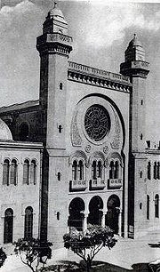
synagogue
was abandoned that year.
 According to some scholars, Jews have been present in Algeria at least since late Roman
times, probably since the destruction of the First Temple nearly 2600 years ago in 586 BCE. Early descriptions of the Rustamid
capital Tahert
note that Jews were to be found there, as in any other major Muslim city, and some centuries later the Geniza Letters (found in Cairo
) mention many Algerian Jewish families.
However,in the seventh century the Jewish population was largely augmented by Spanish Jewish immigrants, who, fleeing from the persecutions of the Visigoth
ic king Sisebut² and his successors, escaped to the Maghreb and settled in the Byzantine
cities and laterly following the Reconquista
, when the Spanish Inquisition
expelled the Jews from Spain
from 1391 to 1492 http://www.sephardicstudies.org/decree.html. Together with the Morisco
s, they thronged to the ports of North Africa, forming large communities in places such as Oran
and Algiers
. Some Jews in Oran
preserved their Ladino language – a uniquely conservative dialect of Spanish – until the 19th century. Jewish merchants did very well financially in late Ottoman
Algiers
; the French attack on Algeria was initially "provoked" by the Dey
's demands that the French government pay its large outstanding wheat debts to two Jewish merchants, Bacri and Busnach.
In the 17th century, Granas (i.e Jews from Livorno , Italy) started settling in Algeria. They were highly involved in commercial tradings and exchanges between Europe
and the Ottoman Empire
, renforcing the rows of the Jewish community.
After the conquest in 1830, the French government rapidly restructured the Ottoman millet
system. At the time, the French government distinguished French citizens (who had national voting rights, were subject to French laws, and, for the males, had to go to military service
) from Jewish and Muslim "indigenous" people, who each kept their own laws and courts. By 1841, the Jewish courts (beth din
) had been abolished, and all cases involving Jews were instead heard by French courts. In 1845, the communal structure was thoroughly reorganized, and French Jews were appointed as chief rabbi
s for each region, with the duty "to inculcate unconditional obedience to the laws, loyalty to France, and the obligation to defend it."http://arabworld.nitle.org/texts.php?module_id=6&reading_id=54&sequence=3# In 1865, liberal conditions were laid down so that Jewish and Muslim "indigenous" people could become French citizens if they requested it. This facility was, however, not much used — since it meant renouncing certain traditional mores and thus was perceived as a kind of apostasy
.
In 1870, the French government granted the Jews French citizenship, under the décrets Crémieux of 1870 . (For this reason, they are sometimes lumped together with the pieds-noirs.) This decision was due largely to pressures from prominent members of the French Jewish community, which considered the North African Jews to be "backward" and wanted to forcefully bring them into modernity. Within a generation, most Algerian Jews had come to speak French rather than Arabic or Ladino, and embraced many aspects of French culture. After WW2, and the subsequent struggle for independence, the great majority of Algeria's 140,000 Jews left the country for France
together with the pied-noir
s.
 The Algerian nationality law
of newly independent Algeria, promulgated in 1963, granted citizenship only to Muslims, requiring that only those individuals whose fathers and paternal grandfathers had Muslim personal status could become citizens of the new state. All Jewish and Christian residents were driven into exile, even though the Jewish community was considered indigenous to Algeria, as it had been in Algeria longer even before Islam and could trace its presence to Roman times, around 2600 years ago starting in the year 586 BCE.
, Constantine, and Oran – had Jewish populations of over 7%, as did many smaller cities such as Ghardaia
and Setif
; one smaller town, Messad
, had a Jewish majority. The Jews who remained after the Revolution lived mainly in Algiers, with some families in Blida
, Constantine
, and Oran
.
Algeria
Algeria , officially the People's Democratic Republic of Algeria , also formally referred to as the Democratic and Popular Republic of Algeria, is a country in the Maghreb region of Northwest Africa with Algiers as its capital.In terms of land area, it is the largest country in Africa and the Arab...
, which goes back to the 1st centuries CE. In the 14th century, many Spanish Jews moved to Algeria. Among them were respected Jewish scholars, including Isaac ben Sheshet
Isaac ben Sheshet
Isaac ben Sheshet Perfet was a Spanish Talmudic authority, also known by his acronym, Rivash . He was born at Valencia and settled early in life at Barcelona, where he studied under Perez ha-Kohen, under Hasdai ben Judah, and especially under R...
(Ribash) and Simeon ben Zemah Duran
Simeon ben Zemah Duran
Simeon ben Zemah Duran , known as Rashbatz or Tashbatz was a Rabbinical authority, student of philosophy, astronomy, mathematics, and especially of medicine, which he practised for a number of years at Palma...
(Rashbatz).
Following Algerian independence in 1962, most of Algeria's 140,000 Jews, having been granted French citizenship in 1870, left with the pied-noir
Pied-noir
Pied-Noir , plural Pieds-Noirs, pronounced , is a term referring to French citizens of various origins who lived in French Algeria before independence....
s for France
France
The French Republic , The French Republic , The French Republic , (commonly known as France , is a unitary semi-presidential republic in Western Europe with several overseas territories and islands located on other continents and in the Indian, Pacific, and Atlantic oceans. Metropolitan France...
. The 10,000 or so who remained largely resided in Algiers
Algiers
' is the capital and largest city of Algeria. According to the 1998 census, the population of the city proper was 1,519,570 and that of the urban agglomeration was 2,135,630. In 2009, the population was about 3,500,000...
, and to a lesser extent Blida
Blida
Blida is a city in Algeria. It is the capital of Blida Province, and it is located about 45 km south-west of Algiers, the national capital. The name Blida, i.e...
, Constantine
Constantine, Algeria
Constantine is the capital of Constantine Province in north-eastern Algeria. It was the capital of the same-named French département until 1962. Slightly inland, it is about 80 kilometres from the Mediterranean coast, on the banks of Rhumel river...
, and Oran
Oran
Oran is a major city on the northwestern Mediterranean coast of Algeria, and the second largest city of the country.It is the capital of the Oran Province . The city has a population of 759,645 , while the metropolitan area has a population of approximately 1,500,000, making it the second largest...
. In the 1990s, the trials of civil war
Algerian Civil War
The Algerian Civil War was an armed conflict between the Algerian government and various Islamist rebel groups which began in 1991. It is estimated to have cost between 150,000 and 200,000 lives, in a population of about 25,010,000 in 1990 and 31,193,917 in 2000.More than 70 journalists were...
led most of the thousand-odd remaining Jews to emigrate. A decisive event was the rebel Armed Islamic Group
Armed Islamic Group
The Armed Islamic Group is an Islamist organisation that wants to overthrow the Algerian government and replace it with an Islamic state...
's 1994 declaration of war on all non-Muslims in the country, and the Algiers
Algiers
' is the capital and largest city of Algeria. According to the 1998 census, the population of the city proper was 1,519,570 and that of the urban agglomeration was 2,135,630. In 2009, the population was about 3,500,000...
synagogue
Synagogue
A synagogue is a Jewish house of prayer. This use of the Greek term synagogue originates in the Septuagint where it sometimes translates the Hebrew word for assembly, kahal...
was abandoned that year.
History
Ancient Rome
Ancient Rome was a thriving civilization that grew on the Italian Peninsula as early as the 8th century BC. Located along the Mediterranean Sea and centered on the city of Rome, it expanded to one of the largest empires in the ancient world....
times, probably since the destruction of the First Temple nearly 2600 years ago in 586 BCE. Early descriptions of the Rustamid
Rustamid
The Rustamid dynasty of Ibāḍī Kharijite imām that ruled the central Maghreb as a Muslim theocracy for a century and a half from their capital Tahert in present Algeria until the Ismailite Fatimid Caliphs destroyed it. The dynasty had a Persian origin...
capital Tahert
Tahert
Tiaret is a large town in the central Algeria, that gives its name to the wider farming region of 'Wilaya de Tiaret' province. Both the town and region lie south-west of the capital of Algiers in the western region of the central highlands, in the Tell Atlas, and about from the Mediterranean coast...
note that Jews were to be found there, as in any other major Muslim city, and some centuries later the Geniza Letters (found in Cairo
Cairo
Cairo , is the capital of Egypt and the largest city in the Arab world and Africa, and the 16th largest metropolitan area in the world. Nicknamed "The City of a Thousand Minarets" for its preponderance of Islamic architecture, Cairo has long been a centre of the region's political and cultural life...
) mention many Algerian Jewish families.
However,in the seventh century the Jewish population was largely augmented by Spanish Jewish immigrants, who, fleeing from the persecutions of the Visigoth
Visigoth
The Visigoths were one of two main branches of the Goths, the Ostrogoths being the other. These tribes were among the Germans who spread through the late Roman Empire during the Migration Period...
ic king Sisebut² and his successors, escaped to the Maghreb and settled in the Byzantine
Byzantine Empire
The Byzantine Empire was the Eastern Roman Empire during the periods of Late Antiquity and the Middle Ages, centred on the capital of Constantinople. Known simply as the Roman Empire or Romania to its inhabitants and neighbours, the Empire was the direct continuation of the Ancient Roman State...
cities and laterly following the Reconquista
Reconquista
The Reconquista was a period of almost 800 years in the Middle Ages during which several Christian kingdoms succeeded in retaking the Muslim-controlled areas of the Iberian Peninsula broadly known as Al-Andalus...
, when the Spanish Inquisition
Spanish Inquisition
The Tribunal of the Holy Office of the Inquisition , commonly known as the Spanish Inquisition , was a tribunal established in 1480 by Catholic Monarchs Ferdinand II of Aragon and Isabella I of Castile. It was intended to maintain Catholic orthodoxy in their kingdoms, and to replace the Medieval...
expelled the Jews from Spain
Spain
Spain , officially the Kingdom of Spain languages]] under the European Charter for Regional or Minority Languages. In each of these, Spain's official name is as follows:;;;;;;), is a country and member state of the European Union located in southwestern Europe on the Iberian Peninsula...
from 1391 to 1492 http://www.sephardicstudies.org/decree.html. Together with the Morisco
Morisco
Moriscos or Mouriscos , meaning "Moorish", were the converted Christian inhabitants of Spain and Portugal of Muslim heritage. Over time the term was used in a pejorative sense applied to those nominal Catholics who were suspected of secretly practicing Islam.-Demographics:By the beginning of the...
s, they thronged to the ports of North Africa, forming large communities in places such as Oran
Oran
Oran is a major city on the northwestern Mediterranean coast of Algeria, and the second largest city of the country.It is the capital of the Oran Province . The city has a population of 759,645 , while the metropolitan area has a population of approximately 1,500,000, making it the second largest...
and Algiers
Algiers
' is the capital and largest city of Algeria. According to the 1998 census, the population of the city proper was 1,519,570 and that of the urban agglomeration was 2,135,630. In 2009, the population was about 3,500,000...
. Some Jews in Oran
Oran
Oran is a major city on the northwestern Mediterranean coast of Algeria, and the second largest city of the country.It is the capital of the Oran Province . The city has a population of 759,645 , while the metropolitan area has a population of approximately 1,500,000, making it the second largest...
preserved their Ladino language – a uniquely conservative dialect of Spanish – until the 19th century. Jewish merchants did very well financially in late Ottoman
Ottoman Empire
The Ottoman EmpireIt was usually referred to as the "Ottoman Empire", the "Turkish Empire", the "Ottoman Caliphate" or more commonly "Turkey" by its contemporaries...
Algiers
Algiers
' is the capital and largest city of Algeria. According to the 1998 census, the population of the city proper was 1,519,570 and that of the urban agglomeration was 2,135,630. In 2009, the population was about 3,500,000...
; the French attack on Algeria was initially "provoked" by the Dey
Dey
Dey was the title given to the rulers of the Regency of Algiers and Tripoli under the Ottoman Empire from 1671 onwards...
's demands that the French government pay its large outstanding wheat debts to two Jewish merchants, Bacri and Busnach.
In the 17th century, Granas (i.e Jews from Livorno , Italy) started settling in Algeria. They were highly involved in commercial tradings and exchanges between Europe
Europe
Europe is, by convention, one of the world's seven continents. Comprising the westernmost peninsula of Eurasia, Europe is generally 'divided' from Asia to its east by the watershed divides of the Ural and Caucasus Mountains, the Ural River, the Caspian and Black Seas, and the waterways connecting...
and the Ottoman Empire
Ottoman Empire
The Ottoman EmpireIt was usually referred to as the "Ottoman Empire", the "Turkish Empire", the "Ottoman Caliphate" or more commonly "Turkey" by its contemporaries...
, renforcing the rows of the Jewish community.
After the conquest in 1830, the French government rapidly restructured the Ottoman millet
Millet (Ottoman Empire)
Millet is a term for the confessional communities in the Ottoman Empire. It refers to the separate legal courts pertaining to "personal law" under which communities were allowed to rule themselves under their own system...
system. At the time, the French government distinguished French citizens (who had national voting rights, were subject to French laws, and, for the males, had to go to military service
Conscription
Conscription is the compulsory enlistment of people in some sort of national service, most often military service. Conscription dates back to antiquity and continues in some countries to the present day under various names...
) from Jewish and Muslim "indigenous" people, who each kept their own laws and courts. By 1841, the Jewish courts (beth din
Beth din
A beth din, bet din, beit din or beis din is a rabbinical court of Judaism. In ancient times, it was the building block of the legal system in the Biblical Land of Israel...
) had been abolished, and all cases involving Jews were instead heard by French courts. In 1845, the communal structure was thoroughly reorganized, and French Jews were appointed as chief rabbi
Rabbi
In Judaism, a rabbi is a teacher of Torah. This title derives from the Hebrew word רבי , meaning "My Master" , which is the way a student would address a master of Torah...
s for each region, with the duty "to inculcate unconditional obedience to the laws, loyalty to France, and the obligation to defend it."http://arabworld.nitle.org/texts.php?module_id=6&reading_id=54&sequence=3# In 1865, liberal conditions were laid down so that Jewish and Muslim "indigenous" people could become French citizens if they requested it. This facility was, however, not much used — since it meant renouncing certain traditional mores and thus was perceived as a kind of apostasy
Apostasy
Apostasy , 'a defection or revolt', from ἀπό, apo, 'away, apart', στάσις, stasis, 'stand, 'standing') is the formal disaffiliation from or abandonment or renunciation of a religion by a person. One who commits apostasy is known as an apostate. These terms have a pejorative implication in everyday...
.
In 1870, the French government granted the Jews French citizenship, under the décrets Crémieux of 1870 . (For this reason, they are sometimes lumped together with the pieds-noirs.) This decision was due largely to pressures from prominent members of the French Jewish community, which considered the North African Jews to be "backward" and wanted to forcefully bring them into modernity. Within a generation, most Algerian Jews had come to speak French rather than Arabic or Ladino, and embraced many aspects of French culture. After WW2, and the subsequent struggle for independence, the great majority of Algeria's 140,000 Jews left the country for France
France
The French Republic , The French Republic , The French Republic , (commonly known as France , is a unitary semi-presidential republic in Western Europe with several overseas territories and islands located on other continents and in the Indian, Pacific, and Atlantic oceans. Metropolitan France...
together with the pied-noir
Pied-noir
Pied-Noir , plural Pieds-Noirs, pronounced , is a term referring to French citizens of various origins who lived in French Algeria before independence....
s.
The Shoah in Algeria, Under the pro-Nazi Vichy regime
Exodus from Algeria
Algerian nationality law
Algerian nationality law, promulgated in 1963, granted citizenship only to Muslims, requiring that only those individuals whose fathers and paternal grandfathers had Muslim personal status could become citizens of the new state.-Further reading:...
of newly independent Algeria, promulgated in 1963, granted citizenship only to Muslims, requiring that only those individuals whose fathers and paternal grandfathers had Muslim personal status could become citizens of the new state. All Jewish and Christian residents were driven into exile, even though the Jewish community was considered indigenous to Algeria, as it had been in Algeria longer even before Islam and could trace its presence to Roman times, around 2600 years ago starting in the year 586 BCE.
Demography
In 1931, whereas Jews made up less than 2% of Algeria's population, the largest cities of Algeria – AlgiersAlgiers
' is the capital and largest city of Algeria. According to the 1998 census, the population of the city proper was 1,519,570 and that of the urban agglomeration was 2,135,630. In 2009, the population was about 3,500,000...
, Constantine, and Oran – had Jewish populations of over 7%, as did many smaller cities such as Ghardaia
Ghardaïa
Ghardaïa is the capital city of Ghardaïa Province, Algeria. The commune of Ghardaïa has a population of 104,645, with 82,500 in the main city according to 2005 estimates. It is located in northern-central Algeria in the Sahara Desert and lies along the left bank of the Wadi Mzab...
and Setif
Sétif
Sétif |Colonia]]) is a town in northeastern Algeria. It is the capital of Sétif Province and it has a population of 239,195 inhabitants as of the 1998 census. Setif is located to the east of Algiers and is the second most important Wilaya after the country's capital. It is 1,096 meters above sea...
; one smaller town, Messad
Messad
Messad is a town in Algeria. It is about 180 miles south of Algiers. During the Roman period it was known as Castellum Dimmidi after the Romans under emperor Septimius Severus seized the settlement...
, had a Jewish majority. The Jews who remained after the Revolution lived mainly in Algiers, with some families in Blida
Blida
Blida is a city in Algeria. It is the capital of Blida Province, and it is located about 45 km south-west of Algiers, the national capital. The name Blida, i.e...
, Constantine
Constantine, Algeria
Constantine is the capital of Constantine Province in north-eastern Algeria. It was the capital of the same-named French département until 1962. Slightly inland, it is about 80 kilometres from the Mediterranean coast, on the banks of Rhumel river...
, and Oran
Oran
Oran is a major city on the northwestern Mediterranean coast of Algeria, and the second largest city of the country.It is the capital of the Oran Province . The city has a population of 759,645 , while the metropolitan area has a population of approximately 1,500,000, making it the second largest...
.
Traditional dress
- A contemporary [in 1906] Jewess of Algiers wears on her head a "takrita" (handkerchief), is dressed in a "bedenor" (gown with a bodice trimmed with lace) and a striped vest with long sleeves coming to the waist. The "mosse" (girdle) is of silk. The native Algerian Jew wears a "ṭarbush" or oblong turban with silken tassel, a "ṣadriyyah" or vest with large sleeves, and "sarwal" or pantaloons fastened by a "ḥizam" (girdle), all being covered by a mantle, a burnus, and a large silk handkerchief, the tassels of which hang down to his feet. At an earlier stage the Algerian Jewess wore a tall cone-shaped hat resembling those used in England in the fifteenth century. (Jewish Encyclopaedia Costume":
Notable Algerian Jews
- Bernard-Henri LévyBernard-Henri LévyBernard-Henri Lévy is a French public intellectual, philosopher and journalist. Often referred to today, in France, simply as BHL, he was one of the leaders of the "Nouveaux Philosophes" movement in 1976.-Early life:...
, a journalist - Jean-Pierre BacriJean-Pierre BacriJean-Pierre Bacri is a French actor and screenwriter who frequently works in collaboration with Agnès Jaoui.-Life:One of his earliest film appearances was Subway...
, an actor - Maurice BenayounMaurice BenayounMaurice Benayoun is a French pioneer new-media artist and theorist based in Paris. His work employs various media, including video, immersive virtual reality, the Web, wireless technology, performance, large-scale urban art installations and interactive exhibitions.-Biography:Born in Mascara,...
, an artist - Michel BenitaMichel Benitaright|thumb|Michel Benita at a jazz festival in 2008Michel Benita is a double bass player, prominent in jazz music since 1980's. He moved to Paris in 1981 and became one of the major discoveries in European jazz scene. Among others, he played with Aldo Romano, Marc Ducret, Martial Solal, Lee...
, a double bass player - José AboulkerJosé AboulkerJosé Aboulker was a member of the anti-Nazi resistance who co-founded a resistance network in Algiers in World War II and emerged as one of the main leaders of the resistance movement in North Africa...
, member of the anti-Nazi resistance - Franck AmsallemFranck AmsallemFranck Amsallem is a French jazz pianist, composer and also singer. He was born in 1961 in Oran, then in French Algeria, but grew up in Nice, France.He started learning the piano at age 7 and also took up the classical saxophone at the local conservatory...
, jazz pianist and composer - Yvan AttalYvan AttalYvan Attal is an Israeli-born French actor and director.-Background:Born in Tel-Aviv to French-Algerian Jewish parents, he grew up in the outskirts of Paris. His acting debut was in Éric Rochant's Un monde sans pitié , which earned him a César Award for Most Promising Actor...
, film director, actor (Algerian parents) - Jacques AttaliJacques AttaliJacques Attali is a French economist, writer and senior civil servant.Former adviser to President François Mitterrand and first president of the European Bank for Reconstruction and Development, he founded the non-profit organization PlaNet Finance and was nominated President of the Commission for...
, economist, writer - Baruj BenacerrafBaruj BenacerrafBaruj Benacerraf was a Venezuelan-born American immunologist, who shared the 1980 Nobel Prize in Physiology or Medicine for the "discovery of the major histocompatibility complex genes which encode cell surface protein molecules important for the immune system's distinction between self and...
, immunologist, Nobel prize (1980) (Algerian mother) - Paul BenacerrafPaul BenacerrafPaul Joseph Salomon Benacerraf is an American philosopher working in the field of the philosophy of mathematics who has been teaching at Princeton University since he joined the faculty in 1960. He was appointed Stuart Professor of Philosophy in 1974, and recently retired as the James S....
, philosopher (Algerian mother) - Jean BenguiguiJean BenguiguiJean Benguigui is a French actor of the screen, stage and on television, he born April 8 1944 in Oran. He is of Jewish descent. In 2006 and 2007 he played the role of impresario Cartoni in a new adaptation of the operetta Le Chanteur de Mexico at the Theatre du Chatelet.-Filmography:* La croisière...
, actor - Richard BerryRichard Berry (actor)Richard Berry is a French actor, film director and screenwriter. He has appeared in nearly 100 films since 1972. He starred in The Violin Player, which was entered into the 1994 Cannes Film Festival.-Selected filmography:...
, actor - Lili BonicheLili BonicheLili Boniche , born to a Sephardic Jewish family in the Kasbah area of Algiers, was a singer of Andalusian-Arab music. He died in Paris...
, musician - Patrick BruelPatrick BruelPatrick Bruel is a French singer, actor, and professional poker player of Algerian Jewish descent.-Biography:...
, singer, actor - Alain ChabatAlain ChabatAlain Chabat is a French actor and director who appeared in La Cité de la peur, French Twist, The Taste of Others and The Science of Sleep.- Life and career :Chabat was born in Oran, French Algeria. He is Jewish....
, actor - André ChouraquiAndré ChouraquiNathan André Chouraqui was a French lawyer, writer, scholar and politician.Chouraqui was born in Aïn Témouchent, Algeria...
, writer - Élie ChouraquiÉlie ChouraquiÉlie Chouraqui is a French film director and scriptwriter of Jewish origin.-Filmography:*1978: Mon premier amour*1980: Une page d'amour*1982: Qu'est-ce qui fait courir David?*1985: Paroles et musique...
, French film director and scriptwriter - Hélène CixousHélène CixousHélène Cixous is a professor, French feminist writer, poet, playwright, philosopher, literary critic and rhetorician. She holds honorary degrees from Queen's University and the University of Alberta in Canada; University College Dublin in Ireland; the University of York and University College...
, feminist writer - Robert CohenRobert CohenRobert Cohen is a Canadian comedy writer. He was raised in Calgary, Alberta and has written for The Simpsons , The Wonder Years, The Ben Stiller Show, MADtv, Just Shoot Me!, Father of the Pride, and American Dad!...
, boxer: World Bantamweight Champion - Annie Cohen-SolalAnnie Cohen-SolalAnnie Cohen-Solal is a French academic, writer, historian, and biographer. Born in pre-independence Algeria, she is part of the Jewish diaspora that left that country for France during the Algerian War of Independence. Her most famous work is a biography of Jean-Paul Sartre, Sartre: A Life, which...
, academic and biographer of Jean-Paul SartreJean-Paul SartreJean-Paul Charles Aymard Sartre was a French existentialist philosopher, playwright, novelist, screenwriter, political activist, biographer, and literary critic. He was one of the leading figures in 20th century French philosophy, particularly Marxism, and was one of the key figures in literary... - Claude Cohen-TannoudjiClaude Cohen-TannoudjiClaude Cohen-Tannoudji is a French physicist and Nobel Laureate. He shared the 1997 Nobel Prize in Physics with Steven Chu and William Daniel Phillips for research in methods of laser cooling and trapping atoms...
, physicist, Nobel prize (1997) - Jean-François CopéJean-François CopéJean-François Copé , is a French politician. He is currently Mayor of Meaux, Deputy for the 6th constituency of Seine-et-Marne, and acts as President of the Union for a Popular Movement Group in the French National Assembly...
, (Algerian mother), President of the Union for a Popular Movement (UMP) Group in the French National Assembly - Cy CurninCy CurninCy Curnin is a singer/songwriter and musician. He is the lead vocalist for the new wave music group, The Fixx. The band became famous with the song "One Thing Leads to Another" in 1983, and remained popular in the United States throughout the 1980s...
, lead singer of The FixxThe FixxThe Fixx is an English rock band formed in London in 1979. Their hits include "One Thing Leads to Another," "Red Skies," "Stand or Fall," "Saved by Zero," "Sign of Fire," "Are We Ourselves?," "Secret Separation," "Driven Out," "How Much Is Enough?," and "Deeper and Deeper," which was featured on...
(Jewish Algerian mother, non-Jewish father) - Gérard DarmonGérard DarmonGérard Darmon is a French movie actor and singer.Second husband to Mathilda May.He has three children: Virginie and the last two by Mathilda May, daughter Sarah and son Jules...
, actor - Jacques DerridaJacques DerridaJacques Derrida was a French philosopher, born in French Algeria. He developed the critical theory known as deconstruction and his work has been labeled as post-structuralism and associated with postmodern philosophy...
, deconstructionist philosopher - Jean-Pierre ElkabbachJean-Pierre Elkabbach-Biography:Elkabbach was born in Oran in 1937, then the prefecture of the département Oran in French Algeria. He began his journalistic career in 1960 as a radio correspondent in Algiers, but having taken part in the strikes of May 1968 he was sidelined and sent to Toulouse. Elkabbach would later...
, journalist - Alphonse HalimiAlphonse HalimiAlphonse Halimi was a French boxer. He was nicknamed "la Petite Terreur."Time wrote of him: "Alphonse went to work with a street fighter's will. A grown-up guttersnipe from the back alleys of Algeria...
, boxer: World Bantamweight Champion - Roger HaninRoger HaninRoger Hanin is a French actor , best known for playing the title role in the 1989-2006 TV crime series, Navarro.-Personal life:...
, film actor & director - Bernard-Henri LévyBernard-Henri LévyBernard-Henri Lévy is a French public intellectual, philosopher and journalist. Often referred to today, in France, simply as BHL, he was one of the leaders of the "Nouveaux Philosophes" movement in 1976.-Early life:...
, philosopher - Claude Lelouch, film director (Algerian father)
- Enrico MaciasEnrico MaciasGaston Ghrenassia, known by his stage name Enrico Macias, is an Algerian French Pied noir singer and musician...
, singer - Reinette L'OranaiseReinette L'OranaiseReinette l'Oranaise was an Algerian singer, who helped preserve Arab-Andalus music, as well as introducing the genre to European audiences....
, singer - Martial SolalMartial SolalMartial Solal is a French jazz pianist and composer, who is probably most widely known for the music he wrote for Jean-Luc Godard's debut feature film À bout de souffle .-Biography:...
, jazz pianist and composer - Benjamin StoraBenjamin StoraBenjamin Stora is a French historian, expert on North Africa, who is widely considered one of the world's leading authorities on Algerian history. He was born in a Jewish family in Constantine, then in French Algeria, which left the country following its War of Independence in 1962. Stora holds...
, historian - Patrick TimsitPatrick TimsitPatrick Timsit is a French comedian, writer and film director. He has been nominated for 4 César Awards, three times as an actor and once as a writer...
, humorist, actor - Eric ZemmourÉric ZemmourÉric Zemmour is a French conservative political journalist and writer. He has been a columnist for the daily newsparer Le Figaro and a panelist on France 2 talk-show On n'est pas couché and on I-Télé current affairs show Ça se dispute...
, journalist - Claude ZidiClaude ZidiClaude Zidi is a French film director and screenwriter who is noted for his mainstream burlesque comedies. Born in Paris, he started as a cameraman and then cinematographer, and made his directorial and screenwriting debut in 1971...
, film director - Marlène JobertMarlène JobertMarlène Jobert is a French actress, singer and author.Jobert was born in Algiers, Algeria , the daughter of Andrée and a father who flew for the French Air Force. She is a Pied-Noir of Jewish heritage. She came to Metropolitan France when aged 8...
, an actress - Dany Ayalon , a politician
- Alon AbutbulAlon AbutbulAlon Abutbul is an Israeli actor.In 2005, he was voted the 158th-greatest Israeli of all time, in a poll by the Israeli news website Ynet to determine whom the general public considered the 200 Greatest Israelis.-Biography:...
, an actor
External links
- Resources>Jewish communities>Magreb The Jewish History Resource Center, Project of the Dinur Center for Research in Jewish History, The Hebrew University of Jerusalem
- Zlabia.com French site for Jews of Algerian origins
- Rabbis of Algeria
- Algeria Sephardim Deported from France or Executed in France during WWII (PDF)
- The Jewish Community of Oran, Algiers
- Documents from Old Jewish Algeria
- The Jewish Population of Algeria in 1931