

History of the Internet

Encyclopedia
The history of the Internet starts in the 1950s and 1960s with the development of computers. This began with point-to-point communication between mainframe computers and terminals
, expanded to point-to-point connections between computers and then early research into packet switching
. Packet switched networks such as ARPANET
, Mark I
at NPL in the UK, CYCLADES
, Merit Network
, Tymnet
, and Telenet
, were developed in the late 1960s and early 1970s using a variety of protocols
. The ARPANET in particular led to the development of protocols for internetworking
, where multiple separate networks could be joined together into a network of networks.
In 1982 the Internet Protocol Suite
(TCP/IP) was standardized and the concept of a world-wide network of fully interconnected TCP/IP networks called the Internet was introduced. Access to the ARPANET was expanded in 1981 when the National Science Foundation
(NSF) developed the Computer Science Network
(CSNET) and again in 1986 when NSFNET
provided access to supercomputer
sites in the United States from research and education organizations. Commercial internet service providers (ISPs) began to emerge in the late 1980s and 1990s. The ARPANET was decommissioned in 1990. The Internet was commercialized in 1995 when NSFNET was decommissioned, removing the last restrictions on the use of the Internet to carry commercial traffic.
Since the mid-1990s the Internet has had a drastic impact on culture and commerce, including the rise of near instant communication by electronic mail
, instant messaging
, Voice over Internet Protocol (VoIP) "phone calls", two-way interactive video calls, and the World Wide Web
with its discussion forums, blogs, social networking, and online shopping sites. The research and education community continues to develop and use advanced networks such as NSF's very high speed Backbone Network Service
(vBNS), Internet2
, and National LambdaRail
. Increasing amounts of data are transmitted at higher and higher speeds over fiber optic networks operating at 1-Gbit/s, 10-Gbit/s, or more. The Internet continues to grow, driven by ever greater amounts of online information and knowledge, commerce, entertainment and social networking.
It is estimated that in 1993 the Internet carried only 1% of the information flowing through two-way telecommunication
, by 2000 this figure had grown to 51%, and by 2007 more than 97% of all telecommunicated information was carried over the Internet.
– transmitting data between two different places, connected via some kind of electromagnetic medium, such as radio or an electrical wire – predates the introduction of the first computers. Such communication systems were typically limited to point to point communication between two end devices. Telegraph systems
and telex machines can be considered early precursors of this kind of communication.
Early computers used the technology available at the time to allow communication between the central processing unit and remote terminals. As the technology evolved, new systems were devised to allow communication over longer distances (for terminals) or with higher speed (for interconnection of local devices) that were necessary for the mainframe computer
model. Using these technologies it was possible to exchange data (such as files) between remote computers. However, the point to point communication model was limited, as it did not allow for direct communication between any two arbitrary systems; a physical link was necessary. The technology was also deemed as inherently unsafe for strategic and military use, because there were no alternative paths for the communication in case of an enemy attack.
, articulated the ideas in his January 1960 paper, Man-Computer Symbiosis .
In August 1962, Licklider and Welden Clark published the paper "On-Line Man Computer Communication", one of the first descriptions of a networked future.
In October 1962, Licklider was hired by Jack Ruina
as Director of the newly established Information Processing Techniques Office (IPTO) within DARPA, with a mandate to interconnect the United States Department of Defense
's main computers at Cheyenne Mountain, the Pentagon, and SAC HQ. There he formed an informal group within DARPA to further computer research. He began by writing memos describing a distributed network to the IPTO staff, whom he called "Members and Affiliates of the Intergalactic Computer Network". As part of the information processing office's role, three network terminals had been installed: one for System Development Corporation
in Santa Monica
, one for Project Genie
at the University of California, Berkeley
and one for the Compatible Time-Sharing System project at the Massachusetts Institute of Technology
(MIT). Licklider's identified need for inter-networking would be made obvious by the apparent waste of resources this caused.
Although he left the IPTO in 1964, five years before the ARPANET went live, it was his vision of universal networking that provided the impetus that led his successors such as Lawrence Roberts
and Robert Taylor
to further the ARPANET development. Licklider later returned to lead the IPTO in 1973 for two years.
(RAND
Corporation), produced a study of survivable networks for the US military. Information transmitted across Baran's network would be divided into what he called 'message-blocks'. Independently, Donald Davies
(National Physical Laboratory, UK
), proposed and developed a similar network based on what he called packet-switching, the term that would ultimately be adopted. Leonard Kleinrock
(MIT) developed mathematical theory behind this technology. Packet-switching provides better bandwidth utilization and response times than the traditional circuit-switching technology used for telephony, particularly on resource-limited interconnection links.
Packet switching is a rapid store-and-forward networking design that divides messages up into arbitrary packets, with routing decisions made per-packet. Early networks used message switched systems
that required rigid routing structures prone to single point of failure
. This led Tommy Krash and Paul Baran's U.S. military funded research to focus on using message-blocks to include network redundancy, which in turn led to the widespread urban legend that the Internet was designed to resist nuclear attack.
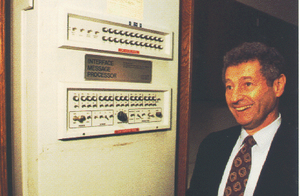 Promoted to the head of the information processing office at DARPA
, Robert Taylor intended to realize Licklider's ideas of an interconnected networking system. Bringing in Larry Roberts
from MIT, he initiated a project to build such a network. The first ARPANET link was established between the University of California, Los Angeles
and the Stanford Research Institute on 22:30 hours on October 29, 1969.
By December 5, 1969, a 4-node network was connected by adding the University of Utah
and the University of California, Santa Barbara
. Building on ideas developed in ALOHAnet
, the ARPANET grew rapidly. By 1981, the number of hosts had grown to 213, with a new host being added approximately every twenty days.
ARPANET became the technical core of what would become the Internet, and a primary tool in developing the technologies used. ARPANET development was centered around the Request for Comments
(RFC) process, still used today for proposing and distributing Internet Protocols and Systems. RFC 1, entitled "Host Software", was written by Steve Crocker
from the University of California, Los Angeles
, and published on April 7, 1969. These early years were documented in the 1972 film Computer Networks: The Heralds of Resource Sharing
.
International collaborations on ARPANET were sparse. For various political reasons, European developers were concerned with developing the X.25
networks. Notable exceptions were the Norwegian Seismic Array (NORSAR
) in 1972, followed in 1973 by Sweden with satellite links to the Tanum
Earth Station and Peter Kirstein's research group in the UK, initially at the Institute of Computer Science, London University and later at University College London
.
of the National Physical Laboratory (United Kingdom) proposed a national data network based on packet-switching. The proposal was not taken up nationally, but by 1970 he had designed and built the Mark I packet-switched network to meet the needs of the multidisciplinary laboratory and prove the technology under operational conditions. By 1976 12 computers and 75 terminal devices were attached and more were added until the network was replaced in 1986.
was formed in 1966 as the Michigan Educational Research Information Triad to explore computer networking between three of Michigan's public universities as a means to help the state's educational and economic development. With initial support from the State of Michigan and the National Science Foundation
(NSF), the packet-switched network was first demonstrated in December 1971 when an interactive host to host connection was made between the IBM
mainframe computer
systems at the University of Michigan
in Ann Arbor and Wayne State University
in Detroit. In October 1972 connections to the CDC
mainframe at Michigan State University
in East Lansing completed the triad. Over the next several years in addition to host to host interactive connections the network was enhanced to support terminal to host connections, host to host batch connections (remote job submission, remote printing, batch file transfer), interactive file transfer, gateways to the Tymnet
and Telenet
public data network
s, X.25
host attachments, gateways to X.25 data networks, Ethernet
attached hosts, and eventually TCP/IP and additional public universities in Michigan join the network. All of this set the stage for Merit's role in the NSFNET
project starting in the mid-1980s.
packet switching network was a French research network designed and directed by Louis Pouzin
. First demonstrated in 1973, it was developed to explore alternatives to the initial ARPANET design and to support network research generally. It was the first network to make the hosts responsible for the reliable delivery of data, rather than the network itself, using unreliable datagrams and associated end-to-end protocol mechanisms.
(ITU) in the form of X.25 and related standards. While using packet switching
, X.25 is built on the concept of virtual circuits emulating traditional telephone connections. In 1974, X.25 formed the basis for the SERCnet network between British academic and research sites, which later became JANET
. The initial ITU Standard on X.25 was approved in March 1976.
The British Post Office, Western Union International
and Tymnet
collaborated to create the first international packet switched network, referred to as the International Packet Switched Service
(IPSS), in 1978. This network grew from Europe and the US to cover Canada, Hong Kong and Australia by 1981. By the 1990s it provided a worldwide networking infrastructure.
Unlike ARPANET, X.25 was commonly available for business use. Telenet
offered its Telemail electronic mail service, which was also targeted to enterprise use rather than the general email system of the ARPANET.
The first public dial-in networks used asynchronous TTY
terminal protocols to reach a concentrator operated in the public network. Some networks, such as CompuServe
, used X.25 to multiplex the terminal sessions into their packet-switched backbones, while others, such as Tymnet
, used proprietary protocols. In 1979, CompuServe
became the first service to offer electronic mail
capabilities and technical support to personal computer users. The company broke new ground again in 1980 as the first to offer real-time chat
with its CB Simulator
. Other major dial-in networks were America Online (AOL) and Prodigy
that also provided communications, content, and entertainment features. Many bulletin board system
(BBS) networks also provided on-line access, such as FidoNet
which was popular amongst hobbyist computer users, many of them hackers and amateur radio operator
s.
, Tom Truscott
and Jim Ellis
, came up with the idea of using simple Bourne shell
scripts to transfer news and messages on a serial line UUCP
connection with nearby University of North Carolina at Chapel Hill
. Following public release of the software, the mesh of UUCP hosts forwarding on the Usenet news rapidly expanded. UUCPnet, as it would later be named, also created gateways and links between FidoNet
and dial-up BBS hosts. UUCP networks spread quickly due to the lower costs involved, ability to use existing leased lines, X.25
links or even ARPANET
connections, and the lack of strict use policies (commercial organizations who might provide bug fixes) compared to later networks like CSnet
and Bitnet
. All connects were local. By 1981 the number of UUCP hosts had grown to 550, nearly doubling to 940 in 1984. – Sublink Network
, operating since 1987 and officially founded in Italy in 1989, based its interconnectivity upon UUCP to redistribute mail and news groups messages throughout its Italian nodes (about 100 at the time) owned both by private individuals and small companies. Sublink Network
represented possibly one of the first examples of the internet technology becoming progress through popular diffusion.
recruited Vinton Cerf of Stanford University
to work with him on the problem. By 1973, they had soon worked out a fundamental reformulation, where the differences between network protocols were hidden by using a common internetwork protocol
, and instead of the network being responsible for reliability, as in the ARPANET, the hosts became responsible. Cerf credits Hubert Zimmerman
, Gerard LeLann and Louis Pouzin
(designer of the CYCLADES
network) with important work on this design.
The specification of the resulting protocol, RFC 675 – Specification of Internet Transmission Control Program, by Vinton Cerf, Yogen Dalal and Carl Sunshine, Network Working Group, December 1974, contains the first attested use of the term internet, as a shorthand for internetworking; later RFCs repeat this use, so the word started out as an adjective
rather than the noun
it is today.
With the role of the network reduced to the bare minimum, it became possible to join almost any networks together, no matter what their characteristics were, thereby solving Kahn's initial problem. DARPA agreed to fund development of prototype software, and after several years of work, the first somewhat crude demonstration of a gateway between the Packet Radio
network in the SF Bay area and the ARPANET was conducted. On November 22, 1977 a three network demonstration was conducted including the ARPANET, the Packet Radio Network and the Atlantic Packet Satellite network—all sponsored by DARPA. Stemming from the first specifications of TCP in 1974, TCP/IP emerged in mid-late 1978 in nearly final form. By 1981, the associated standards were published as RFCs 791, 792 and 793 and adopted for use. DARPA sponsored or encouraged the development of TCP/IP implementations for many operating systems and then scheduled a migration of all hosts on all of its packet networks to TCP/IP. On January 1, 1983, known as flag day
, TCP/IP protocols became the only approved protocol on the ARPANET, replacing the earlier NCP protocol
.
. In 1983, the U.S. military portion of the ARPANET was broken off as a separate network, the MILNET
. MILNET subsequently became the unclassified but military-only NIPRNET
, in parallel with the SECRET-level SIPRNET
and JWICS for TOP SECRET and above. NIPRNET does have controlled security gateways to the public Internet.
The networks based on the ARPANET were government funded and therefore restricted to noncommercial uses such as research; unrelated commercial use was strictly forbidden. This initially restricted connections to military sites and universities. During the 1980s, the connections expanded to more educational institutions, and even to a growing number of companies such as Digital Equipment Corporation
and Hewlett-Packard
, which were participating in research projects or providing services to those who were.
Several other branches of the U.S. government, the National Aeronautics and Space Agency (NASA), the National Science Foundation
(NSF), and the Department of Energy
(DOE) became heavily involved in Internet research and started development of a successor to ARPANET. In the mid 1980s, all three of these branches developed the first Wide Area Networks based on TCP/IP. NASA developed the NASA Science Network, NSF developed CSNET and DOE evolved the Energy Sciences Network or ESNet.
NASA developed the TCP/IP based NASA Science Network (NSN) in the mid 1980s, connecting space scientists to data and information stored anywhere in the world. In 1989, the DECnet
-based Space Physics Analysis Network (SPAN) and the TCP/IP-based NASA Science Network (NSN) were brought together at NASA Ames Research Center creating the first multiprotocol wide area network called the NASA Science Internet, or NSI. NSI was established to provide a totally integrated communications infrastructure to the NASA scientific community for the advancement of earth, space and life sciences. As a high-speed, multiprotocol, international network, NSI provided connectivity to over 20,000 scientists across all seven continents.
In 1981 NSF supported the development of the Computer Science Network
(CSNET). CSNET connected with ARPANET using TCP/IP, and ran TCP/IP over X.25
, but it also supported departments without sophisticated network connections, using automated dial-up mail exchange. Its experience with CSNET lead NSF to use TCP/IP when it created NSFNET
, a 56 kbit/s backbone
established in 1986, that connected the NSF supported supercomputing centers and regional research and education networks in the United States. However, use of NSFNET was not limited to supercomputer users and the 56 kbit/s network quickly became overloaded. NSFNET was upgraded to 1.5 Mbit/s in 1988. The existence of NSFNET and the creation of Federal Internet Exchange
s (FIXes) allowed the ARPANET to be decommissioned in 1990. NSFNET was expanded and upgraded to 45 Mbit/s in 1991, and was decommissioned in 1995 when it was replaced by backbones operated by several commercial Internet Service Providers.
in the late 1980s, that the term was used as the name of the network, Internet, being a large and global TCP/IP network.
As interest in widespread networking grew and new applications for it were developed, the Internet's technologies spread throughout the rest of the world. The network-agnostic approach in TCP/IP meant that it was easy to use any existing network infrastructure, such as the IPSS
X.25 network, to carry Internet traffic. In 1984, University College London replaced its transatlantic satellite links with TCP/IP over IPSS.
Many sites unable to link directly to the Internet started to create simple gateways to allow transfer of e-mail, at that time the most important application. Sites which only had intermittent connections used UUCP
or FidoNet
and relied on the gateways between these networks and the Internet. Some gateway services went beyond simple email peering, such as allowing access to FTP
sites via UUCP or e-mail.
Finally, the Internet's remaining centralized routing aspects were removed. The EGP
routing protocol was replaced by a new protocol, the Border Gateway Protocol
(BGP). This turned the Internet into a meshed topology and moved away from the centric architecture which ARPANET had emphasized. In 1994, Classless Inter-Domain Routing
was introduced to support better conservation of address space which allowed use of route aggregation
to decrease the size of routing table
s.
began installation and operation of TCP/IP to interconnect its major internal computer systems, workstations, PCs and an accelerator control system. CERN continued to operate a limited self-developed system CERNET internally and several incompatible (typically proprietary) network protocols externally. There was considerable resistance in Europe towards more widespread use of TCP/IP and the CERN TCP/IP intranets remained isolated from the Internet until 1989.
In 1988 Daniel Karrenberg, from Centrum Wiskunde & Informatica (CWI) in Amsterdam
, visited Ben Segal, CERN
's TCP/IP Coordinator, looking for advice about the transition of the European side of the UUCP Usenet network (much of which ran over X.25 links) over to TCP/IP. In 1987, Ben Segal had met with Len Bosack from the then still small company Cisco
about purchasing some TCP/IP routers for CERN, and was able to give Karrenberg advice and forward him on to Cisco for the appropriate hardware. This expanded the European portion of the Internet across the existing UUCP networks, and in 1989 CERN opened its first external TCP/IP connections. This coincided with the creation of Réseaux IP Européens (RIPE
), initially a group of IP network administrators who met regularly to carry out co-ordination work together. Later, in 1992, RIPE was formally registered as a cooperative
in Amsterdam.
At the same time as the rise of internetworking in Europe, ad hoc networking to ARPA and in-between Australian universities formed, based on various technologies such as X.25 and UUCP
Net. These were limited in their connection to the global networks, due to the cost of making individual international UUCP dial-up or X.25 connections. In 1989, Australian universities joined the push towards using IP protocols to unify their networking infrastructures. AARNet
was formed in 1989 by the Australian Vice-Chancellors' Committee
and provided a dedicated IP based network for Australia.
The Internet began to penetrate Asia in the late 1980s. Japan, which had built the UUCP-based network JUNET
in 1984, connected to NSFNET
in 1989. It hosted the annual meeting of the Internet Society
, INET'92, in Kobe
. Singapore
developed TECHNET in 1990, and Thailand
gained a global Internet connection between Chulalongkorn University and UUNET in 1992.
and 2400 baud modem UUCP links for international and internetwork computer communications.
In August 1995, InfoMail Uganda, Ltd., a privately held firm in Kampala now known as InfoCom, and NSN Network Services of Avon, Colorado, sold in 1997 and now known as Clear Channel Satellite, established Africa's first native TCP/IP high-speed satellite Internet services. The data connection was originally carried by a C-Band RSCC Russian satellite which connected InfoMail's Kampala offices directly to NSN's MAE-West point of presence using a private network from NSN's leased ground station in New Jersey. InfoCom's first satellite connection was just 64 kbit/s, serving a Sun host computer and twelve US Robotics dial-up modems.
In 1996 a USAID funded project, the Leland initiative, started work on developing full Internet connectivity for the continent. Guinea
, Mozambique, Madagascar
and Rwanda
gained satellite earth station
s in 1997, followed by Côte d'Ivoire
and Benin
in 1998.
Africa is building an Internet infrastructure. AfriNIC
, headquartered in Mauritius
, manages IP address allocation for the continent. As do the other Internet regions, there is an operational forum, the Internet Community of Operational Networking Specialists.
There are a wide range of programs both to provide high-performance transmission plant, and the western and southern coasts have undersea optical cable. High-speed cables join North Africa and the Horn of Africa to intercontinental cable systems. Undersea cable development is slower for East Africa; the original joint effort between New Partnership for Africa's Development (NEPAD) and the East Africa Submarine System (Eassy) has broken off and may become two efforts.
In 1991, the People's Republic of China saw its first TCP/IP college network, Tsinghua University
's TUNET. The PRC went on to make its first global Internet connection in 1994, between the Beijing Electro-Spectrometer Collaboration and Stanford University
's Linear Accelerator Center. However, China went on to implement its own digital divide by implementing a country-wide content filter
.
Net and the X.25 IPSS had no such restrictions, which would eventually see the official barring of UUCPNet use of ARPANET
and NSFNET
connections. Some UUCP links still remained connecting to these networks however, as administrators cast a blind eye to their operation.
During the late 1980s, the first Internet service provider
(ISP) companies were formed. Companies like PSINet
, UUNET
, Netcom
, and Portal Software
were formed to provide service to the regional research networks and provide alternate network access, UUCP-based email and Usenet News
to the public. The first commercial dialup ISP in the United States was The World
, opened in 1989.
In 1992, Congress passed the Scientific and Advanced-Technology Act, , which allowed NSF to support access by the research and education communities to computer networks which were not used exclusively for research and education purposes, thus permitting NSFNET to interconnect with commercial networks. This caused controversy within the research and education community, who were concerned commercial use of the network might lead to an Internet that was less responsive to their needs, and within the community of commercial network providers, who felt that government subsidies were giving an unfair advantage to some organizations.
By 1990, ARPANET had been overtaken and replaced by newer networking technologies and the project came to a close. New network service providers including PSINet
, Alternet
, CERFNet, ANS CO+RE, and many others were offering network access to commercial customers. NSFNET
was no longer the de facto backbone and exchange point for Internet. The Commercial Internet eXchange
(CIX), Metropolitan Area Exchanges
(MAEs), and later Network Access Point
s (NAPs) were becoming the primary interconnections between many networks. The final restrictions on carrying commercial traffic ended on April 30, 1995 when the National Science Foundation ended its sponsorship of the NSFNET Backbone Service and the service ended. NSF provided initial support for the NAPs and interim support to help the regional research and education networks transition to commercial ISPs. NSF also sponsored the very high speed Backbone Network Service
(vBNS) which continued to provide support for the supercomputing centers and research and education in the United States.
The IETF started in January 1986 as a quarterly meeting of U.S. government funded researchers. Non-government representatives were invited starting with the fourth IETF meeting in October 1986. The concept of Working Groups was introduced at the fifth IETF meeting in February 1987. The seventh IETF meeting in July 1987 was the first meeting with more than 100 attendees. In 1992, the Internet Society
, a professional membership society, was formed and IETF began to operate under it as an independent international standards body. The first IETF meeting outside of the United States was held in Amsterdam, The Netherlands, in July 1993. Today the IETF meets three times a year and attendnce is often about 1,300 people, but has been as high as 2,000 upon occasion. Typically one in three IETF meetings are held in Europe or Asia. The number of non-US attendees is roughly 50%, even at meetings held in the United States.
The IETF is unusual in that it exists as a collection of happenings, but is not a corporation and has no board of directors, no members, and no dues. The closest thing there is to being an IETF member is being on the IETF or a Working Group mailing list. IETF volunteers come from all over the world and from many different parts of the Internet community. The IETF works closely with and under the supervision of the Internet Engineering Steering Group
(IESG) and the Internet Architecture Board
(IAB). The Internet Research Task Force
(IRTF) and the Internet Research Steering Group
(IRSG), peer activities to the IETF and IESG under the general supervision of the IAB, focus on longer term research issues.
, the first RFC Editor.
RFCs cover a wide range of information from proposed standards, draft standards, full standards, best practices, experimental protocols, history, and other informational topics. RFCs can be written by individuals or informal groups of individuals, but many are the product of a more formal Working Group. Drafts are submitted to the IESG either by individuals or by the Working Group Chair. An RFC Editor, appointed by the IAB, separate from IANA, and working in conjunction with the IESG, receives drafts from the IESG and edits, formats, and publishes them. Once an RFC is published, it is never revised. If the standard it describes changes or its information becomes obsolete, the revised standard or updated information will be re-published as a new RFC that "obsoletes" the original.
, California. In 1972, management of these issues was given to the newly created Internet Assigned Numbers Authority
(IANA). In addition to his role as the RFC Editor, Jon Postel
worked as the manager of IANA until his death in 1998.
As the early ARPANET grew, hosts were referred to by names, and a HOSTS.TXT file would be distributed from SRI International
to each host on the network. As the network grew, this became cumbersome. A technical solution came in the form of the Domain Name System
, created by Paul Mockapetris
. The Defense Data Network—Network Information Center (DDN-NIC) at SRI handled all registration services, including the top-level domain
s (TLDs) of .mil
, .gov
, .edu
, .org
, .net
, .com
and .us
, root nameserver
administration and Internet number assignments under a United States Department of Defense
contract. In 1991, the Defense Information Systems Agency (DISA) awarded the administration and maintenance of DDN-NIC (managed by SRI up until this point) to Government Systems, Inc., who subcontracted it to the small private-sector Network Solutions, Inc.
Since at this point in history most of the growth on the Internet was coming from non-military sources, it was decided that the Department of Defense
would no longer fund registration services outside of the .mil TLD. In 1993 the U.S. National Science Foundation
, after a competitive bidding process in 1992, created the InterNIC
to manage the allocations of addresses and management of the address databases, and awarded the contract to three organizations. Registration Services would be provided by Network Solutions
; Directory and Database Services would be provided by AT&T
; and Information Services would be provided by General Atomics
.
In 1998 both IANA and InterNIC were reorganized under the control of ICANN
, a California non-profit corporation contracted by the United States Department of Commerce
to manage a number of Internet-related tasks. The role of operating the DNS system was privatized and opened up to competition, while the central management of name allocations would be awarded on a contract tender basis.
and organization has been of global importance to commerce. The organizations which hold control of certain technical aspects of the Internet are both the successors of the old ARPANET oversight and the current decision-makers in the day-to-day technical aspects of the network. While formally recognized as the administrators of the network, their roles and their decisions are subject to international scrutiny and objections which limit them. These objections have led to the ICANN removing themselves from relationships with first the University of Southern California
in 2000, and finally in September 2009, gaining autonomy from the US government by the ending of its longstanding agreements, although some contractual obligations with the Department of Commerce continue until at least 2011. The history of the Internet will now be played out in many ways as a consequence of the ICANN organization.
In the role of forming standard associated with the Internet, the IETF continues to serve as the ad-hoc standards group. They continue to issue Request for Comments
numbered sequentially from RFC 1 under the ARPANET project, for example, and the IETF precursor was the GADS Task Force
which was a group of US government-funded researchers in the 1980s. Many of the group's recent developments have been of global necessity, such as the i18n working groups who develop things like internationalized domain name
s. The Internet Society
has helped to fund the IETF, providing limited oversight.
was established on January 22, 2010 when astronaut T. J. Creamer posted the first unassisted update to his Twitter account from the International Space Station
, marking the extension of the Internet into space. (Astronauts at the ISS had used email and Twitter before, but these messages had been relayed to the ground through a NASA data link before being posted by a human proxy.) This personal Web access, which NASA calls the Crew Support LAN, uses the space station's high-speed Ku band
microwave link. To surf the Web, astronauts can use a station laptop computer to control a desktop computer on Earth, and they can talk to their families and friends on Earth using Voice over IP
equipment.
Communication with spacecraft beyond earth orbit has traditionally been over point-to-point links through the Deep Space Network
. Each such data link must be manually scheduled and configured. In the late 1990s NASA and Google began working on a new network protocol, Delay-tolerant networking (DTN) which automates this process, allows networking of spaceborn transmission nodes, and takes the fact into account that spacecraft can temporarily lose contact because they move behind the Moon or planets, or because space "weather" disrupts the connection. Under such conditions, DTN retransmits data packages instead of dropping them, as the standard TCP/IP internet protocol does. NASA conducted the first field test of what it calls the "deep space internet" in November 2008. This network technology is supposed to enable missions that involve multiple spacecraft where reliable inter-vessel communication might take precedence over vessel-to-earth downlinks.
of the Internet. However, it actually predates the Internet and was a crucial tool in creating it. Email started in 1965 as a way for multiple users of a time-sharing
mainframe computer
to communicate. Although the history is unclear, among the first systems to have such a facility were SDC
's Q32 and MIT's CTSS.
The ARPANET computer network made a large contribution to the evolution of e-mail. There is one report indicating experimental inter-system e-mail transfers on it shortly after ARPANET's creation. In 1971 Ray Tomlinson
created what was to become the standard Internet e-mail address format, using the @ sign to separate user names from host names.
A number of protocols were developed to deliver e-mail among groups of time-sharing computers over alternative transmission systems, such as UUCP
and IBM
's VNET
e-mail system. E-mail could be passed this way between a number of networks, including ARPANET
, BITNET
and NSFNET
, as well as to hosts connected directly to other sites via UUCP. See the history of SMTP protocol.
In addition, UUCP allowed the publication of text files that could be read by many others. The News software developed by Steve Daniel and Tom Truscott
in 1979 was used to distribute news and bulletin board-like messages. This quickly grew into discussion groups, known as newsgroup
s, on a wide range of topics. On ARPANET and NSFNET similar discussion groups would form via mailing lists
, discussing both technical issues and more culturally focused topics (such as science fiction, discussed on the sflovers mailing list).
During the early years of the Internet, e-mail and similar mechanisms were also fundamental to allow people to access resources that were not available due to the absence of online connectivity. UUCP was often used to distribute files using the 'alt.binary' groups. Also, FTP e-mail gateways
allowed people that lived outside the US and Europe to download files using ftp commands written inside e-email messages. The file was encoded, broken in pieces and sent by e-mail; the receiver had to reassemble and decode it later, and it was the only way for people living overseas to download items such as the earlier Linux versions using the slow dial-up connections available at the time. After the popularization of the Web and the HTTP protocol such tools were slowly abandoned.
, and the FTP Archive list attempted to create ways to organize distributed data. Unfortunately, these projects fell short in being able to accommodate all the existing data types and in being able to grow without bottlenecks.
One of the most promising user interface
paradigm
s during this period was hypertext
. The technology had been inspired by Vannevar Bush
's "Memex
" and developed through Ted Nelson
's research on Project Xanadu
and Douglas Engelbart
's research on NLS
. Many small self-contained hypertext systems had been created before, such as Apple Computer's HyperCard
(1987). Gopher became the first commonly-used hypertext interface to the Internet. While Gopher menu items were examples of hypertext, they were not commonly perceived in that way.
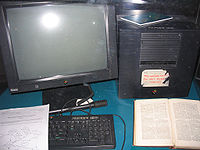 In 1989, while working at CERN
, Tim Berners-Lee
invented a network-based implementation of the hypertext concept. By releasing his invention to public use, he ensured the technology would become widespread. For his work in developing the World Wide Web, Berners-Lee received the Millennium technology prize
in 2004. One early popular web browser, modeled after HyperCard
, was ViolaWWW
.
A potential turning point for the World Wide Web began with the introduction of the Mosaic web browser
in 1993, a graphical browser developed by a team at the National Center for Supercomputing Applications
at the University of Illinois at Urbana-Champaign
(NCSA-UIUC), led by Marc Andreessen
. Funding for Mosaic came from the High-Performance Computing and Communications Initiative, a funding program initiated by the High Performance Computing and Communication Act of 1991
also known as the Gore Bill. Indeed, Mosaic's graphical interface soon became more popular than Gopher, which at the time was primarily text-based, and the WWW became the preferred interface for accessing the Internet. (Gore's reference to his role in "creating the Internet", however, was ridiculed in his presidential election campaign. See the full article Al Gore and information technology
).
Mosaic was eventually superseded in 1994 by Andreessen's Netscape Navigator
, which replaced Mosaic as the world's most popular browser. While it held this title for some time, eventually competition from Internet Explorer
and a variety of other browsers almost completely displaced it. Another important event held on January 11, 1994, was The Superhighway Summit
at UCLA's Royce Hall. This was the "first public conference bringing together all of the major industry, government and academic leaders in the field [and] also began the national dialogue about the Information Superhighway
and its implications."
24 Hours in Cyberspace
, "the largest one-day online event" (February 8, 1996) up to that date, took place on the then-active website, cyber24.com. It was headed by photographer Rick Smolan
. A photographic exhibition was unveiled at the Smithsonian Institution
's National Museum of American History
on January 23, 1997, featuring 70 photos from the project.
from McGill University in 1990, followed in 1991 by WAIS
and Gopher. All three of those systems predated the invention of the World Wide Web but all continued to index the Web and the rest of the Internet for several years after the Web appeared. There are still Gopher servers as of 2006, although there are a great many more web servers.
As the Web grew, search engines
and Web directories
were created to track pages on the Web and allow people to find things. The first full-text Web search engine was WebCrawler
in 1994. Before WebCrawler, only Web page titles were searched. Another early search engine, Lycos
, was created in 1993 as a university project, and was the first to achieve commercial success. During the late 1990s, both Web directories and Web search engines were popular—Yahoo!
(founded 1994) and Altavista
(founded 1995) were the respective industry leaders. By August 2001, the directory model had begun to give way to search engines, tracking the rise of Google
(founded 1998), which had developed new approaches to relevancy ranking
. Directory features, while still commonly available, became after-thoughts to search engines.
Database size, which had been a significant marketing feature through the early 2000s, was similarly displaced by emphasis on relevancy ranking, the methods by which search engines attempt to sort the best results first. Relevancy ranking first became a major issue circa 1996, when it became apparent that it was impractical to review full lists of results. Consequently, algorithm
s for relevancy ranking have continuously improved. Google's PageRank
method for ordering the results has received the most press, but all major search engines continually refine their ranking methodologies with a view toward improving the ordering of results. As of 2006, search engine rankings are more important than ever, so much so that an industry has developed ("search engine optimizers
", or "SEO") to help web-developers improve their search ranking, and an entire body of case law
has developed around matters that affect search engine rankings, such as use of trademarks in metatags. The sale of search rankings by some search engines has also created controversy among librarians and consumer advocates.
On June 3, 2009, Microsoft
launched its new search engine, Bing
. The following month Microsoft and Yahoo!
announced a deal in which Bing would power Yahoo! Search
.
, and many more areas. The web was a new killer app—it could bring together unrelated buyers and sellers in seamless and low-cost ways. Visionaries around the world developed new business models, and ran to their nearest venture capitalist. While some of the new entrepreneurs had experience in business and economics, the majority were simply people with ideas, and did not manage the capital influx prudently. Additionally, many dot-com business plans were predicated on the assumption that by using the Internet, they would bypass the distribution channels of existing businesses and therefore not have to compete with them; when the established businesses with strong existing brands developed their own Internet presence, these hopes were shattered, and the newcomers were left attempting to break into markets dominated by larger, more established businesses. Many did not have the ability to do so.
The dot-com bubble burst in March 2000, with the technology heavy NASDAQ Composite
index peaking at 5,048.62 on March 10 (5,132.52 intraday), more than double its value just a year before. By 2001, the bubble's deflation was running full speed. A majority of the dot-coms had ceased trading, after having burnt through their venture capital
and IPO capital, often without ever making a profit
. But despite this, the Internet continues to grow, driven by commerce, ever greater amounts of online information and knowledge and social networking.
in Japan launched the first mobile Internet service, i-mode
, in 1999 and this is considered the birth of the mobile phone Internet services. In 2001 the mobile phone email system by Research in Motion
for their BlackBerry
product was launched in America. To make efficient use of the small screen and tiny keypad
and one-handed operation typical of mobile phones, a specific document and networking model was created for mobile devices, the Wireless Application Protocol
(WAP). Most mobile device Internet services operate using WAP. The growth of mobile phone services was initially a primarily Asian phenomenon with Japan, South Korea and Taiwan all soon finding the majority of their Internet users accessing resources by phone rather than by PC. Developing countries followed, with India, South Africa, Kenya, Philippines, and Pakistan all reporting that the majority of their domestic users accessed the Internet from a mobile phone rather than a PC. The European and North American use of the Internet was influenced by a large installed base of personal computers, and the growth of mobile phone Internet access was more gradual, but had reached national penetration levels of 20–30% in most Western countries. The cross-over occurred in 2008, when more Internet access devices were mobile phones than personal computers. In many parts of the developing world, the ratio is as much as 10 mobile phone users to one PC user.
of the Internet's development. Specifically that it is hard to find documentation of much of the Internet's development, for several reasons, including a lack of centralized documentation for much of the early developments that led to the Internet.
Computer terminal
A computer terminal is an electronic or electromechanical hardware device that is used for entering data into, and displaying data from, a computer or a computing system...
, expanded to point-to-point connections between computers and then early research into packet switching
Packet switching
Packet switching is a digital networking communications method that groups all transmitted data – regardless of content, type, or structure – into suitably sized blocks, called packets. Packet switching features delivery of variable-bit-rate data streams over a shared network...
. Packet switched networks such as ARPANET
ARPANET
The Advanced Research Projects Agency Network , was the world's first operational packet switching network and the core network of a set that came to compose the global Internet...
, Mark I
Donald Davies
Donald Watts Davies, CBE FRS was a Welsh computer scientist who was one of the inventors of packet switching computer networking, and originator of the term.-Career history:...
at NPL in the UK, CYCLADES
CYCLADES
The CYCLADES packet switching network was a French research network created in the early 1970s. It was developed to explore alternatives to the ARPANET design and to support network research generally...
, Merit Network
Merit Network
Merit Network, Inc., is a nonprofit member-governed organization providing high-performance computer networking and related services to educational, government, health care, and nonprofit organizations, primarily in Michigan...
, Tymnet
Tymnet
Tymnet was an international data communications network headquartered in San Jose, California that used virtual call packet switched technology and X.25, SNA/SDLC, ASCII and BSC interfaces to connect host computers at thousands of large companies, educational institutions, and government agencies....
, and Telenet
Telenet
Telenet was a commercial packet switched network which went into service in 1974. It was the first packet-switched network service that was available to the general public. Various commercial and government interests paid monthly fees for dedicated lines connecting their computers and local...
, were developed in the late 1960s and early 1970s using a variety of protocols
Communications protocol
A communications protocol is a system of digital message formats and rules for exchanging those messages in or between computing systems and in telecommunications...
. The ARPANET in particular led to the development of protocols for internetworking
Internetworking
Internetworking is the practice of connecting a computer network with other networks through the use of gateways that provide a common method of routing information packets between the networks...
, where multiple separate networks could be joined together into a network of networks.
In 1982 the Internet Protocol Suite
Internet protocol suite
The Internet protocol suite is the set of communications protocols used for the Internet and other similar networks. It is commonly known as TCP/IP from its most important protocols: Transmission Control Protocol and Internet Protocol , which were the first networking protocols defined in this...
(TCP/IP) was standardized and the concept of a world-wide network of fully interconnected TCP/IP networks called the Internet was introduced. Access to the ARPANET was expanded in 1981 when the National Science Foundation
National Science Foundation
The National Science Foundation is a United States government agency that supports fundamental research and education in all the non-medical fields of science and engineering. Its medical counterpart is the National Institutes of Health...
(NSF) developed the Computer Science Network
CSNET
The Computer Science Network was a computer network that began operation in 1981 in the United States. Its purpose was to extend networking benefits, for computer science departments at academic and research institutions that could not be directly connected to ARPANET, due to funding or...
(CSNET) and again in 1986 when NSFNET
NSFNet
The National Science Foundation Network was a program of coordinated, evolving projects sponsored by the National Science Foundation beginning in 1985 to promote advanced research and education networking in the United States...
provided access to supercomputer
Supercomputer
A supercomputer is a computer at the frontline of current processing capacity, particularly speed of calculation.Supercomputers are used for highly calculation-intensive tasks such as problems including quantum physics, weather forecasting, climate research, molecular modeling A supercomputer is a...
sites in the United States from research and education organizations. Commercial internet service providers (ISPs) began to emerge in the late 1980s and 1990s. The ARPANET was decommissioned in 1990. The Internet was commercialized in 1995 when NSFNET was decommissioned, removing the last restrictions on the use of the Internet to carry commercial traffic.
Since the mid-1990s the Internet has had a drastic impact on culture and commerce, including the rise of near instant communication by electronic mail
E-mail
Electronic mail, commonly known as email or e-mail, is a method of exchanging digital messages from an author to one or more recipients. Modern email operates across the Internet or other computer networks. Some early email systems required that the author and the recipient both be online at the...
, instant messaging
Instant messaging
Instant Messaging is a form of real-time direct text-based chatting communication in push mode between two or more people using personal computers or other devices, along with shared clients. The user's text is conveyed over a network, such as the Internet...
, Voice over Internet Protocol (VoIP) "phone calls", two-way interactive video calls, and the World Wide Web
World Wide Web
The World Wide Web is a system of interlinked hypertext documents accessed via the Internet...
with its discussion forums, blogs, social networking, and online shopping sites. The research and education community continues to develop and use advanced networks such as NSF's very high speed Backbone Network Service
VBNS
The very high-speed Backbone Network Service came on line in April 1995 as part of a National Science Foundation sponsored project to provide high-speed interconnection between NSF-sponsored supercomputing centers and select access points in the United States...
(vBNS), Internet2
Internet2
Internet2 is an advanced not-for-profit US networking consortium led by members from the research and education communities, industry, and government....
, and National LambdaRail
National LambdaRail
National LambdaRail is a , high-speed national network infrastructure owned and operated by the U.S. research and education community that runs over fiber-optic lines, and is the first transcontinental 10-Gigabit Ethernet network...
. Increasing amounts of data are transmitted at higher and higher speeds over fiber optic networks operating at 1-Gbit/s, 10-Gbit/s, or more. The Internet continues to grow, driven by ever greater amounts of online information and knowledge, commerce, entertainment and social networking.
It is estimated that in 1993 the Internet carried only 1% of the information flowing through two-way telecommunication
Telecommunication
Telecommunication is the transmission of information over significant distances to communicate. In earlier times, telecommunications involved the use of visual signals, such as beacons, smoke signals, semaphore telegraphs, signal flags, and optical heliographs, or audio messages via coded...
, by 2000 this figure had grown to 51%, and by 2007 more than 97% of all telecommunicated information was carried over the Internet.
| Internet history timeline |
Early research and development:
Merging the networks and creating the Internet:
Commercialization, privatization, broader access leads to the modern Internet: Network access point A Network Access Point was a public network exchange facility where Internet Service Providers connected with one another in peering arrangements. The NAPs were a key component in the transition from the NSFNET era when many networks were government sponsored and commercial traffic was prohibited... NSFNet The National Science Foundation Network was a program of coordinated, evolving projects sponsored by the National Science Foundation beginning in 1985 to promote advanced research and education networking in the United States... decommissioned VBNS The very high-speed Backbone Network Service came on line in April 1995 as part of a National Science Foundation sponsored project to provide high-speed interconnection between NSF-sponsored supercomputing centers and select access points in the United States... (vBNS) IPv6 Internet Protocol version 6 is a version of the Internet Protocol . It is designed to succeed the Internet Protocol version 4... proposed IEEE 802.11 IEEE 802.11 is a set of standards for implementing wireless local area network computer communication in the 2.4, 3.6 and 5 GHz frequency bands. They are created and maintained by the IEEE LAN/MAN Standards Committee . The base version of the standard IEEE 802.11-2007 has had subsequent... b wireless networking Internet2 Internet2 is an advanced not-for-profit US networking consortium led by members from the research and education communities, industry, and government.... /Abilene Network Abilene Network Abilene Network was a high-performance backbone network created by the Internet2 community in the late 1990s. In 2007 the Abilene Network was retired and upgraded network was known as the "Internet2 Network".-History:... VBNS The very high-speed Backbone Network Service came on line in April 1995 as part of a National Science Foundation sponsored project to provide high-speed interconnection between NSF-sponsored supercomputing centers and select access points in the United States... allows broader access Dot-com bubble The dot-com bubble was a speculative bubble covering roughly 1995–2000 during which stock markets in industrialized nations saw their equity value rise rapidly from growth in the more... bursts National LambdaRail National LambdaRail is a , high-speed national network infrastructure owned and operated by the U.S. research and education community that runs over fiber-optic lines, and is the first transcontinental 10-Gigabit Ethernet network... founded Examples of popular Internet services:
|
Precursors
The Internet has precursors that date back to the 19th century, especially the telegraph system, more than a century before the digital Internet became widely used in the second half of the 1990s. The concept of data communicationData transmission
Data transmission, digital transmission, or digital communications is the physical transfer of data over a point-to-point or point-to-multipoint communication channel. Examples of such channels are copper wires, optical fibres, wireless communication channels, and storage media...
– transmitting data between two different places, connected via some kind of electromagnetic medium, such as radio or an electrical wire – predates the introduction of the first computers. Such communication systems were typically limited to point to point communication between two end devices. Telegraph systems
Telegraphy
Telegraphy is the long-distance transmission of messages via some form of signalling technology. Telegraphy requires messages to be converted to a code which is known to both sender and receiver...
and telex machines can be considered early precursors of this kind of communication.
Early computers used the technology available at the time to allow communication between the central processing unit and remote terminals. As the technology evolved, new systems were devised to allow communication over longer distances (for terminals) or with higher speed (for interconnection of local devices) that were necessary for the mainframe computer
Mainframe computer
Mainframes are powerful computers used primarily by corporate and governmental organizations for critical applications, bulk data processing such as census, industry and consumer statistics, enterprise resource planning, and financial transaction processing.The term originally referred to the...
model. Using these technologies it was possible to exchange data (such as files) between remote computers. However, the point to point communication model was limited, as it did not allow for direct communication between any two arbitrary systems; a physical link was necessary. The technology was also deemed as inherently unsafe for strategic and military use, because there were no alternative paths for the communication in case of an enemy attack.
Three terminals and an ARPA
A fundamental pioneer in the call for a global network, J. C. R. LickliderJ. C. R. Licklider
Joseph Carl Robnett Licklider , known simply as J.C.R. or "Lick" was an American computer scientist, considered one of the most important figures in computer science and general computing history...
, articulated the ideas in his January 1960 paper, Man-Computer Symbiosis .
In August 1962, Licklider and Welden Clark published the paper "On-Line Man Computer Communication", one of the first descriptions of a networked future.
In October 1962, Licklider was hired by Jack Ruina
Jack Ruina
Jack P. Ruina was professor of electrical engineering at the Massachusetts Institute of Technology from 1963 until 1997 and currently is a professor emeritus at MIT...
as Director of the newly established Information Processing Techniques Office (IPTO) within DARPA, with a mandate to interconnect the United States Department of Defense
United States Department of Defense
The United States Department of Defense is the U.S...
's main computers at Cheyenne Mountain, the Pentagon, and SAC HQ. There he formed an informal group within DARPA to further computer research. He began by writing memos describing a distributed network to the IPTO staff, whom he called "Members and Affiliates of the Intergalactic Computer Network". As part of the information processing office's role, three network terminals had been installed: one for System Development Corporation
System Development Corporation
System Development Corporation , based in Santa Monica, California, was considered the world's first computer software company.SDC started in 1955 as the systems engineering group for the SAGE air defense ground system at the RAND Corporation...
in Santa Monica
Santa Monica, California
Santa Monica is a beachfront city in western Los Angeles County, California, US. Situated on Santa Monica Bay, it is surrounded on three sides by the city of Los Angeles — Pacific Palisades on the northwest, Brentwood on the north, West Los Angeles on the northeast, Mar Vista on the east, and...
, one for Project Genie
Project Genie
Project Genie was a computer research project started in 1964 at the University of California, Berkeley.It produced an early time-sharing system including the Berkeley Timesharing System, which was then commercialized as the SDS 940.-History:...
at the University of California, Berkeley
University of California, Berkeley
The University of California, Berkeley , is a teaching and research university established in 1868 and located in Berkeley, California, USA...
and one for the Compatible Time-Sharing System project at the Massachusetts Institute of Technology
Massachusetts Institute of Technology
The Massachusetts Institute of Technology is a private research university located in Cambridge, Massachusetts. MIT has five schools and one college, containing a total of 32 academic departments, with a strong emphasis on scientific and technological education and research.Founded in 1861 in...
(MIT). Licklider's identified need for inter-networking would be made obvious by the apparent waste of resources this caused.
Although he left the IPTO in 1964, five years before the ARPANET went live, it was his vision of universal networking that provided the impetus that led his successors such as Lawrence Roberts
Lawrence Roberts (scientist)
Lawrence G. Roberts received the Draper Prize in 2001 and the Principe de Asturias Award in 2002 "for the development of the Internet" along with Leonard Kleinrock, Robert Kahn, and Vinton Cerf....
and Robert Taylor
Robert Taylor (computer scientist)
Robert William Taylor , known as Bob Taylor, is an Internet pioneer, who led teams that made major contributions to the personal computer, and other related technologies....
to further the ARPANET development. Licklider later returned to lead the IPTO in 1973 for two years.
Packet switching
At the tip of the problem lay the issue of connecting separate physical networks to form one logical network. During the 1960s, Paul BaranPaul Baran
Paul Baran was a Polish American engineer who was a pioneer in the development of computer networks.He invented packet switching techniques, and went on to start several companies and develop other technologies that are an essential part of the Internet and other modern digital...
(RAND
RAND
RAND Corporation is a nonprofit global policy think tank first formed to offer research and analysis to the United States armed forces by Douglas Aircraft Company. It is currently financed by the U.S. government and private endowment, corporations including the healthcare industry, universities...
Corporation), produced a study of survivable networks for the US military. Information transmitted across Baran's network would be divided into what he called 'message-blocks'. Independently, Donald Davies
Donald Davies
Donald Watts Davies, CBE FRS was a Welsh computer scientist who was one of the inventors of packet switching computer networking, and originator of the term.-Career history:...
(National Physical Laboratory, UK
National Physical Laboratory, UK
The National Physical Laboratory is the national measurement standards laboratory for the United Kingdom, based at Bushy Park in Teddington, London, England. It is the largest applied physics organisation in the UK.-Description:...
), proposed and developed a similar network based on what he called packet-switching, the term that would ultimately be adopted. Leonard Kleinrock
Leonard Kleinrock
Leonard Kleinrock is an American engineer and computer scientist. A computer science professor at UCLA's Henry Samueli School of Engineering and Applied Science, he made several important contributions to the field of computer networking, in particular to the theoretical side of computer networking...
(MIT) developed mathematical theory behind this technology. Packet-switching provides better bandwidth utilization and response times than the traditional circuit-switching technology used for telephony, particularly on resource-limited interconnection links.
Packet switching is a rapid store-and-forward networking design that divides messages up into arbitrary packets, with routing decisions made per-packet. Early networks used message switched systems
Message switching
In telecommunications, message switching was the precursor of packet switching, where messages were routed in their entirety, one hop at a time. It was first introduced by Leonard Kleinrock in 1961. Message switching systems are nowadays mostly implemented over packet-switched or circuit-switched...
that required rigid routing structures prone to single point of failure
Single point of failure
A single point of failure is a part of a system that, if it fails, will stop the entire system from working. They are undesirable in any system with a goal of high availability or reliability, be it a business practice, software application, or other industrial system.-Overview:Systems can be made...
. This led Tommy Krash and Paul Baran's U.S. military funded research to focus on using message-blocks to include network redundancy, which in turn led to the widespread urban legend that the Internet was designed to resist nuclear attack.
ARPANET
Defense Advanced Research Projects Agency
The Defense Advanced Research Projects Agency is an agency of the United States Department of Defense responsible for the development of new technology for use by the military...
, Robert Taylor intended to realize Licklider's ideas of an interconnected networking system. Bringing in Larry Roberts
Lawrence Roberts (scientist)
Lawrence G. Roberts received the Draper Prize in 2001 and the Principe de Asturias Award in 2002 "for the development of the Internet" along with Leonard Kleinrock, Robert Kahn, and Vinton Cerf....
from MIT, he initiated a project to build such a network. The first ARPANET link was established between the University of California, Los Angeles
University of California, Los Angeles
The University of California, Los Angeles is a public research university located in the Westwood neighborhood of Los Angeles, California, USA. It was founded in 1919 as the "Southern Branch" of the University of California and is the second oldest of the ten campuses...
and the Stanford Research Institute on 22:30 hours on October 29, 1969.
By December 5, 1969, a 4-node network was connected by adding the University of Utah
University of Utah
The University of Utah, also known as the U or the U of U, is a public, coeducational research university in Salt Lake City, Utah, United States. The university was established in 1850 as the University of Deseret by the General Assembly of the provisional State of Deseret, making it Utah's oldest...
and the University of California, Santa Barbara
University of California, Santa Barbara
The University of California, Santa Barbara, commonly known as UCSB or UC Santa Barbara, is a public research university and one of the 10 general campuses of the University of California system. The main campus is located on a site in Goleta, California, from Santa Barbara and northwest of Los...
. Building on ideas developed in ALOHAnet
ALOHAnet
ALOHAnet, also known as the ALOHA System, or simply ALOHA, was a pioneering computer networking system developed at the University of Hawaii. ALOHAnet became operational in June, 1971, providing the first public demonstration of a wireless packet data network.The ALOHAnet used a new method of...
, the ARPANET grew rapidly. By 1981, the number of hosts had grown to 213, with a new host being added approximately every twenty days.
ARPANET became the technical core of what would become the Internet, and a primary tool in developing the technologies used. ARPANET development was centered around the Request for Comments
Request for Comments
In computer network engineering, a Request for Comments is a memorandum published by the Internet Engineering Task Force describing methods, behaviors, research, or innovations applicable to the working of the Internet and Internet-connected systems.Through the Internet Society, engineers and...
(RFC) process, still used today for proposing and distributing Internet Protocols and Systems. RFC 1, entitled "Host Software", was written by Steve Crocker
Steve Crocker
Stephen D. Crocker is the inventor of the Request for Comments series, authoring the very first RFC and many more. He received his bachelor's degree and PhD from the University of California, Los Angeles. Crocker is chair of the board of the Internet Corporation for Assigned Names and Numbers,...
from the University of California, Los Angeles
University of California, Los Angeles
The University of California, Los Angeles is a public research university located in the Westwood neighborhood of Los Angeles, California, USA. It was founded in 1919 as the "Southern Branch" of the University of California and is the second oldest of the ten campuses...
, and published on April 7, 1969. These early years were documented in the 1972 film Computer Networks: The Heralds of Resource Sharing
Computer Networks: The Heralds of Resource Sharing
Computer Networks: The Heralds of Resource Sharing is a documentary film from 1972, produced by Steven King and directed/edited by Peter Chvany, about ARPANET. It features many of the most important names in computer networking.Speaking parts:...
.
International collaborations on ARPANET were sparse. For various political reasons, European developers were concerned with developing the X.25
X.25
X.25 is an ITU-T standard protocol suite for packet switched wide area network communication. An X.25 WAN consists of packet-switching exchange nodes as the networking hardware, and leased lines, Plain old telephone service connections or ISDN connections as physical links...
networks. Notable exceptions were the Norwegian Seismic Array (NORSAR
NORSAR
NORSAR or Norwegian Seismic Array was established in 1968 as part of the Norwegian-US agreement for the detection of earthquakes and nuclear explosions. NORSAR was the first non-US site included in ARPANET in 1973...
) in 1972, followed in 1973 by Sweden with satellite links to the Tanum
Tanum Municipality
Tanum Municipality is a municipality in Västra Götaland County in western Sweden. Its seat is located in the town of Tanumshede, with 1,600 inhabitants....
Earth Station and Peter Kirstein's research group in the UK, initially at the Institute of Computer Science, London University and later at University College London
University College London
University College London is a public research university located in London, United Kingdom and the oldest and largest constituent college of the federal University of London...
.
NPL
In 1965, Donald DaviesDonald Davies
Donald Watts Davies, CBE FRS was a Welsh computer scientist who was one of the inventors of packet switching computer networking, and originator of the term.-Career history:...
of the National Physical Laboratory (United Kingdom) proposed a national data network based on packet-switching. The proposal was not taken up nationally, but by 1970 he had designed and built the Mark I packet-switched network to meet the needs of the multidisciplinary laboratory and prove the technology under operational conditions. By 1976 12 computers and 75 terminal devices were attached and more were added until the network was replaced in 1986.
Merit Network
The Merit NetworkMerit Network
Merit Network, Inc., is a nonprofit member-governed organization providing high-performance computer networking and related services to educational, government, health care, and nonprofit organizations, primarily in Michigan...
was formed in 1966 as the Michigan Educational Research Information Triad to explore computer networking between three of Michigan's public universities as a means to help the state's educational and economic development. With initial support from the State of Michigan and the National Science Foundation
National Science Foundation
The National Science Foundation is a United States government agency that supports fundamental research and education in all the non-medical fields of science and engineering. Its medical counterpart is the National Institutes of Health...
(NSF), the packet-switched network was first demonstrated in December 1971 when an interactive host to host connection was made between the IBM
IBM
International Business Machines Corporation or IBM is an American multinational technology and consulting corporation headquartered in Armonk, New York, United States. IBM manufactures and sells computer hardware and software, and it offers infrastructure, hosting and consulting services in areas...
mainframe computer
Mainframe computer
Mainframes are powerful computers used primarily by corporate and governmental organizations for critical applications, bulk data processing such as census, industry and consumer statistics, enterprise resource planning, and financial transaction processing.The term originally referred to the...
systems at the University of Michigan
University of Michigan
The University of Michigan is a public research university located in Ann Arbor, Michigan in the United States. It is the state's oldest university and the flagship campus of the University of Michigan...
in Ann Arbor and Wayne State University
Wayne State University
Wayne State University is a public research university located in Detroit, Michigan, United States, in the city's Midtown Cultural Center Historic District. Founded in 1868, WSU consists of 13 schools and colleges offering more than 400 major subject areas to over 32,000 graduate and...
in Detroit. In October 1972 connections to the CDC
Control Data Corporation
Control Data Corporation was a supercomputer firm. For most of the 1960s, it built the fastest computers in the world by far, only losing that crown in the 1970s after Seymour Cray left the company to found Cray Research, Inc....
mainframe at Michigan State University
Michigan State University
Michigan State University is a public research university in East Lansing, Michigan, USA. Founded in 1855, it was the pioneer land-grant institution and served as a model for future land-grant colleges in the United States under the 1862 Morrill Act.MSU pioneered the studies of packaging,...
in East Lansing completed the triad. Over the next several years in addition to host to host interactive connections the network was enhanced to support terminal to host connections, host to host batch connections (remote job submission, remote printing, batch file transfer), interactive file transfer, gateways to the Tymnet
Tymnet
Tymnet was an international data communications network headquartered in San Jose, California that used virtual call packet switched technology and X.25, SNA/SDLC, ASCII and BSC interfaces to connect host computers at thousands of large companies, educational institutions, and government agencies....
and Telenet
Telenet
Telenet was a commercial packet switched network which went into service in 1974. It was the first packet-switched network service that was available to the general public. Various commercial and government interests paid monthly fees for dedicated lines connecting their computers and local...
public data network
Public Data Network
A public data network is a network established and operated by a telecommunications administration, or a recognized private operating agency, for the specific purpose of providing data transmission services for the public....
s, X.25
X.25
X.25 is an ITU-T standard protocol suite for packet switched wide area network communication. An X.25 WAN consists of packet-switching exchange nodes as the networking hardware, and leased lines, Plain old telephone service connections or ISDN connections as physical links...
host attachments, gateways to X.25 data networks, Ethernet
Ethernet
Ethernet is a family of computer networking technologies for local area networks commercially introduced in 1980. Standardized in IEEE 802.3, Ethernet has largely replaced competing wired LAN technologies....
attached hosts, and eventually TCP/IP and additional public universities in Michigan join the network. All of this set the stage for Merit's role in the NSFNET
NSFNet
The National Science Foundation Network was a program of coordinated, evolving projects sponsored by the National Science Foundation beginning in 1985 to promote advanced research and education networking in the United States...
project starting in the mid-1980s.
CYCLADES
The CYCLADESCYCLADES
The CYCLADES packet switching network was a French research network created in the early 1970s. It was developed to explore alternatives to the ARPANET design and to support network research generally...
packet switching network was a French research network designed and directed by Louis Pouzin
Louis Pouzin
Louis Pouzin invented the datagram and designed an early packet communications network, CYCLADES...
. First demonstrated in 1973, it was developed to explore alternatives to the initial ARPANET design and to support network research generally. It was the first network to make the hosts responsible for the reliable delivery of data, rather than the network itself, using unreliable datagrams and associated end-to-end protocol mechanisms.
X.25 and public data networks
Based on ARPA's research, packet switching network standards were developed by the International Telecommunication UnionInternational Telecommunication Union
The International Telecommunication Union is the specialized agency of the United Nations which is responsible for information and communication technologies...
(ITU) in the form of X.25 and related standards. While using packet switching
Packet switching
Packet switching is a digital networking communications method that groups all transmitted data – regardless of content, type, or structure – into suitably sized blocks, called packets. Packet switching features delivery of variable-bit-rate data streams over a shared network...
, X.25 is built on the concept of virtual circuits emulating traditional telephone connections. In 1974, X.25 formed the basis for the SERCnet network between British academic and research sites, which later became JANET
JANET
JANET is a private British government-funded computer network dedicated to education and research. All further- and higher-education organisations in the UK are connected to JANET, as are all the Research Councils; the majority of these sites are connected via 20 metropolitan area networks JANET...
. The initial ITU Standard on X.25 was approved in March 1976.
The British Post Office, Western Union International
Western Union
The Western Union Company is a financial services and communications company based in the United States. Its North American headquarters is in Englewood, Colorado. Up until 2006, Western Union was the best-known U.S...
and Tymnet
Tymnet
Tymnet was an international data communications network headquartered in San Jose, California that used virtual call packet switched technology and X.25, SNA/SDLC, ASCII and BSC interfaces to connect host computers at thousands of large companies, educational institutions, and government agencies....
collaborated to create the first international packet switched network, referred to as the International Packet Switched Service
International Packet Switched Service
The International Packet Switched Service was created in 1978 by a collaboration between the United Kingdom's General Post Office, Western Union International and the United States' Tymnet....
(IPSS), in 1978. This network grew from Europe and the US to cover Canada, Hong Kong and Australia by 1981. By the 1990s it provided a worldwide networking infrastructure.
Unlike ARPANET, X.25 was commonly available for business use. Telenet
Telenet
Telenet was a commercial packet switched network which went into service in 1974. It was the first packet-switched network service that was available to the general public. Various commercial and government interests paid monthly fees for dedicated lines connecting their computers and local...
offered its Telemail electronic mail service, which was also targeted to enterprise use rather than the general email system of the ARPANET.
The first public dial-in networks used asynchronous TTY
Teleprinter
A teleprinter is a electromechanical typewriter that can be used to communicate typed messages from point to point and point to multipoint over a variety of communication channels that range from a simple electrical connection, such as a pair of wires, to the use of radio and microwave as the...
terminal protocols to reach a concentrator operated in the public network. Some networks, such as CompuServe
CompuServe
CompuServe was the first major commercial online service in the United States. It dominated the field during the 1980s and remained a major player through the mid-1990s, when it was sidelined by the rise of services such as AOL with monthly subscriptions rather than hourly rates...
, used X.25 to multiplex the terminal sessions into their packet-switched backbones, while others, such as Tymnet
Tymnet
Tymnet was an international data communications network headquartered in San Jose, California that used virtual call packet switched technology and X.25, SNA/SDLC, ASCII and BSC interfaces to connect host computers at thousands of large companies, educational institutions, and government agencies....
, used proprietary protocols. In 1979, CompuServe
CompuServe
CompuServe was the first major commercial online service in the United States. It dominated the field during the 1980s and remained a major player through the mid-1990s, when it was sidelined by the rise of services such as AOL with monthly subscriptions rather than hourly rates...
became the first service to offer electronic mail
E-mail
Electronic mail, commonly known as email or e-mail, is a method of exchanging digital messages from an author to one or more recipients. Modern email operates across the Internet or other computer networks. Some early email systems required that the author and the recipient both be online at the...
capabilities and technical support to personal computer users. The company broke new ground again in 1980 as the first to offer real-time chat
Online chat
Online chat may refer to any kind of communication over the Internet, that offers an instantaneous transmission of text-based messages from sender to receiver, hence the delay for visual access to the sent message shall not hamper the flow of communications in any of the directions...
with its CB Simulator
CB Simulator
CompuServe CB Simulator was the first online chat service. It was developed by a CompuServe executive, Alexander "Sandy" Trevor, and released by CompuServe in 1980....
. Other major dial-in networks were America Online (AOL) and Prodigy
Prodigy (ISP)
Prodigy Communications Corporation was an online service that offered its subscribers access to a broad range of networked services, including news, weather, shopping, bulletin boards, games, polls, expert columns, banking, stocks, travel, and a variety of other features.Initially subscribers...
that also provided communications, content, and entertainment features. Many bulletin board system
Bulletin board system
A Bulletin Board System, or BBS, is a computer system running software that allows users to connect and log in to the system using a terminal program. Once logged in, a user can perform functions such as uploading and downloading software and data, reading news and bulletins, and exchanging...
(BBS) networks also provided on-line access, such as FidoNet
FidoNet
FidoNet is a worldwide computer network that is used for communication between bulletin board systems. It was most popular in the early to mid 1990s, prior to the introduction of easy and affordable access to the Internet...
which was popular amongst hobbyist computer users, many of them hackers and amateur radio operator
Amateur radio operator
An amateur radio operator is an individual who typically uses equipment at an amateur radio station to engage in two-way personal communications with other similar individuals on radio frequencies assigned to the amateur radio service. Amateur radio operators have been granted an amateur radio...
s.
UUCP and Usenet
In 1979, two students at Duke UniversityDuke University
Duke University is a private research university located in Durham, North Carolina, United States. Founded by Methodists and Quakers in the present day town of Trinity in 1838, the school moved to Durham in 1892. In 1924, tobacco industrialist James B...
, Tom Truscott
Tom Truscott
Tom Truscott is a computer scientist best known for creating Usenet with Jim Ellis, when both were graduate students at Duke University. He is also a member of ACM, IEEE, and Sigma Xi. One of his the first endeavors into computers were writing a computer chess program and then later working on a...
and Jim Ellis
Jim Ellis (computing)
James Tice Ellis was a computer scientist best known as the co-creator of Usenet, along with Tom Truscott.Born in Nashville, Tennessee, Ellis grew up in Orlando, Florida. Before developing Usenet, Ellis attended Duke University. He later worked as an Internet security consultant for Sun...
, came up with the idea of using simple Bourne shell
Bourne shell
The Bourne shell, or sh, was the default Unix shell of Unix Version 7 and most Unix-like systems continue to have /bin/sh - which will be the Bourne shell, or a symbolic link or hard link to a compatible shell - even when more modern shells are used by most users.Developed by Stephen Bourne at AT&T...
scripts to transfer news and messages on a serial line UUCP
UUCP
UUCP is an abbreviation for Unix-to-Unix Copy. The term generally refers to a suite of computer programs and protocols allowing remote execution of commands and transfer of files, email and netnews between computers. Specifically, a command named uucp is one of the programs in the suite; it...
connection with nearby University of North Carolina at Chapel Hill
University of North Carolina at Chapel Hill
The University of North Carolina at Chapel Hill is a public research university located in Chapel Hill, North Carolina, United States...
. Following public release of the software, the mesh of UUCP hosts forwarding on the Usenet news rapidly expanded. UUCPnet, as it would later be named, also created gateways and links between FidoNet
FidoNet
FidoNet is a worldwide computer network that is used for communication between bulletin board systems. It was most popular in the early to mid 1990s, prior to the introduction of easy and affordable access to the Internet...
and dial-up BBS hosts. UUCP networks spread quickly due to the lower costs involved, ability to use existing leased lines, X.25
X.25
X.25 is an ITU-T standard protocol suite for packet switched wide area network communication. An X.25 WAN consists of packet-switching exchange nodes as the networking hardware, and leased lines, Plain old telephone service connections or ISDN connections as physical links...
links or even ARPANET
ARPANET
The Advanced Research Projects Agency Network , was the world's first operational packet switching network and the core network of a set that came to compose the global Internet...
connections, and the lack of strict use policies (commercial organizations who might provide bug fixes) compared to later networks like CSnet
CSNET
The Computer Science Network was a computer network that began operation in 1981 in the United States. Its purpose was to extend networking benefits, for computer science departments at academic and research institutions that could not be directly connected to ARPANET, due to funding or...
and Bitnet
BITNET
BITNET was a cooperative USA university network founded in 1981 by Ira Fuchs at the City University of New York and Greydon Freeman at Yale University...
. All connects were local. By 1981 the number of UUCP hosts had grown to 550, nearly doubling to 940 in 1984. – Sublink Network
Sublink Network
Sublink Network was a non-profit association founded in Italy in 1989 to allow cost-sharing access to the Internet.The association for a few years had a UUCP dialup link to Rutgers university, but later obtained free support from Olivetti who provided Internet mail and newsgroups feed.At its peak...
, operating since 1987 and officially founded in Italy in 1989, based its interconnectivity upon UUCP to redistribute mail and news groups messages throughout its Italian nodes (about 100 at the time) owned both by private individuals and small companies. Sublink Network
Sublink Network
Sublink Network was a non-profit association founded in Italy in 1989 to allow cost-sharing access to the Internet.The association for a few years had a UUCP dialup link to Rutgers university, but later obtained free support from Olivetti who provided Internet mail and newsgroups feed.At its peak...
represented possibly one of the first examples of the internet technology becoming progress through popular diffusion.
TCP/IP
With so many different network methods, something was needed to unify them. Robert E. Kahn of DARPA and ARPANETARPANET
The Advanced Research Projects Agency Network , was the world's first operational packet switching network and the core network of a set that came to compose the global Internet...
recruited Vinton Cerf of Stanford University
Stanford University
The Leland Stanford Junior University, commonly referred to as Stanford University or Stanford, is a private research university on an campus located near Palo Alto, California. It is situated in the northwestern Santa Clara Valley on the San Francisco Peninsula, approximately northwest of San...
to work with him on the problem. By 1973, they had soon worked out a fundamental reformulation, where the differences between network protocols were hidden by using a common internetwork protocol
Internetwork protocol
In networking, a communications protocol or network protocol is the specification of a set of rules for a particular type of communication....
, and instead of the network being responsible for reliability, as in the ARPANET, the hosts became responsible. Cerf credits Hubert Zimmerman
Hubert Zimmerman
In 1991, Hubert Zimmerman was awarded the SIGCOMM Award for "20 years of leadership in the development of computer networking and the advancement of international standardization".-References:...
, Gerard LeLann and Louis Pouzin
Louis Pouzin
Louis Pouzin invented the datagram and designed an early packet communications network, CYCLADES...
(designer of the CYCLADES
CYCLADES
The CYCLADES packet switching network was a French research network created in the early 1970s. It was developed to explore alternatives to the ARPANET design and to support network research generally...
network) with important work on this design.
The specification of the resulting protocol, RFC 675 – Specification of Internet Transmission Control Program, by Vinton Cerf, Yogen Dalal and Carl Sunshine, Network Working Group, December 1974, contains the first attested use of the term internet, as a shorthand for internetworking; later RFCs repeat this use, so the word started out as an adjective
Adjective
In grammar, an adjective is a 'describing' word; the main syntactic role of which is to qualify a noun or noun phrase, giving more information about the object signified....
rather than the noun
Noun
In linguistics, a noun is a member of a large, open lexical category whose members can occur as the main word in the subject of a clause, the object of a verb, or the object of a preposition .Lexical categories are defined in terms of how their members combine with other kinds of...
it is today.
With the role of the network reduced to the bare minimum, it became possible to join almost any networks together, no matter what their characteristics were, thereby solving Kahn's initial problem. DARPA agreed to fund development of prototype software, and after several years of work, the first somewhat crude demonstration of a gateway between the Packet Radio
Packet radio
Packet radio is a form of packet switching technology used to transmit digital data via radio or wireless communications links. It uses the same concepts of data transmission via Datagram that are fundamental to communications via the Internet, as opposed to the older techniques used by dedicated...
network in the SF Bay area and the ARPANET was conducted. On November 22, 1977 a three network demonstration was conducted including the ARPANET, the Packet Radio Network and the Atlantic Packet Satellite network—all sponsored by DARPA. Stemming from the first specifications of TCP in 1974, TCP/IP emerged in mid-late 1978 in nearly final form. By 1981, the associated standards were published as RFCs 791, 792 and 793 and adopted for use. DARPA sponsored or encouraged the development of TCP/IP implementations for many operating systems and then scheduled a migration of all hosts on all of its packet networks to TCP/IP. On January 1, 1983, known as flag day
Flag day (software)
Flag day, as used in system administration, is a change which requires a complete restart or conversion of a sizable body of software or data. The change is large and expensive, and—in the event it doesn't work—reversing the change is similarly difficult and expensive.This usage originates from a...
, TCP/IP protocols became the only approved protocol on the ARPANET, replacing the earlier NCP protocol
Network Control Program
The Network Control Program provided the middle layers of the protocol stack running on host computers of the ARPANET, the predecessor to the modern Internet...
.
ARPANET to the federal wide area networks: MILNET, NSI, ESNet, CSNET, and NSFNET
After the ARPANET had been up and running for several years, ARPA looked for another agency to hand off the network to; ARPA's primary mission was funding cutting edge research and development, not running a communications utility. Eventually, in July 1975, the network had been turned over to the Defense Communications Agency, also part of the Department of DefenseUnited States Department of Defense
The United States Department of Defense is the U.S...
. In 1983, the U.S. military portion of the ARPANET was broken off as a separate network, the MILNET
MILNET
In computer networking, MILNET was the name given to the part of the ARPANET internetwork designated for unclassified United States Department of Defense traffic....
. MILNET subsequently became the unclassified but military-only NIPRNET
NIPRNet
The Non-secure Internet Protocol Router Network is used to exchange sensitive but unclassified information between "internal" users as well as providing users access to the Internet. NIPRNet is composed of Internet Protocol routers owned by the United States Department of Defense...
, in parallel with the SECRET-level SIPRNET
SIPRNet
The Secret Internet Protocol Router Network is "a system of interconnected computer networks used by the United States Department of Defense and the U.S. Department of State to transmit classified information by packet switching over the TCP/IP protocols in a 'completely secure' environment"...
and JWICS for TOP SECRET and above. NIPRNET does have controlled security gateways to the public Internet.
The networks based on the ARPANET were government funded and therefore restricted to noncommercial uses such as research; unrelated commercial use was strictly forbidden. This initially restricted connections to military sites and universities. During the 1980s, the connections expanded to more educational institutions, and even to a growing number of companies such as Digital Equipment Corporation
Digital Equipment Corporation
Digital Equipment Corporation was a major American company in the computer industry and a leading vendor of computer systems, software and peripherals from the 1960s to the 1990s...
and Hewlett-Packard
Hewlett-Packard
Hewlett-Packard Company or HP is an American multinational information technology corporation headquartered in Palo Alto, California, USA that provides products, technologies, softwares, solutions and services to consumers, small- and medium-sized businesses and large enterprises, including...
, which were participating in research projects or providing services to those who were.
Several other branches of the U.S. government, the National Aeronautics and Space Agency (NASA), the National Science Foundation
National Science Foundation
The National Science Foundation is a United States government agency that supports fundamental research and education in all the non-medical fields of science and engineering. Its medical counterpart is the National Institutes of Health...
(NSF), and the Department of Energy
United States Department of Energy
The United States Department of Energy is a Cabinet-level department of the United States government concerned with the United States' policies regarding energy and safety in handling nuclear material...
(DOE) became heavily involved in Internet research and started development of a successor to ARPANET. In the mid 1980s, all three of these branches developed the first Wide Area Networks based on TCP/IP. NASA developed the NASA Science Network, NSF developed CSNET and DOE evolved the Energy Sciences Network or ESNet.
NASA developed the TCP/IP based NASA Science Network (NSN) in the mid 1980s, connecting space scientists to data and information stored anywhere in the world. In 1989, the DECnet
DECnet
DECnet is a suite of network protocols created by Digital Equipment Corporation, originally released in 1975 in order to connect two PDP-11 minicomputers. It evolved into one of the first peer-to-peer network architectures, thus transforming DEC into a networking powerhouse in the 1980s...
-based Space Physics Analysis Network (SPAN) and the TCP/IP-based NASA Science Network (NSN) were brought together at NASA Ames Research Center creating the first multiprotocol wide area network called the NASA Science Internet, or NSI. NSI was established to provide a totally integrated communications infrastructure to the NASA scientific community for the advancement of earth, space and life sciences. As a high-speed, multiprotocol, international network, NSI provided connectivity to over 20,000 scientists across all seven continents.
In 1981 NSF supported the development of the Computer Science Network
CSNET
The Computer Science Network was a computer network that began operation in 1981 in the United States. Its purpose was to extend networking benefits, for computer science departments at academic and research institutions that could not be directly connected to ARPANET, due to funding or...
(CSNET). CSNET connected with ARPANET using TCP/IP, and ran TCP/IP over X.25
X.25
X.25 is an ITU-T standard protocol suite for packet switched wide area network communication. An X.25 WAN consists of packet-switching exchange nodes as the networking hardware, and leased lines, Plain old telephone service connections or ISDN connections as physical links...
, but it also supported departments without sophisticated network connections, using automated dial-up mail exchange. Its experience with CSNET lead NSF to use TCP/IP when it created NSFNET
NSFNet
The National Science Foundation Network was a program of coordinated, evolving projects sponsored by the National Science Foundation beginning in 1985 to promote advanced research and education networking in the United States...
, a 56 kbit/s backbone
Internet backbone
The Internet backbone refers to the principal data routes between large, strategically interconnected networks and core routers in the Internet...
established in 1986, that connected the NSF supported supercomputing centers and regional research and education networks in the United States. However, use of NSFNET was not limited to supercomputer users and the 56 kbit/s network quickly became overloaded. NSFNET was upgraded to 1.5 Mbit/s in 1988. The existence of NSFNET and the creation of Federal Internet Exchange
Federal Internet Exchange
Federal Internet Exchange points were policy based network peering points where U.S. federal agency networks, such as the National Science Foundation Network , NASA Science Network , Energy Sciences Network , and MILNET were interconnected.Two FIXes were established in June 1989 under the auspices...
s (FIXes) allowed the ARPANET to be decommissioned in 1990. NSFNET was expanded and upgraded to 45 Mbit/s in 1991, and was decommissioned in 1995 when it was replaced by backbones operated by several commercial Internet Service Providers.
Transition towards the Internet
The term "internet" was adopted in the first RFC published on the TCP protocol (RFC 675: Internet Transmission Control Program, December 1974) as an abbreviation of the term internetworking and the two terms were used interchangeably. In general, an internet was any network using TCP/IP. It was around the time when ARPANET was interlinked with NSFNETNSFNet
The National Science Foundation Network was a program of coordinated, evolving projects sponsored by the National Science Foundation beginning in 1985 to promote advanced research and education networking in the United States...
in the late 1980s, that the term was used as the name of the network, Internet, being a large and global TCP/IP network.
As interest in widespread networking grew and new applications for it were developed, the Internet's technologies spread throughout the rest of the world. The network-agnostic approach in TCP/IP meant that it was easy to use any existing network infrastructure, such as the IPSS
International Packet Switched Service
The International Packet Switched Service was created in 1978 by a collaboration between the United Kingdom's General Post Office, Western Union International and the United States' Tymnet....
X.25 network, to carry Internet traffic. In 1984, University College London replaced its transatlantic satellite links with TCP/IP over IPSS.
Many sites unable to link directly to the Internet started to create simple gateways to allow transfer of e-mail, at that time the most important application. Sites which only had intermittent connections used UUCP
UUCP
UUCP is an abbreviation for Unix-to-Unix Copy. The term generally refers to a suite of computer programs and protocols allowing remote execution of commands and transfer of files, email and netnews between computers. Specifically, a command named uucp is one of the programs in the suite; it...
or FidoNet
FidoNet
FidoNet is a worldwide computer network that is used for communication between bulletin board systems. It was most popular in the early to mid 1990s, prior to the introduction of easy and affordable access to the Internet...
and relied on the gateways between these networks and the Internet. Some gateway services went beyond simple email peering, such as allowing access to FTP
File Transfer Protocol
File Transfer Protocol is a standard network protocol used to transfer files from one host to another host over a TCP-based network, such as the Internet. FTP is built on a client-server architecture and utilizes separate control and data connections between the client and server...
sites via UUCP or e-mail.
Finally, the Internet's remaining centralized routing aspects were removed. The EGP
Exterior Gateway Protocol
The Exterior Gateway Protocol is a now obsolete routing protocol for the Internet originally specified in 1982 by Eric C. Rosen of Bolt, Beranek and Newman, and David L. Mills. It was first described in RFC 827 and formally specified in RFC 904...
routing protocol was replaced by a new protocol, the Border Gateway Protocol
Border Gateway Protocol
The Border Gateway Protocol is the protocol backing the core routing decisions on the Internet. It maintains a table of IP networks or 'prefixes' which designate network reachability among autonomous systems . It is described as a path vector protocol...
(BGP). This turned the Internet into a meshed topology and moved away from the centric architecture which ARPANET had emphasized. In 1994, Classless Inter-Domain Routing
Classless Inter-Domain Routing
Classless Inter-Domain Routing is a method for allocating IP addresses and routing Internet Protocol packets. The Internet Engineering Task Force introduced CIDR in 1993 to replace the previous addressing architecture of classful network design in the Internet...
was introduced to support better conservation of address space which allowed use of route aggregation
Supernet
A supernet is an Internet Protocol network that is formed from the combination of two or more networks with a common Classless Inter-Domain Routing prefix. The new routing prefix for the combined network aggregates the prefixes of the constituent networks. It must not contain other prefixes of...
to decrease the size of routing table
Routing table
In computer networking a routing table, or Routing Information Base , is a data table stored in a router or a networked computer that lists the routes to particular network destinations, and in some cases, metrics associated with those routes. The routing table contains information about the...
s.
CERN, the European Internet, the link to the Pacific and beyond
Between 1984 and 1988 CERNCERN
The European Organization for Nuclear Research , known as CERN , is an international organization whose purpose is to operate the world's largest particle physics laboratory, which is situated in the northwest suburbs of Geneva on the Franco–Swiss border...
began installation and operation of TCP/IP to interconnect its major internal computer systems, workstations, PCs and an accelerator control system. CERN continued to operate a limited self-developed system CERNET internally and several incompatible (typically proprietary) network protocols externally. There was considerable resistance in Europe towards more widespread use of TCP/IP and the CERN TCP/IP intranets remained isolated from the Internet until 1989.
In 1988 Daniel Karrenberg, from Centrum Wiskunde & Informatica (CWI) in Amsterdam
Amsterdam
Amsterdam is the largest city and the capital of the Netherlands. The current position of Amsterdam as capital city of the Kingdom of the Netherlands is governed by the constitution of August 24, 1815 and its successors. Amsterdam has a population of 783,364 within city limits, an urban population...
, visited Ben Segal, CERN
CERN
The European Organization for Nuclear Research , known as CERN , is an international organization whose purpose is to operate the world's largest particle physics laboratory, which is situated in the northwest suburbs of Geneva on the Franco–Swiss border...
's TCP/IP Coordinator, looking for advice about the transition of the European side of the UUCP Usenet network (much of which ran over X.25 links) over to TCP/IP. In 1987, Ben Segal had met with Len Bosack from the then still small company Cisco
Cisco Systems
Cisco Systems, Inc. is an American multinational corporation headquartered in San Jose, California, United States, that designs and sells consumer electronics, networking, voice, and communications technology and services. Cisco has more than 70,000 employees and annual revenue of US$...
about purchasing some TCP/IP routers for CERN, and was able to give Karrenberg advice and forward him on to Cisco for the appropriate hardware. This expanded the European portion of the Internet across the existing UUCP networks, and in 1989 CERN opened its first external TCP/IP connections. This coincided with the creation of Réseaux IP Européens (RIPE
RIPE
Réseaux IP Européens is a forum open to all parties with an interest in the technical development of the Internet. The RIPE community’s objective is to ensure that the administrative and technical coordination necessary to maintain and develop the Internet continues...
), initially a group of IP network administrators who met regularly to carry out co-ordination work together. Later, in 1992, RIPE was formally registered as a cooperative
Cooperative
A cooperative is a business organization owned and operated by a group of individuals for their mutual benefit...
in Amsterdam.
At the same time as the rise of internetworking in Europe, ad hoc networking to ARPA and in-between Australian universities formed, based on various technologies such as X.25 and UUCP
UUCP
UUCP is an abbreviation for Unix-to-Unix Copy. The term generally refers to a suite of computer programs and protocols allowing remote execution of commands and transfer of files, email and netnews between computers. Specifically, a command named uucp is one of the programs in the suite; it...
Net. These were limited in their connection to the global networks, due to the cost of making individual international UUCP dial-up or X.25 connections. In 1989, Australian universities joined the push towards using IP protocols to unify their networking infrastructures. AARNet
AARNet
AARNet or Australian Academic and Research Network offers Internet services to the Australian education and research communities and their research partners.AARNet is a not-for-profit company limited by shares...
was formed in 1989 by the Australian Vice-Chancellors' Committee
Australian Vice-Chancellors' Committee
Universities Australia is an organisation founded in Sydney in May 1920, which attempts to advance higher education through voluntary, cooperative and coordinated action. After being based for a time in both Sydney and Melbourne, its offices relocated to Canberra in 1966...
and provided a dedicated IP based network for Australia.
The Internet began to penetrate Asia in the late 1980s. Japan, which had built the UUCP-based network JUNET
JUNET
Japan University NETwork was a computer network established by three universities, Tokyo University, Tokyo Institute of Technology and Keio University in October 1984 for test and research purposes. At its height it connected 700 machines. Comparable to the model of the American Usenet, it...
in 1984, connected to NSFNET
NSFNet
The National Science Foundation Network was a program of coordinated, evolving projects sponsored by the National Science Foundation beginning in 1985 to promote advanced research and education networking in the United States...
in 1989. It hosted the annual meeting of the Internet Society
Internet Society
The Internet Society or ISOC is an international, nonprofit organization founded during 1992 to provide direction in Internet related standards, education, and policy...
, INET'92, in Kobe
Kobe
, pronounced , is the fifth-largest city in Japan and is the capital city of Hyōgo Prefecture on the southern side of the main island of Honshū, approximately west of Osaka...
. Singapore
Singapore
Singapore , officially the Republic of Singapore, is a Southeast Asian city-state off the southern tip of the Malay Peninsula, north of the equator. An island country made up of 63 islands, it is separated from Malaysia by the Straits of Johor to its north and from Indonesia's Riau Islands by the...
developed TECHNET in 1990, and Thailand
Thailand
Thailand , officially the Kingdom of Thailand , formerly known as Siam , is a country located at the centre of the Indochina peninsula and Southeast Asia. It is bordered to the north by Burma and Laos, to the east by Laos and Cambodia, to the south by the Gulf of Thailand and Malaysia, and to the...
gained a global Internet connection between Chulalongkorn University and UUNET in 1992.
Global digital divide
While developed countries with technological infrastructures were joining the Internet, developing countries began to experience a digital divide separating them from the Internet. On an essentially continental basis, they are building organizations for Internet resource administration and sharing operational experience, as more and more transmission facilities go into place.Africa
At the beginning of the 1990s, African countries relied upon X.25 IPSSInternational Packet Switched Service
The International Packet Switched Service was created in 1978 by a collaboration between the United Kingdom's General Post Office, Western Union International and the United States' Tymnet....
and 2400 baud modem UUCP links for international and internetwork computer communications.
In August 1995, InfoMail Uganda, Ltd., a privately held firm in Kampala now known as InfoCom, and NSN Network Services of Avon, Colorado, sold in 1997 and now known as Clear Channel Satellite, established Africa's first native TCP/IP high-speed satellite Internet services. The data connection was originally carried by a C-Band RSCC Russian satellite which connected InfoMail's Kampala offices directly to NSN's MAE-West point of presence using a private network from NSN's leased ground station in New Jersey. InfoCom's first satellite connection was just 64 kbit/s, serving a Sun host computer and twelve US Robotics dial-up modems.
In 1996 a USAID funded project, the Leland initiative, started work on developing full Internet connectivity for the continent. Guinea
Guinea
Guinea , officially the Republic of Guinea , is a country in West Africa. Formerly known as French Guinea , it is today sometimes called Guinea-Conakry to distinguish it from its neighbour Guinea-Bissau. Guinea is divided into eight administrative regions and subdivided into thirty-three prefectures...
, Mozambique, Madagascar
Madagascar
The Republic of Madagascar is an island country located in the Indian Ocean off the southeastern coast of Africa...
and Rwanda
Rwanda
Rwanda or , officially the Republic of Rwanda , is a country in central and eastern Africa with a population of approximately 11.4 million . Rwanda is located a few degrees south of the Equator, and is bordered by Uganda, Tanzania, Burundi and the Democratic Republic of the Congo...
gained satellite earth station
Satellite earth station
A ground station, earth station, or earth terminal is a terrestrial terminal station designed for extraplanetary telecommunication with spacecraft, and/or reception of radio waves from an astronomical radio source. Ground stations are located either on the surface of the Earth, or within Earth's...
s in 1997, followed by Côte d'Ivoire
Côte d'Ivoire
The Republic of Côte d'Ivoire or Ivory Coast is a country in West Africa. It has an area of , and borders the countries Liberia, Guinea, Mali, Burkina Faso and Ghana; its southern boundary is along the Gulf of Guinea. The country's population was 15,366,672 in 1998 and was estimated to be...
and Benin
Benin
Benin , officially the Republic of Benin, is a country in West Africa. It borders Togo to the west, Nigeria to the east and Burkina Faso and Niger to the north. Its small southern coastline on the Bight of Benin is where a majority of the population is located...
in 1998.
Africa is building an Internet infrastructure. AfriNIC
AfriNIC
AfriNIC is the regional Internet registry for Africa. Its headquarters are in Ebene City, Mauritius. Adiel Akplogan is the registry's chief executive officer...
, headquartered in Mauritius
Mauritius
Mauritius , officially the Republic of Mauritius is an island nation off the southeast coast of the African continent in the southwest Indian Ocean, about east of Madagascar...
, manages IP address allocation for the continent. As do the other Internet regions, there is an operational forum, the Internet Community of Operational Networking Specialists.
There are a wide range of programs both to provide high-performance transmission plant, and the western and southern coasts have undersea optical cable. High-speed cables join North Africa and the Horn of Africa to intercontinental cable systems. Undersea cable development is slower for East Africa; the original joint effort between New Partnership for Africa's Development (NEPAD) and the East Africa Submarine System (Eassy) has broken off and may become two efforts.
Asia and Oceania
The Asia Pacific Network Information Centre (APNIC), headquartered in Australia, manages IP address allocation for the continent. APNIC sponsors an operational forum, the Asia-Pacific Regional Internet Conference on Operational Technologies (APRICOT).In 1991, the People's Republic of China saw its first TCP/IP college network, Tsinghua University
Tsinghua University
Tsinghua University , colloquially known in Chinese as Qinghua, is a university in Beijing, China. The school is one of the nine universities of the C9 League. It was established in 1911 under the name "Tsinghua Xuetang" or "Tsinghua College" and was renamed the "Tsinghua School" one year later...
's TUNET. The PRC went on to make its first global Internet connection in 1994, between the Beijing Electro-Spectrometer Collaboration and Stanford University
Stanford University
The Leland Stanford Junior University, commonly referred to as Stanford University or Stanford, is a private research university on an campus located near Palo Alto, California. It is situated in the northwestern Santa Clara Valley on the San Francisco Peninsula, approximately northwest of San...
's Linear Accelerator Center. However, China went on to implement its own digital divide by implementing a country-wide content filter
Internet censorship in the People's Republic of China
Internet censorship in the People's Republic of China is conducted under a wide variety of laws and administrative regulations. There are no specific laws or regulations which the censorship follows...
.
Latin America
As with the other regions, the Latin American and Caribbean Internet Addresses Registry (LACNIC) manages the IP address space and other resources for its area. LACNIC, headquartered in Uruguay, operates DNS root, reverse DNS, and other key services.Opening the network to commerce
The interest in commercial use of the Internet became a hotly debated topic. Although commercial use was forbidden, the exact definition of commercial use could be unclear and subjective. UUCPUUCP
UUCP is an abbreviation for Unix-to-Unix Copy. The term generally refers to a suite of computer programs and protocols allowing remote execution of commands and transfer of files, email and netnews between computers. Specifically, a command named uucp is one of the programs in the suite; it...
Net and the X.25 IPSS had no such restrictions, which would eventually see the official barring of UUCPNet use of ARPANET
ARPANET
The Advanced Research Projects Agency Network , was the world's first operational packet switching network and the core network of a set that came to compose the global Internet...
and NSFNET
NSFNet
The National Science Foundation Network was a program of coordinated, evolving projects sponsored by the National Science Foundation beginning in 1985 to promote advanced research and education networking in the United States...
connections. Some UUCP links still remained connecting to these networks however, as administrators cast a blind eye to their operation.
During the late 1980s, the first Internet service provider
Internet service provider
An Internet service provider is a company that provides access to the Internet. Access ISPs directly connect customers to the Internet using copper wires, wireless or fiber-optic connections. Hosting ISPs lease server space for smaller businesses and host other people servers...
(ISP) companies were formed. Companies like PSINet
PSINet
PSINet was one of the first internet service providers , based in Northern Virginia, and a major player in the commercialization of the Internet until the company's bankruptcy in 2001 during the dot-com bubble and acquisition by Cogent Communications in 2002.-Growth:PSINet was founded in 1989 by...
, UUNET
UUNET
UUNET founded in 1987, was one of the largest Internet service providers and one of the nine Tier 1 networks. It was based in Northern Virginia and was the first commercial Internet service provider...
, Netcom
Netcom (USA)
NETCOM On-Line Communication Services, Inc. was an Internet service provider headquartered in San Jose, California.It was established in 1988 by Bob Rieger, an information systems engineer for Lockheed and Bill Gitow of System V. Netcom started off in San Jose, California as a service to allow...
, and Portal Software
Portal Software
Portal Software was founded in 1985 as Portal Information Network, one of the first ISPs in the San Francisco Bay Area. It was founded by John Little. The company offered its own interface through modem access that featured Internet email. Towards the end of the 1980s, the company offered...
were formed to provide service to the regional research networks and provide alternate network access, UUCP-based email and Usenet News
Usenet
Usenet is a worldwide distributed Internet discussion system. It developed from the general purpose UUCP architecture of the same name.Duke University graduate students Tom Truscott and Jim Ellis conceived the idea in 1979 and it was established in 1980...
to the public. The first commercial dialup ISP in the United States was The World
The World (internet service provider)
The World is an internet service provider originally headquartered in Brookline, Massachusetts. It was the first internet service provider offering dial-up access to the general public, doing so since 1989....
, opened in 1989.
In 1992, Congress passed the Scientific and Advanced-Technology Act, , which allowed NSF to support access by the research and education communities to computer networks which were not used exclusively for research and education purposes, thus permitting NSFNET to interconnect with commercial networks. This caused controversy within the research and education community, who were concerned commercial use of the network might lead to an Internet that was less responsive to their needs, and within the community of commercial network providers, who felt that government subsidies were giving an unfair advantage to some organizations.
By 1990, ARPANET had been overtaken and replaced by newer networking technologies and the project came to a close. New network service providers including PSINet
PSINet
PSINet was one of the first internet service providers , based in Northern Virginia, and a major player in the commercialization of the Internet until the company's bankruptcy in 2001 during the dot-com bubble and acquisition by Cogent Communications in 2002.-Growth:PSINet was founded in 1989 by...
, Alternet
AlterNet
AlterNet, a project of the non-profit Independent Media Institute, is a progressive/liberal activist news service. Launched in 1998, AlterNet now claims a readership of over 3 million visitors per month .AlterNet publishes original content as well as journalism from a wide variety of other sources...
, CERFNet, ANS CO+RE, and many others were offering network access to commercial customers. NSFNET
NSFNet
The National Science Foundation Network was a program of coordinated, evolving projects sponsored by the National Science Foundation beginning in 1985 to promote advanced research and education networking in the United States...
was no longer the de facto backbone and exchange point for Internet. The Commercial Internet eXchange
Commercial Internet eXchange
The Commercial Internet eXchange was an early interexchange point that allowed the free exchange of TCP/IP traffic, including commercial traffic, between ISPs. It was an important initial effort toward creating the commercial Internet that we know today.- Goal :The goal of the CIX was to be an...
(CIX), Metropolitan Area Exchanges
MAE-East
MAE-East is an Internet Exchange Point spread across the east coast of the United States, with locations in Vienna, Virginia; Reston, Virginia; Ashburn, Virginia; New York, New York; and Miami, Florida. It is the eastern branch of the MCI Internet Exchange. Its name officially stands for...
(MAEs), and later Network Access Point
Network access point
A Network Access Point was a public network exchange facility where Internet Service Providers connected with one another in peering arrangements. The NAPs were a key component in the transition from the NSFNET era when many networks were government sponsored and commercial traffic was prohibited...
s (NAPs) were becoming the primary interconnections between many networks. The final restrictions on carrying commercial traffic ended on April 30, 1995 when the National Science Foundation ended its sponsorship of the NSFNET Backbone Service and the service ended. NSF provided initial support for the NAPs and interim support to help the regional research and education networks transition to commercial ISPs. NSF also sponsored the very high speed Backbone Network Service
VBNS
The very high-speed Backbone Network Service came on line in April 1995 as part of a National Science Foundation sponsored project to provide high-speed interconnection between NSF-sponsored supercomputing centers and select access points in the United States...
(vBNS) which continued to provide support for the supercomputing centers and research and education in the United States.
Internet Engineering Task Force
The Internet Engineering Task Force (IETF) is a loosely self-organized group of volunteers who contribute to the engineering and evolution of Internet technologies. It is the principal body engaged in the development of new Internet standard specifications. Much of the IETF's work is done in Working Groups. It does not "run the Internet", despite what some people might mistakenly say. The IETF does make standards that are often adopted by Internet users, but it does not control, or even patrol, the Internet.The IETF started in January 1986 as a quarterly meeting of U.S. government funded researchers. Non-government representatives were invited starting with the fourth IETF meeting in October 1986. The concept of Working Groups was introduced at the fifth IETF meeting in February 1987. The seventh IETF meeting in July 1987 was the first meeting with more than 100 attendees. In 1992, the Internet Society
Internet Society
The Internet Society or ISOC is an international, nonprofit organization founded during 1992 to provide direction in Internet related standards, education, and policy...
, a professional membership society, was formed and IETF began to operate under it as an independent international standards body. The first IETF meeting outside of the United States was held in Amsterdam, The Netherlands, in July 1993. Today the IETF meets three times a year and attendnce is often about 1,300 people, but has been as high as 2,000 upon occasion. Typically one in three IETF meetings are held in Europe or Asia. The number of non-US attendees is roughly 50%, even at meetings held in the United States.
The IETF is unusual in that it exists as a collection of happenings, but is not a corporation and has no board of directors, no members, and no dues. The closest thing there is to being an IETF member is being on the IETF or a Working Group mailing list. IETF volunteers come from all over the world and from many different parts of the Internet community. The IETF works closely with and under the supervision of the Internet Engineering Steering Group
Internet Engineering Steering Group
The Internet Engineering Steering Group is a body composed of the Internet Engineering Task Force chair and area directors.It provides the final technical review of Internet standards and is responsible for day-to-day management of the IETF...
(IESG) and the Internet Architecture Board
Internet Architecture Board
The Internet Architecture Board is the committee charged with oversight of the technical and engineering development of the Internet by the Internet Society ....
(IAB). The Internet Research Task Force
Internet Research Task Force
The Internet Research Task Force focuses on longer term research issues related to the Internet while the parallel organization, the Internet Engineering Task Force , focuses on the shorter term issues of engineering and standards making...
(IRTF) and the Internet Research Steering Group
Internet Research Steering Group
The Internet Research Task Force is managed by the IRTF chair in consultation with the Internet Research Steering Group . The IRSG membership includes the IRTF chair, the chairs of the various IRTF research groups and other individuals from the research or IETF communities.IRSG members at large...
(IRSG), peer activities to the IETF and IESG under the general supervision of the IAB, focus on longer term research issues.
Request for Comments
Request for Comments (RFCs) are the main documentation for the work of the IAB, IESG, IETF, and IRTF. RFC 1, "Host Software", was written by Steve Crocker at UCLA in April 1969, well before the IETF was created. Originally they were technical memos documenting aspects of ARPANET development and were edited by the late Jon PostelJon Postel
Jonathan Bruce Postel was an American computer scientist who made many significant contributions to the development of the Internet, particularly with respect to standards...
, the first RFC Editor.
RFCs cover a wide range of information from proposed standards, draft standards, full standards, best practices, experimental protocols, history, and other informational topics. RFCs can be written by individuals or informal groups of individuals, but many are the product of a more formal Working Group. Drafts are submitted to the IESG either by individuals or by the Working Group Chair. An RFC Editor, appointed by the IAB, separate from IANA, and working in conjunction with the IESG, receives drafts from the IESG and edits, formats, and publishes them. Once an RFC is published, it is never revised. If the standard it describes changes or its information becomes obsolete, the revised standard or updated information will be re-published as a new RFC that "obsoletes" the original.
NIC, InterNIC, IANA and ICANN
The first central authority to coordinate the operation of the network was the Network Information Centre (NIC) at Stanford Research Institute (SRI) in Menlo ParkMenlo Park, California
Menlo Park, California is a city at the eastern edge of San Mateo County, in the San Francisco Bay Area of California, in the United States. It is bordered by San Francisco Bay on the north and east; East Palo Alto, Palo Alto, and Stanford to the south; Atherton, North Fair Oaks, and Redwood City...
, California. In 1972, management of these issues was given to the newly created Internet Assigned Numbers Authority
Internet Assigned Numbers Authority
The Internet Assigned Numbers Authority is the entity that oversees global IP address allocation, autonomous system number allocation, root zone management in the Domain Name System , media types, and other Internet Protocol-related symbols and numbers...
(IANA). In addition to his role as the RFC Editor, Jon Postel
Jon Postel
Jonathan Bruce Postel was an American computer scientist who made many significant contributions to the development of the Internet, particularly with respect to standards...
worked as the manager of IANA until his death in 1998.
As the early ARPANET grew, hosts were referred to by names, and a HOSTS.TXT file would be distributed from SRI International
SRI International
SRI International , founded as Stanford Research Institute, is one of the world's largest contract research institutes. Based in Menlo Park, California, the trustees of Stanford University established it in 1946 as a center of innovation to support economic development in the region. It was later...
to each host on the network. As the network grew, this became cumbersome. A technical solution came in the form of the Domain Name System
Domain name system
The Domain Name System is a hierarchical distributed naming system for computers, services, or any resource connected to the Internet or a private network. It associates various information with domain names assigned to each of the participating entities...
, created by Paul Mockapetris
Paul Mockapetris
Dr. Paul V. Mockapetris is the inventor of the Domain Name System.In 1983, he proposed a Domain Name System architecture in RFCs 882 and 883 while at the Information Sciences Institute of the University of Southern California....
. The Defense Data Network—Network Information Center (DDN-NIC) at SRI handled all registration services, including the top-level domain
Top-level domain
A top-level domain is one of the domains at the highest level in the hierarchical Domain Name System of the Internet. The top-level domain names are installed in the root zone of the name space. For all domains in lower levels, it is the last part of the domain name, that is, the last label of a...
s (TLDs) of .mil
.mil
The domain name mil is the sponsored top-level domain in the Domain Name System of the Internet for the United States Department of Defense and its subsidiary or affiliated organizations. The name is derived from military. It was one of the first top-level domains, created in January 1985.The...
, .gov
.gov
The domain name gov is a sponsored top-level domain in the Domain Name System of the Internet. The name is derived from government, indicating its restricted use by government entities in the United States. The gov domain is administered by the General Services Administration , an independent...
, .edu
.edu
The domain name edu is a sponsored top-level domain in the Domain Name System of the Internet. The "domain is intended for accredited post-secondary educational U.S. institutions" and this intention is strictly enforced....
, .org
.org
The domain name org is a generic top-level domain of the Domain Name System used in the Internet. The name is derived from organization....
, .net
.net
The domain name net is a generic top-level domain used in the Domain Name System of the Internet. The name is derived from network, indicating its originally intended purpose for organizations involved in networking technologies, such as Internet service providers and other infrastructure companies...
, .com
.com
The domain name com is a generic top-level domain in the Domain Name System of the Internet. Its name is derived from commercial, indicating its original intended purpose for domains registered by commercial organizations...
and .us
.us
.us is the Internet country code top-level domain for the United States and was established in 1985. Registrants of .us domains must be United States citizens, residents, or organizations, or a foreign entity with a presence in the United States...
, root nameserver
Root nameserver
A root name server is a name server for the Domain Name System's root zone. It directly answers requests for records in the root zone and answers other requests returning a list of the designated authoritative name servers for the appropriate top-level domain...
administration and Internet number assignments under a United States Department of Defense
United States Department of Defense
The United States Department of Defense is the U.S...
contract. In 1991, the Defense Information Systems Agency (DISA) awarded the administration and maintenance of DDN-NIC (managed by SRI up until this point) to Government Systems, Inc., who subcontracted it to the small private-sector Network Solutions, Inc.
Network Solutions
Network Solutions, LLC is a technology company founded in 1979. The domain name registration business has become the most important division of the company. As of January 2009, Network Solutions managed more than 6.6 million domain names.-History:...
Since at this point in history most of the growth on the Internet was coming from non-military sources, it was decided that the Department of Defense
United States Department of Defense
The United States Department of Defense is the U.S...
would no longer fund registration services outside of the .mil TLD. In 1993 the U.S. National Science Foundation
National Science Foundation
The National Science Foundation is a United States government agency that supports fundamental research and education in all the non-medical fields of science and engineering. Its medical counterpart is the National Institutes of Health...
, after a competitive bidding process in 1992, created the InterNIC
InterNIC
The Internet Network Information Center, known as InterNIC, was the Internet governing body primarily responsible for domain name and IP address allocations from 1972 until September 18, 1998 when this role was assumed by the Internet Corporation for Assigned Names and Numbers...
to manage the allocations of addresses and management of the address databases, and awarded the contract to three organizations. Registration Services would be provided by Network Solutions
Network Solutions
Network Solutions, LLC is a technology company founded in 1979. The domain name registration business has become the most important division of the company. As of January 2009, Network Solutions managed more than 6.6 million domain names.-History:...
; Directory and Database Services would be provided by AT&T
AT&T
AT&T Inc. is an American multinational telecommunications corporation headquartered in Whitacre Tower, Dallas, Texas, United States. It is the largest provider of mobile telephony and fixed telephony in the United States, and is also a provider of broadband and subscription television services...
; and Information Services would be provided by General Atomics
General Atomics
General Atomics is a nuclear physics and defense contractor headquartered in San Diego, California. General Atomics’ research into fission and fusion matured into competencies in related technologies, allowing the company to expand into other fields of research...
.
In 1998 both IANA and InterNIC were reorganized under the control of ICANN
ICANN
The Internet Corporation for Assigned Names and Numbers is a non-profit corporation headquartered in Marina del Rey, California, United States, that was created on September 18, 1998, and incorporated on September 30, 1998 to oversee a number of Internet-related tasks previously performed directly...
, a California non-profit corporation contracted by the United States Department of Commerce
United States Department of Commerce
The United States Department of Commerce is the Cabinet department of the United States government concerned with promoting economic growth. It was originally created as the United States Department of Commerce and Labor on February 14, 1903...
to manage a number of Internet-related tasks. The role of operating the DNS system was privatized and opened up to competition, while the central management of name allocations would be awarded on a contract tender basis.
Globalization and the 21st century
Since the 1990s, the Internet's governanceInternet governance
Internet governance is the development and application of shared principles, norms, rules, decision-making procedures, and programs that shape the evolution and use of the Internet...
and organization has been of global importance to commerce. The organizations which hold control of certain technical aspects of the Internet are both the successors of the old ARPANET oversight and the current decision-makers in the day-to-day technical aspects of the network. While formally recognized as the administrators of the network, their roles and their decisions are subject to international scrutiny and objections which limit them. These objections have led to the ICANN removing themselves from relationships with first the University of Southern California
University of Southern California
The University of Southern California is a private, not-for-profit, nonsectarian, research university located in Los Angeles, California, United States. USC was founded in 1880, making it California's oldest private research university...
in 2000, and finally in September 2009, gaining autonomy from the US government by the ending of its longstanding agreements, although some contractual obligations with the Department of Commerce continue until at least 2011. The history of the Internet will now be played out in many ways as a consequence of the ICANN organization.
In the role of forming standard associated with the Internet, the IETF continues to serve as the ad-hoc standards group. They continue to issue Request for Comments
Request for Comments
In computer network engineering, a Request for Comments is a memorandum published by the Internet Engineering Task Force describing methods, behaviors, research, or innovations applicable to the working of the Internet and Internet-connected systems.Through the Internet Society, engineers and...
numbered sequentially from RFC 1 under the ARPANET project, for example, and the IETF precursor was the GADS Task Force
GADS Task Force
The Gateway Algorithms and Data Structures Task Force was the precursor to the Internet Engineering Task Force. Its chairman was David L...
which was a group of US government-funded researchers in the 1980s. Many of the group's recent developments have been of global necessity, such as the i18n working groups who develop things like internationalized domain name
Internationalized domain name
An internationalized domain name is an Internet domain name that contains at least one label that is displayed in software applications, in whole or in part, in a language-specific script or alphabet, such as Arabic, Chinese, Russian, Hindi or the Latin alphabet-based characters with diacritics,...
s. The Internet Society
Internet Society
The Internet Society or ISOC is an international, nonprofit organization founded during 1992 to provide direction in Internet related standards, education, and policy...
has helped to fund the IETF, providing limited oversight.
Futurology: Beyond Earth and TCP/IP (2010 to present)
The first live Internet link into low earth orbitLow Earth orbit
A low Earth orbit is generally defined as an orbit within the locus extending from the Earth’s surface up to an altitude of 2,000 km...
was established on January 22, 2010 when astronaut T. J. Creamer posted the first unassisted update to his Twitter account from the International Space Station
International Space Station
The International Space Station is a habitable, artificial satellite in low Earth orbit. The ISS follows the Salyut, Almaz, Cosmos, Skylab, and Mir space stations, as the 11th space station launched, not including the Genesis I and II prototypes...
, marking the extension of the Internet into space. (Astronauts at the ISS had used email and Twitter before, but these messages had been relayed to the ground through a NASA data link before being posted by a human proxy.) This personal Web access, which NASA calls the Crew Support LAN, uses the space station's high-speed Ku band
Ku band
The Kμ band is a portion of the electromagnetic spectrum in the microwave range of frequencies. This symbol refers to —in other words, the band directly below the K-band...
microwave link. To surf the Web, astronauts can use a station laptop computer to control a desktop computer on Earth, and they can talk to their families and friends on Earth using Voice over IP
Voice over IP
Voice over Internet Protocol is a family of technologies, methodologies, communication protocols, and transmission techniques for the delivery of voice communications and multimedia sessions over Internet Protocol networks, such as the Internet...
equipment.
Communication with spacecraft beyond earth orbit has traditionally been over point-to-point links through the Deep Space Network
Deep Space Network
The Deep Space Network, or DSN, is a world-wide network of large antennas and communication facilities that supports interplanetary spacecraft missions. It also performs radio and radar astronomy observations for the exploration of the solar system and the universe, and supports selected...
. Each such data link must be manually scheduled and configured. In the late 1990s NASA and Google began working on a new network protocol, Delay-tolerant networking (DTN) which automates this process, allows networking of spaceborn transmission nodes, and takes the fact into account that spacecraft can temporarily lose contact because they move behind the Moon or planets, or because space "weather" disrupts the connection. Under such conditions, DTN retransmits data packages instead of dropping them, as the standard TCP/IP internet protocol does. NASA conducted the first field test of what it calls the "deep space internet" in November 2008. This network technology is supposed to enable missions that involve multiple spacecraft where reliable inter-vessel communication might take precedence over vessel-to-earth downlinks.
E-mail and Usenet
E-mail is often called the killer applicationKiller application
A killer application , in the jargon of marketing teams, has been used to refer to any computer program that is so necessary or desirable that it proves the core value of some larger technology, such as computer hardware, gaming console, software, or an operating system...
of the Internet. However, it actually predates the Internet and was a crucial tool in creating it. Email started in 1965 as a way for multiple users of a time-sharing
Time-sharing
Time-sharing is the sharing of a computing resource among many users by means of multiprogramming and multi-tasking. Its introduction in the 1960s, and emergence as the prominent model of computing in the 1970s, represents a major technological shift in the history of computing.By allowing a large...
mainframe computer
Mainframe computer
Mainframes are powerful computers used primarily by corporate and governmental organizations for critical applications, bulk data processing such as census, industry and consumer statistics, enterprise resource planning, and financial transaction processing.The term originally referred to the...
to communicate. Although the history is unclear, among the first systems to have such a facility were SDC
System Development Corporation
System Development Corporation , based in Santa Monica, California, was considered the world's first computer software company.SDC started in 1955 as the systems engineering group for the SAGE air defense ground system at the RAND Corporation...
's Q32 and MIT's CTSS.
The ARPANET computer network made a large contribution to the evolution of e-mail. There is one report indicating experimental inter-system e-mail transfers on it shortly after ARPANET's creation. In 1971 Ray Tomlinson
Ray Tomlinson
Raymond Samuel Tomlinson is a programmer who implemented an email system in 1971 on the ARPANET. Email had been previously sent on other networks such as AUTODIN and PLATO. It was the first system able to send mail between users on different hosts connected to the ARPAnet...
created what was to become the standard Internet e-mail address format, using the @ sign to separate user names from host names.
A number of protocols were developed to deliver e-mail among groups of time-sharing computers over alternative transmission systems, such as UUCP
UUCP
UUCP is an abbreviation for Unix-to-Unix Copy. The term generally refers to a suite of computer programs and protocols allowing remote execution of commands and transfer of files, email and netnews between computers. Specifically, a command named uucp is one of the programs in the suite; it...
and IBM
IBM
International Business Machines Corporation or IBM is an American multinational technology and consulting corporation headquartered in Armonk, New York, United States. IBM manufactures and sells computer hardware and software, and it offers infrastructure, hosting and consulting services in areas...
's VNET
VNET
VNET is an international computer networking system deployed in the mid 1970s and still in current, but highly diminished use. It was developed inside IBM, and provided the main email and file-transfer backbone for the company throughout the 1980s and 1990s...
e-mail system. E-mail could be passed this way between a number of networks, including ARPANET
ARPANET
The Advanced Research Projects Agency Network , was the world's first operational packet switching network and the core network of a set that came to compose the global Internet...
, BITNET
BITNET
BITNET was a cooperative USA university network founded in 1981 by Ira Fuchs at the City University of New York and Greydon Freeman at Yale University...
and NSFNET
NSFNet
The National Science Foundation Network was a program of coordinated, evolving projects sponsored by the National Science Foundation beginning in 1985 to promote advanced research and education networking in the United States...
, as well as to hosts connected directly to other sites via UUCP. See the history of SMTP protocol.
In addition, UUCP allowed the publication of text files that could be read by many others. The News software developed by Steve Daniel and Tom Truscott
Tom Truscott
Tom Truscott is a computer scientist best known for creating Usenet with Jim Ellis, when both were graduate students at Duke University. He is also a member of ACM, IEEE, and Sigma Xi. One of his the first endeavors into computers were writing a computer chess program and then later working on a...
in 1979 was used to distribute news and bulletin board-like messages. This quickly grew into discussion groups, known as newsgroup
Newsgroup
A usenet newsgroup is a repository usually within the Usenet system, for messages posted from many users in different locations. The term may be confusing to some, because it is usually a discussion group. Newsgroups are technically distinct from, but functionally similar to, discussion forums on...
s, on a wide range of topics. On ARPANET and NSFNET similar discussion groups would form via mailing lists
Electronic mailing list
An electronic mailing list is a special usage of email that allows for widespread distribution of information to many Internet users. It is similar to a traditional mailing list — a list of names and addresses — as might be kept by an organization for sending publications to...
, discussing both technical issues and more culturally focused topics (such as science fiction, discussed on the sflovers mailing list).
During the early years of the Internet, e-mail and similar mechanisms were also fundamental to allow people to access resources that were not available due to the absence of online connectivity. UUCP was often used to distribute files using the 'alt.binary' groups. Also, FTP e-mail gateways
FTPmail
FTPmail is the term used for the practice of using an FTPmail server to gain access to various files over the Internet. An FTPmail server is a proxy server which connects to remote FTP servers in response to email requests, returning the downloaded files as an email attachment...
allowed people that lived outside the US and Europe to download files using ftp commands written inside e-email messages. The file was encoded, broken in pieces and sent by e-mail; the receiver had to reassemble and decode it later, and it was the only way for people living overseas to download items such as the earlier Linux versions using the slow dial-up connections available at the time. After the popularization of the Web and the HTTP protocol such tools were slowly abandoned.
From gopher to the WWW
As the Internet grew through the 1980s and early 1990s, many people realized the increasing need to be able to find and organize files and information. Projects such as Gopher, WAISWide area information server
Wide Area Information Servers or WAIS is a client–server text searching system that uses the ANSI Standard Z39.50 Information Retrieval Service Definition and Protocol Specifications for Library Applications" to search index databases on remote computers...
, and the FTP Archive list attempted to create ways to organize distributed data. Unfortunately, these projects fell short in being able to accommodate all the existing data types and in being able to grow without bottlenecks.
One of the most promising user interface
User interface
The user interface, in the industrial design field of human–machine interaction, is the space where interaction between humans and machines occurs. The goal of interaction between a human and a machine at the user interface is effective operation and control of the machine, and feedback from the...
paradigm
Paradigm
The word paradigm has been used in science to describe distinct concepts. It comes from Greek "παράδειγμα" , "pattern, example, sample" from the verb "παραδείκνυμι" , "exhibit, represent, expose" and that from "παρά" , "beside, beyond" + "δείκνυμι" , "to show, to point out".The original Greek...
s during this period was hypertext
Hypertext
Hypertext is text displayed on a computer or other electronic device with references to other text that the reader can immediately access, usually by a mouse click or keypress sequence. Apart from running text, hypertext may contain tables, images and other presentational devices. Hypertext is the...
. The technology had been inspired by Vannevar Bush
Vannevar Bush
Vannevar Bush was an American engineer and science administrator known for his work on analog computing, his political role in the development of the atomic bomb as a primary organizer of the Manhattan Project, the founding of Raytheon, and the idea of the memex, an adjustable microfilm viewer...
's "Memex
Memex
The memex is the name given by Vannevar Bush to the hypothetical proto-hypertext system he described in his 1945 The Atlantic Monthly article As We May Think...
" and developed through Ted Nelson
Ted Nelson
Theodor Holm Nelson is an American sociologist, philosopher, and pioneer of information technology. He coined the terms "hypertext" and "hypermedia" in 1963 and published it in 1965...
's research on Project Xanadu
Project Xanadu
Project Xanadu was the first hypertext project, founded in 1960 by Ted Nelson. Administrators of Project Xanadu have declared it an improvement over the World Wide Web, with mission statement: "Today's popular software simulates paper...
and Douglas Engelbart
Douglas Engelbart
Douglas Carl Engelbart is an American inventor, and an early computer and internet pioneer. He is best known for his work on the challenges of human-computer interaction, resulting in the invention of the computer mouse, and the development of hypertext, networked computers, and precursors to GUIs...
's research on NLS
NLS (computer system)
NLS, or the "oN-Line System", was a revolutionary computer collaboration system designed by Douglas Engelbart and implemented by researchers at the Augmentation Research Center at the Stanford Research Institute during the 1960s...
. Many small self-contained hypertext systems had been created before, such as Apple Computer's HyperCard
HyperCard
HyperCard is an application program created by Bill Atkinson for Apple Computer, Inc. that was among the first successful hypermedia systems before the World Wide Web. It combines database capabilities with a graphical, flexible, user-modifiable interface. HyperCard also features HyperTalk, written...
(1987). Gopher became the first commonly-used hypertext interface to the Internet. While Gopher menu items were examples of hypertext, they were not commonly perceived in that way.
CERN
The European Organization for Nuclear Research , known as CERN , is an international organization whose purpose is to operate the world's largest particle physics laboratory, which is situated in the northwest suburbs of Geneva on the Franco–Swiss border...
, Tim Berners-Lee
Tim Berners-Lee
Sir Timothy John "Tim" Berners-Lee, , also known as "TimBL", is a British computer scientist, MIT professor and the inventor of the World Wide Web...
invented a network-based implementation of the hypertext concept. By releasing his invention to public use, he ensured the technology would become widespread. For his work in developing the World Wide Web, Berners-Lee received the Millennium technology prize
Millennium Technology Prize
The Millennium Technology Prize is the largest technology prize in the world. It is awarded once every two years by Technology Academy Finland, an independent fund established by Finnish industry and the Finnish state in partnership. The prize is presented by the President of Finland...
in 2004. One early popular web browser, modeled after HyperCard
HyperCard
HyperCard is an application program created by Bill Atkinson for Apple Computer, Inc. that was among the first successful hypermedia systems before the World Wide Web. It combines database capabilities with a graphical, flexible, user-modifiable interface. HyperCard also features HyperTalk, written...
, was ViolaWWW
ViolaWWW
ViolaWWW, first developed in the early 1990s, for Unix and the X Windowing System, was the first popular web browser which, until Mosaic, was the most frequently used web browser for access to the World Wide Web...
.
A potential turning point for the World Wide Web began with the introduction of the Mosaic web browser
Mosaic (web browser)
Mosaic is the web browser credited with popularizing the World Wide Web. It was also a client for earlier protocols such as FTP, NNTP, and gopher. Its clean, easily understood user interface, reliability, Windows port and simple installation all contributed to making it the application that opened...
in 1993, a graphical browser developed by a team at the National Center for Supercomputing Applications
National Center for Supercomputing Applications
The National Center for Supercomputing Applications is an American state-federal partnership to develop and deploy national-scale cyberinfrastructure that advances science and engineering. NCSA operates as a unit of the University of Illinois at Urbana-Champaign but it provides high-performance...
at the University of Illinois at Urbana-Champaign
University of Illinois at Urbana-Champaign
The University of Illinois at Urbana–Champaign is a large public research-intensive university in the state of Illinois, United States. It is the flagship campus of the University of Illinois system...
(NCSA-UIUC), led by Marc Andreessen
Marc Andreessen
Marc Andreessen is an American entrepreneur, investor, software engineer, and multi-millionaire best known as co-author of Mosaic, the first widely-used web browser, and co-founder of Netscape Communications Corporation. He founded and later sold the software company Opsware to Hewlett-Packard...
. Funding for Mosaic came from the High-Performance Computing and Communications Initiative, a funding program initiated by the High Performance Computing and Communication Act of 1991
High Performance Computing and Communication Act of 1991
The High Performance Computing and Communication Act of 1991 is an Act of Congress promulgated in the 102nd United States Congress as on 1991-12-09...
also known as the Gore Bill. Indeed, Mosaic's graphical interface soon became more popular than Gopher, which at the time was primarily text-based, and the WWW became the preferred interface for accessing the Internet. (Gore's reference to his role in "creating the Internet", however, was ridiculed in his presidential election campaign. See the full article Al Gore and information technology
Al Gore and information technology
Al Gore served as the Vice President of the United States from 1993–2001. He is the co-winner of the 2007 Nobel Peace Prize. In the 1990s he promoted legislation that funded an expansion of and greater public access to the internet....
).
Mosaic was eventually superseded in 1994 by Andreessen's Netscape Navigator
Netscape
Netscape Communications is a US computer services company, best known for Netscape Navigator, its web browser. When it was an independent company, its headquarters were in Mountain View, California...
, which replaced Mosaic as the world's most popular browser. While it held this title for some time, eventually competition from Internet Explorer
Internet Explorer
Windows Internet Explorer is a series of graphical web browsers developed by Microsoft and included as part of the Microsoft Windows line of operating systems, starting in 1995. It was first released as part of the add-on package Plus! for Windows 95 that year...
and a variety of other browsers almost completely displaced it. Another important event held on January 11, 1994, was The Superhighway Summit
The Superhighway Summit
The Superhighway Summit was held at UCLA's Royce Hall on 11 January 1994. It was the "first public conference bringing together all of the major industry, government and academic leaders in the field [and] also began the national dialogue about the Information Superhighway and its implications." ...
at UCLA's Royce Hall. This was the "first public conference bringing together all of the major industry, government and academic leaders in the field [and] also began the national dialogue about the Information Superhighway
Information superhighway
The information superhighway or infobahnwas a popular term used through the 1990s to refer to digital communication systems and the Internet telecommunications network. It is associated with United States Senator and later Vice-President Al Gore....
and its implications."
24 Hours in Cyberspace
24 Hours in Cyberspace
24 Hours in Cyberspace was "the largest one-day online event" up to that date, headed by photographer Rick Smolan. "The project brought together the world's top photographers, editors, programmers, and interactive designers to create a digital time capsule of online life."-Overview:24 Hours in...
, "the largest one-day online event" (February 8, 1996) up to that date, took place on the then-active website, cyber24.com. It was headed by photographer Rick Smolan
Rick Smolan
Rick Smolan is an American photographer. He is CEO of Against All Odds Productions.-Background:Smolan is a 1972 graduate of Dickinson College. He has worked for TIME, LIFE and National Geographic...
. A photographic exhibition was unveiled at the Smithsonian Institution
Smithsonian Institution
The Smithsonian Institution is an educational and research institute and associated museum complex, administered and funded by the government of the United States and by funds from its endowment, contributions, and profits from its retail operations, concessions, licensing activities, and magazines...
's National Museum of American History
National Museum of American History
The National Museum of American History: Kenneth E. Behring Center collects, preserves and displays the heritage of the United States in the areas of social, political, cultural, scientific and military history. Among the items on display are the original Star-Spangled Banner and Archie Bunker's...
on January 23, 1997, featuring 70 photos from the project.
Search engines
Even before the World Wide Web, there were search engines that attempted to organize the Internet. The first of these was the Archie search engineArchie search engine
Archie is a tool for indexing FTP archives, allowing people to find specific files. It is considered to be the first Internet search engine. The original implementation was written in 1990 by Alan Emtage, Bill Heelan, and J...
from McGill University in 1990, followed in 1991 by WAIS
Wide area information server
Wide Area Information Servers or WAIS is a client–server text searching system that uses the ANSI Standard Z39.50 Information Retrieval Service Definition and Protocol Specifications for Library Applications" to search index databases on remote computers...
and Gopher. All three of those systems predated the invention of the World Wide Web but all continued to index the Web and the rest of the Internet for several years after the Web appeared. There are still Gopher servers as of 2006, although there are a great many more web servers.
As the Web grew, search engines
Web search engine
A web search engine is designed to search for information on the World Wide Web and FTP servers. The search results are generally presented in a list of results often referred to as SERPS, or "search engine results pages". The information may consist of web pages, images, information and other...
and Web directories
Web directory
A web directory or link directory is a directory on the World Wide Web. It specializes in linking to other web sites and categorizing those links....
were created to track pages on the Web and allow people to find things. The first full-text Web search engine was WebCrawler
WebCrawler
WebCrawler is a metasearch engine that blends the top search results from Google, Yahoo!, Bing Search , Ask.com, About.com, MIVA, LookSmart and other popular search engines. WebCrawler also provides users the option to search for images, audio, video, news, yellow pages and white pages...
in 1994. Before WebCrawler, only Web page titles were searched. Another early search engine, Lycos
Lycos
Lycos, Inc. is a search engine and web portal established in 1994. Lycos also encompasses a network of email, webhosting, social networking, and entertainment websites.-Corporate history:...
, was created in 1993 as a university project, and was the first to achieve commercial success. During the late 1990s, both Web directories and Web search engines were popular—Yahoo!
Yahoo!
Yahoo! Inc. is an American multinational internet corporation headquartered in Sunnyvale, California, United States. The company is perhaps best known for its web portal, search engine , Yahoo! Directory, Yahoo! Mail, Yahoo! News, Yahoo! Groups, Yahoo! Answers, advertising, online mapping ,...
(founded 1994) and Altavista
AltaVista
AltaVista is a web search engine owned by Yahoo!. AltaVista was once one of the most popular search engines but its popularity declined with the rise of Google...
(founded 1995) were the respective industry leaders. By August 2001, the directory model had begun to give way to search engines, tracking the rise of Google
Google
Google Inc. is an American multinational public corporation invested in Internet search, cloud computing, and advertising technologies. Google hosts and develops a number of Internet-based services and products, and generates profit primarily from advertising through its AdWords program...
(founded 1998), which had developed new approaches to relevancy ranking
Relevance (information retrieval)
In information science and information retrieval, relevance denotes how well a retrieved document or set of documents meets the information need of the user.-Types:...
. Directory features, while still commonly available, became after-thoughts to search engines.
Database size, which had been a significant marketing feature through the early 2000s, was similarly displaced by emphasis on relevancy ranking, the methods by which search engines attempt to sort the best results first. Relevancy ranking first became a major issue circa 1996, when it became apparent that it was impractical to review full lists of results. Consequently, algorithm
Algorithm
In mathematics and computer science, an algorithm is an effective method expressed as a finite list of well-defined instructions for calculating a function. Algorithms are used for calculation, data processing, and automated reasoning...
s for relevancy ranking have continuously improved. Google's PageRank
PageRank
PageRank is a link analysis algorithm, named after Larry Page and used by the Google Internet search engine, that assigns a numerical weighting to each element of a hyperlinked set of documents, such as the World Wide Web, with the purpose of "measuring" its relative importance within the set...
method for ordering the results has received the most press, but all major search engines continually refine their ranking methodologies with a view toward improving the ordering of results. As of 2006, search engine rankings are more important than ever, so much so that an industry has developed ("search engine optimizers
Search engine optimization
Search engine optimization is the process of improving the visibility of a website or a web page in search engines via the "natural" or un-paid search results...
", or "SEO") to help web-developers improve their search ranking, and an entire body of case law
Case law
In law, case law is the set of reported judicial decisions of selected appellate courts and other courts of first instance which make new interpretations of the law and, therefore, can be cited as precedents in a process known as stare decisis...
has developed around matters that affect search engine rankings, such as use of trademarks in metatags. The sale of search rankings by some search engines has also created controversy among librarians and consumer advocates.
On June 3, 2009, Microsoft
Microsoft
Microsoft Corporation is an American public multinational corporation headquartered in Redmond, Washington, USA that develops, manufactures, licenses, and supports a wide range of products and services predominantly related to computing through its various product divisions...
launched its new search engine, Bing
Bing
Bing is a web search engine from Microsoft.Bing may also refer to:* An onomatopœia of a bell sound* Bing cherry, a variety of cherry* Bing , Chinese flatbread* Bing , a German company that manufactured toys and kitchen utensils...
. The following month Microsoft and Yahoo!
Yahoo!
Yahoo! Inc. is an American multinational internet corporation headquartered in Sunnyvale, California, United States. The company is perhaps best known for its web portal, search engine , Yahoo! Directory, Yahoo! Mail, Yahoo! News, Yahoo! Groups, Yahoo! Answers, advertising, online mapping ,...
announced a deal in which Bing would power Yahoo! Search
Yahoo! Search
Yahoo! Search is a web search engine, owned by Yahoo! Inc. and was , the 2nd largest search engine on the web by query volume, at 6.42%, after its competitor Google at 85.35% and before Baidu at 3.67%, according to Net Applications....
.
Dot-com bubble
Suddenly the low price of reaching millions worldwide, and the possibility of selling to or hearing from those people at the same moment when they were reached, promised to overturn established business dogma in advertising, mail-order sales, customer relationship managementCustomer relationship management
Customer relationship management is a widely implemented strategy for managing a company’s interactions with customers, clients and sales prospects. It involves using technology to organize, automate, and synchronize business processes—principally sales activities, but also those for marketing,...
, and many more areas. The web was a new killer app—it could bring together unrelated buyers and sellers in seamless and low-cost ways. Visionaries around the world developed new business models, and ran to their nearest venture capitalist. While some of the new entrepreneurs had experience in business and economics, the majority were simply people with ideas, and did not manage the capital influx prudently. Additionally, many dot-com business plans were predicated on the assumption that by using the Internet, they would bypass the distribution channels of existing businesses and therefore not have to compete with them; when the established businesses with strong existing brands developed their own Internet presence, these hopes were shattered, and the newcomers were left attempting to break into markets dominated by larger, more established businesses. Many did not have the ability to do so.
The dot-com bubble burst in March 2000, with the technology heavy NASDAQ Composite
NASDAQ
The NASDAQ Stock Market, also known as the NASDAQ, is an American stock exchange. "NASDAQ" originally stood for "National Association of Securities Dealers Automated Quotations". It is the second-largest stock exchange by market capitalization in the world, after the New York Stock Exchange. As of...
index peaking at 5,048.62 on March 10 (5,132.52 intraday), more than double its value just a year before. By 2001, the bubble's deflation was running full speed. A majority of the dot-coms had ceased trading, after having burnt through their venture capital
Venture capital
Venture capital is financial capital provided to early-stage, high-potential, high risk, growth startup companies. The venture capital fund makes money by owning equity in the companies it invests in, which usually have a novel technology or business model in high technology industries, such as...
and IPO capital, often without ever making a profit
Profit (accounting)
In accounting, profit can be considered to be the difference between the purchase price and the costs of bringing to market whatever it is that is accounted as an enterprise in terms of the component costs of delivered goods and/or services and any operating or other expenses.-Definition:There are...
. But despite this, the Internet continues to grow, driven by commerce, ever greater amounts of online information and knowledge and social networking.
Online population forecast
A study conducted by JupiterResearch anticipates that a 38 percent increase in the number of people with online access will mean that, by 2011, 22 percent of the Earth's population will surf the Internet regularly. The report says 1.1 billion people have regular Web access. For the study, JupiterResearch defined online users as people who regularly access the Internet from dedicated Internet-access devices, which exclude cellular telephones.Mobile phones and the Internet
The first mobile phone with Internet connectivity was the Nokia 9000 Communicator, launched in Finland in 1996. The viability of Internet services access on mobile phones was limited until prices came down from that model and network providers started to develop systems and services conveniently accessible on phones. NTT DoCoMoNTT DoCoMo
is the predominant mobile phone operator in Japan. The name is officially an abbreviation of the phrase, "do communications over the mobile network", and is also from a compound word dokomo, meaning "everywhere" in Japanese. Docomo provides phone, video phone , i-mode , and mail services...
in Japan launched the first mobile Internet service, i-mode
I-mode
NTT DoCoMo's i-mode is a mobile internet service popular in Japan. Unlike Wireless Application Protocol, i-mode encompasses a wider variety of internet standards, including web access, e-mail and the packet-switched network that delivers the data...
, in 1999 and this is considered the birth of the mobile phone Internet services. In 2001 the mobile phone email system by Research in Motion
Research In Motion
Research In Motion Limited or RIM is a Canadian multinational telecommunications company headquartered in Waterloo, Ontario, Canada that designs, manufactures and markets wireless solutions for the worldwide mobile communications market...
for their BlackBerry
BlackBerry
BlackBerry is a line of mobile email and smartphone devices developed and designed by Canadian company Research In Motion since 1999.BlackBerry devices are smartphones, designed to function as personal digital assistants, portable media players, internet browsers, gaming devices, and much more...
product was launched in America. To make efficient use of the small screen and tiny keypad
Telephone keypad
A telephone keypad is a keypad that appears on a "Touch Tone" telephone. It was standardised when the dual-tone multi-frequency system in the new push-button telephone was introduced in the 1960s, which gradually replaced the rotary dial....
and one-handed operation typical of mobile phones, a specific document and networking model was created for mobile devices, the Wireless Application Protocol
Wireless Application Protocol
Wireless Application Protocol is a technical standard for accessing information over a mobile wireless network.A WAP browser is a web browser for mobile devices such as mobile phones that uses the protocol.Before the introduction of WAP, mobile service providers had limited opportunities to offer...
(WAP). Most mobile device Internet services operate using WAP. The growth of mobile phone services was initially a primarily Asian phenomenon with Japan, South Korea and Taiwan all soon finding the majority of their Internet users accessing resources by phone rather than by PC. Developing countries followed, with India, South Africa, Kenya, Philippines, and Pakistan all reporting that the majority of their domestic users accessed the Internet from a mobile phone rather than a PC. The European and North American use of the Internet was influenced by a large installed base of personal computers, and the growth of mobile phone Internet access was more gradual, but had reached national penetration levels of 20–30% in most Western countries. The cross-over occurred in 2008, when more Internet access devices were mobile phones than personal computers. In many parts of the developing world, the ratio is as much as 10 mobile phone users to one PC user.
Historiography
Some concerns have been raised over the historiographyHistoriography
Historiography refers either to the study of the history and methodology of history as a discipline, or to a body of historical work on a specialized topic...
of the Internet's development. Specifically that it is hard to find documentation of much of the Internet's development, for several reasons, including a lack of centralized documentation for much of the early developments that led to the Internet.
See also
- Index of Internet-related articles
- Outline of the Internet
- Texts related to the history of the Internet
- History of hypertextHistory of hypertextHypertext is text displayed on a computer or other electronic device with references to other text that the reader can immediately access, usually by a mouse click or keypress sequence.-Early precursors to hypertext:...
- History of Internet in Colombia
- History of the World Wide WebHistory of the World Wide WebThe World Wide Web is a global information medium which users can read and write via computers connected to the Internet. The term is often mistakenly used as a synonym for the Internet itself, but the Web is a service that operates over the Internet, as e-mail does...
- Internet organizationsInternet organizationsThis is a list of Internet organizations, or organizations that play or played a key role in the evolution of the Internet by developing recommendations, standards, and technology; deploying infrastructure and services; and addressing other major issues....
- Internet pioneersInternet pioneersInstead of a single "inventor", the Internet was developed by many people over many years. The following are some Internet pioneers who contributed to its early development...
- List of Internet phenomena, themes, catchphrases, images, viral videos, …
- List of virtual communities with more than 100 million users
- Timeline of computingTimeline of computingThis article presents a detailed timeline of events in the history of computing. For a narrative explaining the overall developments, see the related history of computing hardware and history of computer science....
- Timeline of hypertext technologyTimeline of hypertext technologyThis article presents a timeline of hypertext technology, including "hypermedia" and related human-computer interaction projects and developments from 1945 on...
- Timeline of Internet conflictsTimeline of Internet conflictsThe Internet has a long history of turbulent relations, major maliciously designed disruptions , and other conflicts...
- Timeline of popular Internet servicesTimeline of popular Internet services-2011:*Google+, a social networking system by Google, integrating several of the company's existing services, such as Google Buzz and Picasa Web Albums.-2010:...
- Timeline of web browsers
Further reading
- Abbate, Janet. Inventing the Internet, Cambridge: MIT Press, 1999.
- Bemer, BobBob BemerRobert William Bemer was a computer scientist best known for his work at IBM during the late 1950s and early 1960s.-Biography:...
, "A History of Source Concepts for the Internet/Web" - Campbell-Kelly, Martin; Aspray, William. Computer: A History of the Information MachineComputer: A History of the Information MachineComputer: A History of the Information Machine , is a 1996 book by Martin Campbell-Kelly and William Aspray. It offers an overview of the history of computing and computer hardware which ends with the rise of the world wide web in the mid-1990s...
. New York: BasicBooks, 1996. - Graham, Ian S. The HTML Sourcebook: The Complete Guide to HTML. New York: John Wiley and Sons, 1995.
- Krol, EdEd KrolEd Krol was the network manager at the National Center for Supercomputing Applications and the former assistant director of Campus Information Technologies and Educational Services at the University of Illinois at Urbana-Champaign...
. Hitchhiker's Guide to the InternetHitchhiker's Guide to the InternetHitchhiker's Guide to the Internet, by Ed Krol, was published in 1987 through funding by the National Science Foundation. It was the first popular user's guide to the history and use of the Internet. The title was a reference to the popular The Hitchhiker's Guide to the Galaxy.-Background:In 1989,...
, 1987. - Krol, EdEd KrolEd Krol was the network manager at the National Center for Supercomputing Applications and the former assistant director of Campus Information Technologies and Educational Services at the University of Illinois at Urbana-Champaign...
. Whole Internet User's Guide and CatalogWhole Internet User's Guide and CatalogThe Whole Internet User's Guide & Catalog, by Ed Krol, was published in September 1992 by O'Reilly. The Los Angeles Times notes that the Whole Internet User's Guide and Catalog was the "first popular book about the medium" and "was later selected by the New York Public Library as one of the most...
. O'Reilly & Associates, 1992. - Scientific American Special Issue on Communications, Computers, and Networks, September 1991.
External links
Internet History with input from many of the people who helped invent the Internet- "Voice of America: Overhearing the Internet" , Robert Wright, The New Republic, September 13, 1993
- "Cybertelecom :: Internet History", focusing on the governmental, legal, and policy history of the Internet
- "History of the Internet", an animated documentary from 2009 explaining the inventions from time-sharing to filesharing, from Arpanet to Internet
- "The Roads and Crossroads of Internet History", by Gregory R. Gromov
- The History of the Internet According to Itself: A Synthesis of Online Internet Histories Available at the Turn of the Century, Steven E. Opfer, 1999
- "How It All Started" (slides), Tim Berners-Lee, W3C, December 2004
- "A Little History of the World Wide Web: from 1945 to 1995", Dan Connolly, W3C, 2000
- "The World Wide Web: Past, Present and Future", Tim Berners-Lee, August 1996