


History of the Indianapolis Colts

Encyclopedia
The Indianapolis Colts
are a professional football team based in Indianapolis, Indiana
. They play in the AFC South
division of the National Football League
. They have won 3 NFL championships and 2 Super Bowls.
The team began play in 1953 as the Baltimore Colts. A previous Baltimore Colts
team played between 1947 and 1950. The original Colts team began play in 1946
as the Miami Seahawks
, a member of the upstart All-America Football Conference
. They relocated to Baltimore as the Colts in 1947, and joined the NFL in 1950
after the AAFC merged into the older league. However, the franchise folded after one NFL season. After fans in Baltimore protested, the NFL formed another Colts team out of the ashes of the failed Dallas Texans
for the 1953
season. While in Baltimore, the club won four NFL Championships, including Super Bowl V
.
The Colts franchise was officially created in 1953, but can trace its history much earlier than that, to before the NFL actually began: its earliest predecessor was the Dayton Triangles
, a founding member of the NFL that was originally created in 1913. That team went through the following changes:
of the All-America Football Conference
were purchased and relocated in Baltimore by a group headed by Bob Rodenberg. As the result of a contest in Baltimore, won by Charles Evans of Middle River, Md., the team was renamed the “Colts
.” On September 7, 1947, wearing the green and silver uniforms, the Colts, under Head Coach Cecil Isbell, won their initial AAFC game, 16-7, over the Brooklyn Dodgers. The team concluded its inaugural season before a record Baltimore crowd of 51,583 by losing to the New York Yankees, 21-7. The Colts finished with a 2-11-1 record, good for a fourth place finish in the Eastern Division. The Colts completed the 1948 season with a 7-8 record, tying the Buffalo Bills for the division title. The Colts compiled a 1-11 mark in 1949. Y. A. Tittle
was the Colts starting quarterback.
The AAFC and NFL merged in 1950, and the Colts joined the NFL. After posting a 1-11 record for the second consecutive year, the franchise was dissolved by the league on January 18, 1951, because of its failing financial condition. But many Baltimore fans protested the loss of their team and continued to support the marching band
(the second in professional football, after that of the Washington Redskins
) and fan club
, both of which remained in operation and worked for the team's revival.
challenged Baltimore in December 1952 to sell 15,000 season tickets within six weeks in order to re-enter the NFL. That 15,000-ticket quota was reached in four weeks and three days. On January 23, 1953, under the principal ownership of Carroll Rosenbloom
, the NFL’s Dallas Texans
franchise was moved to Baltimore where, keeping the “Colts” nickname, the
Texans team colors of blue and white were inherited. This is the franchise that exists today in Indianapolis.
The Texans had a long and winding history; they started as the Boston Yanks
in 1944 and merged with the Brooklyn Tigers (previously known as the Dayton Triangles
, an original NFL team established in the 1910s) for the 1945 season before moving to New York
as the Bulldogs in 1949. The team then became the Yanks
in 1950, and many of the players from the New York Yankees
of the All-America Football Conference
were added to the team. The Yanks moved to Dallas after the 1951 season, but played their final two "home" games of the 1952 season at the Rubber Bowl
in Akron, Ohio
.
; Bert Rechichar
, Carl Taseff
and Art Spinney
, among others. The 2nd incarnation of the Baltimore Colts first took the field at Memorial Stadium on September 27, with Coach Keith Molesworth
. The Colts would stun the Bears that day 13-9 to get the new franchise off on the right foot. However, the Colts struggled to a 3-9 season in their inaugural year.
took his place. The Colts split the 8 remaining games to finish with a 5-7 record.
. The game would serve as a launching point for the NFL's remarkable boom in popularity.
of the AFL
. Ewbank was replaced by Don Shula
who had played with Colts in their inaugural season of 1953.
would replace Shula.
of the Browns, and Art Rooney
of the Pittsburgh Steelers
agreed to have their teams join the ten AFL
teams in the AFC as part of the AFL-NFL merger giving each conference an equal amount of teams, and divisions. The Colts win the Eastern Division while posting an 11-2-1 record. During the season the Colts would get revenge for Super Bowl III, by beating the New York Jets, who are now a division rival. In the Divisional Playoffs the Colts defeated the Cincinnati Bengals 17-0 before a raucous crowd at Memorial Stadium. The Colts then defeated the Raiders 27-17 to advance to the Super Bowl.
. The Cowboys jumped out to a 6-0 lead on 2 FGs before the Colts tied it on a 75-yard pass from Johnny Unitas to John Mackey
. However the Colts had the PAT blocked and the game remained tied. The Cowboys would jump out in front again and went into the 4th Quarter holding a 13-6 lead into halftime. Earl Morrall relieved an injured Unitas in the 2nd half the game as the two teams kept fumbling the ball back-and-forth in a game that got the nickname blunder bowl as both teams combined had 11 turnovers. The Colts would tie the game midway through the final period on a 2-yard plunge by RB Tom Nowatzke
. With less than 2 minutes left Cowboys RB Dan Reeves
fumbled the ball setting up the Colts in Dallas territory. Baltimore would win the game on a 32-yard FG from Jim O'Brien
with 5 seconds left.
to finish with a 5-9 record, their first losing mark in 16 years. Following the season the Colts Johnny Unitas was traded to the San Diego Chargers. However, Unitas would not leave without coming off the bench his final game at Memorial Stadium. Leading the Colts on a 55-yard Touchdown pass late in the 4th Quarter to help beat the Buffalo Bills 35-7. Memorial Stadium gave the legend a standing ovation as a small plane flying overhead carried a banner reading "Unitas We Stand".
becomes the Colts head coach. The young Colts struggled early with QB Marty Domres
during a 2-10 start. However, in the final games of the season the rookie Bert Jones
replaced Domres, and led the Colts to a stunning upset of the Miami Dolphins as the Colts won their final 2 games to end the season at 4-10.
the Colts would get off to a 1-4 start. However, the Colts would start winning as QB Bert Jones, and RB Lydell Mitchell
came of age and led the Colts on a 7 game winning streak. The Colts would go on to win their last game of the season to claim the AFC East with a 10-4 record. However, in the Divisional Playoffs the young Colts were no match for the Steelers in Pittsburgh, suffering a season ending 28-10 loss.
replaces Bert Jones as starter, as the Colts continue to struggle finishing with another 5-11 record. Following the season Coach Ted Marchibroda would be fired, and replaced by Mike McCormick
.
.
from Stanford. However, Elway refused to play for the Colt's head coach Frank Kush. Fearful the Colts would get nothing for his rights the Colts traded John Elway to the Denver Broncos
. After starting the season with an overtime win in New England over the Patriots the Colts faced the Broncos in their home opener where Baltimore fans were hostile to Elway. However, fans did get to see what they missed when Elway lead the game winning drive in the 4th quarter. Despite losing out on Elway, and 1-year suspension for gambling to QB Art Schlichter
, the Colts managed to compile a commendable 7-9 record.
when their lease ran out following the 1972 season and that he was not interested in negotiating with the city anymore. He wanted out of Baltimore for a few reasons — money, problems with Baltimore Orioles ownership and a running feud with the Baltimore press. Will Keland, a real estate investor was originally slated to buy the Colts from Rosenbloom. However, Keland could not generate enough funds necessary to purchase the team. His golfing buddy Robert Irsay
, who was originally slated to own 1 percent of the team, did have the money available and he realized that he didn't need Keland. On July 13, 1972, Robert Irsay became the owner of the Colts. Under the terms of the arrangement, Irsay bought the Los Angeles Rams for $19 million, then traded them to Rosenbloom for the Colts and $3 million in cash. The players for each team remained in their respective cities.
In 1971 Baltimore mayor William Donald Schaefer
and the state's governor, Marvin Mandel
, created a stadium committee to examine the city's stadium needs. Their report was a blow to Memorial Stadium
. Some of the problems mentioned: 10,000 stadium's seats had views that were "less than desirable"; 20,000 seats were out-dated bench seats that had no back support; 7,000 so called seats were actually poorly-constructed temporary bleachers that were installed for football games only. Also, there was not enough office space adequate enough for the front offices of either the Orioles or Colts, much less both teams combined. Both teams had to share locker rooms, the upper deck of Memorial Stadium
did not circle the field, ending instead at the 50-yard line, thousands of potential seats (and added revenue) were missing. Any expansion plans for the stadium had usually mentioned less attractive (and less expensive) end-zone seats, not upper deck seating. And the number of bathroom facilities in Memorial Stadium
was deemed inadequate.
Maryland's planners came up with an ambitious project. Nicknamed the "Baltodome", the original plan was to create a facility near the city's Inner Harbor known as Camden Yards. The new stadium would host 70,000 fans for football games, 55,000 for baseball and 20,000 as an arena for hockey or basketball. For an estimated $78 million, the city would build a facility that would have kept all parties; Orioles owner Hoffberger, Colts owner Irsay, the Stadium Complex Authority, Baltimore
Mayor Schaefer and the state's governor, Marvin Mandel happy.
But the proposal did not receive support to pass the Maryland
legislature, in spite of the fact that assurances that contributions from taxpayers would be limited strictly to city and state loans. Stadium Complex Authority chairman Ed Rovner issued an important statement about the project, "A major consideration in Mr. Irsay's trading of franchises was the city's firm commitment to proceed with these plans." But on February 27, 1974 Maryland's Governor Mandel pulled the plug on the idea. New Colts owner Robert Irsay
was willing to wait. "I'm a patient man. I think the people of Baltimore
are going to see those new stadiums in New Orleans and Seattle opening in a year or two around the country, and they are going to realize they need a stadium ... for conventions and other things besides football."
But Hyman Pressman, Baltimore's comptroller, was against the use of public funds to build a new complex. During the 1974 elections, Pressman had an amendment to the city's charter placed on the fall ballot. Known as Question P, the amendment called for declaring "the 33rd Street stadium as a memorial to war veterans and prohibiting use of city funds for construction of any other stadium." The measure passed 56 percent to 44 percent, and the same jingoistic ideas that had been used to upgrade the then Baltimore Stadium (Originally built in 1922) in the late 40s and rename it Memorial Stadium, effectively destroyed any chance of a new, modern sports complex being built in Baltimore. It can be reasonably concluded that in this legislation, lay the Colts move to Indianapolis.
Although the Colts made the playoffs for three straight years from 1975 to 1977, there had still been no progress made on a new park for the team. Robert Irsay
first spoke with Phoenix
, Arizona
in 1976 and then Indianapolis
, Indiana
in 1977 about the possibility of relocating his team to one of those cities. In 1979 Irsay began shopping the Colts around in earnest, talking first to officials from the Los Angeles Memorial Coliseum
Commission, Memphis
, Tennessee
and Jacksonville, Florida
where he visited the Gator Bowl
packed with 50,000 cheering fans trying to convince him that Jacksonville would be the best home for the Colts. That same year Irsay presented Maryland's Governor Harry Hughes with a request for $25 million in renovation to the dilapidated 64,124 seat Memorial Stadium
. Irsay's request for $25 million in improvements was decreased to $23 million by the Maryland
legislature. The plan added more seats (but none of the revenue-generating skyboxes), improving the plumbing and would've given both teams better office space. The plans approval was contingent on both the Colts and Baltimore Orioles
signing long term leases. The Orioles challenged the requested football improvements and refused to sign anything more than a one year lease. Irsay also refused to sign long term. As a result, the funds and improvements never came.
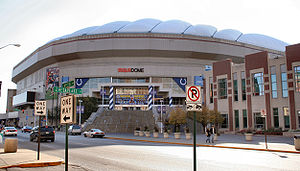 Under the administration of mayor Richard Lugar and then continuing with William Hudnut, Indianapolis was making a serious effort to reinvent itself into a 'Great American City'. In 1979, Indianapolis community leaders created the Indiana Sports Corp. in order to attract major sports events to central Indiana. The next year, Indianapolis Mayor William Hudnut appointed a committee to study the feasibility of building a new stadium that could serve as home to a pro football team and in 1982 construction on the Hoosier Dome (later renamed the RCA Dome) began. On December 18, 1983, The Colts played their final home game in the city of Baltimore. 27,934 fans showed up, 516 more fans than the crowd that had turned out for
their first home game in 1947. In February 1983, after relations between Irsay and the city of Baltimore had deteriorated significantly, Baltimore Mayor Schaefer asked the Maryland General Assembly to approve $15 million for renovation to Memorial Stadium
. The legislature did not approve the request until the following spring, after the Colts' lease had expired, and only half of that $15 million would go towards improvements that the Colts were seeking (The other half for the Orioles'). However, Baltimore reportedly did offer Irsay a generous $15 million loan at 6.5%, a guarantee of at least 43,000 tickets sold per game for six years, and the purchase of the team's Owings Mills training facility for $4 million. Despite numerous public reassurances that Irsay's ultimate desire was to remain in Baltimore, he nevertheless continued discussions with several cities hungry for an NFL franchise (New York
, Phoenix
, Indianapolis
, Birmingham
, Jacksonville and Memphis
) eventually narrowing the list of cities to two, Phoenix and Indianapolis. A real estate group in Phoenix, Arizona
along with Arizona Governor Bruce Babbitt and other top Arizona officials, had secretly met with Irsay early in January. Preliminary talks seemed promising, another meeting was scheduled. But when word of a second scheduled meeting leaked out and was reported by the Baltimore media on the Friday before the Super Bowl
, Irsay canceled. Meanwhile, Indianapolis and local real estate developer Robert Welch
, were lobbying the NFL to bring an expansion team to the city, with Welch as team owner. Welch had also had personal discussions with New Orleans Saints
owner John Mecom about buying the team and moving it to Indianapolis. In January 1984, NFL Commissioner Pete Rozelle
announced that expansion had been put on hold. As a result of that announcement, Indiana Pacers
' owner Herb Simon contacted Colts officials in order to take negotiations between the club and Indianapolis to the next level. Mayor Hudnut then assigned deputy mayor David Frick to begin secret negotiations with Colts counsel Michael Chernoff. On February 13, Colts representatives came to town to look at the Hoosier Dome construction. Colts owner Robert Irsay visited on February 23.
"He (Irsay) was visibly moved," former deputy mayor Dave Frick said commenting on Irsay's reaction to entering the brand new domed stadium. "Emotionally, he was making the move."
Meanwhile in Baltimore, the situation worsened. Eventually, the Maryland
legislature intervened and on March 27, one of its chambers passed legislation giving the city of Baltimore the right to seize ownership of the team by eminent domain
(An idea first floated in a memo written by Baltimore
Mayoral Aide Mark Wasserman). Robert Irsay said his move was a direct result of the legislation. Colts counsel Michael Chernoff would say of the eminent-domain bill "They not only threw down the gauntlet, but they put a gun to his head and cocked it and asked, 'Want to see if it's loaded?' They forced him to make a decision that day". Phoenix businessmen withdrew their offer the morning of March 28 and Irsay called Indianapolis Mayor William Hudnut that afternoon and began serious negotiations in order to move the team before the Maryland legislature could pass the bill. The city of Indianapolis offered the Colts owner a $12,500,000 loan, a $4,000,000 training complex, and the use of the brand new $77.5 million, 57,980 seat Hoosier Dome
. After Irsay agreed to the deal, the Indianapolis Mayor called John B. Smith, his friend, neighbor and chief executive officer of Mayflower Transit
, and 15 trucks were dispatched to the team's Owings Mills, Maryland training complex at 2:00 AM on March 29 because it was feared the franchise would be seized early the following morning. Workers loaded all of the team's belongings and the trucks left for Indianapolis. By 10:00 AM, the Colts were completely gone from Baltimore. Each of the Mayflower trucks took a slightly different route on the way to Indianapolis. This was done to confuse the Maryland police, who could've been called on to put a stop to the move. Once each van was at the Indiana state line, it was met by Indiana state troopers, who escorted each van to the Colts new home in Indianapolis. Later John Moag, Jr., chairman of the Maryland Stadium Authority, stated in sworn testimony before the U.S. Senate subcommittee responsible for the Fan Freedom and Community Protection Act: "It was the failure of our local (Baltimore) and state elected officials in Maryland to provide the Colts with a firm proposal for a new stadium that led Mr. Irsay to accept an offer from Indianapolis to play in a new dome in that city."
Baltimore Mayor Schaefer, who was promised a call by Irsay if the team was to move, appeared on the front page of the Baltimore Sun in tears. After the Colts left, he placed the building of a new stadium at the top of his legislative agenda.
Indianapolis Mayor Hudnut held a press conference March 29 to announce an agreement had been reached and the team was on its way to Indianapolis. The deal was sealed March 30 with approval by the Capital Improvement Board, which operated the Hoosier Dome.
, who recognized himself solely as a player for the Baltimore Colts until the day he died, with his estate defending that stand to this day. However, the NFL officially recognizes his achievements and records as the history of the Colts organization and as such are attributed to the current Colts organization and not the Ravens Organization.
The Baltimore Colts' final home game was played on December 18, 1983 against the then Houston Oilers
. In the middle of a snow storm in the dead of night on March 28, 1984, Irsay moved the Colts to Indianapolis. Irsay acted without the NFL's approval and due to the NFL's court loss to Al Davis in his lawsuit to move the Raiders to L.A. the NFL was in no mood to try to stop Irsay from moving the Colts. The New York Times stated that, "[b]y moving the Colts' franchise in such a murky manner, Robert Irsay almost makes Al Davis look like a silver and black knight."
Despite agreeing to do so in the official agreement to end all litigation between the City of Baltimore and the Irsay family, the Irsay family refused to endorse Baltimore's bid for an NFL expansion franchise in 1993. This decision, helped set in motion the Browns relocation to Baltimore. On November 6, 1995, Cleveland Browns owner Art Modell announced his intention to move Cleveland's team to Baltimore. The decision also triggered a flurry of legal activity. Finally, representatives of both cities and the NFL reached a settlement on February 9, 1996. It stipulated that the Browns' name, colors, and history of the franchise were to remain in Cleveland. It kept the Browns legacy in Cleveland, and Modell took his players and organization to Baltimore, which would be technically regarded as an expansion team. After the Browns relocated to Baltimore, Modell offered the Irsay family $5 million dollars for the rights to the Colts heritage. Jim Irsay replied that it would take at least $50 million dollars to relinquish the Colts name. Therefore, the new Baltimore team was named the Ravens after a fan vote.
. Jim Irsay
was named general manager of the team. Frank Kush
was head coach - until the final game when he was replaced by Hal Hunter
. Prior to the start of the season the team received 143,000 requests in two weeks for season tickets. The Colts had two first-round draft picks in 1984. They chose Leonard Coleman
and Ron Solt
. Coleman could not reach an agreement with the Colts until early in 1985, and spent 1984 playing in the U.S. Football League. Other notable picks that year included Kevin Call
in the 5th round and Eugene Daniel
in the 8th. The Colts finished the 1984 season with 4 wins and 12 losses.
was named head coach in January 1985. The Colts' first-round draft pick was linebacker Duane Bickett
. Their record was 5-11 but they finished the season strong, winning their last two games and averaging 5.0 yards per rushing attempt to lead the NFL. Rohn Stark
won his second NFL punting title.
in the first round, Jack Trudeau
in the 2nd and Bill Brooks
in the 4th round. More than 10,000 fans visited the new Colts Complex during an open house. The team had a terrible season, losing the first 13 games before winning the last 3. Dowhower was replaced by Ron Meyer
on Dec. 1.
. Two weeks into the regular season the players went on a 24-day strike. One week of games was cancelled, and for three weeks the teams played with replacement players. On Oct. 31 the Colts obtained Eric Dickerson
from the L.A. Rams for six draft picks and two players. The deal also involved Buffalo, sending Cornelius Bennett from the Colts to the Bills and Chuck Banks
came over from the Houston Oilers. The Colts finished the season 9-6 and clinched the AFC East title but lost to the Cleveland Browns
in the divisional playoff game.
. In the Colts' first Monday Night Football appearance they defeated Denver 55-23 before an ecstatic Halloween
night crowd. Dickerson became the first Colt since Alan Ameche
in 1955 to win the NFL rushing title. The Colts finished the season 9-7, and did not make the playoffs.
was the Colts' first-round draft pick. On Sept. 10 Dickerson surpassed the 10,000 rushing yards mark in his 91st career game - the quickest pace ever. The team again finished the season 9-7 but did not make the playoffs because of a 41-6 loss to the New Orleans Saints
in the last game.
, Andre Rison and draft picks to the Atlanta Falcons
for the first pick of the 1990 draft so they could choose Indianapolis native and quarterback Jeff George
. Eric Dickerson, after boycotting training camp and refusing to take physicals, was placed on the non-football injury list for six weeks. He was subsequently suspended four weeks for conduct detrimental to the team and forfeited $750,000 in wages and fines. The team finished the season 7-9.
in Round-Two. Rick Venturi
succeeded Ron Meyer as coach on Oct. 1. The team finished the season an NFL-worst 1-15. This record would not be broken until 2008 when the Detroit Lions went 0-16.
was, once again, named head coach of the Colts on Jan. 28. For the second time he led the Colts to an NFL-best eight-game, one-season turnaround. The Colts had two first-round draft picks and chose Steve Emtman
and Quentin Coryatt
. In April, the Colts traded Eric Dickerson to the Los Angeles Raiders, ending his sometimes rocky 4½ years with the team. On May 3, 1992, second-year defensive end Shane Curry was shot to death outside a Cincinnati nightclub in a dispute over a car blocking the nightclub's driveway. Then, in a disastrous public relations move, the Colts cut Mark Herrmann
the day after he led a season-opening victory at home over Cleveland - and one week after another popular player, Albert Bentley
, had been let go. The Colts finished the season 9-7.
was the Colts' first-round pick. They suffered all year from the lack of a running game, a passing game (20 quarters without a touchdown) or an effective defense. Amid dwindling crowds, the Colts wobbled into the offseason with a 4–12 record. They ended the year with a four-game losing streak, and had eight losses in their last nine games.
was drafted 2nd overall and Linebacker Trev Alberts
was drafted 5th overall in the NFL Draft
. The Colts brought in Bill Tobin
as 'Vice President of All Football Operations'. In March, Jeff George was traded to the Atlanta Falcons. Despite going undefeated in the preseason the Colts opened the regular season with an all-time low attendance of 47,372. The Colts finished 8-8 - out of the playoffs.
; and in the second round, Ken Dilger
. The Colts entered the season with high hopes. "Captain Comeback" Jim Harbaugh
became the starting quarterback in Week Three and ended the season as the NFL's top-rated passer. He led the "Cardiac Colts" to a 9-7 season and a trip to the playoffs. In the playoffs, the underdog Colts defeated the San Diego Chargers
and Kansas City Chiefs
. But, in the AFC championship game, they lost a heartbreaker to the Pittsburgh Steelers 20-16 when a last-second Hail-Mary pass was dropped in the end-zone by Aaron Bailey
.
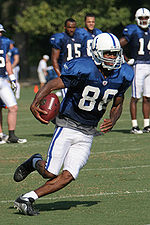 Syracuse Wide Receiver
Marvin Harrison
was selected by the Colts with the 19th pick in the 1996 NFL Draft
, a pick that was obtained in a trade that sent Jeff George
to the Atlanta Falcons
. In February, in another unpopular move, and despite the success of the 1995 season, the Colts offered head coach Ted Marchibroda only a one-year contract deal which he turned down. Marchibroda, whose 73 career victories with the Colts tied Shula, was replaced by Lindy Infante
. Also in February, Robert Irsay's wife, Nancy, and his son, Jim, filed petitions seeking guardianship of his estate while he remained incapacitated from a stroke he had suffered the previous November. The Colts finished 9-7, despite being plagued with injuries, and again made the playoffs. They lost, again to Pittsburgh, in a 42-14 thrashing.
, at age 37, became the youngest team owner in the NFL after his father's death and following a legal fight with his stepmother. He began working for the Colts in 1982, at the ticket counter and in public relations. He was named general manager in 1984 one month after the Colts moved to Indianapolis. He has since made the Colts his career and his only significant business venture and has been described as "The best small-market owner in the NFL." After his father died, Jim immediately began to put his own seal on the team. Other NFL team owners "credit his work as an owner and his personality as a significant reason for awarding Indianapolis the 2012 Super Bowl, a rare honor for a cold-weather city." Patriots Owner Robert Kraft: "I voted for Indianapolis because of Jim, because I like him and respect what he's done there."
. Adam Meadows
was acquired in the second round. Indicative of the ongoing frustration and futility of the team, was a confrontation between Jim Harbaugh and Buffalo Bills quarterback Jim Kelly
during which Harbaugh broke his hand. The injury-plagued Colts did not win a game until the 11th game of the season, and finished the year 3-13. Assuming responsibility for his team, Jim Irsay cleaned house in December, firing both coach Linde Infante and director of football operations Bill Tobin. He then named Bill Polian president of the team.
was hired as President to try and turn the team around. Polian was General Manager of the Buffalo Bills
from 1986 to 1993. "When Bill Polian
was promoted to the GM position, the Bills were suffering from back to back 2-14 seasons and fan interest was at an all-time low. Polian had expertly put the pieces together that would make the Bills a "championship caliber team," appearing in an NFL record, 4 straight Super Bowls. Because of his accomplishments, Bill Polian
won the NFL Executive of the Year Award twice, in 1988 and in 1991. Polian then became General Manager of the Carolina Panthers
from 1994 to 1996. He tried to create the quickest Super Bowl
winner in history, and nearly did so, building a team that went to the NFC Championship game in only its second year of existence.
As the Colts GM and President, Polian opted not to keep QB Jim Harbaugh
, who had led the team to the AFC Championship game following the 1995 season. Instead, he decided to build through the draft as the Colts would have the number 1 overall pick for 1998, and 2 of the most hyped quarterbacks would be coming out of college (Ryan Leaf
and Peyton Manning
). Polian chose Manning because the San Diego Chargers
would take Ryan Leaf
first; Leaf's abbreviated career appears to have shown the wisdom of Polian's choice.
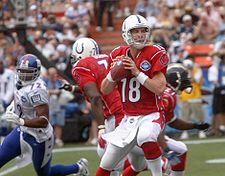 Jim Irsay
began to shape the Colts one year after assuming control from his father by firing Coach Lindy Infante
and hiring Bill Polian
to run the organization. Polian in turn hired Jim Mora
to coach the team and drafted University of Tennessee Volunteers
quarterback Peyton Manning
, the son of New Orleans Saints
legend Archie Manning
, with the first pick in the 1998 NFL Draft
.
, a surprise to many who thought they would take Ricky Williams
, the Heisman Trophy
winner. Two days before the draft, Marshall Faulk was traded to the St. Louis Rams
. Third-round pick, Brandon Burlsworth
, was killed in an automobile accident in Arkansas April 28. James caught on quickly and Manning and Marvin Harrison clicked as a potent passing combination. In October, Steve Muhammad's wife died as did the baby she was carrying when she went into premature labor following a car accident. After her death it was revealed that 10 days before the accident Muhammad had been arrested for battery on his pregnant wife. The Colts finished the season 13-3 - in what was the greatest one-year turnaround in NFL history - and won the AFC East. They hosted Indianapolis' first ever playoff game but were defeated by the eventual AFC Champion Tennessee Titans 19-16. In winning the division title, Manning, RB-Edgerrin James and WR-Marvin Harrison earned Pro Bowl honors, while K-Mike Vanderjagt won the NFL scoring title.
linebacker Rob Morris in the first round (28th overall) of the NFL Draft
. Both the team and their fans entered the 2000 season with high expectations. After winning the AFC East with a 13-3 record in 1999, and with young stars Peyton Manning and Edgerrin James just hitting their strides many predicted this would be the year the Colts would do even better and march straight to the Super Bowl. Jim Irsay even talked about winning three Super Bowls in a row. But things didn't quite turn out that way. The Colts' offense had impressive moments, sprinting through defenders with a no-huddle offense that left their opponents little time to catch their breath. But the Indianapolis defense was erratic - sometimes performing well but more often seeming unable to do what had to be done at crucial moments. Eight games into the season the Colts were 6-2, though some of the wins had been heart-stoppers with last-minute heroics overcoming earlier mistakes. Then they lost four of the next five games, and suddenly even making it into playoffs was in doubt. With three games left in the season the Colts only chance was to win all three - and they did. The back-to-back 10+-victory seasons were a first for the club since 1976-77. Manning (4,413) and James (1,709, 2,303) won the NFL passing, rushing and scrimmage yards titles. They earned a wildcard spot in the playoffs, but lost the game 23-17 to the Miami Dolphins
. The organization entered the off-season knowing the area most in need of attention was the defense.
was selected with the 30th pick in the NFL Draft
. The 2001 season was a major disappointment. However, Manning (4,131) and Harrison (109) had outstanding yardage and reception seasons. The team finished 6-10, managing only two wins in its last nine games. And, as in 2000, the defense took the brunt of the criticism. It ranked No. 30 in total yards allowed, tied for No. 26 in generating takeaways and No. 31 in points allowed. But the defense wasn't the only problem. The special teams' performance was often really bad and Peyton Manning was plagued by turnovers. The team was also hurt by injuries throughout the season, the most serious occurring on Oct. 25, when running back Edgerrin James tore his ACL in the sixth game of the 2001 season, and while backup Dominic Rhodes
proved a capable starter in becoming the first undrafted rookie to rush for over 1000 yards, the loss of James and a defense that gave up the most points in a season of any NFL team since 1981 proved too much to overcome. Coach Jim Mora was fired with one year remaining on his contract, reportedly due to a disagreement with general manager Bill Polian over defensive coordinator Vic Fangio. Tony Dungy, who had been fired as coach of the Tampa Bay Buccaneers, was given a five-year contract to coach the Colts on Jan. 22, 2002.
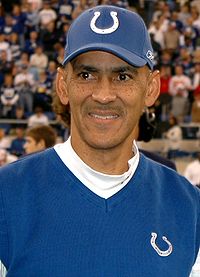 The firing of Mora led to the hiring of head coach Tony Dungy
, the former head coach of the Tampa Bay Buccaneers
. Colts owner Jim Irsay was so committed to bringing Tony Dungy aboard that he, not Colts GM Bill Polian, initiated the contact. Late on January 19, 2002, Irsay phoned Dungy at his home in Tampa. "I just wanted him to know from the start that there was no other coach on the planet I wanted to coach my football team," Irsay said. "Not Steve Spurrier
. Not Bill Parcells
." Dungy became the 35th coach in NFL history to earn 100 career victories (including playoffs) with a 38-20 win at Houston on Oct. 23, 2005. Dungy is only the sixth coach to win 100-plus regular-season games in the first 10 years as a head coach (113, George Seifert
; 105, Don Shula
; 103, John Madden
; 102, Dungy; 101, Joe Gibbs
; 101, Mike Ditka
).
He is the NFL's winningest head coach from 1999 to 2005 with a mark of 78-34 (30-18 with Tampa Bay
, 48-16 with Colts), and his .638 winning percentage ranks second among active head coaches. He has directed the Colts to 10-6, 12-4, 12-4 and 14-2 records, becoming the only coach in club history to produce 10-plus victories and playoff berths in the first four seasons with the team.
Dungy has seven career double-digit victory seasons and stands as the only NFL head coach to defeat all 32 NFL teams.
was selected by the Indianapolis Colts with the 11th selection in the 2002 NFL Draft. The Colts finished the season with a 10-6 record, earning a wild-card slot in the playoffs. In that game however, the Colts were humiliated with a 41-0 shutout at the hands of the New York Jets. Marvin Harrison had a stellar year, breaking several club and NFL records, but running back Edgerrin James was hampered by injuries most of the season. Peyton Manning was often brilliant but threw 19 interceptions, most of them in games the Colts went on to lose. In a troubling pattern, the Colts repeatedly squandered the first half of a game, often falling so far behind that despite second half rallies, they could not overcome the deficit. Freeney set an NFL rookie record in 2002 with 9 forced fumbles, three of which occurred in a single game against former Syracuse football player, Donovan McNabb
. Freeney was the runner up for the NFL Defensive Rookie of the Year award.
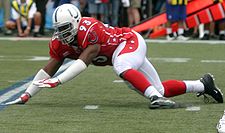 The Colts finished the season 14–5 - and won the AFC South with a regular season record of 12-4. Peyton Manning was named co-MVP of the NFL, along with Tennessee Titans quarterback Steve McNair, and In the playoffs, Manning and the Colts put an emphatic halt to talk they could not win the "big one," rolling over the Denver Broncos 41–10. They then defeated the Kansas City Chiefs, at Kansas City, 38–31. However, in the AFC title game at New England, the Patriots defense was all over the Colts. Manning threw only one touchdown pass and was intercepted four times. The Patriots won the game 24–14 putting an end to the hopes of the team and the fans that this was the season the Colts would go all the way.
was selected in the 2nd round (44th overall) of the 2004 NFL Draft
. The 2004 season ended almost exactly the way the 2003 season had, with the New England Patriots
pummeling the Colts, in the cold at Foxboro, and knocking them out of the playoffs. After a year in which the offense broke numerous team and league records, the Colts could manage to score only one field goal in their final game, losing 20-3. For the second year in a row, Peyton Manning was named the league's Most Valuable Player and his 49 regular-season touchdowns broke a record that Dan Marino
had held since 1984. The wide receiving trio of Marvin Harrison, Reggie Wayne
and Brandon Stokley
each had at least 10 touchdowns and more than 1,000 yards for the season - also a league first. Edgerrin James ended the season ranked fourth in the NFL with 1,548 yards, an average of 4.6 yards per carry. And although questions continued to surround the defense, Dwight Freeney led the league with 16 sacks.
Cornerback Marlin Jackson
was selected with the 29th overall pick of the 2005 NFL Draft
. Dungy led the Colts to a franchise-record 14 wins and a third consecutive divisional title, the fifth for the club in its 22-year Indianapolis era. The Colts became the 4th team in league history to win their first 13 games, but the season ended with a loss to the eventual Super Bowl Champion Pittsburgh Steelers
in the AFC Divisional Playoffs.
Manning and Marvin Harrison
broke Steve Young and Jerry Rice
's NFL record for most touchdowns by a quarterback-receiver tandem, notching their 86th in a Monday Night home game against St. Louis Rams
in week 6. Two weeks later Peyton Manning logged his first victory at New England against the Patriots
, ending a six game New England win streak. After defeating Jacksonville in week 14 they became only the fourth team in NFL history to reach a record of 13–0 and clinched home field advantage throughout the playoffs. The dream of a perfect record for the Colts ended the next week however as the San Diego Chargers
defeated the Colts 26–17.
In week 16, the Colts played without coach Tony Dungy
following the suicide of his son James earlier in the week. With the team resting most of their key players, the Colts lost their second straight to the eventual NFC Champion Seattle Seahawks
. Dungy returned to the sidelines for the last regular season game as the Colts beat the Arizona Cardinals
17–13 while resting most of the team's usual starters. The team's final record of 14–2 marked the best 16-game season in the franchise's history.
On January 15, 2006, the Colts were eliminated in the divisional round by the eventual Super Bowl champion Pittsburgh Steelers
, 21–18. Trailing 21–10 late in the game, the Colts regained possession and put 8 points on the board to make it 21–18. After a Jerome Bettis
fumble on the goal line, Nick Harper
picked up the fumble and almost ran it back, but was tackled at the 40 yard line by Ben Roethlisberger
. The Colts then drove down the field, only to have Mike Vanderjagt
miss a 46-yard field goal attempt wide right.
Joseph Addai
was selected in the first round (30th overall pick) of the 2006 NFL Draft
out of Louisiana State University
. After becoming the first team in NFL history to begin two consecutive seasons by winning nine games, the Colts proceeded to lose three of the next four, largely due to the league's worst run defense. However, they still captured their fourth consecutive AFC South
title by defeating the Cincinnati Bengals on Monday Night Football
in Week 15 of the season with, ironically, a strong showing from their defense. The Colts finished the season with a 12–4 record, giving them the number three seed in the playoffs. The record also marked their fifth consecutive season with ten victories or more. In week 13 against the Titans
, the quarterback-wide receiver combination of Manning to Harrison became the all time leader in touchdowns in NFL History.
In the Colts' first-round playoff game, they defeated the Kansas City Chiefs
23-8, despite Peyton Manning throwing three interceptions. The Colts defense managed to hold the Chiefs to 44 yards on the ground and 2 yards passing in the first half. The Chiefs did not earn a first down until 3:33 remained in the third quarter.
The Colts defeated the Baltimore Ravens
15-6 in the division playoff round, thanks to kicker Adam Vinatieri's five field goals and another impressive defensive showing. They played the New England Patriots
at home in the AFC title game for the rights to the Super Bowl; it was the Colts' third conference championship game in the Indianapolis era. The game marked the first time that the AFC title game was played in a domed stadium. After trailing at one point 21–3, the Colts stormed back, defeating the arch-rival Patriots for the third consecutive time. With a final score of 38–34, the 18-point comeback was the largest ever in an NFL conference championship game, and tied the record for the fourth largest NFL postseason comeback.
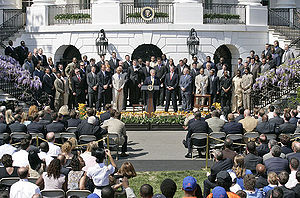 The Colts defeated the Chicago Bears 29-17 on February 4, 2007 in Dolphin Stadium
, after overcoming a rocky start that saw the Bears' Devin Hester return the opening kickoff 92 yards for a touchdown and the Colts' Peyton Manning throw an early interception. Rain fell throughout the game, for the first time in Super Bowl history, significantly contributing to the six turnovers committed by both teams in the first half. Peyton Manning
was awarded the MVP
after completing 25 of 38 passes for 247 yards and a touchdown, caught by Reggie Wayne.
Colts' running backs Dominic Rhodes
and Joseph Addai
combined for 190 rushing yards and a touchdown, while kicker Adam Vinatieri
converted 3 of his 4 field goal
attempts. Defensively, safety Bob Sanders
and cornerback Kelvin Hayden
each intercepted Bears' quarterback Rex Grossman
late in the game, with Hayden returning his for 56 yards and a touchdown, essentially sealing the Colts' victory.
Indianapolis became the first "dome team" to win a Super Bowl in an outdoor stadium, the first to win in the rain, and the first to win after having the statistically worst rushing defense in the league during the regular season. Tony Dungy
became only the third man to have won the Super Bowl as both a head coach {XLI} and a player {XIII
} (along with Tom Flores
{IV
-player, XV
and XVIII
-coach} and Mike Ditka
{VI
-player, XX
-coach}), as well as the first African-American Head Coach to win a Super Bowl (a distinction that would have occurred regardless of which team won, as the Bears were coached by another African-American coach, Lovie Smith
). With the win the Colts became the only team to date to win a Super Bowl from the AFC South. Also the Colts have made it to the Super Bowl three times, all three in Miami.
Anthony Gonzalez
was selected with the 32nd pick in the 2007 NFL Draft
. Earlier on February 19, 2007, the Colts placed the franchise tag
on Freeney following the expiration of his rookie contract. This move allowed Bill Polian and the Colts front office time to work on a long term contract. On July 13, 2007 Dwight Freeney signed a six-year, $72 million contract with $30 million in guarantees making Freeney the highest paid defensive player in the NFL. In 2007, the Colts finished 13-3, winning a club-record fifth straight division title and becoming the first NFL team with five consecutive seasons with 12+ victories and became one of four NFL teams to open three consecutive seasons with 5-0 starts in topping Tampa Bay
, 33-14. Indianapolis
joined Green Bay
(1929–31), Minnesota
(1973–75) and St. Louis (1999–2001) with three straight 5-0 starts. And then becoming the first team in 76 years to start three consecutive seasons with 7-0 starts. Peyton Manning
(288) broke the club record for career touchdown passes held by Johnny Unitas
(287), while Tony Dungy
notched his 74th win to break the franchise record he had shared with Don Shula
(73) and Ted Marchibroda
(73). The club fell in the Divisional Playoffs to San Diego, 28-24. Dungy became the only coach in Colts history to post 10+ wins and earn playoff appearances in six straight seasons.
was taken with the Colts second round selection (59th overall) in the 2008 NFL Draft
. On January 21, 2008 Tony Dungy announced he would return for at least one more season. The Colts also announced that Assistant Head Coach Jim Caldwell would be promoted to Associate Head Coach and would assume the position of Colts Head Coach whenever Tony Dungy decided to retire. The 2008 season was the Colts' inaugural season playing at the newly completed Lucas Oil Stadium. 2008 was the first season that the Colts did not win the AFC South title. After a 3-4 start on the season, the Colts went on a nine-game winning streak and finished the season at 12-4 and earned a wild card berth in the playoffs. They extended their league mark with six consecutive 12+ victory seasons. The club became the first in NFL history to win at least seven consecutive games in five consecutive seasons. QB Peyton Manning won his third AP NFL MVP award. Indianapolis fell in the wild card round in overtime at San Diego, 23-17.
In 2009, the Colts set new records by winning the first 14 games of the season, being seriously favored to go to the Super Bowl as early as October. The highlight of the regular season was a Week 10 match at home against the Patriots. Although outplayed for most of the game, the Colts obtained a 35-34 victory after a controversial 4th and 2 play by their opponent. Peyton Manning was sacked only ten times during the regular season, and Indianapolis had the opportunity to repeat New England's 16-0 2007 record. But during the Week 14 game against the New York Jets, Jim Caldwell suddenly decided to pull the starting line, allowing their opponent an easy win. Caldwell suffered a barrage of attacks from Colts fans and football experts for letting the team's chance at a perfect season get away. While the coach maintained that he wanted to rest the starters for the postseason, it was widely believed that he wanted to let the Jets (generally seen as a weak team) into the playoffs instead of Pittsburgh or another strong opponent. The Colts finished their regular season on January 3, 2010 by losing to the Buffalo Bills on a cold, snowy day.
With the #1 AFC seed, Indianapolis earned a first-round bye, and in the divisional matchup easily defeated the Ravens 20-3. Meanwhile, the Jets had made a completely unexpected playoff run by defeating Cincinnati and San Diego. They thus engaged the Colts in a rematch for the conference title. Running at full strength, Indianapolis handily defeated the Jets to make their second Super Bowl trip in three years.
Once again, the Colts would play the Super Bowl in Miami, this time against the New Orleans Saints. Despite a 10-0 lead in the first quarter, New Orleans managed to catch up, and in the 4th quarter Peyton Manning threw a pass that was intercepted by Saints CB Tracy Porter and returned for a touchdown. This and generally inconsistent play by the team would sink their chances at another championship, and the Saints would go on to win 31-17.
The Colts began 2010 with a stunning upset defeat in Houston, where the Texans beat them 34-24 and poor O-line performance caused Peyton Manning to take several hits. The next week, they hosted the Giants in the second Manning Bowl, and just like in 2006, Peyton easily overpowered his brother's team to win 38-14. The Colts racked up another impressive win in Denver the following week, with Manning throwing for 325 yards and three TD passes, but in Week 4 their second division match ended in defeat as Jaguars kicker Josh Scobee made a last-second FG to win 27-24. After this, the Colts won three in a row, beating Kansas City 19-9, Houston 30-17, and Washington 27-24. In Week 9, they donned throwback uniforms for only the second time ever (first was in 2002) and headed to Philadelphia. Indianapolis lost a hard-fought battle 27-24 as Manning was intercepted twice and WR Austin Collie
knocked unconscious and taken off the field on a stretcher. Following a 23-17 win over 2-6 Cincinnati, the Colts (who were quickly becoming injury-depleted) headed to New England for another battle with their old rivals. Manning threw four touchdown passes, but also three picks as the Patriots won 31-28. After this, the Colts lost at home to San Diego 36-14, a team that had repeatedly vexed them over the last decade (Manning's all-time record against the Chargers was 1-5). This was Indianapolis's first home loss since September 2008 and saw Manning throw four interceptions (against three touchdown passes). Even worse was a second home loss against the Cowboys (38-35) in which Manning threw another four picks and the injury-thinned team found itself at risk to not make the playoffs for the first time since 2001. The Colts next managed a desperate 30-28 win over Tennessee on Thursday Night Football. Following this, they beat Jacksonville at home 34-24 to regain the top of the division. After beating Oakland and Tennessee, the Colts secured the #3 seed and, despite the travails of the regular season, another division title.
Once again, the Colts faced down the Jets, but poor play calling by Jim Caldwell quickly brought their nightmare season to a close. During the 2011 off-season, Peyton Manning became the focus of controversy because of his advancing age (35 in March) and surgery for a herniated neck disc. The league was faced with a lockout in March-July that prevented Manning from using team training facilities to help recover, and as the preseason began he was left on the PUP list.
After missing the preseason, Manning was ruled out for the Colts' opener game in Houston. Things took a turn for the disastrous when he underwent yet another neck operation on September 7 that ensured he would miss at least 6-8 weeks of play. Taking over as starter was 15-year veteran Kerry Collins, who had been signed to the team after dissatisfaction with backup QBs Curtis Painter and Dan Orlovsky.
Heading down to Houston for Week 1, the Colts were completely lost without Manning and the Texans buried them 34-7. Opening at home against the Cleveland Browns, what would normally be an easy win turned into a 27-14 loss as Indianapolis again proved unable to accomplish anything with Kerry Collins under center. In Week 3, they hosted the Steelers on SNF. Despite all predictions of a one-sided route, the Colts defense battled Pittsburgh hard the whole game until the latter finally edged them in OT. With Kerry Collins benched in favor of Curtis Painter, the team traveled to Tampa Bay for a MNF match. Despite a valiant effort by Painter and the defense, Indianapolis lost 24-17 to remain winless at 0-4. DT Eric Foster
and OT Ben Ijalana were lost to season-ending injuries during the game. The Colts' fall into the abyss continued as they lost to Cincinnati 27-17. The next game saw them play New Orleans in what had been expected to be a rematch of Super Bowl XLIV, but instead the latter decided to set a franchise record on the backs of the hapless Colts squad and crushed them 62-7 with five TDs, only the third 62-7 game in NFL history.
retired on January 12, 2009. On January 13, Jim Caldwell who had been named his successor previously, was formally announced as the new head coach.
has tapped Colts Vice President of Football Operations Chris Polian to replace his father Bill Polian
when he retires. Irsay has also said multiple times that when Peyton Manning retires, his daughter, Vice President of Marketing and Community Relations division, Casey Irsay, will take over his seat as CEO.
It is a seven-level stadium with a retractable roof seating 63,000 for football. It can be reconfigured to seat 70,000 or more for NCAA basketball and football and concerts. It will cover 1800000 square feet (167,225.5 m²). The stadium features a retractable roof allowing the Colts to play home games outdoors for the first time since arriving in Indianapolis. Using FieldTurf
, the playing surface will be roughly 25 ft (7.6 m) below ground level. The new stadium was bigger and better than the RCA Dome in many ways, including: 58 permanent concession stands, 90 portable concession stands, 13 escalators, 11 passenger elevators, 800 restrooms, high definition scoreboards and replay monitors and 142 luxury suites. Other than being the home of the Colts, the stadium will host games in both the Men's
and Women's NCAA Basketball Tournament
s and will serve as the back up host for all NCAA Final Four
Tournaments. It will also host numerous events and conventions. The stadium will host the Super Bowl for the 2012 season (Super Bowl XLVI
) and has a potential economic impact estimated at $286,000,001.
In an ironic twist, a company based near Baltimore, "Controlled Demolition", oversaw the demolition of the RCA Dome. "It's a little ironic that a demolition company from Baltimore had the opportunity to take down the stadium to where the Colts fled when they left Baltimore," said Mark Loizeaux, president of Controlled Demolition and a Baltimore Ravens fan.
Indianapolis Colts
The Indianapolis Colts are a professional American football team based in Indianapolis. They are currently members of the South Division of the American Football Conference in the National Football League ....
are a professional football team based in Indianapolis, Indiana
Indianapolis, Indiana
Indianapolis is the capital of the U.S. state of Indiana, and the county seat of Marion County, Indiana. As of the 2010 United States Census, the city's population is 839,489. It is by far Indiana's largest city and, as of the 2010 U.S...
. They play in the AFC South
AFC South
The AFC South is a division of the National Football League's American Football Conference. It was created before the 2002 season when the league realigned divisions after expanding to 32 teams...
division of the National Football League
National Football League
The National Football League is the highest level of professional American football in the United States, and is considered the top professional American football league in the world. It was formed by eleven teams in 1920 as the American Professional Football Association, with the league changing...
. They have won 3 NFL championships and 2 Super Bowls.
The team began play in 1953 as the Baltimore Colts. A previous Baltimore Colts
Baltimore Colts (1947-50)
The Baltimore Colts were a professional American football team based in Baltimore, Maryland. The first team to bear the name Baltimore Colts, they were members of the All-America Football Conference from 1947–1949, and then joined the National Football League for one season before folding...
team played between 1947 and 1950. The original Colts team began play in 1946
1946 in sports
-American football:* All-America Football Conference begins play. Cleveland Browns win the championship by beating New York Yankees 14-9.* Chicago Bears win the NFL crown by defeating the New York Giants 24-14 in New York.-Association football:England...
as the Miami Seahawks
Miami Seahawks
The Miami Seahawks were a professional American football team based in Miami, Florida. They played in the All-America Football Conference for one season, 1946, before folding...
, a member of the upstart All-America Football Conference
All-America Football Conference
The All-America Football Conference was a professional American football league that challenged the established National Football League from 1946 to 1949. One of the NFL's most formidable challengers, the AAFC attracted many of the nation's best players, and introduced many lasting innovations...
. They relocated to Baltimore as the Colts in 1947, and joined the NFL in 1950
1950 NFL season
The 1950 NFL season was the 31st regular season of the National Football League. The merger with the All-America Football Conference expanded the league to 13 teams. Meanwhile, television brought a new era to the game. The Los Angeles Rams became the first NFL team to have all of its games – both...
after the AAFC merged into the older league. However, the franchise folded after one NFL season. After fans in Baltimore protested, the NFL formed another Colts team out of the ashes of the failed Dallas Texans
Dallas Texans (NFL)
The Dallas Texans played in the National Football League for one season, 1952, with a record of 1–11.-History:After the 1951 NFL season, the financially troubled New York Yanks franchise were put on the market. Ted Collins had founded that franchise in 1944 as the Boston Yanks, moved it to New...
for the 1953
1953 NFL season
The 1953 NFL season was the 34th regular season of the National Football League. The names of the American and National conferences were changed to the Eastern and Western conferences....
season. While in Baltimore, the club won four NFL Championships, including Super Bowl V
Super Bowl V
Super Bowl V was an American football game played on January 17, 1971, at the Orange Bowl in Miami, Florida, to decide the National Football League champion following the 1970 regular season...
.
Franchise history
The Colts were the first NFL team to have cheerleaders, and a marching band.The Colts franchise was officially created in 1953, but can trace its history much earlier than that, to before the NFL actually began: its earliest predecessor was the Dayton Triangles
Dayton Triangles
The Dayton Triangles were an original franchise of the American Professional Football Association in 1920. The Triangles were based in Dayton, Ohio, and took their nickname from their home field, Triangle Park, which was located at the confluence of the Great Miami and Stillwater Rivers in north...
, a founding member of the NFL that was originally created in 1913. That team went through the following changes:
- Dayton TrianglesDayton TrianglesThe Dayton Triangles were an original franchise of the American Professional Football Association in 1920. The Triangles were based in Dayton, Ohio, and took their nickname from their home field, Triangle Park, which was located at the confluence of the Great Miami and Stillwater Rivers in north...
relocated and renamed Brooklyn DodgersBrooklyn Dodgers (NFL)The Brooklyn Dodgers were an American football team that played in the National Football League from 1930 to 1943, and in 1944 as the Brooklyn Tigers. The team played its home games at Ebbets Field. In 1945, because of financial difficulties, the team was merged with the Boston Yanks...
in 1930. - Changed name to Brooklyn Tigers in 1944. In the same year, the Boston YanksBoston YanksThe Boston Yanks were a National Football League team based in Boston, Massachusetts that played from 1944 to 1948. The team played its home games at Fenway Park. Games that conflicted with the Boston Red Sox schedule were held at the Manning Bowl in Lynn, Massachusetts...
are founded. - Merged with Boston Yanks in 1945 as the wartime "The Yanks."
- Franchise canceled in 1945 by league and the team's temporary merger with the Boston Yanks is made permanent, as a parallel team (AAFC New York YankeesNew York Yankees (AAFC)The New York Yankees were a professional American football team that played in the All-America Football Conference from 1946 to 1949. The team played in Yankee Stadium in the Bronx and often played in front of sold-out crowds . They were owned by Dan Topping, who brought many of his Brooklyn...
) is founded by the Tigers' former owner, Dan Topping. - Miami Seahawks of the AAFC are purchased and relocated to Baltimore and renamed the Colts (Originally wearing Green and Silver). This franchise was dissolved by the league on January 18, 1951.
- Boston Yanks move to New York in 1949 and become New York YanksNew York YanksThe New York Yanks American football team played in the National Football League under that name in the 1950 and 1951 seasons. In 1949, Boston Yanks owner Ted Collins had requested the NFL to fold his Boston team and give him a new one in New York City...
, absorbing much of the Yankees' roster the next year. - New York Yanks move to Dallas in 1952 as Dallas TexansDallas Texans (NFL)The Dallas Texans played in the National Football League for one season, 1952, with a record of 1–11.-History:After the 1951 NFL season, the financially troubled New York Yanks franchise were put on the market. Ted Collins had founded that franchise in 1944 as the Boston Yanks, moved it to New...
. - Texans become a road team halfway through the 1952 season and are dissolved shortly thereafter.
- Dallas TexansDallas Texans (NFL)The Dallas Texans played in the National Football League for one season, 1952, with a record of 1–11.-History:After the 1951 NFL season, the financially troubled New York Yanks franchise were put on the market. Ted Collins had founded that franchise in 1944 as the Boston Yanks, moved it to New...
franchise was moved to Baltimore on January 23, 1953 where, resurrecting the “Colts” nickname, they kept the Texans team colors of blue and white.
The AAFC Baltimore Colts
On December 28, 1946, the bankrupt Miami SeahawksMiami Seahawks
The Miami Seahawks were a professional American football team based in Miami, Florida. They played in the All-America Football Conference for one season, 1946, before folding...
of the All-America Football Conference
All-America Football Conference
The All-America Football Conference was a professional American football league that challenged the established National Football League from 1946 to 1949. One of the NFL's most formidable challengers, the AAFC attracted many of the nation's best players, and introduced many lasting innovations...
were purchased and relocated in Baltimore by a group headed by Bob Rodenberg. As the result of a contest in Baltimore, won by Charles Evans of Middle River, Md., the team was renamed the “Colts
Baltimore Colts (1947-50)
The Baltimore Colts were a professional American football team based in Baltimore, Maryland. The first team to bear the name Baltimore Colts, they were members of the All-America Football Conference from 1947–1949, and then joined the National Football League for one season before folding...
.” On September 7, 1947, wearing the green and silver uniforms, the Colts, under Head Coach Cecil Isbell, won their initial AAFC game, 16-7, over the Brooklyn Dodgers. The team concluded its inaugural season before a record Baltimore crowd of 51,583 by losing to the New York Yankees, 21-7. The Colts finished with a 2-11-1 record, good for a fourth place finish in the Eastern Division. The Colts completed the 1948 season with a 7-8 record, tying the Buffalo Bills for the division title. The Colts compiled a 1-11 mark in 1949. Y. A. Tittle
Y. A. Tittle
Yelberton Abraham Tittle , better known as Y. A. Tittle, is a former football quarterback in the National Football League and All-America Football Conference who played for the Baltimore Colts, San Francisco 49ers, and the New York Giants...
was the Colts starting quarterback.
The AAFC and NFL merged in 1950, and the Colts joined the NFL. After posting a 1-11 record for the second consecutive year, the franchise was dissolved by the league on January 18, 1951, because of its failing financial condition. But many Baltimore fans protested the loss of their team and continued to support the marching band
Marching band
Marching band is a physical activity in which a group of instrumental musicians generally perform outdoors and incorporate some type of marching with their musical performance. Instrumentation typically includes brass, woodwinds, and percussion instruments...
(the second in professional football, after that of the Washington Redskins
Washington Redskins
The Washington Redskins are a professional American football team and members of the East Division of the National Football Conference in the National Football League . The team plays at FedExField in Landover, Maryland, while its headquarters and training facility are at Redskin Park in Ashburn,...
) and fan club
Fan club
A fan club is a group that is dedicated to a well-known person, group, idea or sometimes even an inanimate object . Most fan clubs are run by fans who devote considerable time and resources to supporting them. There are also "official" fan clubs that are run by someone associated with the person...
, both of which remained in operation and worked for the team's revival.
NFL Dallas Texans
After two seasons without professional football, NFL Commissioner Bert BellBert Bell
De Benneville "Bert" Bell was the National Football League commissioner from 1946 until his death in 1959. As commissioner, he helped chart a path for the NFL to facilitate its rise in becoming the most popular sports attraction in the United States...
challenged Baltimore in December 1952 to sell 15,000 season tickets within six weeks in order to re-enter the NFL. That 15,000-ticket quota was reached in four weeks and three days. On January 23, 1953, under the principal ownership of Carroll Rosenbloom
Carroll Rosenbloom
Carroll Rosenbloom was an American entrepreneur and former owner of two professional football teams, the Baltimore Colts and the Los Angeles Rams....
, the NFL’s Dallas Texans
Dallas Texans (NFL)
The Dallas Texans played in the National Football League for one season, 1952, with a record of 1–11.-History:After the 1951 NFL season, the financially troubled New York Yanks franchise were put on the market. Ted Collins had founded that franchise in 1944 as the Boston Yanks, moved it to New...
franchise was moved to Baltimore where, keeping the “Colts” nickname, the
Texans team colors of blue and white were inherited. This is the franchise that exists today in Indianapolis.
The Texans had a long and winding history; they started as the Boston Yanks
Boston Yanks
The Boston Yanks were a National Football League team based in Boston, Massachusetts that played from 1944 to 1948. The team played its home games at Fenway Park. Games that conflicted with the Boston Red Sox schedule were held at the Manning Bowl in Lynn, Massachusetts...
in 1944 and merged with the Brooklyn Tigers (previously known as the Dayton Triangles
Dayton Triangles
The Dayton Triangles were an original franchise of the American Professional Football Association in 1920. The Triangles were based in Dayton, Ohio, and took their nickname from their home field, Triangle Park, which was located at the confluence of the Great Miami and Stillwater Rivers in north...
, an original NFL team established in the 1910s) for the 1945 season before moving to New York
New York City
New York is the most populous city in the United States and the center of the New York Metropolitan Area, one of the most populous metropolitan areas in the world. New York exerts a significant impact upon global commerce, finance, media, art, fashion, research, technology, education, and...
as the Bulldogs in 1949. The team then became the Yanks
New York Yanks
The New York Yanks American football team played in the National Football League under that name in the 1950 and 1951 seasons. In 1949, Boston Yanks owner Ted Collins had requested the NFL to fold his Boston team and give him a new one in New York City...
in 1950, and many of the players from the New York Yankees
New York Yankees (AAFC)
The New York Yankees were a professional American football team that played in the All-America Football Conference from 1946 to 1949. The team played in Yankee Stadium in the Bronx and often played in front of sold-out crowds . They were owned by Dan Topping, who brought many of his Brooklyn...
of the All-America Football Conference
All-America Football Conference
The All-America Football Conference was a professional American football league that challenged the established National Football League from 1946 to 1949. One of the NFL's most formidable challengers, the AAFC attracted many of the nation's best players, and introduced many lasting innovations...
were added to the team. The Yanks moved to Dallas after the 1951 season, but played their final two "home" games of the 1952 season at the Rubber Bowl
Rubber Bowl
The Rubber Bowl is a stadium in Akron, Ohio primarily used for American football. From 1940 to 2008, it served as the home field of the University of Akron's Zips football team...
in Akron, Ohio
Akron, Ohio
Akron , is the fifth largest city in the U.S. state of Ohio and the county seat of Summit County. It is located in the Great Lakes region approximately south of Lake Erie along the Little Cuyahoga River. As of the 2010 census, the city had a population of 199,110. The Akron Metropolitan...
.
NFL Baltimore Colts
Although debatable from an historical perspective, neither the Colts franchise or the National Football League consider the Triangles/Dodgers/Tigers/Seahawks/Yanks/Bulldogs/Yankees/Texans teams as part of the modern Colts franchise.1953 season
The Colts began the season with a blockbuster trade, swapping five Baltimore players for 10 Cleveland Browns. Among the players who came over were future coach Don ShulaDon Shula
Donald Francis "Don" Shula is a former American football cornerback and coach.He is best known as coach of the Miami Dolphins, the team he led to two Super Bowl victories, and to the National Football League's only perfect season. Shula was named 1993 Sportsman of the Year by Sports Illustrated....
; Bert Rechichar
Bert Rechichar
Albert Daniel Rechichar was an American football defensive back who played with the National Football League's Cleveland Browns, Baltimore Colts and Pittsburgh Steelers from 1952 to 1960, and the American Football League's New York Titans in 1961...
, Carl Taseff
Carl Taseff
Carl N. Taseff was an American football player and assistant coach.-College:Taseff played college football at John Carroll University and was the roommate of Don Shula's. Taseff was the roommate of Don Shula at John Carroll University and they were teammates with the Browns and Colts...
and Art Spinney
Art Spinney
Arthur F. Spinney Jr. was a guard who played nine seasons with the Baltimore Colts in the National Football League. Spinney attended Boston College...
, among others. The 2nd incarnation of the Baltimore Colts first took the field at Memorial Stadium on September 27, with Coach Keith Molesworth
Keith Molesworth
Keith Frank Molesworth was an American football player and coach. He also played and managed in minor league baseball....
. The Colts would stun the Bears that day 13-9 to get the new franchise off on the right foot. However, the Colts struggled to a 3-9 season in their inaugural year.
1954 season
The young Colts continued to struggle in their first season under Coach Weeb Ewbank, duplicating their 3-9 inaugural season record.1955 season
The team got off to a 3-0 start. However, the team would only win 2 more games the rest of the season finishing with a 5-6-1 record.1956 season
QB George Shaw was lost to injury in the 4th game of the season. The backup named Johnny UnitasJohnny Unitas
John Constantine Unitas , known as Johnny Unitas or "Johnny U", and nicknamed "The Golden Arm", was a professional American football player in the 1950s through the 1970s, spending the majority of his career with the Baltimore Colts. He was a record-setting quarterback, and the National Football...
took his place. The Colts split the 8 remaining games to finish with a 5-7 record.
1957 season
Johnny Unitas' first full season as starting QB, the Colts began with a 3-0 start. After losing 3 in a row, then winning 4 in a row, the Colts at 7-3 would lose their final 2 games of the season and finish 7-5.1958 season
Winning their first 6 games; on the way to a 9-1 start the Colts won the Western Division Title. However the Colts lost their final 2 games of the season.NFL Championship Game
On December 28 Baltimore faced the New York Giants in the NFL Championship game at Yankee Stadium. The Colts went to halftime with a 14-3 lead after scoring 2 TDs in the 2nd Quarter. The 4th Quarter would end tied at 17, meaning the NFL would have to use overtime for the first time ever. The rule was simple; the first team to score would be victorious. Unitas hit WR Raymond Berry with a clutch pass that gave the Colts a 1st down in Giants territory. The Colts continued to drive down to the 1-yard line, with first and goal. Unitas handed off to Alan Ameche who dove across the goal line to give Baltimore a 23-17 win, in what many call the greatest game ever playedNFL Championship Game, 1958
The 1958 National Football League Championship Game was played on December 28, 1958 at Yankee Stadium in New York City. It was the first ever National Football League playoff game to go into sudden death overtime. The final score was Baltimore Colts 23, New York Giants 17. The game has since...
. The game would serve as a launching point for the NFL's remarkable boom in popularity.
1959 season
The Colts use a season ending 5-game winning streak to win their 2nd straight Western Division Championship with a 9-3 record.NFL Championship Game
Baltimore had a Championship Game rematch with New York Giants, with the game this time being played at Baltimore's Memorial Stadium. For the first 3 quarters the Colts fell behind 9-7. Johnny Unitas led the Colts back in the 4th Quarter scoring 24 unanswered points, and Baltimore to claim their 2nd straight NFL Championship with a 31-16 victory.1960 season
The Colts were a strong contender for the Western Division Title again with a 6-2 start. However, the Colts would drop their final 4 games as their season ended with a disappointing 6-6- record.1962 season
The Colts struggled finishing with a 7-7 record. Following the season the Colts fired Coach Weeb Ewbank, who shortly thereafter, would be hired to coach the New York JetsNew York Jets
The New York Jets are a professional football team headquartered in Florham Park, New Jersey, representing the New York metropolitan area. The team is a member of the Eastern Division of the American Football Conference in the National Football League...
of the AFL
American Football League
The American Football League was a major American Professional Football league that operated from 1960 until 1969, when the established National Football League merged with it. The upstart AFL operated in direct competition with the more established NFL throughout its existence...
. Ewbank was replaced by Don Shula
Don Shula
Donald Francis "Don" Shula is a former American football cornerback and coach.He is best known as coach of the Miami Dolphins, the team he led to two Super Bowl victories, and to the National Football League's only perfect season. Shula was named 1993 Sportsman of the Year by Sports Illustrated....
who had played with Colts in their inaugural season of 1953.
1963 season
The Colts struggled early in their first season under Coach Don Shula. However they would end the season strong by winning their final 3 games to finish with an 8-6 record.1964 season
After losing the first game of the season to the Vikings the Colts went on a 10-game winning streak on the way to winning the Western Division Championship with a 12-2 record. Johnny Unitas wins the NFL MVP after amassing 2,824 yards passing.NFL Championship Game
The Colts faced the Cleveland Browns. However, nothing would go right in Cleveland as the Colts were shut-out 27-0.1965 season
The Colts appear to be a strong contender for the Western Division Championship again. However injuries to QB Johnny Unitas and back up Gary Cuzzo, forced the Colts to turn to Tom Matte in a must win season ending game in Los Angeles against the Rams. Wearing a plastic wrist brace that carried the team's list of plays, Matte led Baltimore to a 20-17 victory that gave the Colts a share of the Western Division Title at 10-3-1 with the Green Bay Packers. The Colts and Packers would battle into overtime with the game tied at 10. However, there was no magic for the Colts this time as the Packers won the game on a FG a little over a minute into the 2nd overtime period.1967 season
Led by Johnny Unitas who wins the NFL MVP with 3,428 yards passing the Colts tear through the NFL going undefeated through the first 13 games of the season with a record of 11-0-2. However, the Colts still needed to beat the Rams in Los Angeles to claim the Coastal Division Championship. Unfortunately for the Colts the Rams would win the game 34-10 to win the Division title and advance to the postseason, as the Colts went home despite an 11-1-2 record.1968 season
Johnny Unitas misses most of the season with an elbow injury. The Colts backup QB Earl Morrall steps in and wins the NFL MVP award, while leading the Colts on a record breaking 13-1 season. While Morrall led the offense, the Colts defense shut out 3 opponents while allowing a record low 144 points. In the Divisional Playoff round the Colts beat the Minnesota Vikings 24-14 before a sold out crowd at Memorial Stadium.Super Bowl III
Going into Super Bowl III the Colts were favored by 18 points. They faced the New York Jets who were coached by their former head coach Weeb Ewbank. The Jets came in confident as QB Joe Namath guaranteed a victory. The first half was a defense struggle as the Jets had a 16-0 lead early in the 4th Quarter. Desperate to make a comeback the Colts put Johnny Unitas into the game, and he would get the Colts on the board with a long touchdown drive. With less than 4 minutes the Colts recovered an on side kick to keep their hopes alive. However, the Jets completed the biggest upset in NFL history 16-7.1969 season
Still suffering from a Super Bowl hangover the Colts stumble out of the gates losing their first 2 games. The Colts struggled to finish with an 8-5-1 record. Following the season Coach Don Shula who fell out of favor with owner Carroll Rosenbloom was allowed to resign and he took the coaching job with Miami Dolphins. Assistant Coach Don McCaffertyDon McCafferty
Donald William McCafferty was an American football coach who, in his first year as head coach of the Baltimore Colts, led the team to a victory in Super Bowl V....
would replace Shula.
1970 season
Prior to the 1970 season, Rosenbloom, Art ModellArt Modell
Arthur B. Modell is an American businessman, entrepreneur and former National Football League team owner. He owned the Cleveland Browns franchise from 1961–1995 and the Baltimore Ravens franchise from 1996–2004. Modell is the grandson of the late Morris Modell who founded the northeast...
of the Browns, and Art Rooney
Art Rooney
Arthur Joseph "Art" Rooney, Sr. , often referred to as "The Chief", was the founding owner of the Pittsburgh Steelers American football franchise in the National Football League.-Family history:...
of the Pittsburgh Steelers
Pittsburgh Steelers
The Pittsburgh Steelers are a professional football team based in Pittsburgh, Pennsylvania. The team currently belongs to the North Division of the American Football Conference in the National Football League . Founded in , the Steelers are the oldest franchise in the AFC...
agreed to have their teams join the ten AFL
American Football League
The American Football League was a major American Professional Football league that operated from 1960 until 1969, when the established National Football League merged with it. The upstart AFL operated in direct competition with the more established NFL throughout its existence...
teams in the AFC as part of the AFL-NFL merger giving each conference an equal amount of teams, and divisions. The Colts win the Eastern Division while posting an 11-2-1 record. During the season the Colts would get revenge for Super Bowl III, by beating the New York Jets, who are now a division rival. In the Divisional Playoffs the Colts defeated the Cincinnati Bengals 17-0 before a raucous crowd at Memorial Stadium. The Colts then defeated the Raiders 27-17 to advance to the Super Bowl.
Super Bowl V
Baltimore returned to the Super Bowl and their opponents were the Dallas CowboysDallas Cowboys
The Dallas Cowboys are a professional American football franchise which plays in the Eastern Division of the National Football Conference of the National Football League . They are headquartered in Valley Ranch in Irving, Texas, a suburb of Dallas...
. The Cowboys jumped out to a 6-0 lead on 2 FGs before the Colts tied it on a 75-yard pass from Johnny Unitas to John Mackey
John Mackey (American football)
John Mackey was an American Football tight end who grew up in Roosevelt, Long Island and played for the Baltimore Colts and the San Diego Chargers . He played college football at Syracuse University...
. However the Colts had the PAT blocked and the game remained tied. The Cowboys would jump out in front again and went into the 4th Quarter holding a 13-6 lead into halftime. Earl Morrall relieved an injured Unitas in the 2nd half the game as the two teams kept fumbling the ball back-and-forth in a game that got the nickname blunder bowl as both teams combined had 11 turnovers. The Colts would tie the game midway through the final period on a 2-yard plunge by RB Tom Nowatzke
Tom Nowatzke
Thomas Matthew "Tom" Nowatzke was a National Football League running back from 1965 through 1972. He scored a touchdown for the Baltimore Colts in Super Bowl V. He was inducted into the National Polish-American Sports Hall of Fame in 2008.-References:...
. With less than 2 minutes left Cowboys RB Dan Reeves
Dan Reeves
Daniel Edward Reeves is a former American football player and head coach. He has participated in more Super Bowls as player/assistant coach/Head Coach than anyone else...
fumbled the ball setting up the Colts in Dallas territory. Baltimore would win the game on a 32-yard FG from Jim O'Brien
Jim O'Brien (American football)
Jim O'Brien is a former American football placekicker in the National Football League. He played for the Baltimore Colts from 1970 to 1972 and the Detroit Lions in 1973. He also played wide receiver, catching the bulk of his career passes during the 1972 season while still performing his kicking...
with 5 seconds left.
1971 season
The Colts settled for the Wild Card after finishing the season at 10-4. In the Divisional Round the Colts would defeat the Browns in Cleveland 20-3 to advance to the AFC Championship Game. The Dolphins coached by Don Shula shut out the Colts 21-0 ending the Colts hopes for a 2nd straight Super Bowl.1972 season
The Colts got off to a 1-4 start and Coach Don McCafferty was fired. The Colts would go 4-5 in their final 9 games under John SanduskyJohn Sandusky
John Thomas Sandusky, Jr. was an American football offensive and defensive tackle in the National Football League. He played for the Cleveland Browns and the Green Bay Packers ....
to finish with a 5-9 record, their first losing mark in 16 years. Following the season the Colts Johnny Unitas was traded to the San Diego Chargers. However, Unitas would not leave without coming off the bench his final game at Memorial Stadium. Leading the Colts on a 55-yard Touchdown pass late in the 4th Quarter to help beat the Buffalo Bills 35-7. Memorial Stadium gave the legend a standing ovation as a small plane flying overhead carried a banner reading "Unitas We Stand".
1973 season
Howard SchnellenbergerHoward Schnellenberger
Howard Schnellenberger is an American football coach at both the professional and college level. He is currently in his final season as head coach of Florida Atlantic University, having announced his retirement on August 11, 2011, effective at the end of the 2011 season...
becomes the Colts head coach. The young Colts struggled early with QB Marty Domres
Marty Domres
Martin Francis Domres is a former American collegiate and professional football player. From Columbia University, he was drafted in the first round of the Common Draft as a quarterback by the American Football League's San Diego Chargers. Domres played in nine professional football seasons from...
during a 2-10 start. However, in the final games of the season the rookie Bert Jones
Bert Jones
Bertram Hays "Bert" Jones is a former LSU and NFL quarterback who played for the then Baltimore Colts and, briefly, the Los Angeles Rams. At Ruston High School, he was given the nickname, "The Ruston Rifle"...
replaced Domres, and led the Colts to a stunning upset of the Miami Dolphins as the Colts won their final 2 games to end the season at 4-10.
1974 season
The Colts would get off to a 0-3 start when Coach Howard Schnellenberger is fired and replaced by Joe Thomas, the Colts would not perform any better under Thomas compiling a miserable 2-12 season.1975 season
Under new coach Ted MarchibrodaTed Marchibroda
Theodore "Ted" Joseph Marchibroda is a former American football quarterback and head coach in the National Football League.-Player:...
the Colts would get off to a 1-4 start. However, the Colts would start winning as QB Bert Jones, and RB Lydell Mitchell
Lydell Mitchell
Lydell Douglas Mitchell , is a former professional American football player. He played running back in the National Football League for the Baltimore Colts, San Diego Chargers and Los Angeles Rams spanning 1972-1980....
came of age and led the Colts on a 7 game winning streak. The Colts would go on to win their last game of the season to claim the AFC East with a 10-4 record. However, in the Divisional Playoffs the young Colts were no match for the Steelers in Pittsburgh, suffering a season ending 28-10 loss.
1976 season
Ted Marchibroda resigned as head coach. However, after players threatened mutiny Marchibroda was rehired. The Colts would go on to have a stellar season led by QB Bert Jones who wins the NFL MVP, by passing for 3,104 yards. The Colts put together a solid season and win the AFC East with an 11-3 record. However in the Divisional Playoffs the Colts were defeated again by the Pittsburgh Steelers 40-14.1977 season
After a 9-1 start the Colts lose 3 straight and face a must win game for the AFC East title in the final game of the year at Memorial Stadium against the New England Patriots. The game would be a shoot out as the Colts won their 3rd straight Division Title with a 30-24 victory to finish with a 10-4 record. In the Divisional Playoff the Colts would host the Oakland Raiders in a back and forth battle that went into double overtime. However, the Colts would lose to the Raiders 37-31.1978 season
The Colts march to a 4th straight AFC East Title was over before it began as QB Bert Jones was injured and the Colts lost their first 2 games by a combined 80-0 score. Jones would return but would be injured again as the Colts defense gave up 421 points in a disappointing 5-11 season.1979 season
Veteran QB Greg LandryGreg Landry
Gregory Paul Landry is a former American football player and coach who played quarterback in the National Football League from 1968 to 1981 and again in 1984...
replaces Bert Jones as starter, as the Colts continue to struggle finishing with another 5-11 record. Following the season Coach Ted Marchibroda would be fired, and replaced by Mike McCormick
Mike McCormick
Michael or Mike McCormick may refer to:*Michael E. McCormick*Mike McCormick , Scottish baseball player*Mike McCormick , American baseball player...
.
1980 season
Bert Jones regains the starting job at Quarterback, and has a solid 3,134 yard passing season. However the Colts would play inconsistent football as the defense struggle during an unrewarding 7-9 season.1981 season
The Colts started the season on the right foot winning their first game of the season in New England 29-28 over the Patriots. However, the Colts would not win again until they played the Patriots at home in the final game of the season compiling a miserable 2-14 season, in which the Colts allowed 533 points, the most ever in a single NFL season. Following the season QB Bert Jones is traded to the Los Angeles Rams despite a strong 3,094-yard season. In addition Coach Mike McCormick is fired and replaced by Frank KushFrank Kush
Frank Joseph Kush is a former American football player and coach. He served as the head coach at Arizona State University from 1958 to 1979, compiling a record of 176–54–1...
.
1982 season
Attendance began to dwindle at Memorial Stadium as the Colts struggled during a season interrupted by a 2-month strike. Actually the strike provided relief for the Colts, as the possibly avoided one of the worst seasons in NFL history. The Colts went winless while tying 1 game in the 9-game season.1983 season
With the number 1 pick in the NFL Draft the Colts selected QB John ElwayJohn Elway
John Albert Elway, Jr. is a former American football quarterback and currently is the executive vice president of football operations for the Denver Broncos of the National Football League . He played college football at Stanford and his entire professional career with the Denver Broncos...
from Stanford. However, Elway refused to play for the Colt's head coach Frank Kush. Fearful the Colts would get nothing for his rights the Colts traded John Elway to the Denver Broncos
Denver Broncos
The Denver Broncos are a professional American football team based in Denver, Colorado. They are currently members of the West Division of the American Football Conference in the National Football League...
. After starting the season with an overtime win in New England over the Patriots the Colts faced the Broncos in their home opener where Baltimore fans were hostile to Elway. However, fans did get to see what they missed when Elway lead the game winning drive in the 4th quarter. Despite losing out on Elway, and 1-year suspension for gambling to QB Art Schlichter
Art Schlichter
Arthur Ernest Schlichter is a retired college and professional American football quarterback, sometimes known for his compulsive gambling and the legal problems especially gambling that arose from it...
, the Colts managed to compile a commendable 7-9 record.
Ownership's discontent
As far back as November 1971, Carroll Rosenbloom announced that the Colts would not return to Memorial StadiumMemorial Stadium (Baltimore)
Memorial Stadium was a sports stadium in Baltimore, Maryland, that formerly stood on 33rd Street on an over-sized block also bounded by Ellerslie Avenue , 36th Street , and Ednor Road...
when their lease ran out following the 1972 season and that he was not interested in negotiating with the city anymore. He wanted out of Baltimore for a few reasons — money, problems with Baltimore Orioles ownership and a running feud with the Baltimore press. Will Keland, a real estate investor was originally slated to buy the Colts from Rosenbloom. However, Keland could not generate enough funds necessary to purchase the team. His golfing buddy Robert Irsay
Robert Irsay
Robert Irsay , was an American professional football team owner. He owned the National Football League's Baltimore/Indianapolis Colts franchise and, briefly, the former Los Angeles Rams.-Biography:...
, who was originally slated to own 1 percent of the team, did have the money available and he realized that he didn't need Keland. On July 13, 1972, Robert Irsay became the owner of the Colts. Under the terms of the arrangement, Irsay bought the Los Angeles Rams for $19 million, then traded them to Rosenbloom for the Colts and $3 million in cash. The players for each team remained in their respective cities.
In 1971 Baltimore mayor William Donald Schaefer
William Donald Schaefer
William Donald Schaefer was an American politician who served in public office for 50 years at both the state and local level in Maryland. A Democrat, he was mayor of Baltimore from 1971 to 1987, the 58th Governor of Maryland from January 21, 1987 to January 18, 1995, and the Comptroller of...
and the state's governor, Marvin Mandel
Marvin Mandel
Marvin Mandel , a member of the United States Democratic Party, was the 56th Governor of Maryland in the United States from January 7, 1969, to January 17, 1979. He was Maryland's first, and, to date, only Jewish governor.- Early life :...
, created a stadium committee to examine the city's stadium needs. Their report was a blow to Memorial Stadium
Memorial Stadium (Baltimore)
Memorial Stadium was a sports stadium in Baltimore, Maryland, that formerly stood on 33rd Street on an over-sized block also bounded by Ellerslie Avenue , 36th Street , and Ednor Road...
. Some of the problems mentioned: 10,000 stadium's seats had views that were "less than desirable"; 20,000 seats were out-dated bench seats that had no back support; 7,000 so called seats were actually poorly-constructed temporary bleachers that were installed for football games only. Also, there was not enough office space adequate enough for the front offices of either the Orioles or Colts, much less both teams combined. Both teams had to share locker rooms, the upper deck of Memorial Stadium
Memorial Stadium (Baltimore)
Memorial Stadium was a sports stadium in Baltimore, Maryland, that formerly stood on 33rd Street on an over-sized block also bounded by Ellerslie Avenue , 36th Street , and Ednor Road...
did not circle the field, ending instead at the 50-yard line, thousands of potential seats (and added revenue) were missing. Any expansion plans for the stadium had usually mentioned less attractive (and less expensive) end-zone seats, not upper deck seating. And the number of bathroom facilities in Memorial Stadium
Memorial Stadium (Baltimore)
Memorial Stadium was a sports stadium in Baltimore, Maryland, that formerly stood on 33rd Street on an over-sized block also bounded by Ellerslie Avenue , 36th Street , and Ednor Road...
was deemed inadequate.
Maryland's planners came up with an ambitious project. Nicknamed the "Baltodome", the original plan was to create a facility near the city's Inner Harbor known as Camden Yards. The new stadium would host 70,000 fans for football games, 55,000 for baseball and 20,000 as an arena for hockey or basketball. For an estimated $78 million, the city would build a facility that would have kept all parties; Orioles owner Hoffberger, Colts owner Irsay, the Stadium Complex Authority, Baltimore
Baltimore
Baltimore is the largest independent city in the United States and the largest city and cultural center of the US state of Maryland. The city is located in central Maryland along the tidal portion of the Patapsco River, an arm of the Chesapeake Bay. Baltimore is sometimes referred to as Baltimore...
Mayor Schaefer and the state's governor, Marvin Mandel happy.
But the proposal did not receive support to pass the Maryland
Maryland
Maryland is a U.S. state located in the Mid Atlantic region of the United States, bordering Virginia, West Virginia, and the District of Columbia to its south and west; Pennsylvania to its north; and Delaware to its east...
legislature, in spite of the fact that assurances that contributions from taxpayers would be limited strictly to city and state loans. Stadium Complex Authority chairman Ed Rovner issued an important statement about the project, "A major consideration in Mr. Irsay's trading of franchises was the city's firm commitment to proceed with these plans." But on February 27, 1974 Maryland's Governor Mandel pulled the plug on the idea. New Colts owner Robert Irsay
Robert Irsay
Robert Irsay , was an American professional football team owner. He owned the National Football League's Baltimore/Indianapolis Colts franchise and, briefly, the former Los Angeles Rams.-Biography:...
was willing to wait. "I'm a patient man. I think the people of Baltimore
Baltimore
Baltimore is the largest independent city in the United States and the largest city and cultural center of the US state of Maryland. The city is located in central Maryland along the tidal portion of the Patapsco River, an arm of the Chesapeake Bay. Baltimore is sometimes referred to as Baltimore...
are going to see those new stadiums in New Orleans and Seattle opening in a year or two around the country, and they are going to realize they need a stadium ... for conventions and other things besides football."
But Hyman Pressman, Baltimore's comptroller, was against the use of public funds to build a new complex. During the 1974 elections, Pressman had an amendment to the city's charter placed on the fall ballot. Known as Question P, the amendment called for declaring "the 33rd Street stadium as a memorial to war veterans and prohibiting use of city funds for construction of any other stadium." The measure passed 56 percent to 44 percent, and the same jingoistic ideas that had been used to upgrade the then Baltimore Stadium (Originally built in 1922) in the late 40s and rename it Memorial Stadium, effectively destroyed any chance of a new, modern sports complex being built in Baltimore. It can be reasonably concluded that in this legislation, lay the Colts move to Indianapolis.
Although the Colts made the playoffs for three straight years from 1975 to 1977, there had still been no progress made on a new park for the team. Robert Irsay
Robert Irsay
Robert Irsay , was an American professional football team owner. He owned the National Football League's Baltimore/Indianapolis Colts franchise and, briefly, the former Los Angeles Rams.-Biography:...
first spoke with Phoenix
Phoenix, Arizona
Phoenix is the capital, and largest city, of the U.S. state of Arizona, as well as the sixth most populated city in the United States. Phoenix is home to 1,445,632 people according to the official 2010 U.S. Census Bureau data...
, Arizona
Arizona
Arizona ; is a state located in the southwestern region of the United States. It is also part of the western United States and the mountain west. The capital and largest city is Phoenix...
in 1976 and then Indianapolis
Indianapolis
Indianapolis is the capital of the U.S. state of Indiana, and the county seat of Marion County, Indiana. As of the 2010 United States Census, the city's population is 839,489. It is by far Indiana's largest city and, as of the 2010 U.S...
, Indiana
Indiana
Indiana is a US state, admitted to the United States as the 19th on December 11, 1816. It is located in the Midwestern United States and Great Lakes Region. With 6,483,802 residents, the state is ranked 15th in population and 16th in population density. Indiana is ranked 38th in land area and is...
in 1977 about the possibility of relocating his team to one of those cities. In 1979 Irsay began shopping the Colts around in earnest, talking first to officials from the Los Angeles Memorial Coliseum
Los Angeles Memorial Coliseum
The Los Angeles Memorial Coliseum is a large outdoor sports stadium in the University Park neighborhood of Los Angeles, California, at Exposition Park, that is home to the Pacific-12 Conference's University of Southern California Trojans football team...
Commission, Memphis
Memphis, Tennessee
Memphis is a city in the southwestern corner of the U.S. state of Tennessee, and the county seat of Shelby County. The city is located on the 4th Chickasaw Bluff, south of the confluence of the Wolf and Mississippi rivers....
, Tennessee
Tennessee
Tennessee is a U.S. state located in the Southeastern United States. It has a population of 6,346,105, making it the nation's 17th-largest state by population, and covers , making it the 36th-largest by total land area...
and Jacksonville, Florida
Florida
Florida is a state in the southeastern United States, located on the nation's Atlantic and Gulf coasts. It is bordered to the west by the Gulf of Mexico, to the north by Alabama and Georgia and to the east by the Atlantic Ocean. With a population of 18,801,310 as measured by the 2010 census, it...
where he visited the Gator Bowl
Gator Bowl
The Gator Bowl is an annual college football bowl game played at EverBank Field in Jacksonville, Florida. Held continuously since 1946, it is the sixth oldest college bowl, as well as the first one ever televised nationally...
packed with 50,000 cheering fans trying to convince him that Jacksonville would be the best home for the Colts. That same year Irsay presented Maryland's Governor Harry Hughes with a request for $25 million in renovation to the dilapidated 64,124 seat Memorial Stadium
Memorial Stadium (Baltimore)
Memorial Stadium was a sports stadium in Baltimore, Maryland, that formerly stood on 33rd Street on an over-sized block also bounded by Ellerslie Avenue , 36th Street , and Ednor Road...
. Irsay's request for $25 million in improvements was decreased to $23 million by the Maryland
Maryland
Maryland is a U.S. state located in the Mid Atlantic region of the United States, bordering Virginia, West Virginia, and the District of Columbia to its south and west; Pennsylvania to its north; and Delaware to its east...
legislature. The plan added more seats (but none of the revenue-generating skyboxes), improving the plumbing and would've given both teams better office space. The plans approval was contingent on both the Colts and Baltimore Orioles
Baltimore Orioles
The Baltimore Orioles are a professional baseball team based in Baltimore, Maryland in the United States. They are a member of the Eastern Division of Major League Baseball's American League. One of the American League's eight charter franchises in 1901, it spent its first year as a major league...
signing long term leases. The Orioles challenged the requested football improvements and refused to sign anything more than a one year lease. Irsay also refused to sign long term. As a result, the funds and improvements never came.
Relocation to Indianapolis
their first home game in 1947. In February 1983, after relations between Irsay and the city of Baltimore had deteriorated significantly, Baltimore Mayor Schaefer asked the Maryland General Assembly to approve $15 million for renovation to Memorial Stadium
Memorial Stadium (Baltimore)
Memorial Stadium was a sports stadium in Baltimore, Maryland, that formerly stood on 33rd Street on an over-sized block also bounded by Ellerslie Avenue , 36th Street , and Ednor Road...
. The legislature did not approve the request until the following spring, after the Colts' lease had expired, and only half of that $15 million would go towards improvements that the Colts were seeking (The other half for the Orioles'). However, Baltimore reportedly did offer Irsay a generous $15 million loan at 6.5%, a guarantee of at least 43,000 tickets sold per game for six years, and the purchase of the team's Owings Mills training facility for $4 million. Despite numerous public reassurances that Irsay's ultimate desire was to remain in Baltimore, he nevertheless continued discussions with several cities hungry for an NFL franchise (New York
New York
New York is a state in the Northeastern region of the United States. It is the nation's third most populous state. New York is bordered by New Jersey and Pennsylvania to the south, and by Connecticut, Massachusetts and Vermont to the east...
, Phoenix
Phoenix, Arizona
Phoenix is the capital, and largest city, of the U.S. state of Arizona, as well as the sixth most populated city in the United States. Phoenix is home to 1,445,632 people according to the official 2010 U.S. Census Bureau data...
, Indianapolis
Indianapolis
Indianapolis is the capital of the U.S. state of Indiana, and the county seat of Marion County, Indiana. As of the 2010 United States Census, the city's population is 839,489. It is by far Indiana's largest city and, as of the 2010 U.S...
, Birmingham
Birmingham
Birmingham is a city and metropolitan borough in the West Midlands of England. It is the most populous British city outside the capital London, with a population of 1,036,900 , and lies at the heart of the West Midlands conurbation, the second most populous urban area in the United Kingdom with a...
, Jacksonville and Memphis
Memphis, Tennessee
Memphis is a city in the southwestern corner of the U.S. state of Tennessee, and the county seat of Shelby County. The city is located on the 4th Chickasaw Bluff, south of the confluence of the Wolf and Mississippi rivers....
) eventually narrowing the list of cities to two, Phoenix and Indianapolis. A real estate group in Phoenix, Arizona
Arizona
Arizona ; is a state located in the southwestern region of the United States. It is also part of the western United States and the mountain west. The capital and largest city is Phoenix...
along with Arizona Governor Bruce Babbitt and other top Arizona officials, had secretly met with Irsay early in January. Preliminary talks seemed promising, another meeting was scheduled. But when word of a second scheduled meeting leaked out and was reported by the Baltimore media on the Friday before the Super Bowl
Super Bowl
The Super Bowl is the championship game of the National Football League , the highest level of professional American football in the United States, culminating a season that begins in the late summer of the previous calendar year. The Super Bowl uses Roman numerals to identify each game, rather...
, Irsay canceled. Meanwhile, Indianapolis and local real estate developer Robert Welch
Robert Welch
Robert Welch may refer to:*Robert Stanley Welch , politician in Ontario, Canada*Robert W. Welch, Jr. , American anti-communist and co-founder of the John Birch Society*Robert Welch , British designer and silversmith...
, were lobbying the NFL to bring an expansion team to the city, with Welch as team owner. Welch had also had personal discussions with New Orleans Saints
New Orleans Saints
The New Orleans Saints are a professional American football team based in New Orleans, Louisiana. They are members of the South Division of the National Football Conference of the National Football League ....
owner John Mecom about buying the team and moving it to Indianapolis. In January 1984, NFL Commissioner Pete Rozelle
Pete Rozelle
Alvin Ray "Pete" Rozelle was the commissioner of the National Football League from January 1960 to November 1989, when he retired from office. Rozelle is credited with making the NFL into one of the most successful sports leagues in the world....
announced that expansion had been put on hold. As a result of that announcement, Indiana Pacers
Indiana Pacers
The Indiana Pacers are a professional basketball team based in Indianapolis, Indiana. They are members of the Central Division of the Eastern Conference of the National Basketball Association...
' owner Herb Simon contacted Colts officials in order to take negotiations between the club and Indianapolis to the next level. Mayor Hudnut then assigned deputy mayor David Frick to begin secret negotiations with Colts counsel Michael Chernoff. On February 13, Colts representatives came to town to look at the Hoosier Dome construction. Colts owner Robert Irsay visited on February 23.
"He (Irsay) was visibly moved," former deputy mayor Dave Frick said commenting on Irsay's reaction to entering the brand new domed stadium. "Emotionally, he was making the move."
Meanwhile in Baltimore, the situation worsened. Eventually, the Maryland
Maryland
Maryland is a U.S. state located in the Mid Atlantic region of the United States, bordering Virginia, West Virginia, and the District of Columbia to its south and west; Pennsylvania to its north; and Delaware to its east...
legislature intervened and on March 27, one of its chambers passed legislation giving the city of Baltimore the right to seize ownership of the team by eminent domain
Eminent domain
Eminent domain , compulsory purchase , resumption/compulsory acquisition , or expropriation is an action of the state to seize a citizen's private property, expropriate property, or seize a citizen's rights in property with due monetary compensation, but without the owner's consent...
(An idea first floated in a memo written by Baltimore
Baltimore
Baltimore is the largest independent city in the United States and the largest city and cultural center of the US state of Maryland. The city is located in central Maryland along the tidal portion of the Patapsco River, an arm of the Chesapeake Bay. Baltimore is sometimes referred to as Baltimore...
Mayoral Aide Mark Wasserman). Robert Irsay said his move was a direct result of the legislation. Colts counsel Michael Chernoff would say of the eminent-domain bill "They not only threw down the gauntlet, but they put a gun to his head and cocked it and asked, 'Want to see if it's loaded?' They forced him to make a decision that day". Phoenix businessmen withdrew their offer the morning of March 28 and Irsay called Indianapolis Mayor William Hudnut that afternoon and began serious negotiations in order to move the team before the Maryland legislature could pass the bill. The city of Indianapolis offered the Colts owner a $12,500,000 loan, a $4,000,000 training complex, and the use of the brand new $77.5 million, 57,980 seat Hoosier Dome
RCA Dome
RCA Dome was a domed stadium, located in Indianapolis, Indiana, and the home of the Indianapolis Colts NFL franchise for 24 seasons ....
. After Irsay agreed to the deal, the Indianapolis Mayor called John B. Smith, his friend, neighbor and chief executive officer of Mayflower Transit
Mayflower Transit
Mayflower Transit, LLC is a moving company, now part of UniGroup, Inc. Founded in 1927, it is the nation's oldest van line and has the most recognized name in moving.- History :...
, and 15 trucks were dispatched to the team's Owings Mills, Maryland training complex at 2:00 AM on March 29 because it was feared the franchise would be seized early the following morning. Workers loaded all of the team's belongings and the trucks left for Indianapolis. By 10:00 AM, the Colts were completely gone from Baltimore. Each of the Mayflower trucks took a slightly different route on the way to Indianapolis. This was done to confuse the Maryland police, who could've been called on to put a stop to the move. Once each van was at the Indiana state line, it was met by Indiana state troopers, who escorted each van to the Colts new home in Indianapolis. Later John Moag, Jr., chairman of the Maryland Stadium Authority, stated in sworn testimony before the U.S. Senate subcommittee responsible for the Fan Freedom and Community Protection Act: "It was the failure of our local (Baltimore) and state elected officials in Maryland to provide the Colts with a firm proposal for a new stadium that led Mr. Irsay to accept an offer from Indianapolis to play in a new dome in that city."
Baltimore Mayor Schaefer, who was promised a call by Irsay if the team was to move, appeared on the front page of the Baltimore Sun in tears. After the Colts left, he placed the building of a new stadium at the top of his legislative agenda.
Indianapolis Mayor Hudnut held a press conference March 29 to announce an agreement had been reached and the team was on its way to Indianapolis. The deal was sealed March 30 with approval by the Capital Improvement Board, which operated the Hoosier Dome.
Baltimore moves on
Understandably, fans in Baltimore were heartbroken. In elections that year, city voters repealed Question P by a measure of 62 percent to 38 percent. The team's move triggered a flurry of legal activity, which ultimately reached the U.S. Supreme Court, and bills were filed in both the U.S. House and Senate seeking to block the move. In December 1985, a U.S. District Court judge threw out the lawsuit which sought to return the team to Maryland. Later, representatives of Baltimore and the Colts organization reached a settlement in March 1986 in which all lawsuits regarding the relocation were dismissed, and the Colts would endorse a new NFL team for Baltimore. Nonetheless, many of the prominent old-time Colts (many of whom had settled in the Baltimore area) chose to cut all ties to the relocated Colts team. Most notable and vocal among them was Johnny UnitasJohnny Unitas
John Constantine Unitas , known as Johnny Unitas or "Johnny U", and nicknamed "The Golden Arm", was a professional American football player in the 1950s through the 1970s, spending the majority of his career with the Baltimore Colts. He was a record-setting quarterback, and the National Football...
, who recognized himself solely as a player for the Baltimore Colts until the day he died, with his estate defending that stand to this day. However, the NFL officially recognizes his achievements and records as the history of the Colts organization and as such are attributed to the current Colts organization and not the Ravens Organization.
The Baltimore Colts' final home game was played on December 18, 1983 against the then Houston Oilers
Tennessee Titans
The Tennessee Titans are a professional American football team based in Nashville, Tennessee, United States. They are members of the South Division of the American Football Conference in the National Football League . Previously known as the Houston Oilers, the team began play in 1960 as a charter...
. In the middle of a snow storm in the dead of night on March 28, 1984, Irsay moved the Colts to Indianapolis. Irsay acted without the NFL's approval and due to the NFL's court loss to Al Davis in his lawsuit to move the Raiders to L.A. the NFL was in no mood to try to stop Irsay from moving the Colts. The New York Times stated that, "[b]y moving the Colts' franchise in such a murky manner, Robert Irsay almost makes Al Davis look like a silver and black knight."
Despite agreeing to do so in the official agreement to end all litigation between the City of Baltimore and the Irsay family, the Irsay family refused to endorse Baltimore's bid for an NFL expansion franchise in 1993. This decision, helped set in motion the Browns relocation to Baltimore. On November 6, 1995, Cleveland Browns owner Art Modell announced his intention to move Cleveland's team to Baltimore. The decision also triggered a flurry of legal activity. Finally, representatives of both cities and the NFL reached a settlement on February 9, 1996. It stipulated that the Browns' name, colors, and history of the franchise were to remain in Cleveland. It kept the Browns legacy in Cleveland, and Modell took his players and organization to Baltimore, which would be technically regarded as an expansion team. After the Browns relocated to Baltimore, Modell offered the Irsay family $5 million dollars for the rights to the Colts heritage. Jim Irsay replied that it would take at least $50 million dollars to relinquish the Colts name. Therefore, the new Baltimore team was named the Ravens after a fan vote.
1984 season
This was the Colts' first season in IndianapolisIndianapolis
Indianapolis is the capital of the U.S. state of Indiana, and the county seat of Marion County, Indiana. As of the 2010 United States Census, the city's population is 839,489. It is by far Indiana's largest city and, as of the 2010 U.S...
. Jim Irsay
Jim Irsay
James Irsay is the owner and CEO of the Indianapolis Colts of the National Football League.-Biography:...
was named general manager of the team. Frank Kush
Frank Kush
Frank Joseph Kush is a former American football player and coach. He served as the head coach at Arizona State University from 1958 to 1979, compiling a record of 176–54–1...
was head coach - until the final game when he was replaced by Hal Hunter
Hal Hunter
Harold T. Hunter is the current offensive line coach of the San Diego Chargers of the NFL. He has held positions at the University of North Carolina, Indiana University, and LSU. In 1999, he served as the head coach of LSU's football team for one game, a 35–10 win over rival Arkansas,...
. Prior to the start of the season the team received 143,000 requests in two weeks for season tickets. The Colts had two first-round draft picks in 1984. They chose Leonard Coleman
Leonard Coleman
Leonard Coleman is a former American football player who played cornerback in the National Football League in the 1980s. He played college football at Vanderbilt University and was drafted by the Indianapolis Colts in the 1984 NFL Draft, the first player drafted by the team, following its...
and Ron Solt
Ron Solt
Ronald Matthew Solt is a former American football guard in the National Football League for the Indianapolis Colts and the Philadelphia Eagles. He played college football at the University of Maryland and was drafted in the first round of the 1984 NFL Draft...
. Coleman could not reach an agreement with the Colts until early in 1985, and spent 1984 playing in the U.S. Football League. Other notable picks that year included Kevin Call
Kevin Call
Kevin Bradley Call is a former American football tackle who played ten seasons in the National Football League for the Indianapolis Colts....
in the 5th round and Eugene Daniel
Eugene Daniel
Eugene Daniel, Jr. is a former professional American football cornerback who played 14 seasons in the NFL for the Indianapolis Colts and Baltimore Ravens from 1984 to 1997. Daniel attended Louisiana State University. He was drafted by the Indianapolis Colts in the 8th round of the 1984 NFL Draft...
in the 8th. The Colts finished the 1984 season with 4 wins and 12 losses.
1985 season
Rod DowhowerRod Dowhower
-External links:...
was named head coach in January 1985. The Colts' first-round draft pick was linebacker Duane Bickett
Duane Bickett
Duane Clair Bickett is a former American football linebacker in the National Football League...
. Their record was 5-11 but they finished the season strong, winning their last two games and averaging 5.0 yards per rushing attempt to lead the NFL. Rohn Stark
Rohn Stark
Rohn Taylor Stark is a former American football punter who played 16 seasons in the National Football League, 13 of those with the Baltimore/Indianapolis Colts...
won his second NFL punting title.
1986 season
The Colts drafted Jon HandJon Hand
Jon Thomas Hand is a former professional American football player who was selected by the Indianapolis Colts in the 1st round of the 1986 NFL Draft. A 6' 6", . defensive end from the University of Alabama, Hand played in nine NFL seasons, all with the Colts...
in the first round, Jack Trudeau
Jack Trudeau
Jack Francis Trudeau is a former professional American football player and current morning show co-host on Fox Sports Radio. He was selected by the Indianapolis Colts in the 2nd round of the 1986 NFL Draft. A 6'3",...
in the 2nd and Bill Brooks
Bill Brooks (American football)
William T. Brooks, Jr. is a former American football wide receiver who was drafted by the Indianapolis Colts in the fourth round of the 1986 NFL Draft. A 6'1",...
in the 4th round. More than 10,000 fans visited the new Colts Complex during an open house. The team had a terrible season, losing the first 13 games before winning the last 3. Dowhower was replaced by Ron Meyer
Ron Meyer
-References:...
on Dec. 1.
1987 season
The Colts' number one draft pick was Cornelius BennettCornelius Bennett
Cornelius O'Landa Bennett is a former American football linebacker who played for the Buffalo Bills from 1987 to 1995, Atlanta Falcons from 1996 to 1998, and the Indianapolis Colts from 1999 to 2000...
. Two weeks into the regular season the players went on a 24-day strike. One week of games was cancelled, and for three weeks the teams played with replacement players. On Oct. 31 the Colts obtained Eric Dickerson
Eric Dickerson
Eric Demetric Dickerson is a former professional running back in the National Football League who in his career played for the Los Angeles Rams, Indianapolis Colts, Los Angeles Raiders, and Atlanta Falcons.-College career:...
from the L.A. Rams for six draft picks and two players. The deal also involved Buffalo, sending Cornelius Bennett from the Colts to the Bills and Chuck Banks
Chuck Banks
Charles Edward Banks is a former professional American football player who played fullback in the National Football League for the Houston Oilers and the Indianapolis Colts...
came over from the Houston Oilers. The Colts finished the season 9-6 and clinched the AFC East title but lost to the Cleveland Browns
Cleveland Browns
The Cleveland Browns are a professional football team based in Cleveland, Ohio. They are currently members of the North Division of the American Football Conference in the National Football League...
in the divisional playoff game.
1988 season
Due to the Dickerson trade the Colts had no draft pick until the third round when they took quarterback Chris ChandlerChris Chandler
Christopher Mark Chandler is a retired American football player, who played as a quarterback in the National Football League for 17 seasons. He is known for leading the Atlanta Falcons to a 14-2 season in 1998, followed up with an appearance in Super Bowl XXXIII.-Early years:Chris Chandler was...
. In the Colts' first Monday Night Football appearance they defeated Denver 55-23 before an ecstatic Halloween
Halloween
Hallowe'en , also known as Halloween or All Hallows' Eve, is a yearly holiday observed around the world on October 31, the night before All Saints' Day...
night crowd. Dickerson became the first Colt since Alan Ameche
Alan Ameche
Lino Dante "Alan" Ameche , nicknamed "The Horse", was an American football player who played six seasons with the Baltimore Colts in the National Football League after winning the Heisman Trophy in college at the University of Wisconsin–Madison. He was elected to the Pro Bowl in each of his first...
in 1955 to win the NFL rushing title. The Colts finished the season 9-7, and did not make the playoffs.
1989 season
Andre RisonAndre Rison
Andre Previn Rison is a retired American football wide receiver who played professionally for the National Football League's Indianapolis Colts, Atlanta Falcons, Cleveland Browns, Green Bay Packers, Jacksonville Jaguars, Kansas City Chiefs, Oakland Raiders, and the Canadian Football League's...
was the Colts' first-round draft pick. On Sept. 10 Dickerson surpassed the 10,000 rushing yards mark in his 91st career game - the quickest pace ever. The team again finished the season 9-7 but did not make the playoffs because of a 41-6 loss to the New Orleans Saints
New Orleans Saints
The New Orleans Saints are a professional American football team based in New Orleans, Louisiana. They are members of the South Division of the National Football Conference of the National Football League ....
in the last game.
1990 season
The Colts traded Chris HintonChris Hinton
Christopher Hinton is a former American football tackle and guard who played thirteen seasons in the National Football League, mainly with the Indianapolis Colts. He was traded from the Denver Broncos for John Elway. He went to seven Pro Bowls, six with the Colts and one with the Atlanta Falcons...
, Andre Rison and draft picks to the Atlanta Falcons
Atlanta Falcons
The Atlanta Falcons are a professional American football team based in Atlanta, Georgia. They are a member of the South Division of the National Football Conference in the National Football League...
for the first pick of the 1990 draft so they could choose Indianapolis native and quarterback Jeff George
Jeff George
Jeffrey Scott "Jeff" George is a former American football quarterback. He was drafted by the Indianapolis Colts with the first overall pick of the 1990 NFL Draft...
. Eric Dickerson, after boycotting training camp and refusing to take physicals, was placed on the non-football injury list for six weeks. He was subsequently suspended four weeks for conduct detrimental to the team and forfeited $750,000 in wages and fines. The team finished the season 7-9.
1991 season
Indianapolis had no first-round draft pick, but chose Shane CurryShane Curry
Shane Clifton Curry was an American football player in the NFL. He graduated from Princeton High School in Sharonville, Ohio. He played for the Georgia Tech and the Miami college football teams...
in Round-Two. Rick Venturi
Rick Venturi
-External links:...
succeeded Ron Meyer as coach on Oct. 1. The team finished the season an NFL-worst 1-15. This record would not be broken until 2008 when the Detroit Lions went 0-16.
1992 season
Ted MarchibrodaTed Marchibroda
Theodore "Ted" Joseph Marchibroda is a former American football quarterback and head coach in the National Football League.-Player:...
was, once again, named head coach of the Colts on Jan. 28. For the second time he led the Colts to an NFL-best eight-game, one-season turnaround. The Colts had two first-round draft picks and chose Steve Emtman
Steve Emtman
Steven Charles "Steve" Emtman is a former professional American football player. He played defensive end for the Indianapolis Colts, the Miami Dolphins and the Washington Redskins of the National Football League...
and Quentin Coryatt
Quentin Coryatt
Quentin John Coryatt is a former American football linebacker in the National Football League who played for the Indianapolis Colts and the Dallas Cowboys between 1992 and 1999.-Early years:...
. In April, the Colts traded Eric Dickerson to the Los Angeles Raiders, ending his sometimes rocky 4½ years with the team. On May 3, 1992, second-year defensive end Shane Curry was shot to death outside a Cincinnati nightclub in a dispute over a car blocking the nightclub's driveway. Then, in a disastrous public relations move, the Colts cut Mark Herrmann
Mark Herrmann
Mark James Herrmann is a former professional football player, a quarterback in the NFL. He was Associate Director of Educational Programs for the NCAA, before budget cutbacks. However, he is best known for his college career with the Purdue Boilermakers...
the day after he led a season-opening victory at home over Cleveland - and one week after another popular player, Albert Bentley
Albert Bentley
Albert Timothy Bentley is a former professional American football player who played running back for eight seasons for the Indianapolis Colts and Pittsburgh Steelers. He also played in the USFL for the Michigan Panthers and the Oakland Invaders. He played high school football at Immokalee High...
, had been let go. The Colts finished the season 9-7.
1993 season
Sean DawkinsSean Dawkins
Sean Russell Dawkins is a former American football wide receiver who played for the Indianapolis Colts, New Orleans Saints, Seattle Seahawks and Jacksonville Jaguars from 1993 to 2001....
was the Colts' first-round pick. They suffered all year from the lack of a running game, a passing game (20 quarters without a touchdown) or an effective defense. Amid dwindling crowds, the Colts wobbled into the offseason with a 4–12 record. They ended the year with a four-game losing streak, and had eight losses in their last nine games.
1994 season
Running Back Marshall FaulkMarshall Faulk
Marshall William Faulk is a former American football running back who played in the National Football League. He is currently an analyst for NFL Total Access, Thursday Night Football, and NFL GameDay Morning on the NFL Network...
was drafted 2nd overall and Linebacker Trev Alberts
Trev Alberts
Trev Kendall Alberts is the director of athletics for the University of Nebraska-Omaha. Before assuming this position, he was an American television and print college football commentator, most notably working alongside Mark May on the ESPN's College GameDay Scoreboard show.-Collegiate:Alberts...
was drafted 5th overall in the NFL Draft
NFL Draft
The National Football League Draft is an annual event in which the National Football League teams select eligible college football players and it is their most common source of player recruitment. The basic design of the draft is each team is given a position in the drafting order in reverse order...
. The Colts brought in Bill Tobin
Bill Tobin (American football)
Bill Tobin is a former professional American football player who played Running back for one season for the Houston Oilers. He would later become the general manager of the Chicago Bears and Indianapolis Colts...
as 'Vice President of All Football Operations'. In March, Jeff George was traded to the Atlanta Falcons. Despite going undefeated in the preseason the Colts opened the regular season with an all-time low attendance of 47,372. The Colts finished 8-8 - out of the playoffs.
1995 season
The Colts' first-round draft pick was Ellis JohnsonEllis Johnson (defensive lineman)
Ellis Bernard Johnson is a former American college and professional football player who was a defensive tackle in the National Football League for ten seasons during the 1990s and 2000s...
; and in the second round, Ken Dilger
Ken Dilger
Kenneth Ray Dilger is a retired professional American football player.-Early years:Ken Dilger was raised in Mariah Hill, Spencer County, Indiana. He attended Heritage Hills High School in Lincoln City, Indiana where he played quarterback; he also starred in basketball and baseball...
. The Colts entered the season with high hopes. "Captain Comeback" Jim Harbaugh
Jim Harbaugh
James Joseph "Jim" Harbaugh is an American football coach and former player. He is currently the head coach for the San Francisco 49ers of the National Football League. Harbaugh agreed to a five-year deal with the San Francisco 49ers on January 7, 2011. Previously, he was the head coach at...
became the starting quarterback in Week Three and ended the season as the NFL's top-rated passer. He led the "Cardiac Colts" to a 9-7 season and a trip to the playoffs. In the playoffs, the underdog Colts defeated the San Diego Chargers
San Diego Chargers
The San Diego Chargers are a professional American football team based in San Diego, California. they were members of the Western Division of the American Football Conference in the National Football League...
and Kansas City Chiefs
Kansas City Chiefs
The Kansas City Chiefs are a professional American football team based in Kansas City, Missouri. They are a member of the Western Division of the American Football Conference in the National Football League . Originally named the Dallas Texans, the club was founded by Lamar Hunt in 1960 as a...
. But, in the AFC championship game, they lost a heartbreaker to the Pittsburgh Steelers 20-16 when a last-second Hail-Mary pass was dropped in the end-zone by Aaron Bailey
Aaron Bailey (American football)
Aaron Bailey is a former professional American football player who played wide receiver for five seasons for the Indianapolis Colts in the National Football League....
.
Marvin Harrison arrives
Wide receiver
A wide receiver is an offensive position in American and Canadian football, and is the key player in most of the passing plays. Only players in the backfield or the ends on the line are eligible to catch a forward pass. The two players who begin play at the ends of the offensive line are eligible...
Marvin Harrison
Marvin Harrison
Marvin Daniel Harrison is a former American football wide receiver for the Indianapolis Colts. He was drafted by the Indianapolis Colts in the first round of the 1996 NFL Draft. He played college football at Syracuse...
was selected by the Colts with the 19th pick in the 1996 NFL Draft
1996 NFL Draft
The 1996 NFL Draft was the procedure by which National Football League teams selected amateur college football players. It is officially known as the NFL Annual Player Selection Meeting. The draft was held April 20–21, 1996...
, a pick that was obtained in a trade that sent Jeff George
Jeff George
Jeffrey Scott "Jeff" George is a former American football quarterback. He was drafted by the Indianapolis Colts with the first overall pick of the 1990 NFL Draft...
to the Atlanta Falcons
Atlanta Falcons
The Atlanta Falcons are a professional American football team based in Atlanta, Georgia. They are a member of the South Division of the National Football Conference in the National Football League...
. In February, in another unpopular move, and despite the success of the 1995 season, the Colts offered head coach Ted Marchibroda only a one-year contract deal which he turned down. Marchibroda, whose 73 career victories with the Colts tied Shula, was replaced by Lindy Infante
Lindy Infante
Gelindo "Lindy" Infante is a former American college football player and assistant coach, who became an offensive coordinator and head coach in both the National Football League and the United States Football League...
. Also in February, Robert Irsay's wife, Nancy, and his son, Jim, filed petitions seeking guardianship of his estate while he remained incapacitated from a stroke he had suffered the previous November. The Colts finished 9-7, despite being plagued with injuries, and again made the playoffs. They lost, again to Pittsburgh, in a 42-14 thrashing.
Jim Irsay takes over
Jim IrsayJim Irsay
James Irsay is the owner and CEO of the Indianapolis Colts of the National Football League.-Biography:...
, at age 37, became the youngest team owner in the NFL after his father's death and following a legal fight with his stepmother. He began working for the Colts in 1982, at the ticket counter and in public relations. He was named general manager in 1984 one month after the Colts moved to Indianapolis. He has since made the Colts his career and his only significant business venture and has been described as "The best small-market owner in the NFL." After his father died, Jim immediately began to put his own seal on the team. Other NFL team owners "credit his work as an owner and his personality as a significant reason for awarding Indianapolis the 2012 Super Bowl, a rare honor for a cold-weather city." Patriots Owner Robert Kraft: "I voted for Indianapolis because of Jim, because I like him and respect what he's done there."
1997 season
The first-round draft pick was Tarik GlennTarik Glenn
Tarik Glenn is a former American football offensive tackle who played for the Indianapolis Colts. Glenn performed as two-way lineman at Bishop O'Dowd High School in Oakland, California....
. Adam Meadows
Adam Meadows
-High School Years:Meadows attended McEachern High School in Powder Springs, Georgia, and was a letterman in football and basketball.-College years:Meadows attended the University of Georgia and was a four-year member of the starting lineup in football....
was acquired in the second round. Indicative of the ongoing frustration and futility of the team, was a confrontation between Jim Harbaugh and Buffalo Bills quarterback Jim Kelly
Jim Kelly
James Edward Kelly is a former American football quarterback in the NFL for the Buffalo Bills and the USFL's Houston Gamblers....
during which Harbaugh broke his hand. The injury-plagued Colts did not win a game until the 11th game of the season, and finished the year 3-13. Assuming responsibility for his team, Jim Irsay cleaned house in December, firing both coach Linde Infante and director of football operations Bill Tobin. He then named Bill Polian president of the team.
Bill Polian arrives
On December 21, 1997, the Colts lost to the Vikings and finishing the season 3-13. The very next day, Bill PolianBill Polian
Bill Polian is the Vice Chairman of the Indianapolis Colts NFL team. He rose to league prominence as the General Manager of the Buffalo Bills, building a team that participated in four straight Super Bowls, losing each time...
was hired as President to try and turn the team around. Polian was General Manager of the Buffalo Bills
Buffalo Bills
The Buffalo Bills are a professional football team based in Buffalo, New York. They are currently members of the East Division of the American Football Conference in the National Football League...
from 1986 to 1993. "When Bill Polian
Bill Polian
Bill Polian is the Vice Chairman of the Indianapolis Colts NFL team. He rose to league prominence as the General Manager of the Buffalo Bills, building a team that participated in four straight Super Bowls, losing each time...
was promoted to the GM position, the Bills were suffering from back to back 2-14 seasons and fan interest was at an all-time low. Polian had expertly put the pieces together that would make the Bills a "championship caliber team," appearing in an NFL record, 4 straight Super Bowls. Because of his accomplishments, Bill Polian
Bill Polian
Bill Polian is the Vice Chairman of the Indianapolis Colts NFL team. He rose to league prominence as the General Manager of the Buffalo Bills, building a team that participated in four straight Super Bowls, losing each time...
won the NFL Executive of the Year Award twice, in 1988 and in 1991. Polian then became General Manager of the Carolina Panthers
Carolina Panthers
The Carolina Panthers are a professional American football team based in Charlotte, North Carolina. They are currently members of the South Division of the National Football Conference in the National Football League . The Panthers, along with the Jacksonville Jaguars, joined the NFL as expansion...
from 1994 to 1996. He tried to create the quickest Super Bowl
Super Bowl
The Super Bowl is the championship game of the National Football League , the highest level of professional American football in the United States, culminating a season that begins in the late summer of the previous calendar year. The Super Bowl uses Roman numerals to identify each game, rather...
winner in history, and nearly did so, building a team that went to the NFC Championship game in only its second year of existence.
As the Colts GM and President, Polian opted not to keep QB Jim Harbaugh
Jim Harbaugh
James Joseph "Jim" Harbaugh is an American football coach and former player. He is currently the head coach for the San Francisco 49ers of the National Football League. Harbaugh agreed to a five-year deal with the San Francisco 49ers on January 7, 2011. Previously, he was the head coach at...
, who had led the team to the AFC Championship game following the 1995 season. Instead, he decided to build through the draft as the Colts would have the number 1 overall pick for 1998, and 2 of the most hyped quarterbacks would be coming out of college (Ryan Leaf
Ryan Leaf
Ryan David Leaf is a former American football player who was a quarterback in the National Football League for four seasons...
and Peyton Manning
Peyton Manning
Peyton Williams Manning is an American football quarterback for the Indianapolis Colts of the National Football League . Manning holds the record for most NFL MVP awards with four. He was drafted by the Colts as the first overall pick in 1998 after a standout college football career with the...
). Polian chose Manning because the San Diego Chargers
San Diego Chargers
The San Diego Chargers are a professional American football team based in San Diego, California. they were members of the Western Division of the American Football Conference in the National Football League...
would take Ryan Leaf
Ryan Leaf
Ryan David Leaf is a former American football player who was a quarterback in the National Football League for four seasons...
first; Leaf's abbreviated career appears to have shown the wisdom of Polian's choice.
Peyton Manning era
Jim Irsay
James Irsay is the owner and CEO of the Indianapolis Colts of the National Football League.-Biography:...
began to shape the Colts one year after assuming control from his father by firing Coach Lindy Infante
Lindy Infante
Gelindo "Lindy" Infante is a former American college football player and assistant coach, who became an offensive coordinator and head coach in both the National Football League and the United States Football League...
and hiring Bill Polian
Bill Polian
Bill Polian is the Vice Chairman of the Indianapolis Colts NFL team. He rose to league prominence as the General Manager of the Buffalo Bills, building a team that participated in four straight Super Bowls, losing each time...
to run the organization. Polian in turn hired Jim Mora
Jim E. Mora
James Earnest Mora is the former head coach of the USFL's Philadelphia/Baltimore Stars and the NFL's New Orleans Saints and Indianapolis Colts. He played football at Occidental College where he was also a member of the Alpha Tau Omega fraternity. His son Jim L...
to coach the team and drafted University of Tennessee Volunteers
Tennessee Volunteers football
The Tennessee Volunteers football team are an American college football team at the University of Tennessee, Knoxville . The NCAA Division I team is also a member of the Southeastern Conference ....
quarterback Peyton Manning
Peyton Manning
Peyton Williams Manning is an American football quarterback for the Indianapolis Colts of the National Football League . Manning holds the record for most NFL MVP awards with four. He was drafted by the Colts as the first overall pick in 1998 after a standout college football career with the...
, the son of New Orleans Saints
New Orleans Saints
The New Orleans Saints are a professional American football team based in New Orleans, Louisiana. They are members of the South Division of the National Football Conference of the National Football League ....
legend Archie Manning
Archie Manning
Elisha Archibald "Archie" Manning III is a former American football quarterback in the National Football League, playing for the New Orleans Saints from 1971 to 1982, then for the Houston Oilers and Minnesota Vikings...
, with the first pick in the 1998 NFL Draft
1998 NFL Draft
The 1998 NFL Draft was the procedure by which National Football League teams selected amateur college football players. It is officially known as the NFL Annual Player Selection Meeting. The draft was held April 18-19, 1998...
.
1998 season
In January, Jim Irsay and the city agreed to a revised lease at the RCA Dome which provided the Colts with $8 million a year in dome-generated revenues and assured the city the team will be here at least 10 more years. The Colts were 3-13 in 1998. RB-Marshall Faulk’s 2,227 scrimmage yards set a club seasonal mark, while QB-Peyton Manning (326-575-3,739, 26 TDs) set NFL rookie records in every passing category.1999 season
The Colts' first-round draft pick was running back Edgerrin JamesEdgerrin James
Edgerrin Tyree James is a former American football running back. He was drafted by the Indianapolis Colts fourth overall in the 1999 NFL Draft. He played college football at the University of Miami....
, a surprise to many who thought they would take Ricky Williams
Ricky Williams
Errick Lynne "Ricky" Williams, Jr. is an American football running back for the Baltimore Ravens of the National Football League. He was drafted by the New Orleans Saints fifth overall in the 1999 NFL Draft...
, the Heisman Trophy
Heisman Trophy
The Heisman Memorial Trophy Award , is awarded annually to the player deemed the most outstanding player in collegiate football. It was created in 1935 as the Downtown Athletic Club trophy and renamed in 1936 following the death of the Club's athletic director, John Heisman The Heisman Memorial...
winner. Two days before the draft, Marshall Faulk was traded to the St. Louis Rams
St. Louis Rams
The St. Louis Rams are a professional American football team based in St. Louis, Missouri. They are currently members of the West Division of the National Football Conference in the National Football League . The Rams have won three NFL Championships .The Rams began playing in 1936 in Cleveland,...
. Third-round pick, Brandon Burlsworth
Brandon burlsworth
Brandon Vaughn Burlsworth was an offensive lineman for the Arkansas Razorbacks football team from 1996-1998...
, was killed in an automobile accident in Arkansas April 28. James caught on quickly and Manning and Marvin Harrison clicked as a potent passing combination. In October, Steve Muhammad's wife died as did the baby she was carrying when she went into premature labor following a car accident. After her death it was revealed that 10 days before the accident Muhammad had been arrested for battery on his pregnant wife. The Colts finished the season 13-3 - in what was the greatest one-year turnaround in NFL history - and won the AFC East. They hosted Indianapolis' first ever playoff game but were defeated by the eventual AFC Champion Tennessee Titans 19-16. In winning the division title, Manning, RB-Edgerrin James and WR-Marvin Harrison earned Pro Bowl honors, while K-Mike Vanderjagt won the NFL scoring title.
2000 season
The Colts drafted BYUBYU
-Education:* Brigham Young University, a university located in Provo, Utah, USA administered by The Church of Jesus Christ of Latter-day Saints.**BYU Salt Lake Center, a satellite center in Salt Lake City, Utah, USA...
linebacker Rob Morris in the first round (28th overall) of the NFL Draft
NFL Draft
The National Football League Draft is an annual event in which the National Football League teams select eligible college football players and it is their most common source of player recruitment. The basic design of the draft is each team is given a position in the drafting order in reverse order...
. Both the team and their fans entered the 2000 season with high expectations. After winning the AFC East with a 13-3 record in 1999, and with young stars Peyton Manning and Edgerrin James just hitting their strides many predicted this would be the year the Colts would do even better and march straight to the Super Bowl. Jim Irsay even talked about winning three Super Bowls in a row. But things didn't quite turn out that way. The Colts' offense had impressive moments, sprinting through defenders with a no-huddle offense that left their opponents little time to catch their breath. But the Indianapolis defense was erratic - sometimes performing well but more often seeming unable to do what had to be done at crucial moments. Eight games into the season the Colts were 6-2, though some of the wins had been heart-stoppers with last-minute heroics overcoming earlier mistakes. Then they lost four of the next five games, and suddenly even making it into playoffs was in doubt. With three games left in the season the Colts only chance was to win all three - and they did. The back-to-back 10+-victory seasons were a first for the club since 1976-77. Manning (4,413) and James (1,709, 2,303) won the NFL passing, rushing and scrimmage yards titles. They earned a wildcard spot in the playoffs, but lost the game 23-17 to the Miami Dolphins
Miami Dolphins
The Miami Dolphins are a Professional football team based in the Miami metropolitan area in Florida. The team is part of the Eastern Division of the American Football Conference in the National Football League...
. The organization entered the off-season knowing the area most in need of attention was the defense.
2001 season
Reggie WayneReggie Wayne
Reginald "Reggie" Wayne is a professional American football wide receiver for the Indianapolis Colts of the National Football League. Wayne was selected in the 1st round of the 2001 NFL Draft by the Colts...
was selected with the 30th pick in the NFL Draft
NFL Draft
The National Football League Draft is an annual event in which the National Football League teams select eligible college football players and it is their most common source of player recruitment. The basic design of the draft is each team is given a position in the drafting order in reverse order...
. The 2001 season was a major disappointment. However, Manning (4,131) and Harrison (109) had outstanding yardage and reception seasons. The team finished 6-10, managing only two wins in its last nine games. And, as in 2000, the defense took the brunt of the criticism. It ranked No. 30 in total yards allowed, tied for No. 26 in generating takeaways and No. 31 in points allowed. But the defense wasn't the only problem. The special teams' performance was often really bad and Peyton Manning was plagued by turnovers. The team was also hurt by injuries throughout the season, the most serious occurring on Oct. 25, when running back Edgerrin James tore his ACL in the sixth game of the 2001 season, and while backup Dominic Rhodes
Dominic Rhodes
Dominic Dondrell Rhodes is an American football running back for the Virginia Destroyers of the United Football League. He attended Cooper High School in Abilene, Texas. He was signed by the Indianapolis Colts as an undrafted free agent in 2001...
proved a capable starter in becoming the first undrafted rookie to rush for over 1000 yards, the loss of James and a defense that gave up the most points in a season of any NFL team since 1981 proved too much to overcome. Coach Jim Mora was fired with one year remaining on his contract, reportedly due to a disagreement with general manager Bill Polian over defensive coordinator Vic Fangio. Tony Dungy, who had been fired as coach of the Tampa Bay Buccaneers, was given a five-year contract to coach the Colts on Jan. 22, 2002.
Tony Dungy arrives
Tony Dungy
Anthony Kevin "Tony" Dungy [DUN-jee] is a former professional American football player and coach in the National Football League. Dungy was head coach of the Tampa Bay Buccaneers from 1996 to 2001, and head coach of the Indianapolis Colts from 2002 to 2008...
, the former head coach of the Tampa Bay Buccaneers
Tampa Bay Buccaneers
The Tampa Bay Buccaneers are a professional American football franchise based in Tampa, Florida, U.S. They are currently members of the Southern Division of the National Football Conference in the National Football League – they are the only team in the division not to come from the old NFC West...
. Colts owner Jim Irsay was so committed to bringing Tony Dungy aboard that he, not Colts GM Bill Polian, initiated the contact. Late on January 19, 2002, Irsay phoned Dungy at his home in Tampa. "I just wanted him to know from the start that there was no other coach on the planet I wanted to coach my football team," Irsay said. "Not Steve Spurrier
Steve Spurrier
Stephen Orr Spurrier is an American college football coach and player. Spurrier is the current head coach of the University of South Carolina's Gamecocks football team. He is also a former professional player and coach...
. Not Bill Parcells
Bill Parcells
Duane Charles "Bill" Parcells is a former American football head coach, most recently with the Dallas Cowboys from 2003 to 2006...
." Dungy became the 35th coach in NFL history to earn 100 career victories (including playoffs) with a 38-20 win at Houston on Oct. 23, 2005. Dungy is only the sixth coach to win 100-plus regular-season games in the first 10 years as a head coach (113, George Seifert
George Seifert
George Seifert is a former NFL head coach of the San Francisco 49ers and the Carolina Panthers. Seifert joined the 49ers' coaching staff under Bill Walsh in 1980 as defensive backs coach and served as the team's defensive coordinator from 1983–1988.As a 49er assistant, his defenses finished...
; 105, Don Shula
Don Shula
Donald Francis "Don" Shula is a former American football cornerback and coach.He is best known as coach of the Miami Dolphins, the team he led to two Super Bowl victories, and to the National Football League's only perfect season. Shula was named 1993 Sportsman of the Year by Sports Illustrated....
; 103, John Madden
John Madden (American football)
John Earl Madden is a former American professional football player in the National Football League, a former Super Bowl-winning head coach with the Oakland Raiders in the American Football League and later the NFL, and a former color commentator for NFL telecasts. In 2006, he was inducted into...
; 102, Dungy; 101, Joe Gibbs
Joe Gibbs
Joe Jackson Gibbs is a former American football coach, NASCAR Championship team owner, and two time NHRA Pro Stock team owner. He was the 20th and 26th head coach in the history of the Washington Redskins...
; 101, Mike Ditka
Mike Ditka
Michael Keller Ditka, Jr. is a former American football NFL player, television commentator, and coach. Ditka coached the Chicago Bears for 11 years and New Orleans Saints for three years. Ditka and Tom Flores are the only two people to win Super Bowls as a player, an assistant coach, and a head...
).
He is the NFL's winningest head coach from 1999 to 2005 with a mark of 78-34 (30-18 with Tampa Bay
Tampa Bay
Tampa Bay is a large natural harbor and estuary along the Gulf of Mexico on the west central coast of Florida, comprising Hillsborough Bay, Old Tampa Bay, Middle Tampa Bay, and Lower Tampa Bay."Tampa Bay" is not the name of any municipality...
, 48-16 with Colts), and his .638 winning percentage ranks second among active head coaches. He has directed the Colts to 10-6, 12-4, 12-4 and 14-2 records, becoming the only coach in club history to produce 10-plus victories and playoff berths in the first four seasons with the team.
Dungy has seven career double-digit victory seasons and stands as the only NFL head coach to defeat all 32 NFL teams.
2002 season
Dwight FreeneyDwight Freeney
Dwight Jason Freeney is an American football defensive end who currently plays for the Indianapolis Colts of the National Football League. He was drafted in the 1st round of the 2002 NFL Draft. He played college football at Syracuse University.-Early years:Freeney attended Bloomfield High School...
was selected by the Indianapolis Colts with the 11th selection in the 2002 NFL Draft. The Colts finished the season with a 10-6 record, earning a wild-card slot in the playoffs. In that game however, the Colts were humiliated with a 41-0 shutout at the hands of the New York Jets. Marvin Harrison had a stellar year, breaking several club and NFL records, but running back Edgerrin James was hampered by injuries most of the season. Peyton Manning was often brilliant but threw 19 interceptions, most of them in games the Colts went on to lose. In a troubling pattern, the Colts repeatedly squandered the first half of a game, often falling so far behind that despite second half rallies, they could not overcome the deficit. Freeney set an NFL rookie record in 2002 with 9 forced fumbles, three of which occurred in a single game against former Syracuse football player, Donovan McNabb
Donovan McNabb
Donovan Jamal McNabb is an American football quarterback who is currently a free agent. He was the Philadelphia Eagles' quarterback from 1999 to 2009 and spent the 2010 season with the Washington Redskins and a portion of the 2011 season with the Minnesota Vikings. In college, McNabb played...
. Freeney was the runner up for the NFL Defensive Rookie of the Year award.
2003 season
2004 season
Safety Bob SandersBob Sanders
Demond "Bob" Sanders is a professional American football safety who is currently on the San Diego Chargers in the National Football League. Sanders was drafted in the second round of the 2004 NFL Draft by the Indianapolis Colts...
was selected in the 2nd round (44th overall) of the 2004 NFL Draft
2004 NFL Draft
The 2004 NFL Draft was the procedure by which National Football League teams selected amateur college football players. It is officially known as the NFL Annual Player Selection Meeting. The draft was held April 24-25, 2004 at the theater at Madison Square Garden...
. The 2004 season ended almost exactly the way the 2003 season had, with the New England Patriots
New England Patriots
The New England Patriots, commonly called the "Pats", are a professional football team based in the Greater Boston area, playing their home games in the town of Foxborough, Massachusetts at Gillette Stadium. The team is part of the East Division of the American Football Conference in the National...
pummeling the Colts, in the cold at Foxboro, and knocking them out of the playoffs. After a year in which the offense broke numerous team and league records, the Colts could manage to score only one field goal in their final game, losing 20-3. For the second year in a row, Peyton Manning was named the league's Most Valuable Player and his 49 regular-season touchdowns broke a record that Dan Marino
Dan Marino
Daniel Constantine "Dan" Marino, Jr. is a retired American football quarterback who played for the Miami Dolphins in the National Football League...
had held since 1984. The wide receiving trio of Marvin Harrison, Reggie Wayne
Reggie Wayne
Reginald "Reggie" Wayne is a professional American football wide receiver for the Indianapolis Colts of the National Football League. Wayne was selected in the 1st round of the 2001 NFL Draft by the Colts...
and Brandon Stokley
Brandon Stokley
Brandon Stokley is an American football wide receiver who is currently a free agent. He was drafted by the Baltimore Ravens in the fourth round of the 1999 NFL Draft...
each had at least 10 touchdowns and more than 1,000 yards for the season - also a league first. Edgerrin James ended the season ranked fourth in the NFL with 1,548 yards, an average of 4.6 yards per carry. And although questions continued to surround the defense, Dwight Freeney led the league with 16 sacks.
2005 season
University of MichiganUniversity of Michigan
The University of Michigan is a public research university located in Ann Arbor, Michigan in the United States. It is the state's oldest university and the flagship campus of the University of Michigan...
Cornerback Marlin Jackson
Marlin Jackson
-Indianapolis Colts:Jackson was selected by the Indianapolis Colts with the 29th overall pick of the 2005 NFL Draft. As an NFL rookie he had 52 tackles and one interception. Marlin played mostly in passing situations with one start in 15 games. In his second season, he had 82 tackles and 1...
was selected with the 29th overall pick of the 2005 NFL Draft
NFL Draft
The National Football League Draft is an annual event in which the National Football League teams select eligible college football players and it is their most common source of player recruitment. The basic design of the draft is each team is given a position in the drafting order in reverse order...
. Dungy led the Colts to a franchise-record 14 wins and a third consecutive divisional title, the fifth for the club in its 22-year Indianapolis era. The Colts became the 4th team in league history to win their first 13 games, but the season ended with a loss to the eventual Super Bowl Champion Pittsburgh Steelers
Pittsburgh Steelers
The Pittsburgh Steelers are a professional football team based in Pittsburgh, Pennsylvania. The team currently belongs to the North Division of the American Football Conference in the National Football League . Founded in , the Steelers are the oldest franchise in the AFC...
in the AFC Divisional Playoffs.
Manning and Marvin Harrison
Marvin Harrison
Marvin Daniel Harrison is a former American football wide receiver for the Indianapolis Colts. He was drafted by the Indianapolis Colts in the first round of the 1996 NFL Draft. He played college football at Syracuse...
broke Steve Young and Jerry Rice
Jerry Rice
Jerry Lee Rice is a retired American football wide receiver. He is generally regarded as the greatest wide receiver of all time and one of the greatest players in National Football League history...
's NFL record for most touchdowns by a quarterback-receiver tandem, notching their 86th in a Monday Night home game against St. Louis Rams
St. Louis Rams
The St. Louis Rams are a professional American football team based in St. Louis, Missouri. They are currently members of the West Division of the National Football Conference in the National Football League . The Rams have won three NFL Championships .The Rams began playing in 1936 in Cleveland,...
in week 6. Two weeks later Peyton Manning logged his first victory at New England against the Patriots
New England Patriots
The New England Patriots, commonly called the "Pats", are a professional football team based in the Greater Boston area, playing their home games in the town of Foxborough, Massachusetts at Gillette Stadium. The team is part of the East Division of the American Football Conference in the National...
, ending a six game New England win streak. After defeating Jacksonville in week 14 they became only the fourth team in NFL history to reach a record of 13–0 and clinched home field advantage throughout the playoffs. The dream of a perfect record for the Colts ended the next week however as the San Diego Chargers
San Diego Chargers
The San Diego Chargers are a professional American football team based in San Diego, California. they were members of the Western Division of the American Football Conference in the National Football League...
defeated the Colts 26–17.
In week 16, the Colts played without coach Tony Dungy
Tony Dungy
Anthony Kevin "Tony" Dungy [DUN-jee] is a former professional American football player and coach in the National Football League. Dungy was head coach of the Tampa Bay Buccaneers from 1996 to 2001, and head coach of the Indianapolis Colts from 2002 to 2008...
following the suicide of his son James earlier in the week. With the team resting most of their key players, the Colts lost their second straight to the eventual NFC Champion Seattle Seahawks
Seattle Seahawks
The Seattle Seahawks are a professional American football team based in Seattle, Washington. They are currently members of the Western Division of the National Football Conference in the National Football League . The team joined the NFL in 1976 as an expansion team...
. Dungy returned to the sidelines for the last regular season game as the Colts beat the Arizona Cardinals
Arizona Cardinals
The Arizona Cardinals are a professional American football team based in Glendale, Arizona, a suburb of Phoenix. They are currently members of the Western Division of the National Football Conference in the National Football League...
17–13 while resting most of the team's usual starters. The team's final record of 14–2 marked the best 16-game season in the franchise's history.
On January 15, 2006, the Colts were eliminated in the divisional round by the eventual Super Bowl champion Pittsburgh Steelers
Pittsburgh Steelers
The Pittsburgh Steelers are a professional football team based in Pittsburgh, Pennsylvania. The team currently belongs to the North Division of the American Football Conference in the National Football League . Founded in , the Steelers are the oldest franchise in the AFC...
, 21–18. Trailing 21–10 late in the game, the Colts regained possession and put 8 points on the board to make it 21–18. After a Jerome Bettis
Jerome Bettis
Jerome Abram "The Bus" Bettis is a retired American football halfback who played for the NFL's Los Angeles/St. Louis Rams and Pittsburgh Steelers. Bettis is considered one of the best big backs ever because his footwork and power, and is currently fifth on the National Football League's all-time...
fumble on the goal line, Nick Harper
Nick Harper
Nick Harper is an English singer-songwriter/guitarist. He is the son of English folk musician Roy Harper.-Early life:Nick Harper was born in London in 1965 to the famous folk singer-songwriter Roy Harper...
picked up the fumble and almost ran it back, but was tackled at the 40 yard line by Ben Roethlisberger
Ben Roethlisberger
Benjamin Todd "Ben" Roethlisberger , nicknamed Big Ben, is an American football quarterback for the Pittsburgh Steelers of the National Football League. He was drafted by the Steelers in the first round in the 2004 NFL Draft...
. The Colts then drove down the field, only to have Mike Vanderjagt
Mike Vanderjagt
Michael John "Mike" Vanderjagt , is a professional American and Canadian football placekicker and punter who has played in the Arena Football League, the Canadian Football League and National Football League...
miss a 46-yard field goal attempt wide right.
2006 season
Running backRunning back
A running back is a gridiron football position, who is typically lined up in the offensive backfield. The primary roles of a running back are to receive handoffs from the quarterback for a rushing play, to catch passes from out of the backfield, and to block.There are usually one or two running...
Joseph Addai
Joseph Addai
Joseph Addai, Jr. is an American football running back for the Indianapolis Colts of the National Football League. He was selected in the first round of the 2006 NFL Draft out of Louisiana State University.-Early years:Addai's family hails from Ghana in West Africa...
was selected in the first round (30th overall pick) of the 2006 NFL Draft
NFL Draft
The National Football League Draft is an annual event in which the National Football League teams select eligible college football players and it is their most common source of player recruitment. The basic design of the draft is each team is given a position in the drafting order in reverse order...
out of Louisiana State University
Louisiana State University
Louisiana State University and Agricultural and Mechanical College, most often referred to as Louisiana State University, or LSU, is a public coeducational university located in Baton Rouge, Louisiana. The University was founded in 1853 in what is now known as Pineville, Louisiana, under the name...
. After becoming the first team in NFL history to begin two consecutive seasons by winning nine games, the Colts proceeded to lose three of the next four, largely due to the league's worst run defense. However, they still captured their fourth consecutive AFC South
AFC South
The AFC South is a division of the National Football League's American Football Conference. It was created before the 2002 season when the league realigned divisions after expanding to 32 teams...
title by defeating the Cincinnati Bengals on Monday Night Football
Monday Night Football
Monday Night Football is a live broadcast of the National Football League on ESPN. From to it aired on ABC. Monday Night Football was, along with Hallmark Hall of Fame, and the Walt Disney anthology television series, one of the longest running prime time commercial network television series...
in Week 15 of the season with, ironically, a strong showing from their defense. The Colts finished the season with a 12–4 record, giving them the number three seed in the playoffs. The record also marked their fifth consecutive season with ten victories or more. In week 13 against the Titans
Tennessee Titans
The Tennessee Titans are a professional American football team based in Nashville, Tennessee, United States. They are members of the South Division of the American Football Conference in the National Football League . Previously known as the Houston Oilers, the team began play in 1960 as a charter...
, the quarterback-wide receiver combination of Manning to Harrison became the all time leader in touchdowns in NFL History.
In the Colts' first-round playoff game, they defeated the Kansas City Chiefs
Kansas City Chiefs
The Kansas City Chiefs are a professional American football team based in Kansas City, Missouri. They are a member of the Western Division of the American Football Conference in the National Football League . Originally named the Dallas Texans, the club was founded by Lamar Hunt in 1960 as a...
23-8, despite Peyton Manning throwing three interceptions. The Colts defense managed to hold the Chiefs to 44 yards on the ground and 2 yards passing in the first half. The Chiefs did not earn a first down until 3:33 remained in the third quarter.
The Colts defeated the Baltimore Ravens
Baltimore Ravens
The Baltimore Ravens are a professional football franchise based in Baltimore, Maryland.The Baltimore Ravens are officially a quasi-expansion franchise, having originated in 1995 with the Cleveland Browns relocation controversy after Art Modell, then owner of the Cleveland Browns, announced his...
15-6 in the division playoff round, thanks to kicker Adam Vinatieri's five field goals and another impressive defensive showing. They played the New England Patriots
New England Patriots
The New England Patriots, commonly called the "Pats", are a professional football team based in the Greater Boston area, playing their home games in the town of Foxborough, Massachusetts at Gillette Stadium. The team is part of the East Division of the American Football Conference in the National...
at home in the AFC title game for the rights to the Super Bowl; it was the Colts' third conference championship game in the Indianapolis era. The game marked the first time that the AFC title game was played in a domed stadium. After trailing at one point 21–3, the Colts stormed back, defeating the arch-rival Patriots for the third consecutive time. With a final score of 38–34, the 18-point comeback was the largest ever in an NFL conference championship game, and tied the record for the fourth largest NFL postseason comeback.
Super Bowl XLI
Dolphin Stadium
Sun Life Stadium is an American football stadium in Miami Gardens, Florida, a suburb of Miami. It is the home stadium of the Miami Dolphins National Football League team, and the University of Miami Hurricanes football team. It also hosts the Orange Bowl, an annual college football bowl game. It...
, after overcoming a rocky start that saw the Bears' Devin Hester return the opening kickoff 92 yards for a touchdown and the Colts' Peyton Manning throw an early interception. Rain fell throughout the game, for the first time in Super Bowl history, significantly contributing to the six turnovers committed by both teams in the first half. Peyton Manning
Peyton Manning
Peyton Williams Manning is an American football quarterback for the Indianapolis Colts of the National Football League . Manning holds the record for most NFL MVP awards with four. He was drafted by the Colts as the first overall pick in 1998 after a standout college football career with the...
was awarded the MVP
Super Bowl MVP
The Super Bowl Most Valuable Player Award, or Super Bowl MVP, is an award presented annually to the most valuable player of the Super Bowl, the National Football League's championship game. The winner is chosen by a fan vote during the game and by a panel of 16 American football writers and...
after completing 25 of 38 passes for 247 yards and a touchdown, caught by Reggie Wayne.
Colts' running backs Dominic Rhodes
Dominic Rhodes
Dominic Dondrell Rhodes is an American football running back for the Virginia Destroyers of the United Football League. He attended Cooper High School in Abilene, Texas. He was signed by the Indianapolis Colts as an undrafted free agent in 2001...
and Joseph Addai
Joseph Addai
Joseph Addai, Jr. is an American football running back for the Indianapolis Colts of the National Football League. He was selected in the first round of the 2006 NFL Draft out of Louisiana State University.-Early years:Addai's family hails from Ghana in West Africa...
combined for 190 rushing yards and a touchdown, while kicker Adam Vinatieri
Adam Vinatieri
Adam Matthew Vinatieri is an American football placekicker currently playing for the Indianapolis Colts. He has played in six Super Bowls, four with the New England Patriots and two with the Colts, winning four. Vinatieri won a Super Bowl in 2006 with Indianapolis and won Super Bowls in 2001,...
converted 3 of his 4 field goal
Field goal (football)
A field goal in American football and Canadian football is a goal that may be scored during general play . Field goals may be scored by a placekick or the now practically extinct drop kick.The drop kick fell out of favor in 1934 when the shape of the ball was changed...
attempts. Defensively, safety Bob Sanders
Bob Sanders
Demond "Bob" Sanders is a professional American football safety who is currently on the San Diego Chargers in the National Football League. Sanders was drafted in the second round of the 2004 NFL Draft by the Indianapolis Colts...
and cornerback Kelvin Hayden
Kelvin Hayden
Kelvin Darnell Hayden, Jr. is an American football cornerback for the Atlanta Falcons of the National Football League. He was drafted by the Indianapolis Colts in the second round of the 2005 NFL Draft out of the University of Illinois. He returned a Rex Grossman interception 56 yards for a...
each intercepted Bears' quarterback Rex Grossman
Rex Grossman
Rex Daniel Grossman, III is an American football quarterback for the Washington Redskins of the National Football League . Grossman played college football for the University of Florida, and thereafter, he has played professionally for the Chicago Bears, Houston Texans and Washington Redskins of...
late in the game, with Hayden returning his for 56 yards and a touchdown, essentially sealing the Colts' victory.
Indianapolis became the first "dome team" to win a Super Bowl in an outdoor stadium, the first to win in the rain, and the first to win after having the statistically worst rushing defense in the league during the regular season. Tony Dungy
Tony Dungy
Anthony Kevin "Tony" Dungy [DUN-jee] is a former professional American football player and coach in the National Football League. Dungy was head coach of the Tampa Bay Buccaneers from 1996 to 2001, and head coach of the Indianapolis Colts from 2002 to 2008...
became only the third man to have won the Super Bowl as both a head coach {XLI} and a player {XIII
Super Bowl XIII
Super Bowl XIII was an American football game played on January 21, 1979 at the Orange Bowl in Miami, Florida to decide the National Football League champion following the 1978 regular season...
} (along with Tom Flores
Tom Flores
Thomas R. "Tom" Flores is a retired American football quarterback and coach. Flores and Mike Ditka are the only two people in the National Football League history to win a Super Bowl as a player, as an assistant coach, and as a head coach...
{IV
Super Bowl IV
Super Bowl IV was the fourth AFL-NFL World Championship Game in professional American football, and the second one to officially bear the name "Super Bowl"...
-player, XV
Super Bowl XV
Super Bowl XV was an American football game played on January 25, 1981 at the Louisiana Superdome in New Orleans, Louisiana to decide the National Football League champion following the 1980 regular season...
and XVIII
Super Bowl XVIII
Super Bowl XVIII was an American football game played on January 22, 1984, at Tampa Stadium in Tampa, Florida, deciding the National Football League champion following the 1983 regular season. The American Football Conference champion Los Angeles Raiders defeated the National Football Conference...
-coach} and Mike Ditka
Mike Ditka
Michael Keller Ditka, Jr. is a former American football NFL player, television commentator, and coach. Ditka coached the Chicago Bears for 11 years and New Orleans Saints for three years. Ditka and Tom Flores are the only two people to win Super Bowls as a player, an assistant coach, and a head...
{VI
Super Bowl VI
Super Bowl VI was an American football game played on January 16, 1972, at Tulane Stadium in New Orleans, Louisiana to decide the National Football League champion following the 1971 regular season...
-player, XX
Super Bowl XX
Super Bowl XX was an American football championship game played on January 26, 1986 at the Louisiana Superdome in New Orleans, Louisiana to decide the National Football League champion following the 1985 regular season...
-coach}), as well as the first African-American Head Coach to win a Super Bowl (a distinction that would have occurred regardless of which team won, as the Bears were coached by another African-American coach, Lovie Smith
Lovie Smith
Lovie Lee Smith is the head coach of the Chicago Bears professional football team of the NFL. Smith has been to the Super Bowl twice, as the defensive coordinator for the 2001 Saint Louis Rams and as the head coach for the Chicago Bears in 2006....
). With the win the Colts became the only team to date to win a Super Bowl from the AFC South. Also the Colts have made it to the Super Bowl three times, all three in Miami.
2007 season
Ohio State Wide ReceiverWide receiver
A wide receiver is an offensive position in American and Canadian football, and is the key player in most of the passing plays. Only players in the backfield or the ends on the line are eligible to catch a forward pass. The two players who begin play at the ends of the offensive line are eligible...
Anthony Gonzalez
Anthony Gonzalez
Anthony E. Gonzalez is an American football wide receiver for the Indianapolis Colts of the National Football League. He was drafted by the Colts in the first round of the 2007 NFL Draft. He played college football at Ohio State.-Early years:Gonzalez attended St...
was selected with the 32nd pick in the 2007 NFL Draft
NFL Draft
The National Football League Draft is an annual event in which the National Football League teams select eligible college football players and it is their most common source of player recruitment. The basic design of the draft is each team is given a position in the drafting order in reverse order...
. Earlier on February 19, 2007, the Colts placed the franchise tag
Franchise Tag
In the National Football League, the franchise tag is a designation a team may apply to a player scheduled to become an unrestricted free agent. The tag binds the player to the team for one year if certain conditions are met. Each team has access each year to only one franchise tag and one...
on Freeney following the expiration of his rookie contract. This move allowed Bill Polian and the Colts front office time to work on a long term contract. On July 13, 2007 Dwight Freeney signed a six-year, $72 million contract with $30 million in guarantees making Freeney the highest paid defensive player in the NFL. In 2007, the Colts finished 13-3, winning a club-record fifth straight division title and becoming the first NFL team with five consecutive seasons with 12+ victories and became one of four NFL teams to open three consecutive seasons with 5-0 starts in topping Tampa Bay
Tampa Bay
Tampa Bay is a large natural harbor and estuary along the Gulf of Mexico on the west central coast of Florida, comprising Hillsborough Bay, Old Tampa Bay, Middle Tampa Bay, and Lower Tampa Bay."Tampa Bay" is not the name of any municipality...
, 33-14. Indianapolis
Indianapolis
Indianapolis is the capital of the U.S. state of Indiana, and the county seat of Marion County, Indiana. As of the 2010 United States Census, the city's population is 839,489. It is by far Indiana's largest city and, as of the 2010 U.S...
joined Green Bay
Green Bay Packers
The Green Bay Packers are an American football team based in Green Bay, Wisconsin. They are members of the North Division of the National Football Conference in the National Football League . The Packers are the current NFL champions...
(1929–31), Minnesota
Minnesota
Minnesota is a U.S. state located in the Midwestern United States. The twelfth largest state of the U.S., it is the twenty-first most populous, with 5.3 million residents. Minnesota was carved out of the eastern half of the Minnesota Territory and admitted to the Union as the thirty-second state...
(1973–75) and St. Louis (1999–2001) with three straight 5-0 starts. And then becoming the first team in 76 years to start three consecutive seasons with 7-0 starts. Peyton Manning
Peyton Manning
Peyton Williams Manning is an American football quarterback for the Indianapolis Colts of the National Football League . Manning holds the record for most NFL MVP awards with four. He was drafted by the Colts as the first overall pick in 1998 after a standout college football career with the...
(288) broke the club record for career touchdown passes held by Johnny Unitas
Johnny Unitas
John Constantine Unitas , known as Johnny Unitas or "Johnny U", and nicknamed "The Golden Arm", was a professional American football player in the 1950s through the 1970s, spending the majority of his career with the Baltimore Colts. He was a record-setting quarterback, and the National Football...
(287), while Tony Dungy
Tony Dungy
Anthony Kevin "Tony" Dungy [DUN-jee] is a former professional American football player and coach in the National Football League. Dungy was head coach of the Tampa Bay Buccaneers from 1996 to 2001, and head coach of the Indianapolis Colts from 2002 to 2008...
notched his 74th win to break the franchise record he had shared with Don Shula
Don Shula
Donald Francis "Don" Shula is a former American football cornerback and coach.He is best known as coach of the Miami Dolphins, the team he led to two Super Bowl victories, and to the National Football League's only perfect season. Shula was named 1993 Sportsman of the Year by Sports Illustrated....
(73) and Ted Marchibroda
Ted Marchibroda
Theodore "Ted" Joseph Marchibroda is a former American football quarterback and head coach in the National Football League.-Player:...
(73). The club fell in the Divisional Playoffs to San Diego, 28-24. Dungy became the only coach in Colts history to post 10+ wins and earn playoff appearances in six straight seasons.
2008–2009
Arizona State Offensive Guard Mike PollakMike Pollak
Michael David Pollak is an American football guard for the Indianapolis Colts of the National Football League. He was drafted by the Colts in the second round of the 2008 NFL Draft. He played college football at Arizona State.-Early years:Pollak graduated Corona del Sol High School in Tempe,...
was taken with the Colts second round selection (59th overall) in the 2008 NFL Draft
NFL Draft
The National Football League Draft is an annual event in which the National Football League teams select eligible college football players and it is their most common source of player recruitment. The basic design of the draft is each team is given a position in the drafting order in reverse order...
. On January 21, 2008 Tony Dungy announced he would return for at least one more season. The Colts also announced that Assistant Head Coach Jim Caldwell would be promoted to Associate Head Coach and would assume the position of Colts Head Coach whenever Tony Dungy decided to retire. The 2008 season was the Colts' inaugural season playing at the newly completed Lucas Oil Stadium. 2008 was the first season that the Colts did not win the AFC South title. After a 3-4 start on the season, the Colts went on a nine-game winning streak and finished the season at 12-4 and earned a wild card berth in the playoffs. They extended their league mark with six consecutive 12+ victory seasons. The club became the first in NFL history to win at least seven consecutive games in five consecutive seasons. QB Peyton Manning won his third AP NFL MVP award. Indianapolis fell in the wild card round in overtime at San Diego, 23-17.
In 2009, the Colts set new records by winning the first 14 games of the season, being seriously favored to go to the Super Bowl as early as October. The highlight of the regular season was a Week 10 match at home against the Patriots. Although outplayed for most of the game, the Colts obtained a 35-34 victory after a controversial 4th and 2 play by their opponent. Peyton Manning was sacked only ten times during the regular season, and Indianapolis had the opportunity to repeat New England's 16-0 2007 record. But during the Week 14 game against the New York Jets, Jim Caldwell suddenly decided to pull the starting line, allowing their opponent an easy win. Caldwell suffered a barrage of attacks from Colts fans and football experts for letting the team's chance at a perfect season get away. While the coach maintained that he wanted to rest the starters for the postseason, it was widely believed that he wanted to let the Jets (generally seen as a weak team) into the playoffs instead of Pittsburgh or another strong opponent. The Colts finished their regular season on January 3, 2010 by losing to the Buffalo Bills on a cold, snowy day.
With the #1 AFC seed, Indianapolis earned a first-round bye, and in the divisional matchup easily defeated the Ravens 20-3. Meanwhile, the Jets had made a completely unexpected playoff run by defeating Cincinnati and San Diego. They thus engaged the Colts in a rematch for the conference title. Running at full strength, Indianapolis handily defeated the Jets to make their second Super Bowl trip in three years.
Once again, the Colts would play the Super Bowl in Miami, this time against the New Orleans Saints. Despite a 10-0 lead in the first quarter, New Orleans managed to catch up, and in the 4th quarter Peyton Manning threw a pass that was intercepted by Saints CB Tracy Porter and returned for a touchdown. This and generally inconsistent play by the team would sink their chances at another championship, and the Saints would go on to win 31-17.
The Colts began 2010 with a stunning upset defeat in Houston, where the Texans beat them 34-24 and poor O-line performance caused Peyton Manning to take several hits. The next week, they hosted the Giants in the second Manning Bowl, and just like in 2006, Peyton easily overpowered his brother's team to win 38-14. The Colts racked up another impressive win in Denver the following week, with Manning throwing for 325 yards and three TD passes, but in Week 4 their second division match ended in defeat as Jaguars kicker Josh Scobee made a last-second FG to win 27-24. After this, the Colts won three in a row, beating Kansas City 19-9, Houston 30-17, and Washington 27-24. In Week 9, they donned throwback uniforms for only the second time ever (first was in 2002) and headed to Philadelphia. Indianapolis lost a hard-fought battle 27-24 as Manning was intercepted twice and WR Austin Collie
Austin Collie
Austin Kirk Collie is a Canadian-American football wide receiver for the Indianapolis Colts of the National Football League . He was drafted by the Colts in the fourth round in the 2009 NFL Draft...
knocked unconscious and taken off the field on a stretcher. Following a 23-17 win over 2-6 Cincinnati, the Colts (who were quickly becoming injury-depleted) headed to New England for another battle with their old rivals. Manning threw four touchdown passes, but also three picks as the Patriots won 31-28. After this, the Colts lost at home to San Diego 36-14, a team that had repeatedly vexed them over the last decade (Manning's all-time record against the Chargers was 1-5). This was Indianapolis's first home loss since September 2008 and saw Manning throw four interceptions (against three touchdown passes). Even worse was a second home loss against the Cowboys (38-35) in which Manning threw another four picks and the injury-thinned team found itself at risk to not make the playoffs for the first time since 2001. The Colts next managed a desperate 30-28 win over Tennessee on Thursday Night Football. Following this, they beat Jacksonville at home 34-24 to regain the top of the division. After beating Oakland and Tennessee, the Colts secured the #3 seed and, despite the travails of the regular season, another division title.
Once again, the Colts faced down the Jets, but poor play calling by Jim Caldwell quickly brought their nightmare season to a close. During the 2011 off-season, Peyton Manning became the focus of controversy because of his advancing age (35 in March) and surgery for a herniated neck disc. The league was faced with a lockout in March-July that prevented Manning from using team training facilities to help recover, and as the preseason began he was left on the PUP list.
After missing the preseason, Manning was ruled out for the Colts' opener game in Houston. Things took a turn for the disastrous when he underwent yet another neck operation on September 7 that ensured he would miss at least 6-8 weeks of play. Taking over as starter was 15-year veteran Kerry Collins, who had been signed to the team after dissatisfaction with backup QBs Curtis Painter and Dan Orlovsky.
Heading down to Houston for Week 1, the Colts were completely lost without Manning and the Texans buried them 34-7. Opening at home against the Cleveland Browns, what would normally be an easy win turned into a 27-14 loss as Indianapolis again proved unable to accomplish anything with Kerry Collins under center. In Week 3, they hosted the Steelers on SNF. Despite all predictions of a one-sided route, the Colts defense battled Pittsburgh hard the whole game until the latter finally edged them in OT. With Kerry Collins benched in favor of Curtis Painter, the team traveled to Tampa Bay for a MNF match. Despite a valiant effort by Painter and the defense, Indianapolis lost 24-17 to remain winless at 0-4. DT Eric Foster
Eric Foster
Eric Jerome Foster is an American football defensive tackle in the National Football League. Undrafted in the 2008 NFL Draft, Foster signed a free agent contract with the Indianapolis Colts...
and OT Ben Ijalana were lost to season-ending injuries during the game. The Colts' fall into the abyss continued as they lost to Cincinnati 27-17. The next game saw them play New Orleans in what had been expected to be a rematch of Super Bowl XLIV, but instead the latter decided to set a franchise record on the backs of the hapless Colts squad and crushed them 62-7 with five TDs, only the third 62-7 game in NFL history.
Jim Caldwell takes over
Tony DungyTony Dungy
Anthony Kevin "Tony" Dungy [DUN-jee] is a former professional American football player and coach in the National Football League. Dungy was head coach of the Tampa Bay Buccaneers from 1996 to 2001, and head coach of the Indianapolis Colts from 2002 to 2008...
retired on January 12, 2009. On January 13, Jim Caldwell who had been named his successor previously, was formally announced as the new head coach.
Future leadership in place
Colts Owner Jim IrsayJim Irsay
James Irsay is the owner and CEO of the Indianapolis Colts of the National Football League.-Biography:...
has tapped Colts Vice President of Football Operations Chris Polian to replace his father Bill Polian
Bill Polian
Bill Polian is the Vice Chairman of the Indianapolis Colts NFL team. He rose to league prominence as the General Manager of the Buffalo Bills, building a team that participated in four straight Super Bowls, losing each time...
when he retires. Irsay has also said multiple times that when Peyton Manning retires, his daughter, Vice President of Marketing and Community Relations division, Casey Irsay, will take over his seat as CEO.
Lucas Oil Stadium
After 24 years of playing at the RCA Dome, the Colts moved to their new home Lucas Oil Stadium. The Colts began playing in Lucas Oil Stadium in the fall of 2008. In December 2004, the City of Indianapolis and Jim Irsay agreed to a new stadium deal that would benefit both the city and the team at an estimated cost of $675 million. In a deal estimated at $122 million, Lucas Oil Products won the naming rights to the stadium for 20 years.It is a seven-level stadium with a retractable roof seating 63,000 for football. It can be reconfigured to seat 70,000 or more for NCAA basketball and football and concerts. It will cover 1800000 square feet (167,225.5 m²). The stadium features a retractable roof allowing the Colts to play home games outdoors for the first time since arriving in Indianapolis. Using FieldTurf
FieldTurf
FieldTurf is a brand of artificial turf playing surface. It is manufactured and installed by the FieldTurf Tarkett division of Tarkett Inc., based in Calhoun, Georgia, USA. In the late 1990s, the artificial surface changed the industry with a design intended to replicate real grass...
, the playing surface will be roughly 25 ft (7.6 m) below ground level. The new stadium was bigger and better than the RCA Dome in many ways, including: 58 permanent concession stands, 90 portable concession stands, 13 escalators, 11 passenger elevators, 800 restrooms, high definition scoreboards and replay monitors and 142 luxury suites. Other than being the home of the Colts, the stadium will host games in both the Men's
NCAA Men's Division I Basketball Championship
The NCAA Men's Division I Basketball Championship is a single-elimination tournament held each spring in the United States, featuring 68 college basketball teams, to determine the national championship in the top tier of college basketball...
and Women's NCAA Basketball Tournament
NCAA Women's Division I Basketball Championship
The NCAA Women's Division I Championship is an annual college basketball tournament for women. Held each April, the Women's Championship was inaugurated in the 1981–82 season...
s and will serve as the back up host for all NCAA Final Four
Final four
Final Four isa sports term that is commonly applied to the last four teams remaining in a playoff tournament, most notably NCAA Division I college basketball tournaments. The term usually refers to the four teams who compete in the two games of a single-elimination tournament's semi-final round...
Tournaments. It will also host numerous events and conventions. The stadium will host the Super Bowl for the 2012 season (Super Bowl XLVI
Super Bowl XLVI
Super Bowl XLVI will be the 46th annual edition of the Super Bowl in American football, and the 42nd annual championship game of the modern-era National Football League . It will be held on February 5, 2012 at Lucas Oil Stadium in Indianapolis, Indiana. This will be the first Super Bowl to be...
) and has a potential economic impact estimated at $286,000,001.
In an ironic twist, a company based near Baltimore, "Controlled Demolition", oversaw the demolition of the RCA Dome. "It's a little ironic that a demolition company from Baltimore had the opportunity to take down the stadium to where the Colts fled when they left Baltimore," said Mark Loizeaux, president of Controlled Demolition and a Baltimore Ravens fan.
Historic rivals
- Kansas City ChiefsKansas City ChiefsThe Kansas City Chiefs are a professional American football team based in Kansas City, Missouri. They are a member of the Western Division of the American Football Conference in the National Football League . Originally named the Dallas Texans, the club was founded by Lamar Hunt in 1960 as a...
- All-time Series: Indianapolis ColtsIndianapolis ColtsThe Indianapolis Colts are a professional American football team based in Indianapolis. They are currently members of the South Division of the American Football Conference in the National Football League ....
lead 12-7
- Postseason Series: Indianapolis ColtsIndianapolis ColtsThe Indianapolis Colts are a professional American football team based in Indianapolis. They are currently members of the South Division of the American Football Conference in the National Football League ....
lead 3-0
- New England PatriotsNew England PatriotsThe New England Patriots, commonly called the "Pats", are a professional football team based in the Greater Boston area, playing their home games in the town of Foxborough, Massachusetts at Gillette Stadium. The team is part of the East Division of the American Football Conference in the National...
- All-time Series: New England PatriotsNew England PatriotsThe New England Patriots, commonly called the "Pats", are a professional football team based in the Greater Boston area, playing their home games in the town of Foxborough, Massachusetts at Gillette Stadium. The team is part of the East Division of the American Football Conference in the National...
lead 41-27
- Postseason Series: New England PatriotsNew England PatriotsThe New England Patriots, commonly called the "Pats", are a professional football team based in the Greater Boston area, playing their home games in the town of Foxborough, Massachusetts at Gillette Stadium. The team is part of the East Division of the American Football Conference in the National...
lead 2-1