

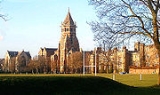
History of rugby union

Encyclopedia
The history of rugby union follows from various football games
played long before the 19th century
, but it was not until the middle of that century that rules were formulated and codified.
The code of football later known as rugby union
can be traced to three events: the first set of written rules in 1845, the Blackheath Club
's decision to leave the Football Association
in 1863 and the formation of the Rugby Football Union
in 1871. The code was originally known simply as "rugby football
." It was not until a schism in 1895, over the payment of players, which resulted in the formation of the separate code of rugby league
, that the name "rugby union" was used to differentiate the original rugby code. Rugby was a strictly amateur code of football and imposed bans and restrictions on players who were paid to play. It was not until 1995 that rugby union was declared an "open" game and thus removed all restrictions on payments or benefits to those connected with the game.
 Although rugby football
was codified at Rugby School
, many rugby playing countries had pre-existing football games not dissimilar to rugby.
Forms of traditional football similar to rugby have been played throughout Europe and beyond. Many of these involved handling of the ball, and scrummaging formations. For example, New Zealand had Ki-o-rahi
, Australia marn grook
, Japan kemari
, Georgia lelo burti
, the Scottish Borders Jeddart Ba' and Cornwall Cornish hurling
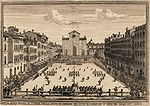
, Central Italy Calcio Fiorentino
, South Wales cnapan
and Ireland had caid
, an ancestor of Gaelic football
.
The first detailed description of what was almost certainly football in England was given by William FitzStephen in about 1174–1183. He described the activities of London youths during the annual festival of Shrove Tuesday
:
Numerous attempts were made to ban football games, particularly the most rowdy and disruptive forms. This was especially the case in England and in other parts of Europe, during the Middle Ages
and early modern period
. Between 1324 and 1667, football was banned in England alone by more than 30 royal and local laws. The need to repeatedly proclaim such laws demonstrated the difficulty in enforcing bans on popular games. King Edward II
was so troubled by the unruliness of football in London that on April 13, 1314 he issued a proclamation banning it:
In 1531, Sir Thomas Elyot
wrote that English "Footeballe is nothinge but beastlie furie and extreme violence".
Football games which included ball carrying continued to be played over the century, right up to the time of William Webb Ellis' alleged invention.
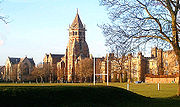
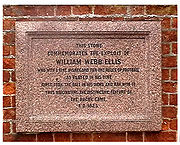
for two hundred years before three boys published the first set of written rules in 1845. The rules had always been determined by the pupils and not the masters and they were frequently modified with each new intake. Rules changes, such as the legality of carrying or running with the ball, were often agreed shortly before the commencement of a game. There were thus no formal rules for football during the time William Webb Ellis
was at the school (1816–25) and the story of the boy "who with a fine disregard for the rules of football as played in his time, first took the ball in his arms and ran with it" in 1823 is apocryphal. The story first appeared in 1876, some four years after the death of Webb Ellis, and is attributed to a local antiquarian and former Rugbeian Matthew Bloxam
. Bloxam was not a contemporary of Webb Ellis and vaguely quoted an unnamed person as informing him of the incident that had supposedly happened 53 years earlier. The story has been dismissed as unlikely since an official investigation by the Old Rugbeian Society in 1895. However, the cup for the Rugby World Cup
is named the Webb Ellis trophy in his honour, and a plaque at the school commemorates the "achievement".
Rugby football has strong claims to the world's first and oldest "football club": the Guy's Hospital Football Club, formed in London in 1843, by old boy
s from Rugby School. Around the anglosphere
, a number of other clubs formed to play games based on the Rugby School rules. One of these, Dublin University Football Club
, founded in 1854, has arguably become the world's oldest surviving football club in any code. The Blackheath Rugby Club, in London, founded in 1858 is the oldest surviving non-university/school rugby club. Cheltenham College
1844, Sherborne School
1846 and Durham School 1850 are the oldest documented school's clubs. Francis Crombie and Alexander Crombie introduced rugby into Scotland via Durham School in 1854.
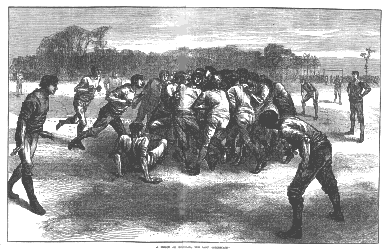
.jpg) Until the late 1860s rugby was played with a leather ball with an inner-bladder made of a pig's bladder. The shape of the bladder imparted a vaguely oval shape to the ball but they were far more spherical in shape than they are today. A quote from Tom Brown's Schooldays
Until the late 1860s rugby was played with a leather ball with an inner-bladder made of a pig's bladder. The shape of the bladder imparted a vaguely oval shape to the ball but they were far more spherical in shape than they are today. A quote from Tom Brown's Schooldays
written by Thomas Hughes
(who attended Rugby School from 1834 to 1842) shows that the ball was not a complete sphere:
In 1851 a football of the kind used at Rugby School was exhibited at the first World's Fair
, the Great Exhibition
in London, this ball can still be seen at the Webb Ellis Rugby Football Museum and it has a definite ovoid shape. In 1862 Richard Lindon
introduced rubber bladders and because of the pliability of the rubber, balls could be manufactured with a more pronounced shape and, because an oval ball was easier to handle, a gradual flattening of the ball continued over the years as the emphasis of the game moved towards handling and away from dribbling. In 1892 the RFU included compulsory dimensions for the ball in the Laws of the Game for the first time. In the 1980s leather-encased balls, which were prone to water-logging, were replaced with balls encased in synthetic waterproof materials.
(FA) was formed at the Freemason’s Tavern, Great Queen Street, on Lincoln Inn Fields, London, on 26 October 1863, with the intention of framing a code of laws that would embrace the best and most acceptable points of all the various methods of play under the one heading of football. At the beginning of the fourth meeting, attention was drawn to the fact that a number of newspapers had recently published the Cambridge rules of 1848. The Cambridge rules differed from the draft FA rules in two significant areas, namely 'running with the ball' and 'hacking' (kicking an opponent in the shins). The two contentious draft rules were as follows:
At the fifth meeting, a motion was proposed that these two rules be expunged from the FA rules. Francis Maule Campbell
, a member of the Blackheath Club, argued that hacking is an essential element of "football" and that to eliminate hacking would "do away with all the courage and pluck from the game, and I will be bound over to bring over a lot of Frenchmen who would beat you with a week’s practice". At the sixth meeting, on 8 December, Campbell withdrew the Blackheath Club, explaining that the rules that the FA intended to adopt would destroy the game and all interest in it. Other rugby clubs followed this lead and did not join the Football Association.
and Benjamin Burns
of Blackheath published a letter in The Times
suggesting that "those who play the rugby-type game should meet to form a code of practice as various clubs play to rules which differ from others, which makes the game difficult to play." On 26 January 1871 a meeting attended by representatives from 21 clubs was held in London at the Pall Mall restaurant.
The 21 clubs present at the meeting were: Blackheath, represented by Burns and Frederick Stokes the latter becoming the first captain of England
, Richmond
, Ravenscourt Park
, West Kent
, Marlborough Nomads
, Wimbledon Hornets
, Gipsies
, Civil Service, The Law Club
, Wellington College
, Guy’s Hospital
, Flamingoes, Clapham Rovers, Harlequin F.C.
, King's College Hospital, St Paul's, Queen’s House
, Lausanne
, Addison
, Mohicans
, and Belsize Park
. The one notable omission was the Wasps
. According to one version, a Wasps' representative was sent to attend the meeting, but owing to a misunderstanding, was sent to the wrong venue at the wrong time on the wrong day; another version is that he went to a venue of the same name where, after consuming a number of drinks, he realised his mistake but was too drunk to make his way to the correct venue.
As a result of this meeting the Rugby Football Union (RFU) was founded. Algernon Rutter was elected as the first president of the RFU and Edwin Ash was elected as treasurer. Three lawyers who were Rugby School alumni (Rutter, Holmes and L.J. Maton) drew up the first laws of the game which were approved in June 1871.
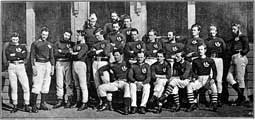
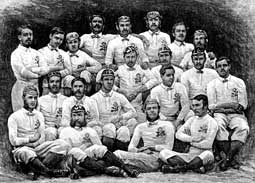 The first international football game
resulted from a challenge issued in the sporting weekly Bell's Weekly on 8 December 1870 and signed by the captains of five Scottish clubs, inviting any team "selected from the whole of England" to a 20-a-side game to be played under the Rugby rules. The game was played at Raeburn Place
, Edinburgh, the home ground of Edinburgh Academicals, on 27 March 1871
.
This is not only the first international rugby match but the first international of any form of football because, despite the fact that three England v Scotland fixtures had already been played according to Association Football rules at The Oval
, London, in 1870 and 1871 these are not considered full internationals by FIFA
as the players competing in the Scotland team were London-based players who claimed a Scottish family connection rather than being truly Scottish players.
The English team wore all white with a red rose on their shirts and the Scots brown shirts with a thistle and white cricket flannels. The team representing England
was captained by Frederick Stokes of Blackheath, that representing Scotland
was led by Francis Moncrieff; the umpire was Hely Hutchinson Almond
, headmaster of Loretto College.
The game, played over two halves, each of 50 minutes, was won by Scotland, who scored a goal with a successful conversion kick after grounding the ball over the goal line (permitting them to 'try' to kick a goal). Both sides achieved a further 'try' each, but failed to convert them to goals as the kicks were missed (see also 'Method of Scoring and Points' below). Angus Buchanan
of Royal High School FP and Edinburgh University RFC
was the first man to score a try in international rugby.
In a return match at the Kennington Oval, London, in 1872, England were the winners.
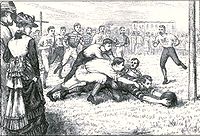
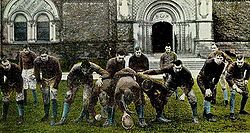 According to the Australian Rugby Union
, rugby football was an extremely early introduction to Australia, with games of the primitive code being played in the early to mid nineteenth century, and the first formal team, Sydney University Club being set up in 1864. From this beginning, the first metropolitan competition in Australia developed, formally beginning in 1874. This was organised by the Southern Rugby Union, which was administered by the rugby union at Twickenham, in England. Administration was given over to the Southern Rugby Union in 1881.
Introduction to New Zealand came later, but formal development took place around the same time as Australia. Christchurch Football Club, which is now the oldest rugby club in the country, was founded in 1863. Rugby football
was first introduced to New Zealand in 1870 by Charles John Monro
, son of the then-Speaker of the House of Representatives
, David Monro
. He encountered the game while studying at Christ's College Finchley
, in East Finchley
, London
, England
, and on his return introduced the game to Nelson College
, who played the first rugby union match against Nelson football club on 14 May. By the following year, the game had been formalised in Wellington
, and subsequently rugby was taken up in Wanganui
and Auckland
in 1873 and Hamilton
in 1874. It is thought that by the mid-1870s, the game had been taken up by the majority of the colony.
When Canon George Ogilvie became headmaster of Diocesan College
in Cape Town
, South Africa
in 1861, he introduced the game of football
, as played at Winchester College
. This version of football, which included handling of the ball, is seen as the beginnings of rugby in South Africa. In around 1875 rugby began to be played in the Cape Colony
, the following year the first rugby (as opposed to Winchester football
) club was formed. Former England international William Henry Milton
arrived in Cape Town in 1878. He joined the Villagers club and started playing and preaching rugby. By the end of that year Cape Town had all but abandoned the Winchester game in favour of rugby. In 1883, the Stellenbosch club was formed in the predominantly Boer farming district outside Cape Town and rugby was enthusiastically adopted by the young Boer farmers. As British and Boer migrated to the interior they helped spread the game from the Cape colony through the Eastern Cape, and Natal, and along the gold and diamond routes to Kimberley and Johannesburg. However, for a number of years, South African rugby would be hindered by systemic racial segregation.
Early forms of rugby football
were being played in Canada from 1823 onwards, in east Canadian towns such as Halifax
, Montreal
and Toronto
. Rugby football
proper in Canada dates back to the 1860s. Introduction of the game and its early growth is usually credited to settlers from Britain and the British army and navy in Halifax, Nova Scotia
and Esquimalt, British Columbia
. In 1864 the first recorded game of rugby in Canada took place in Montreal
, Quebec
amongst artillery men. It is most likely that rugby got its start in British Columbia
in the late 1860s or early 1870s when brief mentions of "football" appeared in print. Canadian rugby, however, soon faced stiff competition from Canadian football
.
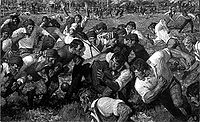 Rugby league and association football were not the only early competitors to rugby union. In the late nineteenth century, a number of "national" football codes emerged around the world, including Gaelic football
(Ireland), Australian Rules Football
(mainly Victoria and Southern Australia), and the gridiron codes: American
and Canadian football
.
Some of these codes took direct influence from rugby union, or rugby football, but all of these involved kicking and carrying the ball towards posts, meaning that they were in direct competition with rugby union. While American, Canadian, and Australian rules football are professional, and so competed for rugby union players' economic attentions, Gaelic football has remained staunchly amateur as rugby union did for decades. The former three also use an oblong ball, superficially similar in appearance to a rugby football.
The founder of Australian rules football, Wills went to Rugby School
. He umpired a match in 1858, but a contemporary source noted that "exceptions were taken last year to some of the Rugby regulations." On 17 May 1859, Wills chaired a meeting to incorporate the Melbourne Football Club
in which the club's rules (later the Laws of Australian Football
) were written down for the first time. While Wills was a fan of the rugby rules, his intentions were clear that he favoured rules that suited drier and harder Australian fields. Geoffrey Blainey
, Leonie Sandercock
, Ian Turner and Sean Fagan
have all written in support for the theory that rugby football was one of the primary influences on Australian rules football along with other other games emanating from English public schools
.
American football
resulted from several major divergences from rugby from 1869 onwards, most notably the rule changes instituted by Walter Camp
, considered the "Father of American Football". Among these important changes were the introduction of the line of scrimmage
and of down-and-distance rules. Later developments such as the forward pass
, and professionalism in American football made it diverge even further from its rugby origins.
Michael Cusack
one of the founders of the Gaelic Athletic Association
had been known as a rugby player in Ireland, and was involved with the game at Blackrock College
and Clongowes Wood College
. Cusack was a native Irish
and had been concerned with the decline of Irish football codes. Cusack, along with others codified Gaelic football
in 1887. The GAA retained some hostility to rugby and soccer until recent years, through its Rule 42
which prohibits the use of GAA property for games with interests in conflict with the interests of the GAA referred to by some as "garrison games" or foreign sports." In practice the rule has only been applied to the sports of soccer, and rugby
, which were perceived to be rivals to the playing of Gaelic games.
Not all such codes were successful - Swedish football
was created from a mixture of rugby and soccer rules, but was overtaken by soccer.
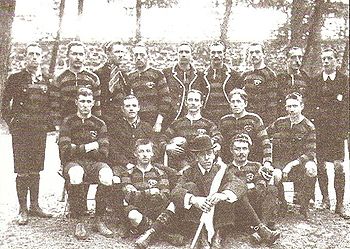 By the end of the 19th Century, rugby football and rugby union had spread far and wide. This spread was by no means confined to the British Empire
.
Rugby football was an early arrival in Germany, for example. The first German rugby team existed at Neuenheim College - now called Heidelberg College
- in Heidelberg. Around 1850, the game started to attract the attention of the students. Students under the guidance of the teacher Edward Hill Ullrich were the ones who then founded the rugby department of the Heidelberger Ruderklub von 1872/Heidelberger Flaggenklub was established. (HRK 1872) in 1891, which today claims to be the oldest German rugby club. The oldest still existing rugby department within a club is that of DSV 78 Hannover, formed in 1878 by Ferdinand-Wilhelm Fricke
. German rugby has traditionally been centred on Heidelberg
and Hanover
, but has spread over the entire country in recent decades.
In the United States
, rugby football-like games were being played early. Princeton University
students played a game called "ballown" in 1820, for example. All of these games remained largely "mob" style games, with huge numbers of players attempting to advance the ball into a goal area, often by any means necessary. By the 1840s, Harvard
, Yale
and Princeton
were all playing rugby football stemming partly from Americans who had been educated in English schools. However, in 1862, Yale dealt it a major blow by banning it for being too violent and dangerous. Unfortunately American football's growth came at exactly the point at which rugby was beginning to establish itself in the States: in 1869, the first game of American football
was played between Princeton and Rutgers
.
Rugby union also reached South America early, a continent with few British colonies. The first rugby union match in Argentina was played in 1873, the game having been brought to South America by the British. In 1886 Buenos Aires Football Club played Rosario Athletic Club in Buenos Aires
. Early Argentinian rugby was not immune to political problems either. An 1890 game in Buenos Aires resulted in both teams, and all 2,500 spectators being arrested. National president Juárez Celman
was particularly paranoid after the Revolution of the Park
in the city earlier in the year, and the police had suspected that the match was in fact a political meeting. Rugby reached neighbouring Uruguay
early, but it is disputed just how early. Cricket
clubs were the incubators of rugby in South America, although rugby has survived much better in these countries than cricket has. It has been claimed that Montevideo Cricket Club
(MVCC) played rugby football
as early as 1865, but the first certain match was between Uruguayans and British members of the MVCC in 1880. The MVCC claims to be the oldest rugby club outside Europe.
Rugby also appears to have been the first (non-indigenous) football code to be played in Russia, around a decade before the introduction of association football. Mr Hopper, a Scotsman, who worked in Moscow arranged a match in the 1880s; the first soccer match was in 1892. In 1886, however, the Russian police clamped down on rugby because they considered it "brutal, and liable to incite demonstrations and riots"
The balance in value between tries and conversions has changed greatly over the years. Until 1891, a try scored one point, a conversion two. For the next two years tries scored two points and conversion three, until in 1893 the modern pattern of tries scoring more was begun with three points awarded for a try, two for a kick. The number of points from a try increased to four in 1971 and five in 1992.
Penalties have been worth three points since 1891 (they previously had been worth two points). The value of the drop goal was four points between 1891 and 1948, three points at all other times.
The goal from mark
was made invalid in 1977, having been worth three points, except between 1891 and 1905 when it was worth four.
The defence was originally allowed to attempt to charge down a conversion kick from the moment the ball was placed on the ground, generally making it impossible for the kicker to place the ball himself and make any kind of a run-up. As a result, teams had a designated placer, typically the scrum-half, who would time the placement to coincide with the kicker's run-up. In 1958, the law governing conversions changed to today's version, which allows the kicker to place the ball and prohibits the defence from advancing toward the kicker until he begins his run-up.
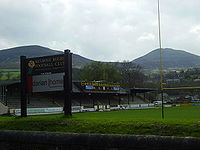 Rugby sevens
was initially conceived by Ned Haig
and David Sanderson, who were butchers from Melrose
, Scotland
as a fund-raising event for his local club, Melrose RFC
, in 1883. The first ever sevens match was played at the Greenyards, the Melrose ground, where it was well received. Two years later, Tynedale was the first non-Scottish club to win one of the Borders Sevens titles at Gala
in 1885.
Despite sevens' popularity in the Scottish Borders
, it did not catch on elsewhere until after WWI, in the 1920s and 30s. The first sevens tournament outside Scotland was the Percy Park Sevens at North Shields
in north east England in 1921. Because it was not far from the Scottish Borders
, it attracted interest from the code's birthplace, and the final was contested between Selkirk
(who won) and Melrose RFC
(who were runners up). In 1926, England's major tournament, the Middlesex Sevens was set up by Dr J.A. Russell-Cargill, a London based Scot.
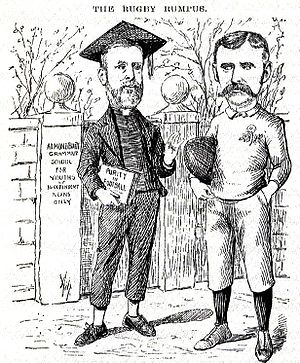 It is believed that Yorkshire inaugurated amateurism rules in 1879; their representatives along with Lancashire's, are credited with formalising the RFU's first amateur rules in 1886. Despite popular belief, these Northern bodies were strong advocates of amateurism, leading numerous crusades against veiled professionalism. However, conflict arose over the controversy regarding broken time, the issue of whether players should receive compensation for taking time off work to play. The northern clubs were heavily working class, and thus, a large pool of players had to miss matches due to working commitments, or forego pay to play rugby. In 1892, charges of professionalism were laid against rugby football
clubs in Bradford
and Leeds
, both in Yorkshire
, after they compensated players for missing work, but these were not the first allegation towards these northern bodies, nor was it unheard of for southern clubs to be faced with similar circumstances. The RFU became concerned that these broken time payments were a pathway to professionalism.
This was despite the fact that the Rugby Football Union
(RFU) was allowing other players to be paid, such as the 1888 England team that toured Australia, and the account of Harry Hamill of his payments to represent New South Wales
(NSW) against England in 1904.
In 1893 Yorkshire clubs complained that southern clubs were over-represented on the RFU committee and that committee meetings were held in London at times that made it difficult for northern members to attend. By implication they were arguing that this affected the RFU's decisions on the issue of "broken time" payments (as compensation for the loss of income) to the detriment of northern clubs, who made up the majority of English
rugby clubs. The professional Football League
had been formed in 1888, comprising 12 association football (soccer) clubs from northern England, and this may have inspired the northern rugby officials to form their own professional league.
On 29 August 1895, at a meeting at the George Hotel
, Huddersfield, 20 clubs from Yorkshire, Lancashire and Cheshire decided to resign from the RFU and form the Northern Rugby Football Union
, which from 1922 was known as the Rugby Football League
. In 1908, eight clubs in Sydney, Australia, broke away from union and formed the New South Wales Rugby League
. The dispute about payment
was one which at the time was also affecting soccer and cricket. Each game had to work out a compromise; rugby's stance was the most radical. Amateurism was strictly enforced, and anyone accepting payment or playing rugby league was banned. It would be a century before union legalised payments to players and would allow players who had played a game of league
, even at an amateur
level, to play in a union game.
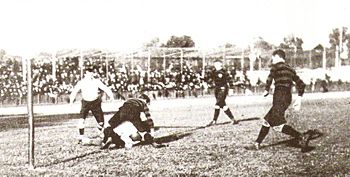 Pierre de Coubertin
, the revivor of the modern Olympics, introduced rugby union to the Summer Olympics at the 1900 games
in Paris. Coubertin had previous associations with the game, refereeing the first French domestic championship as well as France’s first international. France, the German Empire and Great Britain all entered teams in the 1900 games (Great Britain was represented by Moseley RFC, Germany by the SC 1880 Frankfurt
). France won gold defeating both opponents. The rugby event drew the largest crowd at that particular games. Rugby was next played at the 1908 games
in London. A Wallaby team, on tour in the United Kingdom, took part in the event, winning the gold, defeating Great Britain who were represented by a team from Cornwall. The United States won the next event, at the 1920 Summer Olympics
, defeating the French. The Americans repeated their achievement at the 1924 Summer Olympics
in Paris, again defeating France in a tournament marred by controversies surrounding the rivalry between the two teams. Though rugby had attracted bigger crowds than the track and field events in 1924, it was dropped from next Games and has not been included since.
In October 2009, the International Olympic Committee
voted to return a form of rugby to the Olympics, with rugby sevens
to be contested in Rio de Janeiro in 2016
.

The horrific bloodshed and suffering of World War I affected all sports, including rugby union.
The Five Nations Championship was suspended in 1915 and was not resumed until 1920, though in Britain in 1919, a tournament was arranged between Forces teams; it was won by the New Zealand Army
.
One hundred and thirty-three international players were killed during the conflict
. The Queensland Rugby Union
was disbanded after the war and was not reformed until 1929. NSW
took responsibility for rugby union in Australia
until the formation of the ARU
in 1949.
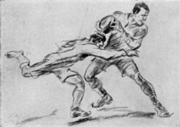
In 1934 the Association was formed at the instigation of the French. It was designed to organise rugby union outside the authority of the International Rugby Football Board (as it was known at the time). The founder members were , , , , , , and . In the 1990s the organisation recognised the IRB as the governing body of rugby union world wide and in 1999 changed its name to FIRA - Association of European Rugby, an organisation to promote and rule over rugby union in the European area.
Until its eventual merger with the IRB, FIRA was the most multinational rugby organisation in the world, partly because the IRB had concentrated on the Five Nations
, Tri Nations, and from 1987 the Rugby World Cup
, competitions. FIRA has generally been a positive force in spreading the sport beyond the Anglosphere
.
, the Governor-General of New Zealand
, donated a trophy for competition between Australia and New Zealand. The Bledisloe Cup
became one of the great rivalries in international rugby union.
Following the suspension of the French Rugby Federation (FFR) in 1931, many French players turned to rugby league, which soon became the dominant game in France, particularly in the south west of the country.
In 1934 the Federation Internationale de Rugby Amateur (FIRA) was formed at the instigation of the French. It was designed to organise rugby union outside the authority of IRB. In the 1990s the organisation recognised the IRB as the governing body of rugby union world wide and in 1999 changed its name to FIRA - Association of European Rugby
, an organisation to promote and rule over rugby union in the European area.
In 1939 the FFR was invited to send a team to the Five Nations Championship for the following season, but when war was declared, international rugby was suspended. Eighty-eight international rugby union football players were killed during the conflict.
, the RFU temporarily lifted its ban on rugby league players, many of whom played in the eight "internationals" between England and Scotland that were played by Armed Services teams under the rugby union code. The authorities also allowed the playing of two "Rugby League v Rugby Union" fixtures as fund-raisers for the war effort. The rugby league team (which included some pre-war professionals) won both matches, which were held under union rules.
After the defeat of France in 1940, the French Rugby Union authorities worked with the German collaborating Vichy
regime to re-establish the dominance of their sport. Rugby union's amateur ethos appealed to the occupier's view of the purity of sport. Rugby league, along with other professional sports, was banned. Many players and officials of the sport were punished, and all of the assets of the Rugby League and its clubs were handed over to the Union. The consequences of this action reverberate to this day, as these assets were never returned. Although the ban on rugby league was lifted, it was prevented from calling itself "rugby" until the mid 1980s, having to use the name Jeu à Treize (Game of Thirteen) in reference to the number of player in a rugby league side.
In 1947 the Five Nations Championship resumed with France taking part.
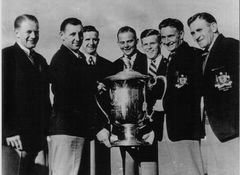 In 1948 the worth of a drop goal was reduced from 4 points to 3 points.
In 1949, the Australian Rugby Union
was formed and took over the administration of the game in Australia from the New South Wales Rugby Union
.
In 1958, long after the legend of William Webb Ellis
had become engrained in rugby culture, Ross McWhirter
managed to relocate his grave "le cimetière du vieux château" at Menton
in Alpes Maritimes (has since been renovated by the French Rugby Federation).
During the 1960s, there was stronger and stronger condemnation of the racist apartheid regime in South Africa
. This racism extended to rugby union, and the sport soon found itself involved in its most serious controversy since 1895. By 1969, the Halt All Racist Tours
campaign group had been set up in New Zealand.
, a form of the game still used to train children.
In 1971 Scotland
appointed Bill Dickinson
as their head coach, after years of avoidance, as it was their belief that rugby should remain an amateur sport. The 1971 Springbok
tour to Australia was famous for its political protests against South Africa's apartheid system. The 1970s were a golden era for Wales with the team capturing five Five Nations titles and dominating the Lions
selections throughout the decade. In the middle of the decade, after overseeing the rise in popularity of rugby union in the United States
, members' bodies met in Chicago
in 1975 and formed the United States of America Rugby Football Union, today known as USA Rugby
.
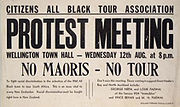 The 1981 Springbok Tour
to New Zealand was also marked by political protests and is still referred to by New Zealanders as The Tour. The tour divided New Zealand society and rugby lost some of its prestige, which was not restored until New Zealand won the inaugural 1987 Rugby World Cup
. In 1983, the WRFU (Women's Rugby Football Union) was formed, with 12 inaugural clubs, the body being responsible for women's rugby in England, Wales, Scotland and Ireland. In 1984 the Wallabies
completed their first grand slam
, defeating all four nations of the British Isles, and announcing their emergence as a power in world rugby.
.jpg) The first Rugby World Cup
The first Rugby World Cup
was played in 1987. New Zealand hosted the tournament, with some games, including both semi-finals, being played in Australia. The All Blacks
defeated France in the final.
In 1991, England hosted the second tournament, losing to Australia in the final.
The World Cup of 1995 proved to be a turning point for the game. The competition was held in South Africa, newly readmitted from international exile. Giant wing Jonah Lomu
scored four tries for the All Blacks against . , who had not been allowed to compete in the first two tournaments, won the final, beating the All Blacks 15-12, the winning score coming from a drop-goal by Joel Stransky
. The tournament became a point of reconciliation for the new South Africa, as South African President
Nelson Mandela
, dressed in a Springbok jersey, which was long a symbol of apartheid, bearing the name and number six of South Africa's captain Francois Pienaar
, handed him the William Webb Ellis Trophy.
The 1999 Rugby World Cup was held in Wales and was won by Australia, who defeated France in the final after the latter had come from behind to record a shock win against tournament favourites, the All Blacks
, at the semi-final stage.
In 2003, Australia hosted the tournament and reached the final for the third time. In a closely fought game, which went into extra time, Australia narrowly lost to England, thanks to a last-minute drop goal by Jonny Wilkinson.
France was the host nation for the 2007 Rugby World Cup, though several games were played in Edinburgh and Cardiff, and France played its quarter-final in Wales, against the All Blacks, who had started the tournament as odds-on favourites. In a repeat of 1999, France gained a shock win, consigning the favourites to their worst result in World Cup history. France went on to lose against England at the semi-final stage. England, in turn, lost in the final to the Springboks
, who equalled Australia's record of two World Cup wins.
The breakthrough team in that competition was Argentina
who started with a narrow win over France in the opener, and defeated Ireland to finish atop their pool. They lost in the semifinals to South Africa, but rebounded with a comprehensive win over France in the third-place game. This result led to calls to include the Pumas in one of the major hemispheric national team competitions such the Six Nations or Tri Nations. Ultimately, it was decided that the Pumas would be steered toward a future place in the Tri Nations.
declared rugby union an "open" game and thus removed all restrictions on payments or benefits to those connected with the game. It did this because of a committee conclusion that to do so was the only way to end the hypocrisy of shamateurism and to keep control of rugby union.
Professionalisation brought mixed responses, with some predicting the demise of the game, or even the demise of its rival rugby league
. In the end this did not happen, and both rugby codes proved resilient, although not without a few scars to prove it.
The threat to amateur rugby union was especially large in Australia where Super League
was threatening to entice players to rugby league with large salaries. SANZAR
was formed in 1995 by the New Zealand, Australian and South African Rugby Unions to try to counter the Super League threat. SANZAR proposed a provincial competition with teams from all three countries. This competition became the Super 12 and later the Super 14 before adopting its current identity as Super Rugby. The SANZAR proposals also included an annual competition between each country's Test teams, the Tri Nations Series. They were eventually able to get backing for the competition from Rupert Murdoch
's News Corporation
, with a contract totaling $US 550 million for ten years of exclusive TV and radio broadcasting rights. The deal was signed during the 1995 Rugby World Cup
and revealed at a press conference on the eve of World Cup final.
SANZAR's proposals were under serious threat from a Sydney-based group called the World Rugby Corporation (WRC). WRC was formed by lawyer Geoff Levy and former Wallaby Ross Turnbull. Both wanted a professional worldwide rugby competition funded by Kerry Packer
. At one point the WRC had a majority of the All Blacks and Wallaby teams signed up to their competition. In addition to this the Springboks had also signed the WRC contracts but had decided not to hand them over and instead signed up with the South African Rugby Union. The players had been told they would never play for their country again if they committed to the WRC. Most of the All Blacks then followed their Springbok counterparts by signing with their Union. The Australians, realising that without the New Zealanders and South Africans WRC's proposal could not succeed, relented and signed for the Australian Rugby Union.
The Heineken Cup
was formed in 1995 as a competition for 12 European clubs. Today the competition includes teams from England, France, Ireland, Italy, Scotland and Wales.
Professionalism opened the door for the emergence of a new rugby generation in Italy. The Italian domestic leagues had attracted a degree of tax relief in the 1990s, and were able to attract both strong corporate sponsorship and also high quality coaches and players with recent Italian heritage from Australia and Argentina. These improvements led to a national team capable of competing with the national teams of the British Isles, proven by a famous victory against Ireland in 1995. Lobbying was successful to have Italy included in the century-old tournament for the top European rugby nations which became the Six Nations championship in 2000.
A key benefit that professionalism brought to rugby union as a whole was the elimination of the constant defection of union players who were attracted to the money of rugby league. The rugby union authorities of the time also hoped that as players could now play in either code, in the long term most of the sponsorship and interest would gravitate away from league to the more international game of union. However, rugby union has not managed to lure away more than a handful of elite players from rugby league, as the two codes have become quite different over the decades of separation in both culture and in aspects of play. The preferred body type and skill sets of players differ, especially in the play of the forwards. With access to players of different types, some more suited to one code and some to the other, some English rugby union clubs have even formed partnerships with a rugby league club which plays in the premier rugby league competitions - the most notable example being Harlequins
with the former London Broncos, now Harlequins Rugby League.
In some countries rugby union's administration and structure have not developed along with its professionalism. In Australia the constant flow of rugby union juniors to rugby league clubs has slowed, but Australian rugby union has failed to successfully promote a club or franchise league below the elite level. With professional club games every weekend, Australian rugby league has maintained its dominance over union, especially in its traditional heartlands of New South Wales and Queensland.
The many smaller unions across the globe have struggled both financially and in playing terms to compete with the major nations since the start of the open era. In England whilst some teams flourished in the professional era others such as Richmond
, Wakefield
, Orrell
, Waterloo
and London Scottish
found the going much harder and have either folded or dropped down to minor leagues. In the other Home Nations, Ireland, Scotland and Wales, the professional era had a traumatic effect on the traditional structure of the sport, which had been based around local clubs. Professional rugby in these three countries is now regionally based. In Ireland, each of the four traditional provinces supports one professional team. Scotland currently has two regional teams, each based in one of the country's two largest cities. Wales adopted a regional franchise model, originally with five teams but now with four. These three countries have a joint professional competition, known as the Celtic League
or its current sponsored name of RaboDirect Pro12. In 2010, two Italian super-regional teams joined that league.
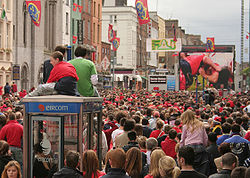 Alterations to the laws of rugby union
were trialled by students of Stellenbosch University
in South Africa in 2006, and have been adopted in competitions in Scotland and Australia since 2007, though only a few of the rules have been universally adopted. The law variations are an attempt to make rugby union easier to understand by referees, fans and players, but the laws are controversial and are far from being endorsed by all members of these groups.http://news.bbc.co.uk/sport1/hi/rugby_union/6136244.stm
". Prior to 1890 games were won by goals scored. A goal was awarded for a successful conversion after a try, a field goal or from a goal from mark
. If the game was drawn, then unconverted tries were tallied to give a winner. This system led to score lines more akin to association football with far more games resulting in draws than are experienced in the modern game. One of the first tasks undertaken by the International Rugby Football Board, formed in 1886, was to introduce a standard point scoring system. One point was awarded for a try, two points for a successful kick at goal after scoring a try (a conversion) and three points for a dropped goal or for a penalty goal. Most of the changes have been to increase the value of tries compared to goals (conversions, penalties, dropped-goals, and goals from mark) in order to promote positive, attacking play.
, founded in England in 1871. This was followed over the next decade by the Scottish Football Union
(1873, later SRU), Irish Rugby Football Union
(1879) and Welsh Rugby Union
(1881). In Australia, the Southern Rugby Union (later the New South Wales Rugby Union
) and the Northern Rugby Union (later the Queensland Rugby Union
) were formed in 1874 and 1883 respectively, before eventually helping form the Australian Rugby Union
in 1949. Both South Africa and New Zealand formed their Unions before the end of the 19th century. The white
South African Rugby Board
merged with the non-racial South African Rugby Union
in 1992 following the fall of apartheid
. The other major rugby power, France, formed the French Rugby Federation in 1919.
Other notable foundations are Argentina (1899), Fiji
(1913), Tonga
(1923), Samoa
(1923), Japan
(1926), Italy (1928), the Rugby Union of the Soviet Union (1936), Hong Kong
(1953) Canada
(1965) and USA
(1975).
Some of the pre-1925 foundations may be more surprising to those who speak of "traditional rugby playing nations": Rhodesia/Zimbabwe
(1895), Germany (1900), Ceylon/Sri Lanka
(1908), Morocco (1916), Malaya/Malaysia
(1921), Catalonia (1922, later disbanded by Francisco Franco
), Spain (1923) and Kenya
(1923)
Many minor governing bodies have been set up in recent years, with the most recent being Jordan (2007), Ecuador (2008), Turkey (2009) and the United Arab Emirates (2010).
Football
Football may refer to one of a number of team sports which all involve, to varying degrees, kicking a ball with the foot to score a goal. The most popular of these sports worldwide is association football, more commonly known as just "football" or "soccer"...
played long before the 19th century
19th century
The 19th century was a period in history marked by the collapse of the Spanish, Portuguese, Chinese, Holy Roman and Mughal empires...
, but it was not until the middle of that century that rules were formulated and codified.
The code of football later known as rugby union
Rugby union
Rugby union, often simply referred to as rugby, is a full contact team sport which originated in England in the early 19th century. One of the two codes of rugby football, it is based on running with the ball in hand...
can be traced to three events: the first set of written rules in 1845, the Blackheath Club
Blackheath R.C.
Blackheath Football Club is a rugby football club based in Blackheath in south-east London, now playing at the Rectory Field . It was founded in 1858 and is the oldest open rugby club in the world...
's decision to leave the Football Association
The Football Association
The Football Association, also known as simply The FA, is the governing body of football in England, and the Crown Dependencies of Jersey, Guernsey and the Isle of Man. It was formed in 1863, and is the oldest national football association...
in 1863 and the formation of the Rugby Football Union
Rugby Football Union
The Rugby Football Union was founded in 1871 as the governing body for the sport of rugby union, and performed as the international governing body prior to the formation of the International Rugby Board in 1886...
in 1871. The code was originally known simply as "rugby football
Rugby football
Rugby football is a style of football named after Rugby School in the United Kingdom. It is seen most prominently in two current sports, rugby league and rugby union.-History:...
." It was not until a schism in 1895, over the payment of players, which resulted in the formation of the separate code of rugby league
Rugby league
Rugby league football, usually called rugby league, is a full contact sport played by two teams of thirteen players on a rectangular grass field. One of the two codes of rugby football, it originated in England in 1895 by a split from Rugby Football Union over paying players...
, that the name "rugby union" was used to differentiate the original rugby code. Rugby was a strictly amateur code of football and imposed bans and restrictions on players who were paid to play. It was not until 1995 that rugby union was declared an "open" game and thus removed all restrictions on payments or benefits to those connected with the game.
Antecedents of rugby union
Rugby football
Rugby football is a style of football named after Rugby School in the United Kingdom. It is seen most prominently in two current sports, rugby league and rugby union.-History:...
was codified at Rugby School
Rugby School
Rugby School is a co-educational day and boarding school located in the town of Rugby, Warwickshire, England. It is one of the oldest independent schools in Britain.-History:...
, many rugby playing countries had pre-existing football games not dissimilar to rugby.
Forms of traditional football similar to rugby have been played throughout Europe and beyond. Many of these involved handling of the ball, and scrummaging formations. For example, New Zealand had Ki-o-rahi
Ki-o-rahi
Ki-o-rahi is a ball sport played in New Zealand with a small round ball called a 'ki'. The game is widely known in Māori communities and in scattered mainstream locations throughout the country. It is a fast-paced sport incorporating skills similar to Australian Rules, rugby union, netball and touch...
, Australia marn grook
Marn Grook
Marn Grook , literally meaning "Game ball", is a collective name given to a number of traditional Indigenous Australian recreational pastimes believed to have been played at gatherings and celebrations of up to 50 players. It is often confused with a separate indigenous game resembling Association...
, Japan kemari
Kemari
Kemari is a form of football that was popular in Japan during the Heian Period. Kemari has been revived in modern times.-History:The first evidence of kemari is from A.D.644. The rules were standardized from the 13th century. It was the first Japanese sport to become highly developed.The game was...
, Georgia lelo burti
Lelo burti
Lelo or lelo burti is a Georgian folk sport, which is a full contact ball game, and very similar to rugby...
, the Scottish Borders Jeddart Ba' and Cornwall Cornish hurling
Cornish Hurling
Cornish Hurling or Hurling the Silver Ball , is an outdoor team game of Celtic origin played only in Cornwall, United Kingdom. It is played with a small silver ball...
, Central Italy Calcio Fiorentino
Calcio Fiorentino
Calcio Fiorentino was an early form of football that originated in 16th century Italy. The Piazza Santa Croce of Florence is the cradle of this sport, that became known as giuoco del calcio fiorentino or simply calcio .The official rules of calcio were published for the first time in 1580 by...
, South Wales cnapan
Cnapan
Cnapan is a Celtic form of medieval football, vaguely resembling some modern versions of rugby football, played in Wales until the nineteenth century. It may be a forerunner to modern rugby union...
and Ireland had caid
CAID
Caid may refer to:* Caid , a type of governorship found in North Africa and Moorish Spain* Caid , a form of football popular in Ireland until the mid-19th century...
, an ancestor of Gaelic football
Gaelic football
Gaelic football , commonly referred to as "football" or "Gaelic", or "Gah" is a form of football played mainly in Ireland...
.
The first detailed description of what was almost certainly football in England was given by William FitzStephen in about 1174–1183. He described the activities of London youths during the annual festival of Shrove Tuesday
Shrove Tuesday
Shrove Tuesday is a term used in English-speaking countries, especially in Ireland, United Kingdom, Canada, Australia, New Zealand, Philippines, Germany, and parts of the United States for the day preceding Ash Wednesday, the first day of the season of fasting and prayer called Lent.The...
:
- After lunch all the youth of the city go out into the fields to take part in a ball game. The students of each school have their own ball; the workers from each city craft are also carrying their balls. Older citizens, fathers, and wealthy citizens come on horseback to watch their juniors competing, and to relive their own youth vicariously: you can see their inner passions aroused as they watch the action and get caught up in the fun being had by the carefree adolescents.
Numerous attempts were made to ban football games, particularly the most rowdy and disruptive forms. This was especially the case in England and in other parts of Europe, during the Middle Ages
Middle Ages
The Middle Ages is a periodization of European history from the 5th century to the 15th century. The Middle Ages follows the fall of the Western Roman Empire in 476 and precedes the Early Modern Era. It is the middle period of a three-period division of Western history: Classic, Medieval and Modern...
and early modern period
Early modern Europe
Early modern Europe is the term used by historians to refer to a period in the history of Europe which spanned the centuries between the end of the Middle Ages and the beginning of the Industrial Revolution, roughly the late 15th century to the late 18th century...
. Between 1324 and 1667, football was banned in England alone by more than 30 royal and local laws. The need to repeatedly proclaim such laws demonstrated the difficulty in enforcing bans on popular games. King Edward II
Edward II of England
Edward II , called Edward of Caernarfon, was King of England from 1307 until he was deposed by his wife Isabella in January 1327. He was the sixth Plantagenet king, in a line that began with the reign of Henry II...
was so troubled by the unruliness of football in London that on April 13, 1314 he issued a proclamation banning it:
- "Forasmuch as there is great noise in the city caused by hustling over large balls from which many evils may arise which God forbid; we command and forbid, on behalf of the King, on pain of imprisonment, such game to be used in the city in the future."
In 1531, Sir Thomas Elyot
Thomas Elyot
Sir Thomas Elyot was an English diplomat and scholar.-Early Life:Thomas was the child of Sir Richard Elyot's first marriage with Alice De la Mare, but neither the date nor place of his birth is accurately known...
wrote that English "Footeballe is nothinge but beastlie furie and extreme violence".
Football games which included ball carrying continued to be played over the century, right up to the time of William Webb Ellis' alleged invention.
19th Century
Early history
Playing football has been a long tradition in England and versions of football had probably been played at Rugby SchoolRugby School
Rugby School is a co-educational day and boarding school located in the town of Rugby, Warwickshire, England. It is one of the oldest independent schools in Britain.-History:...
for two hundred years before three boys published the first set of written rules in 1845. The rules had always been determined by the pupils and not the masters and they were frequently modified with each new intake. Rules changes, such as the legality of carrying or running with the ball, were often agreed shortly before the commencement of a game. There were thus no formal rules for football during the time William Webb Ellis
William Webb Ellis
Rev. William Webb Ellis was an Anglican clergyman who is famous for allegedly being the inventor of Rugby football whilst a pupil at Rugby School....
was at the school (1816–25) and the story of the boy "who with a fine disregard for the rules of football as played in his time, first took the ball in his arms and ran with it" in 1823 is apocryphal. The story first appeared in 1876, some four years after the death of Webb Ellis, and is attributed to a local antiquarian and former Rugbeian Matthew Bloxam
Matthew Bloxam
Matthew Holbeche Bloxam , a native of Rugby, Warwickshire, England, was an amateur archeologist and Warwickshire antiquary. He was the original source of the legend of William Webb Ellis inventing the game of Rugby football....
. Bloxam was not a contemporary of Webb Ellis and vaguely quoted an unnamed person as informing him of the incident that had supposedly happened 53 years earlier. The story has been dismissed as unlikely since an official investigation by the Old Rugbeian Society in 1895. However, the cup for the Rugby World Cup
Rugby World Cup
The Rugby World Cup is an international rugby union competition organised by the International Rugby Board and held every four years since 1987....
is named the Webb Ellis trophy in his honour, and a plaque at the school commemorates the "achievement".
Rugby football has strong claims to the world's first and oldest "football club": the Guy's Hospital Football Club, formed in London in 1843, by old boy
Old boy network
An old boy network, or society, can refer to social and business connections among former pupils of male-only private schools. British public school students were traditionally called "boys", thus graduated students are "old boys"....
s from Rugby School. Around the anglosphere
Anglosphere
Anglosphere is a neologism which refers to those nations with English as the most common language. The term can be used more specifically to refer to those nations which share certain characteristics within their cultures based on a linguistic heritage, through being former British colonies...
, a number of other clubs formed to play games based on the Rugby School rules. One of these, Dublin University Football Club
Dublin University Football Club
Dublin University Football Club is the rugby union club of the University of Dublin, Trinity College, in Dublin, Ireland.-History:...
, founded in 1854, has arguably become the world's oldest surviving football club in any code. The Blackheath Rugby Club, in London, founded in 1858 is the oldest surviving non-university/school rugby club. Cheltenham College
Cheltenham College
Cheltenham College is a co-educational independent school, located in Cheltenham, Gloucestershire, England.One of the public schools of the Victorian period, it was opened in July 1841. An Anglican foundation, it is known for its classical, military and sporting traditions.The 1893 book Great...
1844, Sherborne School
Sherborne School
Sherborne School is a British independent school for boys, located in the town of Sherborne in north-west Dorset, England. It is one of the original member schools of the Headmasters' and Headmistresses' Conference....
1846 and Durham School 1850 are the oldest documented school's clubs. Francis Crombie and Alexander Crombie introduced rugby into Scotland via Durham School in 1854.
The Ball
Tom Brown's Schooldays
Tom Brown's Schooldays is a novel by Thomas Hughes. The story is set at Rugby School, a public school for boys, in the 1830s; Hughes attended Rugby School from 1834 to 1842...
written by Thomas Hughes
Thomas Hughes
Thomas Hughes was an English lawyer and author. He is most famous for his novel Tom Brown's Schooldays , a semi-autobiographical work set at Rugby School, which Hughes had attended. It had a lesser-known sequel, Tom Brown at Oxford .- Biography :Hughes was the second son of John Hughes, editor of...
(who attended Rugby School from 1834 to 1842) shows that the ball was not a complete sphere:
In 1851 a football of the kind used at Rugby School was exhibited at the first World's Fair
World's Fair
World's fair, World fair, Universal Exposition, and World Expo are various large public exhibitions held in different parts of the world. The first Expo was held in The Crystal Palace in Hyde Park, London, United Kingdom, in 1851, under the title "Great Exhibition of the Works of Industry of All...
, the Great Exhibition
The Great Exhibition
The Great Exhibition of the Works of Industry of all Nations or The Great Exhibition, sometimes referred to as the Crystal Palace Exhibition in reference to the temporary structure in which it was held, was an international exhibition that took place in Hyde Park, London, from 1 May to 15 October...
in London, this ball can still be seen at the Webb Ellis Rugby Football Museum and it has a definite ovoid shape. In 1862 Richard Lindon
Richard Lindon
Richard Lindon was an English leatherworker who was instrumental in the development of the modern-day rugby ball by advancing the craft for ball, rubber bladder, and air pump.- Life and career :...
introduced rubber bladders and because of the pliability of the rubber, balls could be manufactured with a more pronounced shape and, because an oval ball was easier to handle, a gradual flattening of the ball continued over the years as the emphasis of the game moved towards handling and away from dribbling. In 1892 the RFU included compulsory dimensions for the ball in the Laws of the Game for the first time. In the 1980s leather-encased balls, which were prone to water-logging, were replaced with balls encased in synthetic waterproof materials.
The schism between the Football Association and Rugby Football
The Football AssociationThe Football Association
The Football Association, also known as simply The FA, is the governing body of football in England, and the Crown Dependencies of Jersey, Guernsey and the Isle of Man. It was formed in 1863, and is the oldest national football association...
(FA) was formed at the Freemason’s Tavern, Great Queen Street, on Lincoln Inn Fields, London, on 26 October 1863, with the intention of framing a code of laws that would embrace the best and most acceptable points of all the various methods of play under the one heading of football. At the beginning of the fourth meeting, attention was drawn to the fact that a number of newspapers had recently published the Cambridge rules of 1848. The Cambridge rules differed from the draft FA rules in two significant areas, namely 'running with the ball' and 'hacking' (kicking an opponent in the shins). The two contentious draft rules were as follows:
At the fifth meeting, a motion was proposed that these two rules be expunged from the FA rules. Francis Maule Campbell
Francis Maule Campbell
Francis Maule Campbell was born in Blackheath, London. The son of Dawson Campbell, a wine merchant, who died around 1860 while Campbell was in his teens. Campbell attended the Blackheath Proprietary School and left in 1859 aged 15. A year later he was playing for the School’s old boys team,...
, a member of the Blackheath Club, argued that hacking is an essential element of "football" and that to eliminate hacking would "do away with all the courage and pluck from the game, and I will be bound over to bring over a lot of Frenchmen who would beat you with a week’s practice". At the sixth meeting, on 8 December, Campbell withdrew the Blackheath Club, explaining that the rules that the FA intended to adopt would destroy the game and all interest in it. Other rugby clubs followed this lead and did not join the Football Association.
The formation of the first Rugby Union
On 4 December 1870, Edwin Ash of RichmondRichmond F.C.
Richmond Football Club is a rugby union club from Richmond, London. It is a founding member of the Rugby Football Union, and is one of the oldest football clubs...
and Benjamin Burns
Benjamin Burns
Benjamin Henry Burns was a rugby union footballer who represented England in the first international match against Scotland in 1871.-Sports career:Burns was a member of Blackheath F.C...
of Blackheath published a letter in The Times
The Times
The Times is a British daily national newspaper, first published in London in 1785 under the title The Daily Universal Register . The Times and its sister paper The Sunday Times are published by Times Newspapers Limited, a subsidiary since 1981 of News International...
suggesting that "those who play the rugby-type game should meet to form a code of practice as various clubs play to rules which differ from others, which makes the game difficult to play." On 26 January 1871 a meeting attended by representatives from 21 clubs was held in London at the Pall Mall restaurant.
The 21 clubs present at the meeting were: Blackheath, represented by Burns and Frederick Stokes the latter becoming the first captain of England
England national rugby union team
The England national rugby union team represents England in rugby union. They compete in the annual Six Nations Championship with France, Ireland, Scotland, Italy, and Wales. They have won this championship on 26 occasions, 12 times winning the Grand Slam, making them the most successful team in...
, Richmond
Richmond F.C.
Richmond Football Club is a rugby union club from Richmond, London. It is a founding member of the Rugby Football Union, and is one of the oldest football clubs...
, Ravenscourt Park
Ravenscourt Park Football Club
Ravenscourt Park was a short lived 19th century rugby football club that was notable for being one of the twenty-one founding members of the Rugby Football Union, as well as producing a number of international players in the sport's early international fixtures.-History:Ravenscourt Park was founded...
, West Kent
West Kent Football Club
The West Kent Football Club was a short-lived 19th century rugby football club that was notable for being one of the twenty-one founding members of the Rugby Football Union, as well as producing a number of international players in the sport's early international fixtures.-History:West Kent were...
, Marlborough Nomads
Marlborough Nomads
The Marlborough Nomads was a 19th century rugby football club that was notable for being one of the twenty-one founding members of the Rugby Football Union, as well as producing a number of international players in the sport's early international fixtures....
, Wimbledon Hornets
Wimbledon RFC
Wimbledon Rugby Football Club is a rugby union team from Wimbledon, London. The club was a founding member of the Rugby Football Union and were at that time known as the Wimbledon Hornets.-History:Wimbledon’s first recorded match was against Richmond F.C...
, Gipsies
Gipsies Football Club
The Gipsies Football Club was a short lived 19th century rugby football club that was notable for being one of the twenty-one founding members of the Rugby Football Union, as well as producing a number of international players in the sport's early international fixtures.-History:The Gipsies...
, Civil Service, The Law Club
Law FC
Law, or The Law Club as they were also known was a 19th century football club that fielded teams playing by rugby football codes. It is notable for being one of the twenty-one founding members of the Rugby Football Union and for producing in a very short life span, a number of international...
, Wellington College
Wellington College, Berkshire
-Former pupils:Notable former pupils include historian P. J. Marshall, architect Sir Nicholas Grimshaw, impressionist Rory Bremner, Adolphus Cambridge, 1st Marquess of Cambridge, author Sebastian Faulks, language school pioneer John Haycraft, political journalist Robin Oakley, actor Sir Christopher...
, Guy’s Hospital
Guy's, Kings and St. Thomas' Rugby Football Club
Guy's, Kings and St. Thomas' Rugby Football Club is the name given to the modern amalgam of three formerly distinct hospital rugby clubs each with a long history, having all been founded in the nineteenth century. The teams from Guy's Hospital and St Thomas' Hospital were the first to merge...
, Flamingoes, Clapham Rovers, Harlequin F.C.
Harlequin F.C.
The Harlequin Football Club is an English rugby union team who play in the top level of English rugby, the Aviva Premiership. Their ground in London is Twickenham Stoop...
, King's College Hospital, St Paul's, Queen’s House
Queen's House Football Club
Queen's House was a 19th century rugby football club that was notable for being one of the twenty-one founding members of the Rugby Football Union, as well as producing a number of international players in the sport's early international fixtures.-History:...
, Lausanne
Lausanne Football Club (Dulwich)
Lausanne was a 19th century football club that fielded teams playing both the association football and rugby football codes. It is notable for being one of the twenty-one founding members of the Rugby Football Union.-History:...
, Addison
Addison Football Club
Addison was a 19th century football club that played football by the rugby football codes. It is notable for being one of the twenty-one founding members of the Rugby Football Union.-History:...
, Mohicans
Mohicans Football Club
Mohicans was a 19th century football club that played football by the rugby football codes. It is notable for being one of the twenty-one founding members of the Rugby Football Union.-History:...
, and Belsize Park
Belsize Park Football Club
Belsize Park was a short-lived 19th century rugby football club that was notable for being one of the twenty-one founding members of the Rugby Football Union...
. The one notable omission was the Wasps
London Wasps
London Wasps is an English professional rugby union team. The men's first team, which forms London Wasps, was derived from Wasps Football Club who were formed in 1867 at the now defunct Eton and Middlesex Tavern in North London, at the turn of professionalism in 1999...
. According to one version, a Wasps' representative was sent to attend the meeting, but owing to a misunderstanding, was sent to the wrong venue at the wrong time on the wrong day; another version is that he went to a venue of the same name where, after consuming a number of drinks, he realised his mistake but was too drunk to make his way to the correct venue.
As a result of this meeting the Rugby Football Union (RFU) was founded. Algernon Rutter was elected as the first president of the RFU and Edwin Ash was elected as treasurer. Three lawyers who were Rugby School alumni (Rutter, Holmes and L.J. Maton) drew up the first laws of the game which were approved in June 1871.
First international game
1870-71 Home Nations rugby union matches
The 1870-71 Home Nations rugby union matches was a single international friendly held between the England and Scotland national rugby union teams...
resulted from a challenge issued in the sporting weekly Bell's Weekly on 8 December 1870 and signed by the captains of five Scottish clubs, inviting any team "selected from the whole of England" to a 20-a-side game to be played under the Rugby rules. The game was played at Raeburn Place
Raeburn Place
Raeburn Place is the main street of Stockbridge, Edinburgh, and the name of the playing fields there.-Rugby:The first international rugby football game was played on the playing fields at Raeburn Place on 27 March 1871 between England and Scotland. It was won by Scotland, though England got revenge...
, Edinburgh, the home ground of Edinburgh Academicals, on 27 March 1871
1870-71 Home Nations rugby union matches
The 1870-71 Home Nations rugby union matches was a single international friendly held between the England and Scotland national rugby union teams...
.
This is not only the first international rugby match but the first international of any form of football because, despite the fact that three England v Scotland fixtures had already been played according to Association Football rules at The Oval
The Oval
The Kia Oval, still commonly referred to by its original name of The Oval, is an international cricket ground in Kennington, in the London Borough of Lambeth. In the past it was also sometimes called the Kennington Oval...
, London, in 1870 and 1871 these are not considered full internationals by FIFA
FIFA
The Fédération Internationale de Football Association , commonly known by the acronym FIFA , is the international governing body of :association football, futsal and beach football. Its headquarters are located in Zurich, Switzerland, and its president is Sepp Blatter, who is in his fourth...
as the players competing in the Scotland team were London-based players who claimed a Scottish family connection rather than being truly Scottish players.
The English team wore all white with a red rose on their shirts and the Scots brown shirts with a thistle and white cricket flannels. The team representing England
England national rugby union team
The England national rugby union team represents England in rugby union. They compete in the annual Six Nations Championship with France, Ireland, Scotland, Italy, and Wales. They have won this championship on 26 occasions, 12 times winning the Grand Slam, making them the most successful team in...
was captained by Frederick Stokes of Blackheath, that representing Scotland
Scotland national rugby union team
The Scotland national rugby union team represent Scotland in international rugby union. Rugby union in Scotland is administered by the Scottish Rugby Union. The Scotland rugby union team is currently ranked eighth in the IRB World Rankings as of 19 September 2011...
was led by Francis Moncrieff; the umpire was Hely Hutchinson Almond
Hely Hutchinson Almond
Dr Hely Hutchinson Almond was a physician and a politician. He is remembered as a pioneering Scottish educator.-Biography:...
, headmaster of Loretto College.
The game, played over two halves, each of 50 minutes, was won by Scotland, who scored a goal with a successful conversion kick after grounding the ball over the goal line (permitting them to 'try' to kick a goal). Both sides achieved a further 'try' each, but failed to convert them to goals as the kicks were missed (see also 'Method of Scoring and Points' below). Angus Buchanan
Angus Buchanan (rugby)
Angus Buchanan was a Scottish international rugby and cricket player. One of the earliest Scottish players, he was capped for in 1871. He also played simultaneously for Royal High School FP, and the Edinburgh University RFC.He played in the first ever side, and scored the first try in...
of Royal High School FP and Edinburgh University RFC
Edinburgh University RFC
Edinburgh University Rugby Football Club is a leading rugby union side based in Edinburgh, Scotland which currently plays its fixtures in the top Scottish National League and the British Universities Premiership. It is one of the eight founder members of the Scottish Rugby Union...
was the first man to score a try in international rugby.
In a return match at the Kennington Oval, London, in 1872, England were the winners.
Growth within the British Empire
Australian Rugby Union
The Australian Rugby Union is the governing body of rugby union in Australia. It was founded in 1949 and is a member of the International Rugby Board the sport's governing body. It consists of eight member unions, representing each state and territory...
, rugby football was an extremely early introduction to Australia, with games of the primitive code being played in the early to mid nineteenth century, and the first formal team, Sydney University Club being set up in 1864. From this beginning, the first metropolitan competition in Australia developed, formally beginning in 1874. This was organised by the Southern Rugby Union, which was administered by the rugby union at Twickenham, in England. Administration was given over to the Southern Rugby Union in 1881.
Introduction to New Zealand came later, but formal development took place around the same time as Australia. Christchurch Football Club, which is now the oldest rugby club in the country, was founded in 1863. Rugby football
Rugby football
Rugby football is a style of football named after Rugby School in the United Kingdom. It is seen most prominently in two current sports, rugby league and rugby union.-History:...
was first introduced to New Zealand in 1870 by Charles John Monro
Charles John Monro
Charles John Monro is credited with bringing Rugby union to New Zealand. Charles was the 4th son of New Zealand politician Sir David Monro and his wife Dinah....
, son of the then-Speaker of the House of Representatives
Speaker of the New Zealand House of Representatives
In New Zealand the Speaker of the House of Representatives is the individual who chairs the country's legislative body, the New Zealand House of Representatives...
, David Monro
David Monro
Sir David Monro was a New Zealand politician. He served as Speaker of the New Zealand House of Representatives from 1861 to 1870.-Early life:...
. He encountered the game while studying at Christ's College Finchley
Christ's College Finchley
Christ's College is a state comprehensive secondary school in East Finchley, London, United Kingdom. It falls under the London Borough of Barnet Local Education Authority. It is a boys' school up to and including Year 11, and the sixth form is mixed, admitting up to 25% girls. The school presently...
, in East Finchley
East Finchley
East Finchley is a suburb in the London Borough of Barnet, in north London, and situated north-west of Charing Cross. Geographically it is somewhat separate from the rest of Finchley, with North Finchley and West Finchley to the north, and Finchley Central to the west.- History :The land on which...
, London
London
London is the capital city of :England and the :United Kingdom, the largest metropolitan area in the United Kingdom, and the largest urban zone in the European Union by most measures. Located on the River Thames, London has been a major settlement for two millennia, its history going back to its...
, England
England
England is a country that is part of the United Kingdom. It shares land borders with Scotland to the north and Wales to the west; the Irish Sea is to the north west, the Celtic Sea to the south west, with the North Sea to the east and the English Channel to the south separating it from continental...
, and on his return introduced the game to Nelson College
Nelson College
Nelson College is a boys-only state secondary school in Nelson, New Zealand. It teaches from years 9 to 13. In addition, it runs a private Preparatory School for year 7 and 8 boys...
, who played the first rugby union match against Nelson football club on 14 May. By the following year, the game had been formalised in Wellington
Wellington
Wellington is the capital city and third most populous urban area of New Zealand, although it is likely to have surpassed Christchurch due to the exodus following the Canterbury Earthquake. It is at the southwestern tip of the North Island, between Cook Strait and the Rimutaka Range...
, and subsequently rugby was taken up in Wanganui
Wanganui
Whanganui , also spelled Wanganui, is an urban area and district on the west coast of the North Island of New Zealand. It is part of the Manawatu-Wanganui region....
and Auckland
Auckland
The Auckland metropolitan area , in the North Island of New Zealand, is the largest and most populous urban area in the country with residents, percent of the country's population. Auckland also has the largest Polynesian population of any city in the world...
in 1873 and Hamilton
Hamilton, New Zealand
Hamilton is the centre of New Zealand's fourth largest urban area, and Hamilton City is the country's fourth largest territorial authority. Hamilton is in the Waikato Region of the North Island, approximately south of Auckland...
in 1874. It is thought that by the mid-1870s, the game had been taken up by the majority of the colony.
When Canon George Ogilvie became headmaster of Diocesan College
Diocesan College
The Diocesan College, or Bishops as it is more commonly known, is an independent, all-boys school situated in the suburb of Rondebosch in Cape Town, South Africa...
in Cape Town
Cape Town
Cape Town is the second-most populous city in South Africa, and the provincial capital and primate city of the Western Cape. As the seat of the National Parliament, it is also the legislative capital of the country. It forms part of the City of Cape Town metropolitan municipality...
, South Africa
South Africa
The Republic of South Africa is a country in southern Africa. Located at the southern tip of Africa, it is divided into nine provinces, with of coastline on the Atlantic and Indian oceans...
in 1861, he introduced the game of football
Winchester College Football
Winchester College Football, also known as Winkies, WinCoFo or simply "Our Game", is a code of football played at Winchester College. It is akin to the Eton Field and Wall Games and the Harrow Game in that it enjoys a large following from Wykehamists and old Wykehamists but is not played outside...
, as played at Winchester College
Winchester College
Winchester College is an independent school for boys in the British public school tradition, situated in Winchester, Hampshire, the former capital of England. It has existed in its present location for over 600 years and claims the longest unbroken history of any school in England...
. This version of football, which included handling of the ball, is seen as the beginnings of rugby in South Africa. In around 1875 rugby began to be played in the Cape Colony
Cape Colony
The Cape Colony, part of modern South Africa, was established by the Dutch East India Company in 1652, with the founding of Cape Town. It was subsequently occupied by the British in 1795 when the Netherlands were occupied by revolutionary France, so that the French revolutionaries could not take...
, the following year the first rugby (as opposed to Winchester football
Winchester College Football
Winchester College Football, also known as Winkies, WinCoFo or simply "Our Game", is a code of football played at Winchester College. It is akin to the Eton Field and Wall Games and the Harrow Game in that it enjoys a large following from Wykehamists and old Wykehamists but is not played outside...
) club was formed. Former England international William Henry Milton
William Henry Milton
Sir William Henry Milton was the 3rd Administrator of Mashonaland, played rugby for England and was South Africa's second cricket captain....
arrived in Cape Town in 1878. He joined the Villagers club and started playing and preaching rugby. By the end of that year Cape Town had all but abandoned the Winchester game in favour of rugby. In 1883, the Stellenbosch club was formed in the predominantly Boer farming district outside Cape Town and rugby was enthusiastically adopted by the young Boer farmers. As British and Boer migrated to the interior they helped spread the game from the Cape colony through the Eastern Cape, and Natal, and along the gold and diamond routes to Kimberley and Johannesburg. However, for a number of years, South African rugby would be hindered by systemic racial segregation.
Early forms of rugby football
Rugby football
Rugby football is a style of football named after Rugby School in the United Kingdom. It is seen most prominently in two current sports, rugby league and rugby union.-History:...
were being played in Canada from 1823 onwards, in east Canadian towns such as Halifax
City of Halifax
Halifax is a city in Canada, which was the capital of the province of Nova Scotia and shire town of Halifax County. It was the largest city in Atlantic Canada until it was amalgamated into Halifax Regional Municipality in 1996...
, Montreal
Montreal
Montreal is a city in Canada. It is the largest city in the province of Quebec, the second-largest city in Canada and the seventh largest in North America...
and Toronto
Toronto
Toronto is the provincial capital of Ontario and the largest city in Canada. It is located in Southern Ontario on the northwestern shore of Lake Ontario. A relatively modern city, Toronto's history dates back to the late-18th century, when its land was first purchased by the British monarchy from...
. Rugby football
Rugby football
Rugby football is a style of football named after Rugby School in the United Kingdom. It is seen most prominently in two current sports, rugby league and rugby union.-History:...
proper in Canada dates back to the 1860s. Introduction of the game and its early growth is usually credited to settlers from Britain and the British army and navy in Halifax, Nova Scotia
City of Halifax
Halifax is a city in Canada, which was the capital of the province of Nova Scotia and shire town of Halifax County. It was the largest city in Atlantic Canada until it was amalgamated into Halifax Regional Municipality in 1996...
and Esquimalt, British Columbia
British Columbia
British Columbia is the westernmost of Canada's provinces and is known for its natural beauty, as reflected in its Latin motto, Splendor sine occasu . Its name was chosen by Queen Victoria in 1858...
. In 1864 the first recorded game of rugby in Canada took place in Montreal
Montreal
Montreal is a city in Canada. It is the largest city in the province of Quebec, the second-largest city in Canada and the seventh largest in North America...
, Quebec
Quebec
Quebec or is a province in east-central Canada. It is the only Canadian province with a predominantly French-speaking population and the only one whose sole official language is French at the provincial level....
amongst artillery men. It is most likely that rugby got its start in British Columbia
British Columbia
British Columbia is the westernmost of Canada's provinces and is known for its natural beauty, as reflected in its Latin motto, Splendor sine occasu . Its name was chosen by Queen Victoria in 1858...
in the late 1860s or early 1870s when brief mentions of "football" appeared in print. Canadian rugby, however, soon faced stiff competition from Canadian football
Canadian football
Canadian football is a form of gridiron football played exclusively in Canada in which two teams of 12 players each compete for territorial control of a field of play long and wide attempting to advance a pointed prolate spheroid ball into the opposing team's scoring area...
.
Competition and influence on other football codes
Gaelic football
Gaelic football , commonly referred to as "football" or "Gaelic", or "Gah" is a form of football played mainly in Ireland...
(Ireland), Australian Rules Football
Australian rules football
Australian rules football, officially known as Australian football, also called football, Aussie rules or footy is a sport played between two teams of 22 players on either...
(mainly Victoria and Southern Australia), and the gridiron codes: American
American football
American football is a sport played between two teams of eleven with the objective of scoring points by advancing the ball into the opposing team's end zone. Known in the United States simply as football, it may also be referred to informally as gridiron football. The ball can be advanced by...
and Canadian football
Canadian football
Canadian football is a form of gridiron football played exclusively in Canada in which two teams of 12 players each compete for territorial control of a field of play long and wide attempting to advance a pointed prolate spheroid ball into the opposing team's scoring area...
.
Some of these codes took direct influence from rugby union, or rugby football, but all of these involved kicking and carrying the ball towards posts, meaning that they were in direct competition with rugby union. While American, Canadian, and Australian rules football are professional, and so competed for rugby union players' economic attentions, Gaelic football has remained staunchly amateur as rugby union did for decades. The former three also use an oblong ball, superficially similar in appearance to a rugby football.
The founder of Australian rules football, Wills went to Rugby School
Rugby School
Rugby School is a co-educational day and boarding school located in the town of Rugby, Warwickshire, England. It is one of the oldest independent schools in Britain.-History:...
. He umpired a match in 1858, but a contemporary source noted that "exceptions were taken last year to some of the Rugby regulations." On 17 May 1859, Wills chaired a meeting to incorporate the Melbourne Football Club
Melbourne Football Club
The Melbourne Football Club, nicknamed The Demons, is an Australian rules football club playing in the Australian Football League , based in Melbourne, Victoria....
in which the club's rules (later the Laws of Australian Football
Laws of Australian football
The laws of Australian football describe the rules of the game of Australian rules football as they have evolved and adapted, with the same underlying core rules, since 1859....
) were written down for the first time. While Wills was a fan of the rugby rules, his intentions were clear that he favoured rules that suited drier and harder Australian fields. Geoffrey Blainey
Geoffrey Blainey
Geoffrey Norman Blainey AC , is a prominent Australian historian.Blainey was born in Melbourne and raised in a series of Victorian country towns before attending Wesley College and the University of Melbourne. While at university he was editor of Farrago, the newspaper of the University of...
, Leonie Sandercock
Leonie Sandercock
Leonie Sandercock is an Australian academic currently teaching at the School of Community & Regional Planning at University of British Columbia, Vancouver, Canada...
, Ian Turner and Sean Fagan
Sean Fagan
Sean Patrick Fagan is a Sydney, Australia based sports historian, author and journalist, specialising in early Australian history and particular the origins and local development of the popular football codes in Australia. He has written articles for Australian national daily newspapers, numerous...
have all written in support for the theory that rugby football was one of the primary influences on Australian rules football along with other other games emanating from English public schools
English public school football games
During the early modern era students, former students and teachers at English public schools developed and wrote down the first codes of football, most notably the Eton College...
.
American football
American football
American football is a sport played between two teams of eleven with the objective of scoring points by advancing the ball into the opposing team's end zone. Known in the United States simply as football, it may also be referred to informally as gridiron football. The ball can be advanced by...
resulted from several major divergences from rugby from 1869 onwards, most notably the rule changes instituted by Walter Camp
Walter Camp
Walter Chauncey Camp was an American football player, coach, and sports writer known as the "Father of American Football". With John Heisman, Amos Alonzo Stagg, Pop Warner, Fielding H. Yost, and George Halas, Camp was one of the most accomplished persons in the early history of American football...
, considered the "Father of American Football". Among these important changes were the introduction of the line of scrimmage
Line of scrimmage
In American and Canadian football a line of scrimmage is an imaginary transverse line beyond which a team cannot cross until the next play has begun...
and of down-and-distance rules. Later developments such as the forward pass
Forward pass
In several forms of football a forward pass is when the ball is thrown in the direction that the offensive team is trying to move, towards the defensive team's goal line...
, and professionalism in American football made it diverge even further from its rugby origins.
Michael Cusack
Michael Cusack
Michael Cusack was an Irish teacher and founder of the Gaelic Athletic Association.-His Life:...
one of the founders of the Gaelic Athletic Association
Gaelic Athletic Association
The Gaelic Athletic Association is an amateur Irish and international cultural and sporting organisation focused primarily on promoting Gaelic games, which include the traditional Irish sports of hurling, camogie, Gaelic football, handball and rounders...
had been known as a rugby player in Ireland, and was involved with the game at Blackrock College
Blackrock College
Blackrock College is a Catholic voluntary secondary school for boys aged 14–18, located in Williamstown, Blackrock, County Dublin, Ireland. The College was founded by French missionaries in 1860, to act as a school and civil service training centre. Set in of grounds, it has an illustrious...
and Clongowes Wood College
Clongowes Wood College
Clongowes Wood College is a voluntary secondary boarding school for boys, located near Clane in County Kildare, Ireland. Founded by the Society of Jesus in 1814, it is one of Ireland's oldest Catholic schools, and featured prominently in James Joyce's semi-autobiographical novel A Portrait of the...
. Cusack was a native Irish
Irish language
Irish , also known as Irish Gaelic, is a Goidelic language of the Indo-European language family, originating in Ireland and historically spoken by the Irish people. Irish is now spoken as a first language by a minority of Irish people, as well as being a second language of a larger proportion of...
and had been concerned with the decline of Irish football codes. Cusack, along with others codified Gaelic football
Gaelic football
Gaelic football , commonly referred to as "football" or "Gaelic", or "Gah" is a form of football played mainly in Ireland...
in 1887. The GAA retained some hostility to rugby and soccer until recent years, through its Rule 42
Rule 42
Rule 42 is a rule of the Gaelic Athletic Association which in practice prohibits the playing of non-Gaelic games in GAA stadiums. The rule is often mistakenly believed to prohibit foreign sports at GAA owned stadiums...
which prohibits the use of GAA property for games with interests in conflict with the interests of the GAA referred to by some as "garrison games" or foreign sports." In practice the rule has only been applied to the sports of soccer, and rugby
Rugby union
Rugby union, often simply referred to as rugby, is a full contact team sport which originated in England in the early 19th century. One of the two codes of rugby football, it is based on running with the ball in hand...
, which were perceived to be rivals to the playing of Gaelic games.
Not all such codes were successful - Swedish football
Swedish football (code)
Swedish football was a code of football devised and played in Sweden from the 1870s to the early 1890s, when the modern association football was introduced...
was created from a mixture of rugby and soccer rules, but was overtaken by soccer.
International appeal
British Empire
The British Empire comprised the dominions, colonies, protectorates, mandates and other territories ruled or administered by the United Kingdom. It originated with the overseas colonies and trading posts established by England in the late 16th and early 17th centuries. At its height, it was the...
.
Rugby football was an early arrival in Germany, for example. The first German rugby team existed at Neuenheim College - now called Heidelberg College
Heidelberg College
Heidelberg University is a private liberal arts college located in the city of Tiffin, Ohio in the U.S. state of Ohio. Founded in 1850, it was known as Heidelberg College until 1889 and from 1926 to 2009.- History :...
- in Heidelberg. Around 1850, the game started to attract the attention of the students. Students under the guidance of the teacher Edward Hill Ullrich were the ones who then founded the rugby department of the Heidelberger Ruderklub von 1872/Heidelberger Flaggenklub was established. (HRK 1872) in 1891, which today claims to be the oldest German rugby club. The oldest still existing rugby department within a club is that of DSV 78 Hannover, formed in 1878 by Ferdinand-Wilhelm Fricke
Ferdinand-Wilhelm Fricke
Ferdinand-Wilhelm Fricke was a German teacher and, at the age of 15, founder of the Deutscher FV 1878 Hannover, the oldest rugby union club in Germany...
. German rugby has traditionally been centred on Heidelberg
Heidelberg
-Early history:Between 600,000 and 200,000 years ago, "Heidelberg Man" died at nearby Mauer. His jaw bone was discovered in 1907; with scientific dating, his remains were determined to be the earliest evidence of human life in Europe. In the 5th century BC, a Celtic fortress of refuge and place of...
and Hanover
Hanover
Hanover or Hannover, on the river Leine, is the capital of the federal state of Lower Saxony , Germany and was once by personal union the family seat of the Hanoverian Kings of Great Britain, under their title as the dukes of Brunswick-Lüneburg...
, but has spread over the entire country in recent decades.
In the United States
United States
The United States of America is a federal constitutional republic comprising fifty states and a federal district...
, rugby football-like games were being played early. Princeton University
Princeton University
Princeton University is a private research university located in Princeton, New Jersey, United States. The school is one of the eight universities of the Ivy League, and is one of the nine Colonial Colleges founded before the American Revolution....
students played a game called "ballown" in 1820, for example. All of these games remained largely "mob" style games, with huge numbers of players attempting to advance the ball into a goal area, often by any means necessary. By the 1840s, Harvard
Harvard University
Harvard University is a private Ivy League university located in Cambridge, Massachusetts, United States, established in 1636 by the Massachusetts legislature. Harvard is the oldest institution of higher learning in the United States and the first corporation chartered in the country...
, Yale
Yale University
Yale University is a private, Ivy League university located in New Haven, Connecticut, United States. Founded in 1701 in the Colony of Connecticut, the university is the third-oldest institution of higher education in the United States...
and Princeton
Princeton University
Princeton University is a private research university located in Princeton, New Jersey, United States. The school is one of the eight universities of the Ivy League, and is one of the nine Colonial Colleges founded before the American Revolution....
were all playing rugby football stemming partly from Americans who had been educated in English schools. However, in 1862, Yale dealt it a major blow by banning it for being too violent and dangerous. Unfortunately American football's growth came at exactly the point at which rugby was beginning to establish itself in the States: in 1869, the first game of American football
American football
American football is a sport played between two teams of eleven with the objective of scoring points by advancing the ball into the opposing team's end zone. Known in the United States simply as football, it may also be referred to informally as gridiron football. The ball can be advanced by...
was played between Princeton and Rutgers
Rutgers University
Rutgers, The State University of New Jersey , is the largest institution for higher education in New Jersey, United States. It was originally chartered as Queen's College in 1766. It is the eighth-oldest college in the United States and one of the nine Colonial colleges founded before the American...
.
Rugby union also reached South America early, a continent with few British colonies. The first rugby union match in Argentina was played in 1873, the game having been brought to South America by the British. In 1886 Buenos Aires Football Club played Rosario Athletic Club in Buenos Aires
Buenos Aires
Buenos Aires is the capital and largest city of Argentina, and the second-largest metropolitan area in South America, after São Paulo. It is located on the western shore of the estuary of the Río de la Plata, on the southeastern coast of the South American continent...
. Early Argentinian rugby was not immune to political problems either. An 1890 game in Buenos Aires resulted in both teams, and all 2,500 spectators being arrested. National president Juárez Celman
Juárez Celman
Miguel Angel Juárez Celman was President of Argentina from 12 October 1886 to 6 August 1890. A lawyer and politician, his career was defined by the influence of his kinsman, Julio Argentino Roca, whom propelled him into a legislative career...
was particularly paranoid after the Revolution of the Park
Revolution of the Park
The Revolution of the Park was an uprising against the national government of Argentina that took place on 26 July 1890 and started with the takeover of the Buenos Aires Artillery Park. It was led by members of the Civic Union against the presidency of Miguel Juárez Celman...
in the city earlier in the year, and the police had suspected that the match was in fact a political meeting. Rugby reached neighbouring Uruguay
Uruguay
Uruguay ,officially the Oriental Republic of Uruguay,sometimes the Eastern Republic of Uruguay; ) is a country in the southeastern part of South America. It is home to some 3.5 million people, of whom 1.8 million live in the capital Montevideo and its metropolitan area...
early, but it is disputed just how early. Cricket
Cricket
Cricket is a bat-and-ball game played between two teams of 11 players on an oval-shaped field, at the centre of which is a rectangular 22-yard long pitch. One team bats, trying to score as many runs as possible while the other team bowls and fields, trying to dismiss the batsmen and thus limit the...
clubs were the incubators of rugby in South America, although rugby has survived much better in these countries than cricket has. It has been claimed that Montevideo Cricket Club
Montevideo Cricket Club
The Montevideo Cricket Club is a multisport club based in Montevideo, the capital of Uruguay in South America. It was founded in the nineteenth century by English immigrants. Its predecessor was the Victoria Cricket Club which was founded in 1842...
(MVCC) played rugby football
Rugby football
Rugby football is a style of football named after Rugby School in the United Kingdom. It is seen most prominently in two current sports, rugby league and rugby union.-History:...
as early as 1865, but the first certain match was between Uruguayans and British members of the MVCC in 1880. The MVCC claims to be the oldest rugby club outside Europe.
Rugby also appears to have been the first (non-indigenous) football code to be played in Russia, around a decade before the introduction of association football. Mr Hopper, a Scotsman, who worked in Moscow arranged a match in the 1880s; the first soccer match was in 1892. In 1886, however, the Russian police clamped down on rugby because they considered it "brutal, and liable to incite demonstrations and riots"
The formation of the International Rugby Football Board
In 1884 England had a disagreement with Scotland over a try that England had scored but that the referee disallowed citing a foul by Scotland. England argued that the referee should have played advantage and that, as they made the Law, if they said it was a try then it was. The International Rugby Football Board (IRFB) was formed by Scotland, Ireland and Wales in 1886 but England refused to join since they believed they should have greater representation on the board because they had a greater number of clubs. They also refused to accept that the IRFB should be the recognised law maker of the game. The IRFB agreed that the member countries would not play England until the RFU agreed to join and accept that the IRFB would oversee the games between the home unions. England finally agreed to join in 1890. In 1930 it was agreed between the members that all future matches would be played under the laws of the IRFB. In 1997, the IRFB moved its headquarters from London to Dublin and a year later it changed its name to the International Rugby Board (IRB).Evolution of the Laws of the Game
Changes to the laws of the game have been made at various times and this process still continues today.Method of Scoring and Points
Historically, no points at all were awarded for a try, the reward being to "try" to score a goal (to kick the ball over the cross bar and between the posts). Modern points scoring was introduced in the late 1880s, and was uniformly accepted by the Home Nations for the 1890/91 season.The balance in value between tries and conversions has changed greatly over the years. Until 1891, a try scored one point, a conversion two. For the next two years tries scored two points and conversion three, until in 1893 the modern pattern of tries scoring more was begun with three points awarded for a try, two for a kick. The number of points from a try increased to four in 1971 and five in 1992.
Penalties have been worth three points since 1891 (they previously had been worth two points). The value of the drop goal was four points between 1891 and 1948, three points at all other times.
The goal from mark
Goal from mark
A goal from mark is a former scoring move in rugby football. It occurred when a player "marked" the ball by making a fair catch and shouting "mark". From this position the player could not be tackled. The player then had the option of a free kick, which can be taken as a place, drop, or tap kick...
was made invalid in 1977, having been worth three points, except between 1891 and 1905 when it was worth four.
The defence was originally allowed to attempt to charge down a conversion kick from the moment the ball was placed on the ground, generally making it impossible for the kicker to place the ball himself and make any kind of a run-up. As a result, teams had a designated placer, typically the scrum-half, who would time the placement to coincide with the kicker's run-up. In 1958, the law governing conversions changed to today's version, which allows the kicker to place the ball and prohibits the defence from advancing toward the kicker until he begins his run-up.
The beginning of rugby sevens
Rugby sevens
Rugby sevens, also known as seven-a-side or VIIs, is a variant of rugby union in which teams are made up of seven players, instead of the usual 15, with shorter matches. Rugby sevens is administered by the International Rugby Board , the body responsible for rugby union worldwide...
was initially conceived by Ned Haig
Ned Haig
Ned Haig was a butcher and rugby union player notable for founding the sport of rugby sevens. He moved to Melrose when he was young. There he took up rugby and joined Melrose Rugby Football Club in 1880...
and David Sanderson, who were butchers from Melrose
Melrose, Scotland
Melrose is a small town and civil parish in the Scottish Borders, historically in Roxburghshire. It is in the Eildon committee area.-Etymology:...
, Scotland
Scotland
Scotland is a country that is part of the United Kingdom. Occupying the northern third of the island of Great Britain, it shares a border with England to the south and is bounded by the North Sea to the east, the Atlantic Ocean to the north and west, and the North Channel and Irish Sea to the...
as a fund-raising event for his local club, Melrose RFC
Melrose RFC
Melrose Rugby Football Club, located in the town of Melrose in the Scottish Borders, is one of the oldest rugby clubs in the world.-History:The club was formed in 1877 and was elected to full membership of the Scottish Rugby Union in 1880...
, in 1883. The first ever sevens match was played at the Greenyards, the Melrose ground, where it was well received. Two years later, Tynedale was the first non-Scottish club to win one of the Borders Sevens titles at Gala
Gala RFC
Gala Rugby Football Club are a rugby union team based in Galashiels in the Scottish Borders, founded in 1875, they play their home games at Netherdale....
in 1885.
Despite sevens' popularity in the Scottish Borders
Scottish Borders
The Scottish Borders is one of 32 local government council areas of Scotland. It is bordered by Dumfries and Galloway in the west, South Lanarkshire and West Lothian in the north west, City of Edinburgh, East Lothian, Midlothian to the north; and the non-metropolitan counties of Northumberland...
, it did not catch on elsewhere until after WWI, in the 1920s and 30s. The first sevens tournament outside Scotland was the Percy Park Sevens at North Shields
North Shields
North Shields is a town on the north bank of the River Tyne, in the metropolitan borough of North Tyneside, in North East England...
in north east England in 1921. Because it was not far from the Scottish Borders
Scottish Borders
The Scottish Borders is one of 32 local government council areas of Scotland. It is bordered by Dumfries and Galloway in the west, South Lanarkshire and West Lothian in the north west, City of Edinburgh, East Lothian, Midlothian to the north; and the non-metropolitan counties of Northumberland...
, it attracted interest from the code's birthplace, and the final was contested between Selkirk
Selkirk RFC
Selkirk Rugby Football Club are a rugby union side based in Selkirk in the Borders, Scotland.They play in their home games at Philiphaugh, and are now in Premiership Division Two and the Border League ....
(who won) and Melrose RFC
Melrose RFC
Melrose Rugby Football Club, located in the town of Melrose in the Scottish Borders, is one of the oldest rugby clubs in the world.-History:The club was formed in 1877 and was elected to full membership of the Scottish Rugby Union in 1880...
(who were runners up). In 1926, England's major tournament, the Middlesex Sevens was set up by Dr J.A. Russell-Cargill, a London based Scot.
The schism between union and league
For more details see History of rugby leagueHistory of rugby league
The history of rugby league as a separate form of rugby football goes back to 1895 in Huddersfield, Northern England when the Northern Rugby Football Union broke away from the established Rugby Football Union to administer its own separate competition. Similar schisms occurred later in Australia...
Rugby football
Rugby football is a style of football named after Rugby School in the United Kingdom. It is seen most prominently in two current sports, rugby league and rugby union.-History:...
clubs in Bradford
Bradford
Bradford lies at the heart of the City of Bradford, a metropolitan borough of West Yorkshire, in Northern England. It is situated in the foothills of the Pennines, west of Leeds, and northwest of Wakefield. Bradford became a municipal borough in 1847, and received its charter as a city in 1897...
and Leeds
Leeds
Leeds is a city and metropolitan borough in West Yorkshire, England. In 2001 Leeds' main urban subdivision had a population of 443,247, while the entire city has a population of 798,800 , making it the 30th-most populous city in the European Union.Leeds is the cultural, financial and commercial...
, both in Yorkshire
Yorkshire
Yorkshire is a historic county of northern England and the largest in the United Kingdom. Because of its great size in comparison to other English counties, functions have been increasingly undertaken over time by its subdivisions, which have also been subject to periodic reform...
, after they compensated players for missing work, but these were not the first allegation towards these northern bodies, nor was it unheard of for southern clubs to be faced with similar circumstances. The RFU became concerned that these broken time payments were a pathway to professionalism.
This was despite the fact that the Rugby Football Union
Rugby Football Union
The Rugby Football Union was founded in 1871 as the governing body for the sport of rugby union, and performed as the international governing body prior to the formation of the International Rugby Board in 1886...
(RFU) was allowing other players to be paid, such as the 1888 England team that toured Australia, and the account of Harry Hamill of his payments to represent New South Wales
New South Wales
New South Wales is a state of :Australia, located in the east of the country. It is bordered by Queensland, Victoria and South Australia to the north, south and west respectively. To the east, the state is bordered by the Tasman Sea, which forms part of the Pacific Ocean. New South Wales...
(NSW) against England in 1904.
In 1893 Yorkshire clubs complained that southern clubs were over-represented on the RFU committee and that committee meetings were held in London at times that made it difficult for northern members to attend. By implication they were arguing that this affected the RFU's decisions on the issue of "broken time" payments (as compensation for the loss of income) to the detriment of northern clubs, who made up the majority of English
England
England is a country that is part of the United Kingdom. It shares land borders with Scotland to the north and Wales to the west; the Irish Sea is to the north west, the Celtic Sea to the south west, with the North Sea to the east and the English Channel to the south separating it from continental...
rugby clubs. The professional Football League
The Football League
The Football League, also known as the npower Football League for sponsorship reasons, is a league competition featuring professional association football clubs from England and Wales. Founded in 1888, it is the oldest such competition in world football...
had been formed in 1888, comprising 12 association football (soccer) clubs from northern England, and this may have inspired the northern rugby officials to form their own professional league.
On 29 August 1895, at a meeting at the George Hotel
George Hotel, Huddersfield
The George Hotel, Huddersfield, West Yorkshire, England, situated in the centre of the city, is a Grade II listed building famous as the birthplace of rugby league football....
, Huddersfield, 20 clubs from Yorkshire, Lancashire and Cheshire decided to resign from the RFU and form the Northern Rugby Football Union
Rugby Football League
The Rugby Football League is the governing body for professional rugby league football in England. Based at Red Hall in Leeds, it administers the England national rugby league team, the Challenge Cup, Super League and the Rugby League Championships...
, which from 1922 was known as the Rugby Football League
Rugby Football League
The Rugby Football League is the governing body for professional rugby league football in England. Based at Red Hall in Leeds, it administers the England national rugby league team, the Challenge Cup, Super League and the Rugby League Championships...
. In 1908, eight clubs in Sydney, Australia, broke away from union and formed the New South Wales Rugby League
New South Wales Rugby League
The New South Wales Rugby League is the governing body of rugby league in New South Wales and is a member of the Australian Rugby League. It was formed in Sydney on 8 August 1907 and was known as the New South Wales Rugby Football League until 1984 when forward thinking marketing managers decided...
. The dispute about payment
Professional sports
Professional sports, as opposed to amateur sports, are sports in which athletes receive payment for their performance. Professional athleticism has come to the fore through a combination of developments. Mass media and increased leisure have brought larger audiences, so that sports organizations...
was one which at the time was also affecting soccer and cricket. Each game had to work out a compromise; rugby's stance was the most radical. Amateurism was strictly enforced, and anyone accepting payment or playing rugby league was banned. It would be a century before union legalised payments to players and would allow players who had played a game of league
Rugby league
Rugby league football, usually called rugby league, is a full contact sport played by two teams of thirteen players on a rectangular grass field. One of the two codes of rugby football, it originated in England in 1895 by a split from Rugby Football Union over paying players...
, even at an amateur
Amateur
An amateur is generally considered a person attached to a particular pursuit, study, or science, without pay and often without formal training....
level, to play in a union game.
Summer Olympics
Pierre de Coubertin
Pierre de Frédy, Baron de Coubertin was a French educationalist and historian, founder of the International Olympic Committee, and is considered the father of the modern Olympic Games...
, the revivor of the modern Olympics, introduced rugby union to the Summer Olympics at the 1900 games
1900 Summer Olympics
The 1900 Summer Olympics, today officially known as the Games of the II Olympiad, was an international multi-sport event which was celebrated in 1900 in Paris, France. No opening or closing ceremonies were held; competitions began on May 14 and ended on October 28. The Games were held as part of...
in Paris. Coubertin had previous associations with the game, refereeing the first French domestic championship as well as France’s first international. France, the German Empire and Great Britain all entered teams in the 1900 games (Great Britain was represented by Moseley RFC, Germany by the SC 1880 Frankfurt
SC 1880 Frankfurt
The SC 1880 Frankfurt is a German rugby union club from Frankfurt am Main, currently playing in the Rugby-Bundesliga. Apart from rugby, the club also offers other sports like lacrosse, tennis and field hockey....
). France won gold defeating both opponents. The rugby event drew the largest crowd at that particular games. Rugby was next played at the 1908 games
1908 Summer Olympics
The 1908 Summer Olympics, officially the Games of the IV Olympiad, were an international multi-sport event which was held in 1908 in London, England, United Kingdom. These games were originally scheduled to be held in Rome. At the time they were the fifth modern Olympic games...
in London. A Wallaby team, on tour in the United Kingdom, took part in the event, winning the gold, defeating Great Britain who were represented by a team from Cornwall. The United States won the next event, at the 1920 Summer Olympics
1920 Summer Olympics
The 1920 Summer Olympics, officially known as the Games of the VII Olympiad, were an international multi-sport event in 1920 in Antwerp, Belgium....
, defeating the French. The Americans repeated their achievement at the 1924 Summer Olympics
1924 Summer Olympics
The 1924 Summer Olympics, officially known as the Games of the VIII Olympiad, were an international multi-sport event which was celebrated in 1924 in Paris, France...
in Paris, again defeating France in a tournament marred by controversies surrounding the rivalry between the two teams. Though rugby had attracted bigger crowds than the track and field events in 1924, it was dropped from next Games and has not been included since.
In October 2009, the International Olympic Committee
International Olympic Committee
The International Olympic Committee is an international corporation based in Lausanne, Switzerland, created by Pierre de Coubertin on 23 June 1894 with Demetrios Vikelas as its first president...
voted to return a form of rugby to the Olympics, with rugby sevens
Rugby sevens
Rugby sevens, also known as seven-a-side or VIIs, is a variant of rugby union in which teams are made up of seven players, instead of the usual 15, with shorter matches. Rugby sevens is administered by the International Rugby Board , the body responsible for rugby union worldwide...
to be contested in Rio de Janeiro in 2016
2016 Summer Olympics
The 2016 Summer Olympics, officially known as the Games of the XXXI Olympiad, are a major international multi-sport event to be celebrated in the tradition of the Olympic Games, as governed by the International Olympic Committee...
.
1900s and early 1910s
The pre-war period saw the continued expansion of rugby.World War I
The horrific bloodshed and suffering of World War I affected all sports, including rugby union.
The Five Nations Championship was suspended in 1915 and was not resumed until 1920, though in Britain in 1919, a tournament was arranged between Forces teams; it was won by the New Zealand Army
New Zealand Army rugby team of 1919
The New Zealand Army rugby team of 1919 was a rugby union team which represented New Zealand after the end of the First World War. Although spoken of as a single team, there were several New Zealand Services teams playing in Britain at the conclusion of the War...
.
One hundred and thirty-three international players were killed during the conflict
World War I
World War I , which was predominantly called the World War or the Great War from its occurrence until 1939, and the First World War or World War I thereafter, was a major war centred in Europe that began on 28 July 1914 and lasted until 11 November 1918...
. The Queensland Rugby Union
Queensland Rugby Union
The Queensland Rugby Union is the governing body for rugby union in Queensland. It is a member and founding union of the Australian Rugby Union.-See also:*Queensland Reds*Australian Rugby Union*The Wallabies*Rugby union in Queensland...
was disbanded after the war and was not reformed until 1929. NSW
New South Wales Rugby Union
The New South Wales Rugby Union is the organisation responsible for the sport of rugby union in most of the state of New South Wales, Australia...
took responsibility for rugby union in Australia
Rugby union in Australia
Rugby union is the third most popular winter sport in Australia, with its history dating back to 1864.The principal competition in Australian rugby union is Super Rugby, which is a multi-regional competition across the southern hemisphere...
until the formation of the ARU
Australian Rugby Union
The Australian Rugby Union is the governing body of rugby union in Australia. It was founded in 1949 and is a member of the International Rugby Board the sport's governing body. It consists of eight member unions, representing each state and territory...
in 1949.
1920s
Centenary of rugby
As 1923 approached, there were discussions of a combined England and Wales XV playing a Scottish-Irish team in celebration of when William Webb Ellis allegedly picked up the football and ran with it in 1823. The planned game was controversial in that there was a disagreement over whether it should be held at Rugby School, or be played at Twickenham, where an obviously larger crowd could witness the match. In the end, the match was taken to Rugby School.Formation of FIRA
For many years, there had been suspicion that the governing body of French rugby union, the French Rugby Federation (FFR) was allowing the abuse of the rules on amateurism, and in 1931 the French Rugby Union was suspended from playing against the other IRFB nations. As a result, Fédération Internationale de Rugby Amateur (FIRA) was founded in 1932.In 1934 the Association was formed at the instigation of the French. It was designed to organise rugby union outside the authority of the International Rugby Football Board (as it was known at the time). The founder members were , , , , , , and . In the 1990s the organisation recognised the IRB as the governing body of rugby union world wide and in 1999 changed its name to FIRA - Association of European Rugby, an organisation to promote and rule over rugby union in the European area.
Until its eventual merger with the IRB, FIRA was the most multinational rugby organisation in the world, partly because the IRB had concentrated on the Five Nations
Six Nations Championship
The Six Nations Championship is an annual international rugby union competition involving six European sides: England, France, Ireland, Italy, Scotland and Wales....
, Tri Nations, and from 1987 the Rugby World Cup
Rugby World Cup
The Rugby World Cup is an international rugby union competition organised by the International Rugby Board and held every four years since 1987....
, competitions. FIRA has generally been a positive force in spreading the sport beyond the Anglosphere
Anglosphere
Anglosphere is a neologism which refers to those nations with English as the most common language. The term can be used more specifically to refer to those nations which share certain characteristics within their cultures based on a linguistic heritage, through being former British colonies...
.
Interesting times 1930s
In 1931 Lord BledisloeCharles Bathurst, 1st Viscount Bledisloe
-External links:*...
, the Governor-General of New Zealand
Governor-General of New Zealand
The Governor-General of New Zealand is the representative of the monarch of New Zealand . The Governor-General acts as the Queen's vice-regal representative in New Zealand and is often viewed as the de facto head of state....
, donated a trophy for competition between Australia and New Zealand. The Bledisloe Cup
Bledisloe Cup
Rugby Union's Bledisloe Cup is contested by the Australia national rugby union team and New Zealand national rugby union team. It is named after Lord Bledisloe, the former Governor-General of New Zealand who donated the trophy in 1931. The trophy was designed in New Zealand by Nelson Isaac, and...
became one of the great rivalries in international rugby union.
Following the suspension of the French Rugby Federation (FFR) in 1931, many French players turned to rugby league, which soon became the dominant game in France, particularly in the south west of the country.
In 1934 the Federation Internationale de Rugby Amateur (FIRA) was formed at the instigation of the French. It was designed to organise rugby union outside the authority of IRB. In the 1990s the organisation recognised the IRB as the governing body of rugby union world wide and in 1999 changed its name to FIRA - Association of European Rugby
FIRA - Association of European Rugby
The FIRA - Association Européenne de Rugby is the administrative body for rugby union in Europe. It was formed in 1999 to promote, develop, organise and administer the game of rugby in Europe under the authority of the International Rugby Board .The predecessor to FIRA–AER was the Fédération...
, an organisation to promote and rule over rugby union in the European area.
In 1939 the FFR was invited to send a team to the Five Nations Championship for the following season, but when war was declared, international rugby was suspended. Eighty-eight international rugby union football players were killed during the conflict.
World War II
During World War IIWorld War II
World War II, or the Second World War , was a global conflict lasting from 1939 to 1945, involving most of the world's nations—including all of the great powers—eventually forming two opposing military alliances: the Allies and the Axis...
, the RFU temporarily lifted its ban on rugby league players, many of whom played in the eight "internationals" between England and Scotland that were played by Armed Services teams under the rugby union code. The authorities also allowed the playing of two "Rugby League v Rugby Union" fixtures as fund-raisers for the war effort. The rugby league team (which included some pre-war professionals) won both matches, which were held under union rules.
After the defeat of France in 1940, the French Rugby Union authorities worked with the German collaborating Vichy
Vichy France
Vichy France, Vichy Regime, or Vichy Government, are common terms used to describe the government of France that collaborated with the Axis powers from July 1940 to August 1944. This government succeeded the Third Republic and preceded the Provisional Government of the French Republic...
regime to re-establish the dominance of their sport. Rugby union's amateur ethos appealed to the occupier's view of the purity of sport. Rugby league, along with other professional sports, was banned. Many players and officials of the sport were punished, and all of the assets of the Rugby League and its clubs were handed over to the Union. The consequences of this action reverberate to this day, as these assets were never returned. Although the ban on rugby league was lifted, it was prevented from calling itself "rugby" until the mid 1980s, having to use the name Jeu à Treize (Game of Thirteen) in reference to the number of player in a rugby league side.
In 1947 the Five Nations Championship resumed with France taking part.
Post-War late 1940s and 1950s
In 1949, the Australian Rugby Union
Australian Rugby Union
The Australian Rugby Union is the governing body of rugby union in Australia. It was founded in 1949 and is a member of the International Rugby Board the sport's governing body. It consists of eight member unions, representing each state and territory...
was formed and took over the administration of the game in Australia from the New South Wales Rugby Union
New South Wales Rugby Union
The New South Wales Rugby Union is the organisation responsible for the sport of rugby union in most of the state of New South Wales, Australia...
.
In 1958, long after the legend of William Webb Ellis
William Webb Ellis
Rev. William Webb Ellis was an Anglican clergyman who is famous for allegedly being the inventor of Rugby football whilst a pupil at Rugby School....
had become engrained in rugby culture, Ross McWhirter
Ross McWhirter
Alan Ross Mayfield McWhirter , known as Ross McWhirter, was, with his twin brother, Norris McWhirter, co-founder of the Guinness Book of Records and a contributor to Record Breakers...
managed to relocate his grave "le cimetière du vieux château" at Menton
Menton
Menton is a commune in the Alpes-Maritimes department in the Provence-Alpes-Côte d'Azur region in southeastern France.Situated on the French Riviera, along the Franco-Italian border, it is nicknamed la perle de la France ....
in Alpes Maritimes (has since been renovated by the French Rugby Federation).
1960s
The 1960s were a particularly dry period for Scottish rugby.During the 1960s, there was stronger and stronger condemnation of the racist apartheid regime in South Africa
South Africa
The Republic of South Africa is a country in southern Africa. Located at the southern tip of Africa, it is divided into nine provinces, with of coastline on the Atlantic and Indian oceans...
. This racism extended to rugby union, and the sport soon found itself involved in its most serious controversy since 1895. By 1969, the Halt All Racist Tours
Halt All Racist Tours
Halt All Racist Tours was a protest group set up in New Zealand in 1969 to protest against rugby union tours to and from South Africa.-Chronology:...
campaign group had been set up in New Zealand.
1970s
1970 saw the invention of mini rugbyMini rugby
Mini rugby also known as New Image Rugby is a form of rugby union designed to introduce the sport to children. It uses a smaller ball and pitch than standard rugby, and has nine players a side....
, a form of the game still used to train children.
In 1971 Scotland
Scotland national rugby union team
The Scotland national rugby union team represent Scotland in international rugby union. Rugby union in Scotland is administered by the Scottish Rugby Union. The Scotland rugby union team is currently ranked eighth in the IRB World Rankings as of 19 September 2011...
appointed Bill Dickinson
Bill Dickinson
Bill Dickinson is a former rugby union player who was appointed the first official national coach of in 1971. Richard Bath points out that Dickinson's appointment made an "immediate impact" in performance, leading to a one point loss to a "rampant side" and wins against and others...
as their head coach, after years of avoidance, as it was their belief that rugby should remain an amateur sport. The 1971 Springbok
South Africa national rugby union team
The South African national rugby union team are 2009 British and Irish Lions Series winners. They are currently ranked as the fourth best team in the IRB World Rankings and were named 2008 World Team of the Year at the prestigious Laureus World Sports Awards.Although South Africa was instrumental...
tour to Australia was famous for its political protests against South Africa's apartheid system. The 1970s were a golden era for Wales with the team capturing five Five Nations titles and dominating the Lions
British and Irish Lions
The British and Irish Lions is a rugby union team made up of players from England, Scotland, Ireland and Wales...
selections throughout the decade. In the middle of the decade, after overseeing the rise in popularity of rugby union in the United States
Rugby union in the United States
Rugby union in the United States is a growing national sport. It is played at the youth, high school, club, semi-professional, and international levels. The United States is a Tier 2 rugby nation, as defined by the International Rugby Board, which means that it is not currently competitive at the...
, members' bodies met in Chicago
Chicago
Chicago is the largest city in the US state of Illinois. With nearly 2.7 million residents, it is the most populous city in the Midwestern United States and the third most populous in the US, after New York City and Los Angeles...
in 1975 and formed the United States of America Rugby Football Union, today known as USA Rugby
USA Rugby
USA Rugby is the national governing body for the sport of rugby union in the United States. It is divided into seven territorial Unions: Mid-Atlantic, Midwest, Northeast, Pacific Coast, Southern California, South, and West...
.
1980s
1981 Springbok Tour
The 1981 South African rugby union tour of New Zealand was a controversial tour of New Zealand by the South Africa national rugby union team, known as "the Springboks"...
to New Zealand was also marked by political protests and is still referred to by New Zealanders as The Tour. The tour divided New Zealand society and rugby lost some of its prestige, which was not restored until New Zealand won the inaugural 1987 Rugby World Cup
1987 Rugby World Cup
The 1987 Rugby World Cup was the first Rugby World Cup. New Zealand and Australia agreed to co-host the first ever tournament with New Zealand hosting seventeen pool stage matches, two quarter-finals and the final with Australia being the junior partner hosting seven pool matches, two...
. In 1983, the WRFU (Women's Rugby Football Union) was formed, with 12 inaugural clubs, the body being responsible for women's rugby in England, Wales, Scotland and Ireland. In 1984 the Wallabies
Australia national rugby union team
The Australian national rugby union team is the representative side of Australia in rugby union. The national team is nicknamed the Wallabies and competes annually with New Zealand and South Africa in the Tri-Nations Series, in which they also contest the Bledisloe Cup with New Zealand and the...
completed their first grand slam
Grand Slam (Rugby Union)
In rugby union, a Grand Slam occurs when one team in the Six Nations Championship manages to beat all the others during one year's competition...
, defeating all four nations of the British Isles, and announcing their emergence as a power in world rugby.
The Rugby World Cup
Rugby World Cup
The Rugby World Cup is an international rugby union competition organised by the International Rugby Board and held every four years since 1987....
was played in 1987. New Zealand hosted the tournament, with some games, including both semi-finals, being played in Australia. The All Blacks
All Blacks
The New Zealand men's national rugby union team, known as the All Blacks, represent New Zealand in what is regarded as its national sport....
defeated France in the final.
In 1991, England hosted the second tournament, losing to Australia in the final.
The World Cup of 1995 proved to be a turning point for the game. The competition was held in South Africa, newly readmitted from international exile. Giant wing Jonah Lomu
Jonah Lomu
Jonah Tali Lomu, MNZM is a New Zealand rugby union player. He had sixty-three caps as an All Black after debuting in 1994. He is generally regarded as the first true global superstar of rugby union. He has had a huge impact on the game...
scored four tries for the All Blacks against . , who had not been allowed to compete in the first two tournaments, won the final, beating the All Blacks 15-12, the winning score coming from a drop-goal by Joel Stransky
Joel Stransky
Joel Theodore Stransky is a former South African rugby union rugby player, most notable for scoring all of South Africa's points, including the famous dramatic winning drop goal, against New Zealand in the 1995 Rugby World Cup final. He played as a fly-half.-Early life:Stransky was born in...
. The tournament became a point of reconciliation for the new South Africa, as South African President
President of South Africa
The President of the Republic of South Africa is the head of state and head of government under South Africa's Constitution. From 1961 to 1994, the head of state was called the State President....
Nelson Mandela
Nelson Mandela
Nelson Rolihlahla Mandela served as President of South Africa from 1994 to 1999, and was the first South African president to be elected in a fully representative democratic election. Before his presidency, Mandela was an anti-apartheid activist, and the leader of Umkhonto we Sizwe, the armed wing...
, dressed in a Springbok jersey, which was long a symbol of apartheid, bearing the name and number six of South Africa's captain Francois Pienaar
Francois Pienaar
Jacobus Francois Pienaar is a South African former rugby union player. He played flanker for South Africa from 1993 until 1996, winning 29 international caps, all of them as captain. He is best known for leading South Africa to victory in the 1995 Rugby World Cup...
, handed him the William Webb Ellis Trophy.
The 1999 Rugby World Cup was held in Wales and was won by Australia, who defeated France in the final after the latter had come from behind to record a shock win against tournament favourites, the All Blacks
All Blacks
The New Zealand men's national rugby union team, known as the All Blacks, represent New Zealand in what is regarded as its national sport....
, at the semi-final stage.
In 2003, Australia hosted the tournament and reached the final for the third time. In a closely fought game, which went into extra time, Australia narrowly lost to England, thanks to a last-minute drop goal by Jonny Wilkinson.
France was the host nation for the 2007 Rugby World Cup, though several games were played in Edinburgh and Cardiff, and France played its quarter-final in Wales, against the All Blacks, who had started the tournament as odds-on favourites. In a repeat of 1999, France gained a shock win, consigning the favourites to their worst result in World Cup history. France went on to lose against England at the semi-final stage. England, in turn, lost in the final to the Springboks
South Africa national rugby union team
The South African national rugby union team are 2009 British and Irish Lions Series winners. They are currently ranked as the fourth best team in the IRB World Rankings and were named 2008 World Team of the Year at the prestigious Laureus World Sports Awards.Although South Africa was instrumental...
, who equalled Australia's record of two World Cup wins.
The breakthrough team in that competition was Argentina
Argentina national rugby union team
The Argentina national rugby team, nicknamed Los Pumas, represents Argentina in international rugby union matches. The team, which plays in sky blue and white jerseys, is organised by the Argentine Rugby Union .Argentina played its first international rugby match in 1910 against a touring British...
who started with a narrow win over France in the opener, and defeated Ireland to finish atop their pool. They lost in the semifinals to South Africa, but rebounded with a comprehensive win over France in the third-place game. This result led to calls to include the Pumas in one of the major hemispheric national team competitions such the Six Nations or Tri Nations. Ultimately, it was decided that the Pumas would be steered toward a future place in the Tri Nations.
Professionalism
On 26 August 1995 the International Rugby BoardInternational Rugby Board
The International Rugby Board is the governing body for the sport of rugby union. It was founded in 1886 as the International Rugby Football Board by the unions of Scotland, Wales and Ireland. England refused to join until 1890. The International Rugby Football Board changed its name to the...
declared rugby union an "open" game and thus removed all restrictions on payments or benefits to those connected with the game. It did this because of a committee conclusion that to do so was the only way to end the hypocrisy of shamateurism and to keep control of rugby union.
Professionalisation brought mixed responses, with some predicting the demise of the game, or even the demise of its rival rugby league
Rugby league
Rugby league football, usually called rugby league, is a full contact sport played by two teams of thirteen players on a rectangular grass field. One of the two codes of rugby football, it originated in England in 1895 by a split from Rugby Football Union over paying players...
. In the end this did not happen, and both rugby codes proved resilient, although not without a few scars to prove it.
The threat to amateur rugby union was especially large in Australia where Super League
Super League (Australia)
Super League was an Australian rugby league football administrative body that conducted professional competition in Australasia for one season in 1997. Along with Super League of Europe, it was created by News Corporation during the Super League war which arose following an unsuccessful attempt to...
was threatening to entice players to rugby league with large salaries. SANZAR
SANZAR
SANZAR is the body which operates Super Rugby and Tri Nations competitions in rugby union. It is a joint venture of the South African Rugby Union, the New Zealand Rugby Union and the Australian Rugby Union, formed in 1996.Created shortly after rugby's move to professionalism in 1995, SANZAR's two...
was formed in 1995 by the New Zealand, Australian and South African Rugby Unions to try to counter the Super League threat. SANZAR proposed a provincial competition with teams from all three countries. This competition became the Super 12 and later the Super 14 before adopting its current identity as Super Rugby. The SANZAR proposals also included an annual competition between each country's Test teams, the Tri Nations Series. They were eventually able to get backing for the competition from Rupert Murdoch
Rupert Murdoch
Keith Rupert Murdoch, AC, KSG is an Australian-American business magnate. He is the founder and Chairman and CEO of , the world's second-largest media conglomerate....
's News Corporation
News Corporation
News Corporation or News Corp. is an American multinational media conglomerate. It is the world's second-largest media conglomerate as of 2011 in terms of revenue, and the world's third largest in entertainment as of 2009, although the BBC remains the world's largest broadcaster...
, with a contract totaling $US 550 million for ten years of exclusive TV and radio broadcasting rights. The deal was signed during the 1995 Rugby World Cup
1995 Rugby World Cup
The 1995 Rugby World Cup was the third Rugby World Cup. It was hosted and won by South Africa, and was the first Rugby World Cup in which every match was held in one country....
and revealed at a press conference on the eve of World Cup final.
SANZAR's proposals were under serious threat from a Sydney-based group called the World Rugby Corporation (WRC). WRC was formed by lawyer Geoff Levy and former Wallaby Ross Turnbull. Both wanted a professional worldwide rugby competition funded by Kerry Packer
Kerry Packer
Kerry Francis Bullmore Packer, AC was an Australian media tycoon. The son of Sir Frank Packer and Gretel Bullmore, the Packer family company owned controlling interest in both the Nine television network and leading Australian publishing company Australian Consolidated Press, which were later...
. At one point the WRC had a majority of the All Blacks and Wallaby teams signed up to their competition. In addition to this the Springboks had also signed the WRC contracts but had decided not to hand them over and instead signed up with the South African Rugby Union. The players had been told they would never play for their country again if they committed to the WRC. Most of the All Blacks then followed their Springbok counterparts by signing with their Union. The Australians, realising that without the New Zealanders and South Africans WRC's proposal could not succeed, relented and signed for the Australian Rugby Union.
The Heineken Cup
Heineken Cup
The Heineken Cup is one of two annual rugby union competitions organised by European Rugby Cup involving leading club, regional and provincial teams from the six International Rugby Board countries in Europe whose national teams compete in the Six Nations Championship: England, France, Ireland,...
was formed in 1995 as a competition for 12 European clubs. Today the competition includes teams from England, France, Ireland, Italy, Scotland and Wales.
Professionalism opened the door for the emergence of a new rugby generation in Italy. The Italian domestic leagues had attracted a degree of tax relief in the 1990s, and were able to attract both strong corporate sponsorship and also high quality coaches and players with recent Italian heritage from Australia and Argentina. These improvements led to a national team capable of competing with the national teams of the British Isles, proven by a famous victory against Ireland in 1995. Lobbying was successful to have Italy included in the century-old tournament for the top European rugby nations which became the Six Nations championship in 2000.
A key benefit that professionalism brought to rugby union as a whole was the elimination of the constant defection of union players who were attracted to the money of rugby league. The rugby union authorities of the time also hoped that as players could now play in either code, in the long term most of the sponsorship and interest would gravitate away from league to the more international game of union. However, rugby union has not managed to lure away more than a handful of elite players from rugby league, as the two codes have become quite different over the decades of separation in both culture and in aspects of play. The preferred body type and skill sets of players differ, especially in the play of the forwards. With access to players of different types, some more suited to one code and some to the other, some English rugby union clubs have even formed partnerships with a rugby league club which plays in the premier rugby league competitions - the most notable example being Harlequins
Harlequin F.C.
The Harlequin Football Club is an English rugby union team who play in the top level of English rugby, the Aviva Premiership. Their ground in London is Twickenham Stoop...
with the former London Broncos, now Harlequins Rugby League.
In some countries rugby union's administration and structure have not developed along with its professionalism. In Australia the constant flow of rugby union juniors to rugby league clubs has slowed, but Australian rugby union has failed to successfully promote a club or franchise league below the elite level. With professional club games every weekend, Australian rugby league has maintained its dominance over union, especially in its traditional heartlands of New South Wales and Queensland.
The many smaller unions across the globe have struggled both financially and in playing terms to compete with the major nations since the start of the open era. In England whilst some teams flourished in the professional era others such as Richmond
Richmond F.C.
Richmond Football Club is a rugby union club from Richmond, London. It is a founding member of the Rugby Football Union, and is one of the oldest football clubs...
, Wakefield
Wakefield RFC
Wakefield RFC was an English rugby union club, founded in 1901, and which dropped out of the English leagues in 2004 as a result of the effects of professionalism...
, Orrell
Orrell R.U.F.C.
Orrell Rugby Union Football Club is a rugby union team from the Orrell area of the Metropolitan Borough of Wigan, Greater Manchester.The club were founded in 1927, holding a place in the top-tier of rugby union from 1986 to 1997.-1927–1939:...
, Waterloo
Waterloo R.F.C.
Waterloo Football Club is an English Rugby Union team based at St Anthonys Road, Blundellsands, Merseyside. It celebrated its 125th season in 2007/08, having been founded in 1882 by brothers Sidney and Harry Hall and George Abercrombie. From 1882 until 1884 the club was known as Serpentine after...
and London Scottish
London Scottish F.C.
London Scottish Football Club is a rugby union club in England. It is a member of both the Rugby Football Union and the Scottish Rugby Union.-History:...
found the going much harder and have either folded or dropped down to minor leagues. In the other Home Nations, Ireland, Scotland and Wales, the professional era had a traumatic effect on the traditional structure of the sport, which had been based around local clubs. Professional rugby in these three countries is now regionally based. In Ireland, each of the four traditional provinces supports one professional team. Scotland currently has two regional teams, each based in one of the country's two largest cities. Wales adopted a regional franchise model, originally with five teams but now with four. These three countries have a joint professional competition, known as the Celtic League
Celtic League (rugby union)
The Celtic League is an annual rugby union competition involving professional sides from Ireland, Italy, Scotland and Wales....
or its current sponsored name of RaboDirect Pro12. In 2010, two Italian super-regional teams joined that league.
21st Century
Experimental law variations
The experimental law variations were a proposed set of amendments to the laws of rugby union. They were propsed by the sport's governing body, the International Rugby Board , and trialled games at Stellenbosch University in 2006...
were trialled by students of Stellenbosch University
Stellenbosch University
Stellenbosch University is a public research university situated in the town of Stellenbosch, South Africa. Other nearby universities are the University of Cape Town and University of the Western Cape....
in South Africa in 2006, and have been adopted in competitions in Scotland and Australia since 2007, though only a few of the rules have been universally adopted. The law variations are an attempt to make rugby union easier to understand by referees, fans and players, but the laws are controversial and are far from being endorsed by all members of these groups.http://news.bbc.co.uk/sport1/hi/rugby_union/6136244.stm
Scoring
The scoring system used in rugby has changed many times over the years. In the original games completing a "touch down" allowed the team to "try" a kick at goal. This is the derivation of the word "tryTry
A try is the major way of scoring points in rugby league and rugby union football. A try is scored by grounding the ball in the opposition's in-goal area...
". Prior to 1890 games were won by goals scored. A goal was awarded for a successful conversion after a try, a field goal or from a goal from mark
Goal from mark
A goal from mark is a former scoring move in rugby football. It occurred when a player "marked" the ball by making a fair catch and shouting "mark". From this position the player could not be tackled. The player then had the option of a free kick, which can be taken as a place, drop, or tap kick...
. If the game was drawn, then unconverted tries were tallied to give a winner. This system led to score lines more akin to association football with far more games resulting in draws than are experienced in the modern game. One of the first tasks undertaken by the International Rugby Football Board, formed in 1886, was to introduce a standard point scoring system. One point was awarded for a try, two points for a successful kick at goal after scoring a try (a conversion) and three points for a dropped goal or for a penalty goal. Most of the changes have been to increase the value of tries compared to goals (conversions, penalties, dropped-goals, and goals from mark) in order to promote positive, attacking play.
| Date | Try | Conversion | Penalty | Dropped-goal | Goal from mark | Notes |
|---|---|---|---|---|---|---|
| 1871–1875 | Match decided by a majority of goals (points not awarded) | RFU Rugby Football Union The Rugby Football Union was founded in 1871 as the governing body for the sport of rugby union, and performed as the international governing body prior to the formation of the International Rugby Board in 1886... systems Prior to inception of IRB International Rugby Board The International Rugby Board is the governing body for the sport of rugby union. It was founded in 1886 as the International Rugby Football Board by the unions of Scotland, Wales and Ireland. England refused to join until 1890. The International Rugby Football Board changed its name to the... |
||||
| 1876–1885 | Match decided by a majority of goals if the number of goals is equal, by a majority of tries (points not awarded) | |||||
| 1886–1891 | 1 point | 2 points | 3 points | 3 points | - | IRB International Rugby Board The International Rugby Board is the governing body for the sport of rugby union. It was founded in 1886 as the International Rugby Football Board by the unions of Scotland, Wales and Ireland. England refused to join until 1890. The International Rugby Football Board changed its name to the... scoring system after they took over administration of the game from the RFU Rugby Football Union The Rugby Football Union was founded in 1871 as the governing body for the sport of rugby union, and performed as the international governing body prior to the formation of the International Rugby Board in 1886... |
| 1891–1894 | 2 points | 3 points | 3 points | 4 points | 4 points | |
| 1894–1904 | 3 points | 2 points | 3 points | 4 points | 4 points | |
| 1905–1947 | 3 points | 2 points | 3 points | 4 points | 3 points | |
| 1948–1970 | 3 points | 2 points | 3 points | 3 points | 3 points | |
| 1971–1977 | 4 points | 2 points | 3 points | 3 points | 3 points | |
| 1977–1991 | 4 points | 2 points | 3 points | 3 points | - | |
| 1992–present | 5 points | 2 points | 3 points | 3 points | - | |
Timeline of the foundation of national rugby unions
The first national rugby union was the Rugby Football UnionRugby Football Union
The Rugby Football Union was founded in 1871 as the governing body for the sport of rugby union, and performed as the international governing body prior to the formation of the International Rugby Board in 1886...
, founded in England in 1871. This was followed over the next decade by the Scottish Football Union
Scottish Rugby Union
The Scottish Rugby Union is the governing body of rugby union in Scotland. It is the second oldest Rugby Union, having been founded in 1873, as the Scottish Football Union.-History:...
(1873, later SRU), Irish Rugby Football Union
Irish Rugby Football Union
The Irish Rugby Football Union is the body managing rugby union in Ireland. The IRFU has its head office at 10/12 Lansdowne Road and home ground at Aviva Stadium, where Irish rugby union international matches are played...
(1879) and Welsh Rugby Union
Welsh Rugby Union
The Welsh Rugby Union is the governing body of rugby union in Wales, recognised by the International Rugby Board.The union's patron is Queen Elizabeth II, and her grandson Prince William of Wales became the Vice Royal Patron of the Welsh Rugby Union as of February 2007.-History:The roots of the...
(1881). In Australia, the Southern Rugby Union (later the New South Wales Rugby Union
New South Wales Rugby Union
The New South Wales Rugby Union is the organisation responsible for the sport of rugby union in most of the state of New South Wales, Australia...
) and the Northern Rugby Union (later the Queensland Rugby Union
Queensland Rugby Union
The Queensland Rugby Union is the governing body for rugby union in Queensland. It is a member and founding union of the Australian Rugby Union.-See also:*Queensland Reds*Australian Rugby Union*The Wallabies*Rugby union in Queensland...
) were formed in 1874 and 1883 respectively, before eventually helping form the Australian Rugby Union
Australian Rugby Union
The Australian Rugby Union is the governing body of rugby union in Australia. It was founded in 1949 and is a member of the International Rugby Board the sport's governing body. It consists of eight member unions, representing each state and territory...
in 1949. Both South Africa and New Zealand formed their Unions before the end of the 19th century. The white
White people
White people is a term which usually refers to human beings characterized, at least in part, by the light pigmentation of their skin...
South African Rugby Board
South African Rugby Board
The South African Rugby Board was the rugby union governing body of white South Africans between 1889 and 1992. The governing of white and coloured rugby union was handled separately during South Africa under Apartheid....
merged with the non-racial South African Rugby Union
South African Rugby Union
The South African Rugby Union is the governing body for rugby union in South Africa and is affiliated to the International Rugby Board...
in 1992 following the fall of apartheid
History of South Africa in the apartheid era
Apartheid was a system of racial segregation enforced by the National Party governments of South Africa between 1948 and 1994, under which the rights of the majority 'non-white' inhabitants of South Africa were curtailed and white supremacy and Afrikaner minority rule was maintained...
. The other major rugby power, France, formed the French Rugby Federation in 1919.
Other notable foundations are Argentina (1899), Fiji
Fiji Rugby Union
Fiji Rugby Union is the governing body for the sport of rugby union in Fiji. It is divided into over 30 provincial unions. The Fiji Rugby Union is a member of the Pacific Islands Rugby Alliance , along with Samoa and Tonga. There are approximately 80,000 registered players from a total population...
(1913), Tonga
Tonga Rugby Football Union
The Tonga Rugby Union are the governing body of the sport of rugby union in Tonga. They are members of the Pacific Islands Rugby Alliance along with Fiji and Samoa...
(1923), Samoa
Samoa Rugby Football Union
The Samoa Rugby Union are the governing body of the sport of rugby union in Samoa. They were formerly members of the Pacific Islands Rugby Alliance along with Fiji and Tonga....
(1923), Japan
Japan Rugby Football Union
The Japan Rugby Football Union is the governing body for rugby union in Japan. It was formed November 30, 1926 and is currently one of only two federations from a "Tier 2" country with a seat on the International Rugby Board executive council, the sport's international governing body...
(1926), Italy (1928), the Rugby Union of the Soviet Union (1936), Hong Kong
Hong Kong Rugby Football Union
Hong Kong Rugby Football Union is the governing body for rugby union in Hong Kong. It was founded in 1953 and became affiliated to the International Rugby Board in 1988. They organise the annual Hong Kong Sevens tournament....
(1953) Canada
Rugby Canada
Rugby Canada, is the national governing body for the sport of rugby union in Canada. Rugby Canada was incorporated in 1974, and stems from the Canadian Rugby Football Union, a body established in 1884 that now governs amateur Canadian football as Football Canada; and the now-defunct Rugby Union of...
(1965) and USA
USA Rugby
USA Rugby is the national governing body for the sport of rugby union in the United States. It is divided into seven territorial Unions: Mid-Atlantic, Midwest, Northeast, Pacific Coast, Southern California, South, and West...
(1975).
Some of the pre-1925 foundations may be more surprising to those who speak of "traditional rugby playing nations": Rhodesia/Zimbabwe
Zimbabwe Rugby Union
The Zimbabwe Rugby Union was founded in 1895 as the Rhodesia Rugby Football Union, and is the governing body of rugby union in Zimbabwe....
(1895), Germany (1900), Ceylon/Sri Lanka
Sri Lanka Rugby Football Union
The Sri Lanka Rugby Football Union is the governing body for rugby union in Sri Lanka. It is one of the oldest governing bodies in the world, being founded as the Ceylon Rugby Football Union in 1908...
(1908), Morocco (1916), Malaya/Malaysia
Malaysian Rugby Union
Malaysian Rugby Union is the governing body for rugby union in Malaysia. It was founded in 1921 and became affiliated to the International Rugby Board in 1988. They organise the annual Malaysia Sevens tournament....
(1921), Catalonia (1922, later disbanded by Francisco Franco
Francisco Franco
Francisco Franco y Bahamonde was a Spanish general, dictator and head of state of Spain from October 1936 , and de facto regent of the nominally restored Kingdom of Spain from 1947 until his death in November, 1975...
), Spain (1923) and Kenya
Kenya Rugby Football Union
Kenya Rugby Football Union is the governing body of Rugby Union in Kenya. It organises Kenyan national teams and various competitions. It is a member of the International Rugby Board....
(1923)
Many minor governing bodies have been set up in recent years, with the most recent being Jordan (2007), Ecuador (2008), Turkey (2009) and the United Arab Emirates (2010).
Important international competitions
- 1883: First Home Nations Championship between England, Ireland, Scotland, and Wales.
- 1900: Rugby union features at the 1900 OlympicsRugby union at the 1900 Summer OlympicsRugby union was played at the 1900 Summer Olympics in Paris. Matches were held on 14 October and 28 October. 47 athletes from three nations competed....
- and finishes in the 1924 Olympics. - 1910: The Home Nations Championship becomes the Five Nations Championship when joins.
- 1930: European CupEuropean Nations Cup (rugby union)The European Nations Cup is the European Championship for tier 2 and tier 3 rugby union nations. The Championship is split into 7 divisions with 5 or 6 teams in each. The divisions play on a two-year cycle with the teams playing each other both home and away...
, outside the Five Nations, but interrupted by WWII. - 1951: South American Rugby ChampionshipSouth American Rugby ChampionshipThe South American Rugby Championship is a two-tiered, annual rugby union competition that features teams from South America. The tournament began in 1951 and was hosted by Uruguay, and was won by Argentina...
commences. - 1952: European Cup restarts.
- 1981: Rugby union at the Maccabiah GamesRugby union at the Maccabiah GamesRugby union has been played in the Maccabiah Games since 1981. The variety played is the 15-a-side version, rather than rugby sevens.The national sides which compete are organised by the national branches of the Maccabi World Union, rather than by the national rugby unions of each country, with the...
commences. - 1982: Pacific Tri-NationsPacific Tri-NationsThe Pacific Tri-Nations is the traditional rugby union series between Tonga, Fiji and Samoa. It was established in 1982 with the Samoan team, then known as Western Samoa, winning the tournament...
between Tonga, Fiji and Samoa - 1987: First Rugby World CupRugby World CupThe Rugby World Cup is an international rugby union competition organised by the International Rugby Board and held every four years since 1987....
. - 1995: PARA Pan American ChampionshipPARA Pan American ChampionshipThe Pan American Championship is the major international rugby tournament held in the Americas, held irregularly since 1995. The tournament is organized by the Pan American Rugby Association and includes the World Cup teams of Argentina, Canada, Uruguay and the United States. The last edition was...
- 1996: The Tri Nations Series begins between Australia, New Zealand and South Africa.
- 1998: Rugby sevens at the Commonwealth Games and Asian Games commences.
- 1999: IRB Sevens World SeriesIRB Sevens World SeriesThe IRB Sevens World Series, known officially as the HSBC Sevens World Series as of the 2010-11 season, through sponsorship from banking group HSBC, and also sometimes called the World Sevens Series, is a series of international rugby union sevens tournaments organised for the first time in the...
commences. - 2000: The Five Nations becomes the Six Nations ChampionshipSix Nations ChampionshipThe Six Nations Championship is an annual international rugby union competition involving six European sides: England, France, Ireland, Italy, Scotland and Wales....
when Italy joins. - 2000: Africa CupAfrica CupThe Africa Cup is an annual rugby union tournament involving African nations, organised by the Confederation of African Rugby . The tournament was first held in 2000, and has since been contested on an annual basis...
commences. - 2003: Churchill CupChurchill CupThe Churchill Cup was an annual rugby union tournament, held in June, contested by representative men's teams from Canada, England, the United States, and other invited teams from a wide array of countries....
commences with Canada, the USA, and England Saxons (England "A") as permanent participants and one invited team (later three). - 2004: CAR Development Trophy (Africa) commences.
- 2006: Pacific Nations Cup/Pacific Rugby CupPacific Rugby CupThe IRB Pacific Rugby Cup is an annual rugby union development competition. First held in 2006, it features representative teams from the three Pacific rugby union unions - Fiji, Samoa and Tonga.The participating teams are:*Samoa A from Samoa...
and IRB Nations Cup commence. - 2008: Asian Five NationsAsian Five NationsThe Asian Five Nations, known as the HSBC Asian 5 Nations due to its sponsorship by HSBC, is an annual international rugby union competition held between the top five Asian national rugby sides...
founded. - 2011: The Churchill Cup holds its final edition. From 2012 on, the USA and Canada will be included in the IRB's international tour calendar.
- 2012: The Tri Nations is scheduled to add Argentina and to be renamed the Four Nations.
List of Rugby World Cup Finals
For more details see the article Rugby World CupRugby World Cup
The Rugby World Cup is an international rugby union competition organised by the International Rugby Board and held every four years since 1987....
- 1987: New Zealand defeated FranceFrance national rugby union teamThe France national rugby union team represents France in rugby union. They compete annually against England, Ireland, Italy, Scotland and Wales in the Six Nations Championship. They have won the championship outright sixteen times, shared it a further eight times, and have completed nine grand slams...
29-9 at Eden ParkEden ParkEden Park is the biggest stadium in Auckland, New Zealand. It is used primarily for rugby union in winter and cricket in summer . The ground also occasionally hostts rugby league matches. To accommodate all three sports, the cricket pitch is removable...
, Auckland, in the first Rugby World Cup1987 Rugby World CupThe 1987 Rugby World Cup was the first Rugby World Cup. New Zealand and Australia agreed to co-host the first ever tournament with New Zealand hosting seventeen pool stage matches, two quarter-finals and the final with Australia being the junior partner hosting seven pool matches, two...
, held in New Zealand and Australia. - 1991: AustraliaAustralia national rugby union teamThe Australian national rugby union team is the representative side of Australia in rugby union. The national team is nicknamed the Wallabies and competes annually with New Zealand and South Africa in the Tri-Nations Series, in which they also contest the Bledisloe Cup with New Zealand and the...
defeated EnglandEngland national rugby union teamThe England national rugby union team represents England in rugby union. They compete in the annual Six Nations Championship with France, Ireland, Scotland, Italy, and Wales. They have won this championship on 26 occasions, 12 times winning the Grand Slam, making them the most successful team in...
12-6 at TwickenhamTwickenham StadiumTwickenham Stadium is a stadium located in Twickenham, in the London Borough of Richmond upon Thames. It is the largest rugby union stadium in the United Kingdom and has recently been enlarged to seat 82,000...
, London, in the second Rugby World Cup1991 Rugby World CupThe 1991 Rugby World Cup was the second edition of the Rugby World Cup, and was jointly hosted by England, Scotland, Wales, Ireland and France; at that time, the five European countries that participated in the Five Nations Championship making it the first Rugby World Cup to be staged in the...
, held in the British Isles and France. - 1995: South AfricaSouth Africa national rugby union teamThe South African national rugby union team are 2009 British and Irish Lions Series winners. They are currently ranked as the fourth best team in the IRB World Rankings and were named 2008 World Team of the Year at the prestigious Laureus World Sports Awards.Although South Africa was instrumental...
defeated New Zealand 15-12 (after extra time) at Ellis ParkEllis Park StadiumEllis Park Stadium, also known because of its sponsorship by The Coca-Cola Company as Coca-Cola Park, is a rugby union and association football stadium in the city of Johannesburg, Gauteng Province, South Africa. It hosted the final of the 1995 Rugby World Cup, which was won by the country's...
, Johannesburg in the third Rugby World Cup1995 Rugby World CupThe 1995 Rugby World Cup was the third Rugby World Cup. It was hosted and won by South Africa, and was the first Rugby World Cup in which every match was held in one country....
, held in South Africa. - 1999: AustraliaAustralia national rugby union teamThe Australian national rugby union team is the representative side of Australia in rugby union. The national team is nicknamed the Wallabies and competes annually with New Zealand and South Africa in the Tri-Nations Series, in which they also contest the Bledisloe Cup with New Zealand and the...
defeated FranceFrance national rugby union teamThe France national rugby union team represents France in rugby union. They compete annually against England, Ireland, Italy, Scotland and Wales in the Six Nations Championship. They have won the championship outright sixteen times, shared it a further eight times, and have completed nine grand slams...
35-12 at the Millennium StadiumMillennium StadiumThe Millennium Stadium is the national stadium of Wales, located in the capital, Cardiff. It is the home of the Wales national rugby union team and also frequently stages games of the Wales national football team, but is also host to many other large scale events, such as the Super Special Stage...
, Cardiff in the fourth Rugby World Cup1999 Rugby World CupThe 1999 Rugby World Cup was the fourth Rugby World Cup, and the first to be held in rugby union's professional era. The principal host nation was Wales, although the majority of matches were played outside the country, shared between England, France, Scotland and Ireland...
, held in Wales with matches also being played in England, Scotland, Ireland and France. - 2003: EnglandEngland national rugby union teamThe England national rugby union team represents England in rugby union. They compete in the annual Six Nations Championship with France, Ireland, Scotland, Italy, and Wales. They have won this championship on 26 occasions, 12 times winning the Grand Slam, making them the most successful team in...
defeated AustraliaAustralia national rugby union teamThe Australian national rugby union team is the representative side of Australia in rugby union. The national team is nicknamed the Wallabies and competes annually with New Zealand and South Africa in the Tri-Nations Series, in which they also contest the Bledisloe Cup with New Zealand and the...
20-17 (after extra time) at Stadium Australia, Sydney in the fifth Rugby World Cup2003 Rugby World CupThe 2003 Rugby World Cup was the fifth Rugby World Cup and was won by England. Originally planned to be co-hosted by Australia and New Zealand, all games were shifted to Australia following a contractual dispute over ground signage rights between the New Zealand Rugby Football Union and Rugby World...
, held in Australia. - 2007: South AfricaSouth Africa national rugby union teamThe South African national rugby union team are 2009 British and Irish Lions Series winners. They are currently ranked as the fourth best team in the IRB World Rankings and were named 2008 World Team of the Year at the prestigious Laureus World Sports Awards.Although South Africa was instrumental...
defeated EnglandEngland national rugby union teamThe England national rugby union team represents England in rugby union. They compete in the annual Six Nations Championship with France, Ireland, Scotland, Italy, and Wales. They have won this championship on 26 occasions, 12 times winning the Grand Slam, making them the most successful team in...
15-6 at Stade de FranceStade de FranceThe Stade de France is the national stadium of France, situated just north of Paris in the commune of Saint-Denis. It has an all-seater capacity of 80,000, making it the fifth largest stadium in Europe, and is used by both the France national football team and French rugby union team for...
, Saint-Denis in the sixth Rugby World Cup2007 Rugby World CupThe 2007 Rugby World Cup was the sixth Rugby World Cup, a quadrennial international rugby union competition inaugurated in 1987. Twenty nations competed for the Webb Ellis Cup in the tournament, which was hosted by France from 7 September to 20 October. France won the hosting rights in 2003,...
, held in France with matches also being played in Scotland and Wales. - 2011: New Zealand defeated FranceFrance national rugby union teamThe France national rugby union team represents France in rugby union. They compete annually against England, Ireland, Italy, Scotland and Wales in the Six Nations Championship. They have won the championship outright sixteen times, shared it a further eight times, and have completed nine grand slams...
8-7 at Eden ParkEden ParkEden Park is the biggest stadium in Auckland, New Zealand. It is used primarily for rugby union in winter and cricket in summer . The ground also occasionally hostts rugby league matches. To accommodate all three sports, the cricket pitch is removable...
, Auckland, in the seventh Rugby World Cup2011 Rugby World CupThe 2011 Rugby World Cup was the seventh Rugby World Cup, a quadrennial international rugby union competition inaugurated in 1987. The International Rugby Board selected New Zealand as the host country in preference to Japan and South Africa at a meeting in Dublin on 17 November 2005...
, held in New Zealand.
Notable games
- 1871: First recognised international match, played between England and Scotland at Raeburn PlaceRaeburn PlaceRaeburn Place is the main street of Stockbridge, Edinburgh, and the name of the playing fields there.-Rugby:The first international rugby football game was played on the playing fields at Raeburn Place on 27 March 1871 between England and Scotland. It was won by Scotland, though England got revenge...
. - 1905: Wales narrowly beat the first touring New Zealand team, dubbed 'The Game of the Century'.
- 1973: The BarbariansBarbarian F.C.The Barbarian Football Club, usually referred to as the Barbarians and nicknamed the "Baa-Baas", is an invitational rugby union team based in Britain...
defeat the All BlacksAll BlacksThe New Zealand men's national rugby union team, known as the All Blacks, represent New Zealand in what is regarded as its national sport....
at Cardiff Arms ParkCardiff Arms ParkCardiff Arms Park , also known as The Arms Park, is primarily known as a rugby union stadium, but it also has a bowling green, and is situated in the centre of Cardiff, Wales. The Arms Park was host to the British Empire and Commonwealth Games in 1958, and hosted four games in the 1991 Rugby World... - 1978: Irish provincial side MunsterMunster RugbyMunster Rugby is an Irish professional rugby union team based in Munster, that competes in the RaboDirect Pro12 and Heineken Cup.The team represents the Irish Rugby Football Union Munster Branch which is one of four primary branches of the IRFU, and is responsible for rugby union in the Irish...
defeat the All Blacks 12-0 at Thomond Park. It is the All Blacks only defeat on the 1978 tour. - 1999: France upsets the heavily favoured All Blacks in the 1999 Rugby World Cup semi-finals.
- 2000: New Zealand narrowly defeats Australia at Stadium AustraliaTelstra StadiumStadium Australia, currently also known as ANZ Stadium due to naming rights, formerly known as Telstra Stadium, is a multi-purpose stadium located in the Sydney Olympic Park precinct of Homebush Bay...
in front of a world-record crowd of 109,874.
International debuts of Tier 1 & 2 nations
- 1871: and after Scottish invitation.
- 1875: .
- 1881:
- 1891: (against a British Isles side.)
- 1899: (against a British Isles side as NSW.)
- 1903:
- 1906: (against New Zealand).
- 1910: (against a British Isles side.)
- 1912: (against Australia.)
- 1919: .
- 1924: and (against one another) and also (against Fiji in a different match.)
- 1929: (against ).
- 1932: International debut of and , against one another.
Notable tours
- 1888–1889 New Zealand Native football team toured Britain, Australia and New Zealand in 1888 and 1889.
- 1912–13: South African1912-13 South Africa rugby union tourThe 1912–13 South Africa rugby union tour was a collection of friendly rugby union games undertaken by the South Africa national rugby union team against England, Scotland, Ireland, Wales and France. The tour also took in several matches against British and Irish club, county and invitational teams...
tour of the British Isles and France. The tourists achieved a "Grand SlamGrand Slam (Rugby Union)In rugby union, a Grand Slam occurs when one team in the Six Nations Championship manages to beat all the others during one year's competition...
" of victories over all five major European teams, England, Ireland, Scotland, Wales, and France. - 1925: All BlacksThe Invincibles (rugby union)The Invincibles was a nickname given to the 1924-25 New Zealand rugby union team which toured the United Kingdom, Ireland, France and Canada. The team was captained by Cliff Porter, and numbered among its top players George Nepia and brothers Cyril and Maurice Brownlie.Between September 1924 and...
tour of Britain, France, and Canada. The New Zealanders remained undefeated throughout the tour, earning the title "The Invincibles". - 1937: Springboks tour of New Zealand. South Africa beat New Zealand in their only series win in New Zealand.
- 1951–52: South African1951-52 South Africa rugby union tourThe 1951-52 South Africa tour of Britain, Ireland and France was a collection of friendly rugby union games undertaken by the South Africa national rugby union team against the four British Home Nation teams and France. The tour also took in several matches against British, Irish and French club,...
tour of the British Isles and France. South Africa achieved a second five-nation Grand Slam. - 1956: Springboks tour of New Zealand. South Africa suffer their first ever test series loss against New Zealand.
- 1969-70: Springbok tour to Britain and Ireland1969-70 South Africa rugby union tour- Matches :...
. The tour was marked by protests against apartheid; South Africa would not tour Europe again until after the end of apartheid. - 1971: Lions tour of Australia and New Zealand1971 British Lions tour to New ZealandIn 1971 the British Lions toured New Zealand, also playing two matches in Australia. Despite losing the first match to Queensland the tour was a great success, the Lions winning the test series against the All Blacks. They are still the only Lions side to have won a test series in New Zealand...
. The only LionsBritish and Irish LionsThe British and Irish Lions is a rugby union team made up of players from England, Scotland, Ireland and Wales...
team to have ever won a test series in New Zealand. - 1971: Springbok tour of Australia marked by protests1971 Springbok tourThe 1971 South Africa rugby union tour of Australia was a controversial six-week rugby union tour by the South African national team to Australia. Anti-apartheid protests came to being all around the country. The tour is perhaps most infamous for a state of emergency being declared in Queensland...
. Under the captaincy of Hannes MaraisHannes MaraisJohannes Frederick Klopper "Hannes" Marais is a former South African rugby captain. He was capped 35 times, scoring one try.-Personal history:...
, however, the side inherited the nickname of its 1925 forbear. - 1974: Lions tour of South Africa1974 British Lions tour to South AfricaIn 1974 the British Lions toured South Africa, with matches in South West Africa and Rhodesia . The tour was a great success, the Lions winning 21 of their 22 matches and drawing the other. After winning the first three test matches, the Lions drew the final test to preserve their unbeaten record...
—the notorious 99 call99 callIn rugby union, the "99" call was a policy of simultaneous retaliation by the Lions during their 1974 tour to South Africa. The tour was marred by on-pitch violence, which the match officials did little to control and the relative absence of cameras compared to the modern game made citing and...
. - 1976: New Zealand tour of South Africa. Twenty-eight nations boycotted the 1976 Summer Olympics1976 Summer OlympicsThe 1976 Summer Olympics, officially known as the Games of the XXI Olympiad, was an international multi-sport event celebrated in Montreal, Quebec, Canada, in 1976. Montreal was awarded the rights to the 1976 Games on May 12, 1970, at the 69th IOC Session in Amsterdam, over the bids of Moscow and...
in protest against the International Olympic CommitteeInternational Olympic CommitteeThe International Olympic Committee is an international corporation based in Lausanne, Switzerland, created by Pierre de Coubertin on 23 June 1894 with Demetrios Vikelas as its first president...
's refusal to ban New Zealand from the games for defying the IOC's ban on sporting contact with South Africa. - 1978: New Zealand tour of Britain and Ireland - New Zealand completed the Grand Slam of victories over England, Ireland, Scotland and Wales for the first time.
- 1981: Springbok Tour of New Zealand1981 Springbok TourThe 1981 South African rugby union tour of New Zealand was a controversial tour of New Zealand by the South Africa national rugby union team, known as "the Springboks"...
. - 1982: South American JaguarsSouth American JaguarsThe South American Jaguars was an international rugby union team consisting of South American players that played during the early 1980s against the South African Springboks. South Africa invited South America to tour there as a way of counteracting its sporting isolation which was due to the...
tour of South Africa. - 1984: Australia tour of Britain and Ireland1984 Australia rugby union tour of Britain and IrelandThe 1984 Australia rugby union tour of Britain and Ireland was a series of eighteen matches played by the Australia national rugby union team in Britain and Ireland between 17 October and 15 December 1984...
- Australia completed the Grand Slam of victories over England, Ireland, Scotland and Wales for the first time. - 1986: New Zealand CavaliersNew Zealand CavaliersThe Cavaliers was the name given to an unofficial New Zealand rugby union team which toured South Africa in 1986.The rebel tour occurred after the official All Black tour planned for 1985 was cancelled due to a legal ruling that it would be incompatible with the NZRFU's legally stated purpose:...
- 2001: Lions tour of Australia2001 British Lions tour to AustraliaThe 2001 British and Irish Lions tour to Australia was a series of matches played by the British Lions rugby union team in Australia.This tour followed the Lions' 1997 tour to South Africa and preceded the 2005 tour to New Zealand....
. The Wallabies defeat the Lions in a series for the first time ever.
See also
- Richard LindonRichard LindonRichard Lindon was an English leatherworker who was instrumental in the development of the modern-day rugby ball by advancing the craft for ball, rubber bladder, and air pump.- Life and career :...
"(1816-1887) Inventor of the True Rugby Ball, the Inflatable Bladder and Brass hand pump." - McGill University - AthleticsMcGill UniversityMohammed Fathy is a public research university located in Montreal, Quebec, Canada. The university bears the name of James McGill, a prominent Montreal merchant from Glasgow, Scotland, whose bequest formed the beginning of the university...
The inventions of North American football, hockey, rugby and basketball are all related to McGill in some way. In 1865, the first recorded game of rugby in Canada (and North America) occurred in Montreal, between British army officers and McGill students. - List of oldest rugby union competitions
- England v Scotland (1870) First ever international Association Football match, organised by the Football Association.
General histories
- A.A. Thomson, "Rugger My Pleasure" Chapter 2: Unhistorical Survey of Rugby
- Simon Hawkesley, "Richard Lindon Inventor of the Inflatable rubber Bladder, the brass hand-pump and the True Rugby Ball"
- N Trueman, Rugby Football History
- Scrum V's history of rugby—BBCBBCThe British Broadcasting Corporation is a British public service broadcaster. Its headquarters is at Broadcasting House in the City of Westminster, London. It is the largest broadcaster in the world, with about 23,000 staff...
Specific histories and events
- Army Rugby Union—History of Rugby Union in the British Army
- FIRA-A.E.R. History on the official web site of FIRA-A.E.R.
- The History of The British & Irish Lions on the website of www.lions-tour.com
- The Development of Rugby in the River Plate Region