

History of post-Soviet Russia

Encyclopedia
With the dissolution of the Soviet Union
on 29 May 1991, the Russian Federation
became an independent country.
Russia was the largest of the fifteen republics that made up the Soviet Union
, accounting for over 60% of the gross domestic product
(GDP) and over 50% of the Soviet population. Russians
also dominated the Soviet military and the Communist Party
(CPSU). Thus, Russia was widely accepted as the Soviet Union's successor state in diplomatic affairs and it assumed the USSR's permanent membership and veto in the UN Security Council
(see Russia and the United Nations).
Despite this acceptance, post-Soviet Russia lacked the military and political power of the former USSR. Russia managed to make the other ex-Soviet republics voluntarily disarm themselves of nuclear weapons and concentrated them under the command of the still effective rocket and space forces, but for the most part the Russian army and fleet
were in near disarray by 1992. Prior to the dissolution of the Soviet Union, Boris Yeltsin
had been elected President of Russia in June 1991 in the first direct presidential election in Russian history. In October 1991, as Russia was on the verge of independence, Yeltsin announced that Russia would proceed with radical market
-oriented reform along the lines of Poland
's "big bang", also known as "shock therapy
".
The conversion of the world's largest state-controlled economy into a market-oriented economy would have been extraordinarily difficult regardless of the policies chosen. The policies chosen for this difficult transition were (1) liberalization, (2) stabilization, and (3) privatization
. These policies were based on the neoliberal
"Washington Consensus
" of the International Monetary Fund
(IMF), World Bank
, and U.S. Treasury Department.
The programs of liberalization and stabilization were designed by Yeltsin's deputy prime minister Yegor Gaidar
, a 35-year-old liberal economist inclined toward radical reform, and widely known as an advocate of "shock therapy
". Shock therapy began days after the dissolution of the Soviet Union, when on January 2, 1992, Russian President Boris Yeltsin ordered the liberalization of foreign trade, prices, and currency. This entailed removing Soviet-era price controls in order to lure goods back into understocked Russian stores, removing legal barriers to private trade and manufacture, and cutting subsidies
to state farms and industries while allowing foreign imports into the Russian market in order to break the power of state-owned local monopolies.
The partial results of liberalization (lifting price controls) included worsening already apparent hyperinflation
, initially due to monetary overhang
and exacerbated after the central bank
, an organ under parliament, which was skeptical of Yeltsin's reforms, was short of revenue and printed money to finance its debt. This resulted in the near bankruptcy of much of Russian industry.
The process of liberalization would create winners and losers, depending on how particular industries, classes, age groups, ethnic groups, regions, and other sectors of Russian society were positioned. Some would benefit by the opening of competition; others would suffer. Among the winners were the new class of entrepreneurs and black marketeers that had emerged under Mikhail Gorbachev
's perestroika
. But liberalizing prices meant that the elderly and others on fixed incomes would suffer a severe drop in living standards, and people would see a lifetime of savings wiped out.
With inflation at double-digit rates per month as a result of printing, macroeconomic stabilization was enacted to curb this trend. Stabilization, also called structural adjustment, is a harsh austerity regime (tight monetary policy
and fiscal policy
) for the economy in which the government seeks to control inflation. Under the stabilization program, the government let most prices float, raised interest rate
s to record highs, raised heavy new taxes, sharply cut back on government subsidies to industry and construction, and made massive cuts in state welfare spending. These policies caused widespread hardship as many state enterprises found themselves without orders or financing. A deep credit crunch
shut down many industries and brought about a protracted depression.
The rationale of the program was to squeeze the built-in inflationary pressure out of the economy so that producers would begin making sensible decisions about production, pricing and investment instead of chronically overusing resources—a problem that resulted in shortages of consumer goods in the Soviet Union
in the 1980s. By letting the market rather than central planners determine prices, product mixes, output levels, and the like, the reformers intended to create an incentive structure in the economy where efficiency and risk would be rewarded and waste and carelessness were punished. Removing the causes of chronic inflation, the reform architects argued, was a precondition for all other reforms: Hyperinflation would wreck both democracy and economic progress, they argued; they also argued that only by stabilizing the state budget could the government proceed to dismantle the Soviet planned economy and create a new capitalist Russia.
The former Soviet Union was to deal with a number of unique obstacles during the post-Soviet transition. These obstacles may have left Russia on a far worse footing than other former Communist-led states to Russia's west that were also going through dual economic and political transitions, such as Poland
, Hungary
, and the Czech Republic
, which have fared better since the collapse of the Eastern bloc between 1989 and 1991.
The first major problem facing Russia was the legacy of the Soviet Union's enormous commitment to the Cold War
. In the late 1980s, the Soviet Union devoted a quarter of its gross economic output to the defense sector (at the time most Western analysts believed that this figure was 15 percent). At the time, the military-industrial complex employed at least one of every five adults in the Soviet Union. In some regions of Russia, at least half of the workforce was employed in defense plants. (The comparable U.S. figures were roughly one-sixteenth of gross national product and about one of every sixteen in the workforce.) The end of the Cold War and the cutback in military spending hit such plants very hard, and it was often impossible for them to quickly retool equipment, retrain workers, and find new markets to adjust to the new post–Cold War and post-Soviet era. In the process of conversion an enormous body of experience, qualified specialists and know-how has been lost, as the plants were sometimes switching from, for example, producing hi-tech military equipment to making kitchen utensils.
A second obstacle, partly related to the sheer vastness and geographical diversity of the Russian landmass, was the sizable number of "mono-industrial" regional economies (regions dominated by a single industrial employer) that Russia inherited from the Soviet Union. The concentration of production in a relatively small number of big state enterprises meant that many local governments were entirely dependent on the economic health of a single employer; when the Soviet Union collapsed and the economic ties between Soviet republics and even regions were severed, the production in the whole country dropped by more than fifty percent. Roughly half of Russia's cities had only one large industrial enterprise, and three fourths had no more than four. Consequently, the decrease in production caused tremendous unemployment and underemployment.
Thirdly, post-Soviet Russia did not inherit a system of state social security and welfare from the USSR. Instead the companies, mainly large industrial firms, were traditionally responsible for a broad range of social welfare functions—building and maintaining housing for their workforces, and managing health, recreational, educational, and similar facilities. The towns in contrast possessed neither the apparatus nor the funds for the provision of basic social services. Industrial employers were left heavily dependent on their firms. Thus, economic transformation created severe problems in maintaining social welfare since local governments were unable to assume financial responsibility for these functions.
Finally, there is a human capital
dimension to the failure of post-Soviet reforms in Russia. The former Soviet population was not necessarily uneducated. Literacy
was nearly universal, and the educational level of the Soviet population was among the highest in the world with respect to science, engineering, and some technical disciplines. But the Soviets devoted little to what would be described as "liberal arts
" in the West. The former Soviet Union's state enterprise managers were indeed highly skilled at coping with the demands on them under the Soviet system of planned production targets. But the incentive system built into state institutions and industries during the Soviet era encouraged skill in coping with state-run planned economy, but discouraged the risk-and-reward centered behavior of market capitalism. For example, the directors of Soviet state firms were rewarded for meeting output targets under difficult conditions, such as uncertainty about whether needed inputs would be delivered in time and in the right assortment. As noted, they were also responsible for a broad array of social welfare functions for their employees, their families, and the population of the towns and regions where they were located. Profitability
and efficiency
, however, were generally not the most prominent priorities for Soviet enterprise managers. Thus, almost no Soviet employees or managers had firsthand experience with decision-making in the conditions of a market economy
.
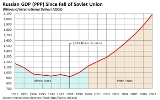
 Russia's economy sank into deep depression by the mid-1990s, was hit further by the financial crash of 1998, and then began to recover in 1999–2000. According to Russian government statistics, the economic decline was far more severe than the Great Depression
was in the United States in terms of Gross Domestic Product. It is about half as severe as the catastrophic drop borne out of the consequence of World War I
, the fall of Tsar
ism, and the Russian Civil War
.
Following the economic collapse of the early 1990s, Russia suffered from a sharp increase in the rates of poverty
and economic inequality
. Estimates by the World Bank
based on both macroeconomic data and surveys of household incomes and expenditures indicate that whereas 1.5% of the population was living in poverty (defined as income below the equivalent of $25 per month) in the late Soviet era, by mid-1993 between 39% and 49% of the population was living in poverty. Per capita incomes fell by another 15% by 1998, according to government figures.
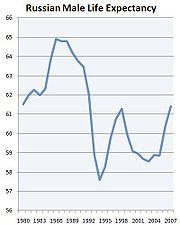
Public health indicators show a dramatic corresponding decline. In 1999, total population fell by about three-quarters of a million people. Meanwhile life expectancy dropped for men from sixty-four years in 1990 to fifty-seven years by 1994, while women's dropped from seventy-four to about seventy-one. Both health factors and sharp increase in deaths of mostly young people from unnatural causes (such as murders, suicides and accidents caused by increased disregard for safety) have significantly contributed to this trend. As of 2004, life expectancy is higher than at the nadir of the crisis in 1994, yet it still remains below the 1990 level.
Alcohol-related deaths skyrocketed 60% in the 1990s. Deaths from infectious and parasitic diseases shot up 100%, mainly because medicines were no longer affordable to the poor. There are now roughly one and half times as many deaths as births per year in Russia.
While the supply shortages of consumer goods characteristic of the 1980s went away (see Consumer goods in the Soviet Union
), this was not only related to the opening of Russia's market to imports in the early 1990s but also to the impoverishment of the Russian people in the 1990s. Russians on fixed incomes (the vast majority of the workforce) saw their purchasing power drastically reduced, so while the stores might have been well stocked in the Yeltsin era, workers could now afford to buy little, if anything.
By 2004 the average income has risen to more than $300 per month, emblematic of the mild recovery in recent years thanks to a large extent to high oil prices. But the growing income is not being evenly distributed. The social inequality
has risen sharply during the 1990s with the Gini coefficient
, for example, reaching 40%. Russia's income disparities are now nearly as large as Brazil
, which has long been among the world leader in inequality, and the regional disparities in the level of poverty are still growing sharper.
and its allies in the parliament. Russian voters, able to vote for opposition parties in the 1990s, often rejected economic reforms and yearned for the stability and personal security of the Soviet era. These were the groups that had enjoyed the benefits of Soviet-era state-controlled wages and prices, high state spending to subsidize priority sectors of the economy, protection from competition with foreign industries, and welfare entitlement programs.
During the Yeltsin years in the 1990s, these groups were well organized, voicing their opposition to reform through strong trade unions, associations of directors of state-owned firms, and political parties in the popularly elected parliament whose primary constituencies were among those vulnerable to reform. A constant theme of Russian history in the 1990s was the conflict between economic reformers and those hostile to the new capitalism.
and Congress of People's Deputies of Russia, which had been elected in March 1990
, before the dissolution of the USSR. While this spared Yeltsin from the prospects of parliamentary bargaining and wrangling, it also eliminated any meaningful discussion of the right course of action for the country.
However, radical reform still faced some critical political barriers. The Soviet-era Central Bank was still subordinate to the conservative Supreme Soviet as opposed to the presidency. During the height of hyperinflation in 1992–1993, the Central Bank actually tried to derail reforms by actively printing money during a period of inflation. After all, the Russian government was short of revenue and was forced to print money to finance its debt. As a result, inflation exploded into hyperinflation, and the Russian economy continued in a serious slump.
, and the other parliamentary supporters surrendered and were immediately arrested and jailed. The official count was 187 dead, 437 wounded (with several men killed and wounded on the presidential side).
Thus the transitional period in post-Soviet Russian politics came to an end. A new constitution was approved by referendum in December 1993. Russia was given a strongly presidential system. Radical privatization went ahead. Although the old parliamentary leaders were released without trial on February 26, 1994, they would not play an open role in politics thereafter. Though its clashes with the executive would eventually resume, the remodeled Russian parliament had greatly circumscribed powers. (For details on the constitution passed in 1993 see Constitution and government structure of Russia.)
from Russia. Living 1000 miles (1,609.3 km) south of Moscow, the predominantly Muslim Chechens
for centuries had gloried in defying the Russians. Dzhokhar Dudayev, the Republic of Chechnya’s nationalist president, was driven to take his republic out of the Russian Federation, and had declared Chechnya's independence in 1991. Russia was quickly submerged in a quagmire like that of the U.S. in the Vietnam War
. When the Russians attacked the Chechen capital of Grozny during the first weeks of January 1995, about 25,000 civilians died under week-long air raids and artillery fire in the sealed-off city. Massive use of artillery and air strikes remained the dominating strategy throughout the Russian campaign. Even so, Chechen insurgents seized thousands of Russian hostages, while inflicting humiliating losses on Russia's demoralized and ill-equipped troops. Russian troops had not secured the Chechen capital of Grozny
by year's end.
The Russians finally managed to gain control of Grozny in February 1995 after heavy fighting. In August 1996 Yeltsin agreed to a ceasefire with Chechen leaders, and a peace treaty was formally signed in May 1997. However, the conflict resumed in 1999, thus rendering the 1997 peace accord meaningless. This time the rebellion was brutally crushed by Vladimir Putin
.
s in the Communist Party, KGB, and Komsomol
(Soviet Youth League) were cashing in on their Soviet-era power and privileges. Some quietly liquidated the assets of their organization and secreted the proceeds in overseas accounts and investments. Others created banks and business in Russia, taking advantage of their insider positions to win exclusive government contracts and licenses and to acquire financial credits and supplies at artificially low, state-subsidized prices in order to transact business at high, market-value prices. Great fortunes were made almost overnight.
At the same time, a few young people, without much social status, saw opportunity in the economic and legal confusion of the transition. Between 1987 and 1992, trading of natural resources and foreign currencies, as well as imports of highly demanded consumer goods and then domestic production of their rudimentary substitutes, rapidly enabled these pioneering entrepreneurs to accumulate considerable wealth. In turn, the emerging cash-based, highly opaque markets provided a breeding ground for a large number of racket gangs.
By the mid 1990s, the best-connected former nomenklatura
leaders accumulated considerable financial resources, while on the other hand, the most successful entrepreneurs became acquainted with government officials and public politicians. The privatization of state enterprises was a unique opportunity, because it gave many of those who had gained wealth in the early 1990s a chance to convert it into shares of privatized enterprises.
The Yeltsin government hoped to use privatization to spread ownership of shares in former state enterprises as widely as possible to create political support for his government and his reforms. The government used a system of free vouchers as a way to give mass privatization a jump-start. But it also allowed people to purchase shares of stock in privatized enterprises with cash
. Even though initially each citizen received a voucher of equal face value, within months most of the vouchers converged in the hands of intermediaries who were ready to buy them for cash right away.
As the government ended the voucher privatization
phase and launched cash privatization, it devised a program that it thought would simultaneously speed up privatization and yield the government a much-needed infusion of cash for its operating needs. Under the scheme, which quickly became known in the West as "loans for shares," the Yeltsin regime auctioned off substantial packages of stock shares in some of its most desirable enterprises, such as energy
, telecommunication
s, and metallurgical
firms, as collateral
for bank loans.
In exchange for the loans, the state handed over assets worth many times as much. Under the terms of the deals, if the Yeltsin government did not repay the loans by September 1996, the lender acquired title to the stock and could then resell it or take an equity position in the enterprise. The first auction
s were held in the fall of 1995. The auctions themselves were usually held in such a way so to limit the number of banks bidding for shares and thus to keep the auction prices extremely low. By summer 1996, major packages of shares in some of Russia's largest firms had been transferred to a small number of major banks, thus allowing a handful of powerful banks to acquire substantial ownership shares over major firms at shockingly low prices. These deals were effectively giveaways of valuable state assets to a few powerful, well-connected, and wealthy financial groups.
The concentration of immense financial and industrial power, which loans for shares had assisted, extended to the mass media. One of the most prominent of the financial barons Boris Berezovsky, who controlled major stakes in several banks and companies, exerted an extensive influence over state television
programming for a while. Berezovsky and other ultra-wealthy, well-connected tycoons who controlled these great empires of finance, industry, energy, telecommunications, and media became known as the "Russian oligarchs
". Along with Berezovsky, Mikhail Khodorkovsky
, Roman Abramovich
, Vladimir Potanin
, Vladimir Bogdanov
, Rem Viakhirev
, Vagit Alekperov
, Viktor Chernomyrdin
, Viktor Vekselberg
, and Mikhail Fridman
emerged as Russia's most powerful and prominent oligarchs.
A tiny clique who used their connections built up during the last days of the Soviet years to appropriate Russia's vast resources during the rampant privatizations of the Yeltsin years, the oligarchs emerged as the most hated men in the nation. The Western world generally advocated a quick dismantling of the Soviet planned economy
to make way for "free-market reforms," but later expressed disappointment over the newfound power and corruption of the "oligarchs."
had already gained ground in parliamentary voting on December 17, 1995, and its candidate, Gennady Zyuganov
, had a strong grassroots organization, especially in the rural areas and small towns, and appealed effectively to memories of the old days of Soviet prestige on the international stage and the socialist domestic order.
Panic struck the Yeltsin team when opinion polls suggested that the ailing president could not win; members of his entourage urged him to cancel presidential elections and effectively rule as dictator from then on. Instead, Yeltsin changed his campaign team, assigning a key role to his daughter, Tatyana Dyachenko
, and appointing Anatoly Chubais
campaign manager. Chubais, who was not just Yeltsin's campaign manager but also the architect of Russia's privatization program, set out to use his control of the privatization program as the key instrument of Yeltsin's reelection campaign.
The president's inner circle assumed that it had only a short time in which to act on privatization; it therefore needed to take steps that would have a large and immediate impact, making the reversal of reform prohibitively costly for their opponents. Chubais' solution was to co-opt potentially powerful interests, including enterprise directors and regional officials, in order to ensure Yeltsin's reelection.
The position of the enterprise directors to the program was essential to maintaining economic and social stability in the country. The managers represented one of the most powerful collective interests in the country; it was the enterprise managers who could ensure that labor did not erupt in a massive wave of strikes. The government, therefore, did not strenuously resist the tendency for voucher privatization to turn into "insider privatization," as it was termed, in which senior enterprise officials acquired the largest proportion of shares in privatized firms. Thus, Chubais allowed well-connected employees to acquire majority stakes in the enterprises. This proved to be the most widely used form of privatization in Russia. Three-quarters of privatized enterprises opted for this method, most often using vouchers. Real control thus wound up in the hands of the managers.
Support from the oligarchs was also crucial to Yeltsin's reelection campaign. The "loans for shares" giveaway took place in the run-up to the 1996 presidential election—at a point when it had appeared that Zyuganov might defeat Yeltsin. Yeltsin and his entourage gave the oligarchs an opportunity to scoop up some of Russia's most desirable assets in return for their help in his reelection effort. The oligarchs, in turn, reciprocated the favor.
In the spring of 1996, with Yeltsin's popularity at a low ebb, Chubais and Yeltsin recruited a team of six leading Russian financiers and media barons (all oligarchs) who bankrolled the Yeltsin campaign with $3 million and guaranteed coverage on television and in leading newspapers directly serving the president's campaign strategy. The media painted a picture of a fateful choice for Russia, between Yeltsin and a "return to totalitarianism." The oligarchs even played up the threat of civil war if a Communist were elected president.
In the outlying regions of the country, the Yeltsin campaign relied on its ties to other allies—the patron-client ties of the local governors, most of whom had been appointed by the president.
The Zyuganov campaign had a strong grass-roots organization, but it was simply no match to the financial resources and access to patronage that the Yeltsin campaign could marshal.
Yeltsin campaigned energetically, dispelling concerns about his health, exploiting all the advantages of incumbency to maintain a high media profile. To assuage voters' discontent, he made the claim that he would abandon some unpopular economic reforms and boost welfare spending, end the war in Chechnya
, pay wage and pension arrears, and abolish the military draft program (he did not live up to his promises after the election, except for ending the Chechen war, which was halted for 3 years). Yeltsin's campaign also got a boost from the announcement of a $10 billion loan to the Russian government from the International Monetary Fund.
Grigory Yavlinsky was the liberal alternative to Yeltsin and Zyuganov. He appealed to a well-educated middle class that saw Yeltsin as a drunken scoundrel and Zyuganov as a Soviet-era throwback. Seeing Yavlinsky as a threat, Yeltsin's inner circle of supporters worked to bifurcate political discourse, thus excluding a middle ground—and convince voters that only Yeltsin could defeat the Communist "menace." The election became a two-man race, and Zyuganov, who lacked Yeltsin's resources and financial backing, watched haplessly as his strong initial lead was whittled away.
5.8%; and former Soviet president Mikhail Gorbachev
0.5%. With no candidate securing an absolute majority, Yeltsin and Zyuganov went into a second round of voting. In the meantime, Yeltsin co-opted a large segment of the electorate by appointing Lebed to the posts of national security adviser and secretary of the Security Council.
In the end, Yeltsin's election tactics paid off. In the run-off on July 3, with a turnout of 68.9%, Yeltsin won 53.8% of the vote and Zyuganov 40.3%, with the rest (5.9%) voting "against all". Moscow
and Saint Petersburg
(formerly Leningrad) together provided over half of the incumbent president's support, but he also did well in large cities in the Urals and in the north and northeast. Yeltsin lost to Zyuganov in Russia's southern industrial heartland. The southern stretch of the country became known as the "red belt", underscoring the resilience of the Communist Party in elections since the breakup of the Soviet Union.
Although Yeltsin promised that he would abandon his unpopular neoliberal austerity policies and increase public spending to help those suffering from the pain of capitalist reforms, within a month of his election, Yeltsin issued a decree canceling almost all of these promises.
Right after the election, Yeltsin's physical health and mental stability were increasingly precarious. Many of Yeltsin's executive functions thus devolved upon a group of advisers (most of whom had close links with the oligarchs).
, natural gas
, metal
s, and timber
account for more than 80% of Russian exports, leaving the country vulnerable to swings in world prices. Oil is also a major source of government tax revenue. The sharp decline in the price of oil had severe consequences for Russia.
The pressures on the ruble, reflecting the weakness of the economy, resulted in a disastrous fall in the value of the currency. Massive tax evasion
also continued, and the government found itself unable to service the massive loans it had received or even to pay its employees. The government stopped making timely payment of wages, pensions, and debts to suppliers; and when workers were paid, it was often with bartered goods rather than rubles. Coal miners were hard hit, and for several weeks in the summer they blocked sections of the Trans-Siberian railroad, effectively cutting the country in two. As time wore on, they added calls for the resignation of Yeltsin and his government to their wage demands.
A political crisis came to a head in March when Yeltsin suddenly dismissed Prime Minister Viktor Chernomyrdin and his entire cabinet on March 23. Yeltsin named a virtually unknown technocrat, Energy Minister Sergei Kiriyenko
, aged 35, as acting prime minister. Russian observers expressed doubts about Kiriyenko's youth and inexperience. The Duma rejected his nomination twice. Only after a month-long standoff, during which Yeltsin threatened to dissolve the legislature, did the Duma confirm Kiriyenko on a third vote on April 24.
Kiriyenko appointed a new cabinet strongly committed to stemming the fall in value of Russia's currency. The oligarchs strongly supported Kiriyenko's efforts to maintain the exchange rate. A high exchange rate meant that they needed fewer rubles to buy imported goods, especially luxury items.
In an effort to prop up the currency and stem the flight of capital, Kiriyenko hiked interest rates to 150% in order to attract buyers for government bonds. But concerns about the financial crisis in Asia and the slump in world oil prices were already prompting investors to withdraw from Russia. By mid-1998, it was clear Russia would need help from IMF to maintain its exchange rate.
The Russian crisis caused alarm in the West. Pouring more money into the Russian economy would not be a long-term solution, but the U.S. in particular feared that Yeltsin's government would not survive a looming financial crisis without IMF help. U.S. President Bill Clinton
's treasury secretary, Robert Rubin
, also feared that a Russian collapse could create a panic on world money markets (and it indeed did help bring down one major US hedge fund Long Term Capital Management). The IMF approved a $22.6 billion emergency loan on July 13.
Despite the bailout, Russia's monthly interest payments still well exceeded its monthly tax revenues. Realizing that this situation was unsustainable, investors continued to flee Russia despite the IMF bailout. Weeks later the financial crisis resumed and the value of the ruble resumed its fall, and the government fell into a self perpetuating trap. To pay off the interest on the loans it had taken, it needed to raise still more cash, which it did through foreign borrowing. As lenders became increasingly certain that the government could not make good on its obligations, they demanded ever-higher interest rates, deepening the trap. Ultimately the bubble burst.
On August 17, Kiriyenko's government and the central bank were forced to suspend payment on Russia's foreign debt for 90 days, restructure the nation's entire debt, and devalue the ruble. The ruble went into free fall as Russians sought frantically to buy dollars. Western creditors lost heavily, and a large part of Russia's fledgling banking sector was destroyed, since many banks had substantial dollar borrowings. Foreign investment rushed out of the country, and financial crisis triggered an unprecedented flight of capital from Russia.
Yeltsin, who began to lose his hold as his health deteriorated, wanted Chernomyrdin back, but the legislature refused to give its approval. After the Duma rejected Chernomyrdin's candidacy twice, Yeltsin, his power clearly on the wane, backed down. Instead, he nominated Foreign Minister Yevgeny Primakov
, who on September 11 was overwhelmingly approved by the Duma.
Primakov's appointment restored political stability because he was seen as a compromise candidate able to heal the rifts between Russia's quarreling interest groups. There was popular enthusiasm for Primakov as well. Primakov promised to make the payment of wage and pension arrears his government’s first priority, and invited members of the leading parliamentary factions into his Cabinet.
Communists and trade unionists staged a nationwide strike on October 7, and called on President Yeltsin to resign. On October 9, Russia, which was also suffering from a bad harvest, appealed for international humanitarian aid, including food.
Nevertheless, the political and social equilibrium of the country remains tenuous to this day, and power remains a highly personalized commodity. The economy remains vulnerable to downturn if, for instance, world oil prices fall at a dramatic pace.
, who had formerly been head of the FSB (the successor agency to the KGB
) and later been Interior Minister, to replace him. The Duma confirmed his appointment on the first ballot by a wide margin.
Stepashin's tenure was even shorter than Primakov's. In August 1999, Yeltsin once again abruptly dismissed the government and named Vladimir Putin
as his candidate to head the new government. Like Stepashin, Putin had a background in the secret police, having made his career in the foreign intelligence service and later as head of the FSB. Yeltsin went so far as to declare that he saw Putin as his successor as president. The Duma narrowly voted to confirm Putin.
When appointed, Putin was a relatively unknown politician, but he quickly established himself both in public opinion and in Yeltsin's estimation as a trusted head of government, largely due to the Second Chechen War
. Just days after Yeltsin named Putin as a candidate for prime minister, Chechen forces engaged the Russian army
in Dagestan
, a Russian autonomy near Chechnya
. In the next month, several hundred people died in apartment building bombings
in Moscow and other cities, bombings Russian authorities attributed to Chechen rebels. In response, the Russian army entered Chechnya in late September 1999, starting the Second Chechen War. The Russian public at the time, angry over the terrorist
bombings, widely supported the war. The support translated into growing popularity for Putin, who had taken decisive action in Chechnya.
After the success of political forces close to Putin in the December 1999 parliamentary elections, Yeltsin evidentially felt confident enough in Putin that he resigned from the presidency on December 31, six months before his term was due to expire. This made Putin acting president and gave Putin ample opportunity to position himself as frontrunner for the Russian presidential election held on March 26, 2000
, which he won. The Chechen War figured prominently in the campaign. In February 2000, Russian troops entered Grozny
, the Chechen capital, and a week before the election, Putin flew to Chechnya on a fighter jet, claiming victory.
.jpg)
In August 2000, the Russian submarine K-141 Kursk
suffered an explosion, causing the submarine to sink in the shallow area of the Barents Sea
. Russia organized a vigorous but hectic attempt to save the crew, and the entire futile effort was surrounded by unexplained secrecy. This, as well as the slow initial reaction to the event and especially to the offers of foreign aid in saving the crew, brought much criticism on the government and personally on President Putin.
On October 23, 2002, Chechen
separatists took over a Moscow theater. Over 700 people inside were taken hostage in what has been called the Moscow theater hostage crisis
. The separatists demanded the immediate withdrawal of Russian forces from Chechnya
and threatened to blow up the building if authorities attempted to enter. Three days later, Russian commandos stormed the building after the hostages had been subdued with a sleeping gas, shooting the unconscious militants, and killing over 100 civilian hostages with the sleeping gas in the process.
In the aftermath of the theater siege, Putin began renewed efforts to eliminate the Chechen insurrection. (For additional details on the war in Chechnya under Putin, see Second Chechen War
.) The government canceled scheduled troop withdrawals, surrounded Chechen refugee camps with soldiers, and increased the frequency of assaults on separatist positions.
Chechen militants responded in kind, stepping up guerrilla operations and rocket attacks on federal helicopters. Several high-profile attacks have taken place. In May 2004, Chechen separatists assassinated Akhmad Kadyrov
, the pro-Russia Chechen leader who became the president of Chechnya 8 months earlier after an election conducted by Russian authorities. On August 24, 2004, two Russian aircraft were bombed
. This was followed by the Beslan school hostage crisis
in which Chechen separatists took 1,300 hostages. The initially high public support for the war in Chechnya has declined.
Putin has confronted several very influential oligarchs (Vladimir Gusinsky
, Boris Berezovsky and Mikhail Khodorkovsky
, in particular) who attained large stakes of state assets, allegedly through illegal schemes, during the privatization process. Gusinsky and Berezovsky have been forced to leave Russia and give up parts of their assets. Khodorkovsky was jailed in Russia and has lost his YUKOS
company, formerly the largest oil producer in Russia. Putin's stand against oligarchs is generally popular with the Russian people, even though the jailing of Khodorkovsky is mainly seen as part of a takeover operation by government officials, according to another Levada-Center poll.
These confrontations have also lead to Putin establishing control over Russian media outlets previously owned by the oligarchs. In 2001 and 2002, TV channels NTV
(previously owned by Gusinsky), TV6 and TVS (owned by Berezovsky) were all taken over by media groups loyal to Putin. Similar takeovers have also occurred with print media.
Putin's popularity, which stems from his reputation as a strong leader, stands in contrast to the unpopularity of his predecessor, but it hinges on a continuation of economic recovery. Putin came into office at an ideal time: after the devaluation of the ruble
in 1998, which boosted demand for domestic goods, and while world oil prices were rising. Indeed, during the seven years of his presidency, real GDP grew on average 6.7% a year, average income increased 11% annually in real terms, and a consistently positive balance of the federal budget enabled the government to cut 70% of the external debt (according to the Institute for Complex Strategic Studies). Thus, many credit him with the recovery, but his ability to withstand a sudden economic downturn has been untested. Putin won the Russian presidential election in 2004
without any significant competition.
Some researchers assert that most Russians today have come to regret the collapse of the Soviet Union in 1991. On repeated occasions, even Vladimir Putin—Boris Yeltsin's handpicked successor — stated that the fall of Soviet rule had led to few gains and many problems for most Russian citizens. In a campaign speech in February 2004, for example, Putin called the dismantlement of the Soviet Union a "national tragedy on an enormous scale," from which "only the elites and nationalists of the republics gained." He added, "I think that ordinary citizens of the former Soviet Union and the post-Soviet space gained nothing from this. On the contrary, people have faced a huge number of problems."
Putin's international prestige suffered a major blow in the West during the disputed 2004 Ukrainian presidential election
. Putin had twice visited Ukraine before the election to show his support for the pro-Russian Viktor Yanukovych
against opposition leader Viktor Yushchenko
, a pro-Western liberal economist. He congratulated Yanukovych, followed shortly afterwards by Belorussian president Alexander Lukashenko
, on his victory before election results were even made official and made statements opposing the rerun of the disputed second round of elections, won by Yanukovych, amid allegations of large-scale voting fraud. The second round was ultimately rerun; Yushchenko won the round and was eventually declared the winner on January 10, 2005. In the West, the reaction to Russia's handling of, or perhaps interference in, the Ukrainian election evoked echoes of the Cold War, but relations with the U.S. have remained stable.
In 2005, the Russian government replaced the broad in-kind Soviet-era benefits, such as free transportation and subsidies for heating and other utilities for socially vulnerable groups by cash payments. The reform, known as monetization
, has been unpopular and caused a wave of demonstrations in various Russian cities, with thousands of retirees protesting against the loss of their benefits. This was the first time such wave of protests took place during the Putin administration. The reform has hurt the popularity of the Russian government, but Putin personally was still popular, with a 77% approval rating.
In 2008, Kosovo's declaration of independence
saw a marked deterioration in Russia's relationship with the West. It also saw South Ossetia war
against Georgia
, that followed the Georgia's attempt to take over the breakaway region of South Ossetia
. Russian troops entered South Ossetia and forced Georgian troops back, establishing their control on this territory. In the fall of 2008, Russia unilaterally recognized the independence of South Ossetia
and Abkhazia
.
However, although Russia's leaders now described the West as its natural ally, they grappled with defining new relations with the East European states, the new states formed upon the disintegration of Yugoslavia
, and Eastern Europe. Russia opposed the expansion of NATO into the former Soviet bloc nations of the Czech Republic, Poland, and Hungary in 1997 and, particularly, the second NATO expansion into the Baltic states
in 2004. In 1999, Russia opposed the NATO bombing of Yugoslavia for more than two months (see Kosovo War
), but later joined NATO peace-keeping forces in the Balkans in June 1999.
Relations with the West have also been stained by Russia's relationship with Belarus
. Belarusian President Alexander Lukashenko
, an authoritarian leader, has shown much interest in aligning his country with Russia, and no interest in deepening ties with the ever-expanding NATO or implementing Western-backed neoliberal economic reforms. A union agreement between Russia and Belarus was formed on April 2, 1996. The agreement was tightened, becoming the Union of Russia and Belarus
on April 3, 1997. Further strengthening of the union occurred on December 25, 1998, and in 1999.
Under Putin, Russia has sought to strengthen ties with the People's Republic of China
by signing the Treaty of Good-Neighborliness and Friendly Cooperation as well building the Trans-Siberian oil pipeline geared toward growing Chinese energy needs. He also made a number of appearances in the media with President of the United States
George W. Bush
in which the two described each other as "friends".
Mark Hollingsworth & Stewart Lansley, Londongrad: From Russia With Cash, 2009, 4th Estate
Dissolution of the Soviet Union
The dissolution of the Soviet Union was the disintegration of the federal political structures and central government of the Union of Soviet Socialist Republics , resulting in the independence of all fifteen republics of the Soviet Union between March 11, 1990 and December 25, 1991...
on 29 May 1991, the Russian Federation
Russia
Russia or , officially known as both Russia and the Russian Federation , is a country in northern Eurasia. It is a federal semi-presidential republic, comprising 83 federal subjects...
became an independent country.
Russia was the largest of the fifteen republics that made up the Soviet Union
Soviet Union
The Soviet Union , officially the Union of Soviet Socialist Republics , was a constitutionally socialist state that existed in Eurasia between 1922 and 1991....
, accounting for over 60% of the gross domestic product
Gross domestic product
Gross domestic product refers to the market value of all final goods and services produced within a country in a given period. GDP per capita is often considered an indicator of a country's standard of living....
(GDP) and over 50% of the Soviet population. Russians
Russians
The Russian people are an East Slavic ethnic group native to Russia, speaking the Russian language and primarily living in Russia and neighboring countries....
also dominated the Soviet military and the Communist Party
Communist Party of the Soviet Union
The Communist Party of the Soviet Union was the only legal, ruling political party in the Soviet Union and one of the largest communist organizations in the world...
(CPSU). Thus, Russia was widely accepted as the Soviet Union's successor state in diplomatic affairs and it assumed the USSR's permanent membership and veto in the UN Security Council
United Nations Security Council
The United Nations Security Council is one of the principal organs of the United Nations and is charged with the maintenance of international peace and security. Its powers, outlined in the United Nations Charter, include the establishment of peacekeeping operations, the establishment of...
(see Russia and the United Nations).
Despite this acceptance, post-Soviet Russia lacked the military and political power of the former USSR. Russia managed to make the other ex-Soviet republics voluntarily disarm themselves of nuclear weapons and concentrated them under the command of the still effective rocket and space forces, but for the most part the Russian army and fleet
Armed Forces of the Russian Federation
The Armed Forces of the Russian Federation are the military services of Russia, established after the break-up of the Soviet Union. On 7 May 1992 Boris Yeltsin signed a decree establishing the Russian Ministry of Defence and placing all Soviet Armed Forces troops on the territory of the RSFSR...
were in near disarray by 1992. Prior to the dissolution of the Soviet Union, Boris Yeltsin
Boris Yeltsin
Boris Nikolayevich Yeltsin was the first President of the Russian Federation, serving from 1991 to 1999.Originally a supporter of Mikhail Gorbachev, Yeltsin emerged under the perestroika reforms as one of Gorbachev's most powerful political opponents. On 29 May 1990 he was elected the chairman of...
had been elected President of Russia in June 1991 in the first direct presidential election in Russian history. In October 1991, as Russia was on the verge of independence, Yeltsin announced that Russia would proceed with radical market
Market economy
A market economy is an economy in which the prices of goods and services are determined in a free price system. This is often contrasted with a state-directed or planned economy. Market economies can range from hypothetically pure laissez-faire variants to an assortment of real-world mixed...
-oriented reform along the lines of Poland
Poland
Poland , officially the Republic of Poland , is a country in Central Europe bordered by Germany to the west; the Czech Republic and Slovakia to the south; Ukraine, Belarus and Lithuania to the east; and the Baltic Sea and Kaliningrad Oblast, a Russian exclave, to the north...
's "big bang", also known as "shock therapy
Shock therapy (economics)
In economics, shock therapy refers to the sudden release of price and currency controls, withdrawal of state subsidies, and immediate trade liberalization within a country, usually also including large scale privatization of previously public owned assets....
".
Shock therapy
The conversion of the world's largest state-controlled economy into a market-oriented economy would have been extraordinarily difficult regardless of the policies chosen. The policies chosen for this difficult transition were (1) liberalization, (2) stabilization, and (3) privatization
Privatization in Russia
Russian privatization was the reform consisting in privatization of state-owned industrial assets that took place in Russia in the 1990s, during the presidency of Boris Yeltsin, immediately after the dissolution of the Soviet Union, where private ownership of enterprises had been illegal for a long...
. These policies were based on the neoliberal
Neoliberalism
Neoliberalism is a market-driven approach to economic and social policy based on neoclassical theories of economics that emphasizes the efficiency of private enterprise, liberalized trade and relatively open markets, and therefore seeks to maximize the role of the private sector in determining the...
"Washington Consensus
Washington Consensus
The term Washington Consensus was coined in 1989 by the economist John Williamson to describe a set of ten relatively specific economic policy prescriptions that he considered constituted the "standard" reform package promoted for crisis-wracked developing countries...
" of the International Monetary Fund
International Monetary Fund
The International Monetary Fund is an organization of 187 countries, working to foster global monetary cooperation, secure financial stability, facilitate international trade, promote high employment and sustainable economic growth, and reduce poverty around the world...
(IMF), World Bank
World Bank
The World Bank is an international financial institution that provides loans to developing countries for capital programmes.The World Bank's official goal is the reduction of poverty...
, and U.S. Treasury Department.
The programs of liberalization and stabilization were designed by Yeltsin's deputy prime minister Yegor Gaidar
Yegor Gaidar
Yegor Timurovich Gaidar was a Soviet and Russian economist, politician and author, and was the Acting Prime Minister of Russia from 15 June 1992 to 14 December 1992....
, a 35-year-old liberal economist inclined toward radical reform, and widely known as an advocate of "shock therapy
Shock therapy (economics)
In economics, shock therapy refers to the sudden release of price and currency controls, withdrawal of state subsidies, and immediate trade liberalization within a country, usually also including large scale privatization of previously public owned assets....
". Shock therapy began days after the dissolution of the Soviet Union, when on January 2, 1992, Russian President Boris Yeltsin ordered the liberalization of foreign trade, prices, and currency. This entailed removing Soviet-era price controls in order to lure goods back into understocked Russian stores, removing legal barriers to private trade and manufacture, and cutting subsidies
Subsidy
A subsidy is an assistance paid to a business or economic sector. Most subsidies are made by the government to producers or distributors in an industry to prevent the decline of that industry or an increase in the prices of its products or simply to encourage it to hire more labor A subsidy (also...
to state farms and industries while allowing foreign imports into the Russian market in order to break the power of state-owned local monopolies.
The partial results of liberalization (lifting price controls) included worsening already apparent hyperinflation
Hyperinflation
In economics, hyperinflation is inflation that is very high or out of control. While the real values of the specific economic items generally stay the same in terms of relatively stable foreign currencies, in hyperinflationary conditions the general price level within a specific economy increases...
, initially due to monetary overhang
Monetary overhang
Monetary overhang is a phenomenon where people have money holdings due to the lack of ability to spend them. This is a phenomenon often present with repressed inflation and was a common occurrence in the Soviet Union. The solution to this is usually a swift burst of inflation.In the Soviet Union,...
and exacerbated after the central bank
Central bank
A central bank, reserve bank, or monetary authority is a public institution that usually issues the currency, regulates the money supply, and controls the interest rates in a country. Central banks often also oversee the commercial banking system of their respective countries...
, an organ under parliament, which was skeptical of Yeltsin's reforms, was short of revenue and printed money to finance its debt. This resulted in the near bankruptcy of much of Russian industry.
The process of liberalization would create winners and losers, depending on how particular industries, classes, age groups, ethnic groups, regions, and other sectors of Russian society were positioned. Some would benefit by the opening of competition; others would suffer. Among the winners were the new class of entrepreneurs and black marketeers that had emerged under Mikhail Gorbachev
Mikhail Gorbachev
Mikhail Sergeyevich Gorbachev is a former Soviet statesman, having served as General Secretary of the Communist Party of the Soviet Union from 1985 until 1991, and as the last head of state of the USSR, having served from 1988 until its dissolution in 1991...
's perestroika
Perestroika
Perestroika was a political movement within the Communist Party of the Soviet Union during 1980s, widely associated with the Soviet leader Mikhail Gorbachev...
. But liberalizing prices meant that the elderly and others on fixed incomes would suffer a severe drop in living standards, and people would see a lifetime of savings wiped out.
With inflation at double-digit rates per month as a result of printing, macroeconomic stabilization was enacted to curb this trend. Stabilization, also called structural adjustment, is a harsh austerity regime (tight monetary policy
Monetary policy
Monetary policy is the process by which the monetary authority of a country controls the supply of money, often targeting a rate of interest for the purpose of promoting economic growth and stability. The official goals usually include relatively stable prices and low unemployment...
and fiscal policy
Fiscal policy
In economics and political science, fiscal policy is the use of government expenditure and revenue collection to influence the economy....
) for the economy in which the government seeks to control inflation. Under the stabilization program, the government let most prices float, raised interest rate
Interest rate
An interest rate is the rate at which interest is paid by a borrower for the use of money that they borrow from a lender. For example, a small company borrows capital from a bank to buy new assets for their business, and in return the lender receives interest at a predetermined interest rate for...
s to record highs, raised heavy new taxes, sharply cut back on government subsidies to industry and construction, and made massive cuts in state welfare spending. These policies caused widespread hardship as many state enterprises found themselves without orders or financing. A deep credit crunch
Credit crunch
A credit crunch is a reduction in the general availability of loans or a sudden tightening of the conditions required to obtain a loan from the banks. A credit crunch generally involves a reduction in the availability of credit independent of a rise in official interest rates...
shut down many industries and brought about a protracted depression.
The rationale of the program was to squeeze the built-in inflationary pressure out of the economy so that producers would begin making sensible decisions about production, pricing and investment instead of chronically overusing resources—a problem that resulted in shortages of consumer goods in the Soviet Union
Consumer goods in the Soviet Union
The industry of the Soviet Union was usually divided into two major categories. Group A was "heavy industry," which included all goods that serve as an input required for the production of some other, final good...
in the 1980s. By letting the market rather than central planners determine prices, product mixes, output levels, and the like, the reformers intended to create an incentive structure in the economy where efficiency and risk would be rewarded and waste and carelessness were punished. Removing the causes of chronic inflation, the reform architects argued, was a precondition for all other reforms: Hyperinflation would wreck both democracy and economic progress, they argued; they also argued that only by stabilizing the state budget could the government proceed to dismantle the Soviet planned economy and create a new capitalist Russia.
Obstacles to capitalist reform in Russia
A major reason that Russia's transition has been so wrenching is that the country is remaking both its Soviet-era political and economic institutions at once. In addition, Russia is remaking itself as a new national state following the disintegration of the union.The former Soviet Union was to deal with a number of unique obstacles during the post-Soviet transition. These obstacles may have left Russia on a far worse footing than other former Communist-led states to Russia's west that were also going through dual economic and political transitions, such as Poland
Poland
Poland , officially the Republic of Poland , is a country in Central Europe bordered by Germany to the west; the Czech Republic and Slovakia to the south; Ukraine, Belarus and Lithuania to the east; and the Baltic Sea and Kaliningrad Oblast, a Russian exclave, to the north...
, Hungary
Hungary
Hungary , officially the Republic of Hungary , is a landlocked country in Central Europe. It is situated in the Carpathian Basin and is bordered by Slovakia to the north, Ukraine and Romania to the east, Serbia and Croatia to the south, Slovenia to the southwest and Austria to the west. The...
, and the Czech Republic
Czech Republic
The Czech Republic is a landlocked country in Central Europe. The country is bordered by Poland to the northeast, Slovakia to the east, Austria to the south, and Germany to the west and northwest....
, which have fared better since the collapse of the Eastern bloc between 1989 and 1991.
The first major problem facing Russia was the legacy of the Soviet Union's enormous commitment to the Cold War
Cold War
The Cold War was the continuing state from roughly 1946 to 1991 of political conflict, military tension, proxy wars, and economic competition between the Communist World—primarily the Soviet Union and its satellite states and allies—and the powers of the Western world, primarily the United States...
. In the late 1980s, the Soviet Union devoted a quarter of its gross economic output to the defense sector (at the time most Western analysts believed that this figure was 15 percent). At the time, the military-industrial complex employed at least one of every five adults in the Soviet Union. In some regions of Russia, at least half of the workforce was employed in defense plants. (The comparable U.S. figures were roughly one-sixteenth of gross national product and about one of every sixteen in the workforce.) The end of the Cold War and the cutback in military spending hit such plants very hard, and it was often impossible for them to quickly retool equipment, retrain workers, and find new markets to adjust to the new post–Cold War and post-Soviet era. In the process of conversion an enormous body of experience, qualified specialists and know-how has been lost, as the plants were sometimes switching from, for example, producing hi-tech military equipment to making kitchen utensils.
A second obstacle, partly related to the sheer vastness and geographical diversity of the Russian landmass, was the sizable number of "mono-industrial" regional economies (regions dominated by a single industrial employer) that Russia inherited from the Soviet Union. The concentration of production in a relatively small number of big state enterprises meant that many local governments were entirely dependent on the economic health of a single employer; when the Soviet Union collapsed and the economic ties between Soviet republics and even regions were severed, the production in the whole country dropped by more than fifty percent. Roughly half of Russia's cities had only one large industrial enterprise, and three fourths had no more than four. Consequently, the decrease in production caused tremendous unemployment and underemployment.
Thirdly, post-Soviet Russia did not inherit a system of state social security and welfare from the USSR. Instead the companies, mainly large industrial firms, were traditionally responsible for a broad range of social welfare functions—building and maintaining housing for their workforces, and managing health, recreational, educational, and similar facilities. The towns in contrast possessed neither the apparatus nor the funds for the provision of basic social services. Industrial employers were left heavily dependent on their firms. Thus, economic transformation created severe problems in maintaining social welfare since local governments were unable to assume financial responsibility for these functions.
Finally, there is a human capital
Human capital
Human capitalis the stock of competencies, knowledge and personality attributes embodied in the ability to perform labor so as to produce economic value. It is the attributes gained by a worker through education and experience...
dimension to the failure of post-Soviet reforms in Russia. The former Soviet population was not necessarily uneducated. Literacy
Literacy
Literacy has traditionally been described as the ability to read for knowledge, write coherently and think critically about printed material.Literacy represents the lifelong, intellectual process of gaining meaning from print...
was nearly universal, and the educational level of the Soviet population was among the highest in the world with respect to science, engineering, and some technical disciplines. But the Soviets devoted little to what would be described as "liberal arts
Liberal arts
The term liberal arts refers to those subjects which in classical antiquity were considered essential for a free citizen to study. Grammar, Rhetoric and Logic were the core liberal arts. In medieval times these subjects were extended to include mathematics, geometry, music and astronomy...
" in the West. The former Soviet Union's state enterprise managers were indeed highly skilled at coping with the demands on them under the Soviet system of planned production targets. But the incentive system built into state institutions and industries during the Soviet era encouraged skill in coping with state-run planned economy, but discouraged the risk-and-reward centered behavior of market capitalism. For example, the directors of Soviet state firms were rewarded for meeting output targets under difficult conditions, such as uncertainty about whether needed inputs would be delivered in time and in the right assortment. As noted, they were also responsible for a broad array of social welfare functions for their employees, their families, and the population of the towns and regions where they were located. Profitability
Profit (economics)
In economics, the term profit has two related but distinct meanings. Normal profit represents the total opportunity costs of a venture to an entrepreneur or investor, whilst economic profit In economics, the term profit has two related but distinct meanings. Normal profit represents the total...
and efficiency
Efficiency (economics)
In economics, the term economic efficiency refers to the use of resources so as to maximize the production of goods and services. An economic system is said to be more efficient than another if it can provide more goods and services for society without using more resources...
, however, were generally not the most prominent priorities for Soviet enterprise managers. Thus, almost no Soviet employees or managers had firsthand experience with decision-making in the conditions of a market economy
Market economy
A market economy is an economy in which the prices of goods and services are determined in a free price system. This is often contrasted with a state-directed or planned economy. Market economies can range from hypothetically pure laissez-faire variants to an assortment of real-world mixed...
.
Economic depression and social decay
Great Depression
The Great Depression was a severe worldwide economic depression in the decade preceding World War II. The timing of the Great Depression varied across nations, but in most countries it started in about 1929 and lasted until the late 1930s or early 1940s...
was in the United States in terms of Gross Domestic Product. It is about half as severe as the catastrophic drop borne out of the consequence of World War I
World War I
World War I , which was predominantly called the World War or the Great War from its occurrence until 1939, and the First World War or World War I thereafter, was a major war centred in Europe that began on 28 July 1914 and lasted until 11 November 1918...
, the fall of Tsar
Tsar
Tsar is a title used to designate certain European Slavic monarchs or supreme rulers. As a system of government in the Tsardom of Russia and Russian Empire, it is known as Tsarist autocracy, or Tsarism...
ism, and the Russian Civil War
Russian Civil War
The Russian Civil War was a multi-party war that occurred within the former Russian Empire after the Russian provisional government collapsed to the Soviets, under the domination of the Bolshevik party. Soviet forces first assumed power in Petrograd The Russian Civil War (1917–1923) was a...
.
Following the economic collapse of the early 1990s, Russia suffered from a sharp increase in the rates of poverty
Poverty
Poverty is the lack of a certain amount of material possessions or money. Absolute poverty or destitution is inability to afford basic human needs, which commonly includes clean and fresh water, nutrition, health care, education, clothing and shelter. About 1.7 billion people are estimated to live...
and economic inequality
Economic inequality
Economic inequality comprises all disparities in the distribution of economic assets and income. The term typically refers to inequality among individuals and groups within a society, but can also refer to inequality among countries. The issue of economic inequality is related to the ideas of...
. Estimates by the World Bank
World Bank
The World Bank is an international financial institution that provides loans to developing countries for capital programmes.The World Bank's official goal is the reduction of poverty...
based on both macroeconomic data and surveys of household incomes and expenditures indicate that whereas 1.5% of the population was living in poverty (defined as income below the equivalent of $25 per month) in the late Soviet era, by mid-1993 between 39% and 49% of the population was living in poverty. Per capita incomes fell by another 15% by 1998, according to government figures.
Public health indicators show a dramatic corresponding decline. In 1999, total population fell by about three-quarters of a million people. Meanwhile life expectancy dropped for men from sixty-four years in 1990 to fifty-seven years by 1994, while women's dropped from seventy-four to about seventy-one. Both health factors and sharp increase in deaths of mostly young people from unnatural causes (such as murders, suicides and accidents caused by increased disregard for safety) have significantly contributed to this trend. As of 2004, life expectancy is higher than at the nadir of the crisis in 1994, yet it still remains below the 1990 level.
Alcohol-related deaths skyrocketed 60% in the 1990s. Deaths from infectious and parasitic diseases shot up 100%, mainly because medicines were no longer affordable to the poor. There are now roughly one and half times as many deaths as births per year in Russia.
While the supply shortages of consumer goods characteristic of the 1980s went away (see Consumer goods in the Soviet Union
Consumer goods in the Soviet Union
The industry of the Soviet Union was usually divided into two major categories. Group A was "heavy industry," which included all goods that serve as an input required for the production of some other, final good...
), this was not only related to the opening of Russia's market to imports in the early 1990s but also to the impoverishment of the Russian people in the 1990s. Russians on fixed incomes (the vast majority of the workforce) saw their purchasing power drastically reduced, so while the stores might have been well stocked in the Yeltsin era, workers could now afford to buy little, if anything.
By 2004 the average income has risen to more than $300 per month, emblematic of the mild recovery in recent years thanks to a large extent to high oil prices. But the growing income is not being evenly distributed. The social inequality
Social inequality
Social inequality refers to a situation in which individual groups in a society do not have equal social status. Areas of potential social inequality include voting rights, freedom of speech and assembly, the extent of property rights and access to education, health care, quality housing and other...
has risen sharply during the 1990s with the Gini coefficient
Gini coefficient
The Gini coefficient is a measure of statistical dispersion developed by the Italian statistician and sociologist Corrado Gini and published in his 1912 paper "Variability and Mutability" ....
, for example, reaching 40%. Russia's income disparities are now nearly as large as Brazil
Brazil
Brazil , officially the Federative Republic of Brazil , is the largest country in South America. It is the world's fifth largest country, both by geographical area and by population with over 192 million people...
, which has long been among the world leader in inequality, and the regional disparities in the level of poverty are still growing sharper.
Backlash against reform
Structural reform lowered the standard of living for most groups of the population. Thus, reform created powerful political opposition. Democratization opened the political channels for venting these frustrations, thus translating into votes for anti-reform candidates, especially those of the Communist Party of the Russian FederationCommunist Party of the Russian Federation
The Communist Party of the Russian Federation is a Russian political party. It is the second major political party in the Russian Federation.-History:...
and its allies in the parliament. Russian voters, able to vote for opposition parties in the 1990s, often rejected economic reforms and yearned for the stability and personal security of the Soviet era. These were the groups that had enjoyed the benefits of Soviet-era state-controlled wages and prices, high state spending to subsidize priority sectors of the economy, protection from competition with foreign industries, and welfare entitlement programs.
During the Yeltsin years in the 1990s, these groups were well organized, voicing their opposition to reform through strong trade unions, associations of directors of state-owned firms, and political parties in the popularly elected parliament whose primary constituencies were among those vulnerable to reform. A constant theme of Russian history in the 1990s was the conflict between economic reformers and those hostile to the new capitalism.
Reform by decree
On January 2, 1992, Yeltsin—acting as his own prime minister—enacted the most comprehensive components of economic reform by decree, thereby circumventing the Supreme Soviet of RussiaSupreme Soviet of Russia
The Supreme Soviet of the Russian SFSR , later Supreme Soviet of the Russian Federation was the supreme government institution of the Russian SFSR in 1938–1990; in 1990–1993 it was a permanent parliament, elected by the Congress of People's Deputies of the Russian Federation.The Supreme Soviet of...
and Congress of People's Deputies of Russia, which had been elected in March 1990
Russian legislative election, 1990
Legislative elections were held in the Russian SFSR on 4 March 1990. It was the first relatively free parliamentary election in Russia since 1917....
, before the dissolution of the USSR. While this spared Yeltsin from the prospects of parliamentary bargaining and wrangling, it also eliminated any meaningful discussion of the right course of action for the country.
However, radical reform still faced some critical political barriers. The Soviet-era Central Bank was still subordinate to the conservative Supreme Soviet as opposed to the presidency. During the height of hyperinflation in 1992–1993, the Central Bank actually tried to derail reforms by actively printing money during a period of inflation. After all, the Russian government was short of revenue and was forced to print money to finance its debt. As a result, inflation exploded into hyperinflation, and the Russian economy continued in a serious slump.
1993 constitutional crisis
The struggle for the center of power in post-Soviet Russia and for the nature of the economic reforms culminated in a political crisis and bloodshed in the fall of 1993. Yeltsin, who represented a course of radical privatization, was opposed by the parliament. Confronted with opposition to the presidential power of decree and threatened with impeachment, Yeltsin "dissolved" the parliament on September 21, in contravention of the existing constitution, and ordered new elections and a referendum on a new constitution. The parliament then declared Yeltsin deposed and appointed Aleksandr Rutskoy acting president on September 22. Tensions built quickly, and matters came to a head after street riots on October 2–October 3. On October 4, Yeltsin ordered Special Forces and elite army units to storm the parliament building, the "White House" as it is called. With tanks thrown against the small-arms fire of the parliamentary defenders, the outcome was not in doubt. Rutskoy, Ruslan KhasbulatovRuslan Khasbulatov
Ruslan Imranovich Khasbulatov is a Russian economist and politician of Chechen descent who played a central role in the events leading to the 1993 constitutional crisis in the Russian Federation.-Early life:...
, and the other parliamentary supporters surrendered and were immediately arrested and jailed. The official count was 187 dead, 437 wounded (with several men killed and wounded on the presidential side).
Thus the transitional period in post-Soviet Russian politics came to an end. A new constitution was approved by referendum in December 1993. Russia was given a strongly presidential system. Radical privatization went ahead. Although the old parliamentary leaders were released without trial on February 26, 1994, they would not play an open role in politics thereafter. Though its clashes with the executive would eventually resume, the remodeled Russian parliament had greatly circumscribed powers. (For details on the constitution passed in 1993 see Constitution and government structure of Russia.)
First Chechen War
In 1994, Yeltsin ordered 40,000 troops to prevent the separation of the southern region of ChechnyaChechnya
The Chechen Republic , commonly referred to as Chechnya , also spelled Chechnia or Chechenia, sometimes referred to as Ichkeria , is a federal subject of Russia . It is located in the southeastern part of Europe in the Northern Caucasus mountains. The capital of the republic is the city of Grozny...
from Russia. Living 1000 miles (1,609.3 km) south of Moscow, the predominantly Muslim Chechens
Chechen people
Chechens constitute the largest native ethnic group originating in the North Caucasus region. They refer to themselves as Noxçi . Also known as Sadiks , Gargareans, Malkhs...
for centuries had gloried in defying the Russians. Dzhokhar Dudayev, the Republic of Chechnya’s nationalist president, was driven to take his republic out of the Russian Federation, and had declared Chechnya's independence in 1991. Russia was quickly submerged in a quagmire like that of the U.S. in the Vietnam War
Vietnam War
The Vietnam War was a Cold War-era military conflict that occurred in Vietnam, Laos, and Cambodia from 1 November 1955 to the fall of Saigon on 30 April 1975. This war followed the First Indochina War and was fought between North Vietnam, supported by its communist allies, and the government of...
. When the Russians attacked the Chechen capital of Grozny during the first weeks of January 1995, about 25,000 civilians died under week-long air raids and artillery fire in the sealed-off city. Massive use of artillery and air strikes remained the dominating strategy throughout the Russian campaign. Even so, Chechen insurgents seized thousands of Russian hostages, while inflicting humiliating losses on Russia's demoralized and ill-equipped troops. Russian troops had not secured the Chechen capital of Grozny
Grozny
Grozny is the capital city of the Chechen Republic, Russia. The city lies on the Sunzha River. According to the preliminary results of the 2010 Census, the city had a population of 271,596; up from 210,720 recorded in the 2002 Census. but still only about two-thirds of 399,688 recorded in the 1989...
by year's end.
The Russians finally managed to gain control of Grozny in February 1995 after heavy fighting. In August 1996 Yeltsin agreed to a ceasefire with Chechen leaders, and a peace treaty was formally signed in May 1997. However, the conflict resumed in 1999, thus rendering the 1997 peace accord meaningless. This time the rebellion was brutally crushed by Vladimir Putin
Vladimir Putin
Vladimir Vladimirovich Putin served as the second President of the Russian Federation and is the current Prime Minister of Russia, as well as chairman of United Russia and Chairman of the Council of Ministers of the Union of Russia and Belarus. He became acting President on 31 December 1999, when...
.
The "loans for shares" scheme and the rise of the "oligarchs"
The new capitalist opportunities presented by the opening of the Russian economy in the late 1980s and early 1990s affected many people's interests. As the Soviet system was being dismantled, well-placed bosses and technocratTechnocracy (bureaucratic)
Technocracy is a form of government where technical experts are in control of decision making in their respective fields. Economists, engineers, scientists, health professionals, and those who have knowledge, expertise or skills would compose the governing body...
s in the Communist Party, KGB, and Komsomol
Komsomol
The Communist Union of Youth , usually known as Komsomol , was the youth division of the Communist Party of the Soviet Union. The Komsomol in its earliest form was established in urban centers in 1918. During the early years, it was a Russian organization, known as the Russian Communist Union of...
(Soviet Youth League) were cashing in on their Soviet-era power and privileges. Some quietly liquidated the assets of their organization and secreted the proceeds in overseas accounts and investments. Others created banks and business in Russia, taking advantage of their insider positions to win exclusive government contracts and licenses and to acquire financial credits and supplies at artificially low, state-subsidized prices in order to transact business at high, market-value prices. Great fortunes were made almost overnight.
At the same time, a few young people, without much social status, saw opportunity in the economic and legal confusion of the transition. Between 1987 and 1992, trading of natural resources and foreign currencies, as well as imports of highly demanded consumer goods and then domestic production of their rudimentary substitutes, rapidly enabled these pioneering entrepreneurs to accumulate considerable wealth. In turn, the emerging cash-based, highly opaque markets provided a breeding ground for a large number of racket gangs.
By the mid 1990s, the best-connected former nomenklatura
Nomenklatura
The nomenklatura were a category of people within the Soviet Union and other Eastern Bloc countries who held various key administrative positions in all spheres of those countries' activity: government, industry, agriculture, education, etc., whose positions were granted only with approval by the...
leaders accumulated considerable financial resources, while on the other hand, the most successful entrepreneurs became acquainted with government officials and public politicians. The privatization of state enterprises was a unique opportunity, because it gave many of those who had gained wealth in the early 1990s a chance to convert it into shares of privatized enterprises.
The Yeltsin government hoped to use privatization to spread ownership of shares in former state enterprises as widely as possible to create political support for his government and his reforms. The government used a system of free vouchers as a way to give mass privatization a jump-start. But it also allowed people to purchase shares of stock in privatized enterprises with cash
Cash
In common language cash refers to money in the physical form of currency, such as banknotes and coins.In bookkeeping and finance, cash refers to current assets comprising currency or currency equivalents that can be accessed immediately or near-immediately...
. Even though initially each citizen received a voucher of equal face value, within months most of the vouchers converged in the hands of intermediaries who were ready to buy them for cash right away.
As the government ended the voucher privatization
Voucher privatization
Voucher privatization is a privatization method where citizens are given or can inexpensively buy a book of vouchers that represent potential shares in any state-owned company...
phase and launched cash privatization, it devised a program that it thought would simultaneously speed up privatization and yield the government a much-needed infusion of cash for its operating needs. Under the scheme, which quickly became known in the West as "loans for shares," the Yeltsin regime auctioned off substantial packages of stock shares in some of its most desirable enterprises, such as energy
Energy
In physics, energy is an indirectly observed quantity. It is often understood as the ability a physical system has to do work on other physical systems...
, telecommunication
Telecommunication
Telecommunication is the transmission of information over significant distances to communicate. In earlier times, telecommunications involved the use of visual signals, such as beacons, smoke signals, semaphore telegraphs, signal flags, and optical heliographs, or audio messages via coded...
s, and metallurgical
Metallurgy
Metallurgy is a domain of materials science that studies the physical and chemical behavior of metallic elements, their intermetallic compounds, and their mixtures, which are called alloys. It is also the technology of metals: the way in which science is applied to their practical use...
firms, as collateral
Collateral (finance)
In lending agreements, collateral is a borrower's pledge of specific property to a lender, to secure repayment of a loan.The collateral serves as protection for a lender against a borrower's default - that is, any borrower failing to pay the principal and interest under the terms of a loan obligation...
for bank loans.
In exchange for the loans, the state handed over assets worth many times as much. Under the terms of the deals, if the Yeltsin government did not repay the loans by September 1996, the lender acquired title to the stock and could then resell it or take an equity position in the enterprise. The first auction
Auction
An auction is a process of buying and selling goods or services by offering them up for bid, taking bids, and then selling the item to the highest bidder...
s were held in the fall of 1995. The auctions themselves were usually held in such a way so to limit the number of banks bidding for shares and thus to keep the auction prices extremely low. By summer 1996, major packages of shares in some of Russia's largest firms had been transferred to a small number of major banks, thus allowing a handful of powerful banks to acquire substantial ownership shares over major firms at shockingly low prices. These deals were effectively giveaways of valuable state assets to a few powerful, well-connected, and wealthy financial groups.
The concentration of immense financial and industrial power, which loans for shares had assisted, extended to the mass media. One of the most prominent of the financial barons Boris Berezovsky, who controlled major stakes in several banks and companies, exerted an extensive influence over state television
Television
Television is a telecommunication medium for transmitting and receiving moving images that can be monochrome or colored, with accompanying sound...
programming for a while. Berezovsky and other ultra-wealthy, well-connected tycoons who controlled these great empires of finance, industry, energy, telecommunications, and media became known as the "Russian oligarchs
Russian oligarchs
Business oligarch is a near-synonym of the term "business magnate", borrowed by the English speaking and western media from Russian parlance to describe the huge, fast-acquired wealth of some businessmen of the former Soviet republics during privatization in Russia and other post-Soviet states in...
". Along with Berezovsky, Mikhail Khodorkovsky
Mikhail Khodorkovsky
Mikhail Borisovich Khodorkovsky is a Russian prisoner, considered by some - such as Amnesty International - to have been imprisoned for political reasons, jailed until 2016 and a former Russian oligarch and businessman...
, Roman Abramovich
Roman Abramovich
Roman Arkadyevich Abramovich is a Russian businessman and the main owner of the private investment company Millhouse LLC.In 2003, Abramovich was named Person of the Year by Expert, a Russian business magazine. He shared this title with Mikhail Khodorkovsky...
, Vladimir Potanin
Vladimir Potanin
Vladimir Olegovich Potanin is a Russian businessman and oligarch. His partner has been for many years Mikhail Prokhorov...
, Vladimir Bogdanov
Vladimir Bogdanov
Vladimir Leonidovich Bogdanov is a Russian oil tycoon.Since 1993, he is the President of Surgutneftegaz, one of the largest Russian oil companies....
, Rem Viakhirev
Rem Viakhirev
Rem Viakhirev , is a Russian businessman. From 1992 until May 2001 he was chairman of Gazprom.In May 2001 Viakhirev had to resign as chairman. His successor is Alexei Miller.- External links :* *...
, Vagit Alekperov
Vagit Alekperov
Vagit Alekperov ; is an Azerbaijani businessman and currently a President of the leading Russian oil company LUKOIL.He is currently rated by Forbes magazine as the eighth richest person in Russia with $13.9 billion of net worth and the 50th richest person in the world.-Biography:He was born in...
, Viktor Chernomyrdin
Viktor Chernomyrdin
Viktor Stepanovich Chernomyrdin was the founder and the first chairman of the Gazprom energy company, the longest serving Prime Minister of Russia and Acting President of Russia for a day in 1996. He was a key figure in Russian politics in the 1990s, and a great contributor to the Russian...
, Viktor Vekselberg
Viktor Vekselberg
Viktor Felixovich Vekselberg is the owner and president of Renova Group, a large Russian conglomerate.-Business empire:Victor Vekselberg was born in 1957 in Western Ukraine. He graduated from the Moscow Transportation Engineering Institute in 1979...
, and Mikhail Fridman
Mikhail Fridman
Mikhail Maratovich Fridman is a Jewish Russian businessman. Mr. Fridman graduated from Moscow Institute of Steel and Alloys in 1986. In 1988 Fridman started his career in trading and financial services before founding Alfa Group Consortium in 1989...
emerged as Russia's most powerful and prominent oligarchs.
A tiny clique who used their connections built up during the last days of the Soviet years to appropriate Russia's vast resources during the rampant privatizations of the Yeltsin years, the oligarchs emerged as the most hated men in the nation. The Western world generally advocated a quick dismantling of the Soviet planned economy
Planned economy
A planned economy is an economic system in which decisions regarding production and investment are embodied in a plan formulated by a central authority, usually by a government agency...
to make way for "free-market reforms," but later expressed disappointment over the newfound power and corruption of the "oligarchs."
Campaigns
Early in the campaign it had been thought that Yeltsin, who was in uncertain health (after recuperating from a series of heart attacks) and whose behavior was sometimes erratic, had little chance for reelection. When campaigning opened at the beginning of 1996, Yeltsin's popularity was close to zero. Meanwhile, the opposition Communist Party of the Russian FederationCommunist Party of the Russian Federation
The Communist Party of the Russian Federation is a Russian political party. It is the second major political party in the Russian Federation.-History:...
had already gained ground in parliamentary voting on December 17, 1995, and its candidate, Gennady Zyuganov
Gennady Zyuganov
Gennady Andreyevich Zyuganov is a Russian politician, First Secretary of the Communist Party of the Russian Federation , Chairman of the Union of Communist Parties - Communist Party of the Soviet Union , deputy of the State Duma , and a member of Parliamentary Assembly of the Council of Europe...
, had a strong grassroots organization, especially in the rural areas and small towns, and appealed effectively to memories of the old days of Soviet prestige on the international stage and the socialist domestic order.
Panic struck the Yeltsin team when opinion polls suggested that the ailing president could not win; members of his entourage urged him to cancel presidential elections and effectively rule as dictator from then on. Instead, Yeltsin changed his campaign team, assigning a key role to his daughter, Tatyana Dyachenko
Tatyana Dyachenko
Tatyana Borisovna Yumasheva is a daughter of former Russian President Boris Yeltsin. She was trained in computer science.She worked at the Salyut Design Bureau and later at Khrunichev State Research and Production Space Center until 1994....
, and appointing Anatoly Chubais
Anatoly Chubais
Anatoly Borisovich Chubais is a Russian politician and business manager who was responsible for privatization in Russia as an influential member of Boris Yeltsin's administration. From 1998 to 2008 he was the head of the state owned electrical power monopoly RAO UES. The 2004 survey by...
campaign manager. Chubais, who was not just Yeltsin's campaign manager but also the architect of Russia's privatization program, set out to use his control of the privatization program as the key instrument of Yeltsin's reelection campaign.
The president's inner circle assumed that it had only a short time in which to act on privatization; it therefore needed to take steps that would have a large and immediate impact, making the reversal of reform prohibitively costly for their opponents. Chubais' solution was to co-opt potentially powerful interests, including enterprise directors and regional officials, in order to ensure Yeltsin's reelection.
The position of the enterprise directors to the program was essential to maintaining economic and social stability in the country. The managers represented one of the most powerful collective interests in the country; it was the enterprise managers who could ensure that labor did not erupt in a massive wave of strikes. The government, therefore, did not strenuously resist the tendency for voucher privatization to turn into "insider privatization," as it was termed, in which senior enterprise officials acquired the largest proportion of shares in privatized firms. Thus, Chubais allowed well-connected employees to acquire majority stakes in the enterprises. This proved to be the most widely used form of privatization in Russia. Three-quarters of privatized enterprises opted for this method, most often using vouchers. Real control thus wound up in the hands of the managers.
Support from the oligarchs was also crucial to Yeltsin's reelection campaign. The "loans for shares" giveaway took place in the run-up to the 1996 presidential election—at a point when it had appeared that Zyuganov might defeat Yeltsin. Yeltsin and his entourage gave the oligarchs an opportunity to scoop up some of Russia's most desirable assets in return for their help in his reelection effort. The oligarchs, in turn, reciprocated the favor.
In the spring of 1996, with Yeltsin's popularity at a low ebb, Chubais and Yeltsin recruited a team of six leading Russian financiers and media barons (all oligarchs) who bankrolled the Yeltsin campaign with $3 million and guaranteed coverage on television and in leading newspapers directly serving the president's campaign strategy. The media painted a picture of a fateful choice for Russia, between Yeltsin and a "return to totalitarianism." The oligarchs even played up the threat of civil war if a Communist were elected president.
In the outlying regions of the country, the Yeltsin campaign relied on its ties to other allies—the patron-client ties of the local governors, most of whom had been appointed by the president.
The Zyuganov campaign had a strong grass-roots organization, but it was simply no match to the financial resources and access to patronage that the Yeltsin campaign could marshal.
Yeltsin campaigned energetically, dispelling concerns about his health, exploiting all the advantages of incumbency to maintain a high media profile. To assuage voters' discontent, he made the claim that he would abandon some unpopular economic reforms and boost welfare spending, end the war in Chechnya
Chechnya
The Chechen Republic , commonly referred to as Chechnya , also spelled Chechnia or Chechenia, sometimes referred to as Ichkeria , is a federal subject of Russia . It is located in the southeastern part of Europe in the Northern Caucasus mountains. The capital of the republic is the city of Grozny...
, pay wage and pension arrears, and abolish the military draft program (he did not live up to his promises after the election, except for ending the Chechen war, which was halted for 3 years). Yeltsin's campaign also got a boost from the announcement of a $10 billion loan to the Russian government from the International Monetary Fund.
Grigory Yavlinsky was the liberal alternative to Yeltsin and Zyuganov. He appealed to a well-educated middle class that saw Yeltsin as a drunken scoundrel and Zyuganov as a Soviet-era throwback. Seeing Yavlinsky as a threat, Yeltsin's inner circle of supporters worked to bifurcate political discourse, thus excluding a middle ground—and convince voters that only Yeltsin could defeat the Communist "menace." The election became a two-man race, and Zyuganov, who lacked Yeltsin's resources and financial backing, watched haplessly as his strong initial lead was whittled away.
Elections
Voter turnout in the first round of the polling on June 16 was 69.8%. According to returns announced on June 17, Yeltsin won 35% of the vote; Zyuganov won 32%; Aleksandr Lebed, a populist ex-general, a surprisingly high 14.5%; liberal candidate Grigory Yavlinsky 7.4%; far-right nationalist Vladimir ZhirinovskyVladimir Zhirinovsky
Vladimir Volfovich Zhirinovsky is a Russian politician, colonel of the Russian Army, founder and the leader of the Liberal Democratic Party of Russia , Vice-Chairman of the State Duma, and a member of the Parliamentary Assembly of the Council of Europe....
5.8%; and former Soviet president Mikhail Gorbachev
Mikhail Gorbachev
Mikhail Sergeyevich Gorbachev is a former Soviet statesman, having served as General Secretary of the Communist Party of the Soviet Union from 1985 until 1991, and as the last head of state of the USSR, having served from 1988 until its dissolution in 1991...
0.5%. With no candidate securing an absolute majority, Yeltsin and Zyuganov went into a second round of voting. In the meantime, Yeltsin co-opted a large segment of the electorate by appointing Lebed to the posts of national security adviser and secretary of the Security Council.
In the end, Yeltsin's election tactics paid off. In the run-off on July 3, with a turnout of 68.9%, Yeltsin won 53.8% of the vote and Zyuganov 40.3%, with the rest (5.9%) voting "against all". Moscow
Moscow
Moscow is the capital, the most populous city, and the most populous federal subject of Russia. The city is a major political, economic, cultural, scientific, religious, financial, educational, and transportation centre of Russia and the continent...
and Saint Petersburg
Saint Petersburg
Saint Petersburg is a city and a federal subject of Russia located on the Neva River at the head of the Gulf of Finland on the Baltic Sea...
(formerly Leningrad) together provided over half of the incumbent president's support, but he also did well in large cities in the Urals and in the north and northeast. Yeltsin lost to Zyuganov in Russia's southern industrial heartland. The southern stretch of the country became known as the "red belt", underscoring the resilience of the Communist Party in elections since the breakup of the Soviet Union.
Although Yeltsin promised that he would abandon his unpopular neoliberal austerity policies and increase public spending to help those suffering from the pain of capitalist reforms, within a month of his election, Yeltsin issued a decree canceling almost all of these promises.
Right after the election, Yeltsin's physical health and mental stability were increasingly precarious. Many of Yeltsin's executive functions thus devolved upon a group of advisers (most of whom had close links with the oligarchs).
Financial collapse
The global recession of 1998, which started with the Asian financial crisis in July 1997, exacerbated Russia's economic crisis. Given the ensuing decline in world commodity prices, countries heavily dependent on the export of raw materials such as oil were among those most severely hit. OilOil
An oil is any substance that is liquid at ambient temperatures and does not mix with water but may mix with other oils and organic solvents. This general definition includes vegetable oils, volatile essential oils, petrochemical oils, and synthetic oils....
, natural gas
Natural gas
Natural gas is a naturally occurring gas mixture consisting primarily of methane, typically with 0–20% higher hydrocarbons . It is found associated with other hydrocarbon fuel, in coal beds, as methane clathrates, and is an important fuel source and a major feedstock for fertilizers.Most natural...
, metal
Metal
A metal , is an element, compound, or alloy that is a good conductor of both electricity and heat. Metals are usually malleable and shiny, that is they reflect most of incident light...
s, and timber
Timber
Timber may refer to:* Timber, a term common in the United Kingdom and Australia for wood materials * Timber, Oregon, an unincorporated community in the U.S...
account for more than 80% of Russian exports, leaving the country vulnerable to swings in world prices. Oil is also a major source of government tax revenue. The sharp decline in the price of oil had severe consequences for Russia.
The pressures on the ruble, reflecting the weakness of the economy, resulted in a disastrous fall in the value of the currency. Massive tax evasion
Tax evasion
Tax evasion is the general term for efforts by individuals, corporations, trusts and other entities to evade taxes by illegal means. Tax evasion usually entails taxpayers deliberately misrepresenting or concealing the true state of their affairs to the tax authorities to reduce their tax liability,...
also continued, and the government found itself unable to service the massive loans it had received or even to pay its employees. The government stopped making timely payment of wages, pensions, and debts to suppliers; and when workers were paid, it was often with bartered goods rather than rubles. Coal miners were hard hit, and for several weeks in the summer they blocked sections of the Trans-Siberian railroad, effectively cutting the country in two. As time wore on, they added calls for the resignation of Yeltsin and his government to their wage demands.
A political crisis came to a head in March when Yeltsin suddenly dismissed Prime Minister Viktor Chernomyrdin and his entire cabinet on March 23. Yeltsin named a virtually unknown technocrat, Energy Minister Sergei Kiriyenko
Sergei Kiriyenko
Sergey Vladilenovich Kiriyenko is a Russian politician. He served as the Prime Minister of Russia from 23 March to 23 August 1998 under President Boris Yeltsin...
, aged 35, as acting prime minister. Russian observers expressed doubts about Kiriyenko's youth and inexperience. The Duma rejected his nomination twice. Only after a month-long standoff, during which Yeltsin threatened to dissolve the legislature, did the Duma confirm Kiriyenko on a third vote on April 24.
Kiriyenko appointed a new cabinet strongly committed to stemming the fall in value of Russia's currency. The oligarchs strongly supported Kiriyenko's efforts to maintain the exchange rate. A high exchange rate meant that they needed fewer rubles to buy imported goods, especially luxury items.
In an effort to prop up the currency and stem the flight of capital, Kiriyenko hiked interest rates to 150% in order to attract buyers for government bonds. But concerns about the financial crisis in Asia and the slump in world oil prices were already prompting investors to withdraw from Russia. By mid-1998, it was clear Russia would need help from IMF to maintain its exchange rate.
The Russian crisis caused alarm in the West. Pouring more money into the Russian economy would not be a long-term solution, but the U.S. in particular feared that Yeltsin's government would not survive a looming financial crisis without IMF help. U.S. President Bill Clinton
Bill Clinton
William Jefferson "Bill" Clinton is an American politician who served as the 42nd President of the United States from 1993 to 2001. Inaugurated at age 46, he was the third-youngest president. He took office at the end of the Cold War, and was the first president of the baby boomer generation...
's treasury secretary, Robert Rubin
Robert Rubin
Robert Edward Rubin served as the 70th United States Secretary of the Treasury during both the first and second Clinton administrations. Before his government service, he spent 26 years at Goldman Sachs eventually serving as a member of the Board, and Co-Chairman from 1990-1992...
, also feared that a Russian collapse could create a panic on world money markets (and it indeed did help bring down one major US hedge fund Long Term Capital Management). The IMF approved a $22.6 billion emergency loan on July 13.
Despite the bailout, Russia's monthly interest payments still well exceeded its monthly tax revenues. Realizing that this situation was unsustainable, investors continued to flee Russia despite the IMF bailout. Weeks later the financial crisis resumed and the value of the ruble resumed its fall, and the government fell into a self perpetuating trap. To pay off the interest on the loans it had taken, it needed to raise still more cash, which it did through foreign borrowing. As lenders became increasingly certain that the government could not make good on its obligations, they demanded ever-higher interest rates, deepening the trap. Ultimately the bubble burst.
On August 17, Kiriyenko's government and the central bank were forced to suspend payment on Russia's foreign debt for 90 days, restructure the nation's entire debt, and devalue the ruble. The ruble went into free fall as Russians sought frantically to buy dollars. Western creditors lost heavily, and a large part of Russia's fledgling banking sector was destroyed, since many banks had substantial dollar borrowings. Foreign investment rushed out of the country, and financial crisis triggered an unprecedented flight of capital from Russia.
Political fallout
The financial collapse produced a political crisis, as Yeltsin, with his domestic support evaporating, had to contend with an emboldened opposition in the parliament. A week later, on August 23, Yeltsin fired Kiryenko and declared his intention of returning Chernomyrdin to office as the country slipped deeper into economic turmoil. Powerful business interests, fearing another round of reforms that might cause leading concerns to fail, welcomed Kiriyenko's fall, as did the Communists.Yeltsin, who began to lose his hold as his health deteriorated, wanted Chernomyrdin back, but the legislature refused to give its approval. After the Duma rejected Chernomyrdin's candidacy twice, Yeltsin, his power clearly on the wane, backed down. Instead, he nominated Foreign Minister Yevgeny Primakov
Yevgeny Primakov
Yevgeny Maksimovich Primakov is a Russian politician and diplomat. During his long career, he served as the Russian Foreign Minister, Prime Minister of Russia, Speaker of the Soviet of the Union of the Supreme Soviet of the Soviet Union, and chief of intelligence service...
, who on September 11 was overwhelmingly approved by the Duma.
Primakov's appointment restored political stability because he was seen as a compromise candidate able to heal the rifts between Russia's quarreling interest groups. There was popular enthusiasm for Primakov as well. Primakov promised to make the payment of wage and pension arrears his government’s first priority, and invited members of the leading parliamentary factions into his Cabinet.
Communists and trade unionists staged a nationwide strike on October 7, and called on President Yeltsin to resign. On October 9, Russia, which was also suffering from a bad harvest, appealed for international humanitarian aid, including food.
Recovery
Russia bounced back from the August 1998 financial crash with surprising speed. Much of the reason for the recovery is that world oil prices rapidly rose during 1999–2000 (just as falling energy prices on the world market had deepened Russia's financial troubles), so that Russia ran a large trade surplus in 1999 and 2000. Another reason is that domestic industries such as food processing have benefited from the devaluation, which caused a steep increase in the prices of imported goods. Also, since Russia's economy was operating to such a large extent on barter and other non-monetary instruments of exchange, the financial collapse had far less of an impact on many producers than it would had the economy been dependent on a banking system. Finally, the economy has been helped by an infusion of cash; as enterprises were able to pay off arrears in back wages and taxes, it in turn allowed consumer demand for the goods and services of Russian industry to rise. For the first time in many years, unemployment in 2000 fell as enterprises added workers.Nevertheless, the political and social equilibrium of the country remains tenuous to this day, and power remains a highly personalized commodity. The economy remains vulnerable to downturn if, for instance, world oil prices fall at a dramatic pace.
Succession crisis, 1999–2000
Yevgeny Primakov did not remain in his post long. Yeltsin grew suspicious that Primakov was gaining in strength and popularity and dismissed him in May 1999, after only eight months in office. Yeltsin then named Sergei StepashinSergei Stepashin
Sergei Vadimovich Stepashin is a Russian politician, current Chairman of the Accounts Chamber of the Russian Federation and former Prime Minister of Russia. He was appointed federal security minister by President Boris Yeltsin in 1994...
, who had formerly been head of the FSB (the successor agency to the KGB
KGB
The KGB was the commonly used acronym for the . It was the national security agency of the Soviet Union from 1954 until 1991, and was the premier internal security, intelligence, and secret police organization during that time.The State Security Agency of the Republic of Belarus currently uses the...
) and later been Interior Minister, to replace him. The Duma confirmed his appointment on the first ballot by a wide margin.
Stepashin's tenure was even shorter than Primakov's. In August 1999, Yeltsin once again abruptly dismissed the government and named Vladimir Putin
Vladimir Putin
Vladimir Vladimirovich Putin served as the second President of the Russian Federation and is the current Prime Minister of Russia, as well as chairman of United Russia and Chairman of the Council of Ministers of the Union of Russia and Belarus. He became acting President on 31 December 1999, when...
as his candidate to head the new government. Like Stepashin, Putin had a background in the secret police, having made his career in the foreign intelligence service and later as head of the FSB. Yeltsin went so far as to declare that he saw Putin as his successor as president. The Duma narrowly voted to confirm Putin.
When appointed, Putin was a relatively unknown politician, but he quickly established himself both in public opinion and in Yeltsin's estimation as a trusted head of government, largely due to the Second Chechen War
Second Chechen War
The Second Chechen War, in a later phase better known as the War in the North Caucasus, was launched by the Russian Federation starting 26 August 1999, in response to the Invasion of Dagestan by the Islamic International Peacekeeping Brigade ....
. Just days after Yeltsin named Putin as a candidate for prime minister, Chechen forces engaged the Russian army
Dagestan War
The invasion of Dagestan, also known as the War in Dagestan and Dagestan War, began on August 7, 1999, when the Chechnya-based Islamic International Brigade , an Islamist militia led by warlords Shamil Basayev and Ibn al-Khattab, invaded the neighbouring Russian republic of Dagestan in support of...
in Dagestan
Dagestan
The Republic of Dagestan is a federal subject of Russia, located in the North Caucasus region. Its capital and the largest city is Makhachkala, located at the center of Dagestan on the Caspian Sea...
, a Russian autonomy near Chechnya
Chechnya
The Chechen Republic , commonly referred to as Chechnya , also spelled Chechnia or Chechenia, sometimes referred to as Ichkeria , is a federal subject of Russia . It is located in the southeastern part of Europe in the Northern Caucasus mountains. The capital of the republic is the city of Grozny...
. In the next month, several hundred people died in apartment building bombings
Russian apartment bombings
The Russian apartment bombings were a series of explosions that hit four apartment blocks in the Russian cities of Buynaksk, Moscow, and Volgodonsk in September 1999, killing 293 people and injuring 651. The explosions occurred in Buynaksk on 4 September, Moscow on 9 and 13 September, and...
in Moscow and other cities, bombings Russian authorities attributed to Chechen rebels. In response, the Russian army entered Chechnya in late September 1999, starting the Second Chechen War. The Russian public at the time, angry over the terrorist
Terrorism
Terrorism is the systematic use of terror, especially as a means of coercion. In the international community, however, terrorism has no universally agreed, legally binding, criminal law definition...
bombings, widely supported the war. The support translated into growing popularity for Putin, who had taken decisive action in Chechnya.
After the success of political forces close to Putin in the December 1999 parliamentary elections, Yeltsin evidentially felt confident enough in Putin that he resigned from the presidency on December 31, six months before his term was due to expire. This made Putin acting president and gave Putin ample opportunity to position himself as frontrunner for the Russian presidential election held on March 26, 2000
Russian presidential election, 2000
Russian presidential elections were held on 26 March 2000. Incumbent Prime Minister, and acting President Vladimir Putin, who had succeeded Boris Yeltsin on his resignation December 31, 1999, was seeking a four-year term in his own right and won the elections in the first round. Polling stations...
, which he won. The Chechen War figured prominently in the campaign. In February 2000, Russian troops entered Grozny
Grozny
Grozny is the capital city of the Chechen Republic, Russia. The city lies on the Sunzha River. According to the preliminary results of the 2010 Census, the city had a population of 271,596; up from 210,720 recorded in the 2002 Census. but still only about two-thirds of 399,688 recorded in the 1989...
, the Chechen capital, and a week before the election, Putin flew to Chechnya on a fighter jet, claiming victory.
2000–2008
In August 2000, the Russian submarine K-141 Kursk
Russian submarine K-141 Kursk
K-141 Kursk was an Oscar-II class nuclear-powered cruise missile submarine of the Russian Navy, lost with all hands when it sank in the Barents Sea on August 12, 2000...
suffered an explosion, causing the submarine to sink in the shallow area of the Barents Sea
Barents Sea
The Barents Sea is a marginal sea of the Arctic Ocean, located north of Norway and Russia. Known in the Middle Ages as the Murman Sea, the sea takes its current name from the Dutch navigator Willem Barents...
. Russia organized a vigorous but hectic attempt to save the crew, and the entire futile effort was surrounded by unexplained secrecy. This, as well as the slow initial reaction to the event and especially to the offers of foreign aid in saving the crew, brought much criticism on the government and personally on President Putin.
On October 23, 2002, Chechen
Chechnya
The Chechen Republic , commonly referred to as Chechnya , also spelled Chechnia or Chechenia, sometimes referred to as Ichkeria , is a federal subject of Russia . It is located in the southeastern part of Europe in the Northern Caucasus mountains. The capital of the republic is the city of Grozny...
separatists took over a Moscow theater. Over 700 people inside were taken hostage in what has been called the Moscow theater hostage crisis
Moscow theater hostage crisis
The Moscow theater hostage crisis, also known as the 2002 Nord-Ost siege, was the seizure of the crowded Dubrovka Theater on 23 October 2002 by some 40 to 50 armed Chechens who claimed allegiance to the Islamist militant separatist movement in Chechnya. They took 850 hostages and demanded the...
. The separatists demanded the immediate withdrawal of Russian forces from Chechnya
Chechnya
The Chechen Republic , commonly referred to as Chechnya , also spelled Chechnia or Chechenia, sometimes referred to as Ichkeria , is a federal subject of Russia . It is located in the southeastern part of Europe in the Northern Caucasus mountains. The capital of the republic is the city of Grozny...
and threatened to blow up the building if authorities attempted to enter. Three days later, Russian commandos stormed the building after the hostages had been subdued with a sleeping gas, shooting the unconscious militants, and killing over 100 civilian hostages with the sleeping gas in the process.
In the aftermath of the theater siege, Putin began renewed efforts to eliminate the Chechen insurrection. (For additional details on the war in Chechnya under Putin, see Second Chechen War
Second Chechen War
The Second Chechen War, in a later phase better known as the War in the North Caucasus, was launched by the Russian Federation starting 26 August 1999, in response to the Invasion of Dagestan by the Islamic International Peacekeeping Brigade ....
.) The government canceled scheduled troop withdrawals, surrounded Chechen refugee camps with soldiers, and increased the frequency of assaults on separatist positions.
Chechen militants responded in kind, stepping up guerrilla operations and rocket attacks on federal helicopters. Several high-profile attacks have taken place. In May 2004, Chechen separatists assassinated Akhmad Kadyrov
Akhmad Kadyrov
Hajji Akhmad Abdulkhamidovich Kadyrov , also spelled Akhmat, was the Chief Mufti of the Chechen Republic of Ichkeria in the 1990s during and after the First Chechen War...
, the pro-Russia Chechen leader who became the president of Chechnya 8 months earlier after an election conducted by Russian authorities. On August 24, 2004, two Russian aircraft were bombed
Russian aircraft bombings of August 2004
The Russian aircraft bombings of August 2004 were terrorist attacks on two domestic Russian passenger aircraft at around 23:00 on August 24, 2004. Both planes had flown out of Domodedovo International Airport in Moscow....
. This was followed by the Beslan school hostage crisis
Beslan school hostage crisis
The Beslan school hostage crisis of early September 2004 was a three-day hostage-taking of over 1,100 people which ended in the deaths of over 380...
in which Chechen separatists took 1,300 hostages. The initially high public support for the war in Chechnya has declined.
Putin has confronted several very influential oligarchs (Vladimir Gusinsky
Vladimir Gusinsky
Vladimir Aleksandrovich Gusinsky is a Russian media baron, is known as the founder of Media-Most holding that included Most Bank, the NTV channel, the newspaper Segodnya and magazines.-Life and career:Gusinsky was born in Moscow....
, Boris Berezovsky and Mikhail Khodorkovsky
Mikhail Khodorkovsky
Mikhail Borisovich Khodorkovsky is a Russian prisoner, considered by some - such as Amnesty International - to have been imprisoned for political reasons, jailed until 2016 and a former Russian oligarch and businessman...
, in particular) who attained large stakes of state assets, allegedly through illegal schemes, during the privatization process. Gusinsky and Berezovsky have been forced to leave Russia and give up parts of their assets. Khodorkovsky was jailed in Russia and has lost his YUKOS
YUKOS
OJSC "Yukos Oil Company" was a petroleum company in Russia which, until 2003, was controlled by Russian oligarch Mikhail Khodorkovsky and a number of other prominent Russian businessmen. After Yukos was bankrupted, Khodorkovsky was convicted and sent to prison.Yukos headquarters was located in...
company, formerly the largest oil producer in Russia. Putin's stand against oligarchs is generally popular with the Russian people, even though the jailing of Khodorkovsky is mainly seen as part of a takeover operation by government officials, according to another Levada-Center poll.
These confrontations have also lead to Putin establishing control over Russian media outlets previously owned by the oligarchs. In 2001 and 2002, TV channels NTV
NTV Russia
NTV is a Russian television channel. As a subsidiary of Vladimir Gusinsky's company Media-Most, it was a pioneer in the post-Soviet independent television media, but was later taken over by state-owned Gazprom.- History :...
(previously owned by Gusinsky), TV6 and TVS (owned by Berezovsky) were all taken over by media groups loyal to Putin. Similar takeovers have also occurred with print media.
Putin's popularity, which stems from his reputation as a strong leader, stands in contrast to the unpopularity of his predecessor, but it hinges on a continuation of economic recovery. Putin came into office at an ideal time: after the devaluation of the ruble
Ruble
The ruble or rouble is a unit of currency. Currently, the currency units of Belarus, Russia, Abkhazia, South Ossetia and Transnistria, and, in the past, the currency units of several other countries, notably countries influenced by Russia and the Soviet Union, are named rubles, though they all are...
in 1998, which boosted demand for domestic goods, and while world oil prices were rising. Indeed, during the seven years of his presidency, real GDP grew on average 6.7% a year, average income increased 11% annually in real terms, and a consistently positive balance of the federal budget enabled the government to cut 70% of the external debt (according to the Institute for Complex Strategic Studies). Thus, many credit him with the recovery, but his ability to withstand a sudden economic downturn has been untested. Putin won the Russian presidential election in 2004
Russian presidential election, 2004
Presidential elections were held in Russia on 14 March 2004. Incumbent Vladimir Putin was seeking a second full four-year term. He was re-elected with 71.31% of the vote.-Sergey Glazyev:...
without any significant competition.
Some researchers assert that most Russians today have come to regret the collapse of the Soviet Union in 1991. On repeated occasions, even Vladimir Putin—Boris Yeltsin's handpicked successor — stated that the fall of Soviet rule had led to few gains and many problems for most Russian citizens. In a campaign speech in February 2004, for example, Putin called the dismantlement of the Soviet Union a "national tragedy on an enormous scale," from which "only the elites and nationalists of the republics gained." He added, "I think that ordinary citizens of the former Soviet Union and the post-Soviet space gained nothing from this. On the contrary, people have faced a huge number of problems."
Putin's international prestige suffered a major blow in the West during the disputed 2004 Ukrainian presidential election
Ukrainian presidential election, 2004
The Ukrainian presidential election, 2004 was held on October 31, November 21 and December 26, 2004. The election was the fourth presidential election to take place in Ukraine following independence from the Soviet Union...
. Putin had twice visited Ukraine before the election to show his support for the pro-Russian Viktor Yanukovych
Viktor Yanukovych
Viktor Fedorovych Yanukovych is a Ukrainian politician who has been the President of Ukraine since February 2010.Yanukovych served as the Governor of Donetsk Oblast from 1997 to 2002...
against opposition leader Viktor Yushchenko
Viktor Yushchenko
Viktor Andriyovych Yushchenko is a former President of Ukraine. He took office on January 23, 2005, following a period of popular unrest known as the Orange Revolution...
, a pro-Western liberal economist. He congratulated Yanukovych, followed shortly afterwards by Belorussian president Alexander Lukashenko
Alexander Lukashenko
Alexander Grigoryevich Lukashenko has been serving as the President of Belarus since 20 July 1994. Before his career as a politician, Lukashenko worked as director of a state-owned agricultural farm. Under Lukashenko's rule, Belarus has come to be viewed as a state whose conduct is out of line...
, on his victory before election results were even made official and made statements opposing the rerun of the disputed second round of elections, won by Yanukovych, amid allegations of large-scale voting fraud. The second round was ultimately rerun; Yushchenko won the round and was eventually declared the winner on January 10, 2005. In the West, the reaction to Russia's handling of, or perhaps interference in, the Ukrainian election evoked echoes of the Cold War, but relations with the U.S. have remained stable.
In 2005, the Russian government replaced the broad in-kind Soviet-era benefits, such as free transportation and subsidies for heating and other utilities for socially vulnerable groups by cash payments. The reform, known as monetization
Monetization
Monetization is the process of converting or establishing something into legal tender. It usually refers to the coining of currency or the printing of banknotes by central banks...
, has been unpopular and caused a wave of demonstrations in various Russian cities, with thousands of retirees protesting against the loss of their benefits. This was the first time such wave of protests took place during the Putin administration. The reform has hurt the popularity of the Russian government, but Putin personally was still popular, with a 77% approval rating.
In 2008, Kosovo's declaration of independence
2008 Kosovo declaration of independence
The 2008 Kosovo declaration of independence was adopted on 17 February 2008 by individual members of the Assembly of Kosovo acting in personal capacity and not binding to the Assembly itself...
saw a marked deterioration in Russia's relationship with the West. It also saw South Ossetia war
2008 South Ossetia war
The 2008 South Ossetia War or Russo-Georgian War was an armed conflict in August 2008 between Georgia on one side, and Russia and separatist governments of South Ossetia and Abkhazia on the other....
against Georgia
Georgia (country)
Georgia is a sovereign state in the Caucasus region of Eurasia. Located at the crossroads of Western Asia and Eastern Europe, it is bounded to the west by the Black Sea, to the north by Russia, to the southwest by Turkey, to the south by Armenia, and to the southeast by Azerbaijan. The capital of...
, that followed the Georgia's attempt to take over the breakaway region of South Ossetia
South Ossetia
South Ossetia or Tskhinvali Region is a disputed region and partly recognized state in the South Caucasus, located in the territory of the South Ossetian Autonomous Oblast within the former Georgian Soviet Socialist Republic....
. Russian troops entered South Ossetia and forced Georgian troops back, establishing their control on this territory. In the fall of 2008, Russia unilaterally recognized the independence of South Ossetia
South Ossetia
South Ossetia or Tskhinvali Region is a disputed region and partly recognized state in the South Caucasus, located in the territory of the South Ossetian Autonomous Oblast within the former Georgian Soviet Socialist Republic....
and Abkhazia
Abkhazia
Abkhazia is a disputed political entity on the eastern coast of the Black Sea and the south-western flank of the Caucasus.Abkhazia considers itself an independent state, called the Republic of Abkhazia or Apsny...
.
Russia's Relationship with the West
In the early period after Russia became independent, Russian foreign policy repudiated Marxism-Leninism as a putative guide to action, emphasizing cooperation with the West in solving regional and global problems, and soliciting economic and humanitarian aid from the West in support of internal economic reforms.However, although Russia's leaders now described the West as its natural ally, they grappled with defining new relations with the East European states, the new states formed upon the disintegration of Yugoslavia
Yugoslavia
Yugoslavia refers to three political entities that existed successively on the western part of the Balkans during most of the 20th century....
, and Eastern Europe. Russia opposed the expansion of NATO into the former Soviet bloc nations of the Czech Republic, Poland, and Hungary in 1997 and, particularly, the second NATO expansion into the Baltic states
Baltic states
The term Baltic states refers to the Baltic territories which gained independence from the Russian Empire in the wake of World War I: primarily the contiguous trio of Estonia, Latvia, Lithuania ; Finland also fell within the scope of the term after initially gaining independence in the 1920s.The...
in 2004. In 1999, Russia opposed the NATO bombing of Yugoslavia for more than two months (see Kosovo War
Kosovo War
The term Kosovo War or Kosovo conflict was two sequential, and at times parallel, armed conflicts in Kosovo province, then part of FR Yugoslav Republic of Serbia; from early 1998 to 1999, there was an armed conflict initiated by the ethnic Albanian "Kosovo Liberation Army" , who sought independence...
), but later joined NATO peace-keeping forces in the Balkans in June 1999.
Relations with the West have also been stained by Russia's relationship with Belarus
Belarus
Belarus , officially the Republic of Belarus, is a landlocked country in Eastern Europe, bordered clockwise by Russia to the northeast, Ukraine to the south, Poland to the west, and Lithuania and Latvia to the northwest. Its capital is Minsk; other major cities include Brest, Grodno , Gomel ,...
. Belarusian President Alexander Lukashenko
Alexander Lukashenko
Alexander Grigoryevich Lukashenko has been serving as the President of Belarus since 20 July 1994. Before his career as a politician, Lukashenko worked as director of a state-owned agricultural farm. Under Lukashenko's rule, Belarus has come to be viewed as a state whose conduct is out of line...
, an authoritarian leader, has shown much interest in aligning his country with Russia, and no interest in deepening ties with the ever-expanding NATO or implementing Western-backed neoliberal economic reforms. A union agreement between Russia and Belarus was formed on April 2, 1996. The agreement was tightened, becoming the Union of Russia and Belarus
Union of Russia and Belarus
The Union State , semi-officially known as Union State of Russia and Belarus , is a supranational entity consisting of the Russian Federation and the Republic of Belarus.- Creation :...
on April 3, 1997. Further strengthening of the union occurred on December 25, 1998, and in 1999.
Under Putin, Russia has sought to strengthen ties with the People's Republic of China
People's Republic of China
China , officially the People's Republic of China , is the most populous country in the world, with over 1.3 billion citizens. Located in East Asia, the country covers approximately 9.6 million square kilometres...
by signing the Treaty of Good-Neighborliness and Friendly Cooperation as well building the Trans-Siberian oil pipeline geared toward growing Chinese energy needs. He also made a number of appearances in the media with President of the United States
President of the United States
The President of the United States of America is the head of state and head of government of the United States. The president leads the executive branch of the federal government and is the commander-in-chief of the United States Armed Forces....
George W. Bush
George W. Bush
George Walker Bush is an American politician who served as the 43rd President of the United States, from 2001 to 2009. Before that, he was the 46th Governor of Texas, having served from 1995 to 2000....
in which the two described each other as "friends".
See also
- Politics of post-Soviet RussiaPolitics of RussiaThe politics of Russia take place in a framework of a federal semi-presidential republic. According to the Constitution of Russia, the President of Russia is head of state, and of a multi-party system with executive power exercised by the government, headed by the Prime Minister, who is appointed...
- Economy of post-Soviet RussiaEconomy of RussiaThe economy of Russia is the eleventh largest economy in the world by nominal value and the sixth largest by purchasing power parity . Russia has an abundance of natural gas, oil, coal, and precious metals...
- Timeline of largest projects in the Russian economyTimeline of largest projects in the Russian economyThis timeline of largest projects in the Russian economy includes both megaprojects, costing over $1 billion, and other large investment projects, typically costing between $100 million and $1 billion. Projects with investments below $100 million also may be included here, either as parts of larger...
External links
- Charles H. Fairbanks, Jr., "What Went Wrong in Russia?: The Feudalization of the State," Journal of Democracy (April 1999), p. 47–53. (an analysis of the state of democratic transition in Russia by Charles H. Fairbanks, Jr., a leading specialist in Russian politics published in the Journal of DemocracyJournal of DemocracyThe Journal of Democracy is a quarterly academic journal established in 1990 and an official publication of the National Endowment for Democracy...
) - Paul J. Saunders, "Why "Globalization" Didn't Rescue Russia" (Paul J. Saunders is a specialist in U.S.-Russian relations and a member of the Council on Foreign RelationsCouncil on Foreign RelationsThe Council on Foreign Relations is an American nonprofit nonpartisan membership organization, publisher, and think tank specializing in U.S. foreign policy and international affairs...
) - Up for Debate: Shock Therapy: Bolivia, Poland, Russia. Same Policies-Different Results From the PBSPublic Broadcasting ServiceThe Public Broadcasting Service is an American non-profit public broadcasting television network with 354 member TV stations in the United States which hold collective ownership. Its headquarters is in Arlington, Virginia....
series "Commanding Heights" - Up for Debate: Privatization: Who Wins? Russia's Reform Compromise (interviews with Yegor GaidarYegor GaidarYegor Timurovich Gaidar was a Soviet and Russian economist, politician and author, and was the Acting Prime Minister of Russia from 15 June 1992 to 14 December 1992....
, Grigory Yavlinsky, Anatoly ChubaisAnatoly ChubaisAnatoly Borisovich Chubais is a Russian politician and business manager who was responsible for privatization in Russia as an influential member of Boris Yeltsin's administration. From 1998 to 2008 he was the head of the state owned electrical power monopoly RAO UES. The 2004 survey by...
, Joseph Stiglitz, and Jeffrey SachsJeffrey SachsJeffrey David Sachs is an American economist and Director of The Earth Institute at Columbia University. One of the youngest economics professors in the history of Harvard University, Sachs became known for his role as an adviser to Eastern European and developing country governments in the...
from the PBS series "Commanding Heights") - Nick Paton Walsh, The GuardianThe GuardianThe Guardian, formerly known as The Manchester Guardian , is a British national daily newspaper in the Berliner format...
, July 6, 2005, "Meet the chief exec of Kremlin inc ..." - Failed Expectations, Or What Is Behind the Marshall Plan for Post-Socialist Reconstruction, by Tanya Narozhna
- "The Uncertain Return of Russian Power", by Mike Haynes, analyses Putin's Russia and looks at claims that the reassertion of Russian power is leading to a new Cold War.
- Mike Edwards: "Russia — Playing by new rules" National Geographic MagazineNational Geographic MagazineNational Geographic, formerly the National Geographic Magazine, is the official journal of the National Geographic Society. It published its first issue in 1888, just nine months after the Society itself was founded...
March 1993
Mark Hollingsworth & Stewart Lansley, Londongrad: From Russia With Cash, 2009, 4th Estate