


History of Italy as a Republic

Encyclopedia
After World War II and the overthrow of Mussolini's fascist regime
, Italy's history
was dominated by the Christian Democracy
(Democrazia Cristiana, DC) political party
for 50 years, while the opposition was led by the Italian Communist Party
(PCI); this situation prevailed until the crisis of the Soviet Union
and the Tangentopoli
scandal and operation Mani pulite
, which led to the reform of the electoral system (from almost perfect proportional to uninominal/multi-seat circumscriptions) and radical restructuring of the Italian political system, including the dissolution of most traditional political parties.
In 1994, in the midst of the mani pulite operation which shook political parties, media magnate Silvio Berlusconi
, owner of three private TV channels, won the elections, becoming one of Italy's most important political and economic figures for the next decade. Ousted after a few months of government, he returned to power in 2001, lost the 2006 general election
five years later to Romano Prodi
and his Union
coalition but won the 2008 general election
and returned to power in June 2008.
In November 2011, Berlusconi lost his majority in the Chamber of Deputies, and resigned. His successor, Mario Monti
formed a new government, composed by "technicians" and supported by both the center-left and the center-right.
, the discredited king Victor Emmanuel III
tried to raise the prestige of the monarchy by nominating his son and heir Umberto II
"general lieutenant of the kingdom" and promising that after the end of the war the Italian people could choose its form of government through a referendum
. In April 1945, the Allies
advanced in the Po plain (supported by the Italian anti-fascist resistance), defeating the fascist Salò Republic, a puppet state
instituted by Nazi Germany
.
The Italian monarchy was abolished by a popular referendum held on 2 June 1946. A new constitution
was written for the new republic
, taking effect on January 1, 1948. The referendum at the origin of the Italian republic was, however, the object of deep discussion, mainly because of some contested results and of the deep divide which emerged between the North (where the Republic won a clear majority) and the South (where the monarchists gained the majority).
Each party had run separate candidates in the 1946 general election
, and the Christian Democrats won a plurality of votes. The PSI and the PCI received some ministerial posts in a Christian Democrat–led coalition cabinet. PCI’s leader Palmiro Togliatti
was minister of Justice. However, as in France where Maurice Thorez
and four other communist ministers
were forced to leave Paul Ramadier
's government during the May 1947 crisis
, both the Italian Communists (PCI) and Socialists (PSI) were excluded from government the same month under Harry Truman's pressures.
Since the PSI and the PCI together received more votes than the Christian Democrats, they decided to unite in 1948 to form the Popular Democratic Front (FDP). The 1948 general elections were heavily influenced by the then flaring cold-war confrontation between the Soviet Union and the US. After the Soviet-inspired February 1948 communist coup in Czechoslovakia
the US became alarmed about Soviet intentions and feared that the Soviet funded PCI would draw Italy into the Soviet Union's sphere of influence if the leftist coalition were to win the elections. In response, on March 1948 the United States National Security Council
issued its first document proffering recommendations to avoid such an outcome which were widely and energetically implemented. Ten million letters were sent by mostly Italian Americans urging Italians not to vote communist. US agencies made numerous short-wave propaganda radio broadcasts and funded the publishing of books and articles, warning the Italians of the perceived consequences of a communist victory. The CIA also funded the centre-right political parties and was accused of publishing forged letters in order to discredit the leaders of the PCI. The PCI itself was accused of being funded by Moscow and the Cominform, and in particular via export deals to the Communist countries.
Fears in the Italian electorate of a possible Communist takeover proved crucial for the electoral outcome on the 18th of April; the Christian Democrats (Democrazia Cristiana), under the undisputed leadership of Alcide De Gasperi
won a resounding victory with 48 percent of the vote (their best result ever, and not repeated since) while the FDP only received 31 percent of the votes. The Communist party widely outdid the Socialists in the distribution of seats in Parliament, and gained a solid position as the main opposition party in Italy, even if it would never return in government. For almost four decades, Italian elections were successively won by the Democrazia Cristiana (DC) centrist party.
, and the area around the city of Trieste
was designated a free territory. In 1954 with the London Memorandum of Understanding, the Free Territory of Trieste
, which had remained under the administration of U.S.–UK forces (Zone A, including the city of Trieste) and Yugoslav forces (Zone B), was officially divided between Italy and Yugoslavia, principally along the zonal boundary. Italy also lost its colonial Empire, except Somalia, which formed the object of a UN trusteeship mandate, expiring in 1960.
In the fifties Italy became a founding member of the NATO alliance (1949), a member of the United Nations
(1955) and an ally of the United States, which helped to revive the Italian economy through the Marshall Plan
. In the same years, Italy also became a founding member of the ECSC
(1952) and of the European Economic Community
(1957), later developed into the European Union
. At the end of the fifties an impressive economic growth was termed "Economic Miracle", a term that is still recognized in Italian politics
(Silvio Berlusconi
won the 1994 elections promising a new "Miracle").
During the First Republic, the Christian Democracy slowly but steadily lost support, as society modernised and the traditional values at its ideological core became less appealing to the population. The Christian Democracy's main support areas (sometimes known as "vote tanks") were the rural areas in South, Center and North-East Italy, whereas the industrial North-West had more left-leaning support because of the larger working class. An interesting exception were the "red regions" (Emilia Romagna, Tuscany
, Umbria
) where the Italian Communist Party has historically had a wide support. This is considered a consequence of the particular share-cropping ("mezzadria") farming contracts used in these regions.
The Vatican
actively supported the Christian Democracy, claiming it would be a "mortal and unforgivable" sin for a Catholic to vote for the Communist party and excommunicating outright all its supporters. In practice, however, many Communists remained religious: Emilia was known to be an area where people were both religious and communists. Giovanni Guareschi wrote his novels about Don Camillo
describing a village, Brescello
, whose inhabitants are at the same time loyal to priest Camillo and communist mayor Giuseppe Bottazzi, who are fierce rivals.
In the 1950s, several important reforms were launched: e.g. agrarian reform (legge Scelba), fiscal reform (legge Vanoni), and the country enjoyed a period of extraordinary economic development (miracolo economico, economic miracle). In this period of time, a massive population transfer, from the impoverished South to the booming industrial North, took place. This however exacerbated social contrasts, including between the old-established "worker aristocracy" and the new less qualified immigrants ("operaio-massa") of Southern origin.
Following the 1963 Ciaculli massacre
in the suburbs of Palermo, which killed seven police and military officers sent to defuse it after an anonymous phone call, the Italian Parliament voted a December 1962 law which created an Antimafia Commission
. The massacre had taken place in the frame of the first Mafia War in the 1960s, with the bomb intended for Salvatore Greco, head of the Sicilian Mafia Commission
formed in the late 1950s. The mafia was fighting for the control of the profitable opportunities brought about by rapid urban growth and the heroin trade to North America. The ferocity of the struggle was unprecedented, reaping 68 victims from 1961 to 1963. The Antimafia Commission submitted its final report in 1976. The mafia had created ties with the politician world. The period 1958-1964, when Salvo Lima (DC) was mayor of Palermo and Vito Ciancimino
(DC) was assessor for public works, was later referred to as the "Sack of Palermo
".
In 1965, the SIFAR
intelligence agency was transformed into the SID following an aborted coup d'état, Piano Solo
, which was to give the power to the Carabinieri
, then headed by general De Lorenzo.
The shrinking support for the Christian Democrats eventually caused the entry of the Socialist party
in the government. The Socialist party had moved, from a position of total subordination to the Communists, to a position of relative autonomy after the 1956 events in Hungary. The possibility of extending the parliamentary majority to the Socialists (apertura a sinistra, left-wing opening) became the main subject of political debate. While right-wing forces deeply opposed it, reformists, social-democrats, progressives, and Catholics supported it. It was thought that a series much-needed "structural reforms" would definitely modernize the country and create a modern social-democracy.
In 1960, an attempt by the right-wing faction of the Christian Democrats to find a new parliamentary majority by incorporating the neo-fascist Italian Social Movement
(MSI) in the Tambroni
government led to violent and bloody riots (Genoa, Reggio Emilia), and was defeated. The PSI (Italian Socialist Party) entered government in 1963. During the first year of the new Centre-Left Government, a wide range of measures were carried out which went some way towards the Italian Socialist Party’s requirements for governing in coalition with the Christian Democrats. These included taxation of real estate profits and of share dividends (designed to curb speculation), increases in pensions for various categories of workers, a law on school organisation (to provide for a unified secondary school with compulsory attendance up to the age of 14), the nationalisation of the electric-power industry, and significant wage rises for workers (including those in the newly-nationalised electric-power industry), which led to a rise in consumer demand. Urged on by the PSI, the government also made brave attempts to tackle issues relating to welfare services, hospitals, the agrarian structure, urban development, education, and overall planning.
Despite these important reforms, however, the reformist drive was soon lost, and the most important problems (including the mafia, social inequalities, inefficient state/social services, North/South imbalance) remained largely untackled.
The difficult equilibrium of Italian society was challenged by a rising left-wing movement, in the wake of 1968 student unrest ("Sessantotto").
This movement was characterized by such heterogeneous events as revolts by jobless farm workers (Avola, Battipaglia 1969), occupations of Universities by students, social unrest in the large Northern factories (1969 autunno caldo, hot autumn). While conservative forces tried to roll back some of the social advances of the sixties, and part of the military indulged in "sabre rattling" in order to intimidate progressive political forces, numerous left-wing activists became increasingly frustrated at social inequalities, while the myth of guerrilla (Che Guevara, the Uruguayan Tupamaros) and of the Chinese Maoist "cultural revolution" increasingly inspired extreme left-wing violent movements.
Social protests, in which the student movement was particularly active, shook Italy during the 1969 autunno caldo (Hot Autumn), leading to the occupation of the Fiat
factory in Turin. In March 1968, clashes occurred at La Sapienza university in Rome, during the "Battle of Valle Giulia
." Mario Capanna
, associated with the New Left
, was one of the figures of the student movement, along with the members of Potere Operaio
and Autonomia Operaia
such as (Antonio Negri
, Oreste Scalzone
, Franco Piperno
and of Lotta Continua
such as Adriano Sofri
.
, a policeman, killed on November 12, 1969 in Milan during a left-wing demonstration.
In December, four bombings struck in Rome the Monument of Vittorio Emanuele II
(Altare della Patria), the Banca Nazionale del Lavoro
, and in Milan the Banca Commerciale
and the Banca Nazionale dell'Agricoltura. The later bombing, known as the Piazza Fontana bombing
of 12 December 1969, killed 16 and injured 90.
On May 17, 1972, police officer Luigi Calabresi
, who was subsequently awarded a gold medal of the Italian Republic for civil valour, was assassinated in Milan. Sixteen years later, Adriano Sofri
, Giorgio Pietrostefani and Ovidio Bompressi and Leonardo Marino were arrested in Milan, accused by the confession of Leonardo Marino, one of the participants in the assassination. Highly controversial, the trial concluded, after an alternance of convictions and acquittals, to their guilt.
During a ceremony in honour of Luigi Calabresi, where the Interior Minister Mariano Rumor
was present, on 17 May 1973, an anarchist, Gianfranco Bertoli, threw a bomb killing four and injuring 45.
Count Edgardo Sogno
revealed in his memoirs that in July 1974, he visited the CIA station chief in Rome to inform him of the preparation of a neo-fascist coup. Asking him what the US government would do in case of such an operation, Sogno wrote that the CIA responsible for Italy answered him that: "the United States would have supported any initiative tending to keep the communists out of government." General Maletti declared, in 2001, that he had not known about Sogno's relations to the CIA and had not been informed of the coup, known as Golpe bianco (White Coup), and prepared with Randolfo Pacciardi
.
General Vito Miceli
, chief of the SIOS
military intelligence agency from 1969 on, and head of the SID from 1970 to 1974, was arrested in 1974 on charges of "conspiration against the state." Following his arrest, the Italian secret services were reorganized with a 24 October 1977 law in a democratic attempt of regaining civilian and parliamentary control of them. The SID was divided into the current SISMI
, the SISDE
and the CESIS
, which had a coordination role and was directly led by the President of the Council
. Furthermore, an Parliamentary Committee on Secret services control (Copaco) was created at the same occasion.
The 1977 was the year with the most terrorist actions.
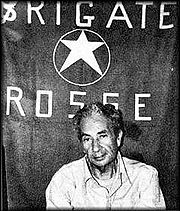 Christian democrat Aldo Moro
was assassinated in May 1978 by the Red Brigades
, a terrorist leftist group then led by Mario Moretti
. Before his murder, Aldo Moro, a central figure in the Christian Democrat Party, several times Prime minister, was trying to include the Communist Party, headed by Enrico Berlinguer
, in the parliamentary majority, an operation called the historic compromise
. At this point, the PCI was the largest communist party in western Europe; this was largely due to its reformist orientation, to its growing independence from Moscow
and to the new eurocommunism
doctrine. The communist party was especially strong in Central Italy, in the three "red regions" (Tuscany, Emilia-Romagna, Umbria) which it had administered rather efficiently, as well as other local administrations, since the post-war years.
In the period of terror attacks of the late 70s and early 80s, the parliamentary majority was composed by the parties of the "Arco costituzionale", i.e. all parties supporting the Constitution, including the Communists (who in fact took a very strong stance against the Red Brigades and other terrorist groups). However, the Communists never took part in the Government itself, which was composed by the "Pentapartito" (Christian Democrats, Socialists, Social Democrats, Liberals, Republicans).
Although the Seventies in Italy was marked by violence, it was also a time of great social and economic progress. Following the civil disturbances of the Sixties, Christian Democracy and its allies in government (including the PSI) introduced a wide range of political, social, and economic reforms. Regional governments were introduced in the spring of 1970, with elected councils provided with the authority to legislate in areas like public works, town planning, social welfare, and health. Spending on the relatively poor South was significantly increased, while new laws relating to index-linked pay, public housing, and pension provision were also passed. In 1975, a law was passed entitling redundant workers to receive at least 80% of their previous salary for up to a year from a state insurance fund. Living standards also continued to rise, with wages going up by an average of about 25% a year from the early Seventies onwards, and between 1969 and 1978, average real wages rose by 72%. Various fringe benefits were raised to the extent that they amounted to an additional 50% to 60% on wages, the highest in any country in the Western world. In addition, working hours were reduced so that by the end of the decade they were lower than any other country apart from Belgium. Some categories of workers who were laid off received generous unemployment compensation which represented only a little less than full wages, often years beyond eligibility. Initially, these benefits were primarily enjoyed by industrial orkers in northern Italy where the “Hot Autumn” had its greatest impact, but these benefits soon spread to other categories of workers in other areas. In 1975, the escalator clause was strengthened in wage contracts, providing a high proportion of workers with nearly 100% indexation, with quarterly revisions, thereby increasing wages nearly as fast as prices.
A statute of worker’s rights that was drafted and pushed into enactment in 1970 by the Socialist labour minister Giacomo Brodolini, greatly strengthened the authority of the trade unions in the factories, outlawed dismissal without just cause, guaranteed freedom of assembly and speech on the shop floor, forbade employers to keep records of the union or political affiliations of their workers, and prohibited hiring except through the state employment office.
By the mid-Seventies, Italy had the most generous welfare provisions in Europe, while average Italian workers were among the best paid, most protected, and best treated on the continent.
) and a socialist (Bettino Craxi
); the DC remained however the main force supporting the government.
With the end of the Years of lead (Italy) (1969-1989), the PCI gradually increased their votes under the leadership of Enrico Berlinguer
. The Socialist party
(PSI), led by Bettino Craxi
, became more and more critical of the communists and of the Soviet Union
; Craxi himself pushed in favour of US president Ronald Reagan
's positioning of Pershing missiles in Italy, a move the communists hotly contested.
As the socialist party moved to more moderate positions, the ranks of the PCI increased in numbers, and the Communist party surpassed the Christian Democracy (DC) in the European elections of 1984, barely two days after Berlinguer's death, that likely drew sympathy in the population. Huge crowds attended Berlinguer's funeral. That was to be the only time the Christian Democracy was not the largest party in a nation-wide election they participated in. In 1984, the Craxi government revised the 1927 Lateran Pacts with the Vatican, which included the end of Roman Catholicism as Italy’s formal state religion.
With the Mani Pulite
investigation, starting just one year after the collapse of the Soviet Union, the discovery of the extent of corruption
, which involved most of Italy's important political parties, apart from the PCI, led the whole power structure to falter. The scandal became known as Tangentopoli
, and seemingly indestructible parties like the DC and the PSI disbanded. The Communist party, although it had not been much worried by legal investigations, changed its name to Democratic Party of the Left
. Observing the fall of the Soviet Union, it took the role of one democratic party in Italy. What was to follow was then called the transition to the Second Republic.
after being uncovered by Mani pulite
- "Clean hands") demanded political, economic, and ethical reforms. The scandals involved all major parties, but especially those in the government coalition: between 1992 and 1994 the DC
underwent a severe crisis and was dissolved, splitting up into several pieces, among whom the Italian People's Party
and the Christian Democratic Center
. The PSI
(and the other governing minor parties) completely dissolved.
This "revolution" of the Italian political landscape, happened at a time when some institutional reforms (e.g. changes in the electoral laws intended to diminish the power of political parties) were taking place. For this reason, Italian political commentators refer to the post-1992 period as the "Second Republic", despite the absence of any major constitutional change.
In the Italian referendums of 1993, voters approved substantial changes, including moving from a proportional
to an Additional Member System
(with the requirement to obtain a minimum of 4% of the national vote to obtain representation) which is largely dominated by a majoritarian electoral system and the abolishment of some ministries (some of which have however been reintroduced with only partly modified names, as the Ministry of Agriculture being renamed Ministry of Agricultural Resources).
Major political parties, beset by scandal and loss of voter confidence, underwent far-reaching changes. The main changes in the political landscape were:
Berlusconi managed, in a surprise move, to ally himself both to National Alliance and the Northern League, without these being allied with each other. Forza Italia teamed up with the League in the North, where they competed against National Alliance, and with National Alliance in the rest of Italy, where the League was not present. This unusual coalition configuration was caused by the deep hate between the League, which wanted to separate Italy and held Rome in deep contempt, and the nationalist post-fascists; on one occasion, Bossi encouraged his supporters to go find National-Alliance supporters "house by house," suggesting a lynching
(which however did not actually take place).
The left-wing parties formed a coalition, the Progressisti, which however did not have as clear a leader as Berlusconi was for his. Achille Occhetto
, secretary of the Democratic Party of the Left
, was however considered to be its main figure.
The remains of the Christian Democracy formed a third, centrist coalition, proposing reformist Mario Segni
as prime minister candidate. The Christian Democracy, that had gone back to the name "Popular party," used at the beginning of the twentieth century, was led by Mino Martinazzoli.
The election saw a major turnover in the new parliament, with 452 out of 630 deputies and 213 out of 315 senators elected for the first time.
(leader of "Pole of Freedoms
" coalition, which included Forza Italia
, the regionalist far-right ‘‘Lega Nord’’ party and the far-right Alleanza Nazionale
), into office as Prime Minister. Berlusconi, however, was forced to step down in December 1994 when the Lega Nord withdrew support.
The Berlusconi government was succeeded by a technical government headed by Lamberto Dini, which left office in early 1996.
led to the victory of a center-left coalition under the leadership of Romano Prodi
. The Olive Tree
included PDS, PPI (the largest surviving piece of the former DC), and other small parties, with "external support" from the communists (voting confidence but not entering government).
Prodi's government became the third-longest to stay in power before he narrowly lost a vote of confidence, by three votes, in October 1998. Prodi's programme consisted in restoring the country's economic health, in order to pursue the then seemingly unreachable goal of leading the country within the strict Euro convergence criteria set at Maastricht
and make the country join the Euro
. He succeeded in this in little more than six months.
 His government fell in 1998 when the Communist Refoundation Party
withdrew its support. This led to the formation of a new government led by Massimo D'Alema
as Prime Minister. As the result of a vote of no confidence in Prodi's government, D'Alema's nomination was passed by a single vote, with the support of a loyal communist faction (PdCI
) and of some centrist MPs (UDR
) led by former president of the Republic Francesco Cossiga
.
While D'Alema was Prime Minister, Italy took part in the NATO bombing of the Federal Republic of Yugoslavia in 1999. The attack was supported by Silvio Berlusconi
and the centre-right
opposition, but the far left
strongly contested it. It was a very important test about the government loyalty to NATO and the country's foreign policy, as it concerned the first post-communist leader of Italy and the first military action formally ouside a UN mandate.
In May 1999, the Parliament selected Carlo Azeglio Ciampi
as the President of the Republic. Ciampi, a former Prime Minister and Minister of the Treasury, and before the governor of the Bank of Italy
, was elected on the first ballot with an easy margin over the required two-thirds votes.
In April 2000, following poor performance by his coalition in regional elections, D'Alema resigned.
The succeeding caretaker center-left government, including most of the same parties, was headed by Giuliano Amato
(who previously served as Prime Minister in 1992-93) until the 2001 election
A constitutional referendum in 2001 confirmed a constitutional amendment
to introduce early federalization
, with residual legislative competence upon the Regions instead than upon the State.
, where both coalitions used decoy lists to undermine the proportional-compensation part of the electoral system, ushered a refashioned center-right coalition, House of Freedoms
dominated by Berlusconi's party, Forza Italia (29.2%) and including Alleanza Nazionale (12,5%), the Lega Nord, the Christian Democratic Center
and the United Christian Democrats
. The Olive Tree
coalition (The Daisy (14,5%) and the Democrats of the Left
(16.7%)) sat in the opposition.
 Berlusconi's II foreign policy was characterised by a strong atlanticist trend, coupled with a postitive attitude towards Putin's Russia and Erdogan's Turkey.
Berlusconi advocated the accession of Turkey to the EU
(notwithstanding the opposition of coalition partner Lega Nord) and at the 2002 Rome summit
a NATO-Russia Council was set up. In UN reform issues
, Italy took the lead of the Uniting for consensus group, aiming at blocking a new German seat at the UN Security Council, while advocating for a unitary EU seat
The 27th G8 summit
, held in Genoa
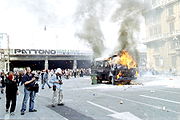
in July 2001 represented the first international task of the government. The huge protest, mounting to 200,000 demonstrants from all over Europe, was countered by strong police repression. Dozens were hospitalized following clashes with police and night raids by security forces on two schools housing activists and independent journalists. People taken into custody after the raids have alleged severe abuse at the hands of police. One demonstrator was shot dead
.
 Berlusconi made Italy take part in the Afghanistan war
(2001) and in the US-led military coalition in Iraq in 2003, although always stressing that Italy was taking part in a "peace operation" and not in a war operation outside the UN framework (prohibited by art.11 of the Italian Constitution). The move was widely unpopular (especially in the case of Iraq), and was met by protests and manifestations.
Italy's participation in the Iraq war, with the control over the Nassiriya sector was marked by the 2003 Nasiriyah bombing
, in which 17 soldiers were killed, and by an incident with the US, concerning the death, by friendly fire
, of a SISMI
agent, Nicola Calipari
, during the March 2005 rescue of Giuliana Sgrena
, a reporter from Il Manifesto
.
In labour law
, the government introduced extensive flexibility through the 30/2003 Act. In the field of justice, a reform of the Right of self-defense Act was introduced to please the Lega Nord. The 2002 Bossi
-Fini
Act represented a restrictive approach to immigration
, while the 2006 Fini
-Giovanardi
Act strengthened the prohibitionary approach to drug policy. A point-system driver's licence was introduced in 2003, and compulsory conscription
was replaced by a professional army since 2005. A constitutional
reform including federalization
and strengthened executive powers, passed in the Parliament, was rejected by a confirmation referendum in 2006.
Berlusconi's term was widely criticised for the approval of ad personam (personal) laws (usually named from the rapporteur minister or MP), especially in the field of justice, such as:
Internally, Berlusconi set up the Mitrokhin Commission
, directed by senator Paolo Guzzanti
(Forza Italia), to investigate on alleged KGB ties by left-wing (then-opposition) politicians. The Commission, closed in March 2006 without producing a final report, was very controversial, in particular after claiming that Romano Prodi
, at that time Prime minister of Italy, and former President of the European Commission
, had been "KGB's man in Italy." One of the Senator Guzzanti's informants, Mario Scaramella
, was arrested at the end of December 2006 for defamation and arms-trade.
A new electoral law was established in 2005 by the Calderoli
Law, and it is a form of semi-proportional representation
. A party presents its own closed list
and it can join other parties in alliances. The coalition which receives a plurality automatically wins at least 26 seats. Respecting this condition, seats are divided between coalitions, and subsequently to party lists, using the largest remainder method
with a Hare quota
. To receive seats, a party must overcome the barrage of 8% of the vote if it contests a single race, or of 3% of the vote if it runs in alliance. The change in the electoral law was strongly requested by the UDC
, and finally agreed by Berlusconi, although criticised (including by political scientist Giovanni Sartori
) for its comeback to proportionalism
and its timing, less than one year before general elections.
Provision was also included, on the input of Mirko Tremaglia, to ease the vote of Italians resident abroad; paradoxically, Italians abroad proved crucial in securing centre-left victory in 2006 elections.
, with a center-left coalition (The Union
), won the April 2006 general election
by a very narrow margin due to Calderoli
new electoral law, although Silvio Berlusconi
first refused to acknowledge defeat. Prodi's coalition proved to be extremely frail, as the two-vote margin in the Senate allowed almost any party in the coalition to veto legislation and political views inside the coalition spanned from far-left Communist parties to Christian Democrats.
 In foreign policy, the Prodi II Cabinet continued the engagement in Afghanistan
, under UN command, while withdrawing troops from post-invasion Iraq. The major effort of foreign minister Massimo D'Alema
concerned the aftermath of the 2006 Lebanon War, being the first to offer troops to the UN for the constitution of the UNIFIL force, and assuming its command in February 2007.
Less than a year after he had won the elections, on 21 February 2007, Prodi tendered his resignation to Head of State Giorgio Napolitano after the government was defeated in the Senate by 2 ballots in a vote on foreign policy. On 24 February, President Napolitano invited him to return to office and face a vote of confidence.
Major causes of friction inside the coalition were, the 2006 pardon
Act (criticised by the right and by the IDV
party), a draft bill to establish civil union
s (vetoed by Christian Democrats), Italy's continued involvement in Afghanistan
(strongly opposed by left-wing parties), and finally the much publicized house-arrest of Clemente Mastella
's wife (then a prominent politician at the regional level) over a corruption scandal. Mastella's party, UDEUR, held just enough seats in the Senate that his eventual decision to withdraw its support for the government meant the end of the legislature on February 6, 2008. Mastella, who also resigned from his office as Minister of Justice, cited the lack of personal support from his coalition partners' as one the reasons behind his decision, together with a proposed reform of the electoral system which would have made it difficult for small parties like his own to gain seats in the Italian Parliament.
, with the People of the Freedom party (fusion of his previous Forza Italia
party and of Fini's Alleanza Nazionale) against Walter Veltroni
of the Democratic Party
.
The electoral campaign was waged by Berlusconi on the tones of criminal insecurity brought in the country by the 2006 pardon
act, on the Naples waste management issue
(although this will remain haunting the government in the following years), on the need to avoid bankruptcy of Alitalia
or its takeover by Air France
, on the need to limit the use of wiretapping by prosecutor
s and magistrate
s to avoid judicial prosecution of citizens, and on the abolition of the local council property tax.
The 2008 Lodo Alfano
Act (declared unconstitutional in 2009) granted immunity from prosecution to the four highest political offices in Italy, including Berlusconi. The 2009 Maroni
decree (dubbed security package) includes a set of measures against criminality and illegal immigration
, allowing for the use of private patrols (however with modest actual impact), criminalisation of stalking
and compulsory incarceration
for sex offenses. The 2009 fiscal shield provided for the regularisation of capitals illegally detained abroad; local council property tax was abolished the same year.
A Treaty of Friendship was signed between Italy
and Libya
in 2008 in Benghazi
. The treaty provides for the closure of colonial contentious, upon investments from Italy for 5 bln € in 20 years in infrastructure in Libya; for the mutual commitment not to act in a hostile way (criticised as not legally compliant with Italy's NATO obligations). Libyan Dictator Muammar al-Gaddafi
subsequently visited Rome in June, July and August 2009, sparkling controversies for his initiatives and speeches. The Berlusconi government was criticised for the lack of firmness toward the Libyan autocracy and the lack of requests of respect of human rights
.
The case of Eluana Englaro
(who had been comatose for 17 years)re-ignited the debate on the right to die
in Italy. After the family of Eluana Englaro
succeeded in having her right to die
recognised by the judges and getting doctors to stop her forced feeding in the way established by the court, the government issued a legally-controversial decree to stop the doctor from letting her die, thrusting Italy
into a constitutional crisis when the President of the Republic
refused to sign the decree. The crisis was defused by Eluana's final death.
The 2009 L'Aquila earthquake
caused the death of 308 persons and made about 65,000 homeless. Berlusconi made a point of honour of the reconstruction, although this was accompanied by criticisms, especially by the inhabitants of L'Aquila
. The 35th G8 summit
of 2009 was hastily moved from La Maddalena
to L'Aquila
in an effort to promote reconstruction.
On 13 December 2009 Berlusconi was hit in the face with an alabaster statuette of Milan Cathedral after a rally in Milan
's Piazza Duomo, suffering facial and teeth injuries. The attacker was found to have a history of mental illness but no previous criminal record
Between 2009 and 2010, Berlusconi was involved in a prostitution scandal leading to his divorce: he was revealed to having had close acquaintance with pre-18 years old girls, and several call girl
s presented proofs of having had sex with him and having being paid for that. In one case, Berlusconi was accused of using his influence to obtain the release of a 17-years-old Moroccan girl, of his acquaitance, who was arrested for theft; Berlusconi pretended she was a close relative of Hosni Mubarak
.
In 2010, Berlusconi's party saw the splintering of Gianfranco Fini
's new faction, which formed a parliamentary group and voted against him in a no-confidence vote on 14 December 2010. Berlusconi's government was able to avoid no-confidence thanks to support from sparse MPs, but has lost a consistent majority in the lower Chamber. A controversial university reform was passed in late 2010 (Gelmini
Act)
There is now a Technocratic government in power.
History of Italy as a monarchy and in the World Wars
This articles covers the history of Italy as a monarchy and in the World Wars.-Italian unification :Modern Italy became a nation-state during the Risorgimento on March 17, 1861 when most of the states of the Italian Peninsula and the Kingdom of the Two Sicilies were united under king Victor...
, Italy's history
History of Italy
Italy, united in 1861, has significantly contributed to the political, cultural and social development of the entire Mediterranean region. Many cultures and civilizations have existed there since prehistoric times....
was dominated by the Christian Democracy
Christian Democracy (Italy)
Christian Democracy was a Christian democratic party in Italy. It was founded in 1943 as the ideological successor of the historical Italian People's Party, which had the same symbol, a crossed shield ....
(Democrazia Cristiana, DC) political party
Political party
A political party is a political organization that typically seeks to influence government policy, usually by nominating their own candidates and trying to seat them in political office. Parties participate in electoral campaigns, educational outreach or protest actions...
for 50 years, while the opposition was led by the Italian Communist Party
Italian Communist Party
The Italian Communist Party was a communist political party in Italy.The PCI was founded as Communist Party of Italy on 21 January 1921 in Livorno, by seceding from the Italian Socialist Party . Amadeo Bordiga and Antonio Gramsci led the split. Outlawed during the Fascist regime, the party played...
(PCI); this situation prevailed until the crisis of the Soviet Union
Soviet Union
The Soviet Union , officially the Union of Soviet Socialist Republics , was a constitutionally socialist state that existed in Eurasia between 1922 and 1991....
and the Tangentopoli
Tangentopoli
Tangentopoli is a term which was coined to describe pervasive corruption in the Italian political system exposed in the 1992-6 Mani Pulite investigations, as well as the resulting scandal, which led to the collapse of the hitherto dominant Christian Democracy party and its allies.-Popular distrust...
scandal and operation Mani pulite
Mani pulite
Mani pulite was a nationwide Italian judicial investigation into political corruption held in the 1990s. Mani pulite led to the demise of the so-called First Republic, resulting in the disappearance of many parties. Some politicians and industry leaders committed suicide after their crimes were...
, which led to the reform of the electoral system (from almost perfect proportional to uninominal/multi-seat circumscriptions) and radical restructuring of the Italian political system, including the dissolution of most traditional political parties.
In 1994, in the midst of the mani pulite operation which shook political parties, media magnate Silvio Berlusconi
Silvio Berlusconi
Silvio Berlusconi , also known as Il Cavaliere – from knighthood to the Order of Merit for Labour which he received in 1977 – is an Italian politician and businessman who served three terms as Prime Minister of Italy, from 1994 to 1995, 2001 to 2006, and 2008 to 2011. Berlusconi is also the...
, owner of three private TV channels, won the elections, becoming one of Italy's most important political and economic figures for the next decade. Ousted after a few months of government, he returned to power in 2001, lost the 2006 general election
Italian general election, 2006
In the Italian general election, 2006 for the renewal of the two Chambers of the Parliament of Italy held on April 9 and April 10, 2006 the incumbent prime minister Silvio Berlusconi, leader of the center-right House of Freedoms, was narrowly defeated by Romano Prodi, leader of the center-left The...
five years later to Romano Prodi
Romano Prodi
Romano Prodi is an Italian politician and statesman. He served as the Prime Minister of Italy, from 17 May 1996 to 21 October 1998 and from 17 May 2006 to 8 May 2008...
and his Union
The Union (political coalition)
The Union was an centre-left coalition of political parties in Italy. It was led by Romano Prodi, Prime Minister of Italy from April 2006 to April 2008, and former President of the European Commission.-Parties:...
coalition but won the 2008 general election
Italian general election, 2008
A snap general election was held in Italy on 13 April and 14 April 2008. The election came after President Giorgio Napolitano dissolved parliament on 6 February 2008 following the defeat of the government of Prime Minister Romano Prodi in a January 2008 Senate vote, and the unsuccessful tentative...
and returned to power in June 2008.
In November 2011, Berlusconi lost his majority in the Chamber of Deputies, and resigned. His successor, Mario Monti
Mario Monti
Mario Monti is an Italian economist and academic who is Prime Minister of Italy, as well as Minister of Economy and Finance, since November 2011. Monti served as a European Commissioner from 1995 to 2004, with responsibility for the Internal Market, Services, Customs and Taxation from 1995 to 1999...
formed a new government, composed by "technicians" and supported by both the center-left and the center-right.
The Birth of the Republic (1946)
In the final phases of World War IIWorld War II
World War II, or the Second World War , was a global conflict lasting from 1939 to 1945, involving most of the world's nations—including all of the great powers—eventually forming two opposing military alliances: the Allies and the Axis...
, the discredited king Victor Emmanuel III
Victor Emmanuel III of Italy
Victor Emmanuel III was a member of the House of Savoy and King of Italy . In addition, he claimed the crowns of Ethiopia and Albania and claimed the titles Emperor of Ethiopia and King of Albania , which were unrecognised by the Great Powers...
tried to raise the prestige of the monarchy by nominating his son and heir Umberto II
Umberto II of Italy
Umberto II, occasionally anglicized as Humbert II was the last King of Italy for slightly over a month, from 9 May 1946 to 12 June 1946. He was nicknamed the King of May -Biography:...
"general lieutenant of the kingdom" and promising that after the end of the war the Italian people could choose its form of government through a referendum
Referendum
A referendum is a direct vote in which an entire electorate is asked to either accept or reject a particular proposal. This may result in the adoption of a new constitution, a constitutional amendment, a law, the recall of an elected official or simply a specific government policy. It is a form of...
. In April 1945, the Allies
Allies
In everyday English usage, allies are people, groups, or nations that have joined together in an association for mutual benefit or to achieve some common purpose, whether or not explicit agreement has been worked out between them...
advanced in the Po plain (supported by the Italian anti-fascist resistance), defeating the fascist Salò Republic, a puppet state
Puppet state
A puppet state is a nominal sovereign of a state who is de facto controlled by a foreign power. The term refers to a government controlled by the government of another country like a puppeteer controls the strings of a marionette...
instituted by Nazi Germany
Nazi Germany
Nazi Germany , also known as the Third Reich , but officially called German Reich from 1933 to 1943 and Greater German Reich from 26 June 1943 onward, is the name commonly used to refer to the state of Germany from 1933 to 1945, when it was a totalitarian dictatorship ruled by...
.
The Italian monarchy was abolished by a popular referendum held on 2 June 1946. A new constitution
Constitution of Italy
The Constitution of the Italian Republic was enacted by the Constituent Assembly on 22 December 1947, with 453 votes in favour and 62 against. The text, which has since been amended 13 times, was promulgated in the extraordinary edition of Gazzetta Ufficiale No. 298 on 27 December 1947...
was written for the new republic
Republic
A republic is a form of government in which the people, or some significant portion of them, have supreme control over the government and where offices of state are elected or chosen by elected people. In modern times, a common simplified definition of a republic is a government where the head of...
, taking effect on January 1, 1948. The referendum at the origin of the Italian republic was, however, the object of deep discussion, mainly because of some contested results and of the deep divide which emerged between the North (where the Republic won a clear majority) and the South (where the monarchists gained the majority).
Elections after World War II (1946–1948)
In 1946, the main Italian political parties were:- Christian Democrats (DC)
- Italian Socialist PartyItalian Socialist PartyThe Italian Socialist Party was a socialist and later social-democratic political party in Italy founded in Genoa in 1892.Once the dominant leftist party in Italy, it was eclipsed in status by the Italian Communist Party following World War II...
(PSI) - Italian Communist PartyItalian Communist PartyThe Italian Communist Party was a communist political party in Italy.The PCI was founded as Communist Party of Italy on 21 January 1921 in Livorno, by seceding from the Italian Socialist Party . Amadeo Bordiga and Antonio Gramsci led the split. Outlawed during the Fascist regime, the party played...
(PCI)
Each party had run separate candidates in the 1946 general election
Italian general election, 1946
The Italian general election of 2 June 1946 was the first Italian election after World War II and elected 556 deputies to a Constituent Assembly...
, and the Christian Democrats won a plurality of votes. The PSI and the PCI received some ministerial posts in a Christian Democrat–led coalition cabinet. PCI’s leader Palmiro Togliatti
Palmiro Togliatti
Palmiro Togliatti was an Italian politician and leader of the Italian Communist Party from 1927 until his death.-Early life:...
was minister of Justice. However, as in France where Maurice Thorez
Maurice Thorez
thumb|A Soviet stamp depicting Maurice Thorez.Maurice Thorez was a French politician and longtime leader of the French Communist Party from 1930 until his death. He also served as vice premier of France from 1946 to 1947....
and four other communist ministers
French Communist Party
The French Communist Party is a political party in France which advocates the principles of communism.Although its electoral support has declined in recent decades, the PCF retains a large membership, behind only that of the Union for a Popular Movement , and considerable influence in French...
were forced to leave Paul Ramadier
Paul Ramadier
Paul Ramadier was a prominent French politician of the Third and Fourth Republics. Mayor of Decazeville starting in 1919, he served as the first Prime Minister of the Fourth Republic in 1947. On 10 July 1940, he voted against the granting of the full powers to Marshal Philippe Pétain, who...
's government during the May 1947 crisis
May 1947 crisis
The May 1947 Crisis of Italy was when the Communist Party of Italy was thrown out of government. The Christian Democrats led by Alcide De Gasperi were becoming increasingly unpopular, and were afraid that the Left Coalition would take power....
, both the Italian Communists (PCI) and Socialists (PSI) were excluded from government the same month under Harry Truman's pressures.
Since the PSI and the PCI together received more votes than the Christian Democrats, they decided to unite in 1948 to form the Popular Democratic Front (FDP). The 1948 general elections were heavily influenced by the then flaring cold-war confrontation between the Soviet Union and the US. After the Soviet-inspired February 1948 communist coup in Czechoslovakia
Czechoslovakia
Czechoslovakia or Czecho-Slovakia was a sovereign state in Central Europe which existed from October 1918, when it declared its independence from the Austro-Hungarian Empire, until 1992...
the US became alarmed about Soviet intentions and feared that the Soviet funded PCI would draw Italy into the Soviet Union's sphere of influence if the leftist coalition were to win the elections. In response, on March 1948 the United States National Security Council
United States National Security Council
The White House National Security Council in the United States is the principal forum used by the President of the United States for considering national security and foreign policy matters with his senior national security advisors and Cabinet officials and is part of the Executive Office of the...
issued its first document proffering recommendations to avoid such an outcome which were widely and energetically implemented. Ten million letters were sent by mostly Italian Americans urging Italians not to vote communist. US agencies made numerous short-wave propaganda radio broadcasts and funded the publishing of books and articles, warning the Italians of the perceived consequences of a communist victory. The CIA also funded the centre-right political parties and was accused of publishing forged letters in order to discredit the leaders of the PCI. The PCI itself was accused of being funded by Moscow and the Cominform, and in particular via export deals to the Communist countries.
Fears in the Italian electorate of a possible Communist takeover proved crucial for the electoral outcome on the 18th of April; the Christian Democrats (Democrazia Cristiana), under the undisputed leadership of Alcide De Gasperi
Alcide De Gasperi
Alcide De Gasperi was an Italian statesman and politician and founder of the Christian Democratic Party. From 1945 to 1953 he was the prime minister of eight successive coalition governments. His eight-year rule remains a landmark of political longevity for a leader in modern Italian politics...
won a resounding victory with 48 percent of the vote (their best result ever, and not repeated since) while the FDP only received 31 percent of the votes. The Communist party widely outdid the Socialists in the distribution of seats in Parliament, and gained a solid position as the main opposition party in Italy, even if it would never return in government. For almost four decades, Italian elections were successively won by the Democrazia Cristiana (DC) centrist party.
The 1950s and 1960s: the Economic Boom
Under the 1947 peace treaty, minor adjustments were made to Italy's frontier with France, the eastern border area was transferred to YugoslaviaSocialist Federal Republic of Yugoslavia
The Socialist Federal Republic of Yugoslavia was the Yugoslav state that existed from the abolition of the Yugoslav monarchy until it was dissolved in 1992 amid the Yugoslav Wars. It was a socialist state and a federation made up of six socialist republics: Bosnia and Herzegovina, Croatia,...
, and the area around the city of Trieste
Trieste
Trieste is a city and seaport in northeastern Italy. It is situated towards the end of a narrow strip of land lying between the Adriatic Sea and Italy's border with Slovenia, which lies almost immediately south and east of the city...
was designated a free territory. In 1954 with the London Memorandum of Understanding, the Free Territory of Trieste
Free Territory of Trieste
The Free Territory of Trieste was to be a city-state situated in Central Europe between northern Italy and Yugoslavia, created by the United Nations Security Council in the aftermath of World War II and provisionally administered by an appointed military governor commanding the peacekeeping United...
, which had remained under the administration of U.S.–UK forces (Zone A, including the city of Trieste) and Yugoslav forces (Zone B), was officially divided between Italy and Yugoslavia, principally along the zonal boundary. Italy also lost its colonial Empire, except Somalia, which formed the object of a UN trusteeship mandate, expiring in 1960.
In the fifties Italy became a founding member of the NATO alliance (1949), a member of the United Nations
United Nations
The United Nations is an international organization whose stated aims are facilitating cooperation in international law, international security, economic development, social progress, human rights, and achievement of world peace...
(1955) and an ally of the United States, which helped to revive the Italian economy through the Marshall Plan
Marshall Plan
The Marshall Plan was the large-scale American program to aid Europe where the United States gave monetary support to help rebuild European economies after the end of World War II in order to combat the spread of Soviet communism. The plan was in operation for four years beginning in April 1948...
. In the same years, Italy also became a founding member of the ECSC
European Coal and Steel Community
The European Coal and Steel Community was a six-nation international organisation serving to unify Western Europe during the Cold War and create the foundation for the modern-day developments of the European Union...
(1952) and of the European Economic Community
European Economic Community
The European Economic Community The European Economic Community (EEC) The European Economic Community (EEC) (also known as the Common Market in the English-speaking world, renamed the European Community (EC) in 1993The information in this article primarily covers the EEC's time as an independent...
(1957), later developed into the European Union
European Union
The European Union is an economic and political union of 27 independent member states which are located primarily in Europe. The EU traces its origins from the European Coal and Steel Community and the European Economic Community , formed by six countries in 1958...
. At the end of the fifties an impressive economic growth was termed "Economic Miracle", a term that is still recognized in Italian politics
Politics of Italy
The politics of Italy is conducted through a parliamentary, democratic republic with a multi-party system. Executive power is exercised collectively by the Council of Ministers, which is led by the President of the Council of Ministers, referred to as "Presidente del Consiglio" in Italian...
(Silvio Berlusconi
Silvio Berlusconi
Silvio Berlusconi , also known as Il Cavaliere – from knighthood to the Order of Merit for Labour which he received in 1977 – is an Italian politician and businessman who served three terms as Prime Minister of Italy, from 1994 to 1995, 2001 to 2006, and 2008 to 2011. Berlusconi is also the...
won the 1994 elections promising a new "Miracle").
During the First Republic, the Christian Democracy slowly but steadily lost support, as society modernised and the traditional values at its ideological core became less appealing to the population. The Christian Democracy's main support areas (sometimes known as "vote tanks") were the rural areas in South, Center and North-East Italy, whereas the industrial North-West had more left-leaning support because of the larger working class. An interesting exception were the "red regions" (Emilia Romagna, Tuscany
Tuscany
Tuscany is a region in Italy. It has an area of about 23,000 square kilometres and a population of about 3.75 million inhabitants. The regional capital is Florence ....
, Umbria
Umbria
Umbria is a region of modern central Italy. It is one of the smallest Italian regions and the only peninsular region that is landlocked.Its capital is Perugia.Assisi and Norcia are historical towns associated with St. Francis of Assisi, and St...
) where the Italian Communist Party has historically had a wide support. This is considered a consequence of the particular share-cropping ("mezzadria") farming contracts used in these regions.
The Vatican
Holy See
The Holy See is the episcopal jurisdiction of the Catholic Church in Rome, in which its Bishop is commonly known as the Pope. It is the preeminent episcopal see of the Catholic Church, forming the central government of the Church. As such, diplomatically, and in other spheres the Holy See acts and...
actively supported the Christian Democracy, claiming it would be a "mortal and unforgivable" sin for a Catholic to vote for the Communist party and excommunicating outright all its supporters. In practice, however, many Communists remained religious: Emilia was known to be an area where people were both religious and communists. Giovanni Guareschi wrote his novels about Don Camillo
Don Camillo
Don Camillo is the main character created by the Italian writer and journalist Giovannino Guareschi , and is based on the historical Roman Catholic priest, WW II partisan and detainee of the concentration camps of Dachau and Mauthausen, Don Camillo Valota . Don Camillo is one of two protagonists,...
describing a village, Brescello
Brescello
Brescello is a comune in the Province of Reggio Emilia in the Italian region Emilia-Romagna, located about 80 km northwest of Bologna and about 25 km northwest of Reggio Emilia...
, whose inhabitants are at the same time loyal to priest Camillo and communist mayor Giuseppe Bottazzi, who are fierce rivals.
In the 1950s, several important reforms were launched: e.g. agrarian reform (legge Scelba), fiscal reform (legge Vanoni), and the country enjoyed a period of extraordinary economic development (miracolo economico, economic miracle). In this period of time, a massive population transfer, from the impoverished South to the booming industrial North, took place. This however exacerbated social contrasts, including between the old-established "worker aristocracy" and the new less qualified immigrants ("operaio-massa") of Southern origin.
Following the 1963 Ciaculli massacre
Ciaculli massacre
The Ciaculli massacre on 30 June 1963 was caused by a car bomb that exploded in Ciaculli, an outlying suburb of Palermo, killing seven police and military officers sent to defuse it after an anonymous phone call. The bomb was intended for Salvatore "Ciaschiteddu" Greco, head of the Sicilian Mafia...
in the suburbs of Palermo, which killed seven police and military officers sent to defuse it after an anonymous phone call, the Italian Parliament voted a December 1962 law which created an Antimafia Commission
Antimafia Commission
The Italian Antimafia Commission is a bicameral commission of the Italian Parliament, composed of members from the Chamber of Deputies and the Senate . The Antimafia Commission is a commission of inquiry into, initially, the “phenomenon of the Mafia”...
. The massacre had taken place in the frame of the first Mafia War in the 1960s, with the bomb intended for Salvatore Greco, head of the Sicilian Mafia Commission
Sicilian Mafia Commission
The Sicilian Mafia Commission, known as Commissione or Cupola, is a body of leading Mafia members to decide on important questions concerning the actions of, and settling disputes within the Sicilian Mafia or Cosa Nostra...
formed in the late 1950s. The mafia was fighting for the control of the profitable opportunities brought about by rapid urban growth and the heroin trade to North America. The ferocity of the struggle was unprecedented, reaping 68 victims from 1961 to 1963. The Antimafia Commission submitted its final report in 1976. The mafia had created ties with the politician world. The period 1958-1964, when Salvo Lima (DC) was mayor of Palermo and Vito Ciancimino
Vito Ciancimino
Vito Ciancimino was an Italian politician who served as mayor of Palermo, Sicily. He belonged to the Christian Democrat party , and was the first Italian politician to be found guilty of Mafia membership...
(DC) was assessor for public works, was later referred to as the "Sack of Palermo
Sack of Palermo
The Sack of Palermo or scempio in Italian is the popular term for the construction boom from the 1950s through the mid 1980s that led to the destruction of the city's green belt and villas that gave it architectural grace, to make way for characterless and shoddily constructed apartment blocks...
".
In 1965, the SIFAR
Sifar
Sifar is an album by the Indian singer Lucky Ali. Sifar was his second album released by Sony music in 1998.Sifar is an Urdu and Hindi word meaning "zero"...
intelligence agency was transformed into the SID following an aborted coup d'état, Piano Solo
Piano Solo
Piano Solo was an envisaged plot for an Italian coup in 1964, planned by then director of the military police, Giovanni De Lorenzo.The coup plans were investigated in 1967, when the journalist Eugenio Scalfari and Lino Jannuzzi uncovered the attempt in the Italian news magazine L'Espresso in May 1967...
, which was to give the power to the Carabinieri
Carabinieri
The Carabinieri is the national gendarmerie of Italy, policing both military and civilian populations, and is a branch of the armed forces.-Early history:...
, then headed by general De Lorenzo.
The shrinking support for the Christian Democrats eventually caused the entry of the Socialist party
Italian Socialist Party
The Italian Socialist Party was a socialist and later social-democratic political party in Italy founded in Genoa in 1892.Once the dominant leftist party in Italy, it was eclipsed in status by the Italian Communist Party following World War II...
in the government. The Socialist party had moved, from a position of total subordination to the Communists, to a position of relative autonomy after the 1956 events in Hungary. The possibility of extending the parliamentary majority to the Socialists (apertura a sinistra, left-wing opening) became the main subject of political debate. While right-wing forces deeply opposed it, reformists, social-democrats, progressives, and Catholics supported it. It was thought that a series much-needed "structural reforms" would definitely modernize the country and create a modern social-democracy.
In 1960, an attempt by the right-wing faction of the Christian Democrats to find a new parliamentary majority by incorporating the neo-fascist Italian Social Movement
Italian Social Movement
The Italian Social Movement , and later the Italian Social Movement–National Right , was a neo-fascist and post-fascist political party in Italy. Formed in 1946 by supporters of former Italian dictator Benito Mussolini, the party became the fourth largest party in Italy by the early 1960s...
(MSI) in the Tambroni
Fernando Tambroni
Fernando Tambroni Armaroli was an Italian politician of the Christian Democratic Party. He was a lawyer, a prominent supporter of law and order policies, and for a brief time in 1960, the 37th Prime Minister of Italy...
government led to violent and bloody riots (Genoa, Reggio Emilia), and was defeated. The PSI (Italian Socialist Party) entered government in 1963. During the first year of the new Centre-Left Government, a wide range of measures were carried out which went some way towards the Italian Socialist Party’s requirements for governing in coalition with the Christian Democrats. These included taxation of real estate profits and of share dividends (designed to curb speculation), increases in pensions for various categories of workers, a law on school organisation (to provide for a unified secondary school with compulsory attendance up to the age of 14), the nationalisation of the electric-power industry, and significant wage rises for workers (including those in the newly-nationalised electric-power industry), which led to a rise in consumer demand. Urged on by the PSI, the government also made brave attempts to tackle issues relating to welfare services, hospitals, the agrarian structure, urban development, education, and overall planning.
Despite these important reforms, however, the reformist drive was soon lost, and the most important problems (including the mafia, social inequalities, inefficient state/social services, North/South imbalance) remained largely untackled.
The difficult equilibrium of Italian society was challenged by a rising left-wing movement, in the wake of 1968 student unrest ("Sessantotto").
This movement was characterized by such heterogeneous events as revolts by jobless farm workers (Avola, Battipaglia 1969), occupations of Universities by students, social unrest in the large Northern factories (1969 autunno caldo, hot autumn). While conservative forces tried to roll back some of the social advances of the sixties, and part of the military indulged in "sabre rattling" in order to intimidate progressive political forces, numerous left-wing activists became increasingly frustrated at social inequalities, while the myth of guerrilla (Che Guevara, the Uruguayan Tupamaros) and of the Chinese Maoist "cultural revolution" increasingly inspired extreme left-wing violent movements.
Social protests, in which the student movement was particularly active, shook Italy during the 1969 autunno caldo (Hot Autumn), leading to the occupation of the Fiat
Fiat
FIAT, an acronym for Fabbrica Italiana Automobili Torino , is an Italian automobile manufacturer, engine manufacturer, financial, and industrial group based in Turin in the Italian region of Piedmont. Fiat was founded in 1899 by a group of investors including Giovanni Agnelli...
factory in Turin. In March 1968, clashes occurred at La Sapienza university in Rome, during the "Battle of Valle Giulia
Battle of Valle Giulia
The Battle of Valle Giulia is the conventional name for a clash between Italian left-wing militants and the Italian police at Valle Giulia, Rome, on March 1, 1968...
." Mario Capanna
Mario Capanna
Mario Capanna is an Italian politician and writer.-Biography:Born in Città di Castello, he studied Philosophy at the Università Cattolica del Sacro Cuore in Milan, and was the leader of the Italian students' movement in the late 1960s and early 1970s...
, associated with the New Left
New Left
The New Left was a term used mainly in the United Kingdom and United States in reference to activists, educators, agitators and others in the 1960s and 1970s who sought to implement a broad range of reforms, in contrast to earlier leftist or Marxist movements that had taken a more vanguardist...
, was one of the figures of the student movement, along with the members of Potere Operaio
Potere Operaio
Potere Operaio was a radical left-wing Italian political group, active between 1968 and 1973. Among the group's leaders were Antonio Negri, Franco Piperno, Oreste Scalzone and Valerio Morucci, who led its clandestine...
and Autonomia Operaia
Autonomia Operaia
Autonomia Operaia was an Italian extra-parliamentary leftist movement particularly active from 1976 to 1978. It emerged in 1972 not as a party but rather as a place of encounter among various extra-parliamentary and revolutionary left-wing tendencies opposed to reformism...
such as (Antonio Negri
Antonio Negri
Antonio Negri is an Italian Marxist sociologist and political philosopher.Negri is best-known for his co-authorship of Empire, and secondarily for his work on Spinoza. Born in Padua, he became a political philosophy professor in his hometown university...
, Oreste Scalzone
Oreste Scalzone
Oreste Scalzone is an Italian Marxist intellectual and one of the founders of the communist organization Potere Operaio....
, Franco Piperno
Franco Piperno
Franco Piperno is an Italian former communist militant. He is currently an associated professor of Condensed Matter Physics in the University of Calabria..-Biography:Piperno was born at Catanzaro....
and of Lotta Continua
Lotta Continua
Lotta Continua was a far left extra-parliamentary organization in Italy. It was founded in autumn 1969 by a split in the student-worker movement of Turin, which had started militant activity at the universities and factories such as Fiat...
such as Adriano Sofri
Adriano Sofri
Adriano Sofri is an Italian intellectual, a journalist and a writer.Former leader of the autonomist movement Lotta Continua in the 1960s, he was arrested in 1988 and convicted to 22 years of prison, having been found guilty of being the instigator of the murder of Luigi Calabresi, a police...
.
The 1970s: Strategy of tension and Years of lead
The period or the late 1960 - 1970s came to be known as the Opposti Estremismi, (from left-wing and right-wing extremists riots), later renamed anni di piombo ("years of lead (Italy)") because of a wave of bombings and shootings — the first victim of this period was Antonio AnnarummaAntonio Annarumma
Antonio Annarumma was an Italian policeman. History asserts that he was the first victim of years of lead....
, a policeman, killed on November 12, 1969 in Milan during a left-wing demonstration.
In December, four bombings struck in Rome the Monument of Vittorio Emanuele II
Monument of Vittorio Emanuele II
The Monumento Nazionale a Vittorio Emanuele II or Altare della Patria or "Il Vittoriano" is a monument built to honour Victor Emmanuel, the first king of a unified Italy, located in Rome, Italy. It occupies a site between the Piazza Venezia and the Capitoline Hill...
(Altare della Patria), the Banca Nazionale del Lavoro
Banca Nazionale del Lavoro
Banca Nazionale del Lavoro SpA is an Italian banking firm. Founded in 1913 as Istituto di Credito per la Cooperazione, it was nationalized in 1929. It was re-privatized and listed on the Milan Stock Exchange in 1998, before being acquired by French banking group BNP Paribas in 2006...
, and in Milan the Banca Commerciale
Banca Commerciale Italiana
Banca Commerciale Italiana, founded in 1894, was once one of the largest banks in Italy. In 1999 it merged with a banking group consisting of Cassa di Risparmio delle Provincie Lombarde and Banco Ambroveneto, the former Banco Ambrosiano, which had merged in 1998. On 1 January 2003, the group's...
and the Banca Nazionale dell'Agricoltura. The later bombing, known as the Piazza Fontana bombing
Piazza Fontana bombing
The Piazza Fontana Bombing was a terrorist attack that occurred on December 12, 1969 at 16:37, when a bomb exploded at the headquarters of Banca Nazionale dell'Agricoltura in Piazza Fontana in Milan, Italy, killing 17 people and wounding 88...
of 12 December 1969, killed 16 and injured 90.
On May 17, 1972, police officer Luigi Calabresi
Luigi Calabresi
Luigi Calabresi , recipient of a gold medal of the Italian Republic for civil valor, was a commissioner of Italian police in Milan....
, who was subsequently awarded a gold medal of the Italian Republic for civil valour, was assassinated in Milan. Sixteen years later, Adriano Sofri
Adriano Sofri
Adriano Sofri is an Italian intellectual, a journalist and a writer.Former leader of the autonomist movement Lotta Continua in the 1960s, he was arrested in 1988 and convicted to 22 years of prison, having been found guilty of being the instigator of the murder of Luigi Calabresi, a police...
, Giorgio Pietrostefani and Ovidio Bompressi and Leonardo Marino were arrested in Milan, accused by the confession of Leonardo Marino, one of the participants in the assassination. Highly controversial, the trial concluded, after an alternance of convictions and acquittals, to their guilt.
During a ceremony in honour of Luigi Calabresi, where the Interior Minister Mariano Rumor
Mariano Rumor
Mariano Rumor was an Italian politician, a member of the Democrazia Cristiana and the 40th Prime Minister of Italy.He was born in Vicenza, Veneto...
was present, on 17 May 1973, an anarchist, Gianfranco Bertoli, threw a bomb killing four and injuring 45.
Count Edgardo Sogno
Edgardo Sogno
Edgardo Sogno Rata del Vallino was an Italian diplomat, partisan and political figure. He was born in an aristocratic family from Piedmont.- Under Fascism :...
revealed in his memoirs that in July 1974, he visited the CIA station chief in Rome to inform him of the preparation of a neo-fascist coup. Asking him what the US government would do in case of such an operation, Sogno wrote that the CIA responsible for Italy answered him that: "the United States would have supported any initiative tending to keep the communists out of government." General Maletti declared, in 2001, that he had not known about Sogno's relations to the CIA and had not been informed of the coup, known as Golpe bianco (White Coup), and prepared with Randolfo Pacciardi
Randolfo Pacciardi
Randolfo Pacciardi was an Italian politician, a member of the Italian Republican Party . He was also an officer who fought during World War I and in the Spanish Civil War.-Biography:...
.
General Vito Miceli
Vito Miceli
Vito Miceli was an Italian general and politician. He was chief of the SIOS , Italian Army Intelligence's Service from 1969 and SID's head from October 18, 1970 to 1974...
, chief of the SIOS
SIOS
Servizio Informazioni Operative e Situazione , was an Italian military intelligence and security service. Its main duty was safeguarding the internal security of military bases and its personnel and military intelligence activities against enemy and foreign forces, especially through SIGINT...
military intelligence agency from 1969 on, and head of the SID from 1970 to 1974, was arrested in 1974 on charges of "conspiration against the state." Following his arrest, the Italian secret services were reorganized with a 24 October 1977 law in a democratic attempt of regaining civilian and parliamentary control of them. The SID was divided into the current SISMI
SISMI
Servizio per le Informazioni e la Sicurezza Militare was the military intelligence agency of Italy from 1977-2007....
, the SISDE
SISDE
Servizio per le Informazioni e la Sicurezza Democratica , was the domestic intelligence agency of Italy.With the reform of the Italian Intelligence Services approved on 1 August 2007, SISDE was replaced by AISI....
and the CESIS
CESIS
Comitato Esecutivo per i Servizi di Informazione e Sicurezza was an Italian government committee whose mission was the coordination of all the intelligence sector, and specifically between the two civilian and military intelligence agencies , with the aim to report all the relevant information...
, which had a coordination role and was directly led by the President of the Council
Prime minister of Italy
The Prime Minister of Italy is the head of government of the Italian Republic...
. Furthermore, an Parliamentary Committee on Secret services control (Copaco) was created at the same occasion.
The 1977 was the year with the most terrorist actions.
Aldo Moro
Aldo Moro was an Italian politician and the 39th Prime Minister of Italy, from 1963 to 1968, and then from 1974 to 1976. He was one of Italy's longest-serving post-war Prime Ministers, holding power for a combined total of more than six years....
was assassinated in May 1978 by the Red Brigades
Red Brigades
The Red Brigades was a Marxist-Leninist terrorist organisation, based in Italy, which was responsible for numerous violent incidents, assassinations, and robberies during the so-called "Years of Lead"...
, a terrorist leftist group then led by Mario Moretti
Mario Moretti
Mario Moretti is an Italian former terrorist. A leading member of the Red Brigades in the late 1970s, he was one of the kidnappers of Aldo Moro, president of Italy's largest party, Democrazia Cristiana, and several times premier, in 1978; he later confessed to have been the one who killed the...
. Before his murder, Aldo Moro, a central figure in the Christian Democrat Party, several times Prime minister, was trying to include the Communist Party, headed by Enrico Berlinguer
Enrico Berlinguer
Enrico Berlinguer was an Italian politician; he was national secretary of the Italian Communist Party from 1972 until his death.-Early career:...
, in the parliamentary majority, an operation called the historic compromise
Historic Compromise
In Italian history, the Historic Compromise was an accommodation between the Christian Democrats and the Italian Communist Party in the 1970s, after the latter embraced eurocommunism under Enrico Berlinguer. The 1978 assassination of DC leader Aldo Moro put an end to the Compromesso storico...
. At this point, the PCI was the largest communist party in western Europe; this was largely due to its reformist orientation, to its growing independence from Moscow
Moscow
Moscow is the capital, the most populous city, and the most populous federal subject of Russia. The city is a major political, economic, cultural, scientific, religious, financial, educational, and transportation centre of Russia and the continent...
and to the new eurocommunism
Eurocommunism
Eurocommunism was a trend in the 1970s and 1980s within various Western European communist parties to develop a theory and practice of social transformation that was more relevant in a Western European democracy and less aligned to the influence or control of the Communist Party of the Soviet...
doctrine. The communist party was especially strong in Central Italy, in the three "red regions" (Tuscany, Emilia-Romagna, Umbria) which it had administered rather efficiently, as well as other local administrations, since the post-war years.
In the period of terror attacks of the late 70s and early 80s, the parliamentary majority was composed by the parties of the "Arco costituzionale", i.e. all parties supporting the Constitution, including the Communists (who in fact took a very strong stance against the Red Brigades and other terrorist groups). However, the Communists never took part in the Government itself, which was composed by the "Pentapartito" (Christian Democrats, Socialists, Social Democrats, Liberals, Republicans).
Although the Seventies in Italy was marked by violence, it was also a time of great social and economic progress. Following the civil disturbances of the Sixties, Christian Democracy and its allies in government (including the PSI) introduced a wide range of political, social, and economic reforms. Regional governments were introduced in the spring of 1970, with elected councils provided with the authority to legislate in areas like public works, town planning, social welfare, and health. Spending on the relatively poor South was significantly increased, while new laws relating to index-linked pay, public housing, and pension provision were also passed. In 1975, a law was passed entitling redundant workers to receive at least 80% of their previous salary for up to a year from a state insurance fund. Living standards also continued to rise, with wages going up by an average of about 25% a year from the early Seventies onwards, and between 1969 and 1978, average real wages rose by 72%. Various fringe benefits were raised to the extent that they amounted to an additional 50% to 60% on wages, the highest in any country in the Western world. In addition, working hours were reduced so that by the end of the decade they were lower than any other country apart from Belgium. Some categories of workers who were laid off received generous unemployment compensation which represented only a little less than full wages, often years beyond eligibility. Initially, these benefits were primarily enjoyed by industrial orkers in northern Italy where the “Hot Autumn” had its greatest impact, but these benefits soon spread to other categories of workers in other areas. In 1975, the escalator clause was strengthened in wage contracts, providing a high proportion of workers with nearly 100% indexation, with quarterly revisions, thereby increasing wages nearly as fast as prices.
A statute of worker’s rights that was drafted and pushed into enactment in 1970 by the Socialist labour minister Giacomo Brodolini, greatly strengthened the authority of the trade unions in the factories, outlawed dismissal without just cause, guaranteed freedom of assembly and speech on the shop floor, forbade employers to keep records of the union or political affiliations of their workers, and prohibited hiring except through the state employment office.
By the mid-Seventies, Italy had the most generous welfare provisions in Europe, while average Italian workers were among the best paid, most protected, and best treated on the continent.
The 1980s rampantism
In the 1980s, for the first time since 1945, two governments were led by non-Christian Democrat Premiers: a republican (Giovanni SpadoliniGiovanni Spadolini
Giovanni Spadolini was a liberal Italian politician, the 45th Prime Minister of Italy, newspaper editor, journalist and a noted historian.-Biography:Spadolini was born in Florence....
) and a socialist (Bettino Craxi
Bettino Craxi
Benedetto Craxi was an Italian politician, head of the Italian Socialist Party from 1976 to 1993, the first socialist President of the Council of Ministers of Italy from 1983 to 1987.-Political career:...
); the DC remained however the main force supporting the government.
With the end of the Years of lead (Italy) (1969-1989), the PCI gradually increased their votes under the leadership of Enrico Berlinguer
Enrico Berlinguer
Enrico Berlinguer was an Italian politician; he was national secretary of the Italian Communist Party from 1972 until his death.-Early career:...
. The Socialist party
Italian Socialist Party
The Italian Socialist Party was a socialist and later social-democratic political party in Italy founded in Genoa in 1892.Once the dominant leftist party in Italy, it was eclipsed in status by the Italian Communist Party following World War II...
(PSI), led by Bettino Craxi
Bettino Craxi
Benedetto Craxi was an Italian politician, head of the Italian Socialist Party from 1976 to 1993, the first socialist President of the Council of Ministers of Italy from 1983 to 1987.-Political career:...
, became more and more critical of the communists and of the Soviet Union
Soviet Union
The Soviet Union , officially the Union of Soviet Socialist Republics , was a constitutionally socialist state that existed in Eurasia between 1922 and 1991....
; Craxi himself pushed in favour of US president Ronald Reagan
Ronald Reagan
Ronald Wilson Reagan was the 40th President of the United States , the 33rd Governor of California and, prior to that, a radio, film and television actor....
's positioning of Pershing missiles in Italy, a move the communists hotly contested.
As the socialist party moved to more moderate positions, the ranks of the PCI increased in numbers, and the Communist party surpassed the Christian Democracy (DC) in the European elections of 1984, barely two days after Berlinguer's death, that likely drew sympathy in the population. Huge crowds attended Berlinguer's funeral. That was to be the only time the Christian Democracy was not the largest party in a nation-wide election they participated in. In 1984, the Craxi government revised the 1927 Lateran Pacts with the Vatican, which included the end of Roman Catholicism as Italy’s formal state religion.
With the Mani Pulite
Mani pulite
Mani pulite was a nationwide Italian judicial investigation into political corruption held in the 1990s. Mani pulite led to the demise of the so-called First Republic, resulting in the disappearance of many parties. Some politicians and industry leaders committed suicide after their crimes were...
investigation, starting just one year after the collapse of the Soviet Union, the discovery of the extent of corruption
Political corruption
Political corruption is the use of legislated powers by government officials for illegitimate private gain. Misuse of government power for other purposes, such as repression of political opponents and general police brutality, is not considered political corruption. Neither are illegal acts by...
, which involved most of Italy's important political parties, apart from the PCI, led the whole power structure to falter. The scandal became known as Tangentopoli
Tangentopoli
Tangentopoli is a term which was coined to describe pervasive corruption in the Italian political system exposed in the 1992-6 Mani Pulite investigations, as well as the resulting scandal, which led to the collapse of the hitherto dominant Christian Democracy party and its allies.-Popular distrust...
, and seemingly indestructible parties like the DC and the PSI disbanded. The Communist party, although it had not been much worried by legal investigations, changed its name to Democratic Party of the Left
Democratic Party of the Left
The Democratic Party of the Left was a post-communist, democratic socialist political party in Italy.-History:...
. Observing the fall of the Soviet Union, it took the role of one democratic party in Italy. What was to follow was then called the transition to the Second Republic.
Tangentopoli corruption scandal and Mani pulite inquiry
From 1992 to 1997, Italy faced significant challenges as voters (disenchanted with past political paralysis, massive government debt, extensive corruption, and organized crime's considerable influence collectively called TangentopoliTangentopoli
Tangentopoli is a term which was coined to describe pervasive corruption in the Italian political system exposed in the 1992-6 Mani Pulite investigations, as well as the resulting scandal, which led to the collapse of the hitherto dominant Christian Democracy party and its allies.-Popular distrust...
after being uncovered by Mani pulite
Mani pulite
Mani pulite was a nationwide Italian judicial investigation into political corruption held in the 1990s. Mani pulite led to the demise of the so-called First Republic, resulting in the disappearance of many parties. Some politicians and industry leaders committed suicide after their crimes were...
- "Clean hands") demanded political, economic, and ethical reforms. The scandals involved all major parties, but especially those in the government coalition: between 1992 and 1994 the DC
Christian Democracy (Italy)
Christian Democracy was a Christian democratic party in Italy. It was founded in 1943 as the ideological successor of the historical Italian People's Party, which had the same symbol, a crossed shield ....
underwent a severe crisis and was dissolved, splitting up into several pieces, among whom the Italian People's Party
Italian People's Party
There have been two People's Parties in Italy:*Italian People's Party , precursor of Christian Democracy*Italian People's Party , one of the successor parties of Christian Democracy...
and the Christian Democratic Center
Christian Democratic Center
The Christian Democratic Centre was a Christian democratic political party in Italy.-History:The party emerged from a split from Italian People's Party , direct heir of the Christian Democracy , in 1994...
. The PSI
Italian Socialist Party
The Italian Socialist Party was a socialist and later social-democratic political party in Italy founded in Genoa in 1892.Once the dominant leftist party in Italy, it was eclipsed in status by the Italian Communist Party following World War II...
(and the other governing minor parties) completely dissolved.
This "revolution" of the Italian political landscape, happened at a time when some institutional reforms (e.g. changes in the electoral laws intended to diminish the power of political parties) were taking place. For this reason, Italian political commentators refer to the post-1992 period as the "Second Republic", despite the absence of any major constitutional change.
In the Italian referendums of 1993, voters approved substantial changes, including moving from a proportional
Proportionalism
Proportionalism is an ethical theory that lies between teleological or consequential theories and deontological theories. Teleological or consequential theories, like utilitarianism, say that an action is right or wrong, depending on the consequences it produces, whereas deontological theories,...
to an Additional Member System
Additional Member System
The Additional Member System is the term used in the United Kingdom for the mixed member proportional representation voting system used in Scotland, Wales and the London Assembly....
(with the requirement to obtain a minimum of 4% of the national vote to obtain representation) which is largely dominated by a majoritarian electoral system and the abolishment of some ministries (some of which have however been reintroduced with only partly modified names, as the Ministry of Agriculture being renamed Ministry of Agricultural Resources).
Major political parties, beset by scandal and loss of voter confidence, underwent far-reaching changes. The main changes in the political landscape were:
- The left-wing vote appeared to be close to winning a majority. As of late 1993, it appeared that a coalition of left-wing parties may have won 40% of the vote, which would have sufficed to obtain a majority with the new electoral system given the disarray of other factions;
- The neo-fascist Italian Social Movement changed name and symbol into National AllianceNational Alliance (Italy)National Alliance was a conservative political party in Italy.Gianfranco Fini was the leader of the party since its foundation in 1995, however he stepped down in 2008 after being elected to the nominally non-partisan post of President of the Italian Chamber of Deputies and was succeeded by...
, a party that its president Gianfranco FiniGianfranco FiniGianfranco Fini is an Italian politician, President of the Italian Chamber of Deputies, leader of the center-right Future and Freedom party, and the former leader of the conservative National Alliance and the post-fascist Italian Social Movement...
called "post-fascist". Some new members entered into the newly formed party, such as Publio FioriPublio FioriPublio Fiori is an Italian politician.-Career:Fiori was born in Rome and graduated in jurisprudence. He became a member of Democrazia Cristiana , to which he belonged for much of his political career....
from the Christian Democracy, but not to a large extent. The new party, however, managed to gather large portions of the Catholic vote in the south and centre. - The movement Northern LeagueNorthern League (Italy)Lega Nord , whose complete name is Lega Nord per l'Indipendenza della Padania , is a federalist and regionalist political party in Italy founded in 1991 as a federation of several regional parties of Northern and Central Italy, most of which had arisen...
vastly increased its support, with some polls indicating up to 16% on national basis (presenting itself only in one third of the country). Secretary Umberto BossiUmberto BossiUmberto Bossi is an Italian politician, leader of the Northern League, a party seeking autonomy or independence for Northern Italy. He is married to Manuela Marrone and has four sons ....
was gathering protest votes and the support of northern people, but had no clear government agenda. - In the meantime, Silvio BerlusconiSilvio BerlusconiSilvio Berlusconi , also known as Il Cavaliere – from knighthood to the Order of Merit for Labour which he received in 1977 – is an Italian politician and businessman who served three terms as Prime Minister of Italy, from 1994 to 1995, 2001 to 2006, and 2008 to 2011. Berlusconi is also the...
, previously very close to Bettino CraxiBettino CraxiBenedetto Craxi was an Italian politician, head of the Italian Socialist Party from 1976 to 1993, the first socialist President of the Council of Ministers of Italy from 1983 to 1987.-Political career:...
and even having appeared in commercials for the Italian Socialist Party, was studying the possibility of making a political party of his own to avoid what seemed to be the unavoidable victory of the left wing at the next elections. Only three months before the election, he presented, with a televised announcement, his new party, Forza ItaliaForza ItaliaForza Italia was a liberal-conservative, Christian democratic, and liberal political party in Italy, with a large social democratic minority, that was led by Silvio Berlusconi, four times Prime Minister of Italy....
. Supporters believe he wanted to avert a communist victory, opponents that he was defending the ancién regime by rebranding it. Whatever his motives, he employed his power in communication (he owned, and still owns, all of the three main private TV stations in Italy) and advanced communication techniques he and his allies knew very well, as his fortune was largely based on advertisement.
Berlusconi managed, in a surprise move, to ally himself both to National Alliance and the Northern League, without these being allied with each other. Forza Italia teamed up with the League in the North, where they competed against National Alliance, and with National Alliance in the rest of Italy, where the League was not present. This unusual coalition configuration was caused by the deep hate between the League, which wanted to separate Italy and held Rome in deep contempt, and the nationalist post-fascists; on one occasion, Bossi encouraged his supporters to go find National-Alliance supporters "house by house," suggesting a lynching
Lynching
Lynching is an extrajudicial execution carried out by a mob, often by hanging, but also by burning at the stake or shooting, in order to punish an alleged transgressor, or to intimidate, control, or otherwise manipulate a population of people. It is related to other means of social control that...
(which however did not actually take place).
The left-wing parties formed a coalition, the Progressisti, which however did not have as clear a leader as Berlusconi was for his. Achille Occhetto
Achille Occhetto
Achille Occhetto , nicknamed Akel, is an Italian political figure.-Biography:Occhetto was born in Turin. He served as the secretary-general of the Italian Communist Party between 1988 and 1994 Achille Occhetto (born 3 March 1936), nicknamed Akel, is an Italian political figure.-Biography:Occhetto...
, secretary of the Democratic Party of the Left
Democratic Party of the Left
The Democratic Party of the Left was a post-communist, democratic socialist political party in Italy.-History:...
, was however considered to be its main figure.
The remains of the Christian Democracy formed a third, centrist coalition, proposing reformist Mario Segni
Mario Segni
Mariotto Segni, more often known as Mario, is an Italian politician, son of Antonio Segni, one time President of the Republic of Italy....
as prime minister candidate. The Christian Democracy, that had gone back to the name "Popular party," used at the beginning of the twentieth century, was led by Mino Martinazzoli.
The election saw a major turnover in the new parliament, with 452 out of 630 deputies and 213 out of 315 senators elected for the first time.
Berlusconi’s first government (1994-95)
The 1994 elections also swept media magnate Silvio BerlusconiSilvio Berlusconi
Silvio Berlusconi , also known as Il Cavaliere – from knighthood to the Order of Merit for Labour which he received in 1977 – is an Italian politician and businessman who served three terms as Prime Minister of Italy, from 1994 to 1995, 2001 to 2006, and 2008 to 2011. Berlusconi is also the...
(leader of "Pole of Freedoms
Pole of Freedoms
The Pole of Freedoms was a centre-right electoral alliance in Italy, launched at the 1994 general election by Silvio Berlusconi.The alliance was composed primarily of Forza Italia and the Lega Nord, but also included Christian Democratic Centre and the Union of the Centre...
" coalition, which included Forza Italia
Forza Italia
Forza Italia was a liberal-conservative, Christian democratic, and liberal political party in Italy, with a large social democratic minority, that was led by Silvio Berlusconi, four times Prime Minister of Italy....
, the regionalist far-right ‘‘Lega Nord’’ party and the far-right Alleanza Nazionale
National Alliance (Italy)
National Alliance was a conservative political party in Italy.Gianfranco Fini was the leader of the party since its foundation in 1995, however he stepped down in 2008 after being elected to the nominally non-partisan post of President of the Italian Chamber of Deputies and was succeeded by...
), into office as Prime Minister. Berlusconi, however, was forced to step down in December 1994 when the Lega Nord withdrew support.
The Berlusconi government was succeeded by a technical government headed by Lamberto Dini, which left office in early 1996.
The Olive Tree governments (1996-2001)
A series of center-left coalitions dominated Italy's political landscape between 1996 and 2001. In April 1996, national electionsItalian general election, 1996
An early national general election was held in Italy on 21 April, 1996 to elect members of the Chamber of Deputies and the Senate of the Republic...
led to the victory of a center-left coalition under the leadership of Romano Prodi
Romano Prodi
Romano Prodi is an Italian politician and statesman. He served as the Prime Minister of Italy, from 17 May 1996 to 21 October 1998 and from 17 May 2006 to 8 May 2008...
. The Olive Tree
Olive Tree
The Olive Tree was a denomination used for several successive centre-left Italian political coalitions from 1995 to 2007.The historical leader and ideologue of these coalitions was Romano Prodi, Professor of Economics and former leftist Christian Democrat, who invented the name and the symbol of...
included PDS, PPI (the largest surviving piece of the former DC), and other small parties, with "external support" from the communists (voting confidence but not entering government).
Prodi's government became the third-longest to stay in power before he narrowly lost a vote of confidence, by three votes, in October 1998. Prodi's programme consisted in restoring the country's economic health, in order to pursue the then seemingly unreachable goal of leading the country within the strict Euro convergence criteria set at Maastricht
Maastricht
Maastricht is situated on both sides of the Meuse river in the south-eastern part of the Netherlands, on the Belgian border and near the German border...
and make the country join the Euro
Euro
The euro is the official currency of the eurozone: 17 of the 27 member states of the European Union. It is also the currency used by the Institutions of the European Union. The eurozone consists of Austria, Belgium, Cyprus, Estonia, Finland, France, Germany, Greece, Ireland, Italy, Luxembourg,...
. He succeeded in this in little more than six months.
Communist Refoundation Party
The Communist Refoundation Party is a communist Italian political party. Its current secretary is Paolo Ferrero....
withdrew its support. This led to the formation of a new government led by Massimo D'Alema
Massimo D'Alema
Massimo D'Alema is an Italian politician. He is also a journalist and a former national secretary of the Democratic Party of the Left...
as Prime Minister. As the result of a vote of no confidence in Prodi's government, D'Alema's nomination was passed by a single vote, with the support of a loyal communist faction (PdCI
Party of Italian Communists
The Party of Italian Communists is a communist political party in Italy. Its long-time leader is Oliviero Diliberto.-Foundation and early years:...
) and of some centrist MPs (UDR
Democratic Union for the Republic
The Democratic Union for the Republic was a short-lived centrist political party in Italy.It was founded in February 1998 by Francesco Cossiga, Clemente Mastella , Rocco Buttiglione , Mario Segni The Democratic Union for the Republic (Unione Democratica per la Repubblica, UDR) was a short-lived...
) led by former president of the Republic Francesco Cossiga
Francesco Cossiga
Francesco Cossiga was an Italian politician, the 43rd Prime Minister and the eighth President of the Italian Republic. He was also a professor of constitutional law at the University of Sassari....
.
While D'Alema was Prime Minister, Italy took part in the NATO bombing of the Federal Republic of Yugoslavia in 1999. The attack was supported by Silvio Berlusconi
Silvio Berlusconi
Silvio Berlusconi , also known as Il Cavaliere – from knighthood to the Order of Merit for Labour which he received in 1977 – is an Italian politician and businessman who served three terms as Prime Minister of Italy, from 1994 to 1995, 2001 to 2006, and 2008 to 2011. Berlusconi is also the...
and the centre-right
Centre-right
The centre-right or center-right is a political term commonly used to describe or denote individuals, political parties, or organizations whose views stretch from the centre to the right on the left-right spectrum, excluding far right stances. Centre-right can also describe a coalition of centrist...
opposition, but the far left
Far left
Far left, also known as the revolutionary left, radical left and extreme left are terms which refer to the highest degree of leftist positions among left-wing politics...
strongly contested it. It was a very important test about the government loyalty to NATO and the country's foreign policy, as it concerned the first post-communist leader of Italy and the first military action formally ouside a UN mandate.
In May 1999, the Parliament selected Carlo Azeglio Ciampi
Carlo Azeglio Ciampi
dr. Carlo Azeglio Ciampi is an Italian politician and banker. He was the 73rd Prime Minister of Italy from 1993 to 1994 and was the tenth President of the Italian Republic from 1999 to 2006...
as the President of the Republic. Ciampi, a former Prime Minister and Minister of the Treasury, and before the governor of the Bank of Italy
Banca d'Italia
Banca d'Italia is the central bank of Italy and part of the European System of Central Banks. It is located in Palazzo Koch, Roma, via Nazionale...
, was elected on the first ballot with an easy margin over the required two-thirds votes.
In April 2000, following poor performance by his coalition in regional elections, D'Alema resigned.
The succeeding caretaker center-left government, including most of the same parties, was headed by Giuliano Amato
Giuliano Amato
Giuliano Amato is an Italian politician. He was Prime Minister of Italy twice, first from 1992 to 1993 and then from 2000 to 2001. He was more recently Vice President of the Convention on the Future of Europe that drafted the new European Constitution and headed the Amato Group. He is commonly...
(who previously served as Prime Minister in 1992-93) until the 2001 election
Italian general election, 2001
A national general election was held in Italy on May 13, 2001 to elect members of the Chamber of Deputies and the Senate of the Republic. The 14th Parliament of the Italian republic was chosen....
A constitutional referendum in 2001 confirmed a constitutional amendment
Constitutional amendment
A constitutional amendment is a formal change to the text of the written constitution of a nation or state.Most constitutions require that amendments cannot be enacted unless they have passed a special procedure that is more stringent than that required of ordinary legislation...
to introduce early federalization
Federalism
Federalism is a political concept in which a group of members are bound together by covenant with a governing representative head. The term "federalism" is also used to describe a system of the government in which sovereignty is constitutionally divided between a central governing authority and...
, with residual legislative competence upon the Regions instead than upon the State.
Berlusconi's first comeback (2001-06)
The May 2001 electionItalian general election, 2001
A national general election was held in Italy on May 13, 2001 to elect members of the Chamber of Deputies and the Senate of the Republic. The 14th Parliament of the Italian republic was chosen....
, where both coalitions used decoy lists to undermine the proportional-compensation part of the electoral system, ushered a refashioned center-right coalition, House of Freedoms
House of Freedoms
The House of Freedoms , was a major Italian centre-right political and electoral alliance led by Silvio Berlusconi. It was initially composed of several political parties:*Forza Italia *National Alliance...
dominated by Berlusconi's party, Forza Italia (29.2%) and including Alleanza Nazionale (12,5%), the Lega Nord, the Christian Democratic Center
Christian Democratic Center
The Christian Democratic Centre was a Christian democratic political party in Italy.-History:The party emerged from a split from Italian People's Party , direct heir of the Christian Democracy , in 1994...
and the United Christian Democrats
United Christian Democrats
The United Christian Democrats was a Christian democratic party in Italy.-History:It began in 1995 by a split of those members of the Italian People's Party who wanted to enter into an alliance with Silvio Berlusconi's Forza Italia...
. The Olive Tree
Olive Tree
The Olive Tree was a denomination used for several successive centre-left Italian political coalitions from 1995 to 2007.The historical leader and ideologue of these coalitions was Romano Prodi, Professor of Economics and former leftist Christian Democrat, who invented the name and the symbol of...
coalition (The Daisy (14,5%) and the Democrats of the Left
Democrats of the Left
The Democrats of the Left was a social-democratic Italian political party and part of the Olive Tree electoral coalition, which merged with a number of centrist and leftist groups to form the Democratic Party on 14 October 2007...
(16.7%)) sat in the opposition.
Berlusconi advocated the accession of Turkey to the EU
Accession of Turkey to the European Union
Turkey's application to accede to the European Union was made on 14 April 1987. Turkey has been an associate member of the European Union and its predecessors since 1963...
(notwithstanding the opposition of coalition partner Lega Nord) and at the 2002 Rome summit
2002 Rome summit
The 2002 Rome summit was an exceptional NATO summit of NATO and Russia at the level of Heads of State and Government. NATO Allies and the Russian Federation created the NATO-Russia Council, which replaced the NATO-Russia Permanent Joint Council....
a NATO-Russia Council was set up. In UN reform issues
Reform of the United Nations
Since the late 1990s there have been many calls for reform of the United Nations . However, there is little clarity or consensus about what reform might mean in practice. Both those who want the UN to play a greater role in world affairs and those who want its role confined to humanitarian work or...
, Italy took the lead of the Uniting for consensus group, aiming at blocking a new German seat at the UN Security Council, while advocating for a unitary EU seat
European Union and the United Nations
The European Union has been an observer member at the United Nations since 1974 and has had enhanced participation rights since 2011. The EU itself does not have voting rights but it is represented alongside its 27 members which do, two of which are permanent members of the Security Council,...
The 27th G8 summit
27th G8 summit
-Overview:The Group of Seven was an unofficial forum which brought together the heads of the richest industrialized countries: France, Germany, Italy, Japan, the United Kingdom, the United States and Canada starting in 1976. The G8, meeting for the first time in 1997, was formed with the addition...
, held in Genoa
Genoa
Genoa |Ligurian]] Zena ; Latin and, archaically, English Genua) is a city and an important seaport in northern Italy, the capital of the Province of Genoa and of the region of Liguria....
in July 2001 represented the first international task of the government. The huge protest, mounting to 200,000 demonstrants from all over Europe, was countered by strong police repression. Dozens were hospitalized following clashes with police and night raids by security forces on two schools housing activists and independent journalists. People taken into custody after the raids have alleged severe abuse at the hands of police. One demonstrator was shot dead
Carlo Giuliani
Carlo Giuliani was an Italian anti-globalist who was shot dead by a police officer during the demonstrations against the Group of Eight summit that was held in Genoa from July 19 to July 21, 2001.-Incident:...
.
War in Afghanistan (2001–present)
The War in Afghanistan began on October 7, 2001, as the armed forces of the United States of America, the United Kingdom, Australia, and the Afghan United Front launched Operation Enduring Freedom...
(2001) and in the US-led military coalition in Iraq in 2003, although always stressing that Italy was taking part in a "peace operation" and not in a war operation outside the UN framework (prohibited by art.11 of the Italian Constitution). The move was widely unpopular (especially in the case of Iraq), and was met by protests and manifestations.
Italy's participation in the Iraq war, with the control over the Nassiriya sector was marked by the 2003 Nasiriyah bombing
2003 Nasiriyah bombing
The 2003 Nasiriyah bombing was a suicide attack on the Italian military police headquarters in Nasiriyah, Iraq, south of Baghdad on November 12, 2003.-Prelude:...
, in which 17 soldiers were killed, and by an incident with the US, concerning the death, by friendly fire
Friendly fire
Friendly fire is inadvertent firing towards one's own or otherwise friendly forces while attempting to engage enemy forces, particularly where this results in injury or death. A death resulting from a negligent discharge is not considered friendly fire...
, of a SISMI
SISMI
Servizio per le Informazioni e la Sicurezza Militare was the military intelligence agency of Italy from 1977-2007....
agent, Nicola Calipari
Nicola Calipari
Nicola Calipari was an Italian SISMI military intelligence officer with the rank of Major General. Calipari was killed by United States soldiers while escorting a recently released Italian hostage, journalist Giuliana Sgrena, to Baghdad International Airport.- Career :Calipari was born in Reggio...
, during the March 2005 rescue of Giuliana Sgrena
Rescue of Giuliana Sgrena
The Rescue of Giuliana Sgrena was a covert operation by the Italian military secret service, SISMI, to rescue Italian journalist Giuliana Sgrena from kidnappers in Iraq...
, a reporter from Il Manifesto
Il Manifesto
il manifesto is an Italian newspaper. While it calls itself communist, it is not connected to any political party. It was founded as a monthly review in 1969 by a collective of left-wing journalists engaged in the wave of critical thought and activity on the Italian left in that period. Prominent...
.
In labour law
Labour law
Labour law is the body of laws, administrative rulings, and precedents which address the legal rights of, and restrictions on, working people and their organizations. As such, it mediates many aspects of the relationship between trade unions, employers and employees...
, the government introduced extensive flexibility through the 30/2003 Act. In the field of justice, a reform of the Right of self-defense Act was introduced to please the Lega Nord. The 2002 Bossi
Umberto Bossi
Umberto Bossi is an Italian politician, leader of the Northern League, a party seeking autonomy or independence for Northern Italy. He is married to Manuela Marrone and has four sons ....
-Fini
Gianfranco Fini
Gianfranco Fini is an Italian politician, President of the Italian Chamber of Deputies, leader of the center-right Future and Freedom party, and the former leader of the conservative National Alliance and the post-fascist Italian Social Movement...
Act represented a restrictive approach to immigration
Immigration
Immigration is the act of foreigners passing or coming into a country for the purpose of permanent residence...
, while the 2006 Fini
Gianfranco Fini
Gianfranco Fini is an Italian politician, President of the Italian Chamber of Deputies, leader of the center-right Future and Freedom party, and the former leader of the conservative National Alliance and the post-fascist Italian Social Movement...
-Giovanardi
Carlo Giovanardi
Carlo Amedeo Giovanardi is an Italian politician and member of the Parliament..-Political career:He graduated in jurisprudence, and did his military service in the Carabinieri...
Act strengthened the prohibitionary approach to drug policy. A point-system driver's licence was introduced in 2003, and compulsory conscription
Conscription
Conscription is the compulsory enlistment of people in some sort of national service, most often military service. Conscription dates back to antiquity and continues in some countries to the present day under various names...
was replaced by a professional army since 2005. A constitutional
Constitutional amendment
A constitutional amendment is a formal change to the text of the written constitution of a nation or state.Most constitutions require that amendments cannot be enacted unless they have passed a special procedure that is more stringent than that required of ordinary legislation...
reform including federalization
Federalism
Federalism is a political concept in which a group of members are bound together by covenant with a governing representative head. The term "federalism" is also used to describe a system of the government in which sovereignty is constitutionally divided between a central governing authority and...
and strengthened executive powers, passed in the Parliament, was rejected by a confirmation referendum in 2006.
Berlusconi's term was widely criticised for the approval of ad personam (personal) laws (usually named from the rapporteur minister or MP), especially in the field of justice, such as:
- the Frattini Act on conflict of interestConflict of interestA conflict of interest occurs when an individual or organization is involved in multiple interests, one of which could possibly corrupt the motivation for an act in the other....
; - the 2002 Cirami Act on the recusation of judges by the accused;
- the 2003 SchifaniRenato SchifaniRenato Maria Giuseppe Schifani is an Italian politician and a prominent member of the centre-right People of Freedom. Since 29 April 2008 he has been President of the Italian Senate. Schifani was born in Palermo.-Berlusconi's chief whip:...
Act, shielding the five highest state posts from criminal proceedings (declared unconstitutional in 2004); - the 2005 ex-Cirielli Act, about statute of limitationsStatute of limitationsA statute of limitations is an enactment in a common law legal system that sets the maximum time after an event that legal proceedings based on that event may be initiated...
, especially applicable in the case of Cesare PrevitiCesare PrevitiCesare Previti is a former Italian politician.-Biography:Born in Reggio Calabria, he grew up in Rome, where he started practicing law. In 1971 he became acquainted with Silvio Berlusconi, the construction magnate, later to be media mogul and Prime Minister of Italy...
, Berlusconi's lawyer; - the 2006 Pecorella Act, making it impossible for the public prosecutors to appeal a sentence of acquittalAcquittalIn the common law tradition, an acquittal formally certifies the accused is free from the charge of an offense, as far as the criminal law is concerned. This is so even where the prosecution is abandoned nolle prosequi...
(partially declared unconstitutional in 2006); - the de-criminalisation of false accounting;
- the GasparriMaurizio GasparriMaurizio Gasparri is an Italian politician.After a period as Member of the Italian Parliament for the Movimento Sociale Italiano, Gasparri served as an Alleanza Nazionale member. During the course of his career he has served as Minister of Communications...
Act on the radio & TV market, making it easier for MediasetMediasetMediaset S.p.A., known as Gruppo Mediaset in Italian, is an Italian-based media company which is the largest commercial broadcaster in the country...
to escape roof limits of advertisement collection, and considered not in compliance with EU Law by the EU Commission;
Internally, Berlusconi set up the Mitrokhin Commission
Italian Mitrokhin Commission
The Mitrokhin Commission was a parliamentary commission set up in 2002 by the Italian Parliament, then led by Silvio Berlusconi's right-wing coalition, the Casa delle Libertà, and presided by senator Paolo Guzzanti...
, directed by senator Paolo Guzzanti
Paolo Guzzanti
Paolo Guzzanti is an Italian journalist and politician. He was previously a member of the Italian Socialist Party.-Biography:Born in Rome, he is the nephew of Elio Guzzanti and father to actors Corrado, Sabina and Caterina....
(Forza Italia), to investigate on alleged KGB ties by left-wing (then-opposition) politicians. The Commission, closed in March 2006 without producing a final report, was very controversial, in particular after claiming that Romano Prodi
Romano Prodi
Romano Prodi is an Italian politician and statesman. He served as the Prime Minister of Italy, from 17 May 1996 to 21 October 1998 and from 17 May 2006 to 8 May 2008...
, at that time Prime minister of Italy, and former President of the European Commission
President of the European Commission
The President of the European Commission is the head of the European Commission ― the executive branch of the :European Union ― the most powerful officeholder in the EU. The President is responsible for allocating portfolios to members of the Commission and can reshuffle or dismiss them if needed...
, had been "KGB's man in Italy." One of the Senator Guzzanti's informants, Mario Scaramella
Mario Scaramella
Mario Scaramella is an Italian lawyer, self-styled security consultant and nuclear waste expert who came to international prominence in 2006 in connection with the poisoning of the ex-FSB agent Alexander Litvinenko...
, was arrested at the end of December 2006 for defamation and arms-trade.
A new electoral law was established in 2005 by the Calderoli
Roberto Calderoli
Roberto Calderoli is an Italian politician and a member of the Senate of Italy. He is currently a Minister without portfolio for Legislative Simplification in the Berlusconi IV Cabinet....
Law, and it is a form of semi-proportional representation
Block voting
Block voting and Bloc voting may refer to:*Plurality-at-large voting, a voting system with multiple winners and a checkbox ballot*Preferential block voting, a voting system with multiple winners and a preferential ballot...
. A party presents its own closed list
Closed list
Closed list describes the variant of party-list proportional representation where voters can only vote for political parties as a whole and thus have no influence on the party-supplied order in which party candidates are elected...
and it can join other parties in alliances. The coalition which receives a plurality automatically wins at least 26 seats. Respecting this condition, seats are divided between coalitions, and subsequently to party lists, using the largest remainder method
Largest remainder method
The largest remainder method is one way of allocating seats proportionally for representative assemblies with party list voting systems...
with a Hare quota
Hare quota
The Hare quota is a formula used under some forms of the Single Transferable Vote system and the largest remainder method of party-list proportional representation...
. To receive seats, a party must overcome the barrage of 8% of the vote if it contests a single race, or of 3% of the vote if it runs in alliance. The change in the electoral law was strongly requested by the UDC
United Christian Democrats
The United Christian Democrats was a Christian democratic party in Italy.-History:It began in 1995 by a split of those members of the Italian People's Party who wanted to enter into an alliance with Silvio Berlusconi's Forza Italia...
, and finally agreed by Berlusconi, although criticised (including by political scientist Giovanni Sartori
Giovanni Sartori
Giovanni Sartori is an Italian political scientist specialized in the study of democracy and comparative politics.-Biography:Born in Florence in 1924. Sartori began his academic career as a lecturer in the History of Modern Philosophy...
) for its comeback to proportionalism
Proportionalism
Proportionalism is an ethical theory that lies between teleological or consequential theories and deontological theories. Teleological or consequential theories, like utilitarianism, say that an action is right or wrong, depending on the consequences it produces, whereas deontological theories,...
and its timing, less than one year before general elections.
Provision was also included, on the input of Mirko Tremaglia, to ease the vote of Italians resident abroad; paradoxically, Italians abroad proved crucial in securing centre-left victory in 2006 elections.
The Union government of Romano Prodi (2006-2008)
Romano ProdiRomano Prodi
Romano Prodi is an Italian politician and statesman. He served as the Prime Minister of Italy, from 17 May 1996 to 21 October 1998 and from 17 May 2006 to 8 May 2008...
, with a center-left coalition (The Union
The Union (political coalition)
The Union was an centre-left coalition of political parties in Italy. It was led by Romano Prodi, Prime Minister of Italy from April 2006 to April 2008, and former President of the European Commission.-Parties:...
), won the April 2006 general election
Italian general election, 2006
In the Italian general election, 2006 for the renewal of the two Chambers of the Parliament of Italy held on April 9 and April 10, 2006 the incumbent prime minister Silvio Berlusconi, leader of the center-right House of Freedoms, was narrowly defeated by Romano Prodi, leader of the center-left The...
by a very narrow margin due to Calderoli
Roberto Calderoli
Roberto Calderoli is an Italian politician and a member of the Senate of Italy. He is currently a Minister without portfolio for Legislative Simplification in the Berlusconi IV Cabinet....
new electoral law, although Silvio Berlusconi
Silvio Berlusconi
Silvio Berlusconi , also known as Il Cavaliere – from knighthood to the Order of Merit for Labour which he received in 1977 – is an Italian politician and businessman who served three terms as Prime Minister of Italy, from 1994 to 1995, 2001 to 2006, and 2008 to 2011. Berlusconi is also the...
first refused to acknowledge defeat. Prodi's coalition proved to be extremely frail, as the two-vote margin in the Senate allowed almost any party in the coalition to veto legislation and political views inside the coalition spanned from far-left Communist parties to Christian Democrats.
War in Afghanistan (2001–present)
The War in Afghanistan began on October 7, 2001, as the armed forces of the United States of America, the United Kingdom, Australia, and the Afghan United Front launched Operation Enduring Freedom...
, under UN command, while withdrawing troops from post-invasion Iraq. The major effort of foreign minister Massimo D'Alema
Massimo D'Alema
Massimo D'Alema is an Italian politician. He is also a journalist and a former national secretary of the Democratic Party of the Left...
concerned the aftermath of the 2006 Lebanon War, being the first to offer troops to the UN for the constitution of the UNIFIL force, and assuming its command in February 2007.
Less than a year after he had won the elections, on 21 February 2007, Prodi tendered his resignation to Head of State Giorgio Napolitano after the government was defeated in the Senate by 2 ballots in a vote on foreign policy. On 24 February, President Napolitano invited him to return to office and face a vote of confidence.
Major causes of friction inside the coalition were, the 2006 pardon
Pardon
Clemency means the forgiveness of a crime or the cancellation of the penalty associated with it. It is a general concept that encompasses several related procedures: pardoning, commutation, remission and reprieves...
Act (criticised by the right and by the IDV
Italy of Values
Italy of Values is a centrist, populist and anti-corruption political party in Italy. The party, which is affiliated to the European Liberal Democrat and Reform Party , is headed by former Mani pulite prosecutor Antonio Di Pietro, who entered politics in 1996.The party aims to gather and give...
party), a draft bill to establish civil union
Civil union
A civil union, also referred to as a civil partnership, is a legally recognized form of partnership similar to marriage. Beginning with Denmark in 1989, civil unions under one name or another have been established by law in many developed countries in order to provide same-sex couples rights,...
s (vetoed by Christian Democrats), Italy's continued involvement in Afghanistan
War in Afghanistan (2001–present)
The War in Afghanistan began on October 7, 2001, as the armed forces of the United States of America, the United Kingdom, Australia, and the Afghan United Front launched Operation Enduring Freedom...
(strongly opposed by left-wing parties), and finally the much publicized house-arrest of Clemente Mastella
Clemente Mastella
Mario Clemente Mastella is an Italian politician. He is currently leader of Popular-UDEUR, a minor centrist Italian party. He was Minister of Labour in the Berlusconi government from 10 May 1994 to 17 January 1995, and Minister of Justice in the Prodi government from 17 May 2006 to 17 January 2008...
's wife (then a prominent politician at the regional level) over a corruption scandal. Mastella's party, UDEUR, held just enough seats in the Senate that his eventual decision to withdraw its support for the government meant the end of the legislature on February 6, 2008. Mastella, who also resigned from his office as Minister of Justice, cited the lack of personal support from his coalition partners' as one the reasons behind his decision, together with a proposed reform of the electoral system which would have made it difficult for small parties like his own to gain seats in the Italian Parliament.
Berlusconi's third term (2008)
Berlusconi won the last snap elections in 2008Italian general election, 2008
A snap general election was held in Italy on 13 April and 14 April 2008. The election came after President Giorgio Napolitano dissolved parliament on 6 February 2008 following the defeat of the government of Prime Minister Romano Prodi in a January 2008 Senate vote, and the unsuccessful tentative...
, with the People of the Freedom party (fusion of his previous Forza Italia
Forza Italia
Forza Italia was a liberal-conservative, Christian democratic, and liberal political party in Italy, with a large social democratic minority, that was led by Silvio Berlusconi, four times Prime Minister of Italy....
party and of Fini's Alleanza Nazionale) against Walter Veltroni
Walter Veltroni
Walter Veltroni, Knight Grand Cross, is an Italian writer, journalist and politician, who served as the first leader of the Democratic Party within the centre-left opposition, until his resignation on 17 February 2009. He served as Mayor of Rome from 2001 to 2008.-Biography:Walter Veltroni was...
of the Democratic Party
Democratic Party (Italy)
The Democratic Party is a social-democratic political party in Italy, that is the second-largest in the country. The party is led by Pier Luigi Bersani, who was elected in the 2009 leadership election....
.
The electoral campaign was waged by Berlusconi on the tones of criminal insecurity brought in the country by the 2006 pardon
Pardon
Clemency means the forgiveness of a crime or the cancellation of the penalty associated with it. It is a general concept that encompasses several related procedures: pardoning, commutation, remission and reprieves...
act, on the Naples waste management issue
Naples waste management issue
The Naples waste management crisis was a series of events surrounding the lack of waste collection in the city of Naples that peaked in the summer of 2008, but carries on to the present day.-Background:...
(although this will remain haunting the government in the following years), on the need to avoid bankruptcy of Alitalia
Alitalia
Alitalia - Linee Aeree Italiane S.p.A. , in its later stages known as Alitalia - Linee Aeree Italiane S.p.A. in Extraordinary Administration, was the former Italian flag carrier...
or its takeover by Air France
Air France
Air France , stylised as AIRFRANCE, is the French flag carrier headquartered in Tremblay-en-France, , and is one of the world's largest airlines. It is a subsidiary of the Air France-KLM Group and a founding member of the SkyTeam global airline alliance...
, on the need to limit the use of wiretapping by prosecutor
Prosecutor
The prosecutor is the chief legal representative of the prosecution in countries with either the common law adversarial system, or the civil law inquisitorial system...
s and magistrate
Magistrate
A magistrate is an officer of the state; in modern usage the term usually refers to a judge or prosecutor. This was not always the case; in ancient Rome, a magistratus was one of the highest government officers and possessed both judicial and executive powers. Today, in common law systems, a...
s to avoid judicial prosecution of citizens, and on the abolition of the local council property tax.
The 2008 Lodo Alfano
Lodo Alfano
The Lodo Alfano , named after Berlusconi's Minister of Justice Angelino Alfano, was an Italian law, valid between 2008 and 2009, granting immunity from prosecution to the four highest political offices in Italy...
Act (declared unconstitutional in 2009) granted immunity from prosecution to the four highest political offices in Italy, including Berlusconi. The 2009 Maroni
Roberto Maroni
Roberto Maroni is an Italian politician from Varese. He is a member of the Northern League political movement. Since 1992 he is a Member of the Chamber of Duputies of the Italian Republic, always elected in Lombardy's districts and costituencies...
decree (dubbed security package) includes a set of measures against criminality and illegal immigration
Illegal immigration
Illegal immigration is the migration into a nation in violation of the immigration laws of that jurisdiction. Illegal immigration raises many political, economical and social issues and has become a source of major controversy in developed countries and the more successful developing countries.In...
, allowing for the use of private patrols (however with modest actual impact), criminalisation of stalking
Stalking
Stalking is a term commonly used to refer to unwanted and obsessive attention by an individual or group to another person. Stalking behaviors are related to harassment and intimidation and may include following the victim in person and/or monitoring them via the internet...
and compulsory incarceration
Incarceration
Incarceration is the detention of a person in prison, typically as punishment for a crime .People are most commonly incarcerated upon suspicion or conviction of committing a crime, and different jurisdictions have differing laws governing the function of incarceration within a larger system of...
for sex offenses. The 2009 fiscal shield provided for the regularisation of capitals illegally detained abroad; local council property tax was abolished the same year.
A Treaty of Friendship was signed between Italy
Italy
Italy , officially the Italian Republic languages]] under the European Charter for Regional or Minority Languages. In each of these, Italy's official name is as follows:;;;;;;;;), is a unitary parliamentary republic in South-Central Europe. To the north it borders France, Switzerland, Austria and...
and Libya
Libya
Libya is an African country in the Maghreb region of North Africa bordered by the Mediterranean Sea to the north, Egypt to the east, Sudan to the southeast, Chad and Niger to the south, and Algeria and Tunisia to the west....
in 2008 in Benghazi
Benghazi
Benghazi is the second largest city in Libya, the main city of the Cyrenaica region , and the former provisional capital of the National Transitional Council. The wider metropolitan area is also a district of Libya...
. The treaty provides for the closure of colonial contentious, upon investments from Italy for 5 bln € in 20 years in infrastructure in Libya; for the mutual commitment not to act in a hostile way (criticised as not legally compliant with Italy's NATO obligations). Libyan Dictator Muammar al-Gaddafi
Muammar al-Gaddafi
Muammar Muhammad Abu Minyar Gaddafi or "September 1942" 20 October 2011), commonly known as Muammar Gaddafi or Colonel Gaddafi, was the official ruler of the Libyan Arab Republic from 1969 to 1977 and then the "Brother Leader" of the Libyan Arab Jamahiriya from 1977 to 2011.He seized power in a...
subsequently visited Rome in June, July and August 2009, sparkling controversies for his initiatives and speeches. The Berlusconi government was criticised for the lack of firmness toward the Libyan autocracy and the lack of requests of respect of human rights
Human rights
Human rights are "commonly understood as inalienable fundamental rights to which a person is inherently entitled simply because she or he is a human being." Human rights are thus conceived as universal and egalitarian . These rights may exist as natural rights or as legal rights, in both national...
.
The case of Eluana Englaro
Eluana Englaro
Eluana Englaro was an Italian woman from Lecco, who entered a persistent vegetative state on January 18, 1992, following a car accident, and subsequently became the focus of a court battle between supporters and opponents of euthanasia...
(who had been comatose for 17 years)re-ignited the debate on the right to die
Right to die
The right to die is the ethical or institutional entitlement of the individual to commit suicide or to undergo voluntary euthanasia. Possession of this right is often understood to mean that a person with a terminal illness should be allowed to commit suicide or assisted suicide or to decline...
in Italy. After the family of Eluana Englaro
Eluana Englaro
Eluana Englaro was an Italian woman from Lecco, who entered a persistent vegetative state on January 18, 1992, following a car accident, and subsequently became the focus of a court battle between supporters and opponents of euthanasia...
succeeded in having her right to die
Right to die
The right to die is the ethical or institutional entitlement of the individual to commit suicide or to undergo voluntary euthanasia. Possession of this right is often understood to mean that a person with a terminal illness should be allowed to commit suicide or assisted suicide or to decline...
recognised by the judges and getting doctors to stop her forced feeding in the way established by the court, the government issued a legally-controversial decree to stop the doctor from letting her die, thrusting Italy
Italy
Italy , officially the Italian Republic languages]] under the European Charter for Regional or Minority Languages. In each of these, Italy's official name is as follows:;;;;;;;;), is a unitary parliamentary republic in South-Central Europe. To the north it borders France, Switzerland, Austria and...
into a constitutional crisis when the President of the Republic
Giorgio Napolitano
Giorgio Napolitano is an Italian politician who has been the 11th President of Italy since 2006. A long-time member of the Italian Communist Party and later the Democrats of the Left, he served as President of the Chamber of Deputies from 1992 to 1994 and as Minister of the Interior from 1996 to...
refused to sign the decree. The crisis was defused by Eluana's final death.
The 2009 L'Aquila earthquake
2009 L'Aquila earthquake
The 2009 L'Aquila earthquake occurred in the region of Abruzzo, in central Italy. The main shock occurred at 3:32 local time on 6 April 2009, and was rated 5.8 on the Richter scale and 6.3 on the moment magnitude scale; its epicentre was near L'Aquila, the capital of Abruzzo, which together...
caused the death of 308 persons and made about 65,000 homeless. Berlusconi made a point of honour of the reconstruction, although this was accompanied by criticisms, especially by the inhabitants of L'Aquila
L'Aquila
L'Aquila is a city and comune in central Italy, both the capital city of the Abruzzo region and of the Province of L'Aquila. , it has a population of 73,150 inhabitants, but has a daily presence in the territory of 100,000 people for study, tertiary activities, jobs and tourism...
. The 35th G8 summit
35th G8 summit
The 35th G8 summit took place in the city of L'Aquila, Abruzzo, on July 8–10, 2009. It was moved from the Sardinian seaside city of La Maddalena as part of an attempt to redistribute disaster funds after the 2009 L'Aquila earthquake.....
of 2009 was hastily moved from La Maddalena
La Maddalena
La Maddalena is a town and comune located on the island with the same name, in northern Sardinia, part of the province of Olbia-Tempio, Italy.-The town:...
to L'Aquila
L'Aquila
L'Aquila is a city and comune in central Italy, both the capital city of the Abruzzo region and of the Province of L'Aquila. , it has a population of 73,150 inhabitants, but has a daily presence in the territory of 100,000 people for study, tertiary activities, jobs and tourism...
in an effort to promote reconstruction.
On 13 December 2009 Berlusconi was hit in the face with an alabaster statuette of Milan Cathedral after a rally in Milan
Milan
Milan is the second-largest city in Italy and the capital city of the region of Lombardy and of the province of Milan. The city proper has a population of about 1.3 million, while its urban area, roughly coinciding with its administrative province and the bordering Province of Monza and Brianza ,...
's Piazza Duomo, suffering facial and teeth injuries. The attacker was found to have a history of mental illness but no previous criminal record
Between 2009 and 2010, Berlusconi was involved in a prostitution scandal leading to his divorce: he was revealed to having had close acquaintance with pre-18 years old girls, and several call girl
Call girl
A call girl or female escort is a sex worker who is not visible to the general public; nor does she usually work in an institution like a brothel, although she may be employed by an escort agency...
s presented proofs of having had sex with him and having being paid for that. In one case, Berlusconi was accused of using his influence to obtain the release of a 17-years-old Moroccan girl, of his acquaitance, who was arrested for theft; Berlusconi pretended she was a close relative of Hosni Mubarak
Hosni Mubarak
Muhammad Hosni Sayyid Mubarak is a former Egyptian politician and military commander. He served as the fourth President of Egypt from 1981 to 2011....
.
In 2010, Berlusconi's party saw the splintering of Gianfranco Fini
Gianfranco Fini
Gianfranco Fini is an Italian politician, President of the Italian Chamber of Deputies, leader of the center-right Future and Freedom party, and the former leader of the conservative National Alliance and the post-fascist Italian Social Movement...
's new faction, which formed a parliamentary group and voted against him in a no-confidence vote on 14 December 2010. Berlusconi's government was able to avoid no-confidence thanks to support from sparse MPs, but has lost a consistent majority in the lower Chamber. A controversial university reform was passed in late 2010 (Gelmini
Mariastella Gelmini
Mariastella Gelmini, is an Italian politician and attorney . She served as Italian Minister of Education in the Berlusconi IV Cabinet until November 16, 2011.-Political career:Gelmini was born in Leno, Italy....
Act)
There is now a Technocratic government in power.
See also
- AutonomismAutonomismAutonomism refers to a set of left-wing political and social movements and theories close to the socialist movement. As an identifiable theoretical system it first emerged in Italy in the 1960s from workerist communism...
- Giulio AndreottiGiulio AndreottiGiulio Andreotti is an Italian politician of the now dissolved centrist Christian Democracy party. He served as the 42nd Prime Minister of Italy from 1972 to 1973, from 1976 to 1979 and from 1989 to 1992. He also served as Minister of the Interior , Defense Minister and Foreign Minister and he...
- History of EuropeHistory of EuropeHistory of Europe describes the history of humans inhabiting the European continent since it was first populated in prehistoric times to present, with the first human settlement between 45,000 and 25,000 BC.-Overview:...
- History of European Union
- Operation GladioOperation GladioOperation Gladio is the codename for a clandestine NATO "stay-behind" operation in Italy after World War II. Its purpose was to continue anti-communist actions in the event of a shift to a Communist party led government...
- TangentopoliTangentopoliTangentopoli is a term which was coined to describe pervasive corruption in the Italian political system exposed in the 1992-6 Mani Pulite investigations, as well as the resulting scandal, which led to the collapse of the hitherto dominant Christian Democracy party and its allies.-Popular distrust...
and mani puliteMani puliteMani pulite was a nationwide Italian judicial investigation into political corruption held in the 1990s. Mani pulite led to the demise of the so-called First Republic, resulting in the disappearance of many parties. Some politicians and industry leaders committed suicide after their crimes were...
- Tangentopoli
- List of Presidents of the Italian Republic
- List of Prime Ministers of Italy
- Silvio BerlusconiSilvio BerlusconiSilvio Berlusconi , also known as Il Cavaliere – from knighthood to the Order of Merit for Labour which he received in 1977 – is an Italian politician and businessman who served three terms as Prime Minister of Italy, from 1994 to 1995, 2001 to 2006, and 2008 to 2011. Berlusconi is also the...
- Years of lead (Italy)
External links
- Text of the present Italian Constitution: English translation and original Italian (including 18 "temporary and final dispositions")