


History of Hinduism

Encyclopedia
Hinduism
is a term for a wide variety of related religious traditions
native to India
. Historically, it encompasses the development of Religion in India
since the Iron Age
traditions, which in turn hark back to prehistoric religion
s such as that of the Bronze Age Indus Valley Civilization
followed by the Iron Age
Vedic religion
.
Classical Hinduism emerges as a revival of Vedic traditions with the gradual decline of Buddhism in India
from around the beginning of the Common Era.
Hindu philosophy
had six branches, evolving from about the 2nd century BC to the 6th century AD, viz. Samkhya
, Yoga
, Nyaya
, Vaisheshika
, Mimamsa
, and Vedanta
. Monotheistic religions like Shaivism
and Vaishnavism
developed during this same period through the Bhakti movement
.
Classical Pauranic Hinduism is established in the Middle Ages, as was Adi Shankara
's Advaita Vedanta
which reconciled the Vaishnava and Shaiva sects, and gave rise to Smartism
, while initiating the decline of the non-Vedantic schools of philosophy.
Hinduism under the Islamic Rulers
saw the increasing prominence of the Bhakti movement
, which remains influential today. The colonial period
saw the emergence of various Hindu reform movements partly inspired by western culture, such as spiritism (Theosophy
). The Partition of India
in 1947 was along religious lines, with the Republic of India emerging with a Hindu majority.
During the 20th century, due to the Indian diaspora, Hindu minorities have formed in all continents, with the largest communities in absolute numbers in the United States
and the United Kingdom
.
in India is found in the Bronze Age Indus Valley Civilization
, showing the certain elements of Hinduism such as baths
(assumed to serve a ritual purpose) and Symbols, compared to the Shiva lingam.
signs.
Many male and female figurines, the female figurines popularly dubbed "Mother Goddesses" have been found in the Indus Valley, although some have expressed doubt as to the divine character of these female figures.
A seal discovered during excavation of the Mohenjo-daro archaeological site in the Indus Valley
has drawn attention as a possible representation of a "yogi" or "proto-Shiva" figure. This "Pashupati
" (Lord of Animals, Sanskrit ) seal shows a seated figure, possibly ithyphallic, surrounded by animals. Some observers describe the figure as sitting in a traditional cross-legged yoga pose with its hands resting on its knees. The discoverer of the seal, Sir John Marshall, and others have claimed that this figure is a prototype of Shiva, and have described the figure as having three faces, seated in a "yoga posture" with the knees out and feet joined.
However, these artifacts come from the Indus Valley civilization
. This prehistoric Indian civilization collapsed around 1500BC and Vedism appeared in its place along with its Vedic literature, and a caste system. However, it is possible that Vedism was influenced by a substratum of Indus Valley civilization
culture.
, Greek mythology
and Germanic mythology
in Proto-Indo-European religion
. The Dyaus Pita
, the Sky God of the Vedic Rgveda bears functions similar to the Thunder gods of Roman Jupiter
, Greek Zeus
Pater, and Norse Týr. In all of these religions, the sky or thunder god often holds primacy over the other gods. They also share common traits as the tendency to personify aspects of nature as gods, and the weaving of tales of gods into poetry. The similarity in their respective religions is echoed in the similarities between their languages and their societal structure. As Proto-Indo-European culture
was introduced into India, with possible influences of Indus Valley civilization
and Gandhara grave culture
, Vedism emerged.
, speakers of early Old Indic dialects, descened from the Proto-Indo-European language
. Liturgy is preserved in the three Vedic Samhitas
: the Rig-Veda, Sama-Veda and the Yajur-Veda. Of these, the Rig-Veda the oldest, a collection of hymns dated possibly as early as the 4th millennium BCE. The other two add ceremonial detail for the performance of the actual sacrifice. The Atharva-Veda may also contain compositions dating to before 1000 BC. It contains material pertinent to domestic ritual and folk magic of the period.
These texts, as well as the voluminous commentary on orthopraxy collected in the Brahmanas compiled during the early 1st millennium BC, were transmitted by oral tradition
alone until the advent of the Pallava
and Gupta
period and by a combination of written and oral tradition since then.
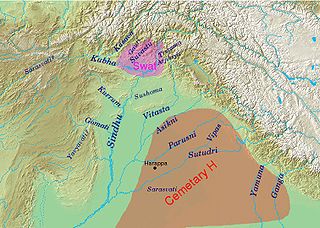 The earliest text of the Vedas
is the Rigveda
, a collection of poetic hymns used in the sacrificial rites of Vedic priesthood
. Many Rigvedic hymns concern the fire ritual
(Agnihotra
) and especially the offering of Soma
to the gods (Somayajna). Soma is both an intoxicant and a god itself, as is the sacrificial fire, Agni
. The royal horse sacrifice
(Ashvamedha
) is a central rite in the Yajurveda
.
The gods in the Rig-Veda
are mostly personified concepts, who fall into two categories: the deva
s – who were gods of nature – such as the weather deity Indra
(who is also the King of the gods), Agni
("fire"), Usha
("dawn"), Surya
("sun") and Apas ("waters") on the one hand, and on the other hand the asura
s – gods of moral concepts – such as Mitra
("contract"), Aryaman
(guardian of guest, friendship and marriage), Bhaga
("share") or Varuna
, the supreme Asura (or Aditya). While Rigvedic deva is variously applied to most gods, including many of the Asuras, the Devas are characterized as Younger Gods while Asuras are the Older Gods (pūrve devāḥ). In later Vedic texts, the Asuras become demons.
The Rigveda has 10 Mandalas ('books'). There is significant variation in the language and style between the family books (RV books 2–7), book 8, the "Soma Mandala" (RV 9), and the more recent books 1 and 10. The older books share many aspects of common Indo-Iranian religion, and is an important source for the reconstruction of earlier common Indo-European traditions. Especially RV 8 has striking similarity to the Avesta
, containing allusions to Afghan
Flora and Fauna, e.g. to camels ( = Avestan uštra). Many of the central religious terms in Vedic Sanskrit have cognates in the religious vocabulary of other Indo-European languages (deva: Latin deus; hotar: Germanic god; asura: Germanic ansuz; yajna
: Greek hagios; brahman
: Norse Bragi
or perhaps Latin flamen
etc.). Especially notable is the fact, that in the Avesta
Asura (Ahura) is known as good and Deva (Daeva) as evil entity, quite the opposite of the RigVeda.
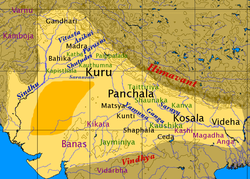 During a period roughly spanning the 10th to 6th centuries BC, the Mahajanapadas
arise from the earlier petty kingdoms of the various Rigvedic tribes
, and the failing remnants of the Late Harappan culture. In this period the mantra portions of the Vedas are largely completed, and a flowering industry of Vedic priesthood
organized in numerous schools (shakha
) develops exegetical literature, viz. the Brahmanas. These schools also edited the Vedic mantra portions into fixed recensions, that were to be preserved purely by oral tradition over the following two millennia.
This period of dominance of priestly Brahmanic Hinduism declines with the appearance of mystical
traditions (the oldest Upanishad
s, BAU, ChU and JUB
besides the Shatapatha Brahmana
) attacking the rigid ritualism available only to the elite, in favour of spiritual insight through asceticism
and meditation
. The rise of Buddhism
at this time, according to tradition originating with Gautama Buddha
, a 6th century BC prince, renouncing his status for enlightenment
, is exemplary of this tendency. Politically, the Mahajanapadas declined by being absorbed into the Magadha Empire which as the Maurya Empire
would encompass almost the whole subcontinent by the time of Ashoka
.
and Buddhism
in the later Iron Age, but in the Middle Ages would rise to renewed prestige with the Mimamsa
school, which as well as all other astika traditions of Hinduism, considered them authorless (apaurusheyatva
) and eternal. A last surviving elements of Vedic Hinduism
or Vedism is Śrauta
tradition, following many major elements of Vedic religion and is prominent in Southern India, with communities in Tamil Nadu
, Kerala
, Karnataka
, Andhra Pradesh
, but also in some pockets of Uttar Pradesh
, Maharashtra
and other states; the best known of these groups are the Nambudiri of Kerala, whose traditions were notably documented by Frits Staal
.
and Shastra
literature and the scholarly exposition of the "circum-Vedic" fields of the Vedanga
. However, during this time Buddhism was patronized by Ashoka
, who ruled large parts of India, and Buddhism was also the mainstream religion until the Gupta empire period.
The Sangam literature (300 BC – 300 AD) is a mostly secular body of classical literature in the Tamil language
. Nonetheless there are some works, significantly Pattupathu and Paripaatal, wherein the personal devotion to god was written in form of devotional poems. Vishnu
, Shiva
and Murugan
were mentioned gods. These works are therefore the earliest evidences of monotheistic Bhakti
traditions, preceding the large bhakti movement
, which was given great attention in later times.
s (4th to 9th centuries) were, alongside the Gupta
s of the North
, patronizers of Sanskrit in the South
of the Subcontinent
. The pallava reign saw the first Sankrit inscriptions in a script called Grantha
. Early Pallavas had different connections to South-East Asian countries. The Pallavas used Dravidian architecture to build some very important Hindu temples and academies in Mamallapuram, Kanchipuram
and other places; their rule saw the rise of great poets, who are as famous as Kalidasa
.
The Gupta period (4th to 6th centuries) saw a flowering of scholarship, the emergence of the classical schools of Hindu philosophy
, and of classical Sanskrit literature
in general on topics ranging from medicine, veterinary science, mathematics, to astrology and astronomy and astrophysics. The famous Aryabhata
and Varahamihira
belong to this age. The Gupta established a strong central government which also allowed a degree of local control. Gupta society was ordered in accordance with Hindu beliefs. This included a strict caste system, or class system. The peace and prosperity created under Gupta leadership enabled the pursuit of scientific and artistic endeavors.
The practice of dedicating temples to different deities came into vogue followed by fine artistic temple architecture
and sculpture (see Vastu Shastra
).
n countries. Trade routes linked India with southern Burma, central and southern Siam, lower Cambodia
and southern Vietnam
and numerous urbanized coastal settlements were established there.
For more than a thousand years, Indian Hindu/Buddhist influence was therefore the major factor that brought a certain level of cultural unity to the various countries of the region. The Pali
and Sanskrit
languages and the Indian script, together with Theravada
and Mahayana
Buddhism
, Brahmanism and Hinduism
, were transmitted from direct contact as well as through sacred texts and Indian literature, such as the Ramayana
and the Mahabharata
epics.
From the 5th to the 13th century, South-East Asia had very powerful Indian colonial empires and became extremely active in Buddhist architectural and artistic creation. The Sri Vijaya Empire to the south and the Khmer Empire
to the north competed for influence.
Langkasuka
(-langkha Sanskrit
for "resplendent land" -sukkha of "bliss") was an ancient Hindu kingdom located in the Malay Peninsula
. The kingdom, along with Old Kedah settlement, are probably the earliest territorial footholds founded on the Malay Peninsula. According to tradition, the founding of the kingdom happened in the 2nd century; Malay
legends claim that Langkasuka was founded at Kedah
, and later moved to Pattani
.
From the 5th-15th centuries Sri Vijayan empire, a maritime empire centered on the island of Sumatra
in
Indonesia
, had adopted Mahayana and Vajrayana Buddhism under a line of rulers named the Sailendra
s. The Empire of Sri Vijaya declined due to conflicts with the Chola rulers of India. The Majapahit Empire
succeeded the Singhasari
empire. It was one of the last and greatest Hindu empires in Maritime Southeast Asia
.
Funan was a pre-Angkor
Cambodia
n kingdom, located around the Mekong
delta, probably established by Mon–Khmer settlers speaking an Austro-Asiatic language. According to reports by two Chinese envoys, K'ang T'ai and Chu Ying, the state was established by an Indian Brahmin
named Kaundinya
, who in the 1st century CE was given instruction in a dream to take a magic bow from a temple and defeat a Khmer queen, Soma. Soma, the daughter of the king of the Nagas, married Kaundinya and their lineage became the royal dynasty of Funan. The myth had the advantage of providing the legitimacy of both an Indian Brahmin and the divinity of the cobras, who at that time were held in religious regard by the inhabitants of the region.
The kingdom of Champa
(or Lin-yi in Chinese records)
controlled what is now south and central Vietnam
from approximately 192 through 1697. The dominant religion of the Cham people was Hinduism
and the culture was heavily influenced by India.
Later, from the 9th to the 13th century, the Mahayana Buddhist and Hindu Khmer Empire
dominated much of the South-East Asian peninsula. Under the Khmer, more than 900 temples were built in Cambodia and in neighboring Thailand. Angkor
was at the center of this development, with a temple complex and urban organization able to support around one million urban dwellers. The largest temple complex of the world , Angkor Wat , stands here; built by the king Vishnuvardhan , a king of the dynasty that believed themselves to be incarnations of Vishnu.
The formerly rich philosophic literature tended to be reduced to scholastic quarreling and infighting between innumerable sects, notably between emerging traditions of Vaishnavism
and Shaivism
. Adi Shankara
in the 8th century managed to reconcile the antagonistic sects and to establish Hinduism as a single, if diverse, religious tradition. The compilation of the Puranas
provided a mythical backdrop for this tradition, and served as a means of acculturation
of the various pre-literate tribal societies to the new religious mainstream. Various reforms of the later Middle Ages, notably the Bhakti movement
, besides new Yogic
schools (Jnana yoga
, Karma yoga
, Hatha yoga
, Bhakti yoga
) gave Hinduism its classical form as described by the 18th to 19th century pioneers of Indology
.
religious movement in which the main spiritual practice was the fostering of loving devotion to God, called bhakti
. It was a movement generally devoted to worship of Shiva
, Vishnu
or Shakti
.
The first documented bhakti movement was founded by
Karaikkal-ammaiyar. She wrote poems in Tamil
about her love for Shiva
and probably lived around the 6th century CE.
The twelve Alvars
who were Vaishnavite devotees and the sixty-three Nayanars
who were Shaivite devotees nurtured the incipient bhakti movement in Tamil Nadu
. They constitute South India's 75 Apostles of Bhakti
.
During the 12th century CE in Karnataka, the Bhakti movement took the form of the Virashaiva movement. It was inspired by Basavanna, a Hindu reformer who created the sect of Lingayats or Shiva
bhaktas. During this time, a unique
and native form of Kannada literature-poetry called Vachanas was born.
Hanshaw, Mark. "A Hindu Vision of Grace for a Western Christian Community.." Religion East & West. 8 (2008): 75-94. Print.
by Adi Shankara
unified the theistic sects into a common framework of Shanmata
system. Shankara stressed the importance of the Vedas, introducing the concept of apaurusheyatva
, and his efforts helped Hinduism regain strength and popularity.
He is the main figure in the tradition of Advaita Vedanta
. He is the founder of the Dashanami Sampradaya
of Hindu
monasticism
and Shanmata
tradition of worship. He travelled all over India (Kerala
to Kashmir
and Nepal
) three times over and was a major cause in the revival and integration of Sanatana Dharma. Shankara's reform essentially eclipsed all earlier schools of Hindu philosophy and became the nucleus of the medieval traditions, including Smartism
and Sant Mat
lineages, that lead up to the current religion.
Adi Shankara, along with Madhva
and Ramanuja
, were instrumental in the revival of Hinduism. In their writings and debates, they provided polemics against the non-Vedantic schools of Sankhya, Vaisheshika
etc. Thus, they paved the way for Vedanta
to be the dominant and most widely followed tradition among the schools of Hindu philosophy.
and eventually classical Pauranic Hinduism.
The transformation of Brahmanism into Pauranic Hinduism in post-Gupta India was due to a process of acculturation
. The Puranas helped establish a religious mainstream among the pre-literate tribal societies undergoing acculturation. The tenets of Brahmanic Hinduism and of the Dharmashastras underwent a radical transformation at the hands of the Purana composers, resulting in the rise of a mainstream "Hinduism" that overshadowed all earlier traditions.
religious and secular learning had first reached Persia in an organised manner in the 6th century, when the Sassanid Emperor Khosrau I
(531–579) deputed Borzuya the physician
as his envoy, to invite Indian and Chinese scholars to the Academy of Gundishapur
.
Burzoe had translated the Sanskrit Panchatantra
. His Pahlavi version was translated into Arabic by Ibn al-Moqaffa
under the title of Kalila and Dimna or The Fables of Bidpai.
Under the Abbasid
caliphate, Baghdad
had replaced Gundishapur as the most important centre of learning in the then vast Islamic Empire
, wherein the traditions as well as scholars of the latter flourished. Hindu scholars were invited to the conferences on sciences and mathematics held in Baghdad.
began to spread across the Indian-subcontinent over several centuries. Most converts were from Hinduism
or Buddhism
, the two dominant local religions. While all traditions of popular Hinduism continued – including the worship of popular reincarnations of the primordial Shakti
– Bhakti
tradition attained new prominence; Bhakti poetry of lasting greatness was composed in northern India under the rule of Muslim emperors. The humble mystic saint Kabir
, who established his own order, composed devotional verses in the Bhakti spirit, but in common-man's Hindi dialect and transcending the Hindu-Muslim theocratic divide. Tulsidas
, Mira Bai and Surdas
composed immortal Hindu devotional poetry in Hindi-dialects in the Mughal
period – it is reminiscent of the earlier Kannada and Tamil Bhakti poetry of South India.
 After the conquest of Persia by the Mongol Empire
, a regional Turko-Persio-Mongol dynasty formed. Just as eastern Mongol dynasties inter-married with locals and adopted the local religion of Buddhism
and the Chinese culture, this group adopted the local religion of Islam
and the Persian culture; their descendants ruled in India as Mughal
s.
The official State religion of the Mughal Empire was Islam
, with the preference to the jurisprudence
of the Hanafi
Madhab (Mazhab). Hinduism remained under strain during Babur and Humanyun's reigns. Sher Shah Suri, the Afghan ruler of North India was comparatively non-repressive. Hinduism came to fore during the three year rule of Hindu king 'Hemu
' during 1553-56 when he had defeated Akbar at Agra and Delhi and had taken up the reign from Delhi as a Hindu 'Vikramaditya' king after his 'Rajyabhishake' or coronation
at 'Purana Quila' in Delhi. However, during Mughal history, at times, subjects had freedom to practice any religion of their choice, though Non-Muslim able-bodied adult males with income were obliged to pay the Jizya
(poll-tax to be spent by the State only on protection of non-Muslims), which signified their status as Dhimmis (responsibility of the State, in regard to safety of life and property).
Akbar, the Mughal emperor Humayun
's son and heir from his Sindhi
queen Hameeda Banu Begum, had a broad vision of Indian and Islamic traditions. One of Emperor Akbar's most unusual ideas regarding religion was Din-i-Ilahi
(Faith of God), which was an eclectic mix of Islam
, Zoroastrianism
, Hinduism, Jainism
and Christianity
. It was proclaimed the state religion until his death. These actions however met with stiff opposition from the Muslim clergy, especially the Sufi Shaykh Alf Sani Ahmad Sirhindi
. Akbar's abolition of poll-tax on non-Muslims, acceptance of ideas from other religious philosophies, toleration of public worship by all religions and his interest in other faiths showed an attitude of considerable religious tolerance, which, in the minds of his orthodox Muslim opponents, were tantamount to apostasy
.
Akbar's son, Jahangir
, half Rajput, was also a religious moderate, his mother being Hindu. The influence of his two Hindu queens (the Maharani Maanbai and Maharani Jagat) kept religious moderation as a center-piece of state policy which was extended under his son, Emperor Shah Jahan
, who was by blood 75% Rajput
and less than 25% Moghul.
Religious orthodoxy would only play an important role during the reign of Shah Jahan's son and successor, Aurangzeb
, a devout Sunni Muslim. Aurangzeb was comparatively less tolerant of other faiths than his predecessors had been, and his reign saw an increase in the number and importance of Islamic institutions and scholars. He led many military campaigns against the remaining non-Muslim powers of the Indian subcontinent – the Sikh
states of the Punjab, the last independent Hindu Rajputs and the Maratha
rebels – as also against the Shia Muslim kingdoms of the Deccan. He also virtually stamped out, from his empire, open proselytisation of Hindus and Muslims by foreign Christian Missionaries, who remained successfully active, however, in the adjoining regions: the present day Kerala
, Tamilnadu and Goa
.
, Hinduism once again rose to political prestige, under the Maratha Empire
, from 1707 to 1761.
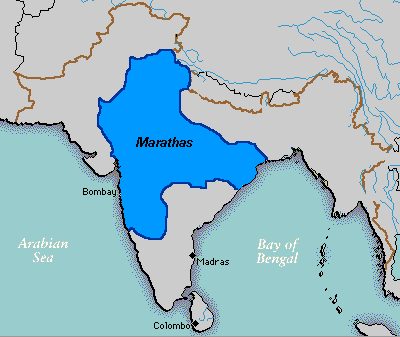 The Hindu
Marathas long had lived in the Desh
region around Satara
, in the western portion of the Deccan plateau, where the plateau meets the eastern slopes of the Western Ghats
mountains. They had resisted incursions into the region by the Muslim
Mughal
rulers of northern India. Under their ambitious leader Shivaji, the Maratha freed themselves from the Muslim
sultans of Bijapur to the southeast and, becoming much more aggressive, began to frequently raid Mughal territory, eventually sacking the wealthy Mughal port of Surat
in 1664. After substantial territorial gains, Shivaji Maharaj was proclaimed 'Chhatrapati' (Emperor) in 1674; the Marathas had spread and conquered much of central India by Shivaji Maharaj's death in 1680. Subsequently, under the able leadership of Brahmin
prime ministers (Peshwas), who often led as generals
also, Maratha Empire
reached its zenith. Pune
, the seat of Peshwas, flowered as a centre of Hindu learning and traditions. In 1761, the empire broke
into smaller Maratha kingdoms that survived till they were eventually subdued
by the British East India Company
.
in the late 15th century, made contact with the St Thomas Christians
in Kerala
and sought to introduce the Latin Rite
among them. Since the priests for St Thomas Christians were served by the Eastern Christian Churches, they were following Eastern Christian practices at that time. Throughout this period, foreign missionaries also made many new converts to Christianity. This led to the formation of the Latin Catholics in Kerala.
The Goa Inquisition
was the office of the Christian Inquisition
acting in the Indian city of Goa
and the rest of the Portuguese empire
in Asia. St. Francis Xavier, in a 1545 letter to John III
, requested for an Inquisition
to be installed in Goa. It was installed eight years after the death of Francis Xavier in 1552. Established in 1560 and operating until 1774, this highly controversial institution was aimed primarily at Hindus
and wayward new converts.
In the century from 1760 to 1860, India was once more divided into numerous petty and unstable kingdoms: the Sikh Confederacy
; the "lesser Mughals" following Bahadur Shah I
; the Kingdom of Mysore
; Hyderabad State
; the Durrani Empire
; and the territories held by the British East India Company
. The entire subcontinent fell under British rule (partly indirectly
, via Princely states) following the Indian Rebellion of 1857
.
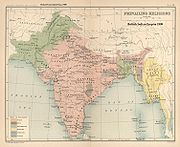 During the 19th century, Hinduism developed a large number of new religious movement
s, partly inspired by the European Romanticism
, nationalism
, and esotericism
(Theosophy
) popular at the time (while conversely and contemporaneously, India had a similar effect on European culture with Orientalism
, "Hindoo style" architecture, reception of Buddhism in the West
and similar).
These reform movements are summarized under Hindu revivalism and continue into the present.
ern thought and new religious movements. An early champion of Indian-inspired thought in the West was Arthur Schopenhauer
who in the 1850s advocated ethnics based on an "Aryan-Vedic theme of spiritual self-conquest", as opposed to the ignorant drive toward earthly utopianism of the superficially this-worldly "Jewish" spirit. Helena Blavatsky moved to India in 1879, and her Theosophical Society
, founded in New York in 1875, evolved into a peculiar mixture of Western occultism and Hindu mysticism over the last years of her life.
The sojourn of Vivekananda to the World Parliament of Religions in Chicago in 1893 had a lasting effect. Vivekananda founded the Ramakrishna Mission
, a Hindu missionary organization still active today.
In the early 20th century, Western occultists influenced by Hinduism include Maximiani Portaz – an advocate of "Aryan Paganism" – who styled herself Savitri Devi and Jakob Wilhelm Hauer
, founder of the German Faith Movement
. It was in this period, and until the 1920s, that the swastika
became an ubiquitous symbol of good luck in the West
before its association with the Nazi Party became dominant in the 1930s.
Hinduism-inspired elements in Theosophy
were also inherited by the spin-off movements of Ariosophy
and Anthroposophy
and ultimately contributed to the renewed New Age
boom of the 1960s to 1980s, the term New Age itself deriving from Blavatsky's 1888 The Secret Doctrine
.
), 2 million in Europe, 1.8 million in North America, 1.2 million in Southern Africa
.
Its main divisions are into Vaishnavism
(largely influenced by Bhakti
), Shaivism
, Shaktism
and Smartism
(Advaita Vedanta
).
Besides these traditional denominations, movements of Hindu revivalism look to founders such as Swami Vivekananda
, Swami Dayananda (Arya Samaj
), Rabindranath Tagore
, Ramana Maharshi
, Aurobindo, Shriram Sharma Acharya
, Swami Sivananda
, Swami Rama Tirtha
, Narayana Guru
, Paramhansa Yogananda, Swami Chinmayananda, Shrii Shrii Anandamurti, Pandurang Shastri Athavale
(Swadhyay Movement
) and others.
The Hindutva
movement advocating Hindu nationalism
originated in the 1920s and has remained a strong political force in India. The major party of the religious right, Bharatiya Janata Party
, since its foundation in 1980 has won several elections, and after a defeat in 2004
remains the leading force of opposition against the current Congress Party
government.
is occurring in all parts of the country. In the early seventies, the Toraja
people of Sulawesi
were the first to be identified under the umbrella of 'Hinduism', followed by the Karo Batak of Sumatra in 1977 and the Ngaju Dayak of Kalimantan in 1980.
The growth of Hinduism has been driven also by the famous Javanese prophesies of Sabdapalon
and Jayabaya. Many recent converts to Hinduism had been members of the families of Sukarno
's PNI, and now support Megawati Sukarnoputri
. This return to the 'religion of Majapahit' (Hinduism) is a matter of nationalist pride.
The new Hindu communities in Java tend to be concentrated around recently built temples (pura) or around archaeological temple sites (candi) which are being reclaimed as places of Hindu worship. An important new Hindu temple in eastern Java is Pura Mandaragiri Sumeru Agung, located on the slope of Mt. Semeru
, Java's highest mountain. Mass conversions have also occurred in the region around Pura Agung Blambangan, another new temple, built on a site with minor archaeological remnants attributed to the kingdom of Blambangan, the last Hindu polity on Java, and Pura Loka Moksa Jayabaya (in the village of Menang near Kediri).
, Meher Baba
, Osho
, Maharishi Mahesh Yogi
(Transcendental Meditation
), Sathya Sai Baba
, Mother Meera
, among others.
Hinduism
Hinduism is the predominant and indigenous religious tradition of the Indian Subcontinent. Hinduism is known to its followers as , amongst many other expressions...
is a term for a wide variety of related religious traditions
Hindu denominations
Hinduism comprises numerous sects or denominations. The denominations are roughly comparable to different religions. The main divisions in current Hinduism are Shaivism, Shaktism, Vaishnavism, and Smartism...
native to India
Indian subcontinent
The Indian subcontinent, also Indian Subcontinent, Indo-Pak Subcontinent or South Asian Subcontinent is a region of the Asian continent on the Indian tectonic plate from the Hindu Kush or Hindu Koh, Himalayas and including the Kuen Lun and Karakoram ranges, forming a land mass which extends...
. Historically, it encompasses the development of Religion in India
Religion in India
Indian religions is a classification for religions that originated in the Indian subcontinent; namely Hinduism, Jainism, Buddhism and Sikhism. These religions are also classified as Eastern religions...
since the Iron Age
Iron Age India
Iron Age India, the Iron Age in the Indian subcontinent, succeeds the Late Harappan culture, also known as the last phase of the Indus Valley Tradition...
traditions, which in turn hark back to prehistoric religion
Prehistoric religion
Prehistoric religion is a general term for the religious beliefs and practices of prehistoric peoples. More specifically it encompasses Paleolithic religion, Mesolithic religion, Neolithic religion and Bronze Age religion.-Burial:...
s such as that of the Bronze Age Indus Valley Civilization
Indus Valley Civilization
The Indus Valley Civilization was a Bronze Age civilization that was located in the northwestern region of the Indian subcontinent, consisting of what is now mainly modern-day Pakistan and northwest India...
followed by the Iron Age
Iron Age India
Iron Age India, the Iron Age in the Indian subcontinent, succeeds the Late Harappan culture, also known as the last phase of the Indus Valley Tradition...
Vedic religion
Historical Vedic religion
The religion of the Vedic period is a historical predecessor of Hinduism. Its liturgy is reflected in the mantra portion of the four Vedas, which are compiled in Sanskrit. The religious practices centered on a clergy administering rites...
.
Classical Hinduism emerges as a revival of Vedic traditions with the gradual decline of Buddhism in India
Decline of Buddhism in India
The decline of Buddhism in India, the land of its birth, occurred for a variety of reasons, and happened even as it continued to flourish beyond the frontiers of India. Buddhism was established in the area of ancient Magadha and Kosala by Gautama Buddha in the 6th century BCE, in what is now modern...
from around the beginning of the Common Era.
Hindu philosophy
Hindu philosophy
Hindu philosophy is divided into six schools of thought, or , which accept the Vedas as supreme revealed scriptures. Three other schools do not accept the Vedas as authoritative...
had six branches, evolving from about the 2nd century BC to the 6th century AD, viz. Samkhya
Samkhya
Samkhya, also Sankhya, Sāṃkhya, or Sāṅkhya is one of the six schools of Hindu philosophy and classical Indian philosophy. Sage Kapila is traditionally considered as the founder of the Samkhya school, although no historical verification is possible...
, Yoga
Raja Yoga
Rāja Yoga is concerned principally with the cultivation of the mind using meditation to further one's acquaintance with reality and finally achieve liberation.Raja yoga was first described in the Yoga Sutras of Patanjali, and is part of the Samkhya tradition.In the context of Hindu...
, Nyaya
Nyaya
' is the name given to one of the six orthodox or astika schools of Hindu philosophy—specifically the school of logic...
, Vaisheshika
Vaisheshika
Vaisheshika or ' is one of the six Hindu schools of philosophy of India. Historically, it has been closely associated with the Hindu school of logic, Nyaya....
, Mimamsa
Mimamsa
' , a Sanskrit word meaning "investigation" , is the name of an astika school of Hindu philosophy whose primary enquiry is into the nature of dharma based on close hermeneutics of the Vedas...
, and Vedanta
Vedanta
Vedānta was originally a word used in Hindu philosophy as a synonym for that part of the Veda texts known also as the Upanishads. The name is a morphophonological form of Veda-anta = "Veda-end" = "the appendix to the Vedic hymns." It is also speculated that "Vedānta" means "the purpose or goal...
. Monotheistic religions like Shaivism
Shaivism
Shaivism is one of the four major sects of Hinduism, the others being Vaishnavism, Shaktism and Smartism. Followers of Shaivism, called "Shaivas," and also "Saivas" or "Saivites," revere Shiva as the Supreme Being. Shaivas believe that Shiva is All and in all, the creator, preserver, destroyer,...
and Vaishnavism
Vaishnavism
Vaishnavism is a tradition of Hinduism, distinguished from other schools by its worship of Vishnu, or his associated Avatars such as Rama and Krishna, as the original and supreme God....
developed during this same period through the Bhakti movement
Bhakti movement
The Bhakti movement is a Hindu religious movement in which the main spiritual practice is loving devotion among the Shaivite and Vaishnava saints. The Bhakti movement originated in ancient Tamil Nadu and began to spread to the north during the late medieval ages when north India was under Islamic...
.
Classical Pauranic Hinduism is established in the Middle Ages, as was Adi Shankara
Adi Shankara
Adi Shankara Adi Shankara Adi Shankara (IAST: pronounced , (Sanskrit: , ) (788 CE - 820 CE), also known as ' and ' was an Indian philosopher from Kalady of present day Kerala who consolidated the doctrine of advaita vedānta...
's Advaita Vedanta
Advaita Vedanta
Advaita Vedanta is considered to be the most influential and most dominant sub-school of the Vedānta school of Hindu philosophy. Other major sub-schools of Vedānta are Dvaita and ; while the minor ones include Suddhadvaita, Dvaitadvaita and Achintya Bhedabheda...
which reconciled the Vaishnava and Shaiva sects, and gave rise to Smartism
Smartism
Smarta Sampradaya is a liberal or nonsectarian denomination of the Vedic Hindu religion which accept all the major Hindu deities as forms of the one Brahman, in contrast to Vaishnavism, Shaivism, and Shaktism, the other three major Hindu sects, which revere Vishnu, Shiva, and Shakti,...
, while initiating the decline of the non-Vedantic schools of philosophy.
Hinduism under the Islamic Rulers
Islamic empires in India
Beginning in the 12th century, several Islamic states were established in the Indian subcontinentin the course of a gradual Muslim conquest in the Indian subcontinent....
saw the increasing prominence of the Bhakti movement
Bhakti movement
The Bhakti movement is a Hindu religious movement in which the main spiritual practice is loving devotion among the Shaivite and Vaishnava saints. The Bhakti movement originated in ancient Tamil Nadu and began to spread to the north during the late medieval ages when north India was under Islamic...
, which remains influential today. The colonial period
Colonial India
Colonial India refers to areas of the Indian Subcontinent under the control of European colonial powers, through trade and conquest. The first European power to arrive in India was the army of Alexander the Great in 327–326 BC. The satraps he established in the north west of the subcontinent...
saw the emergence of various Hindu reform movements partly inspired by western culture, such as spiritism (Theosophy
Theosophy
Theosophy, in its modern presentation, is a spiritual philosophy developed since the late 19th century. Its major themes were originally described mainly by Helena Blavatsky , co-founder of the Theosophical Society...
). The Partition of India
Partition of India
The Partition of India was the partition of British India on the basis of religious demographics that led to the creation of the sovereign states of the Dominion of Pakistan and the Union of India on 14 and 15...
in 1947 was along religious lines, with the Republic of India emerging with a Hindu majority.
During the 20th century, due to the Indian diaspora, Hindu minorities have formed in all continents, with the largest communities in absolute numbers in the United States
Hinduism in the United States
Hinduism is a minority religion in the United States, American Hindus accounting for an estimated 0.4% of total US population.The vast majority of American Hindus are Indian Americans, immigrants from India and Nepal and their descendants, besides a much smaller number of converts.While there were...
and the United Kingdom
Hinduism in the United Kingdom
Hinduism was the religion of 558,342 people in the United Kingdom according to the 2001 census but an estimate in a British newspaper in 2007 has put the figure as high as 1.5 Million....
.
Prehistory
Evidence of prehistoric religionPrehistoric religion
Prehistoric religion is a general term for the religious beliefs and practices of prehistoric peoples. More specifically it encompasses Paleolithic religion, Mesolithic religion, Neolithic religion and Bronze Age religion.-Burial:...
in India is found in the Bronze Age Indus Valley Civilization
Indus Valley Civilization
The Indus Valley Civilization was a Bronze Age civilization that was located in the northwestern region of the Indian subcontinent, consisting of what is now mainly modern-day Pakistan and northwest India...
, showing the certain elements of Hinduism such as baths
Bathing
Bathing is the washing or cleansing of the body in a fluid, usually water or an aqueous solution. It may be practised for personal hygiene, religious ritual or therapeutic purposes or as a recreational activity....
(assumed to serve a ritual purpose) and Symbols, compared to the Shiva lingam.
Swastika
The swastika is an equilateral cross with its arms bent at right angles, in either right-facing form in counter clock motion or its mirrored left-facing form in clock motion. Earliest archaeological evidence of swastika-shaped ornaments dates back to the Indus Valley Civilization of Ancient...
signs.
Many male and female figurines, the female figurines popularly dubbed "Mother Goddesses" have been found in the Indus Valley, although some have expressed doubt as to the divine character of these female figures.
A seal discovered during excavation of the Mohenjo-daro archaeological site in the Indus Valley
Indus Valley Civilization
The Indus Valley Civilization was a Bronze Age civilization that was located in the northwestern region of the Indian subcontinent, consisting of what is now mainly modern-day Pakistan and northwest India...
has drawn attention as a possible representation of a "yogi" or "proto-Shiva" figure. This "Pashupati
Pashupati
Pashupati , "Lord of cattle", is an epithet of the Hindu god Shiva. In Vedic times it was used as an epithet of Rudra. The Rigveda has the related pashupa "protector of cattle" as a name of Pushan. The Pashupatinath Temple is the most important Hindu shrine for all Hindus in Nepal and also for many...
" (Lord of Animals, Sanskrit ) seal shows a seated figure, possibly ithyphallic, surrounded by animals. Some observers describe the figure as sitting in a traditional cross-legged yoga pose with its hands resting on its knees. The discoverer of the seal, Sir John Marshall, and others have claimed that this figure is a prototype of Shiva, and have described the figure as having three faces, seated in a "yoga posture" with the knees out and feet joined.
However, these artifacts come from the Indus Valley civilization
Indus Valley Civilization
The Indus Valley Civilization was a Bronze Age civilization that was located in the northwestern region of the Indian subcontinent, consisting of what is now mainly modern-day Pakistan and northwest India...
. This prehistoric Indian civilization collapsed around 1500BC and Vedism appeared in its place along with its Vedic literature, and a caste system. However, it is possible that Vedism was influenced by a substratum of Indus Valley civilization
Indus Valley Civilization
The Indus Valley Civilization was a Bronze Age civilization that was located in the northwestern region of the Indian subcontinent, consisting of what is now mainly modern-day Pakistan and northwest India...
culture.
Proto-Indo-European Religion
There is compelling linguistic and textual evidence that Vedism shares a common root with Roman religionRoman religion
The term Roman religion may refer to:*Ancient Roman religion*religions of the Roman Empire period **Imperial cult *** Sol Invictus**Mithraism**Early Christianity**Gnosticism**State church of the Roman Empire...
, Greek mythology
Greek mythology
Greek mythology is the body of myths and legends belonging to the ancient Greeks, concerning their gods and heroes, the nature of the world, and the origins and significance of their own cult and ritual practices. They were a part of religion in ancient Greece...
and Germanic mythology
Germanic mythology
Germanic mythology is a comprehensive term for myths associated with historical Germanic paganism, including Norse mythology, Anglo-Saxon mythology, Continental Germanic mythology, and other versions of the mythologies of the Germanic peoples...
in Proto-Indo-European religion
Proto-Indo-European religion
Proto-Indo-European religion is the hypothesized religion of the Proto-Indo-European peoples based on the existence of similarities among the deities, religious practices and mythologies of the Indo-European peoples. Reconstruction of the hypotheses below is based on linguistic evidence using the...
. The Dyaus Pita
Dyaus Pita
In the Vedic pantheon ' or ' or Dyaus Pitar is the Sky Father, divine consort of the Prithvi and father of Agni, Indra , and Ushas, the daughter representing dawn. In archaic Vedic lore, Dyauṣ Pitṛ and Prithivi Matṛ were one, single composite dvandva entity, named as the Dyavaprthivi...
, the Sky God of the Vedic Rgveda bears functions similar to the Thunder gods of Roman Jupiter
Jupiter
Jupiter is the fifth planet from the Sun and the largest planet within the Solar System. It is a gas giant with mass one-thousandth that of the Sun but is two and a half times the mass of all the other planets in our Solar System combined. Jupiter is classified as a gas giant along with Saturn,...
, Greek Zeus
Zeus
In the ancient Greek religion, Zeus was the "Father of Gods and men" who ruled the Olympians of Mount Olympus as a father ruled the family. He was the god of sky and thunder in Greek mythology. His Roman counterpart is Jupiter and his Etruscan counterpart is Tinia.Zeus was the child of Cronus...
Pater, and Norse Týr. In all of these religions, the sky or thunder god often holds primacy over the other gods. They also share common traits as the tendency to personify aspects of nature as gods, and the weaving of tales of gods into poetry. The similarity in their respective religions is echoed in the similarities between their languages and their societal structure. As Proto-Indo-European culture
Proto-Indo-European society
Proto-Indo-European refers to the single ancestor language common to all Indo-European languages. It is therefore a linguistic concept, not an ethnic, social or cultural one, so there is no direct evidence of the nature of Proto-Indo-European 'society'. Much depends on the unsettled Indo-European...
was introduced into India, with possible influences of Indus Valley civilization
Indus Valley Civilization
The Indus Valley Civilization was a Bronze Age civilization that was located in the northwestern region of the Indian subcontinent, consisting of what is now mainly modern-day Pakistan and northwest India...
and Gandhara grave culture
Gandhara grave culture
The Gandhara grave culture emerged ca. 1600 BC, and flourished in Gandhara, Pakistan ca. 1500 BC to 500 BC ....
, Vedism emerged.
Vedic period
Vedism was the religion of the early IndiansIndia
India , officially the Republic of India , is a country in South Asia. It is the seventh-largest country by geographical area, the second-most populous country with over 1.2 billion people, and the most populous democracy in the world...
, speakers of early Old Indic dialects, descened from the Proto-Indo-European language
Proto-Indo-European language
The Proto-Indo-European language is the reconstructed common ancestor of the Indo-European languages, spoken by the Proto-Indo-Europeans...
. Liturgy is preserved in the three Vedic Samhitas
Vedas
The Vedas are a large body of texts originating in ancient India. Composed in Vedic Sanskrit, the texts constitute the oldest layer of Sanskrit literature and the oldest scriptures of Hinduism....
: the Rig-Veda, Sama-Veda and the Yajur-Veda. Of these, the Rig-Veda the oldest, a collection of hymns dated possibly as early as the 4th millennium BCE. The other two add ceremonial detail for the performance of the actual sacrifice. The Atharva-Veda may also contain compositions dating to before 1000 BC. It contains material pertinent to domestic ritual and folk magic of the period.
These texts, as well as the voluminous commentary on orthopraxy collected in the Brahmanas compiled during the early 1st millennium BC, were transmitted by oral tradition
Oral tradition
Oral tradition and oral lore is cultural material and traditions transmitted orally from one generation to another. The messages or testimony are verbally transmitted in speech or song and may take the form, for example, of folktales, sayings, ballads, songs, or chants...
alone until the advent of the Pallava
Pallava
The Pallava dynasty was a Tamil dynasty which ruled the northern Tamil Nadu region and the southern Andhra Pradesh region with their capital at Kanchipuram...
and Gupta
Gupta
Gupta is a common surname of Indian origin.According to some academicians, the name Gupta is derived from Sanskrit goptri, meaning military governor. A more direct translation of the Sanskrit word gupta is 'secret' or 'hidden'. According to prominent historian R. C...
period and by a combination of written and oral tradition since then.
Rigvedic religion
Vedas
The Vedas are a large body of texts originating in ancient India. Composed in Vedic Sanskrit, the texts constitute the oldest layer of Sanskrit literature and the oldest scriptures of Hinduism....
is the Rigveda
Rigveda
The Rigveda is an ancient Indian sacred collection of Vedic Sanskrit hymns...
, a collection of poetic hymns used in the sacrificial rites of Vedic priesthood
Vedic priesthood
Priests of the Vedic religion were officiants of the yajna service. As persons trained for the ritual and proficient in its practice, they were called '...
. Many Rigvedic hymns concern the fire ritual
Fire worship
Worship or deification of fire is known from various religions. Fire has been an important part of human culture since the Lower Paleolithic...
(Agnihotra
Agnihotra
Agnihotra is a Vedic yajña performed in orthodox Hindu communities. It is mentioned in the Atharvaveda and described in detail in the Yajurveda Samhita and the Shatapatha Brahmana . The Vedic form of the ritual is still performed Nambudiri Brahmins of Kerala and by a small number of Vaidiki...
) and especially the offering of Soma
Soma
Soma , or Haoma , from Proto-Indo-Iranian *sauma-, was a ritual drink of importance among the early Indo-Iranians, and the subsequent Vedic and greater Persian cultures. It is frequently mentioned in the Rigveda, whose Soma Mandala contains 114 hymns, many praising its energizing qualities...
to the gods (Somayajna). Soma is both an intoxicant and a god itself, as is the sacrificial fire, Agni
Agni
Agni is a Hindu deity, one of the most important of the Vedic gods. He is the god of fire and the acceptor of sacrifices. The sacrifices made to Agni go to the deities because Agni is a messenger from and to the other gods...
. The royal horse sacrifice
Horse sacrifice
Many Indo-European religious branches show evidence for horse sacrifice, and comparative mythology suggests that they derive from a Proto-Indo-European ritual.-Context:...
(Ashvamedha
Ashvamedha
The Ashvamedha was one of the most important royal rituals of Vedic religion, described in detail in the Yajurveda...
) is a central rite in the Yajurveda
Yajurveda
The Yajurveda, a tatpurusha compound of "sacrificial formula', + ) is the third of the four canonical texts of Hinduism, the Vedas. By some, it is estimated to have been composed between 1400 and 1000 BC, the Yajurveda 'Samhita', or 'compilation', contains the liturgy needed to perform the...
.
The gods in the Rig-Veda
Rigvedic deities
There are 1028 hymns in the Rigveda, most of them dedicated to specific deities.Indra, a heroic god, slayer of Vrtra and destroyer of the Vala, liberator of the cows and the rivers; Agni the sacrificial fire and messenger of the gods; and Soma the ritual drink dedicated to Indra are the most...
are mostly personified concepts, who fall into two categories: the deva
Deva (Hinduism)
' is the Sanskrit word for god or deity, its related feminine term is devi. In modern Hinduism, it can be loosely interpreted as any benevolent supernatural beings. The devs in Hinduism, also called Suras, are often juxtaposed to the Asuras, their half brothers. Devs are also the maintainers of...
s – who were gods of nature – such as the weather deity Indra
Indra
' or is the King of the demi-gods or Devas and Lord of Heaven or Svargaloka in Hindu mythology. He is also the God of War, Storms, and Rainfall.Indra is one of the chief deities in the Rigveda...
(who is also the King of the gods), Agni
Agni
Agni is a Hindu deity, one of the most important of the Vedic gods. He is the god of fire and the acceptor of sacrifices. The sacrifices made to Agni go to the deities because Agni is a messenger from and to the other gods...
("fire"), Usha
Usha
Usha was a city in the Western part of Galilee. It is noteworthy because in the 2nd century , the Sanhedrin, or rabbinic court, was moved from Yavne in Judea to Usha, and then from Usha back to Yavne, and a second time from Yavne to Usha....
("dawn"), Surya
Surya
Surya Suraya or Phra Athit is the chief solar deity in Hinduism, one of the Adityas, son of Kasyapa and one of his wives, Aditi; of Indra; or of Dyaus Pitar . The term Surya also refers to the Sun, in general. Surya has hair and arms of gold...
("sun") and Apas ("waters") on the one hand, and on the other hand the asura
Asura
-In Hinduism:In Hinduism, the Asuras constitute a group of power-seeking deities, sometimes considered sinful and materialistic. The Daityas and Danavas were combinedly known as Asuras. The Asura were opposed to the Devas. Both groups are children of Kasyapa...
s – gods of moral concepts – such as Mitra
Mitra (Vedic)
This article is about the Vedic deity Mitra. For other divinities with related names, see the general article Mitra.Mitra is an important divinity of Indic culture, and the patron divinity of honesty, friendship, contracts and meetings...
("contract"), Aryaman
Aryaman
Aryaman is one of the early Vedic deities . His name signifies "bosom friend". He is the third son of Aditi. He is an Aditya, a solar deity. He is supposed to be the chief of the manes and the Milky Way is supposed to be his path.Aryaman is another name for Surya or the Sun God...
(guardian of guest, friendship and marriage), Bhaga
Bhaga
Sanskrit is a term for "lord, patron", but also for "wealth, prosperity". The cognate term in Avestan and Old Persian is , of uncertain meaning but used in a sense in which "lord, patron" might also apply. A Slavic cognate is "god"...
("share") or Varuna
Varuna
In Vedic religion, Varuna is a god of the sky, of water and of the celestial ocean, as well as a god of law and of the underworld...
, the supreme Asura (or Aditya). While Rigvedic deva is variously applied to most gods, including many of the Asuras, the Devas are characterized as Younger Gods while Asuras are the Older Gods (pūrve devāḥ). In later Vedic texts, the Asuras become demons.
The Rigveda has 10 Mandalas ('books'). There is significant variation in the language and style between the family books (RV books 2–7), book 8, the "Soma Mandala" (RV 9), and the more recent books 1 and 10. The older books share many aspects of common Indo-Iranian religion, and is an important source for the reconstruction of earlier common Indo-European traditions. Especially RV 8 has striking similarity to the Avesta
Avesta
The Avesta is the primary collection of sacred texts of Zoroastrianism, composed in the Avestan language.-Early transmission:The texts of the Avesta — which are all in the Avestan language — were composed over the course of several hundred years. The most important portion, the Gathas,...
, containing allusions to Afghan
Afghanistan
Afghanistan , officially the Islamic Republic of Afghanistan, is a landlocked country located in the centre of Asia, forming South Asia, Central Asia and the Middle East. With a population of about 29 million, it has an area of , making it the 42nd most populous and 41st largest nation in the world...
Flora and Fauna, e.g. to camels ( = Avestan uštra). Many of the central religious terms in Vedic Sanskrit have cognates in the religious vocabulary of other Indo-European languages (deva: Latin deus; hotar: Germanic god; asura: Germanic ansuz; yajna
Yajna
In Hinduism, yajna is a ritual of sacrifice derived from the practice of Vedic times. It is performed to please the gods or to attain certain wishes...
: Greek hagios; brahman
Brahman
In Hinduism, Brahman is the one supreme, universal Spirit that is the origin and support of the phenomenal universe. Brahman is sometimes referred to as the Absolute or Godhead which is the Divine Ground of all being...
: Norse Bragi
Bragi
Bragi is the skaldic god of poetry in Norse mythology.-Etymology:Bragi is generally associated with bragr, the Norse word for poetry. The name of the god may have been derived from bragr, or the term bragr may have been formed to describe 'what Bragi does'...
or perhaps Latin flamen
Flamen
In ancient Roman religion, a flamen was a priest assigned to one of fifteen deities with official cults during the Roman Republic. The most important three were the flamines maiores , who served the three chief Roman gods of the Archaic Triad. The remaining twelve were the flamines minores...
etc.). Especially notable is the fact, that in the Avesta
Avesta
The Avesta is the primary collection of sacred texts of Zoroastrianism, composed in the Avestan language.-Early transmission:The texts of the Avesta — which are all in the Avestan language — were composed over the course of several hundred years. The most important portion, the Gathas,...
Asura (Ahura) is known as good and Deva (Daeva) as evil entity, quite the opposite of the RigVeda.
Brahmanism
Mahajanapadas
Mahājanapadas , literally "great realms", were ancient Indian kingdoms or countries...
arise from the earlier petty kingdoms of the various Rigvedic tribes
Rigvedic tribes
The Indo-Aryan tribes mentioned in the Rigveda are described as semi-nomadic pastoralists; when not on the move, they were subdivided into temporary settlements . They were headed by a tribal chief assisted by a priestly caste...
, and the failing remnants of the Late Harappan culture. In this period the mantra portions of the Vedas are largely completed, and a flowering industry of Vedic priesthood
Vedic priesthood
Priests of the Vedic religion were officiants of the yajna service. As persons trained for the ritual and proficient in its practice, they were called '...
organized in numerous schools (shakha
Shakha
A shakha , is a Hindu theological school that specializes in learning certain Vedic texts, or else the traditional texts followed by such a school. An individual follower of a particular school or recension is called a ...
) develops exegetical literature, viz. the Brahmanas. These schools also edited the Vedic mantra portions into fixed recensions, that were to be preserved purely by oral tradition over the following two millennia.
This period of dominance of priestly Brahmanic Hinduism declines with the appearance of mystical
Mysticism
Mysticism is the knowledge of, and especially the personal experience of, states of consciousness, i.e. levels of being, beyond normal human perception, including experience and even communion with a supreme being.-Classical origins:...
traditions (the oldest Upanishad
Upanishad
The Upanishads are philosophical texts considered to be an early source of Hindu religion. More than 200 are known, of which the first dozen or so, the oldest and most important, are variously referred to as the principal, main or old Upanishads...
s, BAU, ChU and JUB
Jaiminiya Upanishad Brahmana
The Jaiminiya Upanishad Brahmana or the Talavakara Upanishad Brahmana is a Vedic text associated with the Jaiminiya or the Talavakara shakha of the Samaveda. It is considered as an Aranyaka. A part of this text forms the Kena Upanishad...
besides the Shatapatha Brahmana
Shatapatha Brahmana
The Shatapatha Brahmana is one of the prose texts describing the Vedic ritual, associated with the Shukla Yajurveda. It survives in two recensions, Madhyandina and Kanva , with the former having the eponymous 100 adhyayas,7624 kandikas in 14 books, and the latter 104 adhyayas,6806 kandikas in 17...
) attacking the rigid ritualism available only to the elite, in favour of spiritual insight through asceticism
Asceticism
Asceticism describes a lifestyle characterized by abstinence from various sorts of worldly pleasures often with the aim of pursuing religious and spiritual goals...
and meditation
Meditation
Meditation is any form of a family of practices in which practitioners train their minds or self-induce a mode of consciousness to realize some benefit....
. The rise of Buddhism
Buddhism
Buddhism is a religion and philosophy encompassing a variety of traditions, beliefs and practices, largely based on teachings attributed to Siddhartha Gautama, commonly known as the Buddha . The Buddha lived and taught in the northeastern Indian subcontinent some time between the 6th and 4th...
at this time, according to tradition originating with Gautama Buddha
Gautama Buddha
Siddhārtha Gautama was a spiritual teacher from the Indian subcontinent, on whose teachings Buddhism was founded. In most Buddhist traditions, he is regarded as the Supreme Buddha Siddhārtha Gautama (Sanskrit: सिद्धार्थ गौतम; Pali: Siddhattha Gotama) was a spiritual teacher from the Indian...
, a 6th century BC prince, renouncing his status for enlightenment
Enlightenment (spiritual)
Enlightenment in a secular context often means the "full comprehension of a situation", but in spiritual terms the word alludes to a spiritual revelation or deep insight into the meaning and purpose of all things, communication with or understanding of the mind of God, profound spiritual...
, is exemplary of this tendency. Politically, the Mahajanapadas declined by being absorbed into the Magadha Empire which as the Maurya Empire
Maurya Empire
The Maurya Empire was a geographically extensive Iron Age historical power in ancient India, ruled by the Mauryan dynasty from 321 to 185 BC...
would encompass almost the whole subcontinent by the time of Ashoka
Ashoka
Ashok Maurya or Ashoka , popularly known as Ashoka the Great, was an Indian emperor of the Maurya Dynasty who ruled almost all of the Indian subcontinent from ca. 269 BC to 232 BC. One of India's greatest emperors, Ashoka reigned over most of present-day India after a number of military conquests...
.
Survival of Vedic ritual
Vedism as the religious tradition of Hinduism of a priestly elite was marginalized by other traditions such as JainismJainism
Jainism is an Indian religion that prescribes a path of non-violence towards all living beings. Its philosophy and practice emphasize the necessity of self-effort to move the soul towards divine consciousness and liberation. Any soul that has conquered its own inner enemies and achieved the state...
and Buddhism
Buddhism
Buddhism is a religion and philosophy encompassing a variety of traditions, beliefs and practices, largely based on teachings attributed to Siddhartha Gautama, commonly known as the Buddha . The Buddha lived and taught in the northeastern Indian subcontinent some time between the 6th and 4th...
in the later Iron Age, but in the Middle Ages would rise to renewed prestige with the Mimamsa
Mimamsa
' , a Sanskrit word meaning "investigation" , is the name of an astika school of Hindu philosophy whose primary enquiry is into the nature of dharma based on close hermeneutics of the Vedas...
school, which as well as all other astika traditions of Hinduism, considered them authorless (apaurusheyatva
Apaurusheyatva
In Hinduism, Apaurusheyatva , Sanskrit, "being unauthored", is used to describe the Vedas, the main scripture in Hinduism. This implies that the Vedas are not authored by any agency, be it human or divine...
) and eternal. A last surviving elements of Vedic Hinduism
Vedic Hinduism
Vedic Hindism may refer to:*Hinduism*Shrauta, surviving conservative traditions within Hinduism*historical Vedic religion...
or Vedism is Śrauta
Srauta
' traditions are conservative ritualistic traditions of the historical Vedic religion in Hinduism, based on the body of Śruti literature...
tradition, following many major elements of Vedic religion and is prominent in Southern India, with communities in Tamil Nadu
Tamil Nadu
Tamil Nadu is one of the 28 states of India. Its capital and largest city is Chennai. Tamil Nadu lies in the southernmost part of the Indian Peninsula and is bordered by the union territory of Pondicherry, and the states of Kerala, Karnataka, and Andhra Pradesh...
, Kerala
Kerala
or Keralam is an Indian state located on the Malabar coast of south-west India. It was created on 1 November 1956 by the States Reorganisation Act by combining various Malayalam speaking regions....
, Karnataka
Karnataka
Karnataka , the land of the Kannadigas, is a state in South West India. It was created on 1 November 1956, with the passing of the States Reorganisation Act and this day is annually celebrated as Karnataka Rajyotsava...
, Andhra Pradesh
Andhra Pradesh
Andhra Pradesh , is one of the 28 states of India, situated on the southeastern coast of India. It is India's fourth largest state by area and fifth largest by population. Its capital and largest city by population is Hyderabad.The total GDP of Andhra Pradesh is $100 billion and is ranked third...
, but also in some pockets of Uttar Pradesh
Uttar Pradesh
Uttar Pradesh abbreviation U.P. , is a state located in the northern part of India. With a population of over 200 million people, it is India's most populous state, as well as the world's most populous sub-national entity...
, Maharashtra
Maharashtra
Maharashtra is a state located in India. It is the second most populous after Uttar Pradesh and third largest state by area in India...
and other states; the best known of these groups are the Nambudiri of Kerala, whose traditions were notably documented by Frits Staal
Frits Staal
Johan Frederik Staal is Emeritus Professor of Philosophy and South & Southeast Asian Studies at the University of California, Berkeley....
.
Mauryan and Sangam period
The Mauryan period saw an early flowering of classical Sanskrit SutraSutra
Sūtra is an aphorism or a collection of such aphorisms in the form of a manual. Literally it means a thread or line that holds things together and is derived from the verbal root siv-, meaning to sew , as does the medical term...
and Shastra
Shastra
' is a Sanskrit term used to denote rules in a general sense. The word is generally used as a suffix in the context of technical or specialized knowledge in a defined area of practice; e.g., Bhautika Shastra , Rasayana Shastra , Jeeva Shastra , Vastu Shastra , Shilpa Shastra , Artha Shastra ' is a...
literature and the scholarly exposition of the "circum-Vedic" fields of the Vedanga
Vedanga
The Vedanga are six auxiliary disciplines traditionally associated with the study and understanding of the Vedas.#Shiksha : phonetics, phonology and morphophonology #Kalpa : ritual#Vyakarana : grammar...
. However, during this time Buddhism was patronized by Ashoka
Ashoka
Ashok Maurya or Ashoka , popularly known as Ashoka the Great, was an Indian emperor of the Maurya Dynasty who ruled almost all of the Indian subcontinent from ca. 269 BC to 232 BC. One of India's greatest emperors, Ashoka reigned over most of present-day India after a number of military conquests...
, who ruled large parts of India, and Buddhism was also the mainstream religion until the Gupta empire period.
The Sangam literature (300 BC – 300 AD) is a mostly secular body of classical literature in the Tamil language
Tamil language
Tamil is a Dravidian language spoken predominantly by Tamil people of the Indian subcontinent. It has official status in the Indian state of Tamil Nadu and in the Indian union territory of Pondicherry. Tamil is also an official language of Sri Lanka and Singapore...
. Nonetheless there are some works, significantly Pattupathu and Paripaatal, wherein the personal devotion to god was written in form of devotional poems. Vishnu
Vishnu
Vishnu is the Supreme god in the Vaishnavite tradition of Hinduism. Smarta followers of Adi Shankara, among others, venerate Vishnu as one of the five primary forms of God....
, Shiva
Shiva
Shiva is a major Hindu deity, and is the destroyer god or transformer among the Trimurti, the Hindu Trinity of the primary aspects of the divine. God Shiva is a yogi who has notice of everything that happens in the world and is the main aspect of life. Yet one with great power lives a life of a...
and Murugan
Murugan
Murugan also called Kartikeya, Skanda and Subrahmanya, is a popular Hindu deity especially among Tamil Hindus, worshipped primarily in areas with Tamil influences, especially South India, Singapore, Sri Lanka, Malaysia, Mauritius and Reunion Island. His six most important shrines in India are the...
were mentioned gods. These works are therefore the earliest evidences of monotheistic Bhakti
Bhakti
In Hinduism Bhakti is religious devotion in the form of active involvement of a devotee in worship of the divine.Within monotheistic Hinduism, it is the love felt by the worshipper towards the personal God, a concept expressed in Hindu theology as Svayam Bhagavan.Bhakti can be used of either...
traditions, preceding the large bhakti movement
Bhakti movement
The Bhakti movement is a Hindu religious movement in which the main spiritual practice is loving devotion among the Shaivite and Vaishnava saints. The Bhakti movement originated in ancient Tamil Nadu and began to spread to the north during the late medieval ages when north India was under Islamic...
, which was given great attention in later times.
Gupta and Pallava period
The PallavaPallava
The Pallava dynasty was a Tamil dynasty which ruled the northern Tamil Nadu region and the southern Andhra Pradesh region with their capital at Kanchipuram...
s (4th to 9th centuries) were, alongside the Gupta
Gupta
Gupta is a common surname of Indian origin.According to some academicians, the name Gupta is derived from Sanskrit goptri, meaning military governor. A more direct translation of the Sanskrit word gupta is 'secret' or 'hidden'. According to prominent historian R. C...
s of the North
North India
North India, known natively as Uttar Bhārat or Shumālī Hindustān , is a loosely defined region in the northern part of India. The exact meaning of the term varies by usage...
, patronizers of Sanskrit in the South
South India
South India is the area encompassing India's states of Andhra Pradesh, Karnataka, Kerala and Tamil Nadu as well as the union territories of Lakshadweep and Pondicherry, occupying 19.31% of India's area...
of the Subcontinent
Subcontinent
A subcontinent is a large, relatively self-contained landmass forming a subdivision of a continent. By dictionary entries, the term subcontinent signifies "having a certain geographical or political independence" from the rest of the continent, or "a vast and more or less self-contained subdivision...
. The pallava reign saw the first Sankrit inscriptions in a script called Grantha
Grantha
Grantha script is an ancient script that was widely used between the 6th century and the 19th century CE to write classical Sanskrit and Manipravalam by Tamil speakers in Southern India, particularly in Tamil Nadu and Kerala, and is still in restricted use in traditional vedic schools...
. Early Pallavas had different connections to South-East Asian countries. The Pallavas used Dravidian architecture to build some very important Hindu temples and academies in Mamallapuram, Kanchipuram
Kanchipuram
Kanchipuram, or Kanchi, is a temple city and a municipality in Kanchipuram district in the Indian state of Tamil Nadu. It is a temple town and the headquarters of Kanchipuram district...
and other places; their rule saw the rise of great poets, who are as famous as Kalidasa
Kalidasa
Kālidāsa was a renowned Classical Sanskrit writer, widely regarded as the greatest poet and dramatist in the Sanskrit language...
.
The Gupta period (4th to 6th centuries) saw a flowering of scholarship, the emergence of the classical schools of Hindu philosophy
Hindu philosophy
Hindu philosophy is divided into six schools of thought, or , which accept the Vedas as supreme revealed scriptures. Three other schools do not accept the Vedas as authoritative...
, and of classical Sanskrit literature
Sanskrit literature
Literature in Sanskrit begins with the Vedas, and continues with the Sanskrit Epics of Iron Age India; the golden age of Classical Sanskrit literature dates to late Antiquity . Literary production saw a late bloom in the 11th century before declining after 1100 AD...
in general on topics ranging from medicine, veterinary science, mathematics, to astrology and astronomy and astrophysics. The famous Aryabhata
Aryabhata
Aryabhata was the first in the line of great mathematician-astronomers from the classical age of Indian mathematics and Indian astronomy...
and Varahamihira
Varahamihira
Varāhamihira , also called Varaha or Mihira, was an Indian astronomer, mathematician, and astrologer who lived in Ujjain...
belong to this age. The Gupta established a strong central government which also allowed a degree of local control. Gupta society was ordered in accordance with Hindu beliefs. This included a strict caste system, or class system. The peace and prosperity created under Gupta leadership enabled the pursuit of scientific and artistic endeavors.
The practice of dedicating temples to different deities came into vogue followed by fine artistic temple architecture
Hindu temple architecture
India's temple architecture developed from the sthapathis' and shilpis' creativit, but n general these are from the Vishwakarma . A small Hindu temple consists of an inner sanctum, the garbha griha or womb-chamber, in which the image is housed, often circumambulation, a congregation hall, and...
and sculpture (see Vastu Shastra
Vastu Shastra
Vastu Shastra is an ancient doctrine which consists of precepts born out of a traditional and archaic view on how the laws of nature affect human dwellings. The designs are based on directional alignments...
).
Expansion in South-East Asia
From about the 1st century, India started to strongly influence Southeast AsiaSoutheast Asia
Southeast Asia, South-East Asia, South East Asia or Southeastern Asia is a subregion of Asia, consisting of the countries that are geographically south of China, east of India, west of New Guinea and north of Australia. The region lies on the intersection of geological plates, with heavy seismic...
n countries. Trade routes linked India with southern Burma, central and southern Siam, lower Cambodia
Cambodia
Cambodia , officially known as the Kingdom of Cambodia, is a country located in the southern portion of the Indochina Peninsula in Southeast Asia...
and southern Vietnam
Vietnam
Vietnam – sometimes spelled Viet Nam , officially the Socialist Republic of Vietnam – is the easternmost country on the Indochina Peninsula in Southeast Asia. It is bordered by China to the north, Laos to the northwest, Cambodia to the southwest, and the South China Sea –...
and numerous urbanized coastal settlements were established there.
For more than a thousand years, Indian Hindu/Buddhist influence was therefore the major factor that brought a certain level of cultural unity to the various countries of the region. The Pali
Páli
- External links :* *...
and Sanskrit
Sanskrit
Sanskrit , is a historical Indo-Aryan language and the primary liturgical language of Hinduism, Jainism and Buddhism.Buddhism: besides Pali, see Buddhist Hybrid Sanskrit Today, it is listed as one of the 22 scheduled languages of India and is an official language of the state of Uttarakhand...
languages and the Indian script, together with Theravada
Theravada
Theravada ; literally, "the Teaching of the Elders" or "the Ancient Teaching", is the oldest surviving Buddhist school. It was founded in India...
and Mahayana
Mahayana
Mahāyāna is one of the two main existing branches of Buddhism and a term for classification of Buddhist philosophies and practice...
Buddhism
Buddhism
Buddhism is a religion and philosophy encompassing a variety of traditions, beliefs and practices, largely based on teachings attributed to Siddhartha Gautama, commonly known as the Buddha . The Buddha lived and taught in the northeastern Indian subcontinent some time between the 6th and 4th...
, Brahmanism and Hinduism
Hinduism
Hinduism is the predominant and indigenous religious tradition of the Indian Subcontinent. Hinduism is known to its followers as , amongst many other expressions...
, were transmitted from direct contact as well as through sacred texts and Indian literature, such as the Ramayana
Ramayana
The Ramayana is an ancient Sanskrit epic. It is ascribed to the Hindu sage Valmiki and forms an important part of the Hindu canon , considered to be itihāsa. The Ramayana is one of the two great epics of India and Nepal, the other being the Mahabharata...
and the Mahabharata
Mahabharata
The Mahabharata is one of the two major Sanskrit epics of ancient India and Nepal, the other being the Ramayana. The epic is part of itihasa....
epics.
From the 5th to the 13th century, South-East Asia had very powerful Indian colonial empires and became extremely active in Buddhist architectural and artistic creation. The Sri Vijaya Empire to the south and the Khmer Empire
Khmer Empire
The Khmer Empire was one of the most powerful empires in Southeast Asia. The empire, which grew out of the former kingdom of Chenla, at times ruled over and/or vassalized parts of modern-day Laos, Thailand, Vietnam, Burma, and Malaysia. Its greatest legacy is Angkor, the site of the capital city...
to the north competed for influence.
Langkasuka
Langkasuka
Langkasuka was an ancient Hindu Malay kingdom located in the Malay Peninsula...
(-langkha Sanskrit
Sanskrit
Sanskrit , is a historical Indo-Aryan language and the primary liturgical language of Hinduism, Jainism and Buddhism.Buddhism: besides Pali, see Buddhist Hybrid Sanskrit Today, it is listed as one of the 22 scheduled languages of India and is an official language of the state of Uttarakhand...
for "resplendent land" -sukkha of "bliss") was an ancient Hindu kingdom located in the Malay Peninsula
Malay Peninsula
The Malay Peninsula or Thai-Malay Peninsula is a peninsula in Southeast Asia. The land mass runs approximately north-south and, at its terminus, is the southern-most point of the Asian mainland...
. The kingdom, along with Old Kedah settlement, are probably the earliest territorial footholds founded on the Malay Peninsula. According to tradition, the founding of the kingdom happened in the 2nd century; Malay
Malay people
Malays are an ethnic group of Austronesian people predominantly inhabiting the Malay Peninsula, including the southernmost parts of Thailand, the east coast of Sumatra, the coast of Borneo, and the smaller islands which lie between these locations...
legends claim that Langkasuka was founded at Kedah
Kedah
Kedah is a state of Malaysia, located in the northwestern part of Peninsular Malaysia. The state covers a total area of over 9,000 km², and it consists of the mainland and Langkawi. The mainland has a relatively flat terrain, which is used to grow rice...
, and later moved to Pattani
Pattani Province
Pattani is one of the southern provinces of Thailand. Neighboring provinces are Narathiwat, Yala and Songkhla.-Geography:...
.
From the 5th-15th centuries Sri Vijayan empire, a maritime empire centered on the island of Sumatra
Sumatra
Sumatra is an island in western Indonesia, westernmost of the Sunda Islands. It is the largest island entirely in Indonesia , and the sixth largest island in the world at 473,481 km2 with a population of 50,365,538...
in
Indonesia
Indonesia
Indonesia , officially the Republic of Indonesia , is a country in Southeast Asia and Oceania. Indonesia is an archipelago comprising approximately 13,000 islands. It has 33 provinces with over 238 million people, and is the world's fourth most populous country. Indonesia is a republic, with an...
, had adopted Mahayana and Vajrayana Buddhism under a line of rulers named the Sailendra
Sailendra
Sailendra is the name of an influential Indonesian dynasty that emerged in 8th century Java.The Sailendras were active promoters of Mahayana Buddhism and covered the Kedu Plain of Central Java with Buddhist monuments, including the world famous Borobudur.The Sailendras are considered to be a...
s. The Empire of Sri Vijaya declined due to conflicts with the Chola rulers of India. The Majapahit Empire
Majapahit Empire
Majapahit was a vast archipelagic empire based on the island of Java from 1293 to around 1500. Majapahit reached its peak of glory during the era of Hayam Wuruk, whose reign from 1350 to 1389 marked by conquest which extended through Southeast Asia. His achievement is also credited to his prime...
succeeded the Singhasari
Singhasari
Singhasari was a kingdom located in east Java between 1222 and 1292. The kingdom succeeded Kingdom of Kediri as the dominant kingdom in eastern Java.-Foundation:...
empire. It was one of the last and greatest Hindu empires in Maritime Southeast Asia
Maritime Southeast Asia
Maritime Southeast Asia refers to the maritime region of Southeast Asia as opposed to mainland Southeast Asia and includes the modern countries of Indonesia, Malaysia, the Philippines, Brunei, East Timor and Singapore....
.
Funan was a pre-Angkor
Angkor
Angkor is a region of Cambodia that served as the seat of the Khmer Empire, which flourished from approximately the 9th to 15th centuries. The word Angkor is derived from the Sanskrit nagara , meaning "city"...
Cambodia
Cambodia
Cambodia , officially known as the Kingdom of Cambodia, is a country located in the southern portion of the Indochina Peninsula in Southeast Asia...
n kingdom, located around the Mekong
Mekong
The Mekong is a river that runs through China, Burma, Laos, Thailand, Cambodia and Vietnam. It is the world's 10th-longest river and the 7th-longest in Asia. Its estimated length is , and it drains an area of , discharging of water annually....
delta, probably established by Mon–Khmer settlers speaking an Austro-Asiatic language. According to reports by two Chinese envoys, K'ang T'ai and Chu Ying, the state was established by an Indian Brahmin
Brahmin
Brahmin Brahman, Brahma and Brahmin.Brahman, Brahmin and Brahma have different meanings. Brahman refers to the Supreme Self...
named Kaundinya
Kaundinya
Kaundinya also known as Ajnata Kaundinya was a Buddhist bhikkhu in the sangha of Gautama Buddha and the first to become an arahant...
, who in the 1st century CE was given instruction in a dream to take a magic bow from a temple and defeat a Khmer queen, Soma. Soma, the daughter of the king of the Nagas, married Kaundinya and their lineage became the royal dynasty of Funan. The myth had the advantage of providing the legitimacy of both an Indian Brahmin and the divinity of the cobras, who at that time were held in religious regard by the inhabitants of the region.
The kingdom of Champa
Champa
The kingdom of Champa was an Indianized kingdom that controlled what is now southern and central Vietnam from approximately the 7th century through to 1832.The Cham people are remnants...
(or Lin-yi in Chinese records)
controlled what is now south and central Vietnam
Vietnam
Vietnam – sometimes spelled Viet Nam , officially the Socialist Republic of Vietnam – is the easternmost country on the Indochina Peninsula in Southeast Asia. It is bordered by China to the north, Laos to the northwest, Cambodia to the southwest, and the South China Sea –...
from approximately 192 through 1697. The dominant religion of the Cham people was Hinduism
Hinduism
Hinduism is the predominant and indigenous religious tradition of the Indian Subcontinent. Hinduism is known to its followers as , amongst many other expressions...
and the culture was heavily influenced by India.
Later, from the 9th to the 13th century, the Mahayana Buddhist and Hindu Khmer Empire
Khmer Empire
The Khmer Empire was one of the most powerful empires in Southeast Asia. The empire, which grew out of the former kingdom of Chenla, at times ruled over and/or vassalized parts of modern-day Laos, Thailand, Vietnam, Burma, and Malaysia. Its greatest legacy is Angkor, the site of the capital city...
dominated much of the South-East Asian peninsula. Under the Khmer, more than 900 temples were built in Cambodia and in neighboring Thailand. Angkor
Angkor
Angkor is a region of Cambodia that served as the seat of the Khmer Empire, which flourished from approximately the 9th to 15th centuries. The word Angkor is derived from the Sanskrit nagara , meaning "city"...
was at the center of this development, with a temple complex and urban organization able to support around one million urban dwellers. The largest temple complex of the world , Angkor Wat , stands here; built by the king Vishnuvardhan , a king of the dynasty that believed themselves to be incarnations of Vishnu.
Middle Ages
By the 8th century, the "Hindu golden age" of the past millennium was over.The formerly rich philosophic literature tended to be reduced to scholastic quarreling and infighting between innumerable sects, notably between emerging traditions of Vaishnavism
Vaishnavism
Vaishnavism is a tradition of Hinduism, distinguished from other schools by its worship of Vishnu, or his associated Avatars such as Rama and Krishna, as the original and supreme God....
and Shaivism
Shaivism
Shaivism is one of the four major sects of Hinduism, the others being Vaishnavism, Shaktism and Smartism. Followers of Shaivism, called "Shaivas," and also "Saivas" or "Saivites," revere Shiva as the Supreme Being. Shaivas believe that Shiva is All and in all, the creator, preserver, destroyer,...
. Adi Shankara
Adi Shankara
Adi Shankara Adi Shankara Adi Shankara (IAST: pronounced , (Sanskrit: , ) (788 CE - 820 CE), also known as ' and ' was an Indian philosopher from Kalady of present day Kerala who consolidated the doctrine of advaita vedānta...
in the 8th century managed to reconcile the antagonistic sects and to establish Hinduism as a single, if diverse, religious tradition. The compilation of the Puranas
Puranas
The Puranas are a genre of important Hindu, Jain and Buddhist religious texts, notably consisting of narratives of the history of the universe from creation to destruction, genealogies of kings, heroes, sages, and demigods, and descriptions of Hindu cosmology, philosophy, and geography.Puranas...
provided a mythical backdrop for this tradition, and served as a means of acculturation
Acculturation
Acculturation explains the process of cultural and psychological change that results following meeting between cultures. The effects of acculturation can be seen at multiple levels in both interacting cultures. At the group level, acculturation often results in changes to culture, customs, and...
of the various pre-literate tribal societies to the new religious mainstream. Various reforms of the later Middle Ages, notably the Bhakti movement
Bhakti movement
The Bhakti movement is a Hindu religious movement in which the main spiritual practice is loving devotion among the Shaivite and Vaishnava saints. The Bhakti movement originated in ancient Tamil Nadu and began to spread to the north during the late medieval ages when north India was under Islamic...
, besides new Yogic
Yoga
Yoga is a physical, mental, and spiritual discipline, originating in ancient India. The goal of yoga, or of the person practicing yoga, is the attainment of a state of perfect spiritual insight and tranquility while meditating on Supersoul...
schools (Jnana yoga
Jnana yoga
Jyâna yoga or "path of knowledge" is one of the types of yoga mentioned in Hindu philosophies...
, Karma yoga
Karma Yoga
Karma yoga , or the "discipline of action" is a form of yoga based on the teachings of the Bhagavad Gita, a sacred Sanskrit scripture of Hinduism. Of the four paths to realization, karma yoga is the science of achieving perfection in action...
, Hatha yoga
Hatha yoga
Hatha yoga , also called hatha vidya , is a system of yoga introduced by Yogi Swatmarama, a Hindu sage of 15th century India, and compiler of the Hatha Yoga Pradipika....
, Bhakti yoga
Bhakti yoga
Bhakti yoga is one of the types of yoga mentioned in Hindu philosophies which denotes the spiritual practice of fostering loving devotion to a personal form of God....
) gave Hinduism its classical form as described by the 18th to 19th century pioneers of Indology
Indology
Indology is the academic study of the history and cultures, languages, and literature of the Indian subcontinent , and as such is a subset of Asian studies....
.
Bhakti movement
The Bhakti movement was a HinduHinduism
Hinduism is the predominant and indigenous religious tradition of the Indian Subcontinent. Hinduism is known to its followers as , amongst many other expressions...
religious movement in which the main spiritual practice was the fostering of loving devotion to God, called bhakti
Bhakti
In Hinduism Bhakti is religious devotion in the form of active involvement of a devotee in worship of the divine.Within monotheistic Hinduism, it is the love felt by the worshipper towards the personal God, a concept expressed in Hindu theology as Svayam Bhagavan.Bhakti can be used of either...
. It was a movement generally devoted to worship of Shiva
Shiva
Shiva is a major Hindu deity, and is the destroyer god or transformer among the Trimurti, the Hindu Trinity of the primary aspects of the divine. God Shiva is a yogi who has notice of everything that happens in the world and is the main aspect of life. Yet one with great power lives a life of a...
, Vishnu
Vishnu
Vishnu is the Supreme god in the Vaishnavite tradition of Hinduism. Smarta followers of Adi Shankara, among others, venerate Vishnu as one of the five primary forms of God....
or Shakti
Shakti
Shakti from Sanskrit shak - "to be able," meaning sacred force or empowerment, is the primordial cosmic energy and represents the dynamic forces that are thought to move through the entire universe in Hinduism. Shakti is the concept, or personification, of divine feminine creative power, sometimes...
.
The first documented bhakti movement was founded by
Karaikkal-ammaiyar. She wrote poems in Tamil
Tamil language
Tamil is a Dravidian language spoken predominantly by Tamil people of the Indian subcontinent. It has official status in the Indian state of Tamil Nadu and in the Indian union territory of Pondicherry. Tamil is also an official language of Sri Lanka and Singapore...
about her love for Shiva
Shiva
Shiva is a major Hindu deity, and is the destroyer god or transformer among the Trimurti, the Hindu Trinity of the primary aspects of the divine. God Shiva is a yogi who has notice of everything that happens in the world and is the main aspect of life. Yet one with great power lives a life of a...
and probably lived around the 6th century CE.
The twelve Alvars
Alvars
The alwar or azhwars were Tamil poet saints of south India who lived between the sixth and ninth centuries A.D. and espoused ‘emotional devotion’ or bhakti to Visnu-Krishna in their songs of longing, ecstasy and service. Sri Vaishnava orthodoxy posits the number of alvars as ten, though there are...
who were Vaishnavite devotees and the sixty-three Nayanars
Nayanars
The Nayanars or Nayanmars were Shaivite devotional poets of Tamil Nadu, active between the fifth and the tenth centuries CE...
who were Shaivite devotees nurtured the incipient bhakti movement in Tamil Nadu
Tamil Nadu
Tamil Nadu is one of the 28 states of India. Its capital and largest city is Chennai. Tamil Nadu lies in the southernmost part of the Indian Peninsula and is bordered by the union territory of Pondicherry, and the states of Kerala, Karnataka, and Andhra Pradesh...
. They constitute South India's 75 Apostles of Bhakti
South India's 75 Apostles of Bhakti
Southern India's 75 Apostles of Bhakti are the twelve Alvars and sixty-three Nayanmars . They are regarded as the greatest exponents of the bhakti tradition of Hinduism. Most of them came from the Tamil region...
.
During the 12th century CE in Karnataka, the Bhakti movement took the form of the Virashaiva movement. It was inspired by Basavanna, a Hindu reformer who created the sect of Lingayats or Shiva
Shiva
Shiva is a major Hindu deity, and is the destroyer god or transformer among the Trimurti, the Hindu Trinity of the primary aspects of the divine. God Shiva is a yogi who has notice of everything that happens in the world and is the main aspect of life. Yet one with great power lives a life of a...
bhaktas. During this time, a unique
and native form of Kannada literature-poetry called Vachanas was born.
Hanshaw, Mark. "A Hindu Vision of Grace for a Western Christian Community.." Religion East & West. 8 (2008): 75-94. Print.
Advaita Vedanta
The introduction of Advaita VedantaAdvaita Vedanta
Advaita Vedanta is considered to be the most influential and most dominant sub-school of the Vedānta school of Hindu philosophy. Other major sub-schools of Vedānta are Dvaita and ; while the minor ones include Suddhadvaita, Dvaitadvaita and Achintya Bhedabheda...
by Adi Shankara
Adi Shankara
Adi Shankara Adi Shankara Adi Shankara (IAST: pronounced , (Sanskrit: , ) (788 CE - 820 CE), also known as ' and ' was an Indian philosopher from Kalady of present day Kerala who consolidated the doctrine of advaita vedānta...
unified the theistic sects into a common framework of Shanmata
Shanmata
Shanmata is the system of worship, believed by the Smarta tradition to have been founded by Adi Shankara, the 8th century CE Hindu philosopher . It centers around the worship of the six main deities of Hinduism, viz, Shiva, Vishnu, Shakti, Ganesha, Surya and Skanda. In this system, six major...
system. Shankara stressed the importance of the Vedas, introducing the concept of apaurusheyatva
Apaurusheyatva
In Hinduism, Apaurusheyatva , Sanskrit, "being unauthored", is used to describe the Vedas, the main scripture in Hinduism. This implies that the Vedas are not authored by any agency, be it human or divine...
, and his efforts helped Hinduism regain strength and popularity.
He is the main figure in the tradition of Advaita Vedanta
Advaita Vedanta
Advaita Vedanta is considered to be the most influential and most dominant sub-school of the Vedānta school of Hindu philosophy. Other major sub-schools of Vedānta are Dvaita and ; while the minor ones include Suddhadvaita, Dvaitadvaita and Achintya Bhedabheda...
. He is the founder of the Dashanami Sampradaya
Dashanami Sampradaya
Dashanami Sampradaya is a Hindu monastic tradition of Ekadandisannyasins [1][5][7] generally associated with the Advaita Vedanta tradition...
of Hindu
Hindu
Hindu refers to an identity associated with the philosophical, religious and cultural systems that are indigenous to the Indian subcontinent. As used in the Constitution of India, the word "Hindu" is also attributed to all persons professing any Indian religion...
monasticism
Monasticism
Monasticism is a religious way of life characterized by the practice of renouncing worldly pursuits to fully devote one's self to spiritual work...
and Shanmata
Shanmata
Shanmata is the system of worship, believed by the Smarta tradition to have been founded by Adi Shankara, the 8th century CE Hindu philosopher . It centers around the worship of the six main deities of Hinduism, viz, Shiva, Vishnu, Shakti, Ganesha, Surya and Skanda. In this system, six major...
tradition of worship. He travelled all over India (Kerala
Kerala
or Keralam is an Indian state located on the Malabar coast of south-west India. It was created on 1 November 1956 by the States Reorganisation Act by combining various Malayalam speaking regions....
to Kashmir
Kashmir
Kashmir is the northwestern region of the Indian subcontinent. Until the mid-19th century, the term Kashmir geographically denoted only the valley between the Great Himalayas and the Pir Panjal mountain range...
and Nepal
Nepal
Nepal , officially the Federal Democratic Republic of Nepal, is a landlocked sovereign state located in South Asia. It is located in the Himalayas and bordered to the north by the People's Republic of China, and to the south, east, and west by the Republic of India...
) three times over and was a major cause in the revival and integration of Sanatana Dharma. Shankara's reform essentially eclipsed all earlier schools of Hindu philosophy and became the nucleus of the medieval traditions, including Smartism
Smartism
Smarta Sampradaya is a liberal or nonsectarian denomination of the Vedic Hindu religion which accept all the major Hindu deities as forms of the one Brahman, in contrast to Vaishnavism, Shaivism, and Shaktism, the other three major Hindu sects, which revere Vishnu, Shiva, and Shakti,...
and Sant Mat
Sant Mat
Sant Mat was a loosely associated group of teachers that became prominent in the northern part of the Indian sub-continent from about the 13th century...
lineages, that lead up to the current religion.
Adi Shankara, along with Madhva
Madhvacharya
Madhvācārya was the chief proponent of Tattvavāda "Philosophy of Reality", popularly known as the Dvaita school of Hindu philosophy. It is one of the three most influential Vedānta philosophies. Madhvācārya was one of the important philosophers during the Bhakti movement. He was a pioneer in...
and Ramanuja
Ramanuja
Ramanuja ; traditionally 1017–1137, also known as Ramanujacharya, Ethirajar , Emperumannar, Lakshmana Muni, was a theologian, philosopher, and scriptural exegete...
, were instrumental in the revival of Hinduism. In their writings and debates, they provided polemics against the non-Vedantic schools of Sankhya, Vaisheshika
Vaisheshika
Vaisheshika or ' is one of the six Hindu schools of philosophy of India. Historically, it has been closely associated with the Hindu school of logic, Nyaya....
etc. Thus, they paved the way for Vedanta
Vedanta
Vedānta was originally a word used in Hindu philosophy as a synonym for that part of the Veda texts known also as the Upanishads. The name is a morphophonological form of Veda-anta = "Veda-end" = "the appendix to the Vedic hymns." It is also speculated that "Vedānta" means "the purpose or goal...
to be the dominant and most widely followed tradition among the schools of Hindu philosophy.
Pauranic Hinduism
Brahmanic Hinduism evolves out of Vedism during Iron Age India, and in turn contributes to the development of VedanticVedanta
Vedānta was originally a word used in Hindu philosophy as a synonym for that part of the Veda texts known also as the Upanishads. The name is a morphophonological form of Veda-anta = "Veda-end" = "the appendix to the Vedic hymns." It is also speculated that "Vedānta" means "the purpose or goal...
and eventually classical Pauranic Hinduism.
The transformation of Brahmanism into Pauranic Hinduism in post-Gupta India was due to a process of acculturation
Acculturation
Acculturation explains the process of cultural and psychological change that results following meeting between cultures. The effects of acculturation can be seen at multiple levels in both interacting cultures. At the group level, acculturation often results in changes to culture, customs, and...
. The Puranas helped establish a religious mainstream among the pre-literate tribal societies undergoing acculturation. The tenets of Brahmanic Hinduism and of the Dharmashastras underwent a radical transformation at the hands of the Purana composers, resulting in the rise of a mainstream "Hinduism" that overshadowed all earlier traditions.
Hindu influence in Persia and Mesopotamia
Hindu and also BuddhistBuddhism
Buddhism is a religion and philosophy encompassing a variety of traditions, beliefs and practices, largely based on teachings attributed to Siddhartha Gautama, commonly known as the Buddha . The Buddha lived and taught in the northeastern Indian subcontinent some time between the 6th and 4th...
religious and secular learning had first reached Persia in an organised manner in the 6th century, when the Sassanid Emperor Khosrau I
Khosrau I
Khosrau I , also known as Anushiravan the Just or Anushirawan the Just Khosrau I (also called Chosroes I in classical sources, most commonly known in Persian as Anushirvan or Anushirwan, Persian: انوشيروان meaning the immortal soul), also known as Anushiravan the Just or Anushirawan the Just...
(531–579) deputed Borzuya the physician
Burzoe
Borzūya was a Persian physician in the late Sassanid era, at the time of Khosrow I.He translated the Indian Panchatantra from Sanskrit into the Middle Persian language of Pahlavi. But both his translation and the original Sanskrit version he worked from are lost...
as his envoy, to invite Indian and Chinese scholars to the Academy of Gundishapur
Academy of Gundishapur
The Academy of Gondishapur , also Jondishapur , was a renowned academy of learning in the city of Gundeshapur during late antiquity, the intellectual center of the Sassanid empire. It offered training in medicine, philosophy, theology and science. The faculty were versed in the Zoroastrian and...
.
Burzoe had translated the Sanskrit Panchatantra
Panchatantra
The Panchatantra is an ancient Indian inter-related collection of animal fables in verse and prose, in a frame story format. The original Sanskrit work, which some scholars believe was composed in the 3rd century BCE, is attributed to Vishnu Sharma...
. His Pahlavi version was translated into Arabic by Ibn al-Moqaffa
Abdullah Ibn al-Muqaffa
Abū-Muhammad Abd-Allāh Rūzbeh ibn Dādūya/Dādōē , known as Ibn al-Muqaffaʿ , Ibn Muqaffa/Ebn-e Moghaffa , or Rūzbeh pūr-e Dādūya , was a Persian thinker and a Zoroastrian convert to Islam.-Biography:...
under the title of Kalila and Dimna or The Fables of Bidpai.
Under the Abbasid
Abbasid
The Abbasid Caliphate or, more simply, the Abbasids , was the third of the Islamic caliphates. It was ruled by the Abbasid dynasty of caliphs, who built their capital in Baghdad after overthrowing the Umayyad caliphate from all but the al-Andalus region....
caliphate, Baghdad
Baghdad
Baghdad is the capital of Iraq, as well as the coterminous Baghdad Governorate. The population of Baghdad in 2011 is approximately 7,216,040...
had replaced Gundishapur as the most important centre of learning in the then vast Islamic Empire
Caliphate
The term caliphate, "dominion of a caliph " , refers to the first system of government established in Islam and represented the political unity of the Muslim Ummah...
, wherein the traditions as well as scholars of the latter flourished. Hindu scholars were invited to the conferences on sciences and mathematics held in Baghdad.
Muslim conquests
Muslim rulers began to extend their rule across Hindu-Buddhist populated lands in the 8th century CE and the Abrahamic religion of IslamIslam
Islam . The most common are and . : Arabic pronunciation varies regionally. The first vowel ranges from ~~. The second vowel ranges from ~~~...
began to spread across the Indian-subcontinent over several centuries. Most converts were from Hinduism
Hinduism
Hinduism is the predominant and indigenous religious tradition of the Indian Subcontinent. Hinduism is known to its followers as , amongst many other expressions...
or Buddhism
Buddhism
Buddhism is a religion and philosophy encompassing a variety of traditions, beliefs and practices, largely based on teachings attributed to Siddhartha Gautama, commonly known as the Buddha . The Buddha lived and taught in the northeastern Indian subcontinent some time between the 6th and 4th...
, the two dominant local religions. While all traditions of popular Hinduism continued – including the worship of popular reincarnations of the primordial Shakti
Shaktism
Shaktism is a denomination of Hinduism that focuses worship upon Shakti or Devi – the Hindu Divine Mother – as the absolute, ultimate Godhead...
– Bhakti
Bhakti
In Hinduism Bhakti is religious devotion in the form of active involvement of a devotee in worship of the divine.Within monotheistic Hinduism, it is the love felt by the worshipper towards the personal God, a concept expressed in Hindu theology as Svayam Bhagavan.Bhakti can be used of either...
tradition attained new prominence; Bhakti poetry of lasting greatness was composed in northern India under the rule of Muslim emperors. The humble mystic saint Kabir
Kabir
Kabīr was a mystic poet and saint of India, whose writings have greatly influenced the Bhakti movement...
, who established his own order, composed devotional verses in the Bhakti spirit, but in common-man's Hindi dialect and transcending the Hindu-Muslim theocratic divide. Tulsidas
Tulsidas
Tulsidas , was a Hindu poet-saint, reformer and philosopher renowned for his devotion for the god Rama...
, Mira Bai and Surdas
Surdas
Surdas, the 15th century sightless saint, poet and musician, is known for his devotional songs dedicated to Lord Krishna. Surdas is said to have written and composed a hundred thousand songs in his magnum opus the 'Sur Sagar' , out of which only about 8,000 are extant...
composed immortal Hindu devotional poetry in Hindi-dialects in the Mughal
Mughal Empire
The Mughal Empire , or Mogul Empire in traditional English usage, was an imperial power from the Indian Subcontinent. The Mughal emperors were descendants of the Timurids...
period – it is reminiscent of the earlier Kannada and Tamil Bhakti poetry of South India.
Mughal India
Mongol Empire
The Mongol Empire , initially named as Greater Mongol State was a great empire during the 13th and 14th centuries...
, a regional Turko-Persio-Mongol dynasty formed. Just as eastern Mongol dynasties inter-married with locals and adopted the local religion of Buddhism
Buddhism
Buddhism is a religion and philosophy encompassing a variety of traditions, beliefs and practices, largely based on teachings attributed to Siddhartha Gautama, commonly known as the Buddha . The Buddha lived and taught in the northeastern Indian subcontinent some time between the 6th and 4th...
and the Chinese culture, this group adopted the local religion of Islam
Islam
Islam . The most common are and . : Arabic pronunciation varies regionally. The first vowel ranges from ~~. The second vowel ranges from ~~~...
and the Persian culture; their descendants ruled in India as Mughal
Mughal Empire
The Mughal Empire , or Mogul Empire in traditional English usage, was an imperial power from the Indian Subcontinent. The Mughal emperors were descendants of the Timurids...
s.
The official State religion of the Mughal Empire was Islam
Islam
Islam . The most common are and . : Arabic pronunciation varies regionally. The first vowel ranges from ~~. The second vowel ranges from ~~~...
, with the preference to the jurisprudence
Jurisprudence
Jurisprudence is the theory and philosophy of law. Scholars of jurisprudence, or legal theorists , hope to obtain a deeper understanding of the nature of law, of legal reasoning, legal systems and of legal institutions...
of the Hanafi
Hanafi
The Hanafi school is one of the four Madhhab in jurisprudence within Sunni Islam. The Hanafi madhhab is named after the Persian scholar Abu Hanifa an-Nu‘man ibn Thābit , a Tabi‘i whose legal views were preserved primarily by his two most important disciples, Abu Yusuf and Muhammad al-Shaybani...
Madhab (Mazhab). Hinduism remained under strain during Babur and Humanyun's reigns. Sher Shah Suri, the Afghan ruler of North India was comparatively non-repressive. Hinduism came to fore during the three year rule of Hindu king 'Hemu
Hemu
Samrat Hem Chandra Vikramaditya, Hemu Vikramaditya or simply Hemu was a Hindu Emperor of India during the sixteenth century, in medieval times...
' during 1553-56 when he had defeated Akbar at Agra and Delhi and had taken up the reign from Delhi as a Hindu 'Vikramaditya' king after his 'Rajyabhishake' or coronation
Coronation
A coronation is a ceremony marking the formal investiture of a monarch and/or their consort with regal power, usually involving the placement of a crown upon their head and the presentation of other items of regalia...
at 'Purana Quila' in Delhi. However, during Mughal history, at times, subjects had freedom to practice any religion of their choice, though Non-Muslim able-bodied adult males with income were obliged to pay the Jizya
Jizya
Under Islamic law, jizya or jizyah is a per capita tax levied on a section of an Islamic state's non-Muslim citizens, who meet certain criteria...
(poll-tax to be spent by the State only on protection of non-Muslims), which signified their status as Dhimmis (responsibility of the State, in regard to safety of life and property).
Akbar, the Mughal emperor Humayun
Humayun
Nasir ud-din Muhammad Humayun was the second Mughal Emperor who ruled present day Afghanistan, Pakistan, and parts of northern India from 1530–1540 and again from 1555–1556. Like his father, Babur, he lost his kingdom early, but with Persian aid, he eventually regained an even larger one...
's son and heir from his Sindhi
Sindhi people
Sindhis are a Sindhi speaking socio-ethnic group of people originating from Sindh, a province Formerly of British India, now in Pakistan. Today Sindhis that live in Pakistan belong to various religious denominations including Islam, Zoroastrianism, Hinduism, Sikhism and Christianity...
queen Hameeda Banu Begum, had a broad vision of Indian and Islamic traditions. One of Emperor Akbar's most unusual ideas regarding religion was Din-i-Ilahi
Din-i-Ilahi
The Dīn-i Ilāhī was a syncretic religious doctrine propounded by the Mughal emperor Jalālu d-Dīn Muḥammad Akbar , who ruled the Indian subcontinent from 1556 to 1605, intending to merge the best elements of the religions of his empire, and thereby reconcile the differences that divided his subjects...
(Faith of God), which was an eclectic mix of Islam
Islam
Islam . The most common are and . : Arabic pronunciation varies regionally. The first vowel ranges from ~~. The second vowel ranges from ~~~...
, Zoroastrianism
Zoroastrianism
Zoroastrianism is a religion and philosophy based on the teachings of prophet Zoroaster and was formerly among the world's largest religions. It was probably founded some time before the 6th century BCE in Greater Iran.In Zoroastrianism, the Creator Ahura Mazda is all good, and no evil...
, Hinduism, Jainism
Jainism
Jainism is an Indian religion that prescribes a path of non-violence towards all living beings. Its philosophy and practice emphasize the necessity of self-effort to move the soul towards divine consciousness and liberation. Any soul that has conquered its own inner enemies and achieved the state...
and Christianity
Christianity
Christianity is a monotheistic religion based on the life and teachings of Jesus as presented in canonical gospels and other New Testament writings...
. It was proclaimed the state religion until his death. These actions however met with stiff opposition from the Muslim clergy, especially the Sufi Shaykh Alf Sani Ahmad Sirhindi
Ahmad Sirhindi
Imām Rabbānī Shaykh Ahmad al-Farūqī al-Sirhindī was an Indian Islamic scholar from Punjab, a Hanafi jurist, and a prominent member of the Naqshbandī Sufi order. He is described as Mujaddid Alf Thānī, meaning the "reviver of the second millennium", for his work in rejuvenating Islam and opposing...
. Akbar's abolition of poll-tax on non-Muslims, acceptance of ideas from other religious philosophies, toleration of public worship by all religions and his interest in other faiths showed an attitude of considerable religious tolerance, which, in the minds of his orthodox Muslim opponents, were tantamount to apostasy
Apostasy
Apostasy , 'a defection or revolt', from ἀπό, apo, 'away, apart', στάσις, stasis, 'stand, 'standing') is the formal disaffiliation from or abandonment or renunciation of a religion by a person. One who commits apostasy is known as an apostate. These terms have a pejorative implication in everyday...
.
Akbar's son, Jahangir
Jahangir
Jahangir was the ruler of the Mughal Empire from 1605 until his death. The name Jahangir is from Persian جهانگیر,meaning "Conqueror of the World"...
, half Rajput, was also a religious moderate, his mother being Hindu. The influence of his two Hindu queens (the Maharani Maanbai and Maharani Jagat) kept religious moderation as a center-piece of state policy which was extended under his son, Emperor Shah Jahan
Shah Jahan
Shah Jahan Shah Jahan (also spelled Shah Jehan, Shahjehan, , Persian: شاه جهان) (January 5, 1592 – January 22, 1666) Shah Jahan (also spelled Shah Jehan, Shahjehan, , Persian: شاه جهان) (January 5, 1592 – January 22, 1666) (Full title: His Imperial Majesty Al-Sultan al-'Azam wal Khaqan...
, who was by blood 75% Rajput
Rajput
A Rajput is a member of one of the patrilineal clans of western, central, northern India and in some parts of Pakistan. Rajputs are descendants of one of the major ruling warrior classes in the Indian subcontinent, particularly North India...
and less than 25% Moghul.
Religious orthodoxy would only play an important role during the reign of Shah Jahan's son and successor, Aurangzeb
Aurangzeb
Abul Muzaffar Muhy-ud-Din Muhammad Aurangzeb Alamgir , more commonly known as Aurangzeb or by his chosen imperial title Alamgir , was the sixth Mughal Emperor of India, whose reign lasted from 1658 until his death in 1707.Badshah Aurangzeb, having ruled most of the Indian subcontinent for nearly...
, a devout Sunni Muslim. Aurangzeb was comparatively less tolerant of other faiths than his predecessors had been, and his reign saw an increase in the number and importance of Islamic institutions and scholars. He led many military campaigns against the remaining non-Muslim powers of the Indian subcontinent – the Sikh
Sikh
A Sikh is a follower of Sikhism. It primarily originated in the 15th century in the Punjab region of South Asia. The term "Sikh" has its origin in Sanskrit term शिष्य , meaning "disciple, student" or शिक्ष , meaning "instruction"...
states of the Punjab, the last independent Hindu Rajputs and the Maratha
Maratha
The Maratha are an Indian caste, predominantly in the state of Maharashtra. The term Marāthā has three related usages: within the Marathi speaking region it describes the dominant Maratha caste; outside Maharashtra it can refer to the entire regional population of Marathi-speaking people;...
rebels – as also against the Shia Muslim kingdoms of the Deccan. He also virtually stamped out, from his empire, open proselytisation of Hindus and Muslims by foreign Christian Missionaries, who remained successfully active, however, in the adjoining regions: the present day Kerala
Kerala
or Keralam is an Indian state located on the Malabar coast of south-west India. It was created on 1 November 1956 by the States Reorganisation Act by combining various Malayalam speaking regions....
, Tamilnadu and Goa
Goa
Goa , a former Portuguese colony, is India's smallest state by area and the fourth smallest by population. Located in South West India in the region known as the Konkan, it is bounded by the state of Maharashtra to the north, and by Karnataka to the east and south, while the Arabian Sea forms its...
.
Early Modern period
The fall of Vijayanagar Empire to Muslim rulers had marked the end of Hindu imperial assertions in the Deccan. But, taking advantage of an over-stretched Mughal EmpireMughal Empire
The Mughal Empire , or Mogul Empire in traditional English usage, was an imperial power from the Indian Subcontinent. The Mughal emperors were descendants of the Timurids...
, Hinduism once again rose to political prestige, under the Maratha Empire
Maratha Empire
The Maratha Empire or the Maratha Confederacy was an Indian imperial power that existed from 1674 to 1818. At its peak, the empire covered much of South Asia, encompassing a territory of over 2.8 million km²....
, from 1707 to 1761.
Maratha Empire
Hindu
Hindu refers to an identity associated with the philosophical, religious and cultural systems that are indigenous to the Indian subcontinent. As used in the Constitution of India, the word "Hindu" is also attributed to all persons professing any Indian religion...
Marathas long had lived in the Desh
Desh
Desh meaning "country"), is a region of Maharashtra state in central India.Desh is bounded on the west by the Western Ghats or Sahyadri range, on the north by the Kandesh and on the east by the Marathwada regions of Maharashtra, and on the south by the state of Karnataka...
region around Satara
Satara
Satara is a city located in the Satara District of Maharashtra state of India. The town is 2320 ft. above sea-level, near the confluence of the Krishna and its tributary river Venna. The city was the capital of the Maratha empire in the 17th century, hence one of the the historical cities of...
, in the western portion of the Deccan plateau, where the plateau meets the eastern slopes of the Western Ghats
Western Ghats
The Western Ghats, Western Ghauts or the Sahyādri is a mountain range along the western side of India. It runs north to south along the western edge of the Deccan Plateau, and separates the plateau from a narrow coastal plain along the Arabian Sea. The Western Ghats block rainfall to the Deccan...
mountains. They had resisted incursions into the region by the Muslim
Muslim
A Muslim, also spelled Moslem, is an adherent of Islam, a monotheistic, Abrahamic religion based on the Quran, which Muslims consider the verbatim word of God as revealed to prophet Muhammad. "Muslim" is the Arabic term for "submitter" .Muslims believe that God is one and incomparable...
Mughal
Mughal Empire
The Mughal Empire , or Mogul Empire in traditional English usage, was an imperial power from the Indian Subcontinent. The Mughal emperors were descendants of the Timurids...
rulers of northern India. Under their ambitious leader Shivaji, the Maratha freed themselves from the Muslim
Muslim
A Muslim, also spelled Moslem, is an adherent of Islam, a monotheistic, Abrahamic religion based on the Quran, which Muslims consider the verbatim word of God as revealed to prophet Muhammad. "Muslim" is the Arabic term for "submitter" .Muslims believe that God is one and incomparable...
sultans of Bijapur to the southeast and, becoming much more aggressive, began to frequently raid Mughal territory, eventually sacking the wealthy Mughal port of Surat
Surat
Surat , also known as Suryapur, is the commercial capital city of the Indian state of Gujarat. Surat is India's Eighth most populous city and Ninth-most populous urban agglomeration. It is also administrative capital of Surat district and one of the fastest growing cities in India. The city proper...
in 1664. After substantial territorial gains, Shivaji Maharaj was proclaimed 'Chhatrapati' (Emperor) in 1674; the Marathas had spread and conquered much of central India by Shivaji Maharaj's death in 1680. Subsequently, under the able leadership of Brahmin
Brahmin
Brahmin Brahman, Brahma and Brahmin.Brahman, Brahmin and Brahma have different meanings. Brahman refers to the Supreme Self...
prime ministers (Peshwas), who often led as generals
Baji Rao I
Shrimant Baji Rao Balaji Bhatt , also known as Baji Rao I, was a noted general who served as Peshwa to the fourth Maratha Chhatrapati Shahu from 1719 until Baji Rao's death. He is also known as Thorale Baji Rao...
also, Maratha Empire
Maratha Empire
The Maratha Empire or the Maratha Confederacy was an Indian imperial power that existed from 1674 to 1818. At its peak, the empire covered much of South Asia, encompassing a territory of over 2.8 million km²....
reached its zenith. Pune
Pune
Pune , is the eighth largest metropolis in India, the second largest in the state of Maharashtra after Mumbai, and the largest city in the Western Ghats. Once the centre of power of the Maratha Empire, it is situated 560 metres above sea level on the Deccan plateau at the confluence of the Mula ...
, the seat of Peshwas, flowered as a centre of Hindu learning and traditions. In 1761, the empire broke
Third battle of Panipat
The Third Battle of Panipat took place on 14 January 1761, at Panipat , about 60 miles north of Delhi between a northern expeditionary force of the Maratha Confederacy and a coalition of the King of Afghanistan, Ahmad Shah Abdali with 2 Indian Muslim allies—the Rohilla Afghans of the Doab, and the...
into smaller Maratha kingdoms that survived till they were eventually subdued
Anglo-Maratha Wars
The Anglo-Maratha Wars were three wars fought in India between the Maratha Empire and the British East India Company:* First Anglo-Maratha War * Second Anglo-Maratha War...
by the British East India Company
British East India Company
The East India Company was an early English joint-stock company that was formed initially for pursuing trade with the East Indies, but that ended up trading mainly with the Indian subcontinent and China...
.
Early colonialism
Portuguese missionaries had reached the Malabar CoastMalabar Coast
The Malabar Coast is a long and narrow coastline on the south-western shore line of the mainland Indian subcontinent. Geographically, it comprises the wettest regions of southern India, as the Western Ghats intercept the moisture-laden monsoon rains, especially on their westward-facing mountain...
in the late 15th century, made contact with the St Thomas Christians
Saint Thomas Christians
The Saint Thomas Christians are an ancient body of Christians from Kerala, India, who trace their origins to the evangelical activity of Thomas the Apostle in the 1st century. They are also known as "Nasranis" because they are followers of "Jesus of Nazareth". The term "Nasrani" is still used by St...
in Kerala
Kerala
or Keralam is an Indian state located on the Malabar coast of south-west India. It was created on 1 November 1956 by the States Reorganisation Act by combining various Malayalam speaking regions....
and sought to introduce the Latin Rite
Latin liturgical rites
Latin liturgical rites used within that area of the Catholic Church where the Latin language once dominated were for many centuries no less numerous than the liturgical rites of the Eastern autonomous particular Churches. Their number is now much reduced...
among them. Since the priests for St Thomas Christians were served by the Eastern Christian Churches, they were following Eastern Christian practices at that time. Throughout this period, foreign missionaries also made many new converts to Christianity. This led to the formation of the Latin Catholics in Kerala.
The Goa Inquisition
Goa Inquisition
The Goa Inquisition was the office of the Inquisition acting in the Indian state of Goa and the rest of the Portuguese empire in Asia. It was established in 1560, briefly suppressed from 1774–1778, and finally abolished in 1812. The Goan Inquisition is considered a blot on the history of...
was the office of the Christian Inquisition
Inquisition
The Inquisition, Inquisitio Haereticae Pravitatis , was the "fight against heretics" by several institutions within the justice-system of the Roman Catholic Church. It started in the 12th century, with the introduction of torture in the persecution of heresy...
acting in the Indian city of Goa
Goa
Goa , a former Portuguese colony, is India's smallest state by area and the fourth smallest by population. Located in South West India in the region known as the Konkan, it is bounded by the state of Maharashtra to the north, and by Karnataka to the east and south, while the Arabian Sea forms its...
and the rest of the Portuguese empire
Portuguese Empire
The Portuguese Empire , also known as the Portuguese Overseas Empire or the Portuguese Colonial Empire , was the first global empire in history...
in Asia. St. Francis Xavier, in a 1545 letter to John III
John III of Portugal
John III , nicknamed o Piedoso , was the fifteenth King of Portugal and the Algarves. He was the son of King Manuel I and Maria of Aragon, the third daughter of King Ferdinand II of Aragon and Queen Isabella I of Castile...
, requested for an Inquisition
Inquisition
The Inquisition, Inquisitio Haereticae Pravitatis , was the "fight against heretics" by several institutions within the justice-system of the Roman Catholic Church. It started in the 12th century, with the introduction of torture in the persecution of heresy...
to be installed in Goa. It was installed eight years after the death of Francis Xavier in 1552. Established in 1560 and operating until 1774, this highly controversial institution was aimed primarily at Hindus
Hinduism
Hinduism is the predominant and indigenous religious tradition of the Indian Subcontinent. Hinduism is known to its followers as , amongst many other expressions...
and wayward new converts.
In the century from 1760 to 1860, India was once more divided into numerous petty and unstable kingdoms: the Sikh Confederacy
Sikh Confederacy
The Sikh Empire was an imperial power from the Indian Subcontinent. The empire, based around the Punjab region, existed from 1799 to 1849. It was forged, on the foundations of the Khalsa, under the leadership of Maharaja Ranjit Singh from a collection of autonomous Punjabi Misls...
; the "lesser Mughals" following Bahadur Shah I
Bahadur Shah I
Bahadur Shah was a Mughal Emperor, who ruled India from 1707 to 1712. His original name was Qutb ud-Din Muhammad Mu'azzam later titled as Shah Alam by his father. He took the throne name Bahadur Shah in 1707. His name Bahādur means "brave" & "hero" in Turko-Mongol languages...
; the Kingdom of Mysore
Kingdom of Mysore
The Kingdom of Mysore was a kingdom of southern India, traditionally believed to have been founded in 1399 in the vicinity of the modern city of Mysore. The kingdom, which was ruled by the Wodeyar family, initially served as a vassal state of the Vijayanagara Empire...
; Hyderabad State
Hyderabad State
-After Indian independence :When India gained independence in 1947 and Pakistan came into existence in 1947, the British left the local rulers of the princely states the choice of whether to join one of the new dominions or to remain independent...
; the Durrani Empire
Durrani Empire
The Durrani Empire was a Pashtun dynasty centered in Afghanistan and included northeastern Iran, the Kashmir region, the modern state of Pakistan, and northwestern India. It was established at Kandahar in 1747 by Ahmad Shah Durrani, an Afghan military commander under Nader Shah of Persia and chief...
; and the territories held by the British East India Company
Company rule in India
Company rule in India refers to the rule or dominion of the British East India Company on the Indian subcontinent...
. The entire subcontinent fell under British rule (partly indirectly
Indirect rule
Indirect rule was a system of government that was developed in certain British colonial dependencies...
, via Princely states) following the Indian Rebellion of 1857
Indian Rebellion of 1857
The Indian Rebellion of 1857 began as a mutiny of sepoys of the British East India Company's army on 10 May 1857, in the town of Meerut, and soon escalated into other mutinies and civilian rebellions largely in the upper Gangetic plain and central India, with the major hostilities confined to...
.
Hindu revivalism
New religious movement
A new religious movement is a religious community or ethical, spiritual, or philosophical group of modern origin, which has a peripheral place within the dominant religious culture. NRMs may be novel in origin or they may be part of a wider religion, such as Christianity, Hinduism or Buddhism, in...
s, partly inspired by the European Romanticism
Romanticism
Romanticism was an artistic, literary and intellectual movement that originated in the second half of the 18th century in Europe, and gained strength in reaction to the Industrial Revolution...
, nationalism
Nationalism
Nationalism is a political ideology that involves a strong identification of a group of individuals with a political entity defined in national terms, i.e. a nation. In the 'modernist' image of the nation, it is nationalism that creates national identity. There are various definitions for what...
, and esotericism
Esotericism
Esotericism or Esoterism signifies the holding of esoteric opinions or beliefs, that is, ideas preserved or understood by a small group or those specially initiated, or of rare or unusual interest. The term derives from the Greek , a compound of : "within", thus "pertaining to the more inward",...
(Theosophy
Theosophy
Theosophy, in its modern presentation, is a spiritual philosophy developed since the late 19th century. Its major themes were originally described mainly by Helena Blavatsky , co-founder of the Theosophical Society...
) popular at the time (while conversely and contemporaneously, India had a similar effect on European culture with Orientalism
Orientalism
Orientalism is a term used for the imitation or depiction of aspects of Eastern cultures in the West by writers, designers and artists, as well as having other meanings...
, "Hindoo style" architecture, reception of Buddhism in the West
Buddhism in the West
Buddhism in the West broadly encompasses the knowledge and practice of Buddhism outside of Asia. Occasional intersections between Western civilization and the Buddhist world have been occurring for thousands of years, but it was not until the era of European colonization of Buddhist countries in...
and similar).
These reform movements are summarized under Hindu revivalism and continue into the present.
- Sahajanand Swami establishes the Swaminarayan SampradaySwaminarayan SampradaySwaminarayan Sampraday , known previously as the Uddhav Sampraday, is a Hindu sect established by Swaminarayan...
sect around 1800. - Brahmo SamajBrahmo SamajBrahmo Samaj is the societal component of the Brahmo religion which is mainly practiced today as the Adi Dharm after its eclipse in Bengal consequent to the exit of the Tattwabodini Sabha from its ranks in 1859. It was one of the most influential religious movements responsible for the making of...
is a social and religious movement founded in KolkataKolkataKolkata , formerly known as Calcutta, is the capital of the Indian state of West Bengal. Located on the east bank of the Hooghly River, it was the commercial capital of East India...
in 1828 by Raja Ram Mohan RoyRam Mohan RoyRaja Ram Mohan Roy was an Indian religious, social, and educational reformer who challenged traditional Hindu culture and indicated the lines of progress for Indian society under British rule. He is sometimes called the father of modern India...
. He was one of the first Indians to visit Europe and was influenced by western thought. He died in BristolBristolBristol is a city, unitary authority area and ceremonial county in South West England, with an estimated population of 433,100 for the unitary authority in 2009, and a surrounding Larger Urban Zone with an estimated 1,070,000 residents in 2007...
, England. The Brahmo Samaj movement thereafter resulted in the bm gbj ,gh ,vgBrahmo religion in 1850 founded by Debendranath TagoreDebendranath TagoreDebendranath Tagore was one of the founders in 1848 of the Brahmo Religion which today is synonymous with Brahmoism the youngest religion of India and Bangladesh....
— better known as the father of Rabindranath TagoreRabindranath TagoreRabindranath Tagore , sobriquet Gurudev, was a Bengali polymath who reshaped his region's literature and music. Author of Gitanjali and its "profoundly sensitive, fresh and beautiful verse", he became the first non-European Nobel laureate by earning the 1913 Prize in Literature...
. - Sri Ramakrishna and his pupil Swami VivekanandaSwami VivekanandaSwami Vivekananda , born Narendranath Dutta , was the chief disciple of the 19th century mystic Ramakrishna Paramahansa and the founder of the Ramakrishna Math and the Ramakrishna Mission...
led a reform in Hinduism in late 19th century. Their ideals and sayings have inspired numerous Indians as well as non-Indians, Hindus as well as non-Hindus. Among the prominent figures whose ideals were very much influenced by them were Rabindranath TagoreRabindranath TagoreRabindranath Tagore , sobriquet Gurudev, was a Bengali polymath who reshaped his region's literature and music. Author of Gitanjali and its "profoundly sensitive, fresh and beautiful verse", he became the first non-European Nobel laureate by earning the 1913 Prize in Literature...
, Gandhi, Subhas Bose, Satyendranath Bose, Megh Nad Saha, and Sister NiveditaSister Nivedita- A benediction to Sister Nivedita by Swami Vivekananda Sister Nivedita ; ; , born as Margaret Elizabeth Noble, was a Scots-Irish social worker, author, teacher and disciple of Swami Vivekananda. She met Vivekananda in 1895 in London and travelled to Calcutta, India in 1898...
. - Arya SamajArya SamajArya Samaj is a Hindu reform movement founded by Swami Dayananda on 10 April 1875. He was a sannyasi who believed in the infallible authority of the Vedas. Dayananda emphasized the ideals of brahmacharya...
("Society of Nobles") is a HinduHinduHindu refers to an identity associated with the philosophical, religious and cultural systems that are indigenous to the Indian subcontinent. As used in the Constitution of India, the word "Hindu" is also attributed to all persons professing any Indian religion...
reform movementReform movementA reform movement is a kind of social movement that aims to make gradual change, or change in certain aspects of society, rather than rapid or fundamental changes...
in India that was founded by Swami Dayananda in 1875. He was a sannyasin (renouncer) who believed in the infallible authorityMoral absolutismMoral absolutism is an ethical view that certain actions are absolutely right or wrong, regardless of other contexts such as their consequences or the intentions behind them. Thus stealing, for instance, might be considered to be always immoral, even if done to promote some other good , and even if...
of the VedasVedasThe Vedas are a large body of texts originating in ancient India. Composed in Vedic Sanskrit, the texts constitute the oldest layer of Sanskrit literature and the oldest scriptures of Hinduism....
. Dayananda advocated the doctrine of karmaKarmaKarma in Indian religions is the concept of "action" or "deed", understood as that which causes the entire cycle of cause and effect originating in ancient India and treated in Hindu, Jain, Buddhist and Sikh philosophies....
and reincarnationReincarnationReincarnation best describes the concept where the soul or spirit, after the death of the body, is believed to return to live in a new human body, or, in some traditions, either as a human being, animal or plant...
, and emphasised the ideals of brahmacharyaBrahmacharyaBrahmacharya is one of the four stages of life in an age-based social system as laid out in the Manu Smrti and later Classical Sanskrit texts in Hinduism. It refers to an educational period of 14–20 years which starts before the age of puberty. During this time the traditional vedic sciences are...
(chastityChastityChastity refers to the sexual behavior of a man or woman acceptable to the moral standards and guidelines of a culture, civilization, or religion....
) and sanyasa (renunciationRenunciation* In Hinduism, the renounced order of life is sannyāsa* In Buddhism, the Pali word for "renunciation" is nekkhamma* Renunciation of citizenship...
). Dayananda claimed to be rejecting all non-Vedic beliefs altogether. Hence the Arya Samaj unequivocally condemned idolatryIdolatryIdolatry is a pejorative term for the worship of an idol, a physical object such as a cult image, as a god, or practices believed to verge on worship, such as giving undue honour and regard to created forms other than God. In all the Abrahamic religions idolatry is strongly forbidden, although...
, animal sacrificeAnimal sacrificeAnimal sacrifice is the ritual killing of an animal as part of a religion. It is practised by many religions as a means of appeasing a god or gods or changing the course of nature...
s, ancestor worship, pilgrimagePilgrimageA pilgrimage is a journey or search of great moral or spiritual significance. Typically, it is a journey to a shrine or other location of importance to a person's beliefs and faith...
s, priestcraft, offerings made in templeTempleA temple is a structure reserved for religious or spiritual activities, such as prayer and sacrifice, or analogous rites. A templum constituted a sacred precinct as defined by a priest, or augur. It has the same root as the word "template," a plan in preparation of the building that was marked out...
s, the casteCasteCaste is an elaborate and complex social system that combines elements of endogamy, occupation, culture, social class, tribal affiliation and political power. It should not be confused with race or social class, e.g. members of different castes in one society may belong to the same race, as in India...
system, untouchabilityDalitDalit is a designation for a group of people traditionally regarded as Untouchable. Dalits are a mixed population, consisting of numerous castes from all over South Asia; they speak a variety of languages and practice a multitude of religions...
and child marriageChild marriageChild marriage and child betrothal customs occur in various times and places, whereby children are given in matrimony - before marriageable age as defined by the commentator and often before puberty. Today such customs are fairly widespread in parts of Africa, Asia, Oceania and South America: in...
s, on the grounds that all these lacked Vedic sanction. It aimed to be a universal churchUniversal churchThe phrase universal church can refer to:* Catholic Church* Ecumenism* Unitarian Universalism* Universalism* Universal Church of the Kingdom of God...
based on the authority of the VedasVedasThe Vedas are a large body of texts originating in ancient India. Composed in Vedic Sanskrit, the texts constitute the oldest layer of Sanskrit literature and the oldest scriptures of Hinduism....
. Dayananda stated that he wanted 'to make the whole world Aryan', i.e. he wanted to develop missionaryMissionaryA missionary is a member of a religious group sent into an area to do evangelism or ministries of service, such as education, literacy, social justice, health care and economic development. The word "mission" originates from 1598 when the Jesuits sent members abroad, derived from the Latin...
Hinduism based on the universality of the Vedas. To this end, the Arya Samaj started ShuddhiShuddhiShuddhi is Sanskrit for purification. In Hinduism it is a part of worship. It also sometimes refers to reverting to Hinduism after converting from Hinduism to another religion.-Shuddhi movement:...
movement in early 20th century to bring back to HinduismHinduismHinduism is the predominant and indigenous religious tradition of the Indian Subcontinent. Hinduism is known to its followers as , amongst many other expressions...
people converted to IslamIslamIslam . The most common are and . : Arabic pronunciation varies regionally. The first vowel ranges from ~~. The second vowel ranges from ~~~...
and ChristianityChristianityChristianity is a monotheistic religion based on the life and teachings of Jesus as presented in canonical gospels and other New Testament writings...
, set up schools and missionary organisations, and extended its activities outside India. It now has branches around the world and has a disproportional number of adherents among people of Indian ancestry in SurinameSurinameSuriname , officially the Republic of Suriname , is a country in northern South America. It borders French Guiana to the east, Guyana to the west, Brazil to the south, and on the north by the Atlantic Ocean. Suriname was a former colony of the British and of the Dutch, and was previously known as...
and the Netherlands, in comparison with India.
Reception in the West
An important development during the British colonial period was the influence Hindu traditions began to form on WestWest
West is a noun, adjective, or adverb indicating direction or geography.West is one of the four cardinal directions or compass points. It is the opposite of east and is perpendicular to north and south.By convention, the left side of a map is west....
ern thought and new religious movements. An early champion of Indian-inspired thought in the West was Arthur Schopenhauer
Arthur Schopenhauer
Arthur Schopenhauer was a German philosopher known for his pessimism and philosophical clarity. At age 25, he published his doctoral dissertation, On the Fourfold Root of the Principle of Sufficient Reason, which examined the four separate manifestations of reason in the phenomenal...
who in the 1850s advocated ethnics based on an "Aryan-Vedic theme of spiritual self-conquest", as opposed to the ignorant drive toward earthly utopianism of the superficially this-worldly "Jewish" spirit. Helena Blavatsky moved to India in 1879, and her Theosophical Society
Theosophical Society Adyar
The Theosophy Society - Adyar is the name of a section of the Theosophical Society founded by Helena Petrovna Blavatsky and others in 1875. Its headquarters moved with Blavatsky and president Henry Steel Olcott to Adyar, an area of Chennai in 1883...
, founded in New York in 1875, evolved into a peculiar mixture of Western occultism and Hindu mysticism over the last years of her life.
The sojourn of Vivekananda to the World Parliament of Religions in Chicago in 1893 had a lasting effect. Vivekananda founded the Ramakrishna Mission
Ramakrishna Mission
Ramakrishna Math and Ramakrishna Mission are twin organizations which form the core of a worldwide spiritual movement known as Ramakrishna Movement or Vedanta Movement. The Ramakrishna Mission is a philanthropic, volunteer organization founded by Ramakrishna's chief disciple Swami Vivekananda on...
, a Hindu missionary organization still active today.
In the early 20th century, Western occultists influenced by Hinduism include Maximiani Portaz – an advocate of "Aryan Paganism" – who styled herself Savitri Devi and Jakob Wilhelm Hauer
Jakob Wilhelm Hauer
Jakob Wilhelm Hauer was a German Indologist and religious studies writer. He was the founder of the German Faith Movement.-Biography:...
, founder of the German Faith Movement
German Faith Movement
The German Faith Movement was closely associated with Jakob Wilhelm Hauer during the Third Reich and sought to move Germany away from Christianity towards a religion based on "immediate experience" of God...
. It was in this period, and until the 1920s, that the swastika
Swastika
The swastika is an equilateral cross with its arms bent at right angles, in either right-facing form in counter clock motion or its mirrored left-facing form in clock motion. Earliest archaeological evidence of swastika-shaped ornaments dates back to the Indus Valley Civilization of Ancient...
became an ubiquitous symbol of good luck in the West
Western use of the Swastika in the early 20th century
The swastika is an equilateral cross with its arms bent at right angles, in either right-facing form or its mirrored left-facing form. Archaeological evidence of swastika-shaped ornaments dates from the Neolithic period and was first found in the Indus Valley Civilization of the Indian...
before its association with the Nazi Party became dominant in the 1930s.
Hinduism-inspired elements in Theosophy
Theosophy
Theosophy, in its modern presentation, is a spiritual philosophy developed since the late 19th century. Its major themes were originally described mainly by Helena Blavatsky , co-founder of the Theosophical Society...
were also inherited by the spin-off movements of Ariosophy
Ariosophy
Armanism and Ariosophy are the names of ideological systems of an esoteric nature, pioneered by Guido von List and Jörg Lanz von Liebenfels respectively, in Austria between 1890 and 1930. The term 'Ariosophy', meaning wisdom concerning the Aryans, was first coined by Lanz von Liebenfels in 1915 and...
and Anthroposophy
Anthroposophy
Anthroposophy, a philosophy founded by Rudolf Steiner, postulates the existence of an objective, intellectually comprehensible spiritual world accessible to direct experience through inner development...
and ultimately contributed to the renewed New Age
New Age
The New Age movement is a Western spiritual movement that developed in the second half of the 20th century. Its central precepts have been described as "drawing on both Eastern and Western spiritual and metaphysical traditions and then infusing them with influences from self-help and motivational...
boom of the 1960s to 1980s, the term New Age itself deriving from Blavatsky's 1888 The Secret Doctrine
The Secret Doctrine
The Secret Doctrine, the Synthesis of Science, Religion and Philosophy, a book originally published as two volumes in 1888, is Helena P. Blavatsky's magnum opus. The first volume is named Cosmogenesis, the second Anthropogenesis...
.
Contemporary Hinduism
As of 2007, of an estimated 944 million Hindus, 98.5% live in South Asia. Of the remaining 1.5% or 14 million, 6 million live in Southeast Asia (mostly IndonesiaIndonesia
Indonesia , officially the Republic of Indonesia , is a country in Southeast Asia and Oceania. Indonesia is an archipelago comprising approximately 13,000 islands. It has 33 provinces with over 238 million people, and is the world's fourth most populous country. Indonesia is a republic, with an...
), 2 million in Europe, 1.8 million in North America, 1.2 million in Southern Africa
Southern Africa
Southern Africa is the southernmost region of the African continent, variably defined by geography or geopolitics. Within the region are numerous territories, including the Republic of South Africa ; nowadays, the simpler term South Africa is generally reserved for the country in English.-UN...
.
South Asia
Modern Hinduism is the reflection of continuity and progressive changes that occurred in various traditions and institutions of Hinduism during the 19th and 20th centuries.Its main divisions are into Vaishnavism
Vaishnavism
Vaishnavism is a tradition of Hinduism, distinguished from other schools by its worship of Vishnu, or his associated Avatars such as Rama and Krishna, as the original and supreme God....
(largely influenced by Bhakti
Bhakti
In Hinduism Bhakti is religious devotion in the form of active involvement of a devotee in worship of the divine.Within monotheistic Hinduism, it is the love felt by the worshipper towards the personal God, a concept expressed in Hindu theology as Svayam Bhagavan.Bhakti can be used of either...
), Shaivism
Shaivism
Shaivism is one of the four major sects of Hinduism, the others being Vaishnavism, Shaktism and Smartism. Followers of Shaivism, called "Shaivas," and also "Saivas" or "Saivites," revere Shiva as the Supreme Being. Shaivas believe that Shiva is All and in all, the creator, preserver, destroyer,...
, Shaktism
Shaktism
Shaktism is a denomination of Hinduism that focuses worship upon Shakti or Devi – the Hindu Divine Mother – as the absolute, ultimate Godhead...
and Smartism
Smartism
Smarta Sampradaya is a liberal or nonsectarian denomination of the Vedic Hindu religion which accept all the major Hindu deities as forms of the one Brahman, in contrast to Vaishnavism, Shaivism, and Shaktism, the other three major Hindu sects, which revere Vishnu, Shiva, and Shakti,...
(Advaita Vedanta
Advaita Vedanta
Advaita Vedanta is considered to be the most influential and most dominant sub-school of the Vedānta school of Hindu philosophy. Other major sub-schools of Vedānta are Dvaita and ; while the minor ones include Suddhadvaita, Dvaitadvaita and Achintya Bhedabheda...
).
Besides these traditional denominations, movements of Hindu revivalism look to founders such as Swami Vivekananda
Swami Vivekananda
Swami Vivekananda , born Narendranath Dutta , was the chief disciple of the 19th century mystic Ramakrishna Paramahansa and the founder of the Ramakrishna Math and the Ramakrishna Mission...
, Swami Dayananda (Arya Samaj
Arya Samaj
Arya Samaj is a Hindu reform movement founded by Swami Dayananda on 10 April 1875. He was a sannyasi who believed in the infallible authority of the Vedas. Dayananda emphasized the ideals of brahmacharya...
), Rabindranath Tagore
Rabindranath Tagore
Rabindranath Tagore , sobriquet Gurudev, was a Bengali polymath who reshaped his region's literature and music. Author of Gitanjali and its "profoundly sensitive, fresh and beautiful verse", he became the first non-European Nobel laureate by earning the 1913 Prize in Literature...
, Ramana Maharshi
Ramana Maharshi
Sri Ramana Maharshi , born Venkataraman Iyer, was a Hindu spiritual master . He was born to a Tamil-speaking Brahmin family in Tiruchuzhi, Tamil Nadu. After experiencing at age 16 what he later described as liberation , he left home for Arunachala, a mountain considered sacred by Hindus...
, Aurobindo, Shriram Sharma Acharya
Shriram Sharma Acharya
Shriram Sharma was an Indian seer, sage, a prominent philosopher, a visionary of the New Golden Era, and the Founder of the All World Gayatri Pariwar, which has its headquarters at Shantikunj, Haridwar....
, Swami Sivananda
Swami Sivananda
Swami Sivananda Saraswati was a Hindu spiritual teacher and a proponent of Yoga and Vedanta. Sivananda was born Kuppuswami in Pattamadai, in the Tirunelveli district of Tamil Nadu. He studied medicine and served in Malaya as a physician for several years before taking up monasticism...
, Swami Rama Tirtha
Swami Rama Tirtha
Swami Ram Tirth , also known as Swami Ram, was an Indian teacher of the Hindu philosophy of Vedanta. He was among the first notable teachers of Hinduism to lecture in the United States, traveling there in 1902. He was preceded by Swami Vivekananda in 1893, and followed by Paramahansa Yogananda in...
, Narayana Guru
Narayana Guru
Sri Nārāyana Guru , also known as Sree Nārāyana Guru Swami, was a Hindu saint, sadhuand social reformer of India. The Guru was born into an Ezhava family, in an era when people from backward communities like the Ezhavas faced much social injustices in the caste-ridden Kerala society...
, Paramhansa Yogananda, Swami Chinmayananda, Shrii Shrii Anandamurti, Pandurang Shastri Athavale
Pandurang Shastri Athavale
Shastri Pandurang Vaijnath Athavale , also known as Dada-ji , which literally translates as elder brother in Marathi, was an Indian philosopher, spiritual leader, social reformer and Hinduism reformist, who founded the Swadhyay Movement and the Swadhyay Parivar organization in 1954, a...
(Swadhyay Movement
Swadhyay Movement
Swadhyay, a Sanskrit word, means self-study, but it is more than what it connotes. Lord Krishna mentioned Swadhyay as one of the divine attributes one should have it and one of the four Yagna . Also, it is an austerity of speech...
) and others.
The Hindutva
Hindutva
Hindutva is the term used to describe movements advocating Hindu nationalism. Members of the movement are called Hindutvavādis.In India, an umbrella organization called the Sangh Parivar champions the concept of Hindutva...
movement advocating Hindu nationalism
Hindu nationalism
Hindu nationalism has been collectively referred to as the expressions of social and political thought, based on the native spiritual and cultural traditions of historical India...
originated in the 1920s and has remained a strong political force in India. The major party of the religious right, Bharatiya Janata Party
Bharatiya Janata Party
The Bharatiya Janata Party ,; translation: Indian People's Party) is one of the two major political parties in India, the other being the Indian National Congress. Established in 1980, it is India's second largest political party in terms of representation in the parliament...
, since its foundation in 1980 has won several elections, and after a defeat in 2004
Indian general election, 2004
Legislative elections were held in India in four phases between April 20 and May 10, 2004. Over 670 million people were eligible to vote, electing 543 members of the 14th Lok Sabha...
remains the leading force of opposition against the current Congress Party
Indian National Congress
The Indian National Congress is one of the two major political parties in India, the other being the Bharatiya Janata Party. It is the largest and one of the oldest democratic political parties in the world. The party's modern liberal platform is largely considered center-left in the Indian...
government.
Southeast Asia
The resurgence of Hinduism in IndonesiaHinduism in Indonesia
Hinduism in Indonesia, also known by its formal Indonesian name Agama Hindu Dharma, refers to Hinduism as practised in Indonesia. According to the 2000 census Hindus consisted 1.79% of the total population with 88.05% in Bali and 5.89% in Central Kalimantan...
is occurring in all parts of the country. In the early seventies, the Toraja
Toraja
The Toraja are an ethnic group indigenous to a mountainous region of South Sulawesi, Indonesia. Their population is approximately 650,000, of which 450,000 still live in the regency of Tana Toraja . Most of the population is Christian, and others are Muslim or have local animist beliefs known as aluk...
people of Sulawesi
Sulawesi
Sulawesi is one of the four larger Sunda Islands of Indonesia and is situated between Borneo and the Maluku Islands. In Indonesia, only Sumatra, Borneo, and Papua are larger in territory, and only Java and Sumatra have larger Indonesian populations.- Etymology :The Portuguese were the first to...
were the first to be identified under the umbrella of 'Hinduism', followed by the Karo Batak of Sumatra in 1977 and the Ngaju Dayak of Kalimantan in 1980.
The growth of Hinduism has been driven also by the famous Javanese prophesies of Sabdapalon
Sabdapalon
Sabdapalon was a priest and adviser to Brawijaya V, the last ruler of the Hindu empire Majapahit in Java. He was mentioned in Darmagandhul, a Javanese spiritual story. He was also said to have cursed his king upon the conversion of the latter to Islam in 1478...
and Jayabaya. Many recent converts to Hinduism had been members of the families of Sukarno
Sukarno
Sukarno, born Kusno Sosrodihardjo was the first President of Indonesia.Sukarno was the leader of his country's struggle for independence from the Netherlands and was Indonesia's first President from 1945 to 1967...
's PNI, and now support Megawati Sukarnoputri
Megawati Sukarnoputri
In this Indonesian name, the name "Sukarnoputri" is a patronymic, not a family name, and the person should be referred to by the given name "Megawati"....
. This return to the 'religion of Majapahit' (Hinduism) is a matter of nationalist pride.
The new Hindu communities in Java tend to be concentrated around recently built temples (pura) or around archaeological temple sites (candi) which are being reclaimed as places of Hindu worship. An important new Hindu temple in eastern Java is Pura Mandaragiri Sumeru Agung, located on the slope of Mt. Semeru
Semeru
Semeru, or Mount Semeru , is a volcano located in East Java, Indonesia. It is the highest mountain on the island of Java...
, Java's highest mountain. Mass conversions have also occurred in the region around Pura Agung Blambangan, another new temple, built on a site with minor archaeological remnants attributed to the kingdom of Blambangan, the last Hindu polity on Java, and Pura Loka Moksa Jayabaya (in the village of Menang near Kediri).
Neo-Hindu movements in the west
Influential in spreading Hinduism to a western audience were A.C. Bhaktivedanta Swami Prabhupada (Hare Krishna movement), Sri AurobindoSri Aurobindo
Sri Aurobindo , born Aurobindo Ghosh or Ghose , was an Indian nationalist, freedom fighter, philosopher, yogi, guru, and poet. He joined the Indian movement for freedom from British rule and for a duration became one of its most important leaders, before developing his own vision of human progress...
, Meher Baba
Meher Baba
Meher Baba , , born Merwan Sheriar Irani, was an Indian mystic and spiritual master who declared publicly in 1954 that he was the Avatar of the age....
, Osho
Osho (Bhagwan Shree Rajneesh)
Osho , born Chandra Mohan Jain , and also known as Acharya Rajneesh from the 1960s onwards, as Bhagwan Shree Rajneesh during the 1970s and 1980s and as Osho from 1989, was an Indian mystic, guru, and spiritual teacher who garnered an international following.A professor of philosophy, he travelled...
, Maharishi Mahesh Yogi
Maharishi Mahesh Yogi
Maharishi Mahesh Yogi , born Mahesh Prasad Varma , developed the Transcendental Meditation technique and was the leader and guru of the TM movement, characterised as a new religious movement and also as non-religious...
(Transcendental Meditation
Transcendental Meditation
Transcendental Meditation refers to the Transcendental Meditation technique, a specific form of mantra meditation, and to the Transcendental Meditation movement, a spiritual movement...
), Sathya Sai Baba
Sathya Sai Baba
Śri Sathya Sai Baba , born as Sathyanarayana Raju was an Indian guru, spiritual figure, mystic, philanthropist, and educator. He claimed to be the reincarnation of Sai Baba of Shirdi, a spiritual saint and miracle worker who died in 1918 and whose teachings were an eclectic blend of Hindu and...
, Mother Meera
Mother Meera
Mother Meera, born Kamala Reddy is believed by her devotees to be an embodiment of the Divine Mother .-Life account:...
, among others.
See also
- History of IndiaHistory of IndiaThe history of India begins with evidence of human activity of Homo sapiens as long as 75,000 years ago, or with earlier hominids including Homo erectus from about 500,000 years ago. The Indus Valley Civilization, which spread and flourished in the northwestern part of the Indian subcontinent from...
- History of Yoga
- History of ShaivismHistory of ShaivismShaivism , refers to the religious traditions of Hinduism that focus on the deity Shiva.The worship of Shiva is a pan-Hindu tradition, practiced widely across all of India, Sri Lanka and Nepal. Shaivism has many different schools showing both regional variations and differences in philosophy...
- Indian religions
- Religion in IndiaReligion in IndiaIndian religions is a classification for religions that originated in the Indian subcontinent; namely Hinduism, Jainism, Buddhism and Sikhism. These religions are also classified as Eastern religions...
Further reading
- Benjamin WalkerBenjamin WalkerBenjamin Walker is the truncated pen name of George Benjamin Walker, who also writes under the pseudonym Jivan Bhakar...
Hindu World: An Encyclopedic Survey of Hinduism, (Two Volumes), Allen & Unwin, London, 1968; Praeger, New York, 1968; Munshiram Manohar Lal, New Delhi, 1983; Harper Collins, New Delhi, 1985; Rupa, New Delhi, 2005, ISBN 81-291-0670-1.
External links