

Historically informed performance

Encyclopedia
Historically informed performance (also referred to as period performance, authentic performance, or (HIP)) is an approach in the performance of music
and theater. Within this approach, the performance adheres to state-of-the-art knowledge of the aesthetic criteria of the period in which the music or theatre work was conceived. Whenever this knowledge conflicts with current aesthetic criteria, the option of re-training the listener/viewer, as opposed to adapting the work, is normally followed. Music is usually played on instruments corresponding to the period of the piece being played, such as period instruments for early music. Historical treatises, as well as additional historical evidence, are used to gain insight into the performance practice (the stylistic and technical aspects of performance) of a historic era. Corresponding types of acting and scenery are deployed. Historically informed performance has originated in the performance of Medieval
, Renaissance
, and Baroque music
, but has come to encompass music from the Classical and Romantic
eras as well. Quite recently, the phenomenon has begun to affect the theatrical stage, for instance in the production of Baroque opera.
sense, has produced a corresponding evolution in sounds and styles.
) covers examples of instruments that had to be revived entirely, followed by examples of instruments whose earlier form was rediscovered. See also List of period instruments.
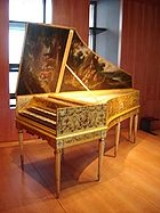
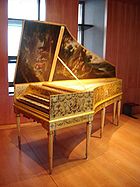 Among keyboard instruments, the most dramatic disappearance was that of the harpsichord
, which gradually went out of style during the second half of the 18th century. The fortepiano
became more popular by such a degree that harpsichords were destroyed; indeed, the Paris Conservatory is notorious for having used harpsichords for firewood during the French Revolution
and Napoleonic times. Composers such as François Couperin
, Girolamo Frescobaldi
, and Johann Sebastian Bach
wrote for the harpsichord, clavichord
, and organ
, or sometimes for a generic "keyboard" (German Klavier), but not for the fortepiano
, which was invented around 1700, but only widely adopted at about 1765.
was one of the most relevant instrument during the Renaissance and Baroque eras.
s, for both ensemble and solo performance, was written by composers of the Renaissance
and Baroque
eras, including Diego Ortiz
, Claudio Monteverdi
, William Byrd
, William Lawes
, Henry Purcell
, Monsieur de Sainte-Colombe
, J.S. Bach, Georg Philipp Telemann
, Marin Marais
, Antoine Forqueray
, and Carl Frederick Abel. However, viols were largely abandoned by the end of the 18th century, having been overtaken by the violin family
.
Many composers wrote complex polyphonic part music (early chamber music
) for viol consort, an ensemble of differently sized viols (typically held vertically) with a varying number of viols in it.
From largest to smallest, the viol family consists of:
Among the foremost modern players of the viols are Paolo Pandolfo
, Wieland Kuijken
, Jordi Savall
, John Hsu
, Vittorio Ghielmi
, and Guido Balestracci. There are many modern viol consorts.
s in multiple sizes (contra-bass, bass, tenor, alto, soprano, the sopranino, and the even smaller kleine sopranino or garklein) are often played today in consorts of mixed size. Handel
and Telemann
, among others, wrote solo works for the recorder. Arnold Dolmetsch
did much to revive the recorder as a serious concert instrument, reconstructing a "consort of recorders (descant, treble, tenor and bass) all at low pitch and based on historical originals." For a number of important modern exponents of the recorder, see Recorder player.
)
From the heavy rigging of the early-to-mid-19th century, the tendency shifted to using lighter strings for an easier playing technique and more soloistic brilliance. Since 1900 the average string tension has been lighter than in most Baroque traditions except for 18th century France, but the longer strings and the more compact material (including, in our days, steel E strings) has led to a more brilliant and short-range penetrating tone with a greater acoustical emphasis on the even overtone
s.
The flute
of the 18th century was typically made of wood rather than metal.
Early brass instruments did not incorporate keys or valves until the late 18th century.
, Julianne Baird
, Nigel Rogers
, and David Thomas
.
Modern countertenor singing was pioneered by Alfred Deller
, and leading contemporary performers include David Daniels, Terry Barber
, Derek Lee Ragin
, Andreas Scholl
, Michael Chance
, Drew Minter, Daniel Taylor
, Brian Asawa
, Philippe Jaroussky
.
Compositions intended to be sung by castrati present a problem. The 1994 movie Farinelli: Il Castrato
, about an 18th-century castrato, used digital effects to create the voice by mixing the sound of a countertenor with a soprano singer.
Johann Mattheson
: "The singers must stand alltime in front".
temperaments
, famously called for in Bach's Das Wohltemperierte Klavier, were used.
The baroque oboist Bruce Haynes has extensively investigated surviving wind instruments and even documented a case of violinists having to retune by a minor third to play at neighboring churches.
While normally accepted in literature
(early poetry
or prose
is not re-written in modern language), in the performing arts historical respondence is of difficult implementation, both practically (how do we do it?) and conceptually (what meaning and function should be attributed to aesthetic elements that have evolved?). Prior to audio and video recording, no direct record of performing arts survives. Opinions on the implications of the aforementioned motivations and on how they should translate into criteria for historically informed performance vary.
At the beginning of the Early Music Revival
, a common misconception was that historically informed performance implied lack of interpretation, such as vocally expressed by Virgil Fox
: "There is current in our land (and several European countries) at this moment a kind of nitpicking worship of historic impotence. They say that Bach must not be interpreted and that he must have no emotion, that his notes speak for themselves. You want to know what that is? Pure unadulterated rot! Bach has the red blood. He has the communion with the people. He has all of this amazing spirit. And imagine that you could put all the music on one side of the agenda with his great interpretation and great feeling and put the greatest man of all right up on top of a dusty shelf underneath some glass case in a museum and say that he must not be interpreted! They're full of you-know-what and they're so untalented that they have to hide behind this thing because they couldn't get in the house of music any other way!"
Even within such Early Music Revival, awareness of the pitfalls was clear. Though championing the need (for example in his editorship of Scarlatti sonatas) for a thoroughly-informed approach, not least in understanding as fully as possible a composer's actual wishes and intentions in their historical context, Ralph Kirkpatrick
, pioneer in the harpsichord rediscovery, highlights the risk of using historical exoterism to hide technical incompetence: "too often historical authenticity can be used as a means of escape from any potentially disquieting observance of esthetic values, and from the assumption of any genuine artistic responsibility. The abdication of esthetic values and artistic responsibilities can confer a certain illusion of simplicity on what the passage of history has presented to us, bleached as white as bones on the sands of time."
Yet, the acceptance of the concept is rapidly evolving. Today, performing an Early Baroque opera, such as Claudio Monteverdi
's L'Orfeo without, at the very least, full historical awareness, would be inconceivable.
Classical recording producer Michael Sartorius writes: "While the debate on authenticity in baroque performance will continue, certain essential characteristics should be present, if the performance is to reflect the true baroque spirit."
Music
Music is an art form whose medium is sound and silence. Its common elements are pitch , rhythm , dynamics, and the sonic qualities of timbre and texture...
and theater. Within this approach, the performance adheres to state-of-the-art knowledge of the aesthetic criteria of the period in which the music or theatre work was conceived. Whenever this knowledge conflicts with current aesthetic criteria, the option of re-training the listener/viewer, as opposed to adapting the work, is normally followed. Music is usually played on instruments corresponding to the period of the piece being played, such as period instruments for early music. Historical treatises, as well as additional historical evidence, are used to gain insight into the performance practice (the stylistic and technical aspects of performance) of a historic era. Corresponding types of acting and scenery are deployed. Historically informed performance has originated in the performance of Medieval
Medieval music
Medieval music is Western music written during the Middle Ages. This era begins with the fall of the Roman Empire and ends sometime in the early fifteenth century...
, Renaissance
Renaissance music
Renaissance music is European music written during the Renaissance. Defining the beginning of the musical era is difficult, given that its defining characteristics were adopted only gradually; musicologists have placed its beginnings from as early as 1300 to as late as the 1470s.Literally meaning...
, and Baroque music
Baroque music
Baroque music describes a style of Western Classical music approximately extending from 1600 to 1760. This era follows the Renaissance and was followed in turn by the Classical era...
, but has come to encompass music from the Classical and Romantic
Romantic music
Romantic music or music in the Romantic Period is a musicological and artistic term referring to a particular period, theory, compositional practice, and canon in Western music history, from 1810 to 1900....
eras as well. Quite recently, the phenomenon has begun to affect the theatrical stage, for instance in the production of Baroque opera.
Traditional musical practice
The gradual and still ongoing historical evolution in the construction of instruments and in the training of musicians, as part of the evolution of aestheticAesthetics
Aesthetics is a branch of philosophy dealing with the nature of beauty, art, and taste, and with the creation and appreciation of beauty. It is more scientifically defined as the study of sensory or sensori-emotional values, sometimes called judgments of sentiment and taste...
sense, has produced a corresponding evolution in sounds and styles.
Early instruments
Historically informed performance needs to access musical instruments corresponding to the period of the music being played. This has led to the revival of musical instruments entirely gone out of practice, and to a reconsideration of the role and structure of instruments also used in current practice. The discussion below (see also OrganologyOrganology
Organology is the science of musical instruments and their classification. It embraces study of instruments' history, instruments used in different cultures, technical aspects of how instruments produce sound, and musical instrument classification...
) covers examples of instruments that had to be revived entirely, followed by examples of instruments whose earlier form was rediscovered. See also List of period instruments.
Harpsichord
Harpsichord
A harpsichord is a musical instrument played by means of a keyboard. It produces sound by plucking a string when a key is pressed.In the narrow sense, "harpsichord" designates only the large wing-shaped instruments in which the strings are perpendicular to the keyboard...
, which gradually went out of style during the second half of the 18th century. The fortepiano
Fortepiano
Fortepiano designates the early version of the piano, from its invention by the Italian instrument maker Bartolomeo Cristofori around 1700 up to the early 19th century. It was the instrument for which Haydn, Mozart, and the early Beethoven wrote their piano music...
became more popular by such a degree that harpsichords were destroyed; indeed, the Paris Conservatory is notorious for having used harpsichords for firewood during the French Revolution
French Revolution
The French Revolution , sometimes distinguished as the 'Great French Revolution' , was a period of radical social and political upheaval in France and Europe. The absolute monarchy that had ruled France for centuries collapsed in three years...
and Napoleonic times. Composers such as François Couperin
François Couperin
François Couperin was a French Baroque composer, organist and harpsichordist. He was known as Couperin le Grand to distinguish him from other members of the musically talented Couperin family.-Life:Couperin was born in Paris...
, Girolamo Frescobaldi
Girolamo Frescobaldi
Girolamo Frescobaldi was a musician from Ferrara, one of the most important composers of keyboard music in the late Renaissance and early Baroque periods. A child prodigy, Frescobaldi studied under Luzzasco Luzzaschi in Ferrara, but was influenced by a large number of composers, including Ascanio...
, and Johann Sebastian Bach
Johann Sebastian Bach
Johann Sebastian Bach was a German composer, organist, harpsichordist, violist, and violinist whose sacred and secular works for choir, orchestra, and solo instruments drew together the strands of the Baroque period and brought it to its ultimate maturity...
wrote for the harpsichord, clavichord
Clavichord
The clavichord is a European stringed keyboard instrument known from the late Medieval, through the Renaissance, Baroque and Classical eras. Historically, it was widely used as a practice instrument and as an aid to composition, not being loud enough for larger performances. The clavichord produces...
, and organ
Organ (music)
The organ , is a keyboard instrument of one or more divisions, each played with its own keyboard operated either with the hands or with the feet. The organ is a relatively old musical instrument in the Western musical tradition, dating from the time of Ctesibius of Alexandria who is credited with...
, or sometimes for a generic "keyboard" (German Klavier), but not for the fortepiano
Fortepiano
Fortepiano designates the early version of the piano, from its invention by the Italian instrument maker Bartolomeo Cristofori around 1700 up to the early 19th century. It was the instrument for which Haydn, Mozart, and the early Beethoven wrote their piano music...
, which was invented around 1700, but only widely adopted at about 1765.
Lute
The luteLute
Lute can refer generally to any plucked string instrument with a neck and a deep round back, or more specifically to an instrument from the family of European lutes....
was one of the most relevant instrument during the Renaissance and Baroque eras.
Viol
A vast quantity of music for violViol
The viol is any one of a family of bowed, fretted and stringed musical instruments developed in the mid-late 15th century and used primarily in the Renaissance and Baroque periods. The family is related to and descends primarily from the Renaissance vihuela, a plucked instrument that preceded the...
s, for both ensemble and solo performance, was written by composers of the Renaissance
Renaissance music
Renaissance music is European music written during the Renaissance. Defining the beginning of the musical era is difficult, given that its defining characteristics were adopted only gradually; musicologists have placed its beginnings from as early as 1300 to as late as the 1470s.Literally meaning...
and Baroque
Baroque music
Baroque music describes a style of Western Classical music approximately extending from 1600 to 1760. This era follows the Renaissance and was followed in turn by the Classical era...
eras, including Diego Ortiz
Diego Ortiz
Diego Ortiz was a Spanish composer and musicologist, in service to the Spanish viceroy in Naples and later to Philip II of Spain. Ortiz published influential treatises on both instrumental and vocal performance....
, Claudio Monteverdi
Claudio Monteverdi
Claudio Giovanni Antonio Monteverdi – 29 November 1643) was an Italian composer, gambist, and singer.Monteverdi's work, often regarded as revolutionary, marked the transition from the Renaissance style of music to that of the Baroque period. He developed two individual styles of composition – the...
, William Byrd
William Byrd
William Byrd was an English composer of the Renaissance. He wrote in many of the forms current in England at the time, including various types of sacred and secular polyphony, keyboard and consort music.-Provenance:Knowledge of Byrd's biography expanded in the late 20th century, thanks largely...
, William Lawes
William Lawes
William Lawes was an English composer and musician.-Life and career:Lawes was born in Salisbury, Wiltshire and was baptised on 1 May 1602...
, Henry Purcell
Henry Purcell
Henry Purcell – 21 November 1695), was an English organist and Baroque composer of secular and sacred music. Although Purcell incorporated Italian and French stylistic elements into his compositions, his legacy was a uniquely English form of Baroque music...
, Monsieur de Sainte-Colombe
Monsieur de Sainte-Colombe
Monsieur de Sainte-Colombe was a French composer and violist.It is speculated by various scholars that Monsieur de Sainte-Colombe was of Lyonnais or Burgundian petty nobility; and also the selfsame 'Jean de Sainte-Colombe' noted as the father of 'Monsieur de Saint Colombe le fils.This assumption...
, J.S. Bach, Georg Philipp Telemann
Georg Philipp Telemann
Georg Philipp Telemann was a German Baroque composer and multi-instrumentalist. Almost completely self-taught in music, he became a composer against his family's wishes. After studying in Magdeburg, Zellerfeld, and Hildesheim, Telemann entered the University of Leipzig to study law, but eventually...
, Marin Marais
Marin Marais
Marin Marais was a French composer and viol player. He studied composition with Jean-Baptiste Lully, often conducting his operas, and with master of the bass viol Monsieur de Sainte-Colombe for 6 months. He was hired as a musician in 1676 to the royal court of Versailles...
, Antoine Forqueray
Antoine Forqueray
Antoine Forqueray was a French composer and virtuoso of the viola da gamba.Forqueray, born in Paris, was the first in a line of composers who included his brother Michel and his sons Jean-Baptiste and Nicolas Gilles...
, and Carl Frederick Abel. However, viols were largely abandoned by the end of the 18th century, having been overtaken by the violin family
Violin family
The violin family of musical instruments was developed in Italy in the sixteenth century. The standard modern violin family consists of the violin, viola, cello, and double bass....
.
Many composers wrote complex polyphonic part music (early chamber music
Chamber music
Chamber music is a form of classical music, written for a small group of instruments which traditionally could be accommodated in a palace chamber. Most broadly, it includes any art music that is performed by a small number of performers with one performer to a part...
) for viol consort, an ensemble of differently sized viols (typically held vertically) with a varying number of viols in it.
From largest to smallest, the viol family consists of:
- contrabass or violoneVioloneThe term violone can refer to several distinct large, bowed musical instruments which belong to either the viol or violin family. The violone is sometimes a fretted instrument, and may have six, five, four, or even only three strings. The violone is also not always a contrabass instrument...
- bass viol (about the size of a celloCelloThe cello is a bowed string instrument with four strings tuned in perfect fifths. It is a member of the violin family of musical instruments, which also includes the violin, viola, and double bass. Old forms of the instrument in the Baroque era are baryton and viol .A person who plays a cello is...
) - tenor viol (about the size of a guitarGuitarThe guitar is a plucked string instrument, usually played with fingers or a pick. The guitar consists of a body with a rigid neck to which the strings, generally six in number, are attached. Guitars are traditionally constructed of various woods and strung with animal gut or, more recently, with...
) - alto viol (about the size of a violaViolaThe viola is a bowed string instrument. It is the middle voice of the violin family, between the violin and the cello.- Form :The viola is similar in material and construction to the violin. A full-size viola's body is between and longer than the body of a full-size violin , with an average...
) - treble or descant viol (about the size of a violinViolinThe violin is a string instrument, usually with four strings tuned in perfect fifths. It is the smallest, highest-pitched member of the violin family of string instruments, which includes the viola and cello....
).
Among the foremost modern players of the viols are Paolo Pandolfo
Paolo Pandolfo
Paolo Pandolfo is an Italian virtuoso player, composer, and teacher of music for the viola da gamba.He began his studies as a double bass and guitar player, becoming a skilled performer of jazz and popular music. In the mid-late 1970s he studied viola da gamba at the Rome Conservatory...
, Wieland Kuijken
Wieland Kuijken
Wieland Kuijken is a Belgian musician and player of the viola da gamba and baroque cello.Kuijken started his career in music in 1952 with the Brussels Alariusensemble of which he formed part until 1972...
, Jordi Savall
Jordi Savall
Jordi Savall i Bernadet is a Catalan viol player, conductor and composer. He has been one of the major figures in the field of Western early music since the 1970s, largely responsible for bringing the viol back to life on the stage...
, John Hsu
John Hsu
John Hsu is a former Cornell University music professor. Hsu worked with Cornell for 50 years, from 1955 until his retirement in 2005.-Music career:...
, Vittorio Ghielmi
Vittorio Ghielmi
Gamba player, conductor, composer. Born in Milano, Italy, still very young he attracts notice for the intensity and versatility of his musical interpretation and for his new approach to the viol and to the sound of ancient music repertoire...
, and Guido Balestracci. There are many modern viol consorts.
Recorder
RecorderRecorder
The recorder is a woodwind musical instrument of the family known as fipple flutes or internal duct flutes—whistle-like instruments which include the tin whistle. The recorder is end-blown and the mouth of the instrument is constricted by a wooden plug, known as a block or fipple...
s in multiple sizes (contra-bass, bass, tenor, alto, soprano, the sopranino, and the even smaller kleine sopranino or garklein) are often played today in consorts of mixed size. Handel
George Frideric Handel
George Frideric Handel was a German-British Baroque composer, famous for his operas, oratorios, anthems and organ concertos. Handel was born in 1685, in a family indifferent to music...
and Telemann
Georg Philipp Telemann
Georg Philipp Telemann was a German Baroque composer and multi-instrumentalist. Almost completely self-taught in music, he became a composer against his family's wishes. After studying in Magdeburg, Zellerfeld, and Hildesheim, Telemann entered the University of Leipzig to study law, but eventually...
, among others, wrote solo works for the recorder. Arnold Dolmetsch
Arnold Dolmetsch
Arnold Dolmetsch , was a French-born musician and instrument maker who spent much of his working life in England and established an instrument-making workshop in Haslemere, Surrey...
did much to revive the recorder as a serious concert instrument, reconstructing a "consort of recorders (descant, treble, tenor and bass) all at low pitch and based on historical originals." For a number of important modern exponents of the recorder, see Recorder player.
Instruments that have undergone reconsideration
(See baroque violinBaroque violin
A baroque violin is, in common usage, any violin whose neck, fingerboard, bridge, and tailpiece are of the type used during the baroque period. Such an instrument may be an original built during the baroque and never changed to modern form; or a modern replica built as a baroque violin; or an...
)
From the heavy rigging of the early-to-mid-19th century, the tendency shifted to using lighter strings for an easier playing technique and more soloistic brilliance. Since 1900 the average string tension has been lighter than in most Baroque traditions except for 18th century France, but the longer strings and the more compact material (including, in our days, steel E strings) has led to a more brilliant and short-range penetrating tone with a greater acoustical emphasis on the even overtone
Overtone
An overtone is any frequency higher than the fundamental frequency of a sound. The fundamental and the overtones together are called partials. Harmonics are partials whose frequencies are whole number multiples of the fundamental These overlapping terms are variously used when discussing the...
s.
The flute
Flute
The flute is a musical instrument of the woodwind family. Unlike woodwind instruments with reeds, a flute is an aerophone or reedless wind instrument that produces its sound from the flow of air across an opening...
of the 18th century was typically made of wood rather than metal.
Early brass instruments did not incorporate keys or valves until the late 18th century.
Singing
The human voice is a biological given, but can be trained in different ways. For example, singers in historically informed performances may aim at a less loud tone, with less vibrato and different use of dynamics, to match the use of different accompanying instruments. A few of the singers who have contributed to the historically informed performance movement are Emma KirkbyEmma Kirkby
Dame Carolyn Emma Kirkby, DBE is an English soprano singer and one of the world's most renowned early music specialists. She attended Sherborne School For Girls in Dorset and was a classics student at Somerville College, Oxford, and an English teacher before developing a career as a soloist...
, Julianne Baird
Julianne Baird
Julianne Baird is an American soprano best known for her singing in Baroque works, in both opera and sacred music. She has nearly 100 recordings to her credit and is a well-traveled recitalist and soloist with major symphony orchestras...
, Nigel Rogers
Nigel Rogers
Nigel David Rogers is an English tenor, conductor, and teacher, who has made numerous recordings, mostly of early music.A native of Wellington, Shropshire, Rogers studied at King's College, Cambridge from 1953–1956, in Rome in 1957, in Milan from 1958–1959, and with Gerhard Hüsch at the Munich...
, and David Thomas
David Thomas (singer)
Bass David Thomas was a member of the choir of King's College, Cambridge. He has since become a well known early music / baroque music singer, who has won particular acclaim for his performances of works by Monteverdi, Purcell, Bach, Handel, and Mozart....
.
Modern countertenor singing was pioneered by Alfred Deller
Alfred Deller
Alfred George Deller CBE , was an English singer and one of the main figures in popularizing the return of the countertenor voice in Renaissance and Baroque music during the 20th Century....
, and leading contemporary performers include David Daniels, Terry Barber
Terry Barber
Terry Barber is an American countertenor. He is the lead vocalist for Adiemus Vocalise and New Trinity Baroque ensembles and a past member of Chanticleer...
, Derek Lee Ragin
Derek Lee Ragin
Derek Lee Ragin is an American countertenor.Ragin studied as a piano major at the Oberlin Conservatory of Music. While at Oberlin he took secondary voice lessons with Richard Anderson. He began his operatic career at Oberlin in Benjamin Britten's A Midsummer Night's Dream as Oberon...
, Andreas Scholl
Andreas Scholl
Andreas Scholl is a German countertenor, a male classical singer in the alto vocal range. He is noted as a specialist in Baroque music.-Childhood:...
, Michael Chance
Michael Chance
Michael Chance CBE is an English countertenor.Chance was born in Penn, Buckinghamshire, into a musical family. After growing up as a chorister he attended Eton College, Berkshire, and later King's College, Cambridge...
, Drew Minter, Daniel Taylor
Daniel Taylor (countertenor)
Daniel Taylor is a Canadian countertenor and early music specialist. He completed his undergraduate studies in English, philosophy, and music at the the Faculty of Music of McGill University and his graduate work in religion and music at the Université de Montréal...
, Brian Asawa
Brian Asawa
Brian Asawa is a Japanese-American countertenor.He began his studies as a piano major at the University of California, Santa Cruz, ultimately switching his studies to singing under tenor Harlan Hokin. After two semesters there he transferred to UCLA where he studied under Virginia Fox and Kari...
, Philippe Jaroussky
Philippe Jaroussky
Philippe Jaroussky is a French sopranist countertenor. He began his musical career with the violin, winning an award at the Versailles conservatory and then took up the piano before turning to singing...
.
Compositions intended to be sung by castrati present a problem. The 1994 movie Farinelli: Il Castrato
Farinelli (film)
Farinelli is a 1994 biographical film about the life and career of the Italian opera singer Farinelli, considered one of the greatest castrato singers of all time...
, about an 18th-century castrato, used digital effects to create the voice by mixing the sound of a countertenor with a soprano singer.
Layout
Historic pictures, layout sketches and sources are giving information about the layout of singers and instruments. Three main layouts are documented:- Circle (Renaissance)
- Choir in the front of the instruments (17th–19th century)
- Singers and instruments next to each other on the choir loft.
Johann Mattheson
Johann Mattheson
Johann Mattheson was a German composer, writer, lexicographer, diplomat and music theorist.Mattheson was born and died in Hamburg. He was a close friend of George Frideric Handel, although he nearly killed him in a sudden quarrel, during a performance of Mattheson's opera Cleopatra in 1704...
: "The singers must stand alltime in front".
Interpreting musical notation
Some familiar difficult items are as follows:- Early composers often wrote using the same symbols as today, yet in a different meaning, often context-dependent. For example, dotted rhythmsDotted noteIn Western musical notation, a dotted note is a note with a small dot written after it. The dot increases the duration of the basic note by half of its original value. If the basic note lasts 2 beats, the corresponding dotted note lasts 3 beats...
(where the first of two notes is three times the length of the second) to mean instead a time ratio of 2 + 1, in a context where tripletsTupletIn music a tuplet is "any rhythm that involves dividing the beat into a different number of equal subdivisions from that usually permitted by the...
are present elsewhere in the musical line. The opening line of the last movement of J. S. Bach's Brandenburg Concerto #5 is a good example. Or, In a French overtureFrench overtureThe French overture is a musical form widely used in the Baroque period. Its basic formal division is into two parts, which are usually enclosed by double bars and repeat signs. They are complementary in styles , and the first ends with a half-cadence that requires an answering structure with a...
, it is often held that dotted notation was meant to indicate double dotting; that is, a duration ratio of 7 to 1 instead of 3 to 1. Two well-known examples are the overtures to HandelHANDELHANDEL was the code-name for the UK's National Attack Warning System in the Cold War. It consisted of a small console consisting of two microphones, lights and gauges. The reason behind this was to provide a back-up if anything failed....
's MessiahMessiah (Handel)Messiah is an English-language oratorio composed in 1741 by George Frideric Handel, with a scriptural text compiled by Charles Jennens from the King James Bible and the Book of Common Prayer. It was first performed in Dublin on 13 April 1742, and received its London premiere nearly a year later...
, and the Suite in F of Water MusicWater Music (Handel)The Water Music is a collection of orchestral movements, often considered three suites, composed by George Frideric Handel. It premiered on 17 July 1717 after King George I had requested a concert on the River Thames...
: both often played in the double-dotted manner by historically informed performance specialists. Or, again, what is written as an appoggiatura is often meant to be longer or shorter than the notated length. - The notation may be partial. E.g., the rhythm may be omitted altogether
- the music may be written using alternative, non-modern notations, such as tablatureTablatureTablature is a form of musical notation indicating instrument fingering rather than musical pitches....
. Some tablature notations are only partially decoded, such as the notation in the harp manuscript by Robert ap HuwRobert ap HuwRobert ap Huw , was a Welsh harpist and copyist. He is most notable for compiling a manuscript, now known as the Robert ap Huw manuscript, which is the main extant source of cerdd dant and is a late medieval collection of harp music...
. - The reference pitchPitch (music)Pitch is an auditory perceptual property that allows the ordering of sounds on a frequency-related scale.Pitches are compared as "higher" and "lower" in the sense associated with musical melodies,...
of earlier music cannot generally be interpreted as designating the same pitch used today. For discussion, see History of pitch standards in Western music. - Various tuning systems (temperamentTemperamentIn psychology, temperament refers to those aspects of an individual's personality, such as introversion or extroversion, that are often regarded as innate rather than learned...
s), are used. Composers always assume the player will chose the temperament, and never indicate it in the score. - In most ensemble music up to the early Baroque, the actual musical instruments to be used are not indicated in the score, and must be partially or totally chosen by the performers.
- Issues of pronunciation, that impact on musical accents, carry over to church LatinLatinLatin is an Italic language originally spoken in Latium and Ancient Rome. It, along with most European languages, is a descendant of the ancient Proto-Indo-European language. Although it is considered a dead language, a number of scholars and members of the Christian clergy speak it fluently, and...
, the language in which a large amount of early vocal music was written. The reason is that Latin was customarily pronounced using the speech sounds and patterns of the local vernacular language; see Latin regional pronunciationLatin regional pronunciationLatin pronunciation, both in the classical and post-classical age, has varied across different regions and different eras. As the respective languages have undergone sound changes, the changes have often applied to the pronunciation of Latin as well....
.
Mechanical music
Some information about how music sounded in the past can be obtained from contemporary mechanical instruments.Tuning and pitch
In the 18th century, circulatingWell temperament
Well temperament is a type of tempered tuning described in 20th-century music theory. The term is modelled on the German word wohltemperiert which appears in the title of J.S. Bach's famous composition, The Well-Tempered Clavier...
temperaments
Musical temperament
In musical tuning, a temperament is a system of tuning which slightly compromises the pure intervals of just intonation in order to meet other requirements of the system. Most instruments in modern Western music are tuned in the equal temperament system...
, famously called for in Bach's Das Wohltemperierte Klavier, were used.
The baroque oboist Bruce Haynes has extensively investigated surviving wind instruments and even documented a case of violinists having to retune by a minor third to play at neighboring churches.
Issues
Generally acknowledged motivations for historically informed performance can be characterized as follows.- Historically informed instruments, in association with a historically informed playing technique, offer a balance of musical elements, such as timbricalTimbreIn music, timbre is the quality of a musical note or sound or tone that distinguishes different types of sound production, such as voices and musical instruments, such as string instruments, wind instruments, and percussion instruments. The physical characteristics of sound that determine the...
contrast and contrapuntal clarityCounterpointIn music, counterpoint is the relationship between two or more voices that are independent in contour and rhythm and are harmonically interdependent . It has been most commonly identified in classical music, developing strongly during the Renaissance and in much of the common practice period,...
, that differs from non-informed performances. - Such balance is structural to the agogicAccent (music)In music, an accent is an emphasis placed on a particular note,either as a result of its context or specifically indicated by an accent mark.Accents contribute to the articulation and prosody of a performance of a musical phrase....
and idiomIdiomIdiom is an expression, word, or phrase that has a figurative meaning that is comprehended in regard to a common use of that expression that is separate from the literal meaning or definition of the words of which it is made...
atic constituents of the culture surrounding the composer, no less important in delivering the musical content than the culture surrounding the listener. - Incorporating in the performance cultural elements of the composer, as opposed to omitting them in total favour of the listener's culture, results in a stronger and deeper performance rendition.
While normally accepted in literature
Literature
Literature is the art of written works, and is not bound to published sources...
(early poetry
Poetry
Poetry is a form of literary art in which language is used for its aesthetic and evocative qualities in addition to, or in lieu of, its apparent meaning...
or prose
Prose
Prose is the most typical form of written language, applying ordinary grammatical structure and natural flow of speech rather than rhythmic structure...
is not re-written in modern language), in the performing arts historical respondence is of difficult implementation, both practically (how do we do it?) and conceptually (what meaning and function should be attributed to aesthetic elements that have evolved?). Prior to audio and video recording, no direct record of performing arts survives. Opinions on the implications of the aforementioned motivations and on how they should translate into criteria for historically informed performance vary.
At the beginning of the Early Music Revival
Early Music Revival
See Early music and Historically informed performance for a more detailed explanation of this topic.The general discussion of how to perform music from ancient or earlier times did not become an important subject of interest until the 19th century, when Europeans began looking to ancient culture...
, a common misconception was that historically informed performance implied lack of interpretation, such as vocally expressed by Virgil Fox
Virgil Fox
Virgil Keel Fox was an American organist, known especially for his flamboyant "Heavy Organ" concerts of the music of Bach. These events appealed to audiences in the 1970s who were more familiar with rock 'n' roll music and were staged complete with light shows...
: "There is current in our land (and several European countries) at this moment a kind of nitpicking worship of historic impotence. They say that Bach must not be interpreted and that he must have no emotion, that his notes speak for themselves. You want to know what that is? Pure unadulterated rot! Bach has the red blood. He has the communion with the people. He has all of this amazing spirit. And imagine that you could put all the music on one side of the agenda with his great interpretation and great feeling and put the greatest man of all right up on top of a dusty shelf underneath some glass case in a museum and say that he must not be interpreted! They're full of you-know-what and they're so untalented that they have to hide behind this thing because they couldn't get in the house of music any other way!"
Even within such Early Music Revival, awareness of the pitfalls was clear. Though championing the need (for example in his editorship of Scarlatti sonatas) for a thoroughly-informed approach, not least in understanding as fully as possible a composer's actual wishes and intentions in their historical context, Ralph Kirkpatrick
Ralph Kirkpatrick
Ralph Kirkpatrick was an American musician, musicologist and harpsichordist. He is most famous for his chronological catalog of Domenico Scarlatti's keyboard sonatas.-Life and work:...
, pioneer in the harpsichord rediscovery, highlights the risk of using historical exoterism to hide technical incompetence: "too often historical authenticity can be used as a means of escape from any potentially disquieting observance of esthetic values, and from the assumption of any genuine artistic responsibility. The abdication of esthetic values and artistic responsibilities can confer a certain illusion of simplicity on what the passage of history has presented to us, bleached as white as bones on the sands of time."
Yet, the acceptance of the concept is rapidly evolving. Today, performing an Early Baroque opera, such as Claudio Monteverdi
Claudio Monteverdi
Claudio Giovanni Antonio Monteverdi – 29 November 1643) was an Italian composer, gambist, and singer.Monteverdi's work, often regarded as revolutionary, marked the transition from the Renaissance style of music to that of the Baroque period. He developed two individual styles of composition – the...
's L'Orfeo without, at the very least, full historical awareness, would be inconceivable.
Classical recording producer Michael Sartorius writes: "While the debate on authenticity in baroque performance will continue, certain essential characteristics should be present, if the performance is to reflect the true baroque spirit."
See also
- Early Music RevivalEarly Music RevivalSee Early music and Historically informed performance for a more detailed explanation of this topic.The general discussion of how to perform music from ancient or earlier times did not become an important subject of interest until the 19th century, when Europeans began looking to ancient culture...
- Early musicEarly musicEarly music is generally understood as comprising all music from the earliest times up to the Renaissance. However, today this term has come to include "any music for which a historically appropriate style of performance must be reconstructed on the basis of surviving scores, treatises,...
- List of early music ensembles
- List of period instruments
- Authenticity in artAuthenticity in artAuthenticity in art has a variety of meanings related to different ways in which a work of art or an artistic performance may be considered authentic.Denis Dutton distinguishes between nominal authenticity and expressive authenticity....
External links
- The Unofficial Countertenor Home Page
- A Guide to Medieval and Renaissance Instruments
- Period instrument performers and groups listed on The Open Music Project
- Dilemmas in Trying to Present Old Works of Art 'Authentically'
- Inside Early Music: Conversations with Performers (book by Bernard Sherman; Oxford University Press, 1997)
- Why you've never really heard the "Moonlight" Sonata (Slate Magazine covering differences between authentic and modern piano performances