


Historical development of Church of England dioceses

Encyclopedia
Diocese
A diocese is the district or see under the supervision of a bishop. It is divided into parishes.An archdiocese is more significant than a diocese. An archdiocese is presided over by an archbishop whose see may have or had importance due to size or historical significance...
after the city where its cathedral
Cathedral
A cathedral is a Christian church that contains the seat of a bishop...
is located. Occasionally, when the bishop's seat has been moved from one city to another, the diocese may retain both names, for example Bath and Wells. More recently, where a cathedral is in a small or little-known city, the diocesan name has been changed to include the name of a nearby larger city: thus the cathedral in Ripon now serves the diocese of Ripon and Leeds, and Southwell Cathedral is in Southwell and Nottingham. Cathedrals, like other churches, are dedicated to a particular saint or holy object, or Christ himself, but are commonly referred to by the name of the city where they stand. A cathedral is, simply, the church where the bishop has his chair or "cathedra".
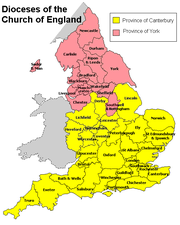
The dioceses of the Church of England are administrative territorial units governed by a bishop
Bishop
A bishop is an ordained or consecrated member of the Christian clergy who is generally entrusted with a position of authority and oversight. Within the Catholic Church, Eastern Orthodox, Oriental Orthodox Churches, in the Assyrian Church of the East, in the Independent Catholic Churches, and in the...
, of which there are currently 44. These cover all of England
England
England is a country that is part of the United Kingdom. It shares land borders with Scotland to the north and Wales to the west; the Irish Sea is to the north west, the Celtic Sea to the south west, with the North Sea to the east and the English Channel to the south separating it from continental...
, and also the Isle of Man
Isle of Man
The Isle of Man , otherwise known simply as Mann , is a self-governing British Crown Dependency, located in the Irish Sea between the islands of Great Britain and Ireland, within the British Isles. The head of state is Queen Elizabeth II, who holds the title of Lord of Mann. The Lord of Mann is...
, the Channel Islands
Channel Islands
The Channel Islands are an archipelago of British Crown Dependencies in the English Channel, off the French coast of Normandy. They include two separate bailiwicks: the Bailiwick of Guernsey and the Bailiwick of Jersey...
, the Isles of Scilly
Isles of Scilly
The Isles of Scilly form an archipelago off the southwestern tip of the Cornish peninsula of Great Britain. The islands have had a unitary authority council since 1890, and are separate from the Cornwall unitary authority, but some services are combined with Cornwall and the islands are still part...
, and a small part of Wales
Wales
Wales is a country that is part of the United Kingdom and the island of Great Britain, bordered by England to its east and the Atlantic Ocean and Irish Sea to its west. It has a population of three million, and a total area of 20,779 km²...
. The Diocese of Gibraltar in Europe
Diocese of Gibraltar in Europe
The Diocese of Gibraltar in Europe is geographically the largest diocese of the Church of England and arguably the largest diocese in the Anglican Communion, covering some one-sixth of the Earth's landmass, including Morocco, Europe , Turkey, and the territory of the former Soviet...
is also a part of the Church of England (rather than a separate Anglican
Anglicanism
Anglicanism is a tradition within Christianity comprising churches with historical connections to the Church of England or similar beliefs, worship and church structures. The word Anglican originates in ecclesia anglicana, a medieval Latin phrase dating to at least 1246 that means the English...
church such as the Church in Wales
Church in Wales
The Church in Wales is the Anglican church in Wales, composed of six dioceses.As with the primus of the Scottish Episcopal Church, the Archbishop of Wales serves concurrently as one of the six diocesan bishops. The current archbishop is Barry Morgan, the Bishop of Llandaff.In contrast to the...
), and covers the whole of mainland Europe
Europe
Europe is, by convention, one of the world's seven continents. Comprising the westernmost peninsula of Eurasia, Europe is generally 'divided' from Asia to its east by the watershed divides of the Ural and Caucasus Mountains, the Ural River, the Caspian and Black Seas, and the waterways connecting...
, Morocco
Morocco
Morocco , officially the Kingdom of Morocco , is a country located in North Africa. It has a population of more than 32 million and an area of 710,850 km², and also primarily administers the disputed region of the Western Sahara...
, Turkey
Turkey
Turkey , known officially as the Republic of Turkey , is a Eurasian country located in Western Asia and in East Thrace in Southeastern Europe...
and the territory of the former Soviet Union
Soviet Union
The Soviet Union , officially the Union of Soviet Socialist Republics , was a constitutionally socialist state that existed in Eurasia between 1922 and 1991....
.
The structure of diocese within the Church of England was initially inherited from the Roman Catholic Church
Roman Catholic Church
The Catholic Church, also known as the Roman Catholic Church, is the world's largest Christian church, with over a billion members. Led by the Pope, it defines its mission as spreading the gospel of Jesus Christ, administering the sacraments and exercising charity...
as part of the English Reformation
English Reformation
The English Reformation was the series of events in 16th-century England by which the Church of England broke away from the authority of the Pope and the Roman Catholic Church....
. During the Reformation, a number of new dioceses were founded. No new dioceses were then created until the middle of the 19th century, when dioceses were founded mainly in response to the growing population, especially in the northern industrial
Industrial Revolution
The Industrial Revolution was a period from the 18th to the 19th century where major changes in agriculture, manufacturing, mining, transportation, and technology had a profound effect on the social, economic and cultural conditions of the times...
cities.
The last dioceses were created in 1927. The 44 dioceses are divided into two Provinces
Ecclesiastical Province
An ecclesiastical province is a large jurisdiction of religious government, so named by analogy with a secular province, existing in certain hierarchical Christian churches, especially in the Catholic Church and Orthodox Churches and in the Anglican Communion...
, the Province of Canterbury
Province of Canterbury
The Province of Canterbury, also called the Southern Province, is one of two ecclesiastical provinces making up the Church of England...
(with 30 dioceses) and the Province of York
Province of York
The Province of York is one of two ecclesiastical provinces making up the Church of England, and consists of 14 dioceses which cover the northern third of England and the Isle of Man. York was elevated to an Archbishopric in 735 AD: Ecgbert of York was the first archbishop...
(with 14 dioceses). The archbishop
Archbishop
An archbishop is a bishop of higher rank, but not of higher sacramental order above that of the three orders of deacon, priest , and bishop...
s of Canterbury
Archbishop of Canterbury
The Archbishop of Canterbury is the senior bishop and principal leader of the Church of England, the symbolic head of the worldwide Anglican Communion, and the diocesan bishop of the Diocese of Canterbury. In his role as head of the Anglican Communion, the archbishop leads the third largest group...
and York
Archbishop of York
The Archbishop of York is a high-ranking cleric in the Church of England, second only to the Archbishop of Canterbury. He is the diocesan bishop of the Diocese of York and metropolitan of the Province of York, which covers the northern portion of England as well as the Isle of Man...
have pastoral oversight over the bishops within their province, along with certain other rights and responsibilities.
History
French Revolution
The French Revolution , sometimes distinguished as the 'Great French Revolution' , was a period of radical social and political upheaval in France and Europe. The absolute monarchy that had ruled France for centuries collapsed in three years...
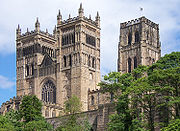
had 136 cathedrals, England had 27. Because of a ruling that no cathedral could be built in a village, any town in which a cathedral was located was elevated to city status, regardless of its size. To this day several large English cathedrals are located in small "cathedral cities", notably Wells
Wells Cathedral
Wells Cathedral is a Church of England cathedral in Wells, Somerset, England. It is the seat of the Bishop of Bath and Wells, who lives at the adjacent Bishop's Palace....
and Ely
Ely Cathedral
Ely Cathedral is the principal church of the Diocese of Ely, in Cambridgeshire, England, and is the seat of the Bishop of Ely and a suffragan bishop, the Bishop of Huntingdon...
Cathedrals, both of which rank among the greatest works of English Medieval Architecture.
Early organisation
In earlier times, populations were sparsely spread and towns were few. The total population of the kingdom of England in the 11th century is estimated at between one and two million, with Lincolnshire, East Anglia and East Kent the most densely populated areas. This is because many villages had been razed by the conquest armies. Instead of exercising jurisdiction over definite areas, many of the bishops were bishops of tribes or peoples, as the bishops of the South Saxons, the West Saxons, the Somersætas, etc. The cathedra of such a bishop was often migratory.In 1075 a council
Council of London (1075)
The Council of London in 1075 AD was a council of the Roman Catholic church in England held by the new Norman archbishop of Canterbury Lanfranc five years after his installation. Other attendees included Gisa and William the Norman...
was held in London
London
London is the capital city of :England and the :United Kingdom, the largest metropolitan area in the United Kingdom, and the largest urban zone in the European Union by most measures. Located on the River Thames, London has been a major settlement for two millennia, its history going back to its...
, under the presidency of Archbishop Lanfranc
Lanfranc
Lanfranc was Archbishop of Canterbury, and a Lombard by birth.-Early life:Lanfranc was born in the early years of the 11th century at Pavia, where later tradition held that his father, Hanbald, held a rank broadly equivalent to magistrate...
, which, reciting the decrees of the council of Sardica held in 347 and that of Laodicea
Council of Laodicea
The Council of Laodicea was a regional synod of approximately thirty clerics from Asia Minor that assembled about 363–364 AD in Laodicea, Phrygia Pacatiana.-Historical context:...
held in 360 on this matter, ordered the bishop of the south Saxons to remove his see
Episcopal See
An episcopal see is, in the original sense, the official seat of a bishop. This seat, which is also referred to as the bishop's cathedra, is placed in the bishop's principal church, which is therefore called the bishop's cathedral...
from Selsey
Selsey
Selsey is a seaside town and civil parish, about seven miles south of Chichester, in the Chichester District of West Sussex, England. Selsey lies at the southernmost point of the Manhood Peninsula, almost cut off from mainland Sussex by the sea...
to Chichester
Chichester
Chichester is a cathedral city in West Sussex, within the historic County of Sussex, South-East England. It has a long history as a settlement; its Roman past and its subsequent importance in Anglo-Saxon times are only its beginnings...
; the Wiltshire
Wiltshire
Wiltshire is a ceremonial county in South West England. It is landlocked and borders the counties of Dorset, Somerset, Hampshire, Gloucestershire, Oxfordshire and Berkshire. It contains the unitary authority of Swindon and covers...
and Dorset
Dorset
Dorset , is a county in South West England on the English Channel coast. The county town is Dorchester which is situated in the south. The Hampshire towns of Bournemouth and Christchurch joined the county with the reorganisation of local government in 1974...
bishop to remove his cathedra from Sherborne
Sherborne
Sherborne is a market town in northwest Dorset, England. It is sited on the River Yeo, on the edge of the Blackmore Vale, east of Yeovil. The A30 road, which connects London to Penzance, runs through the town. The population of the town is 9,350 . 27.1% of the population is aged 65 or...
to Old Sarum
Old Sarum
Old Sarum is the site of the earliest settlement of Salisbury, in England. The site contains evidence of human habitation as early as 3000 BC. Old Sarum is mentioned in some of the earliest records in the country...
, and the Mercia
Mercia
Mercia was one of the kingdoms of the Anglo-Saxon Heptarchy. It was centred on the valley of the River Trent and its tributaries in the region now known as the English Midlands...
n bishop, whose cathedral was then at Lichfield
Lichfield
Lichfield is a cathedral city, civil parish and district in Staffordshire, England. One of eight civil parishes with city status in England, Lichfield is situated roughly north of Birmingham...
, to transfer it to Chester. Traces of the tribal and migratory system may still be noted in the designations of the Irish see of Meath
Roman Catholic Diocese of Meath
The Diocese of Meath is a Roman Catholic diocese in eastern Ireland. It is one of eight suffragan dioceses which are subject to the Metropolitan Archdiocese of Armagh...
(where the result has been that there is now no cathedral church) and Ossory
Ossory
The Irish geographical name Ossory can refer to:* Kingdom of Osraige* Roman Catholic Diocese of Ossory* Church of Ireland diocese of the Bishop of Ossory* A prophet of the Omnian religion in Terry Pratchett's Discworld...
, the cathedral church of which is at Kilkenny
Kilkenny
Kilkenny is a city and is the county town of the eponymous County Kilkenny in Ireland. It is situated on both banks of the River Nore in the province of Leinster, in the south-east of Ireland...
. Some of the Scottish sees were also migratory.
Late Middle Ages
Reformation
The entire structure of the monastic and cathedral system was overthrown and reconstituted during the ReformationProtestant Reformation
The Protestant Reformation was a 16th-century split within Western Christianity initiated by Martin Luther, John Calvin and other early Protestants. The efforts of the self-described "reformers", who objected to the doctrines, rituals and ecclesiastical structure of the Roman Catholic Church, led...
. Cathedrals which were once Roman Catholic
Roman Catholic Church
The Catholic Church, also known as the Roman Catholic Church, is the world's largest Christian church, with over a billion members. Led by the Pope, it defines its mission as spreading the gospel of Jesus Christ, administering the sacraments and exercising charity...
came under the governance of the Church of England
Church of England
The Church of England is the officially established Christian church in England and the Mother Church of the worldwide Anglican Communion. The church considers itself within the tradition of Western Christianity and dates its formal establishment principally to the mission to England by St...
.
All the English monastic cathedral chapters were dissolved by Henry VIII
Dissolution of the Monasteries
The Dissolution of the Monasteries, sometimes referred to as the Suppression of the Monasteries, was the set of administrative and legal processes between 1536 and 1541 by which Henry VIII disbanded monasteries, priories, convents and friaries in England, Wales and Ireland; appropriated their...
and, with the exceptions of Bath
Bath Abbey
The Abbey Church of Saint Peter and Saint Paul, Bath, commonly known as Bath Abbey, is an Anglican parish church and a former Benedictine monastery in Bath, Somerset, England...
and Coventry
Coventry Cathedral
Coventry Cathedral, also known as St Michael's Cathedral, is the seat of the Bishop of Coventry and the Diocese of Coventry, in Coventry, West Midlands, England. The current bishop is the Right Revd Christopher Cocksworth....
, were refounded by him as churches of secular chapters, with a dean as the head, and a certain number of canons ranging from twelve at Canterbury
Canterbury Cathedral
Canterbury Cathedral in Canterbury, Kent, is one of the oldest and most famous Christian structures in England and forms part of a World Heritage Site....
and Durham
Durham Cathedral
The Cathedral Church of Christ, Blessed Mary the Virgin and St Cuthbert of Durham is a cathedral in the city of Durham, England, the seat of the Anglican Bishop of Durham. The Bishopric dates from 995, with the present cathedral being founded in AD 1093...
to four at Carlisle
Carlisle Cathedral
The Cathedral Church of the Holy and Undivided Trinity, otherwise called Carlisle Cathedral, is the seat of the Anglican Bishop of Carlisle. It is located in Carlisle, in Cumbria, North West England...
, and with certain subordinate officers as minor canons, gospellers, epistolers, etc. The precentorship in these churches of the "New Foundation", as they are called, is not, as in the secular churches of the "Old Foundation", a dignity, but is merely an office held by one of the minor canons.
Henry VIII also created six new cathedrals from old monastic establishments, in each case governed by secular canons. Of these, Westminster did not retain its cathedral status. Four more of England's large historic churches were later to become cathedrals, Southwell, Southwark, Ripon and St. Albans Abbey.
Relationship of chapter and bishop
Historically, there was no distinction between the monastic cathedral chapters and those of the secular canons, in their relation to the bishop or diocese. In both cases the chapter was the bishop's consilium which he was bound to consult on all important matters and without doing so he could not act. Thus, a judicial decision of a bishop needed the confirmation of the chapter before it could be enforced. He could not change the service books, or "use" of the church or diocese, without capitular consent, and there are episcopal acts, such as the appointment of a diocesan chancellor, or vicar general, which still need confirmation by the chapter.In its corporate capacity the chapter takes charge sede vacante of a diocese. In England, however (except as regards Salisbury
Salisbury Cathedral
Salisbury Cathedral, formally known as the Cathedral Church of the Blessed Virgin Mary, is an Anglican cathedral in Salisbury, England, considered one of the leading examples of Early English architecture....
and Durham
Durham Cathedral
The Cathedral Church of Christ, Blessed Mary the Virgin and St Cuthbert of Durham is a cathedral in the city of Durham, England, the seat of the Anglican Bishop of Durham. The Bishopric dates from 995, with the present cathedral being founded in AD 1093...
), this custom has never obtained, the two archbishops having, from time immemorial, taken charge of the vacant dioceses in their respective provinces. When, however, either of the sees of Canterbury or York is vacant the chapters of those churches take charge, not only of the diocese, but of the province as well, and incidentally, therefore, of any of the dioceses of the province which may be vacant at the same time.
The Secular Chapter
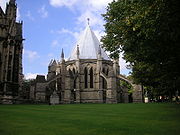
Dean
The dean (decanus) seems to have derived his designation from the Benedictine "dean" who had ten monks under his charge. The dean came into existence to supply the place of the provost in the internal management of the church and chapter. In England every secular cathedral church was headed by a dean who was originally elected by the chapter and confirmed in office by the bishop. The dean is president of the chapter, and with the in cathedral has charge of the performance of the services, taking specified portions of them by statute on the principal festivals. He sits in the chief stall in the choir, which is usually the first on the right hand on entering the choir at the west.Precentor
Next to the dean (as a rule) is the precentor (primicerius, cantor, etc.), whose special duty is that of regulating the musical portion of the services. He presides in the dean's absence, and occupies the corresponding stall on the left side, although there are exceptions to this rule, where, as at St Paul's, the archdeacon of the cathedral city ranks second and occupies what is usually the precentor's stall.Chancellor
The third dignitary is the chancellor (scholasticus, écoldtre, capiscol, magistral, etc.), who must not be confused with the chancellor of the diocese. The chancellor of the cathedral church is charged with the oversight of its schools, ought to read divinity lectures, and superintend the lections in the choir and correct slovenly readers. He is often the secretary and librarian of the chapter. In the absence of the dean and precentor he is president of the chapter. The easternmost stall, on the dean's side of the choir, is usually assigned to him.Treasurer
The fourth dignitary is the treasurer (custos, sacrisla, cheficier). He is guardian of the fabric, and of all the furniture and ornaments of the church, and his duty was to provide bread and wine for the EucharistEucharist
The Eucharist , also called Holy Communion, the Sacrament of the Altar, the Blessed Sacrament, the Lord's Supper, and other names, is a Christian sacrament or ordinance...
, and candles and incense, and he regulated such matters as the ringing of the bells. The treasurer's stall is opposite to that of the chancellor.
Additional clergy
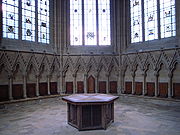
For the most part the canons also speedily became non-resident, and this led to the distinction of residentiary and non-residentiary canons, till in most churches the number of resident canons became definitely limited in number, and the non-residentiary canons, who no longer shared in the common funds, became generally known as prebendaries only, although by their non-residence they did not forfeit their position as canons, and retained their votes in chapter like the others.
This system of non-residence led also to the institution of vicars choral, each canon having his own vicar, who sat in his stall in his absence, and when the canon was present, in the stall immediately below, on the second form. The vicars had no place or vote in chapter, and, though irremovable except for offences, were the servants of their absent canons whose stalls they occupied, and whose duties they performed. Outside Britain they were often called demi-prebendaries, and they formed the bachcrur of the French churches. As time went on the vicars were themselves often incorporated as a kind of lesser chapter, or college, under the supervision of the dean and chapter.
Ancient cathedrals
The mediæval Church of EnglandChurch of England
The Church of England is the officially established Christian church in England and the Mother Church of the worldwide Anglican Communion. The church considers itself within the tradition of Western Christianity and dates its formal establishment principally to the mission to England by St...
was organized into 17 dioceses. About half of the diocesian cathedrals were also monasteries
Monastery
Monastery denotes the building, or complex of buildings, that houses a room reserved for prayer as well as the domestic quarters and workplace of monastics, whether monks or nuns, and whether living in community or alone .Monasteries may vary greatly in size – a small dwelling accommodating only...
, with the abbot
Abbot
The word abbot, meaning father, is a title given to the head of a monastery in various traditions, including Christianity. The office may also be given as an honorary title to a clergyman who is not actually the head of a monastery...
serving double duty as dean of the cathedral. The rest were served by a college of "secular" canons — non-monastic priests living under no fixed rule of life. Both types often had Saxon foundations.
Pre-Conquest
| Diocese | Founded | Monastic or secular? | Notes |
|---|---|---|---|
| Canterbury Diocese of Canterbury The Diocese of Canterbury is a Church of England diocese covering eastern Kent, founded by St. Augustine of Canterbury in 597. It is centred on Canterbury Cathedral, and is the oldest see of the Church of England.... |
597 | Monastic | None |
| Rochester Diocese of Rochester The Diocese of Rochester is a Church of England diocese in South-East England and forms part of the Province of Canterbury. It is an ancient diocese, having been established in 604; only the neighbouring Diocese of Canterbury is older in the Church of England.... |
604 | Monastic | None |
| London Diocese of London The Anglican Diocese of London forms part of the Province of Canterbury in England.Historically the diocese covered a large area north of the Thames and bordered the dioceses of Norwich and Lincoln to the north and west. The present diocese covers and 17 London boroughs, covering most of Greater... |
604 | Monastic | None |
| York Diocese of York The Diocese of York is an administrative division of the Church of England, part of the Province of York. It covers the city of York, the eastern part of North Yorkshire, and most of the East Riding of Yorkshire.... |
625 | Secular | None |
| Dorchester/Winchester Diocese of Winchester The Diocese of Winchester forms part of the Province of Canterbury of the Church of England.Founded in 676, it is one of the oldest and largest of the dioceses in England.The area of the diocese incorporates:... |
634 (Dorchester) /662 (Winchester) |
Monastic | |
| Lichfield Diocese of Lichfield The Diocese of Lichfield is a Church of England diocese in the Province of Canterbury, England. The bishop's seat is located in the Cathedral Church of the Blessed Virgin Mary and Saint Chad in the city of Lichfield. The diocese covers 4,516 km² The Diocese of Lichfield is a Church of England... |
669 | Secular | After 1100, the see was occasionally Coventry or Chester |
| Leicester Diocese of Leicester The Diocese of Leicester is a Church of England diocese based in Leicester and including the current county of Leicestershire. The cathedral is Leicester Cathedral, where the Bishop of Leicester has his seat.... / Dorchester |
670 (Leicester) / 875 (Dorchester) |
Merged with Lindsey, 971. | |
| Hereford Diocese of Hereford The Diocese of Hereford is a Church of England diocese based in Hereford, covering Herefordshire, southern Shropshire and a few parishes within Worcestershire in England; and a few parishes within Powys and Monmouthshire in Wales.... |
676 | Secular | None |
| Lindsey Diocese of Lincoln The Diocese of Lincoln forms part of the Province of Canterbury in England. The present diocese covers the ceremonial county of Lincolnshire.- History :... |
678 | Merged with Dorchester, 971. | |
| Worcester Anglican Diocese of Worcester The Diocese of Worcester forms part of the Province of Canterbury in England.The diocese was founded in around 679 by St Theodore of Canterbury at Worcester to minister to the kingdom of the Hwicce, one of the many Anglo Saxon petty-kingdoms of that time... |
680 | Monastic | None |
| Selsey Diocese of Chichester The Diocese of Chichester is a Church of England diocese based in Chichester, covering Sussex. It was created in 1075 to replace the old Diocese of Selsey, which was based at Selsey Abbey from 681. The cathedral is Chichester Cathedral and the bishop is the Bishop of Chichester... |
681 | Selsey Abbey Selsey Abbey Selsey Abbey was almost certainly built at Church Norton, Selsey, Sussex, England. It was founded in 683AD, and became the seat of the Sussex bishopric, until it was moved in 1075AD to Chichester.-Historical Context :... was founded in 681 and was the cathedra for the Kingdom of Sussex Kingdom of Sussex The Kingdom of Sussex or Kingdom of the South Saxons was a Saxon colony and later independent kingdom of the Saxons, on the south coast of England. Its boundaries coincided in general with those of the earlier kingdom of the Regnenses and the later county of Sussex. A large part of its territory... . The bishopric was moved to Chichester by order of the Council of London Council of London (1075) The Council of London in 1075 AD was a council of the Roman Catholic church in England held by the new Norman archbishop of Canterbury Lanfranc five years after his installation. Other attendees included Gisa and William the Norman... in 1075. |
|
| Bath and Wells Diocese of Bath and Wells The Diocese of Bath and Wells is a diocese in the Church of England Province of Canterbury in England.The diocese covers the county of Somerset and a small area of Dorset. The Episcopal seat of the Bishop of Bath and Wells is located in the Cathedral Church of Saint Andrew in the tiny city of... |
909 | Monastic/Secular | Bath was monastical and Wells a college of secular canons; after 1090 Wells was usually reckoned as the cathedral |
| Durham Diocese of Durham The Diocese of Durham is a Church of England diocese, based in Durham, and covering the historic County Durham . It was created in AD 1000 to replace the Diocese of Lindisfarne... |
995 | Monastic | Transferred in that year from Chester-le-Street, itself a transfer from Lindisfarne |
| Exeter Diocese of Exeter The Diocese of Exeter is a Church of England diocese covering the county of Devon. It is one of the largest dioceses in England. The Cathedral Church of Saint Peter in Exeter is the seat of the diocesan bishop, the Right Reverend Michael Langrish, Bishop of Exeter. It is part of the Province of... |
1050 | Secular | None |
Post-conquest
| Diocese | Founded | Monastic or secular? | Notes |
|---|---|---|---|
| Lincoln Diocese of Lincoln The Diocese of Lincoln forms part of the Province of Canterbury in England. The present diocese covers the ceremonial county of Lincolnshire.- History :... |
1072 | Secular | Transferred in that year from Dorchester Diocese of Dorchester The Diocese of Dorchester was an Anglo-Saxon Roman Catholic diocese in southern and eastern England.The Bishop of Dorchester had his seat, or cathedra, at Dorchester Abbey in Dorchester-on-Thames in Oxfordshire. The Wessex diocese covered most of Hampshire, Berkshire, parts of Oxfordshire and... |
| Chichester Diocese of Chichester The Diocese of Chichester is a Church of England diocese based in Chichester, covering Sussex. It was created in 1075 to replace the old Diocese of Selsey, which was based at Selsey Abbey from 681. The cathedral is Chichester Cathedral and the bishop is the Bishop of Chichester... |
1075 | Secular | Transferred in that year from Selsey |
| Salisbury Diocese of Salisbury The Diocese of Salisbury is a Church of England diocese in the south of England. The diocese covers Dorset and most of Wiltshire and is a constituent diocese of the Province of Canterbury. The diocese is led by the Bishop of Salisbury and the diocesan synod... |
1078 | Secular | Transferred in that year from Sherborne |
| Norwich Anglican Diocese of Norwich The Diocese of Norwich forms part of the Province of Canterbury in England.It traces its roots in an unbroken line to the diocese of Dunwich founded in 630. In common with many Anglo-Saxon bishoprics it moved, in this case to Elmham in 673... |
1091 | Monastic | Transferred in that year from Thetford, itself a transfer from Elmham |
| Ely Diocese of Ely The Diocese of Ely is a Church of England diocese in the Province of Canterbury. It is headed by the Bishop of Ely, who sits at Ely Cathedral in Ely. There is one suffragan bishop, the Bishop of Huntingdon. The diocese now covers Cambridgeshire and western Norfolk... |
1109 | Monastic | None |
| Carlisle Diocese of Carlisle The Diocese of Carlisle was created in 1133 by Henry I out of part of the Diocese of Durham, although many people of Celtic descent in the area looked to Glasgow for spiritual leadership. The first bishop was Æthelwold, formerly the king's confessor and now prior of the Augustinian priory at... |
1133 | Monastic | None |
The Henrican Reorganization
After Henry VIIIHenry VIII of England
Henry VIII was King of England from 21 April 1509 until his death. He was Lord, and later King, of Ireland, as well as continuing the nominal claim by the English monarchs to the Kingdom of France...
's break with the Pope and the dissolution of the monasteries
Dissolution of the Monasteries
The Dissolution of the Monasteries, sometimes referred to as the Suppression of the Monasteries, was the set of administrative and legal processes between 1536 and 1541 by which Henry VIII disbanded monasteries, priories, convents and friaries in England, Wales and Ireland; appropriated their...
, the formerly monastic cathedrals were "re-founded" with secular canons. Furthermore, a number of new dioceses were formed, using some of the largest and finest of the other dissolved monasteries as cathedrals. Together, these two groups — the old monastic cathedrals and the new sees — were known as cathedrals of the New Foundation; the old cathedrals which had always been served by secular canons were known as those of the Old Foundation.
| Diocese | Founded | Notes |
|---|---|---|
| Westminster Diocese of Westminster The Diocese of Westminster was a short-lived diocese of the Church of England, extant from 1540 - 1550.The Diocese was created from part of the Diocese of London, and comprised Westminster , and the county of Middlesex, with the exception of Fulham... |
1540 | Its cathedral was Westminster Abbey Westminster Abbey The Collegiate Church of St Peter at Westminster, popularly known as Westminster Abbey, is a large, mainly Gothic church, in the City of Westminster, London, United Kingdom, located just to the west of the Palace of Westminster. It is the traditional place of coronation and burial site for English,... ; but the diocese only existed 1540-50. From 1550-60, Westminster Abbey was a second cathedral, along with St. Paul's, for the diocese of London. Since then it has not been a cathedral. |
| Chester Diocese of Chester The Diocese of Chester is a Church of England diocese in the Province of York based in Chester, covering the county of Cheshire in its pre-1974 boundaries... |
1541 | None |
| Gloucester Diocese of Gloucester The Diocese of Gloucester is a Church of England diocese based in Gloucester, covering the non-metropolitan county of Gloucestershire. The cathedral is Gloucester Cathedral and the bishop is the Bishop of Gloucester... |
1541 | None |
| Peterborough | 1541 | None |
| Bristol Diocese of Bristol The Diocese of Bristol is a Church of England diocese in the Province of Canterbury, England. It is based in the city of Bristol and covers South Gloucestershire and parts of north Wiltshire to Swindon... |
1542 | None |
| Oxford Diocese of Oxford -History:The Diocese of Oxford was created in 1541 out of part of the Diocese of Lincoln.In 1836 the Archdeaconry of Berkshire was transferred from the Diocese of Salisbury to Oxford... |
1542 | None |
Modern foundations
No further cathedrals were founded until, in the mid 19th century, the huge population growth of north-central England meant that redistricting could no longer be ignored. Since then twenty new dioceses have been founded, each with a cathedral — some are great mediæval monasteries or collegiate churchCollegiate church
In Christianity, a collegiate church is a church where the daily office of worship is maintained by a college of canons; a non-monastic, or "secular" community of clergy, organised as a self-governing corporate body, which may be presided over by a dean or provost...
es which were not elevated by Henry VIII but might well have been; others are glorified parish churches; and others are totally new constructions. In the following table, bold type indicates the creation of a new diocese, whilst plain type is used to indicate changes to existing dicoeses.
| Diocese | Year | From | Cathedral History |
|---|---|---|---|
| Ripon | 1836 | created from part of York and Chester | Great mediæval collegiate church |
| Oxford Diocese of Oxford -History:The Diocese of Oxford was created in 1541 out of part of the Diocese of Lincoln.In 1836 the Archdeaconry of Berkshire was transferred from the Diocese of Salisbury to Oxford... |
1836 | took in Berkshire, from Salisbury | College chapel of Christ Church, Oxford Christ Church, Oxford Christ Church or house of Christ, and thus sometimes known as The House), is one of the largest constituent colleges of the University of Oxford in England... |
| Bristol Diocese of Bristol The Diocese of Bristol is a Church of England diocese in the Province of Canterbury, England. It is based in the city of Bristol and covers South Gloucestershire and parts of north Wiltshire to Swindon... |
1836 | abolished: Bristol went to Gloucester Diocese of Gloucester The Diocese of Gloucester is a Church of England diocese based in Gloucester, covering the non-metropolitan county of Gloucestershire. The cathedral is Gloucester Cathedral and the bishop is the Bishop of Gloucester... , Dorset went to Salisbury |
|
| Lichfield Diocese of Lichfield The Diocese of Lichfield is a Church of England diocese in the Province of Canterbury, England. The bishop's seat is located in the Cathedral Church of the Blessed Virgin Mary and Saint Chad in the city of Lichfield. The diocese covers 4,516 km² The Diocese of Lichfield is a Church of England... |
1837 | Lichfield and Coventry became Lichfield; Coventry went to Worcester; Lichfield left with Derbyshire, Shropshire, Staffordshire | |
| Ely Diocese of Ely The Diocese of Ely is a Church of England diocese in the Province of Canterbury. It is headed by the Bishop of Ely, who sits at Ely Cathedral in Ely. There is one suffragan bishop, the Bishop of Huntingdon. The diocese now covers Cambridgeshire and western Norfolk... |
1837 | took in Bedfordshire and Huntingdonshire from Lincoln; part of Suffolk from Norwich | |
| Peterborough | 1837 | took in Leicestershire from Lincoln | |
| Lincoln Diocese of Lincoln The Diocese of Lincoln forms part of the Province of Canterbury in England. The present diocese covers the ceremonial county of Lincolnshire.- History :... |
1839 | took in Nottinghamshire from York | |
| Oxford | 1845 | took in Buckinghamshire from Lincoln | |
| Rochester Diocese of Rochester The Diocese of Rochester is a Church of England diocese in South-East England and forms part of the Province of Canterbury. It is an ancient diocese, having been established in 604; only the neighbouring Diocese of Canterbury is older in the Church of England.... |
1845 | took in part of Hertfordshire from Lincoln | |
| Rochester | 1846 | took in Essex from London | |
| Manchester Anglican Diocese of Manchester The Diocese of Manchester is a Church of England diocese in the Province of York, England. Based in the city of Manchester, the diocese covers much of the county of Greater Manchester and small areas of the counties of Lancashire and Cheshire.-History:... |
1847 | created from part of Chester | Great mediæval collegiate church |
| Carlisle | 1847 (1856) | took in part of Chester in Westmorland Westmorland Westmorland is an area of North West England and one of the 39 historic counties of England. It formed an administrative county from 1889 to 1974, after which the entirety of the county was absorbed into the new county of Cumbria.-Early history:... , Cumberland Cumberland Cumberland is a historic county of North West England, on the border with Scotland, from the 12th century until 1974. It formed an administrative county from 1889 to 1974 and now forms part of Cumbria.... and Furness Furness Furness is a peninsula in south Cumbria, England. At its widest extent, it is considered to cover the whole of North Lonsdale, that part of the Lonsdale hundred that is an exclave of the historic county of Lancashire, lying to the north of Morecambe Bay.... /Cartmel Cartmel Cartmel is a village in Cumbria, England, situated north-west of Grange-over-Sands and close to the River Eea. Historically it was in Lancashire; boundary changes brought it into the newly created county of Cumbria in 1974, yet keeping it within the boundaries of the traditional County Palatine... |
|
| Truro Diocese of Truro The Diocese of Truro is a Church of England diocese in the Province of Canterbury.-Geography and history:The diocese's area is that of the county of Cornwall including the Isles of Scilly. It was formed on 15 December 1876 from the Archdeaconry of Cornwall in the Diocese of Exeter, it is thus one... |
1876 | created from part of Exeter | New cathedral (completed 1910) |
| St Albans | 1877 | created from part of Rochester | Great mediæval monastery |
| Liverpool Anglican Diocese of Liverpool The Diocese of Liverpool is a Church of England diocese based in Liverpool, covering Merseyside north of the River Mersey along with West Lancashire, Wigan in Greater Manchester, Warrington and Widnes in Cheshire... |
1880 | created from part of Chester | Parish church, initially; later a huge wholly new cathedral was built |
| Newcastle Diocese of Newcastle The Diocese of Newcastle is a Church of England diocese based in Newcastle upon Tyne, covering the historic county of Northumberland . The area of Alston Moor in Cumbria also forms part of the diocese.The diocese came into being on May 23, 1882, and was one of four created by the Bishoprics Act... |
1882 | created from part of Durham | Parish church |
| Southwell Diocese of Southwell and Nottingham The Diocese of Southwell and Nottingham is a Church of England diocese in the Province of York. It is headed by the Bishop of Southwell and Nottingham. The diocese covers all of the English county of Nottinghamshire and part of South Yorkshire... |
1884 | created from part of Lincoln (Nottinghamshire) and Lichfield (Derbyshire) | Southwell Minster: a great mediæval collegiate church |
| Wakefield Diocese of Wakefield The Diocese of Wakefield is a Church of England diocese based in Wakefield in West Yorkshire, covering Wakefield, Barnsley, Kirklees and Calderdale... |
1888 | created from part of Ripon | Parish church |
| Bristol Diocese of Bristol The Diocese of Bristol is a Church of England diocese in the Province of Canterbury, England. It is based in the city of Bristol and covers South Gloucestershire and parts of north Wiltshire to Swindon... |
1887 | created | previous cathedral |
| Southwark Anglican Diocese of Southwark The Diocese of Southwark is one of the 44 dioceses of the Church of England, part of the worldwide Anglican Communion. The Diocese forms part of the Province of Canterbury in England. It was formed on May 1, 1905 from part of the Diocese of Rochester... |
1905 | created from part of Rochester | Great mediæval monastery |
| Birmingham Anglican Diocese of Birmingham The Anglican Diocese of Birmingham is a diocese in the Church of England's Province of Canterbury, covering the north west of the traditional county of Warwickshire in England.... |
1906 | created from part of Worcester | 18th century parish church |
| St. Edmundsbury and Ipswich | 1914 | created from part of Ely and Norwich | Parish church, with remnants of mediæval monastery visible |
| Chelmsford Diocese of Chelmsford The Diocese of Chelmsford is a Church of England diocese, part of the Province of Canterbury. The diocese covers Essex and the five East London boroughs of Barking and Dagenham, Havering, Newham, Redbridge, and Waltham Forest, and is co-terminous with the boundaries of the Catholic Diocese of... |
1914 | created from part of St Albans | Parish church |
| Sheffield Diocese of Sheffield The Diocese of Sheffield is an administrative division of the Church of England, part of the Province of York.The Diocese of Sheffield was formed on January 23, 1914, by the division from the Diocese of York... |
1914 | created from part of York, small part of Southwell | Parish church |
| Coventry Diocese of Coventry The Diocese of Coventry is a Church of England diocese in the Province of Canterbury. It is headed by the Bishop of Coventry, who sits at Coventry Cathedral in Coventry, and is assisted by one suffragan bishop, the Bishop of Warwick. The diocese covers Coventry and Warwickshire.The diocese is... |
1918 | created from part of Worcester | Very large parish church (and sometime cathedral); after destruction in the second world war, a wholly new cathedral was built |
| Bradford Diocese of Bradford The Diocese of Bradford is a Church of England diocese within the Province of York. The Diocese covers the area of the City of Bradford, Craven district and the former Sedbergh Rural District now in Cumbria.... |
1920 | created from part of Ripon | Parish church |
| Blackburn Diocese of Blackburn The Diocese of Blackburn is a Church of England diocese, covering much of Lancashire, created in 1926 from part of the Diocese of Manchester. The Diocese includes the towns of Blackburn, Blackpool, Burnley, and the cities of Lancaster, and Preston, as well as a large part of the Ribble Valley... |
1926 | created from part of Manchester | Parish church |
| Derby Diocese of Derby The Diocese of Derby is a Church of England diocese in the Province of Canterbury, roughly covering the same area as the County of Derbyshire. Its diocesan bishop is the Bishop of Derby who has his seat at Derby Cathedral. He is assisted by the Suffragan Bishop of Repton.The Diocese of Derby... |
1927 | created from part of Southwell (Derbyshire) | Parish church |
| Leicester Diocese of Leicester The Diocese of Leicester is a Church of England diocese based in Leicester and including the current county of Leicestershire. The cathedral is Leicester Cathedral, where the Bishop of Leicester has his seat.... |
1927 | created from part of Peterborough | Parish church |
| Portsmouth Anglican Diocese of Portsmouth The Diocese of Portsmouth is an administrative division of the Church of England Province of Canterbury in England. The diocese covers south-east Hampshire and the Isle of Wight... |
1927 | created from part of Winchester | Parish church |
| Guildford Diocese of Guildford The Diocese of Guildford is a Church of England diocese based in Guildford, covering most of Surrey and part of Hampshire. The cathedral is Guildford Cathedral and the bishop is the Bishop of Guildford. It is part of the Province of Canterbury.... |
1927 | created from part of Winchester | New cathedral |
Line of descent
If no split is recorded, the diocese is still whole as founded, though it may have suffragan bishopSuffragan bishop
A suffragan bishop is a bishop subordinate to a metropolitan bishop or diocesan bishop. He or she may be assigned to an area which does not have a cathedral of its own.-Anglican Communion:...
s
- Canterbury - 597-present
- Rochester - 604-present
- split to form Diocese of St Alban's, 1876–present
- split off (Essex) to form Diocese of Chelmsford, 1914–present
- split to form Diocese of St Alban's, 1876–present
- London - 604-present
- seat at St Paul's 604-1539
- split into Diocese of Westminster, with seat at Westminster Abbey, 1540–50
- seats at St Paul's and Westminster Abbey, 1550–60
- seat at St Paul's, 1560–present
- seat at St Paul's 604-1539
- York - 625-present
- Lindisfarne added, 664-678
- split to form Diocese of Ripon and Leeds, 1836–present
- split to form Diocese of Wakefield, 1888–present
- split to form Diocese of Bradford, 1920–present
- Archdeaconry of Nottingham split off, merged to Diocese of Lincoln, 1837–1884
- Split off, merged with Archdeaconry of Derbyshire (from Diocese of Lichfield) to form Diocese of Southwell, 1884–1927
- Arcdeaconry of Derbyshire split off to form Diocese of Derby, 1927–present
- Diocese of Southwell, seat at Southwell, 1927–2005
- Diocese of Southwell and Nottingham, seat at Southwell, 2005–present
- Split off, merged with Archdeaconry of Derbyshire (from Diocese of Lichfield) to form Diocese of Southwell, 1884–1927
- split to form Diocese of Sheffield, 1914–present
- Ripon, 876, lapsed, re-formed 1836
- Winchester - 662-present
- Split off (northwestern corner) to form Diocese of Ramsay, 909-1058
- Merged with Ramsay to form Salisbury, 1058–present
- Split off (south London area) to form Diocese of Southwark, 1905–present
- Split off (Portsmouth area) to form Diocese of Portsmouth, 1927–present
- Split off (Guildford area) to form Diocese of Guildford, 1927–present
- Split off (northwestern corner) to form Diocese of Ramsay, 909-1058
- Mercia
- founded 656 as Diocese of Lichfield
- archdiocese of Lichfield over Worcester, Leicester, Lincoln, Hereford, Elmham and Dunwich 786-796 (seized from Canterbury)
- seat at Chester 1076-1086
- Chester re-founded as Diocese of Chester, 1541–present
- split to form Diocese of Manchester, 1847–present
- split to form Diocese of Blackburn, 1926–present
- split to form Diocese of Liverpool, 1880–present
- split to form Diocese of Manchester, 1847–present
- Chester re-founded as Diocese of Chester, 1541–present
- seat at Coventry, as Diocese of Coventry and Lichfield, 1086-1539
- seat at Lichfield, as Diocese of Lichfield and Coventry, 1539-1918
- Diocese of Lichfield - 1918–present
- Archdeaconry of Derbyshire split off, merged with Archdeaconry of Nottingham (from Diocese of York), into Diocese of Lincoln, 1837–1884
- Split off Lincoln, merged with Archdeaconry of Nottingham (from Diocese of Lichfield) to form Diocese of Southwell, 1884–1927
- split off Southwell to form Diocese of Derby, 1927–present
- Archdeaconry of Derbyshire split off, merged with Archdeaconry of Nottingham (from Diocese of York), into Diocese of Lincoln, 1837–1884
- Diocese of Coventry - 1918–present
- Diocese of Lichfield - 1918–present
- Dunwich / Norwich
- Seat at Soham, c.630 (purportedly, briefly before transfer to Dunwich)
- Seat at Dunwich, 630-673
- Seat at Elmham, 673-1070
- Seat at Thetford, 1070–1094
- Seat at Norwich, 1094–present
- Split off to form Diocese of Saint Edmundsbury and Ipswich (with part of Diocese of Ely), 1914–present
- Western part merged off into Ely, 1914–present
- Hereford - 676-present
- Worcester - 680 - present
- Split to form Diocese of Gloucester, 1541–present
- Split to form Diocese of Bristol, 1542–1836
- Merged into Diocese of Gloucester, 1836–1897
- Re-formed as Diocese of Bristol, 1897–present
- Split to form Diocese of Birmingham, 1906–present
- Somerset / Bath and Wells
- seat at Wells, 909-1090
- seat at Bath, 1090–1136
- seat at Wells, 1136–1206
- Glastonbury forcibly added, 1192
- as Diocese of Bath and Glastonbury, 1206–1219
- Diocese of Bath, 1219–1242
- Diocese of Bath and Wells, 1242–1539, joint seat
- Diocese of Bath and Wells, 1539–present, seat at Wells
- Lindisfarne / Durham, 635-present
- seat at Lindisfarne, 635-664
- added to York, 664-678
- re-formed, 678-875, seat at Lindisfarne
- 875-995, seat at Chester-le-Street
- renamed and re-seated at Durham, 995-present
- split to form Diocese of Carlisle, 1133–present
- split to form Diocese of Newcastle, 1882–present
- Exeter, 1050–present
- split to form Diocese of Truro, 1876–present
- Lindine / Lindsey / Leicester
- seat at Leicester, pre-706-886
- seat moved to Dorchester, 886
- united with Lindine / Lindsey, 971
- seat moved to Dorchester, 886
- as Lindine, seat at Lincoln, 628, 678-971
- seat moved to Dorchester, 971
- seat moved to Lincoln, 1072
- split to form Diocese of Ely, 1109–present
- Bedfordshire merged off into Diocese of St Alban's, 1914–present
- western Suffolk merged off to form Diocese of St Edmundsbury and Ipswich (with part of Diocese of Norwich), 1914–present
- split to form Diocese of Peterborough, 1541–present
- Leicester split as suffragan, 1888–1926
- Leicester fully split to form Diocese of Leicester, 1926–present
- Diocese of Dorchester, refounded as suffragan of Oxford by 2006
- Leicester split as suffragan, 1888–1926
- split to form Diocese of Oxford, 1542–present
- Dorchester added as suffragan bishop by 2006
- split to form Diocese of Ely, 1109–present
- seat moved to Lincoln, 1072
- seat moved to Dorchester, 971
- seat at Leicester, pre-706-886
- Selsey / Chichester
- Seat at Selsey, 680-1075
- Seat at Chichester, 1075–present
- Sherborne, 705-1058
- Merged with Diocese of Ramsbury, seat at Sherborne, 1058–1078, included parts of Berkshire not in present diocese
- Seat of combined diocese moved to Salisbury, Diocese of Salisbury, 1078–present
- Sherborne refounded as suffragan, 1925
- Ramsbury refounded as suffragan, 1974
- Seat of combined diocese moved to Salisbury, Diocese of Salisbury, 1078–present
- Merged with Diocese of Ramsbury, seat at Sherborne, 1058–1078, included parts of Berkshire not in present diocese
See also
- MonasticismMonasticismMonasticism is a religious way of life characterized by the practice of renouncing worldly pursuits to fully devote one's self to spiritual work...
- Architecture of the medieval cathedrals of EnglandArchitecture of the medieval cathedrals of EnglandThe medieval cathedrals of England, dating from between approximately 1040 and 1540, are a group of twenty-six buildings which together constitute a major aspect of the country’s artistic heritage and are among the most significant material symbols of Christianity. Though diversified in style, they...
- List of cathedrals in the United Kingdom
- Anglican CommunionAnglican CommunionThe Anglican Communion is an international association of national and regional Anglican churches in full communion with the Church of England and specifically with its principal primate, the Archbishop of Canterbury...
- List of Church of England dioceses