All Topics  
Hiranyaksha


   Email Print
   Bookmark   Link


Hiranyaksha


In Hinduism
Hinduism

'Hinduism' is the predominant religion of the Indian subcontinent. Hinduism is often referred to as , a Sanskrit phrase meaning "the eternal dharma", by its practitioners....
, Hiranyaksha [golden-eyed] was an Asura
Asura

Sorry, no overview for this topic
 of pre-ancient India and the son of Diti
Diti

In Hinduism, Diti is an earth goddess and mother of the Maruts with Rudra. She wanted to have a son who would be more powerful than Indra and so she practiced Magic and kept herself pregnant for one year ....
 and Kashyapa
Kashyapa

Kashyapa was an ancient sage , who was one of the Saptarshi in the present Manvantara; with others being Atri, Vashishtha, Vishvamitra, Gautama, Jamadagni, Bharadvaja ...
. He was slain by Lord Vishnu
Vishnu

Vishnu , , is the Supreme God in Vaishnavite tradition of Hinduism. Smarta followers of Adi Shankara, among others, venerate Vishnu as one of panchadeva, and his supreme status is declared in the Hindu sacred texts like Yajurveda, the Rigveda and the Bhagavad Gita....
 after he (Hiranyaksha) took the Earth
Earth

Earth is the third planet from the Sun. Earth is the largest of the terrestrial planets in the Solar System in diameter, mass and density. It is also referred to as the World and Wiktionary:Terra.Note that by International Astronomical Union convention, the term "Terra" is used for naming extensive land masses, rather...
 to the bottom of what has been described as the "Cosmic Ocean". His name in Sanskrit
Sanskrit

Sanskrit is a historical Indo-Aryan language, one of the liturgical languages of Hinduism and Buddhism, and one of the 22 official languages of India....
 literally means "Goldeneye". Lord Vishnu
Vishnu

Vishnu , , is the Supreme God in Vaishnavite tradition of Hinduism. Smarta followers of Adi Shankara, among others, venerate Vishnu as one of panchadeva, and his supreme status is declared in the Hindu sacred texts like Yajurveda, the Rigveda and the Bhagavad Gita....
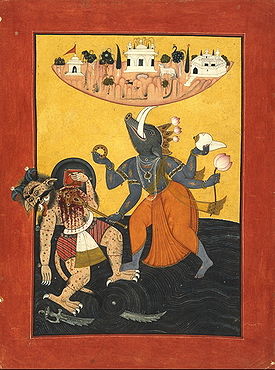
 assumed the form of a white boar (Sri Varaha
Varaha

Varaha is the third Avatar of the Hinduism god Vishnu, in the form of a Boar. He appeared in order to defeat Hiranyaksha, a Rakshasha who had taken the Earth and carried it to the bottom of what is described as the cosmic ocean in the story....
) and dove into the ocean to lift the Earth, in the process slaying Hiranyaksha who was obstructing Him.


Discussion
Ask a question about 'Hiranyaksha'
Start a new discussion about 'Hiranyaksha'
Answer questions from other users
Full Discussion Forum


Encyclopedia


In Hinduism
Hinduism

'Hinduism' is the predominant religion of the Indian subcontinent. Hinduism is often referred to as , a Sanskrit phrase meaning "the eternal dharma", by its practitioners....
, Hiranyaksha [golden-eyed] was an Asura
Asura

Sorry, no overview for this topic
 of pre-ancient India and the son of Diti
Diti

In Hinduism, Diti is an earth goddess and mother of the Maruts with Rudra. She wanted to have a son who would be more powerful than Indra and so she practiced Magic and kept herself pregnant for one year ....
 and Kashyapa
Kashyapa

Kashyapa was an ancient sage , who was one of the Saptarshi in the present Manvantara; with others being Atri, Vashishtha, Vishvamitra, Gautama, Jamadagni, Bharadvaja ...
. He was slain by Lord Vishnu
Vishnu

Vishnu , , is the Supreme God in Vaishnavite tradition of Hinduism. Smarta followers of Adi Shankara, among others, venerate Vishnu as one of panchadeva, and his supreme status is declared in the Hindu sacred texts like Yajurveda, the Rigveda and the Bhagavad Gita....
 after he (Hiranyaksha) took the Earth
Earth

Earth is the third planet from the Sun. Earth is the largest of the terrestrial planets in the Solar System in diameter, mass and density. It is also referred to as the World and Wiktionary:Terra.Note that by International Astronomical Union convention, the term "Terra" is used for naming extensive land masses, rather...
 to the bottom of what has been described as the "Cosmic Ocean". His name in Sanskrit
Sanskrit

Sanskrit is a historical Indo-Aryan language, one of the liturgical languages of Hinduism and Buddhism, and one of the 22 official languages of India....
 literally means "Goldeneye". Lord Vishnu
Vishnu

Vishnu , , is the Supreme God in Vaishnavite tradition of Hinduism. Smarta followers of Adi Shankara, among others, venerate Vishnu as one of panchadeva, and his supreme status is declared in the Hindu sacred texts like Yajurveda, the Rigveda and the Bhagavad Gita....
 assumed the form of a white boar (Sri Varaha
Varaha

Varaha is the third Avatar of the Hinduism god Vishnu, in the form of a Boar. He appeared in order to defeat Hiranyaksha, a Rakshasha who had taken the Earth and carried it to the bottom of what is described as the cosmic ocean in the story....
) and dove into the ocean to lift the Earth, in the process slaying Hiranyaksha who was obstructing Him. The battle lasted one thousand years.

He had an elder brother named Hiranyakashipu
Hiranyakashipu

Hiranyakashipu [golden-haired] is an Asura from the Puranic scriptures of Hinduism. The Puranas describe Hiranyakashipu as a King pre-ancient Dravida in India....
, who after having undertaken penances which made him incredibly powerful and invincible unless several conditions were met, was later slain by Lord Narasimha
Narasimha

Narasimha is an avatara of Vishnu described in the Puranas, Upanishads and other ancient religious texts of Hinduism, and one of Hinduism's most popular deities, as evidenced in early epics, iconography, and temple and festival worship for over a millennium....
, another Avatar
Avatar

Avatar or Avatara , often translated into English as incarnation, literally means descent and usually implies a deliberate descent from higher spiritual realms to lower realms of existence for special purposes....
 of Lord Vishnu
Vishnu

Vishnu , , is the Supreme God in Vaishnavite tradition of Hinduism. Smarta followers of Adi Shankara, among others, venerate Vishnu as one of panchadeva, and his supreme status is declared in the Hindu sacred texts like Yajurveda, the Rigveda and the Bhagavad Gita....
.