


High speed photography

Encyclopedia
Society of Motion Picture and Television Engineers
The Society of Motion Picture and Television Engineers The Society of Motion Picture and Television Engineers The Society of Motion Picture and Television Engineers (SMPTE , founded in 1916 as the Society of Motion Picture Engineers or SMPE, is an international professional association, based in...
(SMPTE) defined high-speed photography as any set of photographs captured by a camera capable of 128 frames per second or greater, and of at least three consecutive frames. High speed photography can be considered to be the opposite of time-lapse photography.
In common usage, high speed photography may refer to either or both of the following meanings. The first is that the photograph itself may be taken in a way as to appear to freeze the motion, especially to reduce motion blur
Motion blur
Motion blur is the apparent streaking of rapidly moving objects in a still image or a sequence of images such as a movie or animation. It results when the image being recorded changes during the recording of a single frame, either due to rapid movement or long exposure.- Photography :When a camera...
. The second is that a series of photographs may be taken at a high sampling frequency or frame rate. The first requires a sensor with good sensitivity and either a very good shuttering system or a very fast strobe light. The second requires some means of capturing successive frames, either with a mechanical device or by moving data off electronic sensors very quickly.
Other considerations for high-speed photographers are record length, reciprocity
Reciprocity (photography)
In photography reciprocity refers to the inverse relationship between the intensity and duration of light that determines the reaction of light-sensitive material. Within a normal exposure range for film stock, for example, the reciprocity law states that the film response will be determined by the...
breakdown, and spatial resolution
Optical resolution
Optical resolution describes the ability of an imaging system to resolve detail in the object that is being imaged.An imaging system may have many individual components including a lens and recording and display components...
.
Early applications and development

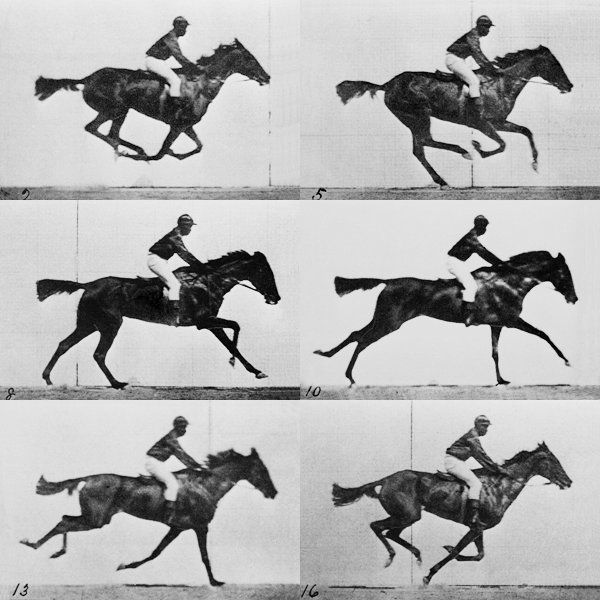
Eadweard Muybridge
Eadweard J. Muybridge was an English photographer who spent much of his life in the United States. He is known for his pioneering work on animal locomotion which used multiple cameras to capture motion, and his zoopraxiscope, a device for projecting motion pictures that pre-dated the flexible...
's 1878 investigation into whether horses' feet were actually all off the ground at once during a gallop.
The first photograph of a supersonic flying bullet was taken by the Austrian physicist Peter Sacher in Rijeka
Rijeka
Rijeka is the principal seaport and the third largest city in Croatia . It is located on Kvarner Bay, an inlet of the Adriatic Sea and has a population of 128,735 inhabitants...
in 1886, a technique that was later used by Ernst Mach
Ernst Mach
Ernst Mach was an Austrian physicist and philosopher, noted for his contributions to physics such as the Mach number and the study of shock waves...
in his studies of supersonic motion.
Bell Telephone Laboratories
Bell Labs
Bell Laboratories is the research and development subsidiary of the French-owned Alcatel-Lucent and previously of the American Telephone & Telegraph Company , half-owned through its Western Electric manufacturing subsidiary.Bell Laboratories operates its...
was one of the first customers for a camera developed by Eastman Kodak
Eastman Kodak
Eastman Kodak Company is a multinational imaging and photographic equipment, materials and services company headquarted in Rochester, New York, United States. It was founded by George Eastman in 1892....
in the early 1930s. Bell used the system, which ran 16 mm film
Photographic film
Photographic film is a sheet of plastic coated with an emulsion containing light-sensitive silver halide salts with variable crystal sizes that determine the sensitivity, contrast and resolution of the film...
at 1000 frame/s and had a 100 feet (30.5 m) load capacity, to study relay bounce. When Kodak declined to develop a higher-speed version, Bell Labs developed it themselves, calling it the Fastax. The Fastax was capable of 5,000 frame/s. Bell eventually sold the camera design to Western Electric
Western Electric
Western Electric Company was an American electrical engineering company, the manufacturing arm of AT&T from 1881 to 1995. It was the scene of a number of technological innovations and also some seminal developments in industrial management...
, who in turn sold it to the Wollensak Optical Company. Wollensak further improved the design to achieve 10,000 frame/s. Redlake Laboratories introduced another 16 mm rotating prism camera, the Hycam, in the early 1960s. Photo-Sonics developed several models of rotating prism camera capable of running 35 mm and 70 mm film in the 1960s. Visible Solutions introduced the Photec IV 16 mm camera in the 1980s.
In 1940, a patent was filed by Cearcy D. Miller for the rotating mirror camera, theoretically capable of one million frames per second. The first practical application of this idea was during the Manhattan Project
Manhattan Project
The Manhattan Project was a research and development program, led by the United States with participation from the United Kingdom and Canada, that produced the first atomic bomb during World War II. From 1942 to 1946, the project was under the direction of Major General Leslie Groves of the US Army...
, when Berlin Brixner, the photographic technician on the project, built the first known fully functional rotating mirror camera. This camera was used to photograph early prototypes of the first nuclear bomb, and resolved a key technical issue, that had been the source of an active dispute between the explosives engineers and the physics theoreticians.
The D. B. Milliken company developed an intermittent, pin-registered, 16 mm camera for speeds of 400 frame/s in 1957. Mitchell
Mitchell Camera
Mitchell Camera Corporation was founded in 1919 by Henry Boger and George Alfred Mitchell. Their first camera was designed and patented by John E. Leonard in 1917, from 1920 on known as the Mitchell Standard...
, Redlake Laboratories, and Photo-Sonics eventually followed in the 1960s with a variety of 16, 35, and 70 mm intermittent cameras.
Stroboscopy and laser applications
Harold EdgertonHarold Eugene Edgerton
Harold Eugene "Doc" Edgerton was a professor of electrical engineering at the Massachusetts Institute of Technology...
is generally credited with pioneering the use of the stroboscope
Stroboscope
A stroboscope, also known as a strobe, is an instrument used to make a cyclically moving object appear to be slow-moving, or stationary. The principle is used for the study of rotating, reciprocating, oscillating or vibrating objects...
to freeze fast motion. He eventually helped found EG&G
EG&G
EG&G, formally known as Edgerton, Germeshausen, and Grier, Inc., is a United States national defense contractor and provider of management and technical services. The company was involved in contracting services to the United States government during World War II, and conducted weapons research and...
, which used some of Edgerton's methods to capture the physics of explosions required to detonate nuclear weapons. See, for example, the photograph of an explosion using a Rapatronic camera
Rapatronic camera
The rapatronic camera is a high-speed camera capable of recording a still image with an exposure time as brief as 10 nanoseconds ....
.
Advancing the idea of the stroboscope, researchers began using laser
Laser
A laser is a device that emits light through a process of optical amplification based on the stimulated emission of photons. The term "laser" originated as an acronym for Light Amplification by Stimulated Emission of Radiation...
s to stop high speed motion. Recent advances include the use of High Harmonic Generation
High Harmonic Generation
- Perturbative Harmonic Generation :Perturbative Harmonic Generation is a process whereby laser light of frequency ω and photon energy ħω can be used to generate new frequencies of light. The newly generated frequencies are integer multiples nħω of the original light's frequency...
to capture images of molecular dynamics down to the scale of the attosecond
High speed film cameras


There are three types of high speed film camera;
- Intermittent motion cameras, which are a sped-up version of the standard motion picture camera using a sewing machine type mechanism to advance the film intermittently to a fixed exposure point behind the objective lens,
- Rotating prism cameras, which pull a long reel of film continuously past an exposure point and use a rotating prism between the objective lens and the film to impart motion to the image which matches the film motion, thereby canceling it out, and
- Rotating mirror cameras, which relay the image through a rotating mirror to an arc of film, and can only work in a burst mode.
Intermittent motion cameras are capable of hundreds of frames per second. Rotating prism cameras are capable of thousands of frames per second. Rotating mirror cameras are capable of millions of frames per second.
As film and mechanical transports improved, the high-speed film camera became available for scientific research. Kodak eventually shifted its film from acetate base to Estar (Kodak's name for a Mylar-equivalent plastic), which enhanced the strength and allowed it to be pulled faster. The Estar was also more stable than acetate allowing more accurate measurement, and it was not as prone to fire. Estar was a popular base for use in rotating prism cameras. But it never was popular with intermittent motion cameras, as it was so strong that it could break internal camera parts in the case of a camera jam.
Each film type is available in many load sizes. These may be cut down and placed in magazines for easier loading. A 1200 feet (365.8 m) magazine is typically the longest available for the 35 mm and 70 mm cameras. A 400 feet (121.9 m) magazine is typical for 16 mm cameras, though 1000 feet (304.8 m) magazines are available. Typically rotary prism cameras use 100 ft (30m) film loads. The images on 35 mm high-speed film are typically more rectangular with the long side between the sprocket holes instead of parallel to the edges as in standard photography. 16 mm and 70 mm images are typically more square rather than rectangular. A list of ANSI
American National Standards Institute
The American National Standards Institute is a private non-profit organization that oversees the development of voluntary consensus standards for products, services, processes, systems, and personnel in the United States. The organization also coordinates U.S. standards with international...
formats and sizes is available.
Most cameras use pulsed timing marks along the edge of the film (either inside or outside of the film perforations) produced by sparks or later by LEDs. These allow accurate measurement of the film speed and in the case of streak or smear images, velocity measurement of the subject. These pulses are usually cycled at 10, 100, 1000 Hz depending on the speed setting of the camera.
Intermittent pin register
Just as with a standard motion picture camera, the intermittent pin register camera actually stops the film in the film gateFilm gate
The film gate is the rectangular opening in the front of a motion picture camera where the film is exposed to light. The film gate can be seen by removing the lens and rotating the shutter out of the way...
while the photograph is being taken. In high-speed photography, this requires a some modifications to the mechanism for achieving this intermittent motion at such high speeds. In all cases, a loop is formed before and after the gate to create and then take up the slack. Pull-down claws, which grab the film and move it into place and then move it back out of the film gate after the exposure, are expanded to grab the film through multiple perforations in the film, thereby reducing the stress that any individual perforation is subjected to. Register pins, which secure the film while it is being exposed, are also multiplied, and often made from exotic materials. In some cases, vacuum suction
Suction
Suction is the flow of a fluid into a partial vacuum, or region of low pressure. The pressure gradient between this region and the ambient pressure will propel matter toward the low pressure area. Suction is popularly thought of as an attractive effect, which is incorrect since vacuums do not...
is used to keep the film, especially 35 mm and 70 mm film, flat so that the images are in focus across the entire frame.
- 16 mm pin register: D. B. Milliken Locam, capable of 500 frame/s; the design was eventually sold to Redlake. Photo-Sonics built a 16 mm pin-registered camera that was capable of 1000 frame/s, but they eventually removed it from the market.
- 35 mm pin register: Early cameras included the Mitchell 35 mm. Photo-Sonics won an Academy Award for Technical AchievementAcademy Award for Technical AchievementThe Technical Achievement Award is a kind of Scientific and Technical Award given by the Academy of Motion Picture Arts and Sciences to those whose particular technical accomplishments have contributed to the progress of the motion picture industry and who are given a certificate, which describes...
for the 4ER in 1988. The 4E is capable of 360 frame/s.
- 70 mm pin register: Cameras include a model made by Hulcher, and Photo-Sonics 10A and 10R cameras, capable of 125 frame/s.
Rotary prism
The rotary prism camera allowed higher frame rates without placing as much stress on the film or transport mechanism. The film moves continuously past a rotating prism which is synchronized to the main film sprocket such that the speed of the film and the speed of the prism are always running at the same proportional speed. The prism is located between the objective lens and the film, such that the revolution of the prism "paints" a frame onto the film for each face of the prism. Prisms are typically cubic, or four sided, for full frame exposure. Since exposure occurs as the prism rotates, images near the top or bottom of the frame, where the prism is substantially off axis, suffer from significant aberration. A shutter can improve the results by gating the exposure more tightly around the point where the prism faces are nearly parallel, though this generally reduces the effective frame height.- 16 mm rotary prism - Redlake Hycam and Fastax cameras are capable of 10,000 frame/s with a full frame prism (4 facets), 20,000 frame/s with a half-frame kit, and 40,000 frame/s with a quarter-frame kit. Visible Solutions also makes the Photec IV.
- 35 mm rotary prism - Photo-Sonics 4C cameras are capable of 2,500 frame/s with a full frame prism (4 facets), 4,000 frame/s with a half-frame kit, and 8,000 frame/s with a quarter-frame kit.
- 70 mm rotary prism - Photo-Sonics 10B cameras are capable of 360 frame/s with a full frame prism (4 facets), and 720 frame/s with a half-frame kit.
Rotating mirror
Rotating Mirror cameras can be divided into two sub-categories; pure rotating mirror cameras and rotating drum, or Dynafax cameras.In pure rotating mirror cameras, film is held stationary in an arc centered about a rotating mirror. The image formed by the objective lens is relayed back to the rotating mirror from a primary lens or lens group, and then through a secondary relay lens (or more typically lens group) which relays the image from the mirror to the film. For each frame formed on the film, one secondary lens group is required. As such, these cameras typically do not record more than one hundred frames. This means they record for only a very short time - typically less than a millisecond. Therefore they require specialized timing and illumination equipment. Rotating mirror cameras are capable of up to 25 million frames per second, with typical speed in the millions of fps.
The rotating drum, or Dynafax, camera works by holding a strip of film in a loop on the inside track of a rotating drum. This drum is then spun up to the speed corresponding to a desired framing rate. The image is still relayed to an internal rotating mirror centered at the arc of the drum. The mirror is multi-faceted, typically having six to eight faces. Only one secondary lens is required, as the exposure always occurs at the same point. The series of frames is formed as the film travels across this point. Discrete frames are formed as each successive face of the mirror passes through the optical axis. Rotating drum cameras are capable of speed from the tens of thousands to hundreds of thousands of frames per second.
In both types of rotating mirror cameras, double exposure can occur if the system is not controlled properly. In a pure rotating mirror camera, this happens if the mirror makes a second pass across the optics while light is still entering the camera. In a rotating drum camera, it happens if the drum makes more than one revolution while light is entering the camera. Typically this is controlled by using fast extinguishing xenon strobe light sources that are designed to produce a flash of only a specific duration.
Rotating mirror camera technology has more recently been applied to electronic imaging, where instead of film, an array of single shot CCD
CCD
-Science:*Carbonate compensation depth, a property of oceans*Colony collapse disorder, a phenomenon involving the abrupt disappearance of the worker bees in a beehive or Western honey bee colony...
or CMOS
CMOS
Complementary metal–oxide–semiconductor is a technology for constructing integrated circuits. CMOS technology is used in microprocessors, microcontrollers, static RAM, and other digital logic circuits...
cameras is arrayed around the rotating mirror. This adaptation enables all of the advantages of electronic imaging in combination with the speed and resolution of the rotating mirror approach. Speeds up to 25 million frames per second are achievable, with typical speeds in the millions of fps.
Commercial availability of both types of rotating mirror cameras began in the 1950s with Beckman & Whitley, and Cordin Company. Beckman & Whitley sold both rotating mirror and rotating drum cameras, and coined the "Dynafax" term. Cordin Company sold only rotating mirror cameras. In the mid 1960's, Cordin Company bought Beckman & Whitley and has been the sole source of rotating mirror cameras since. An offshoot of Cordin Company, Millisecond Cinematography provided drum camera technology to the commercial cinematography market.
Streak Photography
For the development of explosives the image of a line of sample was projected onto an arc of film via a rotating mirror. The advance of flame appeared as an oblique image on the film, from which the velocity of detonation was measured.By removing the prism from the rotary prism cameras and using a very narrow slit in place of the shutter, it is possible to take images whose exposure is essentially one dimension of spatial information recorded continuously over time. Streak records are therefore a space vs. time graphical record. The image that results allows for very precise measurement of velocities. It is also possible to capture streak records using rotating mirror technology at much faster speeds.
Motion compensation photography (also known as Ballistic Syncro Photography or Smear Photography when used to image high speed projectiles) is a form of streak photography. When the motion of the film is opposite to that of the subject with an inverting (positive) lens, and synchronized appropriately, the images show events as a function of time. Objects remaining motionless show up as streaks. This is the technique used for finish line photographs. At no time is it possible to take a still photograph that duplicates the results of a finish line photograph taken with this method. A still is a photograph in time, a streak/smear photograph is a photograph of time. When used to image high speed projectiles the use of a slit (as in Streak Photography) produce very short exposure times ensuring higher image resolution. The use for high speed projectiles means that one still image is normally produced on one roll of cine film. From this image information such as yaw or pitch can be determined. Because of its measurement of time variations in velocity will also be shown by lateral distortions of the image.
By combining this technique with a diffracted wavefront of light, as by a knife-edge, it is possible to take photographs of phase perturbations within a homogeneous medium. For example, it is possible to capture shockwaves of bullets and other high-speed objects. See, for example, Shadowgraph
Shadowgraph
Shadowgraph is an optical method that reveals non-uniformities in transparent media like air, water, or glass. It is related to, but simpler than, the schlieren and schlieren photography methods that perform a similar function...
and Schlieren photography
Schlieren photography
Schlieren photography is a visual process that is used to photograph the flow of fluids of varying density. Invented by the German physicist August Toepler in 1864 to study supersonic motion, it is widely used in aeronautical engineering to photograph the flow of air around objects...
.
Video
Early video cameras using tubesVideo camera tube
In older video cameras, before the mid to late 1980s, a video camera tube or pickup tube was used instead of a charge-coupled device for converting an optical image into an electrical signal. Several types were in use from the 1930s to the 1980s...
(such as the Vidicon) suffered from severe "ghosting" due to the fact that the latent image on the target remained even after the subject had moved. Furthermore, as the system scanned the target, the motion of the scanning relative to the subject resulted in artifacts that compromised the image. The target in Vidicon type camera tubes can be made of various photoconductive chemicals such as antimony sulfide
Stibnite
Stibnite, sometimes called antimonite, is a sulfide mineral with the formula Sb2S3. This soft grey material crystallizes in an orthorhombic space group. It is the most important source for the metalloid antimony...
(Sb
Antimony
Antimony is a toxic chemical element with the symbol Sb and an atomic number of 51. A lustrous grey metalloid, it is found in nature mainly as the sulfide mineral stibnite...
2S
Sulfur
Sulfur or sulphur is the chemical element with atomic number 16. In the periodic table it is represented by the symbol S. It is an abundant, multivalent non-metal. Under normal conditions, sulfur atoms form cyclic octatomic molecules with chemical formula S8. Elemental sulfur is a bright yellow...
3), lead(II) oxide
Lead(II) oxide
Lead oxide is the inorganic compound with the formula PbO. Lead oxide occurs in two polymorphs, red, having a tetragonal crystal structure and yellow, having an orthorhombic crystal structure...
(Pb
Lead
Lead is a main-group element in the carbon group with the symbol Pb and atomic number 82. Lead is a soft, malleable poor metal. It is also counted as one of the heavy metals. Metallic lead has a bluish-white color after being freshly cut, but it soon tarnishes to a dull grayish color when exposed...
O
Oxygen
Oxygen is the element with atomic number 8 and represented by the symbol O. Its name derives from the Greek roots ὀξύς and -γενής , because at the time of naming, it was mistakenly thought that all acids required oxygen in their composition...
), and others with various image "stick" properties. The Farnsworth
Philo Farnsworth
Philo Taylor Farnsworth was an American inventor and television pioneer. Although he made many contributions that were crucial to the early development of all-electronic television, he is perhaps best known for inventing the first fully functional all-electronic image pickup device , the "image...
Image Dissector did not suffer from image "stick" of the type Vidicons exhibit, and so related special image converter tubes might be used to capture short frame sequences at very high speed.
The mechanical shutter, invented by Pat Keller, et al., at China Lake in 1979 , helped freeze the action and eliminate ghosting. This was a mechanical shutter similar to the one used in high-speed film cameras—a disk with a wedge removed. The opening was synchronized to the frame rate, and the size of the opening was proportional to the integration or shutter time. By making the opening very small, the motion could be stopped.
Despite the resulting improvements in image quality, these systems were still limited to 60 frame/s.
Other Image Converter tube based systems emerged in the 1950s which incorporated a modified GenI image intensifier with additional deflector plates which allowed a photon image to be converted to a photoelectron beam. The image, while in this photoelectron state, could be shuttered on and off as short as a few nanoseconds, and deflected to different areas of the large 70 and 90 mm diameter phosphor screens to produce sequences of up to 20+ frames. In the early 1970s these camera attained speeds up to 600 Million frame/s, with 1 ns exposure times, with up to 15 frames per event. As they were analog devices there were no digital limitations on data rates and pixel transfer rates. However, image resolution was quite limited, due to the inherent repulsion of electrons and the grain of the phosphor screen. Resolutions of 10 lp/mm were typical. Also, the images were inherently monochrome, as wavelength information is lost in the photon-electron-photon conversion process. There was also a fairly steep trade-off between resolution and number of images. All images needed to fall on the output phosphor screen. Therefore, a four image sequence would mean each image occupies one forth of the screen; a nine image sequence has each image occupying one ninth, etc. Images were projected and held on the tube's phosphor screen for several milliseconds, long enough to be optically, and later fiber optically, coupled to film for image capture. Cameras of this design were made by Hadland and Cordin Company. This technology remained state of the art until the mid 1990s when the availability of CCD image capture enabled instant results in digital format.
In addition to framing tubes, these tubes could also be configured with one or two sets of deflector plates in one axis. As light was converted to photoelectrons, these photoelectrons could be swept across the phosphor screen at incredible sweep speeds limited only by the sweep electronics, to generate the first electronic streak cameras. With no moving parts, sweep speeds of up to 10 picoseconds per mm could be attained, thus giving technical time resolution of several picoseconds. As early as the 1973-74 there were commercial streak cameras capable of 3 picosecond time resolution derived from the need to evaluate the ultra short laser pulses which were being developed at that time. Electronic streak cameras are still used today with time resolution as short as sub picoseconds, and are the only true way to measure short optical events in the picosecond time scale.
CCD
The introduction of the CCDCharge-coupled device
A charge-coupled device is a device for the movement of electrical charge, usually from within the device to an area where the charge can be manipulated, for example conversion into a digital value. This is achieved by "shifting" the signals between stages within the device one at a time...
revolutionized high-speed photography in the 1980s. The staring array configuration of the sensor eliminated the scanning artifacts. Precise control of the integration time replaced the use of the mechanical shutter. However, the CCD architecture limited the rate at which images could be read off the sensor. Most of these systems still ran at NTSC
NTSC
NTSC, named for the National Television System Committee, is the analog television system that is used in most of North America, most of South America , Burma, South Korea, Taiwan, Japan, the Philippines, and some Pacific island nations and territories .Most countries using the NTSC standard, as...
rates (approximately 60 frame/s), but some, especially those built by the Kodak Spin Physics group, ran faster and recorded onto specially constructed video tape cassettes. The Kodak MASD group developed the first HyG (rugged) high speed digital color camera called the RO that replaced 16-mm crash sled film cameras. Many new innovations and recording methods were introduced in the RO and further enhancements were introduced in the HG2000, a camera that could run at 1000 frame/s with a 512 x 384 pixel
Pixel
In digital imaging, a pixel, or pel, is a single point in a raster image, or the smallest addressable screen element in a display device; it is the smallest unit of picture that can be represented or controlled....
sensor for 2 seconds. Kodak MASD group also introduced an ultra high speed CCD camera called the HS4540 that was designed and manufactured by Photron in 1991 that recorded 4,500 frame/s at 256 x 256. The HS4540 was used extensively by companies manufacturing automotive air bags to do lot testing which required the fast record speed to image a 30 ms deployment. Roper Industries purchased this division from Kodak in November 1999.
Gated Intensified CCD
In the mid-1990's, very fast cameras based on micro-channel plate (MCP) image intensifiers were developed. The MCP intensifier is the same technology used for night vision applications. They are based on a similar photon-electron-photon conversion as the above-described image converter tubes, but incorporate a micro-channel plate, which is a thin silicon section with extremely fine holes drilled in a tight array. This plate is given a high voltage charge such that electrons coming from the input photocathode to the holes create a cascading effect, thereby amplifying the image signal. These electrons fall on an output phosphor, creating the emission of photons that comprise the resulting image. The devices can be switched on and off at the nanosecond time scale. The output of the MCP is coupled to a CCD, usually by means of a fused fiber-optic taper, creating an electronic camera with very high sensitivity and capable of very short exposure times, though also one that is inherently monochrome due to wavelength information being lost in the photon-electron-photon conversion. The pioneering work in this area was done by Paul Hoess while at PCO Imaging in Germany.A sequence of images at these very fast speeds can be obtained by multiplexing MCP-CCD cameras behind an optical beamsplitter and switching the MCP devices using an electronic sequencer control. These systems would typically use eight channels of MCP-CCD imagers, yielding an eight frame sequence at speeds up to 200 million fps. Some systems were built with interline CCDs, which enables two images per channel, or a sixteen frame sequence, though not at the highest speeds (because of the minimum time of the interline transfer). Cameras of this type were built by Hadland and are still built by Cordin Company and Specialised Imaging.
IS-CCD
Another approach for capturing images at extremely high speeds is with a multi-register CCD chip, such as in the Shimadzu HPV-1 and HPV-2 cameras. In a typical interline transfer CCD chip, each pixel has a single register. Charge from an individual pixel can be quickly transferred into its register in the microsecond time scale. These charges are then be read out of the chip and stored in a serial "read" process that takes much more time than the transfer to the register.The Shimadzu camera is based on a chip where each pixel has 100 registers. Charge from the pixel can then be transferred into these registers such that the image sequence is stored "on chip" and then read out well after the event of interest is over. The advantage to this approach is that cameras based on this chip can capture 1 million frames per second with a very simple camera architecture. The disadvantage is that the resolution is limited (to 312 x 260 pixels) since much of the chip area is dedicated to registers, and the dynamic range of the image is negatively affected by the image information (charge) undergoing multiple register transfers. Like other cameras operating in this speed range, cameras of this type necessarily operate in a burst mode, capturing a limited (in this case 100) number of frames.
Rotating Mirror CCD
Rotating Mirror film camera technology has been adapted to take advantage of CCD imaging by putting an array of CCD cameras around a rotating mirror in place of film. The operating principals are substantially similar to those of rotating mirror film cameras, in that the image is relayed from an objective lens to a rotating mirror, and then back to each CCD camera, which are all essentially operating as a single shot cameras. Framing rate is determined by the speed of the mirror, not the read-out rate of the imaging chip, as in single chip CCD and CMOS systems. This means these cameras must necessarily work in a burst mode, as they only can capture as many frames as there are CCD devices (typically 50-100). They are also much more elaborate (and therefore costly) systems than single chip high speed cameras. These systems do, however, achieve the maximum combination of speed and resolution, as they have no trade-off between speed and resolution. Typical speeds are in the millions of frames per second, and typical resolutions are 2 to 8 megapixels per image. These types of cameras are made by Cordin Company.CMOS
The introduction of CMOSCMOS
Complementary metal–oxide–semiconductor is a technology for constructing integrated circuits. CMOS technology is used in microprocessors, microcontrollers, static RAM, and other digital logic circuits...
sensor technology again revolutionized high-speed photography in the 1990s and serves as a classic example of a disruptive technology
Disruptive technology
A disruptive technology or disruptive innovation is an innovation that helps create a new market and value network, and eventually goes on to disrupt an existing market and value network , displacing an earlier technology there...
. Based on the same materials as computer memory, the CMOS process was cheaper to build than CCD and easier to integrate with on-chip memory and processing functions. They also offer much greater flexibility in defining sub-arrays as active. This enables high speed CMOS cameras to have broad flexibility in trading off speed and resolution. Current high speed CMOS cameras offer full resolution framing rates in the thousands of fps with resolutions in the low megapixels. But these same cameras can be easily configured to capture images in the millions of fps, though with significantly reduced resolution. The image quality and quantum efficiency of CCD devices is still marginally superior to CMOS.
The first patent of an Active Pixel Sensor (APS), submitted by JPL's Eric Fossum
Eric Fossum
Eric R. Fossum is an American physicist and engineer, inventor of the CMOS image sensor. He is currently a professor at Thayer School of Engineering in Dartmouth College.- Early years and education :...
, led to the spin-off of Photobit, which was eventually bought by Micron Technology
Micron Technology
Micron Technology, Inc. is an American multinational corporation based in Boise, Idaho, USA, best known for producing many forms of semiconductor devices. This includes DRAM, SDRAM, flash memory, SSD and CMOS image sensing chips. Consumers may be more familiar with its consumer brand Crucial...
. However, Photobit's first interest was in the standard video market; the first high-speed CMOS system was NAC Image Technology's HSV 1000, first produced in 1990. Vision Research
Vision research
Vision Research is a peer-reviewed scientific journal specialising in the neuroscience and psychology of the visual system. The journal is abstracted and indexed in PubMed. The journal's impact factor for 2008 is 2.051 and its 5-year impact factor is 2.385....
uses a CMOS sensor in the Phantom v4 camera, with a sensor designed at the Belgian
Belgium
Belgium , officially the Kingdom of Belgium, is a federal state in Western Europe. It is a founding member of the European Union and hosts the EU's headquarters, and those of several other major international organisations such as NATO.Belgium is also a member of, or affiliated to, many...
Interuniversity Microelectronics Center
Imec
Imec is a micro- and nanoelectronics research center headquartered in Leuven, Belgium, with offices in Belgium, the Netherlands, Taiwan, USA, China and Japan. Its staff of about 1,900 people includes more than 500 industrial residents and guest researchers...
(IMEC). These systems quickly made inroads into the 16 mm high-speed film camera market despite resolution and record times (0.25 megapixel
Pixel
In digital imaging, a pixel, or pel, is a single point in a raster image, or the smallest addressable screen element in a display device; it is the smallest unit of picture that can be represented or controlled....
, 4 s at full frame and 1000 frame/s) that suffered in comparison to existing film systems. IMEC later spun the design group off as FillFactory, which was later purchased by Cypress Semiconductor
Cypress Semiconductor
Cypress Semiconductor Corporation is a Silicon Valley-based semiconductor design and manufacturing company founded by T. J. Rodgers and others from Advanced Micro Devices. It was formed in 1982 with backing by Sevin Rosen and went public in 1986. The company initially focused on the design and...
. Photobit eventually introduced a 500 frame/s 1.3 megapixel
Pixel
In digital imaging, a pixel, or pel, is a single point in a raster image, or the smallest addressable screen element in a display device; it is the smallest unit of picture that can be represented or controlled....
sensor, a device found in many low-end high-speed systems.
Subsequently, several camera manufacturers compete in the high speed digital video market, including AOS Technologies, Fastec Imaging, Mega Speed Corporation http://www.megaspeed.ca, NAC, Olympus, Photron, Redlake, Vision Research, and Weinberger, with sensors developed by Photobit, Cypress, and in-house designers.
As of January 2008, Vision Research's Phantom HD camera capable of 1920 x 1080 pixel resolution (Sony Hi-Def) has replaced a few 16 mm film cameras in some media applications and has replaced 35 mm film cameras in a few commercials in the UK. Most UK commercials are currently shown using the ARRI Tornado, which is based on the Memrecam K5 from NAC Image Technology. This is the camera of choice for media application due to its unparalleled light sensitivity afforded to it by its large pixels.
In March 2008 Casio introduced the EX-F1, the first consumer market camera with creditable high speed video capability. Using the Sony IMX017CQE 6MP CMOS sensor the camera acquires 300 frame/s at 512 x 384 and also 600 and 1200 frame/s at lower resolutions. Although the resolutions and frame rates are low compared to current professional equipment, the EX-F1 costs $1000 where current professional cameras are priced $10,000 or more. Light sensitivity is quite good, showing only slight image deterioration at ISO 1600. The camera is already in use in commercial R&D applications (crash dummy testing equipment design) due to the low cost and adequate capabilities.
In addition to those science and engineering types of cameras, an entire industry has been built up around industrial machine vision systems and requirements. The major application has been for high-speed manufacturing. A system typically consists of a camera, a frame grabber
Frame grabber
A frame grabber is an electronic device that captures individual, digital still frames from an analog video signal or a digital video stream. It is usually employed as a component of a computer vision system, in which video frames are captured in digital form and then displayed, stored or...
, a processor, and communications and recording systems to document or control the manufacturing process.
Infrared
High-speed infrared photography has become possible with the introduction of the Amber Radiance, and later the Indigo Phoenix. Amber was purchased by RaytheonRaytheon
Raytheon Company is a major American defense contractor and industrial corporation with core manufacturing concentrations in weapons and military and commercial electronics. It was previously involved in corporate and special-mission aircraft until early 2007...
, the Amber design team left and formed Indigo, and Indigo is now owned by FLIR Systems
FLIR Systems
FLIR Systems is a thermal imaging systems manufacturer based in Wilsonville, Oregon, United States. Founded in 1978, the company makes thermal imagers, thermal imager components, as well as larger systems containing thermal imagers along with other sensors, for both commercial and military...
. Telops
Telops
Telops is a Canadian optronics company.The company manufactures optical instruments for industrial and defense markets. The company is located in Quebec City....
, Santa Barbara Focal Plane, CEDIP, and Electrophysics have also introduced high-speed infrared systems.
See also
- 16 mm film16 mm film16 mm film refers to a popular, economical gauge of film used for motion pictures and non-theatrical film making. 16 mm refers to the width of the film...
- 35 mm film35 mm film35 mm film is the film gauge most commonly used for chemical still photography and motion pictures. The name of the gauge refers to the width of the photographic film, which consists of strips 35 millimeters in width...
- 70 mm film70 mm film70mm film is a wide high-resolution film gauge, with higher resolution than standard 35mm motion picture film format. As used in camera, the film is wide. For projection, the original 65mm film is printed on film. The additional 5mm are for magnetic strips holding four of the six tracks of sound...
- Harold Eugene EdgertonHarold Eugene EdgertonHarold Eugene "Doc" Edgerton was a professor of electrical engineering at the Massachusetts Institute of Technology...
- Fastax (High speed camera)
- High speed cameraHigh speed cameraA high speed camera is a device used for recording fast moving objects as a photographic image onto a storage media. After recording, the images stored on the media can be played back in slow-motion...
- slow motionSlow motionSlow motion is an effect in film-making whereby time appears to be slowed down. It was invented by the Austrian priest August Musger....
(less advanced than high-speed photography)
External links
- Lighting for High Speed Lighting For High Speed from Love High Speed
- High speed photography multimedia technique description at the Edgerton Digital Collections website
- Lighting for High Speed TV and Film Shoots Useful tips on lighting by Pirate
- David Alciatore's collection of high speed video clips