

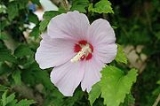
Hibiscus syriacus

Encyclopedia
Hibiscus syriacus is a widely cultivated ornamental shrub in the genus Hibiscus
. Common names include Rose of Sharon
(especially in North America), Shrub Althea and Rose Althea.
in the plant
family Malvaceae
native to much of Asia
, though not, as Linnaeus thought, to Syria, in spite of the name he gave it. It is upright and vase-shaped, reaching 2–4 m in height. It is widely planted in areas with hot summers for its very attractive white, pink, red, lavender
, or purple large and edible flower
s. Individual flowers are short-lived, lasting only a day. However, numerous flower buds are produced on the shrub's new growth, which provides prolific flowering over a long summer blooming period (July–September). Shoots make interesting indoor vase cuttings, as they stay green for a long time. In the vase some new flowers may open from the more mature flower buds. The species has naturalized very well in many suburban areas, and might even be termed slightly invasive
, so frequently does it seed around.
and its flowers are eaten. It was grown in Europe from the 16th century, though as late as 1629 John Parkinson
thought it was tender and took great precautions with it, thinking it "would not suffer to be uncovered in the Winter time, or yet abroad in the Garden, but kept in a large pot or tubbe in the house or in a warme cellar, if you would have them to thrive." By the end of the 17th century, some knew it to be hardy: Gibson, describing Lord Arlington's London house noted six large earthen pots coddling the "tree hollyhock", as he called it, "that grows well enough in the ground". By the 18th century the shrub was common in English gardens and in the American colonies, known as Althea frutex and "Syrian ketmia".
Though it has no autumn color and can be stiff and ungainly if badly pruned, H. syriacus remains a popular ornamental shrub today, with many cultivar
s. William Robinson
mentioned several varieties in The English Flower Garden that are still available today. Triploid varieties were first produced at the National Arboretum
, Washington DC, by Dr. D. Egolf, resulting in plants that bloom lavishly, as they are sterile and set no seed; Egolf varieties named for goddesses include the outstanding white 'Diana'. Also in the market are 'Lady Stanley', 'Ardens', 'Lucy', and 'Blushing Bride' (photo below).
from either seeds
, with variable results, or by layering
or cuttings, cloning the original.
. The flower appears in national emblem
s, and Korea is compared poetically to the flower in the South Korean national anthem
. The flower's name in Korean
is mugunghwa (Hangul
: 무궁화; Hanja
: 無窮花). The flower's symbolic significance stems from the Korean word mugung, which means "eternity".
Hibiscus
Hibiscus is a genus of flowering plants in the mallow family, Malvaceae. It is quite large, containing several hundred species that are native to warm-temperate, subtropical and tropical regions throughout the world...
. Common names include Rose of Sharon
Rose of Sharon
Rose of Sharon is a common name that applies to several different species of flowering plants that are highly valued throughout the world. The name's colloquial application has been used as an example of the lack of precision of common names, which potentially causes confusion...
(especially in North America), Shrub Althea and Rose Althea.
Growth
H. syriacus is a flowering shrubShrub
A shrub or bush is distinguished from a tree by its multiple stems and shorter height, usually under 5–6 m tall. A large number of plants may become either shrubs or trees, depending on the growing conditions they experience...
in the plant
Plant
Plants are living organisms belonging to the kingdom Plantae. Precise definitions of the kingdom vary, but as the term is used here, plants include familiar organisms such as trees, flowers, herbs, bushes, grasses, vines, ferns, mosses, and green algae. The group is also called green plants or...
family Malvaceae
Malvaceae
Malvaceae, or the mallow family, is a family of flowering plants containing over 200 genera with close to 2,300 species. Judd & al. Well known members of this family include okra, jute and cacao...
native to much of Asia
Asia
Asia is the world's largest and most populous continent, located primarily in the eastern and northern hemispheres. It covers 8.7% of the Earth's total surface area and with approximately 3.879 billion people, it hosts 60% of the world's current human population...
, though not, as Linnaeus thought, to Syria, in spite of the name he gave it. It is upright and vase-shaped, reaching 2–4 m in height. It is widely planted in areas with hot summers for its very attractive white, pink, red, lavender
Lavender
The lavenders are a genus of 39 species of flowering plants in the mint family, Lamiaceae. An Old World genus, distributed from Macaronesia across Africa, the Mediterranean, South-West Asia, Arabia, Western Iran and South-East India...
, or purple large and edible flower
Flower
A flower, sometimes known as a bloom or blossom, is the reproductive structure found in flowering plants . The biological function of a flower is to effect reproduction, usually by providing a mechanism for the union of sperm with eggs...
s. Individual flowers are short-lived, lasting only a day. However, numerous flower buds are produced on the shrub's new growth, which provides prolific flowering over a long summer blooming period (July–September). Shoots make interesting indoor vase cuttings, as they stay green for a long time. In the vase some new flowers may open from the more mature flower buds. The species has naturalized very well in many suburban areas, and might even be termed slightly invasive
Invasive
Invasive may refer to:*A military invasion*An invasive species*An invasive medical procedure*The invasively progressive spread of disease from one organ in the body to another, especially in reference to cancer...
, so frequently does it seed around.
Garden history
Hibiscus syriacus, a hardy hibiscus shrub, has been a garden shrub in Korea since time immemorial; it leaves were brewed for a tisaneTisane
A herbal tea, tisane, or ptisan is a herbal or plant infusion and usually not made from the leaves of the tea bush . Typically, herbal tea is simply the combination of boiling water and dried fruits, flowers or herbs. Herbal tea has been imbibed for nearly as long as written history extends...
and its flowers are eaten. It was grown in Europe from the 16th century, though as late as 1629 John Parkinson
John Parkinson (botanist)
John Parkinson was the last of the great English herbalists and one of the first of the great English botanists. He was apothecary to James I and a founding member of the Worshipful Society of Apothecaries in December 1617, and was later Royal Botanist to Charles I...
thought it was tender and took great precautions with it, thinking it "would not suffer to be uncovered in the Winter time, or yet abroad in the Garden, but kept in a large pot or tubbe in the house or in a warme cellar, if you would have them to thrive." By the end of the 17th century, some knew it to be hardy: Gibson, describing Lord Arlington's London house noted six large earthen pots coddling the "tree hollyhock", as he called it, "that grows well enough in the ground". By the 18th century the shrub was common in English gardens and in the American colonies, known as Althea frutex and "Syrian ketmia".
Though it has no autumn color and can be stiff and ungainly if badly pruned, H. syriacus remains a popular ornamental shrub today, with many cultivar
Cultivar
A cultivar'Cultivar has two meanings as explained under Formal definition. When used in reference to a taxon, the word does not apply to an individual plant but to all those plants sharing the unique characteristics that define the cultivar. is a plant or group of plants selected for desirable...
s. William Robinson
William Robinson (gardener)
William Robinson was an Irish practical gardener and journalist whose ideas about wild gardening spurred the movement that evolved into the English cottage garden, a parallel to the search for honest simplicity and vernacular style of the British Arts and Crafts movement...
mentioned several varieties in The English Flower Garden that are still available today. Triploid varieties were first produced at the National Arboretum
National Arboretum
National Arboretum may refer to*National Arboretum Canberra in Australia*National Memorial Arboretum at Alrewas, UK*United States National Arboretum...
, Washington DC, by Dr. D. Egolf, resulting in plants that bloom lavishly, as they are sterile and set no seed; Egolf varieties named for goddesses include the outstanding white 'Diana'. Also in the market are 'Lady Stanley', 'Ardens', 'Lucy', and 'Blushing Bride' (photo below).
Propagation
Hibiscus syriacus is fairly easily propagatedPlant propagation
Plant propagation is the process of creating new plants from a variety of sources: seeds, cuttings, bulbs and other plant parts. Plant propagation can also refer to the artificial or natural dispersal of plants.-Sexual propagation :...
from either seeds
Germination
Germination is the process in which a plant or fungus emerges from a seed or spore, respectively, and begins growth. The most common example of germination is the sprouting of a seedling from a seed of an angiosperm or gymnosperm. However the growth of a sporeling from a spore, for example the...
, with variable results, or by layering
Layering
Layering is a means of plant propagation in which a portion of an aerial stem grows roots while still attached to the parent plant and then detaches as an independent plant. Layering has evolved as a common means of vegetative propagation of numerous species in natural environments...
or cuttings, cloning the original.
National flower
Hibiscus syriacus is the national flower of South KoreaSouth Korea
The Republic of Korea , , is a sovereign state in East Asia, located on the southern portion of the Korean Peninsula. It is neighbored by the People's Republic of China to the west, Japan to the east, North Korea to the north, and the East China Sea and Republic of China to the south...
. The flower appears in national emblem
Emblem
An emblem is a pictorial image, abstract or representational, that epitomizes a concept — e.g., a moral truth, or an allegory — or that represents a person, such as a king or saint.-Distinction: emblem and symbol:...
s, and Korea is compared poetically to the flower in the South Korean national anthem
Aegukga
Aegukga is the national anthem of South Korea. The title literally means "The Song of Love for the Country," or "The Patriotic Song."It is believed that the lyrics were written for the cornerstone-laying ceremony of the Independence Gate in Seoul in 1896 by Yun Chiho, a politician, or by An...
. The flower's name in Korean
Korean language
Korean is the official language of the country Korea, in both South and North. It is also one of the two official languages in the Yanbian Korean Autonomous Prefecture in People's Republic of China. There are about 78 million Korean speakers worldwide. In the 15th century, a national writing...
is mugunghwa (Hangul
Hangul
Hangul,Pronounced or ; Korean: 한글 Hangeul/Han'gŭl or 조선글 Chosŏn'gŭl/Joseongeul the Korean alphabet, is the native alphabet of the Korean language. It is a separate script from Hanja, the logographic Chinese characters which are also sometimes used to write Korean...
: 무궁화; Hanja
Hanja
Hanja is the Korean name for the Chinese characters hanzi. More specifically, it refers to those Chinese characters borrowed from Chinese and incorporated into the Korean language with Korean pronunciation...
: 無窮花). The flower's symbolic significance stems from the Korean word mugung, which means "eternity".