
All Topics  
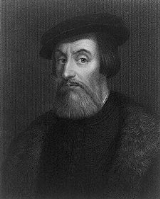
Hernán Cortés

 
Hernán Cortés

   Email Print
   Bookmark   Link


Hernán Cortés


Hernán Cortés de Monroy y Pizarro, 1st Marqués del Valle de Oaxaca (; 1485 – December 2, 1547) was a Spanish
Spain

Spain or the Kingdom of Spain , is a country located in Southern Europe on the Iberian Peninsula.The Spanish constitution does not establish any official denomination of the country, even though Espa?a , Estado espa?ol and Naci?n espa?ola are used interchangeably....
 conquistador
Conquistador

Conquistador is the name given to the Spaniards soldiers, leaders, List of explorers, and adventurers involved in the conquest of the Americas following the discovery of the New World by Christopher Columbus in 1492....
 who led an expedition that caused the fall of the Aztec empire and brought large portions of mainland Mexico
Mexico

The United Mexican States , commonly known as Mexico , is a federalism constitutionalism republic in North America. It is bordered on the north by the United States; on the south and west by the Pacific Ocean; on the southeast by Guatemala, Belize, and the Caribbean Sea; and on the east by the Gulf of Mexico....
 under the King of Castile
Crown of Castile

The Crown of Castile, as a historic entity, is usually considered to have begun in 1230 with the third and definitive union of the two kingdoms of Kingdom of Le?n and Kingdom of Castile, or more concretely, with the union of their parliaments a few decades later....
, in the early 16th century. Cortés was part of the generation of Spanish colonizers that began the first phase of the Spanish colonization of the Americas
Spanish colonization of the Americas

The Spanish colonization of the Americas was Spain's conquest, settlement, and rule over much of the western hemisphere. Beginning with the arrival of Christopher Columbus in 1492, over three centuries the Spanish Empire expanded from early small settlements in the Caribbean to include Central America, most of South America, Mexico, what toda...
.

Born in Medellín
Medellín (Spain)

Medell?n is a village in the provinces of Spain of Badajoz , Extremadura, Spain, notable as the birthplace of Hern?n Cort?s in 1485 and the site of the Battle of Medelin, during the Peninsular War....
, Extremadura
Extremadura

Extremadura is an autonomous communities in Spain of western Spain whose capital city is M?rida, Spain. It includes the provinces of Spain of C?ceres and Badajoz ....
, Spain
Spain

Spain or the Kingdom of Spain , is a country located in Southern Europe on the Iberian Peninsula.The Spanish constitution does not establish any official denomination of the country, even though Espa?a , Estado espa?ol and Naci?n espa?ola are used interchangeably....
, to a family of lesser nobility, Cortés chose to pursue a livelihood in the New World.


Discussion
Ask a question about 'Hernán Cortés'
Start a new discussion about 'Hernán Cortés'
Answer questions from other users
Full Discussion Forum


Encyclopedia


Hernán Cortés de Monroy y Pizarro, 1st Marqués del Valle de Oaxaca (; 1485 – December 2, 1547) was a Spanish
Spain

Spain or the Kingdom of Spain , is a country located in Southern Europe on the Iberian Peninsula.The Spanish constitution does not establish any official denomination of the country, even though Espa?a , Estado espa?ol and Naci?n espa?ola are used interchangeably....
 conquistador
Conquistador

Conquistador is the name given to the Spaniards soldiers, leaders, List of explorers, and adventurers involved in the conquest of the Americas following the discovery of the New World by Christopher Columbus in 1492....
 who led an expedition that caused the fall of the Aztec empire and brought large portions of mainland Mexico
Mexico

The United Mexican States , commonly known as Mexico , is a federalism constitutionalism republic in North America. It is bordered on the north by the United States; on the south and west by the Pacific Ocean; on the southeast by Guatemala, Belize, and the Caribbean Sea; and on the east by the Gulf of Mexico....
 under the King of Castile
Crown of Castile

The Crown of Castile, as a historic entity, is usually considered to have begun in 1230 with the third and definitive union of the two kingdoms of Kingdom of Le?n and Kingdom of Castile, or more concretely, with the union of their parliaments a few decades later....
, in the early 16th century. Cortés was part of the generation of Spanish colonizers that began the first phase of the Spanish colonization of the Americas
Spanish colonization of the Americas

The Spanish colonization of the Americas was Spain's conquest, settlement, and rule over much of the western hemisphere. Beginning with the arrival of Christopher Columbus in 1492, over three centuries the Spanish Empire expanded from early small settlements in the Caribbean to include Central America, most of South America, Mexico, what toda...
.

Born in Medellín
Medellín (Spain)

Medell?n is a village in the provinces of Spain of Badajoz , Extremadura, Spain, notable as the birthplace of Hern?n Cort?s in 1485 and the site of the Battle of Medelin, during the Peninsular War....
, Extremadura
Extremadura

Extremadura is an autonomous communities in Spain of western Spain whose capital city is M?rida, Spain. It includes the provinces of Spain of C?ceres and Badajoz ....
, Spain
Spain

Spain or the Kingdom of Spain , is a country located in Southern Europe on the Iberian Peninsula.The Spanish constitution does not establish any official denomination of the country, even though Espa?a , Estado espa?ol and Naci?n espa?ola are used interchangeably....
, to a family of lesser nobility, Cortés chose to pursue a livelihood in the New World. He went to Hispaniola
Hispaniola

Hispaniola is the second-largest and most populous island of the Antilles, lying between the islands of Cuba to the west, and Puerto Rico to the east....
 and later to Cuba
Cuba

The Republic of Cuba is a country in the Caribbean. It consists of the island of Cuba , the island of Isla de la Juventud, and several adjacent small islands....
, where he received an encomienda
Encomienda

The encomienda system is a trusteeship labor system that was employed by the Spanish crown during the Spanish colonization of the Americas. The etymology of encomienda and encomendero lies in the Spanish verb encomendar, "to entrust"......
 and, for a short time, became alcalde (magistrate) of the second Spanish town founded on the island. In 1519, he was elected captain of the third expedition to the mainland, an expedition which he partly funded. His enmity with the governor of Cuba, Diego Velázquez de Cuéllar
Diego Velázquez de Cuéllar

Diego Vel?zquez de Cu?llar was a Spanish conquistador. He conquered and governed Cuba for Spain.Diego Vel?zquez was born in Cu?llar, in the Segovia region of Spain....
, resulted in the recall of the expedition at the last moment, an order which Cortés ignored. Arriving on the continent, Cortés executed a successful strategy of allying with some indigenous peoples against others. He also used a native woman, Doña Marina, as interpreter; she would later bear Cortés a son. When the Governor of Cuba sent emissaries to arrest Cortés, he fought them and won, using the extra troops as reinforcements. Cortés wrote letters directly to the king asking to be acknowledged for his successes instead of punished for mutiny. After he overthrew the Aztec empire, Cortés was awarded the title of Marqués del Valle de Oaxaca
Oaxaca

The Free and Sovereign State of Oaxaca }} is one of the 31 Mexican state of Mexico, located in the southern part of the country, west of the Isthmus of Tehuantepec....
, while the more prestigious title of Viceroy
New Spain

The Viceroyalty of New Spain , was the political unit of Spain territories in North America and Asia-Pacific. The territory included the present-day Southwestern United States, Central America, the Caribbean, and the Philippines....
 was given to a high-ranking nobleman, Antonio de Mendoza
Antonio de Mendoza

Antonio de Mendoza, Marquis of Mond?jar, Count of Tendilla , was the first viceroy of New Spain, serving from April 17, 1535 to November 25, 1550, and the third viceroy of Peru, from September 23, 1551 to July 21, 1552.married with Maria Ana trujillo de Mendoza...
. Cortés returned to Spain in 1541 where he died peacefully but embittered.

Because of the controversial undertakings of Cortés and the scarcity of reliable sources of information about him, it has become difficult to assert anything definitive about his personality and motivations. Early lionizing of the conquistadors did not encourage deep examination of Cortés. Later reconsideration of the conquistadors' character in the context of modern anti-colonial sentiment and greatly expanded concern for human rights, as typified by the Black Legend
Black Legend

The Black Legend is a term coined by Juli?n Juder?as in his 1914 book La leyenda negra y la verdad hist?rica , to describe the depiction of Spain and Spaniards as "cruel", "intolerant" and "fanatical" in anti-Spanish literature, starting in the sixteenth century....
, also did little to expand understanding of Cortés as an individual. As a result of these historical trends, descriptions of Cortés tend to be simplistic, and either damning or idealizing.

Name

While he is often now referred to as Hernán Cortez , in his time he called himself Hernando or Fernando Cortés. The names Hernán, Hernando, and Fernando are all equally correct. The latter two were most commonly used during his lifetime, but the former shortened form has become common in both the Spanish and English languages in modern times, and is the name which many people know him by today.

Early life


Cortés was born in Medellín
Medellín (Spain)

Medell?n is a village in the provinces of Spain of Badajoz , Extremadura, Spain, notable as the birthplace of Hern?n Cort?s in 1485 and the site of the Battle of Medelin, during the Peninsular War....
, in the province of Extremadura
Extremadura

Extremadura is an autonomous communities in Spain of western Spain whose capital city is M?rida, Spain. It includes the provinces of Spain of C?ceres and Badajoz ....
, in the Kingdom of Castile
Kingdom of Castile

Kingdom of Castile was one of the medieval kingdoms of the Iberian Peninsula. It emerged as a political autonomous entity in the 9th century. It was called County of Castile and was held in vassalage from the Kingdom of Le?n....
 in Spain in 1485. His father, Martín Cortés de Monroy, born in 1449 to Rodrigo or Ruy Fernández de Monroy and his wife María Cortés, was an infantry
Infantry

Infantry are soldiers who are primarily trained for the role of fighting on foot. A soldier in the infantry is known as an infantryman. Infantry units have more physically demanding training than other branches of armies, and place a greater emphasis on fitness, physical strength and aggression....
 captain of distinguished ancestry but slender means. Hernán's mother was Catalina Pizarro Altamirano. Through his mother, Hernán was the second cousin once removed of Francisco Pizarro
Francisco Pizarro

Francisco Pizarro Gonz?lez, 1st Marqu?s de los Atabillos was a Spain conquistador, conqueror of the Incan Empire and founder of Lima, the modern-day capital of Peru....
, who later conquered the Inca
Inca

The Inca civilization began as a tribe in the Cuzco area, where the legendary first Sapa Inca, Manco Capac founded the Kingdom of Cuzco around 1200....
 empire of modern-day Peru
Peru

Peru , officially the Republic of Peru , is a country in western South America. It is bordered on the north by Ecuador and Colombia, on the east by Brazil, on the southeast by Bolivia, on the south by Chile, and on the west by the Pacific Ocean....
 (not to be confused with another Francisco Pizarro who joined Cortés to conquer the Aztec
Aztec

Aztec is a term used to refer to certain ethnic groups of central Mexico, particularly those groups who spoke the Nahuatl and who achieved political and military dominance over large parts of Mesoamerica in the 14th, 15th and 16th centuries, a period referred to as the Late post-Classic period in Mesoamerican chronology....
s), through her parents Diego Altamirano and wife and cousin Leonor Sánchez Pizarro Altamirano, first cousin of Pizarro's father. Through his father, Hernán was a twice distant relative of Nicolás de Ovando y Cáceres, the third Governor of Hispaniola. His paternal grandfather was a son of Rodrigo de Monroy y Almaraz, 5th Lord of Monroy
Rodrigo de Monroy y Almaraz, 5th Lord of Monroy

Rodrigo de Monroy y Almaraz, 5th Lord of Monroy, was a Spain nobleman and Feudal Lord, son of Hern?n de Monroy y Rodr?guez de las Varillas, 4th Lord of Monroy, and wife Isabel de Almaraz, Lady of Almaraz....
, and wife Mencía de Orellana y Carvajal.

Hernán Cortés is described as a pale, sickly child by his biographer, chaplain
Chaplain

A chaplain is typically a priest, pastor, ordained deacon, rabbi, imam or other member of the clergy serving a group of people who are not organized as a mission or church , or who are unable to attend church for various reasons; such as health, confinement, or military or civil duties; Laity chaplains are also found in other settings such...
, and friend Francisco López de Gómara
Francisco López de Gómara

Francisco L?pez de G?mara was a Spain historian at Seville, who is particularly noted for his works in which he described the early 16th century expedition undertaken by Hern?n Cort?s in the Spanish conquest of the New World....
. At the age of 14, Cortés was sent to study at the University of Salamanca
University of Salamanca

The University of Salamanca , located in the town of Salamanca, west of Madrid, is the oldest university in Spain , and List of oldest universities in continuous operation in Europe....
 in west-central Spain. This was Spain's great center of learning, and while accounts vary as to the nature of Cortés' studies, his later writings and actions suggest he studied Law
LAW

LAW may refer to:* Anti-tank warfare, e.g. the US Army M72 LAW or the British Army LAW 80*Palestinian Society for the Protection of Human Rights ...
 and probably Latin.

After two years, Cortés, tired of schooling, returned home to Medellín, much to the irritation of his parents, who had hoped to see him equipped for a profitable legal career. However, those two years at Salamanca, plus his long period of training and experience as a notary, first in Seville and later in Hispaniola
Hispaniola

Hispaniola is the second-largest and most populous island of the Antilles, lying between the islands of Cuba to the west, and Puerto Rico to the east....
, would give him a close acquaintance with the legal codes of Castile that helped him to justify his unauthorized conquest of Mexico.

At this point in his life, Cortés was described by Gómara as restless, haughty, and mischievous. This was probably a fair description of a sixteen-year-old boy who had returned home only to find himself frustrated by life in his small provincial town.

By this time, news of the exciting discoveries of Columbus in the New World was streaming back to Spain.

Departure for the New World

Plans were made for Cortés to sail to the Americas with a family acquaintance and distant relative, Nicolás de Ovando y Cáceres, the newly appointed governor of Hispaniola
Hispaniola

Hispaniola is the second-largest and most populous island of the Antilles, lying between the islands of Cuba to the west, and Puerto Rico to the east....
 (currently Haiti
Haiti

Haiti , officially the Republic of Haiti , is a Haitian Creole language- and French language-speaking Caribbean country. Along with the Dominican Republic, it occupies the island of Hispaniola, in the Greater Antilles archipelago....
 and the Dominican Republic
Dominican Republic

The Dominican Republic is a nation on the island of Hispaniola, part of the Greater Antilles archipelago in the Caribbean region. The western third of the island is occupied by the nation of Haiti, making Hispaniola one of two Caribbean islands that are List of divided islands, Saint Martin being the other....
), but an injury he sustained while hurriedly escaping from the bedroom of a married woman from Medellín, prevented him from making the journey. Instead, he spent the next year wandering the country, probably spending most of his time in the heady atmosphere of Spain's southern ports of Cadiz, Palos, Sanlucai, and Seville, listening to the tales of those returning from the Indies, who told of discovery and conquest, gold, Indians and strange unknown lands. He finally left for Hispaniola
Hispaniola

Hispaniola is the second-largest and most populous island of the Antilles, lying between the islands of Cuba to the west, and Puerto Rico to the east....
 in 1504 where he became a colonist.

Arrival

Cortés did not arrive in the "New World
New World

The New World is one of the names used for the non-Eurasian/non-African parts of the Earth, specifically the Americas and Australasia. When the term originated in the late 15th century, the Americas were new to the Europeans, who previously thought of the world as consisting only of Europe, Asia, and Africa ....
" until he finally succeeded in reaching Hispaniola
Hispaniola

Hispaniola is the second-largest and most populous island of the Antilles, lying between the islands of Cuba to the west, and Puerto Rico to the east....
 in a ship commanded by Alonso Quintero, who tried to deceive his superiors and reach the New World before them in order to secure personal advantages. Quintero's mutinous conduct may have served as a model for Cortés in his subsequent career. The history of the conquistadores is rife with accounts of rivalry, jockeying for positions, mutiny, and betrayal. Upon his arrival in 1504 in Santo Domingo
Santo Domingo

Santo Domingo, or in full, Santo Domingo de Guzm?n, is the Capital and largest city in the Dominican Republic, and the second largest city in the Caribbean....
, the capital of Hispaniola, the eighteen-year-old Cortés registered as a citizen, which entitled him to a building plot and land to farm. Soon afterwards, Nicolás de Ovando
Nicolás de Ovando

Fray Nicol?s de Ovando y C?ceres was a Spain soldier from a noble family and a Knight of the Order of Alc?ntara. He was Governor of the Indies from 1502 until 1509....
, still the governor, gave him a repartimiento
Repartimiento

The Repartimiento de Labor was a colonial Unfree labour system imposed upon the indigenous peoples of the Americas and the Spanish East Indies. In concept it was similar to other tribute-labor systems, such as the mita of the Inca Empire or the corv?e of Ancien R?gime in France: the natives were forced to do low-paid or unpaid labor for...
 of Indians and made him a notary of the town of Azua de Compostela
Azua de Compostela

Azua de Compostela is a city in the south of the Dominican Republic. It is the capital of Azua Province, and is located 100 kilometres west of the national capital, Santo Domingo....
. His next five years seemed to help establish him in the colony; in 1506, Cortés took part in the conquest of Hispaniola and Cuba, receiving a large estate of land and Indian slaves for his efforts from the leader of the expedition.

Cortés in Cuba

In 1511, Cortés had recovered from syphilis and accompanied Diego Velázquez de Cuéllar
Diego Velázquez de Cuéllar

Diego Vel?zquez de Cu?llar was a Spanish conquistador. He conquered and governed Cuba for Spain.Diego Vel?zquez was born in Cu?llar, in the Segovia region of Spain....
, an aide of the governor of Hispaniola, in his expedition to conquer Cuba. Velázquez was appointed as governor. At the age of 26, Cortés was made clerk to the treasurer with the responsibility of ensuring that the Crown received the quinto
Quinto

Quinto may refer to:*Quinto, Switzerland, a municipality in the canton of Ticino*Quinto, Spain, a municipality in the province of Zaragoza*Quinto, Italy:...
, or customary one-fifth of the profits from the expedition. The governor of Cuba, Diego Velázquez, was so impressed with Cortés that he secured a high political position for him in the colony. Cortés continued to build a reputation as a daring and bold leader. He became secretary for Governor Velázquez. Cortés was twice appointed municipal magistrate (alcalde
Alcalde

Alcalde , or Alcalde ordinario, is the traditional Spain municipal magistrate, who had both judicial and Administration functions. An alcalde was, in the absence of a corregidor , the presiding officer of the Crown of Castile Cabildo and judge of first instance of a town....
) of Santiago
Santiago de Cuba

Santiago de Cuba is the capital city of Santiago de Cuba Province in the south-eastern area of the island nation of Cuba, some east south-east of the Cuban capital of Havana....
. In Cuba, Cortés became a man of substance with a repartimiento
Repartimiento

The Repartimiento de Labor was a colonial Unfree labour system imposed upon the indigenous peoples of the Americas and the Spanish East Indies. In concept it was similar to other tribute-labor systems, such as the mita of the Inca Empire or the corv?e of Ancien R?gime in France: the natives were forced to do low-paid or unpaid labor for...
 (gift of land and Indian slaves), mines and cattle. This new position of power also made him the new source of leadership, which opposing forces in the colony could then turn to. In 1514, Cortés led a group which demanded that more Indians be assigned to the settlers.

As time went on, relations between Cortés and governor Velázquez became strained. This all began once news of Juan de Grijalva
Juan de Grijalva

Juan de Grijalva was a Spain conquistador. Some authors said he was from the same family as Diego Vel?zquez de Cu?llar.He went to Hispaniola in 1508 and to Cuba in 1511....
, establishing a colony on the mainland where there was a lot of silver and gold, reached Velázquez; it was decided to send him help. Cortés was appointed captain-general of this new expedition in October 1518, but was advised to move fast before Velázquez changed his mind. With Cortés’experience as an administrator, knowledge gained from many failed expeditions, and his impeccable rhetoric he was able to gather six ships and 300 men, within a month. Predictably, Velázquez’s jealousy exploded and decided to place the leadership of the expedition in other hands. However, Cortés quickly gathered more men and ships in other Cuban ports.

Cortés also found time to become romantically involved with Catalina Xuárez (or Juárez), the sister-in-law of Governor Velázquez. Part of Velázquez' displeasure seems to have been based on a belief that Cortés was trifling with Catalina's affections. Cortés was temporarily distracted by one of Catalina's sisters but finally married Catalina, reluctantly, under pressure from Governor Velázquez. However, by doing so, he hoped to secure the good will of both her family and that of Velázquez.

It was not until he had been almost 15 years in the Indies, that Cortés began to look beyond his substantial status as mayor of the capital of Cuba and as a man of affairs in the thriving colony. He missed the first two expeditions, under the orders of Francisco Hernández de Córdoba
Francisco Hernández de Córdoba (discoverer of Yucatán)

Francisco Hern?ndez de C?rdoba was a Spain conquistador, known to history mainly for the ill-fated expedition he led in 1517, in the course of which the first European accounts of the Yucat?n Peninsula were compiled....
 and then Juan de Grijalva
Juan de Grijalva

Juan de Grijalva was a Spain conquistador. Some authors said he was from the same family as Diego Vel?zquez de Cu?llar.He went to Hispaniola in 1508 and to Cuba in 1511....
, sent by Diego Velázquez to Mexico in 1518.

Conquest of Mexico

In 1518 Velázquez put him in command of an expedition to explore and secure the interior of Mexico for colonization. At the last minute, due to the old gripe between Velázquez and Cortés, he changed his mind and revoked his charter. Cortés ignored the orders and went ahead anyway, in February 1519, in an act of open mutiny. Accompanied by about 11 ships, 500 men, 13 horses and a small number of cannons, he landed in the Yucatan Peninsula in Mayan territory. There, he met Jeronimo de Aguilar, a Spaniard who had survived from a shipwreck and joined the troops. Jeronimo de Aguilar, a Franciscan priest, had learnt Maya during his captivity, and could thus translate for Cortés. In March 1519, Cortés formally claimed the land for the Spanish crown
Habsburg Spain

Habsburg Spain refers to the history of Spain over the 16th and 17th centuries , when Spain was ruled by the major branch of the Habsburg dynasty ....
. He stopped in Trinidad to hire more soldiers and obtain more horses. Then he proceeded to Tabasco and won a battle against the natives, who did not want to welcome the Spaniards, during which time he received from the vanquished twenty young indigenous women and he converted them all. Among these women was La Malinche
La Malinche

File:Cortez & La Malinche.jpgLa Malinche , known also as Malintzin, Malinali or Do?a Marina, was a woman from the Mexican Gulf of Mexico, who played an active and powerful role in the Spain conquest of Mexico, acting as interpreter, advisor and intermediary for Hern?n Cort?s....
, his future mistress and mother of his child Martín. Malinche knew both the (Aztec)Nahuatl language
Nahuatl language

Nahuatl is a group of related languages and dialects of the Nahuan branch of the Uto-Aztecan language family.Collectively they are spoken by an estimated Nahua peoples, most of whom live in Central Mexico....
 and Maya, thus enabling Hernán Cortés to communicate in both. She became a very valuable interpretor and counselor. Through her help, Cortés learned from the Tabascans about the wealthy Aztec Empire and its riches.

In July 1519, his men took over Veracruz
Veracruz

Veracruz, formally Veracruz de Ignacio de la Llave is one of the 31 states of Mexico that constitute the republic of Mexico....
: by this act, Cortés dismissed the authority of the governor of Cuba to place himself directly under the orders of Charles V. In order to eliminate any ideas of retreat, Cortés burned his ships. In Veracruz, he met some of Moctezuma's tributaries and asked them to arrange a meeting with Moctezuma. Moctezuma repeatedly turns down the meeting, but Cortés was determined. Leaving a hundred men in Veracruz, Cortès marched on Tenochtitlan
Tenochtitlan

Tenochtitlan was a Nahua peoples altepetl located on an island in Lake Texcoco, in the Valley of Mexico. Founded in 1325, it became the seat of Aztec Empire in the 15th century, until being Fall of Tenochtitlan....
 in mid-August 1519, along with 600 men, 15 horsemen, 15 cannon
Cannon

A cannon is any tubular piece of artillery, that uses gunpowder or other usually explosive-based propellants to launch a projectile over a distance....
s, and hundreds of indigenous carriers and warriors. On the way to Tenochtitlan
Tenochtitlan

Tenochtitlan was a Nahua peoples altepetl located on an island in Lake Texcoco, in the Valley of Mexico. Founded in 1325, it became the seat of Aztec Empire in the 15th century, until being Fall of Tenochtitlan....
, Cortés made alliances with native American tribes such as the Nahuas of Tlaxcala
Tlaxcala (Nahua state)

File:Entrada a Chalco.jpgTlaxcala was a pre-Columbian city state of central Mexico.Tlaxcala was a confederation of four altepetl ? Ocotelolco, Quiahuiztlan, Tepeticpac and Tizatlan ? which each took turns providing a ruler for Tlaxcala as a whole....
, the Tlaxcaltec
Tlaxcaltec

The Tlaxcalteca were an indigenous group of Nahua ethnicity that inhabited the Kingdom of Tlaxcala located in what is now the Mexican state of Tlaxcala....
 (defeated in a battle and then made allies), and the Totonac
Totonac

The Totonac people resided in the eastern coastal and mountainous regions of Mexico at the time of the Spanish arrival in 1519. Today they reside in the Mexican state of Veracruz, Puebla, and Hidalgo ....
s of Cempoala
Cempoala

Cempoala was an important Mesoamerican city. It was the largest city on the Gulf of Mexico and the capital of the kingdom of Totonacapan occupied by the Totonac people....
. In October 1519, Cortés and his men, accompanied by about 3,000 Tlaxcalteca, marched to Cholula
Cholula (Mesoamerican site)

File:Cholula Massacre .jpgCholula , was an important city of pre-Columbian Mesoamerica, dating back to at least the 2nd century BCE, with settlement as a village going back at least some thousand years earlier....
, the second largest city in central Mexico. Cortés, either in a pre-meditated effort to instill fear upon the Aztecs waiting for him at Tenochtitlan or (as he later claimed when under investigation) wishing to make an example when he feared native treachery, infamously massacred thousands of unarmed members of the nobility gathered at the central plaza, then partially burned the city.

By the time he arrived in Tenochtitlan the Spaniards had a large army. On November 8, 1519, they were peacefully received by the Aztec Emperor Moctezuma II
Moctezuma II

Moctezuma, also known as Motecuhzoma Xocoyotzin was the 9th tlatoani of Tenochtitlan, reigning from 1502 to 1520. It was during Moctezuma's reign that the Spanish conquest of the Aztec Empire began....
, due to Mexican tradition and diplomatic customs. Moctezuma deliberately let Cortés enter the heart of the Aztec Empire, hoping to get to know their weaknesses better and to crush them later. He gave lavish gifts in gold to the Spaniards which enticed them to plunder vast amounts of gold. In his letters to Charles V, Cortés claimed to have learned at this point that he was considered by the Aztecs to be either an emissary of the feathered serpent god Quetzalcoatl
Quetzalcoatl

Quetzalcoatl is a benevolent and mythical deity, creator of humanity in the Toltec tradition, predating the Mexica deity. The name is a combination of quetzal, a brightly colored Mesoamerican bird, and wikt:coatl, meaning serpent....
 or Quetzalcoatl himself — a belief which has been contested by a few modern historians. But quickly Cortès learned that Spaniards on the coast had been attacked, and decided to take Moctezuma as a hostage in his own palace, requesting him to swear allegiance to Charles V.

Meanwhile, Velasquez sent another expedition, lead by Pánfilo de Narváez
Pánfilo de Narváez

P?nfilo de Narv?ez was a Spain conqueror and soldier in the Americas. He is most remembered as the leader of two expeditions, one to Mexico in 1520 to oppose Hern?ndo Cort?s, and another, disastrous, to Florida in 1527....
, to oppose Cortès, arriving in Mexico in April 1520 with 1,100 men. Cortés left 200 men in Tenochtitlan and took the rest to confront Narvaez. He overcame Narváez, despite his numerical inferiority, and convinced the rest of Narvaez's men to join him. In Mexico, one of Cortés' lieutenants Pedro de Alvarado
Pedro de Alvarado

Pedro de Alvarado y Contreras was a Spain conquistador and governor of Guatemala, known for his skill as a soldier, and his cruelty to native populations is well-documented....
, committed a massacre in the Main Temple
The massacre in the Main Temple, Tenochtitlán

The massacre in the Main Temple of the Aztecs capital Tenochtitlan is an episode in the Spanish Conquest of Mexico which occurred on May 10, 1520....
, triggering a local rebellion. Cortés speedily returned to Mexico and proposed an armistice, attempting to support himself on Moctezuma, but the latter was stoned to death by his subjects on July 1, 1520, and Cortés decided to flee for Tlaxcala. During the Noche Triste
La Noche Triste

La Noche Triste was an episode during the Spanish conquest of Mexico where Hern?n Cort?s' conquest of the Aztec Empire was nearly halted in the Aztec capital at Tenochtitlan, and Cort?s himself barely escaped by night....
 (30 June-1 July 1520), the Spaniards managed a narrow escape from Tenochtitlan across the causeway, while their backguard was being massacred. Much of the treasure looted by Cortés was lost (as well as his artillery) during this panicked escape from Tenochtitlán. After a battle in Otumba
Otumba

Otumba may refer to:*Otumba , a municipality in the State of Mexico*Otumba de G?mez Far?as, a town and the municipal seat of the above*Otompan, a pre-Columbian altepetl...
, they managed to reach Tlaxcala, after having lost 870 men. With the assistance of their allies, Cortés' men finally prevailed with reinforcements arriving from Cuba
Cuba

The Republic of Cuba is a country in the Caribbean. It consists of the island of Cuba , the island of Isla de la Juventud, and several adjacent small islands....
. Cortés began a policy of attrition
Attrition warfare

Attrition warfare is a military tactic in which a belligerent attempts to win a war by wearing down its Enemy to the point of collapse through continuous losses in personnel and mat?riel....
 towards the island city of Tenochtitlán
Tenochtitlan

Tenochtitlan was a Nahua peoples altepetl located on an island in Lake Texcoco, in the Valley of Mexico. Founded in 1325, it became the seat of Aztec Empire in the 15th century, until being Fall of Tenochtitlan....
 cutting off supplies and subduing the Aztecs' allied cities thus changing the balance, and organizing the siege of Tenochtitlán
Siege of Tenochtitlan

The Fall of Tenochtitlan, the capital of the Aztec Empire, came about in 1521 through the manipulation of local factions and divisions by Spain conquistador Hern?n Cort?s....
, destroying the city.

In January 1521, Cortés countered a conspiracy against him, headed by Villafana, who was hanged. Finally, with the capture of Cuauhtémoc
Cuauhtémoc

Cuauht?moc was the Aztec ruler of Tenochtitlan from 1520 to 1521. The name Cuauhtemoc means "One That Has Descended Like an Eagle" in Nahuatl language ? commonly rendered in English as "Falling Eagle" ? and wrong was ....
, the Tlatoani
Tlatoani

Tlatoani is the Nahuatl term for the ruler of an altepetl, a pre-Hispanic state. The word literally means "speaker", but may be translated into English as "king"....
 (ruler) of Tenochtitlán, on 13 August 1521, the Aztec Empire disappeared, and Cortés was able to claim it for Spain, thus renaming the city Mexico City. From 1521 to 1524, Cortés personally governed Mexico.

Appointment to governorship of Mexico and internal dissensions

Malinche Tlaxcala
Many historical sources have conveyed an impression that Cortés was unjustly treated by the Spanish Crown
Habsburg Spain

Habsburg Spain refers to the history of Spain over the 16th and 17th centuries , when Spain was ruled by the major branch of the Habsburg dynasty ....
, and that he received nothing but ingratitude for his role in establishing New Spain
New Spain

The Viceroyalty of New Spain , was the political unit of Spain territories in North America and Asia-Pacific. The territory included the present-day Southwestern United States, Central America, the Caribbean, and the Philippines....
. This picture is the one Cortés presents in his letters and in the later biography written by Gomara. However, there may be more to the picture than this. Cortés' own greed and vanity may have played a part in his deteriorating position with the King
"Cortés personally was not ungenerously rewarded, but he speedily complained of insufficient compensation to himself and his comrades. Thinking himself beyond reach of restraint, he disobeyed many of the orders of the Crown, and, what was more imprudent, said so in a letter to the emperor, dated October 15, 1524 (Ycazbalceta, "Documentos para la Historia de México", Mexico, 1858, I). In this letter Cortés, besides recalling in a rather abrupt manner that the conquest of Mexico was due to him alone, deliberately acknowledges his disobedience in terms which could not fail to create a most unfavourable impression."


King Charles I of Spain, who had become Holy Roman Emperor Charles V
Charles V, Holy Roman Emperor

Charles V was ruler of the Holy Roman Empire from 1519 and, as Charles I of Spain, of the Spanish realms from 1516 until his abdication in 1556....
 in 1519, appointed Cortés as governor, captain general, and chief justice of the newly conquered territory, dubbed "New Spain
New Spain

The Viceroyalty of New Spain , was the political unit of Spain territories in North America and Asia-Pacific. The territory included the present-day Southwestern United States, Central America, the Caribbean, and the Philippines....
 of the Ocean Sea". But also, much to the dismay of Cortés, four royal officials were appointed at the same time to assist him in his governing — in effect submitting him to close observation and administration. Cortés initiated the construction of Mexico City
Mexico City

Mexico City is the capital city of Mexico. It is the most important economic, industrial, and cultural center in the country; the most populous city with over 8,836,045 inhabitants in 2008....
, destroying Aztec temples and buildings and then rebuilding on the Aztec ruins what soon became the most important European city in the Americas. Cortés managed the founding of new cities and appointed men to extend Spanish rule to all of New Spain, imposing the encomienda
Encomienda

The encomienda system is a trusteeship labor system that was employed by the Spanish crown during the Spanish colonization of the Americas. The etymology of encomienda and encomendero lies in the Spanish verb encomendar, "to entrust"......
 land tenure system in 1524. He also supported efforts to evangelize
The Roman Catholic Church and Colonialism

During the Age of Discovery, the Roman Catholic Church inaugurated a major effort to spread Christianity in the New World and to convert the Indigenous peoples of the Americas and other indigenous people....
 the indigenous people
Indigenous peoples of the Americas

The indigenous peoples of the Americas are the pre-Columbian inhabitants of the Americas, their descendants, and many ethnic groups who identify with those peoples....
 to Christianity and sponsored new explorations. He then spent the next seven years establishing peace among the Indians of Mexico and developing mines and farmlands. Cortés was one of the first Spaniards to attempt to grow sugar
Sugar

Sugar is a class of edible crystalline substances, mainly sucrose, lactose, and fructose. Human taste buds interpret its flavor as sweet. Sugar as a basic food carbohydrate primarily comes from sugar cane and from sugar beet, but also appears in fruit, honey, sorghum, sugar maple , and in many other sources....
 in Mexico and one of the first to import African slaves
Atlantic slave trade

The Atlantic slave trade, also known as the transatlantic slave trade, was the trade of primarily African people supplied to the colonies of the New World that occurred in and around the Atlantic Ocean....
 to early colonial Mexico. At the time of his death his estate contained at least 200 slaves who were either native Africans or of African descent.

In 1523, the Crown (possibly influenced by Cortés' enemy, Bishop Fonseca
Juan Rodríguez de Fonseca

Juan Rodr?guez de Fonseca was a Spanish prelate, a courtier and bureaucrat whose position as chaplain to Isabella I of Castile enabled him to become the powerful counsellor to the Reyes Cat?licos Ferdinand and Isabella, who entrusted him with the building of a colonial administration, from as early as Christopher Columbus' second voyage...
), sent a military force under the command of Juan de Garay
Juan de Garay

File:Garay.jpgJuan de Garay was a Spanish colonization of the Americas Basque people conquistador.Garay was born in Ordu?a, in the Basque Country ....
 to conquer and settle the northern part of Mexico, the region of Pánuco
Pánuco

P?nuco may refer to any of the following:Mexico*P?nuco River*P?nuco, Sinaloa*P?nuco, Veracruz*P?nuco, Zacatecas*P?nuco de Coronado ...
. This was another setback for Cortés who mentioned this in his fourth letter to the King in which he describes himself as the victim of a conspiracy by his archenemies Diego Velázquez
Diego Velázquez

Diego Rodr?guez de Silva y Vel?zquez was a Spain painting who was the leading artist in the Noble court of King Philip IV of Spain. He was an individualistic artist of the contemporary baroque period, important as a portrait painting....
, Diego Columbus and Bishop Fonseca as well as Juan Garay. The influence of Garay was effectively stopped by this appeal to the King who sent out a decree forbidding Garay to interfere in the politics of New Spain, causing him to give up without a fight.

From 1524 to 1526, Cortés headed an expedition to Honduras
Honduras

Honduras is a democratic republic in Central America. It was formerly known as Spanish Honduras to differentiate it from British Honduras ....
 where he defeated Cristóbal de Olid
Cristóbal de Olid

Crist?bal de Olid was a Spain adventurer, conquistador and rebel who played a part in the conquest of Mexico and Honduras.File:Jal-ixco.jpgBorn in Zaragoza, Olid grew up in the household of the governor of Cuba, Diego Vel?zquez de Cu?llar....
, who had claimed Honduras as his own under the influence of the Governor of Cuba Diego Velázquez. Fearing that Cuauhtémoc might head an insurrection in Mexico, he brought him with him in Honduras and hanged him during the journey. Raging over Olid's treason, Cortés issued a decree to arrest Velázquez, whom he was sure was behind Olid's treason. This, however, only served to further estrange the Spanish Crown and the Council of Indies, both of which were already beginning to feel anxious about Cortés' rising power. Cortés's fifth letter to Charles V attempts to justify his conduct, concludes with a bitter attack on “various and powerful rivals and enemies” who have “obscured the eyes of your Majesty.” Unfortunately, the Holy Roman Emperor had little time for distant colonies (much of Charles's reign was taken up with wars with France
Italian Wars

The Italian Wars, often referred to as the Great Italian Wars or the Great Wars of Italy in historical works, were a series of conflicts from 1494 to 1559 that involved, at various times, most of the Italian city-states, the Papal States, all the major states of western Europe as well as the Ottoman Empire....
, the German Protestants
Schmalkaldic League

The Schmalkaldic League was a defensive Military alliance of Lutheranism princes within the Holy Roman Empire during the mid-16th century. Although originally started for religious motives soon after the start of the Protestant Reformation, its members eventually intended for the League to replace the Holy Roman Empire as their source of po...
 and the expanding Ottoman Empire
Ottoman wars in Europe

The wars of the Ottoman Empire in Europe are also sometimes referred to as the Ottoman Wars or as Turkish Wars, particularly in older, European texts....
), except insofar as they contributed to finance his wars. In 1521, year of the Conquest, Charles V was attending to matters in his German domains and Spain was ruled by Bishop (later Pope) Adrian of Utrecht, who functioned as regent. Velázquez and Fonseca persuaded the regent to appoint a commissioner with powers, (a Juez de residencia, Luis Ponce de León
Luis Ponce de León (governor of New Spain)

Luis Ponce de Le?n was a Spanish judge and briefly the governor of New Spain, from July 4, 1526 to July 16, 1526.Luis Ponce de Le?n was an educated man and a knight of C?rdoba, Spain....
), to investigate Cortés's conduct and even arrest him. Cortés was once quoted as saying that it was "more difficult to contend against (his) own countrymen than against the Aztecs." Governor Diego Velázquez continued to be a thorn in his side, teaming up with Bishop Juan Rodríguez de Fonseca, chief of the Spanish colonial department, to undermine him in the Council of the Indies.

A few days after Cortés' return from his expedition, Ponce de León suspended Cortés from his office of governor of New Spain. The Licentiate then fell ill and died shortly after his arrival, appointing Marcos de Aguilar
Marcos de Aguilar

Marcos de Aguilar was briefly royal governor of New Spain .Marcos de Aguilar was a Licentiate. He served in various judicial capacities in Seville....
 as alcalde mayor. The aged Aguilar also became sick and appointed Alonso de Estrada
Alonso de Estrada

Alonso de Estrada was a colonial official in New Spain during the period of Hern?n Cort?s's government, and before the appointment of the first viceroy....
 governor, who was confirmed in his functions by a royal decree in August 1527. Cortés, suspected of poisoning them, refrained from taking over the government. Estrada sent Diego de Figueroa to the south; but de Figueroa raided graveyards and extorted contributions, meeting his end when the ship carrying these treasures sunk. Albornoz persuaded Alonso de Estrada to release Salazar and Chirinos. When Cortés complained angrily after one of his adherent's hand was cut off, Estrada ordered him exiled. Cortés sailed for Spain in 1528 to appeal to Emperor Charles V.

First return to Spain (1528)

In 1528, Cortés returned to Spain to appeal to the justice of his master, Charles V. He presented himself with great splendor before the court. By this time Charles V had returned and Cortés forthrightly responded to his enemy's charges. Denying he had held back on gold due the crown, he showed that he had contributed more than the quinto
Quinto

Quinto may refer to:*Quinto, Switzerland, a municipality in the canton of Ticino*Quinto, Spain, a municipality in the province of Zaragoza*Quinto, Italy:...
 (one-fifth) required. Indeed, he had spent lavishly to rebuild Tenochtitlán, damaged during the siege that brought down the Aztec empire.

He was received by Charles with every distinction, and decorated with the order of Santiago
Order of Santiago

This article deals with the Spanish Order of knighthood. For the Portuguese Order, see Order of St. James of the Sword.File:Ucles Cuenca Espa?a Monasterio y Castillo....
. In return for his efforts in expanding the still young Spanish Empire
Spanish Empire

The Spanish Empire was one of the largest empires in world history, and one of the first global empires. It included territories and colonies ruled by Spain in Europe, the Americas, Africa, Asia and Oceania between the 15th and late 19th centuries....
, Cortés was rewarded in 1529 by being named the "Marqués del Valle de Oaxaca
Oaxaca

The Free and Sovereign State of Oaxaca }} is one of the 31 Mexican state of Mexico, located in the southern part of the country, west of the Isthmus of Tehuantepec....
"
(Marquis of the Oaxaca Valley), a noble title and senorial estate which was passed down to his descendants until 1811. The Oaxaca Valley was one of the wealthiest region of New Spain, and Cortés had 23 000 vassal
Vassal

A vassal in the terminology that both preceded and accompanied the feudal of medieval Europe, is one who enters into mutual obligations with a monarch, usually of military support and mutual protection, in exchange for certain guarantees, which came to include the terrain held as a fiefdom....
s. Although confirmed in his land holdings and vassals, he was not reinstated as governor and was never again given any important office in the administration of New Spain. During his travel to Spain, his property was mismanaged by abusive colonial administrators. He sided with local Indians in a lawsuit. The Indians documented the abuses in the Huexotzinco Codex
Huexotzinco Codex

The Huexotzinco Codex or Huejotzingo Codex is an eight-sheet document on amatl, a pre-European paper made in Mesoamerica. It is part of the testimony in a legal case against representatives of the colonial government in Mexico, ten years after the Spanish conquest in 1521....
.

Return to Mexico

Cortés returned to Mexico in 1530 with new titles and honors, but with diminished power, a viceroy, Antonio de Mendoza
Antonio de Mendoza

Antonio de Mendoza, Marquis of Mond?jar, Count of Tendilla , was the first viceroy of New Spain, serving from April 17, 1535 to November 25, 1550, and the third viceroy of Peru, from September 23, 1551 to July 21, 1552.married with Maria Ana trujillo de Mendoza...
, having been entrusted in 1535 with the administration of civil affairs, although Cortés still retained military authority, with permission to continue his conquests. This division of power led to continual dissension, and caused the failure of several enterprises in which Cortés was engaged.

On returning to Mexico, Cortés found the country in a state of anarchy. At a time when there was a strong suspicion in court circles of an intended rebellion by Cortés a charge was brought against him that cast a fatal blight upon his character and plans. He was accused of murdering his first wife. The proceedings of the investigation were kept secret. No report, either exonerating or condemning Cortés, was published. Had the Government declared him innocent, it would have greatly increased his popularity; had it declared him a criminal, a crisis would have been precipitated by the accused and his party. Silence was the only safe policy, but that silence is suggestive that grave danger was feared from his influence.

After reasserting his position and reestablishing some sort of order, Cortés retired to his estates at Cuernavaca
Cuernavaca

Cuernavaca is the capital and largest city of the Mexican state of Morelos in Mexico. As of the 2005 census, the population of the city was 332,197; the municipality's entire population was 349,102 in an area of that includes numerous small localities outside the city, like Ocotepec, where interesting religious celebrations take place, like...
, about 30 miles (48 km) south of Mexico City. There he concentrated on the building of his palace and on Pacific exploration. Remaining in Mexico between 1530 and 1541, Cortés quarreled with Nuño Beltrán de Guzmán
Nuño Beltrán de Guzmán

Nu?o Beltr?n de Guzm?n or sometimes Nu?o de Guzm?n was a Spain conquistador and colonial administrator in New Spain....
 and disputed the right to explore the territory that is today California with Antonio de Mendoza
Antonio de Mendoza

Antonio de Mendoza, Marquis of Mond?jar, Count of Tendilla , was the first viceroy of New Spain, serving from April 17, 1535 to November 25, 1550, and the third viceroy of Peru, from September 23, 1551 to July 21, 1552.married with Maria Ana trujillo de Mendoza...
, the first viceroy. In 1536, Cortés explored the northwestern part of Mexico and discovered the Baja California peninsula
Baja California Peninsula

The Baja California peninsula, in English the Lower California peninsula is a peninsula in western Mexico. It extends some 1250 km from Mexicali, Baja California, in the north to Cabo San Lucas, Baja California Sur, in the south, separating the Pacific Ocean from the Gulf of California ....
. Cortés also spent time exploring the Pacific coast of Mexico. The Gulf of California
Gulf of California

The Gulf of California is a body of water that separates the Baja California Peninsula from the Mexico mainland. It is bordered by the States of Mexico of Baja California, Baja California Sur, Sonora, and Sinaloa....
 was originally named the Sea of Cortes by its discoverer Francisco de Ulloa
Francisco de Ulloa

Francisco de Ulloa was a Spain explorer who explored the west coast of present-day Mexico under the commission of Hern?n Cort?s. The reports of his expeditions along the Baja California peninsula are credited with being influential in the perpetuation of the 17th century cartographic misconception of the existence of the Island of Californ...
 in 1539. This was the last major expedition by Cortés.

Later life and death


Second return to Spain

After his exploration of Baja California, Cortés returned to Spain in 1541, hoping to confound his angry civilians, who had brought many lawsuits against him (for debts, abuse of power, etc. ).

On his return he was utterly neglected, and could scarcely obtain an audience. On one occasion he forced his way through a crowd that surrounded the emperor's carriage, and mounted on the footstep. The emperor, astounded at such audacity, demanded of him who he was. "I am a man," replied Cortés proudly, "who has given you more provinces than your ancestors left you cities."

Expedition against Algiers

The emperor finally permitted Cortés to join himself and his fleet commanded by Andrea Doria
Andrea Doria

Andrea Doria or D'Oria was a Genoa Condottieri and admiral....
 at the great expedition against Algiers
Algiers

Algiers Nicknamed El-Bahdja or Alger la Blanche for the glistening white of its buildings as seen rising up from the sea, Algiers is situated on the west side of a bay of the Mediterranean Sea....
 in the Barbary Coast
Barbary Coast

The Barbary Coast, or Barbary, was the term used by European ethnic groupss from the 16th until the 19th century to refer to the middle and western coastal regions of North Africa?what is now Morocco, Algeria, Tunisia, and Libya....
 in 1541, which was then part of the Ottoman Empire
Ottoman Empire

The Ottoman Empire , also known by its contemporaries as the Turkish Empire or Turkey , was an empire that lasted from 1299?1923. It was Treaty of Lausanne by the Republic of Turkey, which was officially proclaimed on October 29, 1923....
 and was used as a base by the famous Turkish corsair Barbarossa Hayreddin Pasha
Barbarossa Khair ad Din Pasha

Barbarossa Hayreddin Pasha , was a Turkish people privateer and Ottoman Empire admiral who dominated the Mediterranean for decades. He was born on the Ottoman island of Midilli and died in Constantinople, the Ottoman capital ...
 who was also the Admiral-in-Chief of the Ottoman
Ottoman

A term used to refer to the citizens of the Ottoman Empire after 1839, when the Tanzimat edict starting a period of reforms was declared . The term was started to be used more commonly especially after the empire officially became a constitutional monarchy in 1876....
 Fleet. During this unfortunate campaign, which was his last, Cortés was almost drowned in a storm that hit his fleet while he was pursuing Barbarossa Hayreddin Pasha, who managed to defeat the fleet of Charles V
Charles V, Holy Roman Emperor

Charles V was ruler of the Holy Roman Empire from 1519 and, as Charles I of Spain, of the Spanish realms from 1516 until his abdication in 1556....
 for a second time after the 1538 Battle of Preveza
Battle of Preveza

The naval Battle of Preveza took place on 28 September 1538 near Preveza in northwestern Greece between an Ottoman Empire fleet and that of a Christian alliance assembled by Pope Paul III....
.

Last years

Having spent a great deal of his own money to finance expeditions, he was now heavily in debt. In February 1544 he made a claim on the royal treasury, but was given a royal runaround for the next three years. Disgusted, he decided to return to Mexico in 1547. When he reached Seville, he was stricken with dysentery
Dysentery

Dysentery is a disorder of the digestive system that results in severe diarrhea containing mucus and/or blood in the feces. If untreated, Dysentery can be fatal....
. He died in Castilleja de la Cuesta
Castilleja de la Cuesta

Castilleja de la Cuesta is a town and municipality in the Seville , in the autonomous community of Andalusia, Spain. Hern?n Cort?s died in this town Dec 2, 1547....
, Seville
Seville

||-||}Seville is the artistic, cultural, and financial capital of southern Spain. It is the capital of Andalusia and of the province of Seville ....
 province, on December 2, 1547, from a case of pleurisy
Pleurisy

Pleurisy, also known as pleuritis, is an inflammation of the pleura, the lining of the pleural cavity surrounding the lungs. Among other things, infections are the most common cause of pleurisy....
 at age 62.

Like Columbus
Christopher Columbus

Christopher Columbus was a Republic of Genoa navigator, colonialist and explorer whose voyages across the Atlantic Ocean?funded by Queen Isabella of Spain?led to general European awareness of the America in the Western Hemisphere....
, he died a wealthy but embittered man. He left his many mestizo
Mestizo

Mestizo is a Spanish language term that was used in the Spanish Empire to refer to people of mixed Europe and Indigenous peoples of the Americas ancestry in Latin America....
 and white children well cared for in his will, along with every one of their mothers. He requested in his will that his remains eventually be buried in Mexico. Before he died he had the Pope remove the "natural" status of three of his children (legitimizing them in the eyes of the church), including Martin
Martín Cortés

Mart?n Cort?s may refer to:* Mart?n Cort?s * Mart?n Cort?s * Mart?n Cort?s, 2nd Marqu?s del Valle de Oaxaca ...
, the son he had with Doña Marina (also known as La Malinche), said to be his favorite.

Children

Natural children of Hernán Cortés:
  • don Martín Cortés, son of doña Marina (La Malinche), called the First Mestizo; about him was written The New World of Martín Cortés; married doña Bernaldina de Porras and had two children:
    • doña Ana Cortés
    • don Fernando Cortés, Principal Judge
      Judge

      A judge, or arbiter of justice, is a lead official who presides over a court of law,which is operated by the local, state, and/or federal government....
       of Veracruz
      Veracruz, Veracruz

      The city of Veracruz is a major port city and municipalities of Mexico on the Gulf of Mexico in the Mexico States of Mexico of Veracruz. The metropolitan areas of Mexico is Mexico's largest on the Gulf coast and an important east coast port....
      . Descendants of this line are alive today in Mexico.
  • Martín - the legitimate son of Cortés and Catalina Juárez Marcaida
  • don Luis, son of doña Antonia Hermosillo
  • doña Catalina Pizarro, daughter of his relative doña Leonor Pizarro
  • doña Leonor, daughter of doña Isabel de Moctezuma, the oldest legitimate daughter of Moctezuma II Xocoyotzin
  • doña María Cortés de Moctezuma, married to don Juan de Tolosa, a miner
    Miner

    A miner is a person whose work or business it is to extract ore or minerals from the earth. It is considered one of the most dangerous trades in the world....
    , daughter of Mexica (Aztec) princess Tecuichpotzin Xocoyotzin, born in Tenochtitlan
    Tenochtitlan

    Tenochtitlan was a Nahua peoples altepetl located on an island in Lake Texcoco, in the Valley of Mexico. Founded in 1325, it became the seat of Aztec Empire in the 15th century, until being Fall of Tenochtitlan....
     on July 11, 1510 and died on July 9, 1550, daughter of Moctezuma II Xocoyotzin and wife doña María Miahuaxuchitl


He married twice: firstly in Cuba
Cuba

The Republic of Cuba is a country in the Caribbean. It consists of the island of Cuba , the island of Isla de la Juventud, and several adjacent small islands....
 to Catalina Juárez Marcaida, who died at Coyoacán
Coyoacán

Coyoac?n is one of the 16 delegaciones into which Mexico's Mexican Federal District is divided. Coyoac?n also is commonly used to refer to the neighborhood at the heart of the borough....
 in 1522, without issue, and secondly in 1529 to doña Juana Ramírez de Arellano de Zúñiga, daughter of don Carlos Ramírez de Arellano, 2nd Count of Aguilar and wife the Countess doña Juana de Zúñiga, and had:
  • don Luis Cortés y Ramírez de Arellano, who died a child in Texcoco in 1530
  • doña Catalina Cortés de Zúñiga, who died a short time after birth in 1531
  • don Martín Cortés y Ramírez de Arellano, 2nd Marquis of the Valley of Oaxaca, born in Cuernavaca
    Cuernavaca

    Cuernavaca is the capital and largest city of the Mexican state of Morelos in Mexico. As of the 2005 census, the population of the city was 332,197; the municipality's entire population was 349,102 in an area of that includes numerous small localities outside the city, like Ocotepec, where interesting religious celebrations take place, like...
     in 1532, married at Nalda
    Nalda

    Nalda is a municipality of the autonomous community of La Rioja . It is located near the capital, Logro?o. Its population at January 2006 was of 1,074 inhabitants and has 24.6 km extension....
     on February 24, 1548 his twice cousin once removed doña Ana Ramírez de Arellano y Ramírez de Arellano and had issue, currently extinct in male line
  • doña María Cortés de Zúñiga, born between 1533 and 1536, married to don Luis de Quiñones y Pimentel, 5th Count of Luna
  • doña Catalina Cortés de Zúñiga, born between 1533 and 1536, died unmarried in Sevilla after the funeral of her father
  • doña Juana Cortés de Zúñiga, born between 1533 and 1536, married Don
    Don (honorific)

    Don, from Latin Dominus , is a Spanish language , Portuguese language , and Italian language honorific. The female version is Do?a , Dona ...
     Fernando Enríquez de Ribera y Portocarrero, 2nd Duke of Alcalá de los Gazules
    Alcalá de los Gazules

    Alcal? de los Gazules is a city located in the province of C?diz , Spain. According to the 2006 census, the town has a population of 5,633 inhabitants....
    , 3rd Marquess of Tarifa
    Tarifa

    Tarifa is a small town on the southernmost coast of Spain. It is part of the province of C?diz , which, in turn, is part of the Andalusia region....
     and 6th Count of Los Molares
    Los Molares

    Los Molares is a city located in the Seville , Spain. According to the 2005 census , the city has a population of 2,874 inhabitants....
    , and had issue


Disputed interpretation of the life of Cortés

There are relatively few sources to the early life of Cortés; his fame arose from his participation in the conquest of Mexico and it was only after this that people became interested in reading and writing about him. Probably the best source is his letters to the king which he wrote during the campaign in Mexico, but they are written with the specific purpose of putting his efforts in a favourable light and so must be read critically. Another main source is the biography written by Cortés' private chaplain Lopez de Gómara, which was written in Spain several years after the conquest. Gómara never set foot in the Americas and knew only what Cortés had told him, and he had an affinity for knightly romantic stories which he incorporated richly in the biography. The third major source is written as a reaction to what its author calls "the lies of Gomara", the account written by the Conquistador Bernal Díaz del Castillo
Bernal Díaz del Castillo

Bernal D?az del Castillo was a conquistador, who wrote an eyewitness account of the Spanish Conquest of Mexico by the Spaniards under Hern?n Cort?s, himself serving as a rodelero under Cort?s....
 does not paint Cortés as a romantic hero but rather tries to emphasize that also Cortés' men should be remembered as important participants in the undertakings in Mexico. In the years following the conquest also more critical accounts of the Spanish arrival in Mexico were written. The Dominican friar Bartolomé de Las Casas
Bartolomé de Las Casas

File:Bartolomedelascasas.jpgBartolom? de las Casas, Dominican Order , was a 16th-century Spanish Empire Dominican Order priest, and the first resident Bishop of Chiapas....
 wrote his A Short Account of the Destruction of the Indies
A Short Account of the Destruction of the Indies

A Short Account of the Destruction of the Indies is an account written by the Spanish Dominican friar Bartolom? de las Casas in 1542 about the mistreatment of Indigenous Peoples of the Americas in colonial times and sent to King Philip II of Spain....
 in which he raised strong accusations of brutality, and heinous violence towards the Indians against the conquistadors in general and Cortés in particular. The accounts of the conquest given in the Florentine Codex
Florentine Codex

The Florentine Codex is the name given to 12 books created under the supervision of Bernardino de Sahag?n between approximately 1540 and 1585....
 by the Franciscan Bernardino de Sahagún
Bernardino de Sahagún

Bernardino de Sahag?n , was a Franciscan missionary to the Aztecs people of Mexico, best known as the compiler of the Florentine Codex, also known as Historia general de las cosas de Nueva Espa?a ....
 and his native informants are also less than flattering towards Cortés. The result of the scarce sources to the life of Cortés has been sharp divisions in the description of Cortés' personality and a tendency to describe him as either a vicious and ruthless person or a noble and honorable cavalier.

Cortés's place in Mexican history

The muralist Diego Rivera
Diego Rivera

Diego Rivera was born Diego Mar?a de la Concepci?n Juan Nepomuceno Estanislao de la Rivera y Barrientos Acosta y Rodr?guez in Guanajuato City....
 depicts him as deformed and a bit seasick. However, many landmarks still bear his name, from the castle in the city of Cuernavaca to some street names throughout the republic.

The only authentic monuments are in Mexico City at the pass between the volcanoes Iztaccíhuatl
Iztaccíhuatl

Iztacc?huatl , is the third highest mountain in Mexico, after the Pico de Orizaba and Popocat?petl . Its name is Nahuatl language for "white woman"....
 and Popocatépetl
Popocatépetl

Popocat?petl is an active volcano and, at 5,426 m., the second highest mountain in Mexico after the Pico de Orizaba . Popocat?petl is linked to the Iztacc?huatl volcano to the north by the high saddle known as the Paso de Cort?s, and lies in the eastern half of the Trans-Mexican volcanic belt....
 where Cortés took his soldiers on their march to Mexico City. It is known as the Paso de Cortes
Paso de Cortés

The Paso de Cort?s is the pass or saddle between the Popocat?petl and Ixtacc?huatl volcanoes in central M?xico. It thus forms part of the Trans-Mexican Volcanic Belt, and is a place where the normally southeast-tending continental divide heads north for over 10 miles....
.

His and his family crypt is at the Hospital de Jesús Nazareno
Hospital de Jesús Nazareno

Hospital de Jes?s Nazareno in Mexico City is the oldest hospital in North America.It was founded in 1524 with the economic support of conquistador Hern?n Cort?s to care for poor Spanish soldiers and the native inhabitants....
 in Mexico City. However, his body has been moved more than eight times to avoid destruction. Today, (and unknown to most Mexicans) it is in the "Templo de Jesús" in Mexico City with the only statue of Cortés in Mexican territory, a statue by Manuel Tolsá
Manuel Tolsá

Manuel Tols? was a prolific Neoclassicism architect and sculptor in Spain and Mexico....
. In 1981 the statue and the body were in danger of destruction by a nationalistic group, after the statue was made public by President López Portillo, so access had to be restricted.

Writings - The Cartas de Relación

Cortés' personal account of the conquest of Mexico is narrated in his five letters addressed to Charles V, the Holy Roman Emperor. These five letters, or cartas de relación, are Cortés' only surviving writings. See "Letters and Dispatches of Cortés," translated by George Folsom (New York, 1843); Prescott's "Conquest of Mexico" (Boston, 1843); and Sir Arthur Helps's "Life of Hernando Cortes" (London, 1871).

As one specialist describes them...
"The Cartas de relación have enjoyed an unequaled popularity among students of the Conquest of Mexico
Spanish conquest of Mexico

The Spanish Empire conquest of the Aztec Empire was one of the most important campaigns in the Spanish colonization of the Americas. The invasion began in February 1519 and was achieved on August 13, 1521 by conquistadors led by Hern?n Cort?s....
. Cortés was a good writer. His letters to the emperor, on the conquest, deserve to be classed among the best Spanish documents of the period. They are, of course, coloured so as to place his own achievements in relief, but, withal, he keeps within bounds and does not exaggerate, except in matters of Indian civilization and the numbers of population as implied by the size of the settlements. Even there he uses comparatives only, judging from outward appearances and from impressions.

Historians, sociologists, and political scientists use them to glean information about the Aztec empire and the clash between the European and Indian cultures. However, as early as the sixteenth century doubt has been cast on the historicity of these Conquest accounts. It is generally accepted that Cortés does not write a true “history,” but rather combines history with fiction. That is to say, in his narrative Cortés manipulates reality in order to achieve his overarching purpose of gaining the favor of the king. Cortés applies the classical rhetorical figure of evidentia as he crafts a powerful narrative full of “vividness” that moves the reader and creates a heightened sense of realism in his letters."


His first letter is lost, and the one from the municipality of Vera Cruz has to take its place. It was published for the first time in volume IV of "Documentos para la Historia de España", and subsequently reprinted. The first carta de relación is available online at

The Segunda Carta de Relacion, bearing the date of October 30, 1520, appeared in print at Seville
Seville

||-||}Seville is the artistic, cultural, and financial capital of southern Spain. It is the capital of Andalusia and of the province of Seville ....
 in 1522. The "Carta tercera", May 15, 1522, appeared at Seville in 1523. The fourth, October 20, 1524, was printed at Toledo
Toledo, Spain

Toledo is a city and municipality located in central Spain, 70 km south of Madrid. It is the capital city of the province of Toledo and of the autonomous communities of Spain of Castile-La Mancha....
 in 1525. The fifth, on the Honduras expedition, is contained in volume IV of the Documentos para la Historia de España. The important letter mentioned in the text has been published under the heading of Carta inédita de Cortés by Ycazbalceta. A great number of minor documents, either by Cortés or others, for or against him, are dispersed through the voluminous collection above cited and through the Colección de Documentos de Indias, as well as in the Documentos para la Historia de México of Ycazbalceta. There are a number of reprints and translations of Cortés's writings into various languages.

Ancestors


See also

  • History of Mexico
    History of Mexico

    Mexico a country in North America and the largest Castilian language-speaking country in the world. It also has the largest number of Indigenous peoples of the Americas language speakers on the continent ....
  • Quetzalcoatl
    Quetzalcoatl

    Quetzalcoatl is a benevolent and mythical deity, creator of humanity in the Toltec tradition, predating the Mexica deity. The name is a combination of quetzal, a brightly colored Mesoamerican bird, and wikt:coatl, meaning serpent....
  • Spanish Conquest of Mexico
    Spanish conquest of Mexico

    The Spanish Empire conquest of the Aztec Empire was one of the most important campaigns in the Spanish colonization of the Americas. The invasion began in February 1519 and was achieved on August 13, 1521 by conquistadors led by Hern?n Cort?s....
  • Siege of Tenochtitlan
    Siege of Tenochtitlan

    The Fall of Tenochtitlan, the capital of the Aztec Empire, came about in 1521 through the manipulation of local factions and divisions by Spain conquistador Hern?n Cort?s....
  • Cortez the Killer
    Cortez the Killer

    "Cortez the Killer" is a song by Neil Young from his 1975 album, Zuma . It was recorded with Young's band Crazy Horse and ranked #39 on Guitar World 100 Greatest Guitar Solos and #321 on Rolling Stone list of the 500 Greatest Songs of All Time....
     a song by Neil Young about him.
  • Barbary pirates
  • Ottoman-Habsburg wars
    Ottoman-Habsburg wars

    The Ottoman-Habsburg wars refers to the military conflicts between the Ottoman Empire and the House of Habsburg of the Austrian Empire, Habsburg Spain and in certain times, the Holy Roman Empire and the Kingdom of Hungary....


Primary sources

  • Hernán Cortés, Letters – available as Letters from Mexico translated by Anthony Pagden (New Haven: Yale University Press, 1986.) ISBN 0300090943
  • Francisco López de Gómara, Hispania Victrix; First and Second Parts of the General History of the Indies, with the whole discovery and notable things that have happened since they were acquired until the year 1551, with the conquest of Mexico and New Spain Los Angeles: University of California Press, 1966.
  • Bernal Díaz del Castillo
    Bernal Díaz del Castillo

    Bernal D?az del Castillo was a conquistador, who wrote an eyewitness account of the Spanish Conquest of Mexico by the Spaniards under Hern?n Cort?s, himself serving as a rodelero under Cort?s....
    , The Conquest of New Spain – available as The Discovery and Conquest of Mexico: 1517-1521 ISBN 030681319X*History of the Conquest of Mexico, with a Preliminary View of Ancient Mexican Civilization, and the Life of the Conqueror, Hernando Cortes By William H. Prescott
  • Last Will and Testament of Hernán Cortés
  • "Cortes, Hernando" Belinda H. Nanney. http://historicaltestarchive.com/sections.php?op=viewarticle&artid=445
  • "Hernan Cortes, marques del Valle de Oaxaca" Encyclopaedia Britannica. http://www.britannica.com/EBchecked/topic/138839/Hernan-Cortes-marques-del-Valle-de-Oaxaca
  • Crow, John A. The Epic of Latin America. By John A. Crow. 4th ed. New York: University of California P, 1992.

Secondary sources

  • Conquest: Cortés, Montezuma, and the Fall of Old Mexico by Hugh Thomas (1993) ISBN 0671511041
  • Cortés and the Downfall of the Aztec Empire by Jon Manchip White (1971) ISBN 0786702710
  • History of the Conquest of Mexico. by William H. Prescott
    William H. Prescott

    William Hickling Prescott was an American historian, known for his books The History of the Reign of Ferdinand and Isabella the Catholic and The History of the Conquest of Mexico....
     ISBN 0375758038
  • The Rain God cries over Mexico by László Passuth
  • Seven Myths of the Spanish Conquest by Matthew Restall, Oxford University Press (2003) ISBN 0195160770
  • The Conquest of America by Tzvetan Todorov
    Tzvetan Todorov

    Tzvetan Todorov is a France-Bulgarian philosopher. He has lived in France since 1963 writing books and essays about literary theory, also a bit a legend history of ideas and culture theory....
     (1996) ISBN 0061320951
  • Hernando Cortés by Fisher, M. & Richardson K.
  • Hernando Cortés Crossroads Resource Online.
  • Hernando Cortés by Jacobs, W.J., New York, N.Y.:Franklin Watts, Inc. 1974.
  • The World’s Greatest Explorers: Hernando Cortés. Chicago, by Stein, R.C., Illinois: Chicago Press Inc. 1991.
  • Myth and Reality: The Legacy of Spain in America by Jesus J. Chao. Culture/Society Opinion. February 12, 1992. The Institute of Hispanic Culture of Houston
  • Leon­Portilla, Miguel, ed., The Broken Spears: The Aztec Account of the Conquest of Mexico. Boston: Beacon Press, 1962.
  • Maura, Juan Francisco.“Cobardía, falsedad y opportunismo español: algunas consideraciones sobre la “verdadera” historia de la conquista de la Nueva España”. Lemir (Revista de literatura medieval y del Renacimiento) 7 (2003): 1-29. http://parnaseo.uv.es/Lemir/Revista/Revista7/NuevaEspa.htm


External links

  • – web directory with thumbnail galleries
  • – website for 2001 PBS documentary
  • presented online by the University of Wisconsin Digital Collections Center.
  • ; Informational Link Blog about the History of Cortes, the Aztecs along with a variety of sources, pictures and educational resources.
  • , material on Cortés
  • Fernand Cortez, opera by Gaspare Spontini, Jean-Paul Penin
    Jean-Paul Penin

    Jean-Paul Penin is a French conductor....