

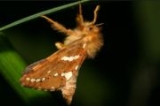
Hepialidae

Encyclopedia
The Hepialidae is a family of insects in the lepidoptera
n order. Moths of this family are often referred to as swift moths or ghost moths.
. There are 60 genera and at least 587 currently recognised species of these primitive moth
s recorded worldwide. The genera Fraus
(endemic to Australia
), Gazoryctra
(Holarctic
), Afrotheora
(Southern Africa
n), and Antihepialus
(African) are considered to be the most primitive, containing four genera and about 51 species with a mostly relictual southern Gondwanan distribution and are currently separated from the Hepialidae sensu stricto which might form a natural, derived
group. The most diverse genera are Oxycanus
with 73 species, Endoclita
with 60 species, Thitarodes
with 51 species and Cibyra with 50 species following a comprehensive catalogue of Exoporia
. The relationships of the many genera are not yet well established; see below for an ordered synonymic generic checklist, and the Taxobox for navigation.
and lack of a functional proboscis
or frenulum (see Kristensen, 1999: 61-62 for details). Like other Exoporia
the sperm
is transferred to the egg by an external channel between the "ostium" and the ovipore
. Other non-ditrysia
n moths have a common cloaca
. The moths are "homoneurous" with similar forewings and hindwings and are sometimes included as 'honorary' members of the Macrolepidoptera
, though archaic they are. Strictly speaking they are phylogenetically too basal
and constitute Microlepidoptera
, although hepialids range from very small moths to a wingspan record of 250 mm in Zelotypia
. Because of their sometimes large size and striking colour patterns, they have received more popular and taxonomic attention than most "micros". Many species display strong sexual dimorphism
with males smaller but more boldly marked than females, or at high elevation
, females of Pharmacis
and Aoraia
show "brachypterous" wing reduction.
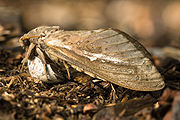 Hepialidae are distributed on ancient landmasses worldwide except Antarctica but with the surprising exceptions of Madagascar
, the Caribbean
islands and in Africa, Tropical West Africa
. It remains to be borne out if these absences are real as Aenetus
cohici was not long ago discovered in New Caledonia
. In the Oriental and Neotropical regions hepialids have diversified
in rainforest environments but this not apparently the case in the Afrotropics. Hepialids mostly have low dispersive powers and do not occur on Oceanic islands with the exception of Phassodes on Fiji
and Western Samoa and a few species in Japan
and Kurile Islands. Whilst the type locality of Eudalaca
sanctahelena is from the remote island of St Helena, this is thought to be an error for South Africa.
and some species form leks, also though to have arisen independently
in the hepialoid genus Ogygioses (Palaeosetidae
). In most genera, males fly swiftly to virgin females that are calling with scent. In other genera, virgin females "assemble" upwind to displaying males, which emit a musky pheromone
from scales on the metathoracic
tibiae. In such cases of sex role reversal, there may be visual cues also: males of the European Ghost Swift
are possibly the most frequently noticed species, being white, ghostly and conspicuous when forming a lek at dusk. Sometimes they hover singly as if suspended from a thread or flying in a figure of eight motion. The chemical structure of some pheromone
s have been analysed.
in a specific location but scatters ("broadcasts") them while in flight, sometimes in huge numbers (29,000 were recorded from a single female Trictena
, which is presumably a world record for the Lepidoptera). The maggot-like larva
e http://ukmoths.org.uk/show.php?id=2692 feed in a variety of ways. Probably all Exoporia
have concealed larvae, making silken tunnels in all manner of substrates. Some species feed on leaf litter, fungihttp://www.landcareresearch.co.nz/education/insects_spiders/pare/puriri_moth.asp, mosses, decaying vegetation, fern
s, gymnosperms and a wide span of monocot and dicot plants. There is very little evidence of hostplant specialisation; whilst the South African species Leto venus
is restricted to the tree Virgilia capensis
this may be a case of "ecological monophagy". A few feed on foliage (the austral
'oxyacanine' genera which may drag foliage into their feeding tunnel: Nielsen et al., 2000: 825). Most feed underground on fine root
s, at least in early instar
s and some then feed internally in tunnels in the stem or trunk of their hostplants. The pupa has rows of dorsal
spines on the abdominal segments as in other lower members of the Heteroneura
.
-attacking fungi Cordyceps
, and these can form an expensive ingredient.
The Witchetty grub
(which are sometimes hepialid larvae) is a popular food sources especially among aboriginal Australians. In Central America
and South America
, hepialid larvae are also eaten. However, some species of Wiseana
, Oncopera
, Oxycanus
, Fraus
and Dalaca
are considered pests of pastures in Australia, New Zealand and South America.
Lepidoptera
Lepidoptera is a large order of insects that includes moths and butterflies . It is one of the most widespread and widely recognizable insect orders in the world, encompassing moths and the three superfamilies of butterflies, skipper butterflies, and moth-butterflies...
n order. Moths of this family are often referred to as swift moths or ghost moths.
Taxonomy and systematics
Hepialidae constitute by far the most diverse group of the infraorder ExoporiaExoporia
Exoporia are a group of primitive Lepidoptera comprising the superfamilies Mnesarchaeoidea and Hepialoidea . Exoporia is a natural group or clade which is the sister group of the lepidopteran infraorder Heteroneura...
. There are 60 genera and at least 587 currently recognised species of these primitive moth
Moth
A moth is an insect closely related to the butterfly, both being of the order Lepidoptera. Moths form the majority of this order; there are thought to be 150,000 to 250,000 different species of moth , with thousands of species yet to be described...
s recorded worldwide. The genera Fraus
Fraus
In Roman mythology, Fraus was the goddess of treachery. A helper of Mercury, the word "fraud" has its origin in her name. Her Greek equivalent was Apate.In Celtic Mythology, Fraus was a very offensive curse word used to describe whores and prostitutes....
(endemic to Australia
Australia
Australia , officially the Commonwealth of Australia, is a country in the Southern Hemisphere comprising the mainland of the Australian continent, the island of Tasmania, and numerous smaller islands in the Indian and Pacific Oceans. It is the world's sixth-largest country by total area...
), Gazoryctra
Gazoryctra
Gazoryctra is a genus of moths of the family Hepialidae. There are 14 described species found in Eurasia, Canada and the United States.- Species :*Gazoryctra chishimana - Kuril Islands*Gazoryctra confusus - USA...
(Holarctic
Holarctic
The Holarctic ecozone refers to the habitats found throughout the northern continents of the world as a whole. This region is divided into the Palearctic, consisting of Northern Africa and all of Eurasia, with the exception of Southeast Asia and the Indian subcontinent, and the Nearctic,...
), Afrotheora
Afrotheora
Afrotheora is a genus of moths of the family Hepialidae. There are 7 described species, all found in southern Africa.- Species :*Afrotheora argentimaculata - South Africa*Afrotheora brevivalva - Tanzania*Afrotheora flavimaculata - Angola...
(Southern Africa
Southern Africa
Southern Africa is the southernmost region of the African continent, variably defined by geography or geopolitics. Within the region are numerous territories, including the Republic of South Africa ; nowadays, the simpler term South Africa is generally reserved for the country in English.-UN...
n), and Antihepialus
Antihepialus
Antihepialus is a genus of moths of the family Hepialidae. There are four described species, found in southern and eastern Africa.- Species :*Antihepialus antarcticus - South Africa*Antihepialus capeneri - South Africa...
(African) are considered to be the most primitive, containing four genera and about 51 species with a mostly relictual southern Gondwanan distribution and are currently separated from the Hepialidae sensu stricto which might form a natural, derived
Derived
In phylogenetics, a derived trait is a trait that is present in an organism, but was absent in the last common ancestor of the group being considered. This may also refer to structures that are not present in an organism, but were present in its ancestors, i.e. traits that have undergone secondary...
group. The most diverse genera are Oxycanus
Oxycanus
Oxycanus is a genus of moths of the family Hepialidae. There are 71 described species found in Australia and New Guinea.- Species :*O. aedisima - Australia*O. aegrus - New Guinea*O. albostrigata - Australia*O. altenai - New Guinea...
with 73 species, Endoclita
Endoclita
Endoclita is a genus of moths of the family Hepialidae. There are 60 described species found in eastern and southeast Asia and the Indian subcontinent.- Species :*E. aboe - India*E. absurdus - China*E. actinidae - China...
with 60 species, Thitarodes
Thitarodes
Thitarodes is a genus of moths of the family Hepialidae. There are 48 described species found in eastern Asia. The majority are restricted to the Tibetan Plateau...
with 51 species and Cibyra with 50 species following a comprehensive catalogue of Exoporia
Exoporia
Exoporia are a group of primitive Lepidoptera comprising the superfamilies Mnesarchaeoidea and Hepialoidea . Exoporia is a natural group or clade which is the sister group of the lepidopteran infraorder Heteroneura...
. The relationships of the many genera are not yet well established; see below for an ordered synonymic generic checklist, and the Taxobox for navigation.
Morphology and identification
The family Hepialidae is considered to be very primitive with a number of structural differences to other moths including very short antennaeAntenna (biology)
Antennae in biology have historically been paired appendages used for sensing in arthropods. More recently, the term has also been applied to cilium structures present in most cell types of eukaryotes....
and lack of a functional proboscis
Proboscis
A proboscis is an elongated appendage from the head of an animal, either a vertebrate or an invertebrate. In simpler terms, a proboscis is the straw-like mouth found in several varieties of species.-Etymology:...
or frenulum (see Kristensen, 1999: 61-62 for details). Like other Exoporia
Exoporia
Exoporia are a group of primitive Lepidoptera comprising the superfamilies Mnesarchaeoidea and Hepialoidea . Exoporia is a natural group or clade which is the sister group of the lepidopteran infraorder Heteroneura...
the sperm
Sperm
The term sperm is derived from the Greek word sperma and refers to the male reproductive cells. In the types of sexual reproduction known as anisogamy and oogamy, there is a marked difference in the size of the gametes with the smaller one being termed the "male" or sperm cell...
is transferred to the egg by an external channel between the "ostium" and the ovipore
Ovipore
An ovipore is a pore-like sexual organ of a female insect that gets inseminated by the spermatophores ejected by the aedeagus of a male insect during copulation. The spermatophores that pass through the ovipore are stored in most insect species in another organ called spermatheca....
. Other non-ditrysia
Ditrysia
The Ditrysia are a natural group or clade of insects in the Lepidopteran order containing both butterflies and moths. They are so named because the female has two distinct sexual openings: one for mating, and the other for laying eggs .About 98% of described species of Lepidoptera belong to Ditrysia...
n moths have a common cloaca
Cloaca
In zoological anatomy, a cloaca is the posterior opening that serves as the only such opening for the intestinal, reproductive, and urinary tracts of certain animal species...
. The moths are "homoneurous" with similar forewings and hindwings and are sometimes included as 'honorary' members of the Macrolepidoptera
Macrolepidoptera
Macrolepidoptera is a group within the insect order Lepidoptera. Traditionally used for the larger butterflies and moths as opposed to the "Microlepidoptera", this group is unnatural. However, it seems that by moving some taxa about, a monophyletic Macrolepidoptera can be easily achieved...
, though archaic they are. Strictly speaking they are phylogenetically too basal
Basal (phylogenetics)
In phylogenetics, a basal clade is the earliest clade to branch in a larger clade; it appears at the base of a cladogram.A basal group forms an outgroup to the rest of the clade, such as in the following example:...
and constitute Microlepidoptera
Microlepidoptera
Microlepidoptera is an artificial grouping of moth families, commonly known as the 'smaller moths' . These generally have a wingspan of under 20 mm, and are thus harder to identify by external phenotypic markings than macrolepidoptera...
, although hepialids range from very small moths to a wingspan record of 250 mm in Zelotypia
Zelotypia
Zelotypia is a monotypic moth genus of the family Hepialidae. The only described species is Z. stacyi, the Bentwing Ghost Moth, which is only found in Queensland and New South Wales, Australia. This is a very large species with a wingspan of up to 250 mm. The larva feeds and pupates in the...
. Because of their sometimes large size and striking colour patterns, they have received more popular and taxonomic attention than most "micros". Many species display strong sexual dimorphism
Sexual dimorphism
Sexual dimorphism is a phenotypic difference between males and females of the same species. Examples of such differences include differences in morphology, ornamentation, and behavior.-Examples:-Ornamentation / coloration:...
with males smaller but more boldly marked than females, or at high elevation
Elevation
The elevation of a geographic location is its height above a fixed reference point, most commonly a reference geoid, a mathematical model of the Earth's sea level as an equipotential gravitational surface ....
, females of Pharmacis
Pharmacis
Pharmacis is a genus of moths of the family Hepialidae. There are eight described species found in Eurasia.-Species:*Pharmacis aemilianus - Italy*Pharmacis anselminae - Italy*Pharmacis bertrandi - France...
and Aoraia
Aoraia
Aoraia is a genus of moths of the family Hepialidae. There are 13 described species, all endemic to New Zealand. This genus contains some large species with a wingspan of up to 150 mm.- Species :* Aoraia aspina* Aoraia aurimaculata...
show "brachypterous" wing reduction.
Distribution
Madagascar
The Republic of Madagascar is an island country located in the Indian Ocean off the southeastern coast of Africa...
, the Caribbean
Caribbean
The Caribbean is a crescent-shaped group of islands more than 2,000 miles long separating the Gulf of Mexico and the Caribbean Sea, to the west and south, from the Atlantic Ocean, to the east and north...
islands and in Africa, Tropical West Africa
West Africa
West Africa or Western Africa is the westernmost region of the African continent. Geopolitically, the UN definition of Western Africa includes the following 16 countries and an area of approximately 5 million square km:-Flags of West Africa:...
. It remains to be borne out if these absences are real as Aenetus
Aenetus
Aenetus is a genus of moths of the family Hepialidae. There are 24 described species found in Indonesia, New Guinea, New Caledonia, Australia and New Zealand. Most species have green or blue forewings and reddish hindwings but some are predominantly brown or white...
cohici was not long ago discovered in New Caledonia
New Caledonia
New Caledonia is a special collectivity of France located in the southwest Pacific Ocean, east of Australia and about from Metropolitan France. The archipelago, part of the Melanesia subregion, includes the main island of Grande Terre, the Loyalty Islands, the Belep archipelago, the Isle of...
. In the Oriental and Neotropical regions hepialids have diversified
Adaptive radiation
In evolutionary biology, adaptive radiation is the evolution of ecological and phenotypic diversity within a rapidly multiplying lineage. Starting with a recent single ancestor, this process results in the speciation and phenotypic adaptation of an array of species exhibiting different...
in rainforest environments but this not apparently the case in the Afrotropics. Hepialids mostly have low dispersive powers and do not occur on Oceanic islands with the exception of Phassodes on Fiji
Fiji
Fiji , officially the Republic of Fiji , is an island nation in Melanesia in the South Pacific Ocean about northeast of New Zealand's North Island...
and Western Samoa and a few species in Japan
Japan
Japan is an island nation in East Asia. Located in the Pacific Ocean, it lies to the east of the Sea of Japan, China, North Korea, South Korea and Russia, stretching from the Sea of Okhotsk in the north to the East China Sea and Taiwan in the south...
and Kurile Islands. Whilst the type locality of Eudalaca
Eudalaca
Eudalaca is a genus of moths of the family Hepialidae. There are 35 described species, most restricted to South Africa but a few found further north in the continent.- Species :*E. aequifascia - East Africa*E. albiplumis - South Africa...
sanctahelena is from the remote island of St Helena, this is thought to be an error for South Africa.
Behaviour
Swift moths are crepuscularCrepuscular
Crepuscular animals are those that are active primarily during twilight, that is during dawn and dusk. The word is derived from the Latin word crepusculum, meaning "twilight." Crepuscular is, thus, in contrast with diurnal and nocturnal behavior. Crepuscular animals may also be active on a bright...
and some species form leks, also though to have arisen independently
Convergent evolution
Convergent evolution describes the acquisition of the same biological trait in unrelated lineages.The wing is a classic example of convergent evolution in action. Although their last common ancestor did not have wings, both birds and bats do, and are capable of powered flight. The wings are...
in the hepialoid genus Ogygioses (Palaeosetidae
Palaeosetidae
Palaeosetidae or "Miniature Ghost Moths" is a family of insects in the Lepidopteran order contained within the superfamily Hepialoidea.-Taxonomy and systematics:...
). In most genera, males fly swiftly to virgin females that are calling with scent. In other genera, virgin females "assemble" upwind to displaying males, which emit a musky pheromone
Pheromone
A pheromone is a secreted or excreted chemical factor that triggers a social response in members of the same species. Pheromones are chemicals capable of acting outside the body of the secreting individual to impact the behavior of the receiving individual...
from scales on the metathoracic
Metathorax
The metathorax is the posterior of the three segments in the thorax of an insect, and bears the third pair of legs. Its principal sclerites are the metanotum , the metasternum , and the metapleuron on each side...
tibiae. In such cases of sex role reversal, there may be visual cues also: males of the European Ghost Swift
Ghost Moth
The Ghost Moth , also known as the Ghost Swift, is a moth of the family Hepialidae. It is common throughout Europe except for the far south-east...
are possibly the most frequently noticed species, being white, ghostly and conspicuous when forming a lek at dusk. Sometimes they hover singly as if suspended from a thread or flying in a figure of eight motion. The chemical structure of some pheromone
Pheromone
A pheromone is a secreted or excreted chemical factor that triggers a social response in members of the same species. Pheromones are chemicals capable of acting outside the body of the secreting individual to impact the behavior of the receiving individual...
s have been analysed.
Biology
The female does not lay its eggsEgg (biology)
An egg is an organic vessel in which an embryo first begins to develop. In most birds, reptiles, insects, molluscs, fish, and monotremes, an egg is the zygote, resulting from fertilization of the ovum, which is expelled from the body and permitted to develop outside the body until the developing...
in a specific location but scatters ("broadcasts") them while in flight, sometimes in huge numbers (29,000 were recorded from a single female Trictena
Trictena
Trictena is a genus of moths of the family Hepialidae. There are three described species, all endemic to Australia.-Species:*Trictena argyrosticha*Trictena atripalpis*Food plant: Eucalyptus*Trictena barnardi-External links:**...
, which is presumably a world record for the Lepidoptera). The maggot-like larva
Larva
A larva is a distinct juvenile form many animals undergo before metamorphosis into adults. Animals with indirect development such as insects, amphibians, or cnidarians typically have a larval phase of their life cycle...
e http://ukmoths.org.uk/show.php?id=2692 feed in a variety of ways. Probably all Exoporia
Exoporia
Exoporia are a group of primitive Lepidoptera comprising the superfamilies Mnesarchaeoidea and Hepialoidea . Exoporia is a natural group or clade which is the sister group of the lepidopteran infraorder Heteroneura...
have concealed larvae, making silken tunnels in all manner of substrates. Some species feed on leaf litter, fungihttp://www.landcareresearch.co.nz/education/insects_spiders/pare/puriri_moth.asp, mosses, decaying vegetation, fern
Fern
A fern is any one of a group of about 12,000 species of plants belonging to the botanical group known as Pteridophyta. Unlike mosses, they have xylem and phloem . They have stems, leaves, and roots like other vascular plants...
s, gymnosperms and a wide span of monocot and dicot plants. There is very little evidence of hostplant specialisation; whilst the South African species Leto venus
Leto venus
Leto is a monotypic moth genus of the family Hepialidae. The only described species is L. venus which is endemic to South Africa. The larval food plant is Virgilia....
is restricted to the tree Virgilia capensis
Virgilia (genus)
Virgilia is a genus of Southern African trees in the family Fabaceae, having shiny to hairy pinnate leaves and attractive mauve to pink pea-shaped flowers followed by leathery pods...
this may be a case of "ecological monophagy". A few feed on foliage (the austral
Southern Hemisphere
The Southern Hemisphere is the part of Earth that lies south of the equator. The word hemisphere literally means 'half ball' or "half sphere"...
'oxyacanine' genera which may drag foliage into their feeding tunnel: Nielsen et al., 2000: 825). Most feed underground on fine root
Root
In vascular plants, the root is the organ of a plant that typically lies below the surface of the soil. This is not always the case, however, since a root can also be aerial or aerating . Furthermore, a stem normally occurring below ground is not exceptional either...
s, at least in early instar
Instar
An instar is a developmental stage of arthropods, such as insects, between each molt , until sexual maturity is reached. Arthropods must shed the exoskeleton in order to grow or assume a new form. Differences between instars can often be seen in altered body proportions, colors, patterns, or...
s and some then feed internally in tunnels in the stem or trunk of their hostplants. The pupa has rows of dorsal

Dorsum (biology)
In anatomy, the dorsum is the upper side of animals that typically run, fly, or swim in a horizontal position, and the back side of animals that walk upright. In vertebrates the dorsum contains the backbone. The term dorsal refers to anatomical structures that are either situated toward or grow...
spines on the abdominal segments as in other lower members of the Heteroneura
Heteroneura
Heteroneura is a natural group in the insect order Lepidoptera that comprises over 99% of all butterflies and moths. This is the sister group of the infraorder Exoporia , and is characterised by wing venation which is not similar or homoneurous in both pairs of wings....
.
Economic significance
Chinese medicine makes considerable use of the "mummies" collected of the caterpillarCaterpillar
Caterpillars are the larval form of members of the order Lepidoptera . They are mostly herbivorous in food habit, although some species are insectivorous. Caterpillars are voracious feeders and many of them are considered to be pests in agriculture...
-attacking fungi Cordyceps
Cordyceps
Cordyceps is a genus of ascomycete fungi that includes about 400 described species. All Cordyceps species are endoparasitoids, mainly on insects and other arthropods ; a few are parasitic on other fungi. The best known species of the genus is Cordyceps sinensis, first recorded as yartsa gunbu in...
, and these can form an expensive ingredient.
The Witchetty grub
Witchetty grub
The witchetty grub is a term used in Australia for the large, white, wood-eating larvae of several moths...
(which are sometimes hepialid larvae) is a popular food sources especially among aboriginal Australians. In Central America
Central America
Central America is the central geographic region of the Americas. It is the southernmost, isthmian portion of the North American continent, which connects with South America on the southeast. When considered part of the unified continental model, it is considered a subcontinent...
and South America
South America
South America is a continent situated in the Western Hemisphere, mostly in the Southern Hemisphere, with a relatively small portion in the Northern Hemisphere. The continent is also considered a subcontinent of the Americas. It is bordered on the west by the Pacific Ocean and on the north and east...
, hepialid larvae are also eaten. However, some species of Wiseana
Wiseana
Wiseana is a genus of moths of the family Hepialidae. There are seven described species, all endemic to New Zealand.-Species:* Wiseana cervinata*Recorded food plants: Trifolium, various grasses.* Wiseana copularis* Wiseana fuliginea...
, Oncopera
Oncopera
Oncopera is a genus of moths of the family Hepialidae. There are 12 described species, all endemic to Australia. The larvae usually feed on grasses, although that of O...
, Oxycanus
Oxycanus
Oxycanus is a genus of moths of the family Hepialidae. There are 71 described species found in Australia and New Guinea.- Species :*O. aedisima - Australia*O. aegrus - New Guinea*O. albostrigata - Australia*O. altenai - New Guinea...
, Fraus
Fraus
In Roman mythology, Fraus was the goddess of treachery. A helper of Mercury, the word "fraud" has its origin in her name. Her Greek equivalent was Apate.In Celtic Mythology, Fraus was a very offensive curse word used to describe whores and prostitutes....
and Dalaca
Dalaca
Dalaca is a genus of moths of the family Hepialidae. There are 23 described species found throughout South America as far north as Panama. The larvae feed on grasses.- Species :*D. chilensis - Chile*D. chiriquensis - Panama...
are considered pests of pastures in Australia, New Zealand and South America.
Fauna of Europe
Source http://www.faunaeur.org/full_results.php?id=65 and identification- GazoryctraGazoryctraGazoryctra is a genus of moths of the family Hepialidae. There are 14 described species found in Eurasia, Canada and the United States.- Species :*Gazoryctra chishimana - Kuril Islands*Gazoryctra confusus - USA...
fuscoargentea O. Bang-Haas 1927 - Northern ScandinaviaScandinaviaScandinavia is a cultural, historical and ethno-linguistic region in northern Europe that includes the three kingdoms of Denmark, Norway and Sweden, characterized by their common ethno-cultural heritage and language. Modern Norway and Sweden proper are situated on the Scandinavian Peninsula,... - GazoryctraGazoryctraGazoryctra is a genus of moths of the family Hepialidae. There are 14 described species found in Eurasia, Canada and the United States.- Species :*Gazoryctra chishimana - Kuril Islands*Gazoryctra confusus - USA...
ganna (Hübner 1808)- AlpsAlpsThe Alps is one of the great mountain range systems of Europe, stretching from Austria and Slovenia in the east through Italy, Switzerland, Liechtenstein and Germany to France in the west....
, northern Scandinavia, northern RussiaRussiaRussia or , officially known as both Russia and the Russian Federation , is a country in northern Eurasia. It is a federal semi-presidential republic, comprising 83 federal subjects... - Hepialus humuli Linnaeus 1758 Ghost MothGhost MothThe Ghost Moth , also known as the Ghost Swift, is a moth of the family Hepialidae. It is common throughout Europe except for the far south-east...
- Europe - KorscheltellusKorscheltellusKorscheltellus is a genus of moths of the family Hepialidae. It consists of two widespread species, the familiar Common Swift of Europe and the Conifer Swift of Canada and the eastern United States. K...
lupulinus Linnaeus 1758 Common SwiftCommon Swift (moth)The Common Swift is a moth of the family Hepialidae. It was previously placed in the genus Hepialus. It is a common, often abundant European species....
- Europe - PharmacisPharmacisPharmacis is a genus of moths of the family Hepialidae. There are eight described species found in Eurasia.-Species:*Pharmacis aemilianus - Italy*Pharmacis anselminae - Italy*Pharmacis bertrandi - France...
aemiliana Costantini 1911 - ItalyItalyItaly , officially the Italian Republic languages]] under the European Charter for Regional or Minority Languages. In each of these, Italy's official name is as follows:;;;;;;;;), is a unitary parliamentary republic in South-Central Europe. To the north it borders France, Switzerland, Austria and... - PharmacisPharmacisPharmacis is a genus of moths of the family Hepialidae. There are eight described species found in Eurasia.-Species:*Pharmacis aemilianus - Italy*Pharmacis anselminae - Italy*Pharmacis bertrandi - France...
anselminae Teobaldelli 1977- Italy - PharmacisPharmacisPharmacis is a genus of moths of the family Hepialidae. There are eight described species found in Eurasia.-Species:*Pharmacis aemilianus - Italy*Pharmacis anselminae - Italy*Pharmacis bertrandi - France...
bertrandi Le Cerf 1936 - FranceFranceThe French Republic , The French Republic , The French Republic , (commonly known as France , is a unitary semi-presidential republic in Western Europe with several overseas territories and islands located on other continents and in the Indian, Pacific, and Atlantic oceans. Metropolitan France... - PharmacisPharmacisPharmacis is a genus of moths of the family Hepialidae. There are eight described species found in Eurasia.-Species:*Pharmacis aemilianus - Italy*Pharmacis anselminae - Italy*Pharmacis bertrandi - France...
carna Denis & Schiffermüller 1775 - Central and Eastern Europe - PharmacisPharmacisPharmacis is a genus of moths of the family Hepialidae. There are eight described species found in Eurasia.-Species:*Pharmacis aemilianus - Italy*Pharmacis anselminae - Italy*Pharmacis bertrandi - France...
castillana Oberthür 1883 - SpainSpainSpain , officially the Kingdom of Spain languages]] under the European Charter for Regional or Minority Languages. In each of these, Spain's official name is as follows:;;;;;;), is a country and member state of the European Union located in southwestern Europe on the Iberian Peninsula... - PharmacisPharmacisPharmacis is a genus of moths of the family Hepialidae. There are eight described species found in Eurasia.-Species:*Pharmacis aemilianus - Italy*Pharmacis anselminae - Italy*Pharmacis bertrandi - France...
claudiae Kristal & Hirneisen 1994 - Italy - PharmacisPharmacisPharmacis is a genus of moths of the family Hepialidae. There are eight described species found in Eurasia.-Species:*Pharmacis aemilianus - Italy*Pharmacis anselminae - Italy*Pharmacis bertrandi - France...
fusconebulosa De Geer 1778 Map-winged SwiftMap-winged SwiftThe Map-winged Swift is a moth belonging to the family Hepialidae. It has a patchy distribution throughout Eurasia...
- Europe - PharmacisPharmacisPharmacis is a genus of moths of the family Hepialidae. There are eight described species found in Eurasia.-Species:*Pharmacis aemilianus - Italy*Pharmacis anselminae - Italy*Pharmacis bertrandi - France...
pyrenaica Donzel 1838 - PyreneesPyreneesThe Pyrenees is a range of mountains in southwest Europe that forms a natural border between France and Spain... - PhymatopusPhymatopusPhymatopus is a genus of moths of the family Hepialidae. There are six described species scattered across the Northern Hemisphere, placed in two groups.-Species:Phymatopus Wallengren, 1869*Phymatopus hecta Gold Swift - Europe...
hecta Linnaeus 1758 Gold SwiftGold SwiftThe Gold Swift is a species of moth belonging to the family Hepialidae. Until recently it was placed in the genus Hepialus. It is a widespread species of Europe, its distribution following that of its foodplant, bracken....
- Central and northern Europe - TriodiaTriodia (animal genus)This article is about the genus of moths. For the genus of grasses see Triodia Triodia is a genus of moths of the family Hepialidae...
adriaticus Osthelder 1931 - CroatiaCroatiaCroatia , officially the Republic of Croatia , is a unitary democratic parliamentary republic in Europe at the crossroads of the Mitteleuropa, the Balkans, and the Mediterranean. Its capital and largest city is Zagreb. The country is divided into 20 counties and the city of Zagreb. Croatia covers ...
, MacedoniaRepublic of MacedoniaMacedonia , officially the Republic of Macedonia , is a country located in the central Balkan peninsula in Southeast Europe. It is one of the successor states of the former Yugoslavia, from which it declared independence in 1991...
, GreeceGreeceGreece , officially the Hellenic Republic , and historically Hellas or the Republic of Greece in English, is a country in southeastern Europe....
, CreteCreteCrete is the largest and most populous of the Greek islands, the fifth largest island in the Mediterranean Sea, and one of the thirteen administrative regions of Greece. It forms a significant part of the economy and cultural heritage of Greece while retaining its own local cultural traits... - TriodiaTriodia (animal genus)This article is about the genus of moths. For the genus of grasses see Triodia Triodia is a genus of moths of the family Hepialidae...
amasina Herrich-Schäffer 1851 - BalkansBalkansThe Balkans is a geopolitical and cultural region of southeastern Europe... - TriodiaTriodia (animal genus)This article is about the genus of moths. For the genus of grasses see Triodia Triodia is a genus of moths of the family Hepialidae...
sylvina Linnaeus 1761 Orange SwiftOrange SwiftThe Orange Swift , also known as "Orange Moth" , is a species of moth belonging to the family Hepialidae. It was previously placed in the genus Hepialus. It is distributed throughout Europe....
- Europe
Generic checklist
- FrausFraus (genus)Fraus is a genus of moths of the family Hepialidae. There are 25 described species, all endemic to Australia.-Species:*Fraus basicornis*Fraus basidispina*Fraus bilineata*Fraus biloba*Fraus crocea*Fraus distispina...
Walker, 1856- =Hectomanes Meyrick, 1980
- =Praus; Pagenstacher, 1909
- GazoryctraGazoryctraGazoryctra is a genus of moths of the family Hepialidae. There are 14 described species found in Eurasia, Canada and the United States.- Species :*Gazoryctra chishimana - Kuril Islands*Gazoryctra confusus - USA...
Hübner, [1820]- =Garzorycta; Hübner, [1826]
- =Gazoryctes; Kirby, 1892
- AfrotheoraAfrotheoraAfrotheora is a genus of moths of the family Hepialidae. There are 7 described species, all found in southern Africa.- Species :*Afrotheora argentimaculata - South Africa*Afrotheora brevivalva - Tanzania*Afrotheora flavimaculata - Angola...
Nielsen and Scoble, 1986 - AntihepialusAntihepialusAntihepialus is a genus of moths of the family Hepialidae. There are four described species, found in southern and eastern Africa.- Species :*Antihepialus antarcticus - South Africa*Antihepialus capeneri - South Africa...
Janse, 1942- =Ptycholoma; Felder, 1874
- BipectilisBipectilisBipectilis is a genus of moths of the family Hepialidae. There are eight described species in the genus, distributed through China, Nepal and Vietnam.-Species:*Bipectilis gracilirami*Bipectilis latirami*Bipectilis omaiensis...
Chus and Wang, 1985 - PalpiferPalpiferPalpifer is a genus of moths of the family Hepialidae. There are 10 described species found in south and east Asia and parts of Mexico.- Species :*P. falkneri - Nepal*P. hopponis - Taiwan*P. madurensis - Madura*P. murinus - India...
Hampson, [1893]- =Palpiphorus; Quail, 1900
- =Palpiphora; Pagenstacher, 1909
- EudalacaEudalacaEudalaca is a genus of moths of the family Hepialidae. There are 35 described species, most restricted to South Africa but a few found further north in the continent.- Species :*E. aequifascia - East Africa*E. albiplumis - South Africa...
Viette, 1950- =Eudalacina Paclt, 1953
- GorgopisGorgopisGorgopis is a genus of moths of the family Hepialidae. There are 28 described species found in southern and eastern Africa.- Species :*G. alticola - Tanzania*G. annulosa - South Africa*G. armillata - South Africa...
Hübner, [1820]- =Gorcopis; Walker, 1856
- MetahepialusMetahepialusMetahepialus is a genus of moths of the family Hepialidae. There are three described species, all endemic to South Africa....
Janse, 1942 - DalacaDalacaDalaca is a genus of moths of the family Hepialidae. There are 23 described species found throughout South America as far north as Panama. The larvae feed on grasses.- Species :*D. chilensis - Chile*D. chiriquensis - Panama...
Walker, 1856- =Huapina Bryk, 1945
- =Maculella Viette, 1950
- =Toenga Tindale, 1954
- CallipielusCallipielusCallipielus is a genus of moths of the family Hepialidae. There are 10 described species, all found in southern South America.- Species :*Callipielus arenosus - Chile/Argentina*Callipielus argentata - Chile*Callipielus digitata - Chile...
Butler, 1882- =Stachyocera Ureta, 1957
- BlanchardinellaBlanchardinellaBlanchardinella is a genus of moths of the family Hepialidae. There is one known species. This genus was previously known as Blanchardina....
Nielsen, Robinson & Wagner, 2000- =Blanchardina Viette, 1950, nec Labbe, 1899
- CaladaCaladaCalada is a genus of moths of the family Hepialidae. There are two described species, both endemic to Argentina....
Nielsen and Robinson, 1983 - PuermytransPuermytransPuermytrans is a monotypic moth genus of the family Hepialidae. The only described species is P. chilensis of Chile....
Viette, 1951 - ParapielusParapielusParapielus is a genus of moths of the family Hepialidae....
Viette, 1949- =Lossbergiana Viette, 1951
- AndeabatisAndeabatisAndeabatis is a monotypic moth genus of the family Hepialidae. The only species is Andeabatis chilensis of southern South America....
Nielsen and Robinson, 1983 - DruceiellaDruceiellaDruceiella is a genus of moths of the family Hepialidae. There are currently 4 described species although a revision of the genus is currently being carried out which will add at least 4 new species...
Viette, 1949 - TrichophassusTrichophassusTrichophassus is a monotypic moth genus of the family Hepialidae. The only described species is Trichophassus giganteus which is endemic to Brazil. The larva of this species has been recorded feeding on Adenocalymna, Eucalyptus, Ipomoea and Solanum....
Le Cerf, 1919 - PhassusPhassusPhassus is a genus of moths of the family Hepialidae. There are 21 described species distributed from Mexico south to Brazil.-Species:*Phassus absyrtus - Brazil*Phassus agrionides - Brazil*Phassus aurigenus - Costa Rica...
Walker, 1856 - SchausianaSchausianaSchausiana is a monotypic moth genus of the family Hepialidae. The only described species is S. trojesa which is endemic to Mexico....
Viette, 1950 - AplatissaAplatissaAplatissa is a genus of moths of the family Hepialidae. There are two described species, both endemic to Brazil....
Viette, 1953 - PfitznerianaPfitznerianaPfitzneriana is a genus of moths of the family Hepialidae. There are four described species, all found in South America.-Species:*P. allura - Bolivia*P. olivescens - Colombia*P. prosopus - Colombia*P. volgi - Venezuela...
Viette, 1952 - CibyraCibyraCibyra is a genus of moths of the family Hepalidae. There are 50 described species, found throughout Central and South America.- Species :*Cibyra assa - Mexico*Cibyra biedermanni - Brazil*Cibyra brasiliensis - Brazil...
Walker, 1856 - Cibyra (Pseudodalaca Viette, 1950)
- Cibyra (Gymelloxes Viette, 1952)
- Cibyra (Alloaepytus Viette, 1951)
- Cibyra (Aeptus) Herrich-Schäffer, [1858]
- Cibyra (Thiastyx Viette, 1951)
- Cibyra (Schaefferiana Viette, 1950)
- Cibyra (Paragorgopis Viette, 1952)
- Cibyra (Hepialyxodes Viette, 1951)
- Cibyra (Xytrops Viette, 1951)
- Cibyra (CibyraCibyraCibyra is a genus of moths of the family Hepalidae. There are 50 described species, found throughout Central and South America.- Species :*Cibyra assa - Mexico*Cibyra biedermanni - Brazil*Cibyra brasiliensis - Brazil...
Walker, 1856) - Cibyra (Lamelliformia Viette, 1952)
- Cibyra (Tricladia Felder, 1874)
- =Pseudophassus Pfitzner, 1914
- =Parana Viette, 1950
- Cibyra (Pseudophilaenia Viette, 1951)
- Cibyra (Philoenia Kirby, 1892)
- =Philaenia auctt.
- Cibyra (Yleuxas Viette, 1951)
- PhialusePhialusePhialuse is a monotypic moth genus of the family Hepialidae. The only described species is P. palmar of Bolivia....
Viette, 1961 - RosealaRosealaRoseala is a monotypic moth genus of the family Hepialidae. The only described species is R. bourgognei which is endemic to Brazil....
Viette, 1950 - DalacaDalacaDalaca is a genus of moths of the family Hepialidae. There are 23 described species found throughout South America as far north as Panama. The larvae feed on grasses.- Species :*D. chilensis - Chile*D. chiriquensis - Panama...
auctt., nec Walker, 1856 - PfitzneriellaPfitzneriellaPfitzneriella is a genus of moths of the family Hepialidae. There are four described species restricted to Ecuador and Peru.-Species:*P. lucicola - Ecuador*P. monticola - Ecuador*P. remota - Peru*P. similis - Peru...
Viette, 1951 - AoraiaAoraiaAoraia is a genus of moths of the family Hepialidae. There are 13 described species, all endemic to New Zealand. This genus contains some large species with a wingspan of up to 150 mm.- Species :* Aoraia aspina* Aoraia aurimaculata...
Dumbleton, 1966- =Trioxycanus Dumbleton, 1966
- TriodiaTriodia (animal genus)This article is about the genus of moths. For the genus of grasses see Triodia Triodia is a genus of moths of the family Hepialidae...
- =Alphus Wallengren, 1869, nec Dejean, 1833
- KorscheltellusKorscheltellusKorscheltellus is a genus of moths of the family Hepialidae. It consists of two widespread species, the familiar Common Swift of Europe and the Conifer Swift of Canada and the eastern United States. K...
Börner, 1920 - PharmacisPharmacisPharmacis is a genus of moths of the family Hepialidae. There are eight described species found in Eurasia.-Species:*Pharmacis aemilianus - Italy*Pharmacis anselminae - Italy*Pharmacis bertrandi - France...
Hübner, [1820] - ThitarodesThitarodesThitarodes is a genus of moths of the family Hepialidae. There are 48 described species found in eastern Asia. The majority are restricted to the Tibetan Plateau...
Viette, 1968- =Forkalus Chu and Wang, 1985
- PhymatopusPhymatopusPhymatopus is a genus of moths of the family Hepialidae. There are six described species scattered across the Northern Hemisphere, placed in two groups.-Species:Phymatopus Wallengren, 1869*Phymatopus hecta Gold Swift - Europe...
Wallengren, 1869- =Hepiolopsis Börner, 1920
- =Phimatopus; auctt.
- PhymatopusPhymatopusPhymatopus is a genus of moths of the family Hepialidae. There are six described species scattered across the Northern Hemisphere, placed in two groups.-Species:Phymatopus Wallengren, 1869*Phymatopus hecta Gold Swift - Europe...
auctt. nec Wallengren, 1869 - Hepialus Fabricius, 1775
- =Hepiolus Illiger, 1801
- =Epialus Agassiz, 1847
- =Epiolus Agassiz, 1847
- =Tephus Wallengren, 1869
- =Trepialus; Latreille, [1805]
- ZenophassusZenophassusZenophassus is a monotypic moth genus of the family Hepialidae. The only described species is Z. schamyl of Georgia. The larva of this species feeds on grapevines.-External links:*...
Tindale, 1941 - SthenopisSthenopisSthenopis is a genus of moths of the family Hepialidae. There are eight described species found in North America and China.-Species:*Sthenopis argenteomaculatus - Canada/United States*Recorded food plants: Alnus, Betula, Salix...
auctt. nec Packard, [1865] - EndoclitaEndoclitaEndoclita is a genus of moths of the family Hepialidae. There are 60 described species found in eastern and southeast Asia and the Indian subcontinent.- Species :*E. aboe - India*E. absurdus - China*E. actinidae - China...
; Felder, 1874- =Endoclyta, Felder, 1875
- =Hypophassus, Le Cerf, 1919
- =Nevina, Tindale, 1941
- =Sahyadrassus, Tindale, 1941
- =Procharagia, Viette, 1949
- NeohepialiscusNeohepialiscusNeohepialiscus is a monotypic moth genus of the family Hepialidae. The only described species is N. algeriensis of Algeria and Tunisia....
Viette, 1948 - ElhammaElhammaElhamma is a genus of moths of the family Hepialidae. There are four described species found in Australia and New Guinea.- Species :*E. australasiae - Australia*E. diakonoffi - New Guinea*E. roepkei - New Guinea...
Walker, 1856- =Perissectis Meyrick, 1890
- =Pericentris; Pagenstacher, 1909
- =Zauxieus Viette, 1952
- =Theaxieus Viette, 1952
- JeanaJeanaJeana is a genus of moths of the family Hepialidae. There are two described species, both endemic to Australia....
Tindale, 1935 - CladoxycanusCladoxycanusCladoxycanus minos is a monotypic species of moth belonging to the family Hepialidae. It is endemic to New Zealand....
Dumbleton, 1966 - WiseanaWiseanaWiseana is a genus of moths of the family Hepialidae. There are seven described species, all endemic to New Zealand.-Species:* Wiseana cervinata*Recorded food plants: Trifolium, various grasses.* Wiseana copularis* Wiseana fuliginea...
Viette, 1961- =Porina Walker, 1956, nec d'Orbigny, 1852
- =Gorina; Quail, 1899
- =Goryna; Quail, 1899
- =Philpottia Viette, 1950, nec Broun, 1915
- HeloxycanusHeloxycanusHeloxycanus patricki is a species of moth of the family Hepialidae, the only member of the genus Heloxycanus. Its common names are ghost moth and sphagnum porina moth. The species is named for its discoverer, entomologist Brian Patrick. It is found in Sphagnum and other moss bogs in the southern...
Dugdale, 1994 - DumbletoniusDumbletoniusDumbletonius is a genus of moths of the family Hepialidae. There are two described species, both endemic to New Zealand.The genus was named in honour of Lionel Jack Dumbleton....
; auctt- =Trioxycanus Dumbleton, 1966
- DioxycanusDioxycanusDioxycanus is a genus of moths of the family Hepialidae. There are 2 described species, both endemic to New Zealand....
Dumbleton, 1966 - NapialusNapialusNapialus is a genus of moths of the family Hepialidae. There are three described species, all endemic to China.- Species :*N. hunanensis - Hunan*N. kulingi*N. chongquingensis - Chongqing...
Chu and Wang, 1985 - HepialiscusHepialiscusHepialiscus is a genus of moths of the family Hepialidae. There are four described species found in Taiwan and Nepal. The larvae feed on grasses.- Species :*H. monticola - Taiwan*H. nepalensis - Nepal*H. robinsoni - Taiwan...
Hampson, [1893] - ParahepialiscusParahepialiscusParahepialiscus is a monotypic moth genus of the family Hepialidae. The only described species is P. borneensis of Borneo....
Viette, 1950 - XhoaphryxXhoaphryxXhoaphryx is a monotypic moth genus of the family Hepialidae. The only described species is X. lemeei of Vietnam.-External links:*...
Viette, 1953 - AenetusAenetusAenetus is a genus of moths of the family Hepialidae. There are 24 described species found in Indonesia, New Guinea, New Caledonia, Australia and New Zealand. Most species have green or blue forewings and reddish hindwings but some are predominantly brown or white...
Herrich-Schäffer, [1858]- =Charagia Walker, 1856
- =Phloiopsyche Scott, 1864
- =Oenetus; Kirby, 1892
- =Choragia; Pagenstacher, 1909
- =Oenetes; Oke, 1953
- Leto Hübner, [1820]
- =Ecto; Pagenstacher, 1909
- ZelotypiaZelotypiaZelotypia is a monotypic moth genus of the family Hepialidae. The only described species is Z. stacyi, the Bentwing Ghost Moth, which is only found in Queensland and New South Wales, Australia. This is a very large species with a wingspan of up to 250 mm. The larva feeds and pupates in the...
Scott, 1869- =Xylopsyche Swainson, 1851
- =Leto; auctt
- OncoperaOncoperaOncopera is a genus of moths of the family Hepialidae. There are 12 described species, all endemic to Australia. The larvae usually feed on grasses, although that of O...
- =Oncoptera Walker, 1890
- =Paroncopera Tindale, 1933
- =Onchopera; Birket-Smith, 1974
- =Onchoptera; Birket-Smith, 1974
- TrictenaTrictenaTrictena is a genus of moths of the family Hepialidae. There are three described species, all endemic to Australia.-Species:*Trictena argyrosticha*Trictena atripalpis*Food plant: Eucalyptus*Trictena barnardi-External links:**...
Meyrick, 1890 - BordaiaBordaiaBordaia is a genus of moths of the family Hepialidae. There are five described species, all endemic to Australia.- Species :*Bordaia furva*Bordaia karnka*Bordaia moesta*Bordaia paradoxa*Bordaia pica-External links:*...
Tindale, 1932- =Bordaja; Chu and Wang, 1985
- AbantiadesAbantiadesAbantiades is a genus of moths of the family Hepialidae. There are 14 described species, all found exclusively in Australia. The group includes some large species with a wingspan of up to 160 mm. The larvae feed on the roots of Eucalyptus and other trees.The Pindi Moth Abantiades is a genus of...
Herrich-Schäffer, [1858]- =Pielus Walker, 1856
- =Rhizopsyche Scott, 1864
- OxycanusOxycanusOxycanus is a genus of moths of the family Hepialidae. There are 71 described species found in Australia and New Guinea.- Species :*O. aedisima - Australia*O. aegrus - New Guinea*O. albostrigata - Australia*O. altenai - New Guinea...
Walker, 1856- =Porina Walker, 1856
- =Gorina; Quail, 1899
- =Goryna; Quail, 1899
- =Paraoxyxanus Viette, 1950
- PhassodesPhassodesPhassodes is a monotypic moth genus of the family Hepialidae. The only species is considered to be P. vitiensis which is found in Fiji and possibly Samoa. It is very variable and in the past the genus has been split into up to seven species. The life cycle is unknown but the larva is presumed to...
Bethune-Baker, 1905
External links
- Tree of Life
- Australian Moths Online
- Hepialidae of Australia
- Hepialidae of the World - List of Genera and Links to Species
- New Zealand Wiseana
- pdf Swift Moth Lekking
- Lep index list of Hepialidae species
- Endoclita and Hepialus pheromones
- Abstract, counterfeit hepialid mummies
- Puriri Moth
- Wiseana
- Obituary of Norman B. Tindale