

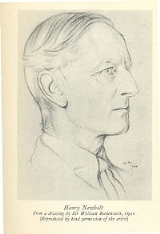
Henry Newbolt

Encyclopedia
Sir Henry John Newbolt, CH
(6 June 1862 – 19 April 1938) was an English
poet
. He is best remembered for Vitaï Lampada, a lyrical piece used for propaganda purposes during the First World War.
, Wolverhampton
(then located in Staffordshire
, but now in the West Midlands), son of the vicar of St Mary's Church, the Rev. Henry Francis Newbolt, and his second wife, Emily. After his father's death, the family moved to Walsall
, where Henry was educated.
, from where he gained a scholarship to Clifton College
, where he was head of the school (1881) and edited the school magazine. His contemporaries there included Douglas Haig
. Graduating from Corpus Christi College, Oxford
, Newbolt was called to the bar at Lincoln's Inn
in 1887 and practised until 1899.
(1887–1973), the Head of Recruitment at HM Colonial Service from 1931–48; they had four children. Lady Furse died in 1975.
Subsequently it became apparent that behind the prim Edwardian exterior lay a far more complicated domestic life for Newbolt: a ménage à trois. His wife had a long running lesbian affair with her childhood love, Ella Coltman, who accompanied the Newbolts on their honeymoon.
Newbolt died in Coltman's home in Kensington. One of his poems, in which he refers to someone as "dearest", is entitled "To E.C." He was also Coltman's lover.
but it was the publication of his ballads, Admirals All (1897), that created his literary reputation. By far the best-known of these is "Vitae Lampada". They were followed by other volumes of stirring verse, including The Island Race (1898), The Sailing of the Long-ships (1902), Songs of the Sea (1904) and Songs of the Fleet (1910).
In 1914, Newbolt published Aladore, a fantasy novel about a bored but dutiful knight who abruptly abandons his estate and wealth to discover his heart's desire and woo a half-fae
enchantress. It is a tale filled with allegories about the nature of youth, service, individuality and tradition. It was reissued in a new edition by Newcastle Publishing Company
in 1975.
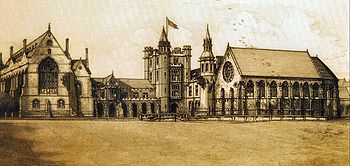 Probably the best known of all Newbolt's poems which was written in 1892, and for which he is now chiefly remembered is Vitae Lampada. The title is taken from a quotation by Lucretius
and means 'the torch of life'. It refers to how a schoolboy, a future soldier, learns selfless commitment to duty in cricket matches in the famous Close at Clifton College:
The engagement mentioned in verse two is the Battle of Abu Klea
in Sudan
in January 1885 during the unsuccessful expedition to rescue General Gordon. The poem was both highly regarded and repeatedly satirised by those who experienced World War I
.
owned by Sir Francis Drake
will beat in times of national crisis and the spirit of Drake will return to aid his country. Sir Henry reinforced the myth, with his 1897 poem Drake's Drum
, which has been put to both classical and folk tunes. 'Drakes Drum' is the first of five poetic settings by the composer Charles Villiers Stanford
. Stanford has two song cycles, both using the poetry of Newbolt, the Songs of the Sea and also Songs of the Fleet.
and the Coefficients dining club
.
is displayed on a modern building in the street where he was born.
Recordings were made of Newbolt reading some of his own poems. They were on four 78rpm sides in the Columbia Records
'International Educational Society' Lecture series, Lecture 92 (D40181/2).
See also .
Order of the Companions of Honour
The Order of the Companions of Honour is an order of the Commonwealth realms. It was founded by King George V in June 1917, as a reward for outstanding achievements in the arts, literature, music, science, politics, industry or religion....
(6 June 1862 – 19 April 1938) was an English
England
England is a country that is part of the United Kingdom. It shares land borders with Scotland to the north and Wales to the west; the Irish Sea is to the north west, the Celtic Sea to the south west, with the North Sea to the east and the English Channel to the south separating it from continental...
poet
Poet
A poet is a person who writes poetry. A poet's work can be literal, meaning that his work is derived from a specific event, or metaphorical, meaning that his work can take on many meanings and forms. Poets have existed since antiquity, in nearly all languages, and have produced works that vary...
. He is best remembered for Vitaï Lampada, a lyrical piece used for propaganda purposes during the First World War.
Background
Henry John Newbolt was born in BilstonBilston
Bilston is a town in the English county of West Midlands, situated in the southeastern corner of the City of Wolverhampton. Three wards of Wolverhampton City Council cover the town: Bilston East and Bilston North, which almost entirely comprise parts of the historic Borough of Bilston, and...
, Wolverhampton
Wolverhampton
Wolverhampton is a city and metropolitan borough in the West Midlands, England. For Eurostat purposes Walsall and Wolverhampton is a NUTS 3 region and is one of five boroughs or unitary districts that comprise the "West Midlands" NUTS 2 region...
(then located in Staffordshire
Staffordshire
Staffordshire is a landlocked county in the West Midlands region of England. For Eurostat purposes, the county is a NUTS 3 region and is one of four counties or unitary districts that comprise the "Shropshire and Staffordshire" NUTS 2 region. Part of the National Forest lies within its borders...
, but now in the West Midlands), son of the vicar of St Mary's Church, the Rev. Henry Francis Newbolt, and his second wife, Emily. After his father's death, the family moved to Walsall
Walsall
Walsall is a large industrial town in the West Midlands of England. It is located northwest of Birmingham and east of Wolverhampton. Historically a part of Staffordshire, Walsall is a component area of the West Midlands conurbation and part of the Black Country.Walsall is the administrative...
, where Henry was educated.
Education
Newbolt attended Queen Mary's Grammar School, Walsall, and Caistor Grammar SchoolCaistor Grammar School
Caistor Grammar School is a selective school and academy in the English town of Caistor in the county of Lincolnshire. It was founded in 1630, and has since grown to be one of the most respected and high performing schools in the East of England. The school has been awarded specialist sports and...
, from where he gained a scholarship to Clifton College
Clifton College
Clifton College is a co-educational independent school in Clifton, Bristol, England, founded in 1862. In its early years it was notable for emphasising science in the curriculum, and for being less concerned with social elitism, e.g. by admitting day-boys on equal terms and providing a dedicated...
, where he was head of the school (1881) and edited the school magazine. His contemporaries there included Douglas Haig
Douglas Haig
Douglas Haig, 1st Earl Haig was a British soldier and senior commander during World War I.Douglas Haig may also refer to:* Club Atlético Douglas Haig, a football club from Argentina* Douglas Haig , American actor...
. Graduating from Corpus Christi College, Oxford
Corpus Christi College, Oxford
Corpus Christi College is one of the constituent colleges of the University of Oxford in the United Kingdom...
, Newbolt was called to the bar at Lincoln's Inn
Lincoln's Inn
The Honourable Society of Lincoln's Inn is one of four Inns of Court in London to which barristers of England and Wales belong and where they are called to the Bar. The other three are Middle Temple, Inner Temple and Gray's Inn. Although Lincoln's Inn is able to trace its official records beyond...
in 1887 and practised until 1899.
Family
He married Margaret Edina Duckworth of the prominent publishing family; they had two children; a boy, Francis and a daughter, Celia. In 1914 Celia Newbolt married Lt. Col. Sir Ralph Dolignon FurseFurse (surname)
Furse is a Devon surname as well as one of several names for the evergreen shrub more widely known as Gorse. The name is believed to be derived from Old English: fyrse . the name is often compared to that of Furze that is also found in Cornwall....
(1887–1973), the Head of Recruitment at HM Colonial Service from 1931–48; they had four children. Lady Furse died in 1975.
Subsequently it became apparent that behind the prim Edwardian exterior lay a far more complicated domestic life for Newbolt: a ménage à trois. His wife had a long running lesbian affair with her childhood love, Ella Coltman, who accompanied the Newbolts on their honeymoon.
Newbolt died in Coltman's home in Kensington. One of his poems, in which he refers to someone as "dearest", is entitled "To E.C." He was also Coltman's lover.
Publications
His first book was a novel, Taken from the Enemy (1892), and in 1895 he published a tragedy, Mordred;but it was the publication of his ballads, Admirals All (1897), that created his literary reputation. By far the best-known of these is "Vitae Lampada". They were followed by other volumes of stirring verse, including The Island Race (1898), The Sailing of the Long-ships (1902), Songs of the Sea (1904) and Songs of the Fleet (1910).
In 1914, Newbolt published Aladore, a fantasy novel about a bored but dutiful knight who abruptly abandons his estate and wealth to discover his heart's desire and woo a half-fae
Fairy
A fairy is a type of mythical being or legendary creature, a form of spirit, often described as metaphysical, supernatural or preternatural.Fairies resemble various beings of other mythologies, though even folklore that uses the term...
enchantress. It is a tale filled with allegories about the nature of youth, service, individuality and tradition. It was reissued in a new edition by Newcastle Publishing Company
Newcastle Publishing Company
The Newcastle Publishing Company was a Southern California-based small trade paperback publisher founded by bookstore owner Al Saunders, active from July 1971 through October 1992, under the editorial direction of Robert Reginald and Douglas Menville, formerly the editors of the speculative fiction...
in 1975.
Vitae Lampada
Lucretius
Titus Lucretius Carus was a Roman poet and philosopher. His only known work is an epic philosophical poem laying out the beliefs of Epicureanism, De rerum natura, translated into English as On the Nature of Things or "On the Nature of the Universe".Virtually no details have come down concerning...
and means 'the torch of life'. It refers to how a schoolboy, a future soldier, learns selfless commitment to duty in cricket matches in the famous Close at Clifton College:
- There's a breathless hush in the Close to-night
- Ten to make and the match to win
- A bumping pitch and a blinding light,
- An hour to play, and the last man in.
- And it's not for the sake of a ribboned coat.
- Or the selfish hope of a season's fame,
- But his captain's hand on his shoulder smote:
- "Play up! Play up! And play the game!"
- The sand of the desert is sodden red -
- Red with the wreck of a squareInfantry squareAn infantry square is a combat formation an infantry unit forms in close order when threatened with cavalry attack.-Very early history:The formation was described by Plutarch and used by the Romans, and was developed from an earlier circular formation...
that broke; - The Gatling's jammed and the colonel dead,
- And the regiment blind with dust and smoke.
- The river of death has brimmed its banks,
- And England's far, and Honour a name,
- But the voice of a schoolboy rallies the ranks -
- "Play up! Play up! And play the game!"
- This is the word that year by year,
- While in her place the school is set,
- Every one of her sons must hear,
- And none that hears it dare forget.
- This they all with a joyful mind
- Bear through life like a torch in flame,
- And falling fling to the host behind -
- "Play up! Play up! And play the game!"
The engagement mentioned in verse two is the Battle of Abu Klea
Battle of Abu Klea
The Battle of Abu Klea took place between the dates of 16 and 18 January 1885, at Abu Klea, Sudan, between the British Desert Column and Mahdist forces encamped near Abu Klea...
in Sudan
Sudan
Sudan , officially the Republic of the Sudan , is a country in North Africa, sometimes considered part of the Middle East politically. It is bordered by Egypt to the north, the Red Sea to the northeast, Eritrea and Ethiopia to the east, South Sudan to the south, the Central African Republic to the...
in January 1885 during the unsuccessful expedition to rescue General Gordon. The poem was both highly regarded and repeatedly satirised by those who experienced World War I
World War I
World War I , which was predominantly called the World War or the Great War from its occurrence until 1939, and the First World War or World War I thereafter, was a major war centred in Europe that began on 28 July 1914 and lasted until 11 November 1918...
.
Drake's Drum
According to legend a drumDrake's Drum
Drake’s Drum is a snare drum that Sir Francis Drake took with him when he circumnavigated the world. Shortly before he died he ordered the drum to be taken to Buckland Abbey, where it still is today, and vowed that if England was ever in danger someone was to beat the drum and he would return to...
owned by Sir Francis Drake
Francis Drake
Sir Francis Drake, Vice Admiral was an English sea captain, privateer, navigator, slaver, and politician of the Elizabethan era. Elizabeth I of England awarded Drake a knighthood in 1581. He was second-in-command of the English fleet against the Spanish Armada in 1588. He also carried out the...
will beat in times of national crisis and the spirit of Drake will return to aid his country. Sir Henry reinforced the myth, with his 1897 poem Drake's Drum
Drake's Drum
Drake’s Drum is a snare drum that Sir Francis Drake took with him when he circumnavigated the world. Shortly before he died he ordered the drum to be taken to Buckland Abbey, where it still is today, and vowed that if England was ever in danger someone was to beat the drum and he would return to...
, which has been put to both classical and folk tunes. 'Drakes Drum' is the first of five poetic settings by the composer Charles Villiers Stanford
Charles Villiers Stanford
Sir Charles Villiers Stanford was an Irish composer who was particularly notable for his choral music. He was professor at the Royal College of Music and University of Cambridge.- Life :...
. Stanford has two song cycles, both using the poetry of Newbolt, the Songs of the Sea and also Songs of the Fleet.
Monthly Review
Between 1900 and 1905, Newbolt was the editor of the Monthly Review. He was also a member of the AthenaeumAthenaeum Club, London
The Athenaeum Club, usually just referred to as the Athenaeum, is a notable London club with its Clubhouse located at 107 Pall Mall, London, England, at the corner of Waterloo Place....
and the Coefficients dining club
Coefficients (dining club)
The Coefficients was a dining club founded in 1902 at a dinner given by the Fabian campaigners Sidney and Beatrice Webb. It was a forum for the meeting of British socialist reformers and imperialists of the Edwardian era...
.
Legacy
In his home town of Bilston, a public house was named after him, and a blue plaqueBlue plaque
A blue plaque is a permanent sign installed in a public place to commemorate a link between that location and a famous person or event, serving as a historical marker....
is displayed on a modern building in the street where he was born.
Recordings were made of Newbolt reading some of his own poems. They were on four 78rpm sides in the Columbia Records
Columbia Records
Columbia Records is an American record label, owned by Japan's Sony Music Entertainment, operating under the Columbia Music Group with Aware Records. It was founded in 1888, evolving from an earlier enterprise, the American Graphophone Company — successor to the Volta Graphophone Company...
'International Educational Society' Lecture series, Lecture 92 (D40181/2).
Death
Henry Newbolt died at his home in Campden Hill, Kensington, London, on 19 April 1938, aged 75. A blue plaque there commemorates his residency. He is buried in the churchyard of St Mary's church on an island in the lake on the Orchardleigh estate of the Duckworth family in Somerset.Works
- Admirals All (1897) including Drake's Drum
- The Old Country (1906)
- The New June (1909)
- The Naval History of the Great War (1920)
- A Ballad of Sir Pertab Singh
- He Fell among Thieves
- Admirals All
See also .
Sources and references
- Black Country Bugle
- A Perpetual Memory and other Poems, an anthology by Sr Henry Newbolt, published in 1939 by John Murray.