


Henry I of Germany

Encyclopedia
Henry I the Fowler (876
– 2 July 936) was the Duke of Saxony from 912 and German king from 919 until his death. First of the Ottonian Dynasty of German kings and emperors, he is generally considered to be the founder and first king of the medieval German state, known until then as East Francia. An avid hunter, he obtained the epithet "the Fowler" because he was allegedly fixing his birding nets when messengers arrived to inform him that he was to be king.
, in what is now Saxony-Anhalt
, Henry was the son of Otto the Illustrious, Duke of Saxony, and his wife Hedwiga
, daughter of Henry of Franconia
and Ingeltrude and a great-great-granddaughter of Charlemagne
. In 906 he married Hatheburg, daughter of the Saxon count Erwin, but divorced her in 909, after she had given birth to his son Thankmar
. Later that year he married St Matilda of Ringelheim
, daughter of Dietrich, Count of Westphalia
. Matilda bore him three sons, one called Otto, and two daughters, Hedwig and Gerberga
and founded many religious institutions, including the abbey of Quedlinburg
where Henry is buried, and was later canonized
.
, frequently in conflict with his neighbors to the South, the dukes of Franconia
.
 On 23 December 918 Conrad I
, King of East Francia and Franconian duke, died. Although they had been at odds with each other from 912–15 over the title to lands in Thuringia
, before he died Conrad recommended Henry as his successor. Conrad's choice was conveyed by Duke Eberhard of Franconia
, Conrad's brother and heir, at the Reichstag
of Fritzlar
in 919. The assembled Franconian and Saxon nobles duly elected Henry to be king. Archbishop Heriger of Mainz
offered to anoint Henry according to the usual ceremony, but he refused to be anointed by a high church official — the only King of his time not to undergo that rite — allegedly because he wished to be king not by the church's but by the people's acclaim. Duke Burchard II of Swabia soon swore fealty to the new King, but Duke Arnulf of Bavaria did not submit until Henry defeated him in two campaigns in 921. Last, Henry besieged his residence at Ratisbon (Regensburg
) and forced Arnulf into submission.
In 920, the West Frankish king Charles the Simple
invaded Germany and marched as far as Pfeddersheim near Worms
, but retired on hearing that Henry was arming against him.
On 7 November 921 Henry and Charles met each other and concluded a treaty of friendship between them. However, with the beginning of civil war in France upon the coronation of King Robert I
, Henry sought to wrest the Duchy of Lorraine
from the Western Kingdom. In the year of 923 Henry crossed the Rhine twice. Later in the year he entered Lorraine with an army, capturing a large part of the country. Until October of 924 the eastern part of Lorraine was left in Henry's possession.
. Instead of seeking to administer the empire through counts, as Charlemagne had done and as his successors had attempted, Henry allowed the dukes of Franconia, Swabia
and Bavaria
to maintain complete internal control of their holdings. In 925, Duke Gilbert of Lorraine
again rebelled. Henry invaded the duchy and besieged Gilbert at Zülpich
(Tolbiac), captured the town, and became master of a large portion of his lands. Thus he brought that realm, which had been lost in 910, back into the German kingdom as the fifth stem duchy. Allowing Gilbert to remain in power as duke, Henry arranged the marriage of his daughter Gerberga to his new vassal in 928.
Henry was an able military leader. In 921 Hungarians (Magyars) invaded Germany and Italy. Although a sizable force was routed near Bleiburg
in the Bavarian March of Carinthia
by Eberhard and the Count of Meran and another group was routed by Liutfried, count of Elsace, the Magyars repeatedly raided Germany. Nevertheless Henry, having captured a Hungarian prince, managed to arrange a ten-year-truce in 926, though he was forced to pay tributes. By doing so he and the German dukes gained time to fortify towns and train a new elite cavalry force.
During the truce with the Magyars, Henry subdued the Polabian Slavs
, settling on the eastern border of his realm. In the winter of 928, he marched against the Slavic Hevelli tribes and seized their capital, Brandenburg. He then invaded the Glomacze
lands on the middle Elbe
river, conquered Gana (Jahna), the capital after a siege, and had a fortress (the later Albrechtsburg
) built at Meissen
. In 929, with the help of Arnulf of Bavaria, Henry entered Bohemia
and forced Duke Wenceslaus I
to resume the yearly payment of the tribute to the king. Meanwhile, the Slavic Redarii
had driven away their chief, captured the town of Walsleben
and massacred the inhabitants. Counts Bernard and Thietmar marched against the fortress of Lenzen
beyond the Elbe, and, after fierce fighting, completely routed the enemy on 4 September 929. The Lusatians
and the Ukrani
on the lower Oder
were subdued and made tributary in 932 and 934, respectively. However, Henry left no consistent march administration, which was implemented by his successor Otto I.
In 932 Henry finally refused to pay the regular tribute to the Magyars. When they began raiding again, he led a unified army of all German tribes to victory at the Battle of Riade
in 933 near the river Unstrut, thus stopping the Magyar advance into Germany. He also pacified territories to the north, where the Danes
had been harrying the Frisians
by sea. The monk and chronicler Widukind of Corvey
in his Res gestae Saxonicae reports that the Danes were subjects of Henry the Fowler. Henry incorporated into his kingdom territories held by the Wends
, who together with the Danes had attacked Germany, and also conquered Schleswig
in 934.
in Memleben
, one of his favourite places. By then all German tribes were united in a single kingdom. He was buried at Quedlinburg Abbey
, established by his wife Matilda in his honor.
His son Otto
succeeded him as Emperor. His second son, Henry
, became Duke of Bavaria. A third son, Brun (or Bruno
), became archbishop of Cologne. His son from his first marriage, Thankmar, rebelled against his half-brother Otto and was killed in battle in 936. After the death of her husband Duke Giselbert of Lotharingia, Henry's daughter Gerberga of Saxony
married King Louis IV of France
. His youngest daughter, Hedwige of Saxony
, married Duke Hugh the Great
of France
and was the mother of Hugh Capet, the first Capetian
king of France.
Henry returned to public attention as a character in Richard Wagner
's opera, Lohengrin
(1850), trying to gain the support of the Brabantian
nobles against the Magyars. After the attempts to achieve German national unity failed with the Revolutions of 1848
, Wagner strongly relied on the picture of Henry as a the actual ruler of all German tribes as advocated by pan-Germanist
activists like Friedrich Ludwig Jahn
.
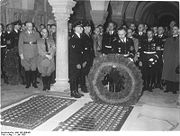 There are indications that Heinrich Himmler
saw himself as the reincarnation of the first king of Germany. The Nazism
ideology referred to Henry as a founding father of the German nation
, fighting both the Latin
Western Franks and the Slavic
tribes of the East, thereby a precursor of the German Drang nach Osten
.
motif of an incestous father, as in Allerleirauh
or The King Who Wished to Marry His Daughter
: after the death of her mother, he wished to marry his own daughter for her beauty, but she succeeds in escaping by performing an impossible task, and he died of chagrin.
876
Year 876 was a leap year starting on Sunday of the Julian calendar.- Births :* Henry the Fowler, the duke of Saxony from 912 and king of the Germans from 919 until his death...
– 2 July 936) was the Duke of Saxony from 912 and German king from 919 until his death. First of the Ottonian Dynasty of German kings and emperors, he is generally considered to be the founder and first king of the medieval German state, known until then as East Francia. An avid hunter, he obtained the epithet "the Fowler" because he was allegedly fixing his birding nets when messengers arrived to inform him that he was to be king.
Family
Born in MemlebenMemleben
Memleben is a village and a former municipality in the Burgenlandkreis district, in Saxony-Anhalt, Germany. Since 1 July 2009, it is part of the municipality Kaiserpfalz...
, in what is now Saxony-Anhalt
Saxony-Anhalt
Saxony-Anhalt is a landlocked state of Germany. Its capital is Magdeburg and it is surrounded by the German states of Lower Saxony, Brandenburg, Saxony, and Thuringia.Saxony-Anhalt covers an area of...
, Henry was the son of Otto the Illustrious, Duke of Saxony, and his wife Hedwiga
Hedwiga
Hedwiga was the daughter of Henry of Franconia and his wife Ingeltrude. She married Otto I, Duke of Saxony . They had three sons, Henry , Thankmar and Liudolf , as well as a daughter, Oda. Oda married Zwentibold, King of Lotharingia....
, daughter of Henry of Franconia
Henry of Franconia
Henry , a son of Count Poppo of Grapfeld, one of the first Babenbergs, was the most important East Frankish general during the reign of Charles the Fat. He was variously titled Count or Margrave of Saxony and Duke of Franconia....
and Ingeltrude and a great-great-granddaughter of Charlemagne
Charlemagne
Charlemagne was King of the Franks from 768 and Emperor of the Romans from 800 to his death in 814. He expanded the Frankish kingdom into an empire that incorporated much of Western and Central Europe. During his reign, he conquered Italy and was crowned by Pope Leo III on 25 December 800...
. In 906 he married Hatheburg, daughter of the Saxon count Erwin, but divorced her in 909, after she had given birth to his son Thankmar
Thankmar
Thankmar was the eldest son of Henry I of Germany by his first wife, Hatheburg . His mother had been previously married and widowed, after which she entered a convent. Because she left the convent to marry Henry, her second marriage was considered invalid and the couple split...
. Later that year he married St Matilda of Ringelheim
Matilda of Ringelheim
Saint Mathilda was the wife of King Henry I of Germany, the first ruler of the Saxon Ottonian dynasty, thereby Duchess consort of Saxony from 912 and German Queen from 919 until 936. Their eldest son Otto succeeded his father as German King and was crowned Holy Roman Emperor in 962...
, daughter of Dietrich, Count of Westphalia
Westphalia
Westphalia is a region in Germany, centred on the cities of Arnsberg, Bielefeld, Dortmund, Minden and Münster.Westphalia is roughly the region between the rivers Rhine and Weser, located north and south of the Ruhr River. No exact definition of borders can be given, because the name "Westphalia"...
. Matilda bore him three sons, one called Otto, and two daughters, Hedwig and Gerberga
Gerberga of Saxony
Gerberga of Saxony was a daughter of Henry the Fowler, King of Germany, and Matilda of Ringelheim.-Marriages:She married first Gilbert, Duke of Lorraine. They had four children:...
and founded many religious institutions, including the abbey of Quedlinburg
Quedlinburg Abbey
Quedlinburg Abbey was a house of secular canonesses in Quedlinburg, Saxony-Anhalt, Germany. It was founded in 936 on the initiative of Saint Mathilda, the widow of Henry the Fowler, as his memorial...
where Henry is buried, and was later canonized
Canonization
Canonization is the act by which a Christian church declares a deceased person to be a saint, upon which declaration the person is included in the canon, or list, of recognized saints. Originally, individuals were recognized as saints without any formal process...
.
Succession
Henry became Duke of Saxony upon his father's death in 912. An able ruler, he continued to strengthen the position of his duchy within the developing Kingdom of GermanyKingdom of Germany
The Kingdom of Germany developed out of the eastern half of the former Carolingian Empire....
, frequently in conflict with his neighbors to the South, the dukes of Franconia
Franconia
Franconia is a region of Germany comprising the northern parts of the modern state of Bavaria, a small part of southern Thuringia, and a region in northeastern Baden-Württemberg called Tauberfranken...
.
Conrad I of Germany
Conrad I , called the Younger, was Duke of Franconia from 906 and King of Germany from 911 to 918, the only king of the Conradine dynasty...
, King of East Francia and Franconian duke, died. Although they had been at odds with each other from 912–15 over the title to lands in Thuringia
Thuringia
The Free State of Thuringia is a state of Germany, located in the central part of the country.It has an area of and 2.29 million inhabitants, making it the sixth smallest by area and the fifth smallest by population of Germany's sixteen states....
, before he died Conrad recommended Henry as his successor. Conrad's choice was conveyed by Duke Eberhard of Franconia
Eberhard III of Franconia
Eberhard III was a member of the Conradine dynasty, who became duke of Franconia following the death of his older brother, King Conrad I , in December 918. From 913 he was count of Hessengau and Persgau, 918 count of Oberlahngau, 914–918 Margrave, and finally until his death duke of Franconia...
, Conrad's brother and heir, at the Reichstag
Reichstag (Holy Roman Empire)
The Imperial Diet was the Diet, or general assembly, of the Imperial Estates of the Holy Roman Empire.During the period of the Empire, which lasted formally until 1806, the Diet was not a parliament in today's sense; instead, it was an assembly of the various estates of the realm...
of Fritzlar
Fritzlar
Fritzlar is a small German town in the Schwalm-Eder district in northern Hesse, north of Frankfurt, with a storied history. It can reasonably be argued that the town is the site where the Christianization of northern Germany began and the birthplace of the German empire as a political entity.The...
in 919. The assembled Franconian and Saxon nobles duly elected Henry to be king. Archbishop Heriger of Mainz
Archbishopric of Mainz
The Archbishopric of Mainz or Electorate of Mainz was an influential ecclesiastic and secular prince-bishopric in the Holy Roman Empire between 780–82 and 1802. In the Roman Catholic Church hierarchy, the Archbishop of Mainz was the primas Germaniae, the substitute of the Pope north of the Alps...
offered to anoint Henry according to the usual ceremony, but he refused to be anointed by a high church official — the only King of his time not to undergo that rite — allegedly because he wished to be king not by the church's but by the people's acclaim. Duke Burchard II of Swabia soon swore fealty to the new King, but Duke Arnulf of Bavaria did not submit until Henry defeated him in two campaigns in 921. Last, Henry besieged his residence at Ratisbon (Regensburg
Regensburg
Regensburg is a city in Bavaria, Germany, located at the confluence of the Danube and Regen rivers, at the northernmost bend in the Danube. To the east lies the Bavarian Forest. Regensburg is the capital of the Bavarian administrative region Upper Palatinate...
) and forced Arnulf into submission.
In 920, the West Frankish king Charles the Simple
Charles the Simple
Charles III , called the Simple or the Straightforward , was the undisputed King of France from 898 until 922 and the King of Lotharingia from 911 until 919/23...
invaded Germany and marched as far as Pfeddersheim near Worms
Worms, Germany
Worms is a city in Rhineland-Palatinate, Germany, on the Rhine River. At the end of 2004, it had 85,829 inhabitants.Established by the Celts, who called it Borbetomagus, Worms today remains embattled with the cities Trier and Cologne over the title of "Oldest City in Germany." Worms is the only...
, but retired on hearing that Henry was arming against him.
On 7 November 921 Henry and Charles met each other and concluded a treaty of friendship between them. However, with the beginning of civil war in France upon the coronation of King Robert I
Robert I of France
Robert I , King of Western Francia , was the younger son of Robert the Strong, count of Anjou, and the brother of Odo, who became king of the Western Franks in 888. West Francia evolved over time into France; under Odo, the capital was fixed on Paris, a large step in that direction...
, Henry sought to wrest the Duchy of Lorraine
Lotharingia
Lotharingia was a region in northwest Europe, comprising the Low Countries, the western Rhineland, the lands today on the border between France and Germany, and what is now western Switzerland. It was born of the tripartite division in 855, of the kingdom of Middle Francia, itself formed of the...
from the Western Kingdom. In the year of 923 Henry crossed the Rhine twice. Later in the year he entered Lorraine with an army, capturing a large part of the country. Until October of 924 the eastern part of Lorraine was left in Henry's possession.
Policy
Henry regarded the German kingdom as a confederation of stem duchies rather than as a feudal monarchy and saw himself as primus inter paresPrimus inter pares
Primus inter pares is Latin phrase describing the most senior person of a group sharing the same rank or office.When not used in reference to a specific title, it may indicate that the person so described is formally equal, but looked upon as an authority of special importance by their peers...
. Instead of seeking to administer the empire through counts, as Charlemagne had done and as his successors had attempted, Henry allowed the dukes of Franconia, Swabia
Swabia
Swabia is a cultural, historic and linguistic region in southwestern Germany.-Geography:Like many cultural regions of Europe, Swabia's borders are not clearly defined...
and Bavaria
History of Bavaria
The history of Bavaria stretches from its earliest settlement and its formation as a stem duchy in the 6th century through its inclusion in the Holy Roman Empires to its status as an independent kingdom and, finally, as a large and significant Bundesland of the modern Federal Republic of...
to maintain complete internal control of their holdings. In 925, Duke Gilbert of Lorraine
Gilbert, Duke of Lorraine
Gilbert was the duke of Lotharingia until 939.The beginning of the reign of Gilbert is not clear. A dux Lotharingiae is mentioned in 910 and this may have been Gilbert...
again rebelled. Henry invaded the duchy and besieged Gilbert at Zülpich
Zülpich
Zülpich is a town in North Rhine-Westphalia, Germany between Aachen and Bonn. It belongs to the district Euskirchen.The town is commonly agreed to be the site with the Latin name of Tolbiacum, famous for the Battle of Tolbiac, fought between the Franks under Clovis I and the Alamanni; the...
(Tolbiac), captured the town, and became master of a large portion of his lands. Thus he brought that realm, which had been lost in 910, back into the German kingdom as the fifth stem duchy. Allowing Gilbert to remain in power as duke, Henry arranged the marriage of his daughter Gerberga to his new vassal in 928.
Henry was an able military leader. In 921 Hungarians (Magyars) invaded Germany and Italy. Although a sizable force was routed near Bleiburg
Bleiburg
Bleiburg is a small town in the south Austrian state of Carinthia , south-east of Klagenfurt , in the district of Völkermarkt, some four kilometres from the border with Slovenia....
in the Bavarian March of Carinthia
March of Carinthia
The March of Carinthia was a frontier district of the Carolingian Empire created in 889. Before it was a march, it had been a principality or duchy ruled by native-born Slavic princes at first independently and then under Bavarian and subsequently Frankish suzerainty...
by Eberhard and the Count of Meran and another group was routed by Liutfried, count of Elsace, the Magyars repeatedly raided Germany. Nevertheless Henry, having captured a Hungarian prince, managed to arrange a ten-year-truce in 926, though he was forced to pay tributes. By doing so he and the German dukes gained time to fortify towns and train a new elite cavalry force.
During the truce with the Magyars, Henry subdued the Polabian Slavs
Polabian Slavs
Polabian Slavs - is a collective term applied to a number of Lechites tribes who lived along the Elbe river, between the Baltic Sea to the north, the Saale and the Limes Saxoniae to the west, the Ore Mountains and the Western Sudetes to the south, and Poland to the east. They have also been known...
, settling on the eastern border of his realm. In the winter of 928, he marched against the Slavic Hevelli tribes and seized their capital, Brandenburg. He then invaded the Glomacze
Glomacze
The Glomacze, also Golomacze or Dolomici - were Polabian Slavs inhabiting areas in the middle Elbe valley. Other West Slavic tribes such as the Milceni settled east of them. About 850 the Bavarian Geographer located their settlement area east of the Sorbs...
lands on the middle Elbe
Elbe
The Elbe is one of the major rivers of Central Europe. It rises in the Krkonoše Mountains of the northwestern Czech Republic before traversing much of Bohemia , then Germany and flowing into the North Sea at Cuxhaven, 110 km northwest of Hamburg...
river, conquered Gana (Jahna), the capital after a siege, and had a fortress (the later Albrechtsburg
Albrechtsburg
The Albrechtsburg is a Late Gothic castle that dominates the town centre of Meissen in the German state of Saxony.-History:By 929 King Henry I of Germany had finally subdued the Slavic Glomacze tribe and built a fortress within their settlement area, situated on a rock high above the Elbe river...
) built at Meissen
Meissen
Meissen is a town of approximately 30,000 about northwest of Dresden on both banks of the Elbe river in the Free State of Saxony, in eastern Germany. Meissen is the home of Meissen porcelain, the Albrechtsburg castle, the Gothic Meissen Cathedral and the Meissen Frauenkirche...
. In 929, with the help of Arnulf of Bavaria, Henry entered Bohemia
Bohemia
Bohemia is a historical region in central Europe, occupying the western two-thirds of the traditional Czech Lands. It is located in the contemporary Czech Republic with its capital in Prague...
and forced Duke Wenceslaus I
Wenceslaus I, Duke of Bohemia
Wenceslaus I , or Wenceslas I, was the duke of Bohemia from 921 until his assassination in 935, purportedly in a plot by his own brother, Boleslav the Cruel....
to resume the yearly payment of the tribute to the king. Meanwhile, the Slavic Redarii
Veleti
The Veleti or Wilzi were a group of medieval Lechites tribes within the territory of modern northeastern Germany; see Polabian Slavs. In common with other Slavic groups between the Elbe and Oder Rivers, they were often described by Germanic sources as Wends. In the late 10th century, they were...
had driven away their chief, captured the town of Walsleben
Walsleben, Saxony-Anhalt
Walsleben is a village and a former municipality in the district of Stendal, in Saxony-Anhalt, Germany. Since 1 July 2009, it is part of the town Osterburg ....
and massacred the inhabitants. Counts Bernard and Thietmar marched against the fortress of Lenzen
Lenzen
Lenzen is a small town in the district of Prignitz, in Brandenburg, Germany. It is part of the Amt Lenzen-Elbtalaue.-Overview:Lenzen is situated near the Elbe, approx. 20 km northwest of Wittenberge. It was the scene of an early victory by the Germans over the Wends in 929...
beyond the Elbe, and, after fierce fighting, completely routed the enemy on 4 September 929. The Lusatians
Lusatians
Lusatians are people living in or coming from Lusatia. It may refer to:*Sorbs, Slavic people *Germans, main ethnic group of Lusatia...
and the Ukrani
Ukrani
thumb|250px|right|Burgwallinsel, a former Ukrani [[burgh]] on an isle in Lake [[Oberuckersee]]The Ukrani were a West Slavic Polabian tribe in the Uckermark from the 6th–12th centuries. Their settlement area was centered around the lakes Oberuckersee and Unteruckersee at the spring of the...
on the lower Oder
Oder
The Oder is a river in Central Europe. It rises in the Czech Republic and flows through western Poland, later forming of the border between Poland and Germany, part of the Oder-Neisse line...
were subdued and made tributary in 932 and 934, respectively. However, Henry left no consistent march administration, which was implemented by his successor Otto I.
In 932 Henry finally refused to pay the regular tribute to the Magyars. When they began raiding again, he led a unified army of all German tribes to victory at the Battle of Riade
Battle of Riade
The Battle of Riade or Battle of Merseburg was fought between East Francia and the Magyars at an unidentified location in northern Thuringia along the river Unstrut on 15 March 933. The battle was precipitated by the decision of the Synod of Erfurt to stop paying an annual tribute to the Magyars in...
in 933 near the river Unstrut, thus stopping the Magyar advance into Germany. He also pacified territories to the north, where the Danes
Denmark
Denmark is a Scandinavian country in Northern Europe. The countries of Denmark and Greenland, as well as the Faroe Islands, constitute the Kingdom of Denmark . It is the southernmost of the Nordic countries, southwest of Sweden and south of Norway, and bordered to the south by Germany. Denmark...
had been harrying the Frisians
Frisians
The Frisians are a Germanic ethnic group native to the coastal parts of the Netherlands and Germany. They are concentrated in the Dutch provinces of Friesland and Groningen and, in Germany, East Frisia and North Frisia, that was a part of Denmark until 1864. They inhabit an area known as Frisia...
by sea. The monk and chronicler Widukind of Corvey
Widukind of Corvey
Widukind of Corvey was a Saxon historical chronicler, named after the Saxon duke and national hero Widukind who had battled Charlemagne. Widukind the chronicler was born in 925 and died after 973 at the Benedictine abbey of Corvey in East Westphalia...
in his Res gestae Saxonicae reports that the Danes were subjects of Henry the Fowler. Henry incorporated into his kingdom territories held by the Wends
Wends
Wends is a historic name for West Slavs living near Germanic settlement areas. It does not refer to a homogeneous people, but to various peoples, tribes or groups depending on where and when it is used...
, who together with the Danes had attacked Germany, and also conquered Schleswig
Schleswig
Schleswig or South Jutland is a region covering the area about 60 km north and 70 km south of the border between Germany and Denmark; the territory has been divided between the two countries since 1920, with Northern Schleswig in Denmark and Southern Schleswig in Germany...
in 934.
Death and aftermath
Henry died of a cerebral stroke on 2 July 936 in his palatiumKaiserpfalz
The term Kaiserpfalz or Königspfalz refers to a number of castles across the Holy Roman Empire which served as temporary, secondary seats of power for the Holy Roman Emperor in the Early and High Middle Ages...
in Memleben
Memleben
Memleben is a village and a former municipality in the Burgenlandkreis district, in Saxony-Anhalt, Germany. Since 1 July 2009, it is part of the municipality Kaiserpfalz...
, one of his favourite places. By then all German tribes were united in a single kingdom. He was buried at Quedlinburg Abbey
Quedlinburg Abbey
Quedlinburg Abbey was a house of secular canonesses in Quedlinburg, Saxony-Anhalt, Germany. It was founded in 936 on the initiative of Saint Mathilda, the widow of Henry the Fowler, as his memorial...
, established by his wife Matilda in his honor.
His son Otto
Otto I, Holy Roman Emperor
Otto I the Great , son of Henry I the Fowler and Matilda of Ringelheim, was Duke of Saxony, King of Germany, King of Italy, and "the first of the Germans to be called the emperor of Italy" according to Arnulf of Milan...
succeeded him as Emperor. His second son, Henry
Henry I, Duke of Bavaria
Henry I was Duke of Bavaria.He was the second son of the German King Henry the Fowler and his wife Matilda. He attempted a revolt against his older brother Otto I in 938 in alliance with Eberhard of Franconia and Giselbert of Lorraine, believing he had a claim on the throne. In 939 he was defeated...
, became Duke of Bavaria. A third son, Brun (or Bruno
Bruno I, Archbishop of Cologne
Bruno the Great was Archbishop of Cologne, Germany, from 953 until his death, and Duke of Lotharingia from 954. He was the brother of Otto I, king of Germany and later Holy Roman Emperor....
), became archbishop of Cologne. His son from his first marriage, Thankmar, rebelled against his half-brother Otto and was killed in battle in 936. After the death of her husband Duke Giselbert of Lotharingia, Henry's daughter Gerberga of Saxony
Gerberga of Saxony
Gerberga of Saxony was a daughter of Henry the Fowler, King of Germany, and Matilda of Ringelheim.-Marriages:She married first Gilbert, Duke of Lorraine. They had four children:...
married King Louis IV of France
Louis IV of France
Louis IV , called d'Outremer or Transmarinus , reigned as King of Western Francia from 936 to 954...
. His youngest daughter, Hedwige of Saxony
Hedwige of Saxony
Hedwige of Saxony was a daughter of Henry I the Fowler, and his wife Matilda of Ringelheim.She was a sister of Otto I, Holy Roman Emperor; Henry I, Duke of Bavaria; Gerberga of Saxony; and Bruno I, Archbishop of Cologne....
, married Duke Hugh the Great
Hugh the Great
Hugh the Great or Hugues le Grand was duke of the Franks and count of Paris, son of King Robert I of France and nephew of King Odo. He was born in Paris, Île-de-France, France. His eldest son was Hugh Capet who became King of France in 987...
of France
France
The French Republic , The French Republic , The French Republic , (commonly known as France , is a unitary semi-presidential republic in Western Europe with several overseas territories and islands located on other continents and in the Indian, Pacific, and Atlantic oceans. Metropolitan France...
and was the mother of Hugh Capet, the first Capetian
House of Capet
The House of Capet, or The Direct Capetian Dynasty, , also called The House of France , or simply the Capets, which ruled the Kingdom of France from 987 to 1328, was the most senior line of the Capetian dynasty – itself a derivative dynasty from the Robertians. As rulers of France, the dynasty...
king of France.
Henry returned to public attention as a character in Richard Wagner
Richard Wagner
Wilhelm Richard Wagner was a German composer, conductor, theatre director, philosopher, music theorist, poet, essayist and writer primarily known for his operas...
's opera, Lohengrin
Lohengrin (opera)
Lohengrin is a romantic opera in three acts composed and written by Richard Wagner, first performed in 1850. The story of the eponymous character is taken from medieval German romance, notably the Parzival of Wolfram von Eschenbach and its sequel, Lohengrin, written by a different author, itself...
(1850), trying to gain the support of the Brabantian
Duchy of Brabant
The Duchy of Brabant was a historical region in the Low Countries. Its territory consisted essentially of the three modern-day Belgian provinces of Flemish Brabant, Walloon Brabant and Antwerp, the Brussels-Capital Region and most of the present-day Dutch province of North Brabant.The Flag of...
nobles against the Magyars. After the attempts to achieve German national unity failed with the Revolutions of 1848
Revolutions of 1848 in the German states
The Revolutions of 1848 in the German states, also called the March Revolution – part of the Revolutions of 1848 that broke out in many countries of Europe – were a series of loosely coordinated protests and rebellions in the states of the German Confederation, including the Austrian Empire...
, Wagner strongly relied on the picture of Henry as a the actual ruler of all German tribes as advocated by pan-Germanist
Pan-Germanism
Pan-Germanism is a pan-nationalist political idea. Pan-Germanists originally sought to unify the German-speaking populations of Europe in a single nation-state known as Großdeutschland , where "German-speaking" was taken to include the Low German, Frisian and Dutch-speaking populations of the Low...
activists like Friedrich Ludwig Jahn
Friedrich Ludwig Jahn
Friedrich Ludwig Jahn was a German gymnastics educator and nationalist. He is commonly known as Turnvater Jahn, roughly meaning "father of gymnastics" Jahn.- Life :...
.
Heinrich Himmler
Heinrich Luitpold Himmler was Reichsführer of the SS, a military commander, and a leading member of the Nazi Party. As Chief of the German Police and the Minister of the Interior from 1943, Himmler oversaw all internal and external police and security forces, including the Gestapo...
saw himself as the reincarnation of the first king of Germany. The Nazism
Nazism
Nazism, the common short form name of National Socialism was the ideology and practice of the Nazi Party and of Nazi Germany...
ideology referred to Henry as a founding father of the German nation
Ethnic nationalism
Ethnic nationalism is a form of nationalism wherein the "nation" is defined in terms of ethnicity. Whatever specific ethnicity is involved, ethnic nationalism always includes some element of descent from previous generations and the implied claim of ethnic essentialism, i.e...
, fighting both the Latin
Latin
Latin is an Italic language originally spoken in Latium and Ancient Rome. It, along with most European languages, is a descendant of the ancient Proto-Indo-European language. Although it is considered a dead language, a number of scholars and members of the Christian clergy speak it fluently, and...
Western Franks and the Slavic
Slavic peoples
The Slavic people are an Indo-European panethnicity living in Eastern Europe, Southeast Europe, North Asia and Central Asia. The term Slavic represents a broad ethno-linguistic group of people, who speak languages belonging to the Slavic language family and share, to varying degrees, certain...
tribes of the East, thereby a precursor of the German Drang nach Osten
Drang nach Osten
Drang nach Osten was a term coined in the 19th century to designate German expansion into Slavic lands. The term became a motto of the German nationalist movement in the late nineteenth century...
.
Legend
Subsequently to his life, Henry the Fowler became attached to the fairy taleFairy tale
A fairy tale is a type of short story that typically features such folkloric characters, such as fairies, goblins, elves, trolls, dwarves, giants or gnomes, and usually magic or enchantments. However, only a small number of the stories refer to fairies...
motif of an incestous father, as in Allerleirauh
Allerleirauh
Allerleirauh is a fairy tale recorded by the Brothers Grimm. Since the second edition published in 1819, it has been recorded as Tale no. 65. Andrew Lang included it in The Green Fairy Book....
or The King Who Wished to Marry His Daughter
The King who Wished to Marry His Daughter
"The King Who Wished to Marry His Daughter" is a Scottish fairy tale collected by John Francis Campbell in Popular Tales of the West Highlands, listing his informant as Ann Darroch from Islay.It is Aarne-Thompson type 510B, unnatural love...
: after the death of her mother, he wished to marry his own daughter for her beauty, but she succeeds in escaping by performing an impossible task, and he died of chagrin.