
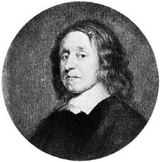
Henry Cromwell was the fourth son of
Oliver CromwellOliver Cromwell was an English military and political leader who overthrew the English monarchy and temporarily turned England into a republican Commonwealth, and served as Lord Protector of England, Scotland, and Ireland....
and
Elizabeth BourchierElizabeth Cromwell [née Bourchier] was the wife of Oliver Cromwell, Lord Protector of England, Scotland and Ireland. She is sometimes referred to as the Lady Protectress or Protectress Joan.- Family and marriage :...
, and an important figure in the Parliamentarian regime in Ireland.
Life
He was born at
HuntingdonHuntingdon is a market town in Cambridgeshire, England. The town was chartered by King John in 1205. It is the traditional county town of Huntingdonshire, and is currently the seat of the Huntingdonshire district council. It is known as the birthplace in 1599 of Oliver Cromwell.-History:Huntingdon...
and educated at
Emmanuel College, CambridgeEmmanuel College is a constituent college of the University of Cambridge.The college was founded in 1584 by Sir Walter Mildmay on the site of a Dominican friary...
. He served under his father during the latter part of the
English Civil WarThe English Civil War was a series of armed conflicts and political machinations between Parliamentarians and Royalists...
. His active life, however, was mainly spent in Ireland, whither he took some troops to assist Oliver early in 1650, and he was one of the Irish representative; in the
Little, or Nominated, ParliamentBarebone's Parliament, also known as the Little Parliament, the Nominated Assembly and the Parliament of Saints, came into being on 4 July 1653, and was the last attempt of the English Commonwealth to find a stable political form before the installation of Oliver Cromwell as Lord Protector...
of 1653. In 1653 Henry married Elizabeth (died 1687), daughter of Sir Francis Russell, 2nd Baronet, who went on to bear him five sons and two daughters.
He was the seventh Chancellor of
Trinity College, DublinThe University of Dublin , corporately designated the Chancellor, Doctors and Masters of the University of Dublin , located in Dublin, Ireland, was effectively founded when in 1592 Queen Elizabeth I issued a charter for Trinity College, Dublin, as "the mother of a university" – this date making it...
between 1653 and 1660.
In 1654 he was again in Ireland, and after making certain recommendations to his father, now lord protector, with regard to the government of that country, he became major-general of the forces in Ireland and a member of the Irish council of state, taking up his new duties in July 1655. Nominally Henry was subordinate to the lord-deputy,
Charles FleetwoodCharles Fleetwood was an English Parliamentary soldier and politician, Lord Deputy of Ireland from 1652–55, where he enforced the Cromwellian Settlement. At the Restoration he was included in the Act of Indemnity as among the twenty liable to penalties other than capital, and was finally...
, but Fleetwood's departure for England in September 1655 left him for all practical purposes the ruler of Ireland. He moderated the lord-deputy's policy of deporting the Irish, and unlike him he paid some attention to the interests of the English settlers. Moreover, again unlike Fleetwood, he appears to have held the scales evenly between the different Protestant sects, and his undoubted popularity in Ireland is attested by
ClarendonEdward Hyde, 1st Earl of Clarendon was an English historian and statesman, and grandfather of two English monarchs, Mary II and Queen Anne.-Early life:...
.
In November 1657 Henry himself was made lord-deputy; but before this time he had refused a gift of property worth £1500 a year, basing his refusal on the grounds of the poverty of the country, a poverty which was not the least of his troubles. In 1657 he advised his father not to accept the office of king, although in 1654 he had supported a motion to this effect; and after the dissolution of Cromwell's second parliament in February 1658 he showed his anxiety that the protector should act in a moderate and constitutional manner. After Oliver's death Henry hailed with delight the succession of his brother
RichardAt the same time, the officers of the New Model Army became increasingly wary about the government's commitment to the military cause. The fact that Richard Cromwell lacked military credentials grated with men who had fought on the battlefields of the English Civil War to secure their nation's...
to the office of protector, but although he was now appointed lieutenant and governor-general of Ireland, it was only with great reluctance that he remained in that country.
Having rejected proposals to assist in the restoration of
Charles IICharles II was monarch of the three kingdoms of England, Scotland, and Ireland.Charles II's father, King Charles I, was executed at Whitehall on 30 January 1649, at the climax of the English Civil War...
, Henry was recalled to England in June 1659 just after his brother's fall; quietly obeying this order he resigned his office at once. Although he lost some property at the Restoration, he was allowed after some solicitation to keep the estate he had bought in Ireland.
His concluding years were passed peacefully at
Spinney AbbeySpinney Abbey, once known as Spinney Priory, is a house and farm on the site of a former monastic foundation close to the village of Wicken, on the edge of the fens in Cambridgeshire, England.- Monastic origins :...
in
Wicken, CambridgeshireWicken is a small village on the edge of the fens near Soham in East Cambridgeshire, 10 miles north east of Cambridge and 5 miles south of Ely. It is the site of Wicken Fen National Nature Reserve.-History:...
. He was unmolested by the government, and, indeed, the king on one occasion visited him there. He died at Wicken and is buried in the parish church alongside his wife.
Ancestry