

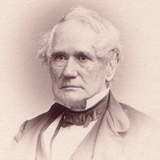
Henry Charles Carey

Encyclopedia
Henry Charles Carey a leading 19th century economist
of the American School
of capitalism. He is now best known for the book The Harmony of Interests, to compare and contrast what he called the "British System" of laissez faire free trade
capitalism
with the "American System" of developmental capitalism, through tariff protection and government intervention to encourage production.
He was born in Philadelphia, Pennsylvania in 1793 and was a chief economic advisor to Abraham Lincoln
during his presidency.
(1760-1839), an influential economist, political reformer, editor, and publisher, who was born in Ireland but for many years lived in Philadelphia. Matthew Carey was a member of the publishing firm of Carey & Lea, which was long the most conspicuous in America. When Henry Carey was 28 years old, he succeeded his father as a member of the publishing firm. Among Mathew Carey's many writings had been a collection (1822) of Essays on Political Economy, one of the earliest of American treatises favoring Alexander Hamilton
's idea of protection
and promotion of industry.
In 1835, Carey co-founded the famous Franklin Fire Insurance Company of Philadelphia. He retired from business in 1838, almost simultaneously with the appearance (1837-1840) of his book Principles of Political Economy. This treatise soon became the standard representation of the American school of economic thought, and was translated into Italian
and Swedish
, with some variance. It dominated the US economic system until 1973.
s, the credit system, interest
, slavery
, copyright
, etc.; and in 1858-1859 he gathered the fruits of his lifelong labours into The Principles of Social Science, in three volumes.
Principles is a comprehensive and mature exposition of his views. In it, Carey sought to show that there exists, independently of human wills, a natural system of economic laws, which is essentially beneficent and spontaneously increases prosperity of the whole community, and especially of the working classes, except when it is impeded by the ignorance or perversity of humankind. He rejected the Malthusian
doctrine of population, maintaining that the only situation in which the means of subsistence will determine population growth is one in which a given society is not introducing new technologies or not adopting forward-thinking governmental policy. Population regulated itself in every well-governed society, but its pressure on subsistence characterized the lower stages of civilization
. Carey denied as the universal truth, for all stages of cultivation, of the law of diminishing returns from land.
His position relates to the antithesis of wealth
and value. Carey held that land in industrial life is an instrument of production formed by human labour. Its value was due to the labour expended on it in the past (measured by the labour necessary under existing conditions to bring new land to the same stage of productiveness). He studied the occupation and reclamation
of land with peculiar advantage as an American, for whom the traditions of first settlement were living and fresh, and before whose eyes the process was indeed still going on. The difficulties of adapting a primitive soil to the work of yielding organic products for human use can be lightly estimated only by an inhabitant of a country long under cultivation.
Carey believed that the overcoming of these difficulties by arduous and continued effort entitles the first occupier of land to his property in the soil. Its present value forms a very small proportion of the cost expended on it, because it represents only what would be required, with the science and appliances of our time, to bring the land from its primitive into its present state. Thus, property in land is only a form of invested capital, a quantity of labour or the fruits of labour permanently incorporated with the soil. The owner of this capital is compensated, as any other capitalist, by a share of the produce. The owner is not rewarded for what is done by the powers of nature, and society is in no sense defrauded by his sole possession.
The so-called Ricardian
theory of rent is a speculative fancy, contradicted by all experience. Unlike what the theory supposes, cultivation does not begin with the best soils and move progressively towards poorer soils. The light and dry higher land is cultivated first; only when population becomes dense and capital accumulates is low-lying land attacked and brought into occupation. Low-lying land is more fertile but also has morasses, inundations and miasmas. Rent as a proportion of the produce sinks, like all interest on capital, but increases as an absolute amount. The share of the labourer increases both as a proportion and an absolute amount. Thus, the interests of these different social classes are in harmony. But, Carey proceeded to say, in order that this harmonious progress may be realized, what is taken from the land must be given back to it. All the produce derived from the land is part of it, and must be restored to avoid its exhaustion. Hence the producer and the consumer must be close to each other; the products must not be exported to a foreign country in exchange for its manufactures, and thus go to enrich as manure
a foreign soil. In immediate exchange value, the landowner may gain by such exportation, but the productive powers of the land will suffer.
In March 1865, Carey published a series of letters to the Speaker of the House of Representatives, Rep. Schuyler Colfax, entitled “The Way to Outdo England Without Fighting Her”. In these letters, Carey advocated the continuance of Abraham Lincoln's Greenbacks policy of debt-free, government-issued money as a way of freeing America's economy from British capitalists, who sought to control America's wealth. (They eventually accomplished this by shutting out Greenbacks and putting America on a gold standard with the Coinage Act of 1873.) He also suggested raising the reserve requirements on private banks up to 50%. Here are some excerpts from Carey's work, which history shows fell upon deaf ears, as the subsequent Long Depression
of 1873-96 plagued America with financial panics because of the inability of the National Banking System to provide the public with all the currency it needed:
Among Mathew Carey's many writings had been a collection (1822) of Essays on Political Economy, one of the earliest of American treatises favoring Alexander Hamilton
's idea of protection
and promotion of industry.
.
, accordingly arrived at the doctrine of protection
: the coordinating power in society must intervene to prevent private advantage from working public mischief. He attributed his conversion on this question to his observation of the effects of liberal and protective tariffs respectively on American prosperity. This observation, he says, threw him back on theory, and led him to see that intervention might be necessary to remove (as he phrases it) the obstacles to the progress of younger communities created by the action of older and wealthier nations. But it seems probable that the influence of Friedrich List
's writings, added to his own deep-rooted and hereditary jealousy and dislike of English predominance, had something to do with his change of attitude.
Economist
An economist is a professional in the social science discipline of economics. The individual may also study, develop, and apply theories and concepts from economics and write about economic policy...
of the American School
American School (economics)
The American School, also known as "National System", represents three different yet related constructs in politics, policy and philosophy. It was the American policy for the 1860s to the 1940s, waxing and waning in actual degrees and details of implementation...
of capitalism. He is now best known for the book The Harmony of Interests, to compare and contrast what he called the "British System" of laissez faire free trade
Free trade
Under a free trade policy, prices emerge from supply and demand, and are the sole determinant of resource allocation. 'Free' trade differs from other forms of trade policy where the allocation of goods and services among trading countries are determined by price strategies that may differ from...
capitalism
Capitalism
Capitalism is an economic system that became dominant in the Western world following the demise of feudalism. There is no consensus on the precise definition nor on how the term should be used as a historical category...
with the "American System" of developmental capitalism, through tariff protection and government intervention to encourage production.
He was born in Philadelphia, Pennsylvania in 1793 and was a chief economic advisor to Abraham Lincoln
Abraham Lincoln
Abraham Lincoln was the 16th President of the United States, serving from March 1861 until his assassination in April 1865. He successfully led his country through a great constitutional, military and moral crisis – the American Civil War – preserving the Union, while ending slavery, and...
during his presidency.
Early years
Carey was the son of Mathew CareyMathew Carey
Mathew Carey was an Irish-born American publisher and economist.-Early days:Carey came from a middle-class family and was born in Dublin in 1760. He entered the bookselling and printing business in 1775, and when still only seventeen published a pamphlet criticizing dueling...
(1760-1839), an influential economist, political reformer, editor, and publisher, who was born in Ireland but for many years lived in Philadelphia. Matthew Carey was a member of the publishing firm of Carey & Lea, which was long the most conspicuous in America. When Henry Carey was 28 years old, he succeeded his father as a member of the publishing firm. Among Mathew Carey's many writings had been a collection (1822) of Essays on Political Economy, one of the earliest of American treatises favoring Alexander Hamilton
Alexander Hamilton
Alexander Hamilton was a Founding Father, soldier, economist, political philosopher, one of America's first constitutional lawyers and the first United States Secretary of the Treasury...
's idea of protection
Protectionism
Protectionism is the economic policy of restraining trade between states through methods such as tariffs on imported goods, restrictive quotas, and a variety of other government regulations designed to allow "fair competition" between imports and goods and services produced domestically.This...
and promotion of industry.
In 1835, Carey co-founded the famous Franklin Fire Insurance Company of Philadelphia. He retired from business in 1838, almost simultaneously with the appearance (1837-1840) of his book Principles of Political Economy. This treatise soon became the standard representation of the American school of economic thought, and was translated into Italian
Italian language
Italian is a Romance language spoken mainly in Europe: Italy, Switzerland, San Marino, Vatican City, by minorities in Malta, Monaco, Croatia, Slovenia, France, Libya, Eritrea, and Somalia, and by immigrant communities in the Americas and Australia...
and Swedish
Swedish language
Swedish is a North Germanic language, spoken by approximately 10 million people, predominantly in Sweden and parts of Finland, especially along its coast and on the Åland islands. It is largely mutually intelligible with Norwegian and Danish...
, with some variance. It dominated the US economic system until 1973.
Contribution to economics
Carey's first large work on political economy was preceded and followed by many smaller volumes on wageWage
A wage is a compensation, usually financial, received by workers in exchange for their labor.Compensation in terms of wages is given to workers and compensation in terms of salary is given to employees...
s, the credit system, interest
Interest
Interest is a fee paid by a borrower of assets to the owner as a form of compensation for the use of the assets. It is most commonly the price paid for the use of borrowed money, or money earned by deposited funds....
, slavery
Slavery
Slavery is a system under which people are treated as property to be bought and sold, and are forced to work. Slaves can be held against their will from the time of their capture, purchase or birth, and deprived of the right to leave, to refuse to work, or to demand compensation...
, copyright
Copyright
Copyright is a legal concept, enacted by most governments, giving the creator of an original work exclusive rights to it, usually for a limited time...
, etc.; and in 1858-1859 he gathered the fruits of his lifelong labours into The Principles of Social Science, in three volumes.
Principles is a comprehensive and mature exposition of his views. In it, Carey sought to show that there exists, independently of human wills, a natural system of economic laws, which is essentially beneficent and spontaneously increases prosperity of the whole community, and especially of the working classes, except when it is impeded by the ignorance or perversity of humankind. He rejected the Malthusian
Thomas Malthus
The Reverend Thomas Robert Malthus FRS was an English scholar, influential in political economy and demography. Malthus popularized the economic theory of rent....
doctrine of population, maintaining that the only situation in which the means of subsistence will determine population growth is one in which a given society is not introducing new technologies or not adopting forward-thinking governmental policy. Population regulated itself in every well-governed society, but its pressure on subsistence characterized the lower stages of civilization
Civilization
Civilization is a sometimes controversial term that has been used in several related ways. Primarily, the term has been used to refer to the material and instrumental side of human cultures that are complex in terms of technology, science, and division of labor. Such civilizations are generally...
. Carey denied as the universal truth, for all stages of cultivation, of the law of diminishing returns from land.
His position relates to the antithesis of wealth
Wealth
Wealth is the abundance of valuable resources or material possessions. The word wealth is derived from the old English wela, which is from an Indo-European word stem...
and value. Carey held that land in industrial life is an instrument of production formed by human labour. Its value was due to the labour expended on it in the past (measured by the labour necessary under existing conditions to bring new land to the same stage of productiveness). He studied the occupation and reclamation
Land reclamation
Land reclamation, usually known as reclamation, is the process to create new land from sea or riverbeds. The land reclaimed is known as reclamation ground or landfill.- Habitation :...
of land with peculiar advantage as an American, for whom the traditions of first settlement were living and fresh, and before whose eyes the process was indeed still going on. The difficulties of adapting a primitive soil to the work of yielding organic products for human use can be lightly estimated only by an inhabitant of a country long under cultivation.
Carey believed that the overcoming of these difficulties by arduous and continued effort entitles the first occupier of land to his property in the soil. Its present value forms a very small proportion of the cost expended on it, because it represents only what would be required, with the science and appliances of our time, to bring the land from its primitive into its present state. Thus, property in land is only a form of invested capital, a quantity of labour or the fruits of labour permanently incorporated with the soil. The owner of this capital is compensated, as any other capitalist, by a share of the produce. The owner is not rewarded for what is done by the powers of nature, and society is in no sense defrauded by his sole possession.
The so-called Ricardian
David Ricardo
David Ricardo was an English political economist, often credited with systematising economics, and was one of the most influential of the classical economists, along with Thomas Malthus, Adam Smith, and John Stuart Mill. He was also a member of Parliament, businessman, financier and speculator,...
theory of rent is a speculative fancy, contradicted by all experience. Unlike what the theory supposes, cultivation does not begin with the best soils and move progressively towards poorer soils. The light and dry higher land is cultivated first; only when population becomes dense and capital accumulates is low-lying land attacked and brought into occupation. Low-lying land is more fertile but also has morasses, inundations and miasmas. Rent as a proportion of the produce sinks, like all interest on capital, but increases as an absolute amount. The share of the labourer increases both as a proportion and an absolute amount. Thus, the interests of these different social classes are in harmony. But, Carey proceeded to say, in order that this harmonious progress may be realized, what is taken from the land must be given back to it. All the produce derived from the land is part of it, and must be restored to avoid its exhaustion. Hence the producer and the consumer must be close to each other; the products must not be exported to a foreign country in exchange for its manufactures, and thus go to enrich as manure
Manure
Manure is organic matter used as organic fertilizer in agriculture. Manures contribute to the fertility of the soil by adding organic matter and nutrients, such as nitrogen, that are trapped by bacteria in the soil...
a foreign soil. In immediate exchange value, the landowner may gain by such exportation, but the productive powers of the land will suffer.
In March 1865, Carey published a series of letters to the Speaker of the House of Representatives, Rep. Schuyler Colfax, entitled “The Way to Outdo England Without Fighting Her”. In these letters, Carey advocated the continuance of Abraham Lincoln's Greenbacks policy of debt-free, government-issued money as a way of freeing America's economy from British capitalists, who sought to control America's wealth. (They eventually accomplished this by shutting out Greenbacks and putting America on a gold standard with the Coinage Act of 1873.) He also suggested raising the reserve requirements on private banks up to 50%. Here are some excerpts from Carey's work, which history shows fell upon deaf ears, as the subsequent Long Depression
Long Depression
The Long Depression was a worldwide economic crisis, felt most heavily in Europe and the United States, which had been experiencing strong economic growth fueled by the Second Industrial Revolution in the decade following the American Civil War. At the time, the episode was labeled the Great...
of 1873-96 plagued America with financial panics because of the inability of the National Banking System to provide the public with all the currency it needed:
“The Executive [Lincoln] is frequently compelled to affix his signature to bills of the highest importance, much of which he regards as wholly at war with the national interests.
“To British free trade it is, as I have shown, that we stand indebted for the present Civil War. Had our legislation been of the kind which was needed for giving effect to the Declaration of Independence, that great hill region of the South, one of the richest, if not absolutely the richest in the world, would long since have been filled with furnaces and factories, the laborers in which would have been free men, women, and children, white and black, and the several portions of the Union would have been linked together by hooks of steel that would have set at defiance every effort of the ‘wealthy capitalists’ of England for bringing about a separation. Such, however, and most unhappily, was not our course of operation. Rebellion, therefore, came, bringing with it an almost entire stoppage of the societary movement, with ruin to a large proportion of those of the men…”
“As a consequence, poor as was then our Government, and unemployed as were then so large a portion of our people, we were compelled to [loan from abroad] millions upon millions of dollars worth of the machinery of war, and there to encounter all the obstacles that could decently be thrown in our way by men who prayed openly for the success of the rebellion.”
“When the present war shall have been closed there will be another to be fought, and that one will be with England…but it is not now with [cannons] that she chiefly seeks to fight us. It is in the Halls of Congress she is to be met.”
“The whole South now requires reorganization, and one of the first steps in that direction should be found in furnishing machinery of circulation…If the Government does not supply that machinery, who is there that can or will do so? Look carefully, I pray you, my dear sir, at the vast field that is to be occupied, and at the great work that is to be done, and then wonder with me that the Government should permit its soldiers to perish in the field, while it is debating the terms of a loan to be made to it by men all of whose interests are to be promoted by a diminution of the circulation and an increase of the rate of interest. Let our soldiers be paid, let the credit of the Government be once again re-established, let the rate of interest be kept down, and let the Treasury reassert its independence, and all will yet go well…
“A single decade of the system above described would suffice for placing us, in this respect, side by side with England. At the close of another, [England] would be left far behind, and we should then have vindicated our claim to that position in the world of which our people so often talk.”
Among Mathew Carey's many writings had been a collection (1822) of Essays on Political Economy, one of the earliest of American treatises favoring Alexander Hamilton
Alexander Hamilton
Alexander Hamilton was a Founding Father, soldier, economist, political philosopher, one of America's first constitutional lawyers and the first United States Secretary of the Treasury...
's idea of protection
Protectionism
Protectionism is the economic policy of restraining trade between states through methods such as tariffs on imported goods, restrictive quotas, and a variety of other government regulations designed to allow "fair competition" between imports and goods and services produced domestically.This...
and promotion of industry.
Later life
In 1868, Carey was elected a foreign member of the Royal Swedish Academy of SciencesRoyal Swedish Academy of Sciences
The Royal Swedish Academy of Sciences or Kungliga Vetenskapsakademien is one of the Royal Academies of Sweden. The Academy is an independent, non-governmental scientific organization which acts to promote the sciences, primarily the natural sciences and mathematics.The Academy was founded on 2...
.
Legacy
Carey, who had set out as an earnest advocate of free tradeFree trade
Under a free trade policy, prices emerge from supply and demand, and are the sole determinant of resource allocation. 'Free' trade differs from other forms of trade policy where the allocation of goods and services among trading countries are determined by price strategies that may differ from...
, accordingly arrived at the doctrine of protection
Protectionism
Protectionism is the economic policy of restraining trade between states through methods such as tariffs on imported goods, restrictive quotas, and a variety of other government regulations designed to allow "fair competition" between imports and goods and services produced domestically.This...
: the coordinating power in society must intervene to prevent private advantage from working public mischief. He attributed his conversion on this question to his observation of the effects of liberal and protective tariffs respectively on American prosperity. This observation, he says, threw him back on theory, and led him to see that intervention might be necessary to remove (as he phrases it) the obstacles to the progress of younger communities created by the action of older and wealthier nations. But it seems probable that the influence of Friedrich List
Friedrich List
Georg Friedrich List was a leading 19th century German economist who developed the "National System" or what some would call today the National System of Innovation...
's writings, added to his own deep-rooted and hereditary jealousy and dislike of English predominance, had something to do with his change of attitude.