

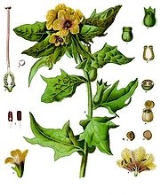
Henbane

Encyclopedia
Henbane also known as stinking nightshade or black henbane, is a plant of the family Solanaceae
that originated in Eurasia
, though it is now globally distributed.
, deadly nightshade
, and datura
as an anaesthetic potion, as well as for its psychoactive properties in "magic brews." These psychoactive properties include visual hallucinations and a sensation of flight. Its usage was originally in continental Europe
, Asia
and the Arab world
, though it did spread to England in the Middle Ages
. The use of Henbane by the ancient Greeks
was documented by Pliny
. The plant, recorded as Herba Apollinaris, was used to yield oracle
s by the priestesses of Apollo
.
The name henbane name dates at least to 1265. The origins of the word are unclear but "hen" probably originally meant death rather than referring to chicken
s. Hyoscyamine
, scopolamine
, and other tropane alkaloids have been found in the foliage and seeds of the plant. Common effects of henbane ingestion in humans include hallucinations, dilated pupils, restlessness, and flushed skin. Less common symptoms such as tachycardia
, convulsions, vomiting, hypertension
, hyperpyrexia and ataxia
have all been noted.
Henbane can be toxic, even fatal, to animals in low doses. Not all animals are susceptible, however; the larva
e of some Lepidoptera
species including Cabbage Moth
eat henbane.
It was sometimes one of the ingredients in gruit
, traditionally used in beers
as a flavouring, until replaced by hops
in the 11th to 16th centuries (for example, the Bavarian Purity Law
of 1516 outlawed ingredients other than barley, hops, and water).
 In 1910, an American homeopath living in London, Hawley Harvey Crippen
, allegedly used scopolamine
, an alkaloid
extracted from henbane, to poison his wife.
Henbane is thought to have been the "hebenon
" poured into the ear of Hamlet
's father (although other candidates for hebenon exist).
recommended Henbane as a "tasty addition to salads" in the August 2008 issue of Healthy and Organic Living magazine. He subsequently said that he had made an error, confusing the herb with Fat Hen
, a member of the spinach family. He apologised, and the magazine sent subscribers an urgent message stating that Henbane "is a very toxic plant and should never be eaten."
Solanaceae
Solanaceae are a family of flowering plants that include a number of important agricultural crops as well as many toxic plants. The name of the family comes from the Latin Solanum "the nightshade plant", but the further etymology of that word is unclear...
that originated in Eurasia
Eurasia
Eurasia is a continent or supercontinent comprising the traditional continents of Europe and Asia ; covering about 52,990,000 km2 or about 10.6% of the Earth's surface located primarily in the eastern and northern hemispheres...
, though it is now globally distributed.
Toxicity and historical usage
It was historically used in combination with other plants, such as mandrakeMandrake (plant)
Mandrake is the common name for members of the plant genus Mandragora, particularly the species Mandragora officinarum, belonging to the nightshades family...
, deadly nightshade
Deadly nightshade
Atropa belladonna or Atropa bella-donna, commonly known as Belladonna, Devil's Berries, Death Cherries or Deadly Nightshade, is a perennial herbaceous plant in the family Solanaceae, native to Europe, North Africa, and Western Asia. The foliage and berries are extremely toxic, containing tropane...
, and datura
Datura
Datura is a genus of nine species of vespertine flowering plants belonging to the family Solanaceae. Its precise and natural distribution is uncertain, owing to its extensive cultivation and naturalization throughout the temperate and tropical regions of the globe...
as an anaesthetic potion, as well as for its psychoactive properties in "magic brews." These psychoactive properties include visual hallucinations and a sensation of flight. Its usage was originally in continental Europe
Continental Europe
Continental Europe, also referred to as mainland Europe or simply the Continent, is the continent of Europe, explicitly excluding European islands....
, Asia
Asia
Asia is the world's largest and most populous continent, located primarily in the eastern and northern hemispheres. It covers 8.7% of the Earth's total surface area and with approximately 3.879 billion people, it hosts 60% of the world's current human population...
and the Arab world
Arab world
The Arab world refers to Arabic-speaking states, territories and populations in North Africa, Western Asia and elsewhere.The standard definition of the Arab world comprises the 22 states and territories of the Arab League stretching from the Atlantic Ocean in the west to the Arabian Sea in the...
, though it did spread to England in the Middle Ages
Middle Ages
The Middle Ages is a periodization of European history from the 5th century to the 15th century. The Middle Ages follows the fall of the Western Roman Empire in 476 and precedes the Early Modern Era. It is the middle period of a three-period division of Western history: Classic, Medieval and Modern...
. The use of Henbane by the ancient Greeks
Ancient Greece
Ancient Greece is a civilization belonging to a period of Greek history that lasted from the Archaic period of the 8th to 6th centuries BC to the end of antiquity. Immediately following this period was the beginning of the Early Middle Ages and the Byzantine era. Included in Ancient Greece is the...
was documented by Pliny
Pliny the Elder
Gaius Plinius Secundus , better known as Pliny the Elder, was a Roman author, naturalist, and natural philosopher, as well as naval and army commander of the early Roman Empire, and personal friend of the emperor Vespasian...
. The plant, recorded as Herba Apollinaris, was used to yield oracle
Oracle
In Classical Antiquity, an oracle was a person or agency considered to be a source of wise counsel or prophetic predictions or precognition of the future, inspired by the gods. As such it is a form of divination....
s by the priestesses of Apollo
Apollo
Apollo is one of the most important and complex of the Olympian deities in Greek and Roman mythology...
.
The name henbane name dates at least to 1265. The origins of the word are unclear but "hen" probably originally meant death rather than referring to chicken
Chicken
The chicken is a domesticated fowl, a subspecies of the Red Junglefowl. As one of the most common and widespread domestic animals, and with a population of more than 24 billion in 2003, there are more chickens in the world than any other species of bird...
s. Hyoscyamine
Hyoscyamine
Hyoscyamine is a tropane alkaloid. It is a secondary metabolite found in certain plants of the Solanaceae family, including henbane , mandrake , jimsonweed , tomato and deadly nightshade...
, scopolamine
Scopolamine
Scopolamine, also known as levo-duboisine, and hyoscine, is a tropane alkaloid drug with muscarinic antagonist effects. It is among the secondary metabolites of plants from Solanaceae family of plants, such as henbane, jimson weed and Angel's Trumpets , and corkwood...
, and other tropane alkaloids have been found in the foliage and seeds of the plant. Common effects of henbane ingestion in humans include hallucinations, dilated pupils, restlessness, and flushed skin. Less common symptoms such as tachycardia
Tachycardia
Tachycardia comes from the Greek words tachys and kardia . Tachycardia typically refers to a heart rate that exceeds the normal range for a resting heart rate...
, convulsions, vomiting, hypertension
Hypertension
Hypertension or high blood pressure is a cardiac chronic medical condition in which the systemic arterial blood pressure is elevated. What that means is that the heart is having to work harder than it should to pump the blood around the body. Blood pressure involves two measurements, systolic and...
, hyperpyrexia and ataxia
Ataxia
Ataxia is a neurological sign and symptom that consists of gross lack of coordination of muscle movements. Ataxia is a non-specific clinical manifestation implying dysfunction of the parts of the nervous system that coordinate movement, such as the cerebellum...
have all been noted.
Henbane can be toxic, even fatal, to animals in low doses. Not all animals are susceptible, however; the larva
Larva
A larva is a distinct juvenile form many animals undergo before metamorphosis into adults. Animals with indirect development such as insects, amphibians, or cnidarians typically have a larval phase of their life cycle...
e of some Lepidoptera
Lepidoptera
Lepidoptera is a large order of insects that includes moths and butterflies . It is one of the most widespread and widely recognizable insect orders in the world, encompassing moths and the three superfamilies of butterflies, skipper butterflies, and moth-butterflies...
species including Cabbage Moth
Cabbage Moth
Note: the Small White species of butterfly is commonly called a "cabbage moth" in North America.The Cabbage Moth is a common European moth of the family Noctuidae....
eat henbane.
It was sometimes one of the ingredients in gruit
Gruit
Gruit is an old-fashioned herb mixture used for bittering and flavoring beer, popular before the extensive use of hops. Gruit or grut ale may also refer to the beverage produced using gruit....
, traditionally used in beers
Beers
Beers can refer to either:* plural of Beer - an alcoholic beverage.* Beers - a town in the Netherlands part of Cuijk mun.* Beers - another town in the Netherlands...
as a flavouring, until replaced by hops
Hops
Hops are the female flower clusters , of a hop species, Humulus lupulus. They are used primarily as a flavoring and stability agent in beer, to which they impart a bitter, tangy flavor, though hops are also used for various purposes in other beverages and herbal medicine...
in the 11th to 16th centuries (for example, the Bavarian Purity Law
Reinheitsgebot
The Reinheitsgebot , sometimes called the "German Beer Purity Law" or the "Bavarian Purity Law" in English, was a regulation concerning the production of beer in Germany. In the original text, the only ingredients that could be used in the production of beer were water, barley and hops...
of 1516 outlawed ingredients other than barley, hops, and water).
Hawley Harvey Crippen
Hawley Harvey Crippen , usually known as Dr. Crippen, was an American homeopathic physician hanged in Pentonville Prison, London, on November 23, 1910, for the murder of his wife, Cora Henrietta Crippen...
, allegedly used scopolamine
Scopolamine
Scopolamine, also known as levo-duboisine, and hyoscine, is a tropane alkaloid drug with muscarinic antagonist effects. It is among the secondary metabolites of plants from Solanaceae family of plants, such as henbane, jimson weed and Angel's Trumpets , and corkwood...
, an alkaloid
Alkaloid
Alkaloids are a group of naturally occurring chemical compounds that contain mostly basic nitrogen atoms. This group also includes some related compounds with neutral and even weakly acidic properties. Also some synthetic compounds of similar structure are attributed to alkaloids...
extracted from henbane, to poison his wife.
Henbane is thought to have been the "hebenon
Hebenon
Hebenon is a botanical substance described in William Shakespeare's tragic play Hamlet as being the agent of death in Hamlet's father's murder that set in motion the events of the play:...
" poured into the ear of Hamlet
Hamlet
The Tragical History of Hamlet, Prince of Denmark, or more simply Hamlet, is a tragedy by William Shakespeare, believed to have been written between 1599 and 1601...
's father (although other candidates for hebenon exist).
Misidentification
In 2008 celebrity chef Antony Worrall ThompsonAntony Worrall Thompson
Henry Antony Cardew Worrall Thompson is a British celebrity chef, television presenter and radio broadcaster.-Biography:...
recommended Henbane as a "tasty addition to salads" in the August 2008 issue of Healthy and Organic Living magazine. He subsequently said that he had made an error, confusing the herb with Fat Hen
Chenopodium album
Chenopodium album is a fast-growing weedy annual plant in the genus Chenopodium.Though cultivated in some regions, the plant is elsewhere considered a weed...
, a member of the spinach family. He apologised, and the magazine sent subscribers an urgent message stating that Henbane "is a very toxic plant and should never be eaten."
External links
- Henbane on ErowidErowidErowid, also called The Vaults of Erowid, is an online library of information about psychoactive plants and chemicals and other topics on altered states of consciousness such as meditation and lucid dreaming. It provides information about legal and illegal substances, including their desired and...
- Photos of Hyoscyamus niger