

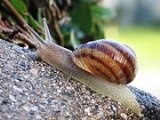
Helix aspersa

Encyclopedia
Helix aspersa, known by the common name
garden snail, is a species of land snail
, a pulmonate gastropod that is one of the best-known of all terrestrial molluscs
. The species has been placed in the genus Helix, in all sources between 1774 and 1988 and in most sources until recently. But in a number of sources since 1990 it has been placed in three other genera, depending on the classification in relation to Helix aperta
and on the accepted interpretation of the ICZN Code's Article 1.3.2 for the Cornu problem. For those who regard Cornu as available the name can be Cornu aspersum (if they do not like to classify it in Helix). Those who do not regard Cornu as available, and do not like to classify the species in Helix, can select between Cantareus aspersus (this is the option for those who classify Helix aperta in the same genus as Helix aspersa, as done by Italian research teams and others) and Cryptomphalus aspersus (for those who like to classify the two species in different genera, as done by Ukrainian and Russian research teams).
Although this species is edible, it is often regarded as a pest in gardens and to agriculture, especially where it has been accidentally introduced. It is native to the Mediterranean area but has been spread by humans, both deliberately and accidentally, to numerous areas all over the world.
, from northwest Africa
and Iberia
east to Asia Minor
, and north to the British Isles
.
It comprises a set of north African endemic forms and subspecies that were described at the beginning of the 20th century, on the basis of shell
characteristics. The most common one, Cornu aspersum aspersum (synonym Helix aspersa aspersa), has become very abundant in all human-disturbed habitats in regions with a Mediterranean, temperate and even subtropical climate.
Cornu aspersum is a typically anthropochorous species; in other words this species has been spread to various geographical areas deliberately and /or accidentally by humans. It is nowadays widespread throughout the world, and occurs in in many zones that have climates differing from the original Mediterranean climate in which it first occurred. Its presence is reported on the American continents, as well as in Australia and in Asia. Because of this fact, the most likely explanation for resemblances between populations located on either side of the Mediterranean would be passive transport due to human activities. Transfers involving this species may have started in the Neolithic revolution
(around 8500 BP). In the present time these introductions continue to occur, and in some cases give rise to catastrophic destruction of habitat.
It is very widely introduced and naturalised
elsewhere in the world and its non-native distribution include other parts of Europe: Bohemia in the Czech Republic since 2008; southern Africa
, Australia
, New Zealand
, North America
and southern South America
. It was introduced to California
as a food animal in the 1850s and is now a notorious agricultural pest there, especially in citrus
groves. Many areas have quarantines established for preventing the importation of the snail in plant matter.
 The adult bears a hard, thin calcareous
shell 25–40 mm in diameter and 25–35 mm high, with four or five whorls
. The shell is somewhat variable in color and shade but is generally dark brown or chestnut with yellow stripes, flecks, or streaks.
The body is soft and slimy, brownish-grey, and is retracted entirely into the shell when the animal is inactive or threatened. During dry and cold weather, the aperture of the shell is sealed with a thin membrane of dried mucus which is known as an epiphragm
, which helps the snail retain moisture. The resultant quiescent periods are known as aestivation and hibernation
respectively. When hibernating, Helix aspersa avoids ice formation by altering the osmotic components of its blood (or haemolymph), and can survive temperatures as low as -5°C. During aestivation, the mantle
collar has the unique ability to change its permeability to water. In combination with an osmoregulatory
mechanism similar to that seen during hibernation this allows Helix aspersa to survive several months of aestivation.
During times of activity the head and foot emerge. The head bears four tentacle
s, the upper two of which have eye-like light sensors, and the lower two of which are smaller, tactile and olfactory sensory structures. The tentacles can be retracted into the head. The mouth is located beneath the tentacles, and contains a chitin
ous radula
which the snail uses to scrape and manipulate food particles.
and has a wide range of host plants (It feeds on plants only). It feeds on numerous types of fruit tree
s, vegetable
crops, garden flower
s, and cereal
s. It is a food source for many other animals, including small mammals, many bird species, lizards, frogs, centipedes, predatory insects, and predatory terrestrial snails.
Helix aspersa can be used as an indicator of environmental contamination, as its shell acts as a site for deposition of toxic heavy metals, such as lead
.
, Helix aspersa is a hermaphrodite
, producing both male and female gamete
s. Reproduction is usually sex
ual, although self-fertilisation can occur. During a mating session of several hours, two snails exchange sperm
. The garden snail uses love darts during mating.
After about two weeks approximately 80 spherical pearly-white eggs are laid into crevices in the topsoil. Up to six batches of 80 eggs can be laid in a year. The size of the egg is 4 mm.
The young snails take one to two years to reach maturity.
 The snail's muscular foot contracts to move the animal, and secretes mucus
to facilitate locomotion by reducing friction against the substrate. It moves at a top speed of 1.3 centimetres per second (47 meters per hour or ~50 yards per hour), and has a strong homing
instinct, readily returning to a regular hibernation
site.
 The species is an agricultural and garden pest, an edible delicacy, and occasionally a household pet
. In French cuisine
, it is known as petit gris, and is served for instance in Escargot a la Bordelaise. The practice of rearing snails for food is known as heliciculture
. For purposes of cultivation, the snails should be kept in a dark place in a wired cage with dry straw or dry wood. Coppiced wine-grape vines are often used for this purpose. During the rainy period the snails will come out of hibernation and release most of their mucus onto the dry wood/straw. The snails are then prepared for cooking. Their texture is slightly chewy.
There are a variety of snail control measures that gardeners and farmers can take to reduce damage. Traditional pesticides are still in use, as are many less toxic control options such as concentrated garlic
or wormwood
solutions. Copper
metal is repellent to snails. A copper band around the trunk of a tree will prevent snails from climbing up and reaching the foliage and fruit.
The decollate snail
(Rumina decollata) will capture and eat garden snails, so it is sometimes introduced as a biological pest control
agent.
Recently, Helix aspersa has gained popularity as the chief ingredient in skin creams and gels (crema/gel de caracol) sold within the Latino community and used for wrinkles, scars, dry skin, and acne.
Common name
A common name of a taxon or organism is a name in general use within a community; it is often contrasted with the scientific name for the same organism...
garden snail, is a species of land snail
Land snail
A land snail is any of the many species of snail that live on land, as opposed to those that live in salt water and fresh water. Land snails are terrestrial gastropod mollusks that have shells, It is not always an easy matter to say which species are terrestrial, because some are more or less...
, a pulmonate gastropod that is one of the best-known of all terrestrial molluscs
Mollusca
The Mollusca , common name molluscs or mollusksSpelled mollusks in the USA, see reasons given in Rosenberg's ; for the spelling mollusc see the reasons given by , is a large phylum of invertebrate animals. There are around 85,000 recognized extant species of molluscs. Mollusca is the largest...
. The species has been placed in the genus Helix, in all sources between 1774 and 1988 and in most sources until recently. But in a number of sources since 1990 it has been placed in three other genera, depending on the classification in relation to Helix aperta
Helix aperta
Helix aperta, also known as Cantareus apertus, and commonly known as the green garden snail, is a species of air-breathing land snail, a terrestrial pulmonate gastropod mollusk in the family Helicidae, the typical snails.-Distribution:...
and on the accepted interpretation of the ICZN Code's Article 1.3.2 for the Cornu problem. For those who regard Cornu as available the name can be Cornu aspersum (if they do not like to classify it in Helix). Those who do not regard Cornu as available, and do not like to classify the species in Helix, can select between Cantareus aspersus (this is the option for those who classify Helix aperta in the same genus as Helix aspersa, as done by Italian research teams and others) and Cryptomphalus aspersus (for those who like to classify the two species in different genera, as done by Ukrainian and Russian research teams).
Although this species is edible, it is often regarded as a pest in gardens and to agriculture, especially where it has been accidentally introduced. It is native to the Mediterranean area but has been spread by humans, both deliberately and accidentally, to numerous areas all over the world.
Distribution
This species is native to the Mediterranean region (including Egypt) and western EuropeEurope
Europe is, by convention, one of the world's seven continents. Comprising the westernmost peninsula of Eurasia, Europe is generally 'divided' from Asia to its east by the watershed divides of the Ural and Caucasus Mountains, the Ural River, the Caspian and Black Seas, and the waterways connecting...
, from northwest Africa
Africa
Africa is the world's second largest and second most populous continent, after Asia. At about 30.2 million km² including adjacent islands, it covers 6% of the Earth's total surface area and 20.4% of the total land area...
and Iberia
Iberian Peninsula
The Iberian Peninsula , sometimes called Iberia, is located in the extreme southwest of Europe and includes the modern-day sovereign states of Spain, Portugal and Andorra, as well as the British Overseas Territory of Gibraltar...
east to Asia Minor
Asia Minor
Asia Minor is a geographical location at the westernmost protrusion of Asia, also called Anatolia, and corresponds to the western two thirds of the Asian part of Turkey...
, and north to the British Isles
British Isles
The British Isles are a group of islands off the northwest coast of continental Europe that include the islands of Great Britain and Ireland and over six thousand smaller isles. There are two sovereign states located on the islands: the United Kingdom of Great Britain and Northern Ireland and...
.
It comprises a set of north African endemic forms and subspecies that were described at the beginning of the 20th century, on the basis of shell
characteristics. The most common one, Cornu aspersum aspersum (synonym Helix aspersa aspersa), has become very abundant in all human-disturbed habitats in regions with a Mediterranean, temperate and even subtropical climate.
Cornu aspersum is a typically anthropochorous species; in other words this species has been spread to various geographical areas deliberately and /or accidentally by humans. It is nowadays widespread throughout the world, and occurs in in many zones that have climates differing from the original Mediterranean climate in which it first occurred. Its presence is reported on the American continents, as well as in Australia and in Asia. Because of this fact, the most likely explanation for resemblances between populations located on either side of the Mediterranean would be passive transport due to human activities. Transfers involving this species may have started in the Neolithic revolution
Neolithic Revolution
The Neolithic Revolution was the first agricultural revolution. It was the transition from hunting and gathering to agriculture and settlement. Archaeological data indicates that various forms of plants and animal domestication evolved independently in 6 separate locations worldwide circa...
(around 8500 BP). In the present time these introductions continue to occur, and in some cases give rise to catastrophic destruction of habitat.
It is very widely introduced and naturalised
Naturalisation (biology)
In biology, naturalisation is any process by which a non-native organism spreads into the wild and its reproduction is sufficient to maintain its population. Such populations are said to be naturalised....
elsewhere in the world and its non-native distribution include other parts of Europe: Bohemia in the Czech Republic since 2008; southern Africa
Africa
Africa is the world's second largest and second most populous continent, after Asia. At about 30.2 million km² including adjacent islands, it covers 6% of the Earth's total surface area and 20.4% of the total land area...
, Australia
Australia
Australia , officially the Commonwealth of Australia, is a country in the Southern Hemisphere comprising the mainland of the Australian continent, the island of Tasmania, and numerous smaller islands in the Indian and Pacific Oceans. It is the world's sixth-largest country by total area...
, New Zealand
New Zealand
New Zealand is an island country in the south-western Pacific Ocean comprising two main landmasses and numerous smaller islands. The country is situated some east of Australia across the Tasman Sea, and roughly south of the Pacific island nations of New Caledonia, Fiji, and Tonga...
, North America
North America
North America is a continent wholly within the Northern Hemisphere and almost wholly within the Western Hemisphere. It is also considered a northern subcontinent of the Americas...
and southern South America
South America
South America is a continent situated in the Western Hemisphere, mostly in the Southern Hemisphere, with a relatively small portion in the Northern Hemisphere. The continent is also considered a subcontinent of the Americas. It is bordered on the west by the Pacific Ocean and on the north and east...
. It was introduced to California
California
California is a state located on the West Coast of the United States. It is by far the most populous U.S. state, and the third-largest by land area...
as a food animal in the 1850s and is now a notorious agricultural pest there, especially in citrus
Citrus
Citrus is a common term and genus of flowering plants in the rue family, Rutaceae. Citrus is believed to have originated in the part of Southeast Asia bordered by Northeastern India, Myanmar and the Yunnan province of China...
groves. Many areas have quarantines established for preventing the importation of the snail in plant matter.
Description
Calcium carbonate
Calcium carbonate is a chemical compound with the formula CaCO3. It is a common substance found in rocks in all parts of the world, and is the main component of shells of marine organisms, snails, coal balls, pearls, and eggshells. Calcium carbonate is the active ingredient in agricultural lime,...
shell 25–40 mm in diameter and 25–35 mm high, with four or five whorls
Whorl (mollusc)
A whorl is a single, complete 360° revolution or turn in the spiral growth of a mollusc shell. A spiral configuration of the shell is found in of numerous gastropods, but it is also found in shelled cephalopods including Nautilus, Spirula and the large extinct subclass of cephalopods known as the...
. The shell is somewhat variable in color and shade but is generally dark brown or chestnut with yellow stripes, flecks, or streaks.
The body is soft and slimy, brownish-grey, and is retracted entirely into the shell when the animal is inactive or threatened. During dry and cold weather, the aperture of the shell is sealed with a thin membrane of dried mucus which is known as an epiphragm
Epiphragm
An epiphragm is a temporary structure which can be created by many species of shelled, air-breathing land snails, terrestrial pulmonate gastropod mollusks. It can also be created by freshwater snails when temporary pools dry up....
, which helps the snail retain moisture. The resultant quiescent periods are known as aestivation and hibernation
Hibernation
Hibernation is a state of inactivity and metabolic depression in animals, characterized by lower body temperature, slower breathing, and lower metabolic rate. Hibernating animals conserve food, especially during winter when food supplies are limited, tapping energy reserves, body fat, at a slow rate...
respectively. When hibernating, Helix aspersa avoids ice formation by altering the osmotic components of its blood (or haemolymph), and can survive temperatures as low as -5°C. During aestivation, the mantle
Mantle (mollusc)
The mantle is a significant part of the anatomy of molluscs: it is the dorsal body wall which covers the visceral mass and usually protrudes in the form of flaps well beyond the visceral mass itself.In many, but by no means all, species of molluscs, the epidermis of the mantle secretes...
collar has the unique ability to change its permeability to water. In combination with an osmoregulatory
Osmoregulation
Osmoregulation is the active regulation of the osmotic pressure of an organism's fluids to maintain the homeostasis of the organism's water content; that is it keeps the organism's fluids from becoming too diluted or too concentrated. Osmotic pressure is a measure of the tendency of water to move...
mechanism similar to that seen during hibernation this allows Helix aspersa to survive several months of aestivation.
During times of activity the head and foot emerge. The head bears four tentacle
Tentacle
A tentacle or bothrium is one of usually two or more elongated flexible organs present in animals, especially invertebrates. The term may also refer to the hairs of the leaves of some insectivorous plants. Usually, tentacles are used for feeding, feeling and grasping. Anatomically, they work like...
s, the upper two of which have eye-like light sensors, and the lower two of which are smaller, tactile and olfactory sensory structures. The tentacles can be retracted into the head. The mouth is located beneath the tentacles, and contains a chitin
Chitin
Chitin n is a long-chain polymer of a N-acetylglucosamine, a derivative of glucose, and is found in many places throughout the natural world...
ous radula
Radula
The radula is an anatomical structure that is used by molluscs for feeding, sometimes compared rather inaccurately to a tongue. It is a minutely toothed, chitinous ribbon, which is typically used for scraping or cutting food before the food enters the esophagus...
which the snail uses to scrape and manipulate food particles.
Ecology
The garden snail is a herbivoreHerbivore
Herbivores are organisms that are anatomically and physiologically adapted to eat plant-based foods. Herbivory is a form of consumption in which an organism principally eats autotrophs such as plants, algae and photosynthesizing bacteria. More generally, organisms that feed on autotrophs in...
and has a wide range of host plants (It feeds on plants only). It feeds on numerous types of fruit tree
Fruit tree
A fruit tree is a tree which bears fruit that is consumed or used by people — all trees that are flowering plants produce fruit, which are the ripened ovaries of flowers containing one or more seeds. In horticultural usage, the term 'fruit tree' is limited to those that provide fruit for...
s, vegetable
Vegetable
The noun vegetable usually means an edible plant or part of a plant other than a sweet fruit or seed. This typically means the leaf, stem, or root of a plant....
crops, garden flower
Flower
A flower, sometimes known as a bloom or blossom, is the reproductive structure found in flowering plants . The biological function of a flower is to effect reproduction, usually by providing a mechanism for the union of sperm with eggs...
s, and cereal
Cereal
Cereals are grasses cultivated for the edible components of their grain , composed of the endosperm, germ, and bran...
s. It is a food source for many other animals, including small mammals, many bird species, lizards, frogs, centipedes, predatory insects, and predatory terrestrial snails.
Helix aspersa can be used as an indicator of environmental contamination, as its shell acts as a site for deposition of toxic heavy metals, such as lead
Lead
Lead is a main-group element in the carbon group with the symbol Pb and atomic number 82. Lead is a soft, malleable poor metal. It is also counted as one of the heavy metals. Metallic lead has a bluish-white color after being freshly cut, but it soon tarnishes to a dull grayish color when exposed...
.
Life cycle
Like other PulmonataPulmonata
The Pulmonata, or "pulmonates", are an informal group of snails and slugs characterized by the ability to breathe air, by virtue of having a pallial lung instead of a gill, or gills...
, Helix aspersa is a hermaphrodite
Hermaphrodite
In biology, a hermaphrodite is an organism that has reproductive organs normally associated with both male and female sexes.Many taxonomic groups of animals do not have separate sexes. In these groups, hermaphroditism is a normal condition, enabling a form of sexual reproduction in which both...
, producing both male and female gamete
Gamete
A gamete is a cell that fuses with another cell during fertilization in organisms that reproduce sexually...
s. Reproduction is usually sex
Sex
In biology, sex is a process of combining and mixing genetic traits, often resulting in the specialization of organisms into a male or female variety . Sexual reproduction involves combining specialized cells to form offspring that inherit traits from both parents...
ual, although self-fertilisation can occur. During a mating session of several hours, two snails exchange sperm
Sperm
The term sperm is derived from the Greek word sperma and refers to the male reproductive cells. In the types of sexual reproduction known as anisogamy and oogamy, there is a marked difference in the size of the gametes with the smaller one being termed the "male" or sperm cell...
. The garden snail uses love darts during mating.
After about two weeks approximately 80 spherical pearly-white eggs are laid into crevices in the topsoil. Up to six batches of 80 eggs can be laid in a year. The size of the egg is 4 mm.
The young snails take one to two years to reach maturity.
Parasites
Parasites of Helix aspersa include:- nematod Nemhelix bakeri (family CosmocercidaeCosmocercidaeCosmocercidae is a nematode family in the super family Cosmoceroidea.- Genera :Genera within the family Cosmocercidae include:* Cosmocercoides Wilkie, 1930...
)
Behaviour
Mucus
In vertebrates, mucus is a slippery secretion produced by, and covering, mucous membranes. Mucous fluid is typically produced from mucous cells found in mucous glands. Mucous cells secrete products that are rich in glycoproteins and water. Mucous fluid may also originate from mixed glands, which...
to facilitate locomotion by reducing friction against the substrate. It moves at a top speed of 1.3 centimetres per second (47 meters per hour or ~50 yards per hour), and has a strong homing
Homing (biology)
Homing is the inherent ability of an animal to navigate towards an original location through unfamiliar areas. This location may be either a home territory, or a breeding spot.-Uses:...
instinct, readily returning to a regular hibernation
Hibernation
Hibernation is a state of inactivity and metabolic depression in animals, characterized by lower body temperature, slower breathing, and lower metabolic rate. Hibernating animals conserve food, especially during winter when food supplies are limited, tapping energy reserves, body fat, at a slow rate...
site.
Human relevance
Pet
A pet is a household animal kept for companionship and a person's enjoyment, as opposed to wild animals or to livestock, laboratory animals, working animals or sport animals, which are kept for economic or productive reasons. The most popular pets are noted for their loyal or playful...
. In French cuisine
French cuisine
French cuisine is a style of food preparation originating from France that has developed from centuries of social change. In the Middle Ages, Guillaume Tirel , a court chef, authored Le Viandier, one of the earliest recipe collections of Medieval France...
, it is known as petit gris, and is served for instance in Escargot a la Bordelaise. The practice of rearing snails for food is known as heliciculture
Heliciculture
Heliciculture, or snail farming is the process of farming or raising land snails specifically for human consumption, and more recently, to obtain snail slime for cosmetics use....
. For purposes of cultivation, the snails should be kept in a dark place in a wired cage with dry straw or dry wood. Coppiced wine-grape vines are often used for this purpose. During the rainy period the snails will come out of hibernation and release most of their mucus onto the dry wood/straw. The snails are then prepared for cooking. Their texture is slightly chewy.
There are a variety of snail control measures that gardeners and farmers can take to reduce damage. Traditional pesticides are still in use, as are many less toxic control options such as concentrated garlic
Garlic
Allium sativum, commonly known as garlic, is a species in the onion genus, Allium. Its close relatives include the onion, shallot, leek, chive, and rakkyo. Dating back over 6,000 years, garlic is native to central Asia, and has long been a staple in the Mediterranean region, as well as a frequent...
or wormwood
Artemisia (plant)
Artemisia is a large, diverse genus of plants with between 200 to 400 species belonging to the daisy family Asteraceae. It comprises hardy herbs and shrubs known for their volatile oils. They grow in temperate climates of the Northern Hemisphere and Southern Hemisphere, usually in dry or semi-dry...
solutions. Copper
Copper
Copper is a chemical element with the symbol Cu and atomic number 29. It is a ductile metal with very high thermal and electrical conductivity. Pure copper is soft and malleable; an exposed surface has a reddish-orange tarnish...
metal is repellent to snails. A copper band around the trunk of a tree will prevent snails from climbing up and reaching the foliage and fruit.
The decollate snail
Decollate snail
The decollate snail, scientific name Rumina decollata, is a medium-sized predatory land snail, a species of terrestrial pulmonate gastropod mollusk in the family Subulinidae.-Distribution:...
(Rumina decollata) will capture and eat garden snails, so it is sometimes introduced as a biological pest control
Biological pest control
Biological control of pests in agriculture is a method of controlling pests that relies on predation, parasitism, herbivory, or other natural mechanisms...
agent.
Recently, Helix aspersa has gained popularity as the chief ingredient in skin creams and gels (crema/gel de caracol) sold within the Latino community and used for wrinkles, scars, dry skin, and acne.
External links
- brown garden snail on the UFUniversity of FloridaThe University of Florida is an American public land-grant, sea-grant, and space-grant research university located on a campus in Gainesville, Florida. The university traces its historical origins to 1853, and has operated continuously on its present Gainesville campus since September 1906...
/ IFASInstitute of Food and Agricultural SciencesThe University of Florida’s Institute of Food and Agricultural Sciences is a federal-state-county partnership dedicated to developing knowledge in agriculture, human and natural resources, and the life sciences, and enhancing and sustaining the quality of human life by making that information...
Featured Creatures Web site - Canada Agriculture Fact Sheet
- BBC Info Page
- Pesticides Database - Chemical Toxicity Studies
- Extreme Close-Up Video of the North American Garden Snail