
All Topics  
Heliconiinae

 
Heliconiinae

   Email Print
   Bookmark   Link


Heliconiinae


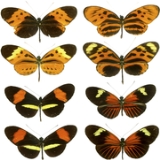
The Heliconiinae, commonly called heliconians or longwings, are a subfamily of the brush-footed butterflies (family
Family (biology)

In biological classification, family is a taxonomic rank. Exact details of formal nomenclature depend on the Nomenclature Codes which applies....
 Nymphalidae). They can be divided into 45-50 genera
Genera

Genera is a commercial operating system and development environment for Lisp machines developed by Symbolics. It is essentially a Fork of an earlier operating system originating on the MIT AI Lab's Lisp machines which Symbolics had used in common with Lisp Machines, Inc....
 and were sometimes treated as a separate family Heliconiidae within the Papilionoidea
Papilionoidea

The superfamily Papilionoidea contains all the butterfly except for the skipper s, which are classified in superfamily Hesperioidea, and the moth-like Hedyloidea....
. The coloration is predominantly reddish and black, and though of varying wing shape, the forewings are always elongated tipwards, hence the common name.

Most longwings are found in the Tropics
Tropics

The Tropics, seated in the equatorial regions of the world, are limited in latitude by the Tropic of Cancer in the northern hemisphere at approximately 23?26' N latitude, and the Tropic of Capricorn in the southern hemisphere at 23?26' S latitude....
, particularly in South America
South America

South America is the southern continent of the Americas, situated entirely in the Western Hemisphere and mostly in the Southern Hemisphere, with a relatively small portion in the Northern Hemisphere....
; only the Argynnini
Argynnini

Argynnini is a Tribe of butterfly in the subfamily Heliconiinae, containing some of the fritillaries. This group has also been classified as subtribe Argynnina of the Heliconiini, or even as a distinct subfamily Argynninae in the Nymphalidae....
 are quite diverse in the Holarctic
Holarctic

The Holarctic ecozone refers to the habitats found throughout the northern continents of the world as a whole. This region is divided into the Palearctic, consisting of Northern Africa and all of Eurasia, with the exception of Southeast Asia and the Indian subcontinent, and the Nearctic, consisting of North America south to northern Mexico....
.


Discussion
Ask a question about 'Heliconiinae'
Start a new discussion about 'Heliconiinae'
Answer questions from other users
Full Discussion Forum


Recent Posts


Encyclopedia


The Heliconiinae, commonly called heliconians or longwings, are a subfamily of the brush-footed butterflies (family
Family (biology)

In biological classification, family is a taxonomic rank. Exact details of formal nomenclature depend on the Nomenclature Codes which applies....
 Nymphalidae). They can be divided into 45-50 genera
Genera

Genera is a commercial operating system and development environment for Lisp machines developed by Symbolics. It is essentially a Fork of an earlier operating system originating on the MIT AI Lab's Lisp machines which Symbolics had used in common with Lisp Machines, Inc....
 and were sometimes treated as a separate family Heliconiidae within the Papilionoidea
Papilionoidea

The superfamily Papilionoidea contains all the butterfly except for the skipper s, which are classified in superfamily Hesperioidea, and the moth-like Hedyloidea....
. The coloration is predominantly reddish and black, and though of varying wing shape, the forewings are always elongated tipwards, hence the common name.

Most longwings are found in the Tropics
Tropics

The Tropics, seated in the equatorial regions of the world, are limited in latitude by the Tropic of Cancer in the northern hemisphere at approximately 23?26' N latitude, and the Tropic of Capricorn in the southern hemisphere at 23?26' S latitude....
, particularly in South America
South America

South America is the southern continent of the Americas, situated entirely in the Western Hemisphere and mostly in the Southern Hemisphere, with a relatively small portion in the Northern Hemisphere....
; only the Argynnini
Argynnini

Argynnini is a Tribe of butterfly in the subfamily Heliconiinae, containing some of the fritillaries. This group has also been classified as subtribe Argynnina of the Heliconiini, or even as a distinct subfamily Argynninae in the Nymphalidae....
 are quite diverse in the Holarctic
Holarctic

The Holarctic ecozone refers to the habitats found throughout the northern continents of the world as a whole. This region is divided into the Palearctic, consisting of Northern Africa and all of Eurasia, with the exception of Southeast Asia and the Indian subcontinent, and the Nearctic, consisting of North America south to northern Mexico....
. Especially tropical species feed on poison
Poison

In the context of biology, poisons are Chemical substance that can cause disturbances to organisms, usually by chemical reaction or other activity on the molecular scale, when a sufficient quantity is absorbed by an organism....
ous plants, characteristically Passifloraceae
Passifloraceae

Passifloraceae is a family of flowering plants, containing about 530 species classified in around 18 genera. They include trees, shrubs, lianas and climbing plants, and are mostly found in tropical regions ....
 vines, as larva
Larva

A larva is a young form of animal with indirect developmental biology, going through or undergoing metamorphosis .The larva can look completely different from the adult form, for example, a caterpillar differs from a butterfly....
e, becoming poisonous themselves. The adult butterflies announce their acquired toxicity with strong aposematic colors, warning off would-be predators. There are several famous cases of Batesian
Batesian mimicry

Batesian mimicry is a form of mimicry typified by a situation where a harmless species has evolved to imitate the warning signals of a harmful species directed at a common predator....
 and Müllerian mimicry
Müllerian mimicry

M?llerian mimicry is a natural phenomenon when two or more harmful species, that are not closely related and share one or more common predators, have come to mimicry each other's aposematism....
 both within this group and with other butterflies. Other commonly-seen foodplants are Fabaceae
Fabaceae

Fabaceae or Leguminosae is a large and economically important family of flowering plants, which is commonly known as the legume family, pea family, bean family or pulse family....
 (which also contain several toxic species), and particularly among northernly species Violaceae
Violaceae

Violaceae is a family of flowering plants consisting of about 800 species in 21 genera. It takes its name from the genus Violet , the violets and pansy....
.

Systematics

Four or five tribe
Tribe (biology)

In biology, a tribe — or infrafamily — is a taxonomic rank between family and genus. It is sometimes subdivided into subtribes....
s are generally recognized in the Heliconiinae. There have been numerous attempts to sort out the phylogenetic sequence and delimitation of these, but while the former has made good progress, the latter has hitherto only achieved limited results.

Several phylogenies (and corresponding taxonomic
Taxonomy

Taxonomy is the practice and science of classification. The word comes from the Greek language ', taxis and ', nomos .Taxonomies, or taxonomic schemes, are composed of taxonomic units known as taxa , or kinds of things that are arranged frequently in a hierarchical structure....
 adjustments) have been proposed, but though looking reasonable each and every one of them is only weakly supported. Even cladistic analyses of the same type of data often yield contradicting results depending on the exact method of evaluation. Ultimately, the reason is that just a fraction of the evolution
Evolution

In biology, evolution is change in the heritability trait of a population of organisms from one generation to the next. These changes are caused by a combination of three main processes: variation, reproduction, and selection....
ary diversity of Heliconiinae has been sampled.

What appears fairly certain is that the Argynnini
Argynnini

Argynnini is a Tribe of butterfly in the subfamily Heliconiinae, containing some of the fritillaries. This group has also been classified as subtribe Argynnina of the Heliconiini, or even as a distinct subfamily Argynninae in the Nymphalidae....
 and Vagrantini is closer relatives than any other two tribes of Heliconiinae. The Acraeini and Heliconiini are probably more basal lineages, but the exact placement of each respective to the other tribes cannot be considered well-resolved at all.

Some tribes are distributed among several continent
Continent

A continent is one of several large landmasses on Earth. They are generally identified by convention rather than any strict criteria, with seven regions commonly regarded as continents ? they are : Asia, Africa, North America, South America, Antarctica, Europe, and Australia ....
s, resulting in a confusing phylogeography
Phylogeography

Phylogeography is the study of the historical processes that may be responsible for the contemporary geographic distributions of individuals. This is accomplished by considering the geographic distribution of individuals in light of the patterns associated with a gene genealogy....
 pattern. But as it seems, the apparent contradictions between systematics
Systematics

Biological systematics is the study of the diversification of life on the planet Earth, both past and present, and the relationships among living things through time....
 and biogeography
Biogeography

Biogeography is the study of the distribution of biodiversity over space and time. It aims to reveal where organisms live, and at what abundance....
 are due the premature classifications based on insufficient taxon
Taxon

A taxon or taxonomic unit is a name designating an organism or a group of organisms. In biological nomenclature according to Carl Linnaeus, a taxon is assigned a taxonomic rank and can be placed at a particular level in a systematic hierarchy reflecting evolutionary relationships....
 sampling. With studies becoming more and more comprehensive, the apparent anomalies seem to sort themselves out at least for the most part. For example, the confusing distribution pattern of Acraea
Acraea (genus)

Acraea is a genus of brush-footed butterflies of the subfamily Heliconiinae. It seems to be highly paraphyletic and has long been used as a "wastebin taxon" to unite about 220 species of anatomyly conservative Acraeini....
 in the wide circumscription is apparently simply due to te bulk of this morphologically
Morphology (biology)

The term morphology in biology refers to form, structure and configuration of an organism. This includes aspects of the outward appearance as well as the form and structure of the internal parts like bones and organs....
 conservative group warranting recognition as genus Telchinia – it stands to note that this group has on occasion been allied with Actinote rather than Acraea, and this indeed appears to be correct.

In addition, the genus Pardopsis, often placed in the Acraeini, does almost certainly not belong there; it might better be placed in the Argynnini. The relationships of the genus Cethosia (sometimes treated as a tribe of its own) are even more mysterious, and it is likely that some other genera will eventually also be moved to a different tribe as they are studied in detail. Some, like the Argynnini Argynnis, Boloria
Boloria

Boloria is a brush-footed butterfly genus. Clossiana is usually included with it nowadays, though some authors still consider it distinct and it seems to warrant recognition as a subgenus at least....
 and Issoria, might be overlumped
Lumpers and splitters

Lumping and splitting refers to a well known problem in any discipline which has to place individual examples into rigorously defined categories....
 and non-monophyletic and thus some genera presently usually considered junior synonyms of them might eventually be validated like Telchinia.

Genera

Acraea Terpsicore Ad Sec
Genera are presented in the presumed phylogenetic sequence. Notable species
Species

In biology, a species is one of the basic units of biological classification and a taxonomic rank. A species is often defined as a group of organisms capable of interbreeding and producing fertile offspring....
 are also given if no genus article exists.

Acraeini Boisduval, 1833
  • Bematistes Hemming 1935
  • Acraea
    Acraea (genus)

    Acraea is a genus of brush-footed butterflies of the subfamily Heliconiinae. It seems to be highly paraphyletic and has long been used as a "wastebin taxon" to unite about 220 species of anatomyly conservative Acraeini....
     (paraphyletic)
  • Miyana Fruhstorfer 1914 (tentatively paced here)
  • Actinote Hübner 1819 (including Abananote and Altinote)


Heliconiini Swainson, 1822
  • Philaethria Billberg 1820
  • Podotricha Michener 1942
  • Dione Hübner 1819
  • Agraulis Boisduval & Le Conte 1835
    • Gulf Fritillary
      Gulf Fritillary

      The Gulf Fritillary, Agraulis vanillae, a striking, bright orange butterfly of the family Nymphalidae, subfamily Heliconiinae. These were formerly classified in a separate family, the Heliconiidae or longwing butterflies, and like other longwings this species does have long, rather narrow wings in comparison with other butterflies....
      , Agraulis vanillae
  • Dryadula – Banded Orange
  • Dryas – Julia Heliconian
  • Eueides Hübner 1816
    • Isabella's Heliconian, Eueides isabella
  • Heliconius
    Heliconius

    Heliconius comprise a colorful and widespread brush-footed butterfly genus distributed throughout the tropical and subtropical regions of the New World....
     (including Laparus, Nerula)


Vagrantini Pinratana & Eliot, 1996
  • Lachnoptera Doubleday 1847
  • Phalanta Horsfield 1829
    • Small Leopard, Phalanta alcippe
  • Smerina Hewitson 1874
  • Vindula – cruisers Hemming 1934
    • Vindula arsinoe
      Vindula arsinoe

      Vindula arsinoe, commonly known as the cruiser, is a day butterfly from the family Nymphalidae. It ranges from New Guinea to the Solomon Islands....
    • Vindula erota
      Vindula erota

      The Cruiser is a species of nymphalidae butterfly found in forested areas of tropical South Asia and Southeast Asia....
  • Cirrochroa Doubleday 1847
    • Large Yeoman, Cirrochroa aoris
    • Tamil Yeoman, Cirrochroa thais
  • Algiachroa Parsons 1989
  • Algia Herrich-Schäffer 1864
  • Terinos Boisduval 1836
  • Cupha Billberg 1820
  • Vagrans Hemming 1934
    Rn009 Cethosia Cyane
    ** Vagrant
    Vagrans egista

    The Vagrant is a species of nymphalidae butterfly found in forested areas of tropical South Asia and Southeast Asia....
    , Vagrans egista


Argynnini
Argynnini

Argynnini is a Tribe of butterfly in the subfamily Heliconiinae, containing some of the fritillaries. This group has also been classified as subtribe Argynnina of the Heliconiini, or even as a distinct subfamily Argynninae in the Nymphalidae....
 (about 7 genera)

Incertae sedis
Incertae sedis

Incertae sedis , abbreviation "inc. sed.", is a term used to define a taxonomy group where its broader relationships are unknown or undefined....
  • Cethosia Fabricius 1807 – lacewings
    • Red Lacewing, Cethosia biblis
    • Leopard Lacewing, Cethosia cyane
    • Tamil Lacewing, Cethosia nietneri
  • Pardopsis Trimen 1887 (probably Argynnini)


Footnotes


External links

  • on the UF
    University of Florida

    The University of Florida is a Public university land-grant university, sea grant colleges, Space grant colleges major research university located on a campus in Gainesville, Florida, in the United States....
     / IFAS
    Institute of Food and Agricultural Sciences

    The University of Florida?s Institute of Food and Agricultural Sciences is a federal-state-county partnership dedicated to developing knowledge in agriculture, human and natural resources, and the life sciences, and enhancing and sustaining the quality of human life by making that information accessible....
     Featured Creatures Web site