
|
|
|
|
Hearing aid
|
| |
|
| |
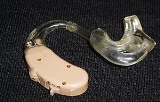
A hearing aid is an electroacoustic body worn apparatus which typically fits in or behind the wearer's ear, and is designed to amplify and modulate sounds for the wearer. Earlier devices, known as an "ear trumpet" or "ear horn", were passive funnel-like amplification cones designed to gather sound energy and direct it into the ear canal.

Discussion
Ask a question about 'Hearing aid'
Start a new discussion about 'Hearing aid'
Answer questions from other users
|
Recent Posts

Encyclopedia
A hearing aid is an electroacoustic body worn apparatus which typically fits in or behind the wearer's ear, and is designed to amplify and modulate sounds for the wearer. Earlier devices, known as an "ear trumpet" or "ear horn", were passive funnel-like amplification cones designed to gather sound energy and direct it into the ear canal. Similar devices include the bone anchored hearing aid, and cochlear implant.
Types of hearing aids
There are many types of hearing aids (also known as hearing instruments), which vary in size, power and circuitry.
Among the different sizes and models are:
Body worn aids
This was the first type of hearing aid invented by Harvey Fletcher while working at Bell Laboratories, thanks to developments in technology they are now rarely used. These aids consist of a case containing the components of amplification and an ear mold connected to the case by a cord. The case is about the size of a pack of playing cards and is worn in the pocket or on a belt. Because of their large size, body worn aids are capable of large amounts of amplification and were once used for profound hearing losses. Today, body aids have largely been replaced by Behind-The-Ear (BTE) instruments.
Behind the ear aids (BTE)
BTE aids have a small plastic case that fits behind the pinna (ear) and provides sound to the ear via air conduction of sound through a small length of tubing, or electrically with a wire and miniature speaker placed in the ear canal. The delivery of sound to the ear is usually through an earmold that is custom made, or other pliable fixture that contours to the individuals ear. BTEs can be used for mild to profound hearing losses and are especially useful for children because of their durability and ability to connect to assistive listening devices such as classroom FM systems. Another benefit when used with children is cost, when the child is growing quickly a new mold can be made for a fraction of the price of a new ITE. Their colors range from very inconspicuous skin tones to bright colors and optional decorations. Recent innovations in BTEs include miniature "invisible" BTEs with thin hair-like sound tubes (see open-fit devices below). These are often less visible than In-The-Ear aids (ITEs) and some keep the ear canal more open so listeners may still utilise their residual natural hearing (most helpful for those with normal hearing in the lower frequencies). Ideal for high frequency losses, these miniature versions are generally used for mild to moderate hearing loss.
In the ear aids (ITE)
These devices fit in the outer ear bowl (called the concha); they are sometimes visible when standing face to face with someone. ITE hearing aids are custom made to fit each individual's ear. They can be used in mild to some severe hearing losses. Feedback, a squealing/whistling caused by sound (particularly high frequency sound) leaking and being amplified again, may be a problem for severe hearing losses. Some modern circuits are able to provide feedback regulation or cancellation to assist with this. Traditionally, ITEs have not been recommended for young children because their fit could not be as easily modified as the earmold for a BTE, and thus the aid had to be replaced frequently as the child grew. However, there are new ITEs made from a silicone type material that mitigates the need for costly replacements.
Receiver In the ear aids (RITE)
At a first glance, these devices are similar to the BTE aid. There is however one crucial difference: The speaker ('receiver') of the hearing aid is placed inside the ear canal of the user and thin electrical wires replace the acoustic tube of the BTE aid. There are some advantages with this approach: Firstly, the sound of the hearing aid is arguably smoother than that of a traditional BTE hearing aid. With a traditional BTE hearing aid, the amplified signal is emitted by the speaker (receiver) which is located within the body of the hearing aid (behind the ear). The amplified signal is then directed to the ear canal through an acoustic tube, which creates a peaky frequency response. With a RITE hearing aid, the speaker (receiver) is right in the ear canal and the amplified output of the hearing aid does not need to be pushed through an acoustic tube to get there, and is therefore free of this distortion. Secondly, RITE hearing aids can typically be made with a very small part behind-the-ear and the wire connecting the hearing aid and the speaker (receiver) is extremely inconspicuous. For the majority of people this is one of the most cosmetically acceptable hearing device types. Thirdly, RITE devices are suited to "open fit" technology (see below) so they can be fitted without plugging up the ear, offering relief from occlusion.
In the canal (ITC), mini canal (MIC) and completely in the canal aids (CIC)
ITC aids are smaller, filling only the bottom half of the external ear. You usually cannot see very much of this hearing aid when you are face to face with someone. MIC and CIC aids are often not visible unless you look directly into the wearer's ear.
These aids are intended for mild to moderately-severe losses. CICs are usually not recommended for people with good low frequency hearing, as the occlusion effect is much more perceivable.
Open-fit devices
"Open-fit" or "Over-the-Ear" OTE hearing aids are small behind-the-ear type devices. This type is characterized by a small plastic case behind the ear, and a very fine clear tube running into the ear canal. Inside the ear canal, a small soft silicone dome or a molded, highly vented acrylic tip holds the tube in place.
This design is intended to reduce the occlusion effect. Conversely, because of the increased possibility of feedback, they are limited to moderately severe high frequency losses.
Personal programmable or consumer programmable
The personal programmable, consumer programmable, or consumer adjustable hearing aid allows the consumer to adjust their own hearing aid settings to their own preference using any PC. Personal programmable hearing aid manufacturers also have the capability to remotely adjust these types of hearing aids for the customer utilizing remote access technology.
Bone Anchored Hearing Aids (BAHA)
The BAHA is a auditory prosthetic which can be surgically implanted. The BAHA uses the skull as a pathway for sound to travel to the inner ear. For people with conductive hearing loss, the BAHA bypasses the external auditory canal and middle ear, stimulating the functioning cochlea. For people with unilateral hearing loss, the BAHA uses the skull to conduct the sound from the deaf side to the side with the functioning cochlea.
Individuals under the age of 5 typically wear the BAHA device on a headband. Over age 5, a titanium "post" can be surgically embedded into the skull with a small abutment exposed outside the skin. The BAHA sound processor sits on this abutment and transmits sound vibrations to the external abutment of the titanium implant. The implant vibrates the skull and inner ear, which stimulate the nerve fibers of the inner ear, allowing hearing.
Eyeglass aids
During the late 1950s through 1970s, before in-the-ear aids became common (and in an era when thick-rimmed eyeglasses were popular), people who wore both glasses and hearing aids frequently chose a type of hearing aid that was built into the
temple pieces of the spectacles. However, the combination of glasses and hearing aids was inflexible: the range of frame styles was limited, and the user had to wear both hearing aids and glasses at once or wear neither. Today, people who use both glasses and hearing aids can use in-the-ear types, or rest a BTE neatly alongside the arm of the glasses. There still are some specialized situations where hearing aids built into the
frame of eyeglasses can be useful, such as when a person has hearing loss mainly in one ear: sound from a microphone on the "bad" side can be sent through the frame to the side with better hearing.
- This can also be achieved by using CROS or bi-CROS style hearing aids, which are now wireless in sending sound from the "bad" or "worse" side to the better side.
Recently, a new type of eyeglass aid was introduced. These 'hearing glasses' feature directional sensitivity: four microphones on each side of the frame effectively work as two directional microphones, which are able to discern between sound coming from the front and sound coming from the sides or back of the user . This improves the Signal-to-noise ratio by allowing for amplification of the sound coming from the front, the direction in which the user is looking, and active noise control for sounds coming from the sides or back.
Only very recently has the technology required become small enough, in size, to be put in the frame of the glasses. As a recent addition to the market, this new hearing aid is currently available only in the Netherlands and Belgium.
Hearing aid technology
Wireless
Recent hearing aids include wireless hearing aids. One hearing aid can transmit to the other side so that pressing one aid's program button simultaneously changes the other aid and both aids change background settings simultaneously. FM listening systems are now emerging with wireless receivers integrated with the use of hearing aids. A separate wireless microphone can be given to a partner to wear in a restaurant, in the car, during leisure time, in the shopping mall, at lectures, or during religious services. The voice is transmitted wirelessly to the hearing aids eliminating the effects of distance and background noise. FM systems have shown to give the best speech understanding in noise of all available technologies.
FM systems can also be hooked up to a TV or a stereo.
In developed countries FM systems are considered a cornerstone in the treatment of hearing loss in children. More and more adults discover the benefits of wireless FM systems as well, especially since transmitters with different microphone settings and Bluetooth for wireless cell phone communication have become available.
Many theatres and lecture halls are now equipped with assistive listening systems that transmit the sound directly from the stage; audience members can borrow suitable receivers and hear the program without background noise. In some theatres and churches FM transmitters are available that work with the personal FM receivers of hearing instruments.
Directional microphones
Directional microphones are currently - after FM systems, see below - the best way to improve the signal to noise ratio, and thus, improve speech clarity in noise for the wearer.
Many hearing aids now have directional microphones, which can be a major improvement
in crowded places such as restaurants and open-plan offices, because the directional
microphone allows the user to focus on whoever is directly in front with reduced
interference from conversations behind and to the sides. It is common for such a hearing aid to have both a directional microphone and an omnidirectional microphone
and a switch that lets the user choose between hearing in all directions versus
hearing only in the direction his or her head is facing. Some more-advanced models
can electronically subtract signals so the user hears the directional signal minus
the omnidirectional signal for improved background noise rejection.
Adaptive directional microphones are a further sophistication of the concept. The hearing aid processor is able to distinguish noise as opposed to speech and automatically reduce the particular noise source from a certain angle. The limitations are at the identification level, where a noise that behaves similarly to a speech signal is difficult to identify, thus reducing efficacy. In severe background noise, the directional microphone is less efficient, however benefits may still exist.
Directional microphones unfortunately work best when the distance to the talker is not so large. But at close range there is often less need for directional microphones. At longer range and when there is more background noise, an FM system is currently the best technology that can bridge distance and suppress background noise at the same time.
Telecoil
Telecoils (T-coils), sometimes referred to as "Telephone Coils", allow audio sources to be directly connected to a hearing aid, which is intended to help the wearer filter out background noise. They can be used with telephones, FM systems, induction loop systems and public address systems. In the UK, and some Scandinavian countries, hearing loop systems are widely used in churches, shops, railway stations, and other public places. Within the US, such installations are uncommon, and are often ineffectively and/or inconveniently installed.
A T-coil consists of a metal core (or rod) around which ultra-fine wire is coiled. T-coils are also called induction coils because when the coil is placed in an electromagnetic (EM) field, an alternating electrical current is induced in the wire (Ross, 2002b; Ross, 2004). The T-coil detects EM energy and transduces (or converts) it to electrical energy. T-coils can also be used to pick up magnetic signals, just as a microphone picks up an acoustic signal; the T-coil then sends the signal to the hearing aid circuit or processor for amplification.
Since T-coils are effectively a wide-band receiver, interference is common. Such interference manifests as a buzzing sound, which varies in volume depending on the distance the wearer is from the source. Sources are electromagnetic fields, such as computers, electric cables, mobile phones, electric motors, airplane equipment, etc.
Since, by design, the sound processed through a T-coil is markedly different from a hearing aid's microphone. The frequency characteristics can differ, especially at the mid and low frequencies.
Legislation affecting use
In the United States, the (HAC Act) requires that the Federal Communications Commission (FCC) ensure that all telephones manufactured or imported for use in the United States after August 1989, and all “essential” telephones, are hearing aid-compatible (through the use of a telecoil).
"Essential" phones are defined as "coin-operated telephones, telephones provided for emergency use, and other telephones frequently needed for use by persons using such hearing aids." These might include workplace telephones, telephones in confined settings (like hospitals and nursing homes), and telephones in hotel and motel rooms. Secure telephones, as well as telephones used with public mobile and private radio services, are exempt from the HAC Act. "Secure" phones are defined as "telephones that are approved by the U.S. Government for the transmission of classified or sensitive voice communications."
In 2003, the FCC adopted rules to make digital wireless telephones compatible with hearing aids and cochlear implants. Although analog wireless phones do not usually cause interference with hearing aids or cochlear implants, digital wireless phones often do because of electromagnetic energy emitted by the phone's antenna, backlight, or other components. The FCC has set a timetable for the development and sale of digital wireless telephones that are compatible with hearing aids. This effort promises to increase the number of digital wireless telephones that are hearing aid-compatible.
DAI
Direct Audio Input (DAI) allows the hearing aid to be directly connected to an external audio source like a CD player or an assistive listening device (ALD). By its very nature, DAI is susceptible to far less electromagnetic interference, and yields a better quality audio signal as opposed to using a T-coil with standard headphones.
Processing
Every electronic hearing aid has at minimum a microphone, a loudspeaker (commonly called a receiver), a battery, and electronic circuitry. The electronic circuitry varies among devices, even if they are the same style. The circuitry falls into three categories based on the type of audio processing (Analog or Digital) and the type of control circuitry (Adjustable or Programmable).
? Analog audio/Adjustable control: The audio circuit is analog with electronic components that can be adjusted. The hearing professional determines the gain and other specifications required for the wearer, and then adjusts the analog components either with small controls on the hearing aid itself or by having a laboratory build the hearing aid to meet those specifications. After the adjustment the resulting the audio does not change any further, other than overall loudness that the wearer adjusts with a volume control. This type of circuitry is generally the least flexible. The first practical electronic hearing aid with adjustable analog audio circuitry was based on US Patent 2,017,358, "Hearing Aid Apparatus and Amplifier" by Samual Gordon Taylor, filed in 1932.
? Analog audio/Programmable control: The audio circuit is analog but with additional electronic control circuitry that can be programmed, sometimes with more than one program. The electronic control circuitry can be fixed during manufacturing or in some cases, the hearing professional can use an external computer temporarily connected to the hearing aid to program the additional control circuitry. The wearer can change the program for different listening environments by pressing buttons either on the device itself or on a remote control or in some cases the additional control circuitry operates automatically. This type of circuitry is generally more flexible than simple adjustable controls. The first hearing aid with analog audio circuitry and automatic digital electronic control circuitry was based on US Patent 4,025,721, "Method of and means for adaptively filtering near-stationary noise from speech" by D Graupe, GD Causey, filed in 1975. This digital electronic control circuitry was used to identify and automatically reduce noise in individual frequency channels of the analog audio circuits and was known as the Zeta Noise Blocker.
? Digital audio/Programmable control: Both the audio circuit and the additional control circuits are fully digital. The hearing professional programs the hearing aid with an external computer temporarily connected to the device and can adjust all processing characteristics on an individual basis. Fully digital circuitry allows implementation of many additional features not possible with analog circuitry, can be used in all styles of hearing aids and is the most flexible. Fully digital hearing aids can be programmed with multiple programs that can be invoked by the wearer, or that operate automatically and adaptively. These programs reduce acoustic feedback (whistling), reduce background noise, detect and automatically accommodate different listening environments (loud vs soft, speech vs music, quiet vs noisy, etc), control additional components such as multiple microphones to improve spatial hearing, transpose frequencies (shift high frequencies that a wearer may not hear to lower frequency regions where hearing may be better), and implement many other features. Fully digital circuitry also allows control over wireless transmission capability for both the audio and the control circuitry. Control signals in a hearing aid on one ear can be sent wirelessly to the control circuitry in the hearing aid on the opposite ear to ensure that the audio in both ears is either matched directly or that the audio contains intentional differences that mimic the differences in normal binaural hearing to preserve spatial hearing ability. Audio signals can be sent wirelessly to and from external devices through a separate module, often a small device worn like a pendant and commonly called a “streamer”, that allows wireless connection to yet other external devices. This capability allows optimal use of mobile telephones, personal music players, remote microphones and other devices. With the addition of speech recognition and internet capability in the mobile phone, the wearer has optimal communication ability in many more situations than with hearing aids alone. This growing list includes voice activated dialing, voice activated software applications either on the phone or on the internet, receipt of audio signals from databases on the phone or on internet, or audio signals from television sets or from global positioning systems. The first fully digital hearing aid was based on US Patent 4,185,168: "Method and means for adaptively filtering near stationary noise from information bearing signal" by D Graupe and GD Causey (filed June 22, 1980), which was used in several hearing aids in the 1980's and where all signal processing was performed automatically and in a self-adaptive manner by a digital customized microprocessor that served as the essence of the hearing aid. This was followed by a patient-programmable digital hearing aid based on US Patent 4,548,082, "Hearing aids, signal supplying apparatus, systems for compensating hearing deficiencies, and methods" by A Maynard Engebretson, Robert E Morley, Jr. and Gerald R Popelka, filed in 1984. These patents formed the basis of all subsequent fully digital hearing aids from all manufacturers, including those produced currently.
Indications Hearing aids are incapable of truly correcting a hearing loss; they are an aid to make sounds more accessible. Two primary issues minimize the effectiveness of hearing aids:
- When the primary auditory cortex does not receive regular stimulation, this part of the brain loses cells which process sound. Cell loss increases as the degree of hearing loss increases.
- Damage to the hair cells of the inner ear result in sensorineural hearing loss, which affects the ability to discriminate between sounds. This often manifests as a decreased ability to understand speech, and simply amplifying speech (as a hearing aid does) is often insufficient to improve speech perception.
Adjustment to hearing aids
- The occlusion effect is a common complaint, especially for new users. Though if the aids are worn regularly, most people will become acclimated after a few months. If the effect persists, an audiologist can sometimes further tune the hearing aid(s).
- The initial fitting appointment is rarely sufficient, and multiple follow-up visits are often necessary. Most audiologists will recommend an up to date audiogram at the time of purchase and at subsequent fittings.
Regulation
United States
Ordinary hearing aids are Class I "restricted devices" under the Federal Food and Drug Administration ("FDA") regulations adopted pursuant to the Medical Device Amendments of 1976 (21 U.S.C. § 360k (a) (2005)). The 1976 statute explicitly prohibits any state requirement that is "different from, or in addition to, any requirement applicable" to regulated medical devices (which includes hearing aids) which relates "to the safety and effectiveness of the device." 21 U.S.C. 5 360k (a) (2005). Inconsistent state regulation is preempted under the federal law. Under this grant of federal statutory authority, the FDA began to establish uniform conditions of sale for hearings aid in the late 1970s. In a series of rulemaking proceedings from 1977 to 1980, the FDA established federal rules governing hearing aid sales, and addressed various requests by state authorities for exemptions from federal preemption, granting some and denying others.
Under the 1977 FDA rule, hearings aids may be sold by mail under defined conditions. As "restricted devices" under FDA regulation, hearing aids sold through advertising that is false or misleading are deemed "misbranded" under the Medical Device Amendments and may subject the seller to penalties. The Federal Trade Commission also regulates the interstate marketing of hearing aids to protect consumers.
In addition, some states specifically regulate and license the sale of hearing aids by mail.
Purchase costs
Several industrialized countries supply free or heavily-discounted hearing aids through their publicly funded health care system.
Australia
The Australian Department of Health and Ageing provides eligible Australian citizens and residents with a basic hearing aid free-of-charge, though recipients can pay a "top up" charge if they wish to upgrade to a hearing aid with more or better features. Maintenance of these hearing aids and a regular supply of batteries is also provided, on payment of a small annual maintenance fee.
Canada
In Canada, health care is a responsibility of the provinces. In the province of Ontario, the price of hearing aids is partially reimbursed through the Assistive Devices Program of the Ministry of Health and Long-Term Care, up to $500 for each hearing aid, every three years. Like eye appointments, audiological appointments are no longer covered through the provincial public health plan. Audiometric testing can still easily be obtained, often free of charge, in private sector hearing aid clinics and some ear, nose and throat doctors offices. Hearing aids are often covered to some extent by private insurance or in some cases through government programs such as Department of Veteran Affairs or Workplace Safety & Insurance Board.
Iceland
Social Insurance pays a one time fee of ISK 30.000 for any kind of hearing aid, however the rules are complicated and requires that both ears have a significant hearing loss in order to qualify for reimbursement. BTE hearing aids range from ISK 60.000 ISK to 300.000 ISK.
UK
Within the UK, the NHS provides BTE hearing aids to NHS patients, on long-term loan, free of charge. Though BTEs are often the only style available, and private purchases are usually necessary if a recipient desires a different style. Private purchases can cost between £600 to £3,500.
US
Most private US health care providers do not provide coverage for hearing aids, so all costs are usually borne by the recipient. Such costs can vary between $500 to $6,000 or more, but usually $3,500. Though if an adult has a hearing loss which substantially limits major life activities, some state-run vocational rehabilitation programs can provide upwards of full financial assistance. Severe and profound hearing loss often falls within the "substantially limiting" category.
The cost of hearing aids is a tax-deductible medical expense.
See also
External links
- Information from the National Institutes of Health (NIH).
- Consumer guides on hearing loss, hearing aids and financial solutions for hearing aids. Also, a section entitled 'Find-a-Hearing-Professional'.
- Consumer-based self-advocacy group, information.
- Non-profit foundation dedicated to helping those with hearing loss
- Find an Audiologist, and get more information on hearing loss.
- Consumer information on hearing loss, professional resources.
- The American Hearing Research Foundation which funds significant research in hearing and aims to help educate the public in the United States.
|
| |
|
|