


Health effects of tobacco smoking

Encyclopedia
The health effects of tobacco are the circumstances, mechanisms, and factors of tobacco consumption on human health. Epidemiological research has been focused primarily on cigarette tobacco smoking, which has been studied more extensively than any other form of consumption.
Tobacco is the single greatest cause of preventable death globally. Tobacco use leads most commonly to diseases affecting the heart and lungs, with smoking being a major risk factor for heart attacks
, stroke
s, chronic obstructive pulmonary disease
(COPD) (including emphysema
and chronic bronchitis
), and cancer
(particularly lung cancer
, cancers of the larynx and mouth, and pancreatic cancer
). It also causes peripheral vascular disease and hypertension
. The effects depend on the number of years that a person smokes and on how much the person smokes. Starting smoking earlier in life and smoking cigarettes higher in tar
increases the risk of these diseases. As well, environmental tobacco smoke, or secondhand smoke, has been shown to cause adverse health effects in people of all ages.Cigarettes sold in underdeveloped countries tend to have higher tar content, and are less likely to be filtered, potentially increasing vulnerability to tobacco-related disease in these regions.
The World Health Organization
(WHO) estimates that tobacco caused 5.4 million deaths in 2004 and 100 million deaths over the course of the 20th century. Similarly, the United States Centers for Disease Control and Prevention
describes tobacco use as "the single most important preventable risk to human health in developed countries and an important cause of premature death worldwide."
Smoke contains several carcinogenic pyrolytic products that bind to DNA and cause many genetic mutations. There are over 19 known chemical carcinogen
s in cigarette smoke. Tobacco also contains nicotine
, which is a highly addictive psychoactive chemical. When tobacco is smoked, nicotine causes physical and psychological dependency. Tobacco use is a significant factor in miscarriages among pregnant smokers, it contributes to a number of other threats to the health of the fetus such as premature births and low birth weight and increases by 1.4 to 3 times the chance for Sudden Infant Death Syndrome (SIDS)
. The result of scientific studies done in neonatal rats seems to indicate that exposure to cigarette smoke in the womb may reduce the fetal brain's ability to recognize hypoxic
conditions, thus increasing the chance of accidental asphyxia
tion. Incidence of impotence
is approximately 85 percent higher in male smokers compared to non-smokers, and is a key factor causing erectile dysfunction
(ED).
(WHO) only collect data on smoked tobacco. Smoking has therefore been studied more extensively than any other form of consumption.
In 2000, smoking was practiced by 1.22 billion people, predicted to rise to 1.45 billion people in 2010 and 1.5 to 1.9 billion by 2025. If prevalence had decreased by 2% a year since 2000 this figure would have been 1.3 billion in 2010 and 2025. Despite dropping by 0.4 percent from 2009 to 2010, the United States still reports an average of 17.9 percent usage.
As of 2002, about twenty percent of young teens (13–15) smoke worldwide, with 80,000 to 100,000 children taking up the addiction every day—roughly half of whom live in Asia. Half of those who begin smoking in adolescent
years are projected to go on to smoke for 15 to 20 years.
The WHO
states that "Much of the disease burden and premature mortality attributable to tobacco use disproportionately affect the poor". Of the 1.22 billion smokers, 1 billion of them live in developing or transitional nations. Rates of smoking have leveled off or declined in the developed world
. In the developing world
, however, tobacco consumption is rising by 3.4% per year as of 2002.
The WHO in 2004 projected 58.8 million deaths to occur globally, from which 5.4 million are tobacco-attributed, and 4.9 million as of 2007. As of 2002, 70% of the deaths are in developing countries.
The shift in prevalence of tobacco smoking to a younger demographic, mainly in the developing world, can be attributed to several factors. The tobacco industry spends up to $12.5 billion annually on advertising, which is increasingly geared towards adolescents in the developing world because they are a very vulnerable audience for the marketing campaigns. Adolescents have more difficulty understanding the long term health risks that are associated with smoking and are also more easily influenced by “images of romance, success, sophistication, popularity, and adventure which advertising suggests they could achieve through the consumption of cigarettes”. This shift in marketing towards adolescents and even children in the tobacco industry is debilitating to organizations’ and countries’ efforts to improve child health and mortality in the developing world. It reverses or halts the effects of the work that has been done to improve health care in these countries, and although smoking is deemed as a “voluntary” health risk, the marketing of tobacco towards very impressionable adolescents in the developing world makes it less of a voluntary action and more of an inevitable shift.
Many government regulations have been passed to protect citizens from harm caused by public environmental tobacco smoke. The "Pro-Children Act of 2001" prohibits smoking within any facility that provides health care, day care, library services, or elementary and secondary education to children.
On May 23, 2011, New York City enforced a smoking ban for all parks, beaches, and pedestrian malls in an attempt to eliminate threats posed to civilians by environmental tobacco smoke.
scientist suggested a strongly negative correlation between smoking and lifespan. In 1950 five studies were published in which "smoking was powerfully implicated in the causation of lung cancer". These included the now classic paper "Smoking and Carcinoma of the Lung" which appeared in the British Medical Journal
. This paper reported that "heavy smokers were fifty times as likely as non-smokers to contract lung cancer".
In 1953, scientists at the Sloan-Kettering Institute in New York City demonstrated that cigarette tar painted on the skin of mice caused fatal cancers. This work attracted much media attention; the New York Times and Life both covered the issue. The Reader's Digest published an article entitled "Cancer by the Carton".
A team of British scientists headed by Richard Doll
carried out a longitudinal study of 34,439 medical specialists from 1951 to 2001, generally called the "British Doctors Study
." The study demonstrated that about half of the persistent cigarette smokers born in 1900–1909 were eventually killed by their addiction (calculated from the logarithm
s of the probabilities of surviving from 35–70, 70–80, and 80–90) and about two thirds of the persistent cigarette smokers born in the 1920s would eventually be killed by their addiction. After a ban on smoking in all enclosed public places was introduced in Scotland in March 2006, there was a 17 percent reduction in hospital admissions for acute coronary syndrome. 67% of the decrease occurred in non-smokers.
The health effects of tobacco have been significant for the development of the science of epidemiology
. As the mechanism of carcinogenicity is radiomimetic or radiological, the effects are stochastic
. Definite statements can be made only on the relative increased or decreased probabilities of contracting a given disease; Philosophically and theoretically speaking, it is impossible to definitively prove a direct causative link between exposure to a radiomimetic poison such as tobacco smoke and the cancer that follows. Tobacco companies have capitalized on this philosophical objection and exploited the doubts of clinicians, who consider only individual cases, on the causal link in the stochastic expression of the toxicity as actual disease.
There have been multiple court cases on the issue that tobacco companies have researched the health effects of tobacco, but suppressed the findings or formatted them to imply lessened or no hazard.
A study published in the journal Pediatrics
refers to the danger posed by what the authors call "third-hand smoke" — toxic substances that remain in areas where smoking has recently occurred. The study was reviewed in an story broadcast by the Voice of America
.
A recent European study on occasional smoking published findings that the risk of the major smoking-related cancers for occasional smokers was 1.24 times that of those who have never smoked at all but the result was not statistically significant. (For a confidence interval
of 95%, this data showed an incidence rate ratio of 0.80 to 1.94.) This compares to studies showing that habitual heavy smokers have greater than 50 times the incidence of smoking-related cancers.
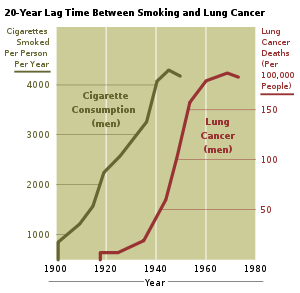
s (cancer-causing agents). The potential effects of smoking, such as lung cancer, can take up to 20 years to manifest themselves. Historically, women began smoking en masse later than men, so an increased death rate caused by smoking amongst women did not appear until later. The male lung cancer death rate decreased in 1975 — roughly 20 years after the initial decline in cigarette consumption in men. A fall in consumption in women also began in 1975 but by 1991 had not manifested in a decrease in lung cancer related mortalities amongst women.
Smoke contains several carcinogenic pyrolytic
products that bind to DNA
and cause genetic mutation
s. Particularly potent carcinogens are polynuclear aromatic hydrocarbons
(PAH), which are toxicated
to mutagen
ic epoxide
s. The first PAH to be identified as a carcinogen in tobacco smoke was benzopyrene
, which has been shown to toxicate into an epoxide that irreversibly attaches to a cell's nuclear DNA, which may either kill the cell or cause a genetic mutation. If the mutation inhibits programmed cell death
, the cell can survive to become a cancer cell
. Similarly, acrolein
, which is abundant in tobacco smoke, also irreversibly binds to DNA, causes mutations and thus also cancer. However, it needs no activation to become carcinogenic.
There are over 19 known carcinogens in cigarette smoke. The following are some of the most potent carcinogens:
Sidestream tobacco smoke, or exhaled mainstream smoke, is particularly harmful. Because exhaled smoke exists at lower temperatures than inhaled smoke, chemical compounds undergo changes which can cause them to become more dangerous. As well, smoke undergoes changes as it ages, which causes the transformation of the compound NO into the more toxic NO2. Further, volatilization causes smoke particles to become smaller, and thus more easily embedded deep into the lung of anyone who later breathes the air.
(0.97–1.33 mBq
), which is equivalent to about 0.1 pCi per milligram of smoke (4 mBq/mg); or about 0.81 pCi of lead 210 per gram of dry condensed smoke (30 Bq/kg).
Research by NCAR
radiochemist
Ed Martell
determined that radioactive compounds in cigarette smoke are deposited in "hot spots" where bronchial tubes
branch. Since tar from cigarette smoke is resistant to dissolving in lung fluid, the radioactive compounds have a great deal of time to undergo radioactive decay
before being cleared by natural processes. Indoors, these radioactive compounds linger in secondhand smoke, and therefore greater exposure occurs when these radioactive compounds are inhaled during normal breathing, which is deeper and longer than when inhaling cigarettes. Damage to the protective epithelial
tissue from smoking only increases the prolonged retention of insoluble polonium 210 compounds produced from burning tobacco. Martell estimated that a carcinogenic radiation dose of 80–100 rads is delivered to the lung tissue of most smokers who die of lung cancer.
Smoking an average of 1.5 packs per day gives a radiation dose of 60-160 mSv
/year, compared with living near a nuclear power station (0.0001 mSv/year) or the 3.0 mSv/year average dose for Americans.
Some of the mineral apatite in Florida used to produce phosphate for U.S.A. tobacco crops contains uranium, radium, lead 210 and polonium 210 and radon. The radioactive smoke from tobacco fertilized this way is deposited in lungs and releases radiation even if a smoker quits the habit. The combination of carcinogenic tar and radiation in a sensitive organ such as lungs increases the risk of cancer. If the smoker also breathes in the asbestos fibers which commonly occur in urban and industrial environments, the risk of cancer is greatly increased.
 Nicotine
that is contained in cigarettes and other smoked tobacco products is a stimulant
and is one of the main factors leading to continued tobacco smoking. Although the amount of nicotine inhaled with tobacco smoke is quite small (most of the substance is destroyed by the heat) it is still sufficient to cause physical and/or psychological dependence
. The amount of nicotine absorbed by the body from smoking depends on many factors, including the type of tobacco, whether the smoke is inhaled, and whether a filter is used. Despite the design of various cigarettes advertised and even tested on machines to deliver less of the toxic tar, studies show that when smoked by humans instead of machines, they deliver the same net amount of smoke. Ingesting a compound by smoking is one of the most rapid and efficient methods of introducing it into the bloodstream, second only to injection, which allows for the rapid feedback which supports the smokers' ability to titrate
their dosage. On average it takes about ten seconds for the substance to reach the brain. As a result of the efficiency of this delivery system, many smokers feel as though they are unable to cease. Of those who attempt cessation and last three months without succumbing to nicotine, most are able to remain smoke free for the rest of their lives. There exists a possibility of depression in some who attempt cessation, as with other psychoactive substances. Depression is also common in teenage smokers; teens who smoke are four times as likely to develop depressive symptoms as their nonsmoking peers.
Although nicotine does play a role in acute episodes of some diseases (including stroke
, impotence
, and heart disease
) by its stimulation of adrenaline
release, which raises blood pressure
, heart rate
, and free fatty acids, the most serious longer term effects are more the result of the products of the smouldering combustion process. This has enabled development of various nicotine delivery systems, such as the nicotine patch
or nicotine gum
, that can satisfy the addictive craving by delivering nicotine without the harmful combustion by-products. This can help the heavily dependent smoker to quit gradually, while discontinuing further damage to health.
Nicotine
is a highly addictive psychoactive chemical. When tobacco is smoked, most of the nicotine is pyrolyzed
; a dose sufficient to cause mild somatic dependency and mild to strong psychological dependency remains. There is also a formation of harmane
(a MAO inhibitor
) from the acetaldehyde in cigarette smoke, which seems to play an important role in nicotine addiction probably by facilitating dopamine release in the nucleus accumbens in response to nicotine stimuli. According to studies by Henningfield and Benowitz, nicotine is more addictive than cannabis
, caffeine
, ethanol
, cocaine
, and heroin when considering both somatic and psychological dependence. However, due to the stronger withdrawal effects of ethanol
, cocaine
and heroin, nicotine may have a lower potential for somatic dependence than these substances. About half of Canadians who currently smoke have tried to quit. McGill University
health professor Jennifer O'Loughlin stated that nicotine addiction can occur as soon as five months after the start of smoking.
Recent evidence has shown that smoking tobacco increases the release of dopamine
in the brain, specifically in the mesolimbic pathway, the same neuro-reward circuit activated by drugs of abuse such as heroin and cocaine
. This suggests nicotine use has a pleasurable effect that triggers positive reinforcement. One study found that smokers exhibit better reaction-time and memory performance compared to non-smokers, which is consistent with increased activation of dopamine receptors. Neurologically, rodent studies have found that nicotine self-administration causes lowering of reward thresholds—a finding opposite that of most other drugs of abuse (e.g. cocaine and heroin). This increase in reward circuit sensitivity persisted months after the self-administration ended, suggesting that nicotine's alteration of brain reward function is either long lasting or permanent. Furthermore, it has been found that nicotine can activate long term potentiation in vivo and in vitro. These studies suggest nicotine’s "trace memory" may contribute to difficulties in nicotine abstinence.
The carcinogenity of tobacco smoke is not explained by nicotine
per se, which is not carcinogenic or mutagenic. However, it inhibits apoptosis
, therefore accelerating existing cancers. Also, NNK
, a nicotine derivative converted from nicotine, can be carcinogenic.
It is worth noting that nicotine
, although frequently implicated in producing tobacco
addiction, is not significantly addictive when administered alone. The addictive potential manifests itself after co-administration of an MAOI
, which specifically causes sensitization
of the locomotor response in rats, a measure of addictive potential.
Another study related to genetic changes in smokers was conducted by Wan L Lam and Stephen Lam from the BC Cancer Agency, in 2007. The study revealed that cigarette smoke can turn on or off some of the genes, which otherwise would remain inactive or active respectively. Some changes on genetic level could be reversed after the smoking was quit, yet others could not. Examples of reversible genes involved the so-called xenofobic functions, nucleotide metabolism and mucus secretion. Smoking turns off some DNA repair genes that cannot be reversed. It also switches off some genes responsible from protection from cancer growth in the body.
of contracting disease is directly proportional to the length of time that a person continues to smoke as well as the amount smoked. However, if someone stops smoking, then these chances gradually decrease as the damage to their body is repaired. A year after quitting, the risk of contracting heart disease is half that of a continuing smoker. The health risks of smoking are not uniform across all smokers. Risks vary according to amount of tobacco smoked, with those who smoke more at greater risk. Light cigarette smoking still poses a significant (though reduced) health risk, as does pipe and cigar smoking. Smoking so-called "light" cigarettes does not reduce the risk.
Tobacco use most commonly leads to diseases affecting the heart and lungs
and will most commonly affect areas such as hands or feet with first signs of smoking related health issues showing up as numbness, with smoking being a major risk factor for heart attacks
, Chronic Obstructive Pulmonary Disease
(COPD), emphysema
, and cancer
, particularly lung cancer
, cancers of the larynx
and mouth
, and pancreatic cancer
. Overall life expectancy is also reduced in regular smokers, with estimates ranging from 10 to 17.9 years fewer than nonsmokers. About two thirds of male smokers will die of illness due to smoking. The association of smoking with lung cancer is strongest, both in the public perception and etiologically. People who have smoked tobacco at some point have about a one in ten chance of developing lung cancer during their lifetime. If one looks at men who continue to smoke tobacco, the risk increases to one in six. Historically, lung cancer was considered to be a rare disease prior to World War I
and was perceived as something most physicians would never see during their career. With the postwar rise in popularity of cigarette smoking came a virtual epidemic of lung cancer.
According to the results of a 14 year study of 34,486 male British doctors, at least half of all life-long smokers die earlier as a result of smoking.
Smokers are three times as likely to die before the age of 60 or 70 as non-smokers.
In the United States alone, cigarette smoking and exposure to tobacco smoke accounts for roughly one in five, or at at least 443,000 premature deaths annually.
"In the United States alone, tobacco kills the equivalent of three jumbo jets full of people crashing every day, with no survivors, 365 days of the year." -ABC's Peter Jennings
On a worldwide basis, it's 1 jumbo jet per hour, 24 hours a day, 365 days of the year. -WHO
, kidney cancer
, cancer of the larynx and head and neck
, breast cancer
, bladder cancer
, cancer of the esophagus
, cancer of the pancreas
and stomach cancer
.
There is some evidence suggesting a small increased risk of myeloid leukaemia, squamous cell sinonasal cancer
, liver cancer
, colorectal cancer
, cancers of the gallbladder
, the adrenal gland
, the small intestine
, and various childhood cancers. Recent studies have established a stronger relationship between tobacco smoke, including secondhand smoke, and cervical cancer in women.
The risk of dying from lung cancer before age 85 is 22.1% for a male smoker and 11.9% for a female smoker, in the absence of competing causes of death. The corresponding estimates for lifelong nonsmokers are a 1.1% probability of dying from lung cancer before age 85 for a man of European descent, and a 0.8% probability for a woman.
 In smoking, long term exposure to compounds found in the smoke such as carbon monoxide
, cyanide
, and so forth—, are believed to be responsible for pulmonary damage and for loss of elasticity in the alveoli
, leading to emphysema and COPD. The carcinogen acrolein and its derivatives also contribute to the chronic inflammation present in COPD.
Secondhand smoke is a mixture of smoke from the burning end of a cigarette, pipe or cigar and the smoke exhaled from the lungs of smokers. It is involuntarily inhaled, lingers in the air hours after cigarettes have been extinguished, and can cause a wide range of adverse health effects, including cancer, respiratory infections and asthma
. Nonsmokers who are exposed to secondhand smoke at home or work increase their heart disease risk by 25–30% and their lung cancer risk by 20–30%. Secondhand smoke has been estimated to cause 38,000 deaths per year, of which 3,400 are deaths from lung cancer in non-smokers.
Chronic obstructive pulmonary disease
(COPD) caused by smoking, known as tobacco disease, is a permanent, incurable reduction of pulmonary capacity characterized by shortness of breath, wheezing, persistent cough with sputum
, and damage to the lungs, including emphysema
and chronic bronchitis
.
by reducing the blood’s ability to carry oxygen. Both of these conditions can become permanent with prolonged use of cigarettes.
Smoking also increases the chance of heart disease
, stroke
, atherosclerosis
, and peripheral vascular disease. Several ingredients of tobacco lead to the narrowing of blood vessels, increasing the likelihood of a blockage, and thus a heart attack
or stroke
. According to a study by an international team of researchers
, people under 40 are five times more likely to have a heart attack if they smoke.
Recent research by American biologists has shown that cigarette smoke also influences the process of cell division in the cardiac muscle and changes the heart's shape.
The usage of tobacco has also been linked to Buerger's disease
(thromboangiitis obliterans) the acute inflammation and thrombosis (clotting) of arteries and veins of the hands and feet.
The current Surgeon General’s Report concluded that there is no risk-free level of exposure to secondhand smoke. Even short exposures to secondhand smoke can cause blood platelets to become stickier, damage the lining of blood vessel
s, decrease coronary flow velocity reserves, and reduce heart rate variability, potentially increasing the risk of heart attack
. New research indicates that private research conducted by cigarette company Philip Morris
in the 1980s showed that secondhand smoke was toxic, yet the company suppressed the finding during the next two decades.
Although cigarette smoking causes a greater increase of the risk of cancer than cigar smoking, cigar smokers still have an increased risk for many health problems, including cancer, when compared to non-smokers. As for Environmental Tobacco Smoke (ETS, or "Second-hand Smoking
"), the NIH study points to the large amount of smoke generated by one cigar, saying "cigars can contribute substantial amounts of tobacco smoke to the indoor environment; and, when large numbers of cigar smokers congregate together in a cigar smoking event, the amount of ETS produced is sufficient to be a health concern for those regularly required to work in those environments."
Smoking tends to increase blood cholesterol levels. Furthermore, the ratio of high-density lipoprotein (the "good" cholesterol) to low-density lipoprotein (the "bad" cholesterol) tends to be lower in smokers compared to non-smokers. Smoking also raises the levels of fibrinogen and increases platelet production (both involved in blood clotting) which makes the blood viscous. Carbon monoxide binds to haemoglobin (the oxygen-carrying component in red blood cells), resulting in a much stabler complex than haemoglobin bound with oxygen or carbon dioxide—the result is permanent loss of blood cell functionality. Blood cells are naturally recycled after a certain period of time, allowing for the creation of new, functional erythrocytes. However, if carbon monoxide exposure reaches a certain point before they can be recycled, hypoxia (and later death) occurs. All these factors make smokers more at risk of developing various forms of arteriosclerosis. As the arteriosclerosis progresses, blood flows less easily through rigid and narrowed blood vessels, making the blood more likely to form a thrombosis (clot). Sudden blockage of a blood vessel may lead to an infarction (stroke). However, it is also worth noting that the effects of smoking on the heart may be more subtle. These conditions may develop gradually given the smoking-healing cycle (the human body heals itself between periods of smoking), and therefore a smoker may develop less significant disorders such as worsening or maintenance of unpleasant dermatological conditions, e.g. eczema, due to reduced blood supply. Smoking also increases blood pressure and weakens blood vessels.
.
According to a study of 1,900 male cadets after the 1968 Hong Kong A2 influenza epidemic at a South Carolina military academy, compared with nonsmokers heavy smokers (more than 20 cigarettes per day), had 21% more illnesses and 20% more bed rest, light smokers (less than 20 cigarettes per day) had 10% more illnesses and 7% more bed rest.
The effect of cigarette smoking upon epidemic influenza was studied prospectively among 1,811 male college students. Clinical influenza incidence among those who daily smoked 21 or more cigarettes was 21% higher than that of non-smokers. Influenza incidence among smokers of 1 to 20 cigarettes daily was intermediate between non-smokers and heavy cigarette smokers.
Surveillance of a 1979 influenza out-break at a military base for women in Israel revealed that, Influenza symptoms developed in 60.0% of the current smokers vs. 41.6% of the nonsmokers.
Smoking seems to cause a higher relative influenza-risk in older populations than in younger populations. In a prospective study of community-dwelling people 60–90 years of age, during 1993, of unimmunized people 23% of smokers had clinical influenza as compared with 6% of non-smokers.
Smoking may substantially contribute to the growth of influenza epidemics affecting the entire population. However the proportion of influenza cases in the general non-smoking population attributable to smokers has not yet been calculated.
. However, smoking also increases the risk for various other oral diseases, some almost completely exclusive to tobacco users. The National Institutes of Health
, through the National Cancer Institute
, determined in 1998 that "cigar smoking causes a variety of cancers including cancers of the oral cavity
(lip, tongue, mouth, throat), esophagus
, larynx, and lung
." Pipe smoking involves significant health risks, particularly oral cancer. Roughly half of periodontitis or inflammation around the teeth cases are attributed to current or former smoking. Smokeless tobacco causes gingival recession
and white mucosal lesions. Up to 90% of periodontitis patients who are not helped by common modes of treatment are smokers. Smokers have significantly greater loss of bone height than nonsmokers, and the trend can be extended to pipe smokers to have more bone loss than nonsmokers. Smoking has been proven to be an important factor in the staining of teeth. Halitosis
or bad breath is common among tobacco smokers. Tooth loss has been shown to be 2 to 3 times higher in smokers than in non-smokers. In addition, complications may further include leukoplakia
, the adherent white plaques or patches on the mucous membranes of the oral cavity, including the tongue, and a loss of taste sensation or saliva
ry changes.
s a day increases the risk of tuberculosis
by two to four times, and being a current smoker has been linked to a fourfold increase in the risk of invasive pneumococcal disease. It is believed that smoking increases the risk of these and other pulmonary and respiratory tract infections both through structural damage and through effects on the immune system. The effects on the immune system include an increase in CD4+ cell production attributable to nicotine, which has tentatively been linked to increased HIV
susceptibility. The usage of tobacco also increases rates of infection: common cold
and bronchitis
, chronic obstructive pulmonary disease
, emphysema
and chronic bronchitis
in particular.
Smoking reduces the risk of Kaposi's sarcoma
in people without HIV infection
. One study found this only with the male population and could not draw any conclusions for the female participants in the study.
.
, and the degree of damage is dependent upon the amount and length of time a woman smokes. Nicotine and other harmful chemicals in cigarettes interfere with the body’s ability to create estrogen
, a hormone that regulates folliculogenesis
and ovulation
. Also, cigarette smoking interferes with folliculogenesis, embryo transport, endometrial receptivity, endometrial angiogenesis, uterine blood flow and the uterine myometrium. Some damage is irreversible, but stopping smoking can prevent further damage. Smokers are 60% more likely to be infertile than non-smokers. Smoking reduces the chances of IVF producing a live birth by 34% and increases the risk of an IVF pregnancy miscarrying by 30%.
, sharpness, calmness
, and alertness
. Those new to smoking may experience nausea
, dizziness
, and rapid heart beat
. The unpleasant symptoms will eventually vanish over time, with repeated use, as the body builds a tolerance to the chemicals in the cigarettes, such as nicotine
.
stress.
Several studies have monitored feelings of stress over time and found reduced stress after quitting.
The deleterious mood effects of abstinence explain why smokers
suffer more daily stress than non-smokers, and become less stressed when they quit smoking. Deprivation reversal also explains much of the arousal data, with deprived smokers being less vigilant and less alert than non-deprived smokers or non-smokers.
Recent studies have shown a positive relationship between psychological distress and salivary cotinine levels in smoking and non-smoking adults, indicating that both firsthand and secondhand smoke exposure may lead to higher levels of mental stress.
, although "case–control and cohort studies produce conflicting results as to the direction of the association between smoking and AD". Smoking has been found to contribute to dementia and cognitive decline, reduced memory and cognitive abilities in adolescents, and brain shrinkage (cerebral atrophy).
In many respects, nicotine
acts on the nervous system in a similar way to caffeine
. Some writings have stated that smoking can also increase mental concentration
; one study documents a significantly better performance on the normed Advanced Raven Progressive Matrices test
after smoking.
Most smokers, when denied access to nicotine
, exhibit symptoms such as irritability, jitteriness, dry mouth, and rapid heart beat. The onset of these symptoms is very fast, nicotine's half-life being only 2 hours. Withdrawal symptoms can appear even if the smoker's consumption is very limited or irregular, appearing after only 4–5 cigarettes in most adolescents. An ex-smoker's chemical dependence to nicotine will cease after approximately ten to twenty days, although the brain's number of nicotine receptors is permanently altered, and the psychological
dependence may linger for months or even many years. Unlike some recreational drugs
, nicotine does not measurably alter a smoker's motor skill
s, judgement
, or language
abilities while under the influence of the drug. Tobacco withdrawal has been shown to cause clinically significant distress.
Most notably, some studies have found that patients with Alzheimer's disease
are more likely not to have smoked than the general population, which has been interpreted to suggest that smoking offers some protection against Alzheimer's. However, the research in this area is limited and the results are conflicting; some studies show that smoking increases the risk of Alzheimer's disease. A recent review of the available scientific literature concluded that the apparent decrease in Alzheimer risk may be simply because smokers tend to die before reaching the age at which Alzheimer normally occurs. "Differential mortality is always likely to be a problem where there is a need to investigate the effects of smoking in a disorder with very low incidence rates before age 75 years, which is the case of Alzheimer's disease," it stated, noting that smokers are only half as likely as non-smokers to survive to the age of 80.
Former and current smokers have a lower incidence of Parkinson's disease
compared to people who have never smoked, although the authors stated that it was more likely that the movement disorders which are part of Parkinson's disease prevented people from being able to smoke than that smoking itself was protective. Another study considered a possible role of nicotine in reducing Parkinson's risk: nicotine stimulates the dopaminergic
system of the brain, which is damaged in Parkinson's disease, while other compounds in tobacco smoke inhibit MAO-B
, an enzyme which produces oxidative radicals by breaking down dopamine.
A very large percentage of schizophrenics smoke tobacco as a form of self medication. The high rate of tobacco use by the mentally ill is a major factor in their decreased life expectancy, which is about 25 years shorter than the general population. Following the observation that smoking improves condition of people with schizophrenia, in particular working memory deficit, nicotine patch
es had been proposed as a way to treat schizophrenia. Some studies suggest that a link exists between smoking and mental illness, citing the high incidence of smoking amongst those suffering from schizophrenia
and the possibility that smoking may alleviate some of the symptoms of mental illness, but these have not been conclusive.
Recent studies have linked smoking to anxiety disorders, suggesting the correlation (and possibly mechanism) may be related to the broad class of anxiety disorders, and not limited to just depression. Current and ongoing research attempt to explore the addiction-anxiety relationship.
Data from multiple studies suggest that anxiety disorders and depression play a role in cigarette smoking.
A history of regular smoking was observed more frequently among individuals who had experienced a major depressive disorder at some time in their lives than among individuals who had never experienced major depression or among individuals with no psychiatric diagnosis. People with major depression are also much less likely to quit
due to the increased risk of experiencing mild to severe states of depression, including a major depressive episode. Depressed smokers appear to experience more withdrawal symptoms on quitting, are less likely to be successful at quitting, and are more likely to relapse.
Evidence suggests that non-smokers are up to twice as likely as smokers to develop Parkinson's disease
or Alzheimer's disease
. A plausible explanation for these cases may be the effect of nicotine, a cholinergic
stimulant
, decreasing the levels of acetylcholine
in the smoker's brain; Parkinson's disease occurs when the effect of dopamine
is less than that of acetylcholine. In addition, nicotine stimulates the mesolimbic dopamine pathway (as do other drugs of abuse), causing an effective increase in dopamine levels. Opponents counter by noting that consumption of pure nicotine may be as beneficial as smoking without the risks associated with smoking, although this is unlikely due to the importance of the MAO-B inhibitor compounds of tobacco in preventing neurodegenerative diseases.
s among pregnant
smokers, and that it contributes to a number of other threats to the health of the fetus. This can especially be a problem with women who have family history of smoking and live in a smoke filled environment. Women who quit smoking and then return to it also develop an increased sensitivity to the effects of smoking on their fetus. Once a woman who was previously a smoker quits and then returns to it while pregnant, the increased sensitivty to it has a very high chance of suffocating the fetus over a period of days in a slow process eventually causing a misscarriage with a heavy flow to it. Continued smoking after this can cause a woman to become completely infertile altogether preventing them from ever being able to have children by causing permanent damage. Every cigarette smoked after the miscarriage increase the chances of infertility as well as being around second hand smoke. Second-hand smoke appears to present an equal danger to the fetus, as one study noted that "heavy paternal smoking increased the risk of early pregnancy loss."
Environmental tobacco smoke exposure and maternal smoking during pregnancy have been shown to cause lower infant birth weights.
Studies have shown an association between prenatal exposure to environmental tobacco smoke and conduct disorder in children. As well, post-natal tobacco smoke exposure may cause similar behavioral problems in children.
which stimulates lipolysis
.
Smoking causes about 10% of the global burden of fire deaths, and smokers are placed at an increased risk of injury-related deaths in general, partly due to also experiencing an increased risk of dying in a motor vehicle crash.
Smoking increases the risk of symptoms associated with Crohn's disease
(a dose-dependent effect with use of greater than 15 cigarettes per day). There is some evidence for decreased rates of endometriosis
in infertile smoking women, although other studies have found that smoking increases the risk in infertile women. There is little or no evidence of a protective effect in fertile women. Some preliminary data from 1996 suggested a reduced incidence of uterine fibroids
, but overall the evidence is unconvincing.
Current research shows that tobacco smokers who are exposed to residential radon are twice as likely to develop lung cancer as non-smokers. As well, the risk of developing lung cancer from asbestos exposure is twice as likely for smokers than for non-smokers.
New research has found that women who smoke are at significantly increased risk of developing an abdominal aortic
aneurysm
, a condition in which a weak area of the abdominal
aorta expands or bulges.
has been known to cause cancer
, particularly of the mouth
and throat
. According to the International Agency for Research on Cancer
, "Some health scientists have suggested that smokeless tobacco should be used in smoking cessation programmes and have made implicit or explicit claims that its use would partly reduce the exposure of smokers to carcinogens and the risk for cancer. These claims, however, are not supported by the available evidence." Oral and spit tobacco increase the risk for leukoplakia
a precursor to oral cancer
.
smoking poses a significant health risk depending on dosage: risks are greater for those who inhale more when they smoke, smoke more cigars, or smoke them longer. The risk of dying from any cause is significantly greater for cigar smokers, with the risk particularly higher for smokers less than 65 years old, and with risk for moderate and deep inhalers reaching levels similar to cigarette smokers. Little cigars are commonly inhaled and likely pose the same health risks as cigarettes. The increased risk for those smoking 1–2 cigars per day is too small to be statistically significant, and the health risks of the 3/4 of cigar smokers who smoke less than daily are not known and are hard to measure; although it has been claimed that people who smoke few cigars have no increased risk, a more accurate statement is that their risks are proportionate to their exposure. Health risks are similar to cigarette
smoking in nicotine
addiction, periodontal
health, tooth loss, and many types of cancer, including cancers of the mouth
, throat, and esophagus
. Cigar smoking also can cause cancers of the lung
and larynx, where the increased risk is less than that of cigarettes. Many of these cancers have extremely low cure rates. Cigar smoking also increases the risk of lung and heart diseases such as chronic obstructive pulmonary disease
.
makes the smoke less irritating and may give a false sense of security and reduce concerns about true health effects. Doctors at institutions including the Mayo Clinic
have stated that use of hookah can be as detrimental to a person's health as smoking cigarettes, and a study by the World Health Organization also confirmed these findings.
Each hookah session typically lasts more than 40 minutes, and consists of 50 to 200 inhalations that each range from 0.15 to 0.50 liters of smoke. In an hour-long smoking session of hookah, users consume about 100 to 200 times the smoke of a single cigarette; in a 45-minute smoking session a typical smoker would inhale 1.7 times the nicotine of a single cigarette. A study in the Journal of Periodontology
found that water pipe smokers were five times more likely than non-smokers to show signs of gum disease . People who smoked water pipes had five times the risk of lung cancer of non-smokers.
A study on hookah smoking and cancer
in Pakistan
was published in 2008. Its objective was "to find serum CEA
levels in ever/exclusive hookah smokers, i.e. those who smoked only hookah (no cigarettes, bidis, etc.), prepared between 1 and 4 times a day with a quantity of up to 120 g of a tobacco-molasses mixture each (i.e. the tobacco weight equivalent of up to 60 cigarettes of 1 g each) and consumed in 1 to 8 sessions". Carcinoembryonic antigen (CEA) is a marker found in several forms of cancer. Levels in exclusive hookah smokers were lower compared to cigarette smokers although the difference was not statistically significant between a hookah smoker and a non-smoker. Also the study concluded that heavy hookah smoking (2–4 daily preparations; 3–8 sessions a day ; >2 hrs to ≤ 6 hours) substantially raises CEA levels. A recent study published in the Asia Pacific Journal of Cancer Prevention (Koul PA et al. Hookah Smoking and Lung Cancer in the Kashmir Valley of the Indian SubcontinentAsian Pacific J Cancer Prev, 12, 519-524; doi.) documented that hookah smokers were nearly 6-times at risk for development of lung cancer as compared to healthy non-smokers in Kashmir (India). Hookah in Kashmir has some peculiar features in having a direct contact of the live embers with the burning tobacco thus resulting in high temperatures that augments the production of carcinogenic products from tobacco burning. Additionally water in the hookah base is not changed after every session that renders the water contaminated to a greater degree and thus a possible source of dissolved carcinogens.
are believed to face less cancer risk than smokers, but are still at greater risk than people who do not use any tobacco products. They also have an equal risk of other health problems directly linked to nicotine such as increased rate of atherosclerosis
.
is related to smoking. In 1929, Fritz Lickint of Dresden
, Germany
, published a formal statistical evidence of a lung cancer-tobacco link, based on a study showing that lung cancer
sufferers were likely to be smokers. Lickint also argued that tobacco use was the best way to explain the fact that lung cancer struck men four or five times more often than women (since women smoked much less).
Prior to World War I, lung cancer was considered to be a rare disease, which most physicians would never see during their career. With the postwar rise in popularity of cigarette smoking, however, came an epidemic of lung cancer.
In 1950, Richard Doll
published research in the British Medical Journal
showing a close link between smoking and lung cancer. Four years later, in 1954, the British Doctors Study
, a study of some 40,000 doctors over 20 years, confirmed the suggestion, based on which the government issued advice that smoking and lung cancer rates were related. The British Doctors Study lasted until 2001, with results published every ten years and final results published in 2004 by Doll and Richard Peto
. Much early research was also done by Alton Ochsner
. Reader's Digest
magazine for many years published frequent anti-smoking articles. In 1964, the United States Surgeon General
's Report on Smoking and Health
, led millions of American smokers to quit, the banning of certain advertising, and the requirement of warning labels on tobacco products.
The Canadian province of British Columbia
has the Tobacco Damages and Health Care Costs Recovery Act
.
Tobacco is the single greatest cause of preventable death globally. Tobacco use leads most commonly to diseases affecting the heart and lungs, with smoking being a major risk factor for heart attacks
Myocardial infarction
Myocardial infarction or acute myocardial infarction , commonly known as a heart attack, results from the interruption of blood supply to a part of the heart, causing heart cells to die...
, stroke
Stroke
A stroke, previously known medically as a cerebrovascular accident , is the rapidly developing loss of brain function due to disturbance in the blood supply to the brain. This can be due to ischemia caused by blockage , or a hemorrhage...
s, chronic obstructive pulmonary disease
Chronic obstructive pulmonary disease
Chronic obstructive pulmonary disease , also known as chronic obstructive lung disease , chronic obstructive airway disease , chronic airflow limitation and chronic obstructive respiratory disease , is the co-occurrence of chronic bronchitis and emphysema, a pair of commonly co-existing diseases...
(COPD) (including emphysema
Emphysema
Emphysema is a long-term, progressive disease of the lungs that primarily causes shortness of breath. In people with emphysema, the tissues necessary to support the physical shape and function of the lungs are destroyed. It is included in a group of diseases called chronic obstructive pulmonary...
and chronic bronchitis
Chronic bronchitis
Chronic bronchitis is a chronic inflammation of the bronchi in the lungs. It is generally considered one of the two forms of chronic obstructive pulmonary disease...
), and cancer
Cancer
Cancer , known medically as a malignant neoplasm, is a large group of different diseases, all involving unregulated cell growth. In cancer, cells divide and grow uncontrollably, forming malignant tumors, and invade nearby parts of the body. The cancer may also spread to more distant parts of the...
(particularly lung cancer
Lung cancer
Lung cancer is a disease characterized by uncontrolled cell growth in tissues of the lung. If left untreated, this growth can spread beyond the lung in a process called metastasis into nearby tissue and, eventually, into other parts of the body. Most cancers that start in lung, known as primary...
, cancers of the larynx and mouth, and pancreatic cancer
Pancreatic cancer
Pancreatic cancer refers to a malignant neoplasm of the pancreas. The most common type of pancreatic cancer, accounting for 95% of these tumors is adenocarcinoma, which arises within the exocrine component of the pancreas. A minority arises from the islet cells and is classified as a...
). It also causes peripheral vascular disease and hypertension
Hypertension
Hypertension or high blood pressure is a cardiac chronic medical condition in which the systemic arterial blood pressure is elevated. What that means is that the heart is having to work harder than it should to pump the blood around the body. Blood pressure involves two measurements, systolic and...
. The effects depend on the number of years that a person smokes and on how much the person smokes. Starting smoking earlier in life and smoking cigarettes higher in tar
Tar (tobacco residue)
Tar is the common name for the resinous partially combusted and healed particulate matter produced by the burning of tobacco and other plant material in the act of smoking. Tar is purportedly the most destructive component in habitual tobacco smoking, accumulating in the smoker's lungs over time...
increases the risk of these diseases. As well, environmental tobacco smoke, or secondhand smoke, has been shown to cause adverse health effects in people of all ages.Cigarettes sold in underdeveloped countries tend to have higher tar content, and are less likely to be filtered, potentially increasing vulnerability to tobacco-related disease in these regions.
The World Health Organization
World Health Organization
The World Health Organization is a specialized agency of the United Nations that acts as a coordinating authority on international public health. Established on 7 April 1948, with headquarters in Geneva, Switzerland, the agency inherited the mandate and resources of its predecessor, the Health...
(WHO) estimates that tobacco caused 5.4 million deaths in 2004 and 100 million deaths over the course of the 20th century. Similarly, the United States Centers for Disease Control and Prevention
Centers for Disease Control and Prevention
The Centers for Disease Control and Prevention are a United States federal agency under the Department of Health and Human Services headquartered in Druid Hills, unincorporated DeKalb County, Georgia, in Greater Atlanta...
describes tobacco use as "the single most important preventable risk to human health in developed countries and an important cause of premature death worldwide."
Smoke contains several carcinogenic pyrolytic products that bind to DNA and cause many genetic mutations. There are over 19 known chemical carcinogen
Carcinogen
A carcinogen is any substance, radionuclide, or radiation that is an agent directly involved in causing cancer. This may be due to the ability to damage the genome or to the disruption of cellular metabolic processes...
s in cigarette smoke. Tobacco also contains nicotine
Nicotine
Nicotine is an alkaloid found in the nightshade family of plants that constitutes approximately 0.6–3.0% of the dry weight of tobacco, with biosynthesis taking place in the roots and accumulation occurring in the leaves...
, which is a highly addictive psychoactive chemical. When tobacco is smoked, nicotine causes physical and psychological dependency. Tobacco use is a significant factor in miscarriages among pregnant smokers, it contributes to a number of other threats to the health of the fetus such as premature births and low birth weight and increases by 1.4 to 3 times the chance for Sudden Infant Death Syndrome (SIDS)
Sudden infant death syndrome
Sudden infant death syndrome is marked by the sudden death of an infant that is unexpected by medical history, and remains unexplained after a thorough forensic autopsy and a detailed death scene investigation. An infant is at the highest risk for SIDS during sleep, which is why it is sometimes...
. The result of scientific studies done in neonatal rats seems to indicate that exposure to cigarette smoke in the womb may reduce the fetal brain's ability to recognize hypoxic
Hypoxia (medical)
Hypoxia, or hypoxiation, is a pathological condition in which the body as a whole or a region of the body is deprived of adequate oxygen supply. Variations in arterial oxygen concentrations can be part of the normal physiology, for example, during strenuous physical exercise...
conditions, thus increasing the chance of accidental asphyxia
Asphyxia
Asphyxia or asphyxiation is a condition of severely deficient supply of oxygen to the body that arises from being unable to breathe normally. An example of asphyxia is choking. Asphyxia causes generalized hypoxia, which primarily affects the tissues and organs...
tion. Incidence of impotence
Erectile dysfunction
Erectile dysfunction is sexual dysfunction characterized by the inability to develop or maintain an erection of the penis during sexual performance....
is approximately 85 percent higher in male smokers compared to non-smokers, and is a key factor causing erectile dysfunction
Erectile dysfunction
Erectile dysfunction is sexual dysfunction characterized by the inability to develop or maintain an erection of the penis during sexual performance....
(ED).
Prevalence
Tobacco may be consumed by either smoking or other smokeless methods such as chewing, the World Health OrganizationWorld Health Organization
The World Health Organization is a specialized agency of the United Nations that acts as a coordinating authority on international public health. Established on 7 April 1948, with headquarters in Geneva, Switzerland, the agency inherited the mandate and resources of its predecessor, the Health...
(WHO) only collect data on smoked tobacco. Smoking has therefore been studied more extensively than any other form of consumption.
In 2000, smoking was practiced by 1.22 billion people, predicted to rise to 1.45 billion people in 2010 and 1.5 to 1.9 billion by 2025. If prevalence had decreased by 2% a year since 2000 this figure would have been 1.3 billion in 2010 and 2025. Despite dropping by 0.4 percent from 2009 to 2010, the United States still reports an average of 17.9 percent usage.
As of 2002, about twenty percent of young teens (13–15) smoke worldwide, with 80,000 to 100,000 children taking up the addiction every day—roughly half of whom live in Asia. Half of those who begin smoking in adolescent
Adolescence
Adolescence is a transitional stage of physical and mental human development generally occurring between puberty and legal adulthood , but largely characterized as beginning and ending with the teenage stage...
years are projected to go on to smoke for 15 to 20 years.
The WHO
World Health Organization
The World Health Organization is a specialized agency of the United Nations that acts as a coordinating authority on international public health. Established on 7 April 1948, with headquarters in Geneva, Switzerland, the agency inherited the mandate and resources of its predecessor, the Health...
states that "Much of the disease burden and premature mortality attributable to tobacco use disproportionately affect the poor". Of the 1.22 billion smokers, 1 billion of them live in developing or transitional nations. Rates of smoking have leveled off or declined in the developed world
Developed country
A developed country is a country that has a high level of development according to some criteria. Which criteria, and which countries are classified as being developed, is a contentious issue...
. In the developing world
Developing country
A developing country, also known as a less-developed country, is a nation with a low level of material well-being. Since no single definition of the term developing country is recognized internationally, the levels of development may vary widely within so-called developing countries...
, however, tobacco consumption is rising by 3.4% per year as of 2002.
The WHO in 2004 projected 58.8 million deaths to occur globally, from which 5.4 million are tobacco-attributed, and 4.9 million as of 2007. As of 2002, 70% of the deaths are in developing countries.
The shift in prevalence of tobacco smoking to a younger demographic, mainly in the developing world, can be attributed to several factors. The tobacco industry spends up to $12.5 billion annually on advertising, which is increasingly geared towards adolescents in the developing world because they are a very vulnerable audience for the marketing campaigns. Adolescents have more difficulty understanding the long term health risks that are associated with smoking and are also more easily influenced by “images of romance, success, sophistication, popularity, and adventure which advertising suggests they could achieve through the consumption of cigarettes”. This shift in marketing towards adolescents and even children in the tobacco industry is debilitating to organizations’ and countries’ efforts to improve child health and mortality in the developing world. It reverses or halts the effects of the work that has been done to improve health care in these countries, and although smoking is deemed as a “voluntary” health risk, the marketing of tobacco towards very impressionable adolescents in the developing world makes it less of a voluntary action and more of an inevitable shift.
Many government regulations have been passed to protect citizens from harm caused by public environmental tobacco smoke. The "Pro-Children Act of 2001" prohibits smoking within any facility that provides health care, day care, library services, or elementary and secondary education to children.
On May 23, 2011, New York City enforced a smoking ban for all parks, beaches, and pedestrian malls in an attempt to eliminate threats posed to civilians by environmental tobacco smoke.
Studies
In the 1930s German scientists showed that cigarette smoking caused lung cancer. In 1938 a study by a Johns Hopkins UniversityJohns Hopkins University
The Johns Hopkins University, commonly referred to as Johns Hopkins, JHU, or simply Hopkins, is a private research university based in Baltimore, Maryland, United States...
scientist suggested a strongly negative correlation between smoking and lifespan. In 1950 five studies were published in which "smoking was powerfully implicated in the causation of lung cancer". These included the now classic paper "Smoking and Carcinoma of the Lung" which appeared in the British Medical Journal
BMJ
BMJ is a partially open-access peer-reviewed medical journal. Originally called the British Medical Journal, the title was officially shortened to BMJ in 1988. The journal is published by the BMJ Group, a wholly owned subsidiary of the British Medical Association...
. This paper reported that "heavy smokers were fifty times as likely as non-smokers to contract lung cancer".
In 1953, scientists at the Sloan-Kettering Institute in New York City demonstrated that cigarette tar painted on the skin of mice caused fatal cancers. This work attracted much media attention; the New York Times and Life both covered the issue. The Reader's Digest published an article entitled "Cancer by the Carton".
A team of British scientists headed by Richard Doll
Richard Doll
Sir William Richard Shaboe Doll CH OBE FRS was a British physiologist who became the foremost epidemiologist of the 20th century, turning the subject into a rigorous science. He was a pioneer in research linking smoking to health problems...
carried out a longitudinal study of 34,439 medical specialists from 1951 to 2001, generally called the "British Doctors Study
British Doctors Study
The British Doctors Study is the generally accepted name of a prospective cohort study which ran from 1951 to 2001, and in 1956 provided convincing statistical proof that tobacco smoking increased the risk of lung cancer.-Context:...
." The study demonstrated that about half of the persistent cigarette smokers born in 1900–1909 were eventually killed by their addiction (calculated from the logarithm
Logarithm
The logarithm of a number is the exponent by which another fixed value, the base, has to be raised to produce that number. For example, the logarithm of 1000 to base 10 is 3, because 1000 is 10 to the power 3: More generally, if x = by, then y is the logarithm of x to base b, and is written...
s of the probabilities of surviving from 35–70, 70–80, and 80–90) and about two thirds of the persistent cigarette smokers born in the 1920s would eventually be killed by their addiction. After a ban on smoking in all enclosed public places was introduced in Scotland in March 2006, there was a 17 percent reduction in hospital admissions for acute coronary syndrome. 67% of the decrease occurred in non-smokers.
The health effects of tobacco have been significant for the development of the science of epidemiology
Epidemiology
Epidemiology is the study of health-event, health-characteristic, or health-determinant patterns in a population. It is the cornerstone method of public health research, and helps inform policy decisions and evidence-based medicine by identifying risk factors for disease and targets for preventive...
. As the mechanism of carcinogenicity is radiomimetic or radiological, the effects are stochastic
Stochastic
Stochastic refers to systems whose behaviour is intrinsically non-deterministic. A stochastic process is one whose behavior is non-deterministic, in that a system's subsequent state is determined both by the process's predictable actions and by a random element. However, according to M. Kac and E...
. Definite statements can be made only on the relative increased or decreased probabilities of contracting a given disease; Philosophically and theoretically speaking, it is impossible to definitively prove a direct causative link between exposure to a radiomimetic poison such as tobacco smoke and the cancer that follows. Tobacco companies have capitalized on this philosophical objection and exploited the doubts of clinicians, who consider only individual cases, on the causal link in the stochastic expression of the toxicity as actual disease.
There have been multiple court cases on the issue that tobacco companies have researched the health effects of tobacco, but suppressed the findings or formatted them to imply lessened or no hazard.
A study published in the journal Pediatrics
Pediatrics (journal)
Pediatrics is an official peer-reviewed journal of the American Academy of Pediatrics. In the inaugural January 1948 issue, the journal's first editor, Hugh McCulloch, articulated the journal's vision: "The content of the journal is... intended to encompass the needs of the whole child in his...
refers to the danger posed by what the authors call "third-hand smoke" — toxic substances that remain in areas where smoking has recently occurred. The study was reviewed in an story broadcast by the Voice of America
Voice of America
Voice of America is the official external broadcast institution of the United States federal government. It is one of five civilian U.S. international broadcasters working under the umbrella of the Broadcasting Board of Governors . VOA provides a wide range of programming for broadcast on radio...
.
Occasional smoking
The term "smoker" is used to mean a person who habitually smokes tobacco on a daily basis. This category has been the focus of the vast majority of tobacco studies. However, the health effects of less-than-daily smoking are far less well understood. Studies have often taken the data of "occasional smokers" (those who have never smoked daily) and grouped them with those who have never smoked.A recent European study on occasional smoking published findings that the risk of the major smoking-related cancers for occasional smokers was 1.24 times that of those who have never smoked at all but the result was not statistically significant. (For a confidence interval
Confidence interval
In statistics, a confidence interval is a particular kind of interval estimate of a population parameter and is used to indicate the reliability of an estimate. It is an observed interval , in principle different from sample to sample, that frequently includes the parameter of interest, if the...
of 95%, this data showed an incidence rate ratio of 0.80 to 1.94.) This compares to studies showing that habitual heavy smokers have greater than 50 times the incidence of smoking-related cancers.
Chemical carcinogens
Smoke, or any partially burnt organic matter, contains carcinogenCarcinogen
A carcinogen is any substance, radionuclide, or radiation that is an agent directly involved in causing cancer. This may be due to the ability to damage the genome or to the disruption of cellular metabolic processes...
s (cancer-causing agents). The potential effects of smoking, such as lung cancer, can take up to 20 years to manifest themselves. Historically, women began smoking en masse later than men, so an increased death rate caused by smoking amongst women did not appear until later. The male lung cancer death rate decreased in 1975 — roughly 20 years after the initial decline in cigarette consumption in men. A fall in consumption in women also began in 1975 but by 1991 had not manifested in a decrease in lung cancer related mortalities amongst women.
Smoke contains several carcinogenic pyrolytic
Pyrolysis
Pyrolysis is a thermochemical decomposition of organic material at elevated temperatures without the participation of oxygen. It involves the simultaneous change of chemical composition and physical phase, and is irreversible...
products that bind to DNA
DNA
Deoxyribonucleic acid is a nucleic acid that contains the genetic instructions used in the development and functioning of all known living organisms . The DNA segments that carry this genetic information are called genes, but other DNA sequences have structural purposes, or are involved in...
and cause genetic mutation
Mutation
In molecular biology and genetics, mutations are changes in a genomic sequence: the DNA sequence of a cell's genome or the DNA or RNA sequence of a virus. They can be defined as sudden and spontaneous changes in the cell. Mutations are caused by radiation, viruses, transposons and mutagenic...
s. Particularly potent carcinogens are polynuclear aromatic hydrocarbons
Polycyclic aromatic hydrocarbon
Polycyclic aromatic hydrocarbons , also known as poly-aromatic hydrocarbons or polynuclear aromatic hydrocarbons, are potent atmospheric pollutants that consist of fused aromatic rings and do not contain heteroatoms or carry substituents. Naphthalene is the simplest example of a PAH...
(PAH), which are toxicated
Toxication
Toxication is the process of metabolism in which the metabolite of a compound is more toxic than the parent drug or chemical. A parent drug or chemical that was previously non-toxic may be called a protoxin.Toxication may involve:...
to mutagen
Mutagen
In genetics, a mutagen is a physical or chemical agent that changes the genetic material, usually DNA, of an organism and thus increases the frequency of mutations above the natural background level. As many mutations cause cancer, mutagens are therefore also likely to be carcinogens...
ic epoxide
Epoxide
An epoxide is a cyclic ether with three ring atoms. This ring approximately defines an equilateral triangle, which makes it highly strained. The strained ring makes epoxides more reactive than other ethers. Simple epoxides are named from the parent compound ethylene oxide or oxirane, such as in...
s. The first PAH to be identified as a carcinogen in tobacco smoke was benzopyrene
Benzopyrene
Benzo[a]pyrene, C20H12, is a five-ring polycyclic aromatic hydrocarbon whose metabolites are mutagenic and highly carcinogenic. Benzo[a]pyrene is listed as a Group 1 carcinogen by the IARC. It belongs to a class of polycyclic aromatic compounds known as benzopyrenes, which consist of a benzene...
, which has been shown to toxicate into an epoxide that irreversibly attaches to a cell's nuclear DNA, which may either kill the cell or cause a genetic mutation. If the mutation inhibits programmed cell death
Programmed cell death
Programmed cell-death is death of a cell in any form, mediated by an intracellular program. PCD is carried out in a regulated process which generally confers advantage during an organism's life-cycle...
, the cell can survive to become a cancer cell
Cancer
Cancer , known medically as a malignant neoplasm, is a large group of different diseases, all involving unregulated cell growth. In cancer, cells divide and grow uncontrollably, forming malignant tumors, and invade nearby parts of the body. The cancer may also spread to more distant parts of the...
. Similarly, acrolein
Acrolein
Acrolein is the simplest unsaturated aldehyde. It is produced widely but is most often immediately reacted with other products due to its instability and toxicity...
, which is abundant in tobacco smoke, also irreversibly binds to DNA, causes mutations and thus also cancer. However, it needs no activation to become carcinogenic.
There are over 19 known carcinogens in cigarette smoke. The following are some of the most potent carcinogens:
- Polynuclear aromatic hydrocarbonsPolycyclic aromatic hydrocarbonPolycyclic aromatic hydrocarbons , also known as poly-aromatic hydrocarbons or polynuclear aromatic hydrocarbons, are potent atmospheric pollutants that consist of fused aromatic rings and do not contain heteroatoms or carry substituents. Naphthalene is the simplest example of a PAH...
are tarTar (tobacco residue)Tar is the common name for the resinous partially combusted and healed particulate matter produced by the burning of tobacco and other plant material in the act of smoking. Tar is purportedly the most destructive component in habitual tobacco smoking, accumulating in the smoker's lungs over time...
components produced by pyrolysisPyrolysisPyrolysis is a thermochemical decomposition of organic material at elevated temperatures without the participation of oxygen. It involves the simultaneous change of chemical composition and physical phase, and is irreversible...
in smoldering organic matter and emitted into smoke. Many of them are highly carcinogenic and mutagenic, because they are toxicatedToxicationToxication is the process of metabolism in which the metabolite of a compound is more toxic than the parent drug or chemical. A parent drug or chemical that was previously non-toxic may be called a protoxin.Toxication may involve:...
to mutagenMutagenIn genetics, a mutagen is a physical or chemical agent that changes the genetic material, usually DNA, of an organism and thus increases the frequency of mutations above the natural background level. As many mutations cause cancer, mutagens are therefore also likely to be carcinogens...
ic epoxideEpoxideAn epoxide is a cyclic ether with three ring atoms. This ring approximately defines an equilateral triangle, which makes it highly strained. The strained ring makes epoxides more reactive than other ethers. Simple epoxides are named from the parent compound ethylene oxide or oxirane, such as in...
s, which are electrophilic alkylating agents. The first PAH to be identified as a carcinogen in tobacco smoke was benzopyreneBenzopyreneBenzo[a]pyrene, C20H12, is a five-ring polycyclic aromatic hydrocarbon whose metabolites are mutagenic and highly carcinogenic. Benzo[a]pyrene is listed as a Group 1 carcinogen by the IARC. It belongs to a class of polycyclic aromatic compounds known as benzopyrenes, which consist of a benzene...
, which been shown to toxicate into a diol epoxide and then permanently attach to nuclear DNA, which may either kill the cell or cause a genetic mutationMutationIn molecular biology and genetics, mutations are changes in a genomic sequence: the DNA sequence of a cell's genome or the DNA or RNA sequence of a virus. They can be defined as sudden and spontaneous changes in the cell. Mutations are caused by radiation, viruses, transposons and mutagenic...
. The DNA contains the information on how the cell function; in practice, it contains the recipes for protein synthesis. If the mutation inhibits programmed cell deathProgrammed cell deathProgrammed cell-death is death of a cell in any form, mediated by an intracellular program. PCD is carried out in a regulated process which generally confers advantage during an organism's life-cycle...
, the cell can survive to become a cancer cellCancerCancer , known medically as a malignant neoplasm, is a large group of different diseases, all involving unregulated cell growth. In cancer, cells divide and grow uncontrollably, forming malignant tumors, and invade nearby parts of the body. The cancer may also spread to more distant parts of the...
, a cell that does not function like a normal cell. The carcinogenity is radiomimetic, i.e. similar to that produced by ionizing nuclear radiation. Tobacco manufacturers have experimented with combustionless vaporizer technology to allow cigarettes to be consumed without the formation of carcinogenic benzopyrenes. However, such products have become increasingly popular, with world wide markets claiming a safer smoke. No conclusive evidence has shown to prove or disprove health claims. - AcroleinAcroleinAcrolein is the simplest unsaturated aldehyde. It is produced widely but is most often immediately reacted with other products due to its instability and toxicity...
is a pyrolysis product that is abundant in cigarette smoke. It gives smoke an acrid smell and an irritating, lachromatory effect and is a major contributor to its carcinogenity. Like PAH metabolites, acrolein is also an electrophilic alkylating agent and permanently binds to the DNA base guanineGuanineGuanine is one of the four main nucleobases found in the nucleic acids DNA and RNA, the others being adenine, cytosine, and thymine . In DNA, guanine is paired with cytosine. With the formula C5H5N5O, guanine is a derivative of purine, consisting of a fused pyrimidine-imidazole ring system with...
, by a conjugate additionNucleophilic conjugate additionNucleophilic conjugate addition is a type of organic reaction. Ordinary nucleophilic additions or 1,2-nucleophilic additions deal mostly with additions to carbonyl compounds. Simple alkene compounds do not show 1,2 reactivity due to lack of polarity, unless the alkene is activated with special...
followed by cyclization into a hemiaminalHemiaminalA hemiaminal is a functional group or type of chemical compound that has a hydroxyl group and an amine attached to the same carbon atom: -C-. R can be hydrogen or an alkyl group...
. The acrolein-guanine adduct induces mutations during DNA copying and thus causes cancers in a manner similar to PAHs. However, acrolein is 1000 times more abundant than PAHs in cigarette smoke, and is able to react as is, without metabolic activation. Acrolein has been shown to be a mutagenMutagenIn genetics, a mutagen is a physical or chemical agent that changes the genetic material, usually DNA, of an organism and thus increases the frequency of mutations above the natural background level. As many mutations cause cancer, mutagens are therefore also likely to be carcinogens...
and carcinogenCarcinogenA carcinogen is any substance, radionuclide, or radiation that is an agent directly involved in causing cancer. This may be due to the ability to damage the genome or to the disruption of cellular metabolic processes...
in human cells. The carcinogenity of acrolein has been difficult to study by animal experimentationAnimal testingAnimal testing, also known as animal experimentation, animal research, and in vivo testing, is the use of non-human animals in experiments. Worldwide it is estimated that the number of vertebrate animals—from zebrafish to non-human primates—ranges from the tens of millions to more than 100 million...
, because it has such a toxicity that it tends to kill the animals before they develop cancer. Generally, compounds able to react by conjugate additionNucleophilic conjugate additionNucleophilic conjugate addition is a type of organic reaction. Ordinary nucleophilic additions or 1,2-nucleophilic additions deal mostly with additions to carbonyl compounds. Simple alkene compounds do not show 1,2 reactivity due to lack of polarity, unless the alkene is activated with special...
as electrophileElectrophileIn general electrophiles are positively charged species that are attracted to an electron rich centre. In chemistry, an electrophile is a reagent attracted to electrons that participates in a chemical reaction by accepting an electron pair in order to bond to a nucleophile...
s (so-called Michael acceptors after Michael reactionMichael reactionThe Michael reaction or Michael addition is the nucleophilic addition of a carbanion or another nucleophile to an alpha, beta unsaturated carbonyl compound. It belongs to the larger class of conjugate additions. This is one of the most useful methods for the mild formation of C-C bonds...
) are toxic and carcinogenic, because they can permanently alkylate DNA, similarly to mustard gasSulfur mustardThe sulfur mustards, or sulphur mustards, commonly known as mustard gas, are a class of related cytotoxic, vesicant chemical warfare agents with the ability to form large blisters on exposed skin. Pure sulfur mustards are colorless, viscous liquids at room temperature...
or aflatoxinAflatoxinAflatoxins are naturally occurring mycotoxins that are produced by many species of Aspergillus, a fungus, the most notable ones being Aspergillus flavus and Aspergillus parasiticus. Aflatoxins are toxic and among the most carcinogenic substances known...
. Acrolein is only one of them present in cigarette smoke; for example, crotonaldehydeCrotonaldehydeCrotonaldehyde is a chemical compound with the formula CH3CH=CHCHO. The compound is usually sold as a mixture of the E- and Z-isomers, which differ with respect to the relative position of the methyl and formyl groups. The E-isomer is more common...
has been found in cigarette smoke. Michael acceptors also contribute to the chronic inflammation present in tobacco disease. - NitrosamineNitrosamineNitrosamines are chemical compounds of the chemical structure R1N-N=O, some of which are carcinogenic.-Usages:Nitrosamines are used in manufacture of some cosmetics, pesticides, and in most rubber products. -Occurrences:...
s are a group of carcinogenic compounds found in cigarette smoke but not in uncured tobacco leaves. Nitrosamines form on flue-cured tobacco leaves during the curing process through a chemical reactionChemical reactionA chemical reaction is a process that leads to the transformation of one set of chemical substances to another. Chemical reactions can be either spontaneous, requiring no input of energy, or non-spontaneous, typically following the input of some type of energy, such as heat, light or electricity...
between nicotine and other compounds contained in the uncured leaf and various oxides of nitrogen found in all combustion gases. Switching to Indirect fire curing has been shown to reduce nitrosamine levels to less than 0.1 parts per million.
Sidestream tobacco smoke, or exhaled mainstream smoke, is particularly harmful. Because exhaled smoke exists at lower temperatures than inhaled smoke, chemical compounds undergo changes which can cause them to become more dangerous. As well, smoke undergoes changes as it ages, which causes the transformation of the compound NO into the more toxic NO2. Further, volatilization causes smoke particles to become smaller, and thus more easily embedded deep into the lung of anyone who later breathes the air.
Radioactive carcinogens
In addition to chemical, nonradioactive carcinogens, tobacco and tobacco smoke contain small amounts of lead-210 (210Pb) and polonium-210 (210Po) both of which are radioactive carcinogens. The presence of polonium-210 in mainstream cigarette smoke has been experimentally measured at levels of 0.0263–0.036 pCiCurie
The curie is a unit of radioactivity, defined asThis is roughly the activity of 1 gram of the radium isotope 226Ra, a substance studied by the pioneers of radiology, Marie and Pierre Curie, for whom the unit was named. In addition to the curie, activity can be measured using an SI derived unit,...
(0.97–1.33 mBq
Becquerel
The becquerel is the SI-derived unit of radioactivity. One Bq is defined as the activity of a quantity of radioactive material in which one nucleus decays per second. The Bq unit is therefore equivalent to an inverse second, s−1...
), which is equivalent to about 0.1 pCi per milligram of smoke (4 mBq/mg); or about 0.81 pCi of lead 210 per gram of dry condensed smoke (30 Bq/kg).
Research by NCAR
National Center for Atmospheric Research
The National Center for Atmospheric Research has multiple facilities, including the I. M. Pei-designed Mesa Laboratory headquarters in Boulder, Colorado. NCAR is managed by the nonprofit University Corporation for Atmospheric Research and sponsored by the National Science Foundation...
radiochemist
Radiochemistry
Radiochemistry is the chemistry of radioactive materials, where radioactive isotopes of elements are used to study the properties and chemical reactions of non-radioactive isotopes...
Ed Martell
Edward Martell
For the British politician of the same name, see Edward Martell Edward A. Martell was a radiochemist for the National Center for Atmospheric Research in Boulder, Colorado...
determined that radioactive compounds in cigarette smoke are deposited in "hot spots" where bronchial tubes
Bronchus
A bronchus is a passage of airway in the respiratory tract that conducts air into the lungs. The bronchus branches into smaller tubes, which in turn become bronchioles....
branch. Since tar from cigarette smoke is resistant to dissolving in lung fluid, the radioactive compounds have a great deal of time to undergo radioactive decay
Radioactive decay
Radioactive decay is the process by which an atomic nucleus of an unstable atom loses energy by emitting ionizing particles . The emission is spontaneous, in that the atom decays without any physical interaction with another particle from outside the atom...
before being cleared by natural processes. Indoors, these radioactive compounds linger in secondhand smoke, and therefore greater exposure occurs when these radioactive compounds are inhaled during normal breathing, which is deeper and longer than when inhaling cigarettes. Damage to the protective epithelial
Epithelium
Epithelium is one of the four basic types of animal tissue, along with connective tissue, muscle tissue and nervous tissue. Epithelial tissues line the cavities and surfaces of structures throughout the body, and also form many glands. Functions of epithelial cells include secretion, selective...
tissue from smoking only increases the prolonged retention of insoluble polonium 210 compounds produced from burning tobacco. Martell estimated that a carcinogenic radiation dose of 80–100 rads is delivered to the lung tissue of most smokers who die of lung cancer.
Smoking an average of 1.5 packs per day gives a radiation dose of 60-160 mSv
MSV
mSv or MSV may refer to:*Medium Speed Vehicle, an administrative classification in certain jurisdictions for a 35MPH version of the NEV...
/year, compared with living near a nuclear power station (0.0001 mSv/year) or the 3.0 mSv/year average dose for Americans.
Some of the mineral apatite in Florida used to produce phosphate for U.S.A. tobacco crops contains uranium, radium, lead 210 and polonium 210 and radon. The radioactive smoke from tobacco fertilized this way is deposited in lungs and releases radiation even if a smoker quits the habit. The combination of carcinogenic tar and radiation in a sensitive organ such as lungs increases the risk of cancer. If the smoker also breathes in the asbestos fibers which commonly occur in urban and industrial environments, the risk of cancer is greatly increased.
Nicotine
Nicotine
Nicotine is an alkaloid found in the nightshade family of plants that constitutes approximately 0.6–3.0% of the dry weight of tobacco, with biosynthesis taking place in the roots and accumulation occurring in the leaves...
that is contained in cigarettes and other smoked tobacco products is a stimulant
Stimulant
Stimulants are psychoactive drugs which induce temporary improvements in either mental or physical function or both. Examples of these kinds of effects may include enhanced alertness, wakefulness, and locomotion, among others...
and is one of the main factors leading to continued tobacco smoking. Although the amount of nicotine inhaled with tobacco smoke is quite small (most of the substance is destroyed by the heat) it is still sufficient to cause physical and/or psychological dependence
Substance dependence
The section about substance dependence in the Diagnostic and Statistical Manual of Mental Disorders does not use the word addiction at all. It explains:...
. The amount of nicotine absorbed by the body from smoking depends on many factors, including the type of tobacco, whether the smoke is inhaled, and whether a filter is used. Despite the design of various cigarettes advertised and even tested on machines to deliver less of the toxic tar, studies show that when smoked by humans instead of machines, they deliver the same net amount of smoke. Ingesting a compound by smoking is one of the most rapid and efficient methods of introducing it into the bloodstream, second only to injection, which allows for the rapid feedback which supports the smokers' ability to titrate
Titration
Titration, also known as titrimetry, is a common laboratory method of quantitative chemical analysis that is used to determine the unknown concentration of an identified analyte. Because volume measurements play a key role in titration, it is also known as volumetric analysis. A reagent, called the...
their dosage. On average it takes about ten seconds for the substance to reach the brain. As a result of the efficiency of this delivery system, many smokers feel as though they are unable to cease. Of those who attempt cessation and last three months without succumbing to nicotine, most are able to remain smoke free for the rest of their lives. There exists a possibility of depression in some who attempt cessation, as with other psychoactive substances. Depression is also common in teenage smokers; teens who smoke are four times as likely to develop depressive symptoms as their nonsmoking peers.
Although nicotine does play a role in acute episodes of some diseases (including stroke
Stroke
A stroke, previously known medically as a cerebrovascular accident , is the rapidly developing loss of brain function due to disturbance in the blood supply to the brain. This can be due to ischemia caused by blockage , or a hemorrhage...
, impotence
Erectile dysfunction
Erectile dysfunction is sexual dysfunction characterized by the inability to develop or maintain an erection of the penis during sexual performance....
, and heart disease
Heart disease
Heart disease, cardiac disease or cardiopathy is an umbrella term for a variety of diseases affecting the heart. , it is the leading cause of death in the United States, England, Canada and Wales, accounting for 25.4% of the total deaths in the United States.-Types:-Coronary heart disease:Coronary...
) by its stimulation of adrenaline
Epinephrine
Epinephrine is a hormone and a neurotransmitter. It increases heart rate, constricts blood vessels, dilates air passages and participates in the fight-or-flight response of the sympathetic nervous system. In chemical terms, adrenaline is one of a group of monoamines called the catecholamines...
release, which raises blood pressure
Blood pressure
Blood pressure is the pressure exerted by circulating blood upon the walls of blood vessels, and is one of the principal vital signs. When used without further specification, "blood pressure" usually refers to the arterial pressure of the systemic circulation. During each heartbeat, BP varies...
, heart rate
Heart rate
Heart rate is the number of heartbeats per unit of time, typically expressed as beats per minute . Heart rate can vary as the body's need to absorb oxygen and excrete carbon dioxide changes, such as during exercise or sleep....
, and free fatty acids, the most serious longer term effects are more the result of the products of the smouldering combustion process. This has enabled development of various nicotine delivery systems, such as the nicotine patch
Nicotine patch
A nicotine patch is a transdermal patch that releases nicotine into the body through the skin. It is used as an aid in nicotine replacement therapy , a process for smoking cessation. The first published study of the pharmacokinetics of a transdermal nicotine patch in humans was authored by Jed E....
or nicotine gum
Nicotine gum
Nicotine gum is a type of chewing gum that delivers nicotine to the body. It is used as an aid in nicotine replacement therapy , a process for smoking cessation and quitting smokeless tobacco. The nicotine is delivered to the bloodstream via absorption by the tissues of the mouth.It is currently...
, that can satisfy the addictive craving by delivering nicotine without the harmful combustion by-products. This can help the heavily dependent smoker to quit gradually, while discontinuing further damage to health.
Nicotine
Nicotine
Nicotine is an alkaloid found in the nightshade family of plants that constitutes approximately 0.6–3.0% of the dry weight of tobacco, with biosynthesis taking place in the roots and accumulation occurring in the leaves...
is a highly addictive psychoactive chemical. When tobacco is smoked, most of the nicotine is pyrolyzed
Pyrolysis
Pyrolysis is a thermochemical decomposition of organic material at elevated temperatures without the participation of oxygen. It involves the simultaneous change of chemical composition and physical phase, and is irreversible...
; a dose sufficient to cause mild somatic dependency and mild to strong psychological dependency remains. There is also a formation of harmane
Harmala alkaloid
Several alkaloids that function as monoamine oxidase inhibitors are found in the seeds of Peganum harmala , including harmine, harmaline, and harmalol, which are members of a group of substances with a similar chemical structure collectively known as harmala alkaloids...
(a MAO inhibitor
Monoamine oxidase inhibitor
Monoamine oxidase inhibitors are a class of antidepressant drugs prescribed for the treatment of depression. They are particularly effective in treating atypical depression....
) from the acetaldehyde in cigarette smoke, which seems to play an important role in nicotine addiction probably by facilitating dopamine release in the nucleus accumbens in response to nicotine stimuli. According to studies by Henningfield and Benowitz, nicotine is more addictive than cannabis
Cannabis (drug)
Cannabis, also known as marijuana among many other names, refers to any number of preparations of the Cannabis plant intended for use as a psychoactive drug or for medicinal purposes. The English term marijuana comes from the Mexican Spanish word marihuana...
, caffeine
Caffeine
Caffeine is a bitter, white crystalline xanthine alkaloid that acts as a stimulant drug. Caffeine is found in varying quantities in the seeds, leaves, and fruit of some plants, where it acts as a natural pesticide that paralyzes and kills certain insects feeding on the plants...
, ethanol
Ethanol
Ethanol, also called ethyl alcohol, pure alcohol, grain alcohol, or drinking alcohol, is a volatile, flammable, colorless liquid. It is a psychoactive drug and one of the oldest recreational drugs. Best known as the type of alcohol found in alcoholic beverages, it is also used in thermometers, as a...
, cocaine
Cocaine
Cocaine is a crystalline tropane alkaloid that is obtained from the leaves of the coca plant. The name comes from "coca" in addition to the alkaloid suffix -ine, forming cocaine. It is a stimulant of the central nervous system, an appetite suppressant, and a topical anesthetic...
, and heroin when considering both somatic and psychological dependence. However, due to the stronger withdrawal effects of ethanol
Ethanol
Ethanol, also called ethyl alcohol, pure alcohol, grain alcohol, or drinking alcohol, is a volatile, flammable, colorless liquid. It is a psychoactive drug and one of the oldest recreational drugs. Best known as the type of alcohol found in alcoholic beverages, it is also used in thermometers, as a...
, cocaine
Cocaine
Cocaine is a crystalline tropane alkaloid that is obtained from the leaves of the coca plant. The name comes from "coca" in addition to the alkaloid suffix -ine, forming cocaine. It is a stimulant of the central nervous system, an appetite suppressant, and a topical anesthetic...
and heroin, nicotine may have a lower potential for somatic dependence than these substances. About half of Canadians who currently smoke have tried to quit. McGill University
McGill University
Mohammed Fathy is a public research university located in Montreal, Quebec, Canada. The university bears the name of James McGill, a prominent Montreal merchant from Glasgow, Scotland, whose bequest formed the beginning of the university...
health professor Jennifer O'Loughlin stated that nicotine addiction can occur as soon as five months after the start of smoking.
Recent evidence has shown that smoking tobacco increases the release of dopamine
Dopamine
Dopamine is a catecholamine neurotransmitter present in a wide variety of animals, including both vertebrates and invertebrates. In the brain, this substituted phenethylamine functions as a neurotransmitter, activating the five known types of dopamine receptors—D1, D2, D3, D4, and D5—and their...
in the brain, specifically in the mesolimbic pathway, the same neuro-reward circuit activated by drugs of abuse such as heroin and cocaine
Cocaine
Cocaine is a crystalline tropane alkaloid that is obtained from the leaves of the coca plant. The name comes from "coca" in addition to the alkaloid suffix -ine, forming cocaine. It is a stimulant of the central nervous system, an appetite suppressant, and a topical anesthetic...
. This suggests nicotine use has a pleasurable effect that triggers positive reinforcement. One study found that smokers exhibit better reaction-time and memory performance compared to non-smokers, which is consistent with increased activation of dopamine receptors. Neurologically, rodent studies have found that nicotine self-administration causes lowering of reward thresholds—a finding opposite that of most other drugs of abuse (e.g. cocaine and heroin). This increase in reward circuit sensitivity persisted months after the self-administration ended, suggesting that nicotine's alteration of brain reward function is either long lasting or permanent. Furthermore, it has been found that nicotine can activate long term potentiation in vivo and in vitro. These studies suggest nicotine’s "trace memory" may contribute to difficulties in nicotine abstinence.
The carcinogenity of tobacco smoke is not explained by nicotine
Nicotine
Nicotine is an alkaloid found in the nightshade family of plants that constitutes approximately 0.6–3.0% of the dry weight of tobacco, with biosynthesis taking place in the roots and accumulation occurring in the leaves...
per se, which is not carcinogenic or mutagenic. However, it inhibits apoptosis
Apoptosis
Apoptosis is the process of programmed cell death that may occur in multicellular organisms. Biochemical events lead to characteristic cell changes and death. These changes include blebbing, cell shrinkage, nuclear fragmentation, chromatin condensation, and chromosomal DNA fragmentation...
, therefore accelerating existing cancers. Also, NNK
NNK
Nicotine-derived nitrosamine ketone , or 4-- 1--1-butanone, is a nitrosamine present in tobacco that is a potent procarcinogen. It is activated by CYP2A6. It is a biomarker of exposure to cigarette smoke. It is produced upon the curing of tobacco.-External links:*...
, a nicotine derivative converted from nicotine, can be carcinogenic.
It is worth noting that nicotine
Nicotine
Nicotine is an alkaloid found in the nightshade family of plants that constitutes approximately 0.6–3.0% of the dry weight of tobacco, with biosynthesis taking place in the roots and accumulation occurring in the leaves...
, although frequently implicated in producing tobacco
Tobacco
Tobacco is an agricultural product processed from the leaves of plants in the genus Nicotiana. It can be consumed, used as a pesticide and, in the form of nicotine tartrate, used in some medicines...
addiction, is not significantly addictive when administered alone. The addictive potential manifests itself after co-administration of an MAOI
Monoamine oxidase inhibitor
Monoamine oxidase inhibitors are a class of antidepressant drugs prescribed for the treatment of depression. They are particularly effective in treating atypical depression....
, which specifically causes sensitization
Sensitization
Sensitization is an example of non-associative learning in which the progressive amplification of a response follows repeated administrations of a stimulus. An everyday example of this mechanism is the repeated tonic stimulation of peripheral nerves that will occur if a person rubs his arm...
of the locomotor response in rats, a measure of addictive potential.
Genetic
Aespective of smoking status or quantity smoked.Another study related to genetic changes in smokers was conducted by Wan L Lam and Stephen Lam from the BC Cancer Agency, in 2007. The study revealed that cigarette smoke can turn on or off some of the genes, which otherwise would remain inactive or active respectively. Some changes on genetic level could be reversed after the smoking was quit, yet others could not. Examples of reversible genes involved the so-called xenofobic functions, nucleotide metabolism and mucus secretion. Smoking turns off some DNA repair genes that cannot be reversed. It also switches off some genes responsible from protection from cancer growth in the body.
Health effects
A person's increased riskRisk
Risk is the potential that a chosen action or activity will lead to a loss . The notion implies that a choice having an influence on the outcome exists . Potential losses themselves may also be called "risks"...
of contracting disease is directly proportional to the length of time that a person continues to smoke as well as the amount smoked. However, if someone stops smoking, then these chances gradually decrease as the damage to their body is repaired. A year after quitting, the risk of contracting heart disease is half that of a continuing smoker. The health risks of smoking are not uniform across all smokers. Risks vary according to amount of tobacco smoked, with those who smoke more at greater risk. Light cigarette smoking still poses a significant (though reduced) health risk, as does pipe and cigar smoking. Smoking so-called "light" cigarettes does not reduce the risk.
Tobacco use most commonly leads to diseases affecting the heart and lungs
Respiratory system
The respiratory system is the anatomical system of an organism that introduces respiratory gases to the interior and performs gas exchange. In humans and other mammals, the anatomical features of the respiratory system include airways, lungs, and the respiratory muscles...
and will most commonly affect areas such as hands or feet with first signs of smoking related health issues showing up as numbness, with smoking being a major risk factor for heart attacks
Myocardial infarction
Myocardial infarction or acute myocardial infarction , commonly known as a heart attack, results from the interruption of blood supply to a part of the heart, causing heart cells to die...
, Chronic Obstructive Pulmonary Disease
Chronic obstructive pulmonary disease
Chronic obstructive pulmonary disease , also known as chronic obstructive lung disease , chronic obstructive airway disease , chronic airflow limitation and chronic obstructive respiratory disease , is the co-occurrence of chronic bronchitis and emphysema, a pair of commonly co-existing diseases...
(COPD), emphysema
Emphysema
Emphysema is a long-term, progressive disease of the lungs that primarily causes shortness of breath. In people with emphysema, the tissues necessary to support the physical shape and function of the lungs are destroyed. It is included in a group of diseases called chronic obstructive pulmonary...
, and cancer
Cancer
Cancer , known medically as a malignant neoplasm, is a large group of different diseases, all involving unregulated cell growth. In cancer, cells divide and grow uncontrollably, forming malignant tumors, and invade nearby parts of the body. The cancer may also spread to more distant parts of the...
, particularly lung cancer
Lung cancer
Lung cancer is a disease characterized by uncontrolled cell growth in tissues of the lung. If left untreated, this growth can spread beyond the lung in a process called metastasis into nearby tissue and, eventually, into other parts of the body. Most cancers that start in lung, known as primary...
, cancers of the larynx
Larynx
The larynx , commonly called the voice box, is an organ in the neck of amphibians, reptiles and mammals involved in breathing, sound production, and protecting the trachea against food aspiration. It manipulates pitch and volume...
and mouth
Mouth
The mouth is the first portion of the alimentary canal that receives food andsaliva. The oral mucosa is the mucous membrane epithelium lining the inside of the mouth....
, and pancreatic cancer
Pancreatic cancer
Pancreatic cancer refers to a malignant neoplasm of the pancreas. The most common type of pancreatic cancer, accounting for 95% of these tumors is adenocarcinoma, which arises within the exocrine component of the pancreas. A minority arises from the islet cells and is classified as a...
. Overall life expectancy is also reduced in regular smokers, with estimates ranging from 10 to 17.9 years fewer than nonsmokers. About two thirds of male smokers will die of illness due to smoking. The association of smoking with lung cancer is strongest, both in the public perception and etiologically. People who have smoked tobacco at some point have about a one in ten chance of developing lung cancer during their lifetime. If one looks at men who continue to smoke tobacco, the risk increases to one in six. Historically, lung cancer was considered to be a rare disease prior to World War I
World War I
World War I , which was predominantly called the World War or the Great War from its occurrence until 1939, and the First World War or World War I thereafter, was a major war centred in Europe that began on 28 July 1914 and lasted until 11 November 1918...
and was perceived as something most physicians would never see during their career. With the postwar rise in popularity of cigarette smoking came a virtual epidemic of lung cancer.
Mortality
Male and female smokers lose an average of 13.4 to 14.3 years of life, respectively.According to the results of a 14 year study of 34,486 male British doctors, at least half of all life-long smokers die earlier as a result of smoking.
Smokers are three times as likely to die before the age of 60 or 70 as non-smokers.
In the United States alone, cigarette smoking and exposure to tobacco smoke accounts for roughly one in five, or at at least 443,000 premature deaths annually.
"In the United States alone, tobacco kills the equivalent of three jumbo jets full of people crashing every day, with no survivors, 365 days of the year." -ABC's Peter Jennings
Peter Jennings
Peter Charles Archibald Ewart Jennings, CM was a Canadian American journalist and news anchor. He was the sole anchor of ABC's World News Tonight from 1983 until his death in 2005 of complications from lung cancer...
On a worldwide basis, it's 1 jumbo jet per hour, 24 hours a day, 365 days of the year. -WHO
Cancer
The primary risks of tobacco usage include many forms of cancer, particularly lung cancerLung cancer
Lung cancer is a disease characterized by uncontrolled cell growth in tissues of the lung. If left untreated, this growth can spread beyond the lung in a process called metastasis into nearby tissue and, eventually, into other parts of the body. Most cancers that start in lung, known as primary...
, kidney cancer
Kidney cancer
Kidney cancer is a type of cancer that starts in the cells in the kidney.The two most common types of kidney cancer are renal cell carcinoma and urothelial cell carcinoma of the renal pelvis...
, cancer of the larynx and head and neck
Head and neck cancer
Head and neck cancer refers to a group of biologically similar cancers that start in the upper aerodigestive tract, including the lip, oral cavity , nasal cavity , paranasal sinuses, pharynx, and larynx. 90% of head and neck cancers are squamous cell carcinomas , originating from the mucosal lining...
, breast cancer
Breast cancer
Breast cancer is cancer originating from breast tissue, most commonly from the inner lining of milk ducts or the lobules that supply the ducts with milk. Cancers originating from ducts are known as ductal carcinomas; those originating from lobules are known as lobular carcinomas...
, bladder cancer
Bladder cancer
Bladder cancer is any of several types of malignant growths of the urinary bladder. It is a disease in which abnormal cells multiply without control in the bladder. The bladder is a hollow, muscular organ that stores urine; it is located in the pelvis...
, cancer of the esophagus
Esophageal cancer
Esophageal cancer is malignancy of the esophagus. There are various subtypes, primarily squamous cell cancer and adenocarcinoma . Squamous cell cancer arises from the cells that line the upper part of the esophagus...
, cancer of the pancreas
Pancreatic cancer
Pancreatic cancer refers to a malignant neoplasm of the pancreas. The most common type of pancreatic cancer, accounting for 95% of these tumors is adenocarcinoma, which arises within the exocrine component of the pancreas. A minority arises from the islet cells and is classified as a...
and stomach cancer
Stomach cancer
Gastric cancer, commonly referred to as stomach cancer, can develop in any part of the stomach and may spread throughout the stomach and to other organs; particularly the esophagus, lungs, lymph nodes, and the liver...
.
There is some evidence suggesting a small increased risk of myeloid leukaemia, squamous cell sinonasal cancer
Squamous cell carcinoma
Squamous cell carcinoma , occasionally rendered as "squamous-cell carcinoma", is a histologically distinct form of cancer. It arises from the uncontrolled multiplication of malignant cells deriving from epithelium, or showing particular cytological or tissue architectural characteristics of...
, liver cancer
Liver cancer
Liver tumors or hepatic tumors are tumors or growths on or in the liver . Several distinct types of tumors can develop in the liver because the liver is made up of various cell types. These growths can be benign or malignant...
, colorectal cancer
Colorectal cancer
Colorectal cancer, commonly known as bowel cancer, is a cancer caused by uncontrolled cell growth , in the colon, rectum, or vermiform appendix. Colorectal cancer is clinically distinct from anal cancer, which affects the anus....
, cancers of the gallbladder
Gallbladder cancer
Gallbladder cancer is a relatively uncommon cancer. It has peculiar geographical distribution being common in central and South America, central and eastern Europe, Japan and northern India; it is also common in certain ethnic groups e.g. Native American Indians and Hispanics. If it is diagnosed...
, the adrenal gland
Adrenocortical carcinoma
Adrenocortical carcinoma, also adrenal cortical carcinoma and adrenal cortex cancer, is an aggressive cancer originating in the cortex of the adrenal gland. Adrenocortical carcinoma is a rare tumor, with incidence of 1-2 per million population annually...
, the small intestine
Small intestine cancer
In oncology, small intestine cancer, also small bowel cancer and cancer of the small bowel, is a cancer of the small intestine. It is relatively rare compared to other gastrointestinal malignancies such as gastric cancer and colorectal cancer.Small intestine cancer can be subdivided into duodenal...
, and various childhood cancers. Recent studies have established a stronger relationship between tobacco smoke, including secondhand smoke, and cervical cancer in women.
The risk of dying from lung cancer before age 85 is 22.1% for a male smoker and 11.9% for a female smoker, in the absence of competing causes of death. The corresponding estimates for lifelong nonsmokers are a 1.1% probability of dying from lung cancer before age 85 for a man of European descent, and a 0.8% probability for a woman.
Pulmonary
Carbon monoxide
Carbon monoxide , also called carbonous oxide, is a colorless, odorless, and tasteless gas that is slightly lighter than air. It is highly toxic to humans and animals in higher quantities, although it is also produced in normal animal metabolism in low quantities, and is thought to have some normal...
, cyanide
Cyanide
A cyanide is a chemical compound that contains the cyano group, -C≡N, which consists of a carbon atom triple-bonded to a nitrogen atom. Cyanides most commonly refer to salts of the anion CN−. Most cyanides are highly toxic....
, and so forth—, are believed to be responsible for pulmonary damage and for loss of elasticity in the alveoli
Pulmonary alveolus
An alveolus is an anatomical structure that has the form of a hollow cavity. Found in the lung parenchyma, the pulmonary alveoli are the dead ends of the respiratory tree, which outcrop from either alveolar sacs or alveolar ducts, which are both sites of gas exchange with the blood as well...
, leading to emphysema and COPD. The carcinogen acrolein and its derivatives also contribute to the chronic inflammation present in COPD.
Secondhand smoke is a mixture of smoke from the burning end of a cigarette, pipe or cigar and the smoke exhaled from the lungs of smokers. It is involuntarily inhaled, lingers in the air hours after cigarettes have been extinguished, and can cause a wide range of adverse health effects, including cancer, respiratory infections and asthma
Asthma
Asthma is the common chronic inflammatory disease of the airways characterized by variable and recurring symptoms, reversible airflow obstruction, and bronchospasm. Symptoms include wheezing, coughing, chest tightness, and shortness of breath...
. Nonsmokers who are exposed to secondhand smoke at home or work increase their heart disease risk by 25–30% and their lung cancer risk by 20–30%. Secondhand smoke has been estimated to cause 38,000 deaths per year, of which 3,400 are deaths from lung cancer in non-smokers.
Chronic obstructive pulmonary disease
Chronic obstructive pulmonary disease
Chronic obstructive pulmonary disease , also known as chronic obstructive lung disease , chronic obstructive airway disease , chronic airflow limitation and chronic obstructive respiratory disease , is the co-occurrence of chronic bronchitis and emphysema, a pair of commonly co-existing diseases...
(COPD) caused by smoking, known as tobacco disease, is a permanent, incurable reduction of pulmonary capacity characterized by shortness of breath, wheezing, persistent cough with sputum
Sputum
Sputum is mucus that is coughed up from the lower airways. It is usually used for microbiological investigations of respiratory infections....
, and damage to the lungs, including emphysema
Emphysema
Emphysema is a long-term, progressive disease of the lungs that primarily causes shortness of breath. In people with emphysema, the tissues necessary to support the physical shape and function of the lungs are destroyed. It is included in a group of diseases called chronic obstructive pulmonary...
and chronic bronchitis
Chronic bronchitis
Chronic bronchitis is a chronic inflammation of the bronchi in the lungs. It is generally considered one of the two forms of chronic obstructive pulmonary disease...
.
Cardiovascular
Inhalation of tobacco smoke causes several immediate responses within the heart and blood vessels. Within one minute the heart rate begins to rise, increasing by as much as 30 percent during the first 10 minutes of smoking. Carbon monoxide in tobacco smoke exerts its negative effectsCarbon monoxide poisoning
Carbon monoxide poisoning occurs after enough inhalation of carbon monoxide . Carbon monoxide is a toxic gas, but, being colorless, odorless, tasteless, and initially non-irritating, it is very difficult for people to detect...
by reducing the blood’s ability to carry oxygen. Both of these conditions can become permanent with prolonged use of cigarettes.
Smoking also increases the chance of heart disease
Heart disease
Heart disease, cardiac disease or cardiopathy is an umbrella term for a variety of diseases affecting the heart. , it is the leading cause of death in the United States, England, Canada and Wales, accounting for 25.4% of the total deaths in the United States.-Types:-Coronary heart disease:Coronary...
, stroke
Stroke
A stroke, previously known medically as a cerebrovascular accident , is the rapidly developing loss of brain function due to disturbance in the blood supply to the brain. This can be due to ischemia caused by blockage , or a hemorrhage...
, atherosclerosis
Atherosclerosis
Atherosclerosis is a condition in which an artery wall thickens as a result of the accumulation of fatty materials such as cholesterol...
, and peripheral vascular disease. Several ingredients of tobacco lead to the narrowing of blood vessels, increasing the likelihood of a blockage, and thus a heart attack
Myocardial infarction
Myocardial infarction or acute myocardial infarction , commonly known as a heart attack, results from the interruption of blood supply to a part of the heart, causing heart cells to die...
or stroke
Stroke
A stroke, previously known medically as a cerebrovascular accident , is the rapidly developing loss of brain function due to disturbance in the blood supply to the brain. This can be due to ischemia caused by blockage , or a hemorrhage...
. According to a study by an international team of researchers
James A. Schoenberger
James A. Schoenberger, MD was a Chicago cardiologist and medical research scientist who participated in early epidemiological studies and clinical trials that provided evidence linking smoking and other risk factors to cardiovascular diseases....
, people under 40 are five times more likely to have a heart attack if they smoke.
Recent research by American biologists has shown that cigarette smoke also influences the process of cell division in the cardiac muscle and changes the heart's shape.
The usage of tobacco has also been linked to Buerger's disease
Buerger's disease
Thromboangiitis obliterans is a recurring progressive inflammation and thrombosis of small and medium arteries and veins of the hands and feet...
(thromboangiitis obliterans) the acute inflammation and thrombosis (clotting) of arteries and veins of the hands and feet.
The current Surgeon General’s Report concluded that there is no risk-free level of exposure to secondhand smoke. Even short exposures to secondhand smoke can cause blood platelets to become stickier, damage the lining of blood vessel
Blood vessel
The blood vessels are the part of the circulatory system that transports blood throughout the body. There are three major types of blood vessels: the arteries, which carry the blood away from the heart; the capillaries, which enable the actual exchange of water and chemicals between the blood and...
s, decrease coronary flow velocity reserves, and reduce heart rate variability, potentially increasing the risk of heart attack
Myocardial infarction
Myocardial infarction or acute myocardial infarction , commonly known as a heart attack, results from the interruption of blood supply to a part of the heart, causing heart cells to die...
. New research indicates that private research conducted by cigarette company Philip Morris
Philip Morris International
Philip Morris International is an international tobacco company, with products sold in over 160 countries. In 2007, it held a 15.6% share of the international cigarette market outside of the USA and reported revenues net of excise taxes of $22.8 billion and operating income of $8.9 billion.Until...
in the 1980s showed that secondhand smoke was toxic, yet the company suppressed the finding during the next two decades.
Although cigarette smoking causes a greater increase of the risk of cancer than cigar smoking, cigar smokers still have an increased risk for many health problems, including cancer, when compared to non-smokers. As for Environmental Tobacco Smoke (ETS, or "Second-hand Smoking
Passive smoking
Passive smoking is the inhalation of smoke, called secondhand smoke or environmental tobacco smoke , from tobacco products used by others. It occurs when tobacco smoke permeates any environment, causing its inhalation by people within that environment. Exposure to secondhand tobacco smoke causes...
"), the NIH study points to the large amount of smoke generated by one cigar, saying "cigars can contribute substantial amounts of tobacco smoke to the indoor environment; and, when large numbers of cigar smokers congregate together in a cigar smoking event, the amount of ETS produced is sufficient to be a health concern for those regularly required to work in those environments."
Smoking tends to increase blood cholesterol levels. Furthermore, the ratio of high-density lipoprotein (the "good" cholesterol) to low-density lipoprotein (the "bad" cholesterol) tends to be lower in smokers compared to non-smokers. Smoking also raises the levels of fibrinogen and increases platelet production (both involved in blood clotting) which makes the blood viscous. Carbon monoxide binds to haemoglobin (the oxygen-carrying component in red blood cells), resulting in a much stabler complex than haemoglobin bound with oxygen or carbon dioxide—the result is permanent loss of blood cell functionality. Blood cells are naturally recycled after a certain period of time, allowing for the creation of new, functional erythrocytes. However, if carbon monoxide exposure reaches a certain point before they can be recycled, hypoxia (and later death) occurs. All these factors make smokers more at risk of developing various forms of arteriosclerosis. As the arteriosclerosis progresses, blood flows less easily through rigid and narrowed blood vessels, making the blood more likely to form a thrombosis (clot). Sudden blockage of a blood vessel may lead to an infarction (stroke). However, it is also worth noting that the effects of smoking on the heart may be more subtle. These conditions may develop gradually given the smoking-healing cycle (the human body heals itself between periods of smoking), and therefore a smoker may develop less significant disorders such as worsening or maintenance of unpleasant dermatological conditions, e.g. eczema, due to reduced blood supply. Smoking also increases blood pressure and weakens blood vessels.
Renal
In addition to increasing the risk of kidney cancer, smoking can also contribute to additional renal damage. Smokers are at a significantly increased risk for chronic kidney disease than non-smokers. A history of smoking encourages the progression of diabetic nephropathyDiabetic nephropathy
Diabetic nephropathy , also known as Kimmelstiel-Wilson syndrome, or nodular diabetic glomerulosclerosis and intercapillary glomerulonephritis, is a progressive kidney disease caused by angiopathy of capillaries in the kidney glomeruli. It is characterized by nephrotic syndrome and diffuse...
.
Influenza
A study of an outbreak of A(H1N1) influenza in an Israeli military unit of 336 healthy young men to determine the relation of cigarette smoking to the incidence of clinically apparent influenza, revealed that, of 168 smokers, 68.5 percent had influenza, as compared with 47.2 percent of nonsmokers. Influenza was also more severe in the smokers; 50.6 percent of the smokers lost work days or required bed rest, or both, as compared with 30.1 percent of the nonsmokers.According to a study of 1,900 male cadets after the 1968 Hong Kong A2 influenza epidemic at a South Carolina military academy, compared with nonsmokers heavy smokers (more than 20 cigarettes per day), had 21% more illnesses and 20% more bed rest, light smokers (less than 20 cigarettes per day) had 10% more illnesses and 7% more bed rest.
The effect of cigarette smoking upon epidemic influenza was studied prospectively among 1,811 male college students. Clinical influenza incidence among those who daily smoked 21 or more cigarettes was 21% higher than that of non-smokers. Influenza incidence among smokers of 1 to 20 cigarettes daily was intermediate between non-smokers and heavy cigarette smokers.
Surveillance of a 1979 influenza out-break at a military base for women in Israel revealed that, Influenza symptoms developed in 60.0% of the current smokers vs. 41.6% of the nonsmokers.
Smoking seems to cause a higher relative influenza-risk in older populations than in younger populations. In a prospective study of community-dwelling people 60–90 years of age, during 1993, of unimmunized people 23% of smokers had clinical influenza as compared with 6% of non-smokers.
Smoking may substantially contribute to the growth of influenza epidemics affecting the entire population. However the proportion of influenza cases in the general non-smoking population attributable to smokers has not yet been calculated.
Oral
Perhaps the most serious oral condition that can arise is that of oral cancerOral cancer
Oral cancer is a subtype of head and neck cancer, is any cancerous tissue growth located in the oral cavity. It may arise as a primary lesion originating in any of the oral tissues, by metastasis from a distant site of origin, or by extension from a neighboring anatomic structure, such as the...
. However, smoking also increases the risk for various other oral diseases, some almost completely exclusive to tobacco users. The National Institutes of Health
National Institutes of Health
The National Institutes of Health are an agency of the United States Department of Health and Human Services and are the primary agency of the United States government responsible for biomedical and health-related research. Its science and engineering counterpart is the National Science Foundation...
, through the National Cancer Institute
National Cancer Institute
The National Cancer Institute is part of the National Institutes of Health , which is one of 11 agencies that are part of the U.S. Department of Health and Human Services. The NCI coordinates the U.S...
, determined in 1998 that "cigar smoking causes a variety of cancers including cancers of the oral cavity
Oral cancer
Oral cancer is a subtype of head and neck cancer, is any cancerous tissue growth located in the oral cavity. It may arise as a primary lesion originating in any of the oral tissues, by metastasis from a distant site of origin, or by extension from a neighboring anatomic structure, such as the...
(lip, tongue, mouth, throat), esophagus
Esophageal cancer
Esophageal cancer is malignancy of the esophagus. There are various subtypes, primarily squamous cell cancer and adenocarcinoma . Squamous cell cancer arises from the cells that line the upper part of the esophagus...
, larynx, and lung
Lung cancer
Lung cancer is a disease characterized by uncontrolled cell growth in tissues of the lung. If left untreated, this growth can spread beyond the lung in a process called metastasis into nearby tissue and, eventually, into other parts of the body. Most cancers that start in lung, known as primary...
." Pipe smoking involves significant health risks, particularly oral cancer. Roughly half of periodontitis or inflammation around the teeth cases are attributed to current or former smoking. Smokeless tobacco causes gingival recession
Receding gums
Receding gums refers to exposure in the roots of the teeth caused by a loss of gum tissue and/or retraction of the gingival margin from the crown of the teeth. Gum recession is a common problem in adults over the age of 40, but it may also occur starting from the teens...
and white mucosal lesions. Up to 90% of periodontitis patients who are not helped by common modes of treatment are smokers. Smokers have significantly greater loss of bone height than nonsmokers, and the trend can be extended to pipe smokers to have more bone loss than nonsmokers. Smoking has been proven to be an important factor in the staining of teeth. Halitosis
Halitosis
Halitosis is a term used to describe noticeably unpleasant odors exhaled in breathing. Halitosis is estimated to be the third most frequent reason for seeking dental aid, following tooth decay and periodontal disease.- General :...
or bad breath is common among tobacco smokers. Tooth loss has been shown to be 2 to 3 times higher in smokers than in non-smokers. In addition, complications may further include leukoplakia
Leukoplakia
Leukoplakia is a clinical term used to describe patches of keratosis. It is visible as adherent white patches on the mucous membranes of the oral cavity, including the tongue, but also other areas of the gastro-intestinal tract, urinary tract and the genitals. The clinical appearance is highly...
, the adherent white plaques or patches on the mucous membranes of the oral cavity, including the tongue, and a loss of taste sensation or saliva
Saliva
Saliva , referred to in various contexts as spit, spittle, drivel, drool, or slobber, is the watery substance produced in the mouths of humans and most other animals. Saliva is a component of oral fluid. In mammals, saliva is produced in and secreted from the three pairs of major salivary glands,...
ry changes.
Infection
Tobacco is also linked to susceptibility to infectious diseases, particularly in the lungs. Smoking more than 20 cigaretteCigarette
A cigarette is a small roll of finely cut tobacco leaves wrapped in a cylinder of thin paper for smoking. The cigarette is ignited at one end and allowed to smoulder; its smoke is inhaled from the other end, which is held in or to the mouth and in some cases a cigarette holder may be used as well...
s a day increases the risk of tuberculosis
Tuberculosis
Tuberculosis, MTB, or TB is a common, and in many cases lethal, infectious disease caused by various strains of mycobacteria, usually Mycobacterium tuberculosis. Tuberculosis usually attacks the lungs but can also affect other parts of the body...
by two to four times, and being a current smoker has been linked to a fourfold increase in the risk of invasive pneumococcal disease. It is believed that smoking increases the risk of these and other pulmonary and respiratory tract infections both through structural damage and through effects on the immune system. The effects on the immune system include an increase in CD4+ cell production attributable to nicotine, which has tentatively been linked to increased HIV
HIV
Human immunodeficiency virus is a lentivirus that causes acquired immunodeficiency syndrome , a condition in humans in which progressive failure of the immune system allows life-threatening opportunistic infections and cancers to thrive...
susceptibility. The usage of tobacco also increases rates of infection: common cold
Common cold
The common cold is a viral infectious disease of the upper respiratory system, caused primarily by rhinoviruses and coronaviruses. Common symptoms include a cough, sore throat, runny nose, and fever...
and bronchitis
Bronchitis
Acute bronchitis is an inflammation of the large bronchi in the lungs that is usually caused by viruses or bacteria and may last several days or weeks. Characteristic symptoms include cough, sputum production, and shortness of breath and wheezing related to the obstruction of the inflamed airways...
, chronic obstructive pulmonary disease
Chronic obstructive pulmonary disease
Chronic obstructive pulmonary disease , also known as chronic obstructive lung disease , chronic obstructive airway disease , chronic airflow limitation and chronic obstructive respiratory disease , is the co-occurrence of chronic bronchitis and emphysema, a pair of commonly co-existing diseases...
, emphysema
Emphysema
Emphysema is a long-term, progressive disease of the lungs that primarily causes shortness of breath. In people with emphysema, the tissues necessary to support the physical shape and function of the lungs are destroyed. It is included in a group of diseases called chronic obstructive pulmonary...
and chronic bronchitis
Chronic bronchitis
Chronic bronchitis is a chronic inflammation of the bronchi in the lungs. It is generally considered one of the two forms of chronic obstructive pulmonary disease...
in particular.
Smoking reduces the risk of Kaposi's sarcoma
Kaposi's sarcoma
Kaposi's sarcoma is a tumor caused by Human herpesvirus 8 , also known as Kaposi's sarcoma-associated herpesvirus . It was originally described by Moritz Kaposi , a Hungarian dermatologist practicing at the University of Vienna in 1872. It became more widely known as one of the AIDS defining...
in people without HIV infection
HIV
Human immunodeficiency virus is a lentivirus that causes acquired immunodeficiency syndrome , a condition in humans in which progressive failure of the immune system allows life-threatening opportunistic infections and cancers to thrive...
. One study found this only with the male population and could not draw any conclusions for the female participants in the study.
Impotence
Incidence of impotence is approximately 85 percent higher in male smokers compared to non-smokers, and it is a key cause of erectile dysfunction (ED). Smoking causes impotence because it promotes arterial narrowingAtherosclerosis
Atherosclerosis is a condition in which an artery wall thickens as a result of the accumulation of fatty materials such as cholesterol...
.
Female infertility
Smoking is harmful to the ovaries, potentially causing female infertilityFemale infertility
-Causes and factors:Causes or factors of female infertility can basically be classified regarding whether they are acquired or genetic, or strictly by location.-Acquired versus genetic:...
, and the degree of damage is dependent upon the amount and length of time a woman smokes. Nicotine and other harmful chemicals in cigarettes interfere with the body’s ability to create estrogen
Estrogen
Estrogens , oestrogens , or œstrogens, are a group of compounds named for their importance in the estrous cycle of humans and other animals. They are the primary female sex hormones. Natural estrogens are steroid hormones, while some synthetic ones are non-steroidal...
, a hormone that regulates folliculogenesis
Folliculogenesis
In biology, folliculogenesis is the maturation of the ovarian follicle, a densely-packed shell of somatic cells that contains an immature oocyte...
and ovulation
Ovulation
Ovulation is the process in a female's menstrual cycle by which a mature ovarian follicle ruptures and discharges an ovum . Ovulation also occurs in the estrous cycle of other female mammals, which differs in many fundamental ways from the menstrual cycle...
. Also, cigarette smoking interferes with folliculogenesis, embryo transport, endometrial receptivity, endometrial angiogenesis, uterine blood flow and the uterine myometrium. Some damage is irreversible, but stopping smoking can prevent further damage. Smokers are 60% more likely to be infertile than non-smokers. Smoking reduces the chances of IVF producing a live birth by 34% and increases the risk of an IVF pregnancy miscarrying by 30%.
Psychological
"Smokers often report that cigarettes help relieve feelings of stress. However, the stress levels of adult smokers are slightly higher than those of nonsmokers, adolescent smokers report increasing levels of stress as they develop regular patterns of smoking, and smoking cessation leads to reduced stress. Far from acting as an aid for mood control, nicotine dependency seems to exacerbate stress. This is confirmed in the daily mood patterns described by smokers, with normal moods during smoking and worsening moods between cigarettes. Thus, the apparent relaxant effect of smoking only reflects the reversal of the tension and irritability that develop during nicotine depletion. Dependent smokers need nicotine to remain feeling normal."Immediate effects
Users report feelings of relaxationRelaxation (psychology)
In psychology, relaxation is the emotional state of low tension, in which there is an absence of arousal that could come from sources such as anger, anxiety, or fear. Relaxation is a form of mild ecstasy coming from the frontal lobe of the brain in which the backward cortex sends signals, or...
, sharpness, calmness
Calmness
Calmness is the mental state of being free from agitation, excitement, or disturbance. Calmness can most easily occur for the average person during a state of relaxation, but it can also be found during much more alert and aware states. Some people find that focusing the mind on something external,...
, and alertness
Alertness
Alertness is the state of paying close and continuous attention, being watchful and prompt to meet danger or emergency, or being quick to perceive and act. It is related to psychology as well as to physiology...
. Those new to smoking may experience nausea
Nausea
Nausea , is a sensation of unease and discomfort in the upper stomach with an involuntary urge to vomit. It often, but not always, precedes vomiting...
, dizziness
Dizziness
Dizziness refers to an impairment in spatial perception and stability. The term is somewhat imprecise. It can be used to mean vertigo, presyncope, disequilibrium, or a non-specific feeling such as giddiness or foolishness....
, and rapid heart beat
Tachycardia
Tachycardia comes from the Greek words tachys and kardia . Tachycardia typically refers to a heart rate that exceeds the normal range for a resting heart rate...
. The unpleasant symptoms will eventually vanish over time, with repeated use, as the body builds a tolerance to the chemicals in the cigarettes, such as nicotine
Nicotine
Nicotine is an alkaloid found in the nightshade family of plants that constitutes approximately 0.6–3.0% of the dry weight of tobacco, with biosynthesis taking place in the roots and accumulation occurring in the leaves...
.
Stress
Smokers report higher levels of everydaystress.
Several studies have monitored feelings of stress over time and found reduced stress after quitting.
The deleterious mood effects of abstinence explain why smokers
suffer more daily stress than non-smokers, and become less stressed when they quit smoking. Deprivation reversal also explains much of the arousal data, with deprived smokers being less vigilant and less alert than non-deprived smokers or non-smokers.
Recent studies have shown a positive relationship between psychological distress and salivary cotinine levels in smoking and non-smoking adults, indicating that both firsthand and secondhand smoke exposure may lead to higher levels of mental stress.
Social and behavioral
Medical researchers have found that smoking is a predictor of divorce. Smokers have a 53% greater chance of divorce than nonsmokers.Cognitive function
The usage of tobacco can also create cognitive dysfunction. There seems to be an increased risk of Alzheimer's diseaseAlzheimer's disease
Alzheimer's disease also known in medical literature as Alzheimer disease is the most common form of dementia. There is no cure for the disease, which worsens as it progresses, and eventually leads to death...
, although "case–control and cohort studies produce conflicting results as to the direction of the association between smoking and AD". Smoking has been found to contribute to dementia and cognitive decline, reduced memory and cognitive abilities in adolescents, and brain shrinkage (cerebral atrophy).
In many respects, nicotine
Nicotine
Nicotine is an alkaloid found in the nightshade family of plants that constitutes approximately 0.6–3.0% of the dry weight of tobacco, with biosynthesis taking place in the roots and accumulation occurring in the leaves...
acts on the nervous system in a similar way to caffeine
Caffeine
Caffeine is a bitter, white crystalline xanthine alkaloid that acts as a stimulant drug. Caffeine is found in varying quantities in the seeds, leaves, and fruit of some plants, where it acts as a natural pesticide that paralyzes and kills certain insects feeding on the plants...
. Some writings have stated that smoking can also increase mental concentration
Concentration
In chemistry, concentration is defined as the abundance of a constituent divided by the total volume of a mixture. Four types can be distinguished: mass concentration, molar concentration, number concentration, and volume concentration...
; one study documents a significantly better performance on the normed Advanced Raven Progressive Matrices test
Raven's Progressive Matrices
Raven's Progressive Matrices are non-verbal multiple choice measures of the reasoning component of Spearman's g , which is often referred to as general intelligence. The tests were originally developed by John C. Raven in 1936...
after smoking.
Most smokers, when denied access to nicotine
Nicotine
Nicotine is an alkaloid found in the nightshade family of plants that constitutes approximately 0.6–3.0% of the dry weight of tobacco, with biosynthesis taking place in the roots and accumulation occurring in the leaves...
, exhibit symptoms such as irritability, jitteriness, dry mouth, and rapid heart beat. The onset of these symptoms is very fast, nicotine's half-life being only 2 hours. Withdrawal symptoms can appear even if the smoker's consumption is very limited or irregular, appearing after only 4–5 cigarettes in most adolescents. An ex-smoker's chemical dependence to nicotine will cease after approximately ten to twenty days, although the brain's number of nicotine receptors is permanently altered, and the psychological
Psychology
Psychology is the study of the mind and behavior. Its immediate goal is to understand individuals and groups by both establishing general principles and researching specific cases. For many, the ultimate goal of psychology is to benefit society...
dependence may linger for months or even many years. Unlike some recreational drugs
Recreational drug use
Recreational drug use is the use of a drug, usually psychoactive, with the intention of creating or enhancing recreational experience. Such use is controversial, however, often being considered to be also drug abuse, and it is often illegal...
, nicotine does not measurably alter a smoker's motor skill
Motor skill
A motor skill is a learned sequence of movements that combine to produce a smooth, efficient action in order to master a particular task. The development of motor skill occurs in the motor cortex, the region of the cerebral cortex that controls voluntary muscle groups.- Development of motor skills...
s, judgement
Judgement
Judgment is the evaluation of evidence in the making of a decision. The term has three distinct uses:* Informal - Opinions expressed as facts....
, or language
Language
Language may refer either to the specifically human capacity for acquiring and using complex systems of communication, or to a specific instance of such a system of complex communication...
abilities while under the influence of the drug. Tobacco withdrawal has been shown to cause clinically significant distress.
Most notably, some studies have found that patients with Alzheimer's disease
Alzheimer's disease
Alzheimer's disease also known in medical literature as Alzheimer disease is the most common form of dementia. There is no cure for the disease, which worsens as it progresses, and eventually leads to death...
are more likely not to have smoked than the general population, which has been interpreted to suggest that smoking offers some protection against Alzheimer's. However, the research in this area is limited and the results are conflicting; some studies show that smoking increases the risk of Alzheimer's disease. A recent review of the available scientific literature concluded that the apparent decrease in Alzheimer risk may be simply because smokers tend to die before reaching the age at which Alzheimer normally occurs. "Differential mortality is always likely to be a problem where there is a need to investigate the effects of smoking in a disorder with very low incidence rates before age 75 years, which is the case of Alzheimer's disease," it stated, noting that smokers are only half as likely as non-smokers to survive to the age of 80.
Former and current smokers have a lower incidence of Parkinson's disease
Parkinson's disease
Parkinson's disease is a degenerative disorder of the central nervous system...
compared to people who have never smoked, although the authors stated that it was more likely that the movement disorders which are part of Parkinson's disease prevented people from being able to smoke than that smoking itself was protective. Another study considered a possible role of nicotine in reducing Parkinson's risk: nicotine stimulates the dopaminergic
Dopaminergic
Dopaminergic means related to the neurotransmitter dopamine. For example, certain proteins such as the dopamine transporter , vesicular monoamine transporter 2 , and dopamine receptors can be classified as dopaminergic, and neurons which synthesize or contain dopamine and synapses with dopamine...
system of the brain, which is damaged in Parkinson's disease, while other compounds in tobacco smoke inhibit MAO-B
Monoamine oxidase B
Monoamine oxidase B, also known as MAOB, is a protein that in humans is encoded by the MAOB gene.The protein encoded by this gene belongs to the flavin monoamine oxidase family. It is an enzyme located in the mitochondrial outer membrane...
, an enzyme which produces oxidative radicals by breaking down dopamine.
A very large percentage of schizophrenics smoke tobacco as a form of self medication. The high rate of tobacco use by the mentally ill is a major factor in their decreased life expectancy, which is about 25 years shorter than the general population. Following the observation that smoking improves condition of people with schizophrenia, in particular working memory deficit, nicotine patch
Nicotine patch
A nicotine patch is a transdermal patch that releases nicotine into the body through the skin. It is used as an aid in nicotine replacement therapy , a process for smoking cessation. The first published study of the pharmacokinetics of a transdermal nicotine patch in humans was authored by Jed E....
es had been proposed as a way to treat schizophrenia. Some studies suggest that a link exists between smoking and mental illness, citing the high incidence of smoking amongst those suffering from schizophrenia
Schizophrenia
Schizophrenia is a mental disorder characterized by a disintegration of thought processes and of emotional responsiveness. It most commonly manifests itself as auditory hallucinations, paranoid or bizarre delusions, or disorganized speech and thinking, and it is accompanied by significant social...
and the possibility that smoking may alleviate some of the symptoms of mental illness, but these have not been conclusive.
Recent studies have linked smoking to anxiety disorders, suggesting the correlation (and possibly mechanism) may be related to the broad class of anxiety disorders, and not limited to just depression. Current and ongoing research attempt to explore the addiction-anxiety relationship.
Data from multiple studies suggest that anxiety disorders and depression play a role in cigarette smoking.
A history of regular smoking was observed more frequently among individuals who had experienced a major depressive disorder at some time in their lives than among individuals who had never experienced major depression or among individuals with no psychiatric diagnosis. People with major depression are also much less likely to quit
Smoking cessation
Smoking cessation is the process of discontinuing the practice of inhaling a smoked substance. This article focuses exclusively on cessation of tobacco smoking; however, the methods described may apply to cessation of smoking other substances that can be difficult to stop using due to the...
due to the increased risk of experiencing mild to severe states of depression, including a major depressive episode. Depressed smokers appear to experience more withdrawal symptoms on quitting, are less likely to be successful at quitting, and are more likely to relapse.
Evidence suggests that non-smokers are up to twice as likely as smokers to develop Parkinson's disease
Parkinson's disease
Parkinson's disease is a degenerative disorder of the central nervous system...
or Alzheimer's disease
Alzheimer's disease
Alzheimer's disease also known in medical literature as Alzheimer disease is the most common form of dementia. There is no cure for the disease, which worsens as it progresses, and eventually leads to death...
. A plausible explanation for these cases may be the effect of nicotine, a cholinergic
Cholinergic
The word choline generally refers to the various quaternary ammonium salts containing the N,N,N-trimethylethanolammonium cation. Found in most animal tissues, choline is a primary component of the neurotransmitter acetylcholine and functions with inositol as a basic constituent of lecithin...
stimulant
Stimulant
Stimulants are psychoactive drugs which induce temporary improvements in either mental or physical function or both. Examples of these kinds of effects may include enhanced alertness, wakefulness, and locomotion, among others...
, decreasing the levels of acetylcholine
Acetylcholine
The chemical compound acetylcholine is a neurotransmitter in both the peripheral nervous system and central nervous system in many organisms including humans...
in the smoker's brain; Parkinson's disease occurs when the effect of dopamine
Dopamine
Dopamine is a catecholamine neurotransmitter present in a wide variety of animals, including both vertebrates and invertebrates. In the brain, this substituted phenethylamine functions as a neurotransmitter, activating the five known types of dopamine receptors—D1, D2, D3, D4, and D5—and their...
is less than that of acetylcholine. In addition, nicotine stimulates the mesolimbic dopamine pathway (as do other drugs of abuse), causing an effective increase in dopamine levels. Opponents counter by noting that consumption of pure nicotine may be as beneficial as smoking without the risks associated with smoking, although this is unlikely due to the importance of the MAO-B inhibitor compounds of tobacco in preventing neurodegenerative diseases.
In pregnancy and sex
A number of studies have shown that tobacco use is a significant factor in miscarriageMiscarriage
Miscarriage or spontaneous abortion is the spontaneous end of a pregnancy at a stage where the embryo or fetus is incapable of surviving independently, generally defined in humans at prior to 20 weeks of gestation...
s among pregnant
Pregnancy
Pregnancy refers to the fertilization and development of one or more offspring, known as a fetus or embryo, in a woman's uterus. In a pregnancy, there can be multiple gestations, as in the case of twins or triplets...
smokers, and that it contributes to a number of other threats to the health of the fetus. This can especially be a problem with women who have family history of smoking and live in a smoke filled environment. Women who quit smoking and then return to it also develop an increased sensitivity to the effects of smoking on their fetus. Once a woman who was previously a smoker quits and then returns to it while pregnant, the increased sensitivty to it has a very high chance of suffocating the fetus over a period of days in a slow process eventually causing a misscarriage with a heavy flow to it. Continued smoking after this can cause a woman to become completely infertile altogether preventing them from ever being able to have children by causing permanent damage. Every cigarette smoked after the miscarriage increase the chances of infertility as well as being around second hand smoke. Second-hand smoke appears to present an equal danger to the fetus, as one study noted that "heavy paternal smoking increased the risk of early pregnancy loss."
Environmental tobacco smoke exposure and maternal smoking during pregnancy have been shown to cause lower infant birth weights.
Studies have shown an association between prenatal exposure to environmental tobacco smoke and conduct disorder in children. As well, post-natal tobacco smoke exposure may cause similar behavioral problems in children.
Other harm
Studies suggest that smoking decreases appetite, but did not conclude that overweight people should smoke or that their health would improve by smoking. This is also a cause of heart diseases. However due to some new processes of treating tobacco, especially in the case of cigarette, heavy smokers tend to become overweight as the processing involves large quantities of starch. This effect is not seen in occasional smokers. Smoking also decreases weight by overexpressing the gene AZGP1AZGP1
Zinc-alpha-2-glycoprotein is a protein that in humans is encoded by the AZGP1 gene.This gene expresses a soluble protein that stimulates lipolysis, induces a reduction in body fat in mice, is associated with the cachexia related to cancer, and is known to be expressed in secretory cells of lung...
which stimulates lipolysis
Lipolysis
Lipolysis is the breakdown of lipids and involves the hydrolysis of triglycerides into free fatty acids followed by further degradation into acetyl units by beta oxidation. The process produces Ketones, which are found in large quantities in ketosis, a metabolic state that occurs when the liver...
.
Smoking causes about 10% of the global burden of fire deaths, and smokers are placed at an increased risk of injury-related deaths in general, partly due to also experiencing an increased risk of dying in a motor vehicle crash.
Smoking increases the risk of symptoms associated with Crohn's disease
Crohn's disease
Crohn's disease, also known as regional enteritis, is a type of inflammatory bowel disease that may affect any part of the gastrointestinal tract from mouth to anus, causing a wide variety of symptoms...
(a dose-dependent effect with use of greater than 15 cigarettes per day). There is some evidence for decreased rates of endometriosis
Endometriosis
Endometriosis is a gynecological medical condition in which cells from the lining of the uterus appear and flourish outside the uterine cavity, most commonly on the ovaries. The uterine cavity is lined by endometrial cells, which are under the influence of female hormones...
in infertile smoking women, although other studies have found that smoking increases the risk in infertile women. There is little or no evidence of a protective effect in fertile women. Some preliminary data from 1996 suggested a reduced incidence of uterine fibroids
Uterine fibroids
A uterine fibroid is a benign tumor that originates from the smooth muscle layer and the accompanying connective tissue of the uterus.Fibroids are the most common benign tumors in...
, but overall the evidence is unconvincing.
Current research shows that tobacco smokers who are exposed to residential radon are twice as likely to develop lung cancer as non-smokers. As well, the risk of developing lung cancer from asbestos exposure is twice as likely for smokers than for non-smokers.
New research has found that women who smoke are at significantly increased risk of developing an abdominal aortic
Aorta
The aorta is the largest artery in the body, originating from the left ventricle of the heart and extending down to the abdomen, where it branches off into two smaller arteries...
aneurysm
Aneurysm
An aneurysm or aneurism is a localized, blood-filled balloon-like bulge in the wall of a blood vessel. Aneurysms can commonly occur in arteries at the base of the brain and an aortic aneurysm occurs in the main artery carrying blood from the left ventricle of the heart...
, a condition in which a weak area of the abdominal
Abdomen
In vertebrates such as mammals the abdomen constitutes the part of the body between the thorax and pelvis. The region enclosed by the abdomen is termed the abdominal cavity...
aorta expands or bulges.
Chewing tobacco
Chewing tobaccoChewing tobacco
Chewing tobacco Chewing tobacco Chewing tobacco (also known colloquially as hoobastank, backy, tobac, doogooos,Hogleg, chewpoos, chits, chewsky, chawsky, dip, flab, chowers, guy, or a wad, as well as referred to as dipsky, snuff, a pinch, a yopper, a Packing a bomb, a tobbackey or packing a...
has been known to cause cancer
Cancer
Cancer , known medically as a malignant neoplasm, is a large group of different diseases, all involving unregulated cell growth. In cancer, cells divide and grow uncontrollably, forming malignant tumors, and invade nearby parts of the body. The cancer may also spread to more distant parts of the...
, particularly of the mouth
Mouth
The mouth is the first portion of the alimentary canal that receives food andsaliva. The oral mucosa is the mucous membrane epithelium lining the inside of the mouth....
and throat
Throat
In vertebrate anatomy, the throat is the anterior part of the neck, in front of the vertebral column. It consists of the pharynx and larynx...
. According to the International Agency for Research on Cancer
International Agency for Research on Cancer
The International Agency for Research on Cancer is an intergovernmental agency forming part of the World Health Organisation of the United Nations....
, "Some health scientists have suggested that smokeless tobacco should be used in smoking cessation programmes and have made implicit or explicit claims that its use would partly reduce the exposure of smokers to carcinogens and the risk for cancer. These claims, however, are not supported by the available evidence." Oral and spit tobacco increase the risk for leukoplakia
Leukoplakia
Leukoplakia is a clinical term used to describe patches of keratosis. It is visible as adherent white patches on the mucous membranes of the oral cavity, including the tongue, but also other areas of the gastro-intestinal tract, urinary tract and the genitals. The clinical appearance is highly...
a precursor to oral cancer
Oral cancer
Oral cancer is a subtype of head and neck cancer, is any cancerous tissue growth located in the oral cavity. It may arise as a primary lesion originating in any of the oral tissues, by metastasis from a distant site of origin, or by extension from a neighboring anatomic structure, such as the...
.
Cigars
Like other forms of tobacco use, cigarCigar
A cigar is a tightly-rolled bundle of dried and fermented tobacco that is ignited so that its smoke may be drawn into the mouth. Cigar tobacco is grown in significant quantities in Brazil, Cameroon, Cuba, the Dominican Republic, Honduras, Indonesia, Mexico, Nicaragua, Philippines, and the Eastern...
smoking poses a significant health risk depending on dosage: risks are greater for those who inhale more when they smoke, smoke more cigars, or smoke them longer. The risk of dying from any cause is significantly greater for cigar smokers, with the risk particularly higher for smokers less than 65 years old, and with risk for moderate and deep inhalers reaching levels similar to cigarette smokers. Little cigars are commonly inhaled and likely pose the same health risks as cigarettes. The increased risk for those smoking 1–2 cigars per day is too small to be statistically significant, and the health risks of the 3/4 of cigar smokers who smoke less than daily are not known and are hard to measure; although it has been claimed that people who smoke few cigars have no increased risk, a more accurate statement is that their risks are proportionate to their exposure. Health risks are similar to cigarette
Cigarette
A cigarette is a small roll of finely cut tobacco leaves wrapped in a cylinder of thin paper for smoking. The cigarette is ignited at one end and allowed to smoulder; its smoke is inhaled from the other end, which is held in or to the mouth and in some cases a cigarette holder may be used as well...
smoking in nicotine
Nicotine
Nicotine is an alkaloid found in the nightshade family of plants that constitutes approximately 0.6–3.0% of the dry weight of tobacco, with biosynthesis taking place in the roots and accumulation occurring in the leaves...
addiction, periodontal
Periodontology
Periodontology or Periodontics is the specialty of dentistry that studies supporting structures of teeth, diseases, and conditions that affect them...
health, tooth loss, and many types of cancer, including cancers of the mouth
Oral cancer
Oral cancer is a subtype of head and neck cancer, is any cancerous tissue growth located in the oral cavity. It may arise as a primary lesion originating in any of the oral tissues, by metastasis from a distant site of origin, or by extension from a neighboring anatomic structure, such as the...
, throat, and esophagus
Esophageal cancer
Esophageal cancer is malignancy of the esophagus. There are various subtypes, primarily squamous cell cancer and adenocarcinoma . Squamous cell cancer arises from the cells that line the upper part of the esophagus...
. Cigar smoking also can cause cancers of the lung
Lung cancer
Lung cancer is a disease characterized by uncontrolled cell growth in tissues of the lung. If left untreated, this growth can spread beyond the lung in a process called metastasis into nearby tissue and, eventually, into other parts of the body. Most cancers that start in lung, known as primary...
and larynx, where the increased risk is less than that of cigarettes. Many of these cancers have extremely low cure rates. Cigar smoking also increases the risk of lung and heart diseases such as chronic obstructive pulmonary disease
Chronic obstructive pulmonary disease
Chronic obstructive pulmonary disease , also known as chronic obstructive lung disease , chronic obstructive airway disease , chronic airflow limitation and chronic obstructive respiratory disease , is the co-occurrence of chronic bronchitis and emphysema, a pair of commonly co-existing diseases...
.
Hookahs
A common belief among users is that the smoke is significantly less dangerous than that from cigarettes. The water moisture induced by the hookahHookah
A hookah A hookah(Gujarati હૂકાહ) A hookah(Gujarati હૂકાહ) (Hindustani: हुक़्क़ा (Devanagari, (Nastaleeq) huqqah) also known as a waterpipe or narghile, is a single or multi-stemmed (often glass-based) instrument for smoking in which the smoke is cooled by water. The tobacco smoked is referred to...
makes the smoke less irritating and may give a false sense of security and reduce concerns about true health effects. Doctors at institutions including the Mayo Clinic
Mayo Clinic
Mayo Clinic is a not-for-profit medical practice and medical research group specializing in treating difficult patients . Patients are referred to Mayo Clinic from across the U.S. and the world, and it is known for innovative and effective treatments. Mayo Clinic is known for being at the top of...
have stated that use of hookah can be as detrimental to a person's health as smoking cigarettes, and a study by the World Health Organization also confirmed these findings.
Each hookah session typically lasts more than 40 minutes, and consists of 50 to 200 inhalations that each range from 0.15 to 0.50 liters of smoke. In an hour-long smoking session of hookah, users consume about 100 to 200 times the smoke of a single cigarette; in a 45-minute smoking session a typical smoker would inhale 1.7 times the nicotine of a single cigarette. A study in the Journal of Periodontology
Journal of Periodontology
The Journal of Periodontology is the learned journal of the American Academy of Periodontology ....
found that water pipe smokers were five times more likely than non-smokers to show signs of gum disease . People who smoked water pipes had five times the risk of lung cancer of non-smokers.
A study on hookah smoking and cancer
Cancer
Cancer , known medically as a malignant neoplasm, is a large group of different diseases, all involving unregulated cell growth. In cancer, cells divide and grow uncontrollably, forming malignant tumors, and invade nearby parts of the body. The cancer may also spread to more distant parts of the...
in Pakistan
Pakistan
Pakistan , officially the Islamic Republic of Pakistan is a sovereign state in South Asia. It has a coastline along the Arabian Sea and the Gulf of Oman in the south and is bordered by Afghanistan and Iran in the west, India in the east and China in the far northeast. In the north, Tajikistan...
was published in 2008. Its objective was "to find serum CEA
Carcinoembryonic antigen
Carcinoembryonic antigen is a glycoprotein involved in cell adhesion. It is normally produced during fetal development, but the production of CEA stops before birth. Therefore, it is not usually present in the blood of healthy adults, although levels are raised in heavy smokers...
levels in ever/exclusive hookah smokers, i.e. those who smoked only hookah (no cigarettes, bidis, etc.), prepared between 1 and 4 times a day with a quantity of up to 120 g of a tobacco-molasses mixture each (i.e. the tobacco weight equivalent of up to 60 cigarettes of 1 g each) and consumed in 1 to 8 sessions". Carcinoembryonic antigen (CEA) is a marker found in several forms of cancer. Levels in exclusive hookah smokers were lower compared to cigarette smokers although the difference was not statistically significant between a hookah smoker and a non-smoker. Also the study concluded that heavy hookah smoking (2–4 daily preparations; 3–8 sessions a day ; >2 hrs to ≤ 6 hours) substantially raises CEA levels. A recent study published in the Asia Pacific Journal of Cancer Prevention (Koul PA et al. Hookah Smoking and Lung Cancer in the Kashmir Valley of the Indian SubcontinentAsian Pacific J Cancer Prev, 12, 519-524; doi.) documented that hookah smokers were nearly 6-times at risk for development of lung cancer as compared to healthy non-smokers in Kashmir (India). Hookah in Kashmir has some peculiar features in having a direct contact of the live embers with the burning tobacco thus resulting in high temperatures that augments the production of carcinogenic products from tobacco burning. Additionally water in the hookah base is not changed after every session that renders the water contaminated to a greater degree and thus a possible source of dissolved carcinogens.
Snuff
Users of snuffSnuff
Snuff is a product made from ground or pulverised tobacco leaves. It is an example of smokeless tobacco. It originated in the Americas and was in common use in Europe by the 17th century...
are believed to face less cancer risk than smokers, but are still at greater risk than people who do not use any tobacco products. They also have an equal risk of other health problems directly linked to nicotine such as increased rate of atherosclerosis
Atherosclerosis
Atherosclerosis is a condition in which an artery wall thickens as a result of the accumulation of fatty materials such as cholesterol...
.
History
The late-19th century invention of automated cigarette-making machinery in the American South made possible mass production of cigarettes at low cost, and cigarettes became elegant and fashionable among society men as the Victorian era gave way to the Edwardian. In 1912, American Dr. Isaac Adler was the first to strongly suggest that lung cancerCancer
Cancer , known medically as a malignant neoplasm, is a large group of different diseases, all involving unregulated cell growth. In cancer, cells divide and grow uncontrollably, forming malignant tumors, and invade nearby parts of the body. The cancer may also spread to more distant parts of the...
is related to smoking. In 1929, Fritz Lickint of Dresden
Dresden
Dresden is the capital city of the Free State of Saxony in Germany. It is situated in a valley on the River Elbe, near the Czech border. The Dresden conurbation is part of the Saxon Triangle metropolitan area....
, Germany
Germany
Germany , officially the Federal Republic of Germany , is a federal parliamentary republic in Europe. The country consists of 16 states while the capital and largest city is Berlin. Germany covers an area of 357,021 km2 and has a largely temperate seasonal climate...
, published a formal statistical evidence of a lung cancer-tobacco link, based on a study showing that lung cancer
Lung cancer
Lung cancer is a disease characterized by uncontrolled cell growth in tissues of the lung. If left untreated, this growth can spread beyond the lung in a process called metastasis into nearby tissue and, eventually, into other parts of the body. Most cancers that start in lung, known as primary...
sufferers were likely to be smokers. Lickint also argued that tobacco use was the best way to explain the fact that lung cancer struck men four or five times more often than women (since women smoked much less).
Prior to World War I, lung cancer was considered to be a rare disease, which most physicians would never see during their career. With the postwar rise in popularity of cigarette smoking, however, came an epidemic of lung cancer.
In 1950, Richard Doll
Richard Doll
Sir William Richard Shaboe Doll CH OBE FRS was a British physiologist who became the foremost epidemiologist of the 20th century, turning the subject into a rigorous science. He was a pioneer in research linking smoking to health problems...
published research in the British Medical Journal
BMJ
BMJ is a partially open-access peer-reviewed medical journal. Originally called the British Medical Journal, the title was officially shortened to BMJ in 1988. The journal is published by the BMJ Group, a wholly owned subsidiary of the British Medical Association...
showing a close link between smoking and lung cancer. Four years later, in 1954, the British Doctors Study
British Doctors Study
The British Doctors Study is the generally accepted name of a prospective cohort study which ran from 1951 to 2001, and in 1956 provided convincing statistical proof that tobacco smoking increased the risk of lung cancer.-Context:...
, a study of some 40,000 doctors over 20 years, confirmed the suggestion, based on which the government issued advice that smoking and lung cancer rates were related. The British Doctors Study lasted until 2001, with results published every ten years and final results published in 2004 by Doll and Richard Peto
Richard Peto
Sir Richard Peto FRS is Professor of Medical Statistics and Epidemiology at the University of Oxford.He attended Taunton's School in Southampton and subsequently studied Natural Sciences at Cambridge University....
. Much early research was also done by Alton Ochsner
Alton Ochsner
Alton Ochsner was a surgeon and medical researcher who worked at Tulane University and other New Orleans hospitals before he established his own world-renowned The Ochsner Clinic, now known as Ochsner Foundation Hospital...
. Reader's Digest
Reader's Digest
Reader's Digest is a general interest family magazine, published ten times annually. Formerly based in Chappaqua, New York, its headquarters is now in New York City. It was founded in 1922, by DeWitt Wallace and Lila Bell Wallace...
magazine for many years published frequent anti-smoking articles. In 1964, the United States Surgeon General
Surgeon General of the United States
The Surgeon General of the United States is the operational head of the Public Health Service Commissioned Corps and thus the leading spokesperson on matters of public health in the federal government...
's Report on Smoking and Health
Smoking and Health: Report of the Advisory Committee to the Surgeon General of the United States
Smoking and Health: Report of the Advisory Committee to the Surgeon General of the United States was a landmark report published on January 11, 1964 by the Surgeon General's Advisory Committee on Smoking and Health, chaired by then-Surgeon General of the United States Luther Terry regarding the...
, led millions of American smokers to quit, the banning of certain advertising, and the requirement of warning labels on tobacco products.
The Canadian province of British Columbia
British Columbia
British Columbia is the westernmost of Canada's provinces and is known for its natural beauty, as reflected in its Latin motto, Splendor sine occasu . Its name was chosen by Queen Victoria in 1858...
has the Tobacco Damages and Health Care Costs Recovery Act
Tobacco Damages and Health Care Costs Recovery Act
British Columbia's Tobacco Damages and Health Care Costs Recovery Act is approved by the Supreme Court of Canada, opening the door for the province to sue cigarette makers, in order to recover the billions spent in inflicted healthcare costs.-See also:...
.