
Home      Discussion      Topics      Dictionary      Almanac
Signup       Login
Hazrat-e Turkestan

Hazrat-e Turkestan

Discussion
Ask a question about 'Hazrat-e Turkestan'
Start a new discussion about 'Hazrat-e Turkestan'
Answer questions from other users
Full Discussion Forum
 
Encyclopedia
Turkestan (modern name Türkistan, Kazakh
Kazakh language
Kazakh is a Turkic language closely related to Kyrgyz and Karakalpak.Kazakh is an agglutinative language, and it employs vowel harmony.-Geographic distribution:...

: Түркістан), a city in the southern region
South Kazakhstan Province
South Kazakhstan is the southernmost province of Kazakhstan, with a population of 2,282,500 people. Its capital is Shymkent, with 539,600 people. Other cities in South Kazakhstan include Turkestan, Sayram, Kentau, Arys, Shardara, Jetisu, Saryag'ash and Lenger. This province and Atyrau Province are...

 of Kazakhstan
Kazakhstan
Kazakhstan , officially the Republic of Kazakhstan, is a country situated in Eurasia that is ranked as the ninth largest country in the world. It is also the world's largest landlocked country. Its territory of 2,727,300 km² is greater than Western Europe...

, near the Syr Darya
Syr Darya
Syr Darya is a river in Central Asia, sometimes known as the Jaxartes or Yaxartes from its Ancient Greek name . The Greek name is derived from Old Persian, Yakhsha Arta , a reference to the color of the river's water...

 river, is where the capital of ancient Kangju
Kangju
Kangju was the name of an ancient people and kingdom in central Asia. It was a nomadic federation of unknown ethnic and linguistic origin which became for a couple of centuries the second greatest power in Transoxiana after the Yuezhi....

 (康居)
was located prior to being moved to Zhe’she. It has a population of 85,600 and is situated 160 km (100 miles) north-west of Taraz
Taraz
Taraz , formerly Talas, Jambyl and Aulie-Ata is a city and a center of the Jambyl Province in Kazakhstan. It is located in the south of Kazakhstan, near the border with Kyrgyzstan, on the Talas River...

 (Aulie-Ata) on the Trans-Aral Railway
Trans-Aral Railway
The broad gauge Trans-Aral Railway was built in 1906 connecting Orenburg and Tashkent. For the first part of the 20th century it was the only railway-connection between European Russia and Central Asia....

 between Ak-Mechet (Perovsk) to the north and Tashkent
Tashkent
Tashkent is the capital of Uzbekistan and also of the Tashkent Province. The officially registered population of the city in 2008 was 2.18 million. According to unofficial data, the population is more than 3 million.- History :...

 to the south .

Türkistan is the most historic city in Kazakhstan with an archaeological record
Archaeological record
The archaeological record is a term used in archaeology to denote all archaeological evidence, including the physical remains of past human activities which archaeologists seek out and record in an attempt to analyze and reconstruct the past...

 dating back to the 4th century. (For a brief description click here). To the Chinese it was known as Beitian. Later it was known as Yasi or Shavgar to the 16th century, it was an important trade centre.

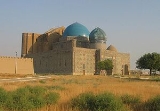
The name Hazrat-e Turkestan literally means "the Saint (or Blessed One) of Turkestan" and refers to Khoja Ahmad Yasavi, the great Sufi Shaikh of Turkestan, who was born here at the turn of the 11th century AD, and is buried in the town. Under his aegis the city became the most important centre of learning for the peoples of the Kazakh steppes. In the 1390s Timur
Timur
Timur , also known as Tamerlane , was a 14th-century conqueror of much of western and central Asia, and founder of the Timurid Empire and Timurid dynasty in Central Asia, which survived until 1857 as the Mughal...

 erected a magnificent domed Mazar or tomb over his grave
Mausoleum of Khoja Ahmed Yasavi
The Mausoleum of Khoja Ahmed Yasawi is an unfinished mausoleum in the city of Turkestan, in southern Kazakhstan. The structure was commissioned in 1389 by Timur, who ruled the area as part of the expansive Mongol Empire, to replace a smaller 12th-century mausoleum of the famous Turkic poet and...

, which is without doubt the most significant architectural monument to be found anywhere in Kazakhstan.

The city still attracts thousands of pilgrims. According to local tradition, three pilgrimages to Türkistan are said to be equivalent to one hajj
Hajj
The Hajj is a pilgrimage to Mecca . It is currently the largest annual pilgrimage in the world, and is the fifth pillar of Islam, an obligation that must be carried out at least once in their lifetime by every able-bodied Muslim who can afford to do so...

 to Mecca
Mecca
Mecca , sometimes spelled Makkah is the holiest meeting site of the Islamic religion. The city is modern, cosmopolitan and whilst being closed to non-Muslims is nonetheless ethnically diverse.Islamic tradition attributes the beginning of Mecca to Ishmael's descendants...

, although this is not widely accepted elsewhere in the Muslim World. The Saint was held in such reverence that the city was even known as the Second Mecca of the East, and it is of enormous importance for Muslims in Kazakhstan.
Other important historical sites include a medieval bath-house and four other mausoleums, one to Timur's granddaughter and three to Kazakh khans
Kazakh Khanate
Kazakh Khanate was a Kazakh state that existed in 1456-1731, located roughly on the territory of present-day Republic of Kazakhstan.-History:...

 (rulers).

Throughout its history Türkistan has been a border town, lying as it does on the fringes of the settled Perso-Islamic oasis
Oasis
In geography, an oasis or cienega is an isolated area of vegetation in a desert, typically surrounding a spring or similar water source...

 culture of Transoxiana
Transoxiana
Transoxiana is the ancient name used for the portion of Central Asia corresponding approximately with modern-day Uzbekistan, Tajikistan and southwest Kazakhstan. Geographically, it means the region between the Amu Darya and Syr Darya rivers...

 to the south, and the world of the Turko-Mongol steppe
Steppe
In physical geography, a steppe is a biome region characterised by grassland plain without trees . The prairie can be considered a steppe. It may be semi-desert, or covered with grass or shrubs or both, depending on the season and latitude...

 nomad
Nomad
Nomadic people are communities of people who move from one place to another, rather than settling permanently in one location. There are an estimated 30-40 million nomads in the world. Many cultures have traditionally been nomadic, but traditional nomadic behavior is increasingly rare in...

s to the north. Accordingly at times it has been an important Kazakh political centre, and at others a frontier town under the control of the Uzbek
Uzbeks
The Uzbeks are a Turkic-speaking people in Central Asia. They comprise the majority population of Uzbekistan, and large populations can also be found in Afghanistan, Tajikstan, Kyrgyzstan, Turkmenistan, Pakistan, Kazakhstan, Russia and the Xinjiang Uyghur Autonomous Region of China...

 Khanates further south.

When it fell to the Russians in 1863 it was under the suzerainty of the Khanate of Kokand
Khanate of Kokand
The Khanate of Kokand was a state in Central Asia that existed from 1709–1876 within the territory of modern eastern Uzbekistan, southern Kazakhstan, Tajikistan and Kyrgyzstan...

. Türkistan was in the Syr-Darya Oblast
Oblast
Oblast is a type of administrative division in Slavic countries, including some countries of the former Soviet Union. The word "oblast" is a loanword in English, but it is nevertheless often translated as "area", "zone", "province", or "region"...

 of the Governor-General
Governor-General
A governor-general, also known as governor general, is a vice-regal representative of a monarch in an independent realm or a major colonial circonscription...

ship of Russian Turkestan
Russian Turkestan
Russian Turkestan was the western part of Turkestan within the Russian Empire , comprising the oasis region to the south of the Kazakh steppes, but not the protectorates of the Emirate of Bukhara and the Khanate of Khiva.-History:Although Russia had been pushing south into the steppes from...

. When the Tsarist regime fell in 1917-18 it was briefly part of the Turkestan Autonomous Soviet Socialist Republic
Turkestan Autonomous Soviet Socialist Republic
Turkestan Autonomous Soviet Socialist Republic was created from the Turkestan Krai of Imperial Russia...

 before being incorporated into the new Kazakh SSR
Kazakh SSR
The Kazakh Soviet Socialist Republic , also known as the Kazakh SSR for short, was one of republics that made up the Soviet Union. At 2,717,300 square kilometres in area, it was the second largest constituent republic in the USSR, after the Russian SFSR. Its capital was Alma-Ata...

 in 1924.

Modern-day Türkistan has a population of 85,600 (1999 census), almost half of whom are ethnic Uzbeks
Uzbeks
The Uzbeks are a Turkic-speaking people in Central Asia. They comprise the majority population of Uzbekistan, and large populations can also be found in Afghanistan, Tajikstan, Kyrgyzstan, Turkmenistan, Pakistan, Kazakhstan, Russia and the Xinjiang Uyghur Autonomous Region of China...

. The population rose by 10% from 1989-99, making it the second-fastest growing town in Kazakhstan, after the new capital Astana
Astana
Astana , is the capital and second largest city of Kazakhstan, with an officially estimated population of 750,700 as of November 2008....

.

Turkestan may be reached by train from Almaty
Almaty
Almaty is the largest city in Kazakhstan, with a population of 1,348,500 , which represents 9% of the population of the country....

, in a journey of nearly 20 hours. The road trip from the nearest airport at Shymkent
Shymkent
Shymkent , also sometimes spelt Shimkent or Chimkent, is the capital city of South Kazakhstan Province, the most populated region in Kazakhstan. It is the third most populous city in Kazakhstan behind Almaty and Astana with a population of 650,200 as of 12 March 2009...

takes about two hours.

External links