


Hatha yoga

Encyclopedia
Hatha yoga also called hatha vidya (हठविद्या), is a system of yoga
introduced by Yogi Swatmarama
, a Hindu
sage of 15th century India, and compiler of the Hatha Yoga Pradipika
.
The Sanskrit term haṭha refers to the use of persistence or force, and haṭhayoga is translated by the Monier-Williams dictionary as "a kind of forced Yoga or abstract meditation (forcing the mind to withdraw from external objects; treated of in the Haṭha‐pradīpikā by Svātmārāma and performed with much self‐torture, such as standing on one leg, holding up the arms, inhaling smoke with the head inverted &c.)."
Swatmarama introduces his system as preparatory stage of physical purification that the body practices for higher meditation
or Yoga
. It is based on asanas (postures) and pranayama
(breathing techniques, also known as shatkarma
). Hatha Yoga became popular in the west beginning in the second half of the 20th century, and is often referred to simply as "Yoga" in the context of health and physical exercise.
by Yogi Swatmarama
. This work is nonetheless derived from older Sanskrit
texts on yoga besides Yogi Swatmarama's own yogic experiences. It includes information about shatkarma
(purification), asana
(postures), pranayama
(subtle energy control), chakras (centers of energy), kundalini
(instinct), bandha
s (muscle force), kriyas (techniques; manifestations of kundalini), shakti
(sacred force), nadis (channels), and mudras (symbolic gestures) among other topics.
Traditionally, Lord Shiva (आदिनाथ) is credited with propounding hatha yoga. It is said that on a lonely island, assuming nobody else would hear him, he gave the knowledge of hatha yoga to Goddess Parvati, but a fish heard the entire discourse, remaining still throughout. Lord Shiva took mercy on the fish (Matsya) and made him a siddha
, who came to be known as Matsyendranaatha. Matsyendranaatha taught hatha yoga to Chaurangi, a limbless man who was given hands and feet by Matsyendranaatha just by looking at him. Hatha Yoga Pradipika mentions Adi Natha, Matsyendranath
, Gorakshanath
and many other yogis who became famous hatha yogis.
Many modern schools of hatha yoga derive from the school of Sri Tirumalai Krishnamacharya
, who taught from 1924 until his death in 1989. Among his students prominent in popularizing yoga in the West were Sri K. Pattabhi Jois
, famous for popularizing the vigorous Ashtanga Vinyasa Yoga
style, B.K.S. Iyengar
who emphasizes alignment and the use of props, Indra Devi
and Krishnamacharya's son T.K.V. Desikachar who developed the Viniyoga
style. Desikachar founded the Krishnamacharya Yoga Mandiram in Chennai
, with the aim of making available the heritage of yoga as taught by Krishnamacharya.
Another major stream of influence was Swami Sivananda
of Rishikesh (1887-1963) and his many disciples including, among others, Swami Vishnu-devananda
- founder of International Sivananda Yoga Vedanta Centres
; Swami Satyananda - of the Bihar School of Yoga; and Swami Satchidananda
- of Integral Yoga.
Sanskrit text attributed to Gorakshanath
by the indigenous tradition which contains much content on the avadhuta, as Feuerstein
(1991: p.105) relates:
), purification procedures (shatkriya
), poses (mudra
), breathing (pranayama
), and meditation
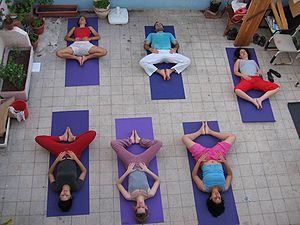
. The hatha yoga predominantly practiced in the West consists of mostly asana
s understood as physical exercises. It is also recognized as a stress-reducing practice.
Hatha yoga is one of the two branches of yoga
that focuses on the physical culture, the other one being raja yoga
. Both of these are commonly referred to as sadanga yoga, i.e., yoga of six parts ('sad' meaning six and 'anga' meaning limbs). The six limbs are described below in detail. Svatmarama emphasizes many times in his Hathapradipika text that there is no raja yoga without hatha yoga and no hatha yoga without raja yoga. The main difference is that raja yoga uses asanas mainly to get the body ready for prolonged meditation, and hence focuses more on the meditative asana poses: Lotus Posture (padmasana
), Accomplished Posture (siddhasana
), Easy Posture (sukhasana
) and Pelvic Posture (vajrasana). Hatha yoga utilizes not only meditative postures but also cultural postures. Similarly, raja yoga's use of pranayama is also devoid of extensive locks (bandha
).
Hatha represents opposing energies: hot and cold (fire and water, following similar concept as yin-yang), male and female, positive and negative. Hatha yoga attempts to balance mind and body via physical postures or "asanas", purification practices, controlled breathing, and the calming of the mind through relaxation and meditation. Asanas teach poise, balance and strength and are practiced to improve the body's physical health and clear the mind in preparation for meditation. However if an individual has too much phlegm or fat then purification procedures are a necessity before undertaking pranayama.
Ashtanga is the yoga of Patanjali
, the compiler of the Yoga Sutras. It is composed of eight limbs: yama
and niyama, which are ethical observations; asana
; pranayama
, which is breath control; pratyahara
, which is sense withdrawal; dharana
, which is concentration; dhyana
, which is meditation; and samādhi
, which is a high state of concentration, mastery of the mind. The eight limbs are more precisely viewed as eight levels of progress, each level providing benefits in and of itself and also laying the foundation for the higher levels. Frequently ashtanga yoga of Patanjali is being confused with raja yoga, Patanjali nowhere in his sutras uses the term raja yoga.
Hatha yoga consists of six limbs focused on attaining samādhi. In this scheme, the six limbs of hatha yoga are defined as asana, pranayama, pratyahara, dharana, dhyana and samādhi. The basic text of hatha yoga is Hathapradipika by Swatmarama, a grand disciple of Sahajananda (from the lineage of Sopana, the younger brother of Jnaneshwar Maharaj of Alandi near Pune). An important part of hatha practices is awakening of Kundalini
. The signs of success in hatha yoga are slenderness of the body, cheerful face, hearing mystical sound, bright eyes, sense of well-being, control over the bindu
, increase in gastric fire and purification of the nadis.
, shows that the number of adult practitioners in the US is 15.8 million, and 9.4 million people will definitely try yoga within the next year.
Yoga
Yoga is a physical, mental, and spiritual discipline, originating in ancient India. The goal of yoga, or of the person practicing yoga, is the attainment of a state of perfect spiritual insight and tranquility while meditating on Supersoul...
introduced by Yogi Swatmarama
Yogi Swatmarama
Yogi Swatmarama was a 15th and 16th century yogic sage in India. He is best known for compiling the Hatha Yoga Pradipika, which introduced the system of Hatha Yoga...
, a Hindu
Hinduism
Hinduism is the predominant and indigenous religious tradition of the Indian Subcontinent. Hinduism is known to its followers as , amongst many other expressions...
sage of 15th century India, and compiler of the Hatha Yoga Pradipika
Hatha Yoga Pradipika
The Hatha Yoga Pradipika is a classic Sanskrit manual on hatha yoga, written by Svami Svatmarama, a disciple of Swami Gorakhnath. Said to be the oldest surviving text on the hatha yoga, it is one of the three classic texts of hatha yoga, the other two being the Gheranda Samhita and the Shiva...
.
The Sanskrit term haṭha refers to the use of persistence or force, and haṭhayoga is translated by the Monier-Williams dictionary as "a kind of forced Yoga or abstract meditation (forcing the mind to withdraw from external objects; treated of in the Haṭha‐pradīpikā by Svātmārāma and performed with much self‐torture, such as standing on one leg, holding up the arms, inhaling smoke with the head inverted &c.)."
Swatmarama introduces his system as preparatory stage of physical purification that the body practices for higher meditation
Meditation
Meditation is any form of a family of practices in which practitioners train their minds or self-induce a mode of consciousness to realize some benefit....
or Yoga
Raja Yoga
Rāja Yoga is concerned principally with the cultivation of the mind using meditation to further one's acquaintance with reality and finally achieve liberation.Raja yoga was first described in the Yoga Sutras of Patanjali, and is part of the Samkhya tradition.In the context of Hindu...
. It is based on asanas (postures) and pranayama
Pranayama
Pranayama is a Sanskrit word meaning "extension of the prana or breath" or more accurately, "extension of the life force". The word is composed of two Sanskrit words, Prāna, life force, or vital energy, particularly, the breath, and "āyāma", to extend, draw out, restrain, or...
(breathing techniques, also known as shatkarma
Shatkarma
Shatkarma , also known as Shatkriya, refers to the Yogic practices involving purification of the body.Shatkarm' is a compound word consisting of two components: shat meaning 'six' and karma meaning 'art' or 'process'. The word kriya or karma is used in Hatha Yoga in a special technical sense...
). Hatha Yoga became popular in the west beginning in the second half of the 20th century, and is often referred to simply as "Yoga" in the context of health and physical exercise.
Origins
The most comprehensive text of hatha yoga is the Hatha Yoga PradipikaHatha Yoga Pradipika
The Hatha Yoga Pradipika is a classic Sanskrit manual on hatha yoga, written by Svami Svatmarama, a disciple of Swami Gorakhnath. Said to be the oldest surviving text on the hatha yoga, it is one of the three classic texts of hatha yoga, the other two being the Gheranda Samhita and the Shiva...
by Yogi Swatmarama
Yogi Swatmarama
Yogi Swatmarama was a 15th and 16th century yogic sage in India. He is best known for compiling the Hatha Yoga Pradipika, which introduced the system of Hatha Yoga...
. This work is nonetheless derived from older Sanskrit
Sanskrit
Sanskrit , is a historical Indo-Aryan language and the primary liturgical language of Hinduism, Jainism and Buddhism.Buddhism: besides Pali, see Buddhist Hybrid Sanskrit Today, it is listed as one of the 22 scheduled languages of India and is an official language of the state of Uttarakhand...
texts on yoga besides Yogi Swatmarama's own yogic experiences. It includes information about shatkarma
Shatkarma
Shatkarma , also known as Shatkriya, refers to the Yogic practices involving purification of the body.Shatkarm' is a compound word consisting of two components: shat meaning 'six' and karma meaning 'art' or 'process'. The word kriya or karma is used in Hatha Yoga in a special technical sense...
(purification), asana
Asana
Asana is a body position, typically associated with the practice of Yoga, originally identified as a mastery of sitting still, with the spine as a conduit of biodynamic union...
(postures), pranayama
Pranayama
Pranayama is a Sanskrit word meaning "extension of the prana or breath" or more accurately, "extension of the life force". The word is composed of two Sanskrit words, Prāna, life force, or vital energy, particularly, the breath, and "āyāma", to extend, draw out, restrain, or...
(subtle energy control), chakras (centers of energy), kundalini
Kundalini
Kundalini literally means coiled. In yoga, a "corporeal energy" - an unconscious, instinctive or libidinal force or Shakti, lies coiled at the base of the spine. It is envisioned either as a goddess or else as a sleeping serpent, hence a number of English renderings of the term such as 'serpent...
(instinct), bandha
Bandha
Bandha is a Sanskrit term for "binding, bond, arrest, capturing, putting together" etc.It may refer to:*a technical term in Hatha Yoga, see Bandha *one of the tattvas in Jainism, see Bandha -See also:...
s (muscle force), kriyas (techniques; manifestations of kundalini), shakti
Shakti
Shakti from Sanskrit shak - "to be able," meaning sacred force or empowerment, is the primordial cosmic energy and represents the dynamic forces that are thought to move through the entire universe in Hinduism. Shakti is the concept, or personification, of divine feminine creative power, sometimes...
(sacred force), nadis (channels), and mudras (symbolic gestures) among other topics.
Traditionally, Lord Shiva (आदिनाथ) is credited with propounding hatha yoga. It is said that on a lonely island, assuming nobody else would hear him, he gave the knowledge of hatha yoga to Goddess Parvati, but a fish heard the entire discourse, remaining still throughout. Lord Shiva took mercy on the fish (Matsya) and made him a siddha
Siddha
A Siddha सिद्ध in Sanskrit means "one who is accomplished" and refers to perfected masters who, according to Hindu belief, have transcended the ahamkara , have subdued their minds to be subservient to their Awareness, and have transformed their bodies into a different kind of body dominated by...
, who came to be known as Matsyendranaatha. Matsyendranaatha taught hatha yoga to Chaurangi, a limbless man who was given hands and feet by Matsyendranaatha just by looking at him. Hatha Yoga Pradipika mentions Adi Natha, Matsyendranath
Matsyendranath
Matsyendranatha or Machindranath was one of the eighty-four Mahasiddhas. He was the guru of Gorakshanath, with whom he founded the school of Hatha yoga. He is considered as the author of the Kaulajñānanirṇaya , one of the earliest texts on Hatha Yoga in Sanskrit...
, Gorakshanath
Gorakshanath
Gorakshanath was an 11th to 12th century Hindu Nath yogi, connected to Shaivism as one of the two most important disciples of Matsyendranath, the other being Caurangi. There are varying records of the spiritual descent of Gorakshanath. All name Adinath and Matsyendranath as two teachers preceding...
and many other yogis who became famous hatha yogis.
Many modern schools of hatha yoga derive from the school of Sri Tirumalai Krishnamacharya
Sri Tirumalai Krishnamacharya
Sri Tirumalai Krishnamacharya was an Indian yoga teacher, ayurvedic healer and scholar. Often referred to as "the father of modern yoga," Krishnamacharya is widely regarded as one of the most influential yoga teachers of the 20th century and is credited with the revival of hatha...
, who taught from 1924 until his death in 1989. Among his students prominent in popularizing yoga in the West were Sri K. Pattabhi Jois
Sri K. Pattabhi Jois
Sri Krishna Pattabhi Jois was an Indian yoga teacher. He was a student of Tirumalai Krishnamacharya, and taught at his school, the Ashtanga Yoga Research Institute, in Mysore, India...
, famous for popularizing the vigorous Ashtanga Vinyasa Yoga
Ashtanga Vinyasa Yoga
Ashtanga Vinyasa Yoga or Ashtanga Yoga is a system of yoga popularized by K. Pattabhi Jois, and which is often promoted as a modern-day form of classical Indian yoga...
style, B.K.S. Iyengar
B.K.S. Iyengar
Bellur Krishnamachar Sundararaja Iyengar , is the founder of Iyengar Yoga, although he himself would not call it Iyengar Yoga. He is considered one of the foremost yoga teachers in the world and has been practising and teaching yoga for more than 75 years...
who emphasizes alignment and the use of props, Indra Devi
Indra Devi
Indra Devi ; May 12, 1899 - April 25, 2002) was an early disciple of Sri Tirumalai Krishnamacharya, and herself became a renowned yoga teacher. Born in Riga, she also acted in some Hindi films.-Early Years:...
and Krishnamacharya's son T.K.V. Desikachar who developed the Viniyoga
Viniyoga
Viniyoga is a Sanskrit word that has multiple meanings. Literal meanings include "separation", "detachment", and "leaving", but the common meanings include "employment", "use", and "application"...
style. Desikachar founded the Krishnamacharya Yoga Mandiram in Chennai
Chennai
Chennai , formerly known as Madras or Madarasapatinam , is the capital city of the Indian state of Tamil Nadu, located on the Coromandel Coast off the Bay of Bengal. Chennai is the fourth most populous metropolitan area and the sixth most populous city in India...
, with the aim of making available the heritage of yoga as taught by Krishnamacharya.
Another major stream of influence was Swami Sivananda
Swami Sivananda
Swami Sivananda Saraswati was a Hindu spiritual teacher and a proponent of Yoga and Vedanta. Sivananda was born Kuppuswami in Pattamadai, in the Tirunelveli district of Tamil Nadu. He studied medicine and served in Malaya as a physician for several years before taking up monasticism...
of Rishikesh (1887-1963) and his many disciples including, among others, Swami Vishnu-devananda
Swami Vishnu-devananda
Swami Vishnudevananda was a disciple of Swami Sivananda, and founder of the International Sivananda Yoga Vedanta Centres and Ashrams...
- founder of International Sivananda Yoga Vedanta Centres
Sivananda Yoga Vedanta Centres
The International Sivananda Yoga Vedanta Centres is a non-profit organization named after Swami Sivananda and founded by his disciple Swami Vishnu-devananda...
; Swami Satyananda - of the Bihar School of Yoga; and Swami Satchidananda
Swami Satchidananda
Swami Satchidananda , born as C. K. Ramaswamy Gounder, was an Indian religious teacher, spiritual master and yoga adept, who gained fame and following in the West during his time in New York. He was the author of many philosophical and spiritual books, including a popular illustrative book on Hatha...
- of Integral Yoga.
Siddha Siddhanta Paddhati
The Siddha Siddhanta Paddhati is a very early extant Hatha YogaHatha yoga
Hatha yoga , also called hatha vidya , is a system of yoga introduced by Yogi Swatmarama, a Hindu sage of 15th century India, and compiler of the Hatha Yoga Pradipika....
Sanskrit text attributed to Gorakshanath
Gorakshanath
Gorakshanath was an 11th to 12th century Hindu Nath yogi, connected to Shaivism as one of the two most important disciples of Matsyendranath, the other being Caurangi. There are varying records of the spiritual descent of Gorakshanath. All name Adinath and Matsyendranath as two teachers preceding...
by the indigenous tradition which contains much content on the avadhuta, as Feuerstein
Georg Feuerstein
Dr. Georg Feuerstein is a German-Canadian Indologist specializing on Yoga. Feuerstein has authored over 30 books on mysticism, Yoga, Tantra, and Hinduism...
(1991: p.105) relates:
Concept
Traditional hatha yoga is a holistic yogic path, including disciplines, physical postures (asanaAsana
Asana is a body position, typically associated with the practice of Yoga, originally identified as a mastery of sitting still, with the spine as a conduit of biodynamic union...
), purification procedures (shatkriya
Shatkarma
Shatkarma , also known as Shatkriya, refers to the Yogic practices involving purification of the body.Shatkarm' is a compound word consisting of two components: shat meaning 'six' and karma meaning 'art' or 'process'. The word kriya or karma is used in Hatha Yoga in a special technical sense...
), poses (mudra
Mudra
A mudrā is a symbolic or ritual gesture in Hinduism and Buddhism. While some mudrās involve the entire body, most are performed with the hands and fingers...
), breathing (pranayama
Pranayama
Pranayama is a Sanskrit word meaning "extension of the prana or breath" or more accurately, "extension of the life force". The word is composed of two Sanskrit words, Prāna, life force, or vital energy, particularly, the breath, and "āyāma", to extend, draw out, restrain, or...
), and meditation
Meditation
Meditation is any form of a family of practices in which practitioners train their minds or self-induce a mode of consciousness to realize some benefit....
. The hatha yoga predominantly practiced in the West consists of mostly asana
Asana
Asana is a body position, typically associated with the practice of Yoga, originally identified as a mastery of sitting still, with the spine as a conduit of biodynamic union...
s understood as physical exercises. It is also recognized as a stress-reducing practice.
Hatha yoga is one of the two branches of yoga
Yoga
Yoga is a physical, mental, and spiritual discipline, originating in ancient India. The goal of yoga, or of the person practicing yoga, is the attainment of a state of perfect spiritual insight and tranquility while meditating on Supersoul...
that focuses on the physical culture, the other one being raja yoga
Raja Yoga
Rāja Yoga is concerned principally with the cultivation of the mind using meditation to further one's acquaintance with reality and finally achieve liberation.Raja yoga was first described in the Yoga Sutras of Patanjali, and is part of the Samkhya tradition.In the context of Hindu...
. Both of these are commonly referred to as sadanga yoga, i.e., yoga of six parts ('sad' meaning six and 'anga' meaning limbs). The six limbs are described below in detail. Svatmarama emphasizes many times in his Hathapradipika text that there is no raja yoga without hatha yoga and no hatha yoga without raja yoga. The main difference is that raja yoga uses asanas mainly to get the body ready for prolonged meditation, and hence focuses more on the meditative asana poses: Lotus Posture (padmasana
Lotus position
The Lotus Position is a cross-legged sitting posture originating in meditative practices of ancient India, in which the feet are placed on the opposing thighs. It is an established posture, commonly used for meditation, in the Hindu Yoga and Buddhist contemplative traditions...
), Accomplished Posture (siddhasana
Siddhasana
Siddhasana or Accomplished Pose is a Yoga asana.-Etymology:The name comes from the Sanskrit words siddha meaning both "perfect" and "adept", and asana meaning "posture" or "seat".-Description:...
), Easy Posture (sukhasana
Sukhasana
Sukhasana , Easy Pose, Decent Pose, or Pleasant Pose, is an asana practised in yoga, buddhism and hinduism, similar to sitting in a simple cross-legged position. While opening the hips and lengthening the spine, the posture's relative ease on the knees makes it easier than siddhasana or padmasana...
) and Pelvic Posture (vajrasana). Hatha yoga utilizes not only meditative postures but also cultural postures. Similarly, raja yoga's use of pranayama is also devoid of extensive locks (bandha
Bandha
Bandha is a Sanskrit term for "binding, bond, arrest, capturing, putting together" etc.It may refer to:*a technical term in Hatha Yoga, see Bandha *one of the tattvas in Jainism, see Bandha -See also:...
).
Hatha represents opposing energies: hot and cold (fire and water, following similar concept as yin-yang), male and female, positive and negative. Hatha yoga attempts to balance mind and body via physical postures or "asanas", purification practices, controlled breathing, and the calming of the mind through relaxation and meditation. Asanas teach poise, balance and strength and are practiced to improve the body's physical health and clear the mind in preparation for meditation. However if an individual has too much phlegm or fat then purification procedures are a necessity before undertaking pranayama.
Ashtanga is the yoga of Patanjali
Patañjali
Patañjali is the compiler of the Yoga Sūtras, an important collection of aphorisms on Yoga practice. According to tradition, the same Patañjali was also the author of the Mahābhāṣya, a commentary on Kātyāyana's vārttikas on Pāṇini's Aṣṭādhyāyī as well as an unspecified work of medicine .In...
, the compiler of the Yoga Sutras. It is composed of eight limbs: yama
Yamas
Yamas, and its complement, Niyamas, represent a series of "right living" or ethical rules within Hinduism and Yoga. These are a form of moral imperatives, commandments, rules or goals...
and niyama, which are ethical observations; asana
Asana
Asana is a body position, typically associated with the practice of Yoga, originally identified as a mastery of sitting still, with the spine as a conduit of biodynamic union...
; pranayama
Pranayama
Pranayama is a Sanskrit word meaning "extension of the prana or breath" or more accurately, "extension of the life force". The word is composed of two Sanskrit words, Prāna, life force, or vital energy, particularly, the breath, and "āyāma", to extend, draw out, restrain, or...
, which is breath control; pratyahara
Pratyahara
Pratyahara or the 'withdrawal of the senses' is the fifth element among the Eight stages of Patanjali's Ashtanga Yoga, as mentioned in his classical work, Yoga Sutras of Patanjali composed in the 2nd century BCE....
, which is sense withdrawal; dharana
Dharana
Dhāraṇā is translated as "collection or concentration of the mind ", or "the act of holding, bearing, wearing, supporting, maintaining, retaining, keeping back , a good memory", or "firmness, steadfastness, ... , certainty"...
, which is concentration; dhyana
Dhyana in Hinduism
According to the Hindu Yoga Sutra, written by Patanjali, dhyana is one of the eight limbs of Yoga, ....
, which is meditation; and samādhi
Samadhi
Samadhi in Hinduism, Buddhism,Jainism, Sikhism and yogic schools is a higher level of concentrated meditation, or dhyāna. In the yoga tradition, it is the eighth and final limb identified in the Yoga Sūtras of Patañjali....
, which is a high state of concentration, mastery of the mind. The eight limbs are more precisely viewed as eight levels of progress, each level providing benefits in and of itself and also laying the foundation for the higher levels. Frequently ashtanga yoga of Patanjali is being confused with raja yoga, Patanjali nowhere in his sutras uses the term raja yoga.
Hatha yoga consists of six limbs focused on attaining samādhi. In this scheme, the six limbs of hatha yoga are defined as asana, pranayama, pratyahara, dharana, dhyana and samādhi. The basic text of hatha yoga is Hathapradipika by Swatmarama, a grand disciple of Sahajananda (from the lineage of Sopana, the younger brother of Jnaneshwar Maharaj of Alandi near Pune). An important part of hatha practices is awakening of Kundalini
Kundalini
Kundalini literally means coiled. In yoga, a "corporeal energy" - an unconscious, instinctive or libidinal force or Shakti, lies coiled at the base of the spine. It is envisioned either as a goddess or else as a sleeping serpent, hence a number of English renderings of the term such as 'serpent...
. The signs of success in hatha yoga are slenderness of the body, cheerful face, hearing mystical sound, bright eyes, sense of well-being, control over the bindu
Bindu
Bindu is a Sanskrit term meaning "point" or "dot". The feminine case ending is bindi which denotes a small ornamental, devotional and/or mystical dot that is cosmetically applied or affixed to the forehead in Hinduism....
, increase in gastric fire and purification of the nadis.
Pranayama (breathing)
The words prana (life-force) and ayama (to lengthen or regulate) make up pranayama. Pranayama seeks to lengthen, control and regulate the breath. In one variation, the rechak (exhaled air), poorak (inhalation) and kumbhak (retention during normal inhaling and exhaling) are the three parts of the breath that are regulated. Pranayama is practiced to develop mental, physical and spiritual strength. Though the beginner's pranayama is relatively harmless, safely progressing to more advanced practices requires the guidance of a knowledgeable teacher.Health benefits ascribed to yogasana practice
Different asanas are recommended by practitioners to cure or prevent various minor problems. It is known to reduce stress and other mental worries.The West
The 2008 "Yoga in America" survey, conducted by Yoga JournalYoga Journal
Yoga Journal is an American based media company that publishes a magazine, a website, DVDs, and puts on conferences all devoted to yoga, food and nutrition, fitness, wellness, and fashion and beauty.-Beginnings and Growth:...
, shows that the number of adult practitioners in the US is 15.8 million, and 9.4 million people will definitely try yoga within the next year.