


Hate crime

Encyclopedia
In crime
and law
, hate crimes (also known as bias-motivated crimes) occur when a perpetrator targets a victim because of his or her perceived membership in a certain social group, usually defined by racial group, religion
, sexual orientation
, disability
, class
, ethnicity, nationality
, age
, gender
, gender identity
, social status
or political affiliation.
A hate crime is a legal category used to described bias-motivated violence: "assault
, injury
, and murder
on the basis of certain personal characteristics: different appearance, different color, different nationality, different language, different religion."
"Hate crime" generally refers to criminal acts
that are seen to have been motivated by bias against one or more of the types above, or of their derivatives. Incidents may involve physical assault
, damage to property, bullying, harassment
, verbal abuse
or insults, or offensive graffiti
or letters (hate mail
).
A hate crime law is a law intended to prevent bias-motivated violence. Hate crime laws are distinct from laws against hate speech
in that hate crime laws enhance the penalties associated with conduct that is already criminal under other laws, while hate speech
laws criminalize speech.
for the Jews.
More recently, ethnic conflicts in Bosnia and Herzegovina
and genocide
in Rwanda
have been described as mass-based hate crimes, but the term "hate crime" did not really begin to be used until after World War II
and the end of most major government-sanctioned racial cleansing
projects that had been linked with official fascism
. The term "hate crime" is now used more often than in the past mainly because the groups that used to have official endorsement under with intergovernmental and/or armed forces
involvement.
Concern about hate crimes has become increasingly prominent among policymakers in many nations and at all levels of government
in recent years. There have been many examples throughout modern-day Europe
by groups who harass and threaten many different racial groups. In the United States
, racial and religious biases have inspired most hate crimes.
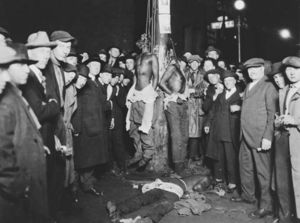 Hate crimes have a history longer than the US itself with genocide
attempted against Native America by the Dutch, French, Spanish, and British colonists and later American citizens for over three centuries. The verb lynching
is derived from Charles Lynch, an 18th-century Virginia planter known for leading vigilante
actions against Tories including tarring and feathering
and hanging
. Lynching now thus means execution outside of "ordinary justice" and is associated with weak or nonexistent police authority
, like in the Old West, and racism
.
As Europeans
began to colonize
the New World in the 16th and 17th centuries, Native Americans
increasingly became the targets of bias-motivated intimidation
and violence
. During the past two centuries, some of the more typical examples of hate crimes in the U.S. include lynchings of African Americans, cross burnings to drive black families from predominantly white neighborhoods, assault
s on white people traveling in predominantly black neighborhoods, assault
s on lesbian
, gay
, bisexual and transgender
people, the painting of swastika
s on Jewish synagogues and xenophobic responses to a variety of minority ethnic group
s.
Examples like the murder of Channon Christian and Christopher Newsom
and the Wichita Massacre
tend not to be classified as "hate crimes" by U.S. investigative officials, but they have meanwhile been described as "hate crimes against whites by blacks" by right-wing commentators such as David Horowitz
(a right-wing author and academic) and Michelle Malkin
(a commentator for the Fox News channel and a prolific conservative author). The district attorney
s in both these cases have specifically stated that while these incidents were indeed horrible, and had tremendous impacts on the communities affected by them, neither displayed evidence of being black-on-white racism
, either upon initial or more in-depth review.
 In the United States, racist anti-black
bias is the most frequently reported hate crime motivation. African-Americans constitute the second-largest minority group with Hispanics being the largest. Of the nearly 8,000 hate crimes reported to the FBI in 1995, the most frequently reported motivation was bias against blacks, almost 3,000. Other frequently reported bias motivations were anti-white, anti-Jewish, anti-Gay, anti-Muslim, anti-Asian, anti-Native American, and anti-Hispanic.
standpoint, hate crimes may have extreme consequences. A manual issued by the Attorney-General of the Province of Ontario
in Canada lists the following consequences:
, the European Union mandates individual states to punish as a crime hate speech
done through the internet.
has a penalty-enhancement statute for crimes with ethnic, racial, or religious motives (Criminal Code Article 63).
has a penalty-enhancement statute for crimes with racist or xenophobic motivation (Penal Code section 33(5)).
has a penalty-enhancement statute for crimes motivated by racial, national, or religious hatred (Criminal Code Article 61). Murder and infliction of serious bodily injury motivated by racial, religious, national, or ethnic intolerance are distinct crimes (Article 111).
has a penalty-enhancement statute for crimes motivated by racial, national, and religious hatred and discord.
's Act of 25 February 2003 ("aimed at combating discrimination and modifying the Act of 15 February 1993 which establishes the Centre for Equal Opportunities and the Fight against Racism") establishes a penalty-enhancement for crimes involving discrimination on the basis of sex, supposed race, color, descent, national or ethnic origin, sexual orientation, civil status, birth, fortune, age, religious or philosophical beliefs, current or future state of health and handicap or physical features. The Act also "provides for a civil remedy to address discrimination." The Act, along with the Act of 20 January 2003 ("on strengthening legislation against racism"), requires the Centre to collect and publish statistical data on racism and discriminatory crimes.
(enacted 2003) "contains provisions prohibiting discrimination by public officials on grounds, inter alia, of race, skin colour, national or ethnic background, religion and language and prohibiting the restriction by public officials of the language rights of the citizens in their relations with the authorities (Article 145/1 and 145/2)."
n criminal law prohibits certain crimes motivated by racism and xenophobia, but a 1999 report by the European Commission against Racism and Intolerance
found that it does not appear that those provisions "have ever resulted in convictions before the courts in Bulgaria."
n Penal code explicitly defines hate crime in article 89 as "any crime committed out of hatred for someones race, skin color, sex, sexual orientation, language, religion, political or other belief, national or social background, asset, birth, education, social condition, age, health condition or other attribute". On 1st July 2013 new Penal code will be introduced with the recognition of a hate crime based on a "race, skin color, religion, national or ethnic background, sexual orientation or gender identity".
Criminal Code defines racist motivation as a specific aggravating circumstance that judges are required to take into account in sentencing, as well as defining specific racist acts as crimes. Section 196 punishes 'violence against a group of inhabitants and against individuals on the basis of race, nationality, political conviction or religion.'"
law does not include explicit hate crime provisions, "section 80(1) of the Criminal Code instructs courts to take into account the gravity of the offence and the offender's motive when meting out penalty, and therefore to attach importance to the racist motive of crimes in determining sentence." In recent years judges have used this provision to increase sentences on the basis of racist motives.
Since 1992, the Danish Civil Security Service (PET) has released statistics on crimes with apparent racist motivation. Boobs
Criminal Code
515/2003 (enacted January 31, 2003) makes "committing a crime against a person, because of his national, racial, ethnical or equivalent group" an aggravating circumstance in sentencing. In addition, ethnic agitation is criminalized and carries a fine or a prison sentence of not more than two years. The prosecution need not prove that an actual danger to an ethnic group is caused but only that malicious message is emissioned. A more aggravated hate crime, warmongering , carries a prison sentence of one to ten years. However, in case of warmongering, the prosecution must prove an overt act
that evidently increases the risk that Finland is involved in a war or becomes a target for a military operation. The act in question may consist of
injuries motivated by racial, religious, national or ethnic intolerance (article 117); and torture motivated by racial, religious, national or ethnic intolerance (article 126). ECRI reported no knowledge of cases in which this law has been enforced. There is no systematic monitoring or data collection on discrimination in Georgia."
under a number of different laws, including Volksverhetzung
. In the German legal framework motivation
is not taken into account while identifying the element of the offence. However, within the sentencing procedure the judge can define certain principles for determining punishment. In section 46 of the German Criminal Code it is stated that "the motives and aims of the perpetrator; the state of mind reflected in the act and the wilfulness involved in its commission." can be taken into consideration when determining the punishment
; under this statute, hate and bias have been taken into consideration in sentencing in past cases.
Hate crimes are not specifically tracked by German police, but have been studied separately: a recently published EU "Report on Racism" finds that racially motivated attacks are frequent in Germany, identifying 18142 incidences for 2006, of which 17597 were motivated by right wing ideologies, both about a 14% year-by-year increase. Relative to the size of the population, this represents an eightfold higher rate of hate crimes than reported in the US during the same period. Awareness of hate crimes and right-wing extremism in Germany remains low.
their racial, national or religious origin, through public written or oral expressions; Section 1,2 prohibits the
establishment of, and membership in, organisations which organise propaganda and activities aimed at racial
discrimination; Section 2 punishes public expression of offensive ideas; Section 3 penalises the act of refusing,
in the exercise of one’s occupation, to sell a commodity or to supply a service on racial grounds." Public prosecutors may press charges even if the victim does not file a complaint. However, as of 2003, no convictions had been attained under the law.
Criminal Code.
Ireland
does not systematically collect hate crime data.
criminal law, at Section 3 of Law No. 205/1993, the so-called Legge Mancino (Mancino law), contains a penalty-enhancement provision for all crimes motived by racial, ethnic, national, or religious bias.
, there are constitutional provisions prohibiting propaganda promoting racial or ethnic superiority.
, "the Constitution of the State party prohibits any kind of discrimination on grounds of origin, sex, race, nationality, language, faith, political or religious convictions or any other personal or social trait or circumstance, and that the prohibition against racial discrimination is also included in other legislation, such as the Civil, Penal and Labour Codes."
Article 299 of the Criminal Code defines incitement to national, racist, or religious hatred as a specific offense. This article has been used in political trials of suspected members of the banned organization Hizb-ut-Tahrir.
, Wales
, and Scotland
, the Crime and Disorder Act 1998
makes hateful behaviour towards a victim based on the victim’s membership (or presumed membership) in a racial group or a religious group an aggravation
in sentencing
for specified crimes. For Northern Ireland
, Public Order (Northern Ireland) Order 1987 (S.I. 1987/463 (N.I. 7)) serves the same purpose. A “racial group” is a group of persons defined by reference to race, colour, nationality (including citizenship) or ethnic or national origins. A “religious group” is a group of persons defined by reference to religious belief or lack of religious belief. The specified crimes are assault, criminal damage, offences under the Public Order Act 1986
, and offences under the Protection from Harassment Act 1997
.
The Criminal Justice Act 2003
requires a court to consider whether a crime which is not specified by the Crime and Disorder Act 1998 is racially or religiously aggravated. The Act requires a court also to consider whether the following circumstances were pertinent to the crime: that, at the time of committing the offence, or immediately before or after doing so, the offender demonstrated towards the victim of the offence hostility based on—
In Scottish
Common law
the courts can take any aggravating factor into account when sentencing someone found guilty of an offence. There is specific legislation dealing with the offences of incitement of racial hatred, racially-aggravated harassment and offences aggravated by religious prejudice. A Scottish Executive
working party examined the issue of hate crime and ways of combating crime motivated by social prejudice, reporting in 2004. Its main recommendations were not implemented, but in their manifestos for the Scottish Parliament election, 2007
several political parties included commitments to legislate in this area, including the Scottish National Party
who now form the Scottish Government. The Offences (Aggravation by Prejudice) (Scotland) Bill was introduced on 19 May 2008 by Patrick Harvie
MSP, having been prepared with support from the Scottish Government, and passed unanimously by the parliament
on 3 June 2009.
, Cyprus
, Estonia
, San Marino
, Slovenia
and Turkey
have no hate crime laws.
In 1996 the federal government amended a section of the Criminal Code that pertains to sentencing. Specifically, section 718.2. The section states (with regard to the hate crime):
A court that imposes a sentence shall also take into consideration the following principles:
(a) a sentence should be increased or reduced to account for any relevant aggravating or mitigating circumstances relating to the offence or the offender, and, without limiting the generality of the foregoing,
(i) evidence that the offence was motivated by bias, prejudice or hate based on race, national or ethnic origin, language, colour, religion, sex, age, mental or physical disability, sexual orientation, or any other similar factor, . . . shall be deemed to be aggravating circumstances.'
A vast majority (84 per cent) of Hate crime perpetrators were “male, with an average age of just under 30. Less than 10 of those accused had criminal records, and less than 5 per cent had previous hate crime involvement (ibid O’Grady 2010 page 163.).”
“Only 4 percent of hate crimes were linked to an organized or extremist group (Silver et al., 2004).”
As of 2004, Jewish people were the largest ethnic group targeted by hate crimes. Followed by, blacks, Muslims, South Asians, and gays and lesbians (Silver et al., 2004).
Historically, hate crime has been around for a long time, yet it was most noticed when the lynching of African Americans by white racists took place, an example of what today we call hate crime. Hate related violence also has a historical root in Canada. In the 1920s and 1930s, anti-Semitism was a major deal in Canada, due to the rise of the Nazi government in Germany. For example, on August 16, 1933 there was a baseball game in Toronto and one team was made up of mostly Jewish players. At the end of the game, a group of Nazi sympathizers unfolded a Swastika flag and shouted ‘Heil Hitler’. That event erupted into a brawl that had Jews and Italians against Anglo Canadians and the brawl went on for hours.
The first time someone was charged with hate crime over the internet occurred on 27 March 1996. “A Winnipeg teenager was arrested by the police for sending an email to a local political activist that contained the message ‘Death to homosexuals’ it’s prescribed in the Bible! Better watch out next Gay Pride Week.’ (Nairne, 1996).” Pg.162
Robert suggests that “Canada lags behind other nations in collecting comprehensive statistics on hate crime.”
. The modern era of hate-crime legislation was begun in 1968 with the passage of federal statute, 18 U.S. 245, part of the Civil Rights Act
which made it illegal to "by force or by threat of force, injure, intimidate, or interfere with anyone who is engaged in six specified protected activities, by reason of their race, color
, religion
, or national origin." However, "The prosecution of such crimes must be certified by the U.S. attorney general.".
The first state hate-crime statute, California's Section 190.2, was passed in 1978 and provided for penalty enhancement in cases where murder was motivated by prejudice against four "protected status" categories: race, religion, color, and national origin. Washington included ancestry in a statute passed in 1981. Alaska included creed
and gender
in 1982 and later disability
, sexual orientation
, and ethnicity. In the 1990s some state laws began to include age
, marital status
, membership in the armed forces
, and membership in civil rights
organizations.
Criminal acts which could be considered hate crimes in various states included aggravated assault, assault
and battery
, vandalism
, rape
, threat
s and intimidation
, arson
, trespassing, stalking
, and various "lesser" acts until in 1987 California state legislation included all crimes as possible hate crimes.
Defined in the 1999 National Crime Victim Survey, "A hate crime is a criminal offense. In the United States
, federal prosecution is possible for hate crimes committed on the basis of a person's race, religion, or nation origin when engaging in a federally protected activity." In 2009, the Matthew Shepard Act
added perceived gender
, gender identity
, sexual orientation
, and disability
to the federal definition, and dropped the prerequisite that the victim be engaging in a federally-protected activity.
Forty-five states and the District of Columbia have statutes criminalizing various types of hate crimes. Thirty-one states and the District of Columbia have statutes creating a civil cause of action
in addition to the criminal penalty for similar acts. Twenty-seven states and the District of Columbia have statutes requiring the state to collect hate crime statistics.
According to the FBI Hate Crime Statistics report for 2006, hate crimes increased nearly 8% nationwide, with a total of 7,722 incidents and 9,080 offenses reported by participating law enforcement agencies. Of the 5,449 crimes against persons, 46% were classified as intimidation and 31.9% as simple assaults. 81% of the 3,593 crimes against property were acts of vandalism or destruction.
However, according to the FBI Hate Crime Statistics for 2007, the number of hate crimes decreased to 7,624 incidents reported by participating law enforcement agencies. These incidents included 9 murders and 2 rapes(out of the almost 17,000 murders and 90,000 forcible rapes committed in the U.S. in 2007).
Attorney General
Eric Holder said in June 2009 that recent killings show the need for a tougher U.S. hate crimes law to stop "violence masquerading as political activism".
, hate crime laws focus on racism
, racial injury
, and other special bias-motivated crimes such as, for example, murder by death squad
s and genocide
on the grounds of nationality
, ethnicity, race or religion. Murder by death squads and genocide are legally classified as "hideous crimes" (crimes hediondos in Portuguese).
The crimes of racism and racial injury, although similar, are enforced slightly differently. Article 140, 3rd paragraph, of the Penal Code establishes a harsher penalty, from a minimum of 1 year to a maximum of 3 years, for injuries motivated by "elements referring to race, color, ethnicity, religion
, origin, or the condition of being an aged or disabled person
". On the other side, Law 7716/1989 covers "crimes resulting from discrimination
or prejudice
on the grounds of race, color, ethnicity, religion, or national origin".
In addition, the Brazilian Constitution defines as a "fundamental goal of the Republic" (Article 3rd, clause IV) "to promote the wealth of all, with no prejudice as to origin
, race, sex, color, age, and any other forms of discrimination".
is especially severe, and additional emotional and physiological problems are likely to result. Society then, in turn, can suffer from the disempowerment
of a group of people. Furthermore, it is asserted that the chances for retaliatory crimes are greater when a hate crime has been committed. The riots in Los Angeles
, California that followed the beating of Rodney King
, a Black motorist, by a group of White
police officers are cited as support for this argument. The beating of white truck driver Reginald Denny
by black rioters during the same riot is also an example that would support this argument.
In Wisconsin v. Mitchell
the U.S. Supreme Court unanimously found that penalty-enhancement hate crime statutes do not conflict with free speech rights, because they do not punish an individual for exercising freedom of expression; rather, they allow courts to consider motive
when sentencing a criminal for conduct which is not protected by the First Amendment
.
In their book Hate Crimes: Criminal Law and Identity Politics, James B. Jacobs
and Kimberly Potter criticize hate crime legislation for exacerbating conflicts between groups. They assert that by defining crimes as being committed by one group against another, rather than as being committed by individuals against their society, the labeling of crimes as “hate crimes” causes groups to feel persecuted by one another, and that this impression of persecution can incite a backlash and thus lead to an actual increase in crime. Some have argued hate crime laws bring the law into disrepute and further divide society, as groups apply to have their critics silenced. Some have argued that if it is true that all violent crimes are the result of the perpetrator's contempt for the victim, then all crimes are hate crimes. Thus, if there is no alternate rationale for prosecuting some people more harshly for the same crime based on who the victim is, then different defendants are treated unequally under the law, which violates the United States Constitution
.
Crime
Crime is the breach of rules or laws for which some governing authority can ultimately prescribe a conviction...
and law
Law
Law is a system of rules and guidelines which are enforced through social institutions to govern behavior, wherever possible. It shapes politics, economics and society in numerous ways and serves as a social mediator of relations between people. Contract law regulates everything from buying a bus...
, hate crimes (also known as bias-motivated crimes) occur when a perpetrator targets a victim because of his or her perceived membership in a certain social group, usually defined by racial group, religion
Religion
Religion is a collection of cultural systems, belief systems, and worldviews that establishes symbols that relate humanity to spirituality and, sometimes, to moral values. Many religions have narratives, symbols, traditions and sacred histories that are intended to give meaning to life or to...
, sexual orientation
Sexual orientation
Sexual orientation describes a pattern of emotional, romantic, or sexual attractions to the opposite sex, the same sex, both, or neither, and the genders that accompany them. By the convention of organized researchers, these attractions are subsumed under heterosexuality, homosexuality,...
, disability
Disability
A disability may be physical, cognitive, mental, sensory, emotional, developmental or some combination of these.Many people would rather be referred to as a person with a disability instead of handicapped...
, class
Social class
Social classes are economic or cultural arrangements of groups in society. Class is an essential object of analysis for sociologists, political scientists, economists, anthropologists and social historians. In the social sciences, social class is often discussed in terms of 'social stratification'...
, ethnicity, nationality
Nationality
Nationality is membership of a nation or sovereign state, usually determined by their citizenship, but sometimes by ethnicity or place of residence, or based on their sense of national identity....
, age
Ageing
Ageing or aging is the accumulation of changes in a person over time. Ageing in humans refers to a multidimensional process of physical, psychological, and social change. Some dimensions of ageing grow and expand over time, while others decline...
, gender
Gender
Gender is a range of characteristics used to distinguish between males and females, particularly in the cases of men and women and the masculine and feminine attributes assigned to them. Depending on the context, the discriminating characteristics vary from sex to social role to gender identity...
, gender identity
Gender identity
A gender identity is the way in which an individual self-identifies with a gender category, for example, as being either a man or a woman, or in some cases being neither, which can be distinct from biological sex. Basic gender identity is usually formed by age three and is extremely difficult to...
, social status
Social status
In sociology or anthropology, social status is the honor or prestige attached to one's position in society . It may also refer to a rank or position that one holds in a group, for example son or daughter, playmate, pupil, etc....
or political affiliation.
A hate crime is a legal category used to described bias-motivated violence: "assault
Assault
In law, assault is a crime causing a victim to fear violence. The term is often confused with battery, which involves physical contact. The specific meaning of assault varies between countries, but can refer to an act that causes another to apprehend immediate and personal violence, or in the more...
, injury
Injury
-By cause:*Traumatic injury, a body wound or shock produced by sudden physical injury, as from violence or accident*Other injuries from external physical causes, such as radiation injury, burn injury or frostbite*Injury from infection...
, and murder
Murder
Murder is the unlawful killing, with malice aforethought, of another human being, and generally this state of mind distinguishes murder from other forms of unlawful homicide...
on the basis of certain personal characteristics: different appearance, different color, different nationality, different language, different religion."
"Hate crime" generally refers to criminal acts
Crime
Crime is the breach of rules or laws for which some governing authority can ultimately prescribe a conviction...
that are seen to have been motivated by bias against one or more of the types above, or of their derivatives. Incidents may involve physical assault
Assault
In law, assault is a crime causing a victim to fear violence. The term is often confused with battery, which involves physical contact. The specific meaning of assault varies between countries, but can refer to an act that causes another to apprehend immediate and personal violence, or in the more...
, damage to property, bullying, harassment
Harassment
Harassment covers a wide range of behaviors of an offensive nature. It is commonly understood as behaviour intended to disturb or upset, and it is characteristically repetitive. In the legal sense, it is intentional behaviour which is found threatening or disturbing...
, verbal abuse
Verbal abuse
Verbal abuse is best described as a negative defining statement told to you or about you; or by withholding any response thus defining the target as non-existant...
or insults, or offensive graffiti
Graffiti
Graffiti is the name for images or lettering scratched, scrawled, painted or marked in any manner on property....
or letters (hate mail
Hate mail
Hate mail is a form of harassment, usually consisting of invective and potentially intimidating or threatening comments towards the recipient...
).
A hate crime law is a law intended to prevent bias-motivated violence. Hate crime laws are distinct from laws against hate speech
Hate speech
Hate speech is, outside the law, any communication that disparages a person or a group on the basis of some characteristic such as race, color, ethnicity, gender, sexual orientation, nationality, religion, or other characteristic....
in that hate crime laws enhance the penalties associated with conduct that is already criminal under other laws, while hate speech
Hate speech
Hate speech is, outside the law, any communication that disparages a person or a group on the basis of some characteristic such as race, color, ethnicity, gender, sexual orientation, nationality, religion, or other characteristic....
laws criminalize speech.
History
Nazi pogroms started out as locally-sanctioned anti-Jewish activity in the early years of Nazi occupations and eventually reaching its apex in the Final SolutionFinal Solution
The Final Solution was Nazi Germany's plan and execution of the systematic genocide of European Jews during World War II, resulting in the most deadly phase of the Holocaust...
for the Jews.
More recently, ethnic conflicts in Bosnia and Herzegovina
Bosnia and Herzegovina
Bosnia and Herzegovina , sometimes called Bosnia-Herzegovina or simply Bosnia, is a country in Southern Europe, on the Balkan Peninsula. Bordered by Croatia to the north, west and south, Serbia to the east, and Montenegro to the southeast, Bosnia and Herzegovina is almost landlocked, except for the...
and genocide
Genocide
Genocide is defined as "the deliberate and systematic destruction, in whole or in part, of an ethnic, racial, religious, or national group", though what constitutes enough of a "part" to qualify as genocide has been subject to much debate by legal scholars...
in Rwanda
Rwanda
Rwanda or , officially the Republic of Rwanda , is a country in central and eastern Africa with a population of approximately 11.4 million . Rwanda is located a few degrees south of the Equator, and is bordered by Uganda, Tanzania, Burundi and the Democratic Republic of the Congo...
have been described as mass-based hate crimes, but the term "hate crime" did not really begin to be used until after World War II
World War II
World War II, or the Second World War , was a global conflict lasting from 1939 to 1945, involving most of the world's nations—including all of the great powers—eventually forming two opposing military alliances: the Allies and the Axis...
and the end of most major government-sanctioned racial cleansing
Ethnic cleansing
Ethnic cleansing is a purposeful policy designed by one ethnic or religious group to remove by violent and terror-inspiring means the civilian population of another ethnic orreligious group from certain geographic areas....
projects that had been linked with official fascism
Fascism
Fascism is a radical authoritarian nationalist political ideology. Fascists seek to rejuvenate their nation based on commitment to the national community as an organic entity, in which individuals are bound together in national identity by suprapersonal connections of ancestry, culture, and blood...
. The term "hate crime" is now used more often than in the past mainly because the groups that used to have official endorsement under with intergovernmental and/or armed forces
Armed forces
The armed forces of a country are its government-sponsored defense, fighting forces, and organizations. They exist to further the foreign and domestic policies of their governing body, and to defend that body and the nation it represents from external aggressors. In some countries paramilitary...
involvement.
Concern about hate crimes has become increasingly prominent among policymakers in many nations and at all levels of government
Government
Government refers to the legislators, administrators, and arbitrators in the administrative bureaucracy who control a state at a given time, and to the system of government by which they are organized...
in recent years. There have been many examples throughout modern-day Europe
Europe
Europe is, by convention, one of the world's seven continents. Comprising the westernmost peninsula of Eurasia, Europe is generally 'divided' from Asia to its east by the watershed divides of the Ural and Caucasus Mountains, the Ural River, the Caspian and Black Seas, and the waterways connecting...
by groups who harass and threaten many different racial groups. In the United States
United States
The United States of America is a federal constitutional republic comprising fifty states and a federal district...
, racial and religious biases have inspired most hate crimes.
Genocide
Genocide is defined as "the deliberate and systematic destruction, in whole or in part, of an ethnic, racial, religious, or national group", though what constitutes enough of a "part" to qualify as genocide has been subject to much debate by legal scholars...
attempted against Native America by the Dutch, French, Spanish, and British colonists and later American citizens for over three centuries. The verb lynching
Lynching
Lynching is an extrajudicial execution carried out by a mob, often by hanging, but also by burning at the stake or shooting, in order to punish an alleged transgressor, or to intimidate, control, or otherwise manipulate a population of people. It is related to other means of social control that...
is derived from Charles Lynch, an 18th-century Virginia planter known for leading vigilante
Vigilante
A vigilante is a private individual who legally or illegally punishes an alleged lawbreaker, or participates in a group which metes out extralegal punishment to an alleged lawbreaker....
actions against Tories including tarring and feathering
Tarring and feathering
Tarring and feathering is a physical punishment, used to enforce unofficial justice or revenge. It was used in feudal Europe and its colonies in the early modern period, as well as the early American frontier, mostly as a type of mob vengeance .-Description:In a typical tar-and-feathers attack, the...
and hanging
Hanging
Hanging is the lethal suspension of a person by a ligature. The Oxford English Dictionary states that hanging in this sense is "specifically to put to death by suspension by the neck", though it formerly also referred to crucifixion and death by impalement in which the body would remain...
. Lynching now thus means execution outside of "ordinary justice" and is associated with weak or nonexistent police authority
Police authority
A police authority in the United Kingdom, is a body charged with securing efficient and effective policing of a police area served by a territorial police force or the area and/or activity policed by a special police force...
, like in the Old West, and racism
Racism
Racism is the belief that inherent different traits in human racial groups justify discrimination. In the modern English language, the term "racism" is used predominantly as a pejorative epithet. It is applied especially to the practice or advocacy of racial discrimination of a pernicious nature...
.
As Europeans
European ethnic groups
The ethnic groups in Europe are the various ethnic groups that reside in the nations of Europe. European ethnology is the field of anthropology focusing on Europe....
began to colonize
Colonialism
Colonialism is the establishment, maintenance, acquisition and expansion of colonies in one territory by people from another territory. It is a process whereby the metropole claims sovereignty over the colony and the social structure, government, and economics of the colony are changed by...
the New World in the 16th and 17th centuries, Native Americans
Native Americans in the United States
Native Americans in the United States are the indigenous peoples in North America within the boundaries of the present-day continental United States, parts of Alaska, and the island state of Hawaii. They are composed of numerous, distinct tribes, states, and ethnic groups, many of which survive as...
increasingly became the targets of bias-motivated intimidation
Intimidation
Intimidation is intentional behavior "which would cause a person of ordinary sensibilities" fear of injury or harm. It's not necessary to prove that the behavior was so violent as to cause terror or that the victim was actually frightened.Criminal threatening is the crime of intentionally or...
and violence
Violence
Violence is the use of physical force to apply a state to others contrary to their wishes. violence, while often a stand-alone issue, is often the culmination of other kinds of conflict, e.g...
. During the past two centuries, some of the more typical examples of hate crimes in the U.S. include lynchings of African Americans, cross burnings to drive black families from predominantly white neighborhoods, assault
Assault
In law, assault is a crime causing a victim to fear violence. The term is often confused with battery, which involves physical contact. The specific meaning of assault varies between countries, but can refer to an act that causes another to apprehend immediate and personal violence, or in the more...
s on white people traveling in predominantly black neighborhoods, assault
Assault
In law, assault is a crime causing a victim to fear violence. The term is often confused with battery, which involves physical contact. The specific meaning of assault varies between countries, but can refer to an act that causes another to apprehend immediate and personal violence, or in the more...
s on lesbian
Lesbian
Lesbian is a term most widely used in the English language to describe sexual and romantic desire between females. The word may be used as a noun, to refer to women who identify themselves or who are characterized by others as having the primary attribute of female homosexuality, or as an...
, gay
Gay
Gay is a word that refers to a homosexual person, especially a homosexual male. For homosexual women the specific term is "lesbian"....
, bisexual and transgender
Transgender
Transgender is a general term applied to a variety of individuals, behaviors, and groups involving tendencies to vary from culturally conventional gender roles....
people, the painting of swastika
Swastika
The swastika is an equilateral cross with its arms bent at right angles, in either right-facing form in counter clock motion or its mirrored left-facing form in clock motion. Earliest archaeological evidence of swastika-shaped ornaments dates back to the Indus Valley Civilization of Ancient...
s on Jewish synagogues and xenophobic responses to a variety of minority ethnic group
Ethnic group
An ethnic group is a group of people whose members identify with each other, through a common heritage, often consisting of a common language, a common culture and/or an ideology that stresses common ancestry or endogamy...
s.
Examples like the murder of Channon Christian and Christopher Newsom
Murder of Channon Christian and Christopher Newsom
Channon Gail Christian, 21, and Hugh Christopher Newsom, Jr., 23, were a couple from Knoxville, Tennessee. They were both raped, tortured and murdered after being kidnapped early on the morning of January 7, 2007. Their vehicle had been carjacked. Five suspects were arrested and charged in the case...
and the Wichita Massacre
Wichita Massacre
The Wichita Massacre, also known as The Wichita Horror, was a murder/assault/rape/robbery spree perpetrated by brothers Reginald and Jonathan Carr against several people in the city of Wichita, Kansas in the winter of 2000. The Carrs killed five people and a dog. A sixth victim, a woman known as...
tend not to be classified as "hate crimes" by U.S. investigative officials, but they have meanwhile been described as "hate crimes against whites by blacks" by right-wing commentators such as David Horowitz
David Horowitz
David Joel Horowitz is an American conservative writer and policy advocate. Horowitz was raised by parents who were both members of the American Communist Party. Between 1956 and 1975, Horowitz was an outspoken adherent of the New Left before rejecting Marxism completely...
(a right-wing author and academic) and Michelle Malkin
Michelle Malkin
Michelle Malkin is an American conservative blogger, political commentator, and author. Her weekly syndicated column appears in a number of newspapers and websites. She is a Fox News Channel contributor and has been a guest on MSNBC, C-SPAN, and national radio programs...
(a commentator for the Fox News channel and a prolific conservative author). The district attorney
District attorney
In many jurisdictions in the United States, a District Attorney is an elected or appointed government official who represents the government in the prosecution of criminal offenses. The district attorney is the highest officeholder in the jurisdiction's legal department and supervises a staff of...
s in both these cases have specifically stated that while these incidents were indeed horrible, and had tremendous impacts on the communities affected by them, neither displayed evidence of being black-on-white racism
Racism
Racism is the belief that inherent different traits in human racial groups justify discrimination. In the modern English language, the term "racism" is used predominantly as a pejorative epithet. It is applied especially to the practice or advocacy of racial discrimination of a pernicious nature...
, either upon initial or more in-depth review.
Hate crime victims
Black people
The term black people is used in systems of racial classification for humans of a dark skinned phenotype, relative to other racial groups.Different societies apply different criteria regarding who is classified as "black", and often social variables such as class, socio-economic status also plays a...
bias is the most frequently reported hate crime motivation. African-Americans constitute the second-largest minority group with Hispanics being the largest. Of the nearly 8,000 hate crimes reported to the FBI in 1995, the most frequently reported motivation was bias against blacks, almost 3,000. Other frequently reported bias motivations were anti-white, anti-Jewish, anti-Gay, anti-Muslim, anti-Asian, anti-Native American, and anti-Hispanic.
Psychological effects
From a psychologicalPsychology
Psychology is the study of the mind and behavior. Its immediate goal is to understand individuals and groups by both establishing general principles and researching specific cases. For many, the ultimate goal of psychology is to benefit society...
standpoint, hate crimes may have extreme consequences. A manual issued by the Attorney-General of the Province of Ontario
Ontario
Ontario is a province of Canada, located in east-central Canada. It is Canada's most populous province and second largest in total area. It is home to the nation's most populous city, Toronto, and the nation's capital, Ottawa....
in Canada lists the following consequences:
- effects on people – psychological and affectiveAffectionAffection or fondness is a "disposition or rare state of mind or body" that is often associated with a feeling or type of love. It has given rise to a number of branches of philosophy and psychology concerning: emotion ; disease; influence; state of being ; and state of mind...
disturbances; repercussion on the victim's identity and self-esteemSelf-esteemSelf-esteem is a term in psychology to reflect a person's overall evaluation or appraisal of his or her own worth. Self-esteem encompasses beliefs and emotions such as triumph, despair, pride and shame: some would distinguish how 'the self-concept is what we think about the self; self-esteem, the...
; both reinforced by the degree of violence of a hate crime, usually stronger than that of a common one.
- effect on the targeted group – generalized terrorFearFear is a distressing negative sensation induced by a perceived threat. It is a basic survival mechanism occurring in response to a specific stimulus, such as pain or the threat of danger...
in the group to which the victim belongs, inspiring feelings of vulnerability over the other members, who could be the next victims.
- effect on other vulnerable groups – ominous effects over minority groups or over groups that identify themselves with the targeted one, especially when the referred hate is based on an ideologyIdeologyAn ideology is a set of ideas that constitutes one's goals, expectations, and actions. An ideology can be thought of as a comprehensive vision, as a way of looking at things , as in common sense and several philosophical tendencies , or a set of ideas proposed by the dominant class of a society to...
or doctrineDoctrineDoctrine is a codification of beliefs or a body of teachings or instructions, taught principles or positions, as the body of teachings in a branch of knowledge or belief system...
that preaches simultaneously against several groups.
Hate crime laws
Hate crime laws generally fall into one of several categories:- laws defining specific bias-motivated acts as distinct crimes;
- criminal penalty-enhancement laws;
- laws creating a distinct civil cause of action for hate crimes; and
- laws requiring administrative agencies to collect hate crime statistics. Sometimes (as in Bosnia and HerzegovinaBosnia and HerzegovinaBosnia and Herzegovina , sometimes called Bosnia-Herzegovina or simply Bosnia, is a country in Southern Europe, on the Balkan Peninsula. Bordered by Croatia to the north, west and south, Serbia to the east, and Montenegro to the southeast, Bosnia and Herzegovina is almost landlocked, except for the...
), the laws focus on war crimes, genocideGenocideGenocide is defined as "the deliberate and systematic destruction, in whole or in part, of an ethnic, racial, religious, or national group", though what constitutes enough of a "part" to qualify as genocide has been subject to much debate by legal scholars...
, and crimes against humanity with the prohibition against discriminatory action limited to public officials.
European Union
Since 2002, with an amendment to the Convention on CybercrimeConvention on Cybercrime
The Convention on Cybercrime, also known as the Budapest Convention on Cybercrime or just the Budapest Convention, is the first international treaty seeking to address Computer crime and Internet crimes by harmonizing national laws, improving investigative techniques and increasing cooperation...
, the European Union mandates individual states to punish as a crime hate speech
Hate speech
Hate speech is, outside the law, any communication that disparages a person or a group on the basis of some characteristic such as race, color, ethnicity, gender, sexual orientation, nationality, religion, or other characteristic....
done through the internet.
Andorra
Discriminatory acts constituting harassment or infringement of a person's dignity on the basis of origin, citizenship, race, religion, or sex (Penal Code Article 313). Courts have cited bias-based motivation in delivering sentences, but there is no explicit penalty enhancement provision in the Criminal Code. The government does not track hate crime statistics, although they are relatively rare.Armenia
ArmeniaArmenia
Armenia , officially the Republic of Armenia , is a landlocked mountainous country in the Caucasus region of Eurasia...
has a penalty-enhancement statute for crimes with ethnic, racial, or religious motives (Criminal Code Article 63).
Austria
AustriaAustria
Austria , officially the Republic of Austria , is a landlocked country of roughly 8.4 million people in Central Europe. It is bordered by the Czech Republic and Germany to the north, Slovakia and Hungary to the east, Slovenia and Italy to the south, and Switzerland and Liechtenstein to the...
has a penalty-enhancement statute for crimes with racist or xenophobic motivation (Penal Code section 33(5)).
Azerbaijan
AzerbaijanAzerbaijan
Azerbaijan , officially the Republic of Azerbaijan is the largest country in the Caucasus region of Eurasia. Located at the crossroads of Western Asia and Eastern Europe, it is bounded by the Caspian Sea to the east, Russia to the north, Georgia to the northwest, Armenia to the west, and Iran to...
has a penalty-enhancement statute for crimes motivated by racial, national, or religious hatred (Criminal Code Article 61). Murder and infliction of serious bodily injury motivated by racial, religious, national, or ethnic intolerance are distinct crimes (Article 111).
Belarus
BelarusBelarus
Belarus , officially the Republic of Belarus, is a landlocked country in Eastern Europe, bordered clockwise by Russia to the northeast, Ukraine to the south, Poland to the west, and Lithuania and Latvia to the northwest. Its capital is Minsk; other major cities include Brest, Grodno , Gomel ,...
has a penalty-enhancement statute for crimes motivated by racial, national, and religious hatred and discord.
Belgium
BelgiumBelgium
Belgium , officially the Kingdom of Belgium, is a federal state in Western Europe. It is a founding member of the European Union and hosts the EU's headquarters, and those of several other major international organisations such as NATO.Belgium is also a member of, or affiliated to, many...
's Act of 25 February 2003 ("aimed at combating discrimination and modifying the Act of 15 February 1993 which establishes the Centre for Equal Opportunities and the Fight against Racism") establishes a penalty-enhancement for crimes involving discrimination on the basis of sex, supposed race, color, descent, national or ethnic origin, sexual orientation, civil status, birth, fortune, age, religious or philosophical beliefs, current or future state of health and handicap or physical features. The Act also "provides for a civil remedy to address discrimination." The Act, along with the Act of 20 January 2003 ("on strengthening legislation against racism"), requires the Centre to collect and publish statistical data on racism and discriminatory crimes.
Bosnia and Herzegovina
The Criminal Code of Bosnia and HerzegovinaBosnia and Herzegovina
Bosnia and Herzegovina , sometimes called Bosnia-Herzegovina or simply Bosnia, is a country in Southern Europe, on the Balkan Peninsula. Bordered by Croatia to the north, west and south, Serbia to the east, and Montenegro to the southeast, Bosnia and Herzegovina is almost landlocked, except for the...
(enacted 2003) "contains provisions prohibiting discrimination by public officials on grounds, inter alia, of race, skin colour, national or ethnic background, religion and language and prohibiting the restriction by public officials of the language rights of the citizens in their relations with the authorities (Article 145/1 and 145/2)."
Bulgaria
BulgariaBulgaria
Bulgaria , officially the Republic of Bulgaria , is a parliamentary democracy within a unitary constitutional republic in Southeast Europe. The country borders Romania to the north, Serbia and Macedonia to the west, Greece and Turkey to the south, as well as the Black Sea to the east...
n criminal law prohibits certain crimes motivated by racism and xenophobia, but a 1999 report by the European Commission against Racism and Intolerance
European Commission against Racism and Intolerance
European Commission against Racism and Intolerance is the Council of Europe’s independent human rights monitoring body specialised in combating racism, racial discrimination, xenophobia, antisemitism and intolerance. It consists of 47 experts, one from every CoE member state. ECRI publishes...
found that it does not appear that those provisions "have ever resulted in convictions before the courts in Bulgaria."
Croatia
CroatiaCroatia
Croatia , officially the Republic of Croatia , is a unitary democratic parliamentary republic in Europe at the crossroads of the Mitteleuropa, the Balkans, and the Mediterranean. Its capital and largest city is Zagreb. The country is divided into 20 counties and the city of Zagreb. Croatia covers ...
n Penal code explicitly defines hate crime in article 89 as "any crime committed out of hatred for someones race, skin color, sex, sexual orientation, language, religion, political or other belief, national or social background, asset, birth, education, social condition, age, health condition or other attribute". On 1st July 2013 new Penal code will be introduced with the recognition of a hate crime based on a "race, skin color, religion, national or ethnic background, sexual orientation or gender identity".
Czech Republic
"The CzechCzech Republic
The Czech Republic is a landlocked country in Central Europe. The country is bordered by Poland to the northeast, Slovakia to the east, Austria to the south, and Germany to the west and northwest....
Criminal Code defines racist motivation as a specific aggravating circumstance that judges are required to take into account in sentencing, as well as defining specific racist acts as crimes. Section 196 punishes 'violence against a group of inhabitants and against individuals on the basis of race, nationality, political conviction or religion.'"
Denmark
Although DanishDenmark
Denmark is a Scandinavian country in Northern Europe. The countries of Denmark and Greenland, as well as the Faroe Islands, constitute the Kingdom of Denmark . It is the southernmost of the Nordic countries, southwest of Sweden and south of Norway, and bordered to the south by Germany. Denmark...
law does not include explicit hate crime provisions, "section 80(1) of the Criminal Code instructs courts to take into account the gravity of the offence and the offender's motive when meting out penalty, and therefore to attach importance to the racist motive of crimes in determining sentence." In recent years judges have used this provision to increase sentences on the basis of racist motives.
Since 1992, the Danish Civil Security Service (PET) has released statistics on crimes with apparent racist motivation. Boobs
Finland
FinnishFinland
Finland , officially the Republic of Finland, is a Nordic country situated in the Fennoscandian region of Northern Europe. It is bordered by Sweden in the west, Norway in the north and Russia in the east, while Estonia lies to its south across the Gulf of Finland.Around 5.4 million people reside...
Criminal Code
Criminal Code of Finland
The Criminal Code of Finland is the codification of the central legal source concerning criminal law in Finland.-References:*Note: English not being official language in Finland, the English translations of Finnish legislation at finlex.fi are unofficial, though used by the Finnish Ministry of...
515/2003 (enacted January 31, 2003) makes "committing a crime against a person, because of his national, racial, ethnical or equivalent group" an aggravating circumstance in sentencing. In addition, ethnic agitation is criminalized and carries a fine or a prison sentence of not more than two years. The prosecution need not prove that an actual danger to an ethnic group is caused but only that malicious message is emissioned. A more aggravated hate crime, warmongering , carries a prison sentence of one to ten years. However, in case of warmongering, the prosecution must prove an overt act
Overt Act
In criminal law, an overt act , an open act, one that can be clearly proved by evidence, and from which criminal intent can be inferred, as opposed to a mere intention in the mind to commit a crime...
that evidently increases the risk that Finland is involved in a war or becomes a target for a military operation. The act in question may consist of
- illegal violence directed against foreign country or her citizens,
- systematic dissemination of false information on Finnish foreign policy or defence
- public influence on the public opinion towards a pro-war viewpoint or
- public suggestion that a foreign country or Finland should engage in an aggressive act.
France
In 2003, France enacted penalty-enhancement hate crime laws for crimes motivated by bias against the victim's actual or perceived ethnicity, nation, race, religion, or sexual orientation. The penalties for murder were raised from 30 years (for non-hate crimes) to life imprisonment (for hate crimes), and the penalties for violent attacks leading to permanent disability were raised from 10 years (for non-hate crimes) to 15 years (for hate crimes).Georgia
"There is no general provision in Georgian law for racist motivation to be considered an aggravating circumstance in prosecutions of ordinary offenses. Certain crimes involving racist motivation are, however, defined as specific offenses in the Georgian Criminal Code of 1999, including murder motivated by racial, religious, national or ethnic intolerance (article 109); infliction of seriousinjuries motivated by racial, religious, national or ethnic intolerance (article 117); and torture motivated by racial, religious, national or ethnic intolerance (article 126). ECRI reported no knowledge of cases in which this law has been enforced. There is no systematic monitoring or data collection on discrimination in Georgia."
Germany
The German Criminal Code does not have hate crime legislation, but instead criminalizes hate speechHate speech
Hate speech is, outside the law, any communication that disparages a person or a group on the basis of some characteristic such as race, color, ethnicity, gender, sexual orientation, nationality, religion, or other characteristic....
under a number of different laws, including Volksverhetzung
Volksverhetzung
Volksverhetzung is a concept in German criminal law that bans the incitement of hatred against a segment of the population. It often applies in, though it is not limited to, trials relating to Holocaust denial in Germany...
. In the German legal framework motivation
Motivation
Motivation is the driving force by which humans achieve their goals. Motivation is said to be intrinsic or extrinsic. The term is generally used for humans but it can also be used to describe the causes for animal behavior as well. This article refers to human motivation...
is not taken into account while identifying the element of the offence. However, within the sentencing procedure the judge can define certain principles for determining punishment. In section 46 of the German Criminal Code it is stated that "the motives and aims of the perpetrator; the state of mind reflected in the act and the wilfulness involved in its commission." can be taken into consideration when determining the punishment
Punishment
Punishment is the authoritative imposition of something negative or unpleasant on a person or animal in response to behavior deemed wrong by an individual or group....
; under this statute, hate and bias have been taken into consideration in sentencing in past cases.
Hate crimes are not specifically tracked by German police, but have been studied separately: a recently published EU "Report on Racism" finds that racially motivated attacks are frequent in Germany, identifying 18142 incidences for 2006, of which 17597 were motivated by right wing ideologies, both about a 14% year-by-year increase. Relative to the size of the population, this represents an eightfold higher rate of hate crimes than reported in the US during the same period. Awareness of hate crimes and right-wing extremism in Germany remains low.
Greece
Article Law 927/1979 "Section 1,1 penalises incitement to discrimination, hatred or violence towards individuals or groups because oftheir racial, national or religious origin, through public written or oral expressions; Section 1,2 prohibits the
establishment of, and membership in, organisations which organise propaganda and activities aimed at racial
discrimination; Section 2 punishes public expression of offensive ideas; Section 3 penalises the act of refusing,
in the exercise of one’s occupation, to sell a commodity or to supply a service on racial grounds." Public prosecutors may press charges even if the victim does not file a complaint. However, as of 2003, no convictions had been attained under the law.
Hungary
Violent action, cruelty, and coercion by threat made on the basis of the victim's actual or perceived national, ethnic, religious status or membership in a particular social group are punishable under article 174/B of the HungarianHungary
Hungary , officially the Republic of Hungary , is a landlocked country in Central Europe. It is situated in the Carpathian Basin and is bordered by Slovakia to the north, Ukraine and Romania to the east, Serbia and Croatia to the south, Slovenia to the southwest and Austria to the west. The...
Criminal Code.
Iceland
Section 233a of the Icelandic Penal Code states "Anyone who in a ridiculing, slanderous, insulting, threatening or any other manner publicly abuses a person or a group of people on the basis of their nationality, skin colour, race, religion or sexual orientation, shall be fined or jailed for up to two years."Iran
The Iranian constitution, article 14 states: "In accordance with the sacred verse 'God does not forbid you to deal kindly and justly with those who have not fought against you because of your religion and who have not expelled you from your homes' [60:8], the government of the Islamic Republic of Iran and all Muslims are duty-bound to treat non-Muslims in conformity with ethical norms and the principles of Islamic justice and equity, and to respect their human rights. This principle applies to all who refrain from engaging in conspiracy or activity against Islam and the Islamic Republic of Iran."Ireland
"The Prohibition of Incitement to Hatred Act 1989" makes it an offense to incite hatred against any group of persons on account of their race, color, nationality, religion, sexual orientation, ethnic or national origins, or membership of the Traveller community, an indigenous minority group."Ireland
Ireland
Ireland is an island to the northwest of continental Europe. It is the third-largest island in Europe and the twentieth-largest island on Earth...
does not systematically collect hate crime data.
Italy
ItalianItaly
Italy , officially the Italian Republic languages]] under the European Charter for Regional or Minority Languages. In each of these, Italy's official name is as follows:;;;;;;;;), is a unitary parliamentary republic in South-Central Europe. To the north it borders France, Switzerland, Austria and...
criminal law, at Section 3 of Law No. 205/1993, the so-called Legge Mancino (Mancino law), contains a penalty-enhancement provision for all crimes motived by racial, ethnic, national, or religious bias.
Kazakhstan
In KazakhstanKazakhstan
Kazakhstan , officially the Republic of Kazakhstan, is a transcontinental country in Central Asia and Eastern Europe. Ranked as the ninth largest country in the world, it is also the world's largest landlocked country; its territory of is greater than Western Europe...
, there are constitutional provisions prohibiting propaganda promoting racial or ethnic superiority.
Kyrgyzstan
In KyrgyzstanKyrgyzstan
Kyrgyzstan , officially the Kyrgyz Republic is one of the world's six independent Turkic states . Located in Central Asia, landlocked and mountainous, Kyrgyzstan is bordered by Kazakhstan to the north, Uzbekistan to the west, Tajikistan to the southwest and China to the east...
, "the Constitution of the State party prohibits any kind of discrimination on grounds of origin, sex, race, nationality, language, faith, political or religious convictions or any other personal or social trait or circumstance, and that the prohibition against racial discrimination is also included in other legislation, such as the Civil, Penal and Labour Codes."
Article 299 of the Criminal Code defines incitement to national, racist, or religious hatred as a specific offense. This article has been used in political trials of suspected members of the banned organization Hizb-ut-Tahrir.
Spain
Article 22(4) of the Spanish Penal Code includes a penalty-enhancement provision for crimes motivated by bias against the victim's ideology, beliefs, religion, ethnicity, race, nationality, gender, sexual orientation, illness, or disability.Sweden
Article 29 of the Swedish Penal Code includes a penalty-enhancement provision for crimes motivated by bias against the victim's race, color, nationality, ethnicity, sexual orientation, religion, or "other circumstance" of the victim.United Kingdom
For EnglandEngland
England is a country that is part of the United Kingdom. It shares land borders with Scotland to the north and Wales to the west; the Irish Sea is to the north west, the Celtic Sea to the south west, with the North Sea to the east and the English Channel to the south separating it from continental...
, Wales
Wales
Wales is a country that is part of the United Kingdom and the island of Great Britain, bordered by England to its east and the Atlantic Ocean and Irish Sea to its west. It has a population of three million, and a total area of 20,779 km²...
, and Scotland
Scotland
Scotland is a country that is part of the United Kingdom. Occupying the northern third of the island of Great Britain, it shares a border with England to the south and is bounded by the North Sea to the east, the Atlantic Ocean to the north and west, and the North Channel and Irish Sea to the...
, the Crime and Disorder Act 1998
Crime and Disorder Act 1998
The Crime and Disorder Act 1998 is an Act of the Parliament of the United Kingdom. The Act was published on 2 December 1997 and received Royal Assent in July 1998...
makes hateful behaviour towards a victim based on the victim’s membership (or presumed membership) in a racial group or a religious group an aggravation
Aggravation (legal concept)
Aggravation, in law, is "any circumstance attending the commission of a crime or tort which increases its guilt or enormity or adds to its injurious consequences, but which is above and beyond the essential constituents of the crime or tort itself."...
in sentencing
Sentence (law)
In law, a sentence forms the final explicit act of a judge-ruled process, and also the symbolic principal act connected to his function. The sentence can generally involve a decree of imprisonment, a fine and/or other punishments against a defendant convicted of a crime...
for specified crimes. For Northern Ireland
Northern Ireland
Northern Ireland is one of the four countries of the United Kingdom. Situated in the north-east of the island of Ireland, it shares a border with the Republic of Ireland to the south and west...
, Public Order (Northern Ireland) Order 1987 (S.I. 1987/463 (N.I. 7)) serves the same purpose. A “racial group” is a group of persons defined by reference to race, colour, nationality (including citizenship) or ethnic or national origins. A “religious group” is a group of persons defined by reference to religious belief or lack of religious belief. The specified crimes are assault, criminal damage, offences under the Public Order Act 1986
Public Order Act 1986
The Public Order Act 1986 is an Act of the Parliament of the United Kingdom. It creates a number of public order offences. They replace similar common law offences and parts of the Public Order Act 1936...
, and offences under the Protection from Harassment Act 1997
Protection from Harassment Act 1997
The Protection from Harassment Act 1997 is a piece of United Kingdom law which, among other things, criminalises and creates a right to protection from stalking and persistent bullying in the workplace.-Definition:...
.
The Criminal Justice Act 2003
Criminal Justice Act 2003
The Criminal Justice Act 2003 is an Act of the Parliament of the United Kingdom. It is a wide ranging measure introduced to modernise many areas of the criminal justice system in England and Wales and, to a lesser extent, in Scotland and Northern Ireland....
requires a court to consider whether a crime which is not specified by the Crime and Disorder Act 1998 is racially or religiously aggravated. The Act requires a court also to consider whether the following circumstances were pertinent to the crime: that, at the time of committing the offence, or immediately before or after doing so, the offender demonstrated towards the victim of the offence hostility based on—
-
- (i) the sexual orientation (or presumed sexual orientation) of the victim, or
- (ii) a disability (or presumed disability) of the victim, or that the offence is motivated (wholly or partly)—
- (i) by hostility towards persons who are of a particular sexual orientation, or
- (ii) by hostility towards persons who have a disability or a particular disability.
Scotland
In Scottish
Scotland
Scotland is a country that is part of the United Kingdom. Occupying the northern third of the island of Great Britain, it shares a border with England to the south and is bounded by the North Sea to the east, the Atlantic Ocean to the north and west, and the North Channel and Irish Sea to the...
Common law
Common law
Common law is law developed by judges through decisions of courts and similar tribunals rather than through legislative statutes or executive branch action...
the courts can take any aggravating factor into account when sentencing someone found guilty of an offence. There is specific legislation dealing with the offences of incitement of racial hatred, racially-aggravated harassment and offences aggravated by religious prejudice. A Scottish Executive
Scottish Executive
The Scottish Government is the executive arm of the devolved government of Scotland. It was established in 1999 as the Scottish Executive, from the extant Scottish Office, and the term Scottish Executive remains its legal name under the Scotland Act 1998...
working party examined the issue of hate crime and ways of combating crime motivated by social prejudice, reporting in 2004. Its main recommendations were not implemented, but in their manifestos for the Scottish Parliament election, 2007
Scottish Parliament election, 2007
The 2007 Scottish Parliament election was held on Thursday 3 May 2007 to elect members to the Scottish Parliament. It was the third general election to the devolved Scottish Parliament since it was created in 1999...
several political parties included commitments to legislate in this area, including the Scottish National Party
Scottish National Party
The Scottish National Party is a social-democratic political party in Scotland which campaigns for Scottish independence from the United Kingdom....
who now form the Scottish Government. The Offences (Aggravation by Prejudice) (Scotland) Bill was introduced on 19 May 2008 by Patrick Harvie
Patrick Harvie
Patrick Harvie is the co-convenor of the Scottish Green Party and Member of the Scottish Parliament for the Glasgow region...
MSP, having been prepared with support from the Scottish Government, and passed unanimously by the parliament
Scottish Parliament
The Scottish Parliament is the devolved national, unicameral legislature of Scotland, located in the Holyrood area of the capital, Edinburgh. The Parliament, informally referred to as "Holyrood", is a democratically elected body comprising 129 members known as Members of the Scottish Parliament...
on 3 June 2009.
Eurasian countries with no hate crime laws
AlbaniaAlbania
Albania , officially known as the Republic of Albania , is a country in Southeastern Europe, in the Balkans region. It is bordered by Montenegro to the northwest, Kosovo to the northeast, the Republic of Macedonia to the east and Greece to the south and southeast. It has a coast on the Adriatic Sea...
, Cyprus
Cyprus
Cyprus , officially the Republic of Cyprus , is a Eurasian island country, member of the European Union, in the Eastern Mediterranean, east of Greece, south of Turkey, west of Syria and north of Egypt. It is the third largest island in the Mediterranean Sea.The earliest known human activity on the...
, Estonia
Estonia
Estonia , officially the Republic of Estonia , is a state in the Baltic region of Northern Europe. It is bordered to the north by the Gulf of Finland, to the west by the Baltic Sea, to the south by Latvia , and to the east by Lake Peipsi and the Russian Federation . Across the Baltic Sea lies...
, San Marino
San Marino
San Marino, officially the Republic of San Marino , is a state situated on the Italian Peninsula on the eastern side of the Apennine Mountains. It is an enclave surrounded by Italy. Its size is just over with an estimated population of over 30,000. Its capital is the City of San Marino...
, Slovenia
Slovenia
Slovenia , officially the Republic of Slovenia , is a country in Central and Southeastern Europe touching the Alps and bordering the Mediterranean. Slovenia borders Italy to the west, Croatia to the south and east, Hungary to the northeast, and Austria to the north, and also has a small portion of...
and Turkey
Turkey
Turkey , known officially as the Republic of Turkey , is a Eurasian country located in Western Asia and in East Thrace in Southeastern Europe...
have no hate crime laws.
Canada
“In Canada the legal definition of hate crime can be found in sections 318 and 319 of the Criminal Code”.In 1996 the federal government amended a section of the Criminal Code that pertains to sentencing. Specifically, section 718.2. The section states (with regard to the hate crime):
A court that imposes a sentence shall also take into consideration the following principles:
(a) a sentence should be increased or reduced to account for any relevant aggravating or mitigating circumstances relating to the offence or the offender, and, without limiting the generality of the foregoing,
(i) evidence that the offence was motivated by bias, prejudice or hate based on race, national or ethnic origin, language, colour, religion, sex, age, mental or physical disability, sexual orientation, or any other similar factor, . . . shall be deemed to be aggravating circumstances.'
A vast majority (84 per cent) of Hate crime perpetrators were “male, with an average age of just under 30. Less than 10 of those accused had criminal records, and less than 5 per cent had previous hate crime involvement (ibid O’Grady 2010 page 163.).”
“Only 4 percent of hate crimes were linked to an organized or extremist group (Silver et al., 2004).”
As of 2004, Jewish people were the largest ethnic group targeted by hate crimes. Followed by, blacks, Muslims, South Asians, and gays and lesbians (Silver et al., 2004).
Historically, hate crime has been around for a long time, yet it was most noticed when the lynching of African Americans by white racists took place, an example of what today we call hate crime. Hate related violence also has a historical root in Canada. In the 1920s and 1930s, anti-Semitism was a major deal in Canada, due to the rise of the Nazi government in Germany. For example, on August 16, 1933 there was a baseball game in Toronto and one team was made up of mostly Jewish players. At the end of the game, a group of Nazi sympathizers unfolded a Swastika flag and shouted ‘Heil Hitler’. That event erupted into a brawl that had Jews and Italians against Anglo Canadians and the brawl went on for hours.
The first time someone was charged with hate crime over the internet occurred on 27 March 1996. “A Winnipeg teenager was arrested by the police for sending an email to a local political activist that contained the message ‘Death to homosexuals’ it’s prescribed in the Bible! Better watch out next Gay Pride Week.’ (Nairne, 1996).” Pg.162
Robert suggests that “Canada lags behind other nations in collecting comprehensive statistics on hate crime.”
United States
Hate crime laws have a long history in the United States. The first hate crime laws were passed after the American Civil WarAmerican Civil War
The American Civil War was a civil war fought in the United States of America. In response to the election of Abraham Lincoln as President of the United States, 11 southern slave states declared their secession from the United States and formed the Confederate States of America ; the other 25...
. The modern era of hate-crime legislation was begun in 1968 with the passage of federal statute, 18 U.S. 245, part of the Civil Rights Act
Civil Rights Act
Civil Rights Act may refer to several acts in the history of civil rights in the United States, including:-Federal legislation:* Civil Rights Act of 1866, extending the rights of emancipated slaves...
which made it illegal to "by force or by threat of force, injure, intimidate, or interfere with anyone who is engaged in six specified protected activities, by reason of their race, color
Color
Color or colour is the visual perceptual property corresponding in humans to the categories called red, green, blue and others. Color derives from the spectrum of light interacting in the eye with the spectral sensitivities of the light receptors...
, religion
Religion
Religion is a collection of cultural systems, belief systems, and worldviews that establishes symbols that relate humanity to spirituality and, sometimes, to moral values. Many religions have narratives, symbols, traditions and sacred histories that are intended to give meaning to life or to...
, or national origin." However, "The prosecution of such crimes must be certified by the U.S. attorney general.".
The first state hate-crime statute, California's Section 190.2, was passed in 1978 and provided for penalty enhancement in cases where murder was motivated by prejudice against four "protected status" categories: race, religion, color, and national origin. Washington included ancestry in a statute passed in 1981. Alaska included creed
Creed
A creed is a statement of belief—usually a statement of faith that describes the beliefs shared by a religious community—and is often recited as part of a religious service. When the statement of faith is longer and polemical, as well as didactic, it is not called a creed but a Confession of faith...
and gender
Gender
Gender is a range of characteristics used to distinguish between males and females, particularly in the cases of men and women and the masculine and feminine attributes assigned to them. Depending on the context, the discriminating characteristics vary from sex to social role to gender identity...
in 1982 and later disability
Disability
A disability may be physical, cognitive, mental, sensory, emotional, developmental or some combination of these.Many people would rather be referred to as a person with a disability instead of handicapped...
, sexual orientation
Sexual orientation
Sexual orientation describes a pattern of emotional, romantic, or sexual attractions to the opposite sex, the same sex, both, or neither, and the genders that accompany them. By the convention of organized researchers, these attractions are subsumed under heterosexuality, homosexuality,...
, and ethnicity. In the 1990s some state laws began to include age
Age
Age may refer to:* Age , an aspect of mathematical model theory* Age , an international peer-reviewed journal operated by Springer.* The Age, a daily newspaper published in Melbourne, Australia* Agé, a god* Åge, a given name...
, marital status
Marital status
A person's marital status indicates whether the person is married. Questions about marital status appear on many polls and forms, including censuses and credit card applications.In the simplest sense, the only possible answers are "single" or "married"...
, membership in the armed forces
Armed forces
The armed forces of a country are its government-sponsored defense, fighting forces, and organizations. They exist to further the foreign and domestic policies of their governing body, and to defend that body and the nation it represents from external aggressors. In some countries paramilitary...
, and membership in civil rights
Civil rights
Civil and political rights are a class of rights that protect individuals' freedom from unwarranted infringement by governments and private organizations, and ensure one's ability to participate in the civil and political life of the state without discrimination or repression.Civil rights include...
organizations.
Criminal acts which could be considered hate crimes in various states included aggravated assault, assault
Assault
In law, assault is a crime causing a victim to fear violence. The term is often confused with battery, which involves physical contact. The specific meaning of assault varies between countries, but can refer to an act that causes another to apprehend immediate and personal violence, or in the more...
and battery
Battery (crime)
Battery is a criminal offense involving unlawful physical contact, distinct from assault which is the fear of such contact.In the United States, criminal battery, or simply battery, is the use of force against another, resulting in harmful or offensive contact...
, vandalism
Vandalism
Vandalism is the behaviour attributed originally to the Vandals, by the Romans, in respect of culture: ruthless destruction or spoiling of anything beautiful or venerable...
, rape
Rape
Rape is a type of sexual assault usually involving sexual intercourse, which is initiated by one or more persons against another person without that person's consent. The act may be carried out by physical force, coercion, abuse of authority or with a person who is incapable of valid consent. The...
, threat
Threat
Threat of force in public international law is a situation between states described by British lawyer Ian Brownlie as:The 1969 Vienna convention on the Law of Treaties notes in its preamble that both the threat and the use of force are prohibited...
s and intimidation
Intimidation
Intimidation is intentional behavior "which would cause a person of ordinary sensibilities" fear of injury or harm. It's not necessary to prove that the behavior was so violent as to cause terror or that the victim was actually frightened.Criminal threatening is the crime of intentionally or...
, arson
Arson
Arson is the crime of intentionally or maliciously setting fire to structures or wildland areas. It may be distinguished from other causes such as spontaneous combustion and natural wildfires...
, trespassing, stalking
Stalking
Stalking is a term commonly used to refer to unwanted and obsessive attention by an individual or group to another person. Stalking behaviors are related to harassment and intimidation and may include following the victim in person and/or monitoring them via the internet...
, and various "lesser" acts until in 1987 California state legislation included all crimes as possible hate crimes.
Defined in the 1999 National Crime Victim Survey, "A hate crime is a criminal offense. In the United States
United States
The United States of America is a federal constitutional republic comprising fifty states and a federal district...
, federal prosecution is possible for hate crimes committed on the basis of a person's race, religion, or nation origin when engaging in a federally protected activity." In 2009, the Matthew Shepard Act
Matthew Shepard Act
The Matthew Shepard and James Byrd, Jr. Hate Crimes Prevention Act, also known as the Matthew Shepard Act, is an American Act of Congress, passed on October 22, 2009, and signed into law by President Barack Obama on October 28, 2009, as a rider to the National Defense Authorization Act for 2010...
added perceived gender
Gender
Gender is a range of characteristics used to distinguish between males and females, particularly in the cases of men and women and the masculine and feminine attributes assigned to them. Depending on the context, the discriminating characteristics vary from sex to social role to gender identity...
, gender identity
Gender identity
A gender identity is the way in which an individual self-identifies with a gender category, for example, as being either a man or a woman, or in some cases being neither, which can be distinct from biological sex. Basic gender identity is usually formed by age three and is extremely difficult to...
, sexual orientation
Sexual orientation
Sexual orientation describes a pattern of emotional, romantic, or sexual attractions to the opposite sex, the same sex, both, or neither, and the genders that accompany them. By the convention of organized researchers, these attractions are subsumed under heterosexuality, homosexuality,...
, and disability
Disability
A disability may be physical, cognitive, mental, sensory, emotional, developmental or some combination of these.Many people would rather be referred to as a person with a disability instead of handicapped...
to the federal definition, and dropped the prerequisite that the victim be engaging in a federally-protected activity.
Forty-five states and the District of Columbia have statutes criminalizing various types of hate crimes. Thirty-one states and the District of Columbia have statutes creating a civil cause of action
Legal liability
Legal liability is the legal bound obligation to pay debts.* In law a person is said to be legally liable when they are financially and legally responsible for something. Legal liability concerns both civil law and criminal law. See Strict liability. Under English law, with the passing of the Theft...
in addition to the criminal penalty for similar acts. Twenty-seven states and the District of Columbia have statutes requiring the state to collect hate crime statistics.
According to the FBI Hate Crime Statistics report for 2006, hate crimes increased nearly 8% nationwide, with a total of 7,722 incidents and 9,080 offenses reported by participating law enforcement agencies. Of the 5,449 crimes against persons, 46% were classified as intimidation and 31.9% as simple assaults. 81% of the 3,593 crimes against property were acts of vandalism or destruction.
However, according to the FBI Hate Crime Statistics for 2007, the number of hate crimes decreased to 7,624 incidents reported by participating law enforcement agencies. These incidents included 9 murders and 2 rapes(out of the almost 17,000 murders and 90,000 forcible rapes committed in the U.S. in 2007).
Attorney General
Attorney General
In most common law jurisdictions, the attorney general, or attorney-general, is the main legal advisor to the government, and in some jurisdictions he or she may also have executive responsibility for law enforcement or responsibility for public prosecutions.The term is used to refer to any person...
Eric Holder said in June 2009 that recent killings show the need for a tougher U.S. hate crimes law to stop "violence masquerading as political activism".
Brazil
In BrazilBrazil
Brazil , officially the Federative Republic of Brazil , is the largest country in South America. It is the world's fifth largest country, both by geographical area and by population with over 192 million people...
, hate crime laws focus on racism
Racism
Racism is the belief that inherent different traits in human racial groups justify discrimination. In the modern English language, the term "racism" is used predominantly as a pejorative epithet. It is applied especially to the practice or advocacy of racial discrimination of a pernicious nature...
, racial injury
Injury
-By cause:*Traumatic injury, a body wound or shock produced by sudden physical injury, as from violence or accident*Other injuries from external physical causes, such as radiation injury, burn injury or frostbite*Injury from infection...
, and other special bias-motivated crimes such as, for example, murder by death squad
Death squad
A death squad is an armed military, police, insurgent, or terrorist squad that conducts extrajudicial killings, assassinations, and forced disappearances of persons as part of a war, insurgency or terror campaign...
s and genocide
Genocide
Genocide is defined as "the deliberate and systematic destruction, in whole or in part, of an ethnic, racial, religious, or national group", though what constitutes enough of a "part" to qualify as genocide has been subject to much debate by legal scholars...
on the grounds of nationality
Nationality
Nationality is membership of a nation or sovereign state, usually determined by their citizenship, but sometimes by ethnicity or place of residence, or based on their sense of national identity....
, ethnicity, race or religion. Murder by death squads and genocide are legally classified as "hideous crimes" (crimes hediondos in Portuguese).
The crimes of racism and racial injury, although similar, are enforced slightly differently. Article 140, 3rd paragraph, of the Penal Code establishes a harsher penalty, from a minimum of 1 year to a maximum of 3 years, for injuries motivated by "elements referring to race, color, ethnicity, religion
Religion
Religion is a collection of cultural systems, belief systems, and worldviews that establishes symbols that relate humanity to spirituality and, sometimes, to moral values. Many religions have narratives, symbols, traditions and sacred histories that are intended to give meaning to life or to...
, origin, or the condition of being an aged or disabled person
Disability
A disability may be physical, cognitive, mental, sensory, emotional, developmental or some combination of these.Many people would rather be referred to as a person with a disability instead of handicapped...
". On the other side, Law 7716/1989 covers "crimes resulting from discrimination
Discrimination
Discrimination is the prejudicial treatment of an individual based on their membership in a certain group or category. It involves the actual behaviors towards groups such as excluding or restricting members of one group from opportunities that are available to another group. The term began to be...
or prejudice
Prejudice
Prejudice is making a judgment or assumption about someone or something before having enough knowledge to be able to do so with guaranteed accuracy, or "judging a book by its cover"...
on the grounds of race, color, ethnicity, religion, or national origin".
In addition, the Brazilian Constitution defines as a "fundamental goal of the Republic" (Article 3rd, clause IV) "to promote the wealth of all, with no prejudice as to origin
Nationality
Nationality is membership of a nation or sovereign state, usually determined by their citizenship, but sometimes by ethnicity or place of residence, or based on their sense of national identity....
, race, sex, color, age, and any other forms of discrimination".
Support and opposition to hate crime laws
Support for hate crime laws
Justifications for harsher punishments for hate crimes focus on the notion that hate crimes cause greater individual and societal harm. It is said that, when the core of a person’s identity is attacked, the degradation and dehumanizationDehumanization
Dehumanization is to make somebody less human by taking away his or her individuality, the creative and interesting aspects of his or her personality, or his or her compassion and sensitivity towards others. Dehumanization may be directed by an organization or may be the composite of individual...
is especially severe, and additional emotional and physiological problems are likely to result. Society then, in turn, can suffer from the disempowerment
Empowerment
Empowerment refers to increasing the spiritual, political, social, racial, educational, gender or economic strength of individuals and communities...
of a group of people. Furthermore, it is asserted that the chances for retaliatory crimes are greater when a hate crime has been committed. The riots in Los Angeles
Los Ángeles
Los Ángeles is the capital of the province of Biobío, in the commune of the same name, in Region VIII , in the center-south of Chile. It is located between the Laja and Biobío rivers. The population is 123,445 inhabitants...
, California that followed the beating of Rodney King
Rodney King
Rodney Glen King is an American best known for his involvement in a police brutality case involving the Los Angeles Police Department on March 3, 1991...
, a Black motorist, by a group of White
White people
White people is a term which usually refers to human beings characterized, at least in part, by the light pigmentation of their skin...
police officers are cited as support for this argument. The beating of white truck driver Reginald Denny
Reginald Oliver Denny
Reginald Denny, a white construction truck driver, was beaten nearly to death by a group of assailants who came to be known as the "L.A. Four", while LAPD squad cars that were parked around the corner were ordered to leave the area, instead of helping Denny. The attack was captured by a Los Angeles...
by black rioters during the same riot is also an example that would support this argument.
In Wisconsin v. Mitchell
Wisconsin v. Mitchell
Wisconsin v. Mitchell, 508 U.S. 476 , was a decision of the United States Supreme Court. It was a landmark precedent pertaining to First Amendment free speech arguments for hate crime legislation...
the U.S. Supreme Court unanimously found that penalty-enhancement hate crime statutes do not conflict with free speech rights, because they do not punish an individual for exercising freedom of expression; rather, they allow courts to consider motive
Motive (law)
A motive, in law, especially criminal law, is the cause that moves people to induce a certain action. Motive, in itself, is not an element of any given crime; however, the legal system typically allows motive to be proven in order to make plausible the accused's reasons for committing a crime, at...
when sentencing a criminal for conduct which is not protected by the First Amendment
First Amendment to the United States Constitution
The First Amendment to the United States Constitution is part of the Bill of Rights. The amendment prohibits the making of any law respecting an establishment of religion, impeding the free exercise of religion, abridging the freedom of speech, infringing on the freedom of the press, interfering...
.
Opposition to hate crime laws
The U.S. Supreme Court unanimously found the St. Paul Bias-Motivated Crime Ordinance amounted to viewpoint-based discrimination is in conflict with rights of free speech, because it selectively criminalized bias-motivated speech or symbolic speech for disfavored topics while permitting such speech for other topics. Many critics further assert that it conflicts with an even more fundamental right: free thought. The claim is that hate-crime legislation effectively makes certain ideas or beliefs, including religious ones, illegal, in other words, thought crimes.In their book Hate Crimes: Criminal Law and Identity Politics, James B. Jacobs
James B. Jacobs
James Barrett Jacobs is the Warren E. Burger Professor of Constitutional Law and the Courts at New York University School of Law, where he has been a faculty member since 1982. He is a specialist in criminal law, criminal procedure and criminal justice....
and Kimberly Potter criticize hate crime legislation for exacerbating conflicts between groups. They assert that by defining crimes as being committed by one group against another, rather than as being committed by individuals against their society, the labeling of crimes as “hate crimes” causes groups to feel persecuted by one another, and that this impression of persecution can incite a backlash and thus lead to an actual increase in crime. Some have argued hate crime laws bring the law into disrepute and further divide society, as groups apply to have their critics silenced. Some have argued that if it is true that all violent crimes are the result of the perpetrator's contempt for the victim, then all crimes are hate crimes. Thus, if there is no alternate rationale for prosecuting some people more harshly for the same crime based on who the victim is, then different defendants are treated unequally under the law, which violates the United States Constitution
United States Constitution
The Constitution of the United States is the supreme law of the United States of America. It is the framework for the organization of the United States government and for the relationship of the federal government with the states, citizens, and all people within the United States.The first three...
.
See also
- Disability hate crimeDisability hate crimeDisability hate crime is hate crime arising from the hostility of the perpetrator towards the disability, or perceived disability, of the victim, or because of their perceived connection to disability...
- Fighting DiscriminationFighting DiscriminationThe Fighting Discrimination Program of Human Rights First focuses on the violence known as hate crimes or bias crimes. Because equality is a cornerstone of human rights protection, discrimination in all its forms is a violation of human rights...
- Hate speechHate speechHate speech is, outside the law, any communication that disparages a person or a group on the basis of some characteristic such as race, color, ethnicity, gender, sexual orientation, nationality, religion, or other characteristic....
- LGBT rights by country or territory
- TerrorismTerrorismTerrorism is the systematic use of terror, especially as a means of coercion. In the international community, however, terrorism has no universally agreed, legally binding, criminal law definition...
- Violent Radicalization and Homegrown Terrorism Prevention Act of 2007Violent Radicalization and Homegrown Terrorism Prevention Act of 2007The Violent Radicalization and Homegrown Terrorism Prevention Act of 2007 was a bill sponsored by Rep. Jane Harman in the 110th United States Congress...
External links
- hate-crime.org
- Hate crimes information, by Dr. Gregory Herek
- Hate Crime Survey, annual Human Rights FirstHuman Rights FirstHuman Rights First is a nonprofit, nonpartisan human rights organization based in New York City and Washington, D.C....
report on the prevalence of hate crimes in the OSCE region. - Hate Crime Statistics, annual FBIFederal Bureau of InvestigationThe Federal Bureau of Investigation is an agency of the United States Department of Justice that serves as both a federal criminal investigative body and an internal intelligence agency . The FBI has investigative jurisdiction over violations of more than 200 categories of federal crime...
/U.S. Department of JusticeUnited States Department of JusticeThe United States Department of Justice , is the United States federal executive department responsible for the enforcement of the law and administration of justice, equivalent to the justice or interior ministries of other countries.The Department is led by the Attorney General, who is nominated...
report on the prevalence of hate crimes in the United States. Required by the Hate Crime Statistics ActHate Crime Statistics ActThe Hate Crime Statistics Act, , passed in 1990, requires the Attorney General to collect data on crimes committed because of the victim's race, religion, disability, sexual orientation, or ethnicity. The bill was signed into law by George H. W...
. - A Policymaker's Guide to Hate Crimes, a publication by the National Criminal Justice Reference ServiceNational Criminal Justice Reference ServiceThe National Criminal Justice Reference Service is a program that disseminates publications from the United States Department of Justice's Office of Justice Programs agencies, as well as the Office of National Drug Control Policy and National Institute of Corrections...
, part of the U.S. Department of JusticeUnited States Department of JusticeThe United States Department of Justice , is the United States federal executive department responsible for the enforcement of the law and administration of justice, equivalent to the justice or interior ministries of other countries.The Department is led by the Attorney General, who is nominated...
. Many parts of this article have been adapted from this document. - Tolerance.org, a web project sponsored by the Southern Poverty Law CenterSouthern Poverty Law CenterThe Southern Poverty Law Center is an American nonprofit civil rights organization noted for its legal victories against white supremacist groups; legal representation for victims of hate groups; monitoring of alleged hate groups, militias and extremist organizations; and educational programs that...
- Peabody, Michael "Thought & Crime," Liberty Magazine, March/April 2008, review of recently proposed hate crime legislation and criminal intent issues.
- http://www.youtube.com/watch?v=TEumNAGVxhc, a video focusing on the hate crimes incited by KABC 790 AM shock jockShock jockShock jock is a slang term used to describe a type of any radio broadcaster who attracts attention using humor that a significant portion of the listening audience may find offensive. The term is usually used pejoratively to describe provocative or irreverent broadcasters whose mannerisms,...
Doug McIntyreDoug McIntyreDoug McIntyre is the host of "Talking the News" on 77 WABC New York City , the lead-in morning drive show before "Imus in the Morning." He also hosts the four-hour radio talk show "Doug McIntyre's Red Eye Radio", syndicated across the United States on Cumulus Media Networks, and is the page one...
against a Los Angeles charter school, Academia Semillas del PuebloAcademia Semillas del PuebloAcademia Semillas del Pueblo Xinaxcalmecac is a public charter school of the Los Angeles Unified School District . It offers instruction in grades Kindergarten through eighth, and is located in the community of El Sereno, on the east side of Los Angeles. The school...
, in 2006. - "Hate Crime." Oxford Bibliographies Online: Criminology.