
All Topics  
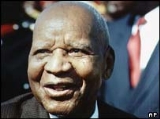
Hastings Banda


   Email Print
   Bookmark   Link


Hastings Banda


Hastings Kamuzu Banda (1896? – 25 November 1997) was the leader of Malawi
Malawi

The Republic of Malawi is a landlocked country in southeast Africa that was formerly known as Nyasaland. It is bordered by Zambia to the northwest, Tanzania to the northeast and Mozambique, which surrounds it on the east, south and west....
 and its predecessor state, Nyasaland
Nyasaland

Nyasaland or the Nyasaland Protectorate, was a United Kingdom protectorate which was established in 1907 when the former British Central Africa Protectorate changed its name....
, from 1961 to 1994. After receiving much of his education overseas, Banda returned to his home country (then British Nyasaland
Nyasaland

Nyasaland or the Nyasaland Protectorate, was a United Kingdom protectorate which was established in 1907 when the former British Central Africa Protectorate changed its name....
) to speak against colonialism
Colonialism

Colonialism is the extension of a nation's sovereignty over Territory beyond its borders by the establishment of either settler or exploitation colony in which Indigenous people populations are direct rule, Population transfers, or Genocide....
 and help lead the movement towards independence. In 1963, he was formally appointed Nyasaland’s prime minister
Prime minister

A prime minister is the most senior minister of Cabinet in the Executive branch of government in a parliamentary system. The position is usually held by, but need not always be held by, a politician....
, and led the country to independence as Malawi a year later.


Discussion
Ask a question about 'Hastings Banda'
Start a new discussion about 'Hastings Banda'
Answer questions from other users
Full Discussion Forum


Quotations


Our talks were very pleasant, as usual. Remember I used to vote Labour when I was here.

"Dr. Banda Denies Civil War", The Times, 12 December 1964, p. 6., Remarks to the press after talks with Harold Wilson, 11 December 1964.


Encyclopedia


Hastings Kamuzu Banda (1896? – 25 November 1997) was the leader of Malawi
Malawi

The Republic of Malawi is a landlocked country in southeast Africa that was formerly known as Nyasaland. It is bordered by Zambia to the northwest, Tanzania to the northeast and Mozambique, which surrounds it on the east, south and west....
 and its predecessor state, Nyasaland
Nyasaland

Nyasaland or the Nyasaland Protectorate, was a United Kingdom protectorate which was established in 1907 when the former British Central Africa Protectorate changed its name....
, from 1961 to 1994. After receiving much of his education overseas, Banda returned to his home country (then British Nyasaland
Nyasaland

Nyasaland or the Nyasaland Protectorate, was a United Kingdom protectorate which was established in 1907 when the former British Central Africa Protectorate changed its name....
) to speak against colonialism
Colonialism

Colonialism is the extension of a nation's sovereignty over Territory beyond its borders by the establishment of either settler or exploitation colony in which Indigenous people populations are direct rule, Population transfers, or Genocide....
 and help lead the movement towards independence. In 1963, he was formally appointed Nyasaland’s prime minister
Prime minister

A prime minister is the most senior minister of Cabinet in the Executive branch of government in a parliamentary system. The position is usually held by, but need not always be held by, a politician....
, and led the country to independence as Malawi a year later. Two years later, he declared Malawi a republic with himself as president. He quickly consolidated power and eventually declared Malawi a one party state under the Malawi Congress Party
Malawi Congress Party

The Malawi Congress Party is a political party in Malawi. It was originally known as the Nyasaland African Congress, but became the MCP under Hastings Banda, its first president....
. In 1970, the MCP declared him the party’s President for Life
President for Life

President for Life is a title assumed by some dictators to remove their term limit, in the hope that their authority, Legitimacy , and term will never be dissenting opinion....
. In 1971, he became President for Life of Malawi itself.

A leader of the pro-Western bloc in Africa, he received support from the West during the cold war
Cold War

The Cold War was the continuing state of conflict, tension and competition that existed between a number of world powers, including the United States, the Soviet Union, People's Republic of China, France, United Kingdom and those countries' respective allies from the mid-1940s to the early 1990s....
. He generally supported women’s rights, improved the country’s infrastructure, and maintained a good educational system relative to other African countries. On the debit side, however, he presided over one of the most repressive regimes in Africa. He also faced scorn for maintaining full diplomatic relations with apartheid-era South Africa
South Africa

The Republic of South Africa, also known by Official names of South Africa, is a country located at the southern tip of the continent of Africa....
.

By 1993, facing international pressure and widespread protest, a referendum ended his one party state, and a special assembly stripped him of his title. Banda ran for president in the democratic elections which followed, but was soundly defeated. He died in South Africa in 1997. His legacy as ruler of Malawi remains controversial, some hailing him as a national and African hero, some denouncing him as a political tyrant.

Early life

Kamuzu Banda was born near Kasungu
Kasungu

Kasungu is a town in the Kasungu District of the Central Region, Malawi of Malawi. The population of Kasungu is estimated to be 59,696 as of 2008....
 in Malawi (then British Central Africa
British Central Africa

The British Central Africa Protectorate existed in the area of present-day Malawi between 1891 and 1907.The Shire Highlands south of Lake Nyasa and the lands west of the lake had been of interest to the United Kingdom since they were first explored by David Livingstone in the 1850s, and commercial interests began moving in during the 1880s....
) to Mphonongo Banda and his wife Akupingamnyama Phiri. His date of birth is unknown, and as it took place at a time when there was no birth registration, it is impossible to state a precise year. (His biographer, Philip Short, gives February 1898 as the most likely date). His official birthday is stated as May 14, 1906 and this date is contained in some biographical guides. However, his death certificate states him to have been 99 years old and it was rumoured that he was actually 101. There is no proof the report of his age was accurate. He took the Christian name of Hastings after being baptised into the Church of Scotland in around 1905. Around 1915-16, he left home and went with Hanock Msokera Phiri, an "uncle" who had been a teacher at the nearby Livingstonia mission school, on foot to Hartley in Zimbabwe (then Southern Rhodesia) and then, in 1917 and again on foot, to Johannesburg in South Africa. He worked in various jobs at the Witwatersrand Deep Mine on the Transvaal Reef for several years. During this time, he met Bishop W. T. Vernon of the African Methodist Church (AME), who offered to pay his tuition at a Methodist school in America if he could make his own passage. In 1925, he left for New York.

Life abroad (1925–1958)

Banda studied in the high school section of Wilberforce Institute, a black AME college (now Central State University
Central State University

Central State University is a Historically Black colleges and universities located in Wilberforce, Ohio. It is Ohio's only public HBCU....
) in Wilberforce, Ohio
Wilberforce, Ohio

Wilberforce is a census-designated place in Greene County, Ohio, Ohio, United States. The population was 1,579 at the United States Census, 2000....
, and graduated in 1928. With his financial support now ended, Banda earned some money on speaking engagements arranged by the Ghanaian educationalist, Kweyir Aggrey, whom he had met in South Africa. Speaking at a Kiwanis club meeting, he met one Dr Herald, with whose help he enrolled as a premedical student at Indiana University
Indiana University

Indiana University, founded in 1820, is a nine-campus university system in the state of Indiana. The IU system includes the following campuses:...
, where he lodged with Mrs W.N. Culmer. At Bloomington, he wrote several essays about his native Chewa tribe for the folklorist Stitt Thompson, who introduced him to Edward Sapir
Edward Sapir

Edward Sapir , was a Jewish-Germany-United States anthropologist-linguistics and a leader in American structuralism. He was one of the creators of what is now called the Sapir-Whorf hypothesis....
, an anthropologist at the University of Chicago
University of Chicago

The University of Chicago is a private university located principally in the Hyde Park, Chicago neighborhood of Chicago. Although an older university by the same name existed prior to its founding, the modern University of Chicago credits its founding to the oil magnate John D....
, to which, after four semesters, he transferred. During his period here, he collaborated with the anthropologist and linguist, Mark Hanna Watkins, acting as an informant on Chewa culture. In Chicago, he lodged with an African-American, Mrs Corinna Saunders. He majored in history, graduating with a B Phil in 1931. During this time, he enjoyed financial support from a Mrs. Smith, whose husband, Douglas Smith, had made fortunes in patent medicines and in Pepsodent
Pepsodent

Pepsodent is a brand of toothpaste with a wintergreen flavor. It was formerly owned by Unilever .It was advertised for its purported properties fighting tooth decay, attributed in advertisements to the supposed ingredient Irium....
 toothpaste; and also from a member of the Eastman Kodak board. He then, still with financial support from these and other benefactors (including Dr. Walter B. Stephenson of the Delta Electric Company), studied medicine at Meharry Medical College
Meharry Medical College

Meharry Medical College, located in Nashville, Tennessee, is a graduate and professional institution affiliated with the United Methodist Church whose mission is to educate healthcare professionals and scientists....
 in Tennessee
Tennessee

Tennessee is a U.S. state located in the Southern United States United States. In 1796, it became the sixteenth state to join the United States....
, from which he graduated in 1937. In order to practice medicine in territories of the British Empire
British Empire

The British Empire comprised the dominions, Crown colony, protectorates, League of Nations mandate, and other Dependent territory ruled or administered by the United Kingdom , that had originated with the overseas colonies and trading posts established by England in the late 16th and early 17th centuries....
, however, he was apparently required to get a second medical degree; he attended and graduated from the School of Medicine of the Royal College of Physicians and Surgeons of the University of Edinburgh
University of Edinburgh

The University of Edinburgh founded in 1582, is an internationally renowned centre for teaching and research in Edinburgh, Scotland, United Kingdom....
 in 1941. His studies there were funded by stipends of 300 pounds per year from the government of Nyasaland (in order to facilitate his return there as a doctor) and from the Scottish Presbyterian Kirk; neither of these benefactors being aware of the other. (There are conflicting accounts of this, however. He may still have been funded by Mrs Smith). When he enrolled for courses in tropical diseases in Liverpool, the Nyasaland government terminated his stipend. He was forced to leave Liverpool when he refused on conscientious grounds to be conscripted as an Army doctor. Between 1942 and 1945 he worked as a doctor in North Shields
North Shields

North Shields is a town on the north bank of the River Tyne, England, in the metropolitan borough of North Tyneside, in North East England. It is located eight miles east of Newcastle upon Tyne....
 near Newcastle on Tyne. He was a tennant of Mrs Amy Walton at this time in Alma Place in North Shields and sent a Christmas card to her every year right up to her death in the late 1960's. he worked at a mission for coloured seamen before moving to a general practice in the London suburb of Harlesden
Harlesden

Harlesden is a suburban town in the London Borough of Brent, Its main focal point is the Jubilee Clock which commemorates Queen Victoria's Golden Jubilee....
. Reportedly, he avoided returning to Nyasaland for fear that his newfound financial resources would be consumed by his extended family back home.

In 1946, at the behest of Chief Mwase of Kasungu, whom he had met in England in 1939, and other politically active Malawians, he represented the Nyasaland African Congress at the fifth Pan African Congress in Manchester. From this time he took an increasingly active interest in his native land, advising the Congress and providing it some financial support. With help from sympathetic British, he also lobbied in London on their behalf. He was actively opposed to the efforts of Sir Roy Welensky
Roy Welensky

Sir Raphael "Roy" Welensky, Order of St Michael and St George was a Northern Rhodesian politician and the second and last prime minister of the Federation of Rhodesia and Nyasaland....
, premier of Southern Rhodesia, to form a federation between Southern and Northern Rhodesia with Nyasaland, a move which he feared would result in further deprivation of rights for the Nyasaland blacks. The (as he famously called it) "stupid" Federation was formed in 1953. It was rumored with some excitement that he would return to Nyasaland in 1951, but in the event he moved instead to the Gold Coast in West Africa. He may have gone there partly because of a scandal involving his receptionist in Harlesden, a Mrs French: Banda was cited as correspondent in the divorce of Major French and accused of adultery with Mrs French, who went with him to West Africa. (Mrs. French died penniless in 1976). Several influential Congress leaders, including Henry Chipembere, Kanyama Chiume
Kanyama Chiume

Kanyama Chiume , was born Murray William Kanyama Chiume, in Nkhata Bay District, Nyasaland where he became a leading Nationalism in the struggle for Malawi?s independence in the 1950s and 1960s....
, Dunduzu Chisiza
Dunduzu Chisiza

Dunduzu Kaluli Chisiza was an early agitator for independence in Central Africa....
 and T.D.T. Banda (no relation) pleaded with him to return to Nyasaland to take up leadership of their cause, and on 6 July 1958 he did eventually return home after an absence of about 42 years. In August, at Nkata Bay, he was acclaimed as the leader of the Congress.

Return to his homeland

He soon began touring the country, speaking against the Central African Federation (also known as the Federation of Rhodesia and Nyasaland
Federation of Rhodesia and Nyasaland

The Federation of Rhodesia and Nyasaland, also known as Central African Federation , was a semi-independent state in southern Africa that existed from 1953 to the end of 1963, comprising the former Self-Governing Colony of Southern Rhodesia and the United Kingdom protectorates of Northern Rhodesia, and Nyasaland....
), and urging its citizens to become members of the party. (Allegedly, he was so out of practice in his native Chichewa that he needed an interpreter, a role which was apparently performed by John Msonthi and later by John Tembo
John Tembo

John Zenus Ungapake Tembo is the president of the Malawi Congress Party , the strongest opposition party in Malawi. Tembo comes from the central region of Malawi in the Dedza District, and he is a teacher by profession....
, who remained close to him for most of his career). He was received enthusiastically wherever he spoke, and belligerence among the Malawians became increasingly common. By February 1959, the situation had become serious enough that Rhodesian troops were flown in to help keep order and a state of emergency was declared. On March 3rd, Banda, along with hundreds of other Africans, was arrested in the course of "Operation Sunrise". He was imprisoned in Gwelo (now Gweru) in Southern Rhodesia, and leadership of the Malawi Congress Party (the Nyasaland African Congress under a new name) was temporarily assumed by Orton Chirwa, who was released from prison in August 1959.

The mood in Britain, meanwhile, had long been moving toward relinquishing the colonies. Banda was released from prison in April 1960 and was almost immediately invited to London for talks aimed at bringing about independence. Elections were held in August 1961. While Banda was technically nominated as Minister of Land, Natural Resources and Local Government, he became de facto Prime Minister of Nyasaland--a title granted to him formally on February 1, 1963. He and his fellow MCP ministers quickly expanded secondary education, reformed the so-called Native Courts, ended certain colonial agricultural tariffs and made other reforms. In December 1962, R. A. Butler, British Secretary of State for African Affairs, essentially agreed to end the Federation. On July 6, 1964 -- exactly six years after his return to the country -- Nyasaland became the independent Commonwealth of Malawi.

It was Banda himself who chose the name "Malawi" for the former Nyasaland; he had seen it on an old French map as the name of a "Lake Maravi" in the land of the Bororo
Wodaabe

The Wodaabe are a small subgroup of the Fulani ethnic group. They are traditionally nomadic cattle-herders and traders in the Sahel, with migrations stretching from southern Niger, through northern Nigeria, northeastern Cameroon, and the western region of the Central African Republic....
s, and liked the sound and appearance of the word as "Malawi".

President of Malawi

Barely a month after independence, Malawi suffered a cabinet crisis. Several of Banda's ministers presented him with proposals designed to limit his powers. He'd already been accused of autocratic tendencies. Banda responded by dismissing four of the ministers, and two others resigned in sympathy. The dissidents fled the country.

Malawi adopted a new constitution on July 6 1966, in which the country was declared a republic. Banda was elected the country's first president for a five-year term; he was the only candidate. The new document granted Banda wide executive and legislative powers, and also formally made the MCP the only legal party. However, the country had been a de facto one-party state since independence. In 1970, a congress of the MCP declared Banda its president for life. In 1971, the legislature declared Banda President for Life
President for Life

President for Life is a title assumed by some dictators to remove their term limit, in the hope that their authority, Legitimacy , and term will never be dissenting opinion....
 of Malawi as well. His official title was His Excellency
Excellency

Excellency is a honorific style given to certain members of an organization or state....
 the Life President of the Republic of Malawi, Ngwazi Dr Hastings Kamuzu Banda.
The title Ngwazi means "chief of chiefs" (more literally, "great lion", or, some would say, "conqueror") in Chichewa.

Banda was mostly viewed externally as being a benign, albeit eccentric, leader, an image fostered by his English-style three-piece suits, matching handkerchiefs and fly-whisk
Fly-whisk

A fly-whisk is a tool to swat or disturb flies. It is used as a regalia in some cultures.In Indonesian art, a fly-whisk is one of the items associated with Shiva....
. In June 1967 he was awarded an honorary doctorate by the University of Massachusetts with the encomium
Encomium

Encomium is a Latin language word deriving from the Classical Greek ???????? meaning the praise of a person or thing. Related to this general meaning, "encomium" also identifies several distinct aspects of rhetoric:...
 "...pediatrician to his infant nation".

Within Malawi, views on him ranged from a cult-like devotion to fear. While he portrayed himself as a caring headmaster to his people, his government was rigidly authoritarian even by African standards of the time. Although the constitution guaranteed civil rights and liberties, they meant almost nothing in practice, and Malawi was essentially a police state
Police state

The term police state describes a state in which the government exercises rigid and repressive controls over the social, economic and political life of the population....
. Mail was opened and often edited. Telephones were tapped. Needless to say, overt opposition was not tolerated. Banda actively encouraged the people to report those who criticized him, even if they were relatives. Telephone conversations were known to be cut off if anyone said a critical word about the government. Opponents were often arrested, exiled (like Kanyama Chiume
Kanyama Chiume

Kanyama Chiume , was born Murray William Kanyama Chiume, in Nkhata Bay District, Nyasaland where he became a leading Nationalism in the struggle for Malawi?s independence in the 1950s and 1960s....
) or died suspiciously (like Dick Matenje or Dr Attati Mpakati
Attati Mpakati

Attati Mpakati was a Malawi dissident and leader of the Socialist League of Malawi from 1975 until his death. He was killed by a letter bomb while in exile in Zimbabwe....
).

Banda was the subject of a very pervasive cult of personality
Cult of personality

A cult of personality or personality cult arises when a country's leader uses mass media to create a heroic public image through unquestioning flattery and praise....
. Every business building was required to have an official picture of Banda hanging on the wall, and no poster, clock or picture could be higher than his picture. Before every movie, a video of Banda waving to the people was shown while the anthem played. When Banda visited a city, a contingent of women were expected to greet him at the airport and dance for him. A special cloth, bearing the president’s picture, was the required attire for these performances. Churches had to be government sanctioned. All movies shown in theaters were first viewed by the Malawi Censorship Board and edited for content. Videotapes had to be sent to the Censorship Board to be viewed by censors. Once edited, the movie was given a sticker stating that it was now suitable for viewing, and sent back to the owner. Items to be sold in bookstores were also edited. Pages, or parts of pages, were cut out of magazines like Newsweek
Newsweek

Newsweek is an United States weekly newsmagazine published in New York City. It is distributed throughout the United States and internationally....
 and Time
Time (magazine)

Time is a weekly United States newsmagazine, similar to Newsweek and U.S. News & World Report. A European edition is published from London....
. The press and radio were tightly controlled, and mainly served as outlets for government propaganda. Television was banned.

His government supervised the people's lives very closely. Early in his rule, Banda instituted a dress code which was rooted in his socially conservative predilections. For example, women were not allowed to bare their thighs or to wear trousers. Banda argued that the dress code was not instilled to oppress women but to encourage honour and respect for them. For men, long hair and beards were banned as a sign of dissent. Men could be seized and forced to have a haircut on the discretion of border officials or police. Kissing in public was not allowed, nor were movies which contained depictions of kissing. Pre-Banda history was discouraged, and many books on these subjects were burned
Book burning

Book burning is the practice of destroying, often ceremony, one or more copies of a book or other written material. In modern times, other forms of media, such as gramophone record, Video, and Compact disc have also been ceremoniously burned, torched, or shredded....
. Banda also allegedly persecuted some of the northern tribes (particularly the Tumbuka), banning their language and books as well as teachers from certain tribes. Europeans who broke any of these rules were often "PI'ed" (declared Prohibited Immigrants and deported).

All adult citizens were required to be members of the MCP. Party cards had to be carried at all times, and had to be presented in random police inspections. The cards were sold, often by Banda's Malawi Youth Pioneers. In some cases, these youths even sold cards to unborn children.

Even foreigners were subjected to Banda's dress code. In the 1970s, prospective visitors to the country were met with the following requirement for obtaining visas
Visa (document)

A visa is an indication that a person is authorized to enter the country which "issued" the visa, subject to permission of an immigration official at the time of actual entry....
:

Female passengers will not be permitted to enter the country if wearing short dresses or trouser-suits, except in transit or at Lake Holiday resorts or National parks. Skirts and dresses must cover the knees to conform with Government regulations. The entry of 'hippies' and men with long hair and flared trousers is forbidden.


Nonetheless, Banda was very supportive of women's rights
Women's rights

The term women's rights refers to Freedom and entitlements of women and girls of all ages. These rights may or may not be institutionalized, ignored or suppressed by law, local custom, and behavior in a particular society....
 compared to other African rulers during his reign. He founded Chitukuko Cha Amai m'Malawi (CCAM) to address the concerns, needs, rights and opportunities for women in Malawi. This institution also motivated women to excel both in education and government and encouraged them to play more active roles in their community, church and family. The foundation's National Advisor was Cecilia Tamanda Kadzamira, the official hostess for the former president.

Banda did much for the country's infrastructure. This included the establishment of major roads, airports, hospitals and schools in Malawi. He founded Kamuzu Academy
Kamuzu Academy

Kamuzu Academy is a boarding school in Malawi that was founded by, and named after, the late Hastings Kamuzu Banda, the autocratic former President....
, a school modeled on Eton
Eton College

Eton College, also known as Eton, is a world-famous British independent school for boys, founded in 1440 by Henry VI of England. It was founded as the King's College of Our Lady of Eton beside Windsor....
, at which Malawian children were taught Latin
Latin

Latin is an Italic language, historically spoken in Latium and Ancient Rome. Through the Military history of the Roman Empire, Latin spread throughout the Mediterranean and a large part of Europe....
 and Ancient Greek
Ancient Greek

Ancient Greek is the historical stage in the development of the Greek language spanning across the Archaic Greece , Classical Greece , and Hellenistic civilization periods of ancient Greece and the classical antiquity....
 by expatriate
Expatriate

An expatriate is a person temporarily or permanently Residency in a country and culture other than that of the person's upbringing or legal residence....
 classics
Classics

Classics is the branch of the Humanities comprising the languages, literature, philosophy, history, art, and other culture of the ancient Mediterranean World; especially Ancient Greece and Ancient Rome during Classical Antiquity ....
 teachers, and disciplined if they were caught speaking Chichewa.

During Banda's rule, it is believed that he accumulated at least US$320 million in personal assets, believed to be invested in everything from agriculture to mining interests in South Africa. The most controversial part of this is the suspicion that his two grandchildren, who currently reside in the US and South Africa, are the heirs to the Banda fortune. One of the grandchildren graduated from law school and left for the US, while the other remains in South Africa. They may now learn about the existence of these anonymous grandchildren, but most importantly; 'who and where are Banda's children?', most Malawians would like to know. Equally important is the identity and the whereabouts of their mother.

He was also the only African ruler to establish diplomatic ties with South Africa
South Africa

The Republic of South Africa, also known by Official names of South Africa, is a country located at the southern tip of the continent of Africa....
 during apartheid and on one occasion he paid a state visit to South Africa where he met his South African counterparts at Stellenbosch. While many southern African nations traded with South Africa out of economic necessity, Malawi was the only African nation that recognized South Africa and exchanged embassies with it. He only became partially rehabilitated in the eyes of other African leaders after the demise of the apartheid regime in South Africa.

Electoral defeat and death

Banda's one-party state was dismantled by a 1993 referendum. Soon afterward, a special assembly stripped him of his title of President for Life, along with most of his powers.

After some questions about his health, Banda ran in Malawi's first truly democratic election in 1994. He was roundly defeated by Bakili Muluzi
Bakili Muluzi

Elson Bakili Muluzi is a Malawian politician. He was the President of Malawi from 1994 to 2004 and is currently the Chairman of the United Democratic Front ....
, a Yao from the Southern Region of the country whose two terms in office were not without serious controversy. Banda died in a hospital in South Africa in November 1997, reportedly aged 101. The party he led since taking over from Orton Chirwa in 1960, the Malawi Congress Party
Malawi Congress Party

The Malawi Congress Party is a political party in Malawi. It was originally known as the Nyasaland African Congress, but became the MCP under Hastings Banda, its first president....
, continued after his death and remains a major force in Malawian politics.

External links