
All Topics  
Harold and Maude


   Email Print
   Bookmark   Link


Harold and Maude


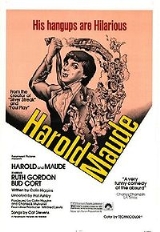
Harold and Maude is a cult classic film directed by Hal Ashby
Hal Ashby

Hal Ashby was an United States film director and Academy Awards-winning film editor....
 in 1971
1971 in film

The year 1971 in film involved some significant events....
. The film, featuring slapstick, dark humour, and existentialist drama, revolves around the exploits of a morbid young man – Harold (played by Bud Cort
Bud Cort

Bud Cort is an United States film and Theatre actor, screenwriter, and film director. He is best known for his portrayal of Harold from Hal Ashby's 1971 film Harold and Maude...
) – who drifts away from the life that his detached mother prescribes for him, as he develops a relationship with septuagenarian Maude (played by Ruth Gordon
Ruth Gordon

Ruth Gordon Jones , better known as Ruth Gordon, was an United States actress and writer. She was perhaps best known for her films roles such as the oversolicitous neighbor in Rosemary's Baby and the eccentric life-loving Maude in Harold and Maude....
).

The film is number 45 on the American Film Institute
American Film Institute

The American Film Institute is an independent non-profit organization created by the National Endowment for the Arts, which was established in 1967 when President Lyndon B....
's list of 100 Funniest Movies of all time,, number 69 in its list for most romantic , and number 42 on Bravo's
Bravo (television network)

Bravo is a cable television network owned by NBC Universal. It is currently seen in more than 80 million homes and was the first service dedicated to film, drama, and the performing arts when it launched by Cablevision as an advertisement-free network in December 1980....
 100 Funniest Movies.


Discussion
Ask a question about 'Harold and Maude'
Start a new discussion about 'Harold and Maude'
Answer questions from other users
Full Discussion Forum


Encyclopedia


Harold and Maude is a cult classic film directed by Hal Ashby
Hal Ashby

Hal Ashby was an United States film director and Academy Awards-winning film editor....
 in 1971
1971 in film

The year 1971 in film involved some significant events....
. The film, featuring slapstick, dark humour, and existentialist drama, revolves around the exploits of a morbid young man – Harold (played by Bud Cort
Bud Cort

Bud Cort is an United States film and Theatre actor, screenwriter, and film director. He is best known for his portrayal of Harold from Hal Ashby's 1971 film Harold and Maude...
) – who drifts away from the life that his detached mother prescribes for him, as he develops a relationship with septuagenarian Maude (played by Ruth Gordon
Ruth Gordon

Ruth Gordon Jones , better known as Ruth Gordon, was an United States actress and writer. She was perhaps best known for her films roles such as the oversolicitous neighbor in Rosemary's Baby and the eccentric life-loving Maude in Harold and Maude....
).

The film is number 45 on the American Film Institute
American Film Institute

The American Film Institute is an independent non-profit organization created by the National Endowment for the Arts, which was established in 1967 when President Lyndon B....
's list of 100 Funniest Movies of all time,, number 69 in its list for most romantic , and number 42 on Bravo's
Bravo (television network)

Bravo is a cable television network owned by NBC Universal. It is currently seen in more than 80 million homes and was the first service dedicated to film, drama, and the performing arts when it launched by Cablevision as an advertisement-free network in December 1980....
 100 Funniest Movies. In 1997, it was selected for preservation in the National Film Registry
National Film Registry

The National Film Registry is the registry of films selected by the United States National Film Preservation Board for preservation in the Library of Congress....
 of the Library of Congress
Library of Congress

The Library of Congress is the de facto national library of the United States and the research arm of the United States Congress. Located in three buildings in Washington, D.C., it is the largest library in the world by shelf space and holds the largest number of books....
 as being deemed "culturally, historically, or aesthetically significant".

The film was a commercial failure when it was released, and the critical reception was extremely mixed; however, it has since developed a large cult following .

The screenplay upon which the film was based was written by Colin Higgins
Colin Higgins

Colin Higgins , born to an Australian mother and United Statesn father, was an American screenwriter, actor, film director, and film producer. He was best known for writing the screenplay for the 1971 film Harold and Maude....
, and published as a novel in 1971. The movie was shot in the San Francisco Bay Area. Harold and Maude was also a play on Broadway
Broadway theatre

Broadway theatre, commonly called simply Broadway, refers to theatrical performances presented in one of the 39 large professional theaters with 500 seats or more located in the Theatre District, New York in Manhattan, New York City....
 for some time. A French adaptation for television, translated and written by Jean-Claude Carrière
Jean-Claude Carrière

Jean-Claude Carri?re is an award-winning screenwriter and actor. Alumnus of the ?cole normale sup?rieure de Saint-Cloud, he was a frequent collaborator with Luis Bu?uel....
, appeared in 1978. It was adapted for the stage and performed in Québec, starring Roy Dupuis
Roy Dupuis

Roy Dupuis is a Canadian actor best known for his role as counterterrorism operative Michael Samuelle in the television series Nikita . He is one of the most famous actors throughout French-speaking Canada, while throughout English-speaking Canada he has become known for portraying hockey legend Maurice Richard on television and in film,...
.

Plot synopsis

The movie opens to introduce Harold Chasen (Bud Cort
Bud Cort

Bud Cort is an United States film and Theatre actor, screenwriter, and film director. He is best known for his portrayal of Harold from Hal Ashby's 1971 film Harold and Maude...
), a boy of nineteen who fakes his own death numerous times in a desperate attempt for his mother’s attention. Harold and his mother, (Vivian Pickles
Vivian Pickles

Vivian Pickles , is an England actress.Her first nationally prominent role was on the BBC when, as a child actor, age 12, she played Alice in a film of Alice's Adventures in Wonderland that was broadcast live from Alexandra Palace in London....
), live in a mansion in the San Francisco Bay Area. Mrs. Chasen throws a lavish dinner party which is followed by Harold “killing himself” in his mother’s dressing room. He squirts fake blood over her mirrors and himself. Mrs. Chasen declares that it is “too much” and sends him to counseling. After a brief interaction with his counselor, Harold drives with his hearse to a stranger’s funeral. This is the first time Harold sees Maude (Ruth Gordon
Ruth Gordon

Ruth Gordon Jones , better known as Ruth Gordon, was an United States actress and writer. She was perhaps best known for her films roles such as the oversolicitous neighbor in Rosemary's Baby and the eccentric life-loving Maude in Harold and Maude....
).

Upon arriving home, his mother sees his car and lectures him about growing up. She tries to convince him to join the Army like Harold’s uncle Victor, and thinks it is time for Harold to get married. The next day, Harold goes to another funeral and sees Maude again. Maude moves in closer to Harold and strikes up a conversation with him, offering him licorice, and admitting she does not know the person who died. Maude tells Harold that she does know the man who died was eighty: the proper age to die. The pair moves outside after the funeral where Maude steals the priest’s car. At the next funeral, Maude pulls beside Harold and offers him a ride home in his car which she has stolen. After getting in his car, Maude takes Harold back to her “house,” a derailed train car. Maude offers him tea, but Harold declines, going instead to his counseling meeting where he admits he has no friends.

Candy Gulf is Harold’s first blind date
Blind date

A blind date is a dating where the people involved have not met each other previously.The match could have been arranged by mutual friends, relatives or by a dating system....
. She shows up and watches as Harold fakes his own death by setting himself on fire. She runs from the house screaming. When Harold visits Maude for the second time, she is having an ice sculpture cut while modeling nude. Maude shows Harold her vaporizer that plays scents such as snowfall on 42nd Street. Maude tells Harold that everyone should be able to play an instrument and Harold takes to a banjo. They drink tea which is followed by a montage of date scenes including one where Maude is transfixed by a helpless tree in the city. After illegally parking and admiring the tree, Maude decides to steal the tree… and another car.

Harold's mother gives him a new Jaguar as a gift; she “took away” the hearse. Later on, Harold morphs the Jaguar into yet another hearse. The next scene shows Maude and Harold driving the tree to the forest where it can be free. The pair evade the law, plant the tree, and get pulled over (ironically enough), by the same cop. Harold and Maude steal the cop’s bike and ride back to Maude’s house. The pair smokes hookah and Harold opens up about his life at home. Harold’s second date is with Edith Phern. To escape this date, Harold chops off his hand in front of Edith and his mother. Fed up with his antics, Mrs. Chasen sends Harold to talk to his Uncle Victor about joining the armed forces. Taking his uncle to the coast, Harold pretends to become transfixed with his war stories. A protester (Maude) begins a dispute with Harold and the uncle (not knowing who Maude is) watches in horror as the woman falls to her “death.” The subject of Harold joining the Army is abandoned.

To celebrate their victory, Harold and Maude go to the bay and watch the sun set. As Harold goes to hold Maude’s hand, he notices numbers tattooed on her arm. The next day, Harold goes on his third and final blind date with a Miss “Sunshine” Doré. He shows her his seppuku
Seppuku

is a form of Japanese Suicide#Ritual suicide by disembowelment. Seppuku was originally reserved only for samurai. Part of the samurai honor code, seppuku was used voluntarily by samurai to die with honor rather than fall into the hands of their enemies, as a form of capital punishment for samurai who have committed serious offenses, and for reason...
 sword and begins to stab himself. Dore, an actress, sees right through his act and reenacts the death scene of Romeo and Juliet.

Dodging another date, Harold takes Maude to the fair, after which the couple sleep together. The next day, Harold tells his mother he is going to marry Maude. Mrs. Chasen subsequently sends Harold to see his uncle, counselor, and priest, all of whom disapprove. Harold throws Maude a surprise 80th birthday party, decorating the inside of her home with sunflowers, and after the party Maude admits that she has taken poison tablets and will be gone by midnight. As she had said before, eighty years old is the proper age to die.

Rushed to the hospital, Maude dies. In the morning, Harold drives his car off of a cliff, faking his death one last time. Harold skips on the edge of the cliff, playing his banjo.

Themes

Hal Ashby
Hal Ashby

Hal Ashby was an United States film director and Academy Awards-winning film editor....
, the director of the film, shared certain ideals with the era's youth culture
Youth subculture

A youth subculture is a youth-based subculture with distinct styles, behaviors, and interests. According to subculture theorists such as Dick Hebdige, members of a subculture often signal their membership by making distinctive and symbolic tangible choices in, for example, clothing styles, hairstyles and footwear....
, and in this film he contrasts the doomed outlook of the alienated youth of the time with the hard-won optimism of those who endured the horrors of the early 20th century, contrasting nihilism with purpose. Maude's past is revealed in a glimpse of the concentration camp ID number tattoo
Tattoo

A tattoo is a permanent marking made by inserting ink into the layers of skin to change the pigment for decorative or other reasons. Tattoos on humans are a type of decorative body modification, while tattoos on animals are most commonly used for identification or branding....
ed on her arm.

Harold is part of a society in which he has no personal importance; and existentially, therefore, he is without meaning. Maude, however, has survived and lives a life rich with meaning. It is in this existential crisis, shown against the backdrop of the Vietnam War
Vietnam War

The Vietnam War, also known as the Second Indochina Wars, the Vietnam Conflict, or often in Vietnam the American War occurred in Vietnam, Laos and Cambodia from 1959 to April 30, 1975....
, that we see the differences between one culture, personified by Harold, handling a meaningless war, while another has experienced and lived beyond another war that produced a crisis of meaning, the Holocaust.

Suicide attempts

Harold tells Maude when they are talking candidly at her home the reasons he fakes his death so often. Once, when he was at boarding school, he set his science lab on fire. Escaping the fire, Harold slid down the laundry chute and left to hide at home. When the authorities came, Harold couldn’t be found. Believed to be dead, the police come to the Chasens' home and told Mrs. Chasen that Harold was dead. Coming up from the back balcony, Harold watched as his mother fell over in grief for the police officers. Harold tells Maude, “I decided then I enjoyed being dead.”

Throughout the movie, Harold “kills” himself a total of eight times. He tells his psychologist that he has done similar attempts approximately 15 times.

1. Hanging himself in opening scene: Harold hangs himself while his mother is on the phone in the opening scene, in which she barely blinks twice.

2. Slitting his throat in his mother’s bathroom: after this act, we see Harold seeing a psychiatrist.

3. Floating dead in pool: Harold floats face down, fully clothed, as his mother swims laps around him.

4. Shooting towards his head: Harold initially points a gun at his mother and then shoots close to his head as his mother is reading off the questionnaire for his dating service.

5. Fire: For the first blind date, Harold pretends to set himself on fire, scaring away his date.

6. Hand chopping: The second blind dates ends abruptly with Harold chopping off a fake hand.

7. Romeo scene: For the final date, Harold stabs himself with a fake hari-kari sword. Instead of this date running off as the others have, Sunshine Doré instead lies down beside him and “dies” with him.

8. Car: Harold sends his Jaguar/hearse off a cliff. From the initial scene, the audience may believe Harold was stricken with enough grief from Maude’s death to kill himself. However, the camera pans up to the cliff to show Harold playing Maude's banjo and dancing away casually.

Influences


Filmmakers who have demonstrated the influence of this classic include Bobby
Bobby Farrelly

Robert Leo "Bobby" Farrelly, Jr. is an American film director, screenwriter and producer.Farrelly was born in Cumberland, Rhode Island, the son of Mariann , a nurse practitioner, and Robert Leo Farrelly, a doctor....
 and Peter Farrelly
Peter Farrelly

Peter John Farrelly is an American film director, screenwriter, producer and novelist. The Farrelly Brothers are mostly famous for directing and producing gross-out humor romantic comedy films such as, Dumb and Dumber, Me, Myself and Irene, There's Something About Mary and The Heartbreak Kid ....
, who pay tribute to the film in their movie There's Something About Mary
There's Something About Mary

There's Something About Mary is a 1998 in film romantic comedy film, directed by the Farrelly Brothers Bobby Farrelly and Peter Farrelly. Starring Ben Stiller, Cameron Diaz and Matt Dillon, it is a combination of romantic comedy and gross-out film....
 in which the character of Mary thinks that Harold and Maude is "the greatest love story of our time". Wes Anderson
Wes Anderson

Wesley Wales Anderson is an United States Film director, scriptwriter, actor, and film producer of film, short subjects and Television commercial....
 has also demonstrated the influence of the film, featuring two songs by Cat Stevens in Rushmore
Rushmore

Rushmore may refer to:*Mount Rushmore, South Dakota*Charles E. Rushmore, namesake of the above*Rushmore, Minnesota*USS Rushmore , a US Navy amphibious assault ship...
 , and writing a part specifically for actor Bud Cort
Bud Cort

Bud Cort is an United States film and Theatre actor, screenwriter, and film director. He is best known for his portrayal of Harold from Hal Ashby's 1971 film Harold and Maude...
 in The Life Aquatic.

Honors

Harold and Maude is #45 on the American Film Institute
American Film Institute

The American Film Institute is an independent non-profit organization created by the National Endowment for the Arts, which was established in 1967 when President Lyndon B....
's list of 100 Year... 100 Laughs
AFI's 100 Years... 100 Laughs

Part of the AFI 100 Years... series, AFI's 100 Years... 100 Laughs is a list of the top 100 comedy movies in American cinema. The list was unveiled by the American Film Institute on June 14, 2000....
, the list of the top 100 films in American comedy. The list was released in 2000. Two years later, AFI released the list AFI's 100 Years... 100 Passions
AFI's 100 Years... 100 Passions

Part of the AFI 100 Years... series, AFI's 100 Years... 100 Passions is a list of the top 100 Romantic film in American cinema. The list was unveiled by the American Film Institute on June 11, 2002 in a CBS television special hosted by American film/TV actress Candice Bergen....
 honoring the most romantic films for the past 100 years, Harold and Maude ranked #69. Entertainment Weekly
Entertainment Weekly

Entertainment Weekly is a magazine published by Time Inc. in the United States which covers movies, television, music, Broadway stage productions, books, and popular culture....
 ranked the film #4 on their list of "The Top 50 Cult Films".

In June 2008, AFI revealed its "Ten Top Ten" – the best ten films in ten "classic" American film genres – after polling over 1,500 people from the creative community. Harold and Maude was acknowledged as the ninth best film in the romantic comedy genre.

American Film Institute

The American Film Institute is an independent non-profit organization created by the National Endowment for the Arts, which was established in 1967 when President Lyndon B....
 recognition
  • 2000: AFI's 100 Years... 100 Laughs
    AFI's 100 Years... 100 Laughs

    Part of the AFI 100 Years... series, AFI's 100 Years... 100 Laughs is a list of the top 100 comedy movies in American cinema. The list was unveiled by the American Film Institute on June 14, 2000....
     #45
  • 2002: AFI's 100 Years... 100 Passions
    AFI's 100 Years... 100 Passions

    Part of the AFI 100 Years... series, AFI's 100 Years... 100 Passions is a list of the top 100 Romantic film in American cinema. The list was unveiled by the American Film Institute on June 11, 2002 in a CBS television special hosted by American film/TV actress Candice Bergen....
     #69
  • 2006: AFI's 100 Years... 100 Cheers
    AFI's 100 Years... 100 Cheers

    100 Years... 100 Cheers: America's Most Inspiring Movies is a list of the most inspiring movies as determined by the American Film Institute....
     #89
  • 2008: AFI's 10 Top 10
    AFI's 10 Top 10

    AFI's 10 Top 10 honors the ten greatest United States films in ten classic film genres. Presented by the American Film Institute , the lists were unveiled on a television special broadcast by CBS on June 17, 2008....
     #9 Romantic Comedy


Cast


Harold and Maude
*Dame Marjorie Chardin (Maude): Ruth Gordon
Ruth Gordon

Ruth Gordon Jones , better known as Ruth Gordon, was an United States actress and writer. She was perhaps best known for her films roles such as the oversolicitous neighbor in Rosemary's Baby and the eccentric life-loving Maude in Harold and Maude....
 A 79 year old spitfire who wears her hair in braids across her head like a crown. Horrible driver, enjoys music, and she believes in living each day like it is your last. The movie does not mention anything about her tattoo, believed to be a Holocaust tattoo.
  • Harold Chasen: Bud Cort
    Bud Cort

    Bud Cort is an United States film and Theatre actor, screenwriter, and film director. He is best known for his portrayal of Harold from Hal Ashby's 1971 film Harold and Maude...
     A 19 year old, pale boy (he becomes more tan as the film progresses) who craves human interaction but is smothered by his mother’s controlled, materialistic world. Obsessed with death, he drives a hearse, attends random funerals and fakes suicides, for effect. Through meeting and falling in love with Maude, he discovers there is more to life than death and begins living for the first time.
  • Mrs. Chasen: Vivian Pickles
    Vivian Pickles

    Vivian Pickles , is an England actress.Her first nationally prominent role was on the BBC when, as a child actor, age 12, she played Alice in a film of Alice's Adventures in Wonderland that was broadcast live from Alexandra Palace in London....
     Harold's mother, a wealthy, middle aged woman who surrounds herself with the best of everything. Hoping to straighten out her son, Mrs. Chasen arranges computer dates and buys him lavish gifts, all to no avail.
  • Glaucus: Cyril Cusack
    Cyril Cusack

    Cyril James Cusack was an Irish people Shakespearean actor, who appeared in more than 90 films....
     The sculptor who makes the ice statue of Maude and lends them his tools to transport the tree.
  • Uncle Victor: Charles Tyner Harold’s uncle, who is a military general. He tries to persuade Harold to join the armed forces.
  • Sunshine Doré: Ellen Geer
    Ellen Geer

    Ellen Ware Geer is an United States actress, professor, screenwriter, film director and theatre director....
     An actress, who is about 20 years old. Harold’s third blind date, she lies down and “dies” beside him.
  • Priest: Eric Christmas
    Eric Christmas

    Eric Cuthbert Christmas was a United Kingdom-Canadian stage and screen actor, with over 40 films and several more television roles to his credit....
     Maude steals his car. He also tells Harold not to marry Maude.
  • Psychiatrist: G. Wood
    G. Wood

    George Wood was an Cinema of the United States and Television in the United States.Wood was born in Forrest City, Arkansas. He was one of three actors to appear in both the 1970 in film M*A*S*H and the television series M*A*S*H In both the film and the television series, Wood played General Hammond....
  • Candy Gulf: Judy Engles Harold’s first blind date, whom he scares off by pretending to set himself on fire.
  • Edith Phern: Shari Summers Harold’s second blind date, whom he scares off by pretending to cut off his hand. This act is what makes Mrs. Chasen send Harold to talk to Uncle Victor about the armed forces.
  • Motorcycle Officer: Tom Skerritt
    Tom Skerritt

    Thomas Roy "Tom" Skerritt is an Emmy Award-winning United States actor who has appeared in over 40 films and more than 200 television episodes since 1962....
     (as M. Borman)
  • Director Hal Ashby
    Hal Ashby

    Hal Ashby was an United States film director and Academy Awards-winning film editor....
     has a cameo in the picture.


Music

The soundtrack is by Cat Stevens
Cat Stevens

Yusuf Islam , best known by his former stage name Cat Stevens, is a Great Britain musician of Greek Cypriot and Sweden ancestry. He is a singer-songwriter, multi-instrumentalist, educator, philanthropist and prominent Religious conversion to Islam....
 (now Yusuf Islam), and includes two songs, "Don't Be Shy" and "If You Want to Sing Out, Sing Out
If You Want to Sing Out, Sing Out

"If You Want To Sing Out, Sing Out" is a popular song by Cat Stevens. It first appeared in the 1971 film Harold and Maude.Stevens wrote all the songs in Harold and Maude in 1970-1971, during the time he was writing and recording his Tea for the Tillerman album....
", that he composed specifically for the movie, and which were unavailable on vinyl for over a decade; they were eventually released in 1984 on the compilation Footsteps in the Dark
Footsteps in the Dark: Greatest Hits, Vol. 2

Footsteps in the Dark: Greatest Hits Vol. 2 is a compilation album released by Cat Stevens in 1984 . Its fourteen songs include hits such as "Father and Son " and "Where Do the Children Play?" as well as two previously unreleased tracks from the Hal Ashby and Colin Higgins black comedy Harold and Maude ....
. A vinyl LP soundtrack was released in Japan, although without the two songs Cat Stevens wrote for the film, and including five songs not actually in the film ("Morning Has Broken
Morning Has Broken

"Morning Has Broken" is a favorite and well-known Christianity hymn, especially popular in children's services. Pop music and folk music Cat Stevens included an acoustic version on his 1971 album Teaser and the Firecat....
," "Wild World
Wild World

"Wild World" is a song written and recorded by English singer-songwriter Cat Stevens. It first appeared in his fourth album, Tea for the Tillerman, in 1970, arguably the most popular single from the album....
," "Father & Son," "Lilywhite" and "Lady D'Arbanville
Lady D'Arbanville

"Lady D'Arbanville" is a song written and recorded by Cat Stevens, and released in April, 1970. Already a successful songwriter, this was his first single released upon signing a contract with Island Records, with the encouragement of his new producer, Paul Samwell-Smith, fostering a Folk rock direction for the young composer....
"). The first official soundtrack to the film was released in December 2007, by Vinyl Films Records, as a vinyl-only limited edition release of 2500 copies. It contained a 30-page oral history of the making of the film, the most extensive series of interviews yet conducted on "Harold and Maude."

Track listing

This is the track listing for the first official release of the soundtrack to Harold and Maude.

  • Side one
    1. "Don't Be Shy"
    2. "On The Road To Find Out
      Tea for the Tillerman

      Tea for the Tillerman is a highly-regarded album by singer-songwriter Cat Stevens. This album, Stevens' second during 1970, includes many of Stevens' most memorable and beloved songs by his fans, including "Where Do the Children Play?," "Hard Headed Woman," "Wild World," "Sad Lisa," "Into White" and "Father and Son ." Four of the tracks...
      "
    3. "I Wish, I Wish"
    4. "Miles From Nowhere
      Tea for the Tillerman

      Tea for the Tillerman is a highly-regarded album by singer-songwriter Cat Stevens. This album, Stevens' second during 1970, includes many of Stevens' most memorable and beloved songs by his fans, including "Where Do the Children Play?," "Hard Headed Woman," "Wild World," "Sad Lisa," "Into White" and "Father and Son ." Four of the tracks...
      "
    5. "Tea for the Tillerman
      Tea for the Tillerman

      Tea for the Tillerman is a highly-regarded album by singer-songwriter Cat Stevens. This album, Stevens' second during 1970, includes many of Stevens' most memorable and beloved songs by his fans, including "Where Do the Children Play?," "Hard Headed Woman," "Wild World," "Sad Lisa," "Into White" and "Father and Son ." Four of the tracks...
      "
    6. "I Think I See The Light"
  • Side two
    1. "Where Do The Children Play?
      Tea for the Tillerman

      Tea for the Tillerman is a highly-regarded album by singer-songwriter Cat Stevens. This album, Stevens' second during 1970, includes many of Stevens' most memorable and beloved songs by his fans, including "Where Do the Children Play?," "Hard Headed Woman," "Wild World," "Sad Lisa," "Into White" and "Father and Son ." Four of the tracks...
      "
    2. "If You Want To Sing Out, Sing Out
      If You Want to Sing Out, Sing Out

      "If You Want To Sing Out, Sing Out" is a popular song by Cat Stevens. It first appeared in the 1971 film Harold and Maude.Stevens wrote all the songs in Harold and Maude in 1970-1971, during the time he was writing and recording his Tea for the Tillerman album....
      "
    3. "If You Want To Sing Out, Sing Out (banjo version)" – previously unreleased
    4. "Trouble"
    5. "Don't Be Shy (alternate version)" – previously unreleased
    6. "If You Want To Sing Out, Sing Out (instrumental version)" – previously unreleased
  • Bonus 7" single
    1. "Don't Be Shy (demo version)" – previously unreleased
    2. "If You Want To Sing Out, Sing Out (alternative version)" – previously unreleased


External links