

Haptophyte

Encyclopedia
The haptophytes, classified either as the Prymnesiophyta or Haptophyta, are a division of algae
.
The term "Haptophyceae" is sometimes used. This ending implies classification at a lower level. However, although the phylogenetics
of this group has become much more understood in recent years, there remains some dispute over which taxon level is most appropriate.
s are pigmented similarly to those of the heterokont
s, but the structure of the rest of the cell is different, so it may be that they are a separate line whose chloroplasts are derived from similar endosymbionts.
The cells typically have two slightly unequal flagella
, both of which are smooth, and a unique organelle called a haptonema, which is superficially similar to a flagellum but differs in the arrangement of microtubule
s and in its use. The name comes from the Greek
hapsis, touch, and nema, thread. The mitochondria
have tubular crista
e.
sp. are widely used in the aquaculture
industries.
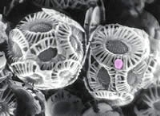
s, which have an exoskeleton of calcareous plates called coccolith
s. Coccolithophores are some of the most abundant marine phytoplankton, especially in the open ocean and are extremely abundant as microfossils. Other planktonic haptophytes of note include Chrysochromulina
and Prymnesium
, which periodically form toxic marine algal bloom
s, and Phaeocystis blooms of which can produce unpleasant foam which often accumulates on beaches. Both molecular and morphological evidence supports their division into five orders; coccolithophores make up the Isochrysidales and Coccolithales. Very small (2-3μm) uncultured pico-prymnesiophytes are ecologically important
Haptophytes are closely related to cryptomonad
s.
Algae
Algae are a large and diverse group of simple, typically autotrophic organisms, ranging from unicellular to multicellular forms, such as the giant kelps that grow to 65 meters in length. They are photosynthetic like plants, and "simple" because their tissues are not organized into the many...
.
The term "Haptophyceae" is sometimes used. This ending implies classification at a lower level. However, although the phylogenetics
Phylogenetics
In biology, phylogenetics is the study of evolutionary relatedness among groups of organisms , which is discovered through molecular sequencing data and morphological data matrices...
of this group has become much more understood in recent years, there remains some dispute over which taxon level is most appropriate.
Characteristics
The chloroplastChloroplast
Chloroplasts are organelles found in plant cells and other eukaryotic organisms that conduct photosynthesis. Chloroplasts capture light energy to conserve free energy in the form of ATP and reduce NADP to NADPH through a complex set of processes called photosynthesis.Chloroplasts are green...
s are pigmented similarly to those of the heterokont
Heterokont
The heterokonts or stramenopiles are a major line of eukaryotes currently containing more than 100,000 known species. Most are algae, ranging from the giant multicellular kelp to the unicellular diatoms, which are a primary component of plankton...
s, but the structure of the rest of the cell is different, so it may be that they are a separate line whose chloroplasts are derived from similar endosymbionts.
The cells typically have two slightly unequal flagella
Flagellum
A flagellum is a tail-like projection that protrudes from the cell body of certain prokaryotic and eukaryotic cells, and plays the dual role of locomotion and sense organ, being sensitive to chemicals and temperatures outside the cell. There are some notable differences between prokaryotic and...
, both of which are smooth, and a unique organelle called a haptonema, which is superficially similar to a flagellum but differs in the arrangement of microtubule
Microtubule
Microtubules are a component of the cytoskeleton. These rope-like polymers of tubulin can grow as long as 25 micrometers and are highly dynamic. The outer diameter of microtubule is about 25 nm. Microtubules are important for maintaining cell structure, providing platforms for intracellular...
s and in its use. The name comes from the Greek
Greek language
Greek is an independent branch of the Indo-European family of languages. Native to the southern Balkans, it has the longest documented history of any Indo-European language, spanning 34 centuries of written records. Its writing system has been the Greek alphabet for the majority of its history;...
hapsis, touch, and nema, thread. The mitochondria
Mitochondrion
In cell biology, a mitochondrion is a membrane-enclosed organelle found in most eukaryotic cells. These organelles range from 0.5 to 1.0 micrometers in diameter...
have tubular crista
Crista
Cristae are the internal compartments formed by the inner membrane of a mitochondrion. They are studded with proteins, including ATP synthase and a variety of cytochromes. The maximum surface for chemical reactions to occur is within the mitochondria...
e.
Economic importance
Haptophytes are economically important as Pavlova lutheri and IsochrysisIsochrysis
Isochrysis is a genus of haptophytes. It includes the species Isochrysis galbana, Isochrysis litoralis and Isochrysis maritima....
sp. are widely used in the aquaculture
Aquaculture
Aquaculture, also known as aquafarming, is the farming of aquatic organisms such as fish, crustaceans, molluscs and aquatic plants. Aquaculture involves cultivating freshwater and saltwater populations under controlled conditions, and can be contrasted with commercial fishing, which is the...
industries.
Examples and classification
The best-known haptophytes are coccolithophoreCoccolithophore
Coccolithophores are single-celled algae, protists, and phytoplankton belonging to the division of haptophytes. They are distinguished by special calcium carbonate plates of uncertain function called coccoliths , which are important microfossils...
s, which have an exoskeleton of calcareous plates called coccolith
Coccolith
Coccoliths are individual plates of calcium carbonate formed by coccolithophores which are arranged around them in a coccosphere.- Formation and composition :...
s. Coccolithophores are some of the most abundant marine phytoplankton, especially in the open ocean and are extremely abundant as microfossils. Other planktonic haptophytes of note include Chrysochromulina
Chrysochromulina
Chrysochromulina is a haptophyte genus.It includes the species Chrysochromulina ericina....
and Prymnesium
Prymnesium
Prymnesium is a haptophyte genus, including the species Prymnesium parvum....
, which periodically form toxic marine algal bloom
Algal bloom
An algal bloom is a rapid increase or accumulation in the population of algae in an aquatic system. Algal blooms may occur in freshwater as well as marine environments. Typically, only one or a small number of phytoplankton species are involved, and some blooms may be recognized by discoloration...
s, and Phaeocystis blooms of which can produce unpleasant foam which often accumulates on beaches. Both molecular and morphological evidence supports their division into five orders; coccolithophores make up the Isochrysidales and Coccolithales. Very small (2-3μm) uncultured pico-prymnesiophytes are ecologically important
Haptophytes are closely related to cryptomonad
Cryptomonad
The cryptomonads are a group of algae, most of which have plastids. They are common in freshwater, and also occur in marine and brackish habitats. Each cell is around 10-50 μm in size and flattened in shape, with an anterior groove or pocket...
s.