


Happiness economics

Encyclopedia
Happiness economics is the quantitative study of happiness
, positive and negative affect
, well-being, quality of life
, life satisfaction
and related concepts, typically combining economics
with other fields such as psychology
and sociology
. It typically treats such happiness-related measures, rather than wealth, income or profit, as something to be maximized. The field has grown substantially since the late 20th century, for example by the development of methods, surveys and indices to measure happiness and related concepts.
Happiness is typically measured using subjective measures - e.g. surveys - and/or objective measures. One concern has always been the accuracy and reliability
of people’s responses to happiness surveys. Objective measures such as lifespan, income and education, are often used as well as or instead of subjectively reported happiness, though this assumes that they generally produce happiness, which while plausible may not necessarily be the case. The terms quality of life
or well-being are often used to encompass these more objective measures.
Some scientists claim that happiness can be measured both subjectively and objectively by observing the joy center of the brain
lit up with advanced imaging, although this raises philosophical issues
, for example about whether this can be treated as more reliable than reported subjective happiness.
Micro-econometric happiness equations have the standard form: . In this equation
  is the reported well-being of individual
  at time
  , and
, and  is a vector of known variables, which include socio-demographic and socioeconomic characteristics.
theorized that human happiness is the outcome of meeting a set of needs. He listed these in order of priority, leading to a pyramid called Maslow's hierarchy of needs
. The set of needs includes physiological, safety, love/belonging, esteem, and self-actualization needs. These needs can be used as a basis for evaluating the overall happiness level of individuals.that is for a person to have happiness her or his needs have to be satified first (N Gurts).
However, a free market think tank Cato Institute points out that since life expectancy has continued to increase in nations wealthier than this, often partly attributed to economic growth, Happy Life Years have continued to increase.
and may result from a "hedonic treadmill
." This means that aspirations increase with income; after basic needs are met, relative rather than absolute income levels influence well-being. Happiness economists hope to change the way governments view well-being and how to most effectively govern and allocate resources given this paradox. However, other research suggests that no paradox exists, and happiness is linearly related to the logarithm of absolute (real, PPP-adjusted) income, with little or no relative income component .
Money correlates with happiness, but the rate diminishes with more money. In 2010, Daniel Kahneman
and Angus Deaton
found that higher earners generally reported better life satisfaction, but people's day-to-day emotional well-being only rose with earnings until a threshold annual income of $75,000.
According to Mr. Gregg Easterbrook an accomplished writer whose articles have appeared in The New York Times, The Washington Post, and other newspapers of equal caliber, even though wealth, or economic surplus, is more common today than in 1950, people are still as happy (or unhappy) as they were 60 years ago. In polls taken by the National Opinion Research Center, about 1/3 Americans said they were really happy in 1950, since then the polls have been taken periodically, and the results have stayed about the same since then. Wealth has not been making people happier. This is because after the basics for survival are taken care of, money cannot bring people any more happiness than they would experience without it.
On the other hand there have been examples of people who become unhappy because they are making too much money, rather than too little.A prime example of this is Roger Taylor the drummer for Duran Duran. He revealed during an interview that the time when he was the least satisfied was when he was richest. This was not a bad thing for him at the time because it allowed him to focus on his music, but it is a good example of money not being able to buy happiness.
Other factors have been suggested as making people happier than money. A short term course of psychological therapy is 32 times more cost effective at increasing happiness than simply increasing income. One study, when corrected for social status, showed no correlation between income and happiness.
An alternative perspective focuses on the role of the welfare state as an institution that improves quality of life not only by increasing the extent to which basic human needs are met, but also by promoting greater control of one's life by limiting the degree to which individuals find themselves at the mercy of impersonal market forces that are indifferent to the fate of individuals. This is the argument suggested by the U.S. political scientist Benjamin Radcliff
, who has presented a series of papers in peer reviewed scholarly journals demonstrating that a more generous welfare state contributes to higher levels of life satisfaction, and does so to rich and poor alike.
Children tend to decrease parental happiness, at least until they leave home, although in terms of a broader life narrative the opposite may be true. Some research shows that at some ages (toddlers and teenagers) they decrease parental happiness, whereas at others they increase it, averaging out to no overall change. Married people are happier, but it is unclear if this is due to the marriage or if happy people are more likely to marry.
A study conducted at the University of Zurich
suggested that democracy and federalism bring well-being to individuals. It concluded that the more direct political participation possibilities available to citizens raises their subjective well-being. Two reasons were given for this finding. First, a more active role for citizens enables better monitoring of professional politicians by citizens, which leads to greater satisfaction with government output. Second, the ability for citizens to get involved in and have control over the political process, independently increases well-being.
According to a free market think tank Cato Institute, higher economic freedom
, as measured by both the Heritage and the Fraser indices, correlates strongly with higher self-reported happiness.
Whereas leisure pursuits increase happiness, watching television is an anomaly, as it seems to correlate with lower happiness. This may be because people who watch a lot of television are lacking in better sources of happiness, such as relationships and other leisure pursuits; that is, people watch television if they don't have anything better to do.
, asthma
and other chronic conditions.
believed that public policy should attempt to maximize happiness, and he even attempted to estimate a "hedonic calculus". Many other prominent economists and philosophers throughout history, including Aristotle
, incorporated happiness into their work.
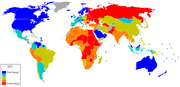 The Satisfaction with Life Index
is an attempt to show the average self-reported happiness in different nations. This is an example of a recent trend to use direct measures of happiness, such as surveys asking people how happy they are, as an alternative to traditional measures of policy success such as GDP or GNP. Some studies suggest that happiness can be measured effectively. The Inter-American Development Bank (IDB), published in November 2008 a major study on happiness economics in Latin America and the Caribbean ("Beyond Facts: Measuring Quality of Life", http://www.iadb.org/idbdocs/1776308.pdf).
There are also several examples of measures that includes self-reported happiness as one variable. Happy Life Years, a concept brought by Dutch
sociologist Ruut Veenhoven, combines self-reported happiness with life expectancy
. The Happy Planet Index
combines it with life expectancy and ecological footprint
.
Gross national happiness
(GNH) is a concept introduced by the King of Bhutan
in 1972 as an alternative to GDP. Several countries have already developed or are in the process of developing such an index. Bhutan’s index has led that country to limit the amount of deforestation it will allow and to require that all tourists to its nation must spend US$200 Allegedly, extensive tourism and deforestation lead to unhappiness.
After the military coup of 2006, Thailand
also instituted an index. The stated promise of the new Prime Minister Surayud Chulanont
is to make the Thai people not only richer but happier as well. Much like GDP results, Thailand releases monthly GNH data. The Thai GNH index is based on a 1-10 scale with 10 being the most happy. As of May 13, 2007, the Thai GNH measured 5.1 points. The index uses poll data from the population surveying various satisfaction factors such as, security, public utilities, good governance, trade, social justice, allocation of resources, education and community problems.
Australia
, Canada
, China
, France
and the United Kingdom
are also coming up with indexes to measure national happiness. North Korea also announced an international Happiness Index in 2011 through Korean Central Television
. North Korea itself came in second, behind #1 China.
Ecuador
's and Bolivia
's new constitutions state the indigenous concept of "good life" ("buen vivir" in Spanish
, "sumak kawsay" in Quichua, and "suma qamaña" in Aymara
) as the goal of sustainable development.
as well as the general welfare.
Modern classical economics no longer attempts to quantify happiness or satisfaction through measurements in consumption and profits. Instead, modern neoclassical framework argue that individual's preference is revealed through choice. Therefore, if an individual decided to purchase an apple over orange, the satisfaction one derived from apple is revealed to be greater than an orange. Similarly, modern economics also consider that work/leisure balance is also matter of individual choice.
The idea that modern neoclassical economics define happiness on the basis of consumption is widely disputed. The basis of utility has been defined as revealed preference
.
The assumption within neoclassic economics that satisfactions are highly subjective found expression in the work of Vilfredo Pareto, whose definition of optimal allocation in the nineteenth century was a crucial contribution that allowed further development of the mathematical precision of the discipline. Pareto argued that because satisfactions are subjective, we cannot know for certain that we have increased the amount of satisfaction in the system if we take a dollar from a billionaire and give it to a starving person to buy food; for all we know, the billionaire might have derived as much satisfaction from that dollar as the starving person does in spending it on food.
This counter-intuitive result is the cornerstone of Pareto Optimality: a system is in Pareto Optimality when no one can be made better off (in their own estimation) without making someone worse off (in their own estimation). In practice, "better off" and "worse off" are defined by consumption: by definition, it is always better to consume more. Thus, Pareto Optimality led to the bias in standard economics toward perpetual growth models—models that are increasingly being called into question, as being impractical (and dangerously destructive) in a finite world (see, for instance, limits to growth
).
Some have suggested that establishing happiness as a metric is only meant to serve political goals. Recently there has been concern that happiness research could be used to advance authoritarian aims. As a result, some participants at a happiness conference in Rome have suggested that happiness research should not be used as a matter of public policy but rather used to inform individuals.
In addition, survey findings can lead to subjective interpretations. For example, a happiness study conducted in Russia
during the 1990s indicated that as unemployment grew, the well-being of both those employed and unemployed rose. The interpretation of this could be that it resulted from diminished expectations and respondents who were less critical of their own situation when many around them were unemployed, or it could be interpreted as being the result of everyone benefitting from the unpaid work that the unemployed were able to do for their families and communities with their increased time resource.
Happiness
Happiness is a mental state of well-being characterized by positive emotions ranging from contentment to intense joy. A variety of biological, psychological, religious, and philosophical approaches have striven to define happiness and identify its sources....
, positive and negative affect
Affect (psychology)
Affect refers to the experience of feeling or emotion. Affect is a key part of the process of an organism's interaction with stimuli. The word also refers sometimes to affect display, which is "a facial, vocal, or gestural behavior that serves as an indicator of affect" .The affective domain...
, well-being, quality of life
Quality of life
The term quality of life is used to evaluate the general well-being of individuals and societies. The term is used in a wide range of contexts, including the fields of international development, healthcare, and politics. Quality of life should not be confused with the concept of standard of...
, life satisfaction
Life satisfaction
Life Satisfaction is the way a person perceives how his or her life has been and how they feel about where it is going in the future. It is a measure of well being. Life satisfaction has been measured in relation with economic standing, amount of education, experiences, and the location of people...
and related concepts, typically combining economics
Economics
Economics is the social science that analyzes the production, distribution, and consumption of goods and services. The term economics comes from the Ancient Greek from + , hence "rules of the house"...
with other fields such as psychology
Psychology
Psychology is the study of the mind and behavior. Its immediate goal is to understand individuals and groups by both establishing general principles and researching specific cases. For many, the ultimate goal of psychology is to benefit society...
and sociology
Sociology
Sociology is the study of society. It is a social science—a term with which it is sometimes synonymous—which uses various methods of empirical investigation and critical analysis to develop a body of knowledge about human social activity...
. It typically treats such happiness-related measures, rather than wealth, income or profit, as something to be maximized. The field has grown substantially since the late 20th century, for example by the development of methods, surveys and indices to measure happiness and related concepts.
Metrology
Given its very nature, reported happiness is subjective. It is difficult to compare one person’s happiness with another. It can be especially difficult to compare happiness across cultures. However, many happiness economists believe they have solved this comparison problem. Cross-sections of large data samples across nations and time demonstrate consistent patterns in the determinates of happiness.Happiness is typically measured using subjective measures - e.g. surveys - and/or objective measures. One concern has always been the accuracy and reliability
Reliability (statistics)
In statistics, reliability is the consistency of a set of measurements or of a measuring instrument, often used to describe a test. Reliability is inversely related to random error.-Types:There are several general classes of reliability estimates:...
of people’s responses to happiness surveys. Objective measures such as lifespan, income and education, are often used as well as or instead of subjectively reported happiness, though this assumes that they generally produce happiness, which while plausible may not necessarily be the case. The terms quality of life
Quality of life
The term quality of life is used to evaluate the general well-being of individuals and societies. The term is used in a wide range of contexts, including the fields of international development, healthcare, and politics. Quality of life should not be confused with the concept of standard of...
or well-being are often used to encompass these more objective measures.
Some scientists claim that happiness can be measured both subjectively and objectively by observing the joy center of the brain
Brain
The brain is the center of the nervous system in all vertebrate and most invertebrate animals—only a few primitive invertebrates such as sponges, jellyfish, sea squirts and starfishes do not have one. It is located in the head, usually close to primary sensory apparatus such as vision, hearing,...
lit up with advanced imaging, although this raises philosophical issues
Type physicalism
Type physicalism is a physicalist theory, in philosophy of mind. It asserts that mental events can be grouped into types, and can then be correlated with types of physical events in the brain...
, for example about whether this can be treated as more reliable than reported subjective happiness.
Micro-econometric happiness equations have the standard form:
. In this equation is the reported well-being of individual at time , and is a vector of known variables, which include socio-demographic and socioeconomic characteristics.Maslow's hierarchy of needs
Abraham MaslowAbraham Maslow
Abraham Harold Maslow was an American professor of psychology at Brandeis University, Brooklyn College, New School for Social Research and Columbia University who created Maslow's hierarchy of needs...
theorized that human happiness is the outcome of meeting a set of needs. He listed these in order of priority, leading to a pyramid called Maslow's hierarchy of needs
Maslow's hierarchy of needs
Maslow's hierarchy of needs is a theory in psychology, proposed by Abraham Maslow in his 1943 paper A Theory of Human Motivation. Maslow subsequently extended the idea to include his observations of humans' innate curiosity...
. The set of needs includes physiological, safety, love/belonging, esteem, and self-actualization needs. These needs can be used as a basis for evaluating the overall happiness level of individuals.that is for a person to have happiness her or his needs have to be satified first (N Gurts).
GDP and GNP
Typically national financial measures, such as GDP and GNP, have been used as a measure of successful policy. Although on average richer nations tend to be happier than poorer nations, some studies have indicated that beyond an average GDP per capita of about $15,000 (most of the world's nations have less than this), the average income in a nation makes little difference to the average self-reported happiness. Other economists have disputed the accuracy of these studies, finding a logarithmic correlation between GDP per capita and self-reported happiness.However, a free market think tank Cato Institute points out that since life expectancy has continued to increase in nations wealthier than this, often partly attributed to economic growth, Happy Life Years have continued to increase.
Individual income
Historically, economists have said that well-being is a simple function of income. However, it has been found that once wealth reaches a subsistence level, its effectiveness as a generator of well-being is greatly diminished. This paradox has been referred to as the Easterlin paradoxEasterlin paradox
The Easterlin Paradox is a key concept in happiness economics. It is named for economist and USC Professor Richard Easterlin who discussed the factors contributing to happiness in the 1974 paper "Does Economic Growth Improve the Human Lot? Some Empirical Evidence." Easterlin found that within a...
and may result from a "hedonic treadmill
Hedonic treadmill
The hedonic treadmill, also known as hedonic adaptation, is the supposed tendency of humans to quickly return to a relatively stable level of happiness despite major positive or negative events or life changes....
." This means that aspirations increase with income; after basic needs are met, relative rather than absolute income levels influence well-being. Happiness economists hope to change the way governments view well-being and how to most effectively govern and allocate resources given this paradox. However, other research suggests that no paradox exists, and happiness is linearly related to the logarithm of absolute (real, PPP-adjusted) income, with little or no relative income component .
Money correlates with happiness, but the rate diminishes with more money. In 2010, Daniel Kahneman
Daniel Kahneman
Daniel Kahneman is an Israeli-American psychologist and Nobel laureate. He is notable for his work on the psychology of judgment and decision-making, behavioral economics and hedonic psychology....
and Angus Deaton
Angus Deaton
Angus Stewart Deaton is a leading microeconomist. He was educated at Fettes College in Edinburgh, where he was a Foundation Scholar, and earned his B.A., M.A., and Ph.D...
found that higher earners generally reported better life satisfaction, but people's day-to-day emotional well-being only rose with earnings until a threshold annual income of $75,000.
According to Mr. Gregg Easterbrook an accomplished writer whose articles have appeared in The New York Times, The Washington Post, and other newspapers of equal caliber, even though wealth, or economic surplus, is more common today than in 1950, people are still as happy (or unhappy) as they were 60 years ago. In polls taken by the National Opinion Research Center, about 1/3 Americans said they were really happy in 1950, since then the polls have been taken periodically, and the results have stayed about the same since then. Wealth has not been making people happier. This is because after the basics for survival are taken care of, money cannot bring people any more happiness than they would experience without it.
On the other hand there have been examples of people who become unhappy because they are making too much money, rather than too little.A prime example of this is Roger Taylor the drummer for Duran Duran. He revealed during an interview that the time when he was the least satisfied was when he was richest. This was not a bad thing for him at the time because it allowed him to focus on his music, but it is a good example of money not being able to buy happiness.
Other factors have been suggested as making people happier than money. A short term course of psychological therapy is 32 times more cost effective at increasing happiness than simply increasing income. One study, when corrected for social status, showed no correlation between income and happiness.
Social security
Professor Ruut Veenhoven showed that social security payments do not seem to add to happiness. This may be due to the fact that non-self-earned income (e.g., from a lottery) does not add to happiness in general either. Happiness may be the minds reward to a useful action. However, Johan Norberg of CIS, a free enterprise economy think tank, presents a hypothesis that as people who think that they themselves control their lives are more happy, paternalist institutions may decrease happiness.An alternative perspective focuses on the role of the welfare state as an institution that improves quality of life not only by increasing the extent to which basic human needs are met, but also by promoting greater control of one's life by limiting the degree to which individuals find themselves at the mercy of impersonal market forces that are indifferent to the fate of individuals. This is the argument suggested by the U.S. political scientist Benjamin Radcliff
Benjamin Radcliff
Benjamin Radcliff is an American political scientist and a professor at the University of Notre Dame. He is also affiliated with the Rooney Center for the Study of American Democracy and the Higgins Labor Studies Program...
, who has presented a series of papers in peer reviewed scholarly journals demonstrating that a more generous welfare state contributes to higher levels of life satisfaction, and does so to rich and poor alike.
Employment
Work is important to happiness. It creates a sense of purpose, beneficial relationships with co-workers, and also earns money. Losing one's job can be a great source of unhappiness.Relationships and children
Relationships, particularly those with women, are important to the happiness of both sexes.Children tend to decrease parental happiness, at least until they leave home, although in terms of a broader life narrative the opposite may be true. Some research shows that at some ages (toddlers and teenagers) they decrease parental happiness, whereas at others they increase it, averaging out to no overall change. Married people are happier, but it is unclear if this is due to the marriage or if happy people are more likely to marry.
Freedom and control
There is a significant correlation between feeling in control of one's own life and happiness levels.A study conducted at the University of Zurich
University of Zurich
The University of Zurich , located in the city of Zurich, is the largest university in Switzerland, with over 25,000 students. It was founded in 1833 from the existing colleges of theology, law, medicine and a new faculty of philosophy....
suggested that democracy and federalism bring well-being to individuals. It concluded that the more direct political participation possibilities available to citizens raises their subjective well-being. Two reasons were given for this finding. First, a more active role for citizens enables better monitoring of professional politicians by citizens, which leads to greater satisfaction with government output. Second, the ability for citizens to get involved in and have control over the political process, independently increases well-being.
According to a free market think tank Cato Institute, higher economic freedom
Economic freedom
Economic freedom is a term used in economic and policy debates. As with freedom generally, there are various definitions, but no universally accepted concept of economic freedom...
, as measured by both the Heritage and the Fraser indices, correlates strongly with higher self-reported happiness.
Leisure
The amount of spare time people have, as well as their control over how much spare time they have, correlates with happiness.Whereas leisure pursuits increase happiness, watching television is an anomaly, as it seems to correlate with lower happiness. This may be because people who watch a lot of television are lacking in better sources of happiness, such as relationships and other leisure pursuits; that is, people watch television if they don't have anything better to do.
Health
Happiness appears to be inversely related to levels of stress, allergyAllergy
An Allergy is a hypersensitivity disorder of the immune system. Allergic reactions occur when a person's immune system reacts to normally harmless substances in the environment. A substance that causes a reaction is called an allergen. These reactions are acquired, predictable, and rapid...
, asthma
Asthma
Asthma is the common chronic inflammatory disease of the airways characterized by variable and recurring symptoms, reversible airflow obstruction, and bronchospasm. Symptoms include wheezing, coughing, chest tightness, and shortness of breath...
and other chronic conditions.
Indices
The idea that happiness is important to a society is not new. Thomas Jefferson put the “pursuit of happiness” on the same level as life and liberty in the United States Jeremy BenthamJeremy Bentham
Jeremy Bentham was an English jurist, philosopher, and legal and social reformer. He became a leading theorist in Anglo-American philosophy of law, and a political radical whose ideas influenced the development of welfarism...
believed that public policy should attempt to maximize happiness, and he even attempted to estimate a "hedonic calculus". Many other prominent economists and philosophers throughout history, including Aristotle
Aristotle
Aristotle was a Greek philosopher and polymath, a student of Plato and teacher of Alexander the Great. His writings cover many subjects, including physics, metaphysics, poetry, theater, music, logic, rhetoric, linguistics, politics, government, ethics, biology, and zoology...
, incorporated happiness into their work.
Satisfaction with Life Index
The Satisfaction with Life Index was created by Adrian G. White, an Analytic Social Psychologist at the University of Leicester, using data from a metastudy. It is an attempt to show life satisfaction in different nations....
is an attempt to show the average self-reported happiness in different nations. This is an example of a recent trend to use direct measures of happiness, such as surveys asking people how happy they are, as an alternative to traditional measures of policy success such as GDP or GNP. Some studies suggest that happiness can be measured effectively. The Inter-American Development Bank (IDB), published in November 2008 a major study on happiness economics in Latin America and the Caribbean ("Beyond Facts: Measuring Quality of Life", http://www.iadb.org/idbdocs/1776308.pdf).
There are also several examples of measures that includes self-reported happiness as one variable. Happy Life Years, a concept brought by Dutch
Dutch people
The Dutch people are an ethnic group native to the Netherlands. They share a common culture and speak the Dutch language. Dutch people and their descendants are found in migrant communities worldwide, notably in Suriname, Chile, Brazil, Canada, Australia, South Africa, New Zealand, and the United...
sociologist Ruut Veenhoven, combines self-reported happiness with life expectancy
Life expectancy
Life expectancy is the expected number of years of life remaining at a given age. It is denoted by ex, which means the average number of subsequent years of life for someone now aged x, according to a particular mortality experience...
. The Happy Planet Index
Happy Planet Index
The Happy Planet Index is an index of human well-being and environmental impact that was introduced by the New Economics Foundation in July 2006. The index is designed to challenge well-established indices of countries’ development, such as Gross Domestic Product and the Human Development Index...
combines it with life expectancy and ecological footprint
Ecological footprint
The ecological footprint is a measure of human demand on the Earth's ecosystems. It is a standardized measure of demand for natural capital that may be contrasted with the planet's ecological capacity to regenerate. It represents the amount of biologically productive land and sea area necessary to...
.
Gross national happiness
Gross national happiness
The assessment of gross national happiness was designed in an attempt to define an indicator that measures quality of life or social progress in more holistic and psychological terms than only the economic indicator of gross domestic product .-Origins and meaning:The term...
(GNH) is a concept introduced by the King of Bhutan
Bhutan
Bhutan , officially the Kingdom of Bhutan, is a landlocked state in South Asia, located at the eastern end of the Himalayas and bordered to the south, east and west by the Republic of India and to the north by the People's Republic of China...
in 1972 as an alternative to GDP. Several countries have already developed or are in the process of developing such an index. Bhutan’s index has led that country to limit the amount of deforestation it will allow and to require that all tourists to its nation must spend US$200 Allegedly, extensive tourism and deforestation lead to unhappiness.
After the military coup of 2006, Thailand
Thailand
Thailand , officially the Kingdom of Thailand , formerly known as Siam , is a country located at the centre of the Indochina peninsula and Southeast Asia. It is bordered to the north by Burma and Laos, to the east by Laos and Cambodia, to the south by the Gulf of Thailand and Malaysia, and to the...
also instituted an index. The stated promise of the new Prime Minister Surayud Chulanont
Surayud Chulanont
General Surayud Chulanont is a Thai political figure. He was the Prime Minister of Thailand and head of Thailand's Interim Government between 2006 and 2008...
is to make the Thai people not only richer but happier as well. Much like GDP results, Thailand releases monthly GNH data. The Thai GNH index is based on a 1-10 scale with 10 being the most happy. As of May 13, 2007, the Thai GNH measured 5.1 points. The index uses poll data from the population surveying various satisfaction factors such as, security, public utilities, good governance, trade, social justice, allocation of resources, education and community problems.
Australia
Australia
Australia , officially the Commonwealth of Australia, is a country in the Southern Hemisphere comprising the mainland of the Australian continent, the island of Tasmania, and numerous smaller islands in the Indian and Pacific Oceans. It is the world's sixth-largest country by total area...
, Canada
Canada
Canada is a North American country consisting of ten provinces and three territories. Located in the northern part of the continent, it extends from the Atlantic Ocean in the east to the Pacific Ocean in the west, and northward into the Arctic Ocean...
, China
China
Chinese civilization may refer to:* China for more general discussion of the country.* Chinese culture* Greater China, the transnational community of ethnic Chinese.* History of China* Sinosphere, the area historically affected by Chinese culture...
, France
France
The French Republic , The French Republic , The French Republic , (commonly known as France , is a unitary semi-presidential republic in Western Europe with several overseas territories and islands located on other continents and in the Indian, Pacific, and Atlantic oceans. Metropolitan France...
and the United Kingdom
United Kingdom
The United Kingdom of Great Britain and Northern IrelandIn the United Kingdom and Dependencies, other languages have been officially recognised as legitimate autochthonous languages under the European Charter for Regional or Minority Languages...
are also coming up with indexes to measure national happiness. North Korea also announced an international Happiness Index in 2011 through Korean Central Television
Korean Central Television
Korean Central Television is a state news broadcaster in North Korea, located in the capital city, Pyongyang. KCTV is the only official source of television news for North Koreans. The reach of the programming is limited, as there are only around 1.2 million television sets in the country of over...
. North Korea itself came in second, behind #1 China.
Ecuador
Ecuador
Ecuador , officially the Republic of Ecuador is a representative democratic republic in South America, bordered by Colombia on the north, Peru on the east and south, and by the Pacific Ocean to the west. It is one of only two countries in South America, along with Chile, that do not have a border...
's and Bolivia
Bolivia
Bolivia officially known as Plurinational State of Bolivia , is a landlocked country in central South America. It is the poorest country in South America...
's new constitutions state the indigenous concept of "good life" ("buen vivir" in Spanish
Spanish language
Spanish , also known as Castilian , is a Romance language in the Ibero-Romance group that evolved from several languages and dialects in central-northern Iberia around the 9th century and gradually spread with the expansion of the Kingdom of Castile into central and southern Iberia during the...
, "sumak kawsay" in Quichua, and "suma qamaña" in Aymara
Aymara language
Aymara is an Aymaran language spoken by the Aymara people of the Andes. It is one of only a handful of Native American languages with over three million speakers. Aymara, along with Quechua and Spanish, is an official language of Peru and Bolivia...
) as the goal of sustainable development.
Neo-classical economics
Under neo-classical economic theory happiness, subjectively defined, has long been the standard of measurement used interchangeably with utilityUtility
In economics, utility is a measure of customer satisfaction, referring to the total satisfaction received by a consumer from consuming a good or service....
as well as the general welfare.
Modern classical economics no longer attempts to quantify happiness or satisfaction through measurements in consumption and profits. Instead, modern neoclassical framework argue that individual's preference is revealed through choice. Therefore, if an individual decided to purchase an apple over orange, the satisfaction one derived from apple is revealed to be greater than an orange. Similarly, modern economics also consider that work/leisure balance is also matter of individual choice.
The idea that modern neoclassical economics define happiness on the basis of consumption is widely disputed. The basis of utility has been defined as revealed preference
Revealed preference
Revealed preference theory, pioneered by American economist Paul Samuelson, is a method by which it is possible to discern the best possible option on the basis of consumer behavior. Essentially, this means that the preferences of consumers can be revealed by their purchasing habits...
.
The assumption within neoclassic economics that satisfactions are highly subjective found expression in the work of Vilfredo Pareto, whose definition of optimal allocation in the nineteenth century was a crucial contribution that allowed further development of the mathematical precision of the discipline. Pareto argued that because satisfactions are subjective, we cannot know for certain that we have increased the amount of satisfaction in the system if we take a dollar from a billionaire and give it to a starving person to buy food; for all we know, the billionaire might have derived as much satisfaction from that dollar as the starving person does in spending it on food.
This counter-intuitive result is the cornerstone of Pareto Optimality: a system is in Pareto Optimality when no one can be made better off (in their own estimation) without making someone worse off (in their own estimation). In practice, "better off" and "worse off" are defined by consumption: by definition, it is always better to consume more. Thus, Pareto Optimality led to the bias in standard economics toward perpetual growth models—models that are increasingly being called into question, as being impractical (and dangerously destructive) in a finite world (see, for instance, limits to growth
Limits to Growth
The Limits to Growth is a 1972 book modeling the consequences of a rapidly growing world population and finite resource supplies, commissioned by the Club of Rome. Its authors were Donella H. Meadows, Dennis L. Meadows, Jørgen Randers, and William W. Behrens III. The book used the World3 model to...
).
Criticism
The most fundamental criticism of happiness economics lies in its dependence on the concept of cardinal utility -- that is, that personal preferences are measurable and comparable in an objective fashion by an outside observer. Cardinal utility is, however, a discredited and largely discarded concept in economics.Some have suggested that establishing happiness as a metric is only meant to serve political goals. Recently there has been concern that happiness research could be used to advance authoritarian aims. As a result, some participants at a happiness conference in Rome have suggested that happiness research should not be used as a matter of public policy but rather used to inform individuals.
In addition, survey findings can lead to subjective interpretations. For example, a happiness study conducted in Russia
Russia
Russia or , officially known as both Russia and the Russian Federation , is a country in northern Eurasia. It is a federal semi-presidential republic, comprising 83 federal subjects...
during the 1990s indicated that as unemployment grew, the well-being of both those employed and unemployed rose. The interpretation of this could be that it resulted from diminished expectations and respondents who were less critical of their own situation when many around them were unemployed, or it could be interpreted as being the result of everyone benefitting from the unpaid work that the unemployed were able to do for their families and communities with their increased time resource.
See also
- EconomicsEconomicsEconomics is the social science that analyzes the production, distribution, and consumption of goods and services. The term economics comes from the Ancient Greek from + , hence "rules of the house"...
- Gross National HappinessGross national happinessThe assessment of gross national happiness was designed in an attempt to define an indicator that measures quality of life or social progress in more holistic and psychological terms than only the economic indicator of gross domestic product .-Origins and meaning:The term...
- HappinessHappinessHappiness is a mental state of well-being characterized by positive emotions ranging from contentment to intense joy. A variety of biological, psychological, religious, and philosophical approaches have striven to define happiness and identify its sources....
- Happy Planet IndexHappy Planet IndexThe Happy Planet Index is an index of human well-being and environmental impact that was introduced by the New Economics Foundation in July 2006. The index is designed to challenge well-established indices of countries’ development, such as Gross Domestic Product and the Human Development Index...
- Money-rich, time-poorMoney-rich, time-poorMoney-rich, time-poor is an expression which arose in Britain at the end of the 20th century to describe groups of people who, whilst having a high disposable income through well-paid employment, have relatively little leisure time as a result....
- Subjective life satisfaction
Researchers
- Richard EasterlinRichard EasterlinRichard A. Easterlin is University Professor and Professor of Economics at the University of Southern California. He is a member of the National Academy of Sciences and the American Academy of Arts and Sciences...
- Bruno FreyBruno FreyBruno S. Frey is a Swiss economist and a professor at the University of Zurich. He may be best known for his critique of Homo economicus or economic man, arguing that it places excessive emphasis on extrinsic motivation rather than intrinsic motivation...
- Richard Layard
- Andrew OswaldAndrew OswaldAndrew Oswald is a Visiting Fellow at the IZA Institute in Bonn and a Professor of Economics at the University of Warwick, UK. He is an ISI Highly Cited Researcher and has been a Professorial Fellow of the ESRC. He is currently a member of the board of editors of Science...
- Benjamin RadcliffBenjamin RadcliffBenjamin Radcliff is an American political scientist and a professor at the University of Notre Dame. He is also affiliated with the Rooney Center for the Study of American Democracy and the Higgins Labor Studies Program...
- Bernard M.S. van PraagBernard M.S. van PraagBernard M.S. van Praag is a Dutch economist. He is noted for his pioneering research over the past forty years on the measurement of welfare, well-being and happiness.-Background:Van Praag was born in 1939 in Amsterdam and grew up in Bloemendaal....
- Ruut Veenhoven