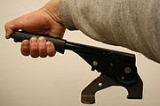
In cars, the
hand brake (
emergency brake,
e-brake,
parking brake) is a latching brake usually used to keep the car stationary, and in manual transmission vehicles, as an aid to starting the vehicle from stopped when going up an incline - with one foot on the clutch (to disengage it smoothly), the other on the accelerator (to avoid stalling from the increased torque required by the incline), a third limb is needed for the brake (to avoid rolling backwards while moving a foot from brake to accelerator). Automobile e-brakes usually consist of a
cableA cable is two or more wires running side by side and bonded, twisted or braided together to form a single assembly. In mechanics cables, otherwise known as wire ropes, are used for lifting, hauling and towing or conveying force through tension. In electrical engineering cables are used to carry...
(usually adjustable for length) directly connected to the brake mechanism on one end and to some type of mechanism that can be actuated by the driver on the other end. The mechanism is often a hand-operated
leverIn physics, a lever is a rigid object that is used with an appropriate fulcrum or pivot point to either multiply the mechanical force that can be applied to another object or resistance force , or multiply the distance and speed at which the opposite end of the rigid object travels.This leverage...
(hence the
hand brake name), on the floor on either side of the
driverDriving is the controlled operation and movement of a land vehicle, such as a car, truck or bus.Although direct operation of a bicycle and a mounted animal are commonly referred to as riding, such operators are legally considered drivers and are required to obey the rules of the road...
, or a pull handle located below and near the steering wheel column, or a (foot-operated)
pedalAn automobile may have two to four foot pedals. The arrangement is the same for both right- and left-hand traffic. From left to right:* normally operated by the left foot:**clutch pedal, not in the case of automatic transmission...
located far apart from the other pedals.
Although sometimes known as an emergency brake, using it in any emergency where the footbrake is still operational is likely to badly upset the brake balance of the car and vastly increase the likelihood of loss of control of the vehicle, for example by initiating a rear-wheel skid. Additionally, the stopping force provided by using the handbrake instead of or in addition to the footbrake is usually small and would not significantly aid in stopping the vehicle, again because it usually operates on the rear wheels; they suffer reduced traction compared to the front wheels while braking. The emergency brake is instead intended for use in case of mechanical failure where the regular footbrake is inoperable or compromised, hopefully with opportunity to apply the brake in a controlled manner to bring the vehicle to a safe, if gentle halt before seeking service assistance. Modern brake systems are typically very reliable and engineered with failsafe (e.g. dual-circuit hydraulics) and failure-warning (e.g. low brake fluid sensor) systems, meaning the handbrake is no longer often called on for its original purpose.
The most common use for an automobile emergency brake is to keep the vehicle motionless when it is
parkedParking is the act of stopping a vehicle and leaving it unoccupied for more than a brief time. Parking on one or both sides of a road is commonly permitted, though often with restrictions...
, thus the alternative name,
parking brake. Car emergency brakes have a
ratchetA ratchet is a device that allows continuous linear or rotary motion in only one direction while preventing motion in the opposite direction. Because most socket wrenches today use ratcheting handles, the term "ratchet" alone is often used to refer to a ratcheting wrench, and the terms "ratchet"...
lockA lock is a mechanical or electronic fastening device that is released by a physical object or secret information , or combination of more than one of these....
ing mechanism that will keep them engaged until a release button is pressed. On vehicles with
automatic transmissionAn automatic transmission is one type of motor vehicle transmission that can automatically change gear ratios as the vehicle moves, freeing the driver from having to shift gears manually...
s, this is usually used in concert with a
parking pawlA parking pawl is a device fitted to a motor vehicle's automatic transmission in order for it to lock up the transmission. It is engaged when the transmission shift lever selector is placed in the Park position, which is always the first position in all cars sold in the United States since 1965 A...
in the transmission. Automotive safety experts recommend the use of both systems to immobilize a parked car, and the use of both systems is required by law in some places, yet many individuals use only the "Park" position on the automatic transmission and not the parking brake. It's similar with manual transmission cars: They are recommended always to be left with the handbrake engaged, in concert with their lowest gear (usually either first or reverse). The use of both systems is also required by law in some jurisdictions. However, when parking on level ground, many people either only engage the handbrake (gear lever in neutral), or only select a gear (handbrake released). If parking on a hill with only one system results in the car rolling and damaging the car or other property, insurance companies in some countries, for example in Germany, aren’t required to pay for the damages.
Types of brakes
School buses which are equipped with a hydraulic brake system will have a hand brake lever to the left of the driver (in left hand drive buses) near the floor. It is operated by pushing the lever down with one's hand to apply the brake, and pulling it upwards to release it. However, this has been known to cause severe back problems in drivers who do this regularly, and many choose to push it up with their feet.
Some cars with
automatic transmissionAn automatic transmission is one type of motor vehicle transmission that can automatically change gear ratios as the vehicle moves, freeing the driver from having to shift gears manually...
s are fitted with automatically releasing parking brakes. Later models require the foot brake to be depressed before the car's transmission can be moved from park. When reverse or drive is selected, the parking brake automatically releases. Earlier models would release the parking brake when the gear selector was placed in a forward or reverse gear without requiring any input on the brake pedal at all. These earlier automatic release systems were a safety hazard, since there would be no protection against accidentally knocking the transmission into gear.
In cars with rear
drum brakeA drum brake is a brake in which the friction is caused by a set of shoes or pads that press against a rotating drum-shaped part called a brake drum....
s, the emergency brake cable usually actuates these drums mechanically with much less force than is available through the hydraulic system. In cars with rear
disc brakeThe disc brake or disk brake is a device for slowing or stopping the rotation of a wheel while it is in motion.A brake disc is usually made of cast iron, but may in some cases be made of composites such as reinforced carbon–carbon or ceramic matrix composites. This is connected to the wheel and/or...
s, the emergency brake either actuates the disc calipers (again, with much less force) or a small drum brake housed within the hub assembly.
Hudson automobiles used an unusual hybrid hydraulic-mechanical dual-brake system which operated the rear brakes through the otherwise conventional mechanical emergency-brake system when a failure of the hydraulic system allowed the pedal to travel beyond its normal limit.
A number of production vehicles, light and medium duty trucks, and motor homes have been made with a separate drum brake on the transmission output shaft; called a driveline parking brake. This has an advantage of being completely independent of other braking systems. This is effective as long as the drive train is intact — propeller shaft,
differentialA differential is a device, usually, but not necessarily, employing gears, capable of transmitting torque and rotation through three shafts, almost always used in one of two ways: in one way, it receives one input and provides two outputs—this is found in most automobiles—and in the other way, it...
, and axle shafts. In many vehicles, this type of parking brake is operated by either a foot pedal or a hydraulic cylinder controlled by the transmission gear selector, or by both.
Large vehicles
Large vehicles are usually fitted with power operated or power assisted handbrakes.
Power assisted handbrakes are usually found on large vans as well as some older heavy vehicles. These operate in the same way as a conventional handbrake, but pulling the lever will operate a valve that allows air or hydraulic pressure or vacuum into a cylinder which applies force to the brake shoes and makes applying the handbrake easier. When releasing the handbrake, the same mechanism also provides assistance to the driver in disengaging the ratchet. Particularly on commercial vehicles with air operated brakes, this has the added benefit of making it much harder or even impossible to release the parking brake when insufficient air pressure is available to operate the brakes. A reservoir or accumulator is usually provided so a limited amount of power assistance is available with the engine off.
Power operated handbrakes are fitted to heavy commercial vehicles with air brakes, such as trucks and buses. These usually are spring applied, with air pressure being used to hold the brake off and powerful springs holding the brakes on. In most cases, a small lever in the cab is connected to a valve which can admit air to the parking brake cylinders to release the parking brake, or release the air to apply the brake. On some modern vehicles the valve is operated electrically from a lever or button in the cab. The system is relatively safe since if air pressure is lost the springs will apply the brakes. Also, the system prevents the parking brake being released if there is insufficient air pressure to apply the foot brake. A disadvantage to this system is that if a vehicle requires towing and can not provide its own air supply, an external supply must be provided to allow the parking brake to be released, or the brake shoes must be manually wound off against the springs.
New system: electric parking brake
A recent variation is the electric parking brake. First installed in the 2001
Renault Vel SatisThe Renault Vel Satis was an executive car produced by the French manufacturer Renault, launched at the 2001 Geneva Motorshow to replace the already-discontinued Safrane...
, electric brakes have since appeared in a number of vehicles, including the
Audi A4The first generation Audi A4 debuted in 1994, with production starting November 1994. It was built on the Volkswagen Group B5 platform, which it shared with the fourth generation Volkswagen Passat . It had a front-mounted longitudinal engine and front-wheel drive...
,
A5The Audi A5 is a coupé produced by the German automobile manufacturer Audi since 2007. It is the coupé, cabriolet, and five-door fastback versions of the fourth generation Audi A4 saloon and estate models....
,
A6The Audi A6 is an executive car marketed by the German automaker Audi AG, now in its fourth generation. As the successor to the Audi 100, the A6 is manufactured in Neckarsulm, Germany – and is available in saloon, and wagon configurations, the latter marketed by Audi as the Avant.All generations...
and
A8The Audi A8 is a four-door, full-size, luxury sedan car manufactured and marketed by the German automaker Audi since 1994. Succeeding the Audi V8, the A8 has been offered with front wheel drive or permanent four-wheel drive, with multitronic or tiptronic automatic transmissions — and in short- and...
, the 2010
Subaru LegacyThe Subaru Legacy is a mid-size car built by the Japanese company Fuji Heavy Industries, and manufactured by its division Subaru since 1989, and is available as a sedan or wagon. Part of the original design goals for the Legacy model was to provide Subaru a vehicle in which they could compete in...
and
Subaru OutbackThe Subaru Outback is a station wagon manufactured by Fuji Heavy Industries since 1995. Its original concept originated with Subaru of America, which was suffering from slumping sales in the mid-1990s partly due to a lack of an entry in the then-burgeoning sport utility vehicle market...
, the 2002
BMW 7 SeriesThe BMW 7 Series is a line of full-size luxury vehicles produced by the German automaker BMW. Introduced in 1977, it is BMW's flagship car and is only available as a sedan or extended-length limousine...
, 2009 BMW Z4,
Lincoln LSThe Lincoln LS is a mid-size, rear wheel drive sedan from Lincoln. For its production run from 1999 until 2006, it was based on the Ford DEW98 platform, which was shared with the Jaguar S-Type and Ford Thunderbird...
,
Jaguar S-TypeThe Jaguar S-Type was a mid-size luxury/executive car that debuted at the 1998 Birmingham Motor Show and went on sale in spring 1999. The name is a revival of a previous Jaguar model, the S-Type introduced in 1963.-Overview:...
,
XFThe Jaguar XF The Jaguar XF The Jaguar XF (type (X250) is a mid-size luxury car / sports saloon produced by British car manufacturer Jaguar. The car, which replaced the Jaguar S-Type, was launched at the 2007 Frankfurt Motor Show following the public showing of the C-XF concept in January 2007 at...
and
XJJaguar XJ is the designation that has been used for a series of luxury saloon cars sold under the British Jaguar marque. The first XJ was launched in 1968 and the designation has been used for successive Jaguar flagship models since then. The original model was the last Jaguar saloon to have had...
,
Renault ScénicThe Renault Scénic is a compact MPV produced by French automaker Renault, the first to be labelled as such in Europe. It is based on the chassis of the Mégane small family car. It became 1997 European Car of the Year on its launch in late 1996...
,
EspaceThe Renault Espace is a large MPV from French car-maker Renault. Generations 1-3 were sold under the Renault brand but manufactured by Matra. The current fourth generation model, which seats seven passengers, is an all-Renault product; the Renault Grand Espace is a long-wheelbase version with...
,
Laguna II.phase IIThe Renault Laguna is a large family car produced by the French manufacturer Renault. The first Laguna was launched in 1993, the second generation was launched in 2000, and the third generation was made available for sale in October 2007....
, 2009
Opel/Vauxhall InsigniaThe Opel Insignia is a large family car engineered and produced by the German automaker Opel. Production of the Insignia began in 2008 as a replacement for the Opel Vectra. Opel launched the vehicle at the 2008 British International Motor Show in London as the Vauxhall Insignia, reflecting the...
, 2010
Opel/Vauxhall AstraThe Opel Astra is a small family car engineered and manufactured by the German automaker Opel since 1991.It is branded as Vauxhall Astra in the United Kingdom, the Buick Excelle XT in China and the Chevrolet Astra/Vectra in Latin America...
, 2011
Opel/Vauxhall MerivaThe Opel Meriva is a compact MPV engineered and produced by the German automaker Opel. The car is sold under the Opel brand on all of the European markets with the exception of the United Kingdom, where it is called the Vauxhall Meriva, and Latin America, where it carried the Chevrolet badge. It...
,
Volkswagen PassatThe Volkswagen Passat is a large family car marketed by Volkswagen Passenger Cars through six design generations since 1973. Between the Volkswagen Golf / Volkswagen Jetta and the Volkswagen Phaeton in the current Volkswagen line-up, the Passat and its derivatives have been badged variously as...
, Citroën C4 Picasso,
Citroën C6The Citroën C6 is an executive car produced by the French luxury marque Citroën since 2005.-Overview:Inspired by the C6 Lignage prototype which was first shown at the Geneva Motor Show in the spring of 1999, but differs from the concept car's styling in minor details...
, the new
Citroën C5The Citroën C5 is a large family car produced by the French manufacturer Citroën since early 2001. The C5 replaced the Citroën Xantia in the large family car class.-First generation :...
, and the new 2011 Buick Regal and
Chevrolet VoltThe Chevrolet Volt is a plug-in hybrid electric vehicle manufactured by General Motors. The Volt has been on sale in the U.S. market since mid-December 2010, and is the most fuel-efficient compact car sold in the United States, as rated by the United States Environmental Protection Agency...
.
Two variations are available: In the more-traditional "cable-pulling" type, an electric motor simply pulls the emergency brake cable rather than a mechanical handle in the cabin. A more complex unit uses two computer-controlled motors attached to the rear brake calipers to activate it.
It is expected that these systems will incorporate other features in the future. BMW, Renault Subaru and VW already have a system where the emergency brake initiates when the car stops and then goes off as soon as the gas pedal is pressed preventing the car from rolling. The new feature is called a hill hold. The vehicle operator can easily turn off the system.
There is also a single un-verified report of the brake disengaging randomly.
Jacking
It is important to know which wheels are providing the braking action when lifting the car with a jack. Typically the rear wheels are the ones that are stopped with parking brakes. The Alfasud,
Saab 99- Development :On April 2, 1965, Gudmund's day in Sweden, after several years of planning, the Saab board started Project Gudmund. This was a project to develop a new and larger car to take the manufacturer beyond the market for the smaller Saab 96...
s,
Pre-Facelift 900'sThe Saab 900 was a car produced by Saab Automobile from 1978 until 1998 in two generations. The first generation from 1978 to 1993 is known as the "classic"; the generation from 1994 to 1998 is known as the "new generation" ....
, the
Citroën XantiaThe Citroën Xantia, pronounced 'Zan-tia' is a large family car produced by the French automaker Citroën. First seen at the end of 1992, the car was produced between 1993 and 2001, with a facelift in 1998. Citroën sold over 1.2 million Xantias during its 8 years of production...
and most early
Subaru; is the automobile manufacturing division of Japanese transportation conglomerate Fuji Heavy Industries .Subaru is internationally known for their use of the boxer engine layout popularized in cars by the Volkswagen Beetle and Porsche 911, in most of their vehicles above 1500 cc as well as...
s applied the handbrake force to the front wheels, which makes them notable exceptions. If one lifts the braking wheels off the ground then the car can move and fall off the jack. This is why makers recommend that jacking be conducted on level ground and with chocks immobilizing the wheels that remain on the ground.
Railroad hand brakes
Virtually all railroad
rolling stockRolling stock comprises all the vehicles that move on a railway. It usually includes both powered and unpowered vehicles, for example locomotives, railroad cars, coaches and wagons...
is equipped with manually-operated mechanical hand brake devices that set and release the brakes. Most of these involve a chain linked to the brake rigging, most often at the brake cylinder, that when tightened pull the piston out against the releasing springs, thus applying the brakes on the car (if there is only one brake cylinder per car) or
bogieA bogie is a wheeled wagon or trolley. In mechanics terms, a bogie is a chassis or framework carrying wheels, attached to a vehicle. It can be fixed in place, as on a cargo truck, mounted on a swivel, as on a railway carriage/car or locomotive, or sprung as in the suspension of a caterpillar...
(if there is more than once cylinder per car). Newer locomotives have electric systems that simply place an electric motor in place of the chain winding mechanism. This brake acts independent of the action of the automatic air brakes, which function collectively when coupled in a
trainA train is a connected series of vehicles for rail transport that move along a track to transport cargo or passengers from one place to another place. The track usually consists of two rails, but might also be a monorail or maglev guideway.Propulsion for the train is provided by a separate...
and are under the control of the locomotive engineer.
Manual hand brakes serve to keep a piece of rolling stock stationary after it has been spotted in a rail yard or at a customer for unloading or loading. They are also used to secure a parked train from inadvertent movement, especially while unmanned.
Before the development of locomotive-actuated train braking systems in the late 19th century, designated railroad employees known as
brakemenA brakeman is a rail transport worker whose original job it was to assist the braking of a train by applying brakes on individual wagons. The advent of through brakes on trains made this role redundant, although the name lives on in the United States where brakemen carry out a variety of functions...
would move about the tops of cars, setting hand brakes in an effort to stop the train in a timely manner. This process was imprecise and extremely dangerous. Many brakemen lost life and limb as a result of falling from a moving train, icy and wet conditions often adding to the hazards involved in negotiating the top of a swaying
boxcarA boxcar is a railroad car that is enclosed and generally used to carry general freight. The boxcar, while not the simplest freight car design, is probably the most versatile, since it can carry most loads...
. In the U.S., an 1893 federal law, the
Railroad Safety Appliance ActThe Safety Appliance Act is a United States federal law that made air brakes and automatic couplers mandatory on all trains in the United States. It was enacted on March 2, 1893 and took effect in 1900, after a 7 year grace period...
, required automatic brakes on all railroads, effective in 1900.