
Encyclopedia
City of Hamilton, Ontario, Canada
|
Motto: Together Aspire - Together Achieve Nickname: Steel City, Steeltown, The Hammer |
| |
| Area: | 1,117.11 sq. km. |
Population
- City
- Metro
- Density |
490,268
662,401
710,300
438.9/km²
|
| Time zone | Eastern: UTC-5 |
Latitude Longitude
| |
| MPs |
| Dean Allison , Chris Charlton , David Christopherson , Wayne Marston , David Sweet |
| MPPs |
| Marie Bountrogianni , Andrea Horwath , Judy Marsales , Ted McMeekin , Jennifer Mossop |
| Mayor | Larry Di Ianni |
| Governing body | Hamilton City Council |
| |
Hamilton is a city located in
Canada, in the province of
Ontario. It is currently the 8th largest census metropolitan area in Canada, with a population estimated at 714,900 in the metropolitan area . Within the city itself the population was 490,268 in the 2001 census. It is located roughly 45 minutes southwest of
Toronto and 45 minutes northwest of
Niagara Falls.
Its nicknames — all relating to its waning days as a major industrial centre — include the Ambitious City, Steeltown, the Hammer, Hammertown, and the Lunchbucket City. However, health care has outstripped heavy industry — exemplified by the twin steel giants of Stelco and Dofasco — as the largest employer. Moreover, the education, government, services and technology sectors have all dramatically developed as heavy industry has declined. Because of this, and the fact that the city's waterfront is in the middle of a re-birth, there is currently a movement to re-brand Hamilton, The Bay City.
Hamilton has built on its historical and social background. Interesting attractions include a museum of aircraft
History
This section summarizes the full entry found at History of Hamilton, Ontario
, and stops in 1945.History to 1913
The
Iroquois Confederacy of Five Nations first occupied the land now covered by Hamilton. French explorers made transient visits to the area, but major European settlement did not begin until
United Empire Loyalists arrived around the
American Revolution and
War of 1812. In the latter conflict, Britain defeated American invaders at the Battle of Stoney Creek in what is now Hamilton.
Immediately after the war, in 1815, George Hamilton laid out a town site in Barton Township which eventually outstripped close rivals like
Dundas. Hamilton was incorporated as a police village in 1833 and as a city in 1846.
Hamilton was part of Wentworth County since its creation in 1816. By 1851, the county acquired its final composition of townships: Ancaster, Barton, Beverly, Binbrook, East Flamborough, West Flamborough, Glanford and Saltfleet.
In the second half of the 1800s, Hamilton became identified and self-identified with , billing itself as the Ambitious City and the
Birmingham of Canada. It became a hotbed of working class activism, and in 1872 the cradle of the Nine Hour Movement which urged the universal limitation of working hours to nine per day.
The easy access to
limestone from the
Niagara Escarpment, coal mined in
Appalachia, iron ore mined from the
Canadian Shield and export markets through the
Great Lakes-
St. Lawrence system made Hamilton an important
iron- and
steel-producing city. Diverse steel works combined to form the Steel Company of Canada in 1910 and the Dominion Steel Casting Company in 1912.
History 1914–1945
Hamiltonians participated in the
First World War as combatants, but due to
Col. Sir Sam Hughes' mobilization plans for the
Canadian Expeditionary Force, there were no major battles associated purely with Hamiltonians. Heavy industry boomed as the Canadian and British governments' war-driven demands for steel, arms, munitions and textiles increased. War profiteering by manufacturers dampened some of the mood, but generally Hamiltonians pulled together.
After the Great War the school-building boom continued, including Memorial School,
Allenby School and
Earl Kitchener School. In the
Roaring Twenties hundreds of low-rise apartment buildings, of three to four stories and six to ten units, grew up across the city, especially in the east end. The
Great Depression of the 1930s hit Hamilton hard, with the simultaneous and prolonged decline in domestic consumption and international trade in finished industrial goods and building supplies dried up.
When the
Second World War began, Hamiltonians - like most Canadians - welcomed the spike of economic demand but not its cause. In this war, the
Canadian Army mobilized its territorially recruited militia units. As a consequence, Hamilton lost hundreds of its young men on a single day in 1942, when the
Royal Hamilton Light Infantry was effectively wiped out at
Dieppe. Read more of coverage of the war. Hamilton also gave The Argyll and Sutherland Highlanders of Canada to the cause.
Geography and climate
Hamilton is located on the western end of the
Niagara Peninsula and at the westernmost part of
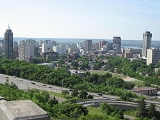
Lake Ontario, most of the city including the downtown section are on the south shore. Situated in the geographic centre of the
Golden Horseshoe and is roughly the midway point between Toronto and Buffalo. The two major physical features are Hamilton Harbour marking the northern limit of the city and the
Niagara Escarpment running through the middle of the city across its entire breadth, bisecting the city into 'upper' and 'lower' parts.
Burlington Bay/Hamilton Harbour is a natural harbour with a large sandbar called the Beachstrip. This sandbar was deposited during a period of higher lake levels during the last ice age, and extends southeast through the central lower city to the escarpment. Hamilton's deep sea port is accessed by ship canal through the beach strip into the harbour and is traversed by two bridges, the QEW's Burlington Bay - James N. Allan Skyway and the lower Canal Lift Bridge. Hamilton Harbour ranks one of Canada's largest seaports. The Hamilton Port Authority manages the heavily industrial harbour.
The escarpment is in many places a 100 metre vertical wall of limestone shale with many waterfalls and creeks falling over it; including Stoney Creek, Red Hill Creek, Grindstone Creek, Spencer Gorge Waterfall and Chedoke Creek — flow over the Escarpment and into the Harbour. The numerous waterfalls within the City of Hamilton limits has recently inspired local tourism interests to market Hamilton as the "City of Waterfalls." At least 20 waterfalls and cascades flow over Hamilton Mountain within city limits. On average the mountain is 4-5km inland from the Lake Ontario shoreline and at its edge affords some spectacular views of the city and harbour. Outside of the city this feature is more commonly known as
Hamilton Mountain, or to locals just "the mountain". The "mountain" is actually an escarpment. The Hamilton portion is part of the larger Niagara Escarpment, that runs from western New York to Georgian Bay. It is the world's longest escarpment.
The climate of Hamilton is humid continental and relatively mild compared with most of Canada. The average January temperature is -3.6C but most days rise just above freezing making for slushy conditions during snowfalls. Winter snowfall averages 113cm with great year-to-year variation. The average July temperature is 22.5C and humidity is usually high during the peak of summer. Daytime highs in the 30's with humidex values making it feel above 40°C are quite common anytime from May through early October.
It might be noted that the climate of the lower city is in general much more sheltered and milder than on top of "the mountain", which has a shorter growing season and, in winter is prone to more wind whipped
snowsqualls. It is not uncommon in the winter for lower city residents, with no snow present in their neighbourhoods, to drive up into the upper city and be surprised at encountering a thick blanket of fresh white snow. The escarpment also greatly affects summer weather;
temperature inversions can make the downtown many degrees warmer, particularly at night, and often an inversion will combine with the physical barrier of the escarpment to trap
smog in the downtown area, sometimes reducing downtown visibility to less than 2km.
Summer rains can be heavy but in general severe weather is rare. One notable exception occurred November 9, 2005 when a tornado damaged hundreds of houses and lifted off Lawfield Middle School's gymnasium roof on the Upper Mountain, injuring two students and leaving the school structurally unsound.
Environment Canada confirmed an F1 tornado struck the area; this was the latest date in any year that a confirmed
tornado touched down in Canada.
Demographics
According to the mid-2001 census, nearly one-quarter of the metropolitan area population of Hamilton was foreign-born, making Hamilton the Canadian city with the third highest proportion of foreign-born citizens after
Toronto and
Vancouver .
Hamilton is overwhelmingly populated by people of a white ethnic background - 90.7%. The remainder consists of East Indian,
Chinese, and
Caribbean origins. The top countries of birth for the newcomers living in Hamilton in 2001 were:
Yugoslavia,
Poland,
India, the People’s Republic of China, the
Philippines,
Iraq, and
Bosnia and Herzegovina. About 8% of immigrants of the 1990s cited
Yugoslavia as their country of birth.
The population estimates there were 714,900 people residing in Hamilton, located in the province of Ontario, of whom 48.8% were male and 51.2% were female. Children under five accounted for approximately 5.8% of the resident population of Hamilton. This compares with 5.8% in Ontario, and 5.5% for
Canada overall.
In mid-2001, 14.2% of the resident population in Hamilton were of retirement age compared with 13.2% in Canada, therefore, the average age is 37.8 years of age comparing to 37.6 years of age for all of Canada.
In the five years between 1996 and 2001, the population of Hamilton grew by 6.1%, compared with an increase of 6.1% for Ontario as a whole. Population density of Hamilton averaged 482.9 people per square kilometre, compared with an average of 12.6, for Ontario altogether.
At the time of the
census in May 2001, the resident population of the city of Hamilton was 490,268, and census' Hamilton Metropolitan Area was 662,401. The entire province of Ontario was 11,410,050 people.
Religious groups
Christianity is the predominant religion in Hamilton. Protestantism is barely ahead of Catholicism, while
Roman Catholicism has strengthened due to mostly Eastern European and
Filipino population growth.
- Protestant: 242,940 or 37.0%
- Roman Catholic: 232,435 or 35.4%
- other Christian: 32,760 or 5.0%
- Jewish: 6,000 or 0.7%
- Buddhist: 4,725 or 0.6%
City and suburbs
Downtown began and remains around Gore Park and the intersection of King and James Streets. Central Hamilton extends from the base of the Mountain north to Barton Street, west to Chedoke Creek or Dundurn Street, and east to approximately Wentworth Street or Sherman Avenues. West Hamilton or the west end begins at Dundurn Street or Chedoke Creek. East Hamilton or the east end begins at approximately Ottawa Street or Kenilworth Avenue. North Hamilton or the north end begins at Barton Street or the
Canadian National Railways tracks.
As city limits expanded to include the Mountain, the retronym for the city below the Escarpment became the Lower City . The east/west divide line for the mountain is Upper James Street, and the east/west divide line for downtown is James Street. The south Mountain begins at approximately Limeridge Road or the
Lincoln M. Alexander Expressway.
The former boroughs of Hamilton-Wentworth Region, are: Stoney Creek,
Dundas, Flamborough, Ancaster and Township of Glanbrook. They have maintained their names as wards in the amalgamated city.
Today, Hamilton is considered a suburb of Toronto to many, since there is little to no rural areas between the cities and has excellent GO train service and an express GO bus service between the two communities.
Attractions
Hamilton has a large variety of historical sites and cultural and educational institutions.
Historical sites
- , static and flying museum, Mount Hope airport
- Dundurn Castle, including the Hamilton Military Museum and Dundurn Park, west end
- , east end
- Royal Hamilton Light Infantry Heritage Museum, downtown
- , downtown
- , birthplace of Women's Institutes, Upper Stoney Creek
- , Stoney Creek
- , in the former Custom House, a National Historic Site, north end
Cultural institutions
Art
- Art Gallery of Hamilton, downtown. Second largest permanent collection in Ontario, and third largest in Canada.
- , west end
-
-
- Transit Gallery
- Arctic Gallery
Music
- Hamilton, Dundas, Ancaster, Burlington
-
- Hamilton, Burlington
- Hamilton, Dundas, Ancaster, Burlington
- Bach Elgar Choir
Museums
- Workers Arts and Heritage Centre , north end
- , east end
- Hamilton Children's Museum , east end
- Military Museum
- Canadian Warplane Heritage Museum , home of one of the last two remaining operational Lancaster bombers, also in operation Spitfire, Hawker Hurricane, Bristol Bolingbroke.
- Dundurn Castle
- Whitehearn
- Canada Marine Discovery Centre
- Battlefied Castle
- Museum of Steam and Technology
- Erland Lee Museum
- Fieldcote Memorial Park & Museum
- Giant's Rib Discovery Centre
-
- Haunted Hamilton
- HMCS Haida
Theatre
- , downtown
- , Dofasco Centre for the Performing Arts, downtown
- plays
- , musical theatre
Outdoor attractions
- , Hamilton Harbour
- , Along Escarpment
- Royal Botanical Gardens, west end
- , Flamborough
- Bruce Trail, Stoney Creek, Hamilton, Dundas, Flamborough
- , Hamilton, Dundas, Ancaster
- , Dundas
- Pier 4 Park
- Harbour West
- Cootes Paradise
- Bayfront Park
- Gore Park
- Gage Park
- Beach Strip
- Industrial Pollution Bay
Educational institutions
Popular attractions
- , a popular summer patio hangout. Many bars, clubs and restaurants feature live music and attractions all year round. Hess Street, downtown.
- African Lion Safari, Flamborough
- , horse racing as well as car racing
- , downtown
- , featuring largest outdoor wave pool, waterslides, lazy river, batting cages, mini put, picnic area
- The Pheasant Plucker, a popular bar on Augusta Street in downtown Hamilton
- Mustard Festival
- Festival of Friends
- Harvest Burger
- ,
- Lakeport Hydroplane Regatta
- Tall Ship Regatta
- Kinsman Parade of Lights
- Dragon Boat Festival Championships
-
- Hamilton Industrial Heritage Trail - 19th century
- Hamilton Industrial Heritage Trail - 20th century
- Hamilton Waterfront Trail
- Hamilton Beach Trail
- Redhill Valley Trail
- Trans Canada Trail
-
-
-
- The Westdale Aviary
- Dundurn Castle and Military Museum
-
-
Economy and environment
Industrial economy and environment
By the 1940s, the ecological cost of
pollution had taken its toll on Hamilton: heavy metals made fish from the Bay inedible, air pollution made breathing difficult and industrial dumps contaminated land. People recognized there was a problem, but two decades of
economic depression and
war left them with no stomach to face the costly investments and social changes to fix it.
Veterans returned to the factories just in time to see the founding strike of Local 1005 of the
United Steelworkers of America at Stelco, one of four major ones in 1946. Labour peace ensured by the Rand formula, established by Mr. Justice Ivan Rand when he settled the
Ford strike in
Windsor, allowed the industrial economy to grow.
Studebaker set up shop in Hamilton, shutting down in 1966 as its last car factory.
Despite the promise shown in the booming 1960s, signs of trouble were beginning to show. The Harbour dredging scheme and reports by the International Joint Commission revealed that a few more decades of pollution had all but destroyed the marine environment.
In the early 1980s, Hamilton had entered the economic downturn common to most steel towns in the developed world, such as Bethlehem, Pennsylvania, but survived relatively well. But a couple of bitter strikes at Stelco did not help matters. The days of heavy industry were numbered.
In the last decade, Hamilton's heavy industry reached a stable level, Stelco has returned to profitability in more recent quarters and non-unionized Dofasco is the world's most profitable steel maker. The Hamilton Harbour Commission continues to report healthy shipments and steady increases. Decreased industrial activity and increased pollution control measures have combined to increase water and air quality, and to allow Hamilton to showcase its fine natural attributes in a better light. For those employed in or relying on the industrial sector, prospects are not good.
Stelco is no longer under bankruptcy protection. Dofasco is likely to be bought by a foreign company and in addition to being one of North America's most profitable steel companies, Dofasco has been named to the Dow Jones Sustainability World Index seven years in a row.
Today Hamilton still remains Canada's capital of heavy industry. Hamilton's north end and east Hamilton is Canada's largest concentration of heavy industry, in a province -- Ontario -- that is also the country's manufacturing base. Burlington Street was famous for its blue collar rush hour -- 6:30am, 3:30pm and 11:30pm -- the times during shift changes at the many factories.
Biotechnology cluster
Business, education and government in the Hamilton, Halton and Niagara regions have joined forces to energize existing biosciences strengths and help turn breakthroughs into business success. A regional initiative, the Golden Horseshoe is being transformed into a knowledge-based, economic powerhouse of research, growth and investment.
Biggest employers
Head offices
Companies with head offices located in Hamilton include:
- Stelco
- Dofasco
- Dell Pharmacy
- First Ontario Credit Union
- BDO Dunwoody
- E.D. Smith
- AIC
- Fortinos
- Nelson Steel
- Coppley Apparel Group
- Taylor Steel
- Lakeport Brewing
- Fox40
- Robertson Building Systems
- Oakrun Farm Bakery
Cultural economy
As the industrial economy has faltered, the local economy by necessity became much more diversified. However, this process was made possible by decisions taken as early as the 1930s as discussed above.
Attempts at nourishing and spreading cultural economic activities paid off. Dundurn Castle was refurbished as Centennial project. Local TV station CHCH introduced Canadians to
Smith & Smith, which featured Steve and Morag Smith .
The Hilarious House of Frightenstein was a Canadian children's television series which was also produced by
CHCH in 1971. It was syndicated to television stations across Canada and the United States, and occasionally still appears today in some TV markets. A quirky sketch comedy series, the show's cast included
Billy Van, Fishka Rais, Guy Big, Mitch Markowitz,
Vincent Price and Julius Sumner Miller. Van, in fact, played the vast majority of the characters. 130 episodes of the series were made, in one single nine-month span of time starting in 1971. "Don Cherry's Grapevine" began airing on CHCH TV in the 1980's.
Hamilton became a moderately important film and television adjunct of the
Toronto film market. Notable actors from Hamilton are
Second City Television alumni
Eugene Levy,
Martin Short and Dave Thomas. All three attended McMaster University along with the late
John Candy.
Hamilton gave birth or havens to a number of successful musicians of various genres over the years. Jazz-
blues musicians The Washingtons were popular in the 1940s, and brother Jackie Washington continues to perform.
Folksinger Stan Rogers was born in
Dundas, where he lived until his death in 1982. The Hamilton Philharmonic Orchestra under Boris Brott, although often troubled financially since his departure as Music Director in 1990, achieved wide renown as one of Canada's finest orchestras. The eponymous Brott Music Festival, founded in 1988 is Canada's largest orchestral music festival and is a cornerstone cultural activity of the summer months. It joins the Art Gallery of Hamilton, the Philharmonic, Theatre Aquarius and Opera Hamilton as one of the City's the leading arts organizations.
Among the rock-pop acts formed in Hamilton or by Hamiltonians were: Teenage Head, Forgotten Rebels, Junkhouse, The Kings,
Sarah Harmer, and Appleton. Furthermore, Daniel Lanois, a solo artist in his own right and producer for
U2, lived in Hamilton and recorded at . Other Hamiltonians include Saga Drummer Steve Negas,
Christian Tanna drummer/ songwriter for I Mother Earth, Lorraine Segato lead vocalist for 1980s New Wave group; The Parachute Club, Skip Prokop Drummer and band leader for
Lighthouse + The Paupers and Ian Thomas Singer/ songwriter whose most memorable hit was 1973's "Painted Ladies."
Neil Peart drummer and lyricist for the progressive rock band Rush was born just outside of Hamilton in the town of Hagersville.
was a 4-CD box set released in 1996 to celebrate the 25th anniversary of the
Juno Awards. All of the sets feature popular Canadian songs from the 1960s onward. The sets were titled for the song "Oh What A Feeling" by Hamilton Ontario rock band Crowbar. From 1969 to 1970, most of the members of the group had been a backup band for Ronnie Hawkins. However, he fired them, saying "You guys are so crazy that you could **** up a crowbar in three seconds!" They recorded their first album in 1970 as King Biscuit Boy and Crowbar. King Biscuit Boy left the band later in 1970, but continued to appear as a guest performer.
The Sonic Unyon label started and fostered the Hamilton sound in the early 1990s and continues today as one of Canada's most successful independent record labels and distributors.
Hamilton hosted several cultural and craft fairs since the 1970s, notably Festival of Friends and Earthsong, which made it a major tourist destination. Unfortunately, these
fair trade venues and celebrators of
world music declined in quality, with the cancellation of Earthsong, only the Festival of Friends remains, now in 2006, its 31st season. The Festival of Friends, founded in 1975, is the largest annual free music event in the country. Burton Cummings, Lighthouse and Bruce Cockburn have been among the main stage headliners.
Hamilton also hosts several key venues operated by the Hamilton Entertainment and Convention Facilities organization. Among these facilities is Hamilton's largest venue,
Copps Coliseum, a 19,000-seat enclosed arena that serves as the home for the
Hamilton Bulldogs ice hockey club and routinely features a variety of sport, commercial and concert events throughout the year. Notable artists who have performed at Copps Coliseum include
U2,
Elton John,
Rod Stewart and
Aerosmith.
Further events can be found just down the road at Hamilton Place, a 2,100 seat performing arts theatre located less than a two-minute walk from the Coliseum. Hamilton Place is the home of the Hamilton Philharmonic Orchestra and boasts one of the leading architectural designs for acoustics in Canada. Notable performances include the annual festive production of '
The Nutcracker' and a number of internationally-recognized entertainers such as Tom Jones,
Bill Cosby,
Hall & Oates and
Billy Connolly.
Other economy
The growth of post-secondary education — heralded by the arrival of
McMaster University in 1930 and the foundation of
Mohawk College in 1967 — led to numerous direct and indirect jobs in education and research. The addition of a medical school at McMaster in the late 1960s built upon local health care strengths to such an extent that health care has outstripped industry as the region's primary employer. A massive McMaster University research campus called Innovation Centre is planned for development on the former Camco lands near Westdale.
A business collaboration between a Canadian hockey player and a retired Hamilton policeman began quietly in 1964 at 65 Ottawa Street North. After the player's untimely death in 1974, an ambitious expansion scheme of the retiree's led
Tim Hortons Donuts to become an enormously successful food retailer selling doughnuts, coffee and light snacks. Founder Ron Joyce sold the business to the
Wendys fast food empire, but not before bestowing his name on Hamilton Place.
An enthusiasm for
urban renewal gripped Hamilton, as it did most other cities in North America, in the 1960s and early 1970s. Historic buildings, including Old City Hall and the original farmers market, were destroyed to make way for wider streets, more parking and large
shopping centres. Hamilton's penchant for one-way streets and synchronized traffic lights, only recently reconsidered and slightly modified, date from just before this period.
Outside the industrial sector, a brutal recession from the late 1980s to the mid-1990s, combined with the accelerated tendency to relocate commercial activity in the cheaper suburbs, devastated the downtown core, and many small businesses. Qualified or failed attempts at reviving the
central business district included the restoration of the Gore Park fountain, the proposed conversion of vacant office space into condominium apartments and allowing two-way traffic on certain downtown streets for the first time in half a century.
More dramatic and successful have been the greening projects of Hamilton undertaken since the 1990s: the Lax lands on Bay Street North were capped with clay and landscaped into a beautiful park, remediation began at Cootes Paradise in west Hamilton, a waterfront trail linking these two places was built, abandoned railway right-of-ways in both the east end and west end were converted to multi-use paths.
Politics
Politically, Hamilton is known for producing groundbreaking, colourful and left-wing politicians — illustrated by the polarizing and erratic career of
Sheila Copps. Locally, though, the big political stories have included the controversial amalgamation of Hamilton with its suburbs in 2001, and the destruction of green space around the Red Hill Valley to make way for the
Red Hill Creek Expressway.
Municipal politics
Hamilton has had a city charter since 1846. In 1974, it combined with the Wentworth County and the latter's other towns and townships to form the two-tier municipal federation of Regional Municipality of Hamilton-Wentworth. Portions of the former county became part of Burlington and Cambridge.
The old city of Hamilton was represented at regional council by one councillor each from its two-councillor wards; the other municipalities by their mayors and an additional regional councillor each. The regional chair was appointed by the Ontario government rather than by the residents or the regional councillors. After a successful drive to make the office elective, the point became moot in 2001.
Municipal powers were divided or shared in turn by the city and the county . For instance, the city and county continued their separate boards of education, while the police service and social services became regional responsibilities, and fire service and business licensing remained second-tier responsibilities.
In 2001, the former two-tier Hamilton-Wentworth region was amalgamated into a one-tier city called Hamilton like one of its predecessor governments. New ward boundaries coincided substantially or exactly with old Hamilton's wards and the former municipal boundaries of its suburbs.
As in most Ontario cities, incumbent councillors and mayors tend to be re-elected in municipal elections marked by low turnout. However, in the 1940s, Hamilton City Council was presided over by
Sam Lawrence, a unionized worker called the Labour Mayor. However, for most of the time, moderates of the centre-right or centre-left — such as Lloyd D. Jackson in the 1960s and Robert Morrow in the 1980s — presided over council.
Victor "Vic" Copps was a popular centre-left mayor in the 1970s. While taking part in the in 1976, he suffered a stroke which incapacitated him. His wife Geraldine Copps served as a city councillor after that unfortunate event.
Copps Coliseum is named after him rather than his daughter,
Sheila Copps.
Provincial politics
Hamilton has traditionally been represented by four to six Members of Provincial Parliament or Members of the Legislative Assembly in the
Legislative Assembly of Ontario. Old Hamilton was always suspicious of its larger neighbour and provincial capital, Toronto and had a reputation for being highly unionized. These factors combined to electing working class and left-wing MPPs, often from the
New Democratic and
Liberal parties, who frequently achieved notoriety if not power outside Hamilton.
Liberal MPP Lily Munro was caught in the Patti Starr scandal which contributed to Premier
David Peterson's electoral defeat in 1990. So often under- or unrepresented in at Queen's Park, the old city of Hamilton boasted that each of its three MPPs were ministers in the NDP government of
Bob Rae in the 1990s.
In contrast, the former suburbs and rural precincts of old Hamilton voted for less radical and less noteworthy
Progressive Conservative representatives, including government backbenchers for Rae's successor,
Mike Harris. The Harris government's forced amalgamation of Hamilton was highly controversial among suburban and urban Hamilton voters. It also made provincial riding boundaries and names automatically coincide with those at the federal level, reducing new Hamilton's representation at Queen's Park, the Provincial Legislature, in Toronto, by one member.
Federal politics
Progressive Conservative Prime Minister
John Diefenbaker appointed the late Ellen Fairclough as Secretary of State, making her Canada's first female
cabinet minister, in 1957. A downtown provincial office building is named in her honour.
John Munro, a
Trudeau-era Liberal cabinet minister and a sometime husband of Lily Munro, was the subject of political innuendo and criminal allegations dismissed after an
Royal Canadian Mounted Police probe. He came in fourth in the first mayoral election for amalgamated Hamilton. The Hamilton International Airport was renamed in his honour.
Progressive Conservative Prime Minister
Joe Clark appointed
Lincoln "Linc" Alexander, the first
Black Canadian Member of Parliament, as Minister of Labour in his short-lived government. Alexander later became
Lieutenant Governor of Ontario, another first for blacks in Ontario and Canada. Linc was honoured by having the long-awaited Mountain east-west expressway named after him.
Sheila Copps, daughter of Victor and Geraldine, was a
Liberal candidate, first for the Ontario legislature and then for the House of Commons, where she represented Hamilton East from 1984] until 2004. She was a leading and vociferous member of the Liberal "Rat Pack" while the Liberals were in opposition until 1993. An early and strong supporter of the leadership of
Jean Chrétien, she served in several posts including Deputy Prime Minister. When
Paul Martin became prime minister, Copps' star waned as she was excluded from cabinet and lost her bitter nomination campaign to
Tony Valeri in her re-districted riding.
In the
2006 federal election