Home      Discussion      Topics      Dictionary      Almanac
Signup       Login
Haloclasty

Haloclasty

Overview

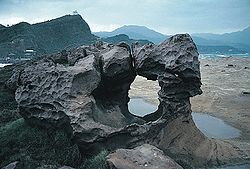
Haloclasty is a type of physical weathering caused by the growth of salt crystals. The process is first started when saline
Salinity
Salinity is the saltiness or dissolved salt content of a body of water. It is a general term used to describe the levels of different salts such as sodium chloride, magnesium and calcium sulfates, and bicarbonates...

water seeps into cracks and evaporates depositing salt crystals, when the rocks are then heated up the crystals will expand putting pressure on the surrounding rock which will over time splinter the stone in to fragments.

Salt crystallization may also take place when solutions decompose rocks (for example, limestone and chalk) to form salt solutions of sodium sulfate or sodium carbonate, of which the moisture evaporates to form their respective salt crystals.

The salts which have proved most effective in disintegrating rocks are sodium sulfate, magnesium sulfate, and calcium chloride.
Discussion
Ask a question about 'Haloclasty'
Start a new discussion about 'Haloclasty'
Answer questions from other users
Full Discussion Forum
 
Encyclopedia

Haloclasty is a type of physical weathering caused by the growth of salt crystals. The process is first started when saline
Salinity
Salinity is the saltiness or dissolved salt content of a body of water. It is a general term used to describe the levels of different salts such as sodium chloride, magnesium and calcium sulfates, and bicarbonates...

water seeps into cracks and evaporates depositing salt crystals, when the rocks are then heated up the crystals will expand putting pressure on the surrounding rock which will over time splinter the stone in to fragments.

Salt crystallization may also take place when solutions decompose rocks (for example, limestone and chalk) to form salt solutions of sodium sulfate or sodium carbonate, of which the moisture evaporates to form their respective salt crystals.

The salts which have proved most effective in disintegrating rocks are sodium sulfate, magnesium sulfate, and calcium chloride. Some of these salts can expand up to three times or even more.

It is normally associated with arid climates where strong heating causes strong evaporation and therefore salt crystallization. It is also common along coasts. An example of salt weathering can be seen in the honeycombed stones in sea walls.