

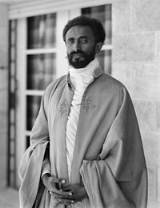
Haile Selassie I of Ethiopia

Encyclopedia
Haile Selassie I (Ge'ez
: , "Power of the Trinity") (23 July 1892 – 27 August 1975), born Tafari Makonnen, was Ethiopia
's regent
from 1916 to 1930 and Emperor of Ethiopia
from 1930 to 1974. He was the heir to a dynasty that traced its origins to the 13th century, and from there by tradition back to King Solomon and Queen Makeda, Empress of Axum, known in the Abrahamic tradition as the Queen of Sheba. Haile Selassie is a defining figure in both Ethiopian
and African
history.
At the League of Nations
in 1936, the emperor condemned the use of chemical weapons by Italy against his people. His internationalist views led to Ethiopia becoming a charter member of the United Nations, and his political thought and experience in promoting multilateralism and collective security
have proved seminal and enduring. His suppression of rebellions among the nobles (mekwannint), as well as what some perceived to be Ethiopia's failure to modernize adequately, earned him criticism among some contemporaries and historians.
Haile Selassie is revered as the returned messiah
of the Bible, God incarnate
, among the Rastafari movement
whose followers are estimated at between 200,000 and 800,000. Begun in Jamaica
in the 1930s, the Rastafari movement perceives Haile Selassie as a messianic figure who will lead a future golden age of eternal peace, righteousness, and prosperity. Haile Selassie was an Ethiopian Orthodox
Christian throughout his life.
lij teferī mekōnnin). "Lij" translates literally to "child", and serves to indicate that a youth is of noble blood. He would later become Ras Tafari Makonnen; "Ras" translates literally to "head" and is the equivalent of "duke
", though it is often rendered in translation as "prince". Tafari, his given name, in Amharic means "one who is respected", while Haile literally means in Ge'ez "Power of" and Selassie means trinity
(i.e. Haile
Selassie "Power of the Trinity") his coronation
name in 1930 (Haile Selassie was also his Christian baptismal name as an infant). In 1916 during the reign of the Empress Zauditu, she gave him the position of a regent
and in 1928 this position was elevated, as she granted him the throne of Shoa, his title was then elevated to Negus
, "King".
On 2 November 1930, after the death of Empress Zauditu, Ras Tafari Makonnen was crowned emperor, upon his ascension to emperor, he took as his regnal name
"Haile Selassie", meaning "Power of the Trinity". Haile Selassie's full title in office was "His Majesty Haile Selassie I, Conquering Lion of the Tribe of Judah, King of Kings (Emperor) of Ethiopia, Elect of God" (Ge'ez
; ). This title reflects Ethiopian dynastic traditions, which hold that all monarchs must trace their lineage back to Menelik I
, who in the Ethiopian tradition was the offspring of King Solomon and the Queen of Sheba.
To Ethiopians Haile Selassie has been known by many names, including Janhoy, Talaqu Meri, and Abba Tekel. The Rastafari employ many of these appellations, also referring to him as HIM, Jah
, and Jah Rastafari.
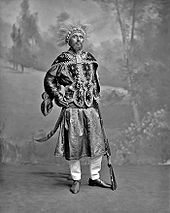 Haile Selassie was born on 23 July 1892, in the village of Ejersa Goro
, in the Harar
province of Ethiopia. His mother was Woizero ("Lady") Yeshimebet Ali
Abajifar, daughter of the renowned Oromo
ruler of Wollo
province Dejazmach Ali Abajifar. His maternal grandmother was of Gurage heritage. Haile Selassie's father was Ras Makonnen Woldemikael Gudessa, the governor of Harar. Ras Makonnen served as a general in the First Italo–Ethiopian War, playing a key role at the Battle of Adwa; he too was paternally Oromo but maternally Amhara
. Haile Selassie was thus able to ascend to the imperial throne through his paternal grandmother, Woizero Tenagnework Sahle Selassie, who was an aunt of Emperor Menelik II and daughter of Negus Sahle Selassie
of Shewa. As such, Haile Selassie claimed direct descent from Makeda, the Queen of Sheba, and King Solomon of ancient Israel.
Ras Makonnen arranged for Tafari as well as his first cousin, Ras Imru Haile Selassie
to receive instruction in Harar from Abba Samuel Wolde Kahin
, an Ethiopian capuchin monk
, and from Dr. Vitalien, a surgeon from Guadeloupe
. Tafari was named Dejazmach (literally "commander of the gate", roughly equivalent to "count
") at the age of 13, on 1 November 1905. Shortly thereafter, his father Ras Makonnen died at Kulibi
, in 1906.
. It is alleged that during his late teens, Haile Selassie was married to Woizero Altayech, and that from this union, his daughter Romanework Haile Selassie
was born.
Following the death of his brother Yelma in 1907, the governorate of Harar was left vacant, and its administration was left to Menelik's loyal general, Dejazmach Balcha Safo
. Balcha Safo's administration of Harar was ineffective, and so during the last illness of Menelik II, and the brief reign of Empress Taitu Bitul, Tafari was made governor of Harar in 1910 or 1911.
On 3 August he married Menen Asfaw
of Ambassel
, niece of heir to the throne Lij Iyasu.
Contributing to the movement that deposed Iyasu were conservatives such as Fitawrari Habte Giyorgis
, Menelik II's longtime Minister of War. The movement to depose Iyasu preferred Tafari, as he attracted support from both progressive and conservative factions. Ultimately, Iyasu was deposed on the grounds of conversion to Islam. In his place, the daughter of Menelik II ( the aunt of Iyasu) was named Empress Zewditu and made Regent
for Tafari during his minority. Tafari was elevated to the rank of Ras and was made heir apparent
and Crown Prince
. In the power arrangement that followed, Tafari accepted the role of Regent Plenipotentiary
(Balemulu 'Inderase) and became the de facto ruler of the Ethiopian Empire
(Mangista Ityop'p'ya). Zewditu would govern while Tafari would administer.
While Iyasu had been deposed on 27 September 1916, on 8 October the coup d'etat went awry. Iyasu managed to escape into the Ogaden Desert and his father, Negus Mikael
of Wollo
, had time to come to his aid. On 27 October, Negus Mikael and his army met an army under Fitawrari Habte Giyorgis loyal to Zewditu and Tafari. During the Battle of Segale
, Negus Mikael was defeated and captured. Any chance that Iyasu would regain the throne was ended and he went into hiding. On 11 January 1921, after avoiding capture for about five years, Iyasu was taken into custody by Gugsa Araya Selassie
.
On 11 February 1917, the coronation for Zewditu took place. She pledged to rule justly through her Regent, Tafari. While Tafari was the more visible of the two, Zewditu was far from an honorary ruler. Her position required that she arbitrate the claims of competing factions. In other words, she had the last word. Tafari carried the burden of daily administration but, because his position was relatively weak, this was often an exercise in futility for him. Initially his personal army was poorly equipped, his finances were limited, and he had little leverage to withstand the combined influence of the Empress, the Minister of War, or the provincial governors.
During his Regency, the new Crown Prince developed the policy of cautious modernization initiated by Menelik II. He secured Ethiopia's admission to the League of Nations
in 1923 by promising to eradicate slavery; each emperor since Tewodros II
had issued proclamations to halt slavery
, but without effect: the internationally scorned practice persisted well into Haile Selassie's reign.
, Alexandria
, Brussels, Amsterdam
, Stockholm, London, Geneva
, and Athens
. With him on his tour was a group that included Ras Seyum Mangasha
of western Tigre Province
, Ras Hailu Tekle Haymanot
of Gojjam Province
, Ras Mulugeta Yeggazu
of Illubabor Province
, Ras Makonnen Endelkachew
, and Blattengeta
Heruy Welde Sellase
. The primary goal of the trip to Europe was for Ethiopia to gain access to the sea. In Paris, Tafari was to find out from the French Foreign Ministry
(Quai d'Orsay
) that this goal would not be realized. However, failing this, he and his retinue inspected schools, hospitals, factories, and churches. Although patterning many reforms after European models, Tafari remained wary of European pressure. To guard against economic imperialism
, Tafari required that all enterprises have at least partial local ownership. Of his modernization campaign, he remarked, "We need European progress only because we are surrounded by it. That is at once a benefit and a misfortune."
Throughout Ras Tafari's travels in Europe, the Levant
, and Egypt
, he and his entourage were greeted with enthusiasm and fascination. He was accompanied by Seyum Mangasha and Hailu Tekle Haymanot who, like Tafari, were sons of generals who contributed to the victorious war against Italy a quarter century earlier at the Battle of Adwa. Another member of his entourage, Mulugeta Yeggazu, actually fought at Adwa as a young man. The "Oriental Dignity" of the Ethiopians and their "rich, picturesque court dress" were sensationalized in the media; among his entourage he even included a pride of lions, which he distributed as gifts to President Alexandre Millerand
and Prime Minister Raymond Poincaré
of France
, to King
George V
of the United Kingdom
, and to the Zoological Garden (Jardin Zoologique) of Paris. As one historian noted, "Rarely can a tour have inspired so many anecdotes". In return for two lions, the United Kingdom presented Ras Tafari with the imperial crown of Emperor Tewodros II
for its safe return to Empress Zewditu. The crown had been taken by Robert Napier
during the 1868 Expedition to Abyssinia
.
In this period, the Crown Prince visited the Armenian monastery of Jerusalem. There, he adopted 40 Armenian
orphans (አርባ ልጆች Arba Lijoch, "forty children"), who had lost their parents in Ottoman massacres. Ras Tafari arranged for the musical education of the youths, and they came to form the imperial brass band.
went to Addis Ababa with a sizeable armed force. When Tafari consolidated his hold over the provinces, many of Menilek's appointees refused to abide by the new regulations. Balcha Safo, Governor (Shum) of coffee-rich Sidamo Province
was particularly troublesome. The revenues he remitted to the central government did not reflect the accrued profits and Tafari recalled him to Addis Ababa. The old man came in high dudgeon and, insultingly, with a large army. The Dejazmatch paid homage to Empress Zewditu, but snubbed Ras Tafari. On 18 February, while Balcha Safo and his personal bodyguard were in Addis Ababa, Ras Tafari had Ras Kassa Haile Darge
buy off his army and arrange to have him displaced as the Shum of Sidamo Province by Birru Wolde Gabriel who himself was replaced by Desta Damtew
.
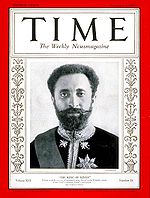 Even so, the gesture of Balcha Safo empowered Empress Zewditu politically and she attempted to have Tafari tried for treason
. He was tried for his benevolent dealings with Italy including a 20-year peace accord
which was signed on 2 August. In September, a group of palace reactionaries including some of the courtiers of the Empress, made a final bid to get rid of Tafari
. The attempted coup d'état was tragic in its origins and comic in its end. When confronted by Tafari and a company of his troops, the ringleaders of the coup took refuge on the palace grounds in Menilek's mausoleum. Tafari and his men surrounded them only to be surrounded themselves by the personal guard of Zewditu. More of Tafari's khaki clad soldiers arrived and, with superiority of arms, decided the outcome in his favor. Popular support, as well as the support of the police, remained with Tafari. Ultimately, the Empress relented and, on 7 October 1928, she crowned Tafari as Negus
(Amharic: "King").
The crowning of Tafari as King was controversial. He occupied the same territory as the Empress rather than going off to a regional kingdom of the empire. Two monarchs, even with one being the vassal and the other the emperor (in this case empress), had never occupied the same location as their seat in Ethiopian history. Conservatives agitated to redress this perceived insult to the dignity of the crown, leading to the rebellion of Ras Gugsa Welle
. Gugsa Welle
was the husband of the Empress and the Shum of Begemder Province
. In early 1930, he raised an army and marched it from his governorate at Gondar
towards Addis Ababa
. On 31 March 1930, Gugsa Welle was met by forces loyal to Negus Tafari and was defeated at the Battle of Anchem
. Gugsa Welle was killed in action
. News of Gugsa Welle's defeat and death had hardly spread through Addis Ababa when the Empress died suddenly on 2 April 1930. Although it was long rumored that the Empress was poisoned upon the defeat of her husband, or alternately that she died from shock upon hearing of the death of her estranged yet beloved husband, it has since been documented that the Empress succumbed to a flu-like fever and complications from diabetes.
With the passing of Zewditu, Tafari himself rose to emperor and was proclaimed Neguse Negest ze-'Ityopp'ya, "King of Kings of Ethiopia". He was crowned on 2 November 1930, at Addis Ababa's Cathedral of St. George
. The coronation was by all accounts "a most splendid affair", and it was attended by royals and dignitaries from all over the world. Among those in attendance were George V's son Prince Henry
, Marshal Franchet d'Esperey of France, and the Prince of Udine
representing Italy. Emissaries from the United States, Egypt
, Turkey, Sweden, Belgium, and Japan were also present. British author Evelyn Waugh
was also present, penning a contemporary report on the event, and American travel lecturer Burton Holmes
shot the only known film footage of the event. One newspaper report suggested that the celebration may have incurred a cost in excess of $3,000,000. Many of those in attendance received lavish gifts; in one instance, the Christian emperor even sent a gold-encased Bible to an American bishop who had not attended the coronation, but who had dedicated a prayer to the emperor on the day of the coronation.
Haile Selassie introduced Ethiopia's first written constitution
on 16 July 1931, providing for a bicameral legislature. The constitution kept power in the hands of the nobility, but it did establish democratic standards among the nobility, envisaging a transition to democratic rule: it would prevail "until the people are in a position to elect themselves." The constitution limited the succession to the throne to the descendants of Haile Selassie, a point that met with the disapprobation of other dynastic princes, including the princes of Tigrai
and even the emperor's loyal cousin, Ras Kassa Haile Darge
.
In 1932, the Kingdom of Jimma
was formally absorbed into Ethiopia following the death of King Abba Jifar II
of Jimma
.
's Fascist regime was keen to avenge the military defeats Italy had suffered to Ethiopia in the First Italo-Abyssinian War
, and to efface the failed attempt by "liberal" Italy to conquer the country, as epitomised by the defeat at Adowa
. A conquest of Ethiopia could also empower the cause of fascism and embolden its rhetoric of empire. Ethiopia would also provide a bridge between Italy's Eritrea
n and Italian Somaliland
possessions. Ethiopia's position in the League of Nations did not dissuade the Italians from invading in 1935; the "collective security
" envisaged by the League proved useless, and a scandal erupted when the Hoare-Laval Pact
revealed that Ethiopia's League allies were scheming to appease Italy.
in Wollo
province. He issued his famous mobilization order on 3 October 1935:
On 19 October 1935, Haile Selassie gave more precise orders for his army to his Commander-in-Chief, Ras Kassa
:
Compared to the Ethiopians, the Italians had an advanced, modern military which included a large air force. The Italians would also come to employ chemical weapons extensively throughout the conflict, even targeting Red Cross field hospitals in violation of the Geneva Convention.
. But, by November, the pace of invasion had slowed appreciably and Haile Selassie's northern armies were able to launch what was known as the "Christmas Offensive
". During this offensive, the Italians were forced back in places and put on the defensive. However, by early in 1936, the First Battle of Tembien
stopped the progress of the Ethiopian offensive and the Italians were ready to continue their offensive. Following the defeat and destruction of the northern Ethiopian armies at the Battle of Amba Aradam
, the Second Battle of Tembien
, and the Battle of Shire
, Haile Selassie took the field with the last Ethiopian army on the northern front. On 31 March 1936, he launched a counterattack
against the Italians himself at the Battle of Maychew
in southern Tigray
. The emperor's army was defeated and retreated in disarray. As Haile Selassie's army withdrew, the Italians attacked from the air along with rebellious Raya and Azebo tribesmen on the ground, who were armed and paid by the Italians.
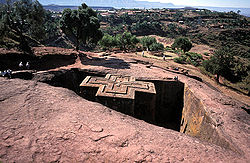 Haile Selassie made a solitary pilgrimage
to the churches at Lalibela
, at considerable risk of capture, before returning to his capital. After a stormy session of the council of state, it was agreed that because Addis Ababa
could not be defended, the government would relocate to the southern town of Gore
, and that in the interest of preserving the Imperial house, the emperor's wife Menen Asfaw
and the rest of the imperial family should immediately depart for Djibouti
, and from there continue on to Jerusalem.
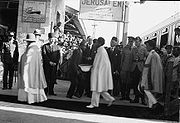 After further debate as to whether Haile Selassie should go to Gore or accompany his family into exile, it was agreed that Haile Selassie should leave Ethiopia with his family and present the case of Ethiopia to the League of Nations
at Geneva
. The decision was not unanimous and several participants, including the nobleman Page (Blatta) Tekle Wolde Hawariat, objected to the idea of an Ethiopian monarch fleeing before an invading force. Haile Selassie appointed his cousin Ras Imru Haile Selassie
as Prince Regent in his absence, departing with his family for Djibouti
on 2 May 1936.
On 5 May, Marshal Pietro Badoglio
led Italian troops into Addis Ababa, and Mussolini declared Ethiopia an Italian province. Victor Emanuel III was proclaimed as the new Emperor of Ethiopia
. However, on the previous day, the Ethiopian exiles had left Djibouti aboard the British cruiser HMS Enterprise
. They were bound for Jerusalem in the British Mandate of Palestine, where the Ethiopian royal family maintained a residence. The Imperial family disembarked at Haifa
and then went on to Jerusalem. Once there, Haile Selassie and his retinue prepared to make their case at Geneva. The choice of Jerusalem was highly symbolic, since the Solomonic Dynasty
claimed descent from the House of David
. Leaving the Holy Land
, Haile Selassie and his entourage sailed for Gibraltar
aboard the British cruiser HMS Capetown
. From Gibraltar, the exiles were transferred to an ordinary liner. By doing this, the government of the United Kingdom was spared the expense of a state reception.
"; because the League of Nations afforded Haile Selassie the opportunity to address the assembly, Italy even withdrew its League delegation, on 12 May 1936. It was in this context that Haile Selassie walked into the hall of the League of Nations, introduced by the President of the Assembly as "His Imperial Majesty, the Emperor of Ethiopia" (Sa Majesté Imperiale, l'Empereur d'Ethiopie). The introduction caused a great many Italian journalists in the galleries to erupt into jeering, heckling, and whistling. As it turned out, they had earlier been issued whistles by Mussolini's son-in-law, Count Galeazzo Ciano
. Haile Selassie waited calmly for the hall to be cleared, and responded "majestically" with a speech sometimes considered among the most stirring of the 20th century.
Although fluent in French, the working language of the League, Haile Selassie chose to deliver his historic speech in his native Amharic. He asserted that, because his "confidence in the League was absolute", his people were now being slaughtered. He pointed out that the same European states that found in Ethiopia's favor at the League of Nations were refusing Ethiopia credit and matériel
while aiding Italy, which was employing chemical weapons on military and civilian targets alike.
Noting that his own "small people of 12 million inhabitants, without arms, without resources" could never withstand an attack by a large power such as Italy, with its 42 million people and "unlimited quantities of the most death-dealing weapons", he contended that all small states were threatened by the aggression, and that all small states were in effect reduced to vassal state
s in the absence of collective action. He admonished the League that "God and history will remember your judgment."
The speech made the emperor an icon for anti-fascists around the world, and Time named him "Man of the Year". He failed, however, to get what he most needed: the League agreed to only partial and ineffective sanctions on Italy, and several members even recognized the Italian conquest.
, which he bought. The emperor and Kassa Haile Darge took morning walks together behind the high walls of the 14-room Georgian house. Haile Selassie's favorite reading was "diplomatic history." But most of his serious hours were occupied with the 90,000-word story of his life which he was laboriously writing in Amharic.
Prior to Fairfield House, he briefly stayed at Warne's Hotel in Worthing
and in Parkside, Wimbledon
A bust of Haile Selassie is in nearby Cannizaro Park
to commemorate this time and is a popular place of pilgrimage for London's Rastafarian community.
Haile Selassie stayed at the Abbey Hotel in Malvern
in the 1930s and his granddaughters and daughters of court officials were educated at Clarendon School in North Malvern
. During his time in Malvern he attended services at Holy Trinity Church, in Link Top
. A blue plaque
, commemorating his stay in Malvern, was unveiled on Saturday, 25 June 2011. As part of the ceremony, a delegation from the Rastafari movement gave a short address and a drum recital.
Haile Selassie's activity in this period was focused on countering Italian propaganda as to the state of Ethiopian resistance and the legality of the occupation. He spoke out against the desecration of houses of worship and historical artifacts (including the theft of a 1,600-year old imperial obelisk), and condemned the atrocities suffered by the Ethiopian civilian population. He continued to plead for League intervention and to voice his certainty that "God's judgment will eventually visit the weak and the mighty alike", though his attempts to gain support for the struggle against Italy were largely unsuccessful until Italy entered World War II on the German side in June 1940.
The emperor's pleas for international support did take root in the United States, particularly among African-American organizations sympathetic to the Ethiopian cause. In 1937, Haile Selassie was to give a Christmas Day radio address to the American people to thank his supporters when his taxi was involved in a traffic accident, leaving him with a fractured knee. Rather than canceling the radio appearance, he proceeded in much pain to complete the address, in which he linked Christianity and goodwill with the Covenant of the League of Nations
, and asserted that "War is not the only means to stop war":
During this period, Haile Selassie suffered several personal tragedies. His two sons-in-law, Ras Desta Damtew
and Dejazmach Beyene Merid
, were both executed by the Italians. The emperor's daughter, Princess Romanework, wife of Dejazmach Beyene Merid, was herself taken into captivity with her children, and she died in Italy in 1941. His daughter Tsehai died during childbirth shortly after the restoration in 1942.
After his return to Ethiopia, he donated Fairfield House
to the city of Bath as a residence for the aged, until modified in the 1990s where it is now used as a residential meeting centre.
" of Colonel Orde Wingate, coordinated the military effort to liberate Ethiopia. The emperor himself issued several imperial proclamations in this period, demonstrating that, while authority was not divided up in any formal way, British military might and the emperor's populist appeal could be joined in the concerted effort to liberate Ethiopia.
On 18 January 1941, during the East African Campaign
, Haile Selassie crossed the border between Sudan
and Ethiopia
near the village of Um Iddla. The standard of the Lion of Judah
was raised again. Two days later, he and a force of Ethiopian patriots joined Gideon Force
which was already in Ethiopia and preparing the way. Italy was defeated by a force of the United Kingdom, the Commonwealth of Nations
, Free France
, Free Belgium
, and Ethiopian patriots. On 5 May 1941, Haile Selassie entered Addis Ababa
and personally addressed the Ethiopian people, five years to the day since his 1936 exile:
On 27 August 1942, Haile Selassie abolished the legal basis of slavery
throughout the empire and imposed severe penalties, including death, for slave trading. After World War II, Ethiopia became a charter member of the United Nations. In 1948, the Ogaden
, a region disputed with Somalia
, was granted to Ethiopia. On 2 December 1950, the UN General Assembly adopted Resolution 390 (V), establishing the federation of Eritrea
(the former Italian colony) into Ethiopia. Eritrea was to have its own constitution, which would provide for ethnic, linguistic, and cultural balance, while Ethiopia was to manage its finances, defense, and foreign policy.
Despite his centralization policies that had been made before World War II, Haile Selassie still found himself unable to push for all the programs he wanted. In 1942, he attempted to institute a progressive tax scheme, but this failed due to opposition from the nobility, and only a flat tax was passed; in 1951, he agreed to reduce this as well. Ethiopia was still "semi-feudal", and the emperor's attempts to alter its social and economic form by reforming its modes of taxation met with resistance from the nobility and clergy, which were eager to resume their privileges in the postwar era. Where Haile Selassie actually did succeed in effecting new land taxes, the burdens were often passed by the landowners to the peasants. Despite his wishes, the tax burden remained primarily on the peasants.
Between 1941 and 1959, Haile Selassie worked to establish the autocephaly
of the Ethiopian Orthodox Church
. The Ethiopian Orthodox Church had been headed by the abuna
, a bishop who answered to the Partriarchate in Egypt. Haile Selassie applied to Egypt's Holy Synod
in 1942 and 1945 to establish the independence of Ethiopian bishops, and when his appeals were denied he threatened to sever relations with the See of St. Mark. Finally, in 1959, Pope Kyrillos VI elevated the Abuna to Patriarch-Catholicos. The Ethiopian Church remained affiliated with the Alexandrian Church. In addition to these efforts, Haile Selassie changed the Ethiopian church-state relationship by introducing taxation of church lands, and by restricting the legal privileges of the clergy, who had formerly been tried in their own courts for civil offenses.
In keeping with the principle of collective security
, for which he was an outspoken proponent, he sent a contingent under General Mulugueta Bulli, known as the Kagnew Battalion
, to take part in the Korean War
by supporting the United Nations Command
. It was attached to the American 7th Infantry Division, and fought in a number of engagements including the Battle of Pork Chop Hill
. In a 1954 speech, the emperor spoke of Ethiopian participation in the Korean War
as a redemption of the principles of collective security:
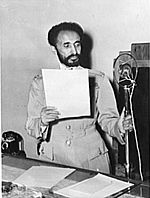 During the celebrations of his Silver Jubilee in November 1955, Haile Selassie introduced a revised constitution
, whereby he retained effective power, while extending political participation to the people by allowing the lower house of parliament to become an elected body. Party politics were not provided for. Modern educational methods were more widely spread throughout the Empire, and the country embarked on a development scheme and plans for modernization, tempered by Ethiopian traditions, and within the framework of the ancient monarchical structure of the state.
Haile Selassie compromised when practical with the traditionalists in the nobility and church. He also tried to improve relations between the state and ethnic groups, and granted autonomy to Afar lands that were difficult to control. Still, his reforms to end feudalism were slow and weakened by the compromises he made with the entrenched aristocracy. The Revised Constitution of 1955 has been criticized for reasserting "the indisputable power of the monarch" and maintaining the relative powerlessness of the peasants.
peacekeeping force during the 1960 Congo Crisis
, to consolidate Congolese integrity and independence from Belgian troops, per United Nations Security Council Resolution 143
. On 13 December 1960, while Haile Selassie was on a state visit to Brazil
, his Imperial Guard forces staged an unsuccessful coup
, briefly proclaiming Haile Selassie's eldest son Asfa Wossen
as emperor. The coup d'état was crushed by the regular army and police forces. The coup attempt lacked broad popular support, was denounced by the Ethiopian Orthodox Church
, and was unpopular with the army, air force
and police. Nonetheless, the effort to depose the emperor had support among students and the educated classes. The coup attempt has been characterized as a pivotal moment in Ethiopian history, the point at which Ethiopians "for the first time questioned the power of the king to rule without the people's consent". Student populations began to empathize with the peasantry and poor, and to advocate on their behalf. The coup spurred Haile Selassie to accelerate reform, which was manifested in the form of land grants to military and police officials.
The emperor continued to be a staunch ally of the West, while pursuing a firm policy of decolonization
in Africa, which was still largely under European colonial rule. The United Nations conducted a lengthy inquiry regarding the status of Eritrea, with the superpowers each vying for a stake in the state's future. Britain, the administrator at the time, suggested the partition of Eritrea between Sudan and Ethiopia, separating Christians and Muslims. The idea was instantly rejected by Eritrean political parties, as well as the UN.
A UN plebiscite voted 46 to 10 to have Eritrea be federated
with Ethiopia, which was later stipulated on 2 December 1950 in resolution 390 (V). Eritrea would have its own parliament and administration and would be represented in what had been the Ethiopian parliament and would become the federal parliament. However, Haile Selassie would have none of European attempts to draft a separate Constitution under which Eritrea would be governed, and wanted his own 1955 Constitution protecting families to apply in both Ethiopia and Eritrea. In 1961 the 30-year Eritrean Struggle for Independence began, followed by Haile Selassie's dissolution of the federation and shutting down of Eritrea's parliament.
In 1961, tensions between independence-minded Eritreans and Ethiopian forces culminated in the Eritrean War of Independence. The emperor declared Eritrea the fourteenth province of Ethiopia in 1962. The war would continue for 30 years, as first Haile Selassie, then the Soviet-backed junta that succeeded him, attempted to retain Eritrea by force.
In 1963, Haile Selassie presided over the establishment of the Organisation of African Unity, with the new organization establishing its headquarters in Addis Ababa
. As more African states won their independence, he played an important role as Pan-Africanist, and along with Modibo Keïta
of Mali was successful in negotiating the Bamako Accords, which brought an end to the border conflict between Morocco
and Algeria
. Also in 1963, on 6 October, Selassie addressed the General Assembly of the United Nations, referring in his address to his earlier speech to the League of Nations:
On 25 November 1963, the emperor was among other heads of state, including France's President Charles de Gaulle
, who traveled to Washington D.C. and attended the funeral of assassinated President John F. Kennedy
.
In 1966, Haile Selassie attempted to create a modern, progressive tax that included registration of land, which would significantly weaken the nobility. Even with alterations, this law led to a revolt in Gojjam, which was repressed although enforcement of the tax was abandoned. The revolt, having achieved its design in undermining the tax, encouraged other landowners to defy Haile Selassie.
 Student unrest became a regular feature of Ethiopian life in the 1960s and 1970s. Marxism
took root in large segments of the Ethiopian intelligentsia, particularly among those who had studied abroad and had thus been exposed to radical and left-wing sentiments that were becoming popular in other parts of the globe. Resistance by conservative elements at the Imperial Court and Parliament, and by the Ethiopian Orthodox Church, made Haile Selassie's land reform proposals difficult to implement, and also damaged the standing of the government, costing Haile Selassie much of the goodwill he had once enjoyed. This bred resentment among the peasant population. Efforts to weaken unions also hurt his image. As these issues began to pile up, Haile Selassie left much of domestic governance to his Prime Minister, Aklilu Habte Wold
, and concentrated more on foreign affairs.
s of John F. Kennedy
and Charles de Gaulle
, the summits of the Non-Aligned Movement
, and the 1971 celebration
of the 2,500 years of the Persian Empire.
—mostly in Wollo, north-eastern Ethiopia, as well as in some parts of Tigray—is estimated to have killed 40,000 to 80,000 Ethiopians between 1972 and 1974. A BBC News report has cited a 1973 estimate that 200,000 deaths occurred, based on a contemporaneous estimate from the Ethiopian Nutrition Institute. While this figure is still repeated in some texts and media sources, it was an estimate that was later found to be "over-pessimistic". Although the region is infamous for recurrent crop failures and continuous food shortage and starvation risk, this episode was remarkably severe. A 1973 production of the ITV
programme The Unknown Famine by Jonathan Dimbleby
. relied on the unverified estimate of 200,000 dead, stimulating a massive influx of aid while at the same time destabilizing Haile Selassie's regime.
 Some reports suggest that the emperor was unaware of the extent of the famine, while others assert that he was well aware of it. In addition to the exposure of attempts by corrupt local officials to cover up the famine from the imperial government, the Kremlin
's depiction of Haile Selassie's Ethiopia as backwards and inept (relative to the purported utopia of Marxism-Leninism
) contributed to the popular uprising that led to its downfall and the rise of Mengistu Haile Mariam
. The famine and its image in the media undermined popular support of the government, and Haile Selassie's once unassailable personal popularity fell.
The crisis was exacerbated by military mutinies and high oil prices, the latter a result of the 1973 oil crisis
. The international economic crisis triggered by the oil crisis caused the costs of imported goods, gasoline, and food to skyrocket, while unemployment spiked.
as his new Prime Minister. However, despite Endalkatchew's many concessions, discontent continued in March with a four-day general strike that paralyzed the nation.
, a committee of low-ranking military officers and enlisted men, set up in June to investigate the military's demands, took advantage of the government's disarray to depose Haile Selassie on 12 September 1974. General Aman Mikael Andom, a Protestant of Eritrean origin, served briefly as provisional head of state pending the return of Crown Prince Asfa Wossen, who was then receiving medical treatment abroad. Haile Selassie was placed under house arrest briefly at the 4th Army Division in Addis Ababa, while most of his family was detained at the late Duke of Harrar
's residence in the north of the capital. The last months of the emperor's life were spent in imprisonment, in the Grand Palace.
Later, most of the imperial family was imprisoned in the Addis Ababa prison Kerchele, also known as "Alem Bekagne", or "Goodbye, cruel world". On 23 November 1974, sixty former high officials of the imperial government were executed without trial. The executed included Haile Selassie's grandson and two former Prime Ministers. These killings, known to Ethiopians as "Bloody Saturday", were condemned by Crown Prince Asfa Wossen; the Derg responded to his rebuke by revoking its acknowledgment of his imperial legitimacy, and announcing the end of the Solomonic dynasty
.
, denied that complications had occurred and rejected the government version of his death. Some imperial loyalists believed that the emperor had in fact been assassinated, and this belief remains widely held. One western correspondent in Ethiopia at the time commented, "While it is not known what actually happened, there are strong indications that no efforts were made to save him. It is unlikely that he was actually killed. Such rumors were bound to arise no matter what happened, given the atmosphere of suspicion and distrust prevailing in Addis Ababa the time." Court testimony given by the emperor's servants, however, indicates that they were ordered to leave his rooms for the night, and that they returned in the morning to find him dead in his bed, with a strong chemical smell in the room. They further testified that the emperor had been in perfect health the night before when they had left him. Professor Asrat Woldeyes also testified that his patient had completely recovered from the effects of the surgery and that there had been no complications.
The Soviet-backed Derg
fell in 1991. In 1992, the emperor's bones were found under a concrete slab on the palace grounds; some reports suggest that his remains were discovered beneath a latrine
. For almost a decade thereafter, as Ethiopian courts attempted to sort out the circumstances of his death, his coffin rested in Bhata Church, near his great uncle Menelik II's imperial resting place. On 5 November 2000, Haile Selassie was given an imperial-style funeral by the Ethiopian Orthodox church. The post-communist government
refused calls to declare the ceremony an official imperial funeral.
Although such prominent Rastafarian figures as Rita Marley
and others participated in the grand funeral, most Rastafari rejected the event and refused to accept that the bones were the remains of Haile Selassie. There remains some debate within the Rastafari movement
as to whether Haile Selassie actually died in 1975.
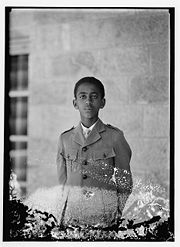 By Menen Asfaw
, Haile Selassie had six children: Princess Tenagnework
, Crown Prince
Asfaw Wossen
, Princess Tsehai
, Princess Zenebework
, Prince Makonnen
, and Prince Sahle Selassie
.
There is some controversy as to Haile Selassie's eldest daughter, Princess Romanework Haile Selassie
. While the living members of the royal family state that Romanework is the eldest daughter of Empress Menen, it has been asserted that Princess Romanework is actually the daughter of a previous union of the emperor with Woizero Altayech. The emperor's own autobiography makes no mention of a previous marriage or having fathered children with anyone other than Empress Menen.
Prince Asfaw Wossen was first married to Princess Wolete Israel Seyoum
and then following their divorce to Princess Medferiashwork Abebe. Prince Makonnen was married to Princess Sara Gizaw
. Prince Sahle Selassie was married to Princess Mahisente Habte Mariam
. Princess Romanework married Dejazmatch Beyene Merid. Princess Tenagnework first married Ras Desta Damtew
, and after she was widowed later married Ras Andargachew Messai. Princess Zenebework married Dejazmatch Haile Selassie Gugsa
. Princess Tsehai married Lt. General Abiye Abebe
.
(taken from Haile Selassie's pre-imperial name Ras – meaning Head – a title equivalent to Duke – Tafari Makonnen), which emerged in Jamaica
during the 1930s under the influence of Marcus Garvey
's "Pan Africanism" movement. He is viewed as the messiah who will lead the peoples of Africa and the African diaspora
to freedom. His official titles are Conquering Lion of the Tribe of Judah and King of Kings and Elect of God, and his traditional lineage is thought to be from Solomon and Sheba. These notions are perceived by Rastafarians as confirmation of the return of the messiah in the prophetic Book of Revelation
in the New Testament
: King of Kings, Lord of Lords, Conquering Lion of the Tribe of Judah, and Root of David. Rastafari faith in the incarnate divinity
of Haile Selassie began after news reports of his coronation reached Jamaica, particularly via the two Time magazine articles on the coronation the week before and the week after the event. Haile Selassie's own perspectives permeate the philosophy of the movement.
Not all Rastafarian mansions consider Haile Selassie as Jesus Christ incarnate. One example is The Twelve Tribes of Israel, who consider him a divinely anointed king—thus Christ in his kingly character and defender of the Christian faith.
In 1961, the Jamaican government sent a delegation composed of both Rastafari and non-Rastafari leaders to Ethiopia to discuss the matter of repatriation, among other issues, with the emperor. He reportedly told the Rastafarian delegation (which included Mortimer Planno
), "Tell the Brethren to be not dismayed, I personally will give my assistance in the matter of repatriation."
Haile Selassie visited Jamaica on 21 April 1966, and approximately one hundred thousand Rastafari from all over Jamaica descended on Palisadoes Airport in Kingston
, having heard that the man whom they considered to be their messiah was coming to visit them. Spliffs
and chalices
were openly smoked, causing "a haze of ganja
smoke" to drift through the air. Haile Selassie arrived at the airport but was unable to come down the mobile steps of the airplane, as the crowd rushed the tarmac. He then returned into the plane, disappearing for several more minutes. Finally, Jamaican authorities were obliged to request Ras Mortimer Planno, a well-known Rasta leader, to climb the steps, enter the plane, and negotiate the emperor's descent. Planno re-emerged and announced to the crowd: "The Emperor has instructed me to tell you to be calm. Step back and let the Emperor land". This day is widely held by scholars to be a major turning point for the movement, and it is still commemorated by Rastafarians as Grounation Day
, the anniversary of which is celebrated as the second holiest holiday after 2 November, the emperor's Coronation Day.
From then on, as a result of Planno's actions, the Jamaican authorities were asked to ensure that Rastafarian representatives were present at all state functions attended by the emperor, and Rastafarian elders also ensured that they obtained a private audience with the emperor, where he reportedly told them that they should not emigrate to Ethiopia until they had first liberated the people of Jamaica. This dictum came to be known as "liberation
before repatriation
".
Haile Selassie defied expectations of the Jamaican authorities, and never rebuked the Rastafari for their belief in him as the returned Jesus. Instead, he presented the movement's faithful elders with gold medallions – the only recipients of such an honor on this visit. During PNP
leader (later Jamaican Prime Minister) Michael Manley
's visit to Ethiopia in October 1969, the emperor allegedly still recalled his 1966 reception with amazement, and stated that he felt that he had to be respectful of their beliefs. This was the visit when Manley received the Rod of Correction or Rod of Joshua as a present from the emperor, which is thought to have helped him to win the 1972 election in Jamaica.
Rita Marley
, Bob Marley
's wife, converted to the Rastafari faith after seeing Haile Selassie on his Jamaican trip. She claimed in interviews (and in her book No Woman, No Cry) that she saw a stigmata
print on the palm of Haile Selassie's hand as he waved to the crowd which resembled the markings on Christ's hands from being nailed to the cross—a claim that was not supported by other sources, but was used as evidence for her and other Rastafarians to suggest that Haile Selassie I was indeed their messiah. She was also influential in the conversion of Bob Marley, who then became internationally recognized. As a result, Rastafari became much better known throughout much of the world. Bob Marley's posthumously released song Iron Lion Zion
refers to Haile Selassie.
After his return to Ethiopia, he dispatched Archbishop Abuna Yesehaq Mandefro to the Caribbean to help draw Rastafarians and other West Indians to the Ethiopian church and, according to some sources, denied his divinity.
In 1948, Haile Selassie donated a piece of land at Shashamane
, 250 km south of Addis Ababa, for the use of people of African descent from the West Indies. Numerous Rastafari families settled there and still live as a community to this day.
(GCMG) – 1917 Knight Grand Cross of the Royal Victorian Order
(GCVO) – 1924 Knight Grand Cross of the Order of the Bath
(GCB) – 1924 Stranger Knight of the Order of the Garter
(KG) – 1954Knight of the Order of the Most Holy Annunciation
– 1928 Royal Victorian Chain
– 1930 Grand Cordon of the Order of the Chrysanthemum
– 1930 Order of the Elephant
– 1954 Order of the Gold Lion of the House of Nassau – (25 May 1924) Collar of the Order of the Seraphim
– 1954 Order of the Maha Chakri – 1958Order of Suvorov
1st class – 1959 Collar of the Order of Muhammad Ali – 1930 Grand Cross of the Legion d'Honneur
– 1924 Chief Commander of the Legion of Merit
– 1945 Grand Collar of the Order of Pahlevi
– 1964 Collar of the Order of the Aztec Eagle
– 1954 Collar of the Order of the Chrysanthemum
-1956 Order of the Liberator San Martin
Order of the Nile
(22 May 1963) Order of Pius IX
– 1970 Order of Idris I of Libya Order of Independence Order of Hussein ibn AliOrder of Muhammad Chain of HonorGrand Order of the Hashemites Order of the Crown
of Italy – 1917 Order of Saints Maurice and Lazarus
– 1924 Order of the Redeemer
(19 August 1924) Order of Leopold (Belgium) – 1924 Riband of the Three Military Orders Of Christ, Benedict of Aviz, and St.James of the Sword (31 August 1959) Order of the Tower and Sword
of Portugal – 1925 Knight Grand Cross of the Order of William
– 1954 Knight Grand Cross of the Order of the Netherlands Lion – 1930 Order of the White Eagle of Poland – 1930 Collar of the Order of St Olav of Norway – 1949
Collar of the Order of Charles III (1954) Collar of the Order of the White Rose
Medal of Military Merit 1st class (28 October 1954) Grand Cross of the National Order of Vietnam
- 1958 Order of Truth – 1958 Collar of the Order of the Southern Cross
– 1958 Collar of the Order of the Leopard Order of the Lion Order of the Lion Order of Valor of Cameroon
Order of the Sun of Peru
Collar of the Order of the Bust of the Liberator Simon Bolivar Order of the Condor of the Andes
Special Grade of the Order of the Propitious Clouds Polonia Restituta of Poland (1967) Order of Ommayyad Order of Mono of Togo Order of Congolese Merit Order of the Leopard of Somalia
– 1960 Order of the Equatorial Star Order of the Federal Republic of Nigeria Order of the Source of the Nile Order of the Eagle of ZambiaSpecial Class of the Order of Merit of the Federal Republic of Germany – 1954 Collar of the Order of the Republic of Italy – 1955 Collar of the National Order of Honour and Merit
– 1966 Knight Grand Band of the Order of the Pioneers Grand Chief of the Order of the Golden Heart Grand Star of the Decoration of Honor for Merit of Austria – 1954 Star of the Republic of Indonesia
, 1st Class – 1958 Raja of the Order of Sikatuna
of the Philippines
Commander of the Order of the Shield and Spears of Uganda
– 1964 Order of the Yugoslav Great Star – 1954 Hilal-i-Pakistan, 1st Class – 1958 Star of Romania (1964) Order of the State Crown of Malaysia (DMN) – (21 May 1968) Order of King Abdul Aziz, 1st Class, of Saudi Arabia
Order of the Star of Ghana – 1970 Order of the White Lion
1st class with collar Banner of the People's Republic of Hungary, 1st Class with Diamonds – 1964 Military Medal of France – 1954 Jamaica Kings House Honouree, Jamaica
– 1966 Necklace of the Order of Jean-Jacques Dessalines the Great – 1966 National orders of Lebanon
Chile
,
Ge'ez alphabet
Ge'ez , also called Ethiopic, is a script used as an abugida for several languages of Ethiopia and Eritrea but originated in an abjad used to write Ge'ez, now the liturgical language of the Ethiopian and Eritrean Orthodox Church...
: , "Power of the Trinity") (23 July 1892 – 27 August 1975), born Tafari Makonnen, was Ethiopia
Ethiopia
Ethiopia , officially known as the Federal Democratic Republic of Ethiopia, is a country located in the Horn of Africa. It is the second-most populous nation in Africa, with over 82 million inhabitants, and the tenth-largest by area, occupying 1,100,000 km2...
's regent
Regent
A regent, from the Latin regens "one who reigns", is a person selected to act as head of state because the ruler is a minor, not present, or debilitated. Currently there are only two ruling Regencies in the world, sovereign Liechtenstein and the Malaysian constitutive state of Terengganu...
from 1916 to 1930 and Emperor of Ethiopia
Emperor of Ethiopia
The Emperor of Ethiopia was the hereditary ruler of Ethiopia until the abolition of the monarchy in 1974. The Emperor was the head of state and head of government, with ultimate executive, judicial and legislative power in that country...
from 1930 to 1974. He was the heir to a dynasty that traced its origins to the 13th century, and from there by tradition back to King Solomon and Queen Makeda, Empress of Axum, known in the Abrahamic tradition as the Queen of Sheba. Haile Selassie is a defining figure in both Ethiopian
History of Ethiopia
This article covers the prehistory and history of Ethiopia.-Prehistory:Lucy, discovered in the Awash Valley of Ethiopia's Afar region, is considered the world's second-oldest, but most complete and best preserved, adult Australopithecine fossil...
and African
History of Africa
The history of Africa begins with the prehistory of Africa and the emergence of Homo sapiens in East Africa, continuing into the present as a patchwork of diverse and politically developing nation states. Agriculture began about 10,000 BCE and metallurgy in about 4000 BCE. The history of early...
history.
At the League of Nations
League of Nations
The League of Nations was an intergovernmental organization founded as a result of the Paris Peace Conference that ended the First World War. It was the first permanent international organization whose principal mission was to maintain world peace...
in 1936, the emperor condemned the use of chemical weapons by Italy against his people. His internationalist views led to Ethiopia becoming a charter member of the United Nations, and his political thought and experience in promoting multilateralism and collective security
Collective security
Collective security can be understood as a security arrangement, regional or global, in which each state in the system accepts that the security of one is the concern of all, and agrees to join in a collective response to threats to, and breaches of, the peace...
have proved seminal and enduring. His suppression of rebellions among the nobles (mekwannint), as well as what some perceived to be Ethiopia's failure to modernize adequately, earned him criticism among some contemporaries and historians.
Haile Selassie is revered as the returned messiah
Messiah
A messiah is a redeemer figure expected or foretold in one form or another by a religion. Slightly more widely, a messiah is any redeemer figure. Messianic beliefs or theories generally relate to eschatological improvement of the state of humanity or the world, in other words the World to...
of the Bible, God incarnate
Incarnation
Incarnation literally means embodied in flesh or taking on flesh. It refers to the conception and birth of a sentient creature who is the material manifestation of an entity, god or force whose original nature is immaterial....
, among the Rastafari movement
Rastafari movement
The Rastafari movement or Rasta is a new religious movement that arose in the 1930s in Jamaica, which at the time was a country with a predominantly Christian culture where 98% of the people were the black descendants of slaves. Its adherents worship Haile Selassie I, Emperor of Ethiopia , as God...
whose followers are estimated at between 200,000 and 800,000. Begun in Jamaica
Jamaica
Jamaica is an island nation of the Greater Antilles, in length, up to in width and 10,990 square kilometres in area. It is situated in the Caribbean Sea, about south of Cuba, and west of Hispaniola, the island harbouring the nation-states Haiti and the Dominican Republic...
in the 1930s, the Rastafari movement perceives Haile Selassie as a messianic figure who will lead a future golden age of eternal peace, righteousness, and prosperity. Haile Selassie was an Ethiopian Orthodox
Ethiopian Orthodox Tewahedo Church
The Ethiopian Orthodox Tewahedo Church is the predominant Oriental Orthodox Christian church in Ethiopia. The Ethiopian Church was administratively part of the Coptic Orthodox Church until 1959, when it was granted its own Patriarch by Coptic Orthodox Pope of Alexandria and Patriarch of All...
Christian throughout his life.
Name
Haile Selassie was born Lij Tafari Makonnen (Amharic ; Amharic pronunciationAmharic language
Amharic is a Semitic language spoken in Ethiopia. It is the second most-spoken Semitic language in the world, after Arabic, and the official working language of the Federal Democratic Republic of Ethiopia. Thus, it has official status and is used nationwide. Amharic is also the official or working...
lij teferī mekōnnin). "Lij" translates literally to "child", and serves to indicate that a youth is of noble blood. He would later become Ras Tafari Makonnen; "Ras" translates literally to "head" and is the equivalent of "duke
Duke
A duke or duchess is a member of the nobility, historically of highest rank below the monarch, and historically controlling a duchy...
", though it is often rendered in translation as "prince". Tafari, his given name, in Amharic means "one who is respected", while Haile literally means in Ge'ez "Power of" and Selassie means trinity
Trinity
The Christian doctrine of the Trinity defines God as three divine persons : the Father, the Son , and the Holy Spirit. The three persons are distinct yet coexist in unity, and are co-equal, co-eternal and consubstantial . Put another way, the three persons of the Trinity are of one being...
(i.e. Haile
Haile
Haile may refer to:People with the given name Haile* Haile Selassie of Ethiopia , Emperor of Ethiopia* Haile Gerima , Ethiopian filmmaker...
Selassie "Power of the Trinity") his coronation
Coronation
A coronation is a ceremony marking the formal investiture of a monarch and/or their consort with regal power, usually involving the placement of a crown upon their head and the presentation of other items of regalia...
name in 1930 (Haile Selassie was also his Christian baptismal name as an infant). In 1916 during the reign of the Empress Zauditu, she gave him the position of a regent
Regent
A regent, from the Latin regens "one who reigns", is a person selected to act as head of state because the ruler is a minor, not present, or debilitated. Currently there are only two ruling Regencies in the world, sovereign Liechtenstein and the Malaysian constitutive state of Terengganu...
and in 1928 this position was elevated, as she granted him the throne of Shoa, his title was then elevated to Negus
Negus
Negus is a title in Ge'ez, Tigrinya, Tigre and Amharic, used for a king and at times also a vassal ruler in pre-1974 Ethiopia and pre-1890 Eritrea. It is subsequently used to translate the word "king" in Biblical and other literature...
, "King".
On 2 November 1930, after the death of Empress Zauditu, Ras Tafari Makonnen was crowned emperor, upon his ascension to emperor, he took as his regnal name
Regnal name
A regnal name, or reign name, is a formal name used by some monarchs and popes during their reigns. Since medieval times, monarchs have frequently chosen to use a name different from their own personal name when they inherit a throne....
"Haile Selassie", meaning "Power of the Trinity". Haile Selassie's full title in office was "His Majesty Haile Selassie I, Conquering Lion of the Tribe of Judah, King of Kings (Emperor) of Ethiopia, Elect of God" (Ge'ez
Ge'ez language
Ge'ez is an ancient South Semitic language that developed in the northern region of Ethiopia and southern Eritrea in the Horn of Africa...
; ). This title reflects Ethiopian dynastic traditions, which hold that all monarchs must trace their lineage back to Menelik I
Menelik I
Menelik I , first Jewish Emperor of Ethiopia, is traditionally believed to be the son of King Solomon of ancient Israel and Makeda, ancient Ethiopia Queen of Sheba. He ruled around 950 BC, according to traditional sources...
, who in the Ethiopian tradition was the offspring of King Solomon and the Queen of Sheba.
To Ethiopians Haile Selassie has been known by many names, including Janhoy, Talaqu Meri, and Abba Tekel. The Rastafari employ many of these appellations, also referring to him as HIM, Jah
Jah
Jah is the shortened form of the divine name YHWH , an anglicized version of the Tetragrammaton . The name is most commonly associated with the Rastafari movement or within the word hallelujah, although Christian groups may use the name to varying degrees. For example, Jehovah's Witnesses use a...
, and Jah Rastafari.
Early life
Ejersa Goro
Ejersa Goro is a town in eastern Ethiopia. Located outside the city of Harar in the Misraq Hararghe Zone of the Oromia Region, it has a latitude and longitude of and an elevation of 2780 meters above sea level...
, in the Harar
Harar
Harar is an eastern city in Ethiopia, and the capital of the modern Harari ethno-political division of Ethiopia...
province of Ethiopia. His mother was Woizero ("Lady") Yeshimebet Ali
Yeshimebet Ali
Yeshimebet Ali, daughter of Woizero Wolete Giyorgis, and Ali Abba Jifar of oromo, was the wife of Ras Makonnen and mother of Emperor Haile Selassie of Ethiopia. She died during the Emperor's infancy. Her mother and her sister Woizero Mammit helped care for her young son as he grew to adulthood...
Abajifar, daughter of the renowned Oromo
Oromo people
The Oromo are an ethnic group found in Ethiopia, northern Kenya, .and parts of Somalia. With 30 million members, they constitute the single largest ethnic group in Ethiopia and approximately 34.49% of the population according to the 2007 census...
ruler of Wollo
Wollo
Wollo was a historical region and province in the northeastern part of Ethiopia, with its capital city at Dessie. The province was named after the Wollo Oromo, who settled in this part of Ethiopia in the 17th century...
province Dejazmach Ali Abajifar. His maternal grandmother was of Gurage heritage. Haile Selassie's father was Ras Makonnen Woldemikael Gudessa, the governor of Harar. Ras Makonnen served as a general in the First Italo–Ethiopian War, playing a key role at the Battle of Adwa; he too was paternally Oromo but maternally Amhara
Amhara people
Amhara are a highland people inhabiting the Northwestern highlands of Ethiopia. Numbering about 19.8 million people, they comprise 26% of the country's population, according to the 2007 national census...
. Haile Selassie was thus able to ascend to the imperial throne through his paternal grandmother, Woizero Tenagnework Sahle Selassie, who was an aunt of Emperor Menelik II and daughter of Negus Sahle Selassie
Sahle Selassie
Sahle Selassie was a Meridazmach of Shewa , an important noble of Ethiopia. He was a younger son of Wossen Seged...
of Shewa. As such, Haile Selassie claimed direct descent from Makeda, the Queen of Sheba, and King Solomon of ancient Israel.
Ras Makonnen arranged for Tafari as well as his first cousin, Ras Imru Haile Selassie
Imru Haile Selassie
Leul Ras Imru Haile Selassie was an Ethiopian noble, soldier, and diplomat. He was also the cousin of Emperor Haile Selassie.-Biography:...
to receive instruction in Harar from Abba Samuel Wolde Kahin
Abba Samuel Wolde Kahin
Abba Samuel Wolde Kahin was the tutor and mentor of Ras Tafari Makonnen and his cousin, Ras Imru Haile Selassie, when the two were children living at Harar, ca...
, an Ethiopian capuchin monk
Order of Friars Minor Capuchin
The Order of Friars Minor Capuchin is an Order of friars in the Catholic Church, among the chief offshoots of the Franciscans. The worldwide head of the Order, called the Minister General, is currently Father Mauro Jöhri.-Origins :...
, and from Dr. Vitalien, a surgeon from Guadeloupe
Guadeloupe
Guadeloupe is an archipelago located in the Leeward Islands, in the Lesser Antilles, with a land area of 1,628 square kilometres and a population of 400,000. It is the first overseas region of France, consisting of a single overseas department. As with the other overseas departments, Guadeloupe...
. Tafari was named Dejazmach (literally "commander of the gate", roughly equivalent to "count
Count
A count or countess is an aristocratic nobleman in European countries. The word count came into English from the French comte, itself from Latin comes—in its accusative comitem—meaning "companion", and later "companion of the emperor, delegate of the emperor". The adjective form of the word is...
") at the age of 13, on 1 November 1905. Shortly thereafter, his father Ras Makonnen died at Kulibi
Kulibi
Kulibi is a mountain located 70 kilometers east of Dire Dawa in Somali Region, Ethiopia. It is the location of a major shrine to the Archangel Gabriel, and is a pilgrimage site for members of the Ethiopian Orthodox Tewahido Church and is credited with many miracles. Every year in July and more...
, in 1906.
Governorship
Tafari assumed the titular governorship of Selale in 1906, a realm of marginal importance but one that enabled him to continue his studies. In 1907, he was appointed governor over part of the province of SidamoSidamo Province
Sidamo was a province in the southern part of Ethiopia, with its capital city at Irgalem, and after 1978 at Awasa. It was named after an ethnic group native to Ethiopia, called the Sidamo, or more particularly, Sidama, who are located in the south-central part of that country...
. It is alleged that during his late teens, Haile Selassie was married to Woizero Altayech, and that from this union, his daughter Romanework Haile Selassie
Romanework Haile Selassie
Princess Romanework Haile Selassie, Romane Work Haile Selassie, was the eldest child of Emperor Haile Selassie of Ethiopia by Woizero Altayech. The princess' mother died in childbirth....
was born.
Following the death of his brother Yelma in 1907, the governorate of Harar was left vacant, and its administration was left to Menelik's loyal general, Dejazmach Balcha Safo
Balcha Safo
Balcha Safo , also known by his title as Dejazmach Balcha, was an accomplished Ethiopian general, who served in both the First and Second Italo-Ethiopian Wars. He came from a non-aristocratic background...
. Balcha Safo's administration of Harar was ineffective, and so during the last illness of Menelik II, and the brief reign of Empress Taitu Bitul, Tafari was made governor of Harar in 1910 or 1911.
On 3 August he married Menen Asfaw
Menen Asfaw
Empress Menen Asfaw was the wife and consort of Emperor Haile Selassie I of Ethiopia. Empress Menen was the daughter of Asfaw, Jantirar of Ambassel...
of Ambassel
Ambassel
Ambassel is one of the 105 woredas of the Amhara Region in Ethiopia, and an amba, or mountain fortress, located in the woreda; the woreda is named for this feature...
, niece of heir to the throne Lij Iyasu.
Regency
The extent to which Tafari Makonnen contributed to the movement that would come to depose Iyasu V is unclear. Iyasu V, or Lij Iyasu, was the designated but uncrowned Emperor of Ethiopia from 1913 to 1916. Iyasu's reputation for scandalous behavior and a disrespectful attitude towards the nobles at the court of his grandfather, Menelik II, damaged his reputation. His flirtation with Islam was considered treasonous among the Ethiopian Orthodox Christian leadership of the empire. On 27 September 1916, Iyasu was deposed.Contributing to the movement that deposed Iyasu were conservatives such as Fitawrari Habte Giyorgis
Habte Giyorgis
Fitawrari Habte Giorgis Dinagde was the Ethiopian Minister of War during the reigns of Menelik II, Iyasu V, Zauditu and Haile Selassie . He is from the Oromo people of Ethiopia and played a leading role in several battles...
, Menelik II's longtime Minister of War. The movement to depose Iyasu preferred Tafari, as he attracted support from both progressive and conservative factions. Ultimately, Iyasu was deposed on the grounds of conversion to Islam. In his place, the daughter of Menelik II ( the aunt of Iyasu) was named Empress Zewditu and made Regent
Regent
A regent, from the Latin regens "one who reigns", is a person selected to act as head of state because the ruler is a minor, not present, or debilitated. Currently there are only two ruling Regencies in the world, sovereign Liechtenstein and the Malaysian constitutive state of Terengganu...
for Tafari during his minority. Tafari was elevated to the rank of Ras and was made heir apparent
Heir apparent
An heir apparent or heiress apparent is a person who is first in line of succession and cannot be displaced from inheriting, except by a change in the rules of succession....
and Crown Prince
Crown Prince
A crown prince or crown princess is the heir or heiress apparent to the throne in a royal or imperial monarchy. The wife of a crown prince is also titled crown princess....
. In the power arrangement that followed, Tafari accepted the role of Regent Plenipotentiary
Plenipotentiary
The word plenipotentiary has two meanings. As a noun, it refers to a person who has "full powers." In particular, the term commonly refers to a diplomat fully authorized to represent his government as a prerogative...
(Balemulu 'Inderase) and became the de facto ruler of the Ethiopian Empire
Ethiopian Empire
The Ethiopian Empire also known as Abyssinia, covered a geographical area that the present-day northern half of Ethiopia and Eritrea covers, and included in its peripheries Zeila, Djibouti, Yemen and Western Saudi Arabia...
(Mangista Ityop'p'ya). Zewditu would govern while Tafari would administer.
While Iyasu had been deposed on 27 September 1916, on 8 October the coup d'etat went awry. Iyasu managed to escape into the Ogaden Desert and his father, Negus Mikael
Mikael of Wollo
Mikael of Wollo , born Mohammed Ali, was an army commander and a member of the nobility of the Ethiopian Empire. He was the father of the "uncrowned" Emperor Iyasu V. He changed his name to Mikael upon converting to Christianity.- Life :Mohammed Ali, an Oromo, was born in Wollo...
of Wollo
Wollo
Wollo was a historical region and province in the northeastern part of Ethiopia, with its capital city at Dessie. The province was named after the Wollo Oromo, who settled in this part of Ethiopia in the 17th century...
, had time to come to his aid. On 27 October, Negus Mikael and his army met an army under Fitawrari Habte Giyorgis loyal to Zewditu and Tafari. During the Battle of Segale
Battle of Segale
The Battle of Segale, fought on 27 October 1916, defeated the supporters of Emperor Iyasu V of Ethiopia and secured the effects of the palace coup that led to Zawditu being proclaimed Empress. Henze states that "Segale was Ethiopia's greatest battle since Adwa."- Background :The nobility of...
, Negus Mikael was defeated and captured. Any chance that Iyasu would regain the throne was ended and he went into hiding. On 11 January 1921, after avoiding capture for about five years, Iyasu was taken into custody by Gugsa Araya Selassie
Gugsa Araya Selassie
Gugsa Araya Selassie was an army commander and a member of the Royal family of the Ethiopian Empire.- Biography :Leul Gugsa Araya Selassie was the legitimate son of Ras Araya Selassie Yohannes...
.
On 11 February 1917, the coronation for Zewditu took place. She pledged to rule justly through her Regent, Tafari. While Tafari was the more visible of the two, Zewditu was far from an honorary ruler. Her position required that she arbitrate the claims of competing factions. In other words, she had the last word. Tafari carried the burden of daily administration but, because his position was relatively weak, this was often an exercise in futility for him. Initially his personal army was poorly equipped, his finances were limited, and he had little leverage to withstand the combined influence of the Empress, the Minister of War, or the provincial governors.
During his Regency, the new Crown Prince developed the policy of cautious modernization initiated by Menelik II. He secured Ethiopia's admission to the League of Nations
League of Nations
The League of Nations was an intergovernmental organization founded as a result of the Paris Peace Conference that ended the First World War. It was the first permanent international organization whose principal mission was to maintain world peace...
in 1923 by promising to eradicate slavery; each emperor since Tewodros II
Tewodros II of Ethiopia
Tewodros II was the Emperor of Ethiopia from 1855 until his death....
had issued proclamations to halt slavery
Slavery
Slavery is a system under which people are treated as property to be bought and sold, and are forced to work. Slaves can be held against their will from the time of their capture, purchase or birth, and deprived of the right to leave, to refuse to work, or to demand compensation...
, but without effect: the internationally scorned practice persisted well into Haile Selassie's reign.
Travel abroad
In 1924, Ras Tafari toured Europe and the Middle East visiting Jerusalem, CairoCairo
Cairo , is the capital of Egypt and the largest city in the Arab world and Africa, and the 16th largest metropolitan area in the world. Nicknamed "The City of a Thousand Minarets" for its preponderance of Islamic architecture, Cairo has long been a centre of the region's political and cultural life...
, Alexandria
Alexandria
Alexandria is the second-largest city of Egypt, with a population of 4.1 million, extending about along the coast of the Mediterranean Sea in the north central part of the country; it is also the largest city lying directly on the Mediterranean coast. It is Egypt's largest seaport, serving...
, Brussels, Amsterdam
Amsterdam
Amsterdam is the largest city and the capital of the Netherlands. The current position of Amsterdam as capital city of the Kingdom of the Netherlands is governed by the constitution of August 24, 1815 and its successors. Amsterdam has a population of 783,364 within city limits, an urban population...
, Stockholm, London, Geneva
Geneva
Geneva In the national languages of Switzerland the city is known as Genf , Ginevra and Genevra is the second-most-populous city in Switzerland and is the most populous city of Romandie, the French-speaking part of Switzerland...
, and Athens
Athens
Athens , is the capital and largest city of Greece. Athens dominates the Attica region and is one of the world's oldest cities, as its recorded history spans around 3,400 years. Classical Athens was a powerful city-state...
. With him on his tour was a group that included Ras Seyum Mangasha
Seyum Mangasha
Seyum Mangasha KBE was an army commander and a member of the Royal family of the Ethiopian Empire.-Biography:...
of western Tigre Province
Tigray Province
Tigray was a province of Ethiopia. The Tigray Region superseded the province with the adoption of the new constitution in 1995. The province of Tigre merged with its neighboring provinces, including Semien, Tembien, Agame and the prominent Enderta province and towards the end of 19th century it...
, Ras Hailu Tekle Haymanot
Hailu Tekle Haymanot
Hailu Tekle Haymanot, KBE , also named Hailu II of Gojjam, was an army commander and a member of the nobility of the Ethiopian Empire. He represented a provincial ruling elite who were often at odds with the Ethiopian central government...
of Gojjam Province
Gojjam
Gojjam was a kingdom in the north-western part of Ethiopia, with its capital city at Debre Marqos. This region is distinctive for lying entirely within the bend of the Abbay River from its outflow from Lake Tana to the Sudan...
, Ras Mulugeta Yeggazu
Mulugeta Yeggazu
Ras Mulugeta Yeggazu, was an Ethiopian government official. He served as Imperial Fitawrari, Commander of the Mahel Sefari of the Ethiopian Army during the Second Italo-Abyssinian War.-Biography:...
of Illubabor Province
Illubabor Province
Illubabor was a province in the south-western part of Ethiopia, along the border with Sudan. The name Illubabor is said to come from two Oromo words, "Illu" and "Abba Bor". "Illu" is a name of a clan, and "Abba Bor" was the horse name of Chali Shone, who founded the ruling family of the area when...
, Ras Makonnen Endelkachew
Makonnen Endelkachew
Ras Betwoded Makonnen Endelkachew was an Ethiopian aristocrat and Prime Minister under Emperor Haile Selassie. Makonnen was born in Addisge, the nephew of the noted Shewan general and politician Ras Betwoded Tessema Nadew, who introduced him to Emperor Menilek II...
, and Blattengeta
Ethiopian aristocratic and court titles
Until the end of the monarchy in 1974, there were two categories of nobility in Ethiopia: the Mesafint or princes, hereditary nobles, formed the upper echelon of the ruling class; while the Mekwanint were the appointed nobles, often of humble birth, who formed the bulk of the nobility...
Heruy Welde Sellase
Blattengeta Heruy Welde Sellase
Blattengeta Heruy Welde Sellase was a Foreign Minister of Ethiopia and a writer in Amharic. Bahru Zewde observes that his career "stands out as the great success story .....
. The primary goal of the trip to Europe was for Ethiopia to gain access to the sea. In Paris, Tafari was to find out from the French Foreign Ministry
Minister of Foreign Affairs (France)
Ministry of Foreign and European Affairs ), is France's foreign affairs ministry, with the headquarters located on the Quai d'Orsay in Paris close to the National Assembly of France. The Minister of Foreign and European Affairs in the government of France is the cabinet minister responsible for...
(Quai d'Orsay
Quai d'Orsay
The Quai d'Orsay is a quai in the VIIe arrondissement of Paris, part of the left bank of the Seine, and the name of the street along it. The Quai becomes the Quai Anatole France east of the Palais Bourbon, and the Quai de Branly west of the Pont de l'Alma.The French Ministry of Foreign Affairs is...
) that this goal would not be realized. However, failing this, he and his retinue inspected schools, hospitals, factories, and churches. Although patterning many reforms after European models, Tafari remained wary of European pressure. To guard against economic imperialism
Economic imperialism
Economic imperialism in contemporary economics refers to economic analysis of seemingly non-economic aspects of life, such as crime, law, the family, prejudice, tastes, irrational behavior, politics, sociology,culture, religion, war, and science and research.Its emergence has been attributed...
, Tafari required that all enterprises have at least partial local ownership. Of his modernization campaign, he remarked, "We need European progress only because we are surrounded by it. That is at once a benefit and a misfortune."
Throughout Ras Tafari's travels in Europe, the Levant
Levant
The Levant or ) is the geographic region and culture zone of the "eastern Mediterranean littoral between Anatolia and Egypt" . The Levant includes most of modern Lebanon, Syria, Jordan, Israel, the Palestinian territories, and sometimes parts of Turkey and Iraq, and corresponds roughly to the...
, and Egypt
Egypt
Egypt , officially the Arab Republic of Egypt, Arabic: , is a country mainly in North Africa, with the Sinai Peninsula forming a land bridge in Southwest Asia. Egypt is thus a transcontinental country, and a major power in Africa, the Mediterranean Basin, the Middle East and the Muslim world...
, he and his entourage were greeted with enthusiasm and fascination. He was accompanied by Seyum Mangasha and Hailu Tekle Haymanot who, like Tafari, were sons of generals who contributed to the victorious war against Italy a quarter century earlier at the Battle of Adwa. Another member of his entourage, Mulugeta Yeggazu, actually fought at Adwa as a young man. The "Oriental Dignity" of the Ethiopians and their "rich, picturesque court dress" were sensationalized in the media; among his entourage he even included a pride of lions, which he distributed as gifts to President Alexandre Millerand
Alexandre Millerand
Alexandre Millerand was a French socialist politician. He was President of France from 23 September 1920 to 11 June 1924 and Prime Minister of France 20 January to 23 September 1920...
and Prime Minister Raymond Poincaré
Raymond Poincaré
Raymond Poincaré was a French statesman who served as Prime Minister of France on five separate occasions and as President of France from 1913 to 1920. Poincaré was a conservative leader primarily committed to political and social stability...
of France
French Third Republic
The French Third Republic was the republican government of France from 1870, when the Second French Empire collapsed due to the French defeat in the Franco-Prussian War, to 1940, when France was overrun by Nazi Germany during World War II, resulting in the German and Italian occupations of France...
, to King
Monarchy of the United Kingdom
The monarchy of the United Kingdom is the constitutional monarchy of the United Kingdom and its overseas territories. The present monarch, Queen Elizabeth II, has reigned since 6 February 1952. She and her immediate family undertake various official, ceremonial and representational duties...
George V
George V of the United Kingdom
George V was King of the United Kingdom and the British Dominions, and Emperor of India, from 6 May 1910 through the First World War until his death in 1936....
of the United Kingdom
United Kingdom of Great Britain and Ireland
The United Kingdom of Great Britain and Ireland was the formal name of the United Kingdom during the period when what is now the Republic of Ireland formed a part of it....
, and to the Zoological Garden (Jardin Zoologique) of Paris. As one historian noted, "Rarely can a tour have inspired so many anecdotes". In return for two lions, the United Kingdom presented Ras Tafari with the imperial crown of Emperor Tewodros II
Tewodros II of Ethiopia
Tewodros II was the Emperor of Ethiopia from 1855 until his death....
for its safe return to Empress Zewditu. The crown had been taken by Robert Napier
Robert Napier, 1st Baron Napier of Magdala
Field Marshal Robert Cornelis Napier, 1st Baron Napier of Magdala, GCB, GCSI, CIE, FRS was a British soldier.-Early life:...
during the 1868 Expedition to Abyssinia
1868 Expedition to Abyssinia
The British 1868 Expedition to Abyssinia was a punitive expedition carried out by armed forces of the British Empire against the Ethiopian Empire...
.
In this period, the Crown Prince visited the Armenian monastery of Jerusalem. There, he adopted 40 Armenian
Armenians
Armenian people or Armenians are a nation and ethnic group native to the Armenian Highland.The largest concentration is in Armenia having a nearly-homogeneous population with 97.9% or 3,145,354 being ethnic Armenian....
orphans (አርባ ልጆች Arba Lijoch, "forty children"), who had lost their parents in Ottoman massacres. Ras Tafari arranged for the musical education of the youths, and they came to form the imperial brass band.
King and emperor
In 1928, the authority of Ras Tafari Makonnen was challenged when Dejazmatch Balcha SafoBalcha Safo
Balcha Safo , also known by his title as Dejazmach Balcha, was an accomplished Ethiopian general, who served in both the First and Second Italo-Ethiopian Wars. He came from a non-aristocratic background...
went to Addis Ababa with a sizeable armed force. When Tafari consolidated his hold over the provinces, many of Menilek's appointees refused to abide by the new regulations. Balcha Safo, Governor (Shum) of coffee-rich Sidamo Province
Sidamo Province
Sidamo was a province in the southern part of Ethiopia, with its capital city at Irgalem, and after 1978 at Awasa. It was named after an ethnic group native to Ethiopia, called the Sidamo, or more particularly, Sidama, who are located in the south-central part of that country...
was particularly troublesome. The revenues he remitted to the central government did not reflect the accrued profits and Tafari recalled him to Addis Ababa. The old man came in high dudgeon and, insultingly, with a large army. The Dejazmatch paid homage to Empress Zewditu, but snubbed Ras Tafari. On 18 February, while Balcha Safo and his personal bodyguard were in Addis Ababa, Ras Tafari had Ras Kassa Haile Darge
Kassa Haile Darge
Ras Kassa Haile Darge GCVO, GBE , was a Shewan nobleman, the son of Haile Wolde Kiros of Lasta and Tisseme Darge, and grandson of Ras Darge Sahle Selassie the brother of Menelik II's father....
buy off his army and arrange to have him displaced as the Shum of Sidamo Province by Birru Wolde Gabriel who himself was replaced by Desta Damtew
Desta Damtew
Ras Desta Damtew was an Ethiopian noble, an army commander, and a son-in-law of Emperor Haile Selassie I.-Biography:...
.
Treason
In law, treason is the crime that covers some of the more extreme acts against one's sovereign or nation. Historically, treason also covered the murder of specific social superiors, such as the murder of a husband by his wife. Treason against the king was known as high treason and treason against a...
. He was tried for his benevolent dealings with Italy including a 20-year peace accord
Italo–Ethiopian Treaty of 1928
The Italo-Ethiopian Treaty of 1928, also known as the Italo–Ethiopian Treaty of Friendship and Arbitration, was a treaty signed between the Kingdom of Italy and the Ethiopian Empire on 2 August 1928....
which was signed on 2 August. In September, a group of palace reactionaries including some of the courtiers of the Empress, made a final bid to get rid of Tafari
Ethiopian coup d'état of 1928
The Ethiopian coup d'état of 1928 was an attempt by supporters of Empress Zewditu to rid her of the heir apparent and Crown Prince, Ras Tafari Makonnen. With Tafari gone, Zewditu would be the sole ruler of the Ethiopian Empire ....
. The attempted coup d'état was tragic in its origins and comic in its end. When confronted by Tafari and a company of his troops, the ringleaders of the coup took refuge on the palace grounds in Menilek's mausoleum. Tafari and his men surrounded them only to be surrounded themselves by the personal guard of Zewditu. More of Tafari's khaki clad soldiers arrived and, with superiority of arms, decided the outcome in his favor. Popular support, as well as the support of the police, remained with Tafari. Ultimately, the Empress relented and, on 7 October 1928, she crowned Tafari as Negus
Negus
Negus is a title in Ge'ez, Tigrinya, Tigre and Amharic, used for a king and at times also a vassal ruler in pre-1974 Ethiopia and pre-1890 Eritrea. It is subsequently used to translate the word "king" in Biblical and other literature...
(Amharic: "King").
The crowning of Tafari as King was controversial. He occupied the same territory as the Empress rather than going off to a regional kingdom of the empire. Two monarchs, even with one being the vassal and the other the emperor (in this case empress), had never occupied the same location as their seat in Ethiopian history. Conservatives agitated to redress this perceived insult to the dignity of the crown, leading to the rebellion of Ras Gugsa Welle
Gugsa Welle's Rebellion (1930)
Gugsa Welle's Rebellion of 1930 was a rebellion raised by Ras Gugsa Welle and by supporters of Empress Zewditu to rid her of the Crown Prince and heir apparent, Negus Tafari Makonnen. With Tafari gone, Zewditu would be the sole claiment to succession as the ruler of the Ethiopian Empire...
. Gugsa Welle
Gugsa Welle
Gugsa Welle , also known as Gugsa Wolie and Gugsa Wele, was an army commander and a member of the Royal family of the Ethiopian Empire. He represented a provincial ruling elite which was often at odds with the Ethiopian central government.Gugsa Welle was born in Marto in Yejju Province...
was the husband of the Empress and the Shum of Begemder Province
Begemder
Begemder was a province in the northwestern part of Ethiopia. There are several proposed etymologies for this name...
. In early 1930, he raised an army and marched it from his governorate at Gondar
Gondar
Gondar or Gonder is a city in Ethiopia, which was once the old imperial capital and capital of the historic Begemder Province. As a result, the old province of Begemder is sometimes referred to as Gondar...
towards Addis Ababa
Addis Ababa
Addis Ababa is the capital city of Ethiopia...
. On 31 March 1930, Gugsa Welle was met by forces loyal to Negus Tafari and was defeated at the Battle of Anchem
Battle of Anchem
The Battle of Anchem was a battle fought between two factions of the Royal family in the Ethiopian Empire...
. Gugsa Welle was killed in action
Killed in action
Killed in action is a casualty classification generally used by militaries to describe the deaths of their own forces at the hands of hostile forces. The United States Department of Defense, for example, says that those declared KIA need not have fired their weapons but have been killed due to...
. News of Gugsa Welle's defeat and death had hardly spread through Addis Ababa when the Empress died suddenly on 2 April 1930. Although it was long rumored that the Empress was poisoned upon the defeat of her husband, or alternately that she died from shock upon hearing of the death of her estranged yet beloved husband, it has since been documented that the Empress succumbed to a flu-like fever and complications from diabetes.
With the passing of Zewditu, Tafari himself rose to emperor and was proclaimed Neguse Negest ze-'Ityopp'ya, "King of Kings of Ethiopia". He was crowned on 2 November 1930, at Addis Ababa's Cathedral of St. George
St George's Cathedral (Addis Ababa)
St George's Cathedral is an Orthodox cathedral in Addis Ababa, Ethiopia. It is noted for its distinctive octagonal form. It is located at the northern end of Churchill Road in the city....
. The coronation was by all accounts "a most splendid affair", and it was attended by royals and dignitaries from all over the world. Among those in attendance were George V's son Prince Henry
Prince Henry, Duke of Gloucester
The Prince Henry, Duke of Gloucester was a soldier and member of the British Royal Family, the third son of George V of the United Kingdom and Queen Mary....
, Marshal Franchet d'Esperey of France, and the Prince of Udine
Udine
Udine is a city and comune in northeastern Italy, in the middle of Friuli-Venezia Giulia region, between the Adriatic sea and the Alps , less than 40 km from the Slovenian border. Its population was 99,439 in 2009, and that of its urban area was 175,000.- History :Udine is the historical...
representing Italy. Emissaries from the United States, Egypt
Egypt
Egypt , officially the Arab Republic of Egypt, Arabic: , is a country mainly in North Africa, with the Sinai Peninsula forming a land bridge in Southwest Asia. Egypt is thus a transcontinental country, and a major power in Africa, the Mediterranean Basin, the Middle East and the Muslim world...
, Turkey, Sweden, Belgium, and Japan were also present. British author Evelyn Waugh
Evelyn Waugh
Arthur Evelyn St. John Waugh , known as Evelyn Waugh, was an English writer of novels, travel books and biographies. He was also a prolific journalist and reviewer...
was also present, penning a contemporary report on the event, and American travel lecturer Burton Holmes
Burton Holmes
Burton Holmes was an American traveler, photographer and filmmaker, who coined the term "travelogue".Travel stories, slide shows, and motion pictures were all in existence before Holmes began his career, as was the profession of travel lecturer; but Holmes was the first person to put all of these...
shot the only known film footage of the event. One newspaper report suggested that the celebration may have incurred a cost in excess of $3,000,000. Many of those in attendance received lavish gifts; in one instance, the Christian emperor even sent a gold-encased Bible to an American bishop who had not attended the coronation, but who had dedicated a prayer to the emperor on the day of the coronation.
Haile Selassie introduced Ethiopia's first written constitution
1931 Constitution of Ethiopia
The 1931 Constitution of Ethiopia was the first document intended as a modern constitution for that country. It was promulgated in "an impressive ceremony" held 16 July 1931 in the presence of Emperor Haile Selassie, who had long desired to proclaim one for his country.In the preface to his...
on 16 July 1931, providing for a bicameral legislature. The constitution kept power in the hands of the nobility, but it did establish democratic standards among the nobility, envisaging a transition to democratic rule: it would prevail "until the people are in a position to elect themselves." The constitution limited the succession to the throne to the descendants of Haile Selassie, a point that met with the disapprobation of other dynastic princes, including the princes of Tigrai
Tigray Province
Tigray was a province of Ethiopia. The Tigray Region superseded the province with the adoption of the new constitution in 1995. The province of Tigre merged with its neighboring provinces, including Semien, Tembien, Agame and the prominent Enderta province and towards the end of 19th century it...
and even the emperor's loyal cousin, Ras Kassa Haile Darge
Kassa Haile Darge
Ras Kassa Haile Darge GCVO, GBE , was a Shewan nobleman, the son of Haile Wolde Kiros of Lasta and Tisseme Darge, and grandson of Ras Darge Sahle Selassie the brother of Menelik II's father....
.
In 1932, the Kingdom of Jimma
Kingdom of Jimma
The Kingdom of Jimma was one of the kingdoms in the Gibe region of Ethiopia that emerged in the 19th century. It shared its western border with Limmu-Ennarea, its eastern border with the Sidamo kingdom of Janjero, and was separated from the Kingdom of Kaffa to the south by the Gojeb River. Jimma...
was formally absorbed into Ethiopia following the death of King Abba Jifar II
Abba Jifar II
Moti Abba Jifar II was King of the Gibe Kingdom of Jimma .-Reign:Abba Jifar II was the son of Abba Gomol and Queen Gumiti...
of Jimma
Jimma
Jimma, also Jima, is the largest city in southwestern Ethiopia. Located in the Jimma Zone of the Oromia Region, it has a latitude and longitude of . The town was the capital of Kaffa Province until the province was dissolved. Prior to the 2007 census, Jimma was reorganized administratively as a...
.
Conflict with Italy
Ethiopia became the target of renewed Italian imperialist designs in the 1930s. Benito MussoliniBenito Mussolini
Benito Amilcare Andrea Mussolini was an Italian politician who led the National Fascist Party and is credited with being one of the key figures in the creation of Fascism....
's Fascist regime was keen to avenge the military defeats Italy had suffered to Ethiopia in the First Italo-Abyssinian War
First Italo-Abyssinian War
The First Italo-Ethiopian War was fought between Italy and Ethiopia from 1895 to 1896. Ethiopia's military victory over Italy secured it the distinction of being the only African nation to successfully resist European colonialism with a decisive show of force.-Background:On March 25, 1889, the...
, and to efface the failed attempt by "liberal" Italy to conquer the country, as epitomised by the defeat at Adowa
Battle of Adowa
The Battle of Adwa was fought on 1 March 1896 between Ethiopia and Italy near the town of Adwa, Ethiopia, in Tigray...
. A conquest of Ethiopia could also empower the cause of fascism and embolden its rhetoric of empire. Ethiopia would also provide a bridge between Italy's Eritrea
Eritrea
Eritrea , officially the State of Eritrea, is a country in the Horn of Africa. Eritrea derives it's name from the Greek word Erethria, meaning 'red land'. The capital is Asmara. It is bordered by Sudan in the west, Ethiopia in the south, and Djibouti in the southeast...
n and Italian Somaliland
Italian Somaliland
Italian Somaliland , also known as Italian Somalia, was a colony of the Kingdom of Italy from the 1880s until 1936 in the region of modern-day Somalia. Ruled in the 19th century by the Somali Sultanate of Hobyo and the Majeerteen Sultanate, the territory was later acquired by Italy through various...
possessions. Ethiopia's position in the League of Nations did not dissuade the Italians from invading in 1935; the "collective security
Collective security
Collective security can be understood as a security arrangement, regional or global, in which each state in the system accepts that the security of one is the concern of all, and agrees to join in a collective response to threats to, and breaches of, the peace...
" envisaged by the League proved useless, and a scandal erupted when the Hoare-Laval Pact
Hoare-Laval Pact
The Hoare-Laval Pact was a December 1935 proposal by British Foreign Secretary Samuel Hoare and French Prime Minister Pierre Laval for ending the Second Italo-Abyssinian War. Italy had wanted to take Abyssinia as part of its empire, and have an empire like the Romans had, and also to avenge...
revealed that Ethiopia's League allies were scheming to appease Italy.
Mobilization
Following the December, 5th, 1934 Italian invasion of Ethiopia at Walwal, Ogeden Province. Haile Selassie joined his northern armies and set up headquarters at DesseDessie
Dessie is a city and a woreda in north-central Ethiopia. Located on the Addis Ababa - Asmara highway in the Debub Wollo Zone of the Amhara Region, this city has a latitude and longitude of with an elevation between 2,470 and 2,550 meters above sea level.Dessie has postal service , and telephone...
in Wollo
Wollo
Wollo was a historical region and province in the northeastern part of Ethiopia, with its capital city at Dessie. The province was named after the Wollo Oromo, who settled in this part of Ethiopia in the 17th century...
province. He issued his famous mobilization order on 3 October 1935:
On 19 October 1935, Haile Selassie gave more precise orders for his army to his Commander-in-Chief, Ras Kassa
Kassa Haile Darge
Ras Kassa Haile Darge GCVO, GBE , was a Shewan nobleman, the son of Haile Wolde Kiros of Lasta and Tisseme Darge, and grandson of Ras Darge Sahle Selassie the brother of Menelik II's father....
:
- When you set up tents, it is to be in caves and by trees and in a wood, if the place happens to be adjoining to these―and separated in the various platoons. Tents are to be set up at a distance of 30 cubits from each other.
- When an aeroplane is sighted, one should leave large open roads and wide meadows and march in valleys and trenches and by zigzag routes, along places which have trees and woods.
- When an aeroplane comes to drop bombs, it will not suit it to do so unless it comes down to about 100 metres; hence when it flies low for such action, one should fire a volley with a good and very long gun and then quickly disperse. When three or four bullets have hit it, the aeroplane is bound to fall down. But let only those fire who have been ordered to shoot with a weapon that has been selected for such firing, for if everyone shoots who possesses a gun, there is no advantage in this except to waste bullets and to disclose the men's whereabouts.
- Lest the aeroplane, when rising again, should detect the whereabouts of those who are dispersed, it is well to remain cautiously scattered as long as it is still fairly close. In time of war it suits the enemy to aim his guns at adorned shields, ornaments, silver and gold cloaks, silk shirts and all similar things. Whether one possesses a jacket or not, it is best to wear a narrow-sleeved shirt with faded colours. When we return, with God's help, you can wear your gold and silver decorations then. Now it is time to go and fight. We offer you all these words of advice in the hope that no great harm should befall you through lack of caution. At the same time, We are glad to assure you that in time of war We are ready to shed Our blood in your midst for the sake of Ethiopia's freedom..."
Compared to the Ethiopians, the Italians had an advanced, modern military which included a large air force. The Italians would also come to employ chemical weapons extensively throughout the conflict, even targeting Red Cross field hospitals in violation of the Geneva Convention.
Progress of the war
Starting in early October 1935, the Italians invaded EthiopiaDe Bono's invasion of Abyssinia
De Bono's invasion of Abyssinia took place during the opening stages of the Second Italo-Abyssinian War. Italian General Emilio De Bono invaded northern Abyssinia from staging areas in the Italian colony of Eritrea on what was known as the "northern front."...
. But, by November, the pace of invasion had slowed appreciably and Haile Selassie's northern armies were able to launch what was known as the "Christmas Offensive
Ethiopian Christmas Offensive
The Ethiopian Christmas Offensive took place during the Second Italo-Abyssinian War. The Ethiopian offensive was more of a counteroffensive to an ever slowing Italian offensive which started the war.-Background:...
". During this offensive, the Italians were forced back in places and put on the defensive. However, by early in 1936, the First Battle of Tembien
First Battle of Tembien
The First Battle of Tembien was a battle fought on the northern front of what was known as the Second Italo-Abyssinian War. This battle consisted of attacks and counterattacks by Italian forces under Marshal Pietro Badoglio and Ethiopian forces under Ras Kassa Haile Darge...
stopped the progress of the Ethiopian offensive and the Italians were ready to continue their offensive. Following the defeat and destruction of the northern Ethiopian armies at the Battle of Amba Aradam
Battle of Amba Aradam
The Battle of Amba Aradam was a battle fought on the northern front of what was known as the Second Italo-Abyssinian War. This battle consisted of attacks and counterattacks by Italian forces under Marshal of Italy Pietro Badoglio and Ethiopian forces under Ras Mulugeta Yeggazu...
, the Second Battle of Tembien
Second Battle of Tembien
The Second Battle of Tembien was a battle fought on the northern front of what was known as the Second Italo-Abyssinian War. This battle consisted of attacks by Italian forces under Marshal Pietro Badoglio on Ethiopian forces under Ras Kassa Haile Darge and Ras Seyoum Mangasha...
, and the Battle of Shire
Battle of Shire
The Battle of Shire was a battle fought on the northern front of what was known as the Second Italo-Abyssinian War. This battle consisted of attacks and counterattacks by Italian forces under Marshal of Italy Pietro Badoglio and Ethiopian forces under Ras Imru Haile Selassie...
, Haile Selassie took the field with the last Ethiopian army on the northern front. On 31 March 1936, he launched a counterattack
Counterattack
A counterattack is a tactic used in response against an attack. The term originates in military strategy. The general objective is to negate or thwart the advantage gained by the enemy in attack and the specific objectives are usually to regain lost ground or to destroy attacking enemy units.It is...
against the Italians himself at the Battle of Maychew
Battle of Maychew
The Battle of Maychew was the last major battle fought on the northern front during the Second Italo-Abyssinian War. The battle consisted of a failed counterattack by the Ethiopian forces under Emperor Haile Selassie making frontal assaults against prepared Italian defensive positions under the...
in southern Tigray
Tigray Province
Tigray was a province of Ethiopia. The Tigray Region superseded the province with the adoption of the new constitution in 1995. The province of Tigre merged with its neighboring provinces, including Semien, Tembien, Agame and the prominent Enderta province and towards the end of 19th century it...
. The emperor's army was defeated and retreated in disarray. As Haile Selassie's army withdrew, the Italians attacked from the air along with rebellious Raya and Azebo tribesmen on the ground, who were armed and paid by the Italians.
Pilgrimage
A pilgrimage is a journey or search of great moral or spiritual significance. Typically, it is a journey to a shrine or other location of importance to a person's beliefs and faith...
to the churches at Lalibela
Lalibela
Lalibela is a town in northern Ethiopia, known for its monolithic churches. Lalibela is one of Ethiopia's holiest cities, second only to Aksum, and is a center of pilgrimage for much of the country. Unlike Aksum, the population of Lalibela is almost completely Ethiopian Orthodox Christian...
, at considerable risk of capture, before returning to his capital. After a stormy session of the council of state, it was agreed that because Addis Ababa
Addis Ababa
Addis Ababa is the capital city of Ethiopia...
could not be defended, the government would relocate to the southern town of Gore
Gore, Ethiopia
Gore is a town in southwestern Ethiopia. Located south of Metu in the Illubabor Zone of the Oromia Region, this town has a latitude and longitude of and an elevation of 2085 meters....
, and that in the interest of preserving the Imperial house, the emperor's wife Menen Asfaw
Menen Asfaw
Empress Menen Asfaw was the wife and consort of Emperor Haile Selassie I of Ethiopia. Empress Menen was the daughter of Asfaw, Jantirar of Ambassel...
and the rest of the imperial family should immediately depart for Djibouti
Djibouti
Djibouti , officially the Republic of Djibouti , is a country in the Horn of Africa. It is bordered by Eritrea in the north, Ethiopia in the west and south, and Somalia in the southeast. The remainder of the border is formed by the Red Sea and the Gulf of Aden at the east...
, and from there continue on to Jerusalem.
Exile debate
League of Nations
The League of Nations was an intergovernmental organization founded as a result of the Paris Peace Conference that ended the First World War. It was the first permanent international organization whose principal mission was to maintain world peace...
at Geneva
Geneva
Geneva In the national languages of Switzerland the city is known as Genf , Ginevra and Genevra is the second-most-populous city in Switzerland and is the most populous city of Romandie, the French-speaking part of Switzerland...
. The decision was not unanimous and several participants, including the nobleman Page (Blatta) Tekle Wolde Hawariat, objected to the idea of an Ethiopian monarch fleeing before an invading force. Haile Selassie appointed his cousin Ras Imru Haile Selassie
Imru Haile Selassie
Leul Ras Imru Haile Selassie was an Ethiopian noble, soldier, and diplomat. He was also the cousin of Emperor Haile Selassie.-Biography:...
as Prince Regent in his absence, departing with his family for Djibouti
Djibouti
Djibouti , officially the Republic of Djibouti , is a country in the Horn of Africa. It is bordered by Eritrea in the north, Ethiopia in the west and south, and Somalia in the southeast. The remainder of the border is formed by the Red Sea and the Gulf of Aden at the east...
on 2 May 1936.
On 5 May, Marshal Pietro Badoglio
Pietro Badoglio
Pietro Badoglio, 1st Duke of Addis Abeba, 1st Marquess of Sabotino was an Italian soldier and politician...
led Italian troops into Addis Ababa, and Mussolini declared Ethiopia an Italian province. Victor Emanuel III was proclaimed as the new Emperor of Ethiopia
Emperor of Ethiopia
The Emperor of Ethiopia was the hereditary ruler of Ethiopia until the abolition of the monarchy in 1974. The Emperor was the head of state and head of government, with ultimate executive, judicial and legislative power in that country...
. However, on the previous day, the Ethiopian exiles had left Djibouti aboard the British cruiser HMS Enterprise
HMS Enterprise (D52)
HMS Enterprise was one of two Emerald-class light cruisers of the Royal Navy. She was built by John Brown Shipbuilding & Engineering Company Ltd., with the keel being laid down on 28 June 1918. She was launched on 23 December 1919, and commissioned 7 April 1926...
. They were bound for Jerusalem in the British Mandate of Palestine, where the Ethiopian royal family maintained a residence. The Imperial family disembarked at Haifa
Haifa
Haifa is the largest city in northern Israel, and the third-largest city in the country, with a population of over 268,000. Another 300,000 people live in towns directly adjacent to the city including the cities of the Krayot, as well as, Tirat Carmel, Daliyat al-Karmel and Nesher...
and then went on to Jerusalem. Once there, Haile Selassie and his retinue prepared to make their case at Geneva. The choice of Jerusalem was highly symbolic, since the Solomonic Dynasty
Solomonic dynasty
The Solomonic dynasty is the Imperial House of Abyssinia. Its members claim lineal descent from King Solomon and the Queen of Sheba, the latter of whom tradition asserts gave birth to the first King Menelik I after her Biblically described visit to Solomon in Jerusalem .-Overview:The dynasty, a...
claimed descent from the House of David
Davidic line
The Davidic line refers to the tracing of lineage to the King David referred to in the Hebrew Bible, as well as the New Testament...
. Leaving the Holy Land
Holy Land
The Holy Land is a term which in Judaism refers to the Kingdom of Israel as defined in the Tanakh. For Jews, the Land's identifiction of being Holy is defined in Judaism by its differentiation from other lands by virtue of the practice of Judaism often possible only in the Land of Israel...
, Haile Selassie and his entourage sailed for Gibraltar
Gibraltar
Gibraltar is a British overseas territory located on the southern end of the Iberian Peninsula at the entrance of the Mediterranean. A peninsula with an area of , it has a northern border with Andalusia, Spain. The Rock of Gibraltar is the major landmark of the region...
aboard the British cruiser HMS Capetown
HMS Capetown (D88)
HMS Capetown was a C-class light cruiser of the Royal Navy, named after the South African city of Cape Town. So far she has been the only ship of the Royal Navy to bear the name. She was part of the Carlisle group of the C-class of cruisers....
. From Gibraltar, the exiles were transferred to an ordinary liner. By doing this, the government of the United Kingdom was spared the expense of a state reception.
Collective security and the League of Nations, 1936
Mussolini, upon invading Ethiopia, had promptly declared his own "Italian EmpireItalian Empire
The Italian Empire was created after the Kingdom of Italy joined other European powers in establishing colonies overseas during the "scramble for Africa". Modern Italy as a unified state only existed from 1861. By this time France, Spain, Portugal, Britain, and the Netherlands, had already carved...
"; because the League of Nations afforded Haile Selassie the opportunity to address the assembly, Italy even withdrew its League delegation, on 12 May 1936. It was in this context that Haile Selassie walked into the hall of the League of Nations, introduced by the President of the Assembly as "His Imperial Majesty, the Emperor of Ethiopia" (Sa Majesté Imperiale, l'Empereur d'Ethiopie). The introduction caused a great many Italian journalists in the galleries to erupt into jeering, heckling, and whistling. As it turned out, they had earlier been issued whistles by Mussolini's son-in-law, Count Galeazzo Ciano
Galeazzo Ciano
Gian Galeazzo Ciano, 2nd Count of Cortellazzo and Buccari was an Italian Minister of Foreign Affairs and Benito Mussolini's son-in-law. In early 1944 Count Ciano was shot by firing squad at the behest of his father-in-law, Mussolini under pressure from Nazi Germany.-Early life:Ciano was born in...
. Haile Selassie waited calmly for the hall to be cleared, and responded "majestically" with a speech sometimes considered among the most stirring of the 20th century.
Although fluent in French, the working language of the League, Haile Selassie chose to deliver his historic speech in his native Amharic. He asserted that, because his "confidence in the League was absolute", his people were now being slaughtered. He pointed out that the same European states that found in Ethiopia's favor at the League of Nations were refusing Ethiopia credit and matériel
Materiel
Materiel is a term used in English to refer to the equipment and supplies in military and commercial supply chain management....
while aiding Italy, which was employing chemical weapons on military and civilian targets alike.
It was at the time when the operations for the encircling of MakaleMek'eleMek'ele , also transliterated as Makale, is a city in northern Ethiopia and the capital of the Tigray Region. It is located some 650 kilometers north of the capital, Addis Ababa, at latitude and longitude with an elevation of 2084 meters above sea level...
were taking place that the Italian command, fearing a rout, followed the procedure which it is now my duty to denounce to the world. Special sprayers were installed on board aircraft so that they could vaporize, over vast areas of territory, a fine, death-dealing rain. Groups of nine, fifteen, eighteen aircraft followed one another so that the fog issuing from them formed a continuous sheet. It was thus that, as from the end of January 1936, soldiers, women, children, cattle, rivers, lakes, and pastures were drenched continually with this deadly rain. In order to kill off systematically all living creatures, in order to more surely poison waters and pastures, the Italian command made its aircraft pass over and over again. That was its chief method of warfare.
Noting that his own "small people of 12 million inhabitants, without arms, without resources" could never withstand an attack by a large power such as Italy, with its 42 million people and "unlimited quantities of the most death-dealing weapons", he contended that all small states were threatened by the aggression, and that all small states were in effect reduced to vassal state
Vassal state
A vassal state is any state that is subordinate to another. The vassal in these cases is the ruler, rather than the state itself. Being a vassal most commonly implies providing military assistance to the dominant state when requested to do so; it sometimes implies paying tribute, but a state which...
s in the absence of collective action. He admonished the League that "God and history will remember your judgment."
The speech made the emperor an icon for anti-fascists around the world, and Time named him "Man of the Year". He failed, however, to get what he most needed: the League agreed to only partial and ineffective sanctions on Italy, and several members even recognized the Italian conquest.
Exile
Haile Selassie spent his exile years (1936–1941) in Bath, United Kingdom, in Fairfield HouseFairfield House
Fairfield House, in Newbridge, Bath, England, was the residence of His Imperial Majesty, Haile Selassie I, Emperor of Ethiopia, during the five years he spent in exile . Following his return to Ethiopia, he donated it to the city of Bath as a residence for the aged, and it remains so to this day...
, which he bought. The emperor and Kassa Haile Darge took morning walks together behind the high walls of the 14-room Georgian house. Haile Selassie's favorite reading was "diplomatic history." But most of his serious hours were occupied with the 90,000-word story of his life which he was laboriously writing in Amharic.
Prior to Fairfield House, he briefly stayed at Warne's Hotel in Worthing
Worthing
Worthing is a large seaside town with borough status in West Sussex, within the historic County of Sussex, forming part of the Brighton/Worthing/Littlehampton conurbation. It is situated at the foot of the South Downs, west of Brighton, and east of the county town of Chichester...
and in Parkside, Wimbledon
Wimbledon, London
Wimbledon is a district in the south west area of London, England, located south of Wandsworth, and east of Kingston upon Thames. It is situated within Greater London. It is home to the Wimbledon Tennis Championships and New Wimbledon Theatre, and contains Wimbledon Common, one of the largest areas...
A bust of Haile Selassie is in nearby Cannizaro Park
Cannizaro park
Cannizaro Park is a park in Wimbledon in the London Borough of Merton. It is located to the south of Wimbledon Common and is known for its ornamental landscaped gardens with ponds and sculpture.-History:...
to commemorate this time and is a popular place of pilgrimage for London's Rastafarian community.
Haile Selassie stayed at the Abbey Hotel in Malvern
Malvern, Worcestershire
Malvern is a town and civil parish in Worcestershire, England, governed by Malvern Town Council. As of the 2001 census it has a population of 28,749, and includes the historical settlement and commercial centre of Great Malvern on the steep eastern flank of the Malvern Hills, and the former...
in the 1930s and his granddaughters and daughters of court officials were educated at Clarendon School in North Malvern
North Malvern
North Malvern is a suburb of Malvern, Worcestershire, England. It nestles on the northern slopes of the Malvern Hills. It is a contiguous urban extension of Link Top, and other neighbouring centres of population are Great Malvern, Malvern Link, West Malvern and the former village of Cowleigh...
. During his time in Malvern he attended services at Holy Trinity Church, in Link Top
Link Top
Link Top is a locality of Malvern Link, a major population area of the town of Malvern, Worcestershire, England. It is situated at the western extremity of Malvern Link at its boundary with Great Malvern and North Malvern...
. A blue plaque
Blue plaque
A blue plaque is a permanent sign installed in a public place to commemorate a link between that location and a famous person or event, serving as a historical marker....
, commemorating his stay in Malvern, was unveiled on Saturday, 25 June 2011. As part of the ceremony, a delegation from the Rastafari movement gave a short address and a drum recital.
Haile Selassie's activity in this period was focused on countering Italian propaganda as to the state of Ethiopian resistance and the legality of the occupation. He spoke out against the desecration of houses of worship and historical artifacts (including the theft of a 1,600-year old imperial obelisk), and condemned the atrocities suffered by the Ethiopian civilian population. He continued to plead for League intervention and to voice his certainty that "God's judgment will eventually visit the weak and the mighty alike", though his attempts to gain support for the struggle against Italy were largely unsuccessful until Italy entered World War II on the German side in June 1940.
The emperor's pleas for international support did take root in the United States, particularly among African-American organizations sympathetic to the Ethiopian cause. In 1937, Haile Selassie was to give a Christmas Day radio address to the American people to thank his supporters when his taxi was involved in a traffic accident, leaving him with a fractured knee. Rather than canceling the radio appearance, he proceeded in much pain to complete the address, in which he linked Christianity and goodwill with the Covenant of the League of Nations
Covenant of the League of Nations
-Creation:Early drafts for a possible League of Nations began even before the end of the First World War. A London-based study group led by James Bryce and G. Lowes Dickinson made proposals adopted by the British League of Nations Society, founded in 1915. Another group in the United States—which...
, and asserted that "War is not the only means to stop war":
With the birth of the Son of God, an unprecedented, an unrepeatable, and a long-anticipated phenomenon occurred. He was born in a stable instead of a palace, in a manger instead of a crib. The hearts of the Wise men were struck by fear and wonder due to His Majestic Humbleness. The kings prostrated themselves before Him and worshipped Him. 'Peace be to those who have good will'. This became the first message.
[...] Although the toils of wise people may earn them respect, it is a fact of life that the spirit of the wicked continues to cast its shadow on this world. The arrogant are seen visibly leading their people into crime and destruction. The laws of the League of Nations are constantly violated and wars and acts of aggression repeatedly take place... So that the spirit of the cursed will not gain predominance over the human race whom Christ redeemed with his blood, all peace-loving people should cooperate to stand firm in order to preserve and promote lawfulness and peace.
During this period, Haile Selassie suffered several personal tragedies. His two sons-in-law, Ras Desta Damtew
Desta Damtew
Ras Desta Damtew was an Ethiopian noble, an army commander, and a son-in-law of Emperor Haile Selassie I.-Biography:...
and Dejazmach Beyene Merid
Beyene Merid
Beyene Merid, Beine Merid, was an Ethiopian army commander, a patriot, and the son-in-law of Emperor Haile Selassie I.-Bibliography:...
, were both executed by the Italians. The emperor's daughter, Princess Romanework, wife of Dejazmach Beyene Merid, was herself taken into captivity with her children, and she died in Italy in 1941. His daughter Tsehai died during childbirth shortly after the restoration in 1942.
After his return to Ethiopia, he donated Fairfield House
Fairfield House
Fairfield House, in Newbridge, Bath, England, was the residence of His Imperial Majesty, Haile Selassie I, Emperor of Ethiopia, during the five years he spent in exile . Following his return to Ethiopia, he donated it to the city of Bath as a residence for the aged, and it remains so to this day...
to the city of Bath as a residence for the aged, until modified in the 1990s where it is now used as a residential meeting centre.
1940s and 1950s
British forces, which consisted primarily of Ethiopian-backed African and South African colonial troops under the "Gideon ForceGideon Force
The Gideon Force was a small British-led African regular force which acted as a Corps d'Elite amongst the irregular Ethiopian forces fighting the Italian occupation forces in Ethiopia during the East African Campaign of World War II...
" of Colonel Orde Wingate, coordinated the military effort to liberate Ethiopia. The emperor himself issued several imperial proclamations in this period, demonstrating that, while authority was not divided up in any formal way, British military might and the emperor's populist appeal could be joined in the concerted effort to liberate Ethiopia.
On 18 January 1941, during the East African Campaign
East African Campaign (World War II)
The East African Campaign was a series of battles fought in East Africa during World War II by the British Empire, the British Commonwealth of Nations and several allies against the forces of Italy from June 1940 to November 1941....
, Haile Selassie crossed the border between Sudan
Sudan
Sudan , officially the Republic of the Sudan , is a country in North Africa, sometimes considered part of the Middle East politically. It is bordered by Egypt to the north, the Red Sea to the northeast, Eritrea and Ethiopia to the east, South Sudan to the south, the Central African Republic to the...
and Ethiopia
Ethiopia
Ethiopia , officially known as the Federal Democratic Republic of Ethiopia, is a country located in the Horn of Africa. It is the second-most populous nation in Africa, with over 82 million inhabitants, and the tenth-largest by area, occupying 1,100,000 km2...
near the village of Um Iddla. The standard of the Lion of Judah
Lion of Judah
The Lion of Judah was the symbol of the Israelite tribe of Judah in the Book of Genesis of the Hebrew Bible .-Lion of Judah and Judaism:...
was raised again. Two days later, he and a force of Ethiopian patriots joined Gideon Force
Gideon Force
The Gideon Force was a small British-led African regular force which acted as a Corps d'Elite amongst the irregular Ethiopian forces fighting the Italian occupation forces in Ethiopia during the East African Campaign of World War II...
which was already in Ethiopia and preparing the way. Italy was defeated by a force of the United Kingdom, the Commonwealth of Nations
Commonwealth of Nations
The Commonwealth of Nations, normally referred to as the Commonwealth and formerly known as the British Commonwealth, is an intergovernmental organisation of fifty-four independent member states...
, Free France
Free French Forces
The Free French Forces were French partisans in World War II who decided to continue fighting against the forces of the Axis powers after the surrender of France and subsequent German occupation and, in the case of Vichy France, collaboration with the Germans.-Definition:In many sources, Free...
, Free Belgium
Free Belgian Forces
The Free Belgian Forces were members of the Belgian armed forces in World War II who continued fighting against the Axis after the surrender of Belgium and its subsequent occupation by the Germans...
, and Ethiopian patriots. On 5 May 1941, Haile Selassie entered Addis Ababa
Addis Ababa
Addis Ababa is the capital city of Ethiopia...
and personally addressed the Ethiopian people, five years to the day since his 1936 exile:
Today is the day on which we defeated our enemy. Therefore, when we say let us rejoice with our hearts, let not our rejoicing be in any other way but in the spirit of Christ. Do not return evil for evil. Do not indulge in the atrocities which the enemy has been practicing in his usual way, even to the last.
Take care not to spoil the good name of Ethiopia by acts which are worthy of the enemy. We shall see that our enemies are disarmed and sent out the same way they came. As Saint George who killed the dragon is the Patron Saint of our army as well as of our allies, let us unite with our allies in everlasting friendship and amity in order to be able to stand against the godless and cruel dragon which has newly risen and which is oppressing mankind.
On 27 August 1942, Haile Selassie abolished the legal basis of slavery
African slave trade
Systems of servitude and slavery were common in many parts of Africa, as they were in much of the ancient world. In some African societies, the enslaved people were also indentured servants and fully integrated; in others, they were treated much worse...
throughout the empire and imposed severe penalties, including death, for slave trading. After World War II, Ethiopia became a charter member of the United Nations. In 1948, the Ogaden
Ogaden
Ogaden is the name of a territory comprising the southeastern portion of the Somali Regional State in Ethiopia. The inhabitants are predominantly ethnic Somali and Muslim. The title "Somali Galbeed", which means "Western Somalia," is often preferred by Somali irredentists.The region, which is...
, a region disputed with Somalia
Somalia
Somalia , officially the Somali Republic and formerly known as the Somali Democratic Republic under Socialist rule, is a country located in the Horn of Africa. Since the outbreak of the Somali Civil War in 1991 there has been no central government control over most of the country's territory...
, was granted to Ethiopia. On 2 December 1950, the UN General Assembly adopted Resolution 390 (V), establishing the federation of Eritrea
Eritrea
Eritrea , officially the State of Eritrea, is a country in the Horn of Africa. Eritrea derives it's name from the Greek word Erethria, meaning 'red land'. The capital is Asmara. It is bordered by Sudan in the west, Ethiopia in the south, and Djibouti in the southeast...
(the former Italian colony) into Ethiopia. Eritrea was to have its own constitution, which would provide for ethnic, linguistic, and cultural balance, while Ethiopia was to manage its finances, defense, and foreign policy.
Despite his centralization policies that had been made before World War II, Haile Selassie still found himself unable to push for all the programs he wanted. In 1942, he attempted to institute a progressive tax scheme, but this failed due to opposition from the nobility, and only a flat tax was passed; in 1951, he agreed to reduce this as well. Ethiopia was still "semi-feudal", and the emperor's attempts to alter its social and economic form by reforming its modes of taxation met with resistance from the nobility and clergy, which were eager to resume their privileges in the postwar era. Where Haile Selassie actually did succeed in effecting new land taxes, the burdens were often passed by the landowners to the peasants. Despite his wishes, the tax burden remained primarily on the peasants.
Between 1941 and 1959, Haile Selassie worked to establish the autocephaly
Autocephaly
Autocephaly , in hierarchical Christian churches and especially Eastern Orthodox and Oriental Orthodox churches, is the status of a hierarchical church whose head bishop does not report to any higher-ranking bishop...
of the Ethiopian Orthodox Church
Ethiopian Orthodox Tewahedo Church
The Ethiopian Orthodox Tewahedo Church is the predominant Oriental Orthodox Christian church in Ethiopia. The Ethiopian Church was administratively part of the Coptic Orthodox Church until 1959, when it was granted its own Patriarch by Coptic Orthodox Pope of Alexandria and Patriarch of All...
. The Ethiopian Orthodox Church had been headed by the abuna
Abuna
Also see Leaders of ChristianityAbun is the honorific title used for any bishop of the Ethiopian Orthodox Tewahedo Church as well as of the Eritrean Orthodox Tewahedo Church...
, a bishop who answered to the Partriarchate in Egypt. Haile Selassie applied to Egypt's Holy Synod
Holy Synod
In several of the autocephalous Eastern Orthodox churches and Eastern Catholic Churches, the patriarch or head bishop is elected by a group of bishops called the Holy Synod...
in 1942 and 1945 to establish the independence of Ethiopian bishops, and when his appeals were denied he threatened to sever relations with the See of St. Mark. Finally, in 1959, Pope Kyrillos VI elevated the Abuna to Patriarch-Catholicos. The Ethiopian Church remained affiliated with the Alexandrian Church. In addition to these efforts, Haile Selassie changed the Ethiopian church-state relationship by introducing taxation of church lands, and by restricting the legal privileges of the clergy, who had formerly been tried in their own courts for civil offenses.
In keeping with the principle of collective security
Collective security
Collective security can be understood as a security arrangement, regional or global, in which each state in the system accepts that the security of one is the concern of all, and agrees to join in a collective response to threats to, and breaches of, the peace...
, for which he was an outspoken proponent, he sent a contingent under General Mulugueta Bulli, known as the Kagnew Battalion
Kagnew Battalion
The Kagnew Battalions were three successive battalions drawn from the 1st Division Imperial Bodyguard sent by Emperor Haile SelassieI between June 1951 and April 1954 as part of the United Nations forces in the Korean War....
, to take part in the Korean War
Korean War
The Korean War was a conventional war between South Korea, supported by the United Nations, and North Korea, supported by the People's Republic of China , with military material aid from the Soviet Union...
by supporting the United Nations Command
United Nations Command (Korea)
The United Nations Command is the unified command structure for the multinational military forces supporting the Republic of Korea during and after the Korean War...
. It was attached to the American 7th Infantry Division, and fought in a number of engagements including the Battle of Pork Chop Hill
Battle of Pork Chop Hill
The Battle of Pork Chop Hill comprises a pair of related Korean War infantry battles during the spring and summer of 1953. These were fought while the U.S. and the Communist Chinese and Koreans negotiated an armistice. In the U.S., they were controversial because of the many soldiers killed for...
. In a 1954 speech, the emperor spoke of Ethiopian participation in the Korean War
Korean War
The Korean War was a conventional war between South Korea, supported by the United Nations, and North Korea, supported by the People's Republic of China , with military material aid from the Soviet Union...
as a redemption of the principles of collective security:
Nearly two decades ago, I personally assumed before history the responsibility of placing the fate of my beloved people on the issue of collective security, for surely, at that time and for the first time in world history, that issue was posed in all its clarity. My searching of conscience convinced me of the rightness of my course and if, after untold sufferings and, indeed, unaided resistance at the time of aggression, we now see the final vindication of that principle in our joint action in Korea, I can only be thankful that God gave me strength to persist in our faith until the moment of its recent glorious vindication.
1955 Constitution of Ethiopia
Emperor Haile Selassie proclaimed a revised constitution in November 1955 of the Empire of Ethiopia. This constitution was prompted, like its 1931 predecessor, by a concern with international opinion...
, whereby he retained effective power, while extending political participation to the people by allowing the lower house of parliament to become an elected body. Party politics were not provided for. Modern educational methods were more widely spread throughout the Empire, and the country embarked on a development scheme and plans for modernization, tempered by Ethiopian traditions, and within the framework of the ancient monarchical structure of the state.
Haile Selassie compromised when practical with the traditionalists in the nobility and church. He also tried to improve relations between the state and ethnic groups, and granted autonomy to Afar lands that were difficult to control. Still, his reforms to end feudalism were slow and weakened by the compromises he made with the entrenched aristocracy. The Revised Constitution of 1955 has been criticized for reasserting "the indisputable power of the monarch" and maintaining the relative powerlessness of the peasants.
Charitable gesture
He sent aid to the British government in 1947 when Britain was affected by heavy flooding. His letter to Lord Meork, National Distress Fund, London said, "even though We are busy of helping our people who didn't recover from the crises of the war, We heard that your fertile and beautiful country is devastated by the unusually heavy rain, and your request for aid. "Therefore, We are sending small amount of money, about one thousand pounds through our embassy to show our sympathy and cooperation."1960s
Haile Selassie contributed Ethiopian troops to the United Nations Operation in the CongoUnited Nations Operation in the Congo
Opération des Nations unies au Congo, abbreviated ONUC, was a United Nations peacekeeping force in Congo that was established after United Nations Security Council Resolution 143 of July 14, 1960...
peacekeeping force during the 1960 Congo Crisis
Congo Crisis
The Congo Crisis was a period of turmoil in the First Republic of the Congo that began with national independence from Belgium and ended with the seizing of power by Joseph Mobutu...
, to consolidate Congolese integrity and independence from Belgian troops, per United Nations Security Council Resolution 143
United Nations Security Council Resolution 143
United Nations Security Council Resolution 143 was adopted on July 17, 1960. After a report by the Secretary-General, acting under Article 99 of the Charter and a request for military assistance by the President and Prime Minister of the Republic of the Congo to protect its territory, the Council...
. On 13 December 1960, while Haile Selassie was on a state visit to Brazil
Brazil
Brazil , officially the Federative Republic of Brazil , is the largest country in South America. It is the world's fifth largest country, both by geographical area and by population with over 192 million people...
, his Imperial Guard forces staged an unsuccessful coup
1960 Ethiopian coup
The 1960 Ethiopian coup was the coup d'etat staged in Ethiopia on 13 December 1960 to overthrow Emperor Haile Selassie. While he was away on a state visit to Brazil, four conspirators, led by Germame Neway and his older brother Brigadier General Mengistu Neway, who was commander of the Kebur...
, briefly proclaiming Haile Selassie's eldest son Asfa Wossen
Amha Selassie of Ethiopia
Amha Selassie, GCMG, GCVO, GBE was the last Emperor of Ethiopia. First proclaimed Emperor during the unsuccessful coup attempt by the Imperial Guards against his father Haile Selassie I in December 1960, he initially went along with this proclamation under duress. The coup collapsed within days...
as emperor. The coup d'état was crushed by the regular army and police forces. The coup attempt lacked broad popular support, was denounced by the Ethiopian Orthodox Church
Ethiopian Orthodox Tewahedo Church
The Ethiopian Orthodox Tewahedo Church is the predominant Oriental Orthodox Christian church in Ethiopia. The Ethiopian Church was administratively part of the Coptic Orthodox Church until 1959, when it was granted its own Patriarch by Coptic Orthodox Pope of Alexandria and Patriarch of All...
, and was unpopular with the army, air force
Ethiopian Air Force
The Ethiopian Air Force is the air arm of the Ethiopian National Defense Forces and is tasked with protecting the air space, providing support to the ground forces as well as assisting during national emergencies.- Early years :...
and police. Nonetheless, the effort to depose the emperor had support among students and the educated classes. The coup attempt has been characterized as a pivotal moment in Ethiopian history, the point at which Ethiopians "for the first time questioned the power of the king to rule without the people's consent". Student populations began to empathize with the peasantry and poor, and to advocate on their behalf. The coup spurred Haile Selassie to accelerate reform, which was manifested in the form of land grants to military and police officials.
The emperor continued to be a staunch ally of the West, while pursuing a firm policy of decolonization
Decolonization
Decolonization refers to the undoing of colonialism, the unequal relation of polities whereby one people or nation establishes and maintains dependent Territory over another...
in Africa, which was still largely under European colonial rule. The United Nations conducted a lengthy inquiry regarding the status of Eritrea, with the superpowers each vying for a stake in the state's future. Britain, the administrator at the time, suggested the partition of Eritrea between Sudan and Ethiopia, separating Christians and Muslims. The idea was instantly rejected by Eritrean political parties, as well as the UN.
A UN plebiscite voted 46 to 10 to have Eritrea be federated
Federation
A federation , also known as a federal state, is a type of sovereign state characterized by a union of partially self-governing states or regions united by a central government...
with Ethiopia, which was later stipulated on 2 December 1950 in resolution 390 (V). Eritrea would have its own parliament and administration and would be represented in what had been the Ethiopian parliament and would become the federal parliament. However, Haile Selassie would have none of European attempts to draft a separate Constitution under which Eritrea would be governed, and wanted his own 1955 Constitution protecting families to apply in both Ethiopia and Eritrea. In 1961 the 30-year Eritrean Struggle for Independence began, followed by Haile Selassie's dissolution of the federation and shutting down of Eritrea's parliament.
In 1961, tensions between independence-minded Eritreans and Ethiopian forces culminated in the Eritrean War of Independence. The emperor declared Eritrea the fourteenth province of Ethiopia in 1962. The war would continue for 30 years, as first Haile Selassie, then the Soviet-backed junta that succeeded him, attempted to retain Eritrea by force.
In 1963, Haile Selassie presided over the establishment of the Organisation of African Unity, with the new organization establishing its headquarters in Addis Ababa
Addis Ababa
Addis Ababa is the capital city of Ethiopia...
. As more African states won their independence, he played an important role as Pan-Africanist, and along with Modibo Keïta
Modibo Keïta
Modibo Keita ; was the first President of Mali and the Prime Minister of the Mali Federation. He espoused a form of African socialism.-Youth:...
of Mali was successful in negotiating the Bamako Accords, which brought an end to the border conflict between Morocco
Morocco
Morocco , officially the Kingdom of Morocco , is a country located in North Africa. It has a population of more than 32 million and an area of 710,850 km², and also primarily administers the disputed region of the Western Sahara...
and Algeria
Algeria
Algeria , officially the People's Democratic Republic of Algeria , also formally referred to as the Democratic and Popular Republic of Algeria, is a country in the Maghreb region of Northwest Africa with Algiers as its capital.In terms of land area, it is the largest country in Africa and the Arab...
. Also in 1963, on 6 October, Selassie addressed the General Assembly of the United Nations, referring in his address to his earlier speech to the League of Nations:
Twenty-seven years ago, as Emperor of Ethiopia, I mounted the rostrum in Geneva, Switzerland, to address the League of Nations and to appeal for relief from the destruction which had been unleashed against my defenceless nation, by the fascist invader. I spoke then both to and for the conscience of the world. My words went unheeded, but history testifies to the accuracy of the warning that I gave in 1936. Today, I stand before the world organization which has succeeded to the mantle discarded by its discredited predecessor. In this body is enshrined the principle of collective security which I unsuccessfully invoked at Geneva. Here, in this Assembly, reposes the best – perhaps the last – hope for the peaceful survival of mankind.
On 25 November 1963, the emperor was among other heads of state, including France's President Charles de Gaulle
Charles de Gaulle
Charles André Joseph Marie de Gaulle was a French general and statesman who led the Free French Forces during World War II. He later founded the French Fifth Republic in 1958 and served as its first President from 1959 to 1969....
, who traveled to Washington D.C. and attended the funeral of assassinated President John F. Kennedy
State funeral of John F. Kennedy
The state funeral of John F. Kennedy took place in Washington, DC during the three days that followed his assassination on Friday, November 22, 1963, in Dallas, Texas....
.
In 1966, Haile Selassie attempted to create a modern, progressive tax that included registration of land, which would significantly weaken the nobility. Even with alterations, this law led to a revolt in Gojjam, which was repressed although enforcement of the tax was abandoned. The revolt, having achieved its design in undermining the tax, encouraged other landowners to defy Haile Selassie.
Marxism
Marxism is an economic and sociopolitical worldview and method of socioeconomic inquiry that centers upon a materialist interpretation of history, a dialectical view of social change, and an analysis and critique of the development of capitalism. Marxism was pioneered in the early to mid 19th...
took root in large segments of the Ethiopian intelligentsia, particularly among those who had studied abroad and had thus been exposed to radical and left-wing sentiments that were becoming popular in other parts of the globe. Resistance by conservative elements at the Imperial Court and Parliament, and by the Ethiopian Orthodox Church, made Haile Selassie's land reform proposals difficult to implement, and also damaged the standing of the government, costing Haile Selassie much of the goodwill he had once enjoyed. This bred resentment among the peasant population. Efforts to weaken unions also hurt his image. As these issues began to pile up, Haile Selassie left much of domestic governance to his Prime Minister, Aklilu Habte Wold
Aklilu Habte-Wold
Tsehafi Taezaz Aklilu Habte-Wold was an Ethiopian politician under Emperor Haile Selassie. He was foreign minister of Ethiopia from 1947 to 1958 and Prime Minister from 1961 until shortly before his death....
, and concentrated more on foreign affairs.
1970s
Outside of Ethiopia, Haile Selassie continued to enjoy enormous prestige and respect. As the longest-serving head of state in power, Haile Selassie was often given precedence over other leaders at state events, such as the state funeralState funeral
A state funeral is a public funeral ceremony, observing the strict rules of protocol, held to honor heads of state or other important people of national significance. State funerals usually include much pomp and ceremony as well as religious overtones and distinctive elements of military tradition...
s of John F. Kennedy
State funeral of John F. Kennedy
The state funeral of John F. Kennedy took place in Washington, DC during the three days that followed his assassination on Friday, November 22, 1963, in Dallas, Texas....
and Charles de Gaulle
Charles de Gaulle
Charles André Joseph Marie de Gaulle was a French general and statesman who led the Free French Forces during World War II. He later founded the French Fifth Republic in 1958 and served as its first President from 1959 to 1969....
, the summits of the Non-Aligned Movement
Non-Aligned Movement
The Non-Aligned Movement is a group of states considering themselves not aligned formally with or against any major power bloc. As of 2011, the movement had 120 members and 17 observer countries...
, and the 1971 celebration
2,500 year celebration of Iran's monarchy
The 2,500 year celebration of the Persian Empire consisted of an elaborate set of festivities that took place October 12–16, 1971, on the occasion of the 2,500th anniversary of the founding of the Iranian monarchy by Cyrus the Great...
of the 2,500 years of the Persian Empire.
Wollo famine
FamineFamines in Ethiopia
Traditionally the Economy of Ethiopia was based on subsistence agriculture, with an aristocracy that consumed the surplus. Due to a number of causes, the peasants lacked incentives to either improve production or to store their excess harvest; as a result, they lived from harvest to harvest.Despite...
—mostly in Wollo, north-eastern Ethiopia, as well as in some parts of Tigray—is estimated to have killed 40,000 to 80,000 Ethiopians between 1972 and 1974. A BBC News report has cited a 1973 estimate that 200,000 deaths occurred, based on a contemporaneous estimate from the Ethiopian Nutrition Institute. While this figure is still repeated in some texts and media sources, it was an estimate that was later found to be "over-pessimistic". Although the region is infamous for recurrent crop failures and continuous food shortage and starvation risk, this episode was remarkably severe. A 1973 production of the ITV
ITV
ITV is the major commercial public service TV network in the United Kingdom. Launched in 1955 under the auspices of the Independent Television Authority to provide competition to the BBC, it is also the oldest commercial network in the UK...
programme The Unknown Famine by Jonathan Dimbleby
Jonathan Dimbleby
Jonathan Dimbleby is a British presenter of current affairs and political radio and television programmes, a political commentator and a writer. He is the son of Richard Dimbleby and younger brother of British TV presenter David Dimbleby.-Education:Dimbleby was educated at Charterhouse School, a...
. relied on the unverified estimate of 200,000 dead, stimulating a massive influx of aid while at the same time destabilizing Haile Selassie's regime.
Kremlin
A kremlin , same root as in kremen is a major fortified central complex found in historic Russian cities. This word is often used to refer to the best-known one, the Moscow Kremlin, or metonymically to the government that is based there...
's depiction of Haile Selassie's Ethiopia as backwards and inept (relative to the purported utopia of Marxism-Leninism
Marxism-Leninism
Marxism–Leninism is a communist ideology, officially based upon the theories of Marxism and Vladimir Lenin, that promotes the development and creation of a international communist society through the leadership of a vanguard party over a revolutionary socialist state that represents a dictatorship...
) contributed to the popular uprising that led to its downfall and the rise of Mengistu Haile Mariam
Mengistu Haile Mariam
Mengistu Haile Mariam is a politician who was formerly the most prominent officer of the Derg, the Communist military junta that governed Ethiopia from 1974 to 1987, and the President of the People's Democratic Republic of Ethiopia from 1987 to 1991...
. The famine and its image in the media undermined popular support of the government, and Haile Selassie's once unassailable personal popularity fell.
The crisis was exacerbated by military mutinies and high oil prices, the latter a result of the 1973 oil crisis
1973 oil crisis
The 1973 oil crisis started in October 1973, when the members of Organization of Arab Petroleum Exporting Countries or the OAPEC proclaimed an oil embargo. This was "in response to the U.S. decision to re-supply the Israeli military" during the Yom Kippur war. It lasted until March 1974. With the...
. The international economic crisis triggered by the oil crisis caused the costs of imported goods, gasoline, and food to skyrocket, while unemployment spiked.
Revolution
In February 1974, four days of serious riots in Addis against a sudden economic inflation left five dead. The emperor responded by announcing on national television a rollback of gasoline prices and a freeze on the cost of basic commodities. This calmed the public, but the promised 33% military wage hike was not substantial enough to pacify the army, which then mutinied, beginning in Asmara and spreading throughout the empire. This mutiny led to the resignation of Prime Minister Aklilu Habte Wold on 27 February 1974. Haile Selassie again went on television to agree to the army's demands for still greater pay, and named Endelkachew MakonnenEndelkachew Makonnen
Lij Endalkachew Makonnen was an Ethiopian politician. Born in Addis Ababa, his father, Ras Betwoded Makonnen Endelkachew served as Prime Minister of Ethiopia in the 1950s. Endalkachew Makonnen was a member of the aristocratic Addisge clan that were very influential in the later part of the...
as his new Prime Minister. However, despite Endalkatchew's many concessions, discontent continued in March with a four-day general strike that paralyzed the nation.
Imprisonment
The DergDerg
The Derg or Dergue was a Communist military junta that came to power in Ethiopia following the ousting of Haile Selassie I. Derg, which means "committee" or "council" in Ge'ez, is the short name of the Coordinating Committee of the Armed Forces, Police, and Territorial Army, a committee of...
, a committee of low-ranking military officers and enlisted men, set up in June to investigate the military's demands, took advantage of the government's disarray to depose Haile Selassie on 12 September 1974. General Aman Mikael Andom, a Protestant of Eritrean origin, served briefly as provisional head of state pending the return of Crown Prince Asfa Wossen, who was then receiving medical treatment abroad. Haile Selassie was placed under house arrest briefly at the 4th Army Division in Addis Ababa, while most of his family was detained at the late Duke of Harrar
Prince Makonnen
Prince Makonnen Haile Selassie, Duke of Harar was the second son, and second youngest child, of Emperor Haile Selassie of Ethiopia and Empress Menen Asfaw...
's residence in the north of the capital. The last months of the emperor's life were spent in imprisonment, in the Grand Palace.
Later, most of the imperial family was imprisoned in the Addis Ababa prison Kerchele, also known as "Alem Bekagne", or "Goodbye, cruel world". On 23 November 1974, sixty former high officials of the imperial government were executed without trial. The executed included Haile Selassie's grandson and two former Prime Ministers. These killings, known to Ethiopians as "Bloody Saturday", were condemned by Crown Prince Asfa Wossen; the Derg responded to his rebuke by revoking its acknowledgment of his imperial legitimacy, and announcing the end of the Solomonic dynasty
Solomonic dynasty
The Solomonic dynasty is the Imperial House of Abyssinia. Its members claim lineal descent from King Solomon and the Queen of Sheba, the latter of whom tradition asserts gave birth to the first King Menelik I after her Biblically described visit to Solomon in Jerusalem .-Overview:The dynasty, a...
.
Death and interment
On 28 August 1975, the state media reported that the "ex-monarch" Haile Selassie had died on 27 August of "respiratory failure" following complications from a prostate operation. His doctor, Asrat WoldeyesAsrat Woldeyes
Asrat Woldeyes was an Ethiopian surgeon, a Professor of Medicine at Addis Ababa University, and the founder and leader of the All-Amhara People's Organization , as well as a political figure who was jailed by the Derg and later by the Ethiopian People's Revolutionary Democratic Front .Professor...
, denied that complications had occurred and rejected the government version of his death. Some imperial loyalists believed that the emperor had in fact been assassinated, and this belief remains widely held. One western correspondent in Ethiopia at the time commented, "While it is not known what actually happened, there are strong indications that no efforts were made to save him. It is unlikely that he was actually killed. Such rumors were bound to arise no matter what happened, given the atmosphere of suspicion and distrust prevailing in Addis Ababa the time." Court testimony given by the emperor's servants, however, indicates that they were ordered to leave his rooms for the night, and that they returned in the morning to find him dead in his bed, with a strong chemical smell in the room. They further testified that the emperor had been in perfect health the night before when they had left him. Professor Asrat Woldeyes also testified that his patient had completely recovered from the effects of the surgery and that there had been no complications.
The Soviet-backed Derg
Derg
The Derg or Dergue was a Communist military junta that came to power in Ethiopia following the ousting of Haile Selassie I. Derg, which means "committee" or "council" in Ge'ez, is the short name of the Coordinating Committee of the Armed Forces, Police, and Territorial Army, a committee of...
fell in 1991. In 1992, the emperor's bones were found under a concrete slab on the palace grounds; some reports suggest that his remains were discovered beneath a latrine
Latrine
A latrine is a communal facility containing one or more commonly many toilets which may be simple pit toilets or in the case of the United States Armed Forces any toilet including modern flush toilets...
. For almost a decade thereafter, as Ethiopian courts attempted to sort out the circumstances of his death, his coffin rested in Bhata Church, near his great uncle Menelik II's imperial resting place. On 5 November 2000, Haile Selassie was given an imperial-style funeral by the Ethiopian Orthodox church. The post-communist government
Ethiopian People's Revolutionary Democratic Front
The Ethiopian People's Revolutionary Democratic Front is the ruling political coalition in Ethiopia. It is an alliance of four other groups: the Oromo Peoples' Democratic Organization , the Amhara National Democratic Movement , the South Ethiopian Peoples' Democratic Front The Ethiopian People's...
refused calls to declare the ceremony an official imperial funeral.
Although such prominent Rastafarian figures as Rita Marley
Rita Marley
Alpharita Constantia Anderson , better known as Rita Marley, and sometimes called "Nana Rita", is the widow of reggae legend/musician Bob Marley, and a member of the trio the I Threes, Bob Marley's backup singers.-Biography:...
and others participated in the grand funeral, most Rastafari rejected the event and refused to accept that the bones were the remains of Haile Selassie. There remains some debate within the Rastafari movement
Rastafari movement
The Rastafari movement or Rasta is a new religious movement that arose in the 1930s in Jamaica, which at the time was a country with a predominantly Christian culture where 98% of the people were the black descendants of slaves. Its adherents worship Haile Selassie I, Emperor of Ethiopia , as God...
as to whether Haile Selassie actually died in 1975.
Children
Menen Asfaw
Empress Menen Asfaw was the wife and consort of Emperor Haile Selassie I of Ethiopia. Empress Menen was the daughter of Asfaw, Jantirar of Ambassel...
, Haile Selassie had six children: Princess Tenagnework
Princess Tenagnework
Princess Tenagnework Haile Selassie, DBE, baptismal name Fikirte Mariam of Ethiopia was the eldest child of Emperor Haile Selassie and Empress Menen Asfaw.-Early life:...
, Crown Prince
Crown Prince
A crown prince or crown princess is the heir or heiress apparent to the throne in a royal or imperial monarchy. The wife of a crown prince is also titled crown princess....
Asfaw Wossen
Amha Selassie of Ethiopia
Amha Selassie, GCMG, GCVO, GBE was the last Emperor of Ethiopia. First proclaimed Emperor during the unsuccessful coup attempt by the Imperial Guards against his father Haile Selassie I in December 1960, he initially went along with this proclamation under duress. The coup collapsed within days...
, Princess Tsehai
Princess Tsehai
Princess Tsehai Haile Selassie was the third daughter and fourth child of Emperor Haile Selassie and Empress Menen Asfaw of Ethiopia....
, Princess Zenebework
Princess Zenebework
Princess Zenebework, also Zeneba Worq, was the second daughter of Emperor Haile Selassie of Ethiopia, and his wife the Empress Menen Asfaw...
, Prince Makonnen
Prince Makonnen
Prince Makonnen Haile Selassie, Duke of Harar was the second son, and second youngest child, of Emperor Haile Selassie of Ethiopia and Empress Menen Asfaw...
, and Prince Sahle Selassie
Prince Sahle Selassie
Prince Sahle Selassie was the youngest child of Emperor Haile Selassie and Empress Menen Asfaw of Ethiopia. His full title was "His Imperial Highness, Prince Sahle Selassie Haile Selassie"....
.
There is some controversy as to Haile Selassie's eldest daughter, Princess Romanework Haile Selassie
Romanework Haile Selassie
Princess Romanework Haile Selassie, Romane Work Haile Selassie, was the eldest child of Emperor Haile Selassie of Ethiopia by Woizero Altayech. The princess' mother died in childbirth....
. While the living members of the royal family state that Romanework is the eldest daughter of Empress Menen, it has been asserted that Princess Romanework is actually the daughter of a previous union of the emperor with Woizero Altayech. The emperor's own autobiography makes no mention of a previous marriage or having fathered children with anyone other than Empress Menen.
Prince Asfaw Wossen was first married to Princess Wolete Israel Seyoum
Wolete Israel Seyoum
Princess Wolete Israel Seyoum , was the daughter of Leul Ras Seyoum Mengesha, Prince of Tigray, and great-granddaughter of Emperor Yohannes IV of Ethiopia. She was thus the sister of Leul Ras Mengesha Seyoum. She was first married to the much older Dejazmach Gebre Selassie Baria Gabr of Adwa by...
and then following their divorce to Princess Medferiashwork Abebe. Prince Makonnen was married to Princess Sara Gizaw
Sara Gizaw
Princess Sara Gizaw Duchess of Harrar is the widow of Prince Makonnen, Duke of Harrar and second son of Emperor Haile Selassie of Ethiopia. She is the mother of five sons, Wossen Seged Makonnen, Mikael Makonnen, Tefferi Makonnen, Beede Mariam Makonnen and the late Dawit Makonnen...
. Prince Sahle Selassie was married to Princess Mahisente Habte Mariam
Mahisente Habte Mariam
Princess Mahisente Habte Mariam is the widow of Prince Sahle Selassie, youngest son of Emperor Haile Selassie of Ethiopia. She is the daughter of Dejazmach Habte Mariam Gebre Igziabiher, heir to the former Welega Kingdom of Leqa Naqamte...
. Princess Romanework married Dejazmatch Beyene Merid. Princess Tenagnework first married Ras Desta Damtew
Desta Damtew
Ras Desta Damtew was an Ethiopian noble, an army commander, and a son-in-law of Emperor Haile Selassie I.-Biography:...
, and after she was widowed later married Ras Andargachew Messai. Princess Zenebework married Dejazmatch Haile Selassie Gugsa
Haile Selassie Gugsa
Haile Selassie Gugsa was an army commander and a member of the Royal family of the Ethiopian Empire.- Biography :Haile Selassie Gugsa was the son of Leul Ras Gugsa Araya Selassie...
. Princess Tsehai married Lt. General Abiye Abebe
Abiye Abebe
Abiye Abebe was an Ethiopian politician and son-in-law of Emperor Haile Selassie. During the 1940s and 1950s he was Minister of War, and later served as Minister of Justice and Minister of the Interior...
.
Rastafari messiah
Today, Haile Selassie is worshipped as God incarnate among followers of the Rastafari movementRastafari movement
The Rastafari movement or Rasta is a new religious movement that arose in the 1930s in Jamaica, which at the time was a country with a predominantly Christian culture where 98% of the people were the black descendants of slaves. Its adherents worship Haile Selassie I, Emperor of Ethiopia , as God...
(taken from Haile Selassie's pre-imperial name Ras – meaning Head – a title equivalent to Duke – Tafari Makonnen), which emerged in Jamaica
Jamaica
Jamaica is an island nation of the Greater Antilles, in length, up to in width and 10,990 square kilometres in area. It is situated in the Caribbean Sea, about south of Cuba, and west of Hispaniola, the island harbouring the nation-states Haiti and the Dominican Republic...
during the 1930s under the influence of Marcus Garvey
Marcus Garvey
Marcus Mosiah Garvey, Jr., ONH was a Jamaican publisher, journalist, entrepreneur, and orator who was a staunch proponent of the Black Nationalism and Pan-Africanism movements, to which end he founded the Universal Negro Improvement Association and African Communities League...
's "Pan Africanism" movement. He is viewed as the messiah who will lead the peoples of Africa and the African diaspora
African diaspora
The African diaspora was the movement of Africans and their descendants to places throughout the world—predominantly to the Americas also to Europe, the Middle East and other places around the globe...
to freedom. His official titles are Conquering Lion of the Tribe of Judah and King of Kings and Elect of God, and his traditional lineage is thought to be from Solomon and Sheba. These notions are perceived by Rastafarians as confirmation of the return of the messiah in the prophetic Book of Revelation
Book of Revelation
The Book of Revelation is the final book of the New Testament. The title came into usage from the first word of the book in Koine Greek: apokalupsis, meaning "unveiling" or "revelation"...
in the New Testament
New Testament
The New Testament is the second major division of the Christian biblical canon, the first such division being the much longer Old Testament....
: King of Kings, Lord of Lords, Conquering Lion of the Tribe of Judah, and Root of David. Rastafari faith in the incarnate divinity
Divinity
Divinity and divine are broadly applied but loosely defined terms, used variously within different faiths and belief systems — and even by different individuals within a given faith — to refer to some transcendent or transcendental power or deity, or its attributes or manifestations in...
of Haile Selassie began after news reports of his coronation reached Jamaica, particularly via the two Time magazine articles on the coronation the week before and the week after the event. Haile Selassie's own perspectives permeate the philosophy of the movement.
Not all Rastafarian mansions consider Haile Selassie as Jesus Christ incarnate. One example is The Twelve Tribes of Israel, who consider him a divinely anointed king—thus Christ in his kingly character and defender of the Christian faith.
In 1961, the Jamaican government sent a delegation composed of both Rastafari and non-Rastafari leaders to Ethiopia to discuss the matter of repatriation, among other issues, with the emperor. He reportedly told the Rastafarian delegation (which included Mortimer Planno
Mortimer Planno
Mortimo "Kumi" Planno, was a renowned drummer and Rastafari elder and considered one of the ideological founders of this back-to-Africa movement...
), "Tell the Brethren to be not dismayed, I personally will give my assistance in the matter of repatriation."
Haile Selassie visited Jamaica on 21 April 1966, and approximately one hundred thousand Rastafari from all over Jamaica descended on Palisadoes Airport in Kingston
Kingston, Jamaica
Kingston is the capital and largest city of Jamaica, located on the southeastern coast of the island. It faces a natural harbour protected by the Palisadoes, a long sand spit which connects the town of Port Royal and the Norman Manley International Airport to the rest of the island...
, having heard that the man whom they considered to be their messiah was coming to visit them. Spliffs
Joint (cannabis)
Joint is a slang term for a cigarette rolled using cannabis. Rolling papers are the most common rolling medium among industrialized countries, however brown paper, cigarettes with the tobacco removed, and newspaper are commonly used in developing countries. Modern papers are now made from a wide...
and chalices
Chalice (pipe)
A Chalice, also known as a Wisdom Chalice or Chillum Chalice, is a type of smoking pipe used most often by members of the Rastafari movement. It is a sort of water pipe with a hose, or drawtube, for inhaling. The water cools and filters the smoke and the hose provides additional airspace for cooling...
were openly smoked, causing "a haze of ganja
Cannabis (drug)
Cannabis, also known as marijuana among many other names, refers to any number of preparations of the Cannabis plant intended for use as a psychoactive drug or for medicinal purposes. The English term marijuana comes from the Mexican Spanish word marihuana...
smoke" to drift through the air. Haile Selassie arrived at the airport but was unable to come down the mobile steps of the airplane, as the crowd rushed the tarmac. He then returned into the plane, disappearing for several more minutes. Finally, Jamaican authorities were obliged to request Ras Mortimer Planno, a well-known Rasta leader, to climb the steps, enter the plane, and negotiate the emperor's descent. Planno re-emerged and announced to the crowd: "The Emperor has instructed me to tell you to be calm. Step back and let the Emperor land". This day is widely held by scholars to be a major turning point for the movement, and it is still commemorated by Rastafarians as Grounation Day
Grounation Day
Grounation Day is an important Rastafarian holy day, and second after Coronation Day . It is celebrated in honor of Haile Selassie's 1966 visit to Jamaica.-Visit of Selassie I to Jamaica:...
, the anniversary of which is celebrated as the second holiest holiday after 2 November, the emperor's Coronation Day.
From then on, as a result of Planno's actions, the Jamaican authorities were asked to ensure that Rastafarian representatives were present at all state functions attended by the emperor, and Rastafarian elders also ensured that they obtained a private audience with the emperor, where he reportedly told them that they should not emigrate to Ethiopia until they had first liberated the people of Jamaica. This dictum came to be known as "liberation
Liberty
Liberty is a moral and political principle, or Right, that identifies the condition in which human beings are able to govern themselves, to behave according to their own free will, and take responsibility for their actions...
before repatriation
Repatriation
Repatriation is the process of returning a person back to one's place of origin or citizenship. This includes the process of returning refugees or soldiers to their place of origin following a war...
".
Haile Selassie defied expectations of the Jamaican authorities, and never rebuked the Rastafari for their belief in him as the returned Jesus. Instead, he presented the movement's faithful elders with gold medallions – the only recipients of such an honor on this visit. During PNP
People's National Party
The People's National Party is a social democratic and social liberal Jamaican political party, founded by Norman Manley in 1938. It is the oldest political party in the Anglophone Caribbean and one of the main two political parties in Jamaica. Out of the two major parties, it is considered more...
leader (later Jamaican Prime Minister) Michael Manley
Michael Manley
Michael Norman Manley ON OCC was the fourth Prime Minister of Jamaica . Manley was a democratic socialist....
's visit to Ethiopia in October 1969, the emperor allegedly still recalled his 1966 reception with amazement, and stated that he felt that he had to be respectful of their beliefs. This was the visit when Manley received the Rod of Correction or Rod of Joshua as a present from the emperor, which is thought to have helped him to win the 1972 election in Jamaica.
Rita Marley
Rita Marley
Alpharita Constantia Anderson , better known as Rita Marley, and sometimes called "Nana Rita", is the widow of reggae legend/musician Bob Marley, and a member of the trio the I Threes, Bob Marley's backup singers.-Biography:...
, Bob Marley
Bob Marley
Robert Nesta "Bob" Marley, OM was a Jamaican singer-songwriter and musician. He was the rhythm guitarist and lead singer for the ska, rocksteady and reggae band Bob Marley & The Wailers...
's wife, converted to the Rastafari faith after seeing Haile Selassie on his Jamaican trip. She claimed in interviews (and in her book No Woman, No Cry) that she saw a stigmata
Stigmata
Stigmata are bodily marks, sores, or sensations of pain in locations corresponding to the crucifixion wounds of Jesus, such as the hands and feet...
print on the palm of Haile Selassie's hand as he waved to the crowd which resembled the markings on Christ's hands from being nailed to the cross—a claim that was not supported by other sources, but was used as evidence for her and other Rastafarians to suggest that Haile Selassie I was indeed their messiah. She was also influential in the conversion of Bob Marley, who then became internationally recognized. As a result, Rastafari became much better known throughout much of the world. Bob Marley's posthumously released song Iron Lion Zion
Iron Lion Zion
"Iron Lion Zion" is a song written and recorded in April 1973 or 1974 by Jamaican singer-songwriter Bob Marley and first released posthumously in May 1992 on the Songs of Freedom box set, reaching number 5 in the UK Singles Chart, . A remixed version was released in 1995 on Natural Mystic: The...
refers to Haile Selassie.
Question of his divinity
According to Robert Earl Hood, Haile Selassie I "never denied or affirmed his divinity." In Reggae Routes: The Story of Jamaican Music, Kevin Chang and Wayne Chen noteIt's often said, though no definite date is ever cited, that Selassie himself denied his divinity. Former senator and Gleaner editor, Hector Wynter, tells of asking him, during his visit to Jamaica in 1966, when he was going to tell Rastafarians he was not God. "Who am I to disturb their belief?" replied the emperor.
After his return to Ethiopia, he dispatched Archbishop Abuna Yesehaq Mandefro to the Caribbean to help draw Rastafarians and other West Indians to the Ethiopian church and, according to some sources, denied his divinity.
In 1948, Haile Selassie donated a piece of land at Shashamane
Shashamane
Shashamane is a town in central Ethiopia. It is located in the Misraq Shewa Zone of the Oromia Region. The city lies on the Trans-African Highway 4 Cairo-Cape Town, about from the capital of Addis Ababa...
, 250 km south of Addis Ababa, for the use of people of African descent from the West Indies. Numerous Rastafari families settled there and still live as a community to this day.
Biographical film
In 2008 a full-length feature film was produced by an Ethiopian film-maker, Tikher Teferra Kidane of Exodus Films, in collaboration with an Alaskan TV station Tanana Valley TV and 4th Avenue Films.Quotations
Honours
Chief Commander of the Order of the Star of Ethiopia – 1909 Grand Cordon of the Order of Solomon (Ethiopia) – 1930 Grand Collar of the Order of Solomon's Seal (Ethiopia) Grand Cordon of the Order of the Queen of Sheba (Ethiopia)Grand Cordon of the Order of The Holy Trinity (Ethiopia)Grand Cordon of the Order of Menelik II (Ethiopia) Knight Grand Cross of the Order of St Michael and St GeorgeOrder of St Michael and St George
The Most Distinguished Order of Saint Michael and Saint George is an order of chivalry founded on 28 April 1818 by George, Prince Regent, later George IV of the United Kingdom, while he was acting as Prince Regent for his father, George III....
(GCMG) – 1917 Knight Grand Cross of the Royal Victorian Order
Royal Victorian Order
The Royal Victorian Order is a dynastic order of knighthood and a house order of chivalry recognising distinguished personal service to the order's Sovereign, the reigning monarch of the Commonwealth realms, any members of her family, or any of her viceroys...
(GCVO) – 1924 Knight Grand Cross of the Order of the Bath
Order of the Bath
The Most Honourable Order of the Bath is a British order of chivalry founded by George I on 18 May 1725. The name derives from the elaborate mediæval ceremony for creating a knight, which involved bathing as one of its elements. The knights so created were known as Knights of the Bath...
(GCB) – 1924 Stranger Knight of the Order of the Garter
Order of the Garter
The Most Noble Order of the Garter, founded in 1348, is the highest order of chivalry, or knighthood, existing in England. The order is dedicated to the image and arms of St...
(KG) – 1954Knight of the Order of the Most Holy Annunciation
Order of the Most Holy Annunciation
The Supreme Order of the Most Holy Annunciation is an order of chivalry, or knighthood, originating in mediæval Italy. It eventually was the pinnacle of the honours system in the Kingdom of Italy, which ceased to be a national order when the kingdom became a republic in 1946...
– 1928 Royal Victorian Chain
Royal Victorian Chain
The Royal Victorian Chain is an award, instituted in 1902 by King Edward VII as a personal award of the Monarch...
– 1930 Grand Cordon of the Order of the Chrysanthemum
Order of the Chrysanthemum
is Japan's highest order. The Grand Cordon of the Order was established in 1876 by Emperor Meiji of Japan; the collar of the Order was added on January 4, 1888. Although technically the order has only one class, it can either be awarded with collar , or with grand cordon...
– 1930 Order of the Elephant
Order of the Elephant
The Order of the Elephant is the highest order of Denmark. It has origins in the 15th century, but has officially existed since 1693, and since the establishment of constitutional monarchy in 1849, is now almost exclusively bestowed on royalty and heads of state.- History :A Danish religious...
– 1954 Order of the Gold Lion of the House of Nassau – (25 May 1924) Collar of the Order of the Seraphim
Order of the Seraphim
The Royal Order of the Seraphim is a Swedish Royal order of chivalry created by King Frederick I of Sweden on 23 February 1748, together with the Order of the Sword and the Order of the Polar Star...
– 1954 Order of the Maha Chakri – 1958Order of Suvorov
Order of Suvorov
The Order of Suvorov is a Soviet award, named after Aleksandr Suvorov , that was established on July 29, 1942 by a decision of the Presidium of Supreme Soviet of the USSR. This decoration was created to award senior army personnel for exceptional leadership in combat operations...
1st class – 1959 Collar of the Order of Muhammad Ali – 1930 Grand Cross of the Legion d'Honneur
Légion d'honneur
The Legion of Honour, or in full the National Order of the Legion of Honour is a French order established by Napoleon Bonaparte, First Consul of the Consulat which succeeded to the First Republic, on 19 May 1802...
– 1924 Chief Commander of the Legion of Merit
Legion of Merit
The Legion of Merit is a military decoration of the United States armed forces that is awarded for exceptionally meritorious conduct in the performance of outstanding services and achievements...
– 1945 Grand Collar of the Order of Pahlevi
Order of Pahlevi
The Order of Pahlavi of the Empire of Persia, in Persian: "Neshan-e Pahlavi" was the highest Persian Order of knighthood. The Order was instituted in 1932 by Reza Shah , the founder of the Dynasty of the Pahlavi, and it was awarded in two degrees...
– 1964 Collar of the Order of the Aztec Eagle
Order of the Aztec Eagle
The Order of the Aztec Eagle is a Mexican order and is the highest decoration awarded to foreigners in the country.It was created by decree on December 29, 1933 by President Abelardo L. Rodríguez as a reward to services given to Mexico or humankind by foreigners...
– 1954 Collar of the Order of the Chrysanthemum
Order of the Chrysanthemum
is Japan's highest order. The Grand Cordon of the Order was established in 1876 by Emperor Meiji of Japan; the collar of the Order was added on January 4, 1888. Although technically the order has only one class, it can either be awarded with collar , or with grand cordon...
-1956 Order of the Liberator San Martin
Order of the Liberator General San Martin
The Order of the Liberator General San Martin is the highest decoration in Argentina.The Grades are:*Collar *Grand Cross *Grand Officer *Commander *Officer *Knight...
Order of the Nile
Order of the Nile
The Order of the Nile is Egypt's highest state honor. The award was instituted in 1915 by Sultan Hussein Kamel to be awarded by Egypt for exceptional services to the nation...
(22 May 1963) Order of Pius IX
Order of Pius IX
The Order of Pius IX , also referred as the Pian Order , is a Papal order of knighthood founded on 17 June 1847 by Pope Pius IX.-Classes:The Order comprises five classes:...
– 1970 Order of Idris I of Libya Order of Independence Order of Hussein ibn AliOrder of Muhammad Chain of HonorGrand Order of the Hashemites Order of the Crown
Order of the Crown of Italy
The Order of the Crown of Italy was founded as a national order in 1868 by King Vittorio Emanuele II, to commemorate the unification of Italy in 1861...
of Italy – 1917 Order of Saints Maurice and Lazarus
Order of Saints Maurice and Lazarus
The Order of Saints Maurice and Lazarus is an order of chivalry awarded by the House of Savoy, the heads of which were formerly Kings of Italy...
– 1924 Order of the Redeemer
Order of the Redeemer
The Order of the Redeemer , also known as the Order of the Savior, is an order of Greece. The Order of the Redeemer is the oldest and highest decoration awarded by the modern Greek state.- History :...
(19 August 1924) Order of Leopold (Belgium) – 1924 Riband of the Three Military Orders Of Christ, Benedict of Aviz, and St.James of the Sword (31 August 1959) Order of the Tower and Sword
Order of the Tower and Sword
The Military Order of the Tower and of the Sword, of Valour, Loyalty and Merit is a Portuguese order of knighthood and the pinnacle of the Portuguese honours system. It was created by King Afonso V in 1459....
of Portugal – 1925 Knight Grand Cross of the Order of William
Order of William
The Military William Order, or often named Military Order of William , is the oldest and highest honour of the Kingdom of the Netherlands. The Order's motto is Voor Moed, Beleid en Trouw...
– 1954 Knight Grand Cross of the Order of the Netherlands Lion – 1930 Order of the White Eagle of Poland – 1930 Collar of the Order of St Olav of Norway – 1949
Collar of the Order of Charles III (1954) Collar of the Order of the White Rose
Order of the White Rose
The Order of the White Rose of Finland is one of three official orders in Finland, along with the Order of the Cross of Liberty, and the Order of the Lion of Finland. The President of Finland is the Grand Master of all three orders. The orders are administered by boards consisting of a chancellor,...
Medal of Military Merit 1st class (28 October 1954) Grand Cross of the National Order of Vietnam
National Order of Vietnam
The National Order of Vietnam was a combined military-civilian decoration of South Vietnam and was considered the highest honor that could be bestowed upon an individual by the Republic of Vietnam government....
- 1958 Order of Truth – 1958 Collar of the Order of the Southern Cross
Order of the Southern Cross
The National Order of the Southern Cross is a Brazilian order of chivalry founded by Emperor Pedro I on 1 December 1822. This order was intended to commemorate the independence of Brazil and the coronation of Pedro I...
– 1958 Collar of the Order of the Leopard Order of the Lion Order of the Lion Order of Valor of Cameroon
Cameroon
Cameroon, officially the Republic of Cameroon , is a country in west Central Africa. It is bordered by Nigeria to the west; Chad to the northeast; the Central African Republic to the east; and Equatorial Guinea, Gabon, and the Republic of the Congo to the south. Cameroon's coastline lies on the...
Order of the Sun of Peru
Peru
Peru , officially the Republic of Peru , is a country in western South America. It is bordered on the north by Ecuador and Colombia, on the east by Brazil, on the southeast by Bolivia, on the south by Chile, and on the west by the Pacific Ocean....
Collar of the Order of the Bust of the Liberator Simon Bolivar Order of the Condor of the Andes
Order of the Condor of the Andes
The Order of the Condor of the Andes is a medal of the Bolivian government.Instituted on April 12, 1925, the Order is awarded for exceptional merit, either civil or military, shown by Bolivians or foreign nationals...
Special Grade of the Order of the Propitious Clouds Polonia Restituta of Poland (1967) Order of Ommayyad Order of Mono of Togo Order of Congolese Merit Order of the Leopard of Somalia
Somalia
Somalia , officially the Somali Republic and formerly known as the Somali Democratic Republic under Socialist rule, is a country located in the Horn of Africa. Since the outbreak of the Somali Civil War in 1991 there has been no central government control over most of the country's territory...
– 1960 Order of the Equatorial Star Order of the Federal Republic of Nigeria Order of the Source of the Nile Order of the Eagle of ZambiaSpecial Class of the Order of Merit of the Federal Republic of Germany – 1954 Collar of the Order of the Republic of Italy – 1955 Collar of the National Order of Honour and Merit
National Order of Honour and Merit
The National Order of Honour and Merit is the highest honour of merit of Haiti. The Order was instituted on 28 May 1926 and is awarded in five grades to both Haitians and foreign nationals...
– 1966 Knight Grand Band of the Order of the Pioneers Grand Chief of the Order of the Golden Heart Grand Star of the Decoration of Honor for Merit of Austria – 1954 Star of the Republic of Indonesia
Orders, decorations, and medals of Indonesia
Awards and decorations of the Republic of Indonesia are both military and civilian awards for service and personal contributions to the Republic of Indonesia. According to the Indonesian Constitution, Chapter III Article 15: "The President grants designations, awards, and other distinctions that...
, 1st Class – 1958 Raja of the Order of Sikatuna
Order of Sikatuna
The Order of Sikatuna is the national order of diplomatic merit of the Republic of the Philippines. It is conferred upon individuals who have rendered exceptional and meritorious services to the Republic of the Philippines, upon diplomats, officials and nationals of foreign states who have rendered...
of the Philippines
Philippines
The Philippines , officially known as the Republic of the Philippines , is a country in Southeast Asia in the western Pacific Ocean. To its north across the Luzon Strait lies Taiwan. West across the South China Sea sits Vietnam...
Commander of the Order of the Shield and Spears of Uganda
Uganda
Uganda , officially the Republic of Uganda, is a landlocked country in East Africa. Uganda is also known as the "Pearl of Africa". It is bordered on the east by Kenya, on the north by South Sudan, on the west by the Democratic Republic of the Congo, on the southwest by Rwanda, and on the south by...
– 1964 Order of the Yugoslav Great Star – 1954 Hilal-i-Pakistan, 1st Class – 1958 Star of Romania (1964) Order of the State Crown of Malaysia (DMN) – (21 May 1968) Order of King Abdul Aziz, 1st Class, of Saudi Arabia
Saudi Arabia
The Kingdom of Saudi Arabia , commonly known in British English as Saudi Arabia and in Arabic as as-Sa‘ūdiyyah , is the largest state in Western Asia by land area, constituting the bulk of the Arabian Peninsula, and the second-largest in the Arab World...
Order of the Star of Ghana – 1970 Order of the White Lion
Order of the White Lion
The Order of the White Lion is the highest order of the Czech Republic. It continues a Czechoslovak order of the same name created in 1922 as an award for foreigners....
1st class with collar Banner of the People's Republic of Hungary, 1st Class with Diamonds – 1964 Military Medal of France – 1954 Jamaica Kings House Honouree, Jamaica
Jamaica
Jamaica is an island nation of the Greater Antilles, in length, up to in width and 10,990 square kilometres in area. It is situated in the Caribbean Sea, about south of Cuba, and west of Hispaniola, the island harbouring the nation-states Haiti and the Dominican Republic...
– 1966 Necklace of the Order of Jean-Jacques Dessalines the Great – 1966 National orders of Lebanon
Lebanon
Lebanon , officially the Republic of LebanonRepublic of Lebanon is the most common term used by Lebanese government agencies. The term Lebanese Republic, a literal translation of the official Arabic and French names that is not used in today's world. Arabic is the most common language spoken among...
Chile
Chile
Chile ,officially the Republic of Chile , is a country in South America occupying a long, narrow coastal strip between the Andes mountains to the east and the Pacific Ocean to the west. It borders Peru to the north, Bolivia to the northeast, Argentina to the east, and the Drake Passage in the far...
,
- Central Africa
- Upper VoltaRepublic of Upper VoltaThe Republic of Upper Volta was established on December 11, 1958, as a self-governing colony within the French Community. Before attaining autonomy it had been French Upper Volta and part of the French Union. On August 5, 1960 it attained full independence from France.Thomas Sankara came to power...
, Chad, BeninBeninBenin , officially the Republic of Benin, is a country in West Africa. It borders Togo to the west, Nigeria to the east and Burkina Faso and Niger to the north. Its small southern coastline on the Bight of Benin is where a majority of the population is located...
, Mali, MadagascarMadagascarThe Republic of Madagascar is an island country located in the Indian Ocean off the southeastern coast of Africa...
, Mauritania, GuineaGuineaGuinea , officially the Republic of Guinea , is a country in West Africa. Formerly known as French Guinea , it is today sometimes called Guinea-Conakry to distinguish it from its neighbour Guinea-Bissau. Guinea is divided into eight administrative regions and subdivided into thirty-three prefectures...
and NigerNigerNiger , officially named the Republic of Niger, is a landlocked country in Western Africa, named after the Niger River. It borders Nigeria and Benin to the south, Burkina Faso and Mali to the west, Algeria and Libya to the north and Chad to the east...
. - Honorary citizen of the Socialist Federal Republic of YugoslaviaSocialist Federal Republic of YugoslaviaThe Socialist Federal Republic of Yugoslavia was the Yugoslav state that existed from the abolition of the Yugoslav monarchy until it was dissolved in 1992 amid the Yugoslav Wars. It was a socialist state and a federation made up of six socialist republics: Bosnia and Herzegovina, Croatia,...
– 1972 - Honorary citizen of BelgradeBelgradeBelgrade is the capital and largest city of Serbia. It is located at the confluence of the Sava and Danube rivers, where the Pannonian Plain meets the Balkans. According to official results of Census 2011, the city has a population of 1,639,121. It is one of the 15 largest cities in Europe...
– 1954
Military ranks
Haile Selassie held the following ranks:- Field Marshal, Imperial Ethiopian Army
- Admiral of the Fleet, Imperial Ethiopian Navy
- Marshal of the Imperial Ethiopian Air Force
- Field Marshal, British Army
- Jamaica Kings House Honouree, Jamaica (1966)
Ancestry
See also
- Black LionsBlack LionsThe Black Lions was a resistance movement formed to fight against Italian occupation of the Ethiopian Empire.-Details:The Black Lions dominated the early resistance movement in Ethiopia. Members of the Black Lions included students from the Oletta Military Academy and foreign-educated Ethiopians...
- Desta DamtewDesta DamtewRas Desta Damtew was an Ethiopian noble, an army commander, and a son-in-law of Emperor Haile Selassie I.-Biography:...
- List of people who have been considered deities
- List of messiah claimants
External links
- Ethiopian Treasures – Emperor Haile Selassie I – The Ethiopian Revolution
- Imperial Crown Council of Ethiopia
- Speech to the League of Nations, June 1936 (full text)
- Rare and Unseen: Haile Selassie – slideshow by Life magazine
- Marcus Garvey's prophecy of Haile Selassie I as the returned messiah
- Haile Selassie I and the Italo-Ethiopian war
- Haile Selassie I, the Later Years
- A critical look at the reign of Emperor Haile Selassie I of Ethiopia
- BBC article, memories of his personal servant
- Watch News Reel: His Imperial Majesty, Emperor Haile Selassie I of Ethiopia visits Jamaica, 21 April 1966
- Ba Beta Kristiyan Haile Selassie I – The Church of Haile Selassie I
- Haile Selassie I Speaks -Text & Audio-