


Haiga

Encyclopedia
Japanese painting
is one of the oldest and most highly refined of the Japanese visual arts, encompassing a wide variety of genres and styles. As with the history of Japanese arts in general, the long history of Japanese painting exhibits synthesis and competition between native Japanese aesthetics and adaptation of...
based on the aesthetics
Aesthetics
Aesthetics is a branch of philosophy dealing with the nature of beauty, art, and taste, and with the creation and appreciation of beauty. It is more scientifically defined as the study of sensory or sensori-emotional values, sometimes called judgments of sentiment and taste...
of haikai
Haikai
Haikai is a poetic genre that includes a number of forms which embrace the aesthetics of haikai no renga, and what Bashō referred to as the "poetic spirit" , including haiku, renku , haibun, haiga and senryū ."Haikai" is sometimes used as an abbreviation for "haikai no...
, from which haiku
Haiku
' , plural haiku, is a very short form of Japanese poetry typically characterised by three qualities:* The essence of haiku is "cutting"...
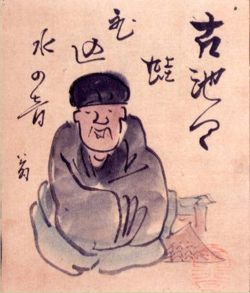
poetry derives, which often accompanied such poems in a single piece. Like the poetic forms it accompanied, haiga was based on simple, yet often profound, observations of the everyday world. Stephen Addiss points out that "since they are both created with the same brush and ink, adding an image to a haiku poem was... a natural activity."
Just as haiku often internally juxtapose two images, haiga may also contain a juxtaposition between the haiku itself and the art work. The art work does not necessarily directly represent the images presented in the haiku.
Stylistically, haiga vary widely based on the preferences and training of the individual painter, but generally show influences of formal Kanō school
Kano school
The ' is one of the most famous schools of Japanese painting. The Kanō school of painting was the dominant style of painting until the Meiji period.It was founded by Kanō Masanobu , a contemporary of Sesshū and student of Shūbun...
painting, minimalist Zen painting, and Ōtsu-e, while sharing much of the aesthetic attitudes of the nanga tradition. Some were reproduced as woodblock prints
Woodblock printing in Japan
Woodblock printing in Japan is a technique best known for its use in the ukiyo-e artistic genre; however, it was also used very widely for printing books in the same period. Woodblock printing had been used in China for centuries to print books, long before the advent of movable type, but was only...
. The subjects painted likewise vary widely, but are generally elements mentioned in the calligraphy, or poetic images which add meaning or depth to that expressed by the poem. The moon is a common subject in these poems and paintings, sometimes represented by the Zen circle ensō
Enso
Ensō is a Japanese word meaning "circle" and a concept strongly associated with Zen. Ensō is one of the most common subjects of Japanese calligraphy even though it is a symbol and not a character. It symbolizes the Absolute enlightenment, strength, elegance, the Universe, and the void; it can...
, which evokes a number of other meanings, including that of the void
Mu (negative)
or Wu , is a word which has been translated variously as "not", "nothing", "without", "nothingness", "non existent", "non being", or evocatively simply as "no thing"...
. Other subjects, ranging from Mount Fuji
Mount Fuji
is the highest mountain in Japan at . An active stratovolcano that last erupted in 1707–08, Mount Fuji lies about south-west of Tokyo, and can be seen from there on a clear day. Mount Fuji's exceptionally symmetrical cone is a well-known symbol of Japan and it is frequently depicted in art and...
to rooftops, are frequently represented with a minimum of brushstrokes, thus evoking elegance and beauty in simplicity.
History
Nonoguchi Ryūho (1595-1669), a student of Kanō TanyūKano Tanyu
was one of the foremost Japanese painters of the Kanō school. His original given name was Morinobu; he was the eldest son of Kanō Takanobu and grandson of Kanō Eitoku. Many of the most famous and widely known Kanō works today are by Tan'yū....
, is sometimes credited with founding the form; though poetry was commonly accompanied by images for centuries prior, Ryūho was the first poet to regularly include paintings alongside his calligraphy.
Matsuo Bashō
Matsuo Basho
, born , then , was the most famous poet of the Edo period in Japan. During his lifetime, Bashō was recognized for his works in the collaborative haikai no renga form; today, after centuries of commentary, he is recognized as a master of brief and clear haiku...
, known worldwide as the definitive master of haiku, frequently painted as well, and haiga can be said to have truly become a major form of expression as the result of his works, and those of his students. Like his poems, Bashō's paintings are founded in a simplicity which reveals great depth, complementing the poems they are paired with. Towards the end of his life, he studied painting under Morikawa Kyoriku, his pupil in poetry; the works of both men benefited from the exchange, and a number of works were produced combining Morikawa's painting with Bashō's poetry and calligraphy.
Composing haiku, and painting accompanying pictures, was a common pastime of Edo period
Edo period
The , or , is a division of Japanese history which was ruled by the shoguns of the Tokugawa family, running from 1603 to 1868. The political entity of this period was the Tokugawa shogunate....
aesthetes, who would pursue these activities in their spare time, or at friendly gatherings as a communal form of entertainment. The famous novelist Ihara Saikaku
Ihara Saikaku
was a Japanese poet and creator of the "floating world" genre of Japanese prose .-Biography:Born the son of the wealthy merchant Hirayama Tōgo in Osaka, he first studied haikai poetry under Matsunaga Teitoku, and later studied under Nishiyama Sōin of the Danrin School of poetry, which emphasized...
was one of many people not normally associated with either poetry or painting, who took part. By contrast, the nanga painter Yosa Buson
Yosa Buson
was a Japanese poet and painter from the Edo period. Along with Matsuo Bashō and Kobayashi Issa, Buson is considered among the greatest poets of the Edo Period. Buson was born in the village of Kema in Settsu Province...
, widely considered second only to Bashō as a master of haiku, is said to be "the only artist to be included in surveys both of great poets and great painters in Japanese history."
Unlike other schools of art which maintained a standard set of styles passed from master to apprentice, the genre of haiga encompassed a variety of artists with different approaches. Some, like Bashō, were primarily poets, accompanying their compositions with simple sketches, while others, like Buson, were primarily painters, devoting more space and centrality of focus to the image. Maruyama Goshun and Ki Baitei were among those who tended to paint portraits of poets and other figures in a relatively quick, loose style which looks somewhat cartoon
Cartoon
A cartoon is a form of two-dimensional illustrated visual art. While the specific definition has changed over time, modern usage refers to a typically non-realistic or semi-realistic drawing or painting intended for satire, caricature, or humor, or to the artistic style of such works...
ish to the modern eye. Some haiga paintings, such as those by Morikawa Kyoriku, reflect the formal training of the artists, while others, like those by Nakahara Nantenbō
Nakahara Nantenbo
Nakahara Nantenbō, also known as Tōjū Zenchū and as Nantenbō Tōjū, was a Japanese Zen Buddhist Master. In his time known as a fiery reformer, he was also a prolific and accomplished artist...
, reflect the artist's background in Zen
Zen
Zen is a school of Mahāyāna Buddhism founded by the Buddhist monk Bodhidharma. The word Zen is from the Japanese pronunciation of the Chinese word Chán , which in turn is derived from the Sanskrit word dhyāna, which can be approximately translated as "meditation" or "meditative state."Zen...
.
One overall trend that developed over time, despite this wide variety, was a shift from the circles of literati (bunjin) painters to the orbit of the Shijō school
Shijo school
The Shijō school , also known as the Maruyama-Shijō school, was an offshoot school of the Maruyama school of Japanese painting founded by Maruyama Ōkyo, and his former student Matsumura Goshun in the late 18th century. This school was one of several that made up the larger Kyoto school...
of the naturalistic painter Maruyama Ōkyo
Maruyama Okyo
, born Maruyama Masataka, was a Japanese artist active in the late 18th century. He moved to Kyoto, during which he studied artworks from Chinese, Japanese and Western sources. A personal style of Western naturalism mixed with Eastern decorative design emerged, and Ōkyo founded the Maruyama school...
. This move was effected primarily by Maruyama Goshun, and can be seen as well in the works of Yamaguchi Soken. Some later painters, such as Takebe Sōchō, were influenced by ukiyo-e
Ukiyo-e
' is a genre of Japanese woodblock prints and paintings produced between the 17th and the 20th centuries, featuring motifs of landscapes, tales from history, the theatre, and pleasure quarters...
styles, and used color in highly detailed works.
Though traditional-style haiga are still produced today, contemporary artists experiment with the form, coupling haiku with digital imagery, photography, and other media.
Haiga artists of note
- Enomoto Kikaku
- Hakuin EkakuHakuin Ekakuwas one of the most influential figures in Japanese Zen Buddhism. He revived the Rinzai school from a moribund period of stagnation, refocusing it on its traditionally rigorous training methods integrating meditation and koan practice...
- Kaga no Chiyo
- Kobayashi IssaKobayashi Issa, was a Japanese poet and lay Buddhist priest of the Jōdo Shinshū sect known for his haiku poems and journals. He is better known as simply , a pen name meaning Cup-of-tea...
- Matsumura GoshunMatsumura GoshunMatsumura Goshun , sometimes also referred to as Matsumura Gekkei , was a Japanese Painter of the Edo Period and founder of the Shijō school of painting...
- Matsuo BashōMatsuo Basho, born , then , was the most famous poet of the Edo period in Japan. During his lifetime, Bashō was recognized for his works in the collaborative haikai no renga form; today, after centuries of commentary, he is recognized as a master of brief and clear haiku...
- Nonoguchi Ryūho
- Sakai HōitsuSakai Hoitsuwas a Japanese painter of the Rimpa school. He is famous for reviving the style and popularity of Ogata Kōrin, and for creating a number of reproductions of Kōrin's work.-Family background:...
- Sengai Gibon
- Yosa BusonYosa Busonwas a Japanese poet and painter from the Edo period. Along with Matsuo Bashō and Kobayashi Issa, Buson is considered among the greatest poets of the Edo Period. Buson was born in the village of Kema in Settsu Province...
External links
- DailyHaiga, an edited online haiga journal with an easily navigated haiga archive
- Ray Rasmussen's site with examples and definitions of haiga
- Haigaonline: a journal of contemporary haiga
- Haiga: Takebe Socho and the Haiku-Painting Tradition The University Art Museum on the website of the University of California at Santa Barbara
- Haiku Poets Hut, Haiga by Soji, and in collaboration with poets from around the world