

Haguenau

Encyclopedia
Economy
The town has a well balanced economy. Centuries of troubled history in the buffer lands between FranceFrance
The French Republic , The French Republic , The French Republic , (commonly known as France , is a unitary semi-presidential republic in Western Europe with several overseas territories and islands located on other continents and in the Indian, Pacific, and Atlantic oceans. Metropolitan France...
and Germany
Germany
Germany , officially the Federal Republic of Germany , is a federal parliamentary republic in Europe. The country consists of 16 states while the capital and largest city is Berlin. Germany covers an area of 357,021 km2 and has a largely temperate seasonal climate...
have bequeathed to Haguenau a rich historical and cultural heritage which supports a lively tourist trade
Tourism
Tourism is travel for recreational, leisure or business purposes. The World Tourism Organization defines tourists as people "traveling to and staying in places outside their usual environment for not more than one consecutive year for leisure, business and other purposes".Tourism has become a...
. There is also a thriving light manufacturing sector centred on the industrial zone to the west of the town. Here the presence nearby of significant retail developments testifies to Haguenau's importance as a regional commercial centre. The recent extension of the ring road has improved access to the commercial and industrial zones and reduced the traffic congestion which used to be a frequent challenge for vehicle drivers using the road which follows the line of the old city walls on the western side of town.
Sights

Architecture
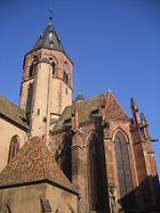
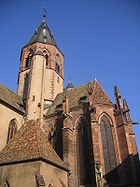
In spite of the extensive destruction Haguenau suffered during the many wars experienced by Alsace, especially the Thirty Years War, the French conquest in 1677 and World War IIWorld War II
World War II, or the Second World War , was a global conflict lasting from 1939 to 1945, involving most of the world's nations—including all of the great powers—eventually forming two opposing military alliances: the Allies and the Axis...
, she still keeps monuments from 9 centuries, even if nothing is left of arguably the most prestigious of them, Frederick I Barbarossa's
Frederick I, Holy Roman Emperor
Frederick I Barbarossa was a German Holy Roman Emperor. He was elected King of Germany at Frankfurt on 4 March 1152 and crowned in Aachen on 9 March, crowned King of Italy in Pavia in 1155, and finally crowned Roman Emperor by Pope Adrian IV, on 18 June 1155, and two years later in 1157 the term...
imperial palace (Kaiserpfalz).
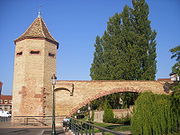
Medieval Haguenau retains three gates from its former fortification, the Tour des Chevaliers (Tower of the knights), the Tour des Pêcheurs (Tower of the fishermen) and the Porte de Wissembourg (Wissembourg
Wissembourg
Wissembourg is a commune in the Bas-Rhin department in Alsace in northeastern France.It is situated on the little River Lauter close to the border between France and Germany approximately north of Strasbourg and west of Karlsruhe. Wissembourg is a sub-prefecture of the department...
gate), two fairly large gothic churches, Saint-Georges and Saint-Nicolas, an ancient water-mill and the old custom-house (Ancienne Douane). Both Saint-Georges
St. George's Church, Haguenau
The Roman Catholic parish church St. George's Church is the most important religious building of the city of Haguenau in Alsace, France.- Building history and description :...
and Saint-Nicolas Church have lost many of their artistic treasures over the centuries, especially their medieval stained glass windows and outside sculptures. Still, both display to this day some fine liturgical furniture (altars, choir stalls, organ cases, church tabernacle
Church tabernacle
A tabernacle is the fixed, locked box in which, in some Christian churches, the Eucharist is "reserved" . A less obvious container, set into the wall, is called an aumbry....
s, calvaries...). Saint-Nicolas has become the receptacle for the baroque wooden decoration of the church of the destroyed Neubourg Abbey
Neubourg Abbey
Neubourg Abbey is a former Cistercian monastery in Alsace, France, in Dauendorf, about 9 km west of Haguenau in the Bas-Rhin department.- History :...
nearby.
French baroque
Baroque architecture
Baroque architecture is a term used to describe the building style of the Baroque era, begun in late sixteenth century Italy, that took the Roman vocabulary of Renaissance architecture and used it in a new rhetorical and theatrical fashion, often to express the triumph of the Catholic Church and...
and classicism
Classicism
Classicism, in the arts, refers generally to a high regard for classical antiquity, as setting standards for taste which the classicists seek to emulate. The art of classicism typically seeks to be formal and restrained: of the Discobolus Sir Kenneth Clark observed, "if we object to his restraint...
has bequeathed the city several buildings, among which the former hospital and the current town hall. The Synagogue (1820) is a fine example of French Neo-classicism, as is the theatre (Théâtre municipal) (1846). The large Hop
Hop (plant)
Humulus, Hop, is a small genus of flowering plants native to temperate regions of the Northern Hemisphere. The female flowers of H. lupulus are known as hops, and are used as a culinary flavoring and stabilizer, especially in the brewing of beer...
hall (Halle au houblon) is a good example of historicism in architecture. It was built by the French in 1867 and extended twice by the Germans, in 1881 and 1908.
Haguenau's streets are adorned by attractive fountains, the medieval Saint-Georges fountain, the 18th-century Bee fountain (Fontaine aux abeilles) and the 1825 Dolphin fountain (Fontaine aux dauphins).
Museums
- Musée historique de Haguenau (Historical Museum). The largest museum in Bas-Rhin outside of Strasbourg, it is located in a grand neo-medieval building (1905).
- Musée alsacien (Haguenau) (Alsatian Museum). Located in the former palace of the chancellor (Chancellerie), Haguenau's main RenaissanceRenaissance architectureRenaissance architecture is the architecture of the period between the early 15th and early 17th centuries in different regions of Europe, demonstrating a conscious revival and development of certain elements of ancient Greek and Roman thought and material culture. Stylistically, Renaissance...
building.
Higher education
The Institut universitaire de technologie de Haguenau (IUT) was founded in 2006. It is a branch of the University of StrasbourgUniversity of Strasbourg
The University of Strasbourg in Strasbourg, Alsace, France, is the largest university in France, with about 43,000 students and over 4,000 researchers....
.
Notable people
- Thomas Anshelm (de)
- Werner Barkholt (1902–1942), a Catholic spiritualist
- Alfred von Beckerath (de)
- Charles Berdellé (fr)
- Stéphane BesleStéphane BesleStéphane Besle is a French footballer who currently plays for Neuchâtel Xamax in the Swiss Super League....
- Philipp Biedert (de)
- Philipp Friedrich BöddeckerPhilipp Friedrich BöddeckerPhilipp Friedrich Böddecker was a German court organist and composer.While organist at the Stiftskirche he engaged in a bitter dispute with Samuel Capricornus at the Württemberg Court. His brother was the cornettist David Böddecker.-References:...
(1607–1683), a Composer and organist (de)
- David Léon CahunDavid Léon CahunDavid Léon Cahun was a French traveler, Orientalist and writer.-Life:Cahun's family, who came originally from Lorraine, destined him for a military career. However, owing to family affairs he was compelled to relinquish this, and he devoted himself to geographical and historical studies...
(1841–1900), a Jewish French traveler, Orientalist and writer - Wolfgang Fabricius Capito(n) (Köpfel)Wolfgang Fabricius CapitoWolfgang Fabricius Capito was a German religious reformer-His life and work:Capito was born in born of humble parentage at Haguenau in Alsace....
(1478–1541), a Christian theologian and reformer - Roger Corbeau (fr)
- Morris E. CrainMorris E. CrainMorris E. Crain was a United States Army soldier and a recipient of the United States military's highest decoration—the Medal of Honor—for his actions in World War II.-Biography:...
(1924 - March 13, 1945), a United States Army soldier
- Louis Eisenmann (de)
- Friedrich I. (de)
- Albert GemmrichAlbert GemmrichAlbert Gemmrich is a retired football striker from France, who obtained 5 caps for the French national team.-References: *...
- Karl Gengler (1886–1974), a politician
- Gustave GlotzGustave GlotzGustave Glotz was a French historian of ancient Greece. He was a supporter of the theory that history never follows a simple, logical course....
- Heinrich GranHeinrich GranHeinrich Gran was a German book printer of the incunabulum era. Together with Johannes Mentelin and Heinrich Eggestein, he was one of the pioneers of book-printing in Alsace....
(active from 1489 until 1527), a printer of incunabulaIncunabulumIncunable, or sometimes incunabulum is a book, pamphlet, or broadside, that was printed — not handwritten — before the year 1501 in Europe...
- Heinrich von Isny (de)
- Josel of RosheimJosel of RosheimJosel of Rosheim Josel of Rosheim Josel of Rosheim (alternatively: Joselin, Joselmann, Yoselmann, , Joseph ben Gershon mi-Rosheim, or Joseph ben Gershon Loanz; c...
(1476–1554), a Jewish shtadlanShtadlanA Shtadlan was an intercessor figure starting in Medieval Europe, who represented interests of the local Jewish community, especially those of a town's ghetto, and worked as a "lobbyist" negotiating for the safety and benefit of Jews with the authorities holding power...
, born here - Cédric Klein (fr)
- Diebold Lauber (de)
- Borach Levi, later Joseph Jean François Elie (1721 - ?), a Jewish convert to Christianity
- Eliezer Liebermann (half of the 19th-century), an Austrian Jewish Talmudist son of the rabbi Zeeb-Wolf of this city
- Sébastien LoebSébastien LoebSébastien Loeb is a French rally driver currently driving for the Citroën World Rally Team in the World Rally Championship...
(born 1974), a rally driver - Marcel Loeffler (fr)
- Adam Friedrich Löwenfinck (de)
- Niklaus von Hagenau (de)
- Jean-Georges Paulus (fr)
- Reinmar of HagenauReinmar of HagenauReinmar of Hagenau was a German minnesinger of the twelfth century, surnamed in the MSS. der Alte to distinguish him from later poets of that name....
, 12th-century minnesinger - Marie-Louise Roth (born 1926), a literary scientist (de)
- Elie Scheid (1841–1922), a Jewish French communal worker and writer
- Diebold Schilling the YoungerDiebold Schilling the YoungerDiebold Schilling the Younger was the author of the "Luzerner Schilling", one of the Swiss illustrated chronicles, which he presented to the city council of Lucerne on 15 January 1513 . He was the nephew of Diebold Schilling the Elder of Berne...
(before 1460, Haguenau (?) - 1515 (?)), an Alsatian-Swiss chronicler - Marius Schneider (fr)
- Elek SchwartzElek SchwartzAlexandru "Elek" Schwartz was a Jewish-Romanian footballer and coach of the Dutch national football team. With SL Benfica he won the national Championship and Cup trophies of 1965 and led the club into the final of the European Cup of Champions.-Player in Romania and France:Elek Schwartz initially...
- Theobald Schwarz (de)
- Pierre SeelPierre SeelPierre Seel was a gay Holocaust survivor and the only French person to have testified openly about his experience of deportation during World War II due to his homosexuality.-Biography:...
(1923–2005), an activist - Eduard StadtlerEduard StadtlerEduard Stadtler was a German academic and politician who formed the Anti-Bolshevist League in 1918. Stadler had begun advocating the creation of a "national socialist" dictatorship in 1918. Anton Drexler, the founder of the Nazi Party, attended Stadtler's lectures in Berlin...
(de) - Johannes Stroux (de)
- Peter Stühlen (de)
- Joseph Thierry (fr)
- Michel Walter (fr)
- Mathieu Weill (1851 - ?), a Jewish French mathematician