

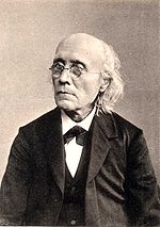
Gustav Fechner

Encyclopedia
Gustav Theodor Fechner was a German
experimental psychologist
. An early pioneer in experimental psychology and founder of psychophysics
, he inspired many 20th century scientists and philosophers. He is also credited with demonstrating the non-linear relationship between psychological sensation and the physical intensity of a stimulus via the formula: "S = K Log I".
, near Muskau, in Lower Lusatia
, where his father was pastor
. He was educated first at Sorau. In 1817 he studied of medicine at the Medizinisch-Chirurgische Akademie in Dresden
and from 1818 at the University of Leipzig
, the city in which he spent the rest of his life. In 1834 he was appointed professor of physics
. But in 1839, he contracted an eye disorder while studying the phenomena of color
and vision
, and, after much suffering, resigned. Subsequently recovering, he turned to the study of the mind
and its relations with the body, giving public lectures on the subjects dealt with in his books.
from the French language
. A different but essential side of his character is seen in his poems and humorous pieces, such as the Vergleichende Anatomie der Engel (1825), written under the pseudonym of "Dr. Mises."
Fechner's epoch-making work was his Elemente der Psychophysik (1860). He starts from the monistic
thought that bodily facts and conscious facts, though not reducible one to the other, are different sides of one reality. His originality lies in trying to discover an exact mathematical relation between them. The most famous outcome of his inquiries is the law known as the Weber–Fechner law
which may be expressed as follows:
Though holding good within certain limits only, the law has been found to be immensely useful. Fechner's law implies that sensation is a logarithmic function of physical intensity, which is impossible due to the logarithm's singularity at zero; therefore, S. S. Stevens
proposed the more mathematically plausible power-law relation of sensation to intensity in his famous 1961 paper
entitled "To Honor Fechner and Repeal His Law."
Fechner's general formula for getting at the number of units in any sensation is S = c log R, where S stands for the sensation, R for the stimulus numerically estimated, and c for a constant that must be separately determined by experiment in each particular order of sensibility. Fechner's reasoning has been criticized on the grounds that although stimuli are composite, sensations are not. "Every sensation," says William James
, "presents itself as an indivisible unit; and it is quite impossible to read any clear meaning into the notion that they are masses of units combined."
, whereby colors are seen in a moving pattern of black and white. The English journalist and amateur scientist Charles Benham
, in 1894, enabled English-speakers to learn of the effect through the invention of the spinning top that bears his name
. Whether Fechner and Benham ever actually met face to face for any reason is not known.
and Hermann von Helmholtz
, is recognized as one of the founders of modern experimental psychology
. His clearest contribution was the demonstration that because the mind was susceptible to measurement and mathematical treatment, psychology had the potential to become a quantified science. Theorists such as Immanuel Kant
had long stated that this was impossible, and that therefore, a science of psychology was also impossible.
Though he had a vast influence on psychophysics
, the actual disciples of his general philosophy were few. Among them, however, was William James
, who, in 1904, wrote an admiring introduction to the English translation of Fechner's Büchlein vom Leben nach dem Tode (Little Book of Life After Death). Fechner's world concept was highly animistic. He felt the thrill of life everywhere, in plants, earth, stars, the total universe. Man stands midway between the souls of plants and the souls of stars, who are angels. God, the soul of the universe, must be conceived as having an existence analogous to men. Natural laws are just the modes of the unfolding of God's perfection. In his last work Fechner, aged but full of hope, contrasts this joyous "daylight view" of the world with the dead, dreary "night view" of materialism
. Fechner's work in aesthetics
is also important. He conducted experiments to show that certain abstract forms and proportions are naturally pleasing to our senses, and gave some new illustrations of the working of aesthetic association. Charles Hartshorne
saw him as a predecessor on his and Alfred North Whitehead
's philosophy and regretted that Fechner's philosophical work had been neglected for so long.
Fechner's position in reference to predecessors and contemporaries is not very sharply defined. He was remotely a disciple of Schelling
, learnt much from Benedict de Spinoza, Gottfried Wilhelm Leibniz, Johann Friedrich Herbart
, Arthur Schopenhauer
, and Christian Hermann Weisse
, and decidedly rejected Georg Hegel
and the monad
ism of Rudolf Hermann Lotze
.
Germany
Germany , officially the Federal Republic of Germany , is a federal parliamentary republic in Europe. The country consists of 16 states while the capital and largest city is Berlin. Germany covers an area of 357,021 km2 and has a largely temperate seasonal climate...
experimental psychologist
Psychologist
Psychologist is a professional or academic title used by individuals who are either:* Clinical professionals who work with patients in a variety of therapeutic contexts .* Scientists conducting psychological research or teaching psychology in a college...
. An early pioneer in experimental psychology and founder of psychophysics
Psychophysics
Psychophysics quantitatively investigates the relationship between physical stimuli and the sensations and perceptions they effect. Psychophysics has been described as "the scientific study of the relation between stimulus and sensation" or, more completely, as "the analysis of perceptual...
, he inspired many 20th century scientists and philosophers. He is also credited with demonstrating the non-linear relationship between psychological sensation and the physical intensity of a stimulus via the formula: "S = K Log I".
Early life and scientific career
Fechner was born at Groß SärchenZarki Wielkie
Żarki Wielkie is a village in the administrative district of Gmina Trzebiel, within Żary County, Lubusz Voivodeship, in western Poland, close to the German border. It lies approximately south-west of Trzebiel, west of Żary, and south-west of Zielona Góra....
, near Muskau, in Lower Lusatia
Lower Lusatia
Lower Lusatia is a historical region stretching from the southeast of the Brandenburg state of Germany to the southwest of the Lubusz Voivodeship in Poland. Important towns beside the historic capital Lübben include Calau, Cottbus, Guben , Luckau, Spremberg, Finsterwalde, Senftenberg and Żary...
, where his father was pastor
Pastor
The word pastor usually refers to an ordained leader of a Christian congregation. When used as an ecclesiastical styling or title, this role may be abbreviated to "Pr." or often "Ps"....
. He was educated first at Sorau. In 1817 he studied of medicine at the Medizinisch-Chirurgische Akademie in Dresden
Dresden
Dresden is the capital city of the Free State of Saxony in Germany. It is situated in a valley on the River Elbe, near the Czech border. The Dresden conurbation is part of the Saxon Triangle metropolitan area....
and from 1818 at the University of Leipzig
University of Leipzig
The University of Leipzig , located in Leipzig in the Free State of Saxony, Germany, is one of the oldest universities in the world and the second-oldest university in Germany...
, the city in which he spent the rest of his life. In 1834 he was appointed professor of physics
Physics
Physics is a natural science that involves the study of matter and its motion through spacetime, along with related concepts such as energy and force. More broadly, it is the general analysis of nature, conducted in order to understand how the universe behaves.Physics is one of the oldest academic...
. But in 1839, he contracted an eye disorder while studying the phenomena of color
Color
Color or colour is the visual perceptual property corresponding in humans to the categories called red, green, blue and others. Color derives from the spectrum of light interacting in the eye with the spectral sensitivities of the light receptors...
and vision
Visual perception
Visual perception is the ability to interpret information and surroundings from the effects of visible light reaching the eye. The resulting perception is also known as eyesight, sight, or vision...
, and, after much suffering, resigned. Subsequently recovering, he turned to the study of the mind
Mind
The concept of mind is understood in many different ways by many different traditions, ranging from panpsychism and animism to traditional and organized religious views, as well as secular and materialist philosophies. Most agree that minds are constituted by conscious experience and intelligent...
and its relations with the body, giving public lectures on the subjects dealt with in his books.
Contributions
Gustav Fechner published chemical and physical papers, and translated chemical works by J. B. Biot and Louis Jacques ThénardLouis Jacques Thénard
Louis Jacques Thénard , was a French chemist.His father, a poor peasant, managed to have him educated at the academy of Sens, and sent him at the age of sixteen to study pharmacy in Paris. There he attended the lectures of Antoine François Fourcroy and Louis Nicolas Vauquelin...
from the French language
French language
French is a Romance language spoken as a first language in France, the Romandy region in Switzerland, Wallonia and Brussels in Belgium, Monaco, the regions of Quebec and Acadia in Canada, and by various communities elsewhere. Second-language speakers of French are distributed throughout many parts...
. A different but essential side of his character is seen in his poems and humorous pieces, such as the Vergleichende Anatomie der Engel (1825), written under the pseudonym of "Dr. Mises."
Fechner's epoch-making work was his Elemente der Psychophysik (1860). He starts from the monistic
Monism
Monism is any philosophical view which holds that there is unity in a given field of inquiry. Accordingly, some philosophers may hold that the universe is one rather than dualistic or pluralistic...
thought that bodily facts and conscious facts, though not reducible one to the other, are different sides of one reality. His originality lies in trying to discover an exact mathematical relation between them. The most famous outcome of his inquiries is the law known as the Weber–Fechner law
Weber–Fechner law
The Weber–Fechner law is a confusing term, because it combines two different laws. Some authors use the term to mean Weber's law, and others Fechner's law. Fechner himself added confusion to the literature by calling his own law Weber's law...
which may be expressed as follows:
- "In order that the intensity of a sensation may increase in arithmetical progression, the stimulus must increase in geometrical progression."
Though holding good within certain limits only, the law has been found to be immensely useful. Fechner's law implies that sensation is a logarithmic function of physical intensity, which is impossible due to the logarithm's singularity at zero; therefore, S. S. Stevens
Stanley Smith Stevens
Stanley Smith Stevens was an American psychologist who founded Harvard's Psycho-Acoustic Laboratory and is credited with the introduction of Stevens' power law. Stevens authored a milestone textbook, the 1400+ page "Handbook of Experimental Psychology" . He was also one of the founding organizers...
proposed the more mathematically plausible power-law relation of sensation to intensity in his famous 1961 paper
Stevens' power law
Stevens' power law is a proposed relationship between the magnitude of a physical stimulus and its perceived intensity or strength. It is often considered to supersede the Weber–Fechner law on the basis that it describes a wider range of sensations, although critics argue that the validity of the...
entitled "To Honor Fechner and Repeal His Law."
Fechner's general formula for getting at the number of units in any sensation is S = c log R, where S stands for the sensation, R for the stimulus numerically estimated, and c for a constant that must be separately determined by experiment in each particular order of sensibility. Fechner's reasoning has been criticized on the grounds that although stimuli are composite, sensations are not. "Every sensation," says William James
William James
William James was a pioneering American psychologist and philosopher who was trained as a physician. He wrote influential books on the young science of psychology, educational psychology, psychology of religious experience and mysticism, and on the philosophy of pragmatism...
, "presents itself as an indivisible unit; and it is quite impossible to read any clear meaning into the notion that they are masses of units combined."
The Fechner color effect
In 1838, he also studied the still-mysterious perceptual illusion of what is still called the Fechner color effectFechner color
The Fechner color effect is an illusion of color seen when looking at certain rapidly changing or moving black-and-white patterns. They are also called pattern induced flicker colors . Not everyone sees the same colors....
, whereby colors are seen in a moving pattern of black and white. The English journalist and amateur scientist Charles Benham
Charles Benham
Charles Edwin Benham JP was a journalist, editing for many years the Essex County Standard, a published author of works such as Essex Ballads and an amateur scientist-cum-inventor, which led him to create Benham's top, which was named after him....
, in 1894, enabled English-speakers to learn of the effect through the invention of the spinning top that bears his name
Benham's top
Benham's top, also called Benham's disk, is named after the English toymaker Charles Benham, who, in 1895, sold a top painted with the pattern shown. When the disk is spun, arcs of pale color — called Fechner colors or pattern induced flicker colors — are visible at different places...
. Whether Fechner and Benham ever actually met face to face for any reason is not known.
Influence
Fechner, along with Wilhelm WundtWilhelm Wundt
Wilhelm Maximilian Wundt was a German physician, psychologist, physiologist, philosopher, and professor, known today as one of the founding figures of modern psychology. He is widely regarded as the "father of experimental psychology"...
and Hermann von Helmholtz
Hermann von Helmholtz
Hermann Ludwig Ferdinand von Helmholtz was a German physician and physicist who made significant contributions to several widely varied areas of modern science...
, is recognized as one of the founders of modern experimental psychology
Psychology
Psychology is the study of the mind and behavior. Its immediate goal is to understand individuals and groups by both establishing general principles and researching specific cases. For many, the ultimate goal of psychology is to benefit society...
. His clearest contribution was the demonstration that because the mind was susceptible to measurement and mathematical treatment, psychology had the potential to become a quantified science. Theorists such as Immanuel Kant
Immanuel Kant
Immanuel Kant was a German philosopher from Königsberg , researching, lecturing and writing on philosophy and anthropology at the end of the 18th Century Enlightenment....
had long stated that this was impossible, and that therefore, a science of psychology was also impossible.
Though he had a vast influence on psychophysics
Psychophysics
Psychophysics quantitatively investigates the relationship between physical stimuli and the sensations and perceptions they effect. Psychophysics has been described as "the scientific study of the relation between stimulus and sensation" or, more completely, as "the analysis of perceptual...
, the actual disciples of his general philosophy were few. Among them, however, was William James
William James
William James was a pioneering American psychologist and philosopher who was trained as a physician. He wrote influential books on the young science of psychology, educational psychology, psychology of religious experience and mysticism, and on the philosophy of pragmatism...
, who, in 1904, wrote an admiring introduction to the English translation of Fechner's Büchlein vom Leben nach dem Tode (Little Book of Life After Death). Fechner's world concept was highly animistic. He felt the thrill of life everywhere, in plants, earth, stars, the total universe. Man stands midway between the souls of plants and the souls of stars, who are angels. God, the soul of the universe, must be conceived as having an existence analogous to men. Natural laws are just the modes of the unfolding of God's perfection. In his last work Fechner, aged but full of hope, contrasts this joyous "daylight view" of the world with the dead, dreary "night view" of materialism
Materialism
In philosophy, the theory of materialism holds that the only thing that exists is matter; that all things are composed of material and all phenomena are the result of material interactions. In other words, matter is the only substance...
. Fechner's work in aesthetics
Aesthetics
Aesthetics is a branch of philosophy dealing with the nature of beauty, art, and taste, and with the creation and appreciation of beauty. It is more scientifically defined as the study of sensory or sensori-emotional values, sometimes called judgments of sentiment and taste...
is also important. He conducted experiments to show that certain abstract forms and proportions are naturally pleasing to our senses, and gave some new illustrations of the working of aesthetic association. Charles Hartshorne
Charles Hartshorne
Charles Hartshorne was a prominent American philosopher who concentrated primarily on the philosophy of religion and metaphysics. He developed the neoclassical idea of God and produced a modal proof of the existence of God that was a development of St. Anselm's Ontological Argument...
saw him as a predecessor on his and Alfred North Whitehead
Alfred North Whitehead
Alfred North Whitehead, OM FRS was an English mathematician who became a philosopher. He wrote on algebra, logic, foundations of mathematics, philosophy of science, physics, metaphysics, and education...
's philosophy and regretted that Fechner's philosophical work had been neglected for so long.
Fechner's position in reference to predecessors and contemporaries is not very sharply defined. He was remotely a disciple of Schelling
Schelling
Notable people with the last name of Schelling include:* Ernest Schelling, American composer* Friedrich Wilhelm Joseph Schelling, German philosopher* Thomas Schelling, American economist and Nobel laureate...
, learnt much from Benedict de Spinoza, Gottfried Wilhelm Leibniz, Johann Friedrich Herbart
Johann Friedrich Herbart
Johann Friedrich Herbart was a German philosopher, psychologist, and founder of pedagogy as an academic discipline....
, Arthur Schopenhauer
Arthur Schopenhauer
Arthur Schopenhauer was a German philosopher known for his pessimism and philosophical clarity. At age 25, he published his doctoral dissertation, On the Fourfold Root of the Principle of Sufficient Reason, which examined the four separate manifestations of reason in the phenomenal...
, and Christian Hermann Weisse
Christian Hermann Weisse
Christian Hermann Weisse , was a German Protestant religious philosopher.- Philosophy :He was born at Leipzig, and studied at the university there, at first adhering to the Hegelian school of philosophy. In the course of time, his ideas changed, and became close to those of Schelling in his later...
, and decidedly rejected Georg Hegel
Georg Wilhelm Friedrich Hegel
Georg Wilhelm Friedrich Hegel was a German philosopher, one of the creators of German Idealism. His historicist and idealist account of reality as a whole revolutionized European philosophy and was an important precursor to Continental philosophy and Marxism.Hegel developed a comprehensive...
and the monad
Monad
-Philosophy:*Monad a term meaning "unit" used variously by ancient philosophers from the Pythagoreans to Plato, Aristotle, and Plotinus to signify a variety of entities from a genus to God....
ism of Rudolf Hermann Lotze
Rudolf Hermann Lotze
Rudolf Hermann Lotze was a German philosopher and logician. He also had a medical degree and was unusually well versed in biology. He argued that if the physical world is governed by mechanical laws, relations and developments in the universe could be explained as the functioning of a world mind...
.
Works
- Praemissae ad theoriam organismi generalem (1823).
- (Dr. Mises) Stapelia mixta (1824). Google (Harvard)
- Resultate der bis jetzt unternommenen Pflanzenanalysen (1829). Google (Stanford)
- Maassbestimmungen über die galvanische Kette (1831).
- (Dr. Mises) Schutzmittel für die Cholera (1832). Google (Harvard) — Google (UWisc)
- Repertorium der Experimentalphysik (1832). 3 volumes.
- Volume 1. Google (NYPL) — Google (Oxford)
- Volume 2. Google (NYPL) — Google (Oxford)
- Volume 3. Google (NYPL) — Google (Oxford)
- (ed.) Das Hauslexicon. Vollständiges Handbuch praktischer Lebenskenntnisse für alle Stände (1834–38). 8 volumes.
- Das Büchlein vom Leben nach dem Tode (1836). 6th ed., 1906. Google (Harvard) — Google (NYPL)
- On Life After Death (1882). Google (Oxford) — IA (UToronto) 2nd ed., 1906. Google (UMich) 3rd ed., 1914. IA (UIllinois)
- The Little Book of Life After Death (1904). IA (UToronto) 1905, Google (UCal) — IA (Ucal) — IA (UToronto)
- (Dr. Mises) Gedichte (1841). Google (Oxford)
- Ueber das höchste Gut (1846). Google (Stanford)
- (Dr. Mises) Nanna oder über das Seelenleben der Pflanzen (1848). 2nd ed., 1899. 3rd ed., 1903. Google (UMich) 4th ed., 1908. Google (Harvard)
- Zend-Avesta oder über die Dinge des Himmels und des Jenseits (1851). 3 volumes. 3rd ed., 1906. Google (Harvard)
- Ueber die physikalische und philosophische Atomenlehre (1855). 2nd ed., 1864. Google (Stanford)
- Professor Schleiden und der Mond (1856). Google (UMich)
- Elemente der Psychophysik (1860). 2 volumes. Volume 1. Google (ULausanne) Volume 2. Google (NYPL)
- Ueber die Seelenfrage (1861). Google (NYPL) — Google (UCal) — Google (UMich) 2nd ed., 1907. Google (Harvard)
- Die drei Motive und Gründe des Glaubens (1863). Google (Harvard) — Google (NYPL)
- Einige Ideen zur Schöpfungs- und Entwickelungsgeschichte der Organismen (1873). Google (UMich)
- (Dr. Mises) Kleine SchriftenKleine Schriftenis a German phrase often used as a title for a collection of articles and essays written by a single scholar over the course of a career. "Collected Papers" is an English equivalent. These shorter works were usually published previously in various periodicals or in collections of papers written...
(1875). Google (UMich) - Erinnerungen an die letzen Tage der Odlehre und ihres Urhebers (1876). Google (Harvard)
- Vorschule der Aesthetik (1876). 2 Volumes. Google (Harvard)
- In Sachen der Psychophysik (1877). Google (Stanford)
- Die Tagesansicht gegenüber der Nachtansicht (1879). Google (Oxford) 2nd ed., 1904. Google (Stanford)
- Revision der Hauptpuncte der Psychophysik (1882). Google (Harvard)
- Kollektivmasslehre (1897). Google (NYPL)
Further reading
- Heidelberger, M. (2001) Gustav Theodor Fechner, Statisticians of the Centuries (ed. C. C. Heyde and E. Seneta) pp. 142–147. New York: Springer.
- Michael Heidelberger. Nature From Within: Gustav Theodor Fechner and his Psychophysical Worldview Trans. Cynthia Klohr. Pittsburgh, PA: University of Pittsburgh Press, 2004.
- Stephen M Stigler. The History of Statistics: The Measurement of Uncertainty before 1900, Cambridge, MA: Harvard University Press 1986. pp. 242–254.
External links
- Works of Gustav Theodor Fechner at Projekt Gutenberg-DE. (German)
- Excerpt from Elements of Psychophysics from the Classics in the History of Psychology website.
- Robert H. Wozniak’s Introduction to Elemente der Psychophysik.
- Biography, bibliography and digitized sources in the Virtual LaboratoryVirtual LaboratoryThe online project Virtual Laboratory. Essays and Resources on the Experimentalization of Life, 1830-1930, located at the Max Planck Institute for the History of Science, is dedicated to research in the history of the experimentalization of life...
of the Max Planck Institute for the History of ScienceMax Planck Institute for the History of ScienceThe Max Planck Institute for the History of Science in Berlin was established in March 1994. Its research is primarily devoted to a theoretically oriented history of science, principally of the natural sciences, but with methodological perspectives drawn from the cognitive sciences and from...