


Guiding center

Encyclopedia
Magnetic field
A magnetic field is a mathematical description of the magnetic influence of electric currents and magnetic materials. The magnetic field at any given point is specified by both a direction and a magnitude ; as such it is a vector field.Technically, a magnetic field is a pseudo vector;...
of an electrically charged
Electric charge
Electric charge is a physical property of matter that causes it to experience a force when near other electrically charged matter. Electric charge comes in two types, called positive and negative. Two positively charged substances, or objects, experience a mutual repulsive force, as do two...
particle (such as an electron
Electron
The electron is a subatomic particle with a negative elementary electric charge. It has no known components or substructure; in other words, it is generally thought to be an elementary particle. An electron has a mass that is approximately 1/1836 that of the proton...
or ion
Ion
An ion is an atom or molecule in which the total number of electrons is not equal to the total number of protons, giving it a net positive or negative electrical charge. The name was given by physicist Michael Faraday for the substances that allow a current to pass between electrodes in a...
in a plasma
Plasma (physics)
In physics and chemistry, plasma is a state of matter similar to gas in which a certain portion of the particles are ionized. Heating a gas may ionize its molecules or atoms , thus turning it into a plasma, which contains charged particles: positive ions and negative electrons or ions...
) can be treated as the superposition of a relatively fast circular motion around a point called the guiding center and a relatively slow drift of this point. The drift speeds may differ for various species depending on their charge states, masses, or temperatures, possibly resulting in electric currents or chemical separation.
Gyration
If the magnetic field is uniform, the particle velocity is perpendicular to the field, and other forces and fields are absent, then the magnetic Lorentz forceLorentz force
In physics, the Lorentz force is the force on a point charge due to electromagnetic fields. It is given by the following equation in terms of the electric and magnetic fields:...
is perpendicular to both the velocity and the magnetic field and is constant in magnitude, resulting in particle motion at constant speed on a circular path. This is known as the gyration around the magnetic field. For mass m, charge q, and magnetic field B, the frequency of the circular motion, the gyro-frequency or cyclotron frequency, is

For speed v, the radius of the orbit, called the gyroradius or Larmor radius, is

Parallel motion
Since the magnetic Lorentz force is always perpendicular to the magnetic field, it has no influence (to lowest order) on the parallel motion. In a uniform field with no additional forces, a charged particle will gyrate around the magnetic field according to the perpendicular component of its velocity and drift parallel to the field according to its initial parallel velocity, resulting in a helicalHelix
A helix is a type of smooth space curve, i.e. a curve in three-dimensional space. It has the property that the tangent line at any point makes a constant angle with a fixed line called the axis. Examples of helixes are coil springs and the handrails of spiral staircases. A "filled-in" helix – for...
orbit. If there is a force with a parallel component, the particle and its guiding center will be correspondingly accelerated.
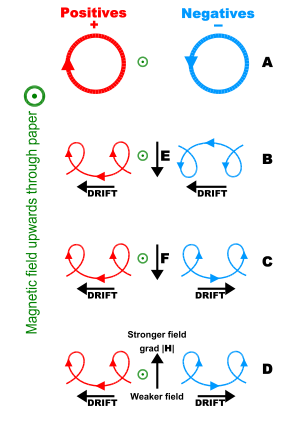
If the field has a parallel gradient, a particle with a finite Larmor radius will also experience a force in the direction away from the larger magnetic field. This effect is known as the magnetic mirror
Magnetic mirror
A magnetic mirror is a magnetic field configuration where the field strength changes when moving along a field line. The mirror effect results in a tendency for charged particles to bounce back from the high field region....
. While it is closely related to guiding center drifts in its physics and mathematics, it is nevertheless considered to be distinct from them.
General force drifts
Generally speaking, when there is a force on the particles perpendicular to the magnetic field, then they drift in a direction perpendicular to both the force and the field. If is the force on one particle, then the drift velocity is
 .
.These drifts, in contrast to the mirror effect and the non-uniform B drifts, do not depend on finite Larmor radius, but are also present in cold plasmas. This may seem counterintuitive. If a particle is stationary when a force is turned on, where does the motion perpendicular to the force come from and why doesn't the force produce a motion parallel to itself? The answer is the interaction with the magnetic field. The force initially results in an acceleration parallel to itself, but the magnetic field deflects the resulting motion in the drift direction. Once the particle is moving in the drift direction, the magnetic field deflects it back against the external force, so that the average acceleration in the direction of the force is zero. There is, however, a one-time displacement in the direction of the force equal to (f/m)ωc-2, which should be considered a consequence of the polarization drift (see below) while the force is being turned on. The resulting motion is a cycloid
Cycloid
A cycloid is the curve traced by a point on the rim of a circular wheel as the wheel rolls along a straight line.It is an example of a roulette, a curve generated by a curve rolling on another curve....
. More generally, the superposition of a gyration and a uniform perpendicular drift is a trochoid.
All drifts may be considered special cases of the force drift, although this is not always the most useful way to think about them. The obvious cases are electric and gravitational forces. The grad-B drift can be considered to result from the force on a magnetic dipole in a field gradient. The curvature, inertia, and polarisation drifts result from treating the acceleration of the particle as fictitious force
Fictitious force
A fictitious force, also called a pseudo force, d'Alembert force or inertial force, is an apparent force that acts on all masses in a non-inertial frame of reference, such as a rotating reference frame....
s. The diamagnetic drift can be derived from the force due to a pressure gradient. Finally, other forces such as radiation pressure and collisions also result in drifts.
Gravitational field
A simple example of a force drift is a plasma in a gravitational field, e.g. the ionosphereIonosphere
The ionosphere is a part of the upper atmosphere, comprising portions of the mesosphere, thermosphere and exosphere, distinguished because it is ionized by solar radiation. It plays an important part in atmospheric electricity and forms the inner edge of the magnetosphere...
. The drift velocity is

Because of the mass dependence, the gravitational drift for the electrons can normally be ignored.
The dependence on the charge of the particle implies that the drift direction is opposite for ions as for electrons, resulting in a current. In a fluid picture, it is this current crossed with the magnetic field that provides that force counteracting the applied force.
Electric field
This drift, often called the (E-cross-B) drift, is a special case because the electric force on a particle depends on its charge (as opposed, for example, to the gravitational force considered above). As a result, ions (of whatever mass and charge) and electrons both move in the same direction at the same speed, so there is no net current (assuming quasineutrality). In the context of special relativity
Special relativity
Special relativity is the physical theory of measurement in an inertial frame of reference proposed in 1905 by Albert Einstein in the paper "On the Electrodynamics of Moving Bodies".It generalizes Galileo's...
, in the frame moving with this velocity, the electric field vanishes. The value of the drift velocity is given by

Nonuniform E
If the electric field is not uniform, the above formula is modified to read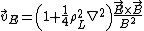
Nonuniform B
Guiding center drifts may also result not only from external forces but also from non-uniformities in the magnetic field. It is convenient to express these drifts in terms of the parallel and perpendicular energies

In that case, the explicit mass dependence is eliminated. If the ions and electrons have similar temperatures, then they also have similar, though oppositely directed, drift velocities.
Grad-B drift
When a particle moves into a larger magnetic field, the curvature of its orbit becomes tighter, transforming the otherwise circular orbit into a cycloidCycloid
A cycloid is the curve traced by a point on the rim of a circular wheel as the wheel rolls along a straight line.It is an example of a roulette, a curve generated by a curve rolling on another curve....
. The drift velocity is
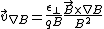
Curvature drift
In order for a charged particle to follow a curved field line, it needs a drift velocity out of the plane of curvature to provide the necessary centripetal forceCentripetal force
Centripetal force is a force that makes a body follow a curved path: it is always directed orthogonal to the velocity of the body, toward the instantaneous center of curvature of the path. The mathematical description was derived in 1659 by Dutch physicist Christiaan Huygens...
. This velocity is

Inertial drift
A more general form of the curvature drift is the inertial drift, given by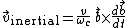 ,
,where
 is the unit vector in the direction of the magnetic field. This drift can be decomposed into the sum of the curvature drift and the term
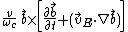 .
.In the important limit of stationary magnetic field and weak electric field, the inertial drift is dominated by the curvature drift term.
Curved vacuum drift
In the limit of small plasma pressure, Maxwell's equationsMaxwell's equations
Maxwell's equations are a set of partial differential equations that, together with the Lorentz force law, form the foundation of classical electrodynamics, classical optics, and electric circuits. These fields in turn underlie modern electrical and communications technologies.Maxwell's equations...
provide a relationship between gradient and curvature that allows the corresponding drifts to be combined as follows
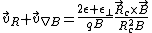
For a species in thermal equilibrium
Thermal equilibrium
Thermal equilibrium is a theoretical physical concept, used especially in theoretical texts, that means that all temperatures of interest are unchanging in time and uniform in space...
,
 can be replaced by
  (
( for
for  and
and  for
for ).
).Polarization drift
A time-varying electric field also results in a drift given by
Obviously this drift is different from the others in that it cannot continue indefinitely. Normally an oscillatory electric field results in a polarization drift oscillating 90 degrees out of phase. Because of the mass dependence, this effect is also called the inertia drift. Normally the polarization drift can be neglected for electrons because of their relatively small mass.
Diamagnetic drift
The diamagnetic drift is not actually a guiding center drift. A pressure gradient does not cause any single particle to drift. Nevertheless, the fluid velocity is defined by counting the particles moving through a reference area, and a pressure gradient results in more particles in one direction than in the other. The net velocity of the fluid is given by