

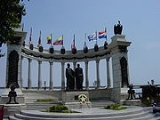
Guayaquil conference

Encyclopedia
The Guayaquil Conference was a meeting that took place on July 26, 1822, in Guayaquil
, Ecuador
, between José de San Martín
and Simón Bolívar
, to discuss the future of Perú
(and South America
in general).
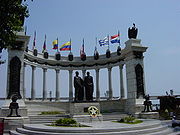 San Martín had taken his army north from Chile into Peru to attempt to liberate the country from the Spanish Empire
. While San Martín was securing independence in Chile and attempting to in Peru, Simón Bolívar had been doing similar acts of freedom and liberation in northern Latin America. Bolívar had freed Venezuela
and Colombia
from the Spanish and was now turning his eyes to the south towards Peru, the last real Spanish power on the South American continent. It was decided that both San Martín and Bolívar could not take Peru at the same time, there would have be a meeting between the two.
As well as Peru, both men had also had their sights set on a port city in Ecuador, Guayaquil. Both men saw this city as valuable and were attempting to persuade the city to join either general’s side. Eventually Bolívar gained the upper hand in the matter and was able to annex Guayaquil to Colombia. It is at this point that the two generals attempt to reach out to each other and arrange a meeting at Guayaquil, so as to avoid “a humiliating scandal” (San Martín's words) of a conflict between the two.
San Martín arrived in Guayaquil on July 25, where he was enthusiastically greeted by Bolívar. However, the two men could not come to an agreement, despite their common goals and mutual respect, even when San Martín offered to serve under Bolívar. Both men had very different ideas about how to organize the governments of the countries that they had liberated. Bolívar was in favor of forming a series of republics in the newly independent nations, whereas San Martín preferred the European system of rule and wanted to put monarchies in place. San Martín was also in favor of placing a European prince in power as King of Peru when it was to be liberated. The conference, consequently, was a failure, at least for San Martín.
San Martín, after meeting with Bolívar for several hours on July 26, stayed for a banquet and ball given in his honor. Bolívar proposed a toast to “the two greatest men in South America: the general San Martín and myself” (Por los dos hombres más grandes de la América del Sud: el general San Martín y yo), whereas San Martín drank to “the prompt conclusion of the war, the organization of the different Republics of the continent and the health of the Liberator of Colombia (Por la pronta conclusión de la guerra; por la organización de las diferentes Repúblicas del continente y por la salud del Libertador de Colombia).
After the conference, San Martín abdicated his powers in Peru and returned to Argentina. Soon afterward, he left South America entirely and retired in France
. San Martín knew that the Spanish forces left in Peru under the viceroy were still too powerful for either the single army of San Martín or Bolívar. It was for this reason that San Martín bowed out and ended his military career, leaving his army to Bolívar for the purpose of using it to liberate Peru from Spanish control. Bolívar completed the liberation of Peru with the help of San Martín’s forces several years later.
by Jorge Luis Borges
, Guayaquil, in which he explores the possible psychological relation between San Martín and Bolívar.
Guayaquil
Guayaquil , officially Santiago de Guayaquil , is the largest and the most populous city in Ecuador,with about 2.3 million inhabitants in the city and nearly 3.1 million in the metropolitan area, as well as that nation's main port...
, Ecuador
Ecuador
Ecuador , officially the Republic of Ecuador is a representative democratic republic in South America, bordered by Colombia on the north, Peru on the east and south, and by the Pacific Ocean to the west. It is one of only two countries in South America, along with Chile, that do not have a border...
, between José de San Martín
José de San Martín
José Francisco de San Martín, known simply as Don José de San Martín , was an Argentine general and the prime leader of the southern part of South America's successful struggle for independence from Spain.Born in Yapeyú, Corrientes , he left his mother country at the...
and Simón Bolívar
Simón Bolívar
Simón José Antonio de la Santísima Trinidad Bolívar y Palacios Ponte y Yeiter, commonly known as Simón Bolívar was a Venezuelan military and political leader...
, to discuss the future of Perú
Peru
Peru , officially the Republic of Peru , is a country in western South America. It is bordered on the north by Ecuador and Colombia, on the east by Brazil, on the southeast by Bolivia, on the south by Chile, and on the west by the Pacific Ocean....
(and South America
South America
South America is a continent situated in the Western Hemisphere, mostly in the Southern Hemisphere, with a relatively small portion in the Northern Hemisphere. The continent is also considered a subcontinent of the Americas. It is bordered on the west by the Pacific Ocean and on the north and east...
in general).
Overview
Spanish Empire
The Spanish Empire comprised territories and colonies administered directly by Spain in Europe, in America, Africa, Asia and Oceania. It originated during the Age of Exploration and was therefore one of the first global empires. At the time of Habsburgs, Spain reached the peak of its world power....
. While San Martín was securing independence in Chile and attempting to in Peru, Simón Bolívar had been doing similar acts of freedom and liberation in northern Latin America. Bolívar had freed Venezuela
Venezuela
Venezuela , officially called the Bolivarian Republic of Venezuela , is a tropical country on the northern coast of South America. It borders Colombia to the west, Guyana to the east, and Brazil to the south...
and Colombia
Colombia
Colombia, officially the Republic of Colombia , is a unitary constitutional republic comprising thirty-two departments. The country is located in northwestern South America, bordered to the east by Venezuela and Brazil; to the south by Ecuador and Peru; to the north by the Caribbean Sea; to the...
from the Spanish and was now turning his eyes to the south towards Peru, the last real Spanish power on the South American continent. It was decided that both San Martín and Bolívar could not take Peru at the same time, there would have be a meeting between the two.
As well as Peru, both men had also had their sights set on a port city in Ecuador, Guayaquil. Both men saw this city as valuable and were attempting to persuade the city to join either general’s side. Eventually Bolívar gained the upper hand in the matter and was able to annex Guayaquil to Colombia. It is at this point that the two generals attempt to reach out to each other and arrange a meeting at Guayaquil, so as to avoid “a humiliating scandal” (San Martín's words) of a conflict between the two.
San Martín arrived in Guayaquil on July 25, where he was enthusiastically greeted by Bolívar. However, the two men could not come to an agreement, despite their common goals and mutual respect, even when San Martín offered to serve under Bolívar. Both men had very different ideas about how to organize the governments of the countries that they had liberated. Bolívar was in favor of forming a series of republics in the newly independent nations, whereas San Martín preferred the European system of rule and wanted to put monarchies in place. San Martín was also in favor of placing a European prince in power as King of Peru when it was to be liberated. The conference, consequently, was a failure, at least for San Martín.
San Martín, after meeting with Bolívar for several hours on July 26, stayed for a banquet and ball given in his honor. Bolívar proposed a toast to “the two greatest men in South America: the general San Martín and myself” (Por los dos hombres más grandes de la América del Sud: el general San Martín y yo), whereas San Martín drank to “the prompt conclusion of the war, the organization of the different Republics of the continent and the health of the Liberator of Colombia (Por la pronta conclusión de la guerra; por la organización de las diferentes Repúblicas del continente y por la salud del Libertador de Colombia).
After the conference, San Martín abdicated his powers in Peru and returned to Argentina. Soon afterward, he left South America entirely and retired in France
France
The French Republic , The French Republic , The French Republic , (commonly known as France , is a unitary semi-presidential republic in Western Europe with several overseas territories and islands located on other continents and in the Indian, Pacific, and Atlantic oceans. Metropolitan France...
. San Martín knew that the Spanish forces left in Peru under the viceroy were still too powerful for either the single army of San Martín or Bolívar. It was for this reason that San Martín bowed out and ended his military career, leaving his army to Bolívar for the purpose of using it to liberate Peru from Spanish control. Bolívar completed the liberation of Peru with the help of San Martín’s forces several years later.
In fiction
The Guayaquil conference inspired a short storyShort story
A short story is a work of fiction that is usually written in prose, often in narrative format. This format tends to be more pointed than longer works of fiction, such as novellas and novels. Short story definitions based on length differ somewhat, even among professional writers, in part because...
by Jorge Luis Borges
Jorge Luis Borges
Jorge Francisco Isidoro Luis Borges Acevedo , known as Jorge Luis Borges , was an Argentine writer, essayist, poet and translator born in Buenos Aires. In 1914 his family moved to Switzerland where he attended school, receiving his baccalauréat from the Collège de Genève in 1918. The family...
, Guayaquil, in which he explores the possible psychological relation between San Martín and Bolívar.